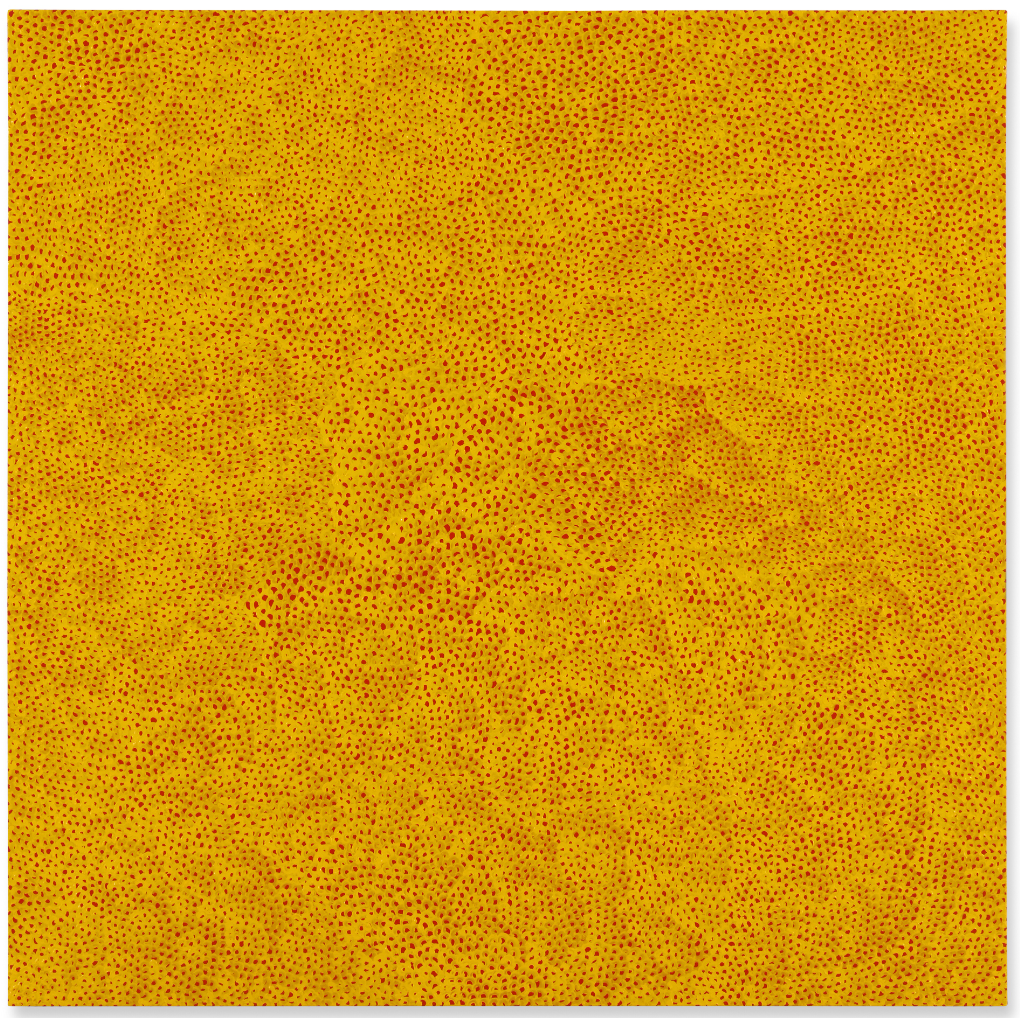
YAYOI KUSAMA (b. 1929)
Infinity Nets (WKG), 2015
Acrylic on canvas
145.5 x 145.5 cm (57 1/4 x 57 1/4 inches)
Signed, titled and dated 2015 (on the reverse)
Provenance
David Zwirner, New York
Acquired from the above by the present owner
Sotheby’s London: 6 March 2024
Estimated: GBP 1,500,000 – 2,000,000
GBP 1,621,000 / USD 2,055,428
Monumental and strikingly powerful, Infinity-Nets (WKG) is a supreme recent example of Yayoi Kusama’s most iconic and consequential series of paintings. Executed in 2015, the canvas is submerged by an almost infinite multitude of tiny whirls and whorls, woven across and within the surface through the artist’s delicate and precise mark-making. Kusama has employed an unusual palette of deep, cadmium yellow, offset and enhanced by a vivid crimson ground, varying the paint thickness and brushstroke size to create a composition that shimmers and ebbs hypnotically. In its unique combination of color and form, the canvas glints with an electric energy. As quasi-organic forms shift in and out of view, the resulting image rests in a liminal space somewhere between abstract and representational art, embodying many of the key aspects of Kusama’s artistic practice and ethos. Rhythmically repetitive and reminiscent of the machinelike Minimalist aesthetic, Infinity-Nets (WKG) is resolutely, intensely hand-crafted, embodying the sheer skill and artistry that has come to define Kusama’s entire oeuvre.
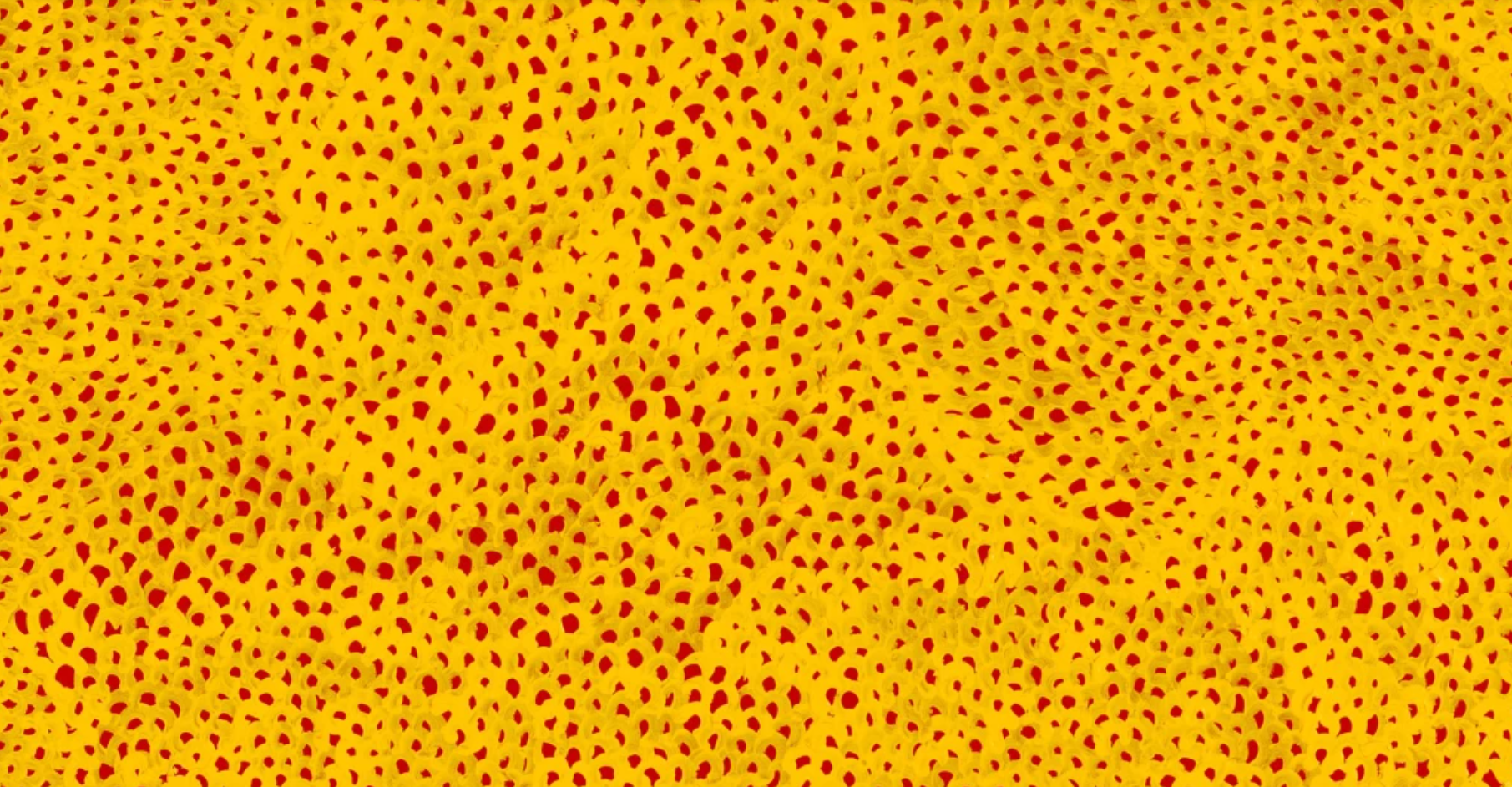
Within Kusama’s widely varied oeuvre, her Infinity Nets are amongst her most visually and conceptually complex. Each painting is a highly personalized expression of the artist’s desire to “lend specificity to infinity of space” (Yayoi Kusama, Infinity Net: The Autobiography of Yayoi Kusama, London 2013, p. 23). This paradox is both a conceptual and material problem that Kusama has solved repeatedly and infinitely since her incipient Nets from 1959. That year, when reviewing the white-on-black Nets exhibited in Kusama’s first New York solo show, Donald Judd described the paintings as “advanced in concept” and attempted to summaries Kusama’s mechanics as thus: “Essentially it is produced by the interaction of two close, somewhat parallel, vertical planes, at points merging at the surface plane and at others diverging slightly but powerfully […] The strokes are applied with a great assurance and strength which even a small area conveys. The total quality suggests an analogy to a large, fragile, but vigorously carved grill or to a massive, solid lace” (Donald Judd, ARTnews, October 1959). Judd’s reference to lace is apposite to Kusama’s concept of the net. A material, tangible object, it obscures yet also reveals something hidden, something beyond. This psychological aspect of the Infinity Nets is inextricably linked to the artist’s obsessive-compulsive disorder. This manifested itself in years of powerful hallucinations, to which Kusama found a balm in painting repetitively her pumpkins, polka-dots and nets. For her, the process of artmaking was a form of “self-obliteration,” a means of connecting to the transcendental and universal through her idiosyncratic genius and philosophy.
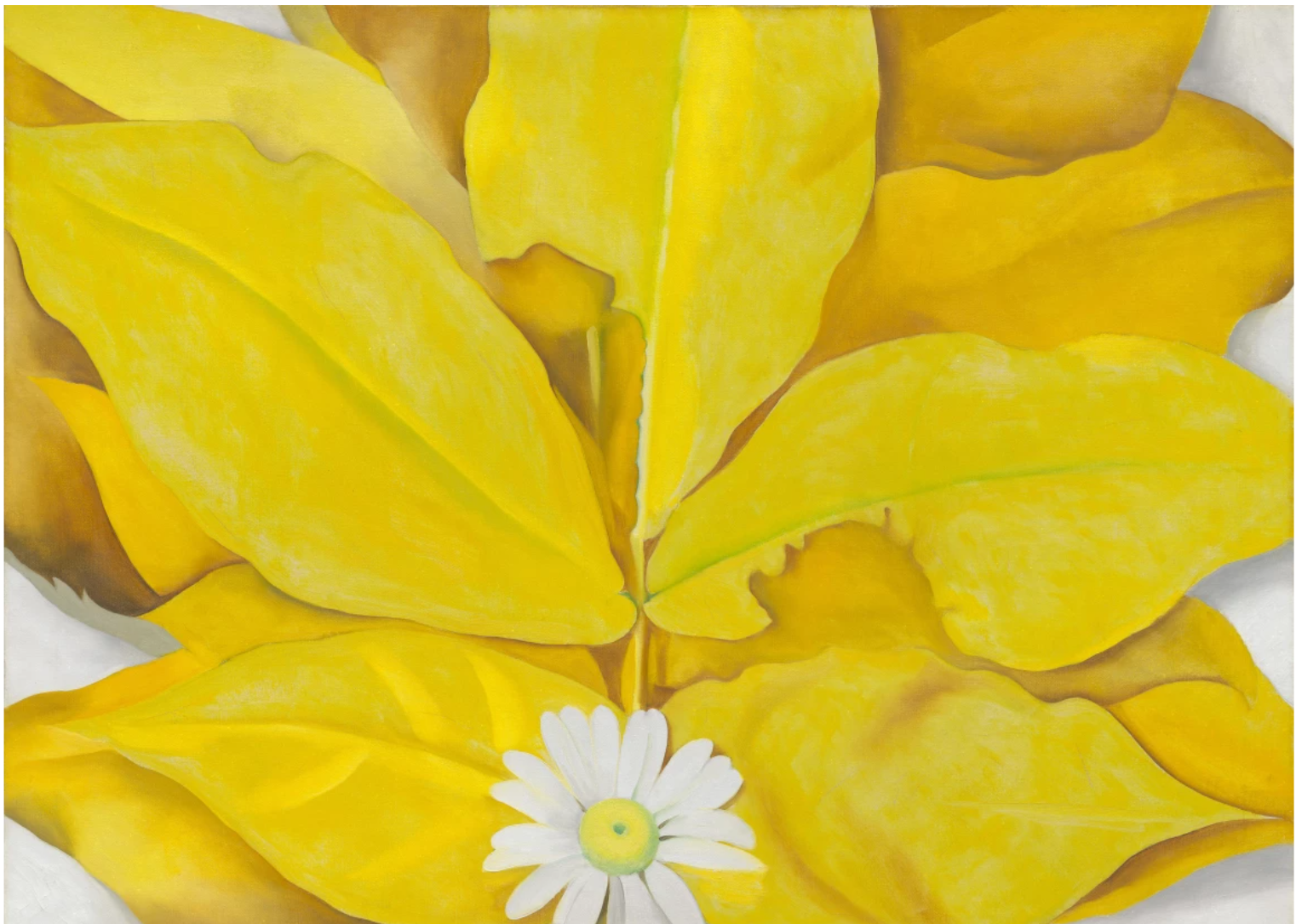
GEORGIA O’KEEFE, YELLOW HICKORY LEAVES WITH DAISY, 1928 / THE ART INSTITUTE OF CHICAGO
IMAGES: © ART INSTITUTE OF CHICAGO / THE ALFRED STIEGLITZ COLLECTION, GIFT OF GEORGIA O’KEEFFE, / BRIDGEMAN IMAGES
ARTWORK: © GEORGIA O’KEEFFE MUSEUM / DACS 2024
In the same way, creating her Infinity Nets is as much a meditative practice of repetition as it is a philosophical practice of disintegrating the bounds between finitude and infinitude. Born in Nagano in 1929 to a family of seedling merchants, from the age of 10 Kusama began to experience dizzying hallucinations: flashes of light, dense fields of dots, talking flowers and living fabric patterns, multiplying and engulfing her. Following World War II, Kusama moved from her hometown of Matsumoto to study the traditional Nihonga style of painting at the Kyoto Municipal School of Arts and Crafts. Her training in using this Japanese watercolor would have a significant impact on the precision and delicacy of her painting, prefiguring her critical turn to the water-based medium of acrylic paint instead of oil in the late 1970s. As seen in the present work, the quick drying time of acrylic attests to Kusama’s heightened ambition as well as skill, stamina and endurance after decades of ceaseless painting. With each arc marking a moment of time passing but not past, Kusama’s laborious technique eschews narrative value in favor of an examination of tangible temporality: gestures repeated ad infinitum. A mature and exquisitely rendered incarnation of Kusama’s most beloved series, Infinity-Nets (WKG) epitomizes the artist’s unique brand of cosmic abstraction and ethereal infiniteness.