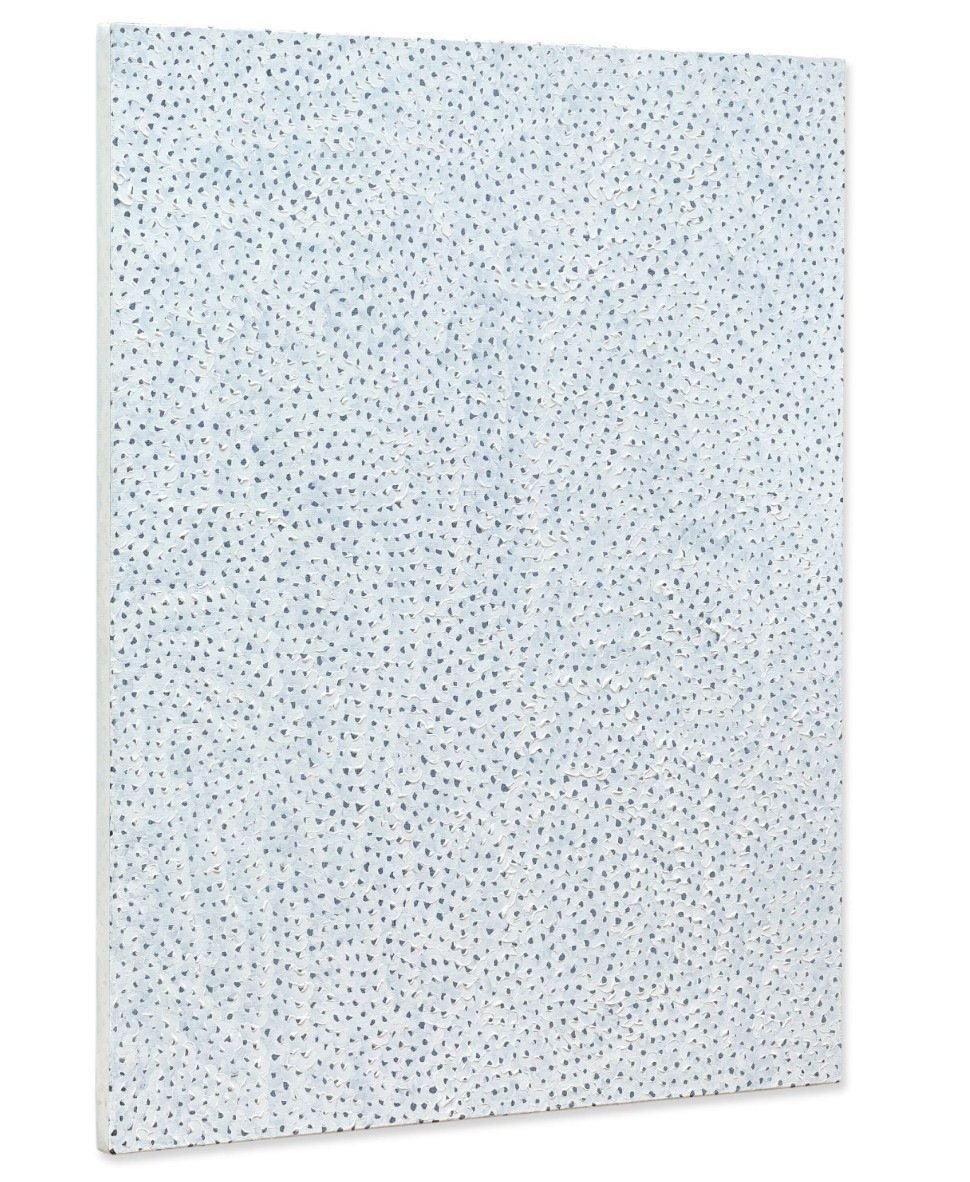
YAYOI KUSAMA
Infinity Nets (QPOW), 2006
Acrylic on canvas
91.1×72.7 cm (35.9×28.6 inches)
Signed, titled in English and Japanese and dated 2006 (on the reverse)
Provenance
MOMA Contemporary, Fukuoka
Art Consultancy Limited, London
Private Collection
Christie’s, New York, 27 September 2019, Lot 106
Acquired from the above sale by the present owner
Auction History
Sotheby’s Hong-Kong: 9 October 2022
Estimated: HKD 5,500,000 – 8,000,000
HKD 9,450,000 / USD 1,203,745
REPEAT SALE
Christie’s New-York: 27 September 2019
Estimated: USD 700,000 – 1,000,000
USD 735,000
Yayoi Kusama (b. 1929) (christies.com)
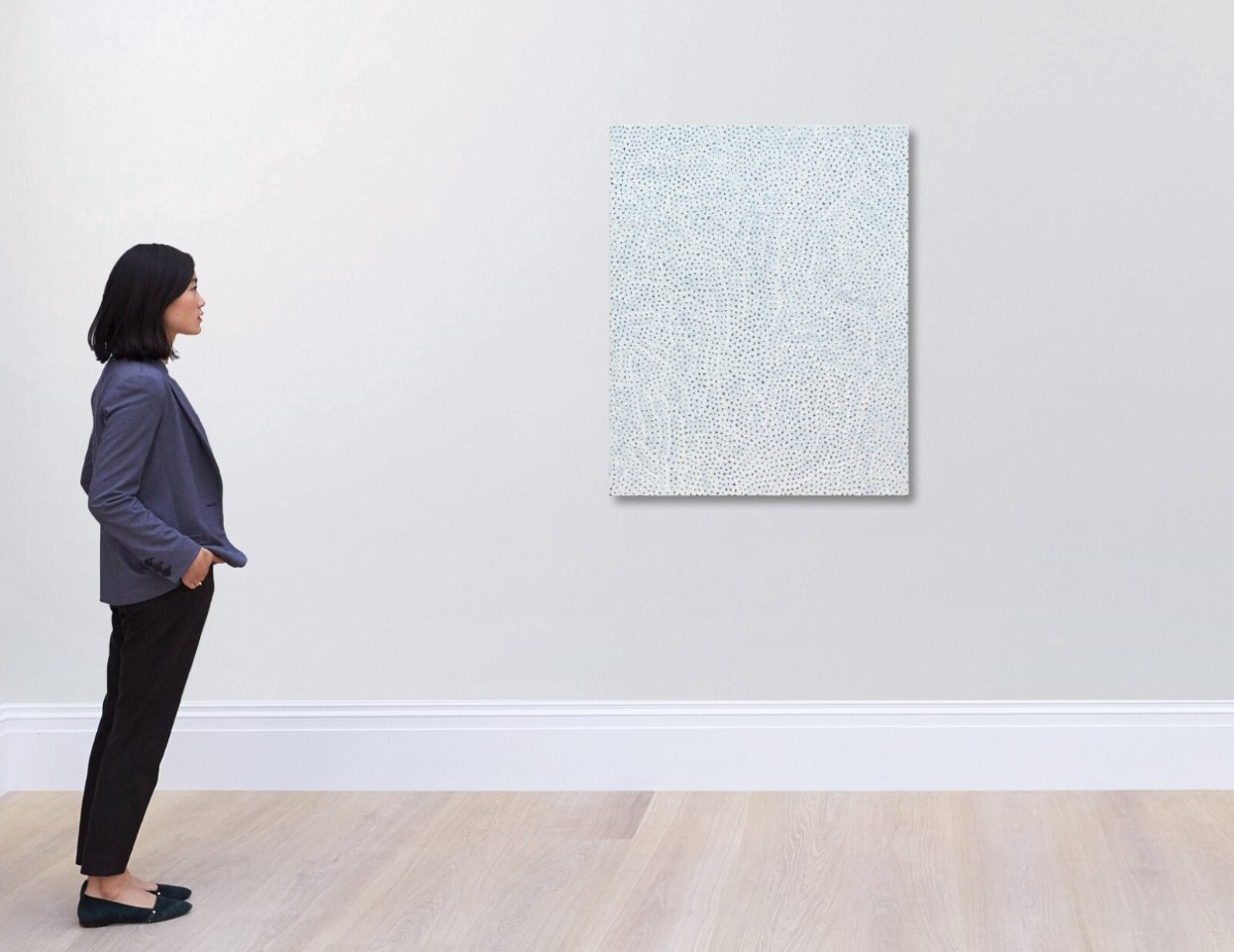
Dancing with rhythmic motion, Infinity-Nets (QPOW), painted in 2006, is a testament to Yayoi Kusama’s captivating mastery of spatial abstraction from the artist’s most celebrated corpus of paintings. An archetypal example of Kusama’s iconic style of abstraction, which established her extraordinary position in art history, the present work consists of an endless maze of oscillating, kaleidoscopic patterns. The present work continues the legacy of Kusama’s iconic series of Infinity Nets that the artist began in 1958, employing the same repetitive and hypnotic mark-making that functions as the conceptual nexus of the artist’s obsession and unconscious, ultimately culminating in a canvas of heightened visual and psychological intensity. Although the artist was first affiliated with the Abstract Expressionist movement in New York, Kusama has defied categorization throughout her career. In Japan, her earliest work was considered Surrealist, while the 1960s brought group exhibitions alongside Pop artists and the European ZERO; indeed, the breadth of her practice has spanned performance, video, sculpture, installation, and even literature. Amongst this diverse body of work, however, it is the Infinity Nets that stand as the most iconic and enduring iteration of her ground-breaking practice. Created almost 50 years after she began this expansive series, Infinity Nets (QPOW) closely corresponds with the very first examples owing to its wonderful texture and exclusively white-monochromicity.
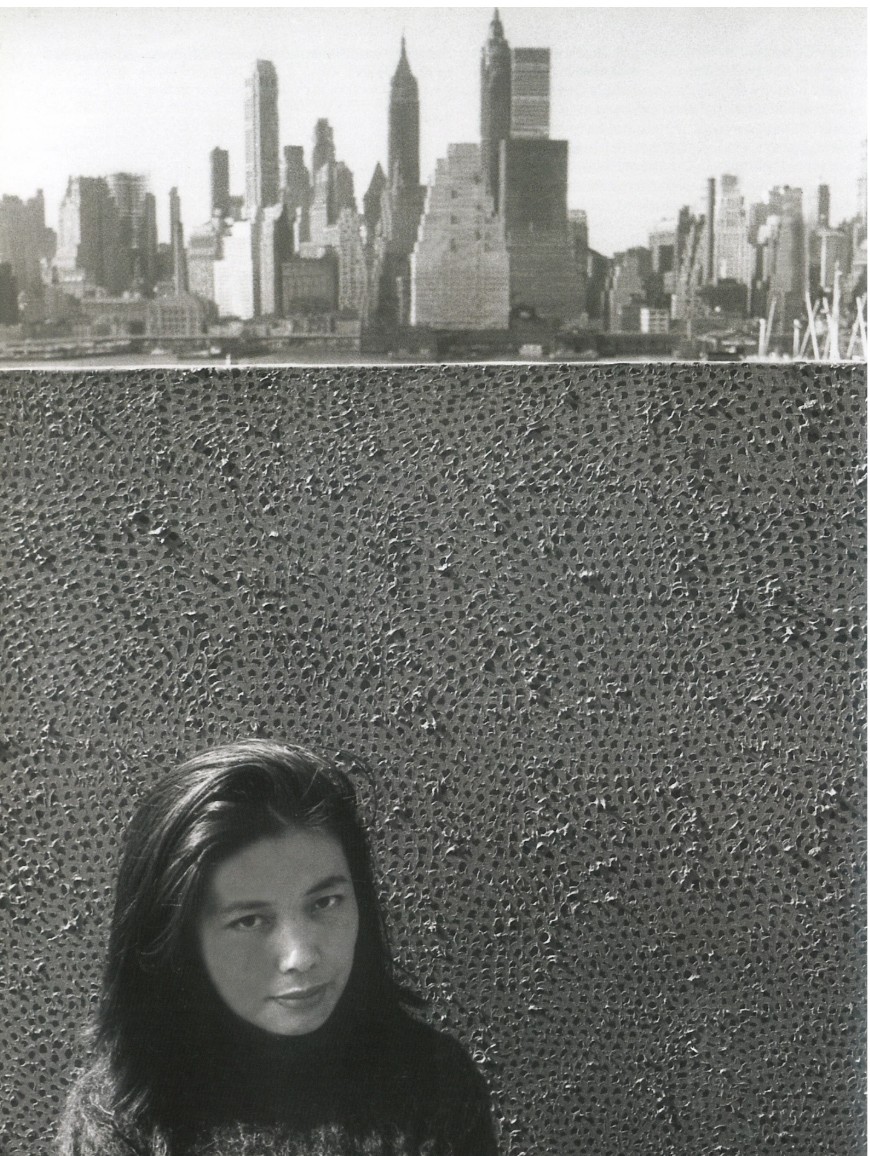
Yayoi Kusama in front of an Infinity Net painting with the Manhattan skyline in the background, c.1961 © YAYOI KUSAMA
In Infinity Nets (QPOW), Kusama’s restricted palette imparts a sense of ethereality onto the canvas; the work is vaporous, texturally anomalous and full of reflected light. The artist’s labyrinthine web of mesmeric pigment loops display irrepressible force, drawing the viewer irresistibly towards the shimmering spaces contained within the tightly woven blanket of paint. The undulating, almost topographical surface of the work hypnotically meanders across the extent of the picture plane, mirroring the process in which it is created. Kusama’s innumerable brushstrokes pile onto one another, culminating in some parts of the canvas in mounds of expressive impasto, and congealing into radiating planes of pigment in others. Each dab of paint is laid with a punctilious devotion to the act of mark-making, consuming the canvas in a field of texture. For all the flurry of countless brushstrokes across this grand canvas, with its elegant palette and intricate construction, the work remains entirely serene and utterly spellbinding to the artist and viewer alike.
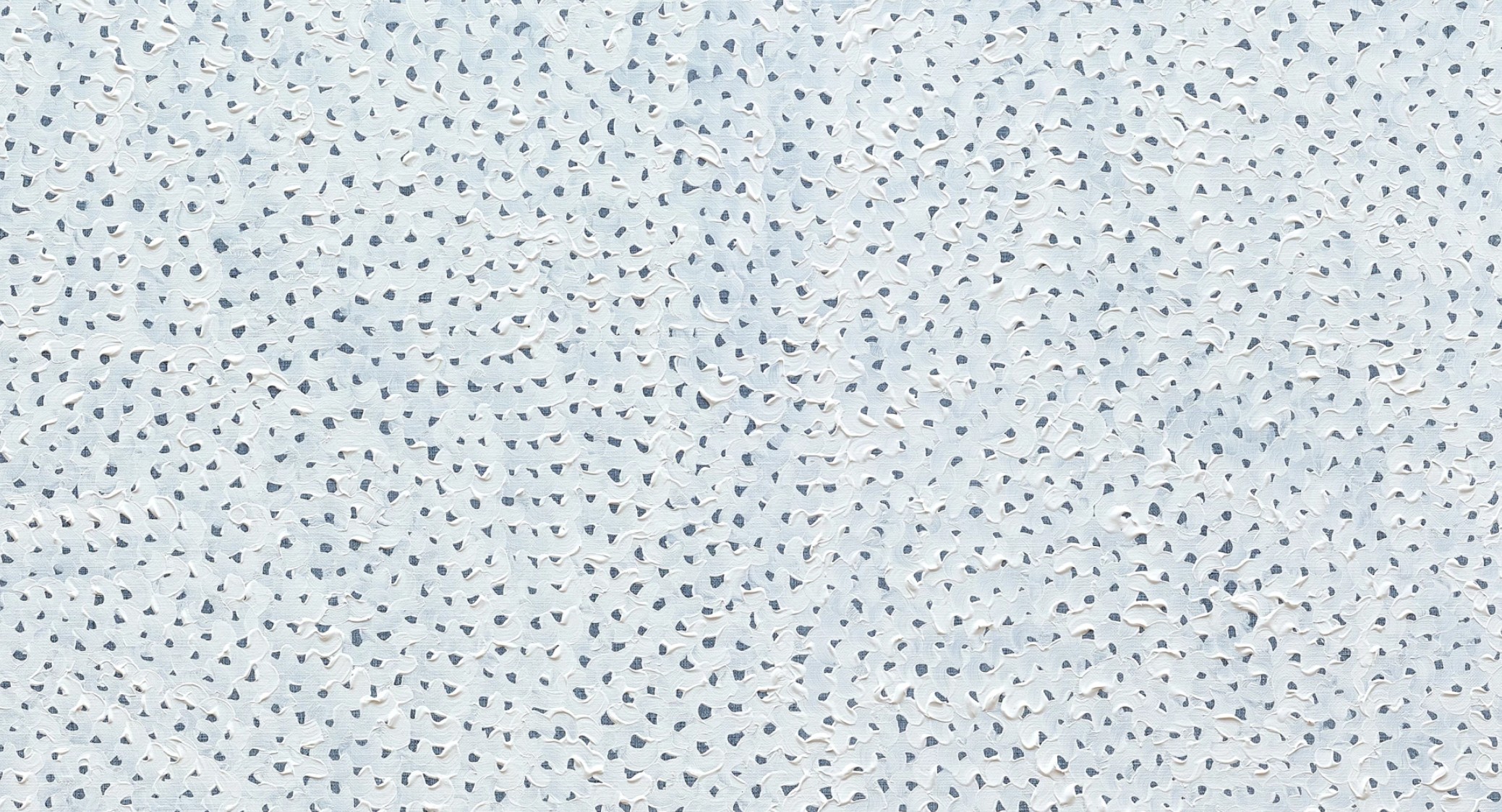
Covered in a delicate lattice of small semi-circles, Infinity Nets (QPOW) is an outstanding example Kusama’s white infinity nets paintings. Sleek white hoops link boundlessly across an underlying wash of grey-blue, giving the impression of a finely-woven net having been lain across a dark glossy pool. The emanating darkness below the surface beckons the viewer closer, inviting us to consider each individual brush stroke even as they knit together in breathtaking symphony. The work rises and falls as the artist varies her strokes, some applied so translucently that the grey-blue wash seeps through, creating patches of shadowy blue tone that pulls the paint deep into the canvas. In the next breath, paint is applied in globular strokes, building thick crests of milky white impasto peaks that push brightly out into the fore. The hypnotic strokes that roll across the surface of the canvas envelop the viewer, completely consuming the surface of the work to encourage a quiet sense of introspection and meditation.
Before moving to New York in the late 1950s, Kusama sought the advice of American abstract artist Georgia O’Keeffe: she sent O’Keeffe examples of her early work – surreal yet anthropomorphic watercolor pieces – and the two artists began a correspondence that would last until the end of O’Keeffe’s life; indeed, for Kusama, their exchange was the deciding factor in her choice to emigrate in late 1957. With the elder artist, Kusama shared an obsession with organic plant-like forms that simultaneously evoke the somatic: her earliest watercolors imply a kind of florid abstract corporeality that can also be found in the cell-like repetition that constitutes the Infinity Nets. When they finally met in New York in 1961, O’Keeffe generously introduced the young Kusama to her dealer in New York, Edith Halpert, who, in support of the burgeoning Japanese artist, bought one of the early Infinity Nets.
“Unable to sleep, I would get out of bed and paint. There was no other way to endure the cold and the hunger so I pushed myself on to ever more intense work… I often suffered episodes of severe neurosis. I would cover a canvas with nets, then continue painting them on the table, on the floor, and finally on my own body. As I repeated this process over and over again, the nets began to expand to infinity. I forgot about myself as they enveloped me, clinging to my arms and legs and clothes and filling the entire room…”
A mesmeric corpus produced over the course of the artist’s prodigious career, the Infinity Nets serve as the cornerstone of Kusama’s artistic practice, and the foundation for the remainder of her painterly and sculptural output, inhabiting a psychological realm nestled between the premeditation of grand artistic concept and the automatism of surrealism. Kusama first started the Infinity Nets in June 1958, shortly after moving from Japan to New York City. Driven by a great ambition to become a successful artist and rival the dominant male voices of the time, she responded to the prevailing avant-garde language of Abstract Expressionism by turning personal psychological impulse into an ingenious formal concern. Indeed, the Infinity Nets mark a manifestation of and coping mechanism for Kusama’s obsessive-compulsive disorder and hallucinations brought on by a diagnosed psychological condition. Kusama struggled with visions of infinitely oscillating, kaleidoscopic patterns throughout her childhood in Japan.