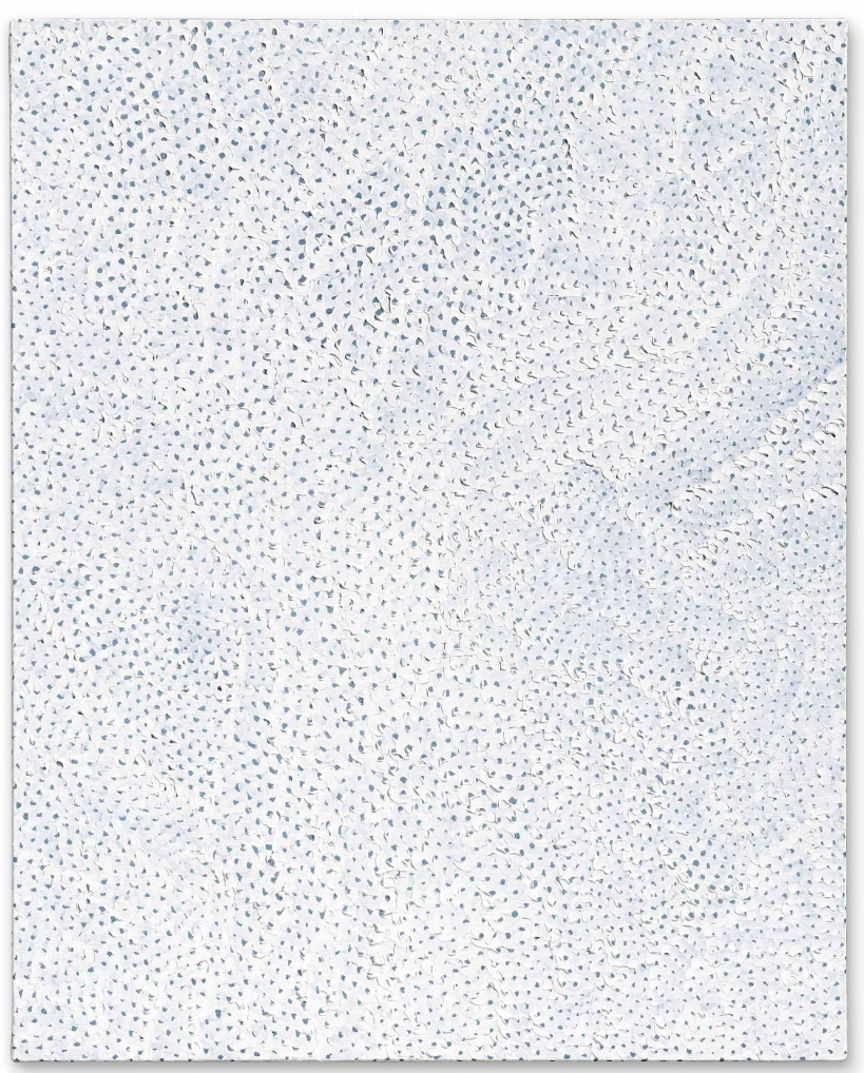
Infinity Nets OQWWS, 2006
Acrylic on canvas
91.3×70 cm (63.9×63.9 inches)
Signed in English, titled in Japanese and English and dated 2009 on the reverse
Provenance
Ota Fine Arts, Tokyo
Acquired by the present owner from the above
Christie’s London: 11 February 2016
GBP 626,500 / USD 905,346
Source: Christie’s
Yayoi Kusama (b. 1929) (christies.com)
Delicate layers of white impasto weave a vast, shimmering web across the surface of Yayoi Kusama’s Infinity-Nets (OQWWS), veiling a hypnotic constellation of grey-white dots that quiver before our eyes. Executed in 2006, the same year that Kusama became the first Japanese woman to receive the prestigious Praemium Imperiale, it is an exquisite example of the celebrated Infinity Nets that precipitated her meteoric rise to international acclaim. With its intricate all-over pattern of dots, the work presents a spellbinding optical conundrum: an endless fluctuation of positive and negative space that seems to suggest an immense, unfathomable void situated beyond the surface of the canvas.
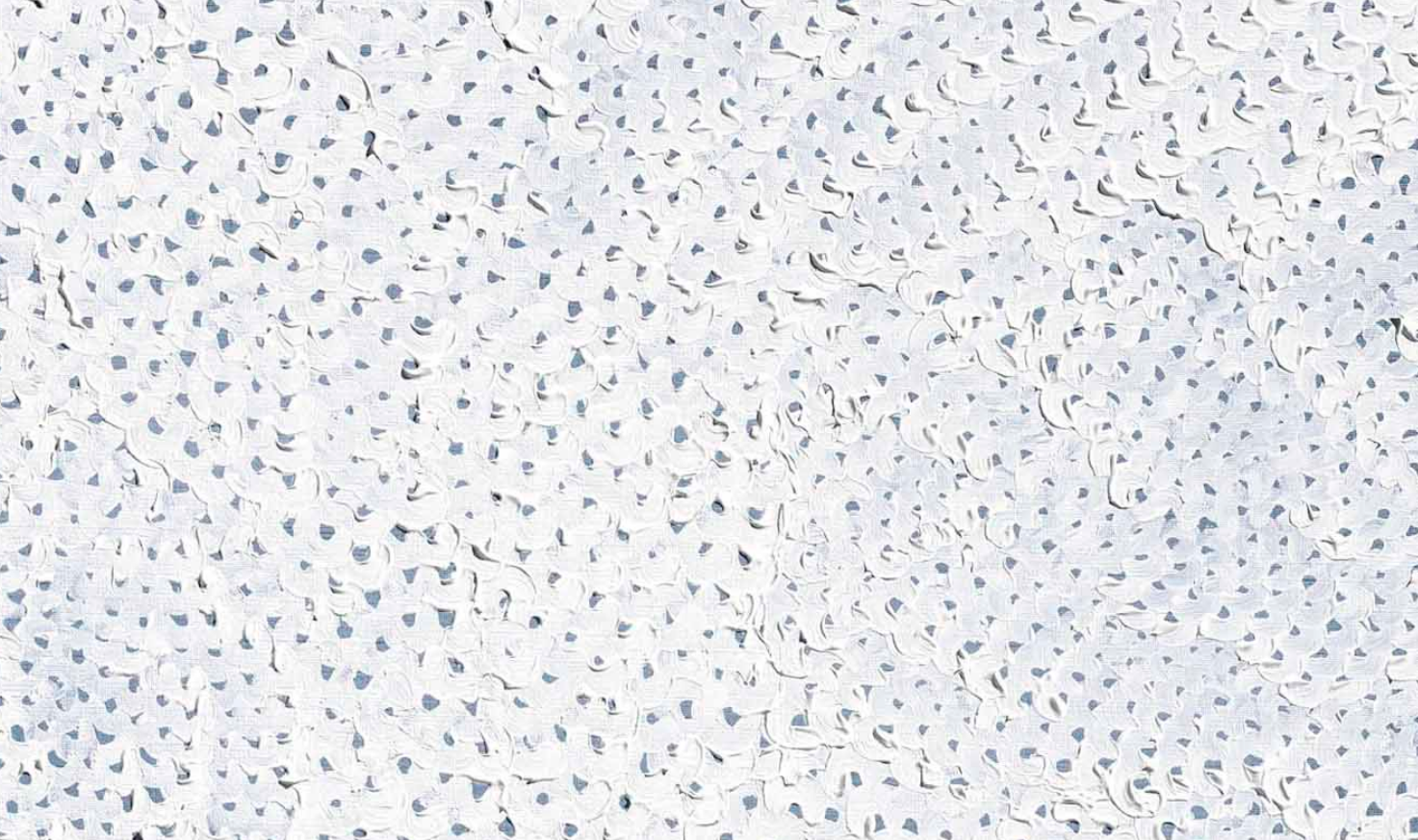
First conceived upon her arrival in New York in the late 1950s, the Infinity Nets have been a constant throughout Kusama’s oeuvre. Though initially born as an elegant riposte to the painterly gesturalism that dominated the New York art scene at that time, the cosmic sublimity of these mesmeric compositions positioned Kusama as heir to the Abstract Expressionist practices of Jackson Pollock and Barnett Newman. In the subtle, shifting surfaces of the Infinity Nets, Kusama evokes a transcendental space that lies beyond the limits of the human imagination. Alternately suggesting the vastness of the cosmos and the infinitesimal forms of cells or atoms, the complex matrix of dots stands as the ultimate cipher for the incomprehensible dimensions of infinity. First shown alongside the work of artists including Yves Klein, Lucio Fontana, Piero Manzoni and Mark Rothko, Kusama’s Infinity Nets had a profound impact on the international art scene, presaging elements of the Minimalist movement that took hold in the 1960s and 1970s. Today, they stand among the greatest achievements of her oeuvre, representing the ultimate embodiment of her aesthetic aims.