DAVID HOCKNEY (b. 1937)
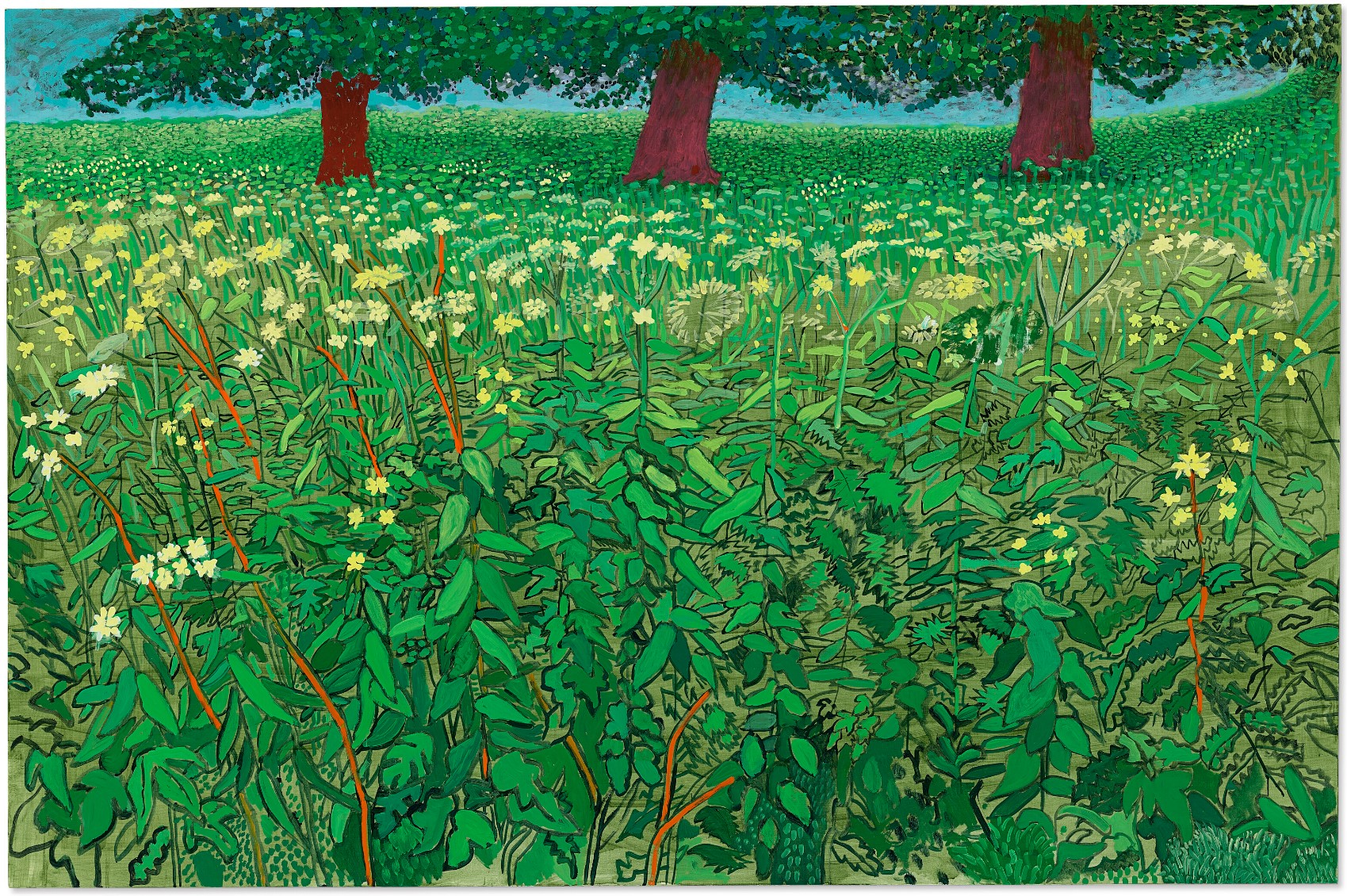
Queen Anne’s Lace Near Kilham, 2010-2011
Oil on canvas
67 x 102 1/4 inches (170.2 x 259.7 cm)
Queen Anne’s Lace Near Kilham, 2010-2011
Oil on canvas
67 x 102 1/4 inches (170.2 x 259.7 cm)
Provenance
LA Louver Gallery, Los Angeles
Acquired from the above by the late owner, 2011
LA Louver Gallery, Los Angeles
Acquired from the above by the late owner, 2011
Auction History
Visionary: The Paul G. Allen Collection
Christie’s New-York: 9 November 2022
Estimated: USD 8,000,000 – 12,000,000
USD 18,710,000
Visionary: The Paul G. Allen Collection
Christie’s New-York: 9 November 2022
Estimated: USD 8,000,000 – 12,000,000
USD 18,710,000
Queen Anne’s Lace Near Kilham is a triumph of contemporary landscape painting. In a departure from the historic traditions of the genre, Hockney banished the sweeping vista in favor of presenting a carpet of wild Queen Anne’s Lace. The flower, which flourishes in the heat of high summer, covers the field in a swathe of lush green foliage topped with crowns of delicate white flowers. Interspersed amongst the titular flowers are other meadow plants, the different organic forms woven into the organic tapestry the artist lays out before us. Three large trees stand majestically in the rear of the field casting a protective cloak of shade over the scene, the shadows rendered in Fauvist purples and smoky pinks. As the blanket of Queen Anne’s Lace withdraws towards the horizon, it dissolves into pointillist variegated dots that recede into the distance.
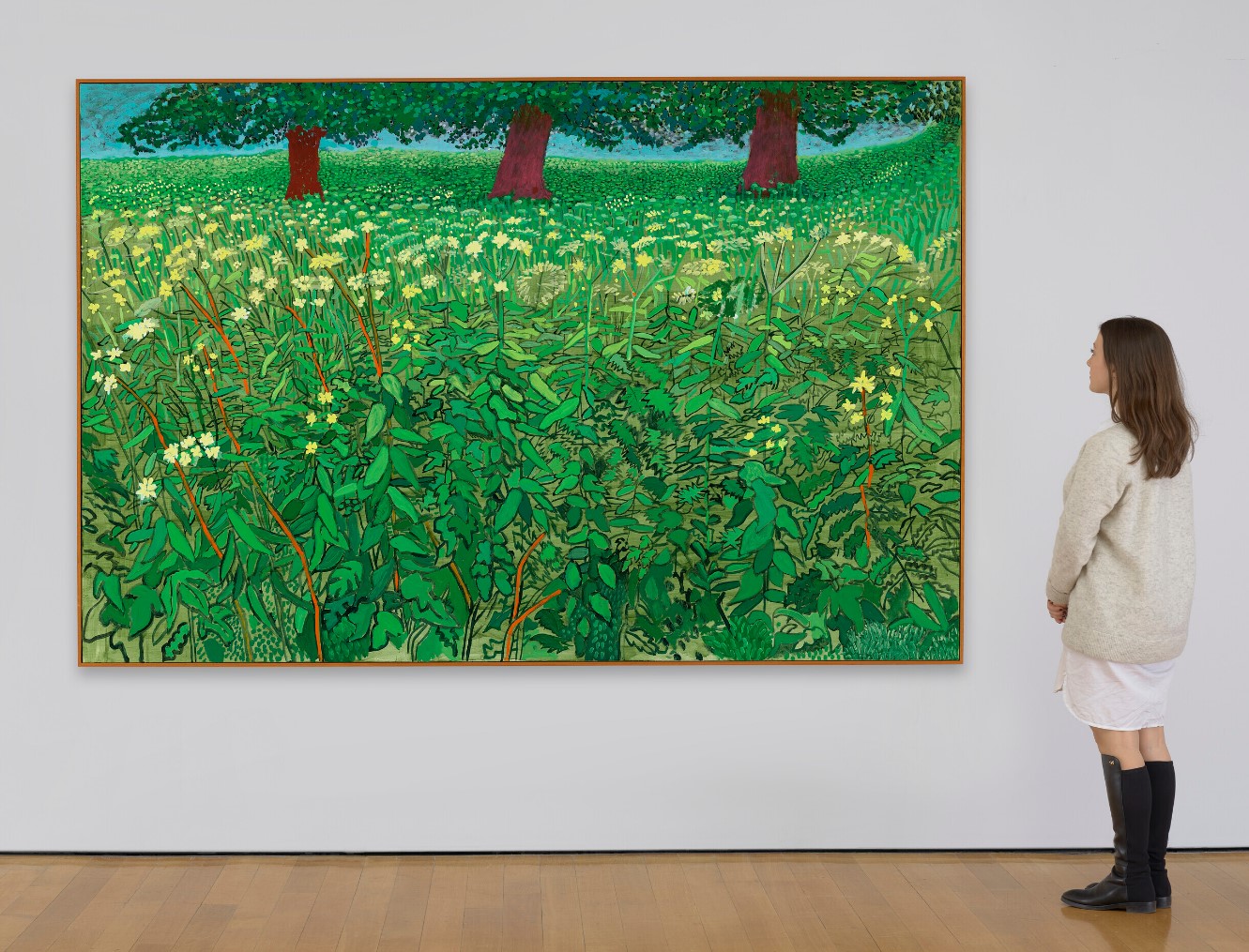
Another remarkable aspect of Hockney’s landscapes is the physical investment he makes in each canvas. He often visited his chosen location many times over the course of a year, each time reacting differently to the view as it changed over the seasons. Sometimes he paints from life, at other times he takes photographs which he later works from in his studio. He paints in all weathers, and neither rain, snow or scorching sunshine stops him from capturing the moments that enthrall him. His former assistant recalled how he would often be woken early in the morning by Hockney when the artist realized that the light would be just right for a day’s painting. Canvases, paints, and brushes would be packed into the artist’s small van and driven to the chosen location. Hockney worked at a feverish but considered pace, using the viscous properties of the oil paint to capture the nature of the scene before him. Sometimes he worked on a single canvas (such as Queen Anne’s Lace Near Kilham), but later he would work on a more monumental scale, painting a series of large-scale canvases that would be joined together to complete the finished scene.
Hockney’s landscapes were a radical departure for the artist. For a painter famous for his character studies of friends, family, lovers, and other people from his social circle, his landscapes contain no human figures whatsoever. In addition to their bold aesthetics, their lack of figures is arresting, but—as Hockney once explained to the writer Lawrence Weschler, “’I call these my figure paintings,’ Hockney says to me one day, and I rise warily to the bait: But, David, there are no figures in them. ‘You,’ he says a merry gleam in his eye, ‘are the figure’” (ibid., p. 11). Working in this way, the artist has stated that he wants to submerge the viewer in an intensely physical experience of place.
Paintings such as these update the grand tradition of British landscape painting initiated by the likes of John Constable and J.M.W. Turner. Constable was very much on Hockney’s mind during this period after he visited a major retrospective of the nineteenth-century artist’s paintings at Tate Britain in 2006. He was especially impressed by what are known as the “six footers,” a series of monumental canvases Constable produced beginning in 1819, in which the artist used the size of his large six-foot canvases to assert his belief in the importance of landscape painting, a genre which up to this point had often been regarded as an inferior form of art. Like Constable, Hockney believes the sense of place is what defines the specificity of his paintings, and of the locations they venerate.
Although familiar with these landscapes as a child, Hockney found an immense sense of pleasure in seeing them again with new eyes; the same sense of joy and awe which Hockney experienced on first setting eyes on the Californian swimming pools seems to be present in these landscapes too. Painted en plein air, they not only depict the physical landscape, they also become part of it too. Painted at speed, so as to capture the constantly changing light conditions, Hockney adroitly harnesses the viscosity of the oil paint to capture the energy of the ever-changing landscape. It is a medium “so responsive to spontaneity,” writes curator Marco Livingstone, “and to the slightest movement of hand or wrist, [it requires] great discipline and diligence of method” (“The Road Less Travelled,” in M. Livingstone and E. Devaney, David Hockney: A Bigger Picture, exh. cat., Royal Academy of Arts, London, 2012, p. 25). Now painting in his ninth decade, here Hockney continues the painterly interrogation of his world he began over half a century ago, with spectacular results.
Although familiar with these landscapes as a child, Hockney found an immense sense of pleasure in seeing them again with new eyes; the same sense of joy and awe which Hockney experienced on first setting eyes on the Californian swimming pools seems to be present in these landscapes too. Painted en plein air, they not only depict the physical landscape, they also become part of it too. Painted at speed, so as to capture the constantly changing light conditions, Hockney adroitly harnesses the viscosity of the oil paint to capture the energy of the ever-changing landscape. It is a medium “so responsive to spontaneity,” writes curator Marco Livingstone, “and to the slightest movement of hand or wrist, [it requires] great discipline and diligence of method” (“The Road Less Travelled,” in M. Livingstone and E. Devaney, David Hockney: A Bigger Picture, exh. cat., Royal Academy of Arts, London, 2012, p. 25). Now painting in his ninth decade, here Hockney continues the painterly interrogation of his world he began over half a century ago, with spectacular results.