The Wolds are a vast, uniquely pristine pocket of agricultural land between York and the seaside town of Bridlington, where Hockney worked in his adolescence and where he embarked on long country drives with his aging mother upon his homecoming in his sixties. Fascinated by the temporal and spatial movement of the landscape that he knew so intimately and saw transform from season to season, Hockney allows his recollections to weave into the way he sees and paints the landscape in the moment, thus channeling the fluxes and flows of nature and amalgamating them into a single depiction. He draws heavily on the Impressionists and Post-impressionists by working en plein air and applying remarkable speed in order to capture the fleeting shapes and moods of the rapidly changing vista.
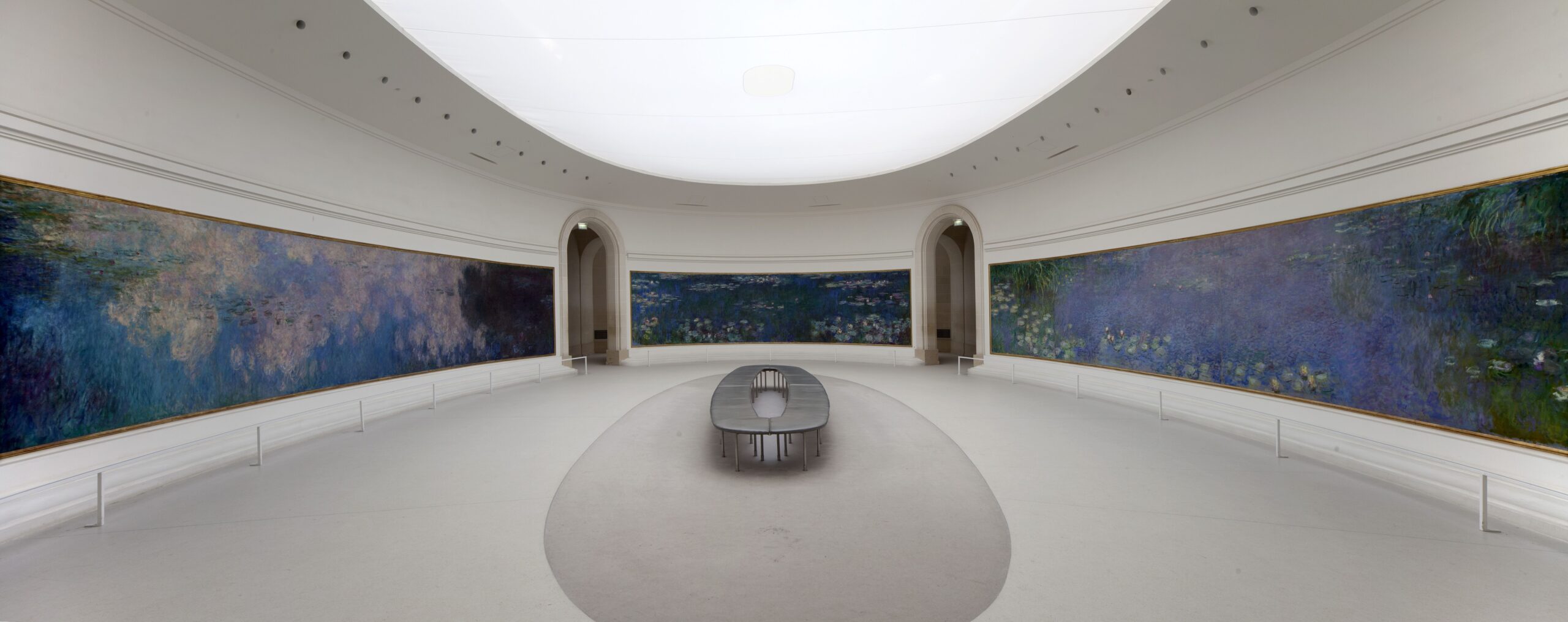
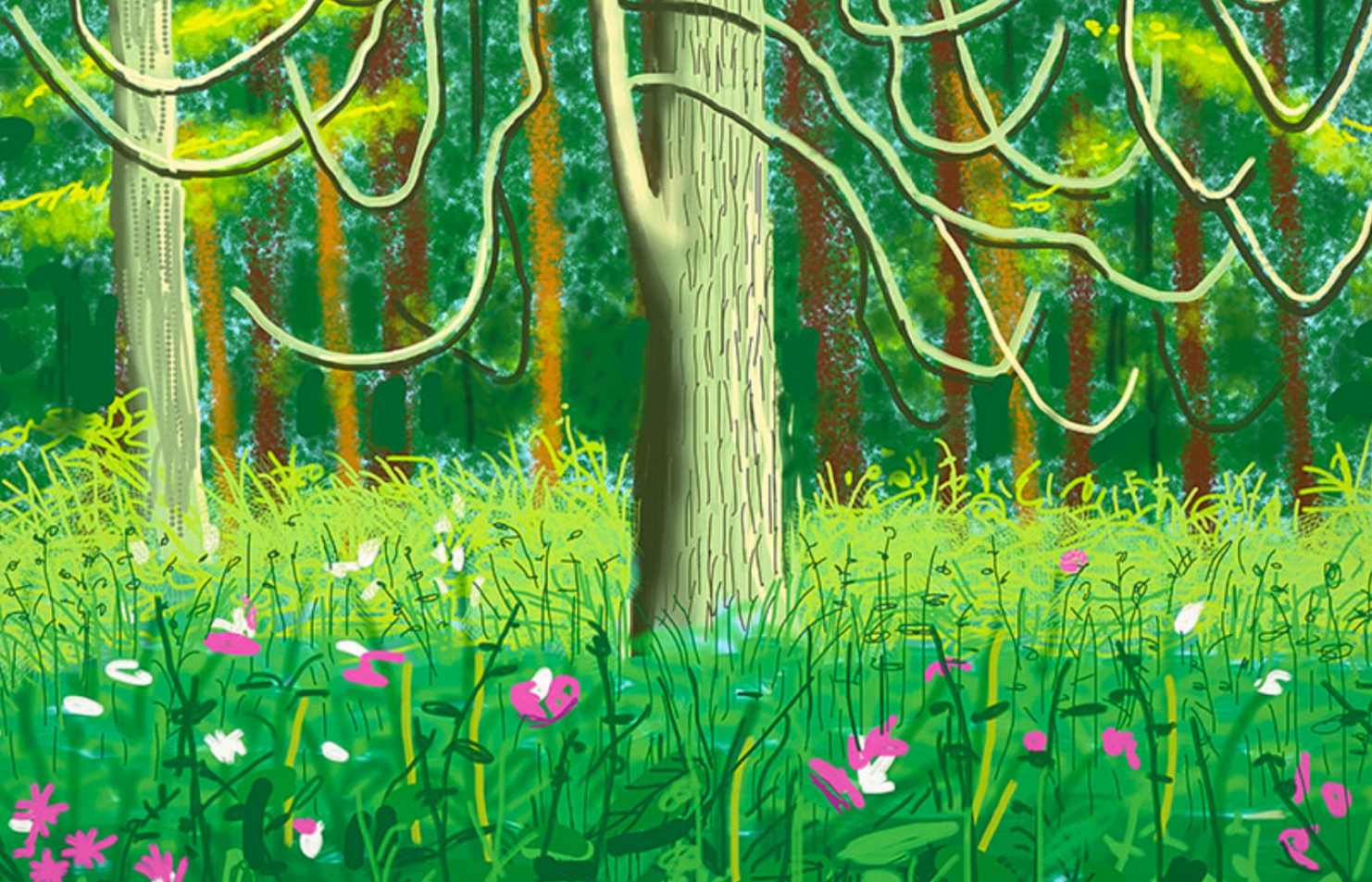
The inspiration behind Hockney’s Woldgate Woods paintings was further nurtured by two seminal events of 2006: The artist’s visit to the Musée de l’Orangerie in Paris, where he experienced the enveloping effect of Claude Monet’s Nymphéas installed in two oval-shaped rooms, and his visit of the major exhibition Constable: The Great Landscapes at the Tate Britain, presenting Constable’s monumental ‘six-footer’ landscapes of 1818-19 for the first time. The grandeur of these works inspired Hockney towards pursuing a more expansive scale through depiction of a single vista across six connected canvases, thus unsettling the dominant ideas about what it meant to see and represent nature. Interrogating the realism of early landscape painting, later consolidated further with the advent of photography, Hockney explains, “Artists thought the optical projection of nature was verisimilitude, which is what they were aiming for, but in the twenty-first century, I know that is not verisimilitude. Once you know that, when you go out to paint you’ve got something else to do. I do not think the world looks like photographs. I think it looks a lot more glorious than that” (David Hockney quoted in Exh. Cat., London, Tate Britain, David Hockney, 2017-18, p. 172). The leitmotif of Hockney’s entire career, his interest in translating the bodily sensation of being in the world supersedes the naturalism of landscape in the Western tradition, gaining a new unprecedented form. In contrast to the polished compositions of photographic representation, with its one-point perspective that seemingly flattens the world and keeps the spectator in a fixed, distant position outside the image, Woldgate Woods II, 16, & 17 May 2006 offers six different vantage points in the middle of each canvas, evoking not only the movement of the world but also the movement of the eye. One of the numerous elements that draws the spectator inside the painting in this way is the tree trunk dominating the leftmost side of the grid, which is closest to us in the image, whilst almost disappearing from perception, thus mimicking the mechanisms of peripheral vision with which we view the world around us. While achieving this effect through painterly means, the grid formed by multiple canvases alludes to Hockney’s experimentation with the photographic medium in the 1980s, and the Woldgate Woods oil paintings represent a groundbreaking artistic inquiry at the borderline between different mediums and philosophies. As Tim Barringer remarks, “Hockney’s Yorkshire landscapes offer a wry commentary on the demise of modernism, ‘teasingly juxtaposing his illusionistic images with their saturated Fauvist colours, with a grid-like framework, the most recognisable symbol (in its pure form) of austere experiments in minimalism from Piet Mondrian to Donald Judd and Carl Andre” (Tim Barringer quoted in: Exh. Cat., London, Tate Britain, David Hockney, 2017-18, p. 175).
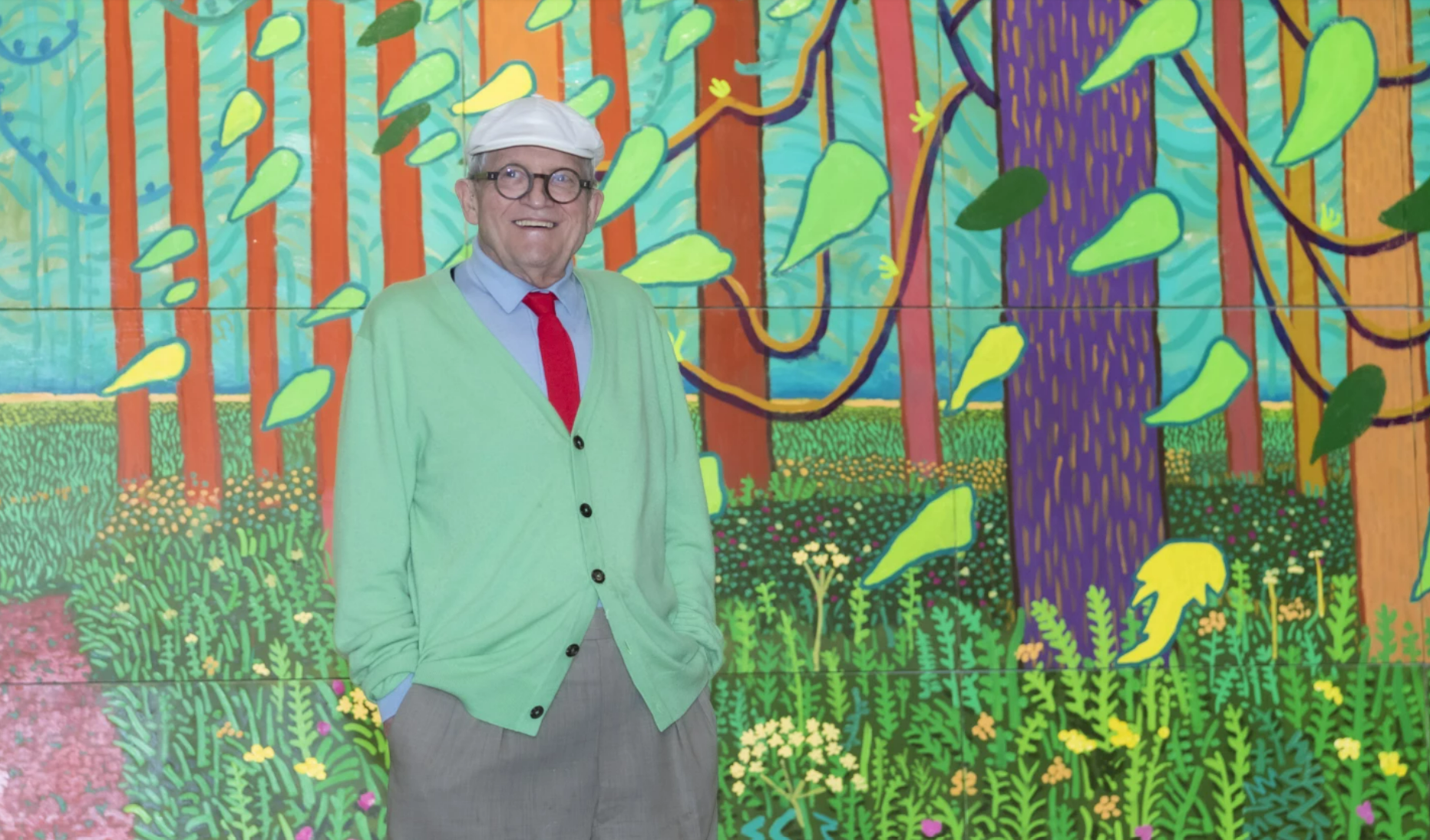
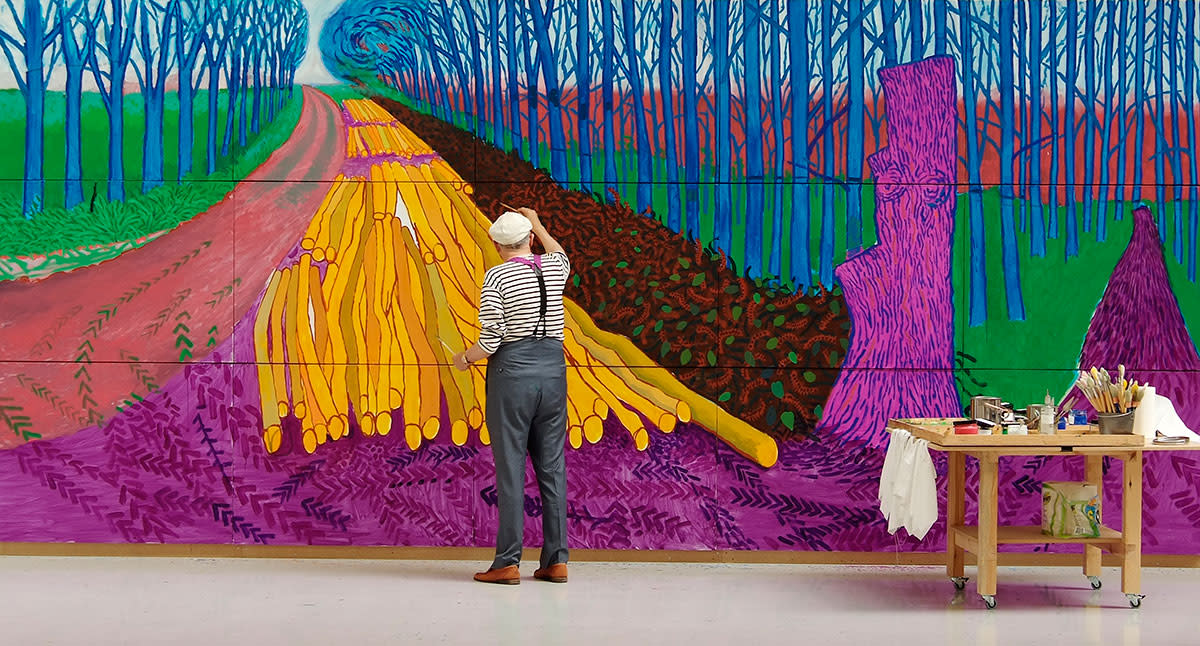
DAVID HOCKNEY IN FRONT OF THE ARRIVAL OF THE SPRING IN WOLDGATE, EAST YORKSHIRE 2011, SEPTEMBER 26, 2017, PARIS, FRANCE. IMAGE: © LUC CASTEL/GETTYIMAGES
Woldgate Woods II, 16 & 17 May, 2006
Sotheby’s London: 29 June 2022
Estimated GBP 10,000,000 – 15,000,000
PASSED
Woldgate Woods II, 16 & 17 May, 2006 | British Art: The Jubilee Auction | 2022 | Sotheby’s
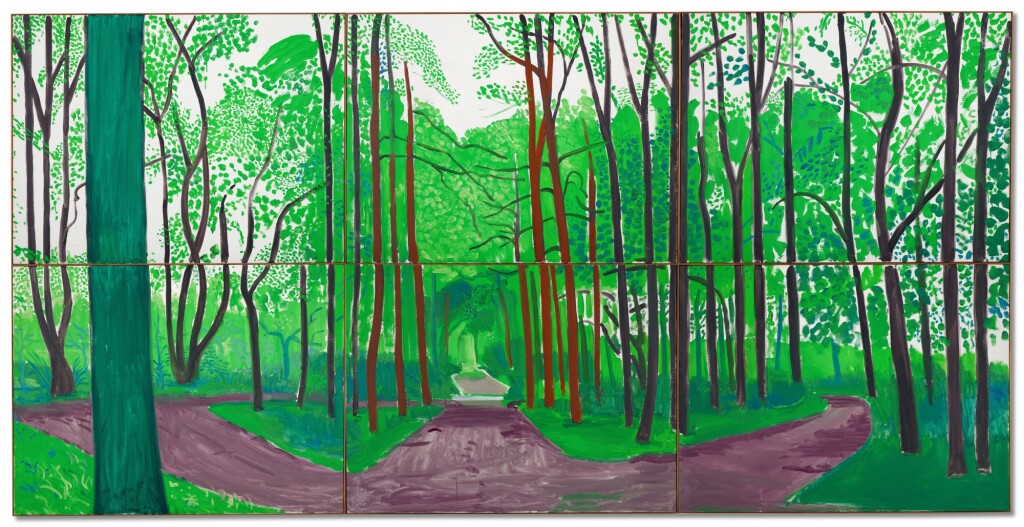
DAVID HOCKNEY
Woldgate Woods II, 16 & 17 May, 2006
Oil on canvas, in 6 parts
Each: 46×48 inches (91.4 x 121.9 cm)
Overall: 72×144 inches (182.9 x 365.8 cm)
Signed David Hockney and dated 16 + 17 May 06 (on the reverse of panel 6)
Numbered (on the reverse of each panel)
A work of sublime vastness, Woldgate Woods II, 16 & 17 May 2006 is an extraordinary example of David Hockney’s long-running investigation into place, landscape, memory and topography. Here, Hockney utilizes a palette of luxuriantly bright greens and deep, cool browns against the backdrop of ivory sky to conjure the sensation of roaming through the efflorescent woods of his native East Yorkshire in springtime. After twenty-five years spent in Southern California, where he executed iconic depictions of the invariably sunlit, dream-like landscape of Los Angeles, Hockney’s return to the multifaceted, active Northern English landscape of his youth reinvigorated his sensibilities, prompting an unprecedented period of artistic reinvention. This moving ode to homeland is a splendid manifestation of Hockney’s exploration into the nuances of perspective and color, as well as the limitations and possibilities of photography. Executed in 2006, the present work marks a buoyant revival of landscape painting in the Twenty-First Century, and is a work that cements Hockney’s renown as Britain’s greatest living painter.
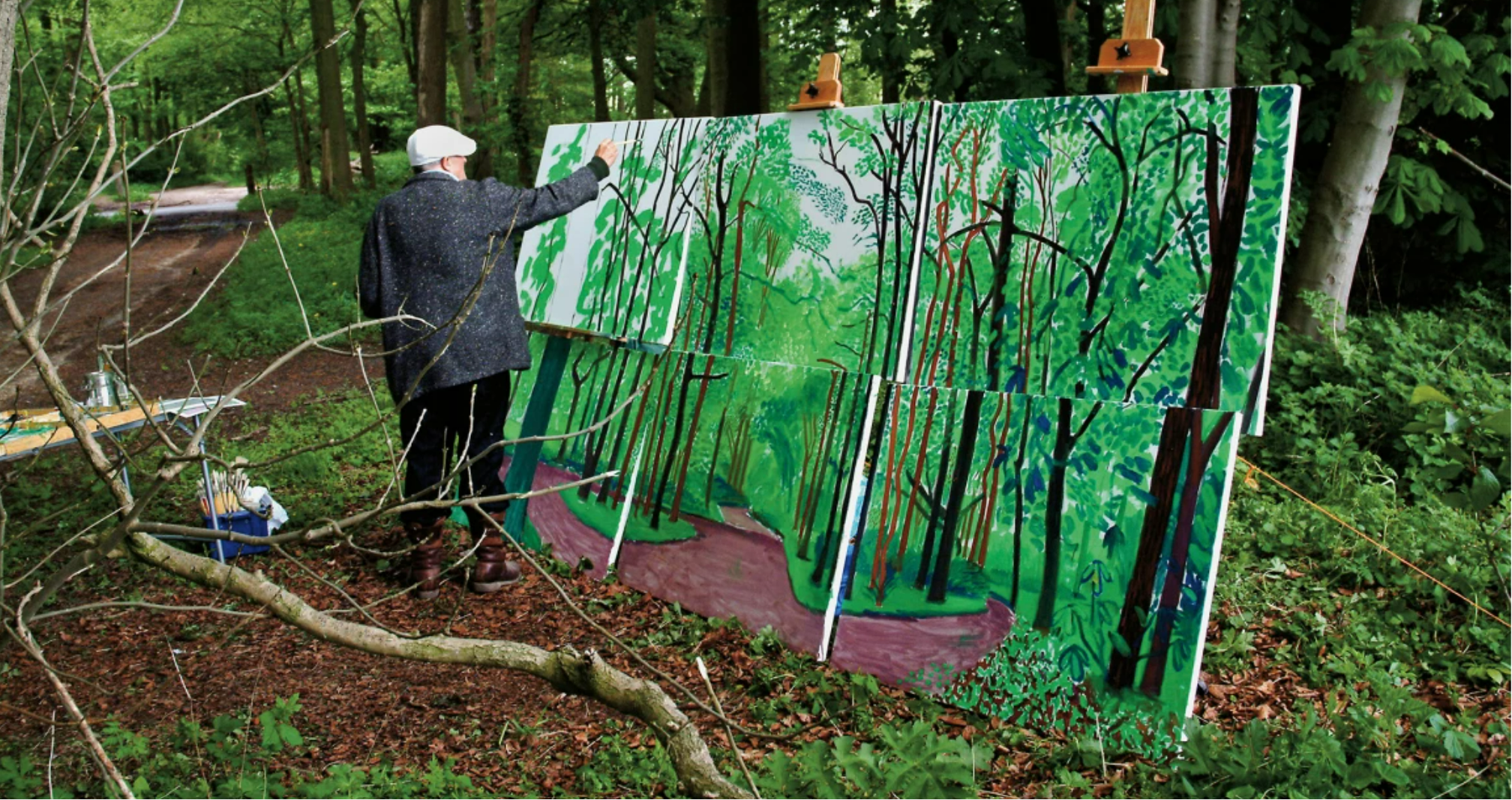
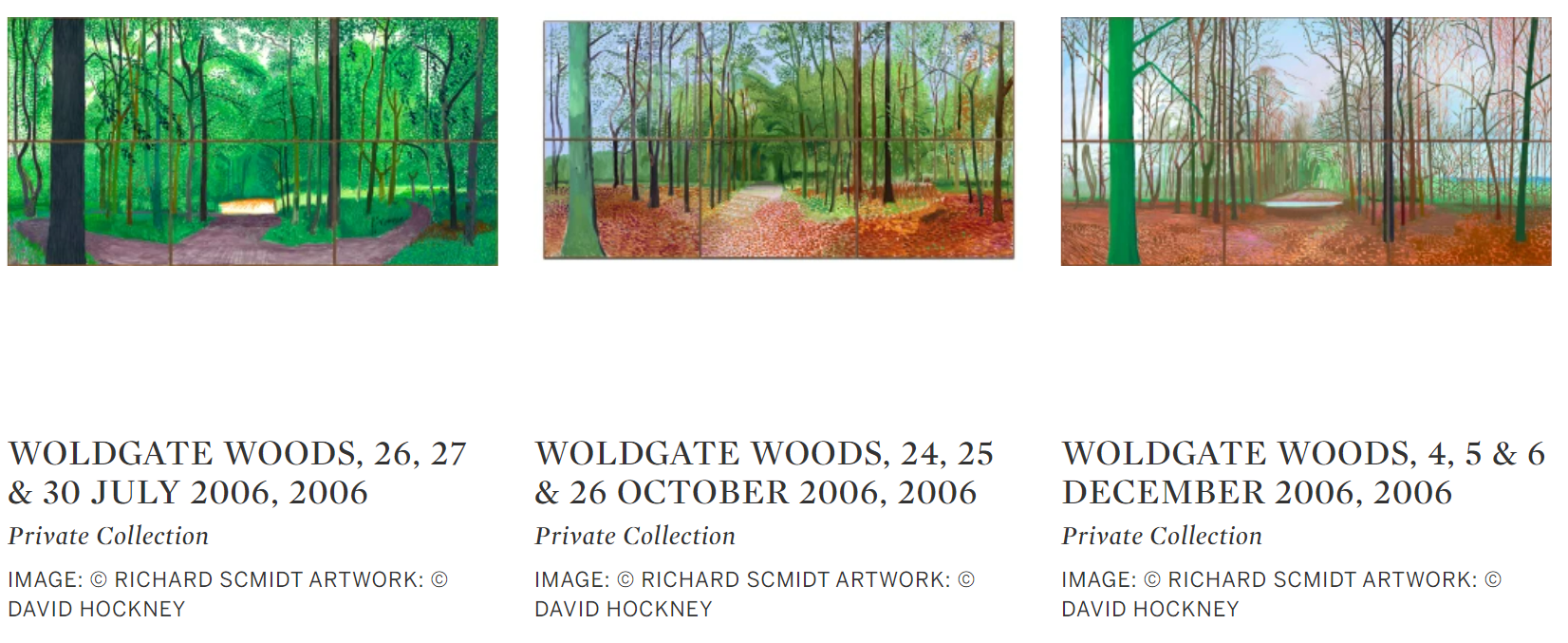
DAVID HOCKNEY PAINTING WOLDGATE WOODS 26,27 & 30 JULY 2006, 2006
IMAGE: © JEAN-PIERRE GONÇALVES DE LIMA / ARTWORK: © DAVID HOCKNEY
Woldgate Woods II, 16, & 17 May 2006 belongs to a series of nine monumental six-panel paintings of the same vista, captured in its varied appearance over the course of the changing seasons. Vincent Van Gogh, with his ability to see clearly into the world before him, is a particularly strong influence for Hockney, whose own unparalleled attentiveness to the idiosyncrasies of each separate element in a natural environment vibrantly manifests in Woldgate Woods II, 16, and 17 May 2006.
The inspiration behind Hockney’s Woldgate Woods paintings was further nurtured by two seminal events of 2006: The artist’s visit to the Musée de l’Orangerie in Paris, where he experienced the enveloping effect of Claude Monet’s Nymphéas installed in two oval-shaped rooms, and his visit of the major exhibition Constable: The Great Landscapes at the Tate Britain, presenting Constable’s monumental ‘six-footer’ landscapes of 1818-19 for the first time. The grandeur of these works inspired Hockney towards pursuing a more expansive scale through depiction of a single vista across six connected canvases, thus unsettling the dominant ideas about what it meant to see and represent nature. Interrogating the realism of early landscape painting, later consolidated further with the advent of photography, Hockney explains, “Artists thought the optical projection of nature was verisimilitude, which is what they were aiming for, but in the twenty-first century, I know that is not verisimilitude. Once you know that, when you go out to paint you’ve got something else to do. I do not think the world looks like photographs. I think it looks a lot more glorious than that” (David Hockney quoted in Exh. Cat., London, Tate Britain, David Hockney, 2017-18, p. 172). The leitmotif of Hockney’s entire career, his interest in translating the bodily sensation of being in the world supersedes the naturalism of landscape in the Western tradition, gaining a new unprecedented form. In contrast to the polished compositions of photographic representation, with its one-point perspective that seemingly flattens the world and keeps the spectator in a fixed, distant position outside the image, Woldgate Woods II, 16, & 17 May 2006 offers six different vantage points in the middle of each canvas, evoking not only the movement of the world but also the movement of the eye. One of the numerous elements that draws the spectator inside the painting in this way is the tree trunk dominating the leftmost side of the grid, which is closest to us in the image, whilst almost disappearing from perception, thus mimicking the mechanisms of peripheral vision with which we view the world around us. While achieving this effect through painterly means, the grid formed by multiple canvases alludes to Hockney’s experimentation with the photographic medium in the 1980s, and the Woldgate Woods oil paintings represent a groundbreaking artistic inquiry at the borderline between different mediums and philosophies. As Tim Barringer remarks, “Hockney’s Yorkshire landscapes offer a wry commentary on the demise of modernism, ‘teasingly juxtaposing his illusionistic images with their saturated Fauvist colours, with a grid-like framework, the most recognisable symbol (in its pure form) of austere experiments in minimalism from Piet Mondrian to Donald Judd and Carl Andre” (Tim Barringer quoted in: Exh. Cat., London, Tate Britain, David Hockney, 2017-18, p. 175).
DAVID HOCKNEY IN FRONT OF THE ARRIVAL OF THE SPRING IN WOLDGATE, EAST YORKSHIRE 2011, SEPTEMBER 26, 2017, PARIS, FRANCE. IMAGE: © LUC CASTEL/GETTYIMAGES
Through a combination of devices that are both painterly and photographic, empirical and intuitive, the vibrant, lush spring-time landscape on the surface of the present work becomes a celebration of the constantly shifting nature of Hockney’s native East Yorkshire. Woldgate Woods II, 16, & 17 May 2006 sees Hockney rejecting the laws of perspective, instead catching space, light and time in breathtaking movement. The result is a thrilling and immersive scene captured in the kaleidoscopic hues integral to his celebrated portrayal of sun-drenched Californian vistas. Powerfully re-imagining the art historical genre of landscape painting in Great Britain, the present work reveals a highly mnemonic and personal vista. At once ephemeral and immersive, Woldgate Woods II, 16, & 17 May 2006 showcases a vastness of ambition and profundity of earnest contemplation intrinsic to Hockney’s iconic practice of landscape painting.
Woldgate Woods, 24, 25, and 26 October 2006
Sotheby’s New-York: 16 November 2016
Estimated: USD 9,000,000 – 12,000,000
USD 11,712,500
DAVID HOCKNEY
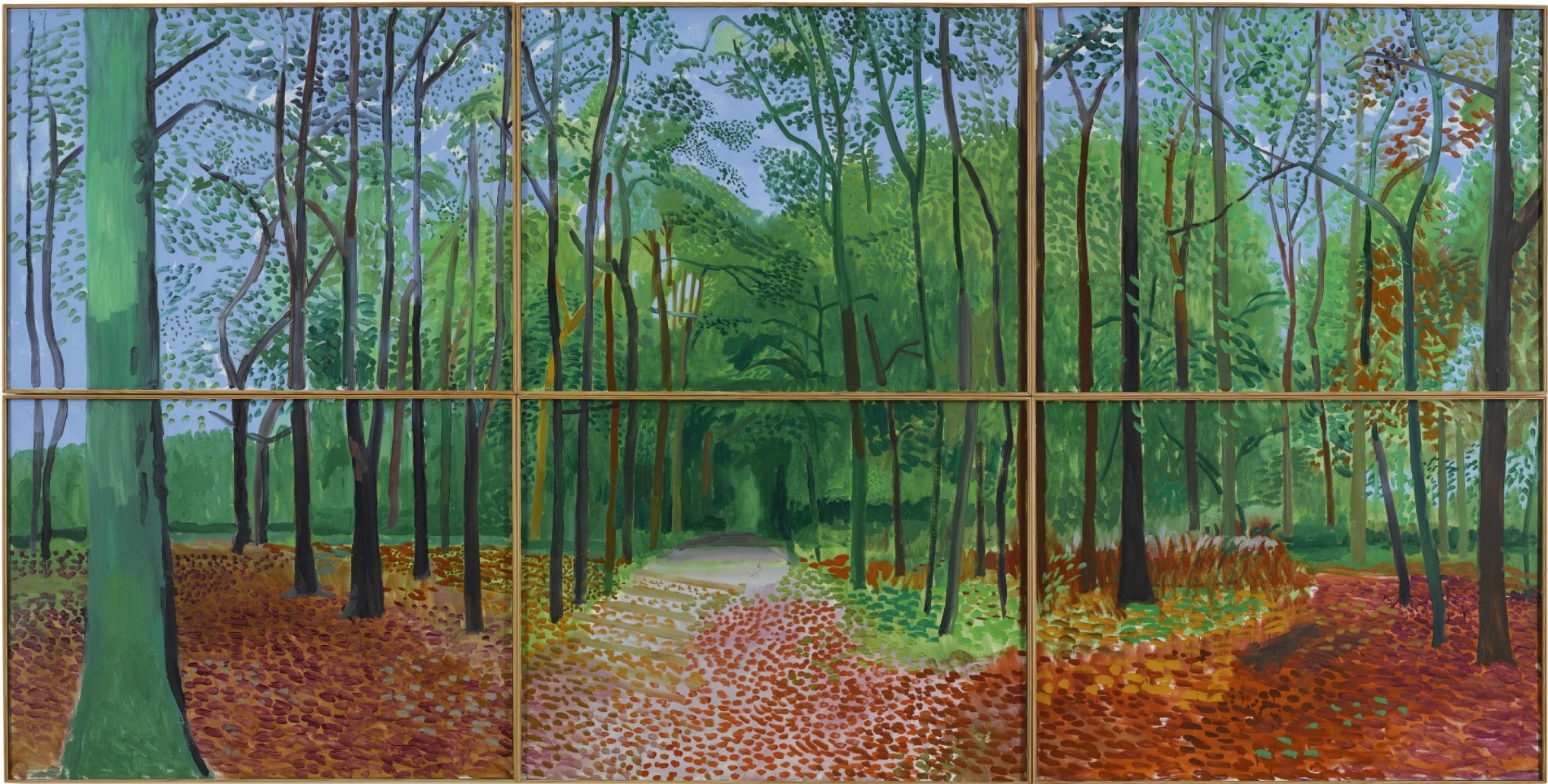
Woldgate Woods, 24, 25, and 26 October 2006
Oil on canvas, in six parts
Overall: 72×144 inches (182.9 x 365.7 cm)
Signed, titled and dated 2006 on the reverse of the lower right panel
Woldgate Woods, 24, 25, and 26 October 2006 belongs to a group of nine monumental six-panel paintings of the same vista, captured in its varied appearance over the course of the changing seasons. The Wolds is a vast pocket of agricultural land between York and the seaside town of Bridlington; not obtruded by industry or development, and always used exclusively as farmland, Hockney refers to this landscape as “the least changed bit of England that I know.” (the artist cited in Exh. Cat., Schwäbisch Hall, Kunsthalle Würth, David Hockney / Nur Natur / Just Nature, 2009, p. 182) Hockney first came to know this small pocket of Yorkshire when he was around fifteen years of age, having spent his summer holidays of 1952 and 1953 collecting corn on a local farm between the villages of Wetwang and Huggate. Less immediately spectacular in appearance than West Yorkshire—a region visited and painted by the great landscape painters of the Nineteenth Century such as J.M.W. Turner and John Varley—the agrarian undulating knolls always held a special attraction in Hockney’s heart. Although Hockney remained fond of these gentle hills and dense forest coves, it was not until his sixtieth year that he came to study them with a renewed vigor and interest. It was the tragic combination of his mother’s advancing age and the ill health of his close friend Jonathan Silver that drew Hockney back to the Wolds. Every three months he would return to this small area of East Yorkshire and take his mother for long drives across the countryside, magnifying his intense affection for the landscape. In the summer of 1997, Hockney embarked on a small group of oil paintings that were driven by the accumulated sensations of these habitual journeys. Although vivid enough to be evocative of direct observation, these works made recourse to the overarching simplifications and generalizations of memory and are very different to his most iconic and celebrated Yorkshire landscapes that he commenced nearly a decade later in 2005. Entirely undisturbed by time, the landscape of the Wolds is one that has remained changeless since Hockney’s youth; it is this long-term stasis of the land that made the cyclical changes in climate and season all the more poignant for the artist.
Hockney returned to easel painting in March 2005, following several years of painting his favored East Yorkshire landscapes solely in watercolor. Invigorated by the far greater possibilities of oil painting, Hockney set up his easels en plein air and sought to displace a photographic way of looking for a more straightforward representation of the real space stretched out before him. Hockney’s method of using multiple canvases allowed him to work on an ever-greater scale outdoors. With these pictures, he strove for an immediacy and intensity of capturing the world. While the vast scale and chromatic glory of Hockney’s Woldgate Woods, 24, 25, and 26 October 2006 convey a sense of majesty, the present work is in fact reflective of a more private voyage of life, love, and discovery for the artist. Having nearly avoided painting his native England until this point, prior to the late 1990s Hockney’s investigations into landscape painting were dominated by sunny views of his adopted home, Southern California, his journeys through the great American West, Europe and to more exotic lands such as Japan, Mexico and Egypt. It was staying for extended periods of time in the Bridlington house once occupied by his mother and sister that allowed the artist, in a way, to remain close to his past and relive his memory.
In 2006, the same year he painted the series of Woldgate Woods oils, Hockney saw the major exhibition Constable: The Great Landscapes at the Tate Britain. Hockney studied intensely the ‘six-footer’ landscapes begun by Constable in 1818-1819, and only shown for the first time together with their full-size sketches in the 2006 exhibition. Seeing the remarkably scaled sketches together with their final versions energized Hockney; that it would be difficult to paint on such an expansive scale outdoors only strengthened Hockney’s interest in doing so. The vitality and force of their loose application in many instances exceeded the polish of the more photographic, complete paintings, and anticipated the Impressionist ideal of the genre.
“In the position I now find myself in, realizing that two hundred years ago Constable would have thought the optical projection of nature was something to aim for. I now know it is not – so stand in the landscape you love, try and depict your feelings of space, and forget photographic vision, which is distancing us too much from the physical world.”
Hockney interested himself in portraying the transitory experience of nature rather than a photographic representation. Utilizing palette and brushwork in a manner reflective of the vivacity of Monet, Van Gogh, and Fauve painters such as Matisse, Derain, and Vlaminck, Hockney’s Woldgate Woods, 24, 25, and 26 October 2006 is boldly colored and lushly painted, capturing the very feeling of standing before the thicket of forest atop crinkling leaves as the air turns cool with the advance of the winter season. The tactile application of paint in Vincent Van Gogh’s later animated paintings of the countryside surrounding Arles and St Rémy can further be discerned within the thick impasto of the present work’spaint surface and the swirling curves of the brushstrokes. Also in 2006, Hockney made the first of many subsequent visits to the newly renovated Musée de l’Orangerie in Paris to see the recently re-installed Nymphéas by Claude Monet arranged in two oval rooms. Completely enveloping the viewer, this installation similarly conveyed the intensity that Hockney imparted in his own paintings, invoking a sensorial response to a particular place under specific conditions. Furthermore, Monet’s predilection for serial imagery—exploring the same landscapes and motifs in various weather conditions and times of day—influenced the artist as he embarked on the Woldgate Woods cycle.
Hockney’s careful studies of the changing light and natural forces altering the face of the land over the seasons share the character of his human portraits—a cautious observation of time and the effect of its passing. In contrast to the relatively stable, unchanging nature of the climate in California, the changing seasons and active landscape of East Yorkshire became more apparent to Hockney the more time he spent there. For the artist, the landscapes came with a sincere level of familiarity and emotional affection, observing the fluctuations of the seasons with the same tenderness with which he painted portraits of his friends over their lives. In a career shadowed by death for the previous three decades, Hockney’s loving portrayal of the East Yorkshire landscape privileges a defiant celebration of life while acknowledging a sense of mortality.
With the Woldgate Woods paintings, the passage of time itself began to occupy more of Hockney’s subject matter. Hockney’s portrayals of East Yorkshire foreground an individual, subjective perspective of nature, displaying a keen temporal sensitivity—his Woldgate Woods cycle describes one’s own looking, appreciating, and experiencing the land. Capturing the same viewpoint over cycles of growth and regeneration allows Hockney to investigate the ever-changing complexity of the natural world, heightening the sensation of actually being in the landscape by evoking the air, smells, and sights through his vivid colors and emphatic brushstrokes. As the size of his canvases grew, so did the dynamism and boldness of his brushwork. However, the increase in monumental scale of the Woldgate Woods paintings miraculously produced a greater intimacy, enveloping and submerging the viewer into its three-dimensional space, transporting us to the moment of its execution.
Perspective and the representation of space in two dimensions has remained a crucial interest and curiosity of Hockney’s since the early 1960s. In Woldgate Woods, 24, 25, and 26 October 2006, the artist frames an ambitiously exaggerated, widened vantage point, wrestling with the authority of one-point perspective. A prolonged foray into photographic collage begun in 1982 decisively fractured Hockney’s reliance on traditional European one-point perspective, instead rendering space in a Cubist-inspired mélange of perspective points. With his passion for Polaroid collages, the artist broke with realism in order to expand the scope of his vision and capture the true experience of being in the landscape. The picture would no longer be a static window presented to the viewer; instead, the viewer would be faced with multiple entry points in which to enter the space, experiencing the image rather than understanding it as a representation of physically real space. In its arrangement of six individually framed canvases, Hockney’s Woldgate Woods, 24, 25, and 26 October 2006 mirrors his photo-collages; while seemingly converging at a single vanishing point in the center of the wood, instead Hockney’s image destabilizes traditional perspective. Hockney painted the nine six-canvas Woldgate Woods paintings from inside a canopy of trees at the junction of three paths, therein providing the viewer with three unique vantage points—all equally appealing and powerful to the mind’s eye. Hockney offers a depiction of the world as it is actually experienced—letting the viewer’s eyes travel across various openings within the same image. In the simple gesture of framing each canvas individually, moreover, Hockney emphasizes the fractured parts rather than the whole and breaks down any facile single entry point into the landscape.
The Arrival of Spring in Woldgate, East Yorkshire in 2011 (twenty eleven) – 4 May
Phillips London: 3 March 2022
GBP 504,000
DAVID HOCKNEY
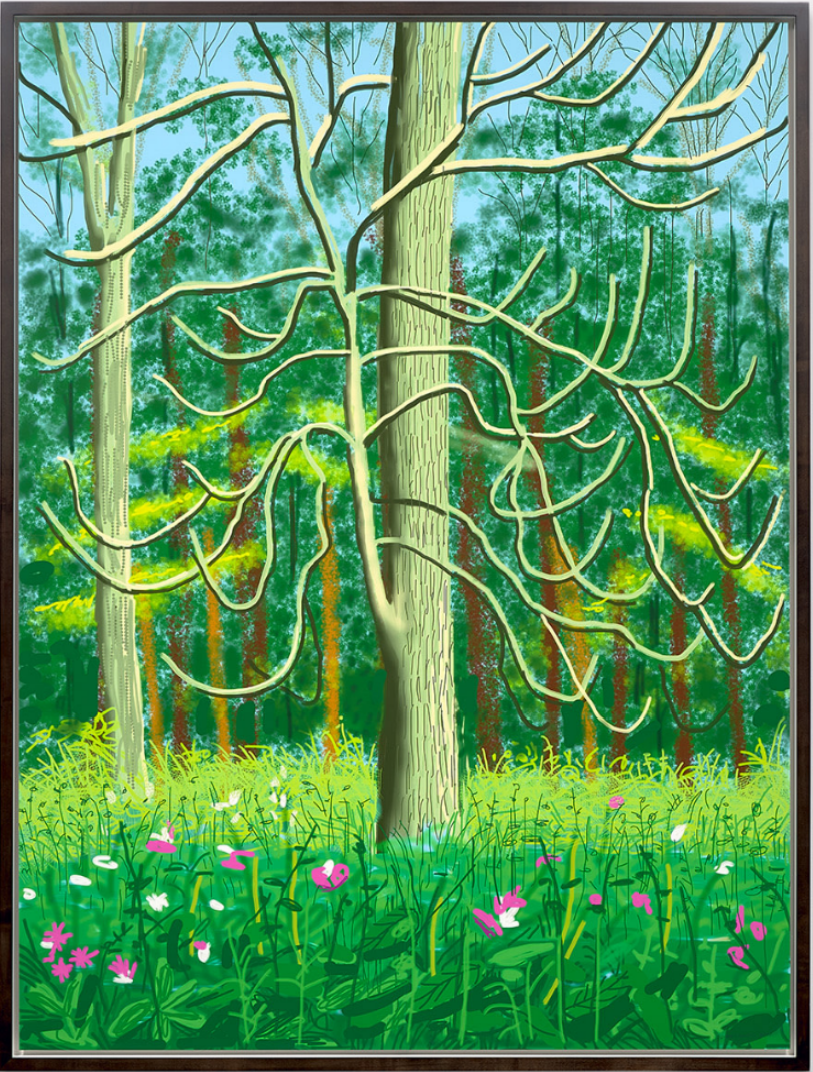
The Arrival of Spring in Woldgate, East Yorkshire in 2011 (twenty eleven) – 4 May
iPad drawing printed on four sheets of paper and mounted on four sheets of Dibond
Each: 117.5 x 88.3 cm (46 1/4 x 34 3/4 inches)
Overall: 235 x 166.7 cm (92 1/2 x 65 5/8 inches)
Signed and dated ‘David Hockney 2011.’ lower right
Numbered ‘9/10’ lower center
Executed in 2011, this work is number 9 from an edition of 10.
“I just happen to be an artist who uses the iPad, I’m not an iPad artist. It’s just a medium. But I am aware of the revolutionary aspects of it, and its implications.”
Executed in a brilliantly bold selection of layered greens, yellows, and blues befitting its subject, The Arrival of Spring in Woldgate, East Yorkshire in 2011 (twenty eleven) – 4 May is a joyous celebration of the natural world, life, and regeneration from this quintessential British artist. Drawing parallels to John Constable’s sustained focus on the gently rolling hills of the Dedham Vale, or the seasonal changes occurring in and around the sleepy agricultural village of Giverny obsessively captured over four decades by Claude Monet, Hockney’s return to his late mother’s home in Bridlington offered a new and rich subject for the artist. Revelling in the seasonal shifts unfolding in his native Yorkshire countryside, the body of work that emerged from this period represents the most sustained and painterly sequence of pictures in his life, closely focused on qualities of light, color and organic form.
Completed alongside a series of more traditional oil paintings and watercolours, the multi-panel The Arrival of Spring in Woldgate, East Yorkshire in 2011 (twenty eleven) – 4 May was first unveiled as part of the Royal Academy of Arts’ sensational 2012 survey exhibition David Hockney: A Bigger Picture. Alongside one monumental oil painting arranged across 32 canvases, Hockney recorded the seasonal transition into spring in a series of fifty-one iPad drawings executed between January and June of that year, which were then printed on a large scale and arranged as a grand narrative cycle throughout one of the galleries of the exhibition. Bringing his paintings and iPad drawings together for the first time, the series announced the artist’s reinvention of this classical subject with his pioneering use of cutting-edge 21st century digital technologies.
“I know a lot about drawings and paintings, I’ve spent sixty years doing them. But this is new because of the layers, and because you can go back to them. You can’t do that on paper or canvas.”
Always open to the exciting possibilities that advancements in technology could introduce into his practice once the software could finally follow the hand, Hockney began experimenting with digital art in 2007, starting by making work directly on his iPhone in rapidly executed and strikingly dynamic compositions. Maintaining the sensation and immediacy of drawing, while allowing for a new kind of precision and freedom in its graphic quality, these works became increasingly complex and detailed with the introduction of the iPad into his practice in 2010.
“The app I used in 2011 was called Brushes It was a new medium and I enjoyed finding out about it. I tried a few other apps but settled on Brushes as being the best for me. It was quite simple, as all the brushes were labelled with a mark, just a mark, no names, so you didn’t have an oil painting brush or a watercolor brush, just the mark it made on the canvas.”
Allowing Hockney to work quickly with an intensely saturated palette, fluid sense of line, and wide variety of paint effects, the medium complimented the immersive approach to his subject taken by the artist, leading him to develop a kind of Pointillist stippling and more discriminating grading’ across this cycle of works that highlights the close connections between Hockney’s landscapes and their art historical precedents.
“The green of the spiring is a luscious fresh green that’s gone by about June really, but April and May have this very, very fresh green, and you need a few greens, you’ve got to use a few greens. It’s a difficult color but we can see more greens than any other color.”
In its scope and scale, Hockney’s seasonal cycle of course recalls the close observation of the landscape and the almost imperceptible shifts in light and atmosphere recorded by Impressionist master Claude Monet. Certainly, Monet’s approach to serial imagery and his forensic examination of the landscape around him in all variety of weathers directly informed Hockney’s immersive approach to his subject and his thinking around The Arrival of Spring, Woldgate Woods, twenty eleven works. Working en plein air in the Impressionist tradition, Hockney was able to work quickly and precisely in the countryside that he had known from childhood, blending the sensorial experience of his total immersion in nature with a profoundly emotional one.
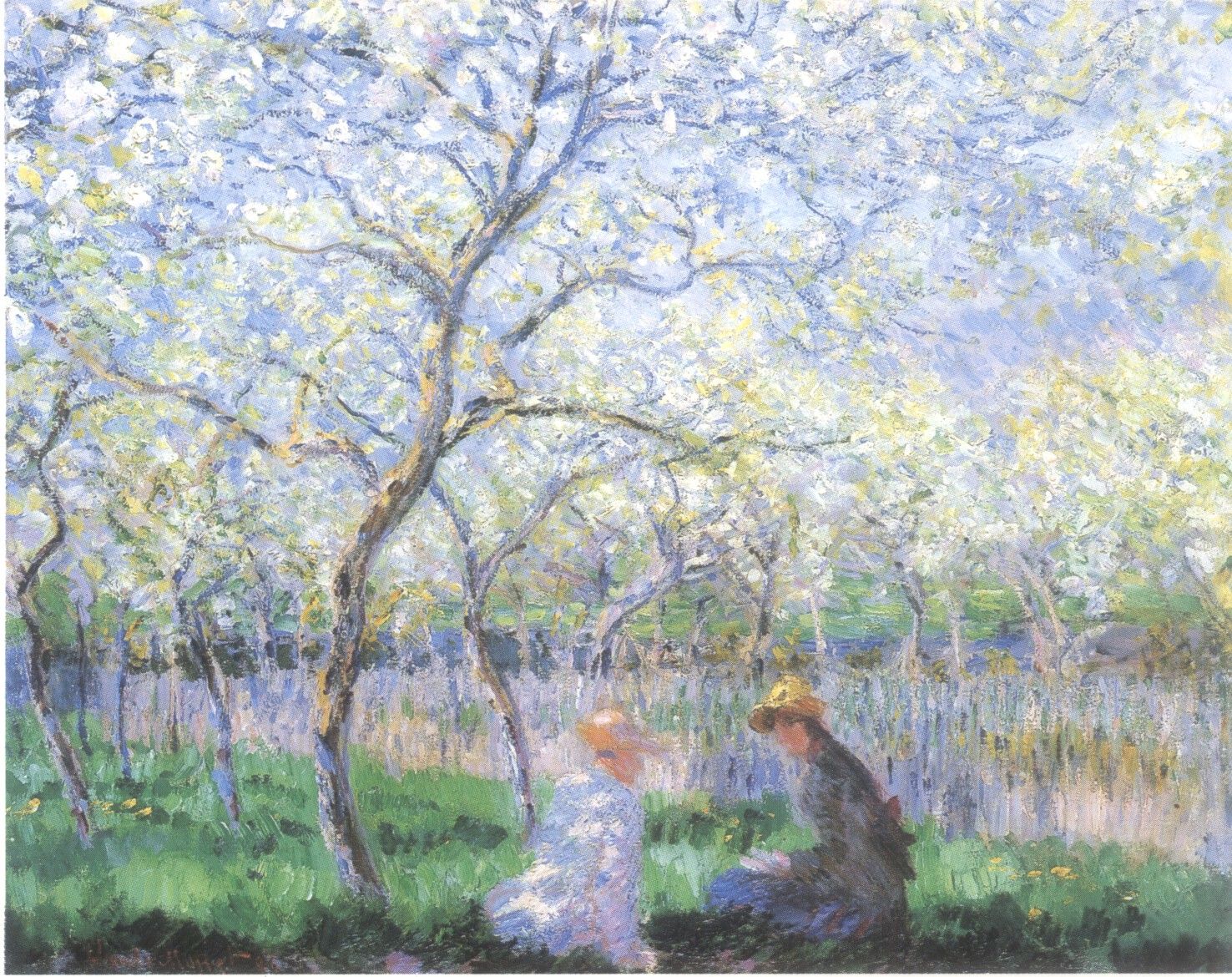
Claude Monet, Printemps (Springtime), 1886, The Fitzwilliam Museum, Cambridge. Image: © Fitzwilliam Museum / Bridgeman Images
A definitive visual record of the English countryside, Hockney’s reflections on the passing of time and the sequence of seasonal change are at once deeply personal and strikingly impassive – the seasons will continue to change, even if we aren’t here to see them. Much like his Impressionist predecessor, Hockney realized that this classical subject could not be represented in a single painting but demanded the context of a larger narrative cycle.
“I realized to show the full arrival of spring, you have to start in the winter and go into the summer a bit, and then you see all the differences and all the rich things that happen to each tree.”
Fittingly, Hockney has more recently returned to this theme in an exhibition consisting entirely of iPad drawings David Hockney: The Arrival of Spring in Normandy, 2021, and expanded it into a full seasonal cycle – David Hockney: A Year in Normandy presented at the Musée de l’Orangerie in Paris in a lyrical echo of Monet’s majestic Nymphéas.
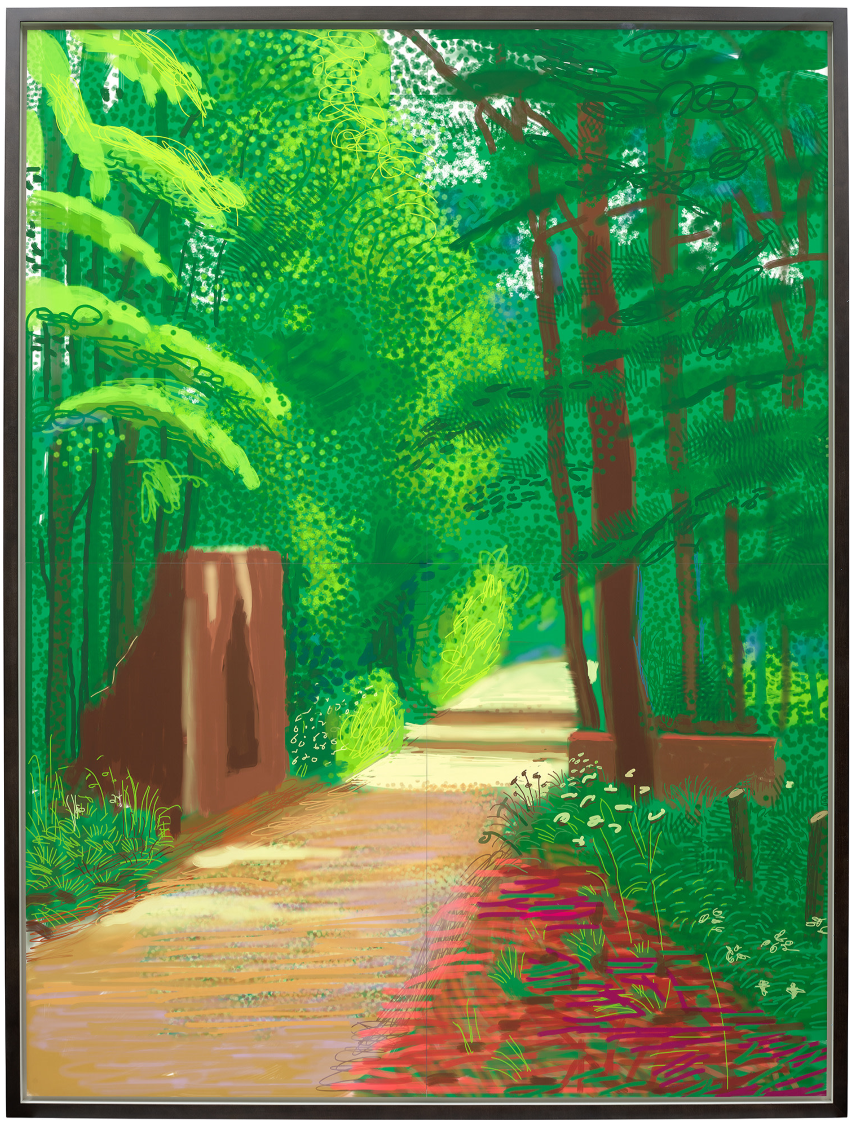
Executed in the first week of May, in what Hockney affectionately terms ‘Action Week’, the present work captures this proliferation of growth as touches of white, streaks of yellow, and subtle modulations of green animate the foreground between the dancing heads of the blue lianas scattered across the sun-dappled undergrowth of Woldgate Woods. Referring directly to Monet’s Impressionistic brushwork, starkly rendered branches stretch themselves out under the blue sky, filling before our eyes with the gauzy explosions of Hawthorn blossom across them. Approaching this new medium with an enthusiasm and energy that belies his eighty years, Hockney has reinvented himself as a great landscape painter, inserting himself in a long line of artists for whom technological innovation has opened radical new ways of approaching this most traditional of subjects.
The Arrival of Spring in Woldgate, East Yorkshire in 2011 (twenty eleven) – 2 June, 2011
Phillips London: 27 June 2024
Estimated: GBP 280,000 – 350,000
GBP 406,400 / USD 515,315
David Hockney – Modern & Contemporary Ar… Lot 7 June 2024 | Phillips
DAVID HOCKNEY
The Arrival of Spring in Woldgate, East Yorkshire in 2011 (twenty eleven) – 2 June, 2011
iPad drawing printed on four sheets of paper, mounted on four sheets of Dibond
Each: 117.5 x 88.3 cm (46 1/4 x 34 3/4 inches)
Overall: 235 x 166.7 cm (92 1/2 x 65 5/8 inches)
Signed, numbered and dated ‘David Hockney 5/10 2011’ lower right
Widely regarded as Britain’s greatest living painter, The Arrival of Spring in Woldgate, East Yorkshire in 2011 – 2 June 2011 demonstrates the virtuosity, inventiveness, and clarity of approach that best characterizes David Hockney’s mature practice. Continuously investigating the capabilities of technology to realize his vision, Hockney’s spirited rendering of the Yorkshire landscape is both intimately attuned to the phenomena of the natural world and the forces of memory, tenderly embodying the romance and tragedy of life itself. After two decades in Southern California, where Hockney realized his sun-lit, iconic images of the West Coast, the artist’s return to the rolling foothills of East Yorkshire prompted an unprecedented period of artistic re-invention. Visiting for the summer of 1997 to see his terminally ill friend Jonathan Silver, Hockney’s renewed exposure to the verdant, rolling scenery through the daily drives from his mother’s home in Bridlington heralded the beginning of his Yorkshire landscapes.
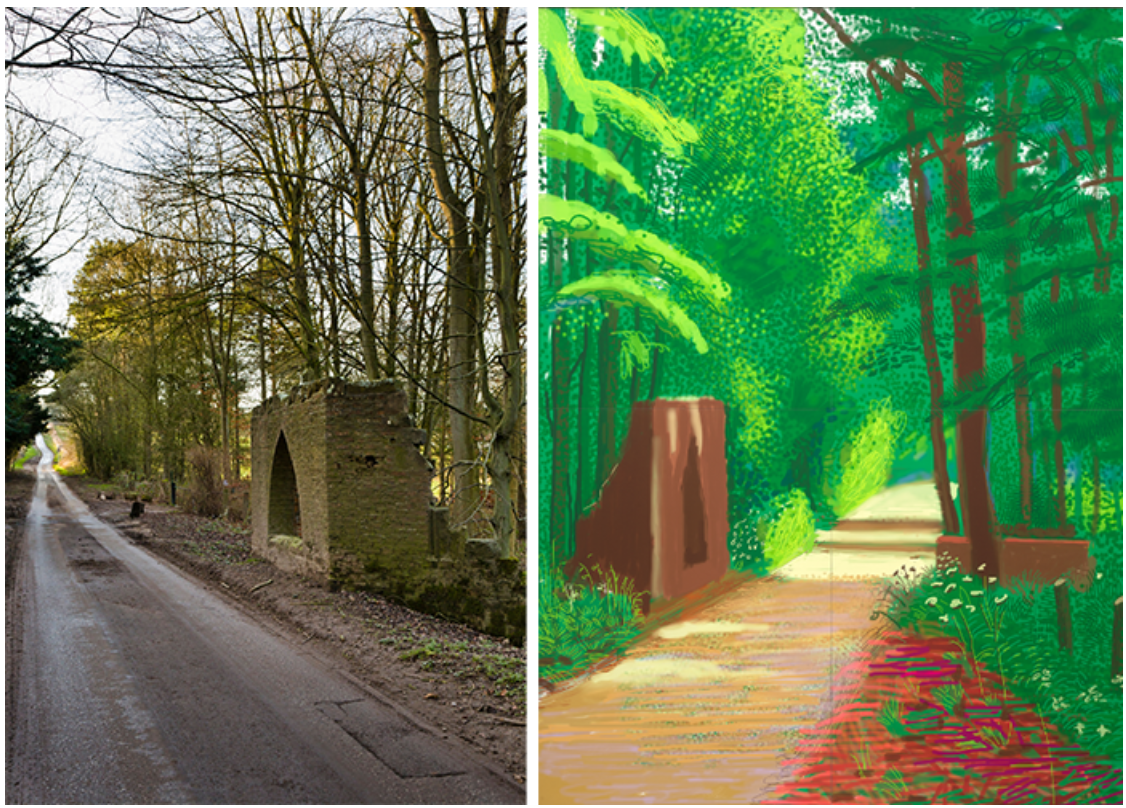
Woldgate Woods, East Yorkshire England. Image: Mark Buckle / Alamy Stock Photo
A place of increasing emotional intensity following the death of his mother in 1999, Hockney moved to Bridlington full time in 2005, close to his sister Margaret. The garlanded, isolated landscape of the small seaside town on the Yorkshire coast would provide a fertile atmosphere for Hockney to commence his pioneering Arrival of Spring series in 2011. Comprised of fifty-one iPad drawings and a related, monumental painting executed over thirty-two canvases, Hockney painted along a single-track road running between Bridlington and Kilham. Recording the cycle of the seasons, commencing on the 1st January with winter, the present work concludes the expansive series. Caught at the final moment before the unfolding of the summer, Hockney captures the intensity and incandescence still found in late spring. Immersive in scale and rich in texture, the bright, lively renderings of green, red, and brown exude abundance and volume, flickers of light dancing between the leaves.
Using unorthodox and novel mediums to communicate his vision from the onset of his career, The Arrival of Spring in Woldgate, East Yorkshire in 2011 – 2 June 2011 demonstrates Hockney’s perpetual enthusiasm in approaching new technologies of image-making. The artist has spoken powerfully about the weekly trips taken with his father to the cinema, where ‘The screen, as if by magic, was opening up the wall to you, it showed you another world’. As if catalyzed by film, already in the 1960s Hockney began to use the camera, purchasing a polaroid in 1964 whose images served as references for his paintings.
“Technology always has contributed to art.
The brush itself is a piece of technology isn’t it?”
From photocollages to prints made using his color photocopier during the early 1980s, Hockney commenced digital drawing in 1987 as he was invited, alongside several others, to create drawings using the Quantel Paintbox. Continuing to experiment with the Apple Macintosh in 1991, the artist was initially frustrated by each software’s limitations.
“It wasn’t as fast as your hand. For a draughtsman, that’s no good – if you’re drawing a line and the ink isn’t there, or if you’ve finished and the drawing was still being done.”
Yet, with the advent of the iPhone and then the iPad (that Hockney was among the first to acquire in 2010), technology finally caught up with Hockney’s aspirations. As in the present work, Hockney was able to work using his screen en plein air, enabling the artist to capture shifting effects of light and weather with immediacy. Evidence of the enthusiasm with which Hockney has approached new technologies throughout his career, The Arrival of Spring in Woldgate, East Yorkshire in 2011 – 2 June 2011 reflects the artist’s capacity to enchant, innovate, and surprise.
Woldgate Woods, Winter, 2010
Sotheby’s London: 2 March 2022
GBP 922,500
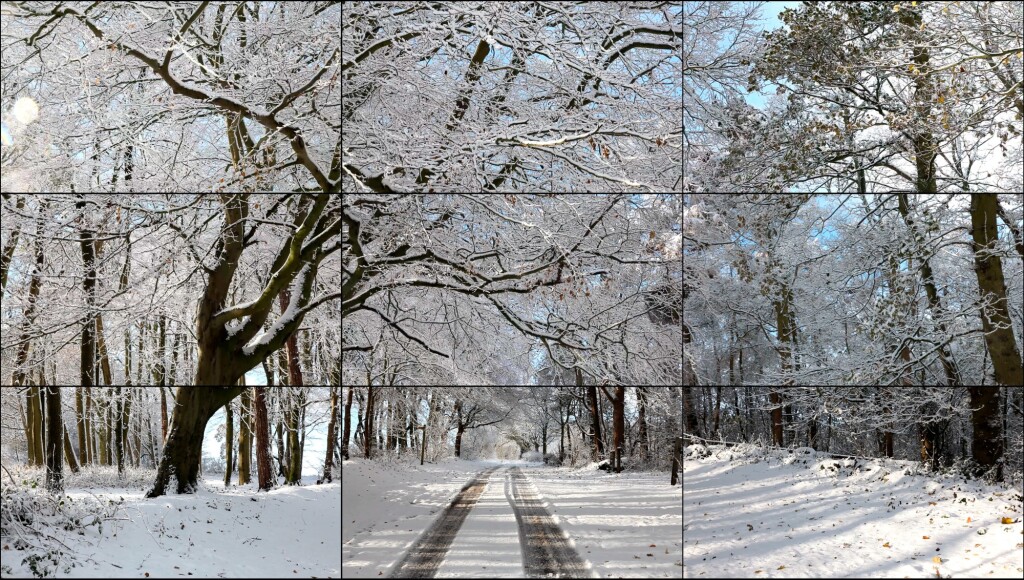
DAVID HOCKNEY
Woldgate Woods, Winter, 2010
Nine synchronised digital videos
Overall: 206 x 362 cm (81 x 142.5 inches)
This work is number 7 from an edition of 10, plus 2 artist’s proofs
A remarkably vast panorama of spatial depth, Woldgate Woods, Winter 2010 is part of Hockney’s continued exploration of time, landscape, perception and memory in a site that has proved a profoundly important subject for the artist throughout his much-acclaimed career. In a pivotal creative re-invention, Hockney’s first multi-camera video carefully recorded the effects of sunlight, shadow and other ephemeral effects of weather as they impacted on the expansive snowy landscape of a forest in East Yorkshire, transforming the bucolic North of England into something visionary. The significance of this key work has been repeatedly recognized through its inclusion in several of Hockney’s recent major exhibitions, including the comprehensive survey of his landscapes, David Hockney: A Bigger Picture, at the Royal Academy in London in 2012 (which later travelled to the Guggenheim Museum in Bilbao and the Museum Ludwig in Cologne) and the landmark career retrospective, David Hockney, at Tate Britain in London in 2017 (which later travelled to the Centre Georges Pompidou in Paris and The Metropolitan Museum of Art in New York).
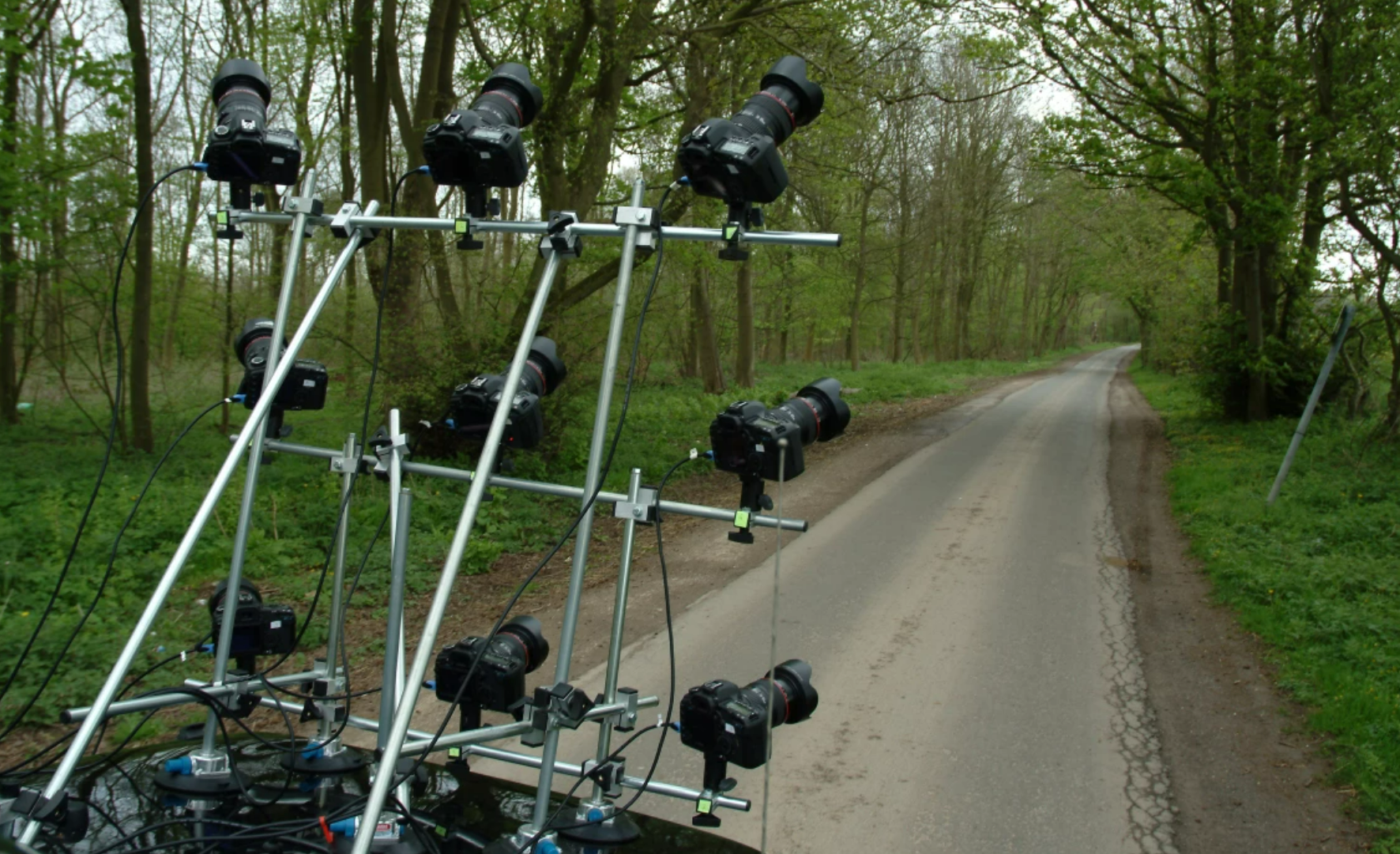
In keeping with Hockney’s progressive use of technology, a common theme throughout his oeuvre, Woldgate Woods, Winter 2010 belongs to a pioneering series of video works created by Hockney in the countryside near his childhood home in East Yorkshire. The series comprises four separate video works, each depicting a different season and made up of nine screens arranged in three rows of three displaying footage captured using nine separate cameras fixed on top of a gradually moving vehicle. Allowing viewers to see the changing viewpoints simultaneously in one visual space and in real time, the present work focuses on the expansive snowy landscape situated on either side of the narrow Roman road which runs through Woldgate Woods from Bessingby Hill to the village of Kilham. By recording the same track with nine separate cameras filming at the same time, Hockney managed to create what he refers to as a ‘Cubist movie’ in which multiple viewpoints literally capture changing time and space, an effect the artist also has sought to represent in many of his painted landscapes. The cameras filming the track all point in slightly different directions, yet the nine separate views in the final work bring together these varied viewpoints via a two-dimensional viewing surface. Hockney thereby realised that “with this technique you could not only draw in space, but you could draw in time […] because it’s a different time in this corner and that, when you look from one to the other you look through time” (David Hockney quoted in: Chronology 1937 – Today: 2010, The David Hockney Foundation (online)).
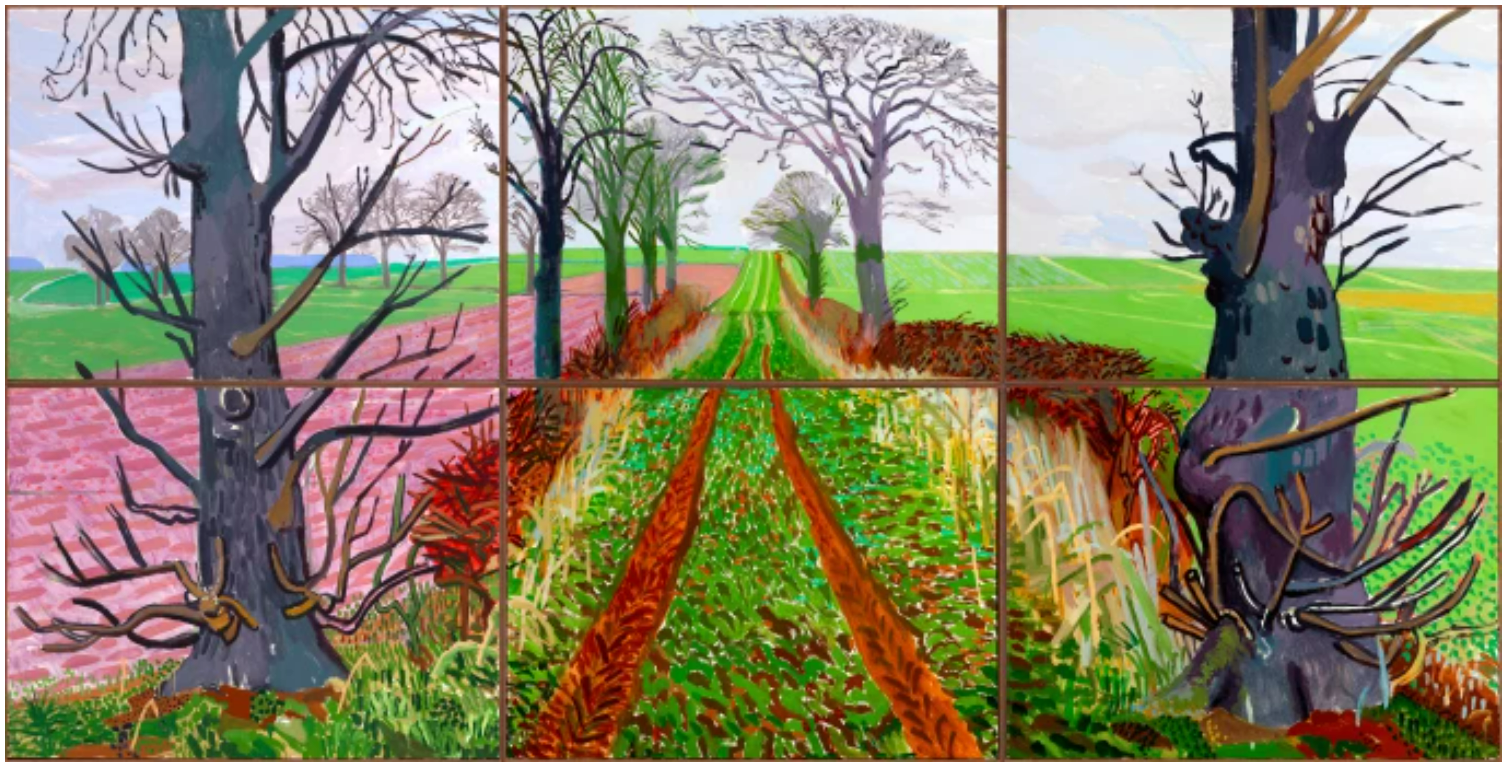
DAVID HOCKNEY, A CLOSER WINTER TUNNEL, FEBRUARY – MARCH, 2006 / ART GALLERY OF NEW SOUTH WALES, SYDNEY
PHOTO: RICHARD SCHMIDT / ARTWORK: © DAVID HOCKNEY.
Wrestling with the authority of one-point perspective, Hockney expands the scope of his vision, aiming to capture the true experience of being in the landscape. Beginning in 1982, Hockney had pioneered a means of photographic collage that broke down traditional reliance upon European one-point perspective in artistic representation. With these works, Hockney succeeded in rendering photographic space in a Cubist-inspired mélange of perspective points. Presented in this manner, the picture ceased to be a static window presented to the viewer; instead, the viewer is faced with multiple entry points through which to view and enter space, experiencing the image rather than understanding it as a representation of physical reality. Hockney’s image then destabilises traditional perspective and offers a depiction of the world as it is actually experienced—letting the viewer’s eyes travel across various openings within the same image. In choosing the simple gesture of presenting each scene as a separate screen, Hockney breaks down any one single entry point into the landscape and further emphasizes a fractured viewing experience that is more authentic.
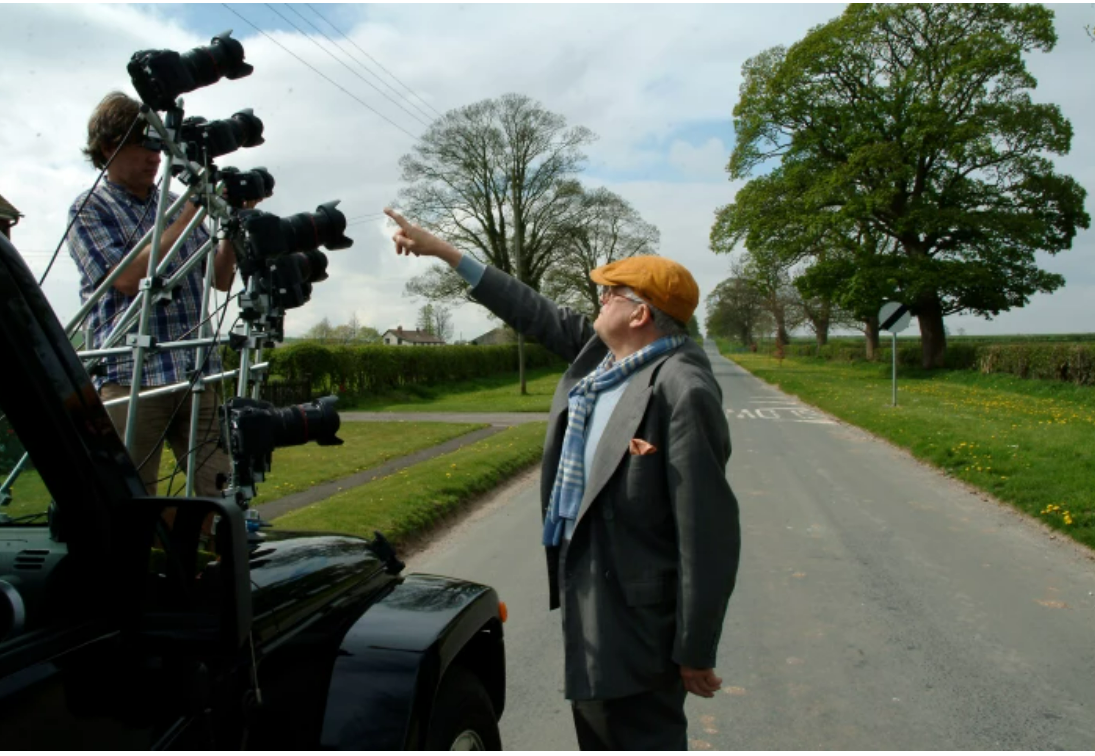
DAVID HOCKNEY DIRECTING NINE CAMERAS, ASSISTED BY JONATHAN WILKINSON, APRIL 2010 IMAGE: JEAN-PIERRE GONCALVES DE LIMA © DAVID HOCKNEY
The Wolds are a vast pocket of agricultural land between York and the seaside town of Bridlington; not obtruded by industry or development, and always used exclusively as farmland, Hockney refers to this landscape as “the least changed bit of England that I know” (David Hockney quoted in: Exh. Cat., Schwäbisch Hall, Kunsthalle Würth, David Hockney / Nur Natur / Just Nature, 2009, p. 182). Hockney first came to know this small pocket of Yorkshire when he was around fifteen years of age, having spent his summer holidays of 1952 and 1953 collecting corn on a local farm between the villages of Wetwang and Huggate. Less immediately spectacular in appearance than West Yorkshire—a region visited and painted by the great landscape painters of the Nineteenth Century such as J.M.W. Turner and John Varley—the agrarian undulating knolls always held a special attraction in Hockney’s heart. Although Hockney remained fond of these gentle hills and dense forest coves, it was not until his sixtieth year that he came to study them with a renewed vigour and interest. It was the tragic combination of his mother’s advancing age and the ill health of his close friend Jonathan Silver that drew Hockney back to the Wolds. Every three months he would return to this small area of East Yorkshire and take his mother for long drives across the countryside, magnifying his intense affection for the landscape. Eventually, in the summer of 1997, Hockney embarked on a small group of oil paintings that were driven by the accumulated sensations of these habitual journeys. Entirely undisturbed by time, the landscape of the Wolds is one that has remained changeless since Hockney’s youth; it is this long-term stasis of the land that made the cyclical changes in climate and season all the more poignant for the artist.
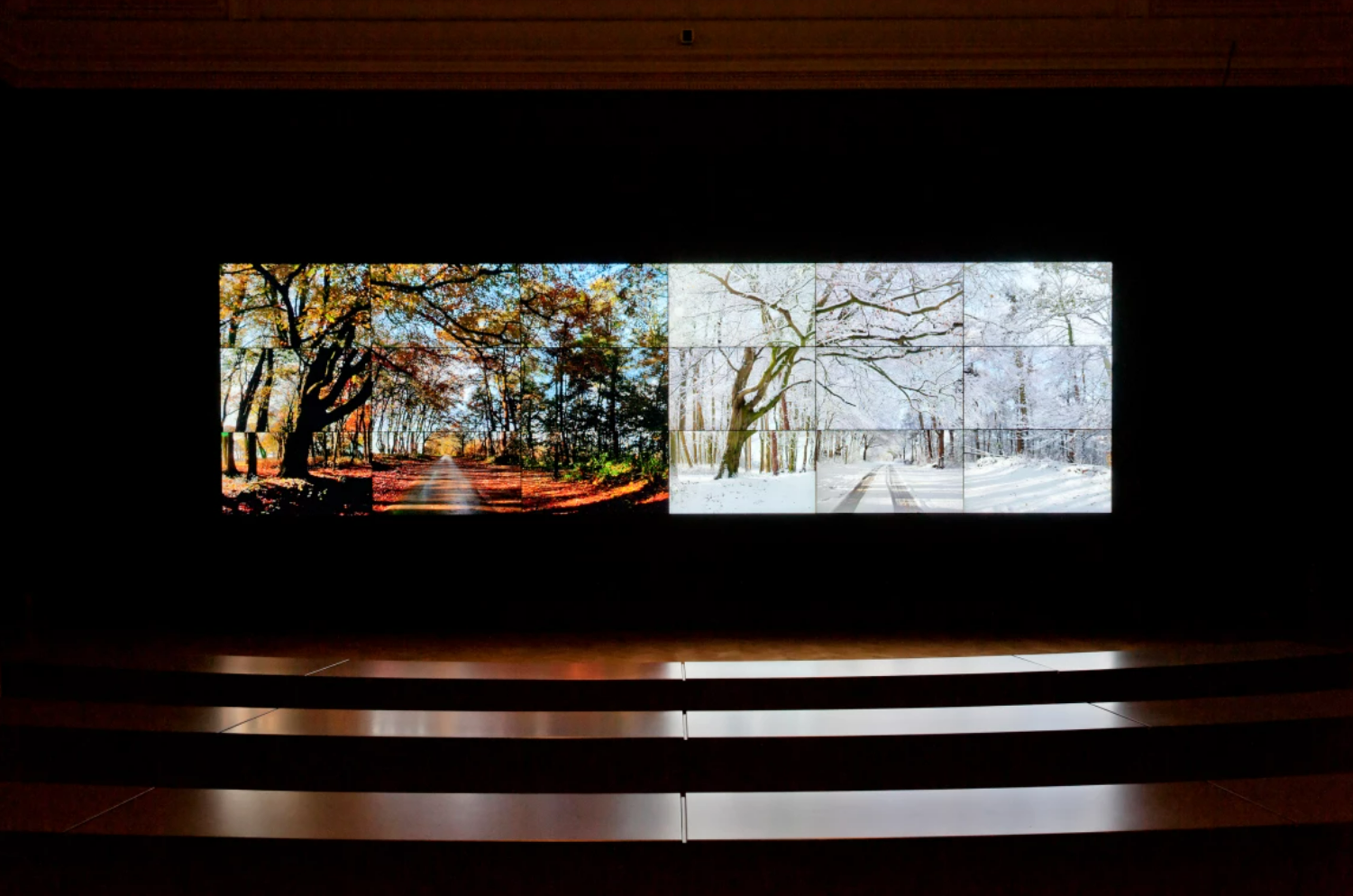
INSTALLATION VIEW OF THE PRESENT WORK AT DAVID HOCKNEY: A BIGGER PICTURE, ROYAL ACADEMY OF ARTS, ROYAL ACADEMY OF ARTS, LONDON, JANUARY – APRIL 2012 / IMAGE: © ROYAL ACADEMY OF ARTS, LONDON; PHOTOGRAPHER: MARCUS J LEITH
ARTWORK: © DAVID HOCKNEY
After a period spent painting his favoured East Yorkshire landscapes in watercolor Hockney returned to easel painting in 2005. He set up his easels en plein air aiming to find a more straightforward representation of the real space which stretched out before him. Using multiple canvases allowed the artist to work on an ever-greater scale outdoors. With these pictures, he strove for an immediacy and intensity in capturing the world. Marco Livingstone explains, “His immediate success and the speed at which he increased the scale and complexity of the pictures in diptychs then in paintings that unfold fluidly over four, six, eight or even more separate conjoined canvases, was the product of a lifetime’s experience: a cumulative history of painting and drawing, of looking at nature and of scrutinizing the art of his predecessors” (Marco Livingstone quoted in: Exh. Cat., Schwäbisch Hall, Kunsthalle Würth, David Hockney / Nur Natur / Just Nature, 2009, p. 189). In these monumental vistas of the Yorkshire landscape, Hockney is interested in the perspective of the spectator who stands in the centre of the composition. Indeed, Hockney said of these works that his intention was to “convey the experience of space” (David Hockney quoted in: Laurence Weschler, “Wider Perspectives: Painting Yorkshire and the Grand Canyon (1998),” True to Life: Twenty-five Years of Conversations with David Hockney, Berkeley, 2008, p. 112).
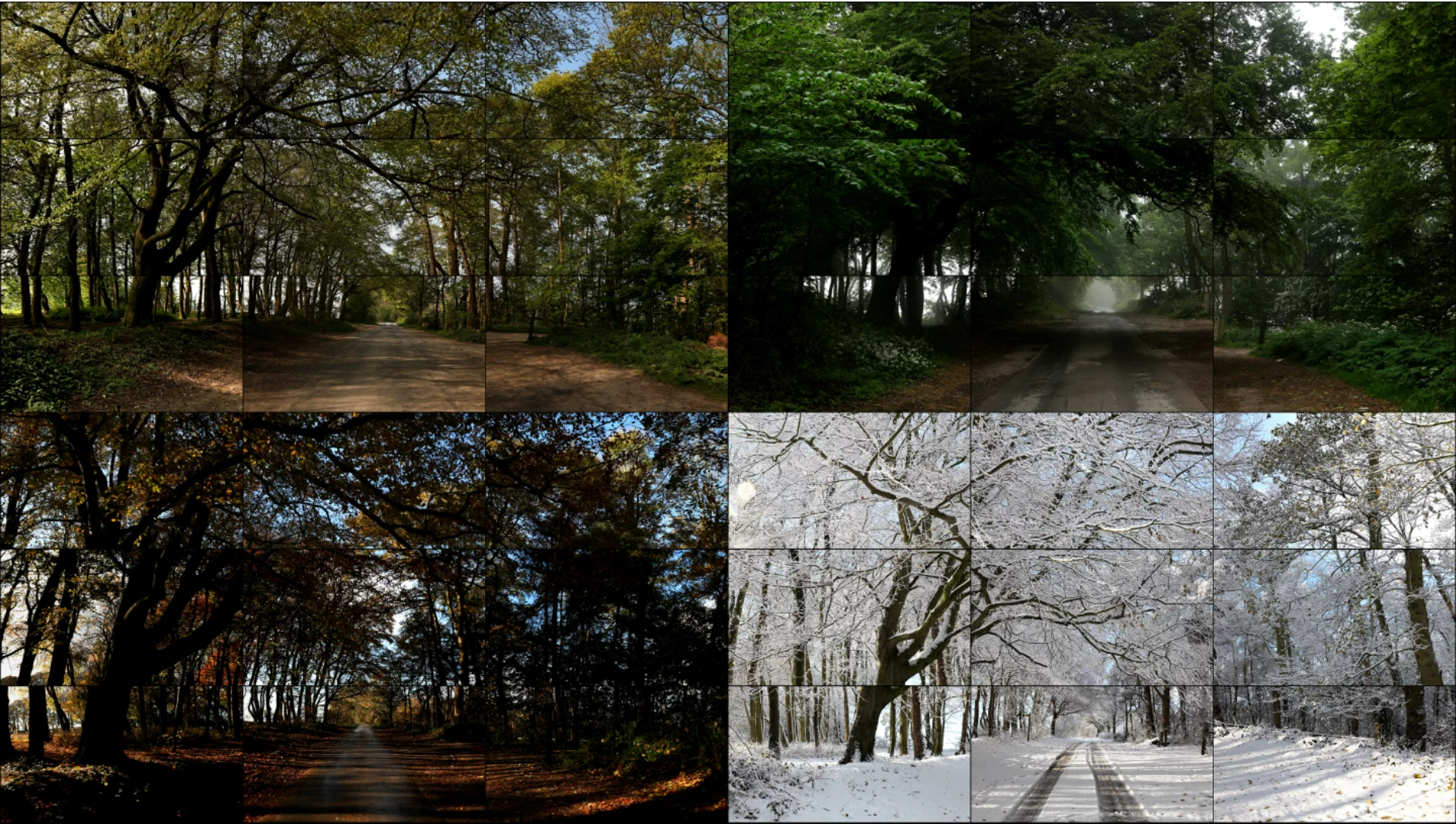
DAVID HOCKNEY, THE FOUR SEASONS, WOLDGATE WOODS (SPRING 2011, SUMMER 2010, AUTUMN 2010, WINTER 2010), 2010-2011
IMAGE/ARTWORK: © DAVID HOCKNEY
Woldgate Woods, Winter 2010 is then the logical extension of Hockney’s incessant passion for looking, appreciating, and experiencing the land. Capturing the same viewpoint over cycles of growth and regeneration allows the artist to investigate the ever-changing complexity of the natural world, heightening the sensation of actually being in the landscape. Recalling nineteenth-century panoramas and Monet’s curved Nymphéas canvases at the Orangerie in Paris, the viewer is obliged to shift their vision in order to take the multiple viewpoints of the same scene in. However, the increase in monumental scale of Woldgate Woods, Winter 2010 miraculously produces a greater intimacy, enveloping and submerging the viewer into its three-dimensional space and transporting us to the moment of its execution.
One of the most ground-breaking of Hockney’s remarkable depictions of his home county, the East Yorkshire landscape in Woldgate Woods, Winter 2010 is like a sitter that he has known for the longest period of his now eighty-year life; the face of the land and its ever-changing complexities, as masterfully interpreted by Hockney, personifies the artist’s career-long fascination with lived human experience. Breathing new life into the once stagnant, historic tradition of landscape painting the present work is a glorious and poignant paean to the landscape of Yorkshire and receives due placement as a pivotal work within Hockney’s oeuvre.