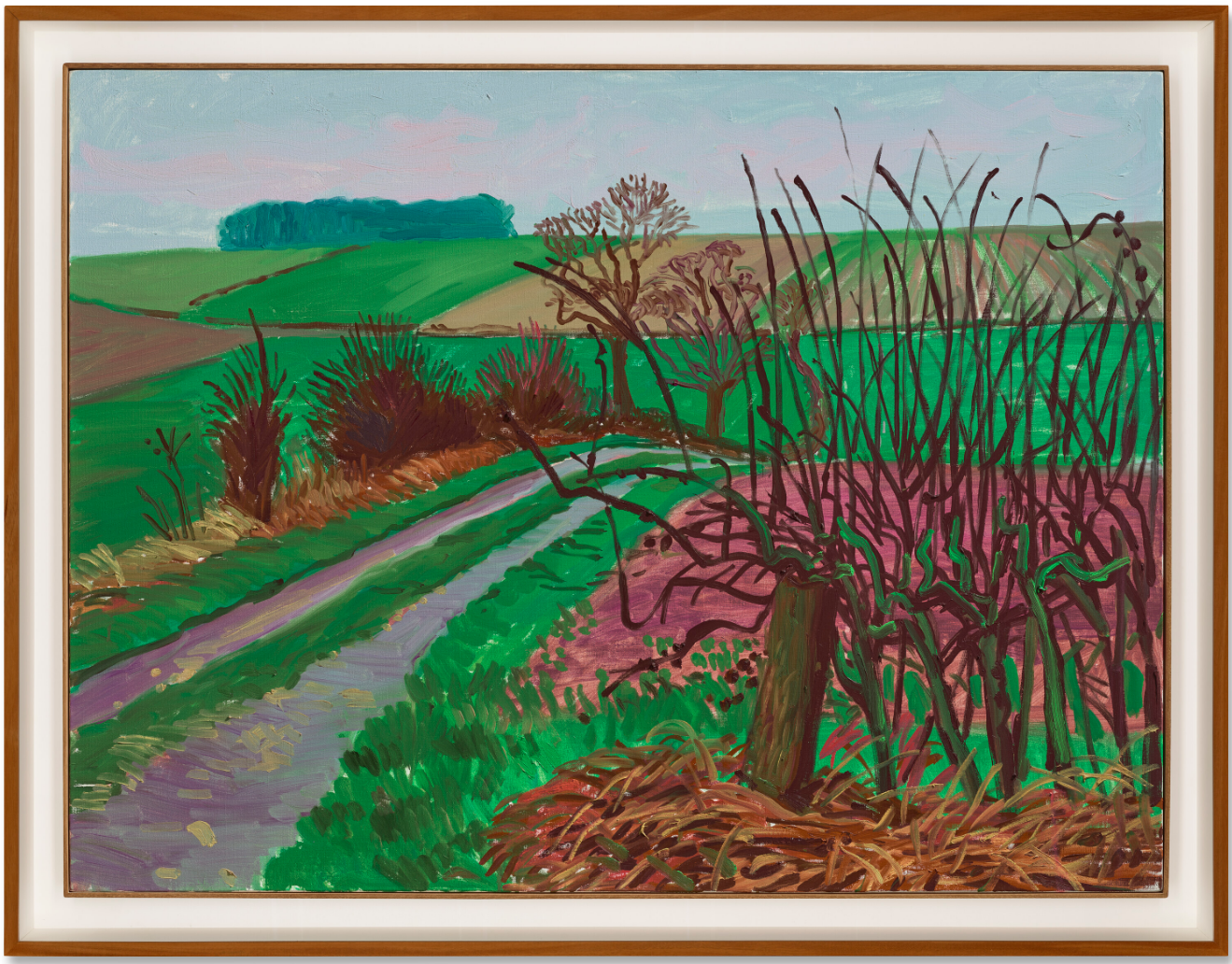
DAVID HOCKNEY (B. 1937)
Track and Hedgerow, January, 2006
Oil on canvas
36×48 inches (91.4 x 121.9 cm)
Signed and dated ‘David Hockney Jan 23 06’ (on the reverse)
Provenance
Annely Juda Fine Art, London
Private collection, Boston
Anon. sale; Christie’s, New York, 11 November 2010, lot 185
Acquired at the above sale by the present owner
Auction History
Christie’s New-York: 9 November 2023
Estimated: USD 5,500,000 – 6,500,000
USD 6,342,000
DAVID HOCKNEY (B. 1937) (christies.com)
Included in the artist’s landmark 2012 retrospective David Hockney: A Bigger Picture at the Royal Academy of Arts, London, Track and Hedgerow, January is a radiant love letter to his native Yorkshire landscape. With loose, impressionistic brushstrokes, Hockney pays tribute to the unspoiled beauty of his homeland: its lonely paths, atmospheric light and undulating fields, as rich and vivid as his childhood memories.
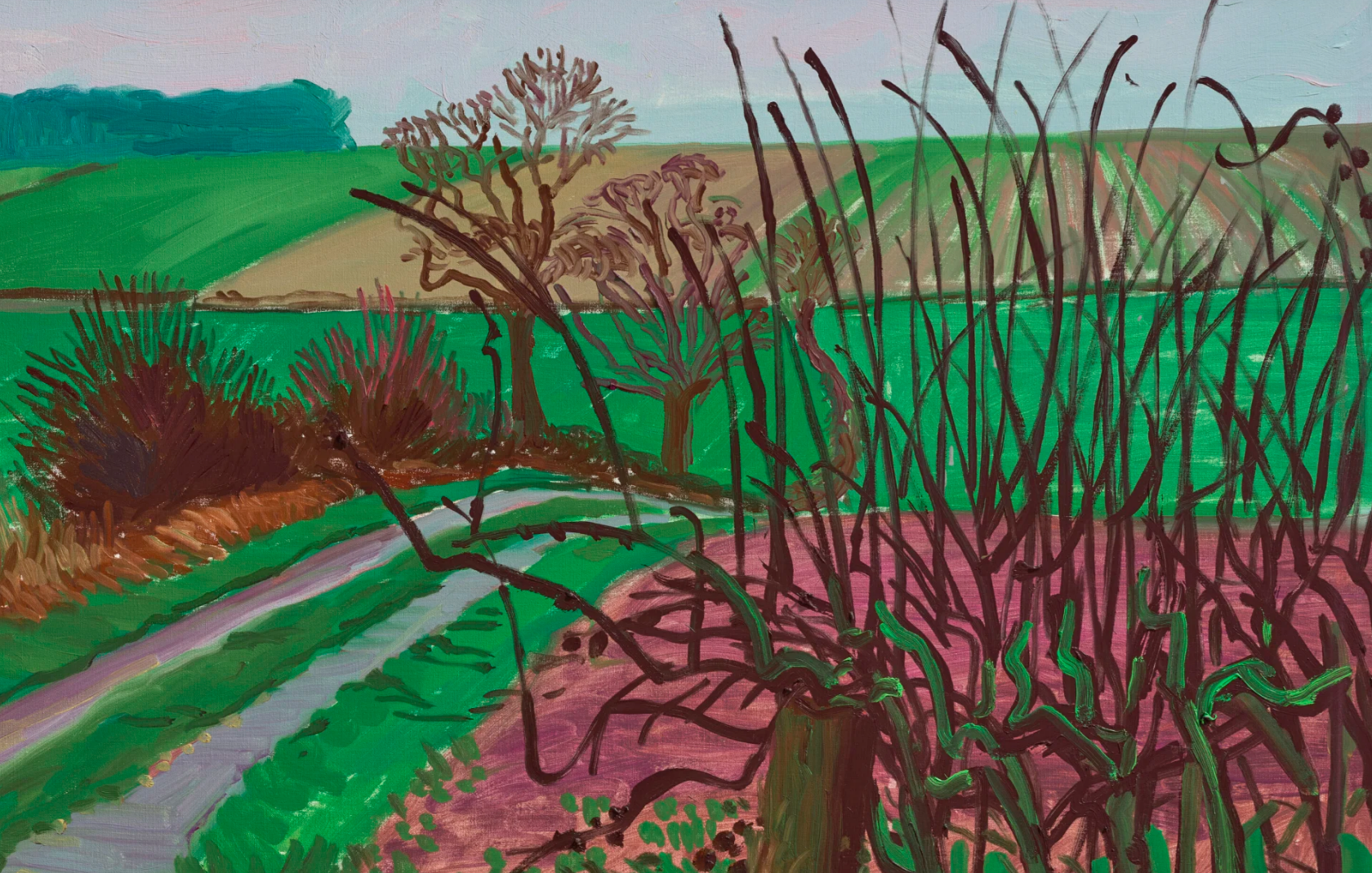
Described by Marco Livingstone at the time as “the most commanding [works] he has ever made,” Hockney’s depictions of the Wolds between 2005 and 2008 marked a major new chapter in his forty-year-long career (M. Livingstone, “Home to Bridlington: Routes to a Private Paradise,” in David Hockney: Just Nature, exh. cat. Kunsthalle Würth, Schwäbisch Hall, 2009, p. 188). The artist had made repeated visits home in the years leading up to his mother’s death in 1999, and was struck by the ever-changing splendor of his native county. Returning in 2004, he began to work outdoors, channelling the influence of Constable, van Gogh, Monet and Turner as he captured the shifting light and seasons. Saturated with the same life-affirming glow as his Californian paintings, Track and Hedgerow, January is a poignant elegy to home, infused with new passion, grandeur and technical bravura. The present painting bears witness to Hockney’s deep and intuitive affinity with the Yorkshire soil. Its patchwork of nuanced light and color is immediately recognizable to anyone who has taken a winter walk through the area. There is the thin band of sky, its veil of silver-grey cloud backlit with blue, and a distant, emerald stand of evergreens on the horizon. A reddish patch of ploughed earth shines bright among the chlorophyll of verge and field. Commanding the foreground, the leafless hedgerow reaches its dark boughs skyward. A video of Hockney at work shows him painting these branches in a thatch of deft, whiplash strokes. Devotedly en plein air, he wears a heavy coat and keeps warm with a Thermos flask as he paints. An assistant holds up the finished canvas against the landscape, and Hockney declares himself satisfied.
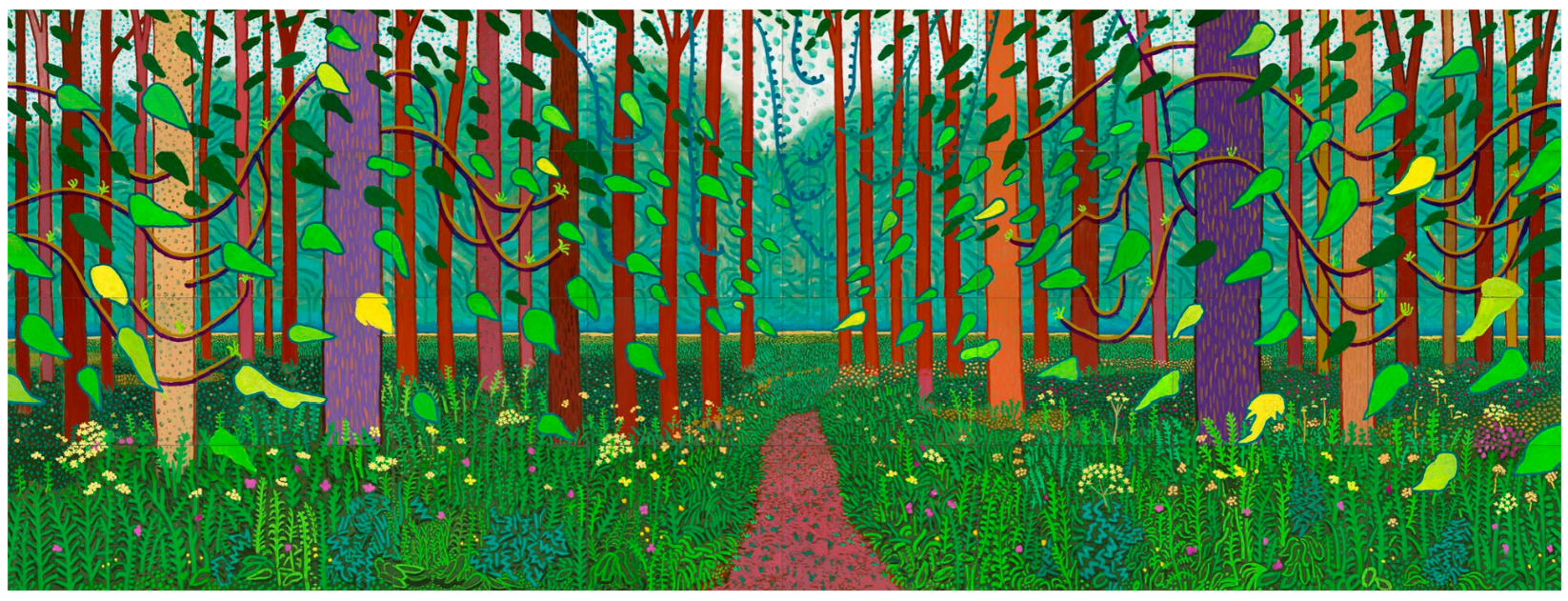
David Hockney, The Arrival of Spring in Woldgate, East Yorkshire in 2011, 2011. Centre Georges Pompidou, Paris. © David Hockney. Photo: © The David Hockney Foundation.
Hockney’s portraits, often depicting the same subjects over many years, reveal the intimacies and evolutions of his personal relationships. His Yorkshire landscapes display the same warm attention towards his homeland. On its 2006 debut in the exhibition David Hockney – A Year in Yorkshire at Annely Juda Fine Art, Track and Hedgerow, January was shown alongside paintings Hockney had made throughout the year; in the larger Royal Academy show, landscapes painted across several years were organized according to specific sites, so that viewers were taken on a journey through the East Riding. Seen together, the works bear witness to Hockney’s close engagement with the changing seasons. The present painting’s bare hawthorn hedges might elsewhere be seen bejeweled with young green leaves or bursting into the spectacular blossom of May. It is arguably in the wintry calm seen here, however, that Hockney’s vision is at its most sensitive. “Perhaps contrary to popular expectations,” writes Marco Livingstone, “the best circumstances for painting are not necessarily to be found on cloudless days in spring or summer: it is in autumn or winter, in fact, that this landscape can be studied at its most subtle, branches clearly demarcated when they are denuded of leaves and the colors of the soil and vegetation appearing more intense in the gentler light” (M. Livingstone, “The Road Less Travelled,” in David Hockney: A Bigger Picture, exh. cat. Royal Academy of Arts, London, 2012, p. 25.)
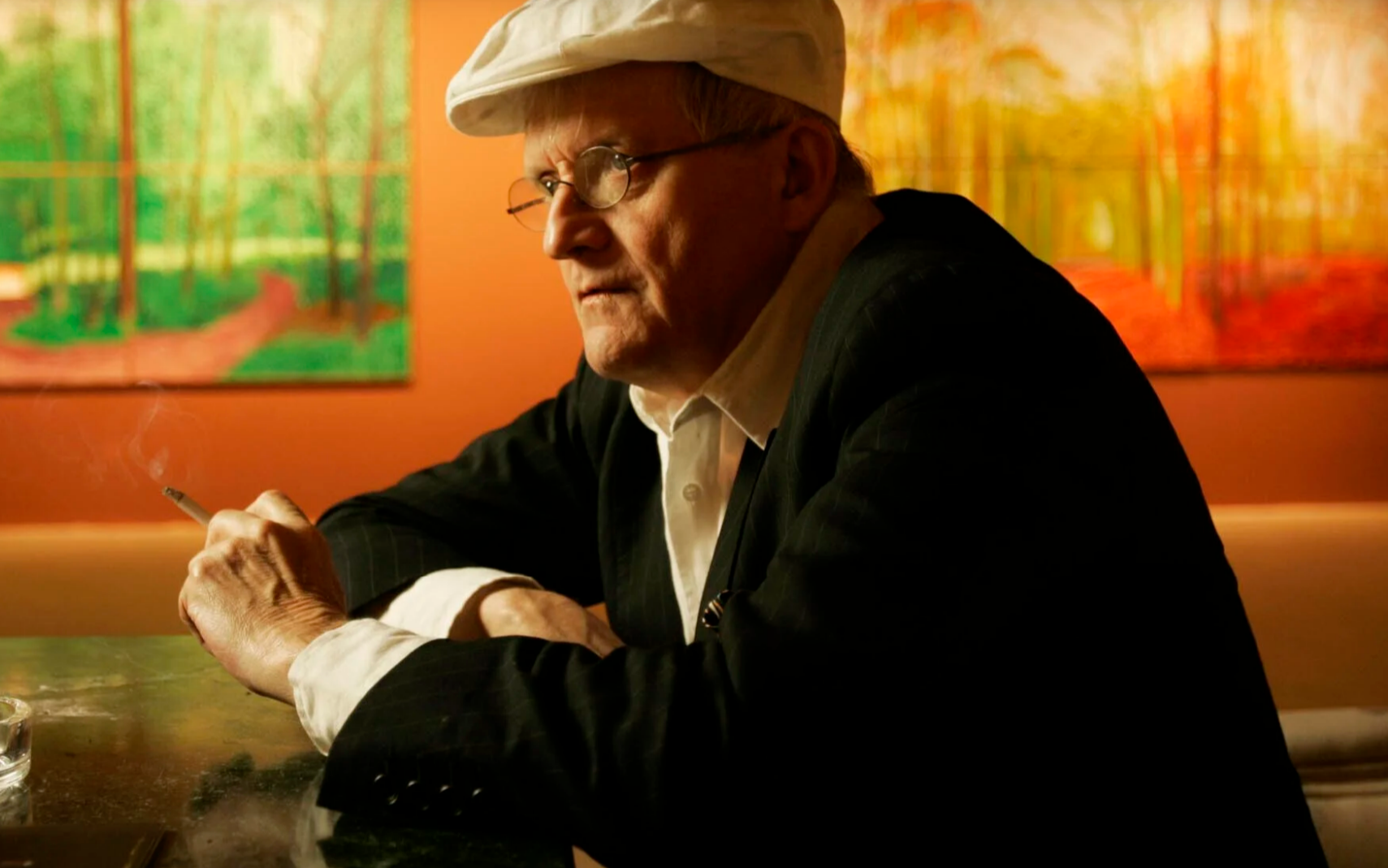
David Hockney in his studio with his new landscape paintings, 2007. Photo: Al Seib / Contributor. Artwork: © David Hockney.
Over the following years, Hockney would explore the most rural corners of the East Yorkshire landscape in almost every available medium: from watercolor, paint and pencil to photography, film and digital inkjet print. The result was not only one of his most distinctive bodies of work, but also an extraordinary technical tour de force. From 2008, he would even make use of the iPad and iPhone as drawing tools. Despite these technological forays, however, Hockney’s work remained firmly grounded in the lessons of art history. His resolve to paint outdoors increased when the major exhibition Constable: The Great Landscapes opened at Tate Britain in the summer of 2006. Hockney especially admired the artist’s “six-footers”—shown together there for the first time—which included loosely-painted full-scale “sketches” as well as polished final versions. He also stood in wonder before Monet’s Nymphéas on a trip to the newly refurbished Musée de l’Orangerie in Paris. Van Gogh, too remained a vital source of inspiration, admired for his ability to capture the eternal flux of the landscape. In California, Hockney had missed the thrill of the changing seasons; back in Yorkshire, they seemed more beautiful and vital than ever before. Bathed in winter light, Track and Hedgerow, January is alive with the revelations of both past and present, capturing the wonder and the familiarity of home.