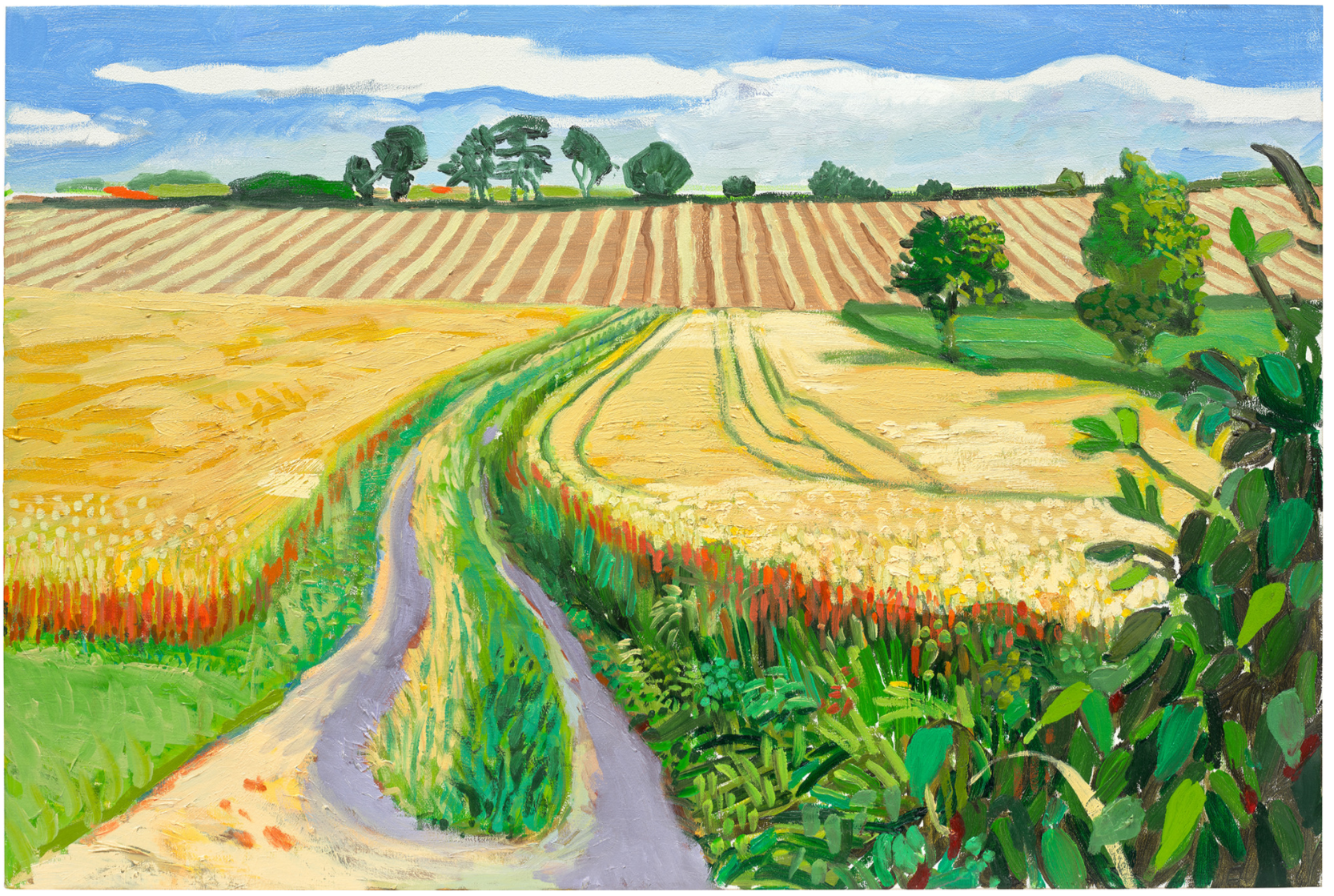
DAVID HOCKNEY
Path Through Wheat Field, July, 2005
Oil on canvas
61.1 x 91.4 cm (24 x 35 7/8 inches)
Signed and dated ‘David Hockney July 22 – 4 Aug 05’ on the reverse
Provenance
Annely Juda Fine Art, London
Acquired from the above by the present owner circa 2006
Auction History
Phillips London: 10 October 2024
Estimated: GBP 2,000,000 – 3,000,000
GBP 3,315,000 / USD 4,342,650
David Hockney – Modern & Contemporary… Lot 6 October 2024 | Phillips
Suffused with a warm, summer light, energized and amplified by fluid strokes of bright, joyous color, David Hockney’s Path Through Wheat Field, July is a tender paean to the dramatic landscape of the artist’s childhood, and to the long tradition of landscape painting itself. Completely fresh to the market, the present work was painted in 2005 following Hockney’s return to his native Yorkshire and marks a period of remarkable creative re-invention and innovation as the artist approached his seventieth year. Included in significant exhibitions such as the major travelling survey of his landscape painting David Hockney: A Bigger Picture, the work is an important, early example of the pivotal cycle of paintings in oil. Working at a prodigious rate and painting en plein air, in this series Hockney recorded the passing of the seasons in the rolling hills and valleys beyond Bridlington over the course of a year, masterfully translating the chromatic intensity and sophisticated spatial logic of his Californian landscapes into the golden fields and verdant hedgerows of his homeland, capturing both the rich natural beauty of the Wolds and Hockney’s deep, personal connection to this place.
Born in the industrial town of Bradford, West Yorkshire in 1937, Hockney enthusiastically recalls the summers spent as a teenager working the fields around Bridlington, stooking corn for harvest and collecting the chaff. Traversing the vast, undulating terrain by bicycle daily the young Hockney was intimately familiar with its winding paths and sudden, dramatic vistas, just as he would have been with the rhythmic passing of the seasons and shifting weather patterns. Although California provided the backdrop and inspiration for some of his most iconic pictures, the strong physical and emotional presence of the Yorkshire Wolds never really left him, and can perhaps even be traced beneath the roving, panoramic scenes of the Hollywood Hills and Pacific Coast Highway that he captured with the carefully observant and eager eye of the outsider in the 1980s.
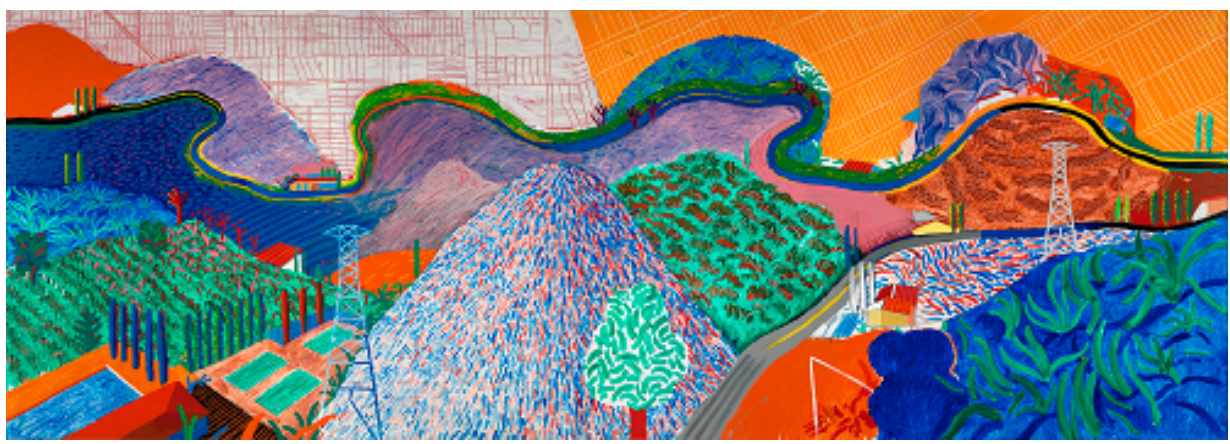
David Hockney, Mulholland Drive: The Road to the Studio, 1980, Los Angeles County Museum of Art. Image: Richard Schmidt, Artwork: © David Hockney
It wasn’t until the artist approached sixty that he turned more consciously to the rolling landscape of his childhood, his more frequent return visits to Bridlington in East Yorkshire in the late 1990s driven largely by bonds of family and friendship following the decline of his mother’s health and the terminal diagnosis of his close friend the gallerist Jonathan Silver. Taking long drives with his mother out across the Wolds from Bridlington he found himself enchanted once again by the lilting landscape, a sensation cemented even further in the winding, panoramic drives out west to Wetherby, where Silver continued to gently press Hockney to turn his painterly attention to the contoured landscape of the Wolds. Returning to California with Silver’s words laying heavy on his mind he began painting these scenes from memory, producing a small but highly significant suite of 6 paintings – examples of which include the 1998 canvas Garrowby Hill, now held within the permanent collection of the Museum of Fine Arts, Boston – that set the trajectory for his triumphant return to the North of England – and to easel painting. As Marco Livingstone has sensitively put it, ‘It was through friendship, devotion to family and a sense of loss that Hockney came to paint Yorkshire and, through this prolonged love letter to his native land, to understand the depths of his feeling for his country and explicitly for the north of England, where his roots are as deep and firm as those of the trees he has expended such affectionate and respectful attention.’
Experimenting first in watercolor, Hockney quickly discovered the rich possibilities and variety afforded by this subject, and by 2005 following his more permanent relocation to Bridlington, his distinctive silhouette could be seen working in all weathers across East Yorkshire, setting up his easel and working at speed on the roadside. As the Impressionists had worked en plein air to record the subtle shifts in light and color offered by different times of day and passing seasons, Hockney took himself to task, even modifying his 4×4 to accommodate the sometimes vast canvases and paint palettes just as Claude Monet had constructed his own studio boat to allow him to paint his panoramic views of the Seine and the specific play of light on the water’s surface that would have been inaccessible otherwise.
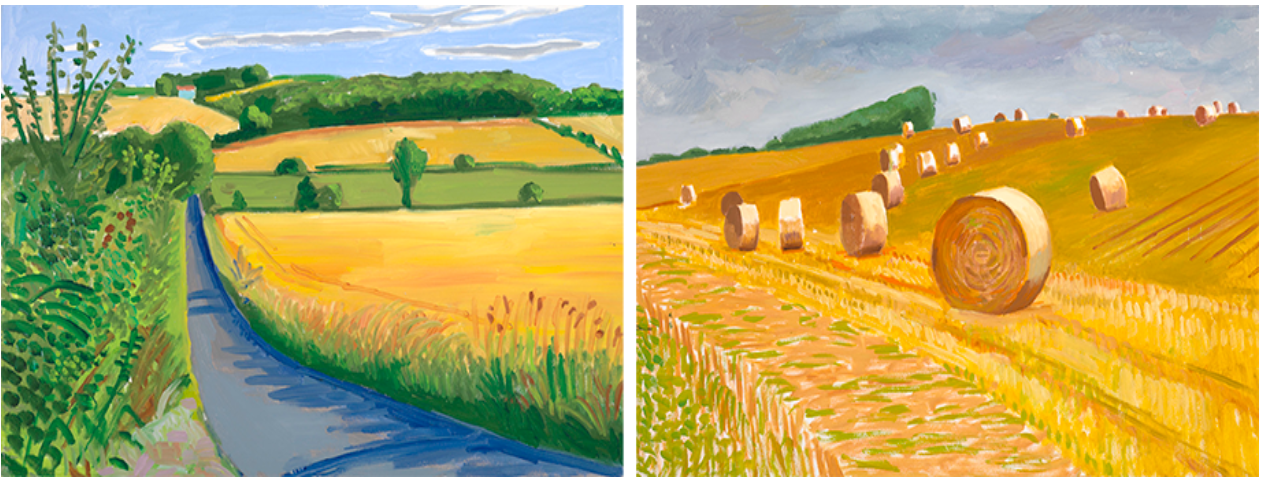
Left: David Hockney, Rudston to Langtoft, 30 July, 2005, 2005, Private Collection. Image: Richard Schmidt, Artwork: © David Hockney
Right: David Hockney, Untitled Harvest, 2005, Private Collection. Image: Richard Schmidt, Artwork: © David Hockney
Although perhaps an unexpected subject for a contemporary painter more often associated with Pop and portraiture, Hockney’s turn to a more traditional mode of landscape painting places him firmly in a long line of artists for whom the abundant natural beauty of their immediate surroundings presented certain pictorial challenges and rewards. In the context of British painting, Hockney’s Yorkshire landscapes resonate with the bucolic scenes of the Dedham Vale so memorably captured by John Constable, and it was the occasion of a major retrospective of the artist the year after the current work’s execution that emboldened Hockney to try his hand at working en plein air at a more expansive scale, sometimes combining multiple canvases to depict a single, vast scene. In terms of color, dynamism, and the sheer joy provoked by these natural surroundings, the influence of Post-Impressionist Vincent van Gogh is especially pronounced across Hockney’s Yorkshire paintings, notably in the rich golden cornfields and meandering sense of line that is so powerfully realized in Path Through Wheat Field, July.
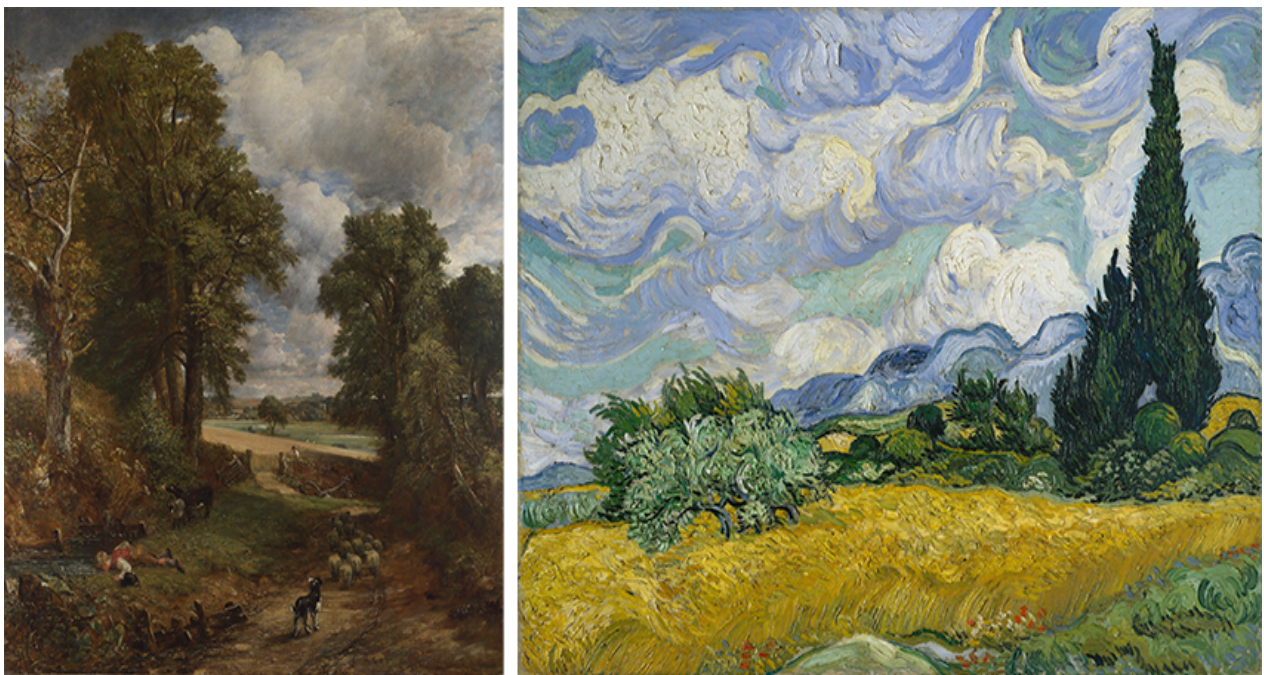
Left: John Constable, The Cornfield, 1826, The National Gallery, London. Image: © The National Gallery, London/Scala, Florence
Right: Vincent van Gogh, Wheat Field with Cypresses, 1889, The Metropolitan Museum of Art, New York. Image: © The Metropolitan Museum of Art, New York, Purchase, The Annenberg Foundation Gift, 1993
Combining memory, emotion, and sensation, in these evocative canvases Hockney also applied the lessons taken from a deepening fascination with the question of optics and its relationship to pictorial space that the artist had explored across photocollages, book-length studies on the use of optical aids by Old Masters, and his own experiments with a vintage camera lucida. Like van Gogh before him Hockney was really looking at this landscape and the shifting qualities of light and weather across it, quickly realizing the inadequacies of photography for capturing the more complex sense of depth and spatial reality that the eye could perceive out on the Wolds.
“Around Bridlington, I was painting the land, land that I myself had worked.
I had dwelt in those fields, so that out there, seeing, for me,
necessarily came steeped in memory.”
Although deeply interested in photography, Hockney recognized an important distinction between the camera’s tendency to keep the viewer at a remove, to flatten space, and stop time and the slower, more individualized experience of looking with the eye. As Hockney has said, with these works, his primary intention was to ‘convey the experience of space’, an experience that is not only perceptual but draws on feeling, memory, and embodied sensation.