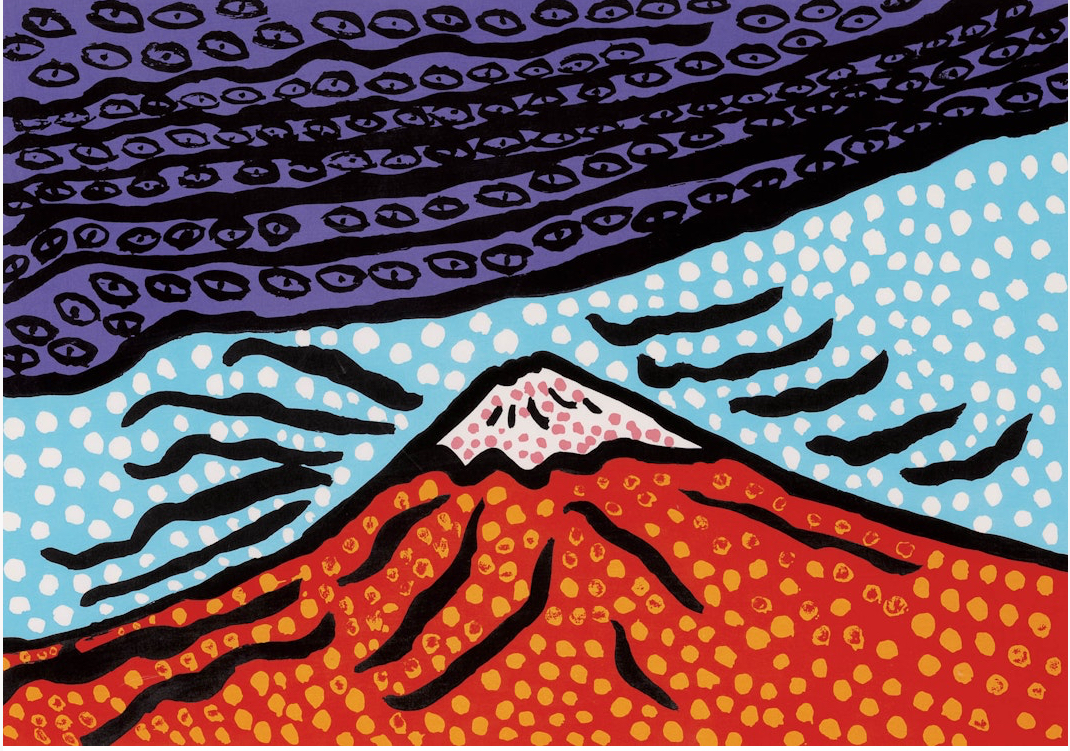
Mt. Fuji is the home of my heart
Medium: Woodcut print on echizen kisuki hosho paper
[6 plates / 11 runs]
Year: 2015
Image: 42 x 59.5 cm (16.5 x 23.4 inches)
Sheet: 50.8 x 67.5 cm (20.2 x 14.2 inches)
Edition: 120
Woodcut curver: Niinomi Morichika, Kishi Chikura
Printer: Kyoso Yoshio
Publisher: The Adachi Woodcut Prints
Literature: ABE 401
Yayoi Kusama Prints 1979-2017, ABE PUBLISHING LTD, Number 401, Illustrated page 232
Signed, dated, and numbered in pencil on lower edge
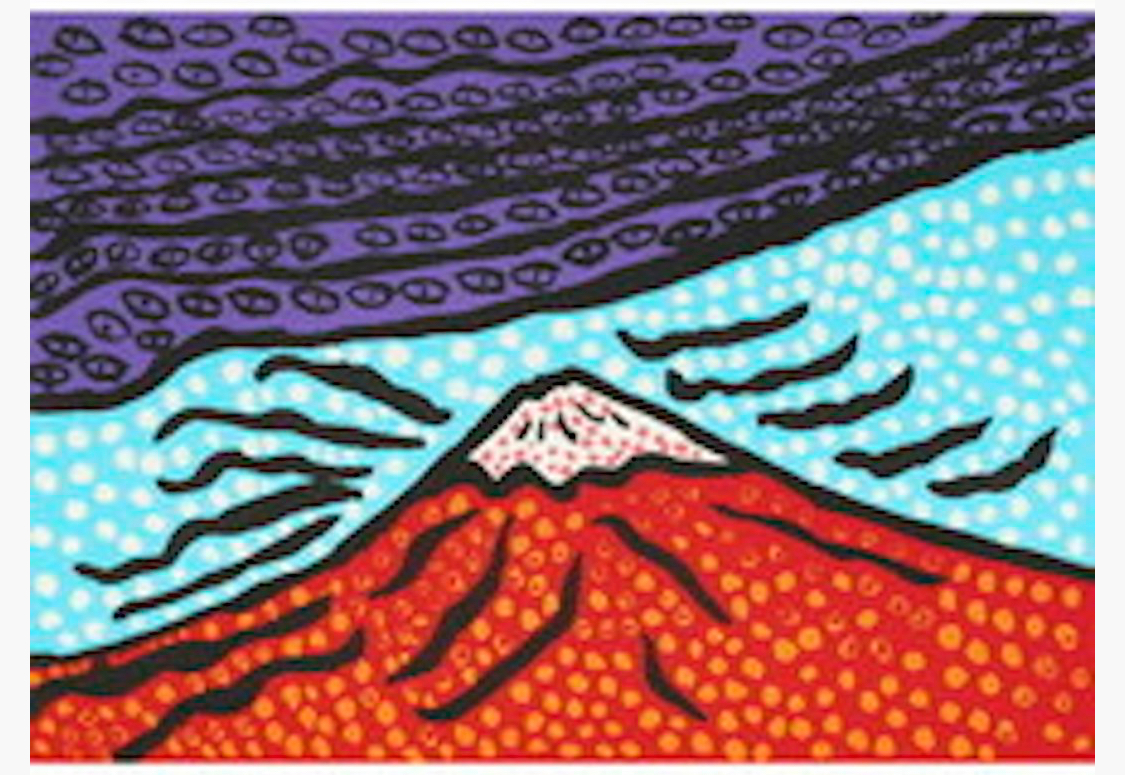
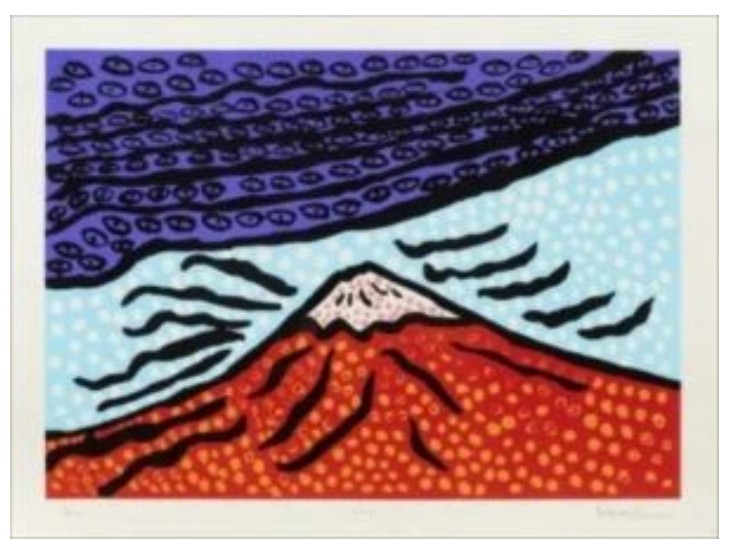
Moved by a visit to Mount Fuji, Yayoi Kusama transforms Japan’s most famous mountain into a pulsating vision of obsessive pattern and personal mythology, speaking to the artist’s love affair with her homeland. In Mt. Fuji Is The Home of My Heart, 2015, Kusama fractures the composition through three horizontal color zones of purple, blue and red, creating a sunset-like ambience that also radiates volcanic energy. Since ancient times, the graceful mountain has been depicted in ukiyo-e woodblock prints and paintings produced during the Edo period (1603–1868). Inspired by illustrious printmakers like Katsushika Hokusai whose Thirty-Six Views of Mount Fuji, 1830-32, included The Great Wave, Kusama embarked on a similar project, rendering the mountain from various angles and color schemes. Yet where Hokusai offered serene permanence, Kusama deliberating departed from the subtle palettes of traditional Japanese painting to gives us dots that throb and multiply across the surface, pulsating and writhing like the flow of lava.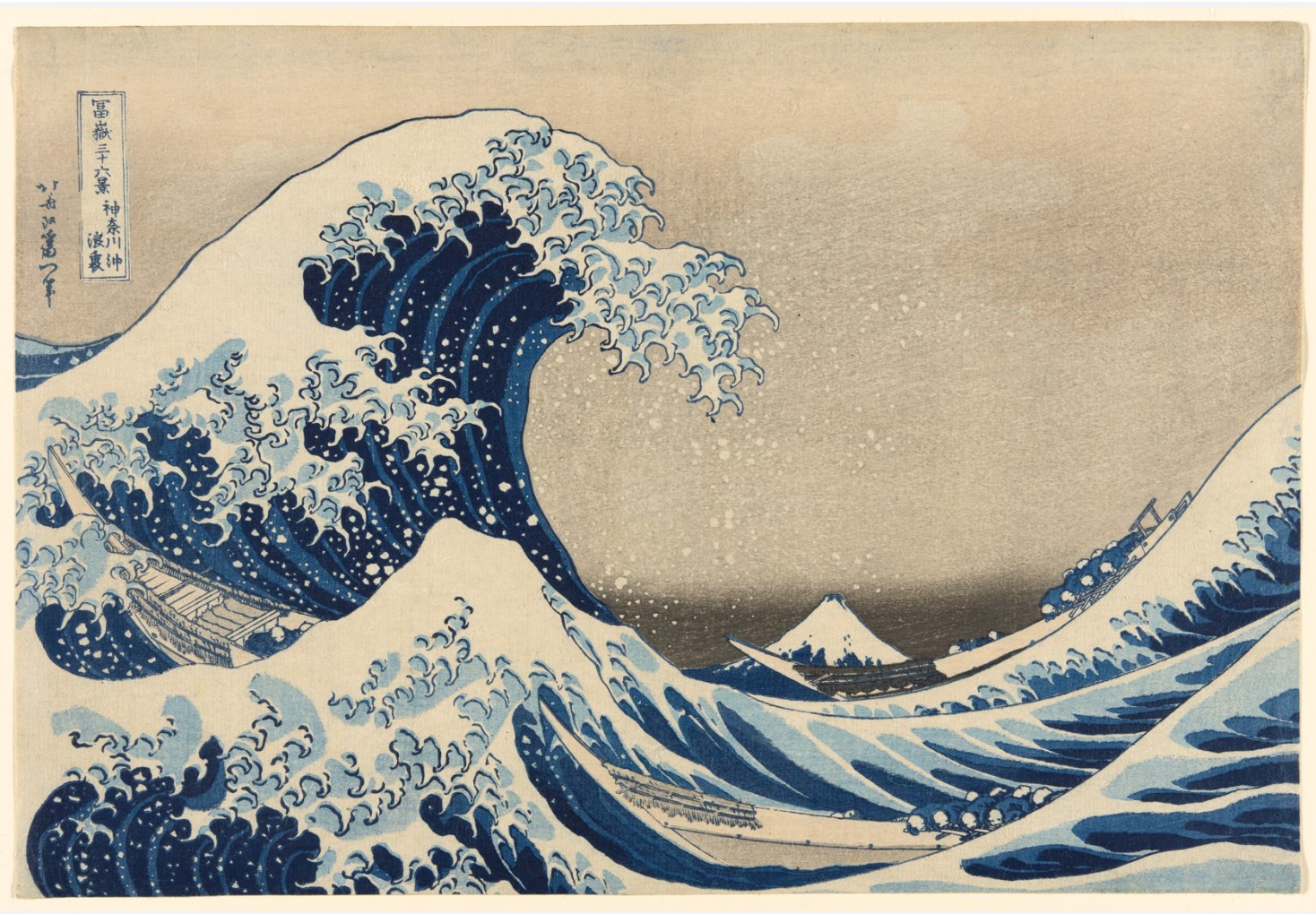 Katsushika Hokusai’s much celebrated series, Thirty-Six Views of Mount Fuji (Fugaku sanjûrokkei), was begun in 1830, when the artist was 70 years old. This tour-de-force series established the popularity of landscape prints, which continues to this day. Perhaps most striking about the series is Hokusai’s copious use of the newly affordable Berlin blue pigment, featured in many of the compositions in the color for the sky and water. Mount Fuji is the protagonist in each scene, viewed from afar or up close, during various weather conditions and seasons, and from all directions. The most famous image from the set is the Great Wave (Kanagawa oki nami ura), in which a diminutive Mount Fuji can be seen in the distance under the crest of a giant wave. The three impressions of Hokusai’s Great Wave in the Art Institute are all later impressions than the first state of the design.

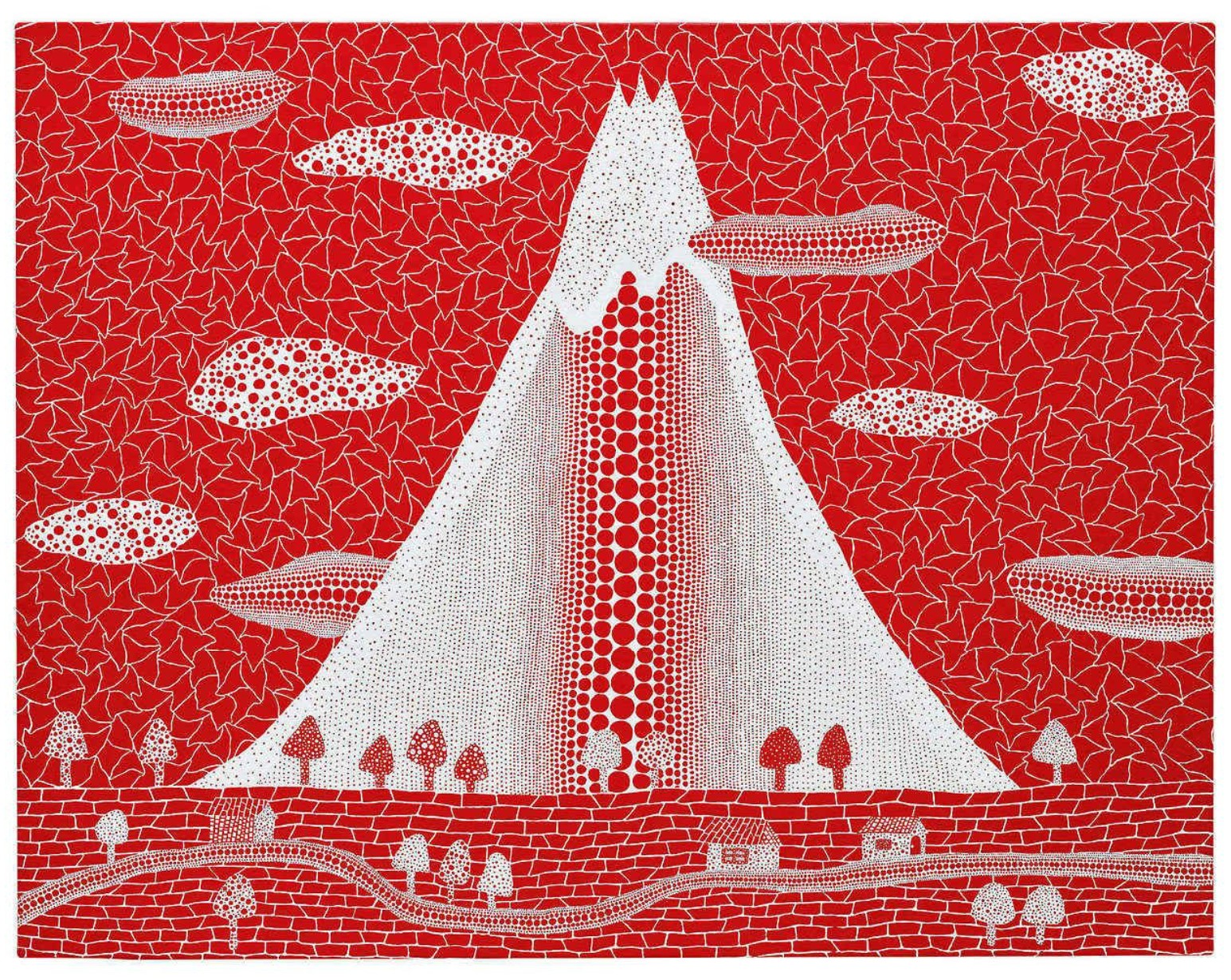
 Kusama first depicted Mount Fuji in 1982 with the lithograph Red Mt. Fuji. Over twenty years later, she revisited the subject in woodcut: a direct reference to the tradition of Japanese woodblock prints. This rendition of Mt. Fuji reveals Kusama’s mastery of the printmaking process, with dots reminiscent of her initial paint marks. Above the mountain, countless eyes stare out from a dark sky, forming an imposing part of the landscape that could wreak havoc at any time. On the one hand, they possess a surreal quality which recalls the myths surrounding the mountain; on the other, they are a motif that has reoccurred in Kusama’s practice since 2004, recalling her own spiritual awakening. For Kusama, art serves as a therapeutic release from her hallucinations. Wide-open eyes symbolize a transformation: what were once traumatic visions become eye-opening experiences. In Mt. Fuji, the eyes represent hope and the power to overcome anxiety – a triumph made possible, as the work’s title suggests, through Kusama’s depiction of her homeland.
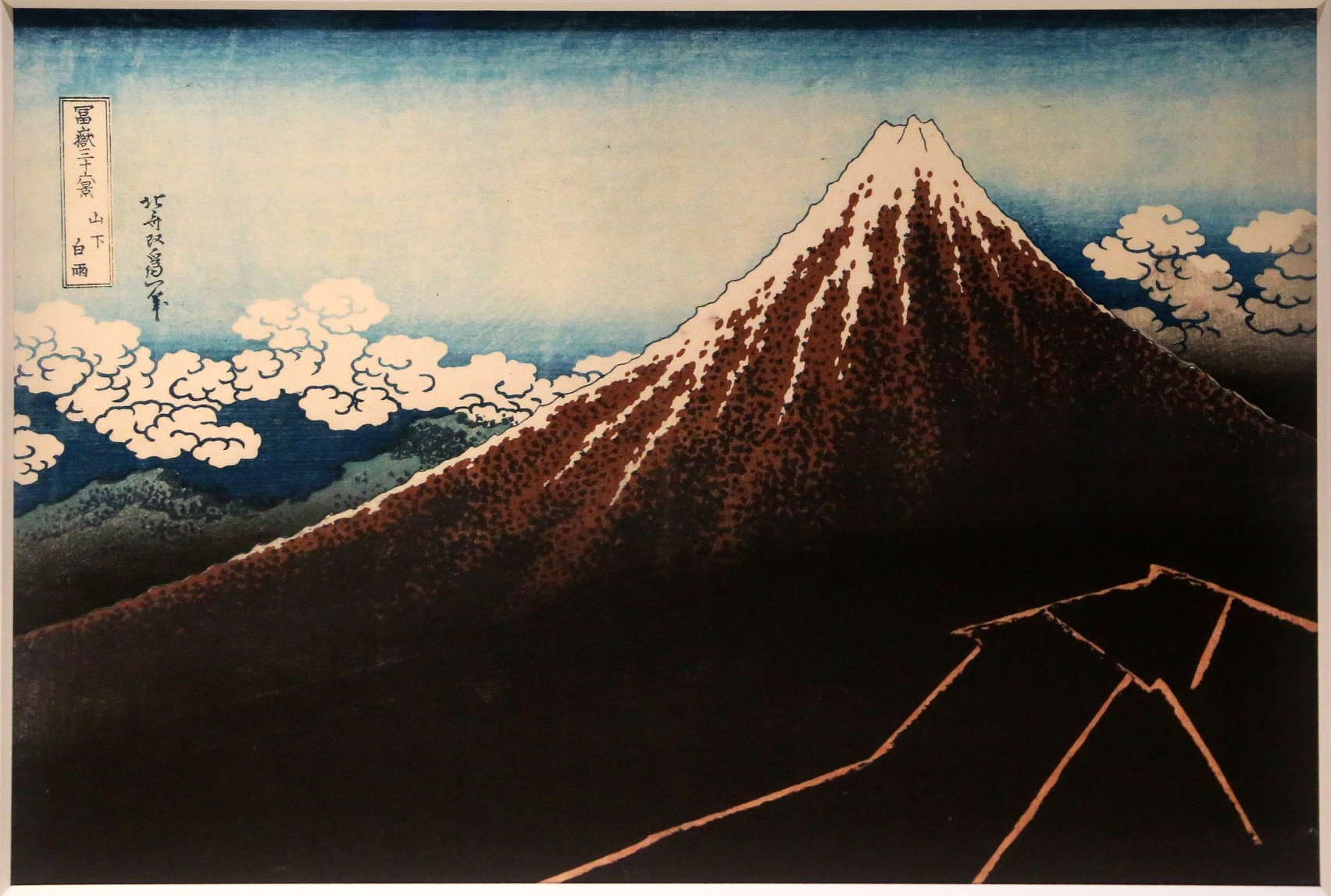
Thirty-Six Views of Mount Fuji is a renowned series of landscape prints by Katsushika Hokusai, showcasing Japan’s iconic mountain from various perspectives and in different seasons. Katsushika Hokusai (1760–1849) was a prominent ukiyo-e artist during the Edo period. He created this series between 1830 and 1832, at the age of seventy, marking a peak in his artistic career. The series consists of 46 prints, originally starting with 36, depicting Mount Fuji from various locations and under different weather conditions. Notable prints include The Great Wave off Kanagawa, Fine Wind, Clear Morning (also known as Red Fuji), and Thunderstorm Beneath the Summit.
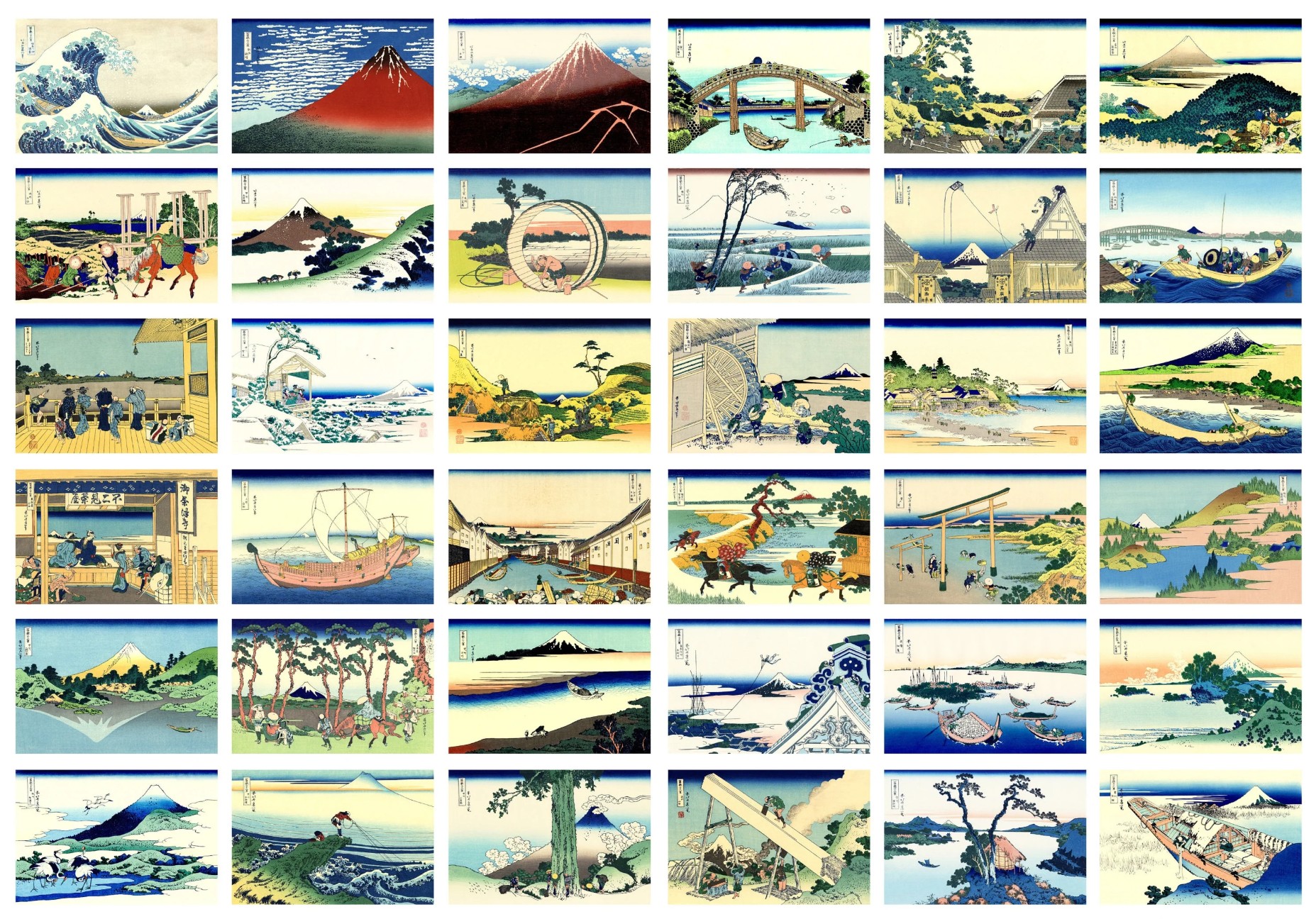
Hokusai employed traditional woodblock printing techniques, where his designs were carved into woodblocks, allowing for multiple prints to be made. Each color required a separate block, showcasing Hokusai’s mastery of color and composition. Mount Fuji holds deep cultural and spiritual significance in Japan, often associated with themes of permanence and beauty amidst the transient nature of life. Hokusai’s prints juxtapose the mountain’s steadfastness with the dynamic elements of nature, such as storms and waves.
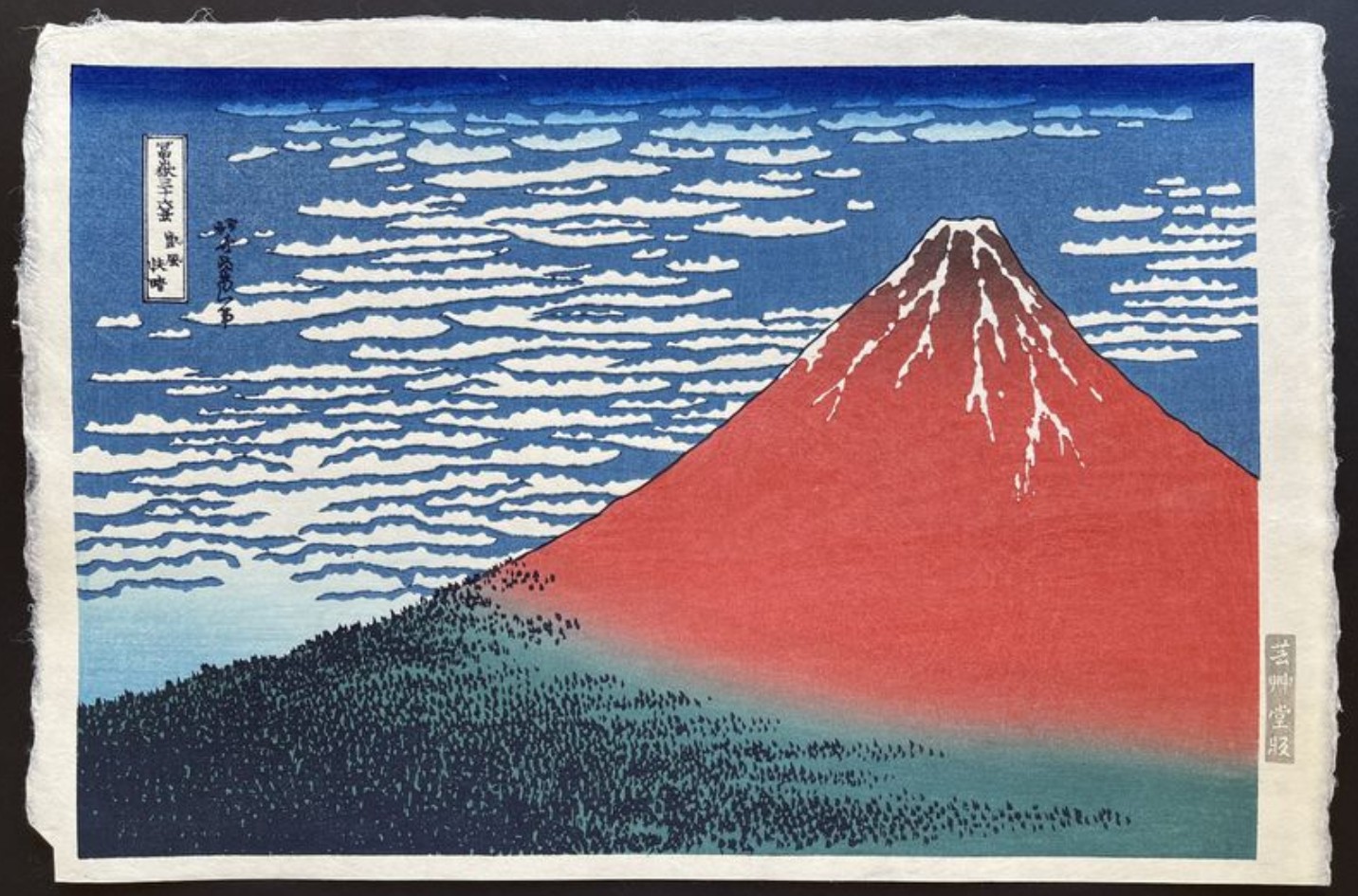
The Great Wave off Kanagawa is perhaps the most famous print featuring Mount Fuji, it captures a massive wave with Mount Fuji in the background, symbolizing the power of nature. Whereas Fine Wind, Clear Morning (Red Fuji): depicts Mount Fuji bathed in the warm light of dawn, showcasing its majestic form against a clear sky. Thunderstorm Beneath the Summit illustrates the dramatic weather conditions surrounding Mount Fuji, emphasizing the mountain’s grandeur.
Hokusai’s “Thirty-Six Views of Mount Fuji” has had a lasting impact on both Japanese art and Western art movements, influencing Impressionists and modern artists alike. The series remains a cornerstone of Japanese woodblock printmaking and continues to be celebrated for its artistic innovation and cultural significance.
Auction Results
Estimated: HKD 120,000 – 220,000
HKD 141,900 / USD 18,235
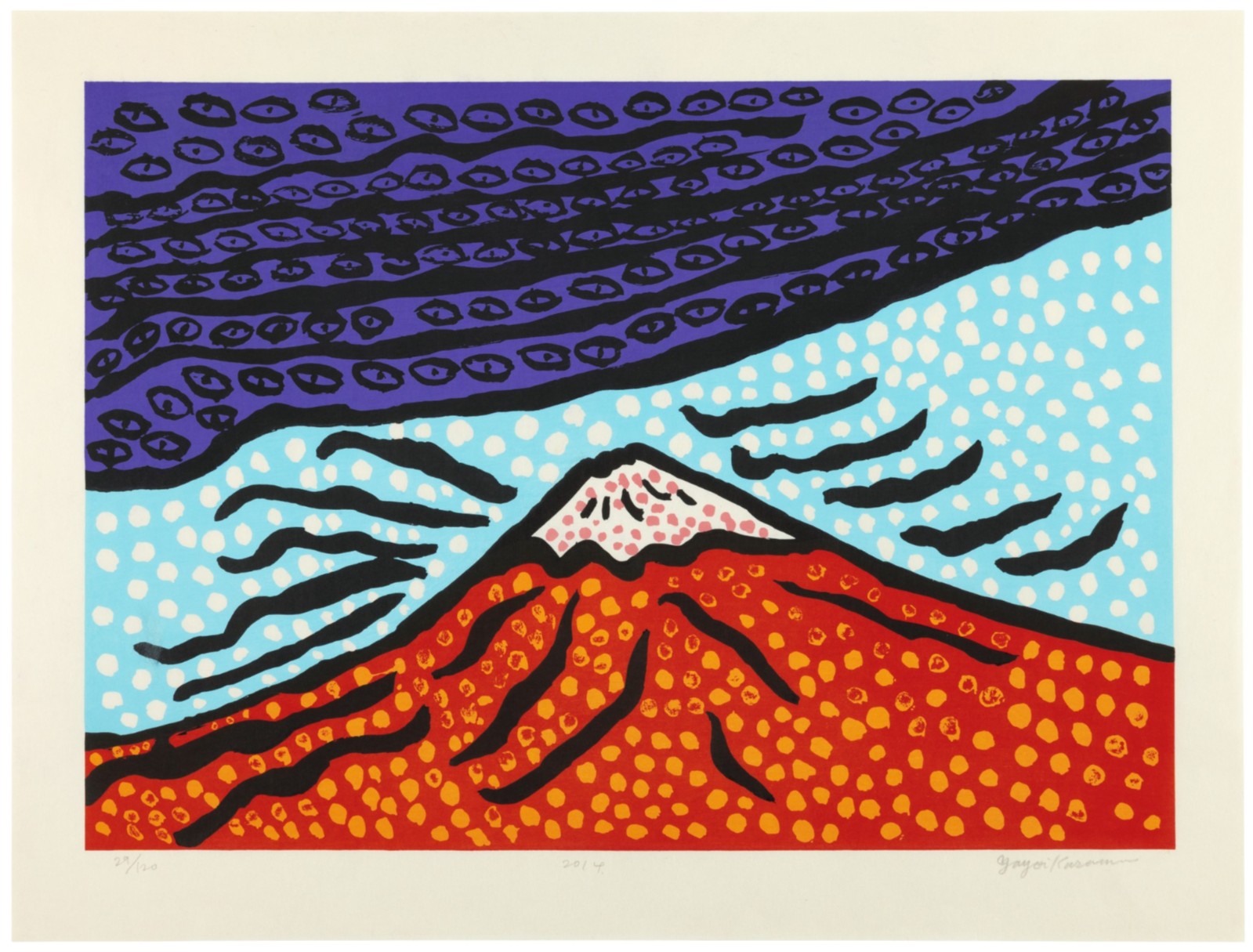
Signed, dated and numbered 29/120 in pencil
Also numbered on an accompanying colophon
Published by Adachi Woodcut Prints, Tokyo
Printed in Japan by Yoshio Kyoso
Mallet Japan: 17 July 2025
Estimated: JPY 2,000,000 – 3,000,000
JPY 3,600,000 (Hammer)
JPY 4,194,000 / USD 28,185
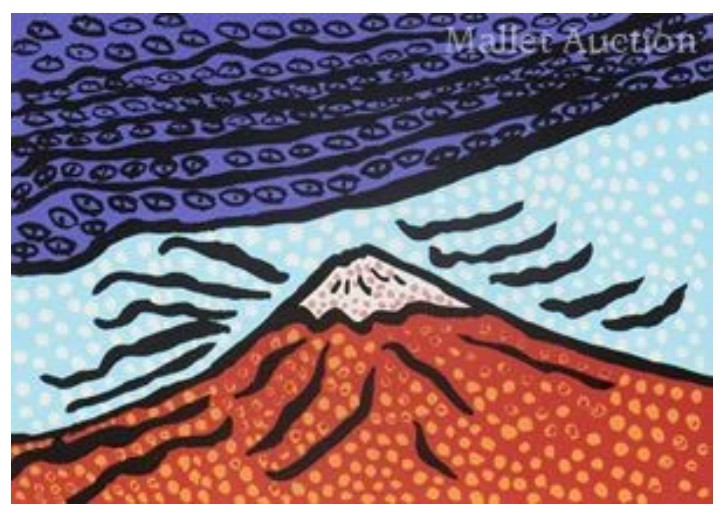
YAYOI KUSAMA
Mt. Fuji is the home of my heart, 2014
Woodcut in colors
Signed, from the edition of 120
Mallet Japan: 10 October 2024
Estimated: JPY 2,500,000 – 3,500,000
JPY 4,600,000 (Hammer)
JPY 5,359,000 / USD 36,070
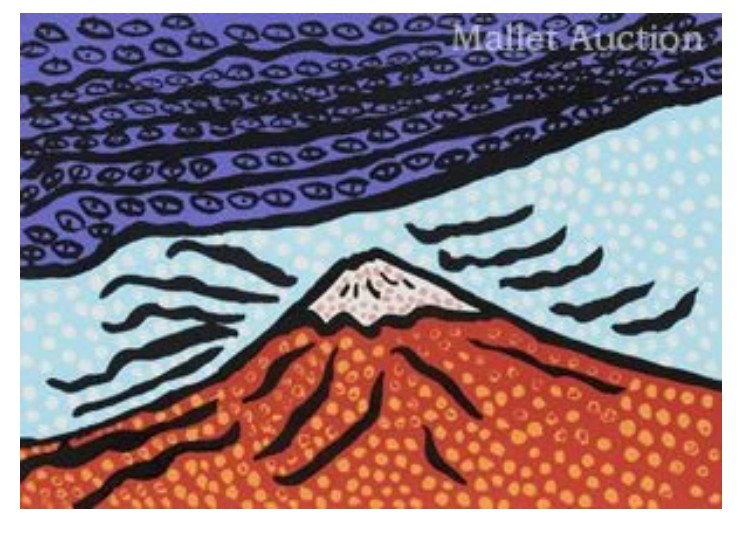
YAYOI KUSAMA
Mt. Fuji is the home of my heart, 2014
Woodcut in colors
Signed, from the edition of 120
SBI Art Auction: 12 April 2024
Estimated: JPY 2,500,000 – 3,500,000
JPY 4,600,000 / USD 30,030
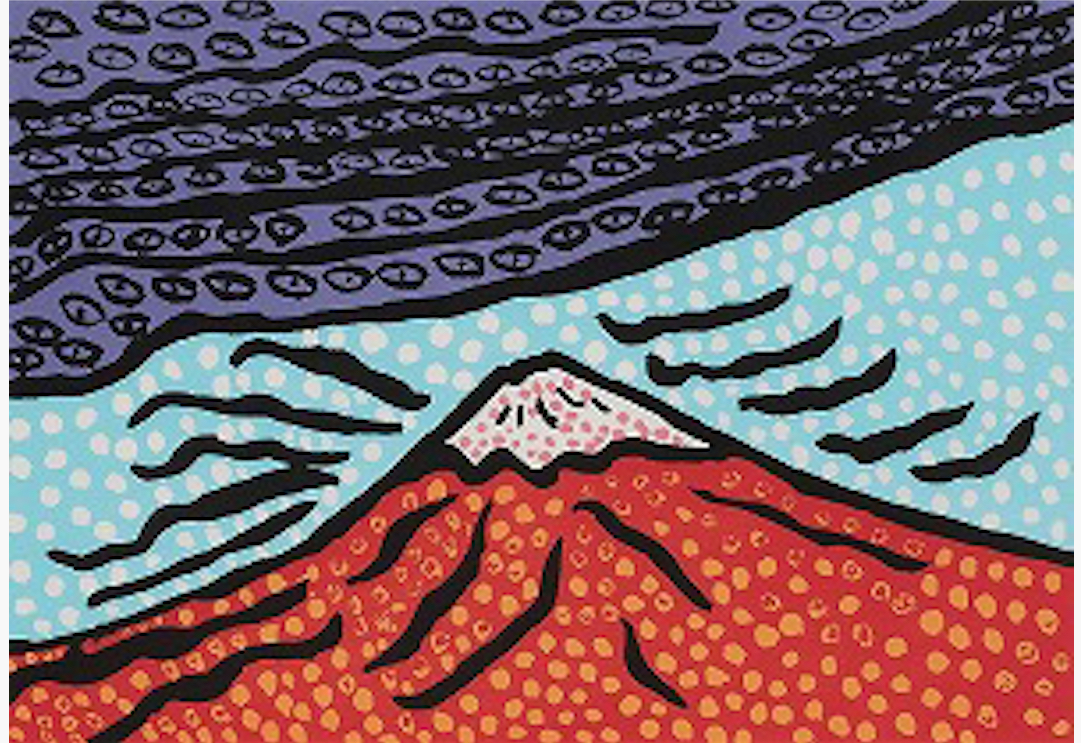
YAYOI KUSAMA
Mt. Fuji is the home of my heart (Kusama 401), 2014
Woodcut
Signed, dated and numbered from the edition of 120
Mallet Japan: 27 July 2023
Estimated: JPY 2,000,000 – 3,000,000
JPY 3,200,000 (Hammer)
JPY 3,728,000 / USD 26,435
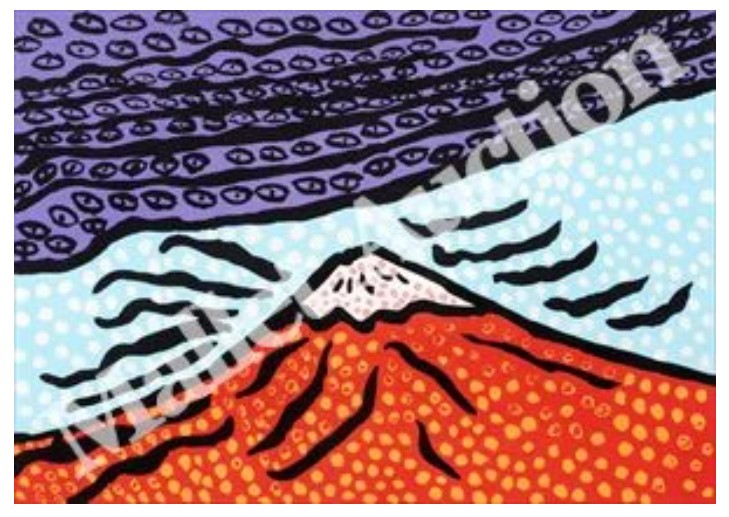
YAYOI KUSAMA
Mt. Fuji is the home of my heart, 2014
Woodcut in colors
Signed, from the edition of 120
Est-Ouest Auctions Hong-Kong: 28 May 2023
Estimated: USD 35,000 – 48,000
USD 27,720
YAYOI KUSAMA
MT. FUJI IS THE HOME OF MY HEART, 2015
Woodcut
Signed, dated and numbered on the margin, labeled on the frame reverse
Mallet Japan: 1 December 2022
Estimated: JPY 2,000,000 – 3,000,000
JPY 3,800,000 (Hammer)
JPY 4,427,000 / USD 32,660
YAYOI KUSAMA
Mt. Fuji is the home of my heart, 2014
Woodcut in colors
Signed, from the edition of 120
SBI Art Auction: 30 October 2021
Estimated: JPY 1,800,000 – 2,800,000
JPY 3,680,000 / USD 32,290
YAYOI KUSAMA
Mt. Fuji is the home of my heart (Kusama 401), 2014
Woodcut
Signed, dated and numbered
From the edition of 120
K Auction Seoul: 23 July 2021
Estimated: KRW 32,000,000 – 52,000,000
KRW 43,700,000 / USD 37,970
YAYOI KUSAMA
Mt. Fuji is the home of my heart, 2014
Woodcut
Signed, dated and numbered on the front
Mallet Japan: 22 July 2021
Estimated: JPY 2,000,000 – 3,000,000
JPY 3,500,000 (Hammer)
JPY 4,077,500 / USD 37,030
YAYOI KUSAMA
Mt. Fuji is the home of my heart, 2014
Woodcut in colors
Signed, from the edition of 120