In 1986, the art dealer Hans Mayer came across a Mercedes-Benz advert marking the centenary of the invention of the motor car. Thinking that the German company might be interested commissioning a series of paintings from Warhol celebrating its proud history, Mayer himself ordered four paintings from Warhol in an effort to tempt Mercedes into making a larger commission. Warhol delivered the canvases in the summer of 1986 and Mercedes was delighted with the result. Initially, Warhol proposed the idea of including different makes of cars, but Mercedes requested that the selection be made using Mercedes models alone. Warhol made his choices from photographs supplied by Mercedes and produced two versions of each canvas, one with a single motif and one with multiple images. Work on the first eight cars was completed in January 1987, and three large scale canvases were completed just two weeks before the artist’s death a month later.
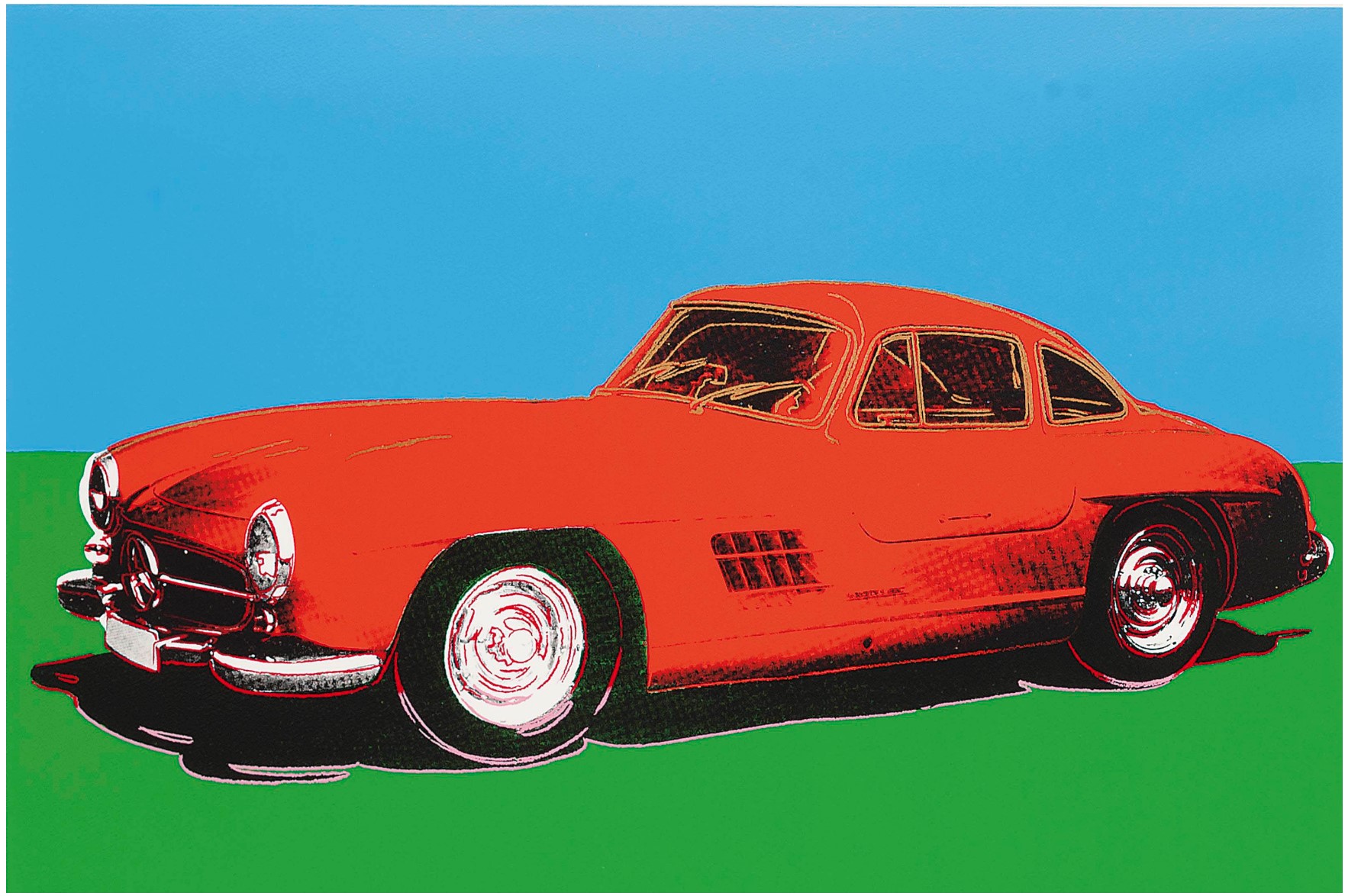 AFTER ANDY WARHOL
Cars Mercedes 300 SL Gulwing, 2007
Screenprint in colors on wove paper
27.2 x 33.5 inches (69.1 x 85.1 cm)
Warhol was particularly drawn to the sleek and elegant curves on the bodywork of the Mercedes-Benz W 196. The seductive nature of the curve had appeared in many of the artist’s earlier works including his 1962 painting Marilyn’s Lips, and even in the serpentine silhouettes of his Coca-Cola bottles. Although he was undeniably attracted to the ubiquitous nature of objects as part of his quest to challenge the tenets of high art, he was also interested in their formal qualities too. Throughout his career, as styles, fashions and people changed, one constant in his oeuvre was his close examination of the formal qualities of the objects he immortalized. The car, just like the Coca-Cola bottles and soup cans before them, provide the perfect vehicle for Warhol’s astute examination of form in addition to his insightful investigation of the car as the vehicle for our cultural aspirations.
“I adore America. My image is a statement of the symbols of the harsh, impersonal products and brash metallic objects on which America is built today. It is a projection of everything that can be bought and sold, the practical but impermanent symbols that sustain us.”
The car was also one of the first objects that Warhol immortalized using his silkscreen process. They began in 1962 when he was commissioned to produce a series of paintings for a spread in Harper’s Bazaar. The magazine’s editor had seen the growing importance of the automobile industry and wanted to ingratiate the publication with this valuable market. The result was a four-page spread in which the canvases were stacked against the wall of Warhol’s apartment (along with 210 Coca-Cola bottles) and photographed by the magazine. These early car paintings set the stage for what was to become one of the artist’s most consistent group of paintings and began a fascination with the automobile that would sustain Warhol throughout his artistic career.
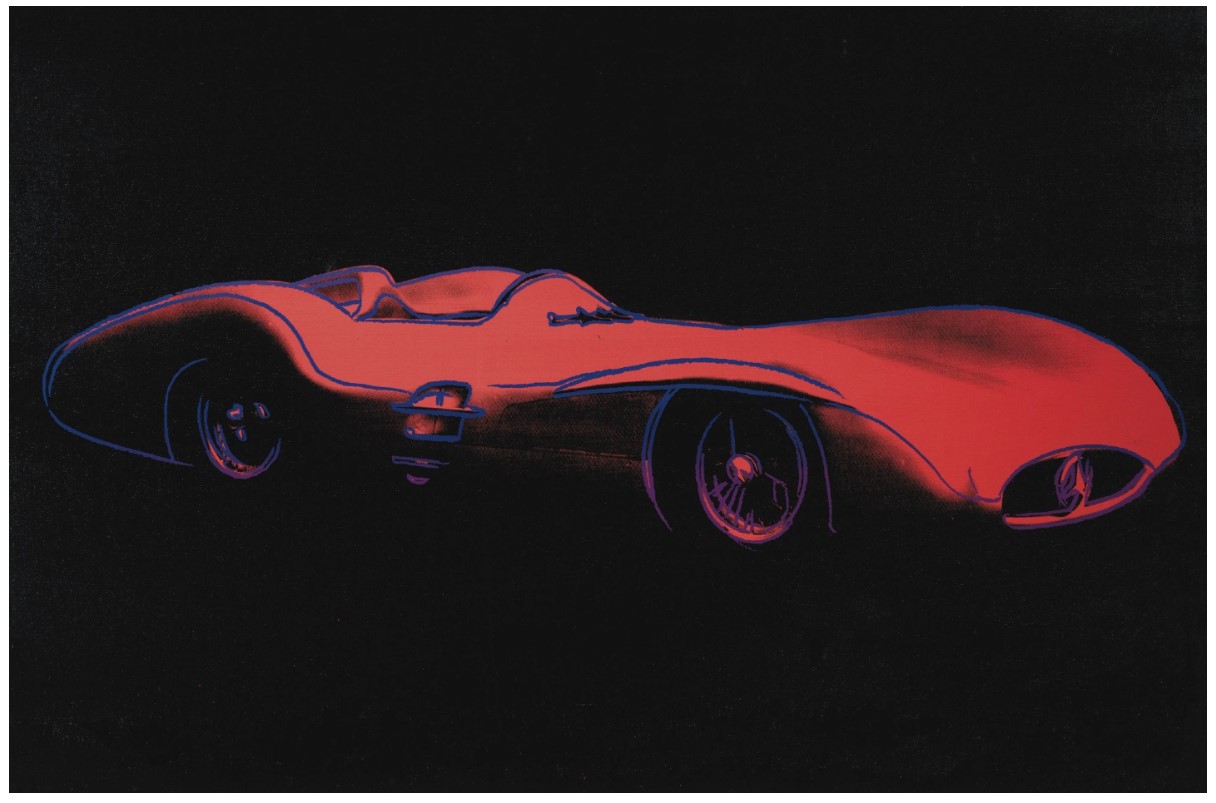 ANDY WARHOL
Mercedes-Benz W 196 R Grand Prix Car (Streamlined Version), 1954, 1986
Some of the artist’s most recognizable car paintings were included in his iconic Death and Disaster series. The most haunting of these were a series of silkscreens he produced using photographs of car crashes gleaned from local news agencies. Warhol’s choice of car crashes to be among the first images to be immortalized in his Death and Disaster paintings was a remarkably perceptive one for the artist. In the post-war economic boom that swept much of the United States after World War II, the automobile had become the symbol of prosperity and social mobility that the “American Dream” promised. In cities like Los Angeles, the automobile had become the dominant cultural phenomenon around which much of the newly classified concept of leisure time was played out. By depicting the results of a momentary lapse in concentration when lives can be changed forever, Warhol shows how quickly the American dream can change.
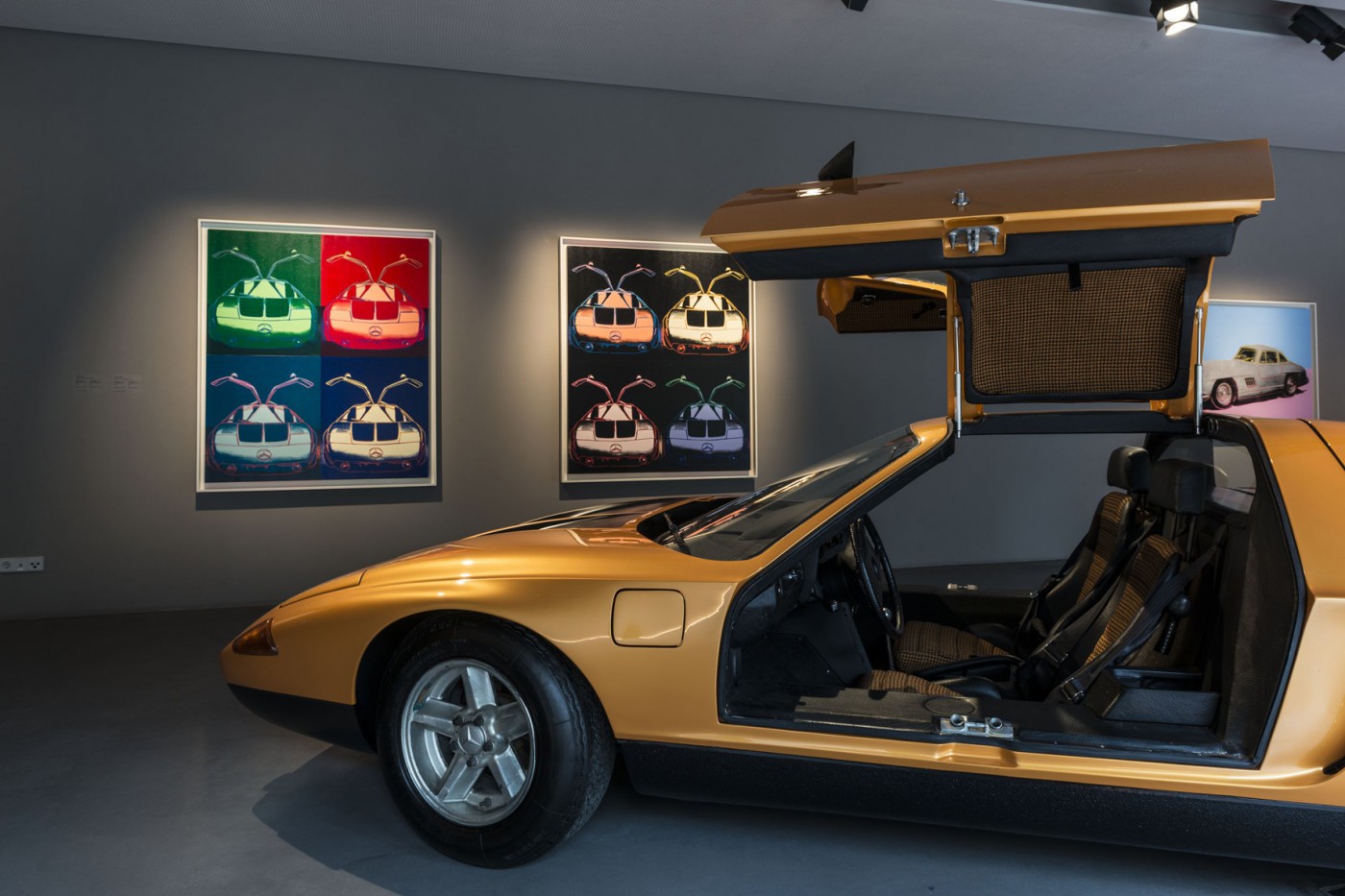 Daimler Art Collection
His Cars series also marks Warhol’s return to the use of repetition in his paintings, something that the artist had abandoned for a number of years. As has already been noted, for this series Warhol produced two versions of the cars, a single motif and a series of multiple images, assembled into groups of eight or twelve cars. Warhol is thought to have revived his use of repetition for a number of reasons; partly to draw attention to the formal qualities of the object, but also to highlight the ubiquitous nature of the object itself. Yet while the original image is the same, the natural variations inherent in the screening process and the different color ground used for each results in a work of infinite variety, a fact Warhol relished.
“All my images are the same but very different at the same time. They change with the light of colors, with the times and moods. Isn’t life a series of images that change as they repeat themselves.”
Artists have been capturing the social and cultural implications of our infatuation with the automobile ever since the Italian Futurists depicted some of the earliest cars in a blur of multi-colored movement. William de Kooning also captured the exhilaration of speed with his views from the highway to Long Island in Merritt Parkway (Detroit Institute of Arts). However, it was in the 1960s that the car became the universal object that we know today and became a motif in its own right. For Warhol, Mercedes-Benz marks a triumphal return to both a formal and cultural motif, which had produced some of the most insightful works of the artist’s career. As one of his last great paintings, Warhol’s Mercedes-Benz W 196 R Grand Prix Car (Streamlined Version), 1954 is a fitting tribute to a life of insightful observation.
Auction Results
Christie’s New-York: 11 November 2013
USD 13,045,000
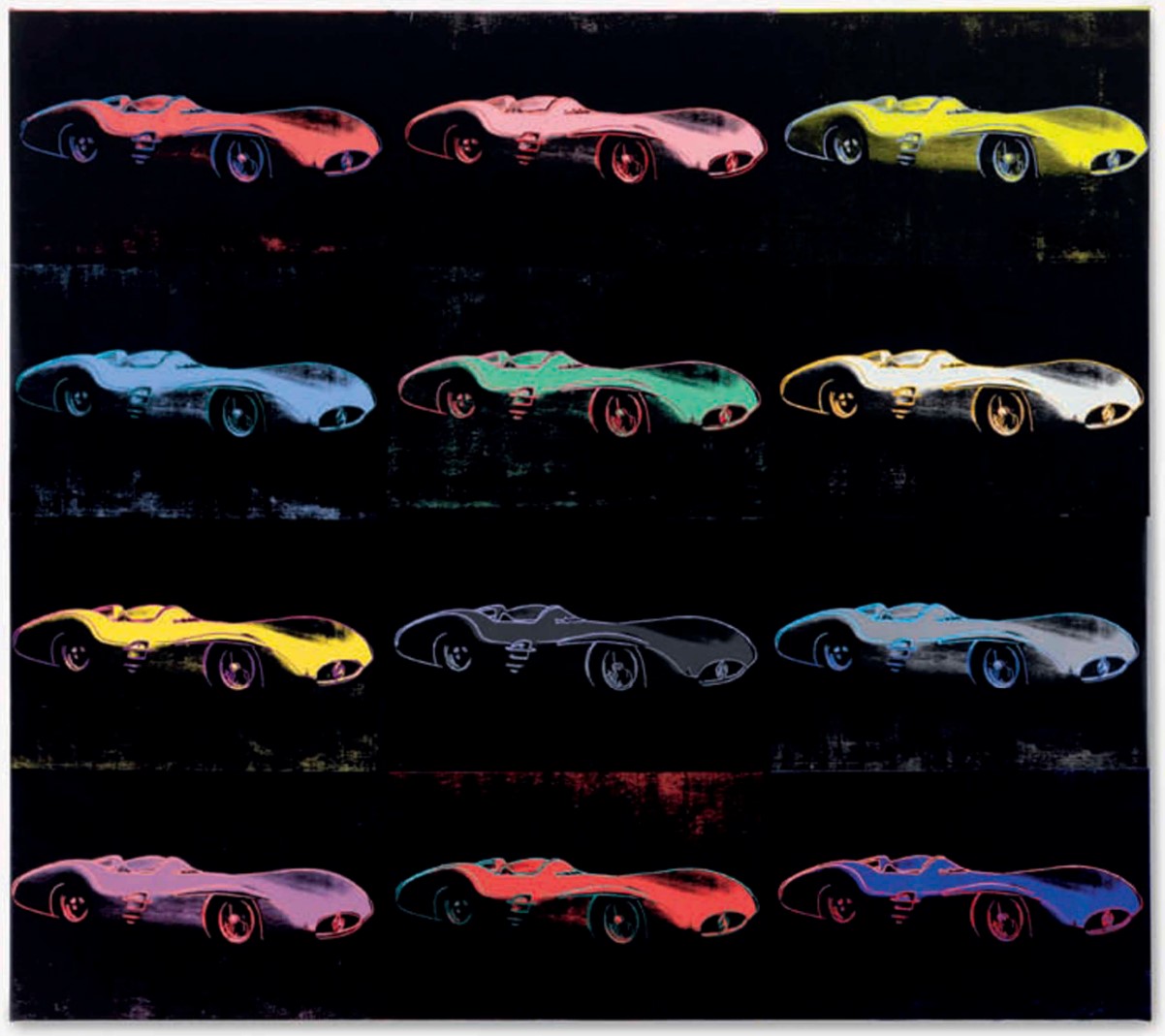
ANDY WARHOL
Mercedes-Benz W 196 R Grand Prix Car (Streamlined Version, 1954), 1987
Synthetic polymer and silkscreen inks on canvas
160.5 x 180.1 inches (407.6 x 457.5 cm)
Stamped with signature ‘Andy Warhol’ (on the overlap)
Resplendently executed in a dazzling range of bejeweled colors, Andy Warhol’s monumental Mercedes-Benz W 196 R Grand Prix Car (Streamlined Version), 1954 is among the artist’s last great paintings and marks a return to one of Warhol’s favorite subjects–the automobile. The car was a motif that appeared throughout Warhol’s career, from his 1962 black and white canvases featuring serial images of classic American cars, through his iconic Death and Disaster car crashes, culminating in this 1986 commission from Daimler-Benz in Germany. In all of these paintings the car was the star, representing economic success and individual freedom. As such, this series of paintings, and Mercedes-Benz in particular, acts as the ultimate celebration of Warhol’s career. Taking its place alongside Coca-Cola bottles, Campbell’s Soup cans, and his celestial body of Hollywood stars, Warhol celebrates the car as the symbol of the twentieth century and, as such, Mercedes-Benz takes its place in Warhol’s icon pantheon.
Composed of a grid made up of four rows of brightly colored vehicles, Warhol’s Mercedes-Benz is a celebration of style and form. As his source image, Warhol uses a photograph of the Mercedes team car used by the Argentinian racing driver, Juan Manuel Fangio, to win five Formula One World Championships in the 1950s. Each repetition is comprised of a candy-colored square over which Warhol screens a negative image of the car in black, resulting in the body of the car emerging through the darkness with astonishing brilliance. The elegant outlines are then emphasized with a second screen of neon highlights, emphasizing the seductive lines of the contoured bodywork. By overlaying the dark pigment directly on top of the bright colors, Warhol allows the cars to sparkle through the inky blackness like jewels shimmering in the darkness. In many places, the underlying color pushes through the black upper layer, giving a distinct sense of movement and energy, of tires racing across the tarmac.
Christie’s New-York: 13 November 2007
USD 2,505,000
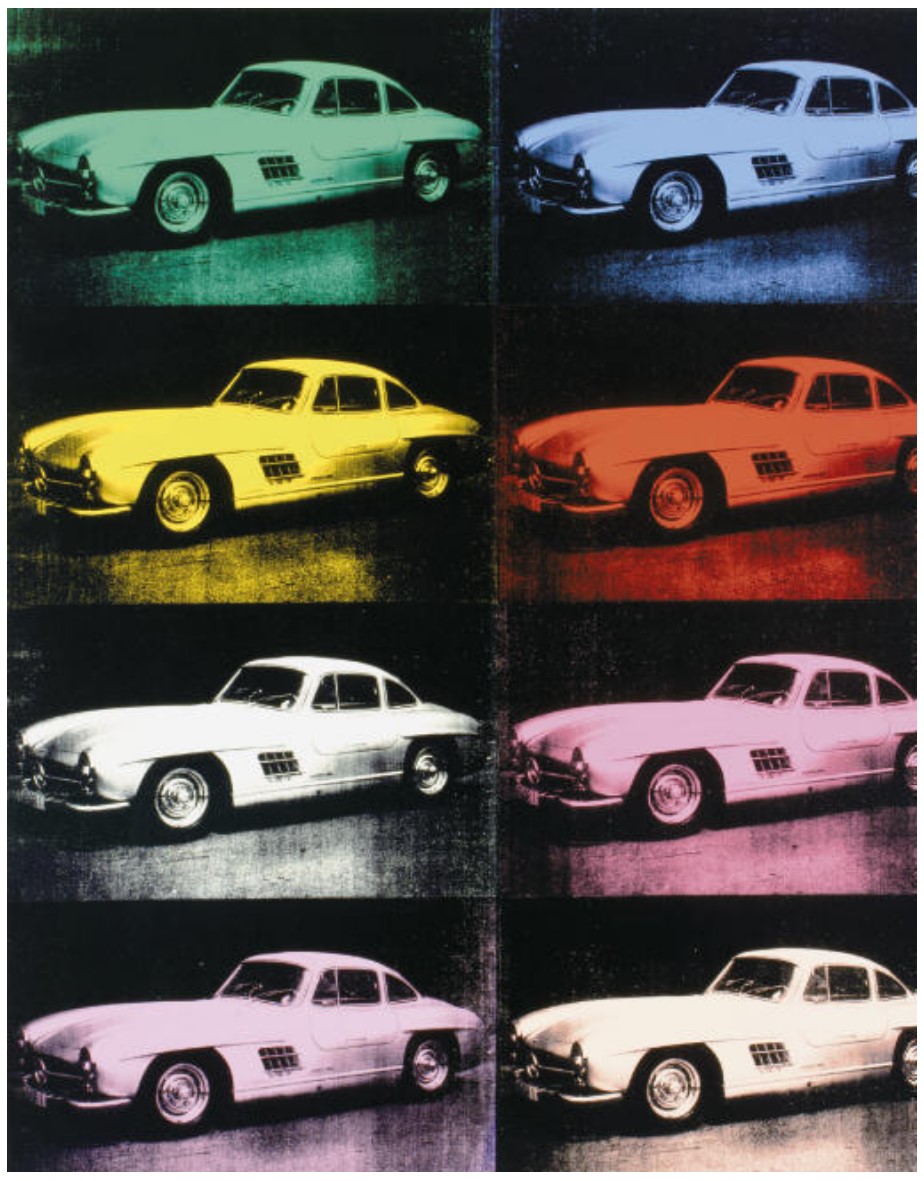 ANDY WARHOL
Mercedes-Benz 300 SL Coupé, 1954, 1986
Synthetic polymer and silkscreen inks on canvas
60.1 x 50.2 inches (152.5 x 127.5 cm)
Signed and dated ‘Andy Warhol 1986’ (on the overlap)
Sotheby’s New-York: 15 May 2014
USD 3,973,000
ANDY WARHOL
Mercedes-Benz W 196 R Grand Prix Car (Streamlined Version), 1954, 1986
Acrylic and silkscreen ink on canvas
40.4 x 60.2 inches (102.5 x 153 cm)