Andy Warhol’s singular brand of social critique, acerbic wit and deadpan irony is exquisitely exemplified in the radiant image of The Last Supper, deriving from the last and most significant series the artist executed before his death in 1987. The Last Supper paintings are not only Warhol’s last and largest series, but also the “largest series of religious art by any American artist,” marking the present work as a unique late treasure within Warhol’s prolific career. Fine Art, Pop Art, celebrity and fame all intermingle in this iconic mass-produced picture of one of the most canonical images in art history: the highly venerated masterpiece by Leonardo da Vinci. Warhol combined Pop culture and art history by choosing one of the most famous and widely reproduced paintings in the world and rendered it with vibrant Pop colors. In this way, not only does Warhol pay homage to the Renaissance master, but he also dares to place himself in that same lineage, a prophetic move made all the more poignant by the fact that Warhol would be dead only a month after these paintings were completed.
“Church is a fun place to go.”
Introduction
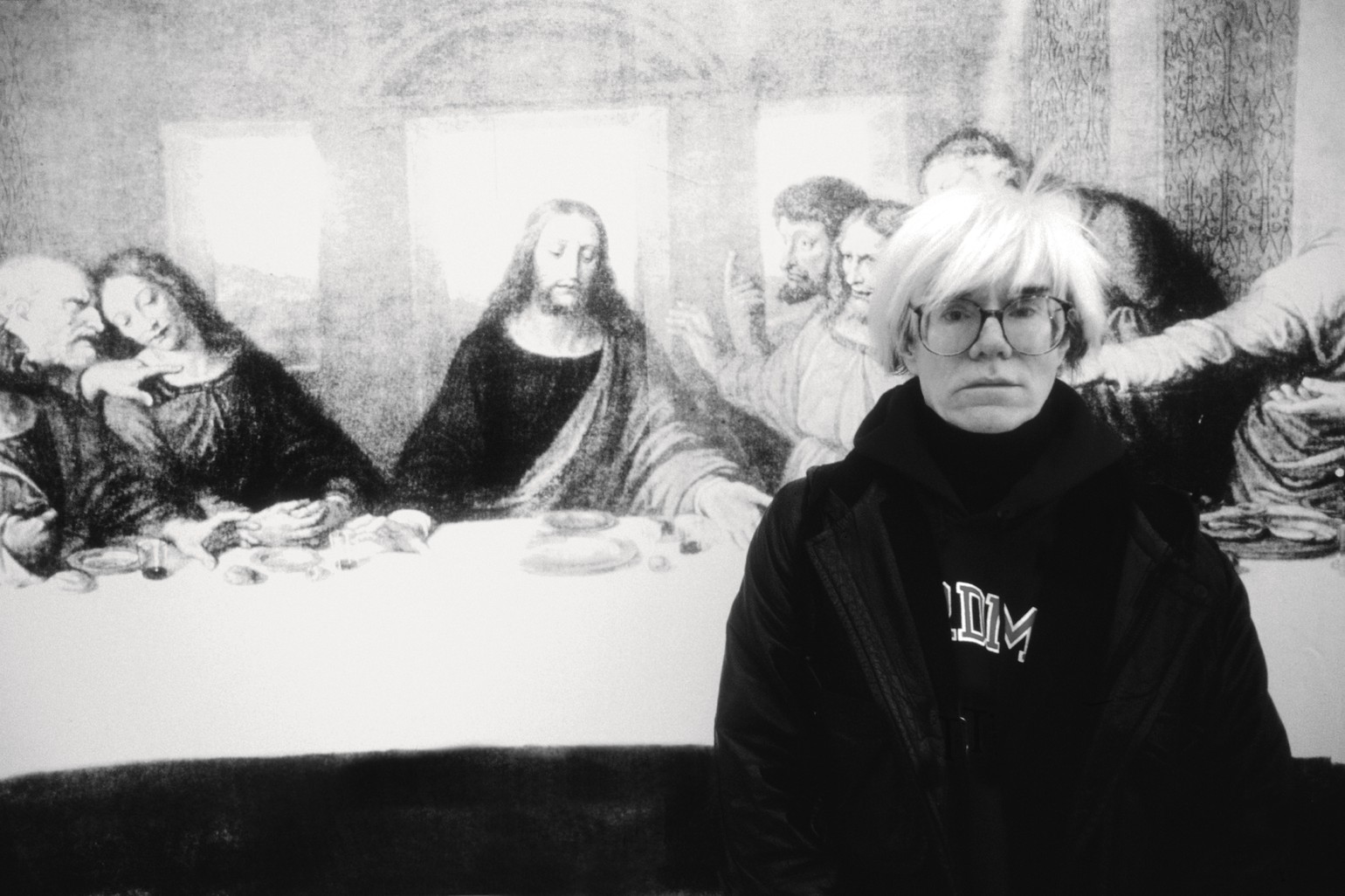
Created specifically for Iolas’s inaugural show in Milan, twenty of Warhol’s numerous Last Supper works were strategically exhibited across the piazza from Santa Maria delle Grazie, the home of Leonardo’s original work, in an effort to recontextualize the original fresco. Warhol’s attendance at this show would be his last public appearance before his death later in 1987. Hailed as a masterpiece of the Italian Renaissance, Leonardo’s The Last Supper marks a pinnacle of artistic achievement and is a paradigm of one-point linear perspective. One-point linear perspective was innovative in that it articulated space and depth in a two-dimensional plane, and here draws viewers’ attention to a single vanishing point around the central figure of Christ. In his rendition of Leonardo’s masterpiece, Warhol nullifies this technical triumph, compressing Leonardo’s trompe l’oeil and insisting upon its flatness via the process of silkscreening and the application of the camouflage pattern, which, inherently, is entirely flat. Warhol’s technique of appropriating familiar imagery through serial reproduction separates the image from its original source material, eventually degrading a painting as revered and sublime as Leonardo da Vinci’s Last Supper to a banal picture no different than a quotidian advertisement in a magazine.
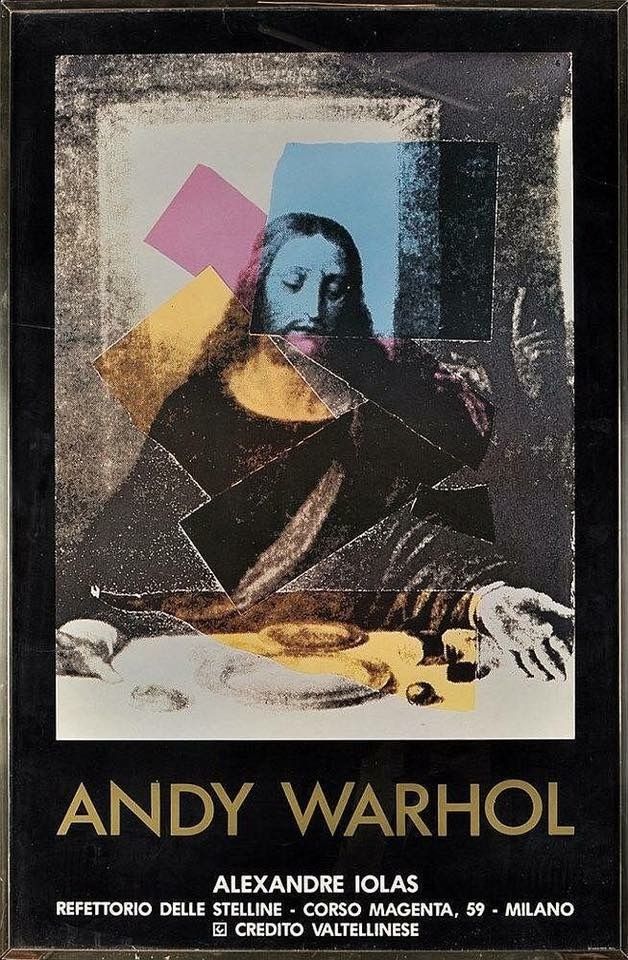
In 1984, Iolas approached the Credito Valtellinese located in the Palazzo Stelline to use their former rectory as an exhibition space. The Palazzo was located directly across the street from the Dominican cloister Santa Maria delle Grazie, which housed Leonardo’s The Last Supper, and so Iolas proposed to commission contemporary artists to re-image the masterpiece. According to Warhol, Iolas reached out to three artists but ultimately offered him the whole commission. The resulting exhibition, Warhol—Il Cenacolo (“Warhol – The Last Supper”) opened in January 1987 and presented around 22 of the artist’s silkscreen paintings. It is estimated that nearly 30,000 visitors flocked to the show that, in a poignant biographic coincidence, would be the last for both artist and gallerist. Iolas, who had given Warhol his first show in 1952, would die in June of that year and Warhol, who had been experiencing discomfort during the opening passed away after returning to New York on February 1987 from complications following a gallbladder operation.
Warhol grew up in a deeply Catholic household, and, according to his brother John Warhol, an image of The Last Supper hung in the family’s kitchen in Pittsburgh, portending an eventual treatment of this nostalgic image. The son of first-generation immigrants and profoundly religious parents, Warhol frequently attended services at St. John Chrysostom Byzantine Church. Crucifixes, icons and all manner of religious imagery would have been inescapable, impressing upon the young Warhol the irrevocable marriage between religion and art. That he would eventually return to this specific subject matter in the years right before his death is perhaps coincidental, yet reveals that Warhol’s persona as aloof, detached and obsessed with money, fame and celebrity belied a deeper-seated piety. Warhol’s late examination of one of the most quintessential scenes in Christianity accompanied the artist’s fascination with camouflage, which also became a particularly significant motif in his later years.
ANDY WARHOL
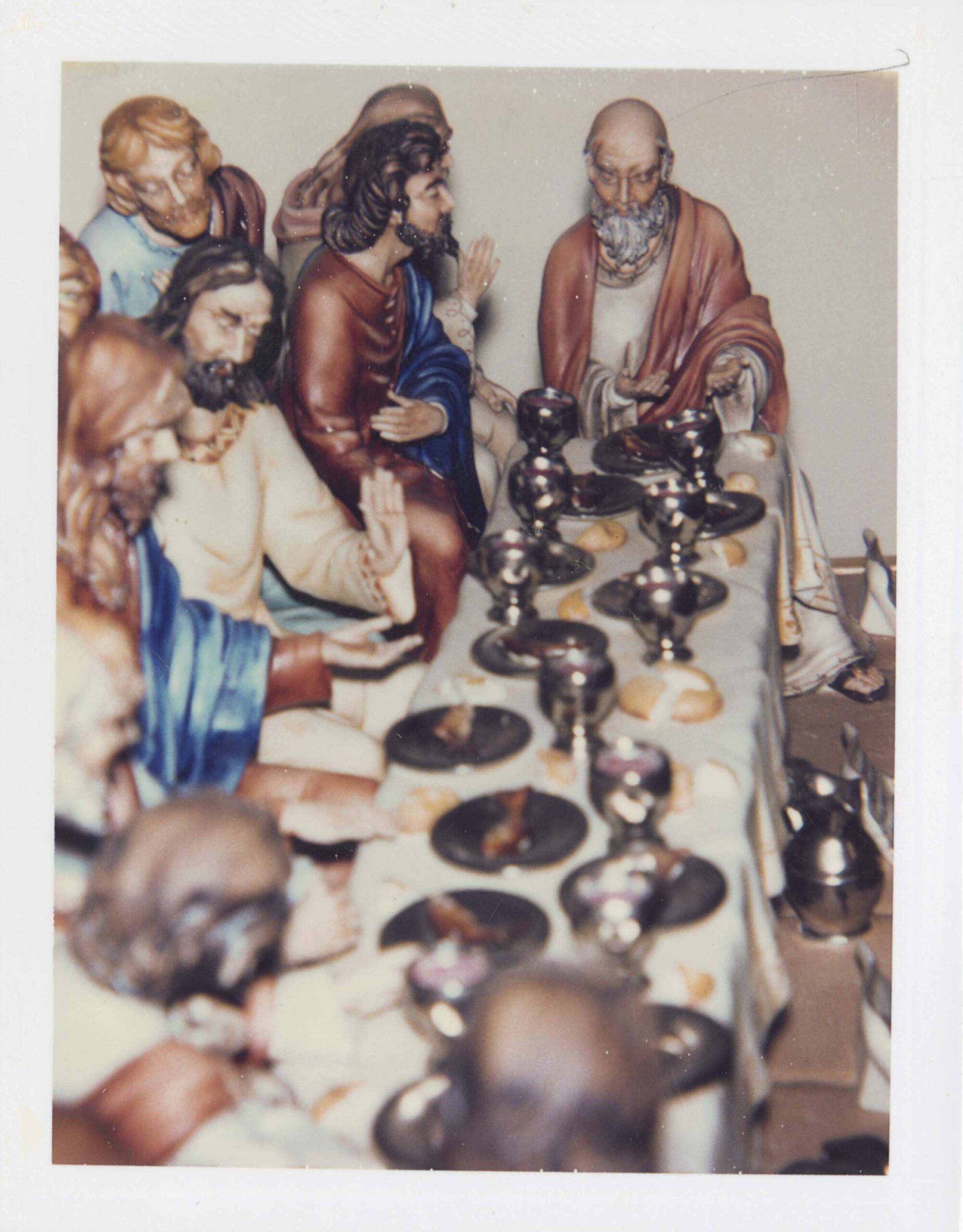
Last Supper, 1970s
Unique Polacolor ER print
4.2 x 3.4 inches (10.8 x 8.5cm)
The Last Supper series is also a magnificent summation of Warhol’s core thematic concern. The celebrity portraits and the Death and Disaster series have their associations with Warhol’s twin obsessions of mortality and fame, but The Last Supper as an aesthetic subject combines the immortality of religion with the immortality of art. Da Vinci’s famous paintings – both the Mona Lisa and The Last Supper – appealed to Warhol as subjects since they fit perfectly into his aesthetic program of bringing everyday, universally recognizable imagery into the realm of Fine Art. The Last Supper is a monumental fresco so can only be experienced by a trip to Milan, while the Mona Lisa almost never travels, with her December 1962 tour to New York’s Metropolitan Museum of Art being one of the rare exceptions. Both works are known to millions primarily through commercial means such as posters, t-shirts, postcards and book illustrations. By borrowing these images from their reproductions, Warhol ironically returned them to the realm of painting in The Last Suppers of the 1980s. Their limited geographical access is trumped by the ubiquitous and far-reaching realm of the media and the world of art.
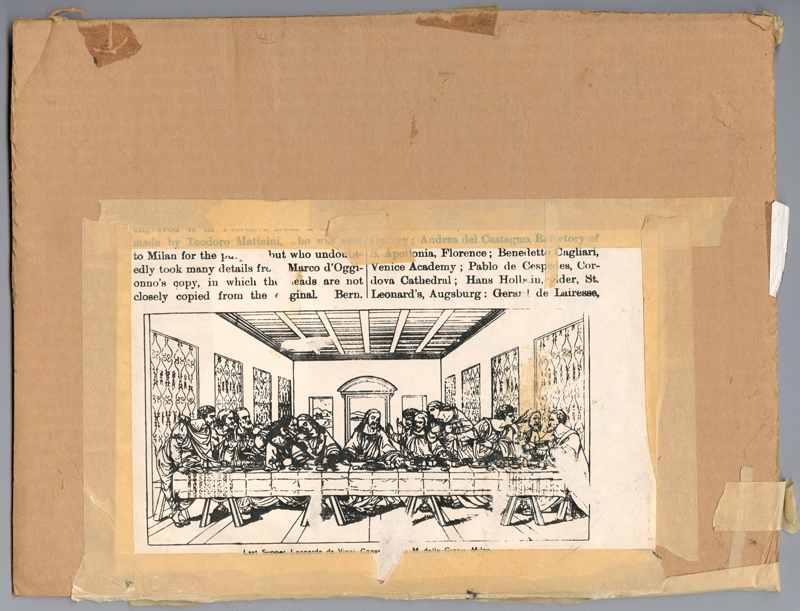
As he did with most of his paintings, Warhol began his Last Supper series with a considered study of a pre-existing image. Warhol worked from a cheap black and white photograph of a widely circulated 19th century engraving and a schematic outline drawing found in a copy of the 1913 book Cyclopedia of Painters and Painting. Warhol converted this image into a silkscreen which he worked into a series of canvases. The present rendition of the subject belongs to a group of works of this size which stack the repeated image one atop the other, but Warhol would also spool several images of this scene and of Christ’s head across paintings as large as 35 feet. In stark contrast to its seemingly eternal life as a reproduction, Leonardo da Vinci’s actual Last Supper was in severe danger of being lost forever when Warhol decided to immortalize it. The masterpiece had gradually become less and less visible, a problem that had been occurring since the 16th century due to the artist’s experimental choice of media, which was later compounded by damage due to Allied bombing raids during World War II. Also, overpainting and restoration work obscured what remained of the original painting. Warhol, in fact, joined the protest against the ongoing restoration by signing a petition shortly before his death. The Pop-colored palette might, metaphorically at least, be an attempt by Warhol to “restore” the original back to its former glory, building on the expressive sfumato technique that Leonardo famously developed, and providing a vibrancy to the image that the original no longer had.
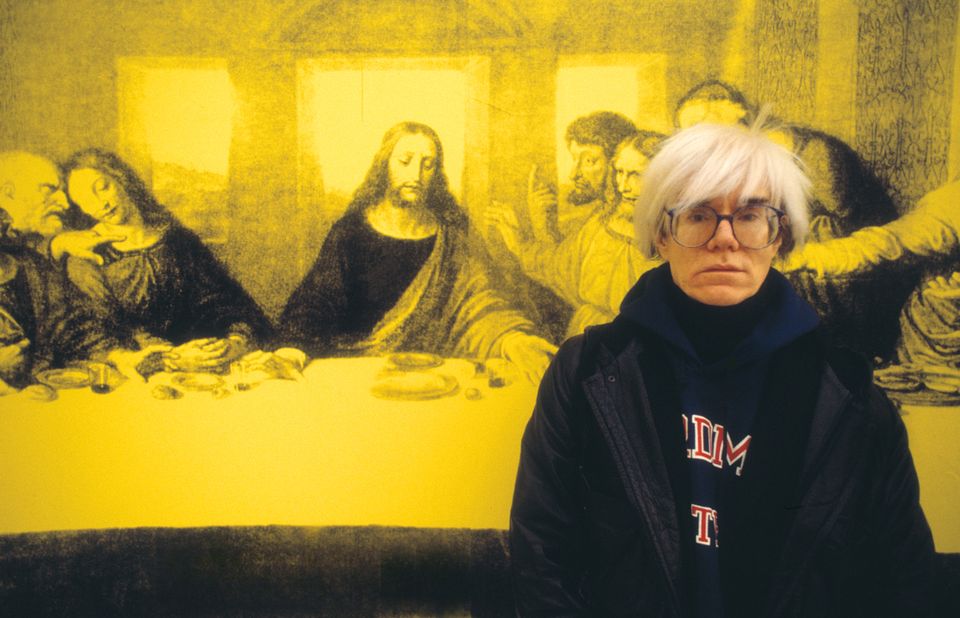
To some critics, Warhol’s Pop imagery appears as a new generation of icons and talismans for the godless modern age. These are replacements in the time of Capitalism for the religious paintings of bygone days. Warhol himself often acknowledged that the United States were a nation fueled by shopping, by money, by possessions. This resulted in his adaptation of advertising images and their conversion, in his hands, into art. This is often used to stress Warhol’s cynicism, his criticism of the systems at play in the modern world. Yet much of the time Warhol was celebrating the United States and celebrating the capitalism in which he basked. Likewise, if the iconic nature of Warhol’s images is derived from the presence of religious art during his childhood, they are nonetheless far from blasphemy. Instead, Last Supper has become a celebration of Christ, a celebration of Christianity, a celebration of religious art… It is in keeping with this that John Richardson, in his eulogy for Warhol, would point to the impact he had in refreshing the outmoded icons of religion. Leonardo’s Last Supper has been reborn for the modern world, reimagined, reinvigorated, charged with contemporary currency. In this way, Warhol injected new life into religious art.
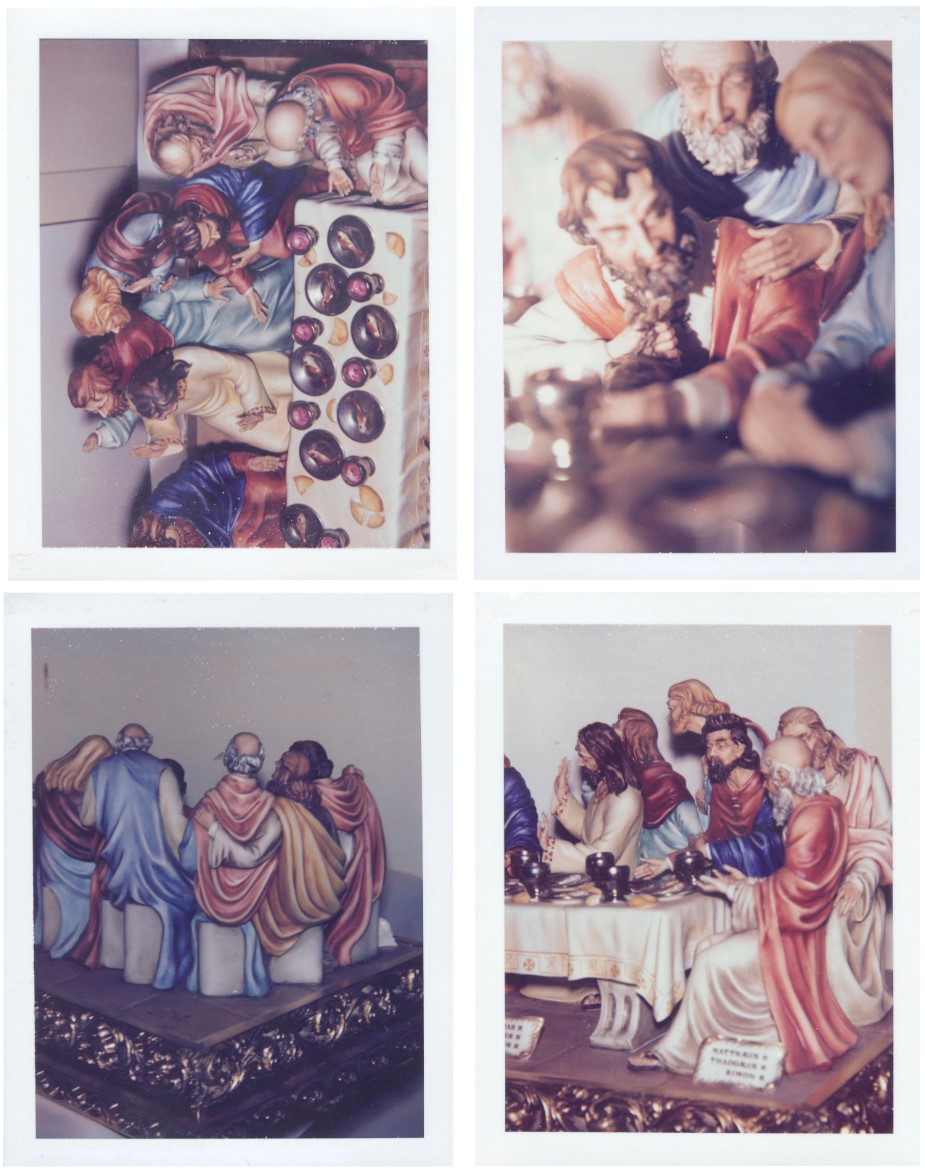
ANDY WARHOL
The Last Supper, 1985
Four unique polaroid prints
While challenging notions between low and high art in this way, Warhol effectively engaged in a century-long tradition of approaching The Last Supper through mediations of the original. Although The Last Supper is one of the world’s most celebrated and studied works of art, it has not existed in its original form for 500 years as the original deteriorated within a few years of its completion due to Leonardo’s experimental techniques. Studies of the work rely on engravings and reproductions, which themselves vary over the centuries according to the stages of erosion, restoration and the artist’s own ability to faithfully render The Last Supper. For Warhol, The Last Supper proved to be the mediated image par excellence; its fame only having grown through the circulation of reproductions, rather than through the direct experience of the original. When Warhol appropriated Leonardo’s The Last Supper, it was one of the most incessantly copied and circulated images in popular culture. While Warhol’s Last Supper oscillates between flatness and illusionistic depth in a manner that adheres to Renaissance painting tradition, Warhol’s strategy of repetition sets a challenging perceptual game in motion that makes his reprisal of the masterpiece wholly subversive. Not only does he transgress Catholic dogma by including two images of Christ in the same picture, the visual unity of the Church and doctrine as expressed through Leonardo’s use of central perspective is here turned on its head. The sacred and devotional is turned into a secular image of the modern age.
2025 Auction Results
The Last Supper, 1986
Edlis Neeson Collection
Christie’s New-York: 19 November 2025
Estimated: USD 6,000,000 – 8,000,000
USD 8,127,000
ANDY WARHOL (1928-1987), The Last Supper | Christie’s
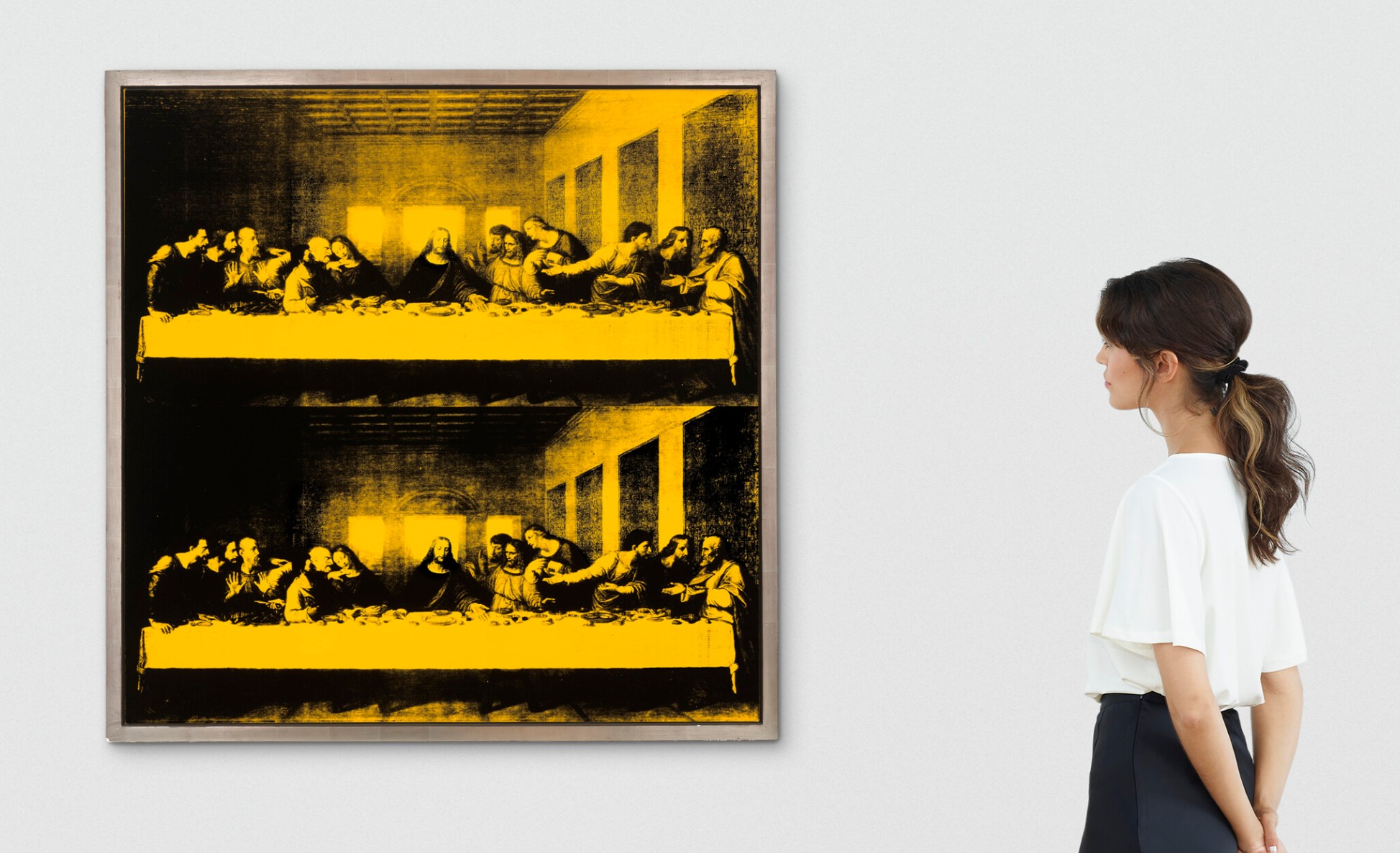
ANDY WARHOL (1928-1987)
The Last Supper, 1986
Acrylic and silkscreen ink on canvas
40×40 inches (101.6 x 101.6 cm)
Stamped with the artist’s signature ‘Andy Warhol ©’ (on the overlap)
Signed and inscribed by Frederick Hughes
‘I certify this to be an original painting by Andy Warhol completed by him in 1986 Frederick Hughes’
(on the overlap)
The Last Supper, 1986
Leonard & Louise Riggio: Collected Works
Christie’s New-York: 12 May 2025
Estimated: USD 6,500,000 – 8,500,000
USD 7,068,000
ANDY WARHOL (1928-1987), The Last Supper | Christie’s
ANDY WARHOL (1928-1987)
The Last Supper, 1986
Acrylic and silkscreen ink on canvas
40×40 inches (101.6 x 101.6 cm)
Stamped with the artist’s signature ‘Andy Warhol ©’ (on the overlap)
Signed and inscribed by Frederick Hughes
‘I certify that this is an original painting by Andy Warhol completed by him in 1986 Frederick Hughes’
(on the overlap)
2024 Auction Results
The Last Supper, 1986
Estimated: USD 5,000,000 – 7,000,000
USD 6,079,500

ANDY WARHOL (1928 – 1987)
The Last Supper, 1986
Acrylic and silkscreen ink on canvas
40 1/8 x 40 1/8 inches (101.9 x 101.9 cm)
Stamped with the artist’s signature (on the overlap)
Inscribed on the overlap:
I certify that this is an original painting by Andy Warhol completed by him in 1986 Frederick Hughes
Large Serial Last Suppers
Sixty Last Suppers, 1986
Christie’s New-York: 15 November 2017
Estimate on Request
USD 60,875,000
Andy Warhol (1928-1987), Sixty Last Suppers | Christie’s
ANDY WARHOL
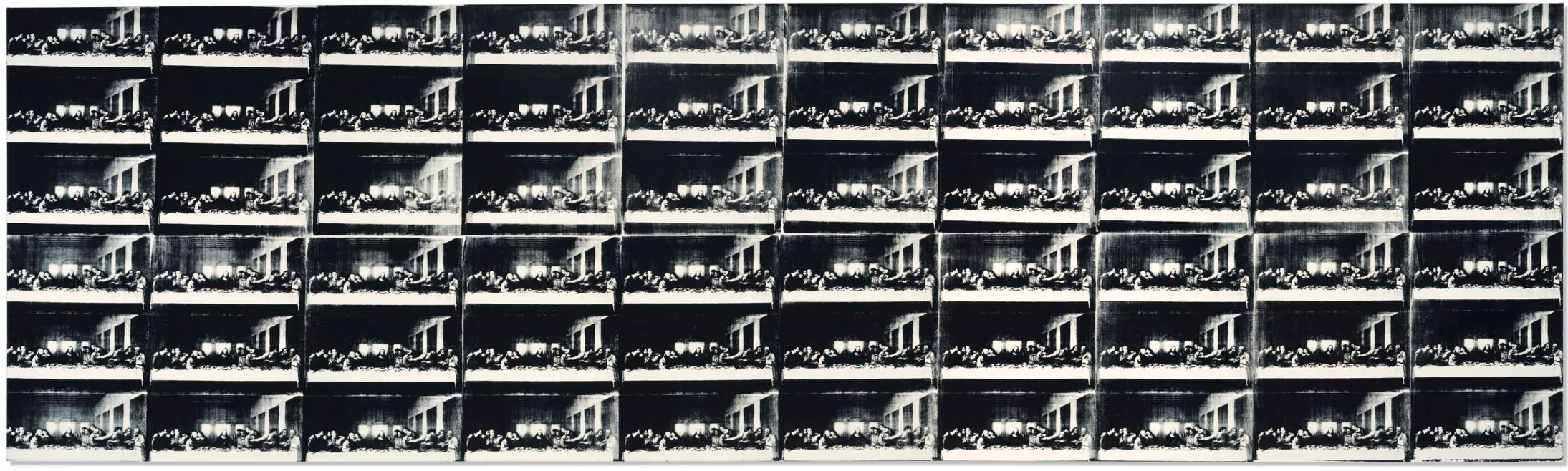
Sixty Last Suppers, 1986
Acrylic and silkscreen ink on canvas
116 x 393 inches (294.6 x 998.2 cm)
Numbered twice ‘PA82.020’ (on the overlap)
Numbered again ‘PA82.020’ (on the stretcher)
The final tour-de-force of Andy Warhol’s illustrious career, Sixty Last Suppers reclaims the ghosted image of the painting that ushered in the Renaissance—challenging Leonardo as to whose canvases was fresher and more powerful. Made in the last year of the artist’s life, Sixty Last Suppers emerges as a final encapsulation of many of the tenets which defied the artist’s celebrated career. In 1985, Andy Warhol was commissioned by his friend and dealer, Alexandre Iolas to create a series of works based on the Last Supper for an exhibition in Milan. The works were shown in a space for the Italian bank, Credito Valtellinese in the former refectory of the Palazzo delle Stelline, which was located directly across the street from Leonardos Renaissance masterpiece in the refectory of the Santa Maria delle Grazie. For Warhol, who had riffed off da Vinci’s Mona Lisa decades earlier, the opportunity to confront Leonardo in this setting was an irresistible opportunity that proved to be the impetus for the Pop master’s last great burst of creativity.
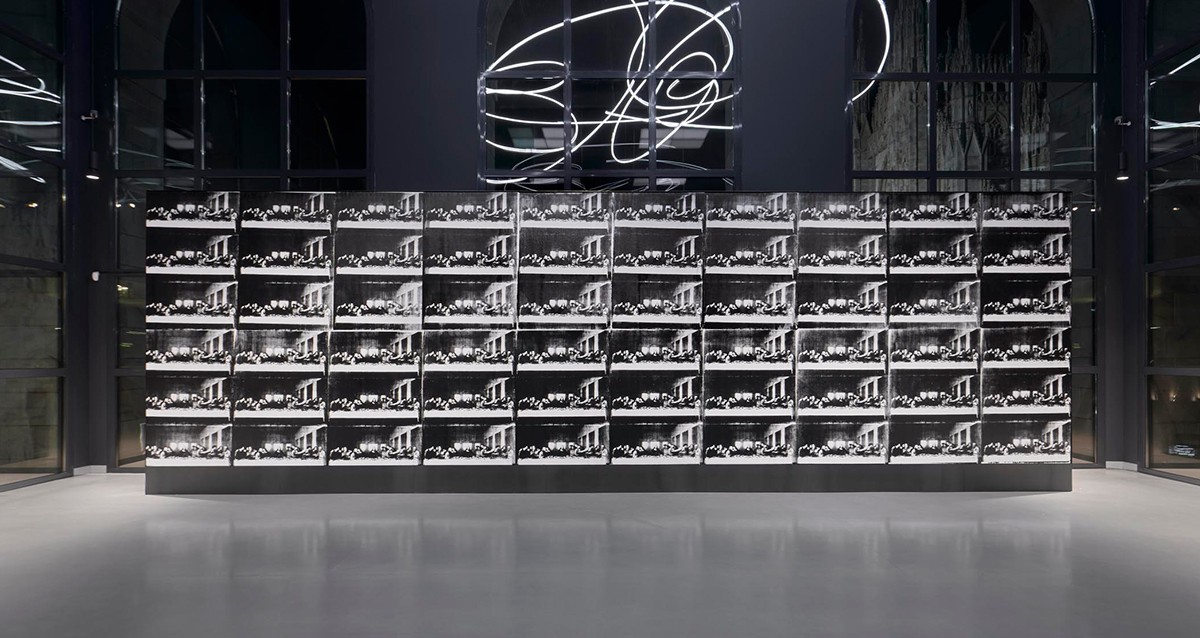 Museo del Novecento, Milan, 24 March – 18 May, 2017
For the exhibition entitled Warhol—Il Cenacolo, which ran from 22 January 1987 through 21 March 1987. Enraptured with his new subject, Warhol executed two series based on two distinct sources. The first, a series of silkscreens derived from a 19th century copy the da Vinci from which Sixty Last Suppers, The Last Supper (Pink) (Andy Warhol Museum, Pittsburgh), and The Camouflage Last Supper (Menil Collection, Houston) belong, and a second series of hand painted works molded after a line drawing, from which The Last Supper (Museum of Modern Art, New York and The Last Supper / Be Somebody with a Body (Andy Warhol Museum, Pittsburgh) belong. While only twenty-two of the multitudes of paintings and prints that Warhol had created around the theme were displayed at the Credito Valtellinese, it is estimated that nearly 30,000 visitors flocked to see what both the artist and the gallerists last exhibition would be. Upon his return to New York, Warhol passed away following a gall-bladder operation on February 22, 1987, shortly thereafter Iolas succumbed to AIDS. “The exhibition was a farewell, agood-bye,” explained Corinna Thierolf, “as shocking as it was wonderful, from which this Last Supper series subsequently derived a quality of mysterious enchantment. The theme immediately calls to mind Christ prophesying his own death at the last meal in the company of his disciples.
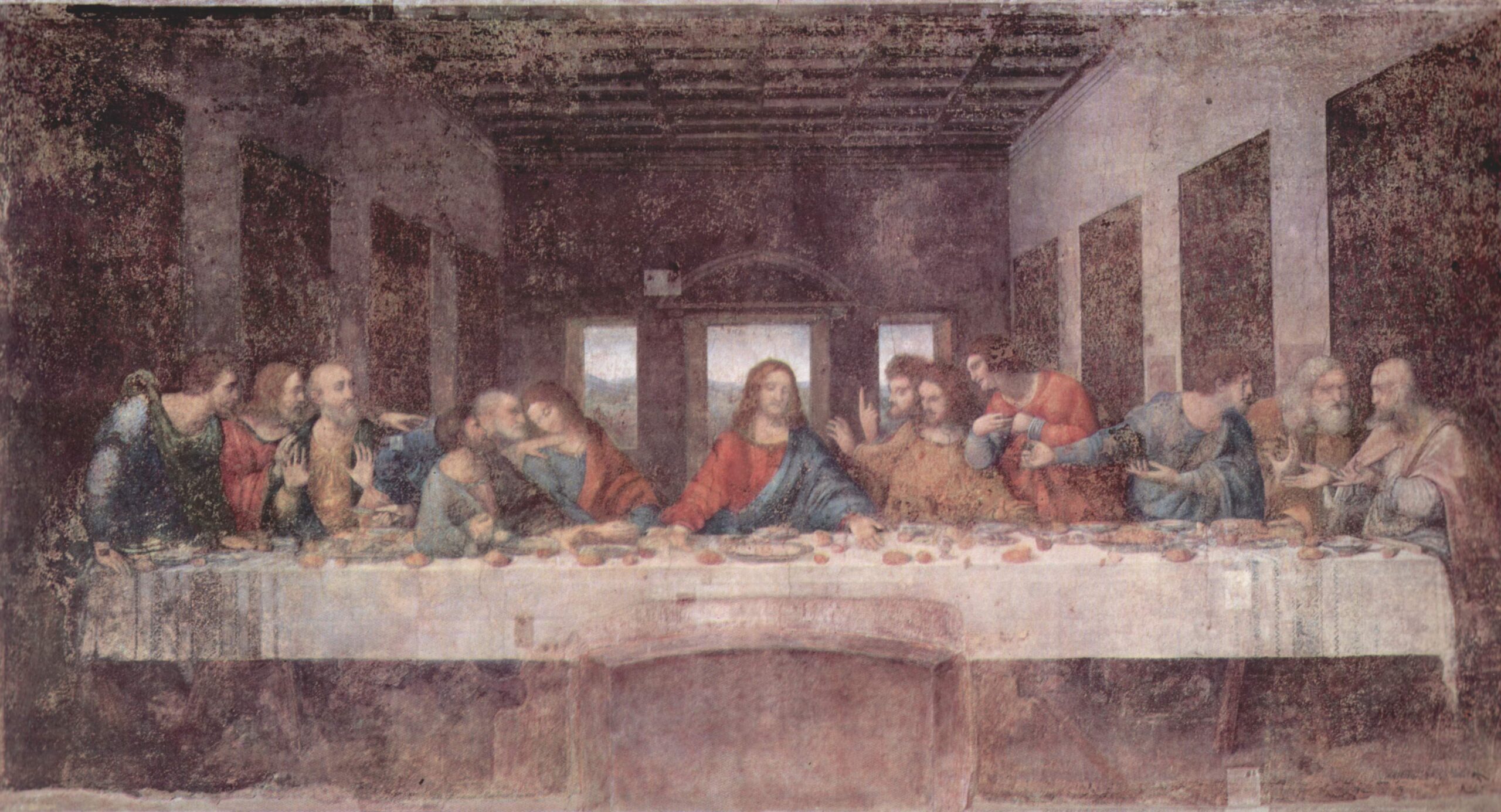
By the time Warhol appropriated Leonardo’s Last Supper, it had long been part of popular culture. Turning to the cheapened household copies, Warhol recreated the classical image over and over with revitalized vigor. Indeed, the photograph of the venerated mural that Warhol implemented as the basis for his silkscreened pictures was a reproduction of an engraving that is most closely linked to a widely-distributed copy of the original Leonardo done by Raphael Morghen in the 1800s. Warhol’s decision to use a copy of the original was in part due to necessity. As his studio assistant at the time, Rupert Smith explained, “Andy worked on the project on and off for a year from photographs, but I could never get a really great photograph out of the real Last Supper books because the images were always so dark” (R. Smith, quoted in J. Schellmann, Andy Warhol: Art from Art, Cologne, 1994, p. 77). However, Warhol soon became enamored with the quest to find cheap knockoffs of the Renaissance masterpiece. In one…updated Vasari type book,” Smith continued, “we found line drawings of every famous painting. Andy used that because it gave a clear definition. He also used a kind of maquette, a sculpture of The Last Supper we found on the New Jersey turnpike in one of those gas stations; it was white, made to look like marble, but it was really plastic. I think I paid $13 for it. And then Andy found another one in the Time Square area where the Mediterranean Iranian rug dealers sell Christian paraphernalia and towels and electronic gear on the side. He said to pay a couple thousand for it; it was big and all enameled. Andy photographed this one thinking we would use it, but the actual photo of The Last Supper he used I bought at a Korean religious store next to the factory. It was one of those copies of the 19th century version that had been re-done, like you’d buy in Woolworths” (R. Smith, quoted in J. Schellmann, Andy Warhol: Art from Art, Cologne, 1994, p. 77).
Indeed, in turning his found copies into a copy of his own, Warhol became part of the infinite legacy of Leonardo’s own Last Supper—the collective of an icon written and rewritten throughout history. “Yet among all the reworkings of The Last Supper,” Francesca Bonazzoli has explained “the one that remains exemplary is the clever iconographic use to which Andy Warhol put it in the last exhibition before his death…. Warhol’s idea was to work on the added value of Leonardo’s image. Producing multiple reproductions of a photo of a copy that was itself a copy of the original only served to confirm The Last Supper’s fetishistic value. Like miraculous images, the image-icon does not need to be authentic in order to become a fetish and exercise its power of attraction for the public. Warhol thus revealed the inherent quality of Leonardo’s Last Supper: its existence as an image that can always be interpreted, modified, and reproduced. It is a fetish for mass veneration, one whose fame has grown more through imitation than through direct observation of the original” (F. Bonazzoli and M. Robecchi, Mona Lisa to Marge, Munich, 2014, p. 45).
Here, Warhol’s serial work subverts the very notion of original representation as it aspires to the “unpresentable presentation” of the infinite (J. Derrida, The Truth in Painting, trans. G. Bennington and I. McLeod, University of Chicago Press, 1987, p. 125). There is no limit to this image. By completely covering the canvas with images, Warhol suggests that the picture plane continues into infinity and that there are always more images beyond the frame. Indeed, this implied repetition exterior to the painting takes place in the imagination. Gilles Deleuze points out that “repetition is itself in essence imaginary… it makes that which it contacts appear as elements or cases of repetition” (G. Deleuze, Difference and Repetition, New York, 1994, p. 76). What is here substantiated is an imaginary instance of Leonardo’s Last Supper beyond its past, future, and cultural ubiquity. By infinitely multiplying the image on one canvas, Warhol makes the viewer even more immediately aware that the image is a replicate by showing a copy of a copy of a copy of a copy. Reproducing sixty images of The Last Supper on one canvas reveals the already infinite nature of the act of copying. Moreover, these repetitions are rendered by Warhol in a grid pattern which implies the infinite through the Euclidian geometry of the picture plane where the parallel lines never meet and infinite perpendiculars frame the same image. Reveling in the nature of seriality, Warhol shows a prescient understanding of the past and the future of the images in this work. The work as a whole, rather than the singular silkscreen, is analogous to the Nietzschean moment—the gateway from which eternal recurrence precedes and recedes–since the painted canvas is the object of an infinite artwork come into being as a tangible presence, a commodifiable object.
Additionally, as with his serial screen prints of Marilyn Monroe, Elvis, Marlon Brando and his Death and Disaster series, the repetition found in Sixty Last Suppers echoes the contemporary media that Warhol was so fond of. From the photograph to film, television and even the Amiga computer, Warhol had—since the 1960s—fully embraced the visual complexity of the technical world. While in these earlier examples the overlapping vertical screens often appeared to mimic the 16mm celluloid film strip, Sixty Last Suppers—with its abutting black-and-white rectangles— evokes stacks of miniature television screens with the details of Leonardo’s image faded by their shadows. Indeed, by the time Sixty Last Suppers was painted, Warhol had fully embraced TV, launching his own Warhol TV which aired from 1980 to 1982. While the movement of the repeated images in his works from the 1960s serve to heighten and confuse the trauma of the original “The grid in Sixty Last Suppers is clean, without blur or overlap, and the dark shadows give the image a soft glow echoing that of a television screen. The repetition here is static, locking the image in time” (A. McDonald (ed.), Gagosian Quarterly, Summer 2017, p. 88). Referencing the Leonardo’s mass circulation, while also recogn izing the transgressive element in multiplying the figure of Christ repeatedly over a single canvas, Warhol leaves his viewer with an openended question about whether there is a loss or gain the image’s spiritual aura at the hands of endless repetition.
Detail of the Last Supper (Christ 112 Times) Yellow
Sotheby’s New-York: 14 May 2008
Estimated: USD 10,000,000 – 15,000,000
USD 9,561,000

ANDY WARHOL
Detail of the Last Supper (Christ 112 Times) Yellow, 1986
Acrylic and silkscreen ink on canvas
80×421 inches (203.2 x 1069.3 cm)
Detail of the Last Supper (Christ 112 Times) Yellow reincorporates the grid composition and seriality introduced in his early Pop paintings. Amongst these, Warhol’s Marilyn X 100 in the collection of the Cleveland Museum of Art presents an interesting point for formal comparison. Cropped from da Vinci’s grand composition, Christ’s head and Marilyn’s star portrait are both the fetishistic subject of Warhol’s aesthetic gaze. Both emphasize commoditization through the repetition of a single image to a grand extent. Albeit, where the Detail of the Last Supper (Christ 112 Times) Yellow alludes to the consumption of a religious icon through a vastly reproduced image, the Marilyn X 100 refers to Warhol’s violation of traditional art hierarchies, replaced with a fluid dialogue between high and low art forms; ultimately subverting the idea of painting as a medium of invention and originality.
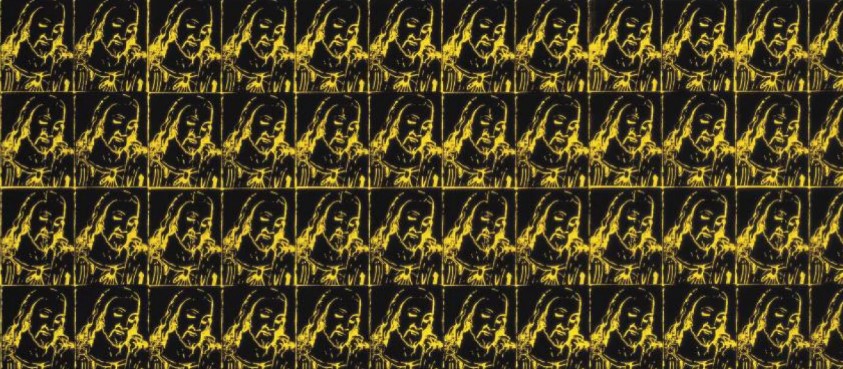
Both Detail of the Last Supper (Christ 112 Times) Yellow and Marilyn X 100 are on a grandiose scale that references the mural size of da Vinci’s masterpiece. For Warhol, size was never accidental and was meant as a compositional element equal in significance to content. For the viewer, the physical response to an enormous canvas is imposing, emphasized by the power of a repetitive image. These are works that require the spectator to step back in order to appreciate the grand scale of the composition as a unified coherent whole wherein accurate perception of its details becomes secondary. Once the successive rows and columns are abstracted, they are lost in a repetitive echo.
In the Detail of the Last Supper (Christ 112 Times) Yellow seriality is conveyed with a sense of mutability and transience, both central strategies operating in Warhol’s enterprise. The figure of Christ as subject is not simply transferred from the realm of high art into popular culture. Rather it is appropriated from a classical popular image and re-contextualized to meet Warhol’s technical and aesthetic requirements. The result is the transformation of Christ into a harmony of black and yellow imagery bearing little resemblance to the original painting by Leonardo da Vinci. Nonetheless, the image of Christ retains an overwhelming spirituality in spite of its seemingly detached treatment; a reminder that we should never take Andy Warhol at face value.
Last Supper (40×40)
The Last Supper, 1986
Edlis Neeson Collection
Christie’s New-York: 19 November 2025
Estimated: USD 6,000,000 – 8,000,000
USD 8,127,000
ANDY WARHOL (1928-1987), The Last Supper | Christie’s
ANDY WARHOL (1928-1987)
The Last Supper, 1986
Acrylic and silkscreen ink on canvas
40×40 inches (101.6 x 101.6 cm)
Stamped with the artist’s signature ‘Andy Warhol ©’ (on the overlap)
Signed and inscribed by Frederick Hughes
‘I certify this to be an original painting by Andy Warhol completed by him in 1986 Frederick Hughes’
(on the overlap)
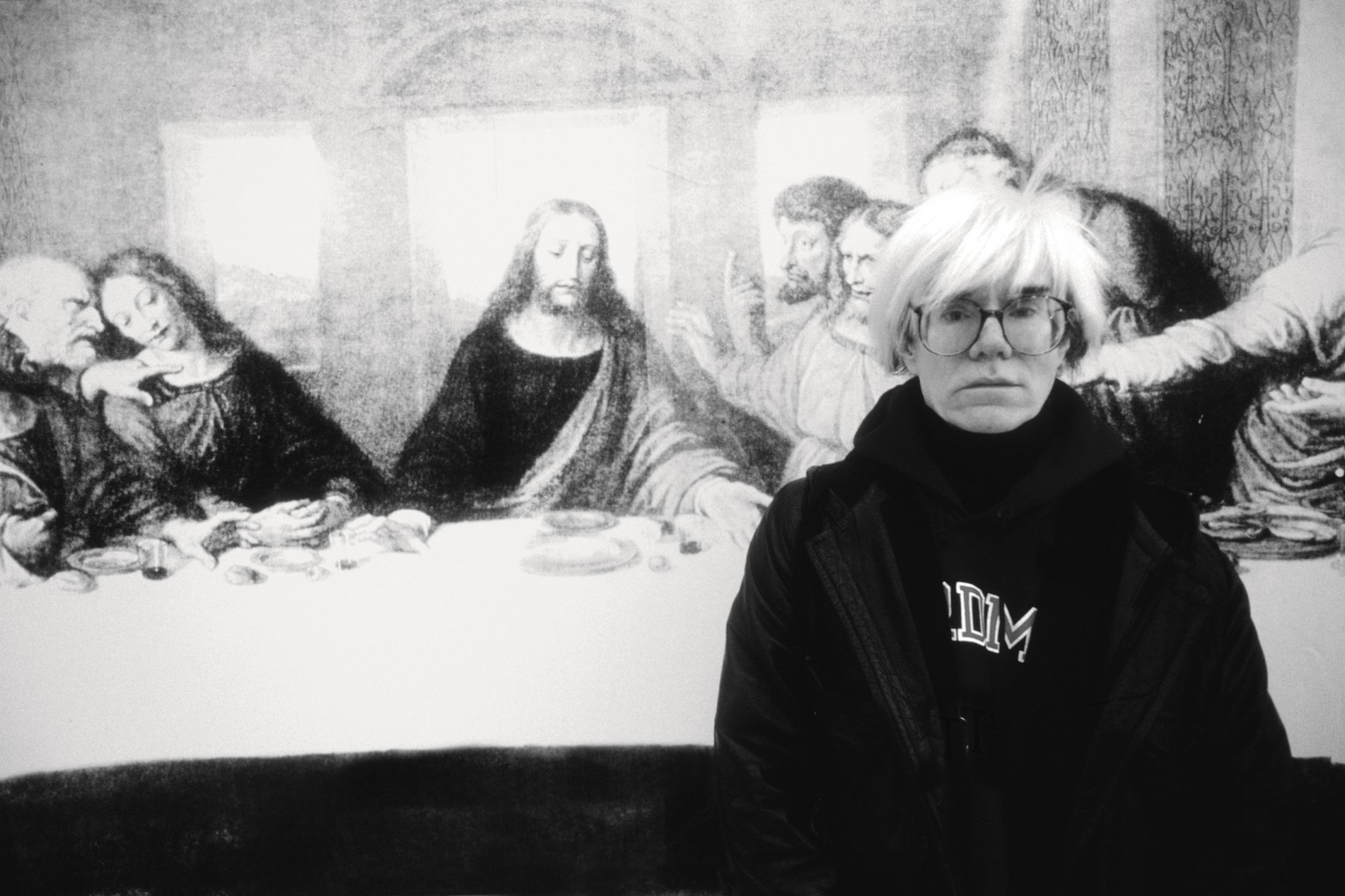
As Andy Warhol’s last work and ultimate artistic statement, The Last Supper is the culmination of the twentieth-century titan’s profoundly impactful oeuvre, recapitulating a lifetime of creativity and artistic invention into a singular series. Warhol places himself in contention with Leonardo da Vinci, one of the greatest artists in the artistic pantheon, appropriating and conversing with Leonardo’s iconic Last Supper mural to assert his place at the pinnacle of the art historical canon. As his final series, The Last Supper works powerfully to reiterate the principles which had defined Warhol’s entire artistic enterprise, meditating on fame, death, originality, and transformation. Warhol’s The Last Supper series was first exhibited at Warhol-Il Cenacolo in the refectory of Palazzo Stelline in Milan, directly across the street from Santa Maria delle Grazie, whose refectory is the site of Leonardo’s Last Supper. Warhol died in New York on February 22nd, exactly one month after he attended the opening of this Milan exhibition.
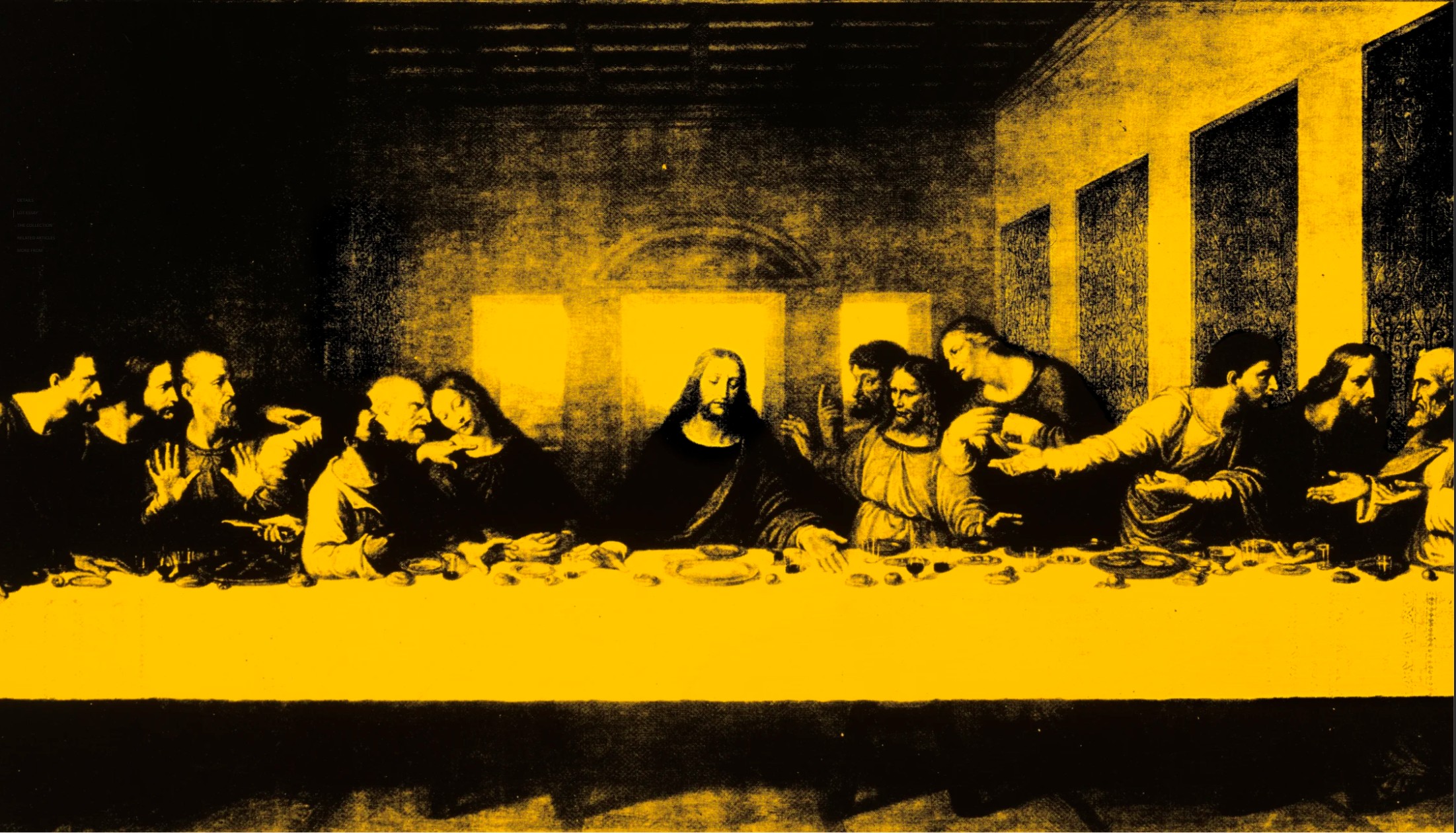
The dealer Alexander Iolas, who presented the artist’s first exhibition in 1952, also suggested the subject for what would be Warhol’s last show. Leonardo’s masterpiece became Warhol’s obsession, the Pop artist analyzing the famed composition from every angle and through a cacophony of reproductions. Warhol produced an exceptional quantity of preparatory material relating to the Last Supper, creating drawings, engravings, screenprints, and sculptural models of the scene in order to deconstruct and fully inhabit the composition. Warhol’s frenzied studies, stretching the course of almost two years, parallel the Old Master’s own struggles in achieving his mural, which demanded three.
Warhol explained to his assistant Benjamin Liu his goal of making Leonardo’s painting “exciting again”.
“It’s a good picture… It’s something you see all the time. You don’t think about it.”
The source image seamlessly synchronizes with many of Warhol’s longstanding themes. Leonardo’s Last Supper had begun to deteriorate a decade after its completion due to an inherently unstable binding method and environmental effects, meaning that after many excruciating restoration campaigns, its present representation and its many reproductions no longer faithfully reflect how the painting originally appeared. This very aspect made the subject perfect for Warhol, whose entire career investigated the invention of celebrity and the inevitability of death and decay.
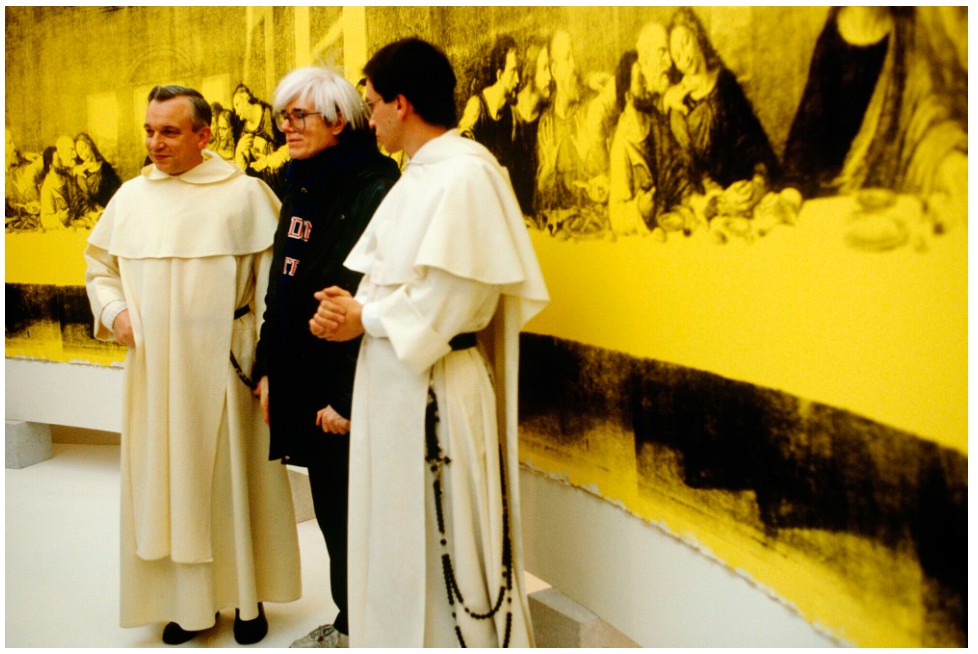
Maria Mulas, Andy Warhol during the exhibition that showed his Last Supper, 1987, Credito Valtellinese, Stelline Foundation, Italy. Photo: © Maria Mulas. All rights reserved 2025 / Bridgeman Images. Artwork: © 2025 The Andy Warhol Foundation for the Visual Arts, Inc. / Licensed by Artists Rights Society (ARS), New York.
The artist aimed to achieve as close an imitation of the original mural as possible, searching widely for the perfect photographic model for his work. Warhol finally chose a cheap, nineteenth-century engraving found in a devotional souvenir shop across from The Factory as the model for his silkscreens. With this selection, The Last Supper becomes a meditation on originality, the instantly-recognizable subject seen in the present work arriving on the silkscreen from a cascading series of intermediaries—a duplicated photograph of a reproduction of a copy after the original painting—its immediate recognition with the original a vivid assessment in how works of art become iconic through the dissemination of its image in reproduction.
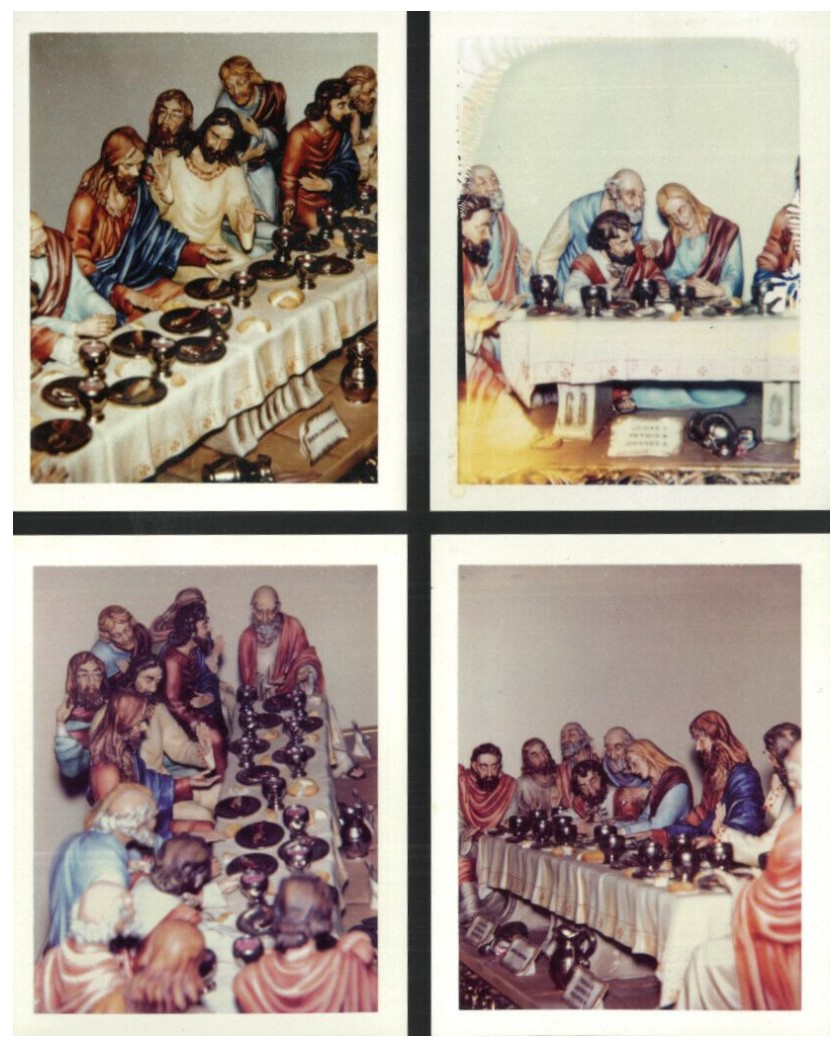
Andy Warhol, Last Supper, 1985. © 2025 The Andy Warhol Foundation for the Visual Arts, Inc. / Licensed by Artists Rights Society (ARS).
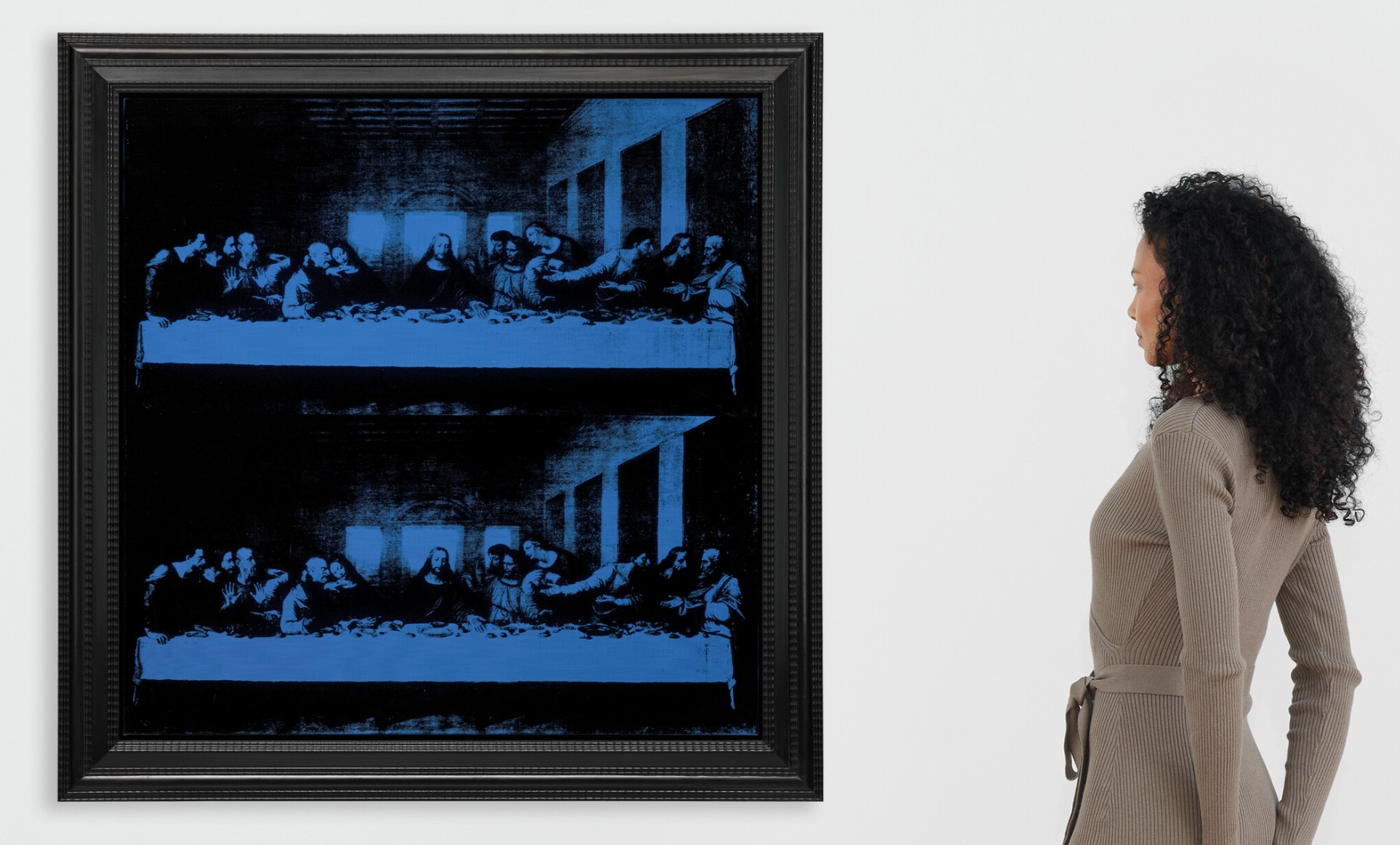
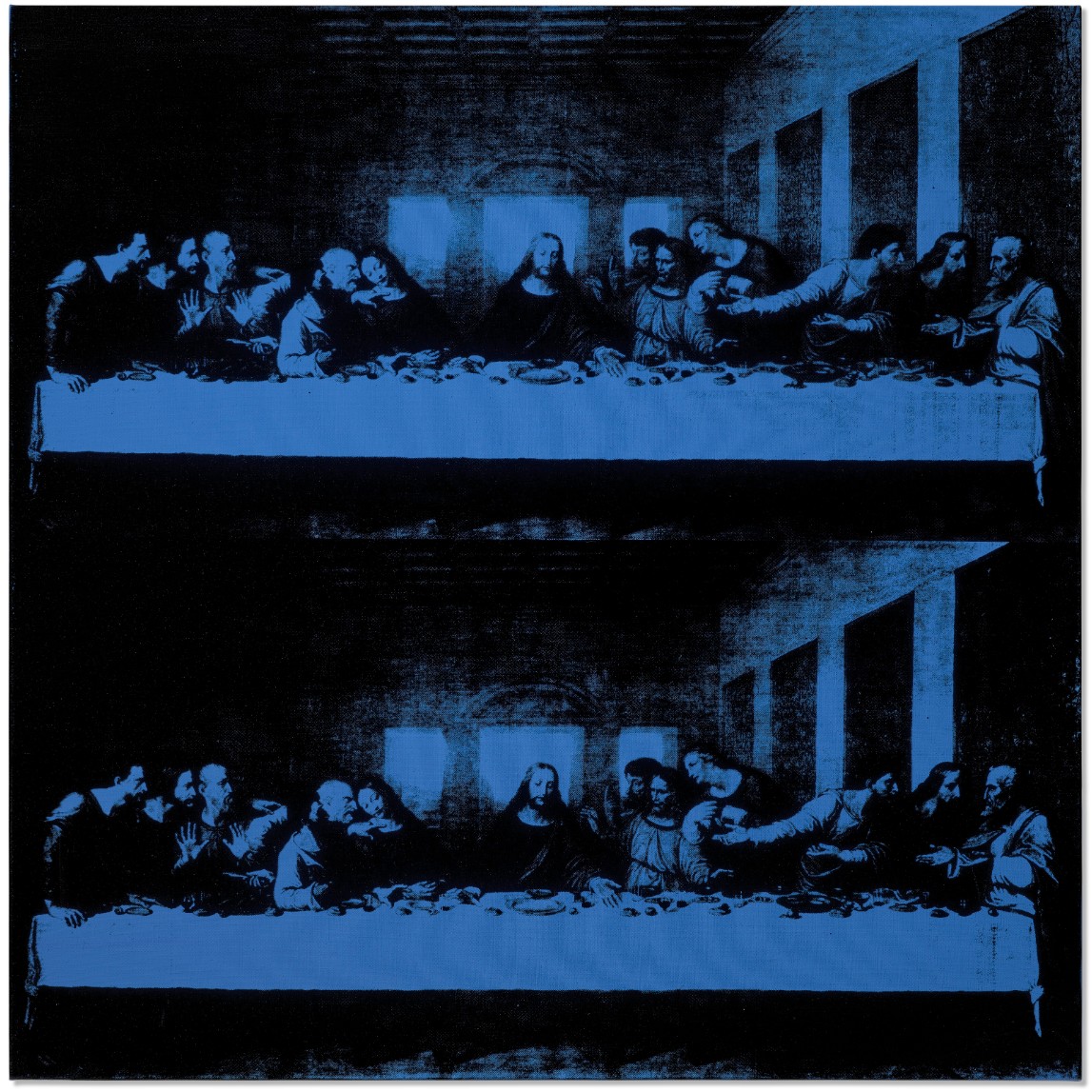
While remaining truthful to his source image, Warhol complicates the composition by doubling his source image onto dualling horizontal planes, arranged one above the other. Christ and his Apostles now appear not once but twice, profoundly capturing the many dualities of Leonardo’s original. This action of duplication reenacts the dual reality of Leonardo’s masterpiece. The master infuses his scene with a mind-boggling multiple doubleness, capturing both Jesus’s announcement of his betrayal and the institution of the Eucharist in a single frozen image.
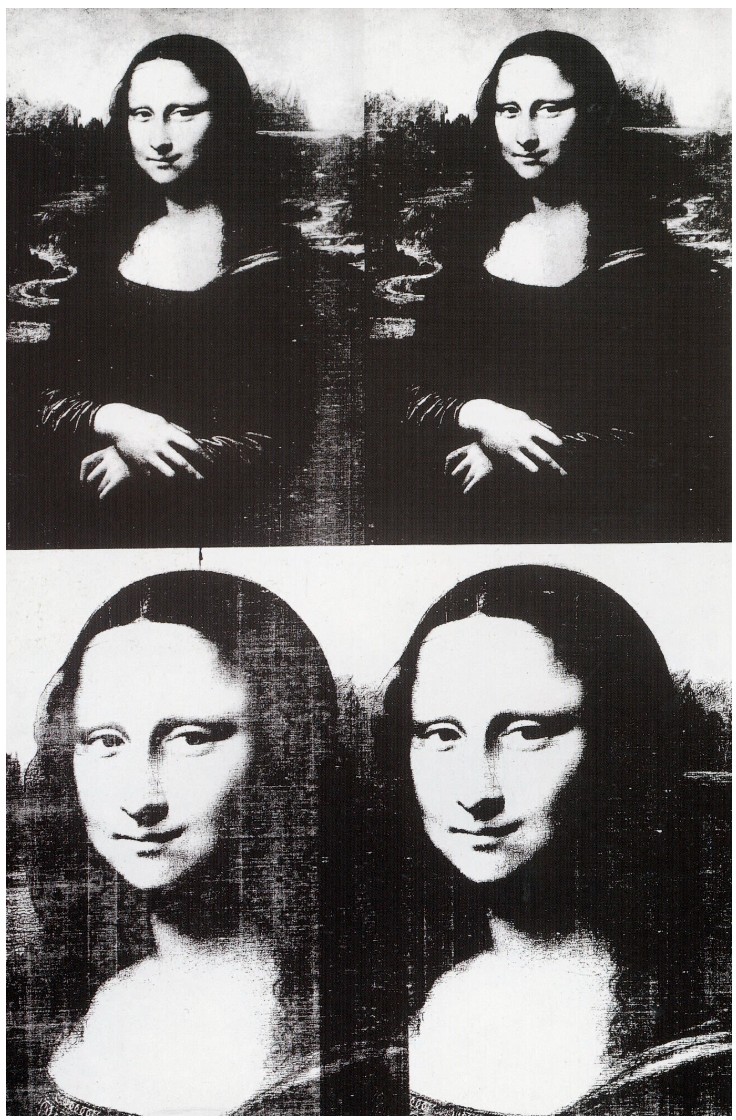
Andy Warhol, Mona Lisa, 1963. Metropolitan Museum of Art, New York.
© 2025 The Andy Warhol Foundation for the Visual Arts, Inc. / Licensed by Artists Rights Society (ARS).
There is an ironic symmetry in Warhol tackling Leonardo in his last series. One of the artist’s earliest silkscreen projects from the early 1960s was of the Florentine master’s Mona Lisa, the two Leonardo series serving as fitting bookends to a prolific period of discovery and artistic invention. With The Last Supper, Warhol was in fact returning to an important image which held deep sentimental value—his mother Julia kept a tattered reproduction of Leonardo’s Last Supper within the frayed yellowed pages of her Old Slavonic Prayer Book.
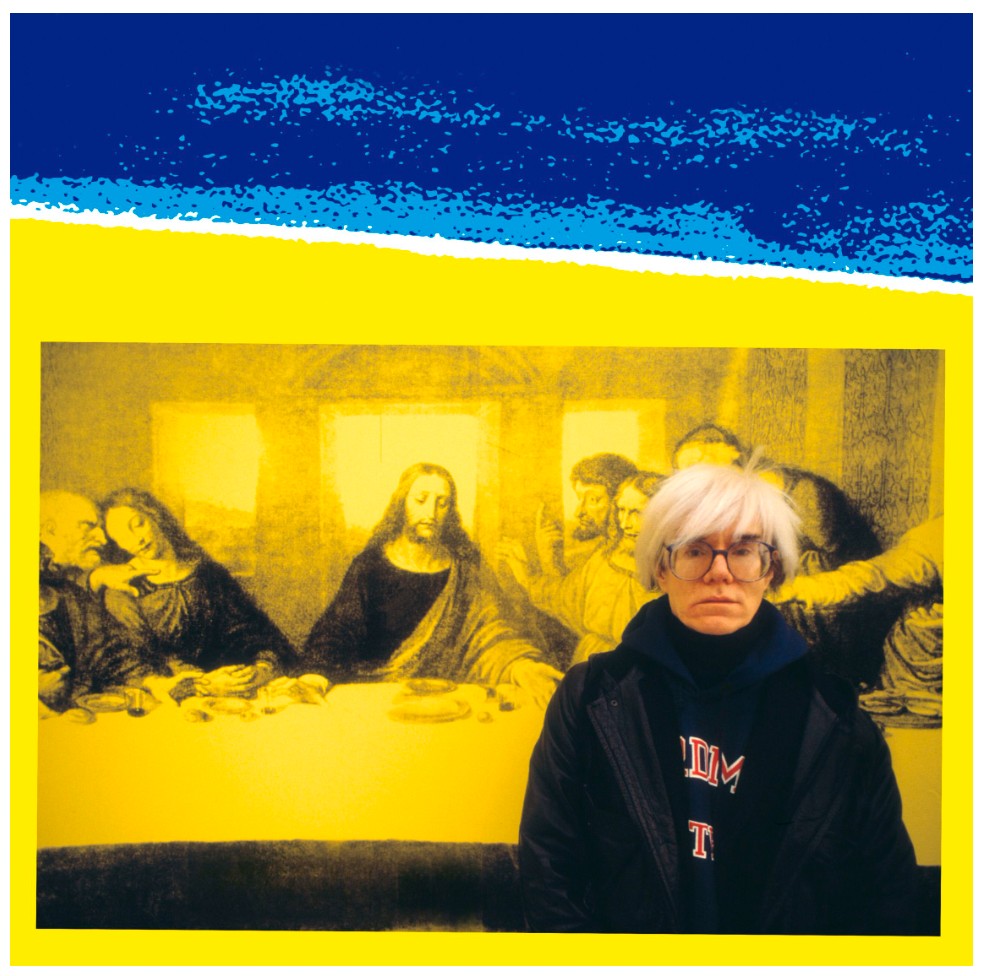
Andy Warhol in front of his work The Last Supper, Milan, 1987. Photo: Giorgio Lotti / Archivio Giorgio Lotti / Mondadori Portfolio via Getty Images. Artwork: © 2025 The Andy Warhol Foundation for the Visual Arts, Inc. / Licensed by Artists Rights Society (ARS).
Potently interweaving his own insights and principles into Leonardo’s iconic masterpiece, Andy Warhol established a compelling trans-historical dialogue with his predecessor. As his definitive, final statement, The Last Supper is inextricably linked with Warhol, forming a veritable self-portrait of the artist. The work visualizes Warhol’s ascent as one of the greatest and most influential figures of the twentieth century, surpassing even Leonardo in fame.
The Last Supper, 1986
Leonard & Louise Riggio: Collected Works
Christie’s New-York: 12 May 2025
Estimated: USD 6,500,000 – 8,500,000
USD 7,068,000
ANDY WARHOL (1928-1987), The Last Supper | Christie’s
ANDY WARHOL (1928-1987)
The Last Supper, 1986
Acrylic and silkscreen ink on canvas
40×40 inches (101.6 x 101.6 cm)
Stamped with the artist’s signature ‘Andy Warhol ©’ (on the overlap)
Signed and inscribed by Frederick Hughes
‘I certify that this is an original painting by Andy Warhol completed by him in 1986 Frederick Hughes’
(on the overlap)
Andy Warhol’s The Last Supper is the artist’s ultimate statement, culminating as both the apogee of a lifetime of creativity and final series in the titan of twentieth-century art’s highly influential oeuvre. The painting sees Warhol revisiting and meditating on both his long and varied career as well as the broader history of art. His creative engagement and dialogue with Leonardo da Vinci’s iconic masterpiece asserts his prominence in the art historical canon and serves as a powerful reiteration of the principles and techniques which served Warhol’s entire artistic enterprise. The series was first exhibited to the public in Milan at Warhol-Il Cenacolo in 1987, where over thirty thousand people passed through the exhibition to catch a glimpse of the new masterpiece of twentieth-century art shown across the street from Santa Maria delle Grazie, the convent where Leonardo’s original fresco remains in situ. This would be the final lifetime exhibition for Warhol, who died just a month after the opening, and provides a fitting swansong to the artist’s storied life.
Leonardo’s early masterpiece became an obsession for Warhol, who produced an astounding quantity of preparatory material for the work, fabricating prints, engravings, drawings, screenprints, and even sculptural models in order to deconstruct and reimagine Leonardo’s tableau. The repetitious methods used in obsessively copying and altering the source material reenacts Leonardo’s own struggles with his fresco. The present work follows from Warhol’s previous silkscreen series of celebrities created two decades prior in the choice of an iconic, instantly recognizable subject, however the artist is here using the silkscreen technique not merely as a means of reproduction but as a tool for deconstruction, each replication serving to penetrate the innovative formal structure of the old master. Warhol presents the work as a double image, stacking two duplicated Last Suppers on a single canvas. This achieves a deliberate conceptual manipulation of perspective, reinterpreting Leonardo’s inventive use of one-point linear perspective into a multiplicity of perspectival effects. Leonardo’s careful perspectival construction placing Jesus at the absolute center of the composition is undermined and challenged by Warhol’s double image, which destabilizes and decenters these effects.
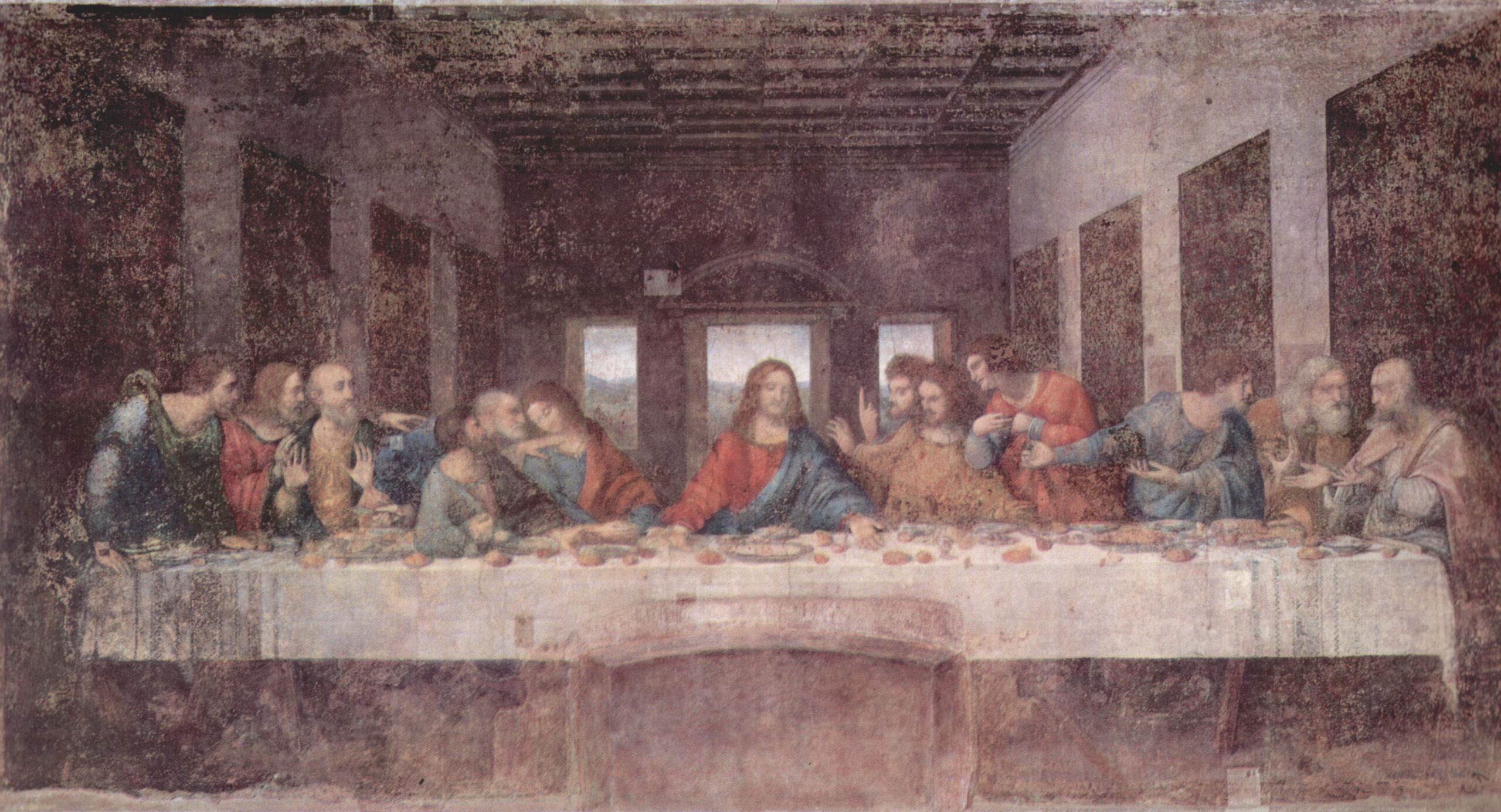
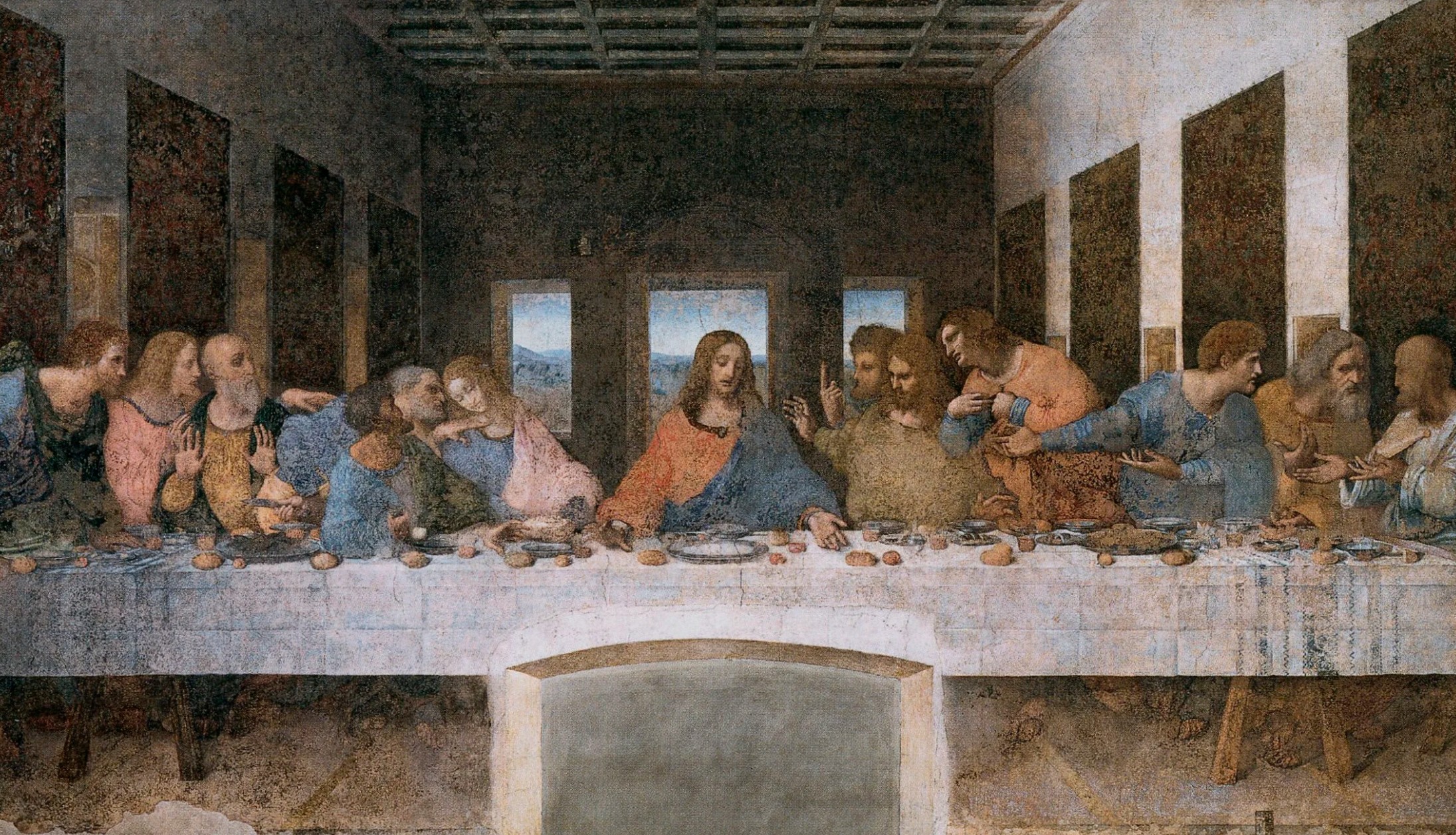
Leonardo da Vinci, The Last Supper, 1495-1497, Santa Maria della Grazie, Milan
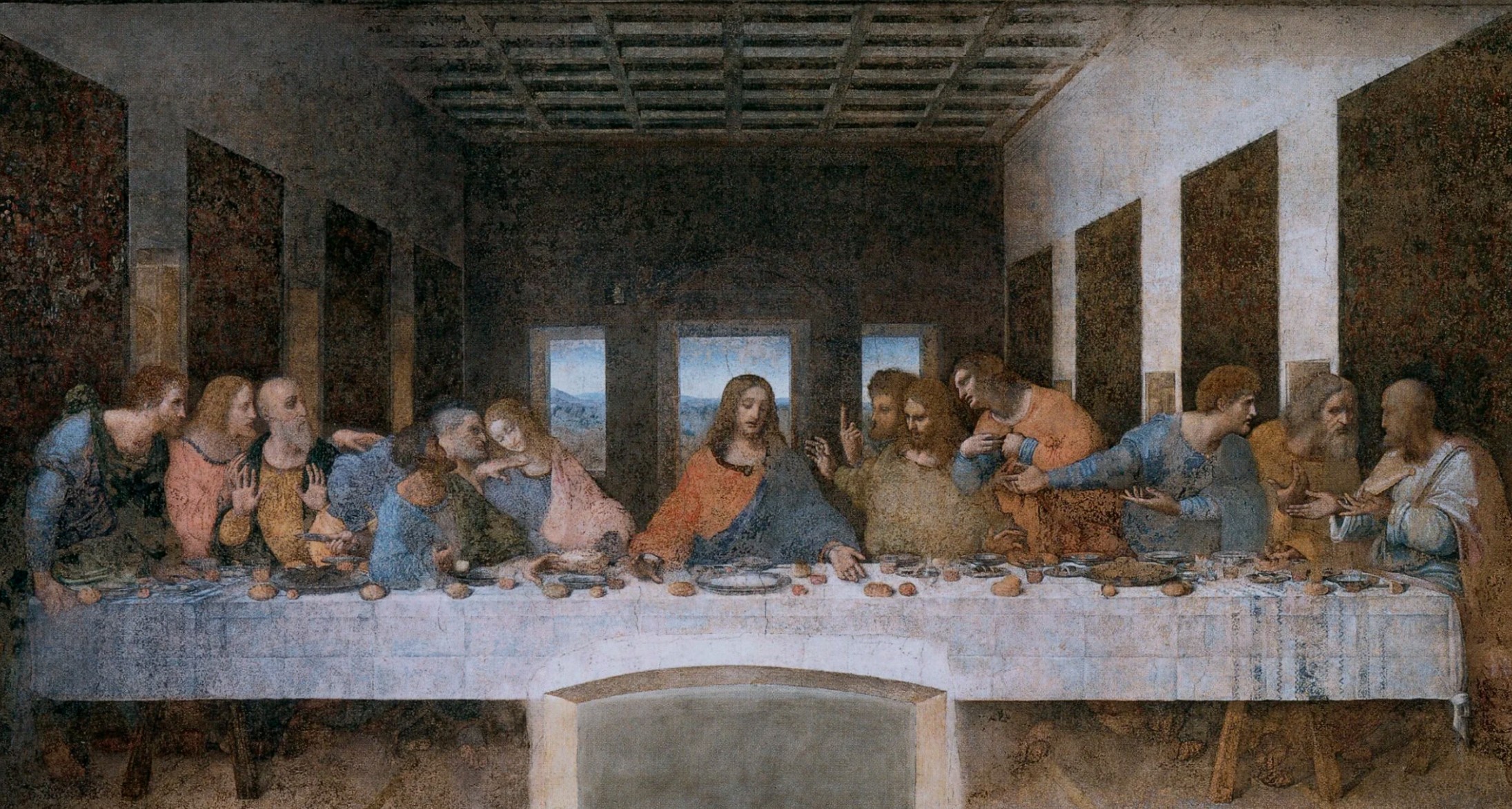
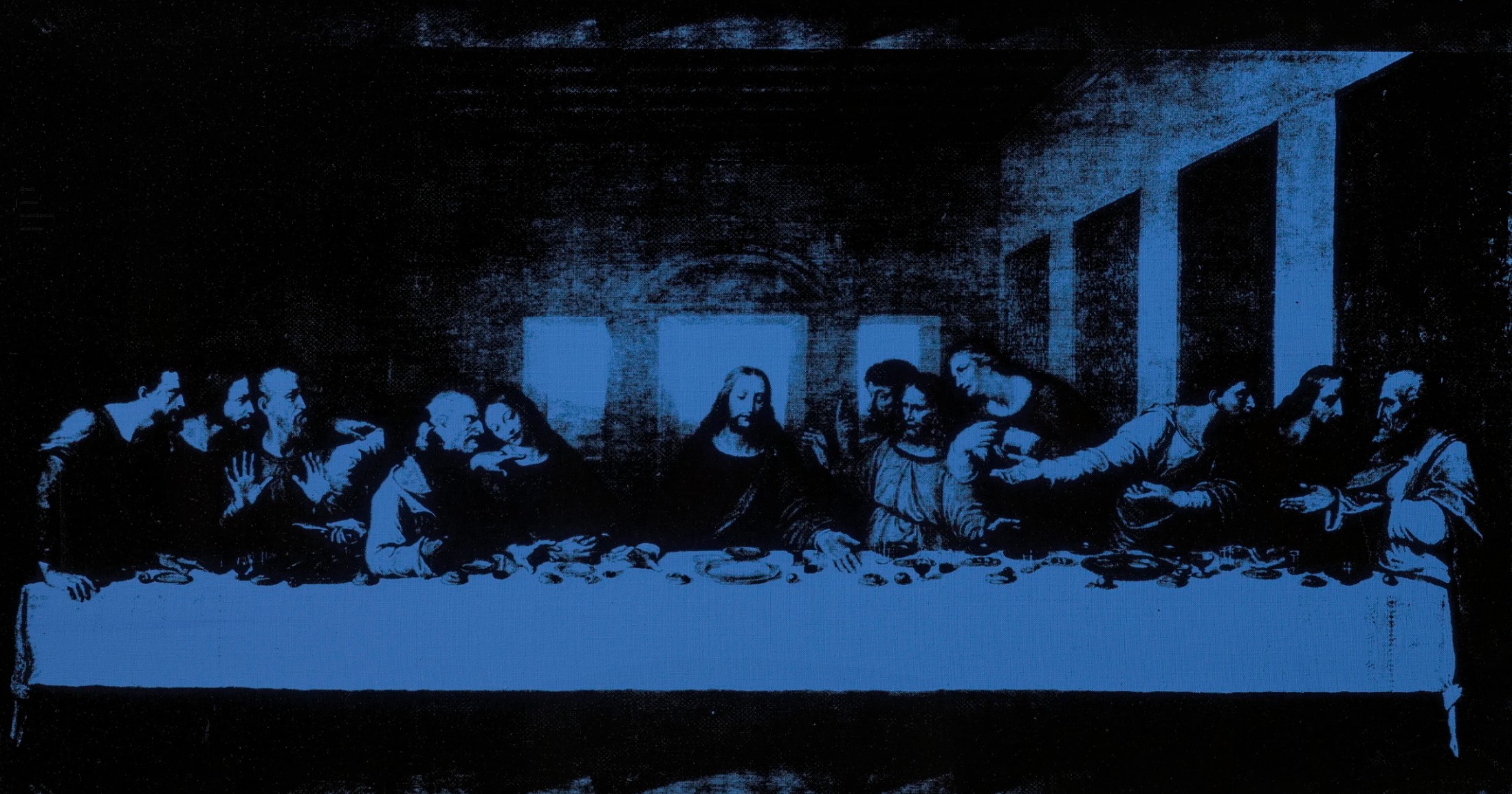
Leonardo’s Last Supper is Warhol’s ideal subject, as a decade after completion the fresco had already deteriorated due to unsuitable experimental binding method as to no longer reflect the glory of the original work. Centuries of restoration and conservation exist alongside thousands of copies of the works, create a cacophonous array of related images all purporting to represent an idealized yet nonexistent referent. The masterpiece is thus studied and understood more from copies than from the faded original fresco, a fact emphasized through Warhol’s choice of source material for The Last Supper: an amateur photograph of a widely-circulated nineteenth-century engraving of the work placed upon a blue field. Warhol’s employment of blue pigment harmonizes the composition while fracturing the atmospheric effect Leonardo achieves in the original fresco, flattening the composition. The present work is thus a duplicated interpretation of a reproduction of a copy of the original, its very relation to the original a vivid assessment in the ways art becomes iconic through the dissemination of copies. Through these many intermediaries, Warhol is able to access and analyze Leonardo’s technique and structure in a way analogous to an art historian.
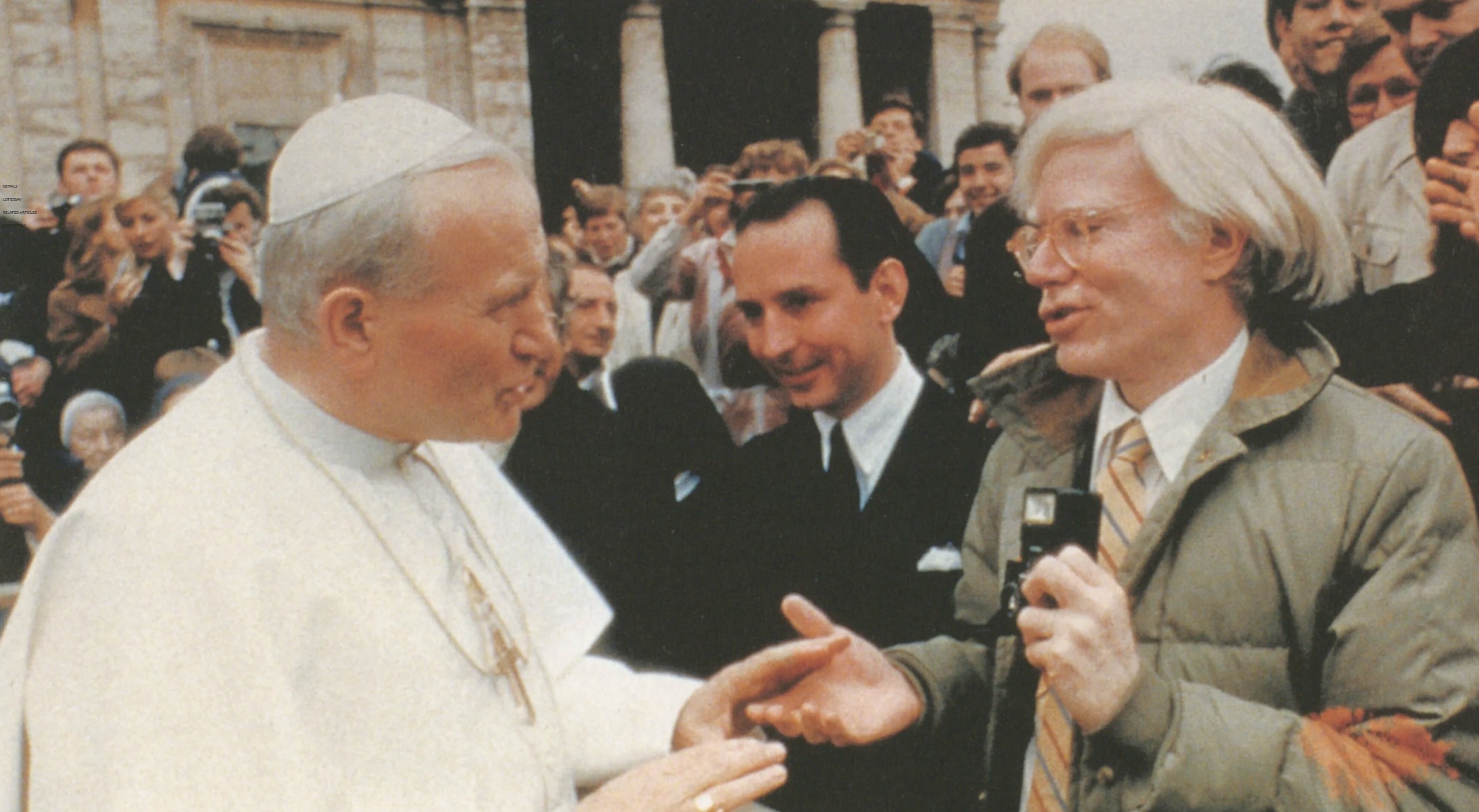
Andy Warhol with Pope John Paul II, Vatican City, 1980. Photo: The Vatican Museum, Vatican City, Foto Felici.
It is fitting that Warhol’s last silkscreen project would return to Leonardo da Vinci, as one of his first silkscreen works produced in the 1960s were of the Florentine master’s Mona Lisa. Beyond the symmetry of initiating and terminating his decades-long exploration of silkscreens with works after Leonardo, The Last Supper is also notable for its religious overtones, depicting Jesus’s last night before his crucifixion. Warhol himself was religious, attending mass weekly, and the theological component of Leonardo’s work must have moved the artist. Warhol’s interpretation of a sacred image reveals how a deeply spiritual work can be transmuted into an astute comment on popular culture through the endless effects of mechanical reproduction, recalling Walter Benjamin’s theory of how an artwork’s aura is devalued through reproduction. Warhol’s masterful reinterpretation of the theme reestablishes an auratic function to The Last Supper, powerfully infusing Leonardo’s inventions with Warhol’s insights to create a trans-historical dialogue reflective of temporalities and resolutions. This powerful artistic message is further amplified by its status as a work in Warhol’s final series, becoming artist’s definitive statement.
The Last Supper, 1986
Estimated: USD 5,000,000 – 7,000,000
USD 6,079,500
ANDY WARHOL (1928 – 1987)
The Last Supper, 1986
Acrylic and silkscreen ink on canvas
40 1/8 x 40 1/8 inches (101.9 x 101.9 cm)
Stamped with the artist’s signature (on the overlap)
Inscribed on the overlap:
I certify that this is an original painting by Andy Warhol completed by him in 1986 Frederick Hughes


A masterpiece of the Italian Renaissance, Leonardo da Vinci’s The Last Supper became a paradigm one-point linear perspective, which was an innovative visual device that articulated space and depth in a two-dimensional plane, and here draws viewers’ attention to a single vanishing point around the central figure of Christ. In his rendition, Warhol nullifies this technical triumph, compressing Leonardo’s trompe l’oeil and insisting upon its flatness via the process of silk screening and the application of the camouflage pattern, which, inherently, is entirely flat, further deconstructing the overlaid image. Warhol’s technique of appropriating familiar imagery through serial reproduction separates the image from its original source material, eventually degrading a painting as revered and sublime as Leonardo da Vinci’s The Last Supper to a banal signifier akin to a quotidian advertisement in a magazine. In preparation for this body of work, Warhol acquired several reproductions of Leonardo’s painting in art books alongside several highly commercialized miniature sculptural renditions. For the source of his silkscreens, he decided upon a detailed black and white reproduction from a commonly distributed Nineteenth century engraving first published in the 1885 Cyclopedia of Painters and Painting. Further emphasized by the palette, the rich burgundy and cadmium red of the pigment recalls the Eucharist, which, set against the artificially vibrant pink, juxtaposes the tension between the poignant narrative of the scene and its superficial mass reproduction.

LEONARDO DA VINCI, THE LAST SUPPER, 1495-97. MUSEO DEL CENACOLO VINCIANO, SANTA MARIA DELLE GRAZIE, MILAN, ITALY. IMAGE © BRIDGEMAN IMAGES
Within Warhol’s seminal The Last Supper series, the electric vibrancy and rich layers of camouflage lend the present work a particularly extraordinary presence. Paradoxically concealed and emergent, abstracted and figurative, sacred and profane, the dualities within The Last Supper bear witness to the clearest articulation of what curator Robert Rosenblum has described as “the endless contradictions” of Andy Warhol.
Last Supper, 1986
Christie’s New-York: 17 May 2017
Estimated: USD 6,000,000 – 8,000,000
USD 18,727,500
Andy Warhol (1928-1987), Last Supper | Christie’s
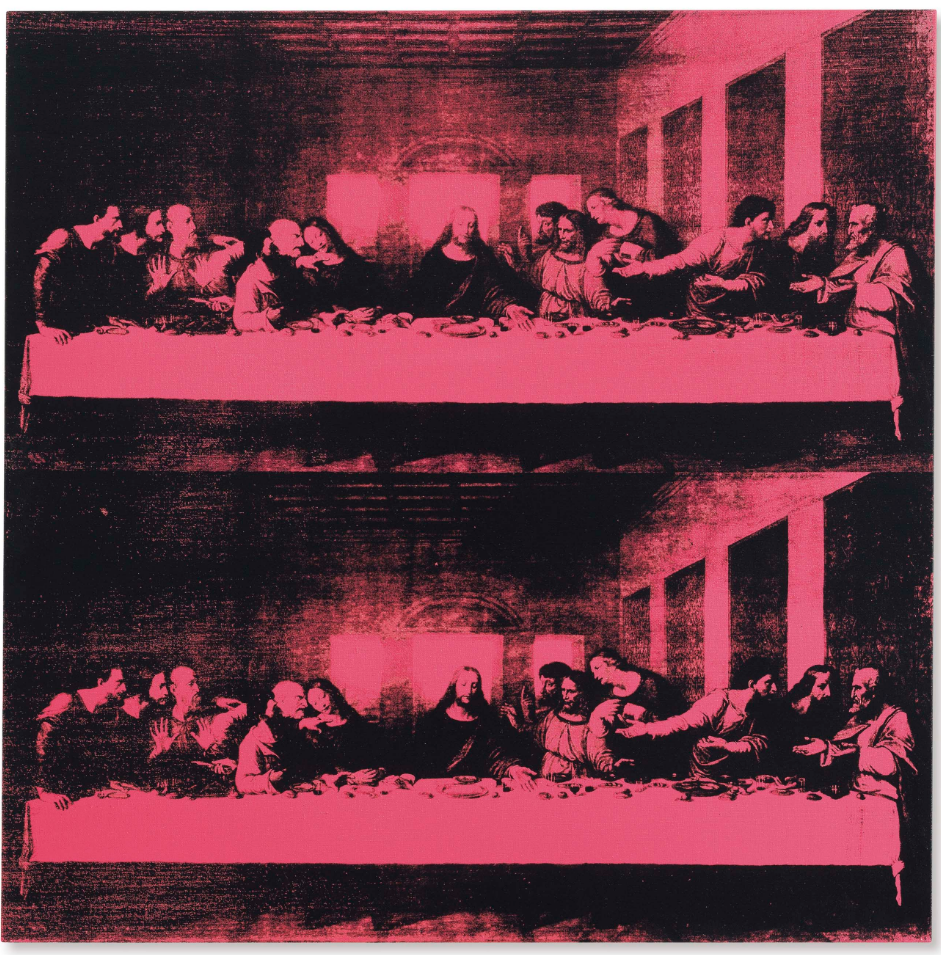
ANDY WARHOL
Last Supper, 1986
Synthetic polymer and silkscreen ink on canvas
40×40 inches (101.6 x 101.6 cm)
Stamped with signature ‘Andy Warhol’ (on the overlap)
Signed and inscribed by Frederick Hughes
‘I certify this to be an original painting by Andy Warhol completed by him in 1986
Frederick Hughes’
(on the overlap)
The Last Supper, 1986
Phillips New-York: 17 May 2018
Estimated: USD 8,000,000 – 12,000,000
USD 8,232,500
Andy Warhol – 20th Century & Contemporar… Lot 14 May 2018 | Phillips
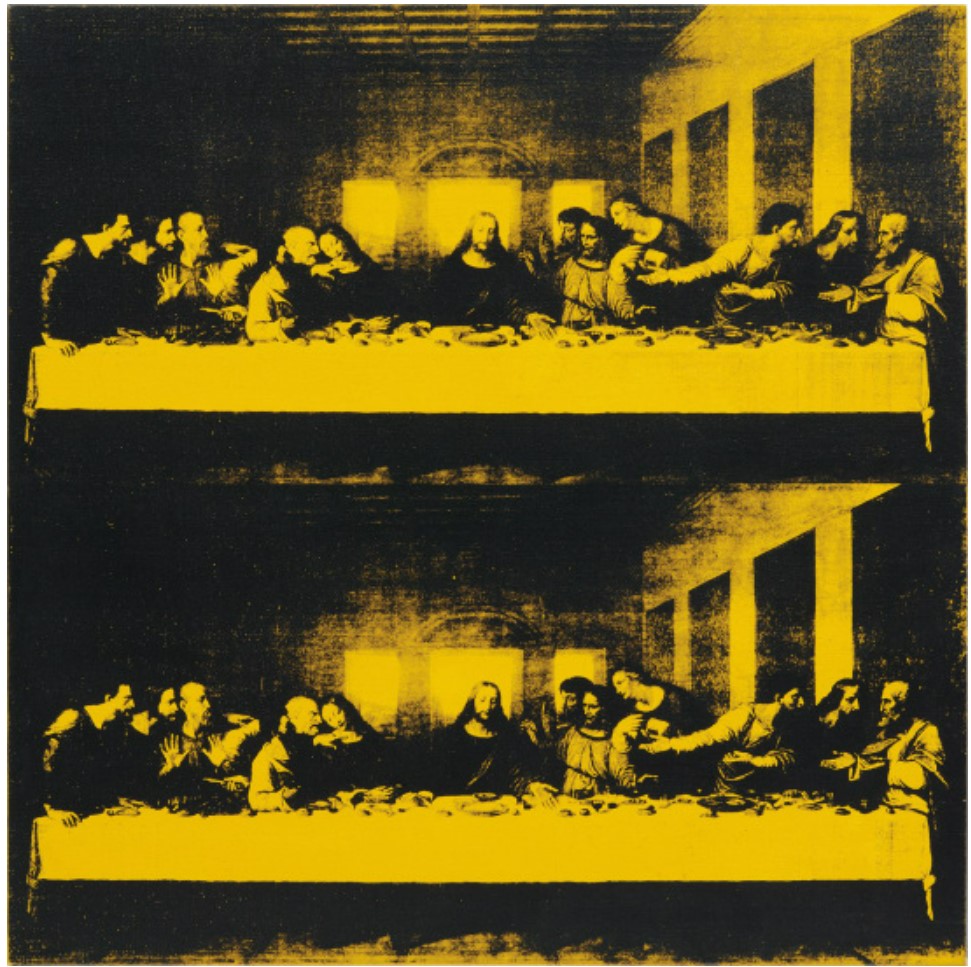
ANDY WARHOL
The Last Supper, 1986
Synthetic polymer paint and silkscreen ink on canvas
40×40 inches (101.6 x 101.6 cm)
Executed in 1986, Last Supper belongs to the final epic series that Andy Warhol executed before his untimely death. Initially conceived as a commission for the gallerist Alexandre Iolas, the series saw Warhol transform Leonardo da Vinci’s Renaissance masterpiece, The Last Supper, through his unique vernacular of appropriation, seriality and repetition. The present work belongs to a discrete group of fewer than 25 known silkscreen paintings based on an old black and white printed reproduction of The Last Supper that the artist cropped, stacked, overlaid and rotated in his silkscreen reinterpretations. The present work forms a handful of iterations the artist conceived on a 40 by 40 inch scale that presented the iconic image doubled and stacked in yellow, pink, green, blue or camouflage. The bright yellow uniquely doubles as a light source, imbuing Last Supper with a halo effect reminiscent of a religious icon, while also giving the effect of a flickering scene on a television screen – hinting at a movement, but frozen in time as a static image in the here and now.
The Last Supper, 1986
Sotheby’s New-York: 16 November 2017
Estimated: USD 4,000,000 – 6,000,000
USD 4,631,100
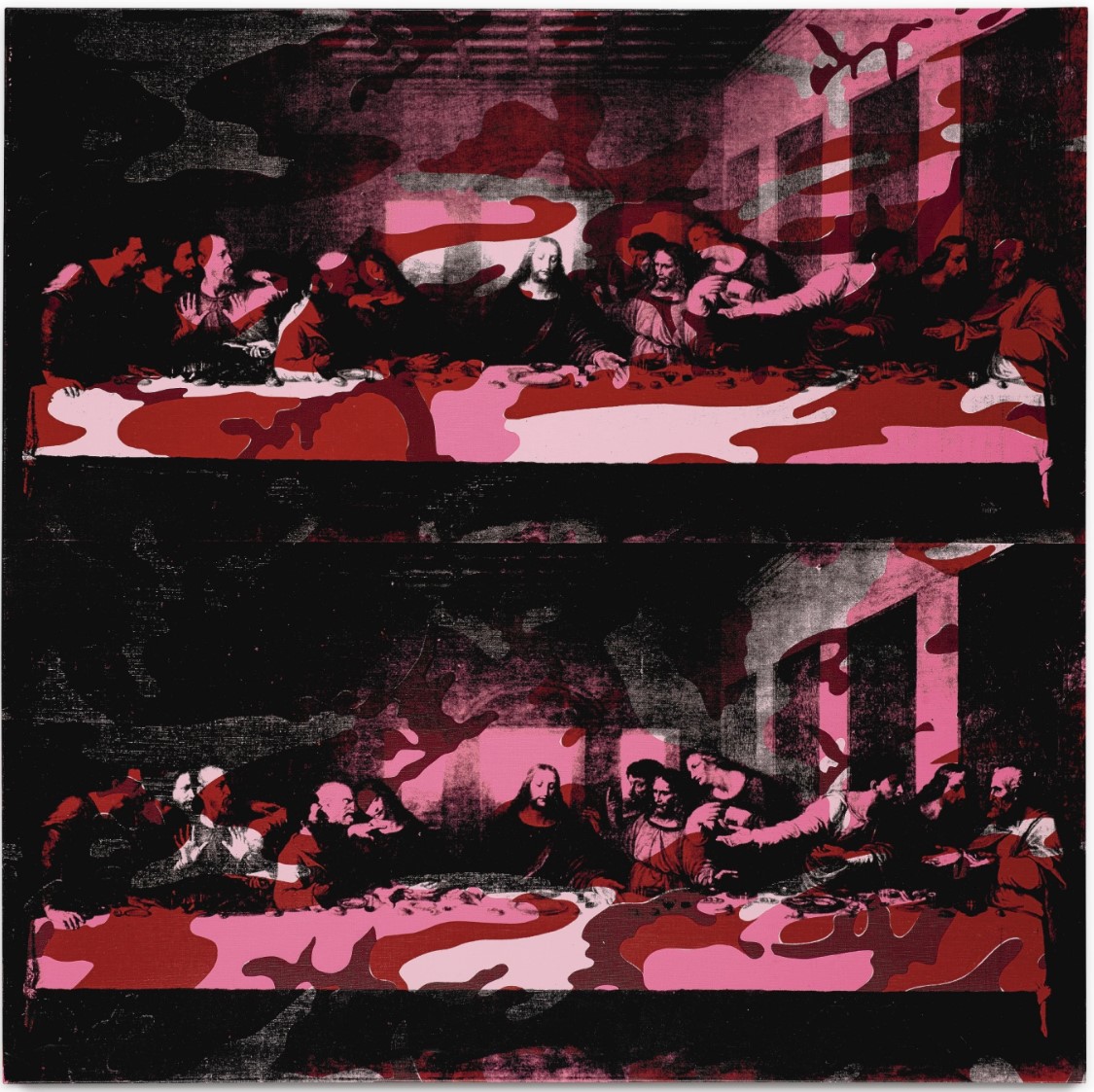
ANDY WARHOL
The Last Supper, 1986
Acrylic and silkscreen ink on canvas
40.1 x 40.1 inches (101.9 x 101.9 cm)
The present version is particularly distinguished given its expertly executed screen registration, the application of the universally recognized pattern of camouflage, and most importantly for its provenance, having been acquired from the artist directly by his gallerist Alexander Iolas. Radiating in brilliant hues of pink, red and white, the electric vibrancy of the image lends the present work an extraordinary presence. Warhol has also brought his own pop sensibility to the camouflage, foregoing the traditional olives, forest greens and tans for vivid hues of bubblegum pink and blood red. Biomorphic forms of shocking pink and deep red swim languorously across the surface, invigorating an otherwise black and white reproduction, but doing little to veil or obscure Christ’s final meal with his disciples. The present example combines Warhol’s obsession with fame in the ultimate celebrity of Christ, religious and spiritual inclinations, preoccupation with death and fierce commitment to mass production. It can also be read as a clever and elegiac self-portrait, in which Warhol attempts to conceal his religious devotion with the mass-produced, wholesale camouflage. Contemplative, ironic, and conflating two of the artist’s latest visual vocabularies before his untimely death, The Last Supper poetically consummates Warhol’s prolific career that began and ended in religion.
The Last Supper, 1986
Sotheby’s New-York: 9 November 2011
Estimated: USD 5,500,000 – 7,500,000
USD 6,522,500
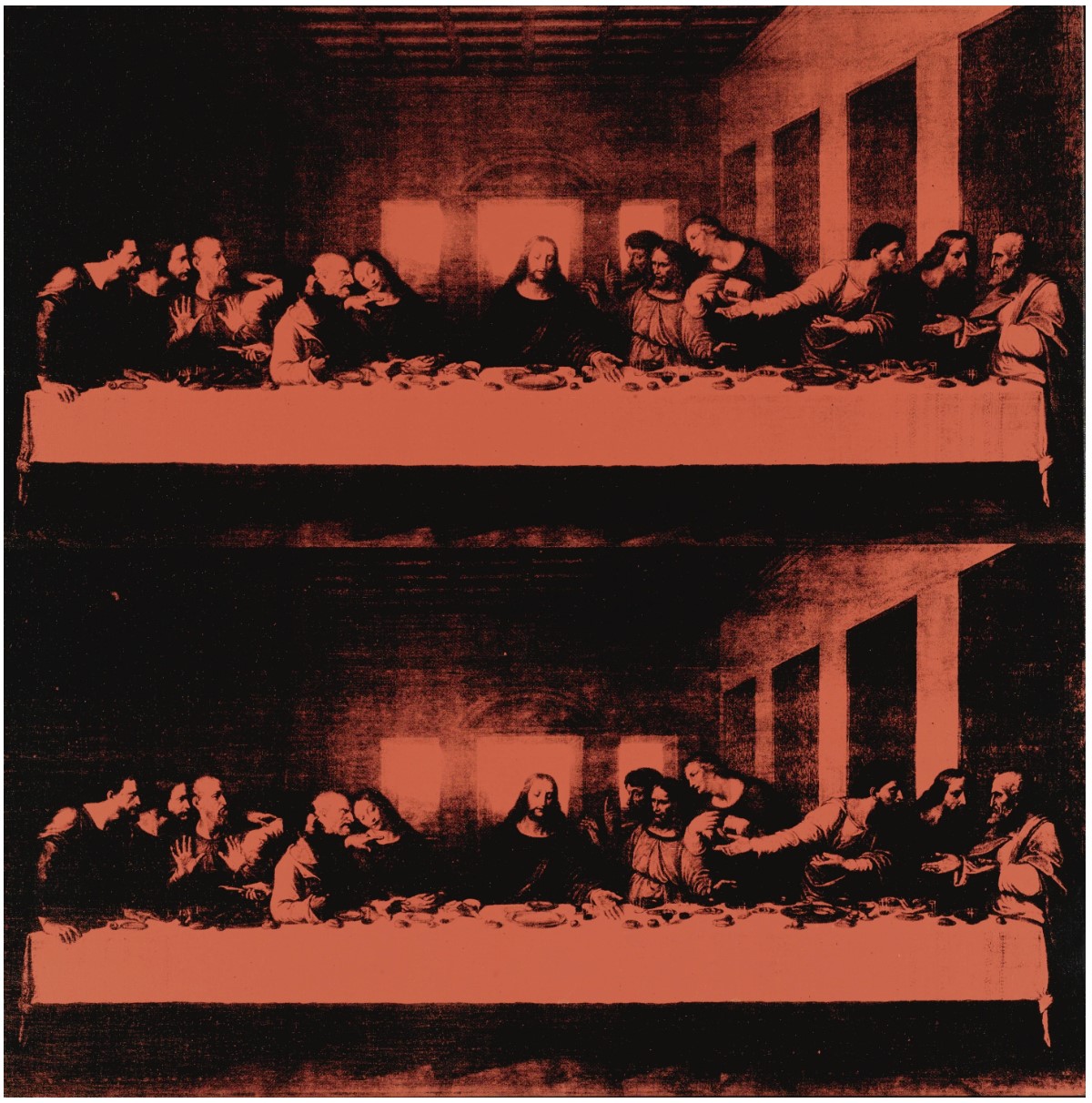
ANDY WARHOL
The Last Supper, 1986
Synthetic polymer paint silkscreened on canvas
40×40 inches (101.6 x 101.6 cm)
The present rendition of the subject belongs to a group of works of this size which stack the repeated image one atop the other, but Warhol would also spool several images of this scene and of Christ’s head across paintings as large as 35 feet. With the addition of the patterned camouflage design, in such works as the 25 foot wide Camouflage Last Supper, also from 1986, the image is transformed into an even more powerfully elegiac painting of the subject which may be the final puzzle in what was a gloriously puzzling life and body of work. The visually dynamic composition borrowed from da Vinci – and its subject matter with its poignant meaning for Warhol – are both veiled in a pattern defined by its ability to conceal: Warhol’s genius for irony is nowhere more dramatic than in the employment of disguise in the act of revelation. Linked conceptually with the Shadow and Rorschach paintings as abstractions, Warhol created canvases that were only camouflage patterns as well as using the device to mask self-portraits and other Warholian subjects such as the Last Supper paintings that had particular portent for him.
The Last Supper, 1986
Sotheby’s New-York: 9 November 2010
Estimated: USD 4,000,000 – 6,000,000
USD 6,802,500
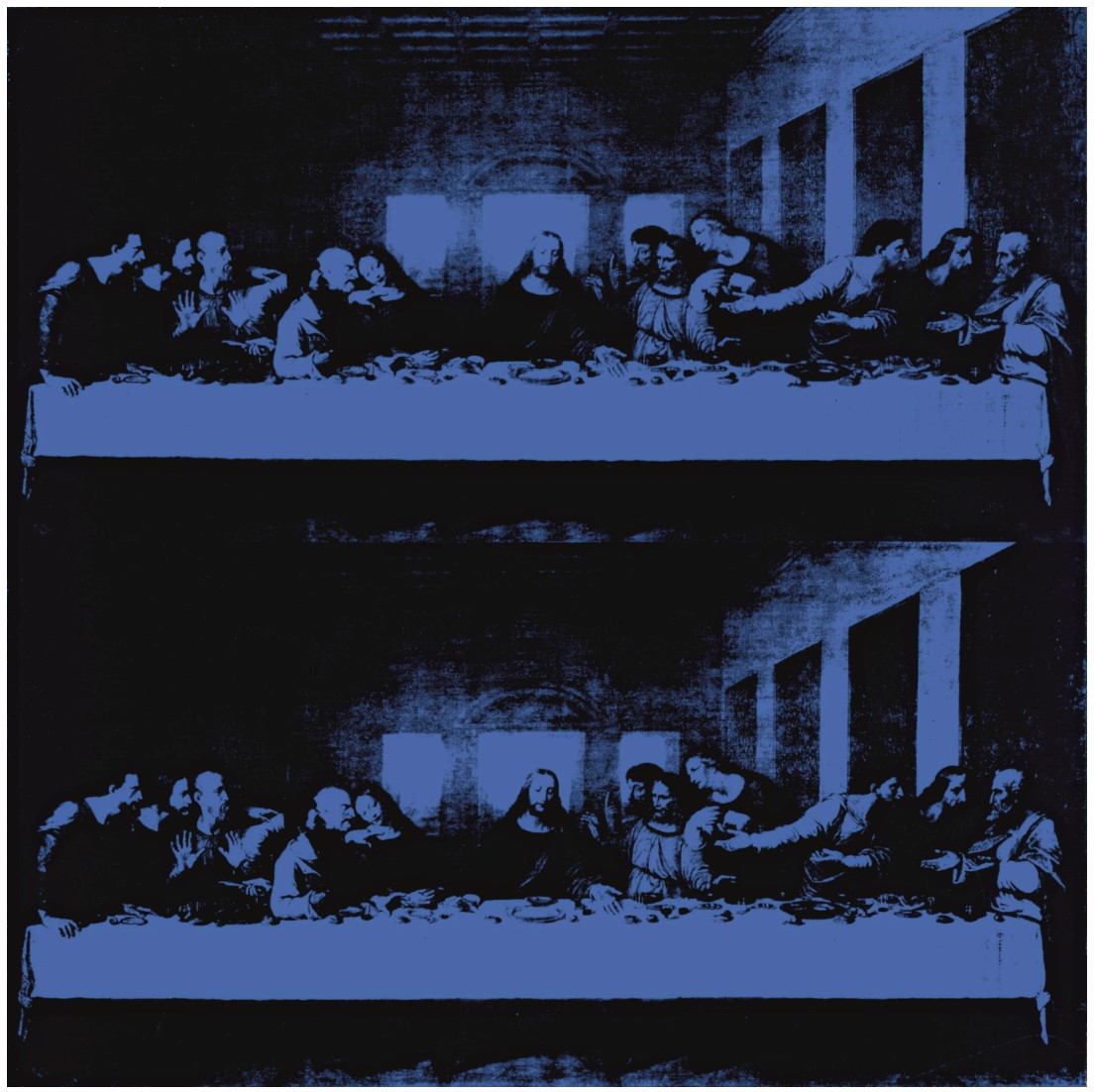 ANDY WARHOL
The Last Supper, 1986
Synthetic polymer paint silkscreened on canvas
40×40 inches (101.6 x 101.6 cm)
In this chromatically lush version, The Last Supper is crisply screened against a radiant deep blue. The hand-painted works would mostly focus on the rendering of one image, but the silkscreened paintings availed themselves of Warhol’s signature aesthetic act – repetitive imagery. This rendition of the subject belongs to a group of works of this size which stack the repeated image one atop the other, but Warhol would also spool several images of this scene and of Christ’s head across paintings as large as 35 feet.
Last Supper, 1986
Christie’s New-York: 13 May 2008
Estimated: USD 6,000,000 – 9,000,000
USD 8,777,000
Andy Warhol (1928-1987) , Last Supper | Christie’s
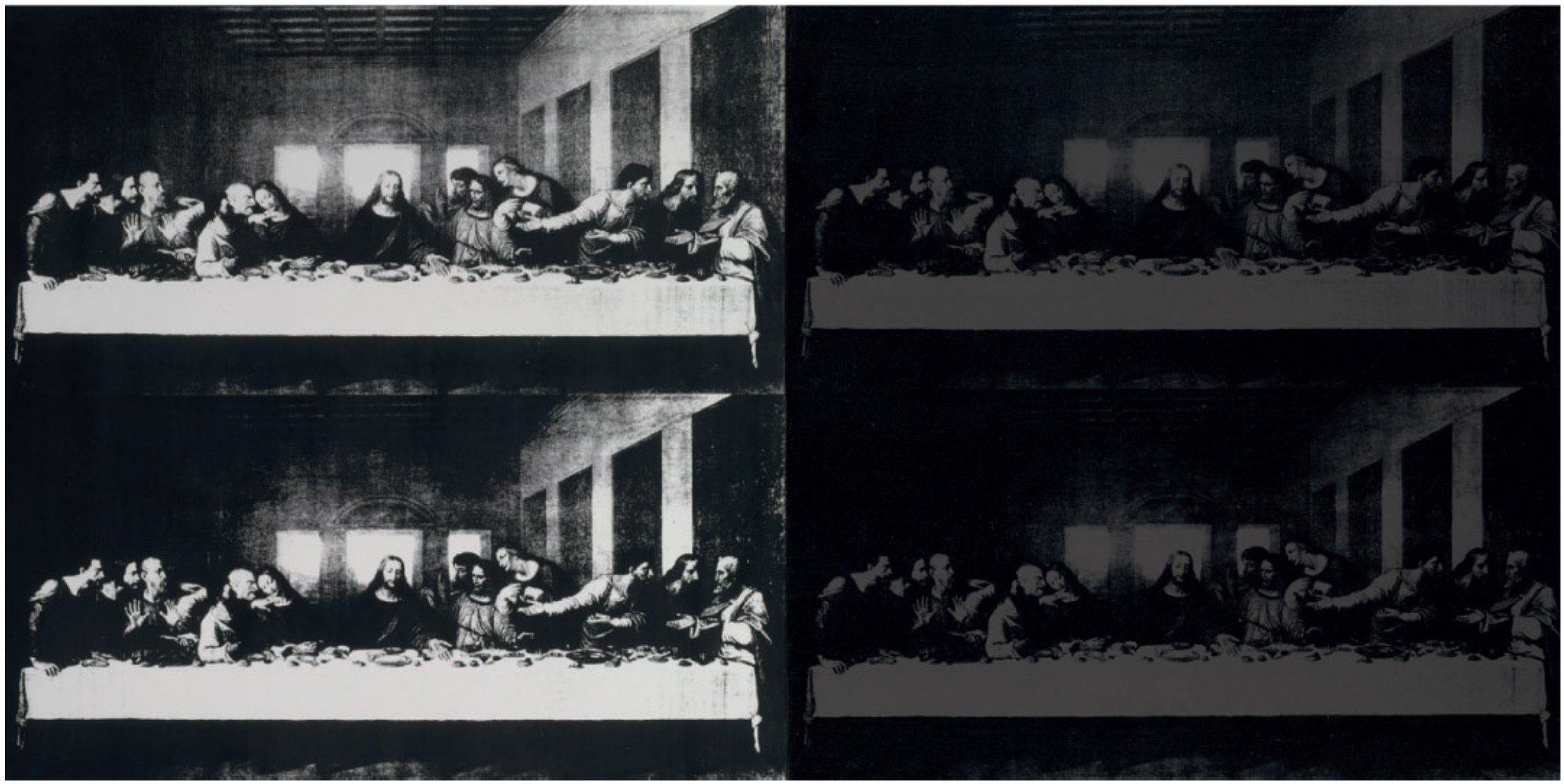
ANDY WARHOL
Last Supper, 1986
Synthetic polymer and silkscreen inks on canvas, in two parts
Each: 40×40 inches (101.6 x 101.6 cm)
Overall: 40×80 inches (101.6 x 203.2 cm)
The present work is an especially powerful example of Warhol’s Last Supper series, its composition reduced to a spare monochromatic color scheme that allows for dramatically different inflections of the subject in the contrast between the black on white and black on black canvases. The diptych format has strong religious connotations, familiar from Christian devotional altarpieces. Yet the exact nature of Warhol’s commentary on religion in the modern world remains tantalizingly ambiguous. In his hands, The Last Supper could imply a critique of the commodification of a religious image, stand as a veneration of the celebrity-like status of the painting, or even offer a Pop celebration of Warhol’s own religious faith. Concomitantly with its seemingly endless reproduction, Leonardo’s masterpiece had gradually become less and less visible, recognized since the 16th Century as deteriorating due to the artist’s experimental choice of mediums, then later damaged by bombs during World War II. Also, overpainting and restoration work obscured what remained of the original painting. Warhol, in fact, joined the protest against the ongoing restoration by signing a petition shortly before his death. The diptych’s black on black side conjures a melancholy mood that both underlines the painting’s own slow death, and the narrative moment of Christ revealing he will be betrayed. In the black on white side of the canvas, the silkscreen’s smoky ink offers a mechanized counterpart to the expressive sfumato technique that Leonardo famously developed and provided clarity of image that the original no longer had.
Last Supper, 1986
Christie’s London: 7 February 2006
Estimated: GBP 850,000 – 1,200,000
GBP 2,696,000
Andy Warhol (1928-1987) , Last Supper | Christie’s
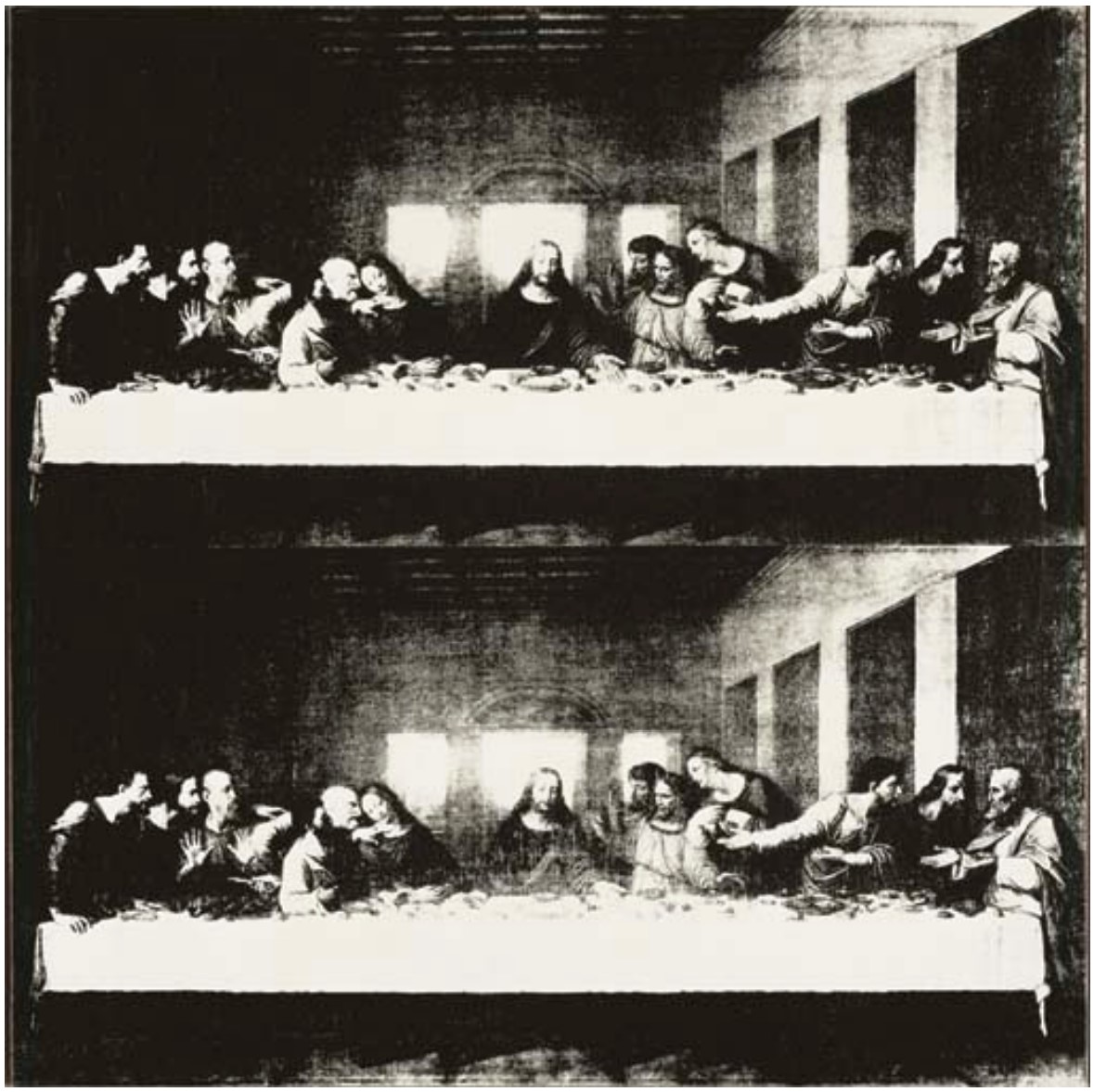
ANDY WARHOL
Last Supper, 1986
Synthetic polymer paint silkscreened on canvas
40×40 inches (101.6 x 101.6 cm)
Last Supper, executed in 1986, is an outstanding example from Warhol’s final great series of pictures. Imbued with a new and lively Pop intensity, Leonardo’s masterpiece in Milan has been reincarnated by Warhol. The sober and stylish black-and-white of this image, extremely rare within this series, recalls the visual impact of his shocking early Death and Disaster works. Here, the stark appearance of the Last Supper is further subverted by the double presentation of Christ and his disciples. Two Christs, two Last Suppers – this adds a poster-like feel to Leonardo’s picture, making it appear more ubiquitous than it already was. Dating from towards the end of Warhol’s life, Last Supper touches upon themes that were close to Warhol’s own heart. It has been pointed out that food and entertaining were central to much of Warhol’s life, and certainly both feature in the Last Supper. Beyond this, though, Last Supper characteristically blends the usual opaque inscrutability that marks Warhol’s greatest Pop images with his intimately personal concerns with mortality and religion, themes that came to light more and more as he approached the end of his life and while many of his friends and acquaintances died around him.
Camouflage Last Supper, 1986
Christie’s London: 24 June 2004
Estimated: GBP 500,000 – 700,000
GBP 509,250
Andy Warhol (1928-1987) , Camouflage Last Supper | Christie’s
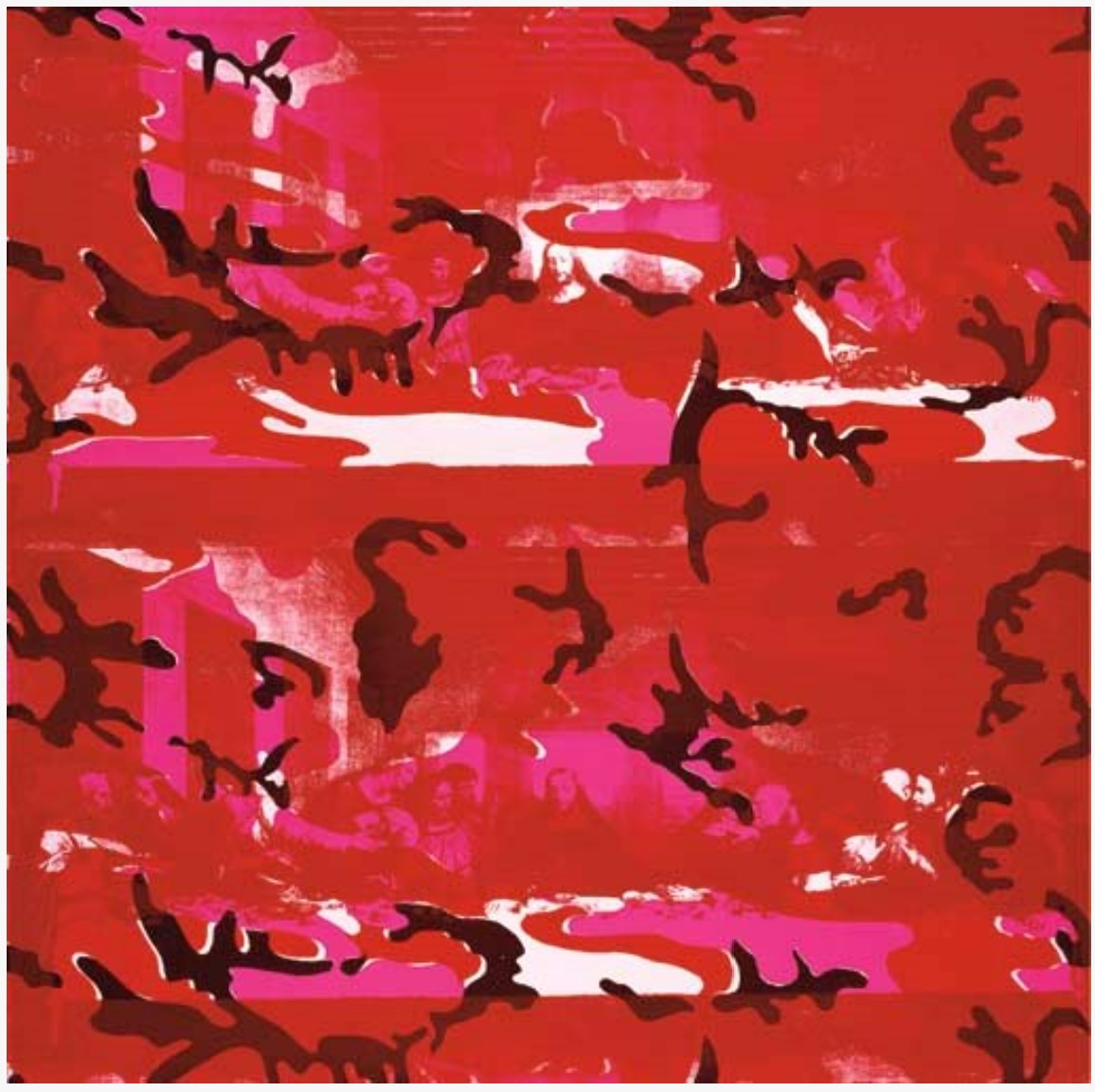
ANDY WARHOL
Camouflage Last Supper, 1986
Synthetic polymer paint and silkscreened inks on canvas
40×40 inches (101.6 x 101.6 cm)
In this version of the Last Supper, Warhol has also combined this dubious and kistch image of the Leonardo painting with a layer of candy-coloured camouflage. Layering artifice upon artifice in this way he deliberately creates an art-historical enigma. Warhol’s use of the shadow and of camouflage in his late work allowed the artist to indulge a long-held desire to create abstract paintings without departing from his own essentially realist vision. For, although both these two important series of works appear abstract, they are in fact both photographically transferred images of ‘real’ things from the ‘real’ world. Taking the innovation of his Shadow paintings a step further, Warhol’s use of camouflage develops the notion of reality as disguise by offering up a section of army camouflage for scrutiny. Using a sample of fabric purchased from an Army surplus store as his subject, Warhol both playfully satirised the flat patterning of abstract form to be found in the work of the Abstract Expressionists and asked his usual questions about where the borderlines exist between what is considered real and what is not. Here, a device for veiling or for disguise is in fact the reality, in what may be a sardonic reference to the soon to be covered-over and ‘restored’ Last Supper. Like Gerhard Richter’s abstract paintings of the same period, and in particular the artist’s earlier abstractions of Titian’s Annunciation the Camouflage-abstraction in this painting suggests the idea that the true reality of things is imperceptible and only really interpretable through the approximation of fictive models.
Last Supper, 1986
Christie’s New-York: 15 November 1999
Estimated: USD 400,000 – 600,000
USD 772,500
Andy Warhol (1928-1987) , The Last Supper | Christie’s
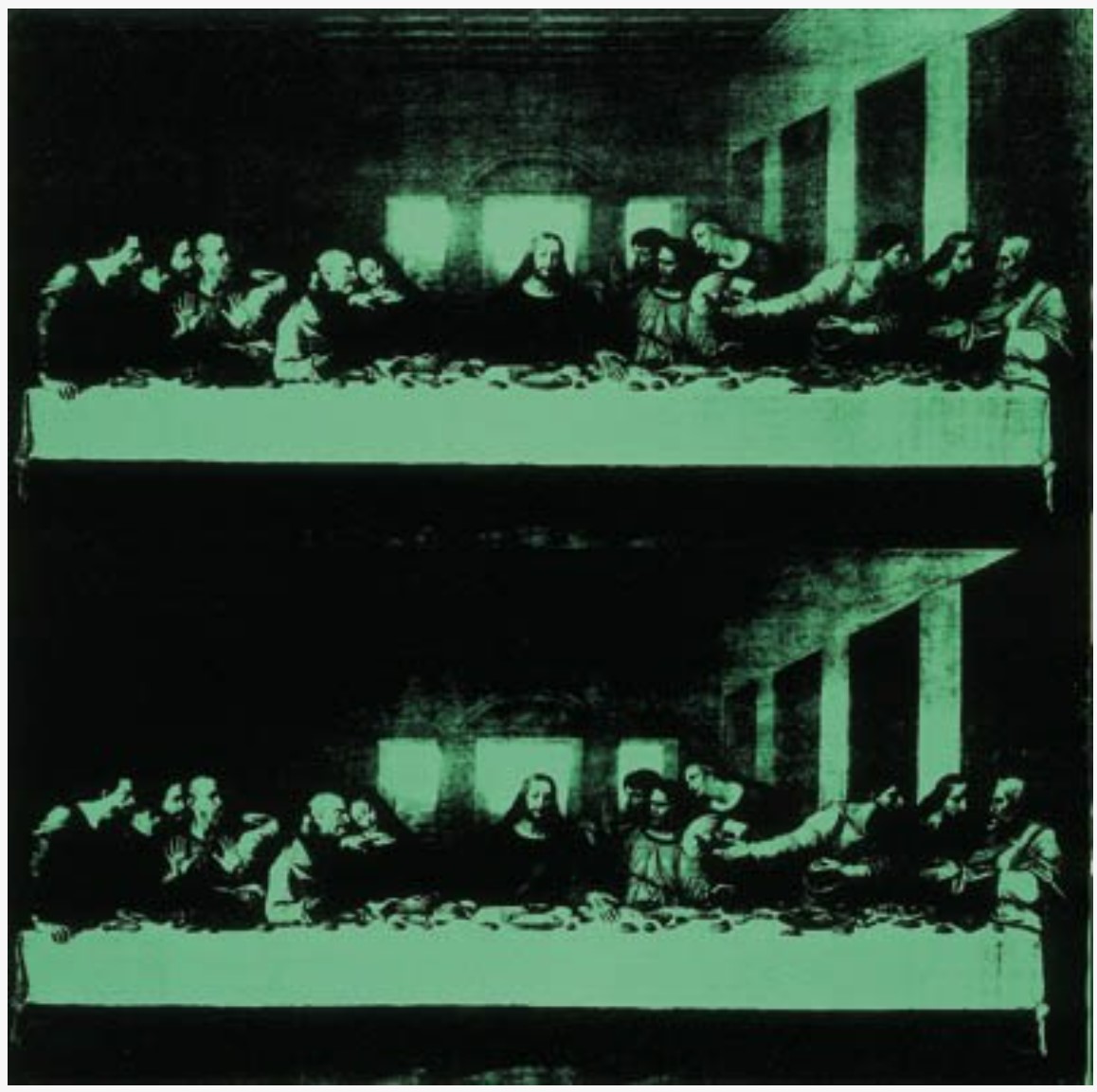
ANDY WARHOL
Last Supper, 1986
Synthetic polymer paint silkscreened on canvas
40×40 inches (101.6 x 101.6 cm)
In the last decade of his life, Andy Warhol continued working with the same energy and passion that had marked the earlier periods of his career. This final decade is set off from the others, however, by a distinctive interest in religious subject matter. Warhol’s representation of religious themes culminated in his final painting series, of 1986, a large and diverse collection of pictures of the Last Supper, of which the present work is an especially vibrant example.
In the present picture, we see Leonardo’s composition duplicated two twice. Warhol used his trademark technique of photosilkscreen, applying the silkscreen image with black acrylic paint to the painted-green canvas. Warhol also made other paintings of the same double-image composition, but with other combinations of color and repetition. In all these photosilkscreened Last Supper paintings, Warhol used as his source a photographic reproduction of a nineteenth-century engraving of Leonardo’s painting, rather than a more modern and accurate photographic reproduction (J. D. Dillenberger, The Religious Art of Andy Warhol, New York, 1998, p. 103). The result is an image that is many times removed from the original mural painting. And, like Warhol’s famous Pop images, the reproduction is a product of popular culture, reminding us that paintings themselves–not the least Leonardo’s Last Supper–can enter the realm of popular culture alongside Campbell’s Soup cans and publicity photographs of movie stars.