DAVID HOCKNEY
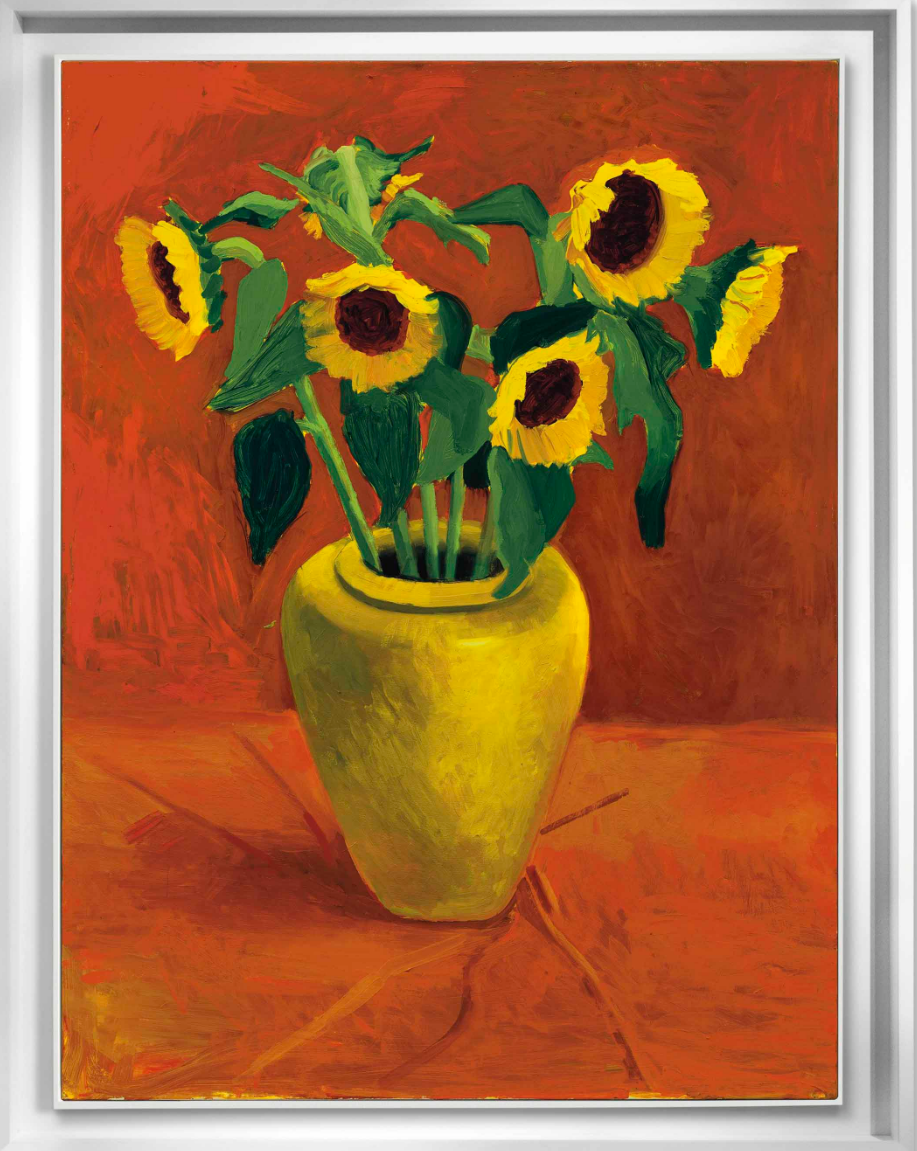
Sunflowers In a Yellow Vase, 1996
Oil on canvas
48×36 inches (121.9 x 91.4 cm)
Signed, titled and dated ‘Sunflowers in a yellow vase, David Hockney, 1996’ (on the reverse)
Provenance
L.A. Louver, Venice, California
Acquired from the above by the present owner
Auction History
Christie’s London: 6 March 2017
Estimated: GBP 1,500,000 – 2,500,000
GBP 1,805,000 / USD 2,203,545
David Hockney (b. 1937), Sunflowers In a Yellow Vase | Christie’s
With radiant yellow blooms set against a glowing backdrop, Sunflowers in a Yellow Vase witnesses David Hockney’s visionary return to figurative painting at a poignant moment in his life. Among the largest flower paintings produced during the pivotal year of 1996, it captures the artist’s powerful attempt to re-engage with reality as he struggled to come to terms with its cruelty. On the brink of his sixtieth year, Hockney was struck by a deep sense of melancholy following the deaths of a number of close friends. Like Francis Bacon before him, the loss of those who had punctuated his life and work – among them Joe McDonald, Jean Léger, Nathan Kolodner and Ossie Clark – had a transformative impact upon his artistic outlook. His first sunflower paintings had initially served as get-well cards for several of these figures; as time went by, the motif would become a vehicle for catharsis, allowing him to reconnect with the world through paint.
“It’s obvious that [Van Gogh] could already see a great deal when he was still in the north. But there’s an extra clarity that occurs in the south – where we all see a bit more simply because you don’t have misty horizons and water vapor in the atmosphere. Being in the south of France obviously gave Vincent an enormous joy, which visibly comes out in the paintings. That’s what people feel when they look at them. They are so incredibly direct. I remember in some of his letters, Vincent saying that he was aware he saw more clearly than other people. It was an intense vision.”
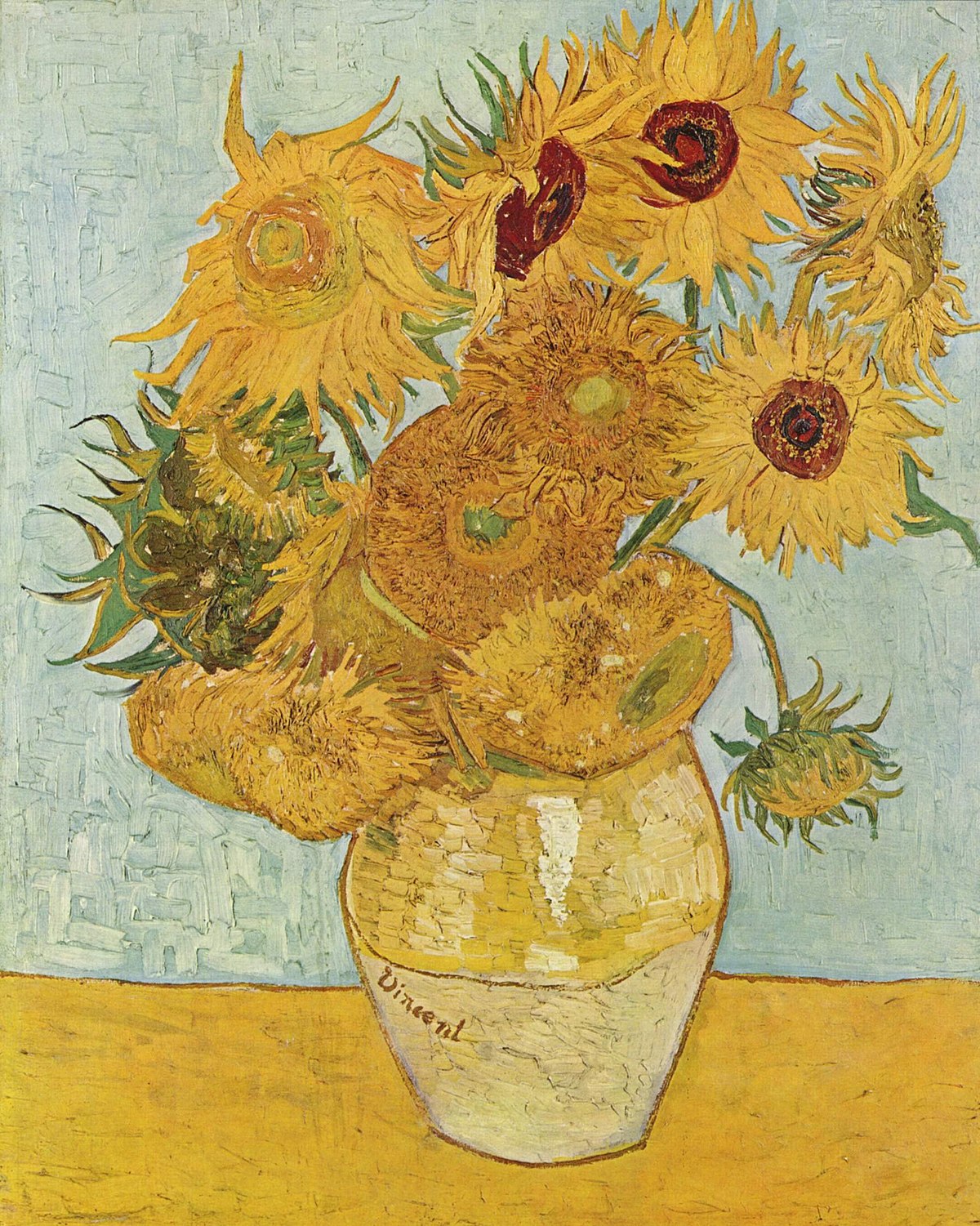
The previous year, his spirits had been lifted by Claude Monet’s retrospective at The Art Institute of Chicago, as well as Johannes Vermeer’s at The Hague. Having spent much of the previous decade immersed in photography, Hockney lifted his eyes from the camera lens, vowing to savor the beauty of his surroundings with the studied intensity of his forebears. Stripping away the models and idioms that had informed his earlier practice – Cubism, collage, theatre sets – he redirected the sparkling light of California onto a subject that had once fascinated his hero Vincent Van Gogh. Where the latter’s Sunflowers had functioned as expressive conduits – as a means of escaping the present – Hockney’s allowed him to look reality straight in the eye: to confront it face-on in all its splendor and brutality. Simultaneously tributes to departed friends and homages to the lessons of the past, Sunflowers in a Yellow Vase is above all a bittersweet testament to art’s therapeutic power: to the haptic pleasure of sealing a living form in paint, even in the knowledge of its impermanence.
Though laced with symbolic overtones, Sunflowers in a Yellow Vase is simultaneously a glowing exaltation of light, space, color and form, refracted through the lens of art history. Rendered in a saturated palette of rich, modulated tonalities, Hockney’s intricate brushstrokes chart the play of light across the translucent petals, the folds of the fabric and the exquisite curvature of the vase. Monet’s dappled textures, combined with Vermeer’s golden chiaroscuro, combine to create a powerful mise-en-scène, observed with the clear, unflinching gaze of an artist at peace with the world, and at one with his medium.
“When I start painting I get into a good routine. I’m disciplined enough to concentrate for hours. I love it! It’s terrific when I really get painting: squeezing the paint out and using it so it doesn’t even have time to get a skin on it; working in the evenings where I’ll set something up; and then continuing on it first thing in the morning.”
Since the early 1970s, vases of flowers had punctuated Hockney’s works like recurring visions. In the celebrated double portrait Mr and Mrs Clark and Percy (1970-71, Tate, London) – depicting Ossie Clark and his wife – they vividly disrupt the flat planes of their interior setting. In My Parents (1970-71, Tate, London) – painted the year before his father’s death – they function as poignant memento mori, luminous against a silent, empty expanse of wall. It was during this particular period of mourning that Hockney first began to explore the work of Van Gogh in earnest, initially through the medium of drawing. Using reddish-brown ink and reed pens similar to those used by Van Gogh in Arles, he sought to imbibe his predecessor’s ability to transmit emotions to paper, most famously capturing his mother the day before her husband’s funeral. Over time, Hockney came to engage more deeply with Van Gogh’s command of paint, marvelling at his study of Provençal light. Having moved from East Yorkshire to Los Angeles, he understood the revelatory effect of bright southern skies upon an artist originally from northern territories. ‘It’s obvious that [Van Gogh] could already see a great deal when he was still in the north’, he explains. But there’s an extra clarity that occurs in the south – where we all see a bit more simply because you don’t have misty horizons and water vapour in the atmosphere. Being in the south of France obviously gave Vincent an enormous joy, which visibly comes out in the paintings. That’s what people feel when they look at them’ (D. Hockney, quoted in M. Gayford, A Bigger Message: Conversations with David Hockney, London 2011, pp. 183-84). In Looking at Pictures on a Screen (1977), a reproduction of Van Gogh’s Sunflowers appears behind the figure of Henry Geldzahler, testifying to the work’s early impact upon his consciousness. Significantly, Geldzahler’s death just two years before the present work was among those that affected Hockney most deeply as the Dutch master re-entered his psyche in the 1990s.