Between 1979 and 1986, Warhol innovatively embarked on a retrospective phase of his career. Created on the suggestion of his dealer Bruno Bischofberger, the series of Reversal paintings were envisaged as series which revisited the creative potential of his most successful images. Reinventing his most iconic works, Warhol refreshes them for a new generation, providing a post-modern reinterpretation of his own art. In doing so, he effectively re-contextualizes an appropriation of an appropriation. Part pastiche of his earlier work and part reinvention, Warhol’s Reversal Series addresses the artist’s own fame through the plundering his own visual lexicon, taking the icons which, he had himself helped to create and reviving them. By flipping and inversing the imagery, Warhol’s representation of Marilyn has surpassed the fame of the actress herself and has instead become emblematic of Warhol and the themes pervasive throughout his body of work.
“Warhol’s Reversals recapitulate his portraits of famous faces but with the tonal values reversed. As if the spectator was looking at photographic negatives, highlighted faces have gone dark while former shadows now rush forward. The reversed Marilyns, especially, have a lurid otherworldly glow, as if illuminated by internal footlights.”
D. Bourdon
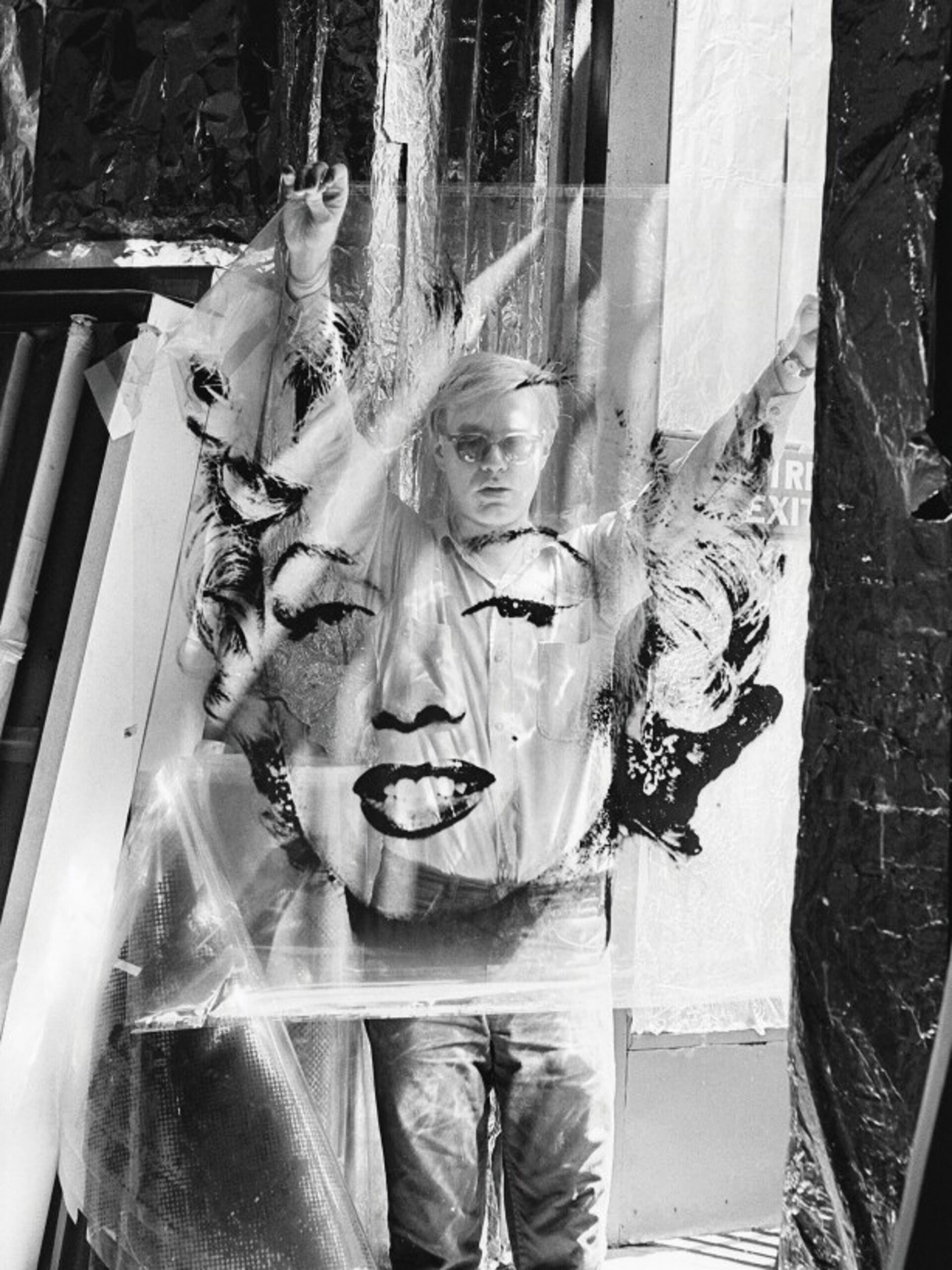
Introduction
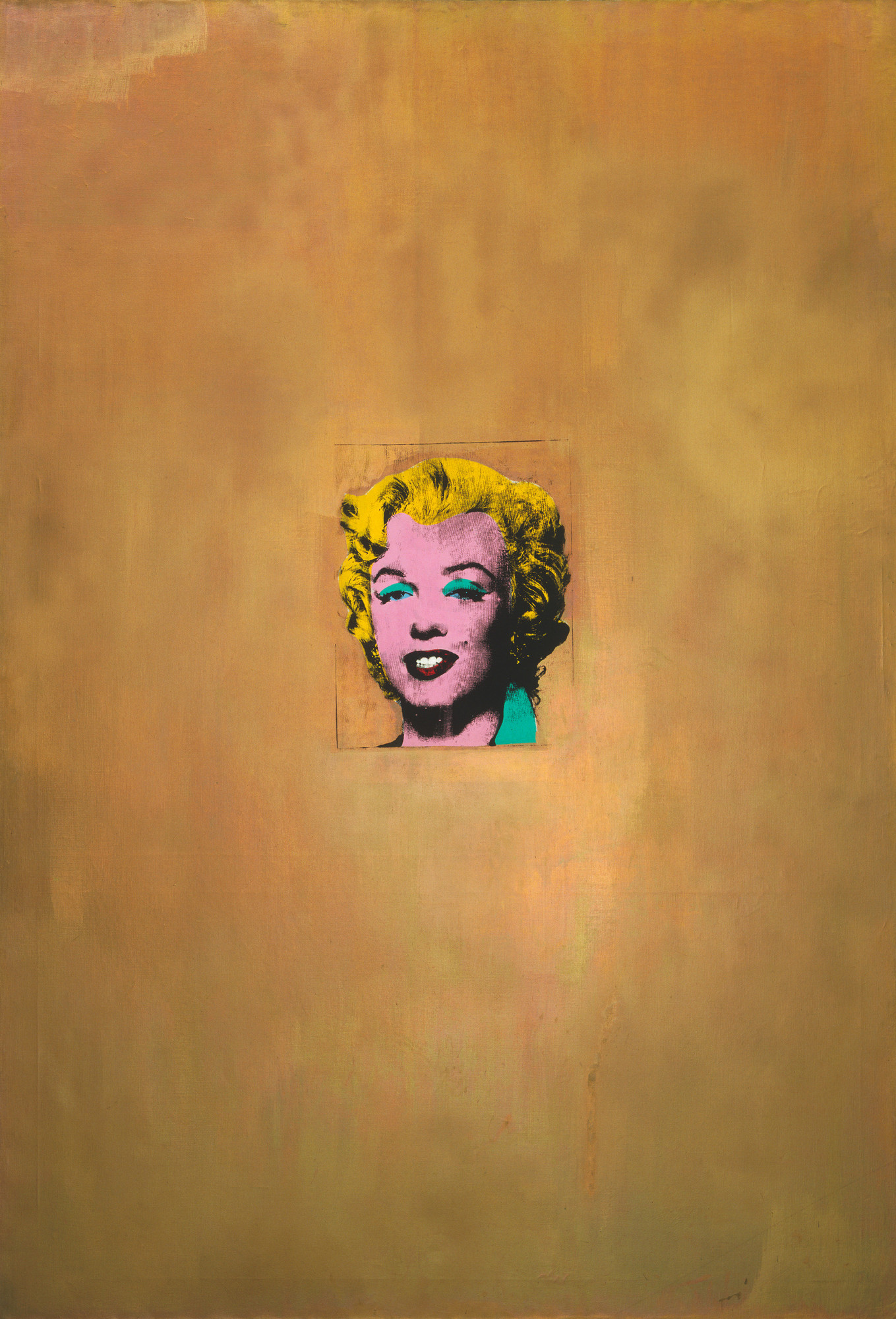
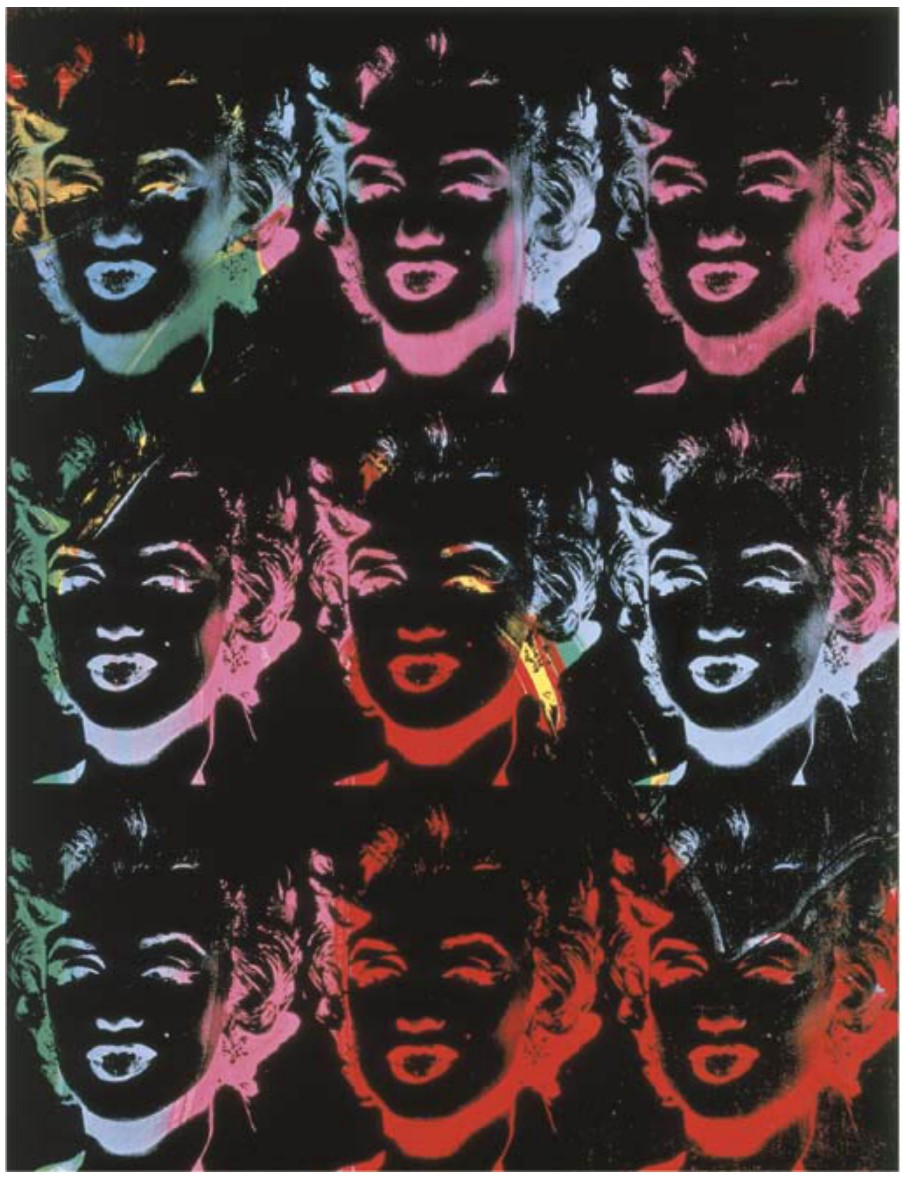
Marilyns (Reversal Series) is a triumphant return to the subject matter in which Warhol first visited in 1962, his iconic Gold Marilyn Monroe, now in the collection of the Museum of Modern Art, New York. He subsequently returned to her likeness several times over the course of his career, making her one of his most enduring subjects. With its vibrant disco inspired palette and unique use of a ‘negative’ image, this more contemporary Marilyn (Reversal Series) demonstrates that, even years later, Warhol was still at the top of his game.
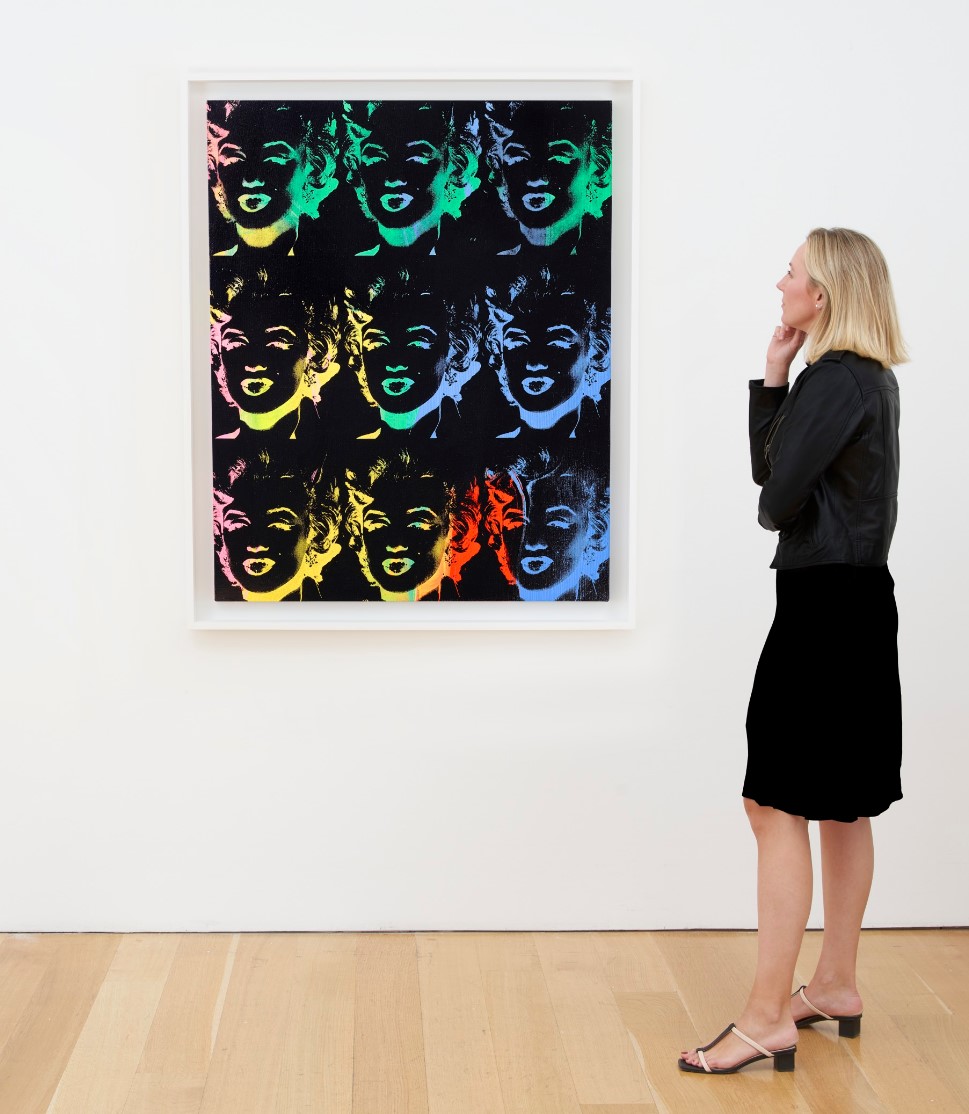
In the Reversal series, the contrast between the multicolored and dark elements highlights Monroe’s physical beauty arguably more than any other of Warhol’s renderings of the artist, however, there still remains a sense of personal darkness that consumed much of Monroe’s private life. Thus, perhaps more than any of his other Marilyn paintings, these later Reversals are a more reflective portrait of the real Monroe as she struggled to reconcile the superficial nature of movie superstardom with her own complex personality.
Like her legions of fans, Warhol found Monroe’s tantalizing allure mesmeric. He saw in the actress an individual whose personal identity was fashioned by public demand. She was emblematic of the contemporary culture that worshipped celebrities and neatly packaged stardom, and by the time this work was painted in the 1980s, the beginnings of a realization of the psychological damage that this can cause. Within weeks of Monroe’s unexpected and tragic death in August 1962, the artist began to create his famous images of her. Warhol built upon an extensive portraiture tradition that stretches back centuries. There has always been a demand to refashion human likeness, whether to unearth the sitter’s psychology, visualize personal ambition or convey a particular ideal. Here, Warhol challenged and revised classic portraiture through the use of non-naturalistic color, compositional focus on her larger-than-life face, and the serial arrangement of canvases. In this work, not only are we given one reproduction of Marilyn Monroe’s smoldering eyes and sensuous lips, but also nine unique and visually striking renderings of the legendary actress. In several images she sports striking Phthalo Green hair; in another, green or blue eye shadow. As an actress, Monroe was given many different faces through makeup and costumes, and across these works, Warhol shows us a radiant array of her guises.
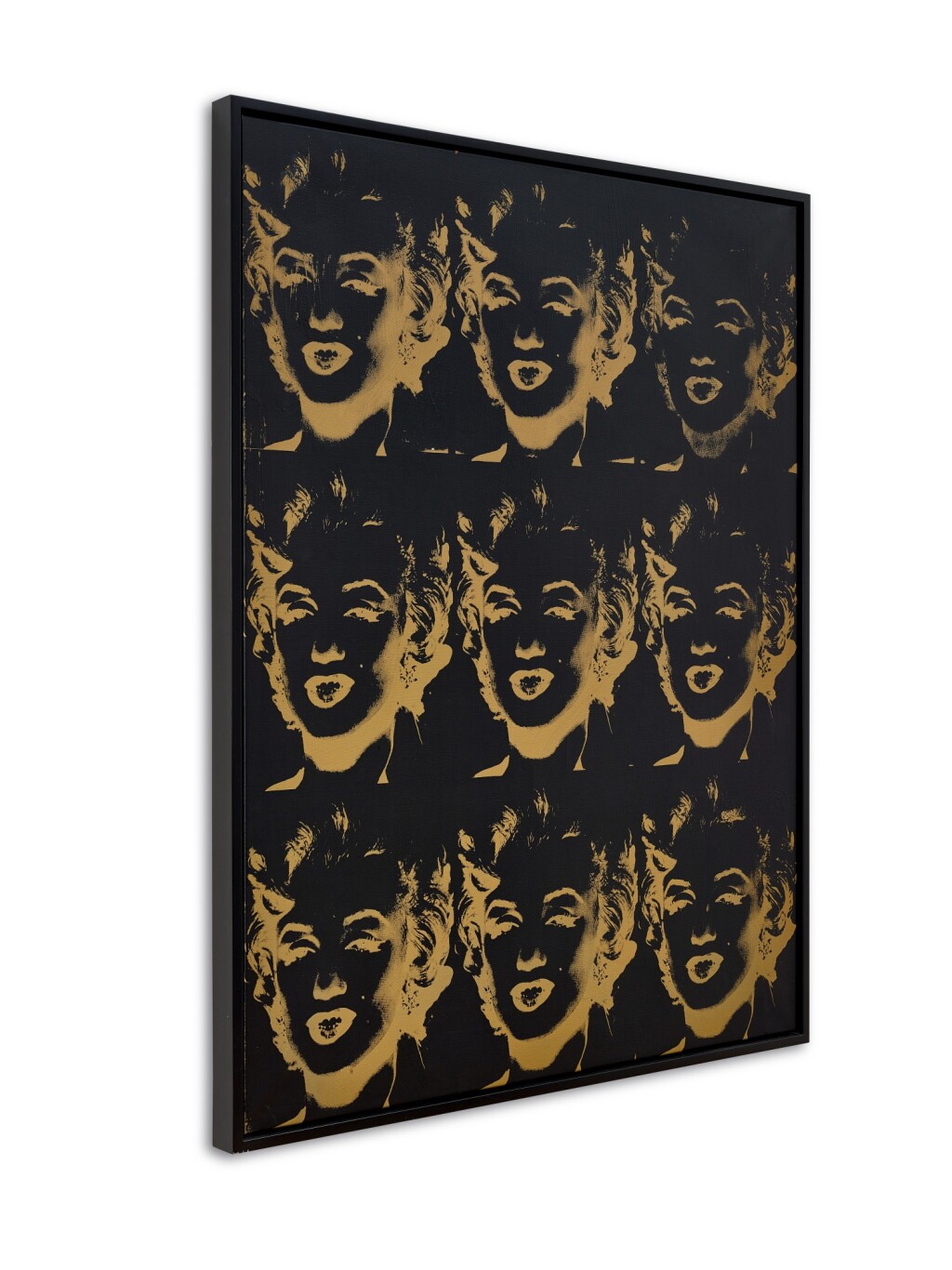
In addition to updating his earlier portraits of Monroe, Warhol is also reconsidering and reconfirming his own artistic legacy. By the time he commenced his Reversal series, his 1960s images of Monroe had become as much a part of the American cultural vernacular as had his images of Campbell’s Soup cans or Coca-Cola bottles. Reflecting on his subject almost 15 years later, he still captured the star’s renowned beauty, but this time, in an altogether more striking way and one that is still, in a typical Warholian way, reflecting the zeitgeist of the age of disco in which it was created. By rendering Marilyn as a reversal, Warhol acknowledges and confronts head-on any fears he may have had about being criticized for re-visiting an old subject. By using a ‘backwards’ image of Marilyn and rendering her in a vibrant and new palette, he produces a work which in fact looks forward and speaks directly to a new generation of his peers, showing he is still the most adept chronicler of popular culture. As the critic David Bourdon points out:
“By ransacking his own past to produce the Reversals and Retrospectives, Warhol revealed himself to be one of the shrewdest of the new wave of post-modernists. While modernism had been an ideal that survived throughout most of the 1960s, continuing its self-conscious search for new forms of expression, post-modernism, which gained currency in the ‘pluralist’ 1970s, reflected an ironic attitude towards all aesthetic camps and displayed an indifference to the traditional hierarchies of ‘high’ and ‘low’ art.”
(D. Bourdon, Warhol, New York, 1989, p. 380).
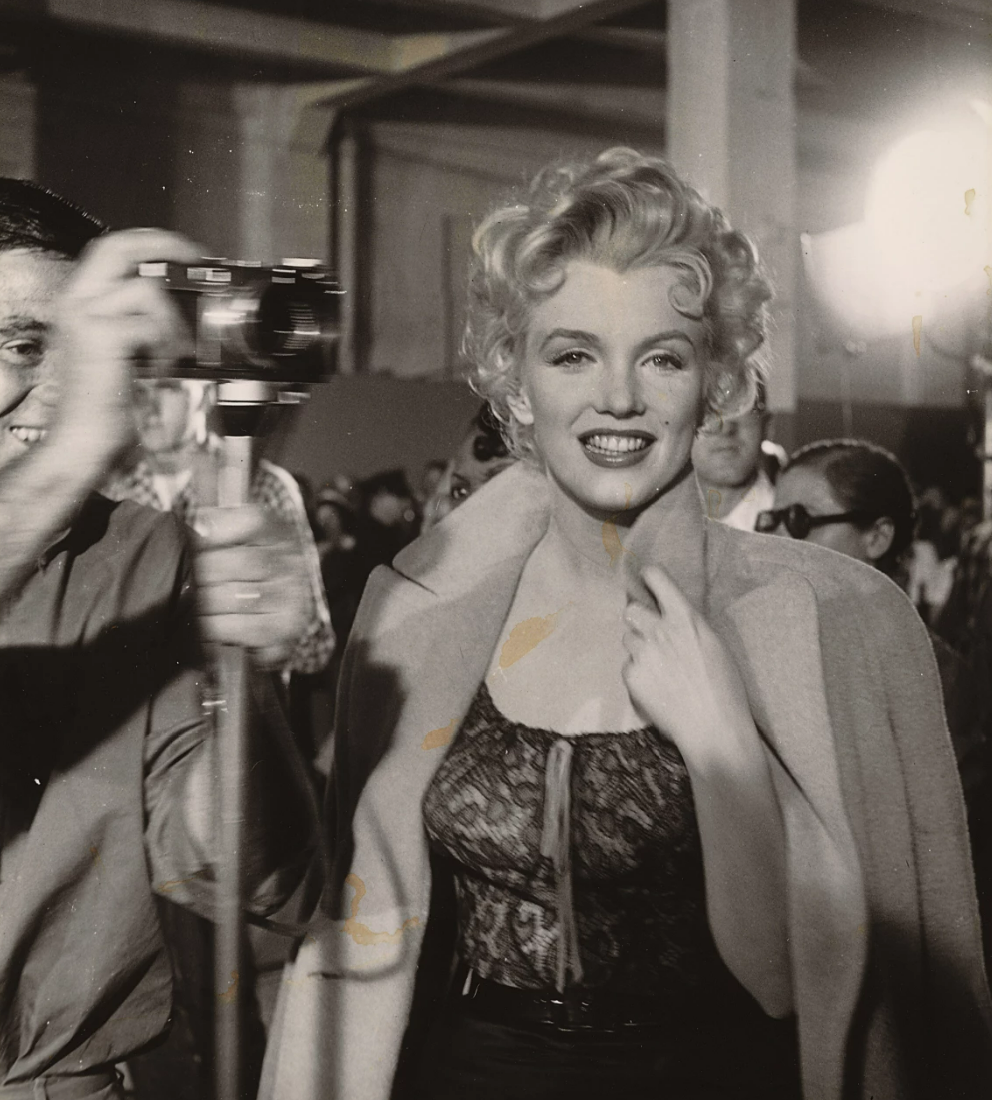
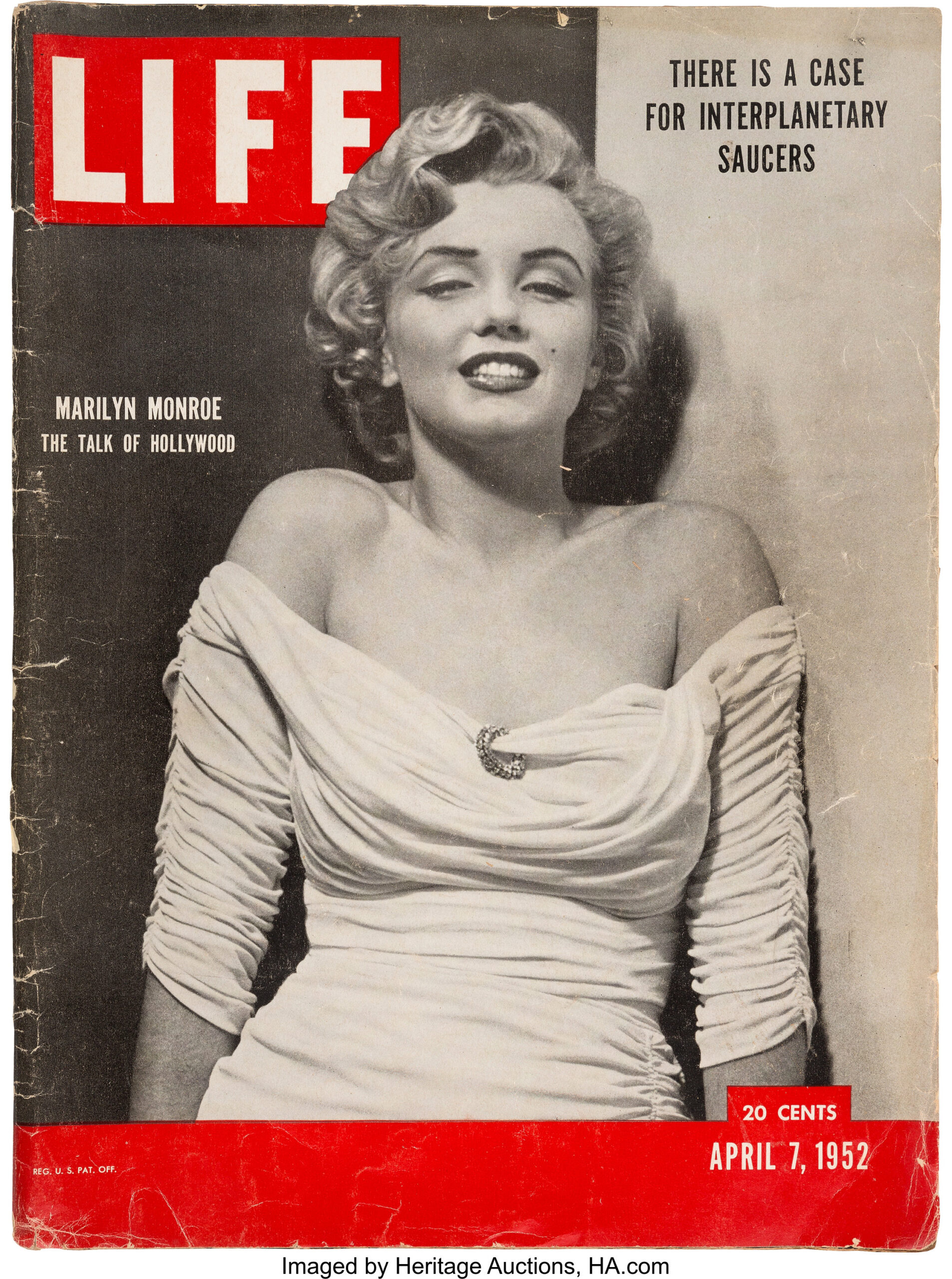
At the height of her career, Marilyn Monroe was the epitome of Hollywood glamour, but her real-life story revealed much humbler beginnings. After spending much of her childhood in foster homes, Monroe began a career as a model, which soon elevated to a film contract in 1946 with Twentieth Century Fox. While her earliest film appearances were minor, her performances in The Asphalt Jungle and All About Eve in 1950 began to draw attention. By 1952 she had her first leading role in Don’t Bother to Knock and 1953 brought a lead in Niagara, the melodramatic film noir that profited on her seductiveness, and served as the source for Warhol’s Marilyn series. Her “dumb blonde” persona was used to comic effect in subsequent classics such as Gentlemen Prefer Blondes, How to Marry a Millionaire and The Seven Year Itch. Limited by typecasting, Monroe studied at the Actor’s Studio to broaden her range. Her dramatic performance in Bus Stop was hailed by critics and garnered a Golden Globe nomination. She further received a Golden Globe Award for her iconic performance in Some Like It Hot, shortly before she completed her last film, The Misfits, in 1961.
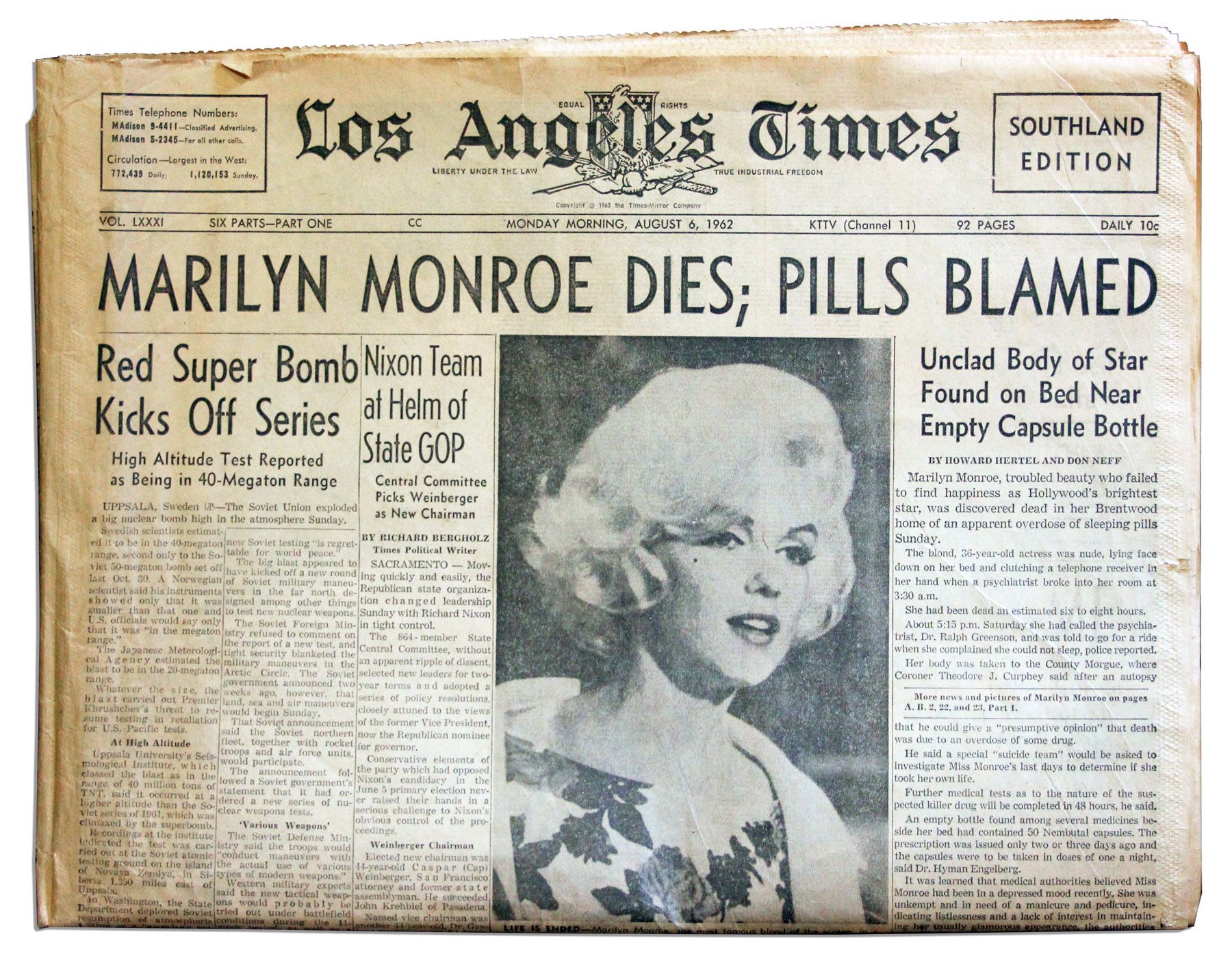
The final years of Monroe’s life were marked by illness, personal problems and a reputation for unreliability. In fact, even the circumstances of her death, from an overdose of barbiturates, have been the subject of conjecture. Though officially classified as a “probable suicide,” the possibilities of an accidental overdose or homicide have not been ruled out. And yet, regardless of her tragic demise, Monroe’s image is just as strong today as it was at the height of her career. In 1999, Monroe was ranked as the sixth-greatest female star of all time by the American Film Institute. In the decades following her death, she has often been cited as both a pop and a cultural icon as well as the quintessential American sex symbol. Central to his pantheon of Pop icons, which included Elizabeth Taylor, Jackie Kennedy and Elvis, Nine Multicolored Marilyns (Reversal Series) provides a more nuanced immortalization of Marilyn Monroe as the embodiment of the cult of celebrity.
Warhol instinctively understood the Marilyn brand as an industrialized construct, designed for mass consumption like a Coca-Cola bottle or Campbell’s Soup Can, and radically revealed it as a precisely composed non-reality. Of course, Marilyn offered Warhol the biggest brand of all, and he accentuated this by choosing a manifestly contrived version of Marilyn as the definitive sex -symbol. Although this image of Marilyn has come to stand as the instantly recognizable emblem of her global fame, encapsulating as it does so perfectly every aspect of her enduring allure, it is an entirely dehumanized portrait, devoid of any of the psychosomatic realities that proved ultimately fatal for Norma Jeane Mortenson on the night of 5 August 1962. Moreover, the negative reversal of her image magnifies the ghostliness of her visage, resulting in a compellingly haunting memorial to the screen siren. Even after the brutal reality and terminal tragedy of her suicide, the artificial veneer of a projected image remains the enduring legacy of a human life.
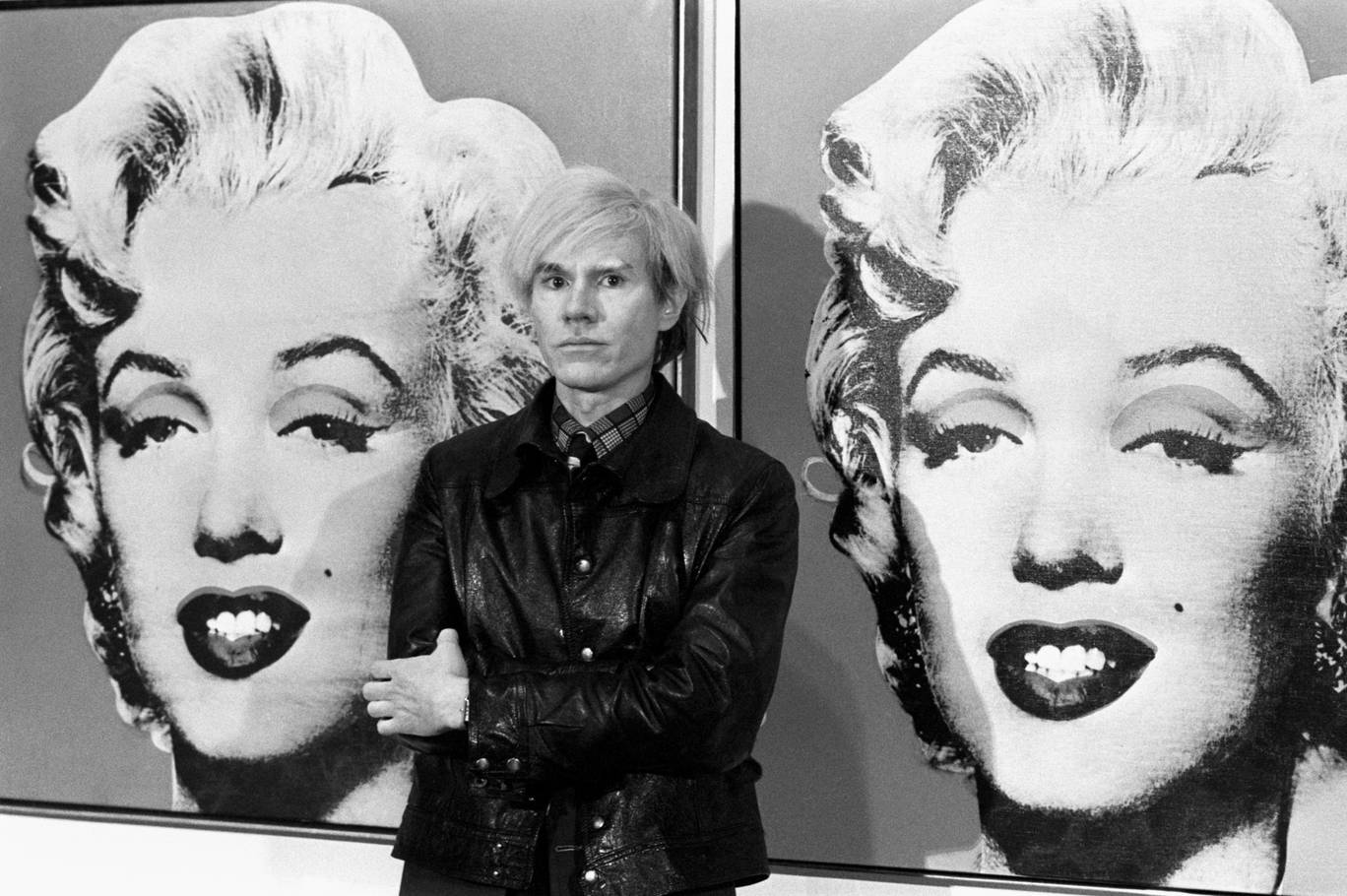
At the beginning of the 1980s, after a decade devoted mostly to portrait commissions, Warhol re-invigorated his practice. In line with appropriationist strategies of burgeoning artists such as Richard Prince and Cindy Sherman, Warhol began to quote from and interrogate his own 1960s iconography. Appropriating Warhol the ‘brand’, Nine Gold Marilyns presents an ornamental x-ray recapitulation of one of the most captivating and celebrated inquiries of his career. Akin to the unique quality of Warhol’s large Gold Marilyn Monroe and the two Gold Marilyn Tondos, the present work is unique across the series of Reversals. Where the rest of the series is cast in swirling marks of lurid and fluorescent pigment, the unique gold ground of the present work recalls these early reliquary-like gold canvases. Akin to the ghostly screen of Warhol’s Marilyn tondos, Monroe’s repeated likeness appears as a floodlit negative. By plunging shadows and midtones into darkness, a ghostly dematerialisation of his subject comes to the fore; these shadowy faces appear reduced to their index, invoking a spectral imprint. Though maintaining recognition and legibility thanks to the iconicity of Monroe’s face, Warhol’s manipulations neutralise the power of the original image. The emphasis here is less on the celebrity of the sitter and more on that of the artist himself; less a depiction of the film star and more a reflection on Warhol’s own artistic past.
Though the re-iteration and repetition of iconic personalities and consumer products had long been the very cornerstone of Warhol’s practice, this new retroactive body of work kindled a climactic transfiguration of the artist’s formative concerns and mythology. As explained by Roberto Marrone, “All the images Warhol used in the Retrospectives and Reversals ranked among his most memorable and commercial icons… These were the images that made him famous – the icons, symbols and brands through which he had made his own name and which had therefore to some extent become associated with his own life, history, career and myth. In repeating these same images in a new ‘reversed’ and negative form in 1979, Warhol now bestowed upon them a new and altogether darker and more sombre mood reflective of the respective distance in time between their original use and the later moment of their re-creation” (Roberto Marrone in: Exh. Cat., Zurich, Galerie Bruno Bischofberger, Andy Warhol: Big Retrospective Painting, 2009, p. 32). Narrating a moment of repose and personal reflection, Warhol stood at the end of a decade creatively dominated by his celebrity portrait practice: flamboyant images that came to encapsulate an era. Prophetically heralding the final decade of Warhol’s life, the late works possess a somewhat eerie undercurrent of grave finality whilst the psychological shadows of Solanis’ attempted assassination linger on via the distinct meditative quality that characterizes these works. Where Warhol had looked to megawatt personalities such as Monroe and Jackie Kennedy for the tragic-heroism of their fame during the 1960s, the Reversals divulge a more personal and philosophical interrogation of the artist’s identity via the very tropes and Warholian slogans that propelled him to acclaim.
2026 Auction Results
Four Marilyns (Reversal Series), 1979-86
Sotheby’s London: 15 October 2026
Estimated: GBP 2,200,000 – 2,800,000
GBP 2,713,000 / USD 3,589,570
Andy Warhol | Four Marilyns (Reversal Series) | Contemporary Evening
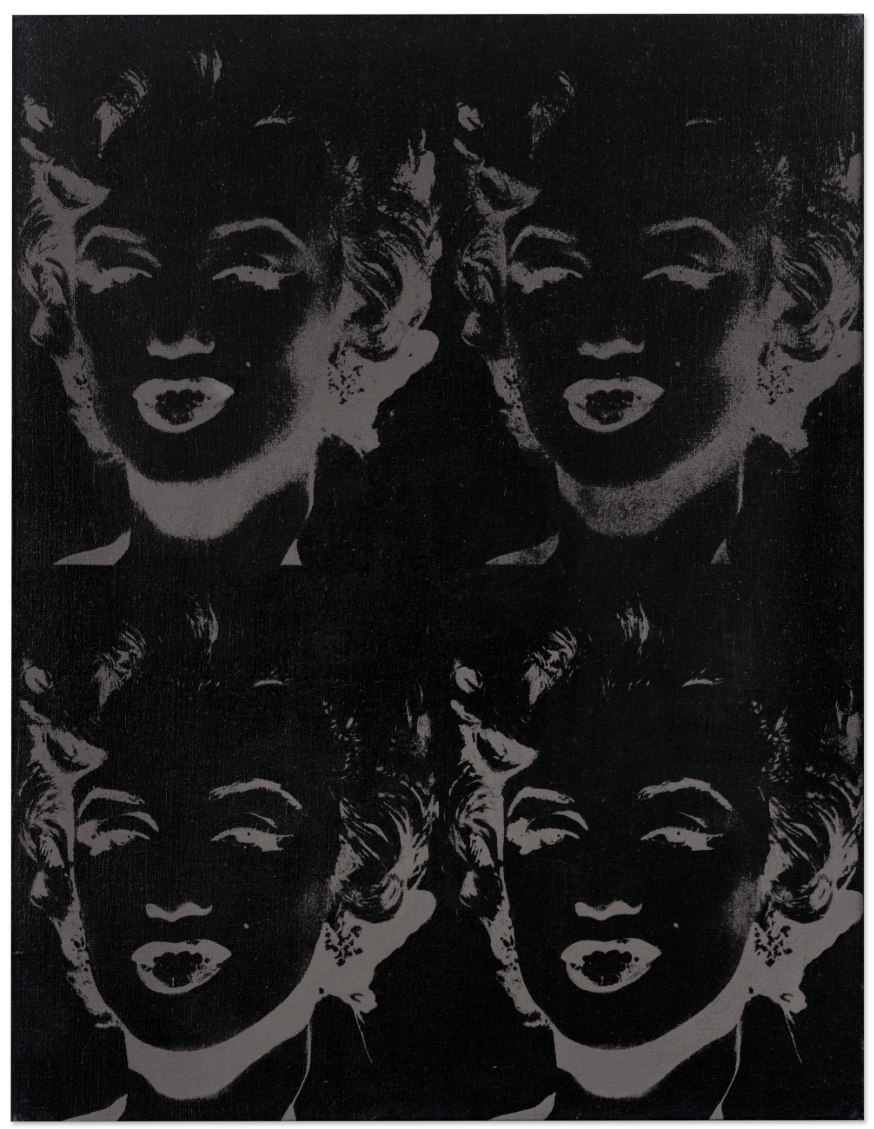
ANDY WARHOL (1928 – 1987)
Four Marilyns (Reversal Series), 1979-86
Acrylic and silkscreen ink on canvas
36-1/4 x 28 inches (92.1 x 71.1 cm)
Signed (on the overlap)
Signed (on the reverse)
4 Colored Marilyns (Reversal Series), 1979-86
Property from an Important Private Collection
Phillips New-York: 19 May 2026
Estimated: USD 4,000,000 – 6,000,000
USD 5,630,000
Andy Warhol Modern & Contemporary Art Evening Sale
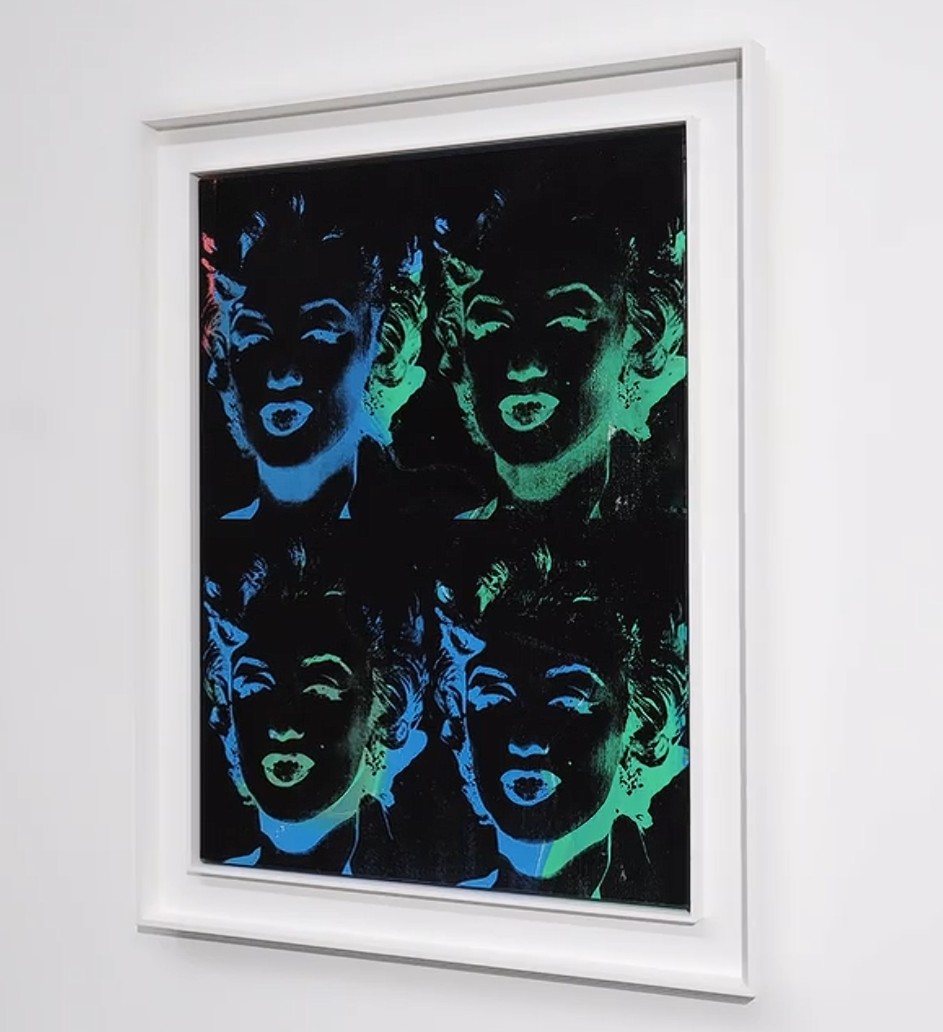
ANDY WARHOL
4 Colored Marilyns (Reversal Series), 1979-86
Acrylic and silkscreen ink on canvas
35-7/8 x 27-7/8 inches (91.1 x 70.8 cm)
Signed, stamped by the Andy Warhol Art Authentication Board Inc.
Initialed, numbered and dated “Andy Warhol 79/8 A130.089” on the overlap
Four Marilyns (Reversal Series), 1986
Sotheby’s London: 4 March 2026
Estimated: GBP 1,800,000 – 2,500,000
GBP 3,262,000 / USD 4,357,705
Four Marilyns (Reversal Series) | Modern & Contemporary Evening Auction | 2026 | Sotheby’s
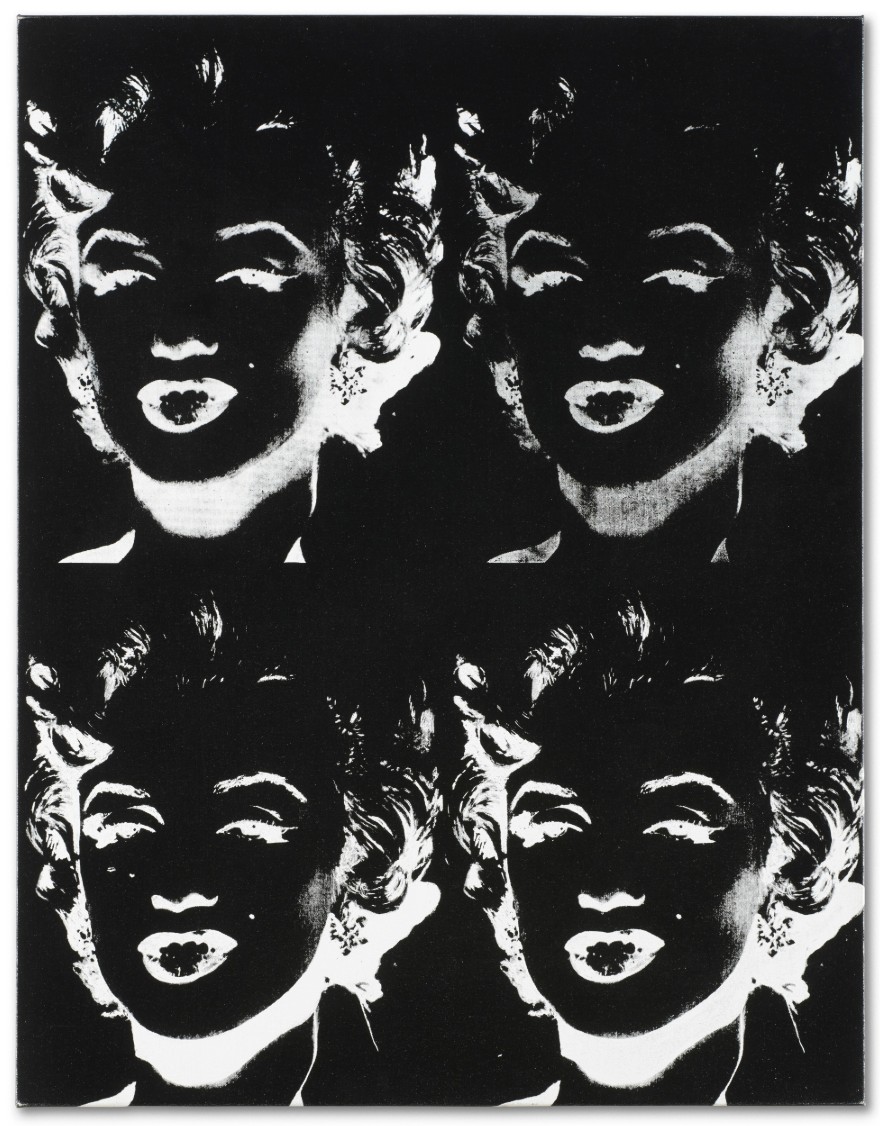
ANDY WARHOL (1928 – 1987)
Four Marilyns (Reversal Series), 1986
Acrylic and silkscreen ink on canvas
36×28 inches (91.5 x 71 cm)
Stamp signed (on the overlap)
Stamped by the Andy Warhol Art Authentication Board, Inc.
Numbered A120.042
Inscribed I certify that this is an original painting by Andy Warhol completed by Andy in 1986 Frederick Hughes
(on the overlap)
Marilyn (Reversal Series), 1986
Property from an Esteemed Private Collection
Sotheby’s London: 4 March 2026
Estimated: GBP 800,000 – 1,200,000
GBP 998,400 / USD 1,333,765
Marilyn (Reversal Series) | Modern & Contemporary Evening Auction | 2026 | Sotheby’s
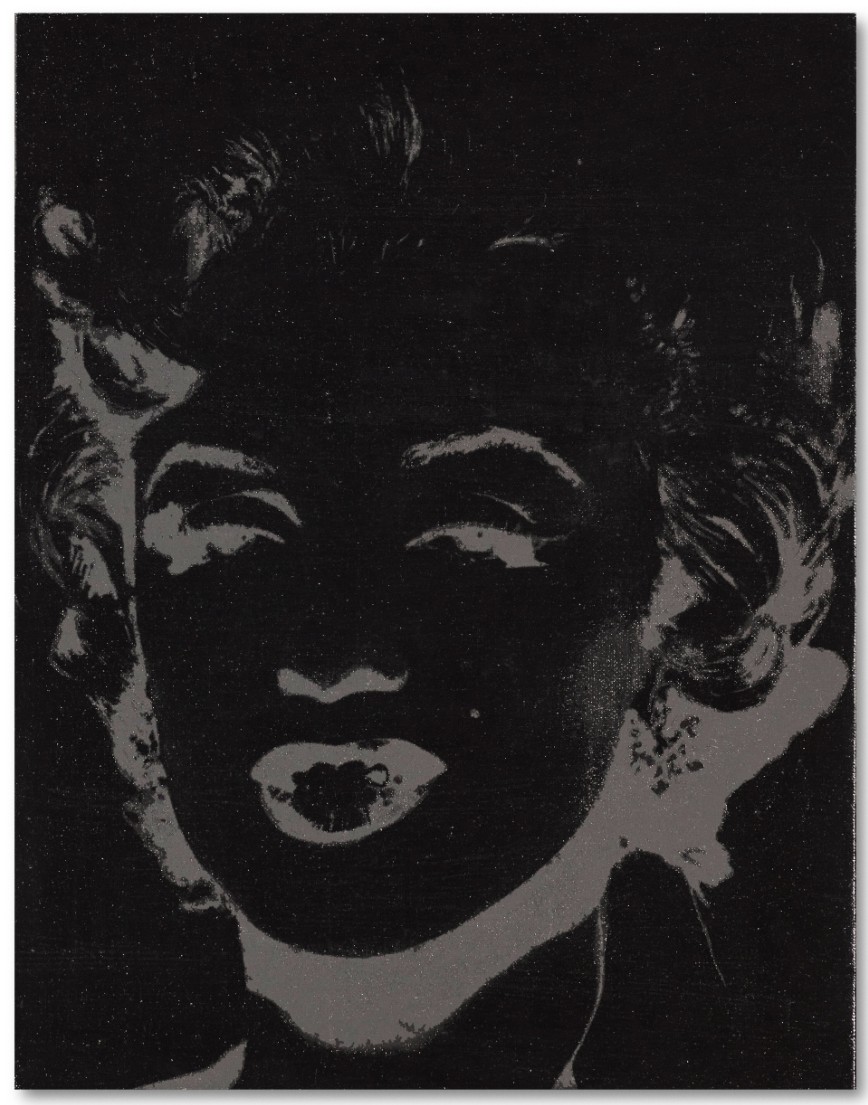
ANDY WARHOL (1928 – 1987)
Marilyn (Reversal Series), 1986
Acrylic and silkscreen ink on canvas
18×14 inches (45.7 x 35.6 cm)
Stamp signed (on the reverse)
Stamped by the Andy Warhol Art Authentication Board, Inc.
Numbered A107.066
Inscribed ‘I verify that this is an original painting by Andy Warhol completed by him in 1986 Frederick Hughes’
on the reverse
2025 Auction Results
Four Pink Marilyns (Reversal Series), 1986
Sotheby’s London: 16 October 2025
Estimated: GBP 3,000,000 – 5,000,000
GBP 4,326,000 / USD 5,796,840
Four Pink Marilyns (Reversal Series) | Contemporary Evening Auction | 2025 | Sotheby’s
REPEAT SALE
Sotheby’s New-York: 11 November 2015
Estimated: USD 3,000,000 – 4,000,000
USD 4,506,000
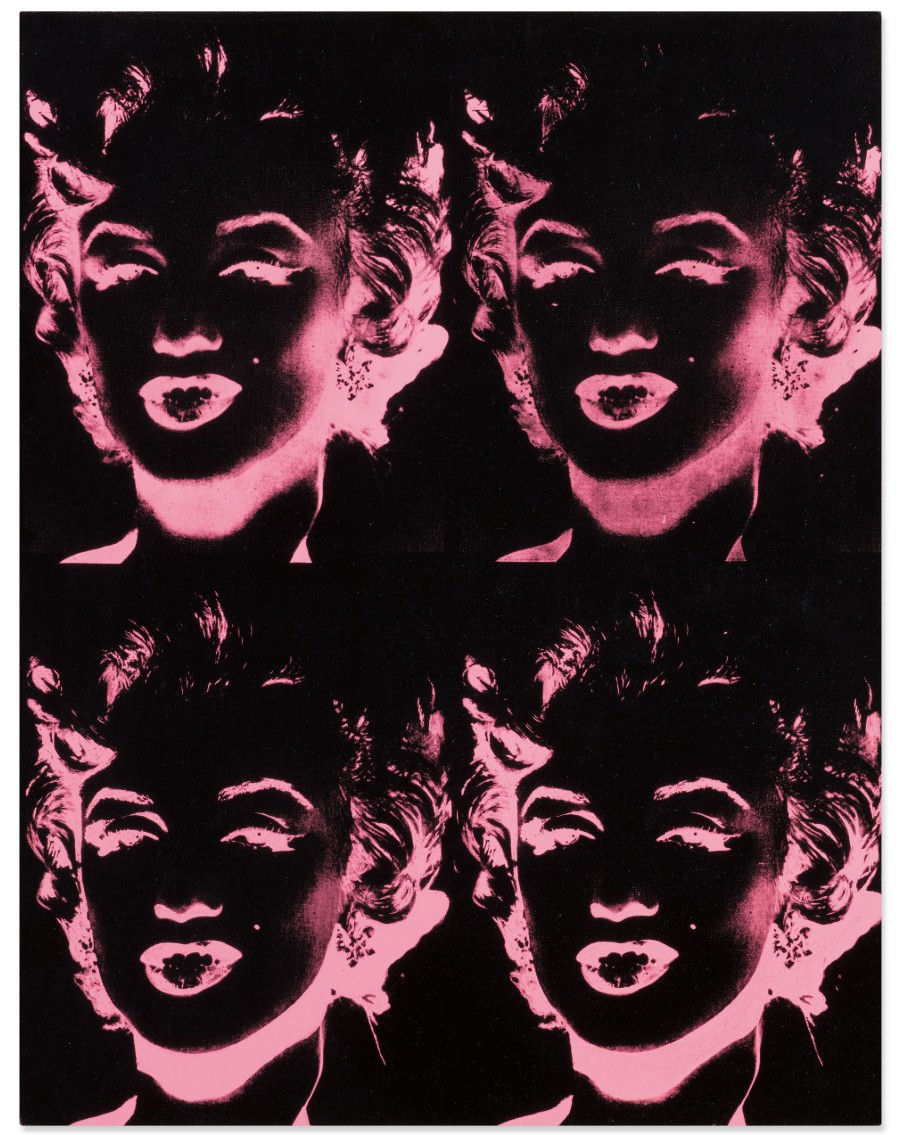
ANDY WARHOL (1928 – 1987)
Four Pink Marilyns (Reversal Series), 1986
Acrylic and silkscreen ink on canvas
36 1/8 x 28 inches (91.7 x 71 cm)
Signed and dated 86 (on the overlap)
Stamped by the Andy Warhol Art Authentication Board, Inc., and numbered A107.999 on the overlap
2024 Auction Results
One Multicolored Marilyn (Reversal Series), 1979-1986
Christie’s London: 7 March 2024
Estimated: GBP 800,000 – 1,200,000
GBP 1,068,500 / USD 1,354,858
ANDY WARHOL (1928-1987), One Multicoloured Marilyn (Reversal Series) | Christie’s (christies.com)
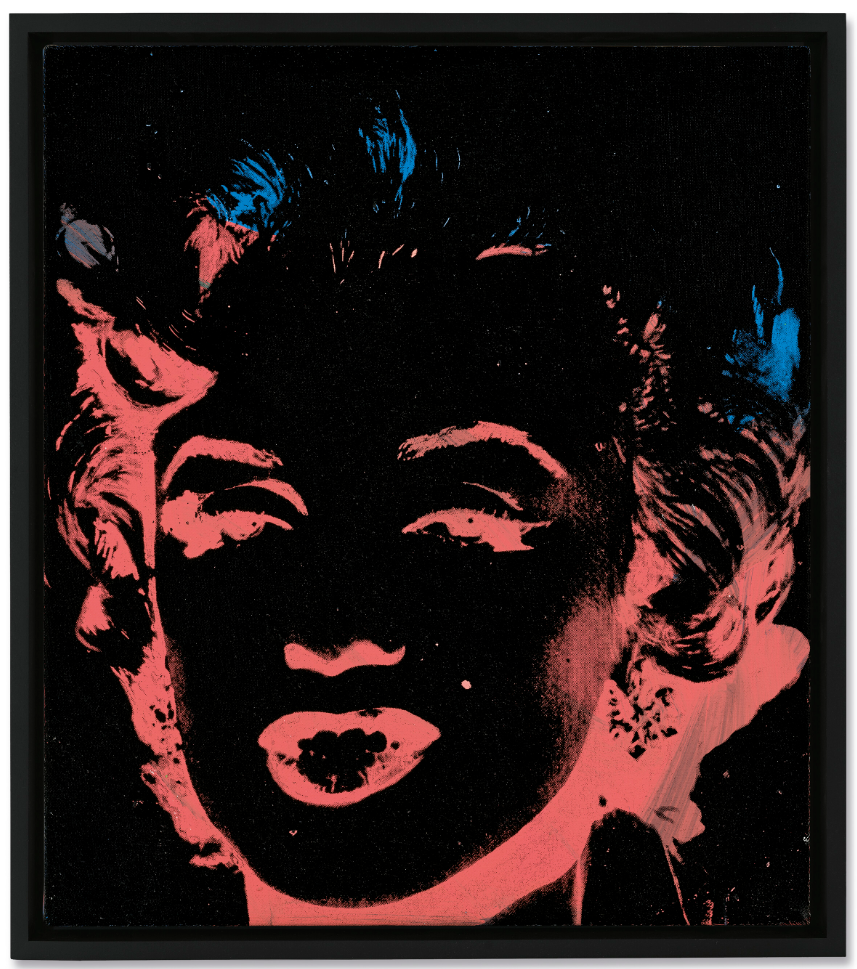
ANDY WARHOL (1928-1987)
One Multicolored Marilyn (Reversal Series), 1979-1986
Acrylic and silkscreen ink on canvas
16×14 inches (40.6 x 35.5 cm)
Stamped with the artist’s signature ‘Andy Warhol’ (on the overlap)
2023 Auction Results
Marilyn, 1979-1986
Christie’s Hong-Kong: 28 May 2023
Estimated: HKD 7,800,000 – 11,800,000
HKD 10,055,000 / USD 1,283,638
ANDY WARHOL (1928-1987), Marilyn | Christie’s
REPEAT SALE
Christie’s New-York: 9 March 2021
Estimated: USD 800,000 – 1,200,000
USD 1,290,000
Andy Warhol (1928-1987), Marilyn | Christie’s
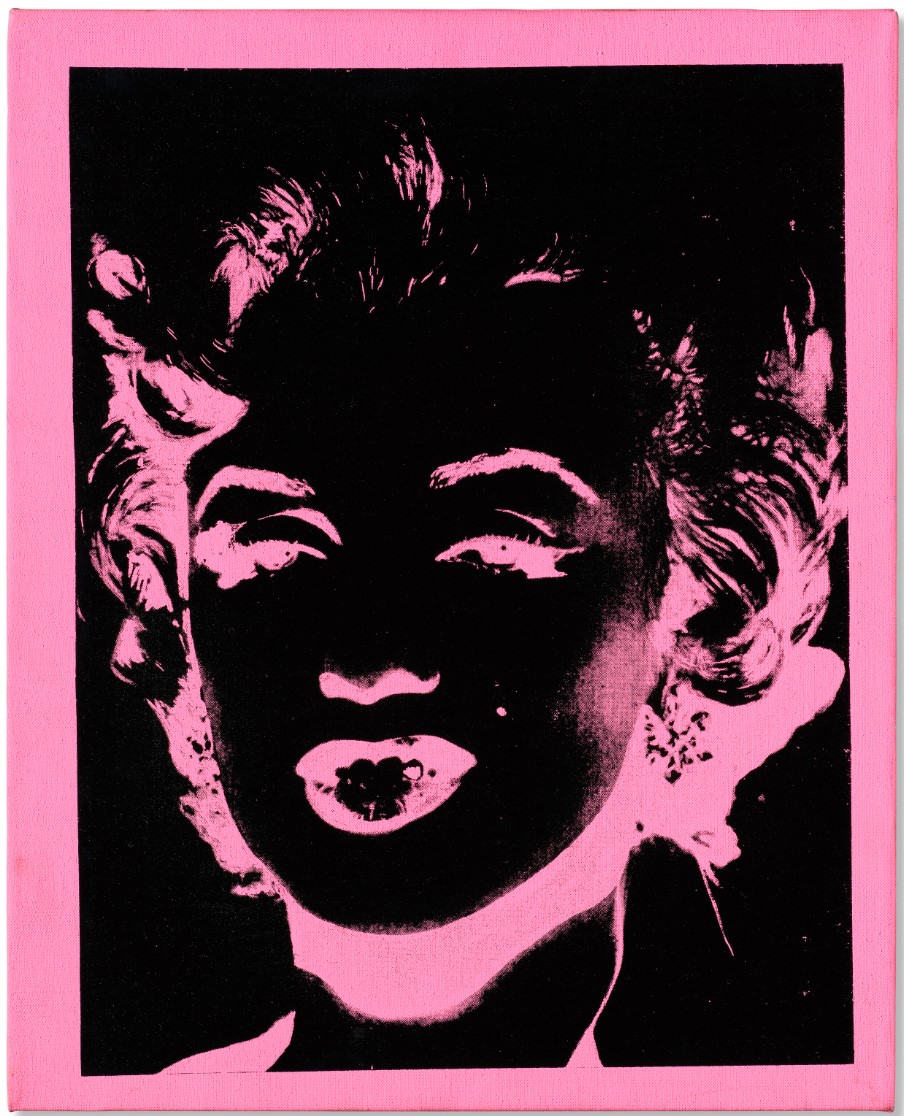
ANDY WARHOL (1928-1987)
Marilyn, 1979-1986
Acrylic and silkscreen ink on canvas
20×16 inches (50.8 x 40.6 cm)
Stamped with the artist’s signature ‘Andy Warhol’ (on the overlap)
2022 Auction Results
Nine Multicolored Marilyns (Reversal Series), 1979-86
Sotheby’s London: 14 October 2022
Estimated: GBP 6,000,000 – 8,000,000
GBP 5,189,200 / USD 5,817,489
Nine Multicoloured Marilyns (Reversal Series) | Contemporary Evening Auction | 2022 | Sotheby’s
REPEAT SALE
Sotheby’s London: 30 June 2014
Estimated: GBP 4,000,000 – 6,000,000
GBP 4,562,500 / USD 7,802,770
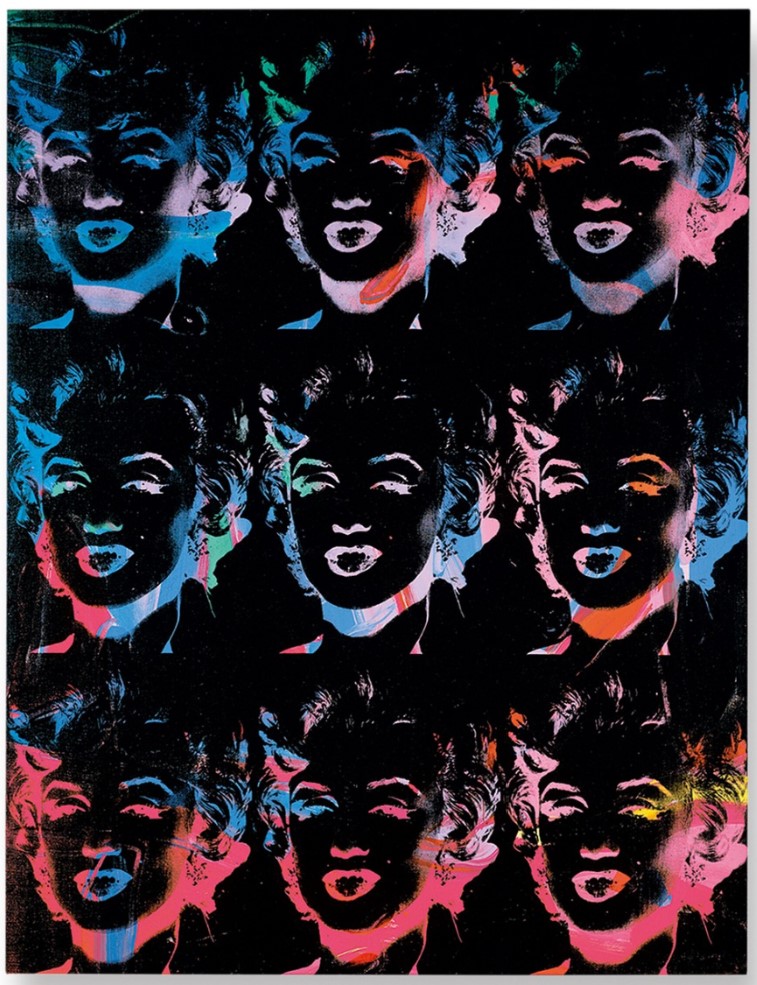
ANDY WARHOL (1928 – 1987)
Nine Multicolored Marilyns (Reversal Series), 1979-86
Acrylic and silkscreen ink on canvas
54 ⅜ x 41 ¾ inches (138 x 106.1 cm)
Signed Andy Warhol and dated 79/86 (on the overlap)
Marilyn (Reversal), 1979-1986
Sotheby’s New-York: 30 September 2022
Estimated: USD 1,200,000 – 1,800,000
USD 1,441,500
Marilyn (Reversal) | Contemporary Curated | 2022 | Sotheby’s (sothebys.com)
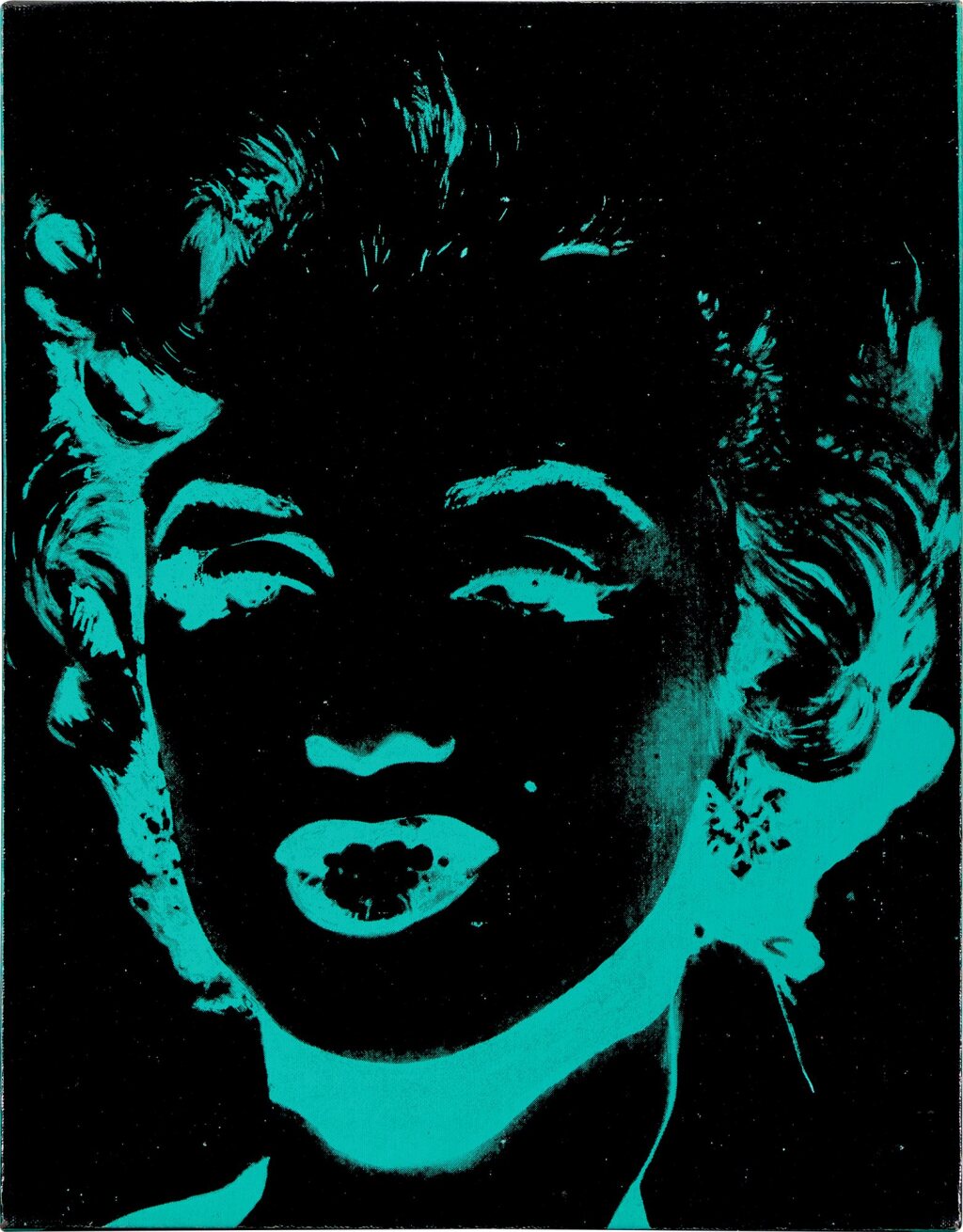
Marilyn (Reversal), 1979-1986
18×14 inches (45.7 x 35.6 cm)
Stamped with the artist’s signature, dated 1986
Authenticated by Frederick Hughes and numbered A111.0510 (on the overlap)
2021 Auction Results
9 Gold Marilyns (Reversal Series), 1980
Sotheby’s London: 29 June 2021
Estimated: GBP 5,500,000 – 8,000,000
GBP 6,517,500 / USD 9,023,259
REPEAT SALE
Phillips New-York: 11 November 2013
Estimated: USD 8,000,000 – 12,000,000
USD 9,125,000
Andy Warhol Contemporary Art Evening Sale
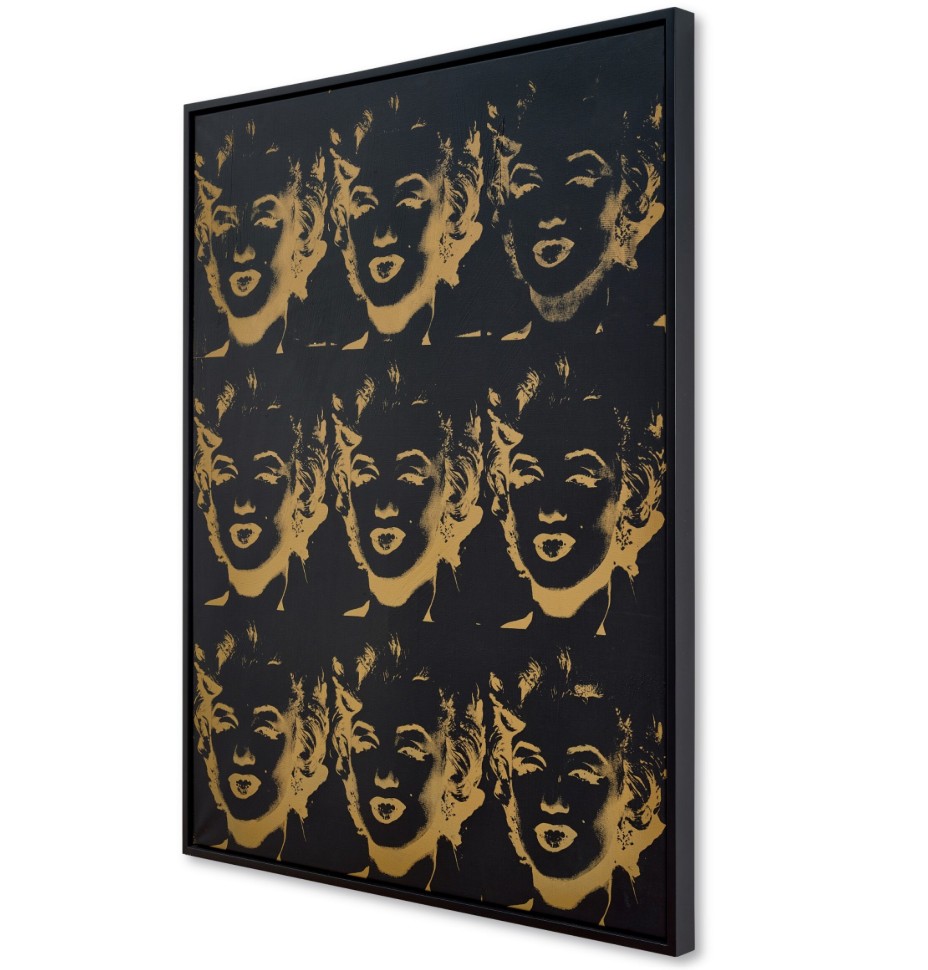
ANDY WARHOL
9 Gold Marilyns (Reversal Series), 1980
Gold acrylic and silkscreen ink on canvas
54 x 41.5 inches (137 x 105.5 cm)
Nine Multicolored Marilyns (Reversal Series), 1979-1986
Christie’s New-York: 12 May 2021
Estimated: USD 6,500,000 – 8,500,000
USD 10,207,000
Andy Warhol (1928-1987) (christies.com)
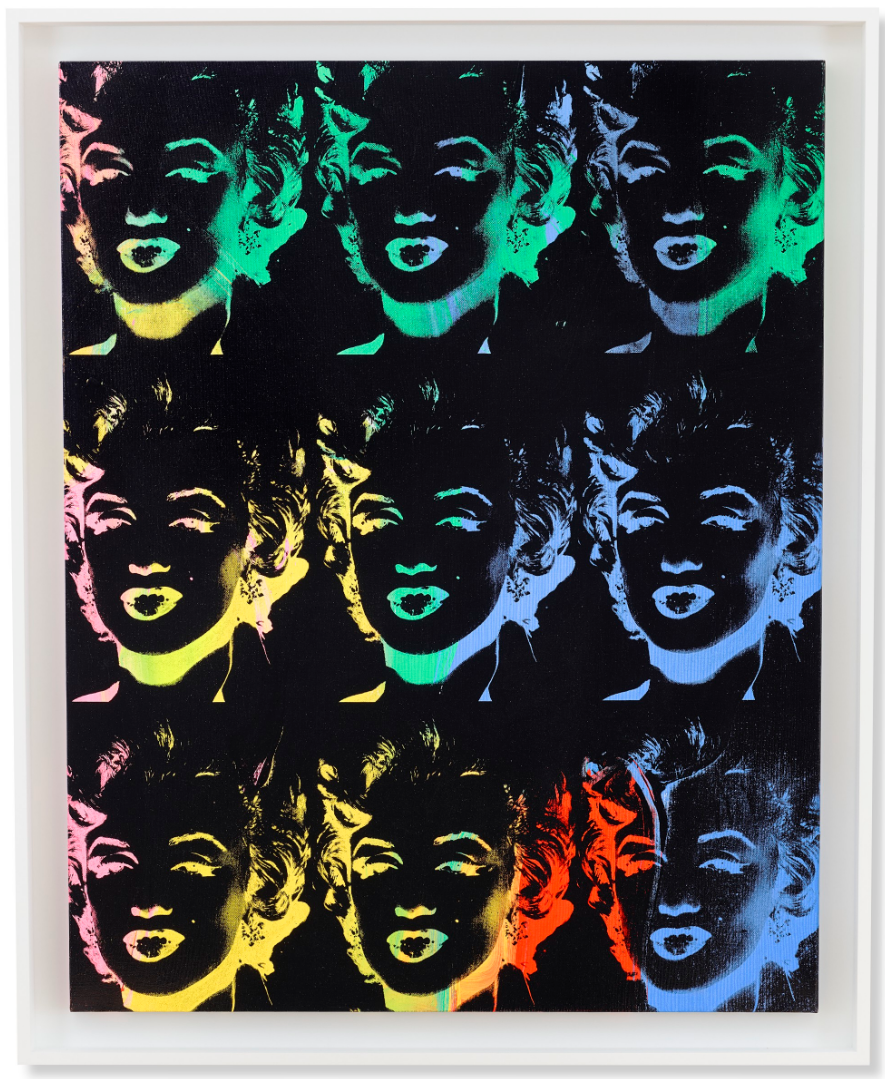
ANDY WARHOL
Nine Multicolored Marilyns (Reversal Series), 1979-1986
Acrylic and silkscreen ink on canvas
50×40 inches (127 x 101.6 cm)
Stamped with the artist’s signature ‘Andy Warhol ©’ (on the overlap)
Signed and inscribed by Frederick Hughes ‘I certify that this is an original painting by Andy Warhol completed by him in 1986 Frederick Hughes’ (on the overlap)
One Grey / Black Marilyn (Reversal Series), 1979-1986
Phillips London: 15 April 2021
Estimated: GBP 700,000 – 900,000
GBP 733,950 / USD 1,011,094
Andy Warhol – 20th Century & Contempor… Lot 17 April 2021 | Phillips
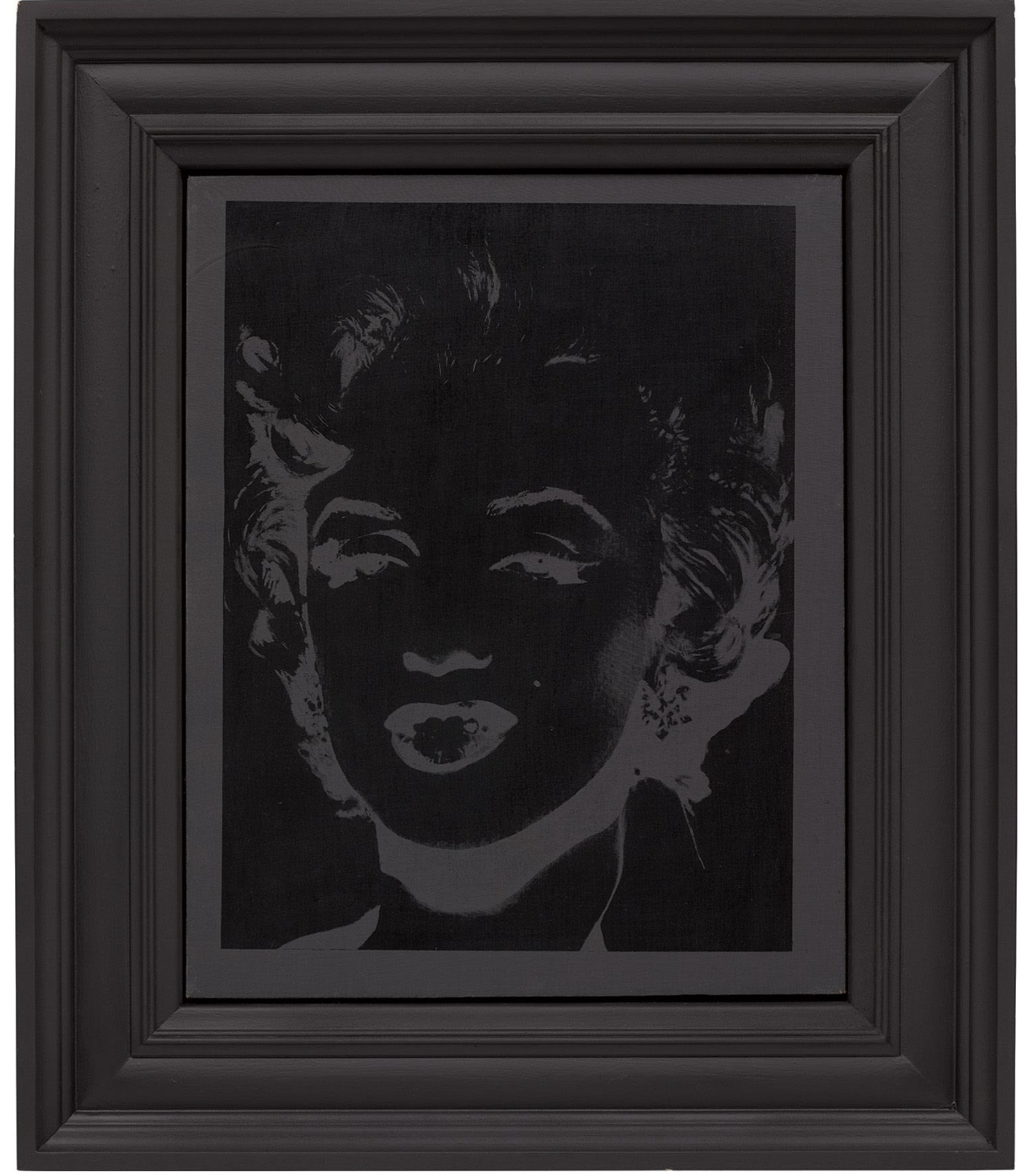
ANDY WARHOL
One Grey / Black Marilyn (Reversal Series) II-50-160, 1979-1986
Acrylic and silkscreen ink on canvas
20 x 15 7/8 inches (50.8 x 40.6 cm)
Signed ‘Andy Warhol’ on the reverse
Marilyn, 1979-1986
Christie’s New-York: 9 March 2021
Estimated: USD 800,000 – 1,200,000
USD 1,290,000
Andy Warhol (1928-1987) (christies.com)
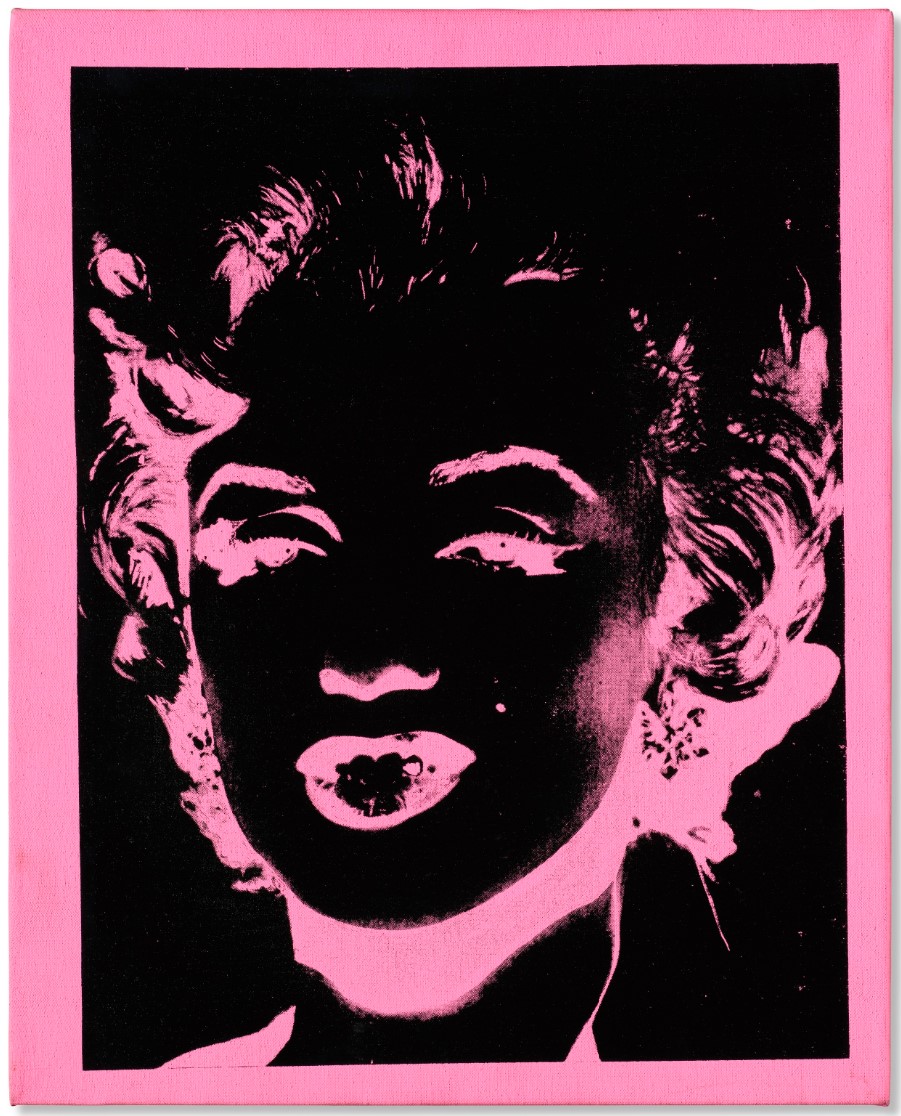
Andy Warhol (1928-1987)
Marilyn, 1979-1986
Acrylic and silkscreen ink on canvas
20×16 inches (50.8 x 40.6 cm.)
Stamped with the artist’s signature ‘Andy Warhol’ (on the overlap)
2020 Auction Results
Marilyn, 1979-1986
Property from the Foundation Mireille and James Lévy
Christie’s New-York: 2 December 2020
Estimated: USD 1,200,000 – 1,800,000
USD 1,698,000
Andy Warhol (1928-1987) (christies.com)
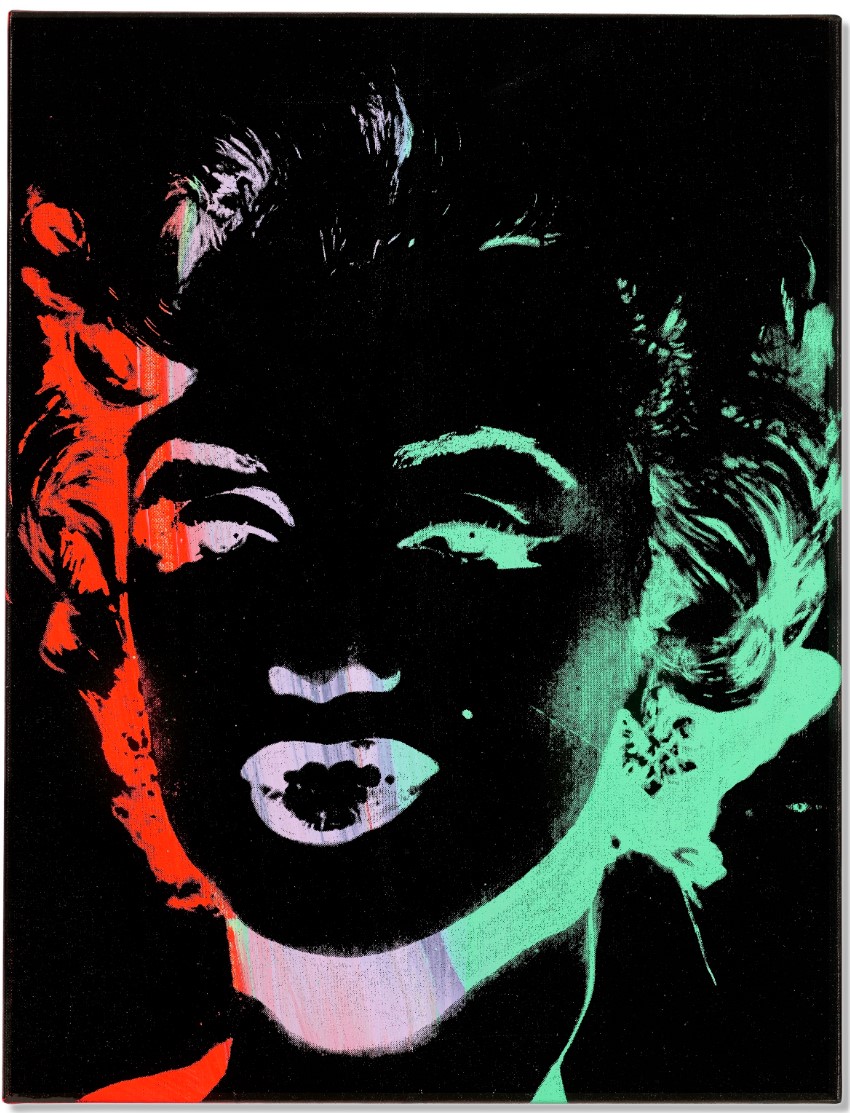
ANDY WARHOL
Marilyn, 1979-1986
Acrylic and silkscreen ink on canvas
18.1 x 13.9 inches (46 x 34.9 cm)
Signed and dated ‘Andy Warhol 79/86’ (on the overlap)
Marilyn, 1979-1986
Property from the Foundation Mireille and James Lévy
Christie’s New-York: 3 December 2020
Estimated: USD 1,200,000 – 1,800,000
USD 1,818,000
Andy Warhol (1928-1987) (christies.com)
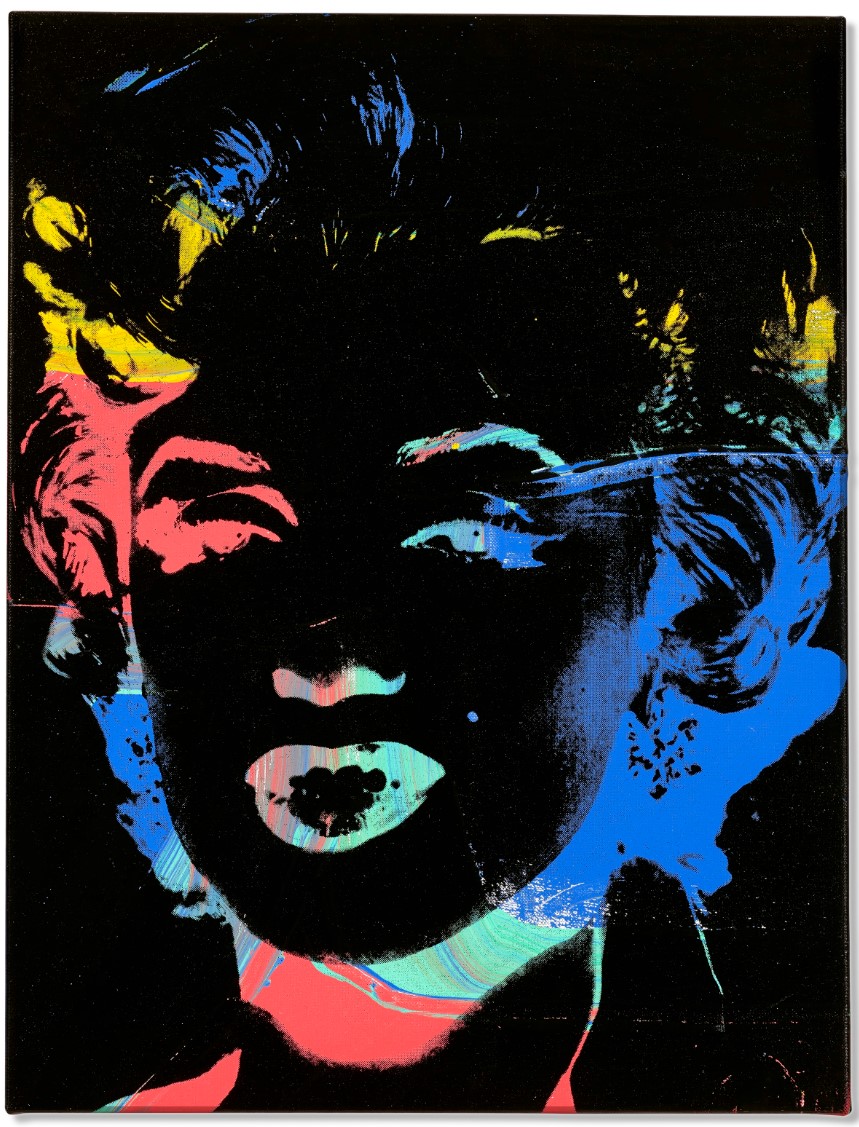
ANDY WARHOL
Marilyn, 1979-1986
Acrylic and silkscreen ink on canvas
18.1 x 13.9 inches (46 x 34.9 cm)
Signed ‘Andy Warhol’ (on the overlap)
2019 Auction Results
NO SALE IN 2019
2018 Auction Results
Marilyn (Reversal), 1979-1986
Christie’s New-York: 16 November 2018
Estimated: USD 1,000,000 – 1,500,000
USD 1,332,500
Andy Warhol (1928-1987) (christies.com)
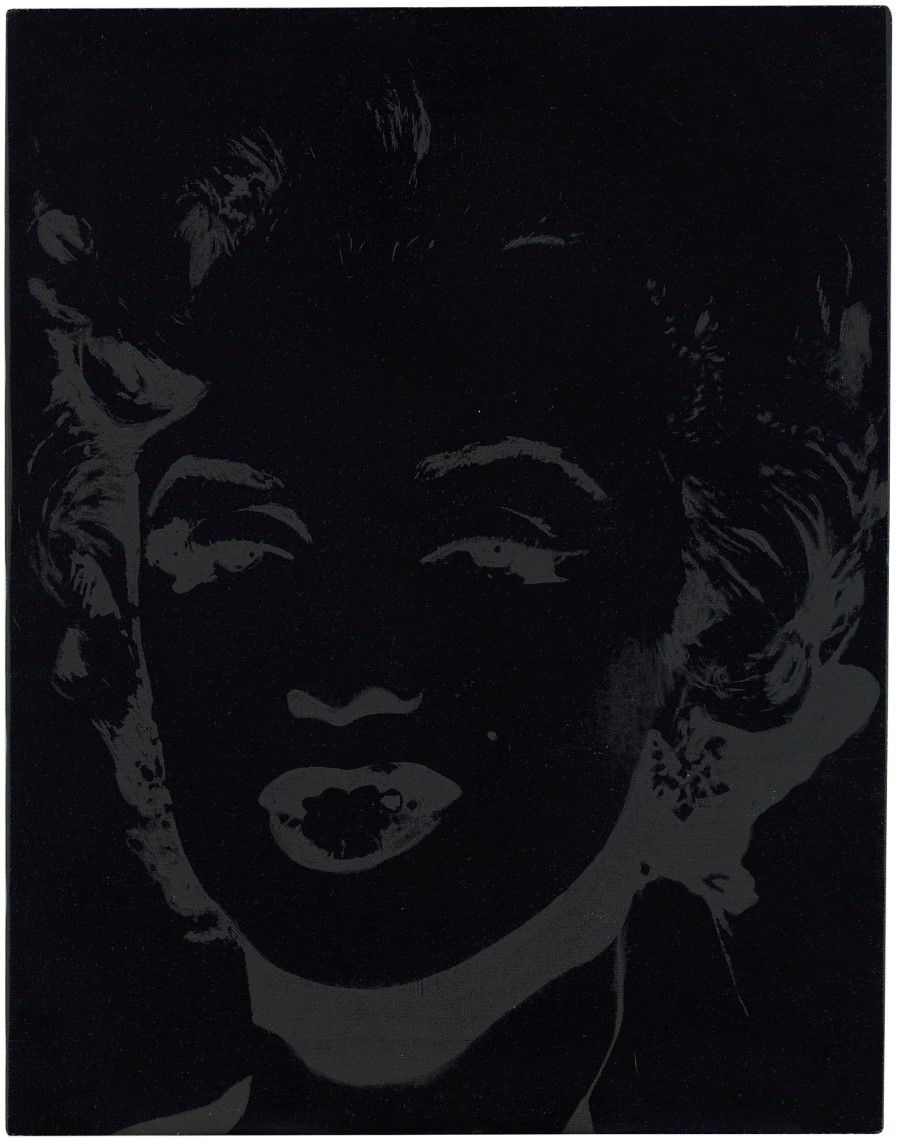
ANDY WARHOL
Marilyn (Reversal), 1979-1986
Synthetic polymer and silkscreen ink on canvas
18×14 inches (45.7 x 35.6 cm)
Stamped with artist’s signature ‘Andy Warhol’ (on the reverse)
Signed and inscribed by Frederick Hughes ‘I certify that this is an original painting by Andy Warhol completed by him in 1986 – Frederick A Hughes’ (on the overlap)
Marilyn (Reversal), 1979-1986
Sotheby’s London: 26 June 2018
Estimated: GBP 1,200,000 – 1,800,000
GBP 1,390,000
(#18) ANDY WARHOL | Marilyn (Reversal) (sothebys.com)
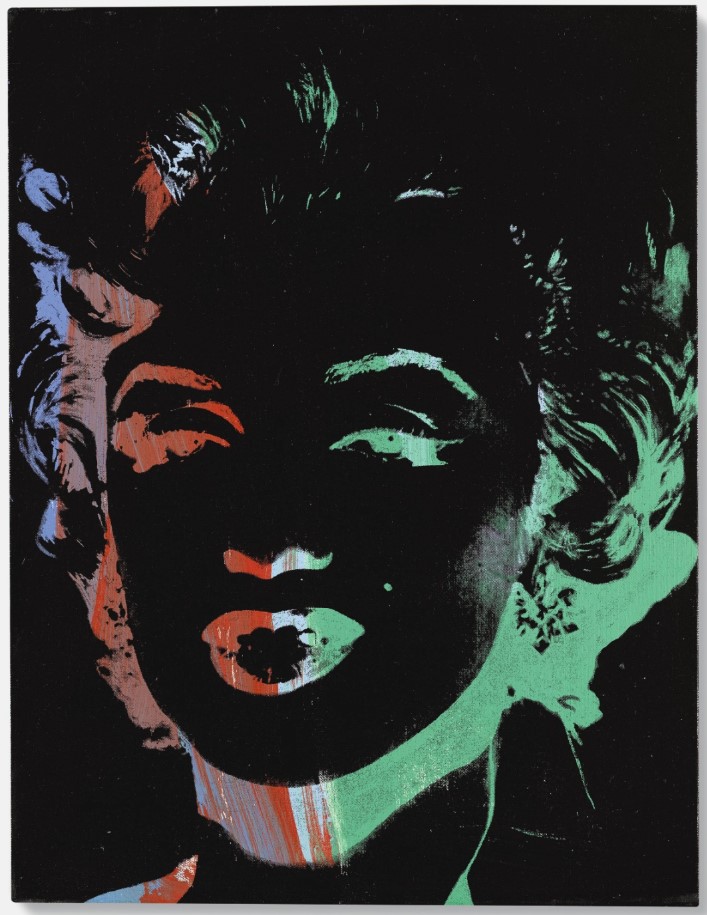
ANDY WARHOL
Marilyn (Reversal), 1979-1986
Acrylic and silkscreen ink on canvas
18.1 x 14 inches (46.1 x 35.4 cm)
Signed and dated 79/86 on the overlap
Nine Multicolored Marilyns
Nine Multicolored Marilyns (Reversal Series), 1979-86
Sotheby’s London: 14 October 2022
Estimated: GBP 6,000,000 – 8,000,000
GBP 5,189,200 / USD 5,817,489
Nine Multicoloured Marilyns (Reversal Series) | Contemporary Evening Auction | 2022 | Sotheby’s
REPEAT SALE
Sotheby’s London: 30 June 2014
Estimated: GBP 4,000,000 – 6,000,000
GBP 4,562,500 / USD 7,802,770
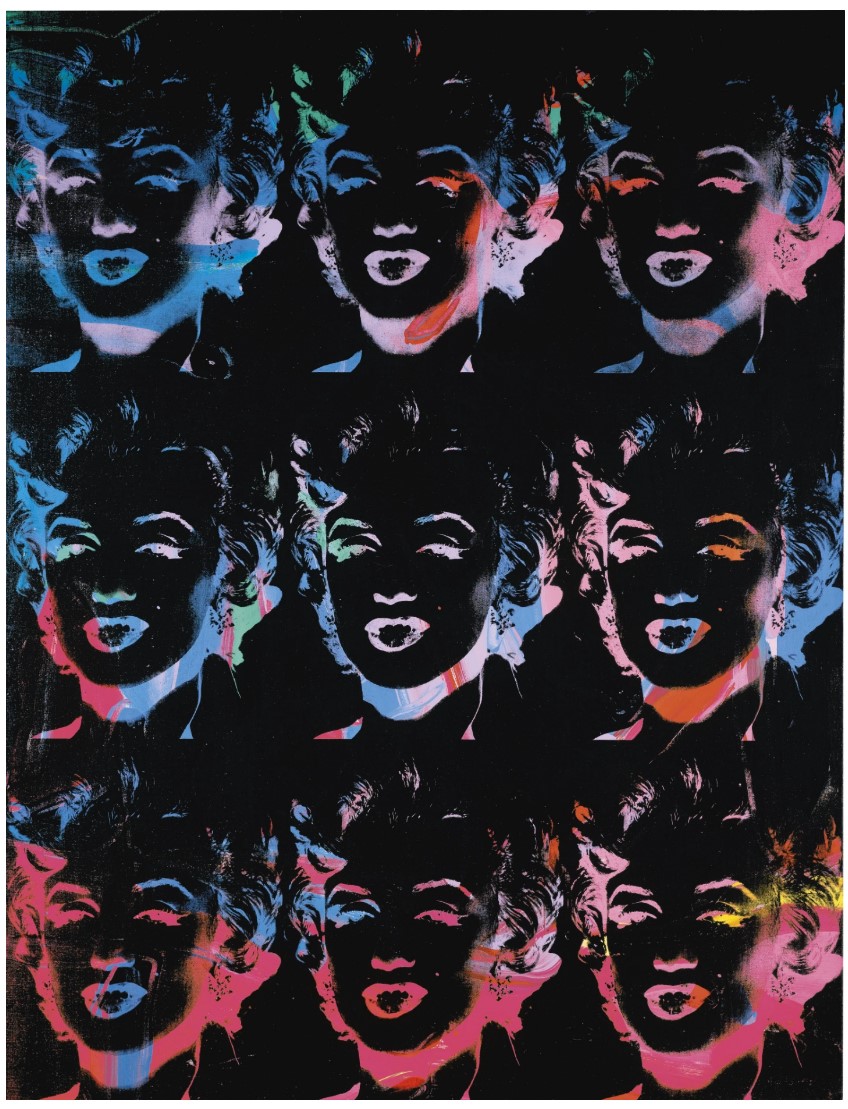
ANDY WARHOL (1928 – 1987)
Nine Multicolored Marilyns (Reversal Series), 1979-86
Acrylic and silkscreen ink on canvas
54 ⅜ x 41 ¾ inches (138 x 106.1 cm)
Signed Andy Warhol and dated 79/86 (on the overlap)
Provenance
Galerie Bruno Bischofberger, Zurich
Private Collection, Germany
Christie’s New York, 3 May 1995, lot 46
Private Collection (acquired directly from the above)
Sotheby’s London, 30 June 2014, lot 43 (consigned by the above)
Acquired from the above by the present owner
Nine Muliticolored Marilyns (Reversal Series) depicts the most instantly recognizable and famous personality of the Twentieth Century and Andy Warhol’s most iconic subject. On the surface of the present work, Marilyn Monroe’s portrait is serially reproduced nine times, her face in dark shadow and illuminated by psychedelic and expressively applied hues of vibrant pink and blue. This painting is an outstanding example of Warhol’s deeply reflective and rigorously conceptual Reversal series, which he began in the 1970s. Within a context of the appropriationist strategies of burgeoning artists such as Richard Prince and Cindy Sherman, Warhol began this pivotal body of work by expropriating material from his own infamous repertoire of images and transforming and updating his classic Pop iconography of the 1960s in a self-referential act of post-modern brilliance. Warhol’s portraits of the previous decade had seeped into a mass visual register of American popular culture and achieved a potent symbolic power to rival the mass media images the artist appropriated to create these works. The impact of Warhol’s depiction of Marilyn Monroe not only registers the timeless quality of her celebrity, but also the symbolic power of Warhol’s own. With a renewed intellectual vigor, Warhol swiftly pivoted away from the notion of Hollywood celebrity and towards a reflection upon his own artistic legacy. By appropriating Warhol the brand, the Reversal series heralded the beginning of a new Warholian dialogue. Appropriating Warhol as a brand, Nine Multicoloured Marilyns presents a fluorescent x-ray recapitulation of one of the most captivating and celebrated inquiries of his career. In 1962 Warhol cemented Marilyn’s status as a cult icon; more than twenty years later in 1986 the impact of her image not only registers the timeless quality of her celebrity but the symbolic power of Warhol’s own.
Nine Multicolored Marilyns (Reversal Series), 1979-1986
Christie’s New-York: 12 May 2021
Estimated: USD 6,500,000 – 8,500,000
USD 10,207,000
Andy Warhol (1928-1987) (christies.com)
ANDY WARHOL
Nine Multicolored Marilyns (Reversal Series), 1979-1986
Acrylic and silkscreen ink on canvas
50×40 inches (127 x 101.6 cm)
Stamped with the artist’s signature ‘Andy Warhol ©’ (on the overlap)
Signed and inscribed by Frederick Hughes ‘I certify that this is an original painting by Andy Warhol completed by him in 1986 Frederick Hughes’ (on the overlap)
Provenance
Lang & O’Hara Gallery, New York
Private collection, New York
Private collection, Switzerland
Acquired from the above by the present owner, 2008
Against a backdrop of electric colors, Warhol presents a series of nine images of Marilyn Monroe. While much of her face looks like it has been plunged into deep shadow, her features (her famously luscious lips, her perfectly plucked eyebrows, and her twinkling eyes) all sparkle with high-keyed color. Even her famous beauty spot pierces the dark like a dazzling star in the night sky. In the Reversal series, the contrast between the multicolored and dark elements highlights Monroe’s physical beauty arguably more than any other of Warhol’s renderings of the artist, however, there still remains a sense of personal darkness that consumed much of Monroe’s private life. Thus, perhaps more than any of his other Marilyn paintings, these later Reversals are a more reflective portrait of the real Monroe as she struggled to reconcile the superficial nature of movie superstardom with her own complex personality.
Nine Multicolored Marilyns (Reversal Series), 1979-1986
Christie’s New-York: 15 May 2013
Estimated: USD 5,500,000 – 6,500,000
USD 7,403,750
Andy Warhol (1928-1987) , Nine Multicolored Marilyns (Reversal Series) | Christie’s
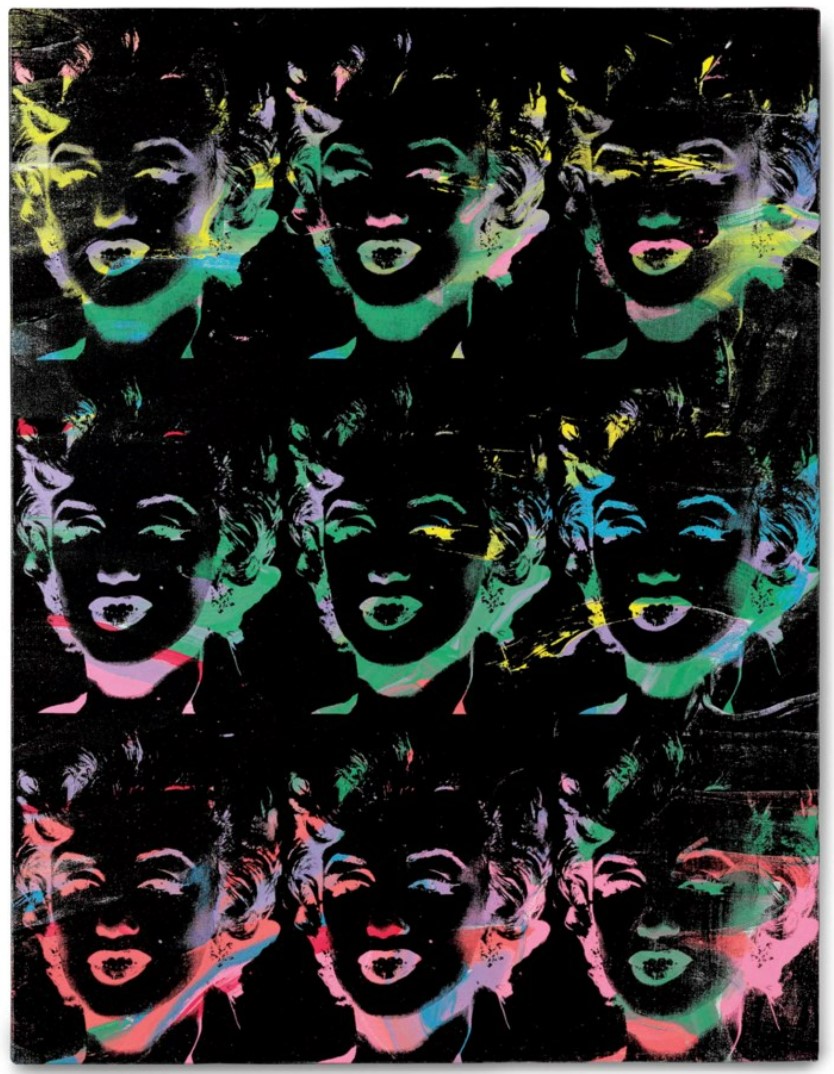
Nine Multicolored Marilyns (Reversal Series), 1979-1986
Synthetic polymer and silkscreen ink on canvas
54.7 x 41.6 inches (139 x 105.7 cm)
Signed and dated ‘Andy Warhol 79/86’ (on the overlap)
Provenance
Galerie Bruno Bischofberger, Zurich
Lang & O’Hara Gallery, Inc., New York
Anon. sale; Phillips de Pury & Luxembourg, New York, 13 May 2002, lot 34
Galerie Andrea Caratsch, Zurich
Acquired from the above by the present owner
Nine Multicolored Marilyns (Reversal Series), 1979-1986
Estimated: GBP 2,200,000 – 2,800,000
GBP 2,505,250 / USD 4,997,010
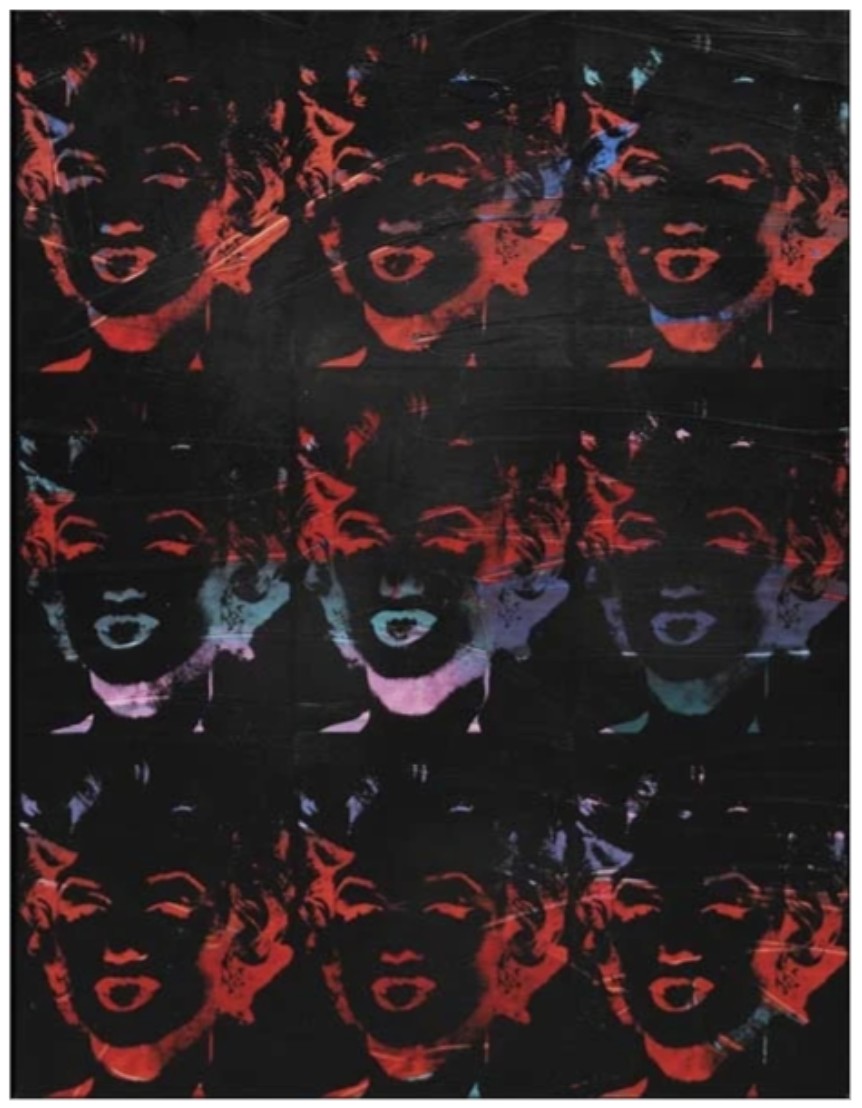
Nine Multicolored Marilyns (Reversal Series), 1979-1986
Synthetic polymer and silkscreen ink on canvas
54.7 x 41.6 inches (138×106 cm)
Signed and dated ‘Andy Warhol 79/86’ (on the overlap)
Nine Multicoloured Marilyns (Reversal Series), 1979-1986
Christie’s London: 8 February 2005
Estimated: GBP 450,000 – 650,000
GBP 1,128,000 / USD 2,095,435
Andy Warhol (1928-1987) , Nine Multicoloured Marilyns (Reversal Series) | Christie’s
Nine Multicoloured Marilyns (Reversal Series), 1979-1986
Acrylic, synthetic polymer paint and silkscreen inks on canvas
54.5 x 41.7 inches (138.4 x 106 cm)
Signed and dated ‘Andy Warhol 79/86’ (on the overlap)
Galerie Bruno Bischofberger, Zurich
Anon. Sale, Christie’s London, 29 June 1995, lot 56
Acquired at the above sale by the present owner
Nine Blue Marilyns, 1979
Nine Blue Marilyns (Reversal Series), 1979
Sotheby’s New-York: 8 November 2005
Estimated: USD 2,000,000 – 3,000,000
USD 2,480,000
ANDY WARHOL
Nine Blue Marilyns (Reversal Series), 1979
Acrylic and silkscreen ink on canvas
54 x 41.7 inches (137.2 x 106 cm)
Provenance
Galerie Bruno Bischofsberger, Zurich
Greenberg Van Doren Gallery, St. Louis
Acquired by the present owner from the above
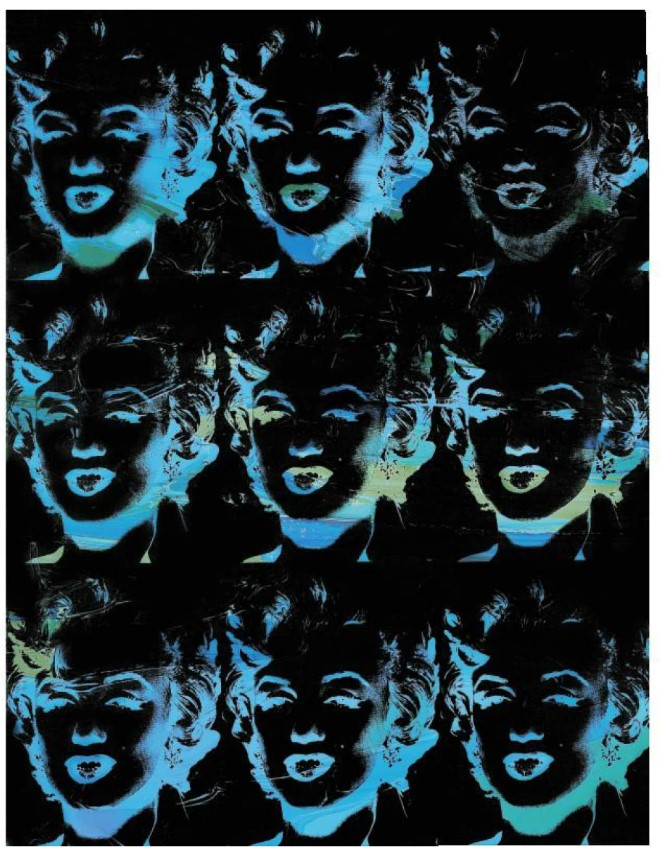
Executed at the peak of Warhol’s fame, the present work belongs to Warhol’s retrospective Reversal Series, so called because it involved a process of reversing the original silkscreen printing process of earlier images to create negative impressions. Enveloping Marilyn’s distinctive visage in a dark veil, as if shot in x-ray, her familiar, pouting features pulsate with an inner vitality as they burst forth in swirling waves of electric blue. Nine Blue Marilyns (Reversal Series) shows Warhol to be a tireless innovator and exposes the natural evolution of the concept underscoring his Pop conquest. Obsessed with the imperfections of his own appearance, Warhol from the outset of his career questioned the nature of art and beauty. Plundering instantly recognizable, glamorous images from the pantheon of modern celebrity, Warhol sought to challenge conventional notions of originality and craftsmanship in art. Nine Blue Marilyns (Reversal Series) is a testament to the striking and innovative effects Warhol achieved in this radical departure, and epitomizes his tireless artistic innovation. It has often been said that Warhol made fame famous, and if we accept this as true, then the present work is a dynamic avowal to the power of the Warhol look. By choosing his own legendary image of Marilyn as an icon of celebrity in itself, the Marilyn Reversals become metaphorical self-portraits laying claim to the value and history of his artistic legacy.
9 Gold Marilyns, 1980
9 Gold Marilyns (Reversal Series), 1980
Sotheby’s London: 29 June 2021
Estimated: GBP 5,500,000 – 8,000,000
GBP 6,517,500 / USD 9,023,259
REPEAT SALE
Phillips New-York: 11 November 2013
Estimated: USD 8,000,000 – 12,000,000
USD 9,125,000
Andy Warhol Contemporary Art Evening Sale
ANDY WARHOL
9 Gold Marilyns (Reversal Series), 1980
Gold acrylic and silkscreen ink on canvas
54 x 41.5 inches (137 x 105.5 cm)
Forever suspended in shimmering gold paint, Marilyn Monroe’s iconic headshot is stacked and repeated in an assembly line composition that reinterprets the ornamental Medieval reliquary for our celebrity-obsessed age. Echoing Gold Marilyn Monroe (1962; The Museum of Modern Art, New York) – Warhol’s unique monumental painting from his very first body of work prompted by the film-star’s suicide in 1962, the present work is a uniquely golden and imposing example from Warhol’s later series of Marilyn Reversals. Repeated nine times in negative, the present work is a paradigm of Warhol’s deeply reflective yet conceptually forward-looking Reversals series and an exceptional iteration of the ultimate Warholian subject. Standing at the very apex of Warhol’s 1980s oeuvre, Nine Gold Marilyns not only probes the prevalent dialogue of authorship and authenticity prevalent at the time, but also interrogates Warhol’s own artistic code with unparalleled visual impact. Where in 1962 Warhol had cemented Monroe’s status as a cult icon, more than twenty years later the impact of her Warholian likeness here not only registers the timeless quality of Monroe’s celebrity but also the symbolic power of Warhol himself.
Four Pink Marilyns, 1986
Four Pink Marilyns (Reversal Series), 1986
Sotheby’s London: 16 October 2025
Estimated: GBP 3,000,000 – 5,000,000
GBP 4,326,000 / USD 5,796,840
Four Pink Marilyns (Reversal Series) | Contemporary Evening Auction | 2025 | Sotheby’s
REPEAT SALE
Sotheby’s New-York: 11 November 2015
Estimated: USD 3,000,000 – 4,000,000
USD 4,506,000
ANDY WARHOL (1928 – 1987)
Four Pink Marilyns (Reversal Series), 1986
Acrylic and silkscreen ink on canvas
36 1/8 x 28 inches (91.7 x 71 cm)
Signed and dated 86 (on the overlap)
Stamped by the Andy Warhol Art Authentication Board, Inc., and numbered A107.999 on the overlap
Executed in 1986, Four Pink Marilyns (Reversal Series) represents one of the most conceptually charged moments in Andy Warhol’s late career. More than two decades after he first cemented Marilyn Monroe’s status as a cult icon in his elegiac 1962 portraits, Warhol revisited her image in the Reversals series, transforming the familiar visage into something newly spectral and uncanny. Repeated four times in negative register, the present work underscores both the timeless endurance of Monroe’s celebrity and the symbolic power of Warhol’s own artistic mythology. The Reversals marked a decisive shift in Warhol’s practice at the beginning of the 1980s. Following the relative quietude of the previous decade, he turned towards a re-examination of his own pantheon of 1960s icons, aligning himself with the appropriationist strategies of younger contemporaries such as Cindy Sherman and Richard Prince. In doing so, Warhol effectively appropriated himself as a brand, recasting his formative images of Marilyn, Mao, and Campbell’s Soup into what might be understood as incandescent x-ray visions of his earlier career. In this light, Four Pink Marilyns (Reversal Series) can be seen not merely as a return to one of Warhol’s most celebrated inquiries but as a climactic transfiguration of his core concerns – repetition, celebrity, commodification, and mortality – distilled into a late work of haunting resonance.
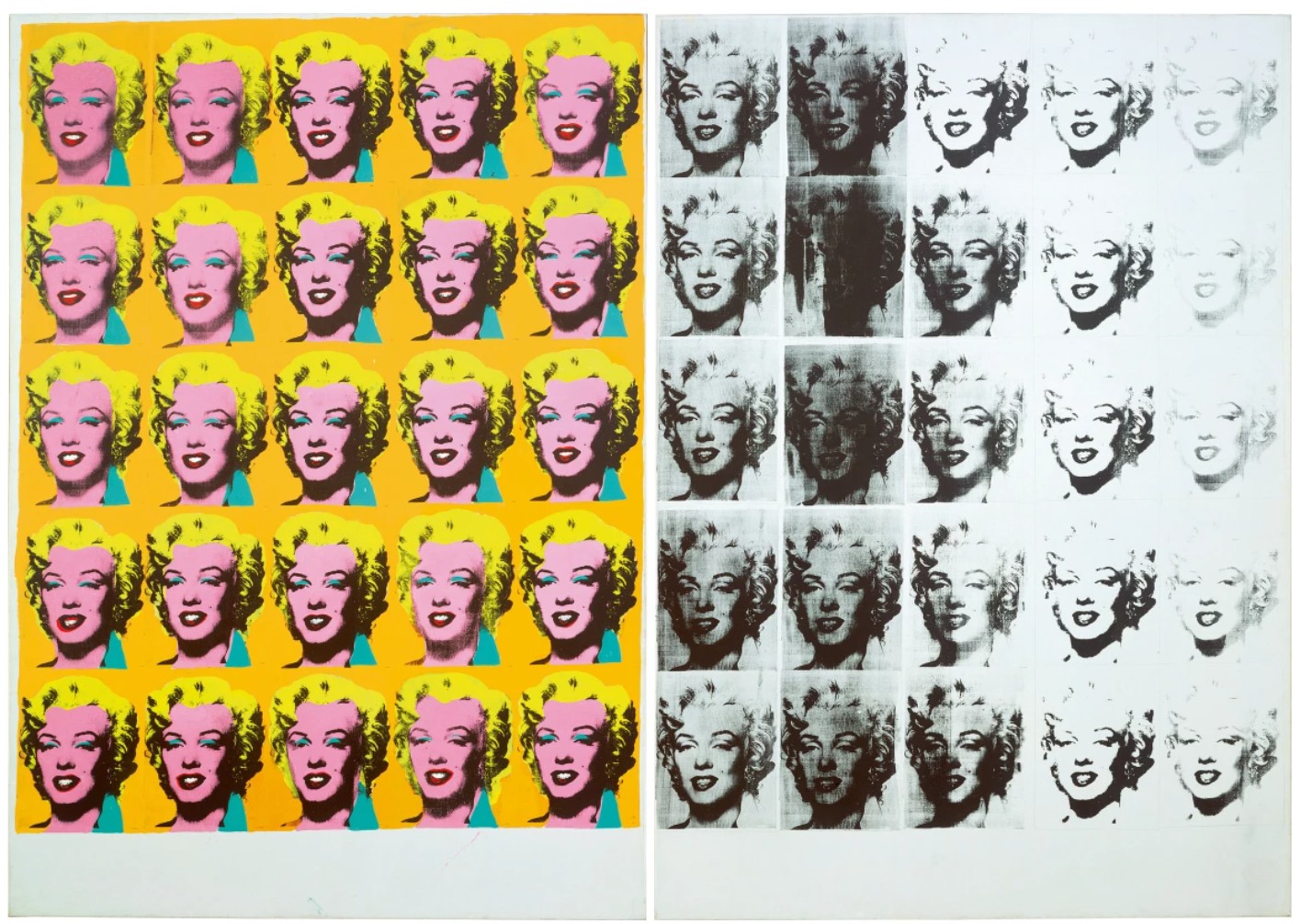
Andy Warhol, Marilyn Diptych, 1962. Tate Modern, London.
Image: © Tate. Artwork: © 2025 The Andy Warhol Foundation for the Visual Arts, Inc./Licensed by DACS, London
Four Pink Marilyns (Reversal Series) stands at the very apex of Warhol’s lifelong project of appropriation. Where, in the years that followed, the artist would turn to the art-historical canon – appropriating motifs from Lucas Cranach, Paolo Uccello, Edvard Munch, and Giorgio de Chirico – here, he turned his gaze inward, lifting directly from his own repertoire. This self-quotation is both typical of Warhol’s subversive strategies and emblematic of the pervasive mood of self-mythologization that permeates his late practice. In revisiting Marilyn Monroe, an image that had already secured him enduring fame in the early 1960s, Warhol not only probed the contemporaneous debates around authorship and authenticity but also implicitly endorsed the very artistic code upon which his reputation was built. In this iteration, Monroe’s visage is presented not through the familiar registers of heightened glamour –lipstick-red mouths or gilded hair – but as a spectral imprint. Rendered in negative, her repeated likeness is suffused with luminous bubble-gum pink, while shadows are exaggerated and mid-tones collapse into darkness. The result is a haunting dematerialization of Monroe, her features reduced to ghostly indices that oscillate between presence and absence. The work thus invokes a duality: both the radiant allure of celebrity and its inevitable fading into spectral memory.
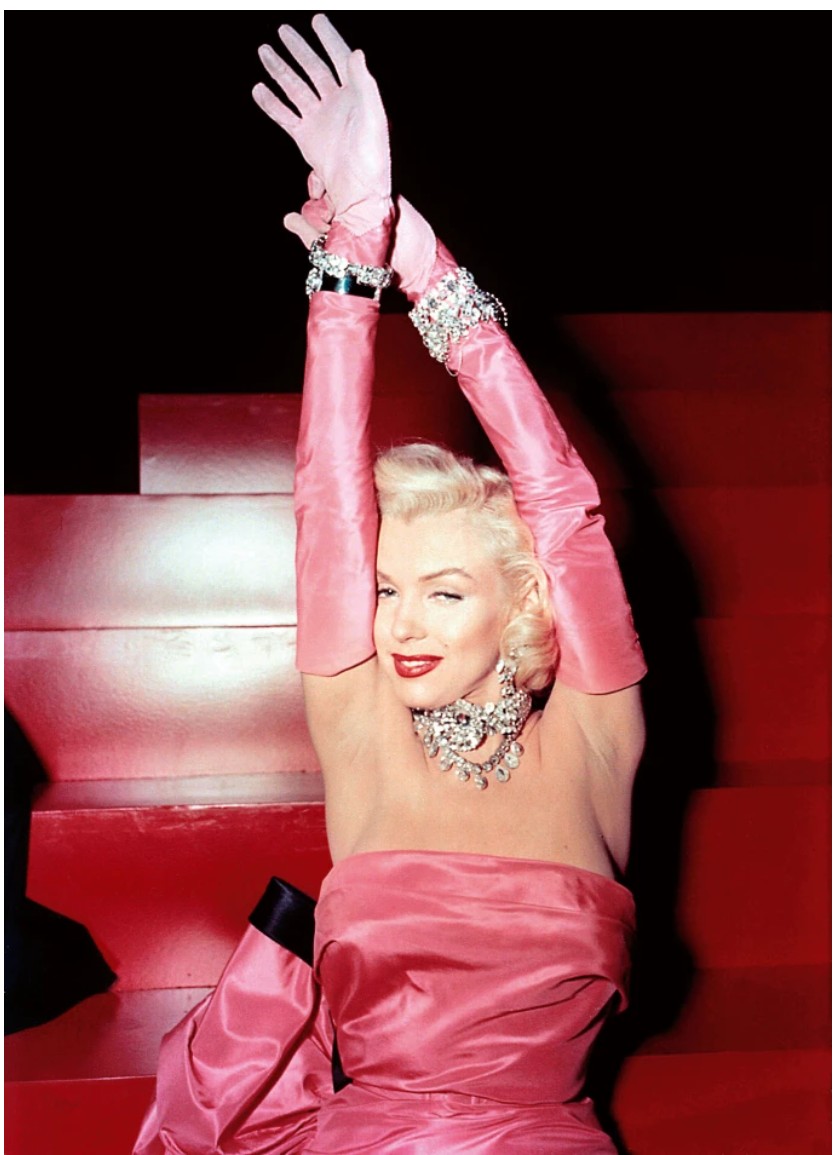
Marilyn Monroe, 1953, TM and Copyright ©20th Century Fox Film Corp. All rights reserved./Courtesy Everett Collection
With Marilyn Monroe, Andy Warhol discovered a modern memento mori that unified the obsessions driving his career: glamour, beauty, fame, and death. In Four Pink Marilyns (Reversal Series), these themes coalesce with renewed force. The image radiates the aura of Monroe as sex symbol and Hollywood legend, while simultaneously presenting the shadow of mortality. The stark dichotomy of black silkscreen ink against a luminous pink ground evokes both the glamour of the silver screen and the spectral fragility beneath its surface. Warhol’s deployment of the silkscreen process, a mechanical technique that effaces the artist’s hand, further serves as metaphor for the operations of mass media and its power to reproduce, disseminate, and ultimately flatten celebrity into consumable commodity. The conceptual brilliance of the work lies in this layering of thematic registers: the seduction of cinema, the artificiality of fame, and the inevitability of decay, all operating simultaneously. As Rainer Crone observed in 1970, Warhol gravitated towards movie stars because they functioned as “representatives of mass culture” (Rainer Crone, Andy Warhol, New York 1970, p. 22). Monroe epitomized this paradox more completely than any other: she was at once the most desirable woman in the world and the tragic victim of her own celebrity. For Warhol, her image encapsulated the unstable balance between personhood and brand, a dialectic he would also explore through Elvis Presley, Elizabeth Taylor, Marlon Brando, and Jackie Kennedy.
“In the early days of film, fans used to idolize a whole star—they would take one star and love everything about that star… So you should always have a product that’s not just ‘you.’”
In Monroe, Warhol recognized the consummate product of mass culture: an actress whose image was at once infinitely reproducible and inexhaustibly desirable, yet ultimately haunted by its own impermanence. Through her, he crystallized the quintessential logic of Pop: the translation of the ephemeral into the iconic, and of personal tragedy into mass spectacle.
Warhol instinctively understood the Marilyn brand as an industrialized construct, designed for mass consumption like a Coca-Cola bottle or Campbell’s Soup Can, and radically revealed it as a precisely composed non-reality. Of course Marilyn offered Warhol the biggest brand of all, and he accentuated this by choosing a manifestly contrived version of Marilyn. Although this image of Marilyn has come to stand as the instantly-recognisable emblem of her global fame, encapsulating as it does so perfectly every aspect of her enduring allure, it is an entirely dehumanised portrait, devoid of any of the psychosomatic realities that proved ultimately fatal for Norma Jeane Mortenson on the night of August 5 1962. Moreover, the negative reversal of her image magnifies the ghostliness of her visage, resulting in a compellingly haunting memorial to the screen siren. Even after the brutal reality and terminal tragedy of her suicide, the artificial veneer of a projected image remains the enduring legacy of a human life.
“Everything is sort of artificial. I don’t know where the artificial stops and the real starts. The artificial fascinates me, the bright and shiny…”
With the further temporal and formal remove of the image’s negative impression, Warhol emphasised the very postmodern notion of image production and circulation through the endlessly reproduced visage of Marilyn Monroe. Warhol celebrated and critiqued the power of the icon like no other artist of the Twentieth Century, and Four Pink Marilyns (Reversal Series) interrogates the limits of the popular visual vernacular, posing vital questions of collective perception in contemporary society.
Four (Multi)Colored Marilyns, 1979-1986
4 Colored Marilyns (Reversal Series), 1979-86
Property from an Important Private Collection
Phillips New-York: 19 May 2026
Estimated: USD 4,000,000 – 6,000,000
USD 5,630,000
Andy Warhol Modern & Contemporary Art Evening Sale
ANDY WARHOL
4 Colored Marilyns (Reversal Series), 1979-86
Acrylic and silkscreen ink on canvas
35-7/8 x 27-7/8 inches (91.1 x 70.8 cm)
Signed, stamped by the Andy Warhol Art Authentication Board Inc.
Initialed, numbered and dated “Andy Warhol 79/8 A130.089” on the overlap
Provenance
Galerie Bruno Bischofberger, Zurich
Private Collection, Japan
Joseph K. Levene Fine Art, Ltd., New York
Private Collection, New York (acquired from the above)
Alan Koppel Gallery, Chicago
Private Collection, Chicago
Barbara Mathes Gallery, New York
Acquired from the above by the present owner in 2005
Executed between 1979 and 1986, 4 Colored Marilyns (Reversal Series) emerges from a pivotal moment in Andy Warhol’s practice, when the artist began revisiting and destabilizing the very images that had defined his fame. More than two decades after his elegiac 1962 portraits secured both Marilyn Monroe’s and his own iconic status, Warhol returned to her image in the Reversals, revisiting his most famous subject not to replicate its glamour but to invert it. In doing so, he transformed one of the most recognizable images in postwar art into a spectral afterimage, an uncanny echo of Monroe’s celebrity and his own artistic mythology.
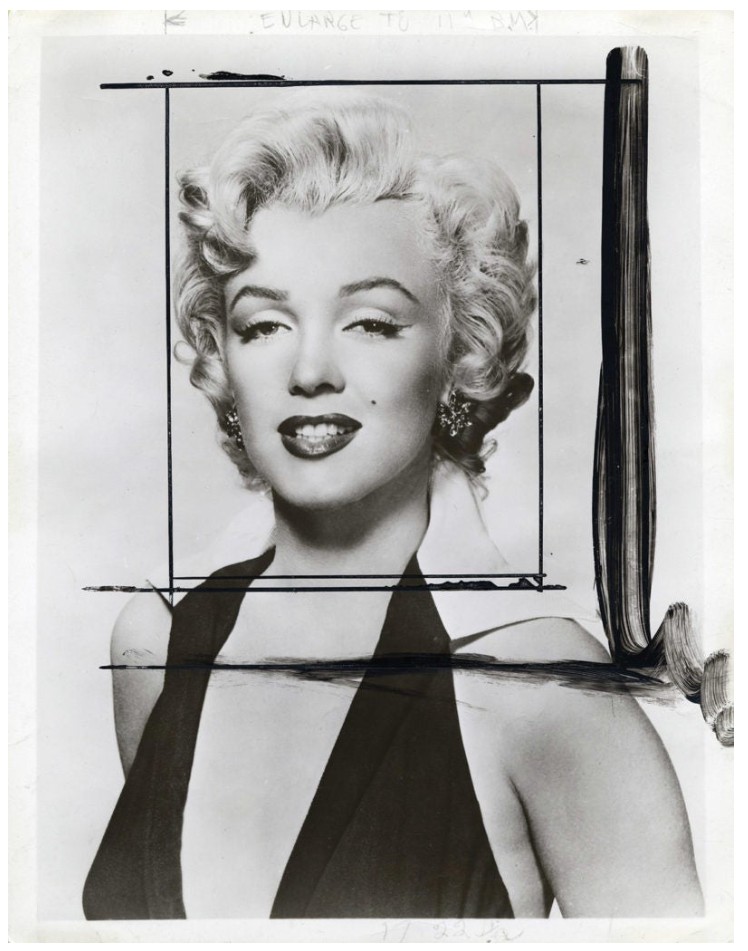
Publicity still of Marilyn Monroe for the film Niagara, showing crop marks made by Andy Warhol, ca. 1953. Photograph by Gene Korman. The Andy Warhol Museum, Pittsburgh; Founding Collection, contribution The Andy Warhol Foundation for the Visual Arts, Inc. Image: © 2026 The Andy Warhol Foundation for the Visual Arts, Inc. / Licensed by Artists Rights Society (ARS), New York
The Reversals are widely regarded as a decisive postmodern turn in Warhol’s practice. Initiated in 1979, the series employed photographic negatives of six earlier motifs: Marilyn, Mona Lisa, Mao, Big Electric Chair, Cow Wallpaper, and the photobooth Self-Portrait. In 1986, Bruno Bischofberger commissioned a second group of Marilyn Reversals, which Warhol signed and dated on the reverse to acknowledge both the original 1979 conception and their later execution. As David Bourdon observed in 1989, “By ransacking his own past to produce the Reversals and Retrospectives, Warhol revealed himself to be one of the shrewdest of the new wave of post-modernists.” Bourdon positioned the series within the pluralist climate of the 1970s, marked by irony and indifference toward traditional hierarchies of ‘high’ and ‘low’ art. In this context, 4 Colored Marilyns emerges not as nostalgic reprise but as calculated self-appropriation: Warhol quoting Warhol.
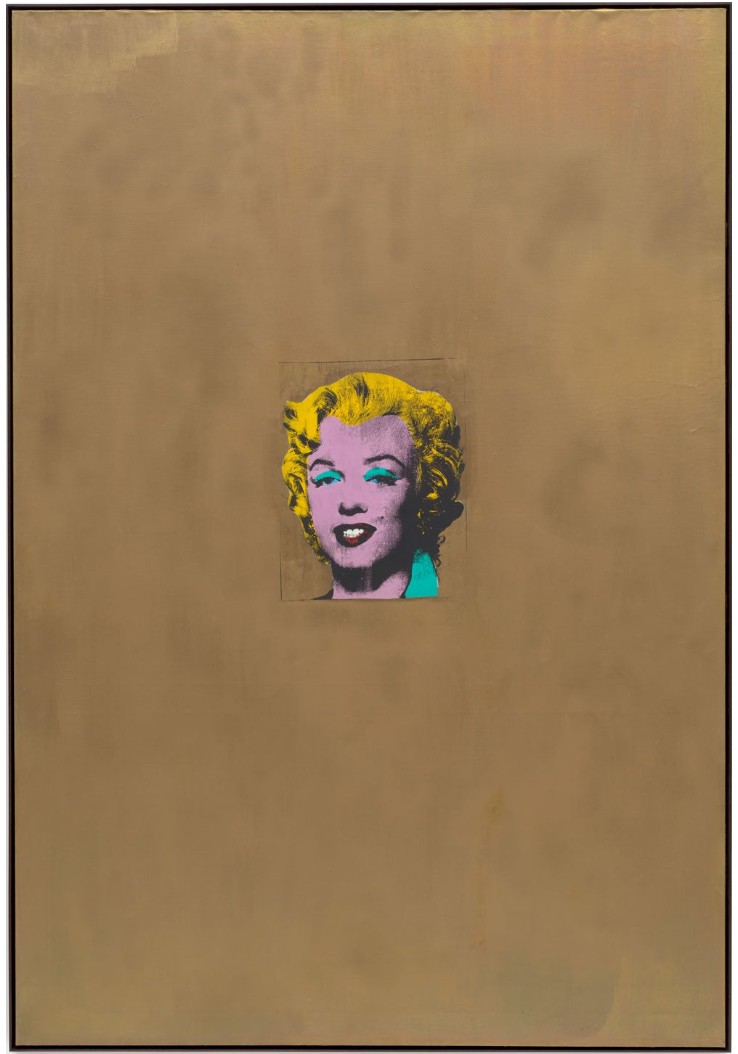
Andy Warhol, Gold Marilyn Monroe, 1962. The Museum of Modern Art, New York.
Image: © The Museum of Modern Art/Licensed by SCALA / Art Resource, NY
Artwork: © 2026 The Andy Warhol Foundation for the Visual Arts, Inc. / Licensed by Artists Rights Society (ARS), New York
Within a tight two-by-two grid, Monroe’s face—derived from the same 1953 Niagara publicity still used in 1962—appears in negative register. The reversal collapses tonal logic. Illuminated flesh turns to shadow; former shadows flare in electric blues and greens. Lips glow phosphorescent, eyelids shimmer, and her beauty mark punctuates the darkness. Against a dense black ground, the four impressions hover with uncanny stillness. Bourdon described the effect succinctly: “Warhol’s Reversals recapitulate his portraits of famous faces but with the tonal values reversed… The reversed Marilyns, especially, have a lurid otherworldly glow, as if illuminated by internal footlights.” iii That glow suffuses the present canvas. Monroe registers less as corporeal presence than as visual residue, an image impressed upon cultural memory.
“In the early days of film, fans used to idolize a whole star—they would take one star and love everything about that star… So you should always have a product that’s not just ‘you’”
Repetition had long structured Warhol’s vocabulary, yet here it carries a distinct temporal charge. Roberto Marrone noted that the images revisited in the Retrospectives and Reversals were among Warhol’s most celebrated icons. By repeating them in reversed form in 1979, Warhol conferred upon them “a new and altogether darker and more somber mood reflective of the respective distance in time between their original use and the later moment of their re-creation.”
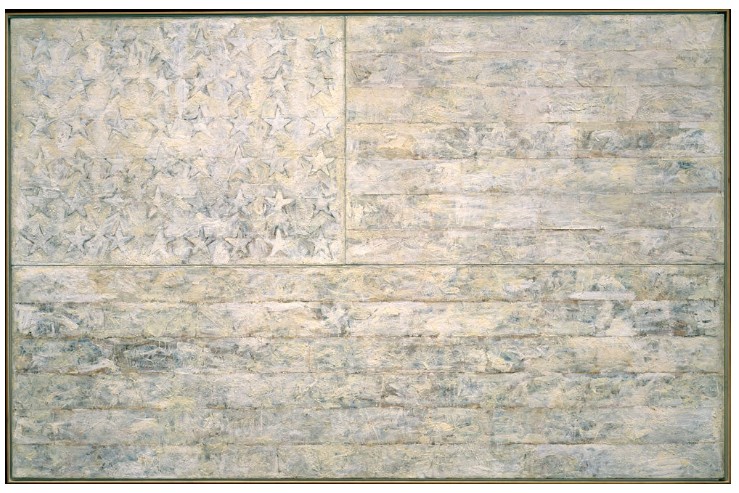
Jasper Johns, White Flag, 1955. The Metropolitan Museum of Art, New York. Image: © The Metropolitan Museum of Art. Image source: Art Resource, NY, Artwork: © 2026 Jasper Johns / Licensed by VAGA at Artists Rights Society (ARS), New York
That distance is materially evident in 4 Colored Marilyns. Though compositionally identical, the four faces are chromatically unstable. Blues drift toward turquoise, greens intensify to radioactive saturation, and a single strip of high-key cosmetic pink punctuates an otherwise cyan-toned coif of hair. The granular silkscreen surface and slight misregistrations interrupt mechanical uniformity. Warhol once remarked, with characteristic understatement, “I sort of half paint them just to give it a style. It’s more fun—and it’s faster to do.” The hybridization of painterly intervention and photographic reproduction, however, produces precisely the friction that animates the work. As Warhol acknowledged, “I started repeating the same image because I liked the way the repetition changed the same image.” In the Reversals, seriality no longer mimics mass production; it registers remembrance, drift, and the gradual erosion of fixity.
From the outset, Monroe functioned in Warhol’s oeuvre as a modern memento mori. Created in the immediate aftermath of her death, the 1962 Marilyns fused glamour and mortality with chilling clarity. Warhol’s oft-quoted observation that “Death can really make you look like a star” distills the paradox at the heart of his fascination.
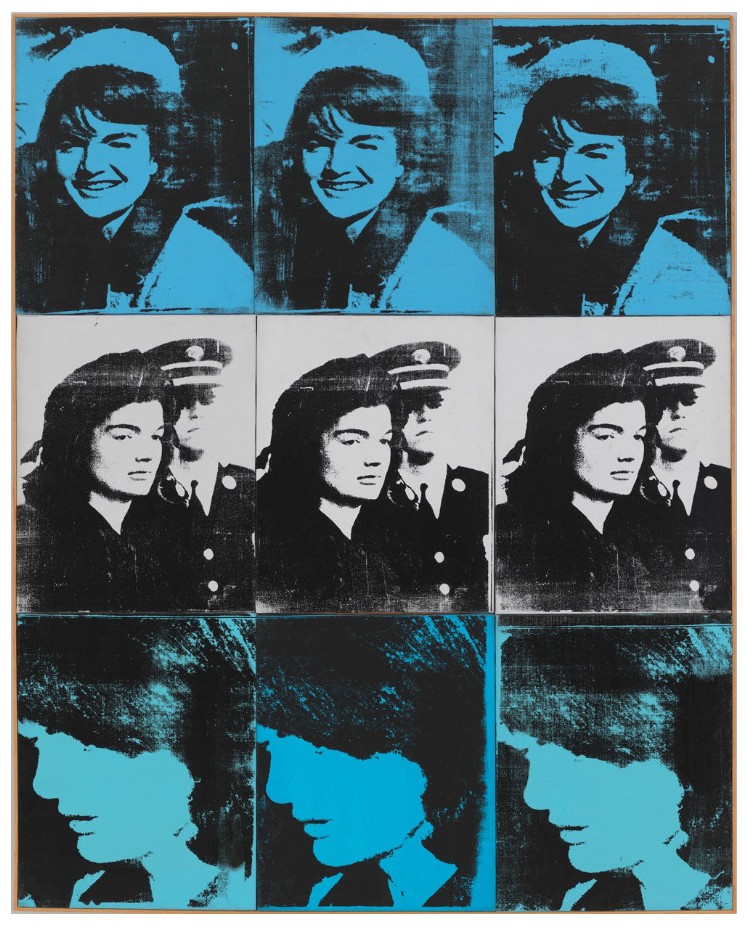
Andy Warhol, Nine Jackies, 1964. Whitney Museum of American Art, New York.
Image: © Whitney Museum of American Art / Licensed by Scala / Art Resource, NY
Artwork: © 2026 The Andy Warhol Foundation for the Visual Arts, Inc. / Licensed by Artists Rights Society (ARS), New York
Monroe epitomized the dual condition of celebrity as both icon and commodity, a tension Warhol explored across figures such as Elvis Presley, Elizabeth Taylor, Marlon Brando, and Jackie Kennedy, yet nowhere with greater clarity than here. In 4 Colored Marilyns, that dialectic becomes literal: stark tonal reversal evokes both the glare of studio lighting and the void behind it, as features surface only to recede into an enveloping black ground. The image remains legible yet dematerialized, its seriality reinforcing the flattening logic of mass media. By the late 1970s, Warhol’s own images had become cultural shorthand. To revisit Marilyn was to revisit the foundation of his artistic identity. Warhol was no longer appropriating mass media alone; he was appropriating himself. This recursive gesture approaches what French philosopher Jean Baudrillard termed the “hyperreal,” a condition in which images refer not to original referents but to other images. In 4 Colored Marilyns, the chain of mediation is clear: Monroe to publicity still, publicity still to 1962 screenprint, screenprint to reversed iteration. The painting’s true subject is not simply Monroe but Warhol’s prior representation of her.
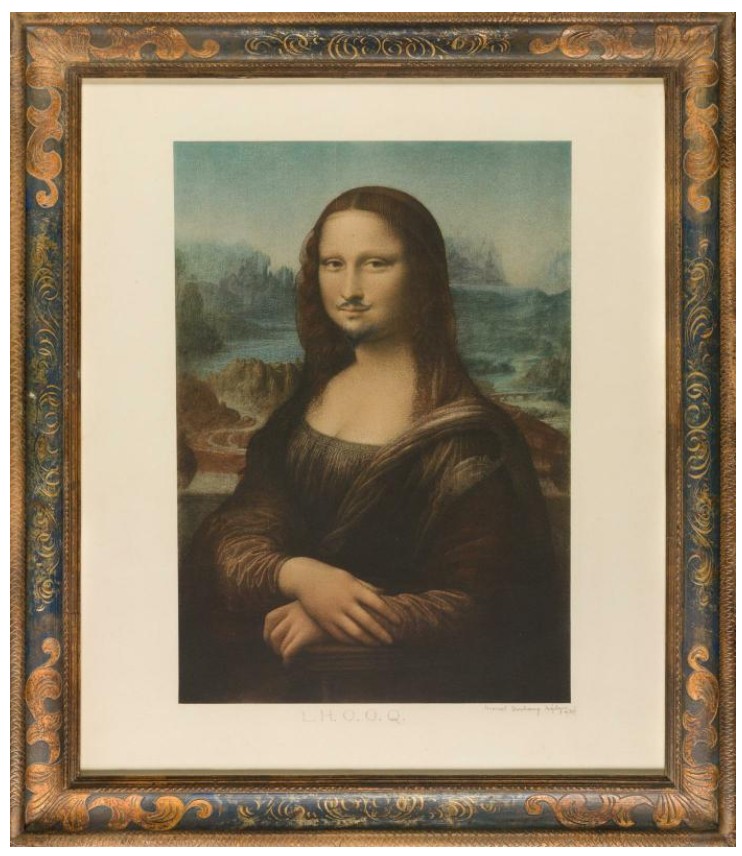
Marcel Duchamp, L. H. O. O. Q., 1919. Centre Pompidou, Paris. Image: © CNAC/MNAM, Dist. RMN-Grand Palais / Art Resource, NY, Artwork: © 2026 Association Marcel Duchamp / ADAGP, Paris / Artists Rights Society (ARS), New York
Here, reversal functions not only as formal inversion but as continuation of a broader artistic lineage. By re-appropriating an image central to his own oeuvre, Warhol treats his earlier production as a kind of ‘readymade,’ recalling Marcel Duchamp’s repositioning of everyday objects. Just as he once appropriated banal commodities such as soup cans, Warhol now re-appropriates his canonical imagery in a distinctly Duchampian gesture. The painting becomes a postmodern meditation on originality and authorship, simultaneously citation and transformation. In 4 Colored Marilyns, that gesture materializes as self-conscious reworking, rendering the image at once familiar and newly unrecognizable. The Reversals register the psychological gravity of Warhol’s later years, shaped in part by the aftermath of his near-fatal shooting in 1968. The negative space in the present work carries an existential weight absent from the acid-bright 1962 canvases, as reversal operates not only as a formal device but as a meditation on time, distance, and transformation. In 4 Colored Marilyns, the icon does not simply return; it reappears altered, hovering between presence and disappearance. What persists is not the certainty of the image, but its instability. If the early Marilyns announced the triumph of Pop, the Reversals meditate on its aftermath. In reversing Marilyn, Warhol reversed himself, transforming the image that made him famous into an incandescent x-ray of his own legacy.
Four Multicolored Marilyns (Reversal Series), 1979-1986
Christie’s New-York: 9 November 2023
Estimated: USD 3,000,000 – 5,000,000
USD 1,986,000
ANDY WARHOL (1928-1987) (christies.com)
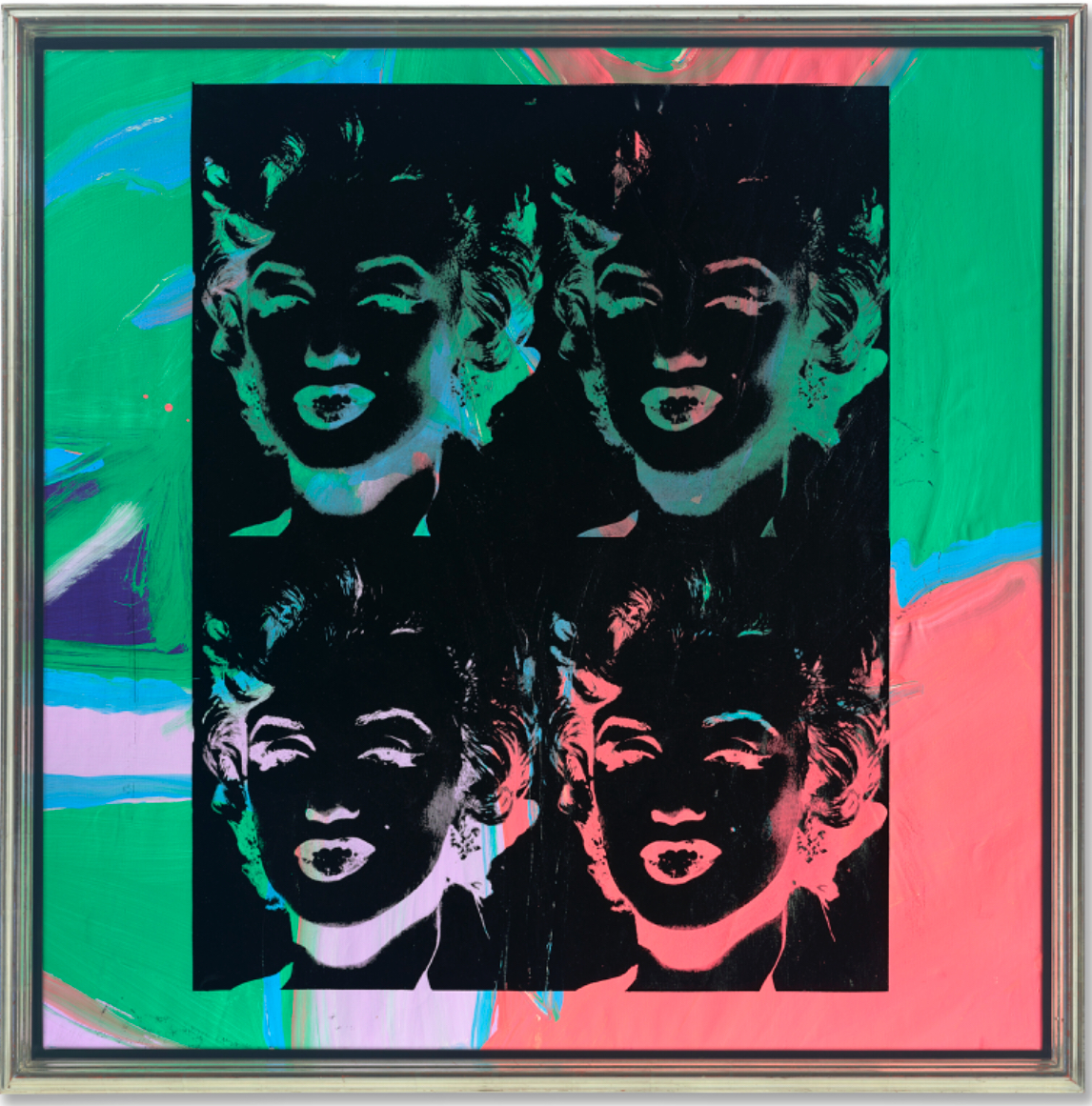
ANDY WARHOL (1928-1987)
Four Multicolored Marilyns (Reversal Series), 1979-1986
Acrylic and silkscreen ink on canvas
40×40 inches (101.6 x 101.6 cm)
Stamped twice with the artist’s signature ‘Andy Warhol’ (on the overlap)
Provenance
Waddington Galleries, Ltd., London
Private collection
Anon. sale; Sotheby’s, New York, 9 May 1990, lot 344
Acquired at the above sale by the late owner
Set within a large square canvas, Warhol repeats a negative black-and-white image of Monroe in a two-by-two grid formation. The four close crops of the actress’s face are pulled from the same source image he first used in his iconic painting Gold Marilyn Monroe (1962, Museum of Modern Art, New York), but are now infused with an ominous darkness. The black silkscreen has been applied over a swooping, dynamic canvas, and the areas of painted green, blue, red, and light purple swirl at the edges and peak through the negative spaces. This combination of painterly surface and crisp imagery exists throughout the artist’s oeuvre and serves as an important source of visual tension. The brushy abstraction is at odds with the photographic reproduction, creating a dialogue between the two styles that immediately entrances the viewer. Repetition had long been one of Warhol’s defining processes as he mimicked the consumerist modes of production and ushered in American Pop. Realizing that multiple versions of the same source image had more visual power than a singular picture, he often presented works in grids or series to emphasize the nature of commercialization.
Four Multicolored Marilyns (Reversal series), 1979-1986
Christie’s London: 6 March 2017
Estimated: GBP 3,000,000 – 5,000,000
GBP 2,853,000 / USD 3,482,940
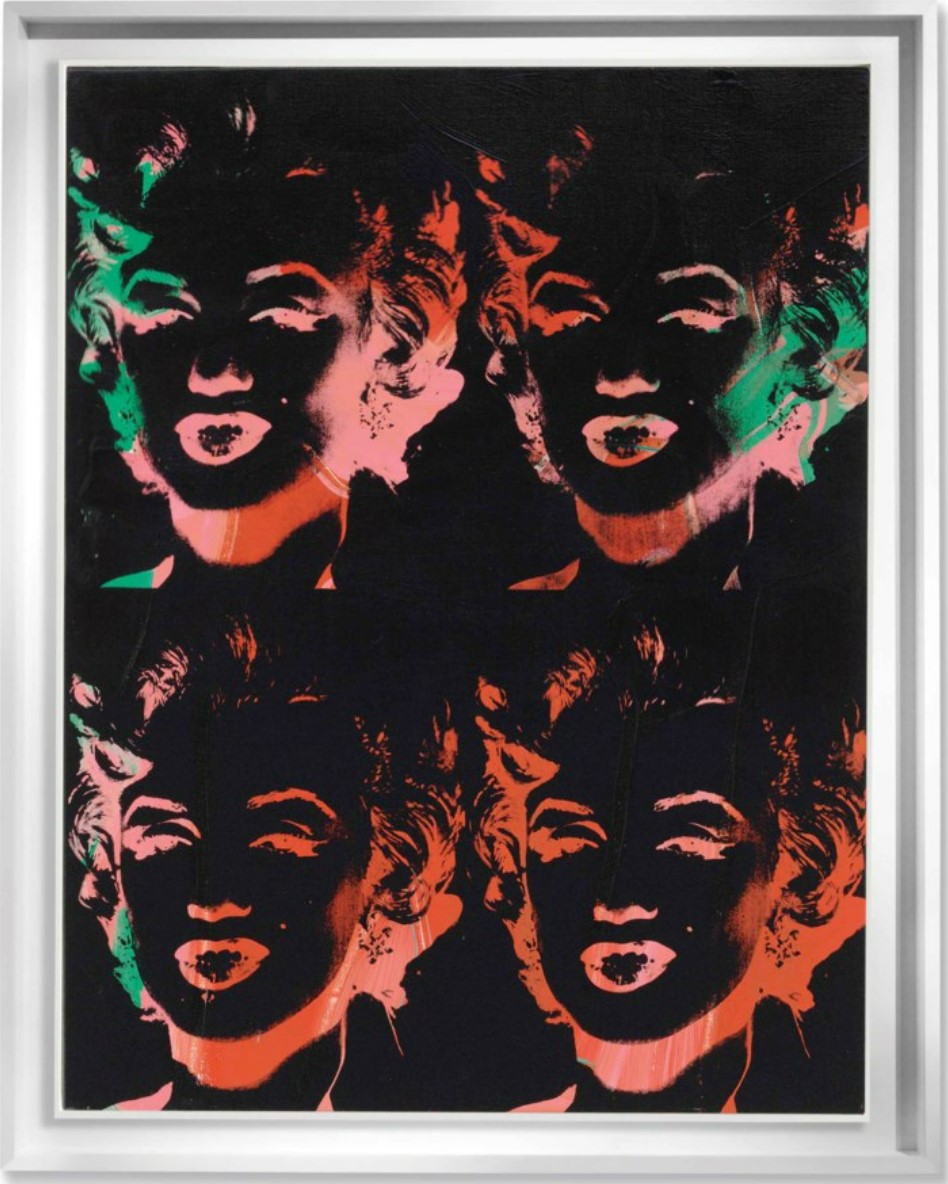
Four Multicolored Marilyns (Reversal series), 1979-1986
Acrylic and silkscreen ink on canvas
36.2 x 28 inches (92×71 cm)
Signed, numbered and dated ‘Andy Warhol A391.103 79/86’ (on the overlap)
Anon. sale, Sotheby’s New York, 5 October 1989, lot 204.
Max Lang Gallery, New York.
Acquired from the above by the present owner in 2004.
Four Multicolored Marilyns (Reversal Series), 1979-1986
Sotheby’s London: 10 February 2015
Estimated: GBP 2,500,000 – 3,500,000
GBP 3,285,000 / USD 5,011,030
REPEAT SALE
Sotheby’s Paris: 24 October 2012
Estimated: EUR 1,500,000 – 2,000,000
EUR 3,200,750 / USD 4,144,100
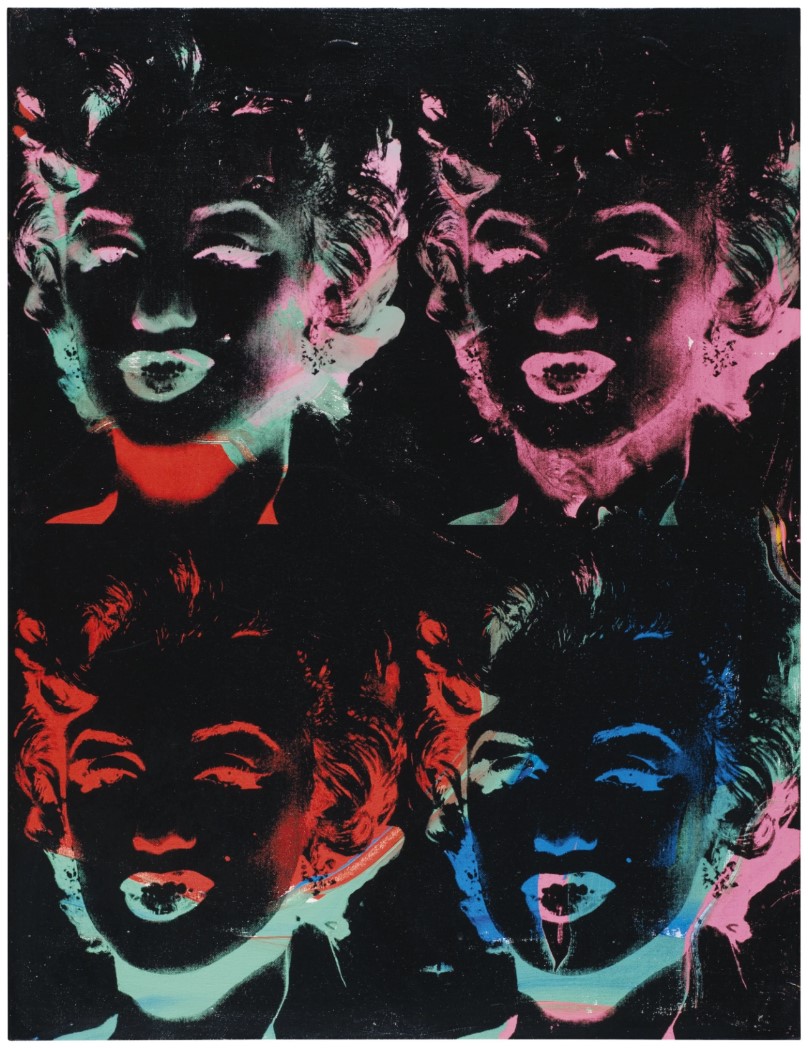
ANDY WARHOL
Four Multicolored Marilyns (Reversal Series), 1979-1986
Acrylic and silkscreen ink on canvas
36.2 x 27.7 inches (92 x 70.5 cm)
Signed and dated 79/86 on the overlap
Provenance
Galerie Bruno Bischofberger, Zurich
Thomas Ammann Fine Art AG, Zurich
Zaira Mis Collection, Brussels (acquired from the above in 1989)
Sale: Sotheby’s, Paris, Collection Mis, Art Moderne et Contemporain, 24 October 2012, Lot 23
Acquired directly from the above by the present owner
Four Multicoloured Marilyns combines expressive painterly mark-making, with overtly Warholian silkscreen ink, and the most famous visage of the Twentieth Century to create a superlative work; a stand-out example of Warhol’s deeply reflective yet conceptually progressive Reversals series. Following the burgeoning contemporaneous trend of appropriation, Warhol began to call upon his own oeuvre in the late 1970s, quoting from the pantheon of icons he had already established. The present work shows the artist further imbuing Marilyn’s image with themes of glamour, beauty, and death in a manner that identifies it with the highest echelons of his praxis.Warhol started Four Multicoloured Marilyns by broadly brushing skeins of paint onto a length of canvas to create a varied and gestural ground. The effect appears quite different to the insistently flat surfaces of his 1960s canvases, and almost Abstract Expressionist in its splashy feel – an ironic painterly appropriation first initiated with the celebrated Chairman Mao series. However, this lush surface, in which the physical presence of the artist is palpable, is drained of meaning by the superimposition of deep black silkscreen ink. Rather than using his bold manipulation of color to accentuate lip-hue and exaggerate hair color, Warhol delineates the four faces in brutally harsh negative, thus presenting a sardonic indictment of the expressive potential of the brushstroke as well as an implicit endorsement of his own flat technique.
Four Marilyns (Reversal), 1979-1986
Four Marilyns (Reversal Series), 1979-86
Sotheby’s London: 15 October 2026
Estimated: GBP 2,200,000 – 2,800,000
GBP 2,713,000 / USD 3,589,570
Andy Warhol | Four Marilyns (Reversal Series) | Contemporary Evening
ANDY WARHOL (1928 – 1987)
Four Marilyns (Reversal Series), 1979-86
Acrylic and silkscreen ink on canvas
36-1/4 x 28 inches (92.1 x 71.1 cm)
Signed (on the overlap)
Signed (on the reverse)
Provenance
Jose Mugrabi, New York
Private Collection, Asia
Acquired from the above in 2014 by the present owner
Executed between 1979 and 1986, Andy Warhol’s Four Marilyn (Reversal Series), is a unique interpretation of the artist’s most recognisable subject – Marilyn Monroe. The unique black on black composition, in which Warhol depicts Monroe four times, is infused with a strikingly reflective and simultaneously sombre quality. Four Marilyn (Reversal Series) is situated at the apex of Warhol’s artistic development of the 1980s and captures a moment of introspection synonymous with these Warhol years. A unique and superlative example of the Reversals, a series which Warhol embraced in the 1980s, the present work is an act of post-modern brilliance as itsees Warhol’s appropriation of material from his own repertoire, drawing on the imagery that had shaped his output from the 1960s and secured his standing as a master of the modern age.
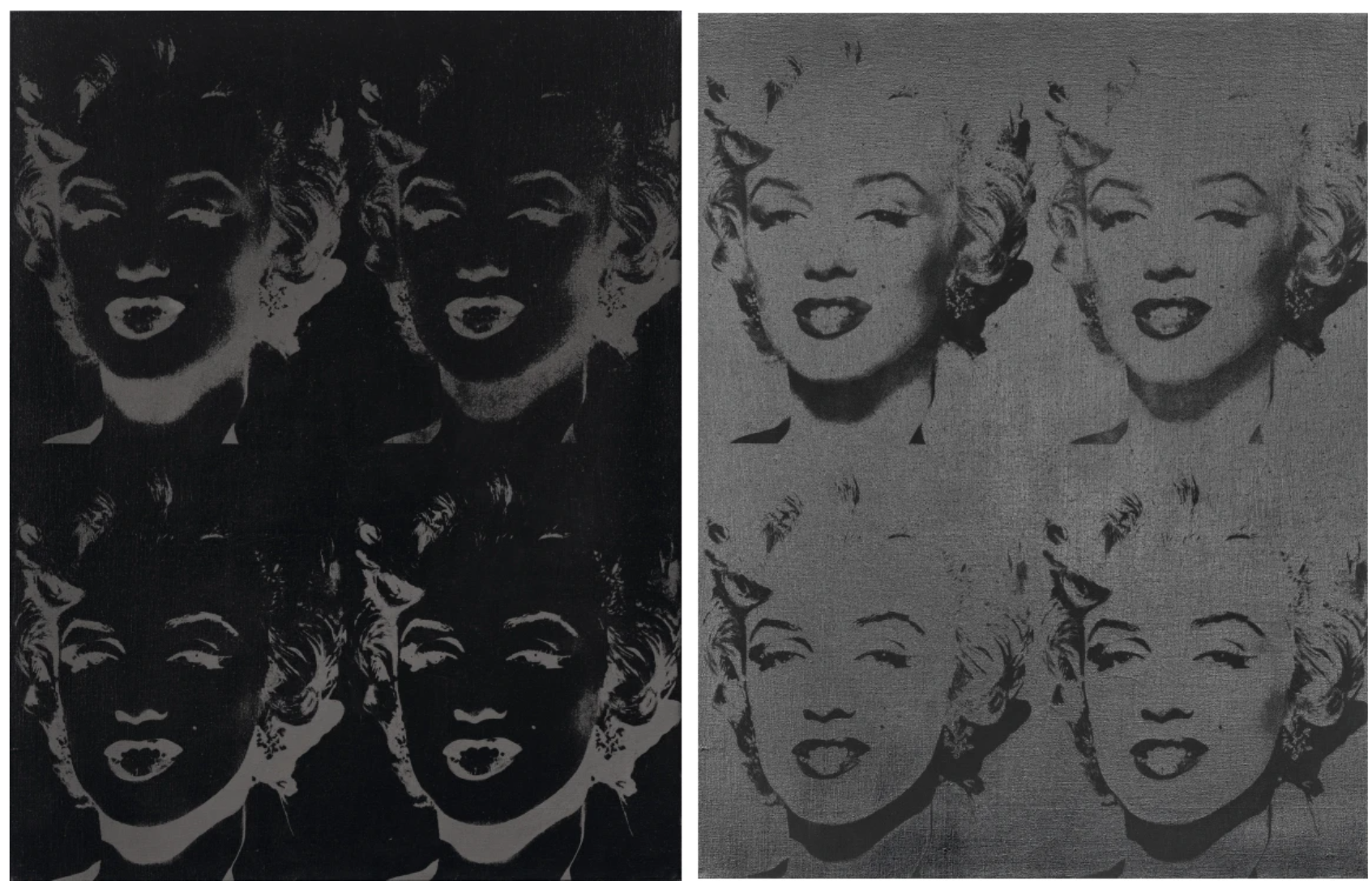
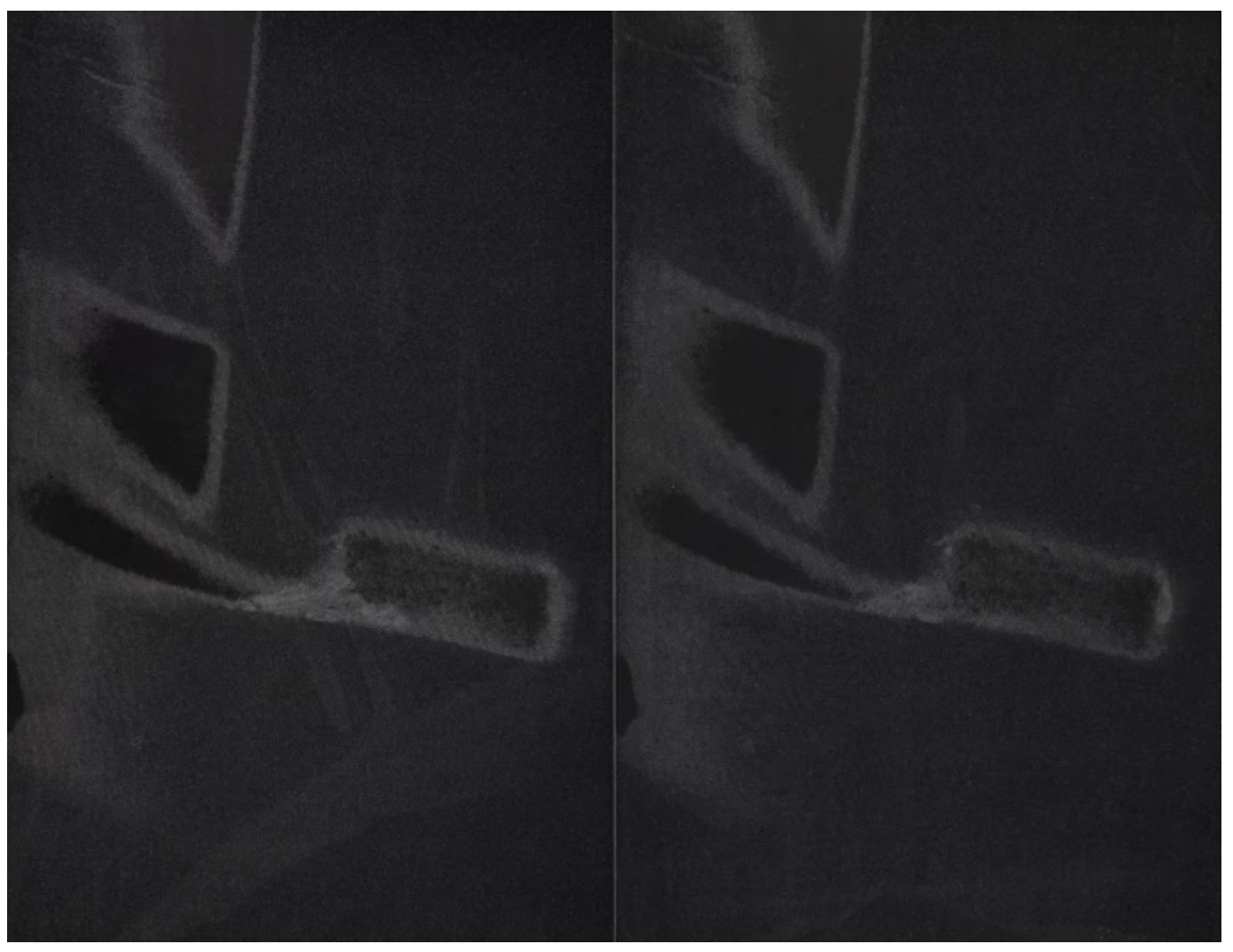
LEFT: The Present Work
RIGHT: The Present Work, under alternate lighting
Just as Warhol engages in conversation with his own familiar artistic lexicon by reversing his previous iconic Marilyn series, so too does the viewer when engaging with the work. From one angle the image appears to be the familiar Warhol icon: from another angle, this illusion breaks down, destabilizing the idea of a fixed image as Marilyn hauntingly transforms, bestowing upon it an entirely new meaning. In this reversal the iconic image becomes increasingly spectral and the portrait, tinged with familiarity, is transformed into a lingering eulogy. Simultaneously, the repetition of Monroe in the reversal, further empties the image of meaning – in doing so, Warhol commodifies the image by altering and appropriating his own earlier work.
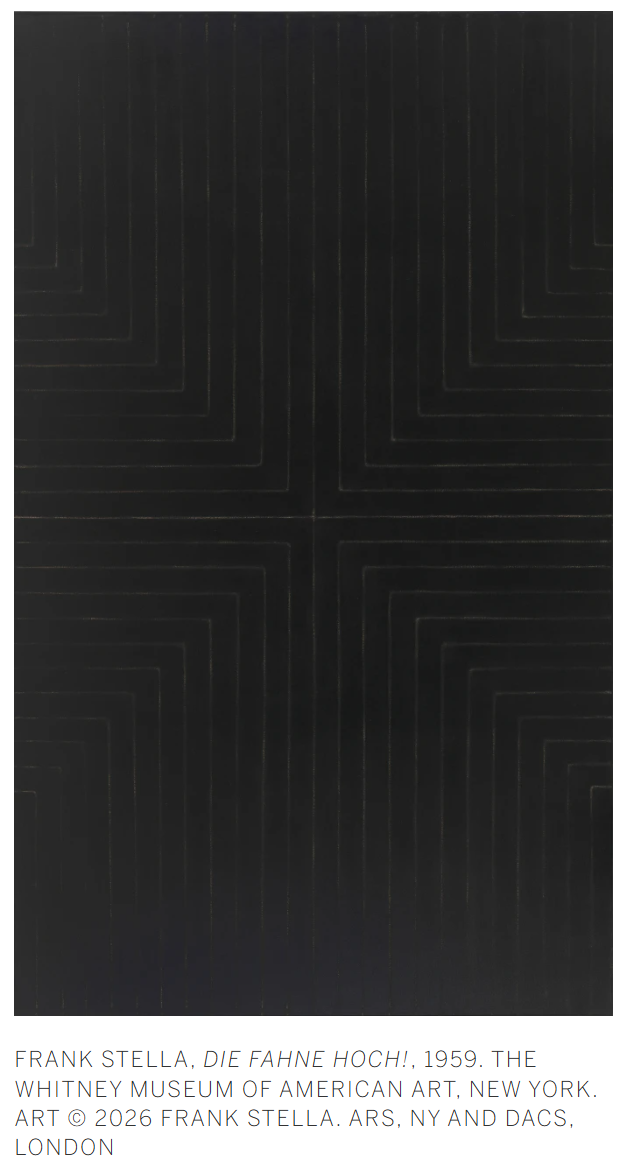
Warhol’s appropriation of and fixation on glamour, luxury, fame, and cultural as well as material consumerism, often appear through his adoption of quotidian subjects and popular celebrities, as “found objects.” This artistic philosophy follows the earlier 20th century tradition of the ‘readymade’ artwork pioneered by Marcel Duchamp through Fountain (1917), an upside down urinal, and LHOOQ (1917), a postcard of the Mona Lisa with a mustache and goatee drawn on: Warhol, like Duchamp, took existing reality as a found object and flattened it into pop art. Created more than two decades after Warhol’s first Marilyn portraits in the 1960s, Four Marilyn demonstrates how Warhol eventually began commandeering even his own artwork as “found object.” The Reversals marked a decisive shift in Warhol’s practice at the beginning of the 1980s, where he turned towards a re-examination of his own pantheon of 1960s icons.
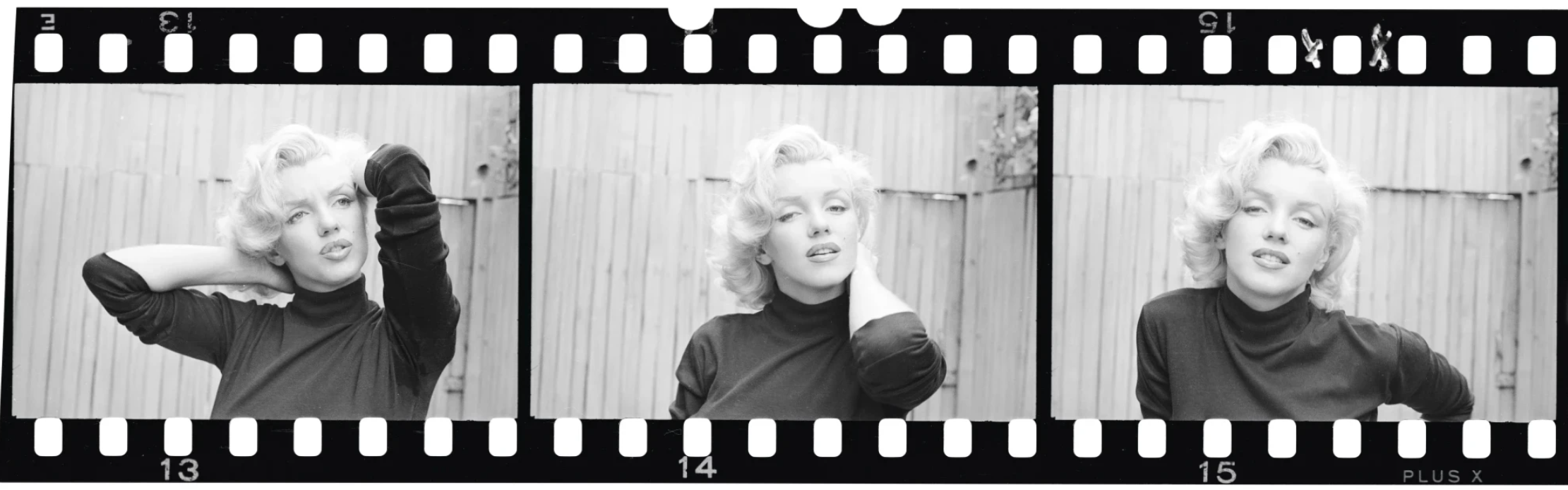
Actress Marilyn Monroe, Hollywood, California. Image: Alfred Eisenstaedt/The LIFE Picture Collection/Shutterstock
In revisiting Monroe’s image in the Reversal series, Warhol transformed the familiar visage into something newly spectral and uncanny. Repeated four times in negative register, Four Marilyn underscores both the enduring power of Monroe’s celebrity and the symbolic weight of Warhol’s own artistic mythology. As Roberto Marrone notes, “all the images Warhol used in the Retrospectives and Reversals ranked among his most memorable and commercial icons… In repeating these same images in a new ‘reversed’ and negative form, Warhol bestowed upon them a darker and more sombre mood reflective of the distance in time between their original use and their re-creation” (Roberto Marrone in: Exh. Cat., Zurich, Galerie Bruno Bischofberger, Andy Warhol: Big Retrospective Painting, 2009, p. 32).
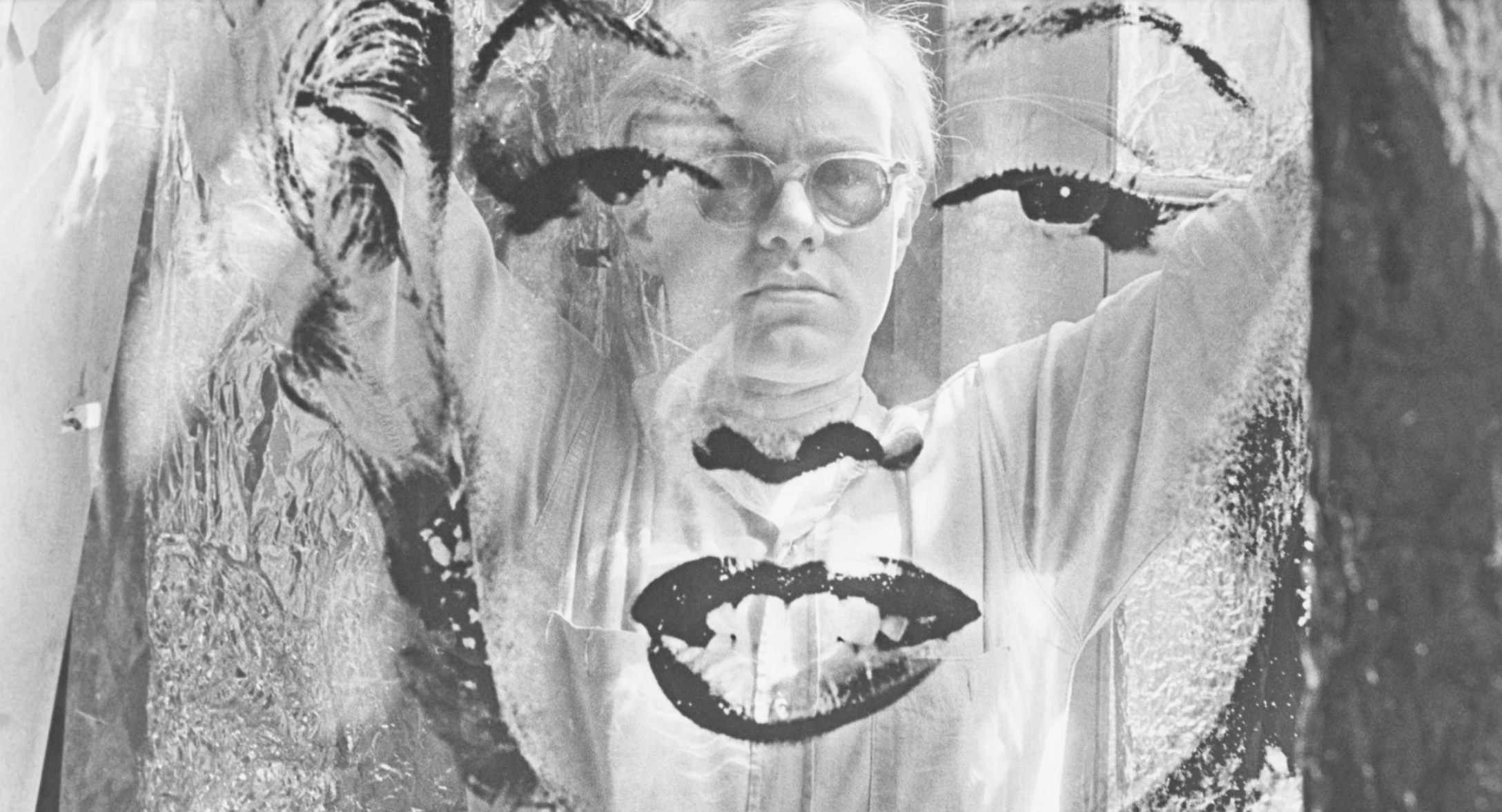
William John Kennedy, Andy Warhol Holding Marilyn Acetate III, circa 1964. Image © William John Kennedy.
Art © 2026 The Andy Warhol Foundation for the Visual Arts, Inc. / Licensed by DACS, London
Four Marilyn (Reversal series) is a fascinating combination of Warhol’s fixation on glamour, luxury, and stardom – while simultaneously a reflective retrospective influenced by his own experiences with the celebrity status he too went on to achieve by the 1970s and 80s. Completed the year before Warhol’s death, this reversal foregrounds the duality of celebrity itself – at once dazzlingly visible yet destined to fade into memory. The stark contrast of black silkscreen ink against a luminous black ground evokes both the seductive surface of cinema and the spectral fragility beneath it. Warhol’s deployment of silkscreen, a mechanical process that effaces the artist’s hand, further serves as a metaphor for mass media and its power to reproduce, disseminate, and ultimately flatten individuality into consumable image. At once homage and elegy, Four Marilyn (Reversal Series) stands among the most resonant meditations on fame and mortality in twentieth century art. Revisiting one of his most enduring icons at a moment of historical and personal reflection, Warhol confronts the afterlife of images and the uneasy permanence of celebrity itself – permanence that has posthumously maintained Warhol as one of the most iconic contemporary celebrities of this century.
Four Marilyns (Reversal Series), 1986
Sotheby’s London: 4 March 2026
Estimated: GBP 1,800,000 – 2,500,000
GBP 3,262,000 / USD 4,357,705
Four Marilyns (Reversal Series) | Modern & Contemporary Evening Auction | 2026 | Sotheby’s
ANDY WARHOL (1928 – 1987)
Four Marilyns (Reversal Series), 1986
Acrylic and silkscreen ink on canvas
36×28 inches (91.5 x 71 cm)
Stamp signed (on the overlap)
Stamped by the Andy Warhol Art Authentication Board, Inc.
Numbered A120.042
Inscribed I certify that this is an original painting by Andy Warhol completed by Andy in 1986 Frederick Hughes
(on the overlap)
Provenance
Galerie Bruno Bischofberger, Zurich
Private Collection (acquired from the above in 1987)
Magidson Fine Art, New York (acquired from the above in 1989)
Fumi International Inc., Tokyo
Matsuda Collection, Tokyo
Joseph K. Levene Fine Art, Ltd., New York
Sotheby’s, London, 23 June 2004, lot 14 (consigned by the above)
Acquired from the above sale by the present owner
Executed in 1986, Four Marilyns (Reversal Series) represents one of the most conceptually charged moments in Andy Warhol’s late career. More than two decades after he first cemented Marilyn Monroe’s status as a cult icon in his elegiac 1962 portraits, Warhol revisited her image in the Reversals series, transforming the familiar visage into something newly spectral and uncanny. Repeated four times in negative register, the present work underscores both the enduring power of Monroe’s celebrity and the symbolic weight of Warhol’s own artistic mythology. The Reversals marked a decisive shift in Warhol’s practice at the beginning of the 1980s. Following the relative quietude of the previous decade, he turned towards a re-examination of his own pantheon of 1960s icons, aligning himself with the appropriationist strategies of younger contemporaries such as Cindy Sherman and Richard Prince. In doing so, Warhol effectively appropriated himself as a brand, recasting his formative images of Marilyn, Mao, and Campbell’s Soup into what might be understood as incandescent x-ray visions of his earlier career. As Roberto Marrone has observed, “All the images Warhol used in the Retrospectives and Reversals ranked among his most memorable and commercial icons… In repeating these same images in a new ‘reversed’ and negative form, Warhol bestowed upon them a darker and more sombre mood reflective of the distance in time between their original use and their re-creation” (Roberto Marrone in: Exh. Cat., Zurich, Galerie Bruno Bischofberger, Andy Warhol: Big Retrospective Painting, 2009, p. 32). In this light, Four Marilyns (Reversal Series) can be seen not merely as a return to one of Warhol’s most celebrated inquiries but as a climactic transfiguration of his core concerns – repetition, celebrity, commodification, and mortality – distilled into a late work of haunting resonance.
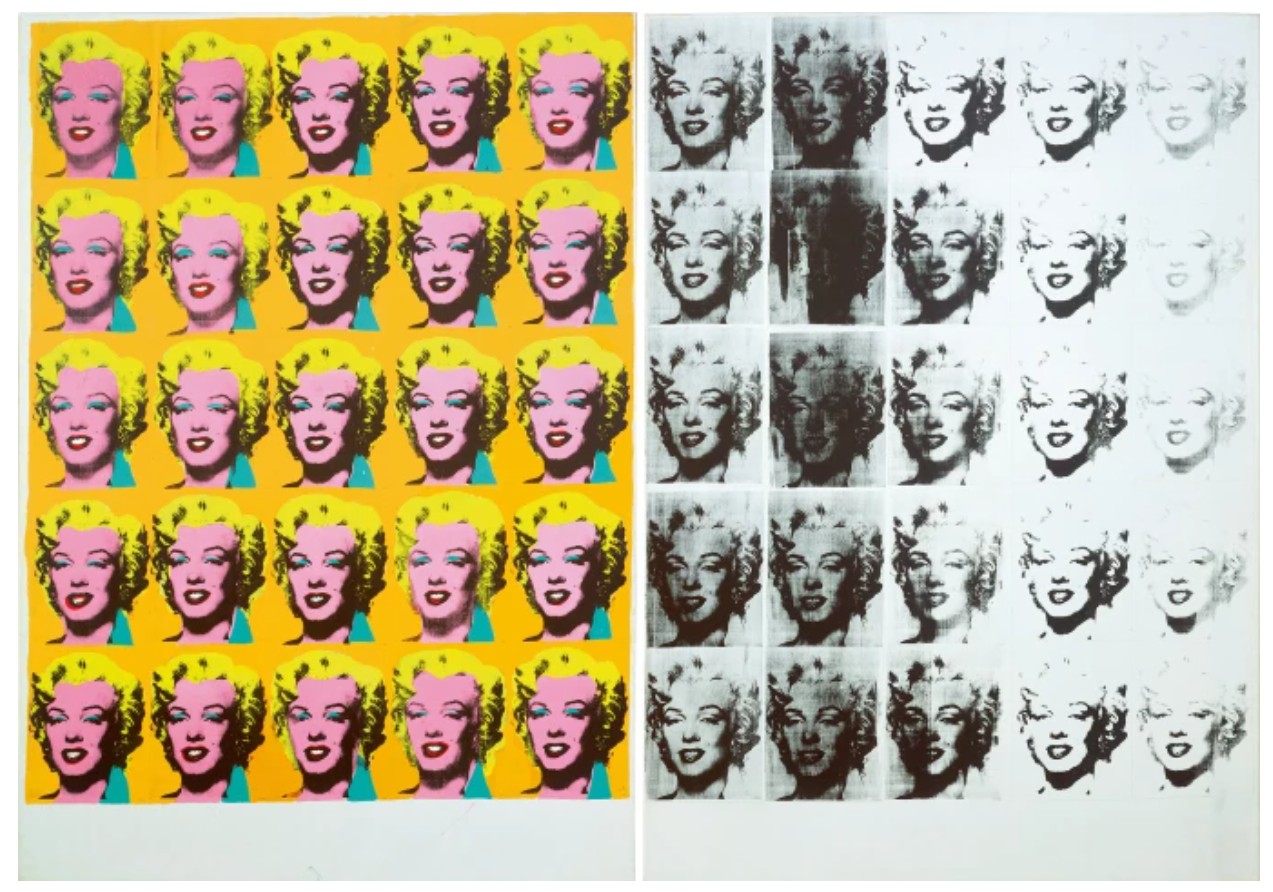
Andy Warhol, Marilyn Diptych, 1962. Tate Modern, London.
Artwork: © 2026 The Andy Warhol Foundation for the Visual Arts, Inc./Licensed by DACS, London
The present work stands at the apex of Warhol’s lifelong project of appropriation. Where, in the years that followed, he would turn to the art historical canon – appropriating motifs from Lucas Cranach, Paolo Uccello, Edvard Munch, and Giorgio de Chirico – here Warhol’s gaze is directed inward, lifting directly from his own repertoire. This act of self-quotation is emblematic of the pervasive mood of self-mythologisation that permeates his late practice. By revisiting Marilyn Monroe, an image that had already secured him enduring fame, Warhol simultaneously reaffirmed and destabilized the very artistic code upon which his reputation was built. In Four Marilyns (Reversal Series), Monroe’s visage is presented not through the familiar registers of heightened glamour, but as a spectral imprint. Rendered in negative, her repeated likeness is suffused with an eerie white luminosity, while shadows deepen and mid tones collapse into darkness. The effect is one of haunting dematerialization: Monroe appears suspended between presence and absence, radiance and erasure. Through this reversal, Warhol foregrounds the duality of celebrity itself – at once dazzlingly visible and destined to fade into memory.
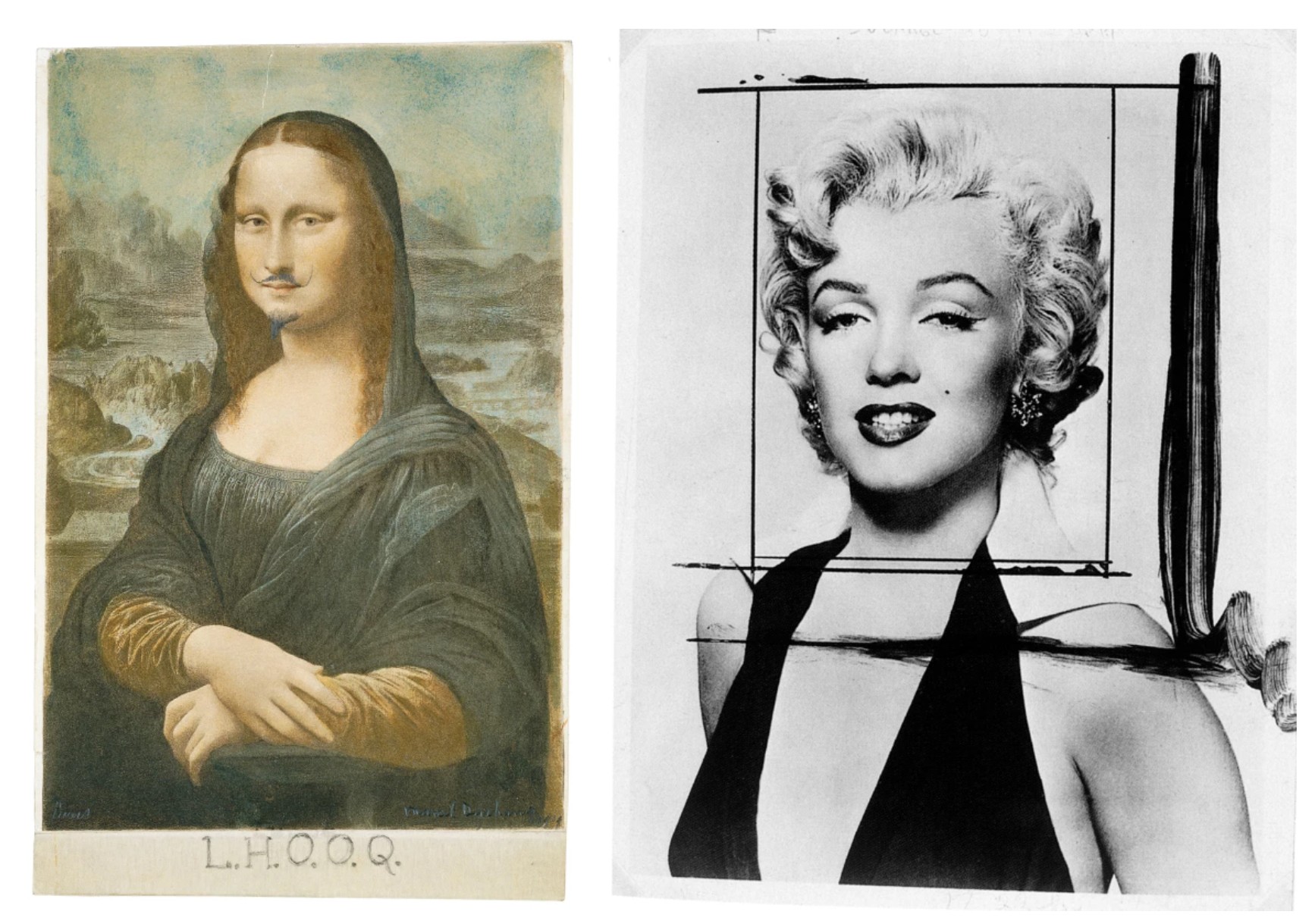
LEFT: Marcel Duchamp, LHOOQ or La Joconde, 1919/1940. Image: University of Southern California. © 2026 Association Marcel Duchamp / ADAGP, Paris and DACS, London
RIGHT: Publicity still of Marilyn Monroe for the film Niagara (1953), showing crop marks made by Andy Warhol. Image: The Andy Warhol Museum, Pittsburgh; Foundling Collection, Contribution The Andy Warhol Foundation for the Visual Arts, Inc © 2026 The Andy Warhol Foundation for the Visual Arts, Inc. / Licensed by DACS, London.
With Marilyn Monroe, Warhol discovered a modern memento mori capable of unifying the central obsessions that drove his career: glamour, beauty, fame, and death. In the present work, these themes coalesce with renewed force. The stark contrast of black silkscreen ink against a luminous white ground evokes both the seductive surface of cinema and the spectral fragility beneath it. Warhol’s deployment of silkscreen, a mechanical process that effaces the artist’s hand, further serves as a metaphor for mass media and its power to reproduce, disseminate, and ultimately flatten individuality into consumable image. As Rainer Crone observed, Warhol gravitated towards movie stars because they functioned as “representatives of mass culture” (Rainer Crone, Andy Warhol, New York 1970, p. 22). Monroe epitomized this paradox more fully than any other: she was at once the most desirable woman in the world and the tragic victim of her own celebrity.
Andy Warhol, Diamond Dust Shadows (Two Works), circa 1979. Private Collection. Sold Sotheby’s London, July 2020.
© 2026 The Andy Warhol Foundation for the Visual Arts, Inc. / Licensed by DACS, London.
In the present example, the hauntingly mesmeric monochrome portrait of Monroe is repeated with a deliberate absence of colour that calls to mind the repetitive printings of black-and-white tabloid papers. Even before Monroe’s highly publicised death, these publications had already rendered Monroe’s portrait an image ubiquitous in popular culture at the time. In some impressions of Monroe’s portrait, black ink pools thickly, nearly obliterating Monroe’s ghostly visage, while in others, her silhouette renders only as a faint trace, a barely visible impression that appears to recede from the canvas before the viewer’s eyes. The serial repetition takes on the sinister quality of the very tabloid papers which both tortured her life and glamorised her death. For Warhol, her image crystallised the unstable balance between personhood and brand, a dialectic he would also explore through Elvis Presley, Elizabeth Taylor, Marlon Brando, and Jackie Kennedy. Warhol himself articulated this insight with characteristic clarity: “You should always have a product that’s not just ‘you’” (Andy Warhol, The Philosophy of Andy Warhol (From A to B and Back Again), London 1977, p. 86).
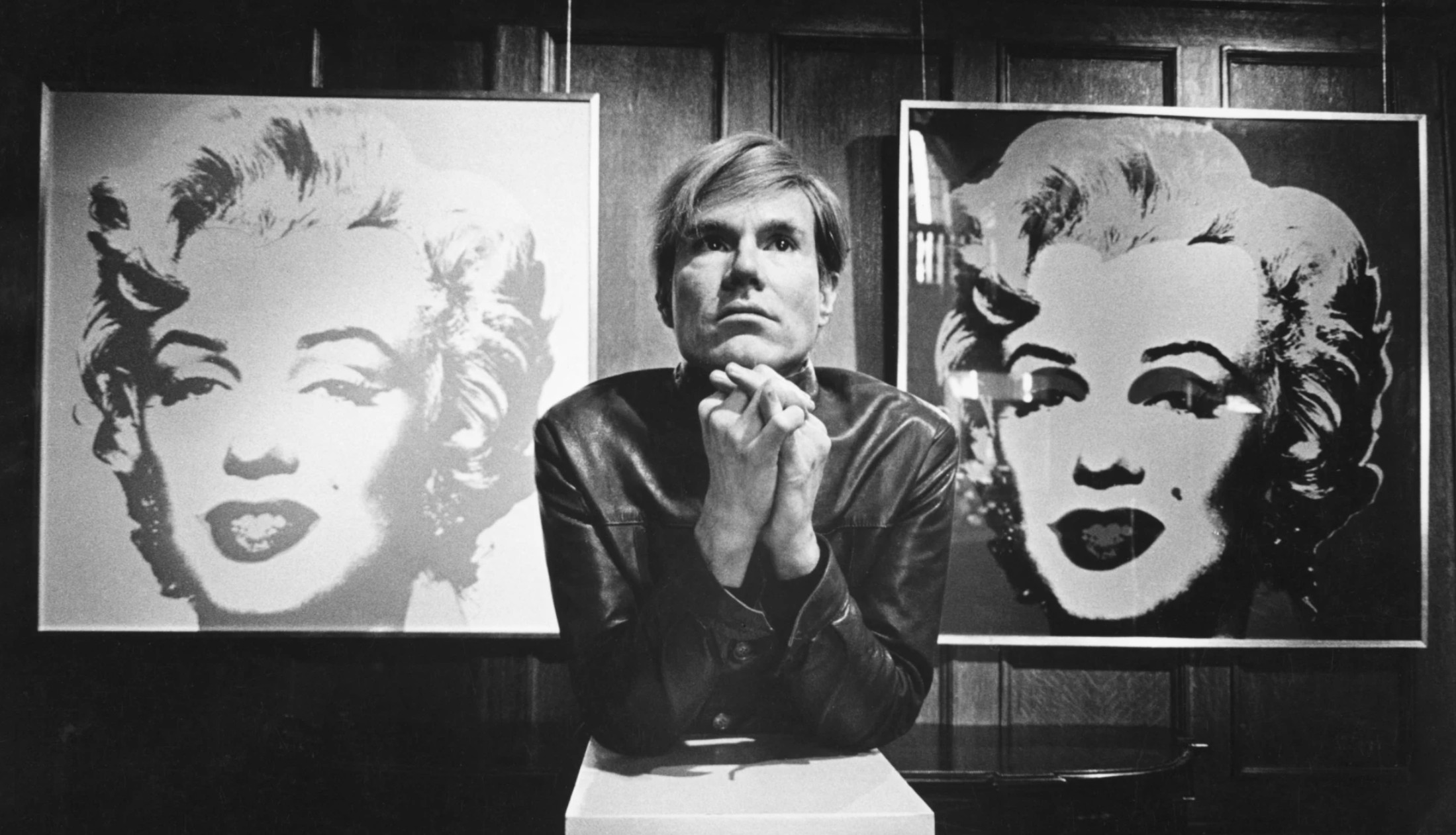
Andy Warhol with two works from the Marilyn series. Photograph: © Donald Getsug.
Art © 2026 The Andy Warhol Foundation for the Visual Arts, Inc. / Licensed by DACS, London.
The negative reversal of Monroe’s image amplifies its ghostliness, transforming the familiar portrait into a haunting memorial that persists beyond lived experience. Even after the terminal reality of her death, the artificial veneer of the projected image remains. As Warhol later reflected, “Everything is sort of artificial… The artificial fascinates me, the bright and shiny” (Exh. Cat., Stockholm, Moderna Museet, Andy Warhol, 1968, p. 25). With the further temporal and formal remove of the reversed image, Warhol underscores the postmodern logic of image production and circulation through Monroe’s endlessly reproduced face. At once homage and elegy, Four Marilyns (Reversal Series) stands among the most resonant meditations on fame and mortality in twentieth century art. Revisiting one of his most enduring icons at a moment of historical and personal reflection, Warhol confronts the afterlife of images and the uneasy permanence of celebrity itself.
Four Marilyns (Reversal), 1979-1986
Christie’s New-York: 14 November 2016
Estimated: USD 2,000,000 – 3,000,000
USD 3,187,500
Andy Warhol (1928-1987) (christies.com)
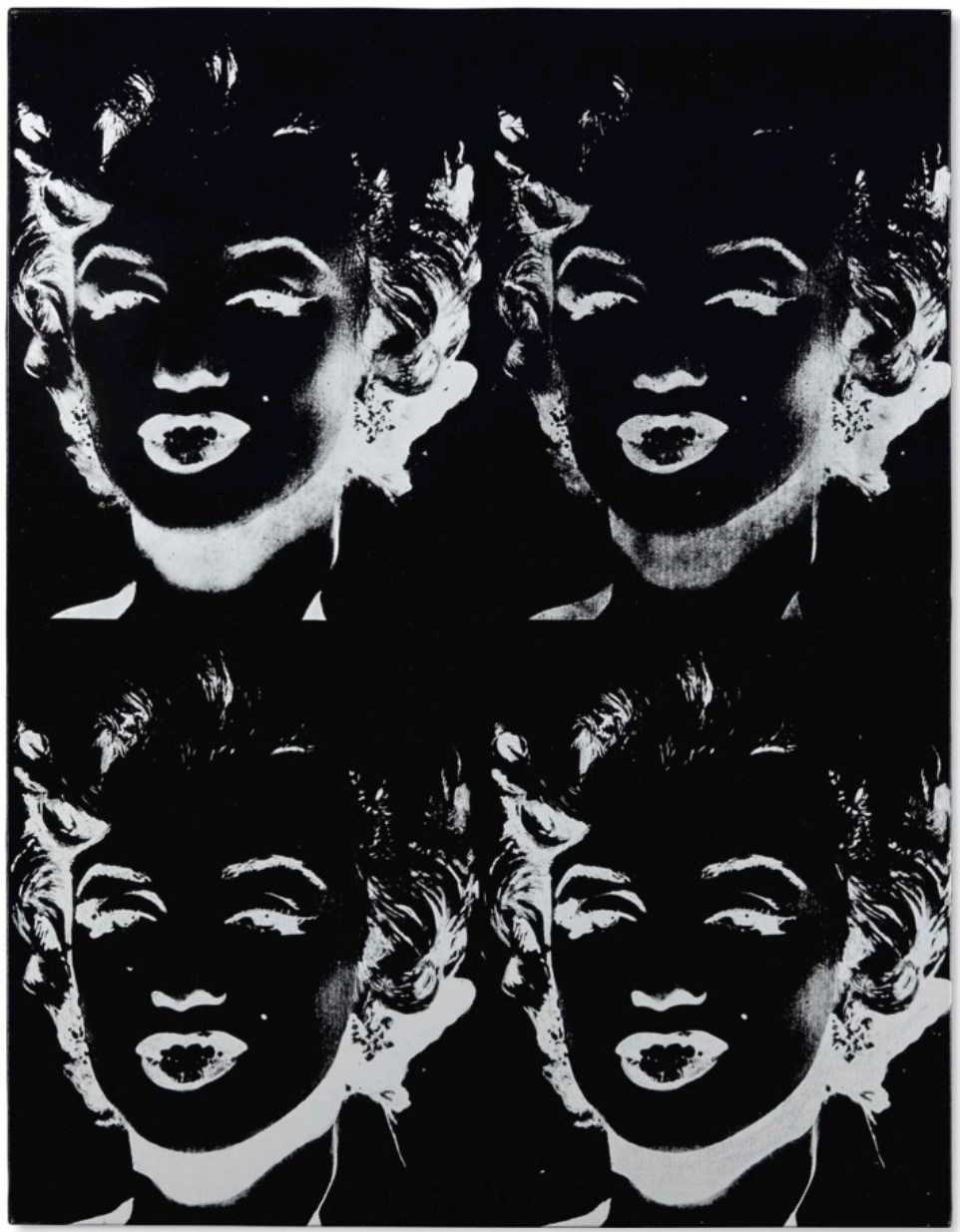
Four Marilyns (Reversal), 1979-1986
Acrylic and silkscreen ink on canvas
36×28 inches (91.4 x 71.1 cm)
Numbered ‘Andy Warhol A113.056’ (on the overlap)
Inscribed and signed by Frederick Hughes
‘I certify that this is an original painting by Andy Warhol completed by him in 1986 © Frederick Hughes’ (on the overlap)
Private collection, Los Angeles
Acquired from the above by the present owner
Four Marilyns (Reversal series), 1979-1986
Sotheby’s London: 28 June 2016
Estimated: GBP 1,800,000 – 2,500,000
GBP 2,893,000
(#18) Andy Warhol (sothebys.com)
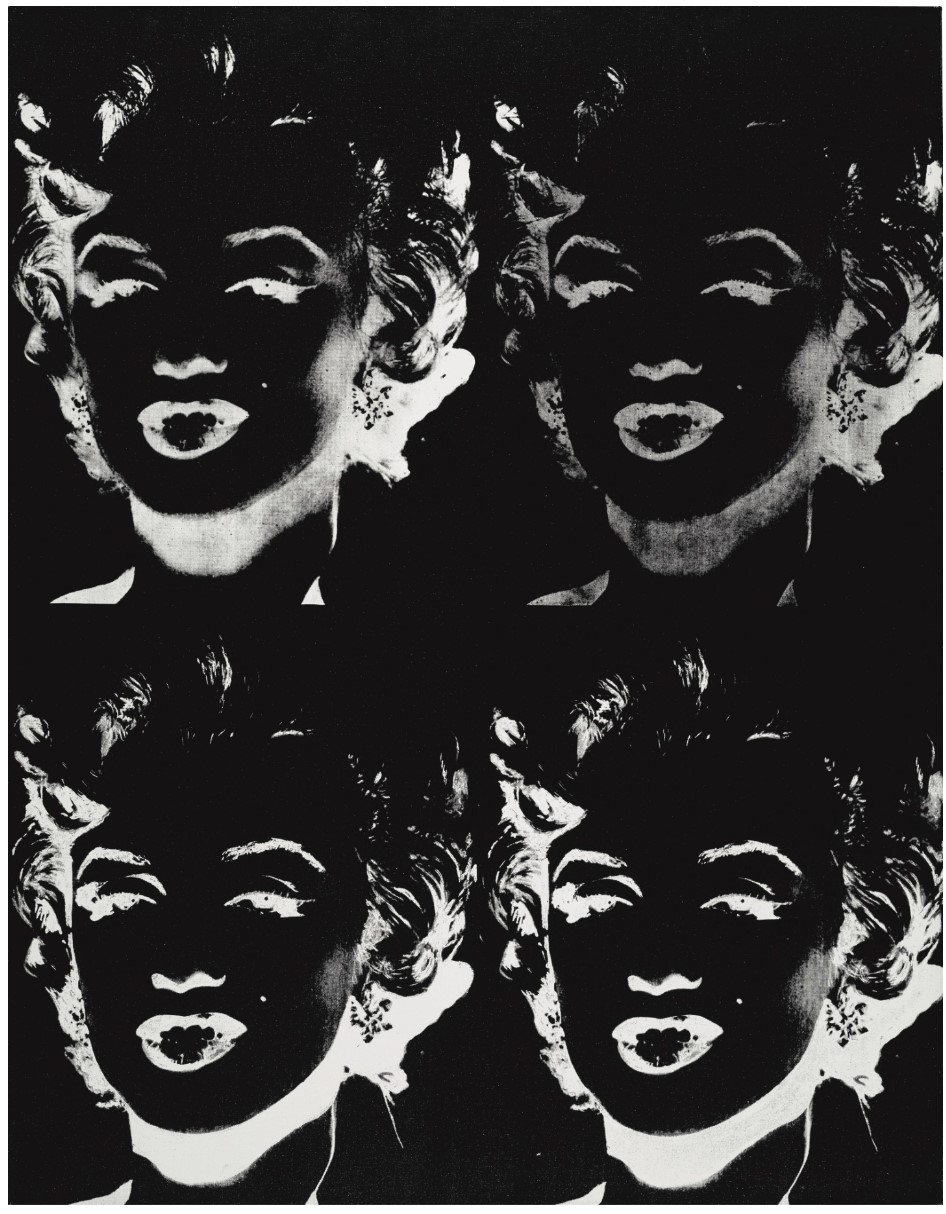
Four Marilyns (Reversal series), 1979-1986
Acrylic and silkscreen ink on canvas
36.5 x 28 inches (92.7 x 71.1 cm)
Signed on the overlap and annotated
I certify that this is an original painting by Andy Warhol completed by him in 1986 Frederick Hughes
on the overlap
Provenance
Galerie Bruno Bischofberger, Zurich
Private Collection, USA
Sotheby’s, New York, 19 May 1999, Lot 286 (consigned by the above)
Acquired from the above by the present owner
Four Marilyns (Black/Green), 1979-1986
Four Marilyns (Reversal Series Black/Green), 1979-1986
Christie’s London: 27 June 2012
Estimated: GBP 1,000,000 – 1,500,000
GBP 1,273,250
Andy Warhol (1928-1987) , Four Marilyns (Reversal Series Black/Green) | Christie’s
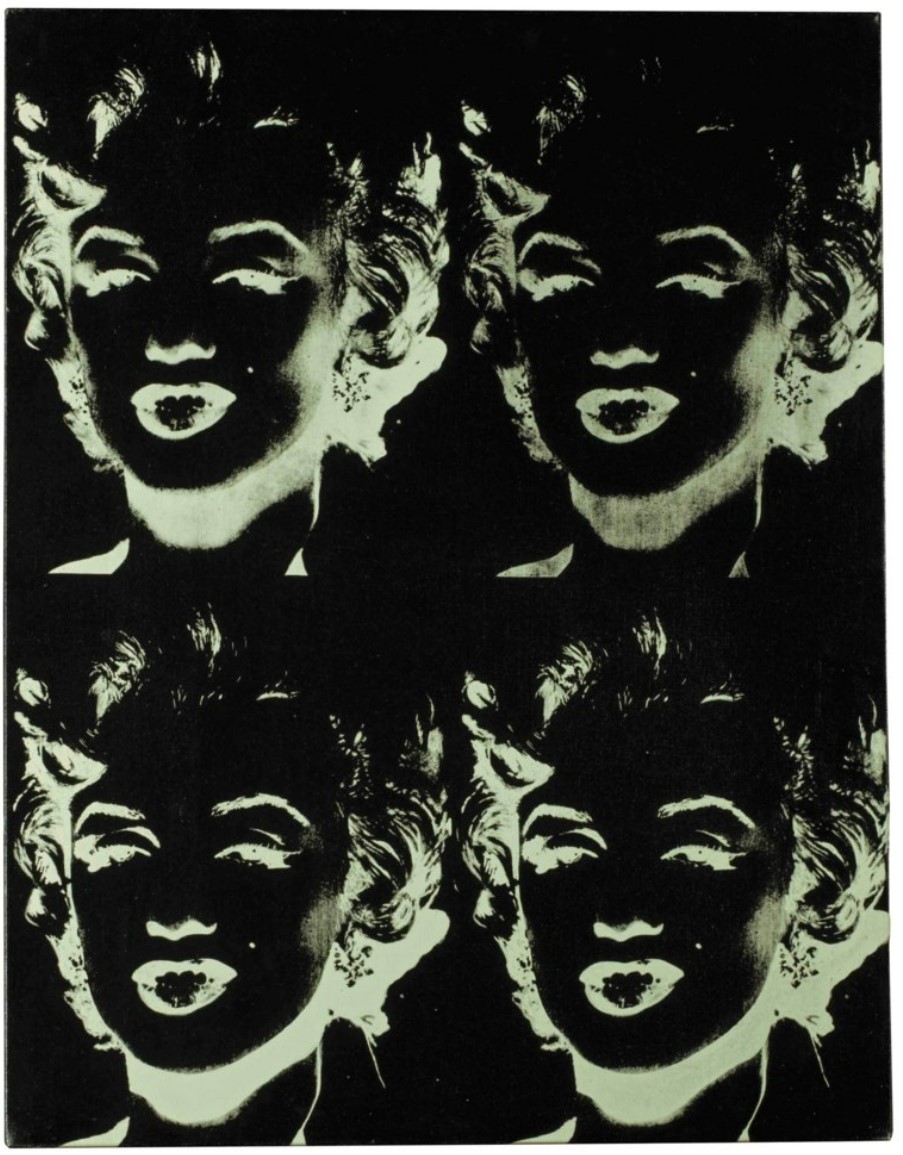
Four Marilyns (Reversal Series Black/Green), 1979-1986
Acrylic and silkscreen ink on canvas
36×28 inches (91.4 x 71.1 cm)
signed ‘Andy Warhol’ (on the overlap); inscribed by Frederick Hughes ‘I certify that this is an original painting by Andy Warhol completed by him in 1986’ (on the overlap)
Executed at the peak of Andy Warhol’s fame, Four Marilyns (Reversal Series, Black/Green), belongs to the artist’s retrospective Reversal Series created between 1979 and 1986. Of all the Reversal paintings that Warhol made, it is the marilyns that provide the most haunting imagery and which have the most lasting resonance. In Four Marilyns (Reversal Series, Black/Green), the iconic features of the actress Marilyn Monroe are shown in negative, glowing minty green against the inky black background, a contrast that introduces a sense of electricity to the picture. The result is a striking combination of old and new. Widely considered the most successful negative form from the Reversal Series, the image of Marilyn epitomizes the haunting representation of the film star. In this chic black and minty white version, Marilyn’s face is illuminated by flashes of phosphorescent hues; the screen goddess takes on a haunting quality, the reversal process bestowing on Marilyn the monumental and almost timeless quality of a classical sculpture. Repeated four times against the black background as if in a filmstrip, Four Marilyns (Reversal Series, Black/Green) is a stylish monument to Monroe, Hollywood and the illusion of the Silver Screen deliberately intertwined with the mystique of Warhol’s own legend.
Single Marilyns
Marilyn (Reversal Series), 1986
Property from an Esteemed Private Collection
Sotheby’s London: 4 March 2026
Estimated: GBP 800,000 – 1,200,000
GBP 998,400 / USD 1,333,765
Marilyn (Reversal Series) | Modern & Contemporary Evening Auction | 2026 | Sotheby’s
ANDY WARHOL (1928 – 1987)
Marilyn (Reversal Series), 1986
Acrylic and silkscreen ink on canvas
18×14 inches (45.7 x 35.6 cm)
Stamp signed (on the reverse)
Stamped by the Andy Warhol Art Authentication Board, Inc.
Numbered A107.066
Inscribed ‘I verify that this is an original painting by Andy Warhol completed by him in 1986 Frederick Hughes’
on the reverse
Provenance
Galleria Quintana, Bogota
Private Collection
Christie’s, New York, 13 November 2008, lot 131
Acquired from the above sale by the present owner
An exquisite example from Andy Warhol’s wide-spanning oeuvre, the present work represents a striking reinvention of his most iconic subject and lifelong muse. Marilyn (Reversal Series) is situated at the apex of Warhol’s artistic development of the 1980s and captures a moment of introspection synonymous with these Warhol years. In an act of post-modern brilliance the present work sees Warhol’s appropriation of material from his repertoire, drawing on the imagery that had shaped his output from the 1960s and secured his celebrity. Just as Warhol engages in conversation with his own familiar artistic lexicon by reversing his previous iconic Marilyn series, so too does the viewer when engaging with the work. From one angle the image appears to be the familiar Warhol icon: up close this illusion breaks down, destabilising the idea of a fixed image as Marilyn hauntingly transforms, bestowing upon it an entirely new meaning. In this reversal the iconic image becomes increasingly spectral and the portrait, tinged with familiarity, is transformed into a lingering eulogy. Through one picture, two iconic images emerge, a dichotomy contained within a single work. The Reversals marked a decisive turn in Warhol’s practice at the beginning of the 1980s as he revisited the iconic images of Marilyn, Mao, and Campbell’s Soup, in this new ‘reversed’ and negative form. Works from this period reframe Warhol’s earlier production and its defining concerns; the focus shifts away from familiar motifs and toward the act of seeing that produced them. Thus, the present work can be understood as a modern memento mori through which the central fascinations that catalyzed his artistic creation – beauty, fame, transience and mortality – coalesce.
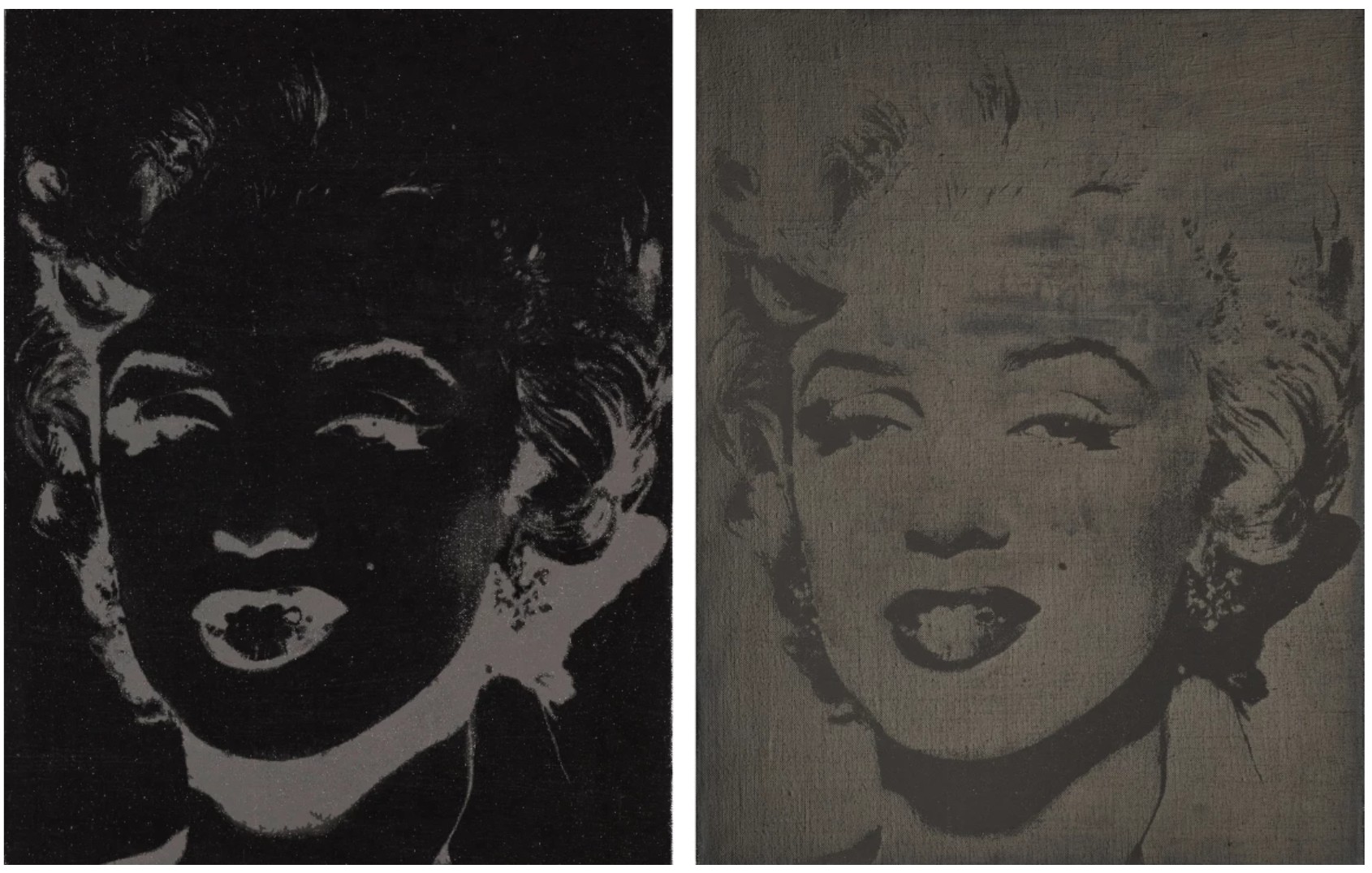
LEFT: THE PRESENT WORK
RIGHT: THE PRESENT WORK UNDER ALTERNATE LIGHTING
In the present work Marilyn’s visage emerges through shadow, recalling her presence on the silver screen that propelled her to global stardom. Yet here, the glamour appears diminished; the silver and black tones possess a delicate fragility, mirroring the transience of both life and fame. Her image was endlessly reproducible and perpetually desirable, yet shadowed by its own transience. Monroe represented the central logic of Pop Art: the conversion of ephemerality into iconography, and private suffering into public spectacle. In Marilyn (Reversal) we see the dematerialization of Munroe, as her image hovers in between absence and presence, suffused with darkness. Warhol identified Monroe as the ultimate artifact of mass culture and as a figure who epitomized this volatility between brand and personhood. Through Warhol’s silkscreen practice he replaced expressive artistic gesture with mechanical reproduction, mirroring the processes by which mass media transforms singular identities into reproducible, exchangeable images. His 1962 Marilyn series marked one of his earliest uses of the technique; thus in the present work we see Warhol call upon both the imagery and practice that defined the 1960s.
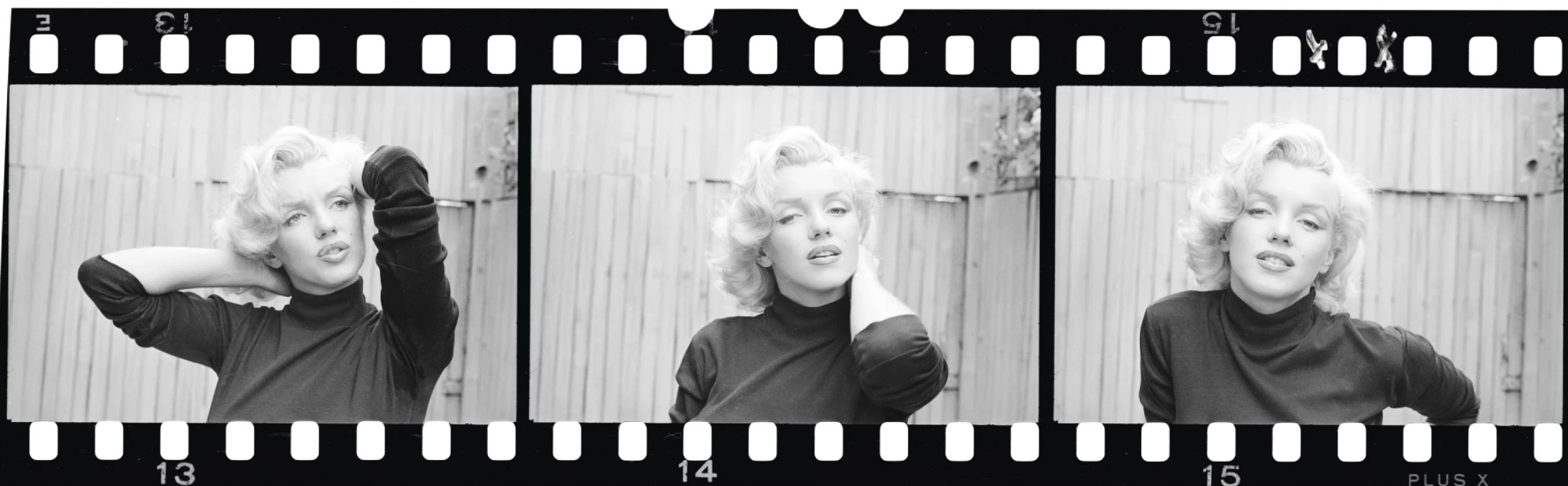
Actress Marilyn Monroe, Hollywood, California. Image: Alfred Eisenstaedt/The LIFE Picture Collection/Shutterstock
Few twentieth century artists engaged the power of the icon with Warhol’s intensity, and the present work pushes this engagement further, testing the boundaries of popular visual language and examining how images are collectively perceived in modern culture. Marilyn (Reversal Series) represents one of the most conceptually charged moments in Andy Warhol’s late career, highlighting both the lasting influence of Monroe’s fame and the symbolic significance of Warhol’s artistic mythology. The present work represents the culmination of Warhol’s seminal life long preoccupation, operating on several conceptual levels at once, intertwining the enchantment of film, the mechanisms of celebrity production, and the inevitability of decline.
One Multicolored Marilyn (Reversal Series), 1979-1986
Christie’s London: 7 March 2024
Estimated: GBP 800,000 – 1,200,000
GBP 1,068,500 / USD 1,354,858
ANDY WARHOL (1928-1987), One Multicoloured Marilyn (Reversal Series) | Christie’s (christies.com)
ANDY WARHOL (1928-1987)
One Multicolored Marilyn (Reversal Series), 1979-1986
Acrylic and silkscreen ink on canvas
16×14 inches (40.6 x 35.5 cm)
Stamped with the artist’s signature ‘Andy Warhol’ (on the overlap)
Provenance
Galerie Bruno Bischofberger, Zurich
Waddington Galleries, London (acquired from the above in 1987)
James Goodman Gallery Inc., New York
Acquired from the above by the present owner in 1988
Featuring Warhol’s most enduring subject, Multicolored Marilyn (Reversal) demonstrates the artist’s lifelong obsession with celebrity and his ceaseless innovation in the medium of painting. Executed almost two decades after he first immortalized Monroe’s likeness in Gold Marilyn Monroe (1962, Museum of Modern Art, New York), in the present work the artist updates his iconic image of the legendary actress for the disco age. The Marilyns are the first and most powerful of the Reversal series Warhol made between 1979 and 1986. Revisiting his earlier oeuvre and reinventing its already-appropriated imagery for a new generation, they set out a modus operandi which would continue for the rest of his career. Combining Warhol’s insightful examination of the notion of celebrity and relentless painterly invention, Multicolored Marilyn (Reversal) acts as a summation of Warhol’s entire practice.
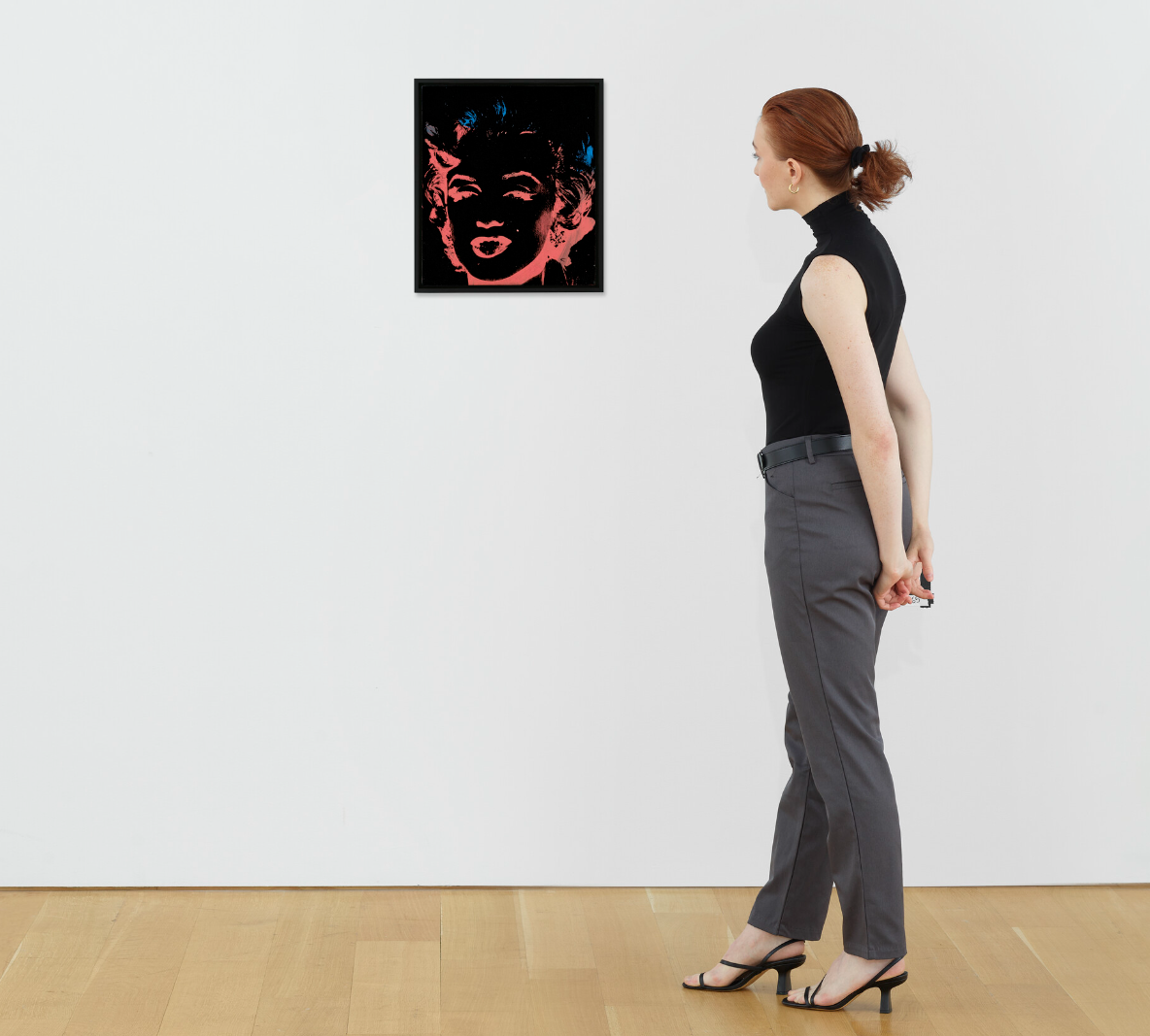
Pulsating off the surface of the canvas, Monroe’s distinctive features pierce the darkness in electric blue and coral pink. Her pouting lips, distinctive coiffure and beauty spot are immediately recognizable as belonging to one of the twentieth century’s greatest cultural icons. Warhol builds on his foundational use of a pre-existing 1950s publicity photo as his source, depicting Monroe here in a reverse or ‘negative’ version with the tonal values switched. This simple device infuses his familiar image with a new sense of freshness and relevancy. While revisiting his earlier oeuvre, the work’s vibrant transformation also looks forward and speaks directly to a new generation of Warhol’s peers. Warhol’s remarkable likeness of Marilyn Monroe was the perfect vehicle for his own project of reinvention. She had become one of the most iconic faces of the last half-century, and by the time Pop Art emerged was instantly recognisable around the world. Warhol regarded her as a kindred spirit; a fellow artist who was underappreciated by her peers and whose creative talents were often misunderstood and rarely appreciated for their nuances. The general public was quick to gauge Monroe’s physical attributes but few bothered to praise her talents as an actress and comedienne. Immediately after her tragic death on 5 August 1962, Warhol became so preoccupied by the idea of Marilyn as a media construct that he translated her photograph into an image that would go on not only define his career, but also the actress’s legacy too.
Marilyn, 1979-1986
Christie’s Hong-Kong: 28 May 2023
Estimated: HKD 7,800,000 – 11,800,000
HKD 10,055,000 / USD 1,283,638
ANDY WARHOL (1928-1987), Marilyn | Christie’s
REPEAT SALE
Christie’s New-York: 9 March 2021
Estimated: USD 800,000 – 1,200,000
USD 1,290,000
Andy Warhol (1928-1987), Marilyn | Christie’s
ANDY WARHOL (1928-1987)
Marilyn, 1979-1986
Acrylic and silkscreen ink on canvas
20×16 inches (50.8 x 40.6 cm)
Stamped with the artist’s signature ‘Andy Warhol’ (on the overlap)
Provenance
Private collection, New York
Phillips London, 29 June 1988, lot 59
Foundation Mireille and James Lévy, New York (acquired from the above sale)
Christie’s New York, 9 March 2021, lot 17
Acquired from the above sale by the present owner
In the late 1970s, Warhol embarked on a retrospective phase in his career, revisiting the creative potential of the early images that had made him so famous. Subjects he chose to re-incarnate included Mao, Flowers and, as demonstrated by the present lot, Marilyn. Borrowing from the catalogue of his subjects, Warhol reinvented the most iconic works, refreshing them for a new generation by providing a post-modern reinterpretation of his own art, effectively re-contextualizing an appropriation of an appropriation. The series also allowed Warhol to keep moving forward, to continue renewing and refreshing his art practice, bringing it forward into a new context and a new era. Through pastiche, re-appropriation and reinvention, the work brought him in sync with a younger postmodern generation of artists with an equally healthy disregard for art historical traditions and the canon, helping to break down stale divisions between what was considered high and low art. With this series, Warhol’s work took a step closer to the Conceptual art practices that had been developing contemporaneously with his own practice throughout the 1960s and into the 1970s. Beyond the meanings Marilyn has for critics and art historians, there is the image itself: stylish, captivating, glamorous, tragic, endlessly intriguing and a late career work that reaffirms the artist’s place at the forefront of contemporary art. It is mystique, fame and glamor distilled, electric with color, gleaming silver and darkness.
Marilyn (Reversal), 1979-1986
Sotheby’s New-York: 30 September 2022
Estimated: USD 1,200,000 – 1,800,000
USD 1,441,500
Marilyn (Reversal) | Contemporary Curated | 2022 | Sotheby’s (sothebys.com)
Marilyn (Reversal), 1979-1986
18×14 inches (45.7 x 35.6 cm)
Stamped with the artist’s signature, dated 1986
Authenticated by Frederick Hughes and numbered A111.0510 (on the overlap)
Meridian Fine Arts, New York
Alan Koppel Gallery, Chicago (acquired from the above in January 1999)
Private Collection, Chicago (acquired from the above in 1999)
Van de Weghe, New York
Acquired from the above by the present owner in 2011
Rendered in an incandescent teal-blue palette against a stark black background, Andy Warhol’s Marilyn (Reversal Series) presents a striking reinvention of the artist’s most iconic subject. A radiant example of the final stage of Warhol’s career, this work represents an important moment whereby Warhol returns to his most famous subjects, from Marilyn to Mao to the Mona Lisa, bringing his illustrious Pop career full circle. These Reversal paintings revisit Warhol’s early portraits while reversing their tonal values, as if these later works are the photographic negatives to his early masterpieces.
One Grey / Black Marilyn (Reversal Series), 1979-1986
Phillips London: 15 April 2021
Estimated: GBP 700,000 – 900,000
GBP 733,950 / USD 1,011,094
Andy Warhol – 20th Century & Contempor… Lot 17 April 2021 | Phillips
ANDY WARHOL
One Grey / Black Marilyn (Reversal Series) II-50-160, 1979-1986
Acrylic and silkscreen ink on canvas
20 x 15 7/8 inches (50.8 x 40.6 cm)
Signed ‘Andy Warhol’ on the reverse
Provenance
Waddington Galleries, London
Acquired from the above by the present owner in 1990
A singular force behind his next thirty years of artistic production, Warhol’s muse came in the form of a femme fatale — both beautiful and tragic. Though Monroe and Warhol never exchanged a single word or glance, their souls seemed fated to connect. Sharing a number of character traits — namely their inherently paradoxical identities, steeped in dichotomies of public life versus shyness, celebrity versus tragedy — it only appeared natural that Warhol would choose Marylin — a mirror of sorts — as his muse. ‘The irony of Andy Warhol’s “Marilyn” is that it is an icon of an icon created by an icon’. It is perhaps this similarity, and the immortalization of this similarity in Marylin’s portrait, that unites them most strikingly. As the negative is usually the ‘original’ from which a photograph is printed, there was a certain paradox in the idea of making ‘copies’ of earlier paintings in this negative form. In addition to representing an evolution of Warhol’s famed silkscreen technique, the series reflected the artist’s increasing fascination with shadow, as the darkest areas in the original images were transformed into the brightest highlights.
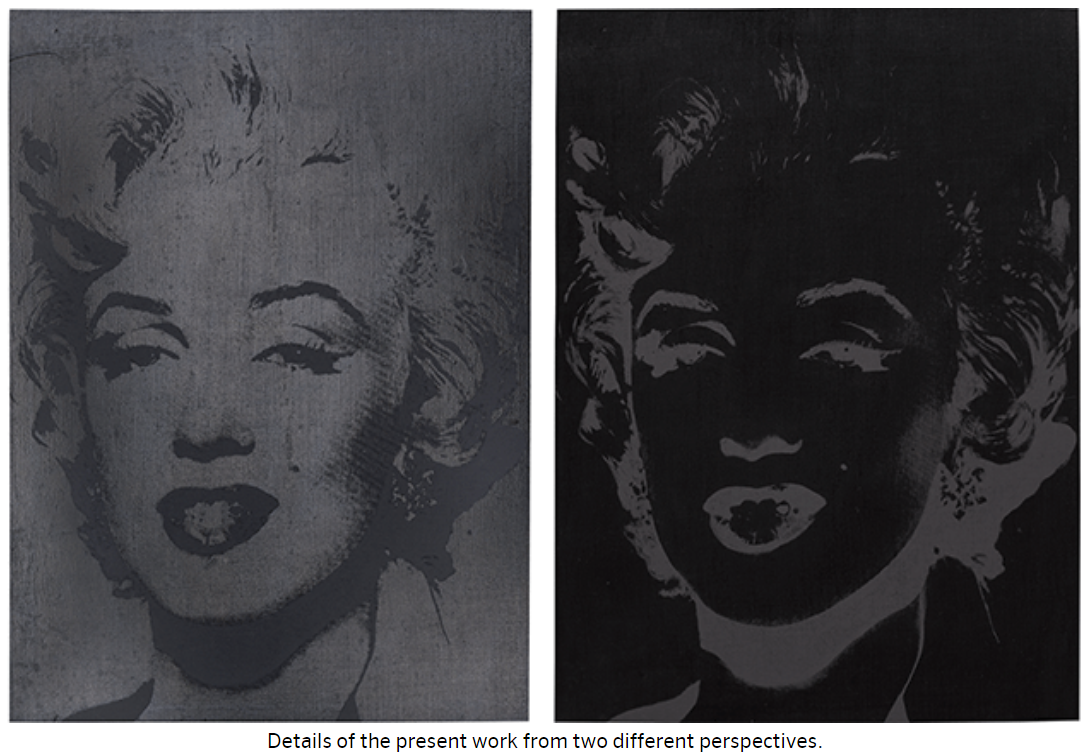
Other works combined a negative image with diamond dust, which Warhol sprinkled over the canvas as the silkscreen dried. In some, the image was nearly obliterated to the point of resembling an abstract painting. Warhol’s Reversals recapitulate his portraits of famous faces but with the tonal values reversed. As if the spectator were looking at photographic negatives, highlighted faces have gone dark while former shadows now rush forward in electric hues. The reversed Marilyns, especially, have a lurid otherworldly glow, as if illuminated by internal footlights.
Marilyn, 1979-1986
Property from the Foundation Mireille and James Lévy
Christie’s New-York: 2 December 2020
Estimated: USD 1,200,000 – 1,800,000
USD 1,698,000
Andy Warhol (1928-1987) (christies.com)
ANDY WARHOL
Marilyn, 1979-1986
Acrylic and silkscreen ink on canvas
18.1 x 13.9 inches (46 x 34.9 cm)
Signed and dated ‘Andy Warhol 79/86’ (on the overlap)
Provenance
Galerie Bruno Bischofberger, St. Moritz
Acquired from the above by the present owner, 1996
For these two Marilyn canvases (above and below), the actress is rendered in bright blue, sea green and vibrant coral set against a saturated black. The image of the actress was appropriated from a cropped section of a still from the 1953 film Niagara and Warhol reversed the color scheme in order to create these paintings. The instantly recognizable features of the actress are clearly visible, despite the limited means with which they have been rendered. Marilyn is an wonderful example of a motif so prevalent throughout the artist’s oeuvre and the reversal of the color scheme makes these paintings even more unique and interesting. There is, however, more to Marilyn than the captivatingly bold contrasting colors and refreshed approach to composition.
Marilyn, 1979-1986
Property from the Foundation Mireille and James Lévy
Christie’s New-York: 3 December 2020
Estimated: USD 1,200,000 – 1,800,000
USD 1,818,000
Andy Warhol (1928-1987) (christies.com)
ANDY WARHOL
Marilyn, 1979-1986
Acrylic and silkscreen ink on canvas
18.1 x 13.9 inches (46 x 34.9 cm)
Signed ‘Andy Warhol’ (on the overlap)
Provenance
Galerie Thaddaeus Ropac, Salzburg
Acquired from the above by the present owner, 1988
Marilyn (Reversal), 1979-1986
Christie’s New-York: 16 November 2018
Estimated: USD 1,000,000 – 1,500,000
USD 1,332,500
Andy Warhol (1928-1987) (christies.com)
ANDY WARHOL
Marilyn (Reversal), 1979-1986
Synthetic polymer and silkscreen ink on canvas
18×14 inches (45.7 x 35.6 cm)
Stamped with artist’s signature ‘Andy Warhol’ (on the reverse)
Signed and inscribed by Frederick Hughes ‘I certify that this is an original painting by Andy Warhol completed by him in 1986 – Frederick A Hughes’ (on the overlap)
Provenance
Galerie Bruno Bischofberger, Zürich
Private collection
Anon. sale; Phillips, New York, 15 May 2003, lot 30
Private collection, Germany
Anon. sale; Christie’s, New York, 11 November 2015, lot 159
Private collection, New York
Acquired from the above by the present owner
Marilyn (Reversal) depicts an intimate rendering of one of the 20th century’s most iconic visage—that of Marilyn Monroe. Executed between 1979 and 1986, the present lot belongs to Warhol’s exemplary and retrospective Reversal series in which he took his already acclaimed Marilyn iconography and inverted her image. For Marilyn (Reversal), the switch in appearance is minimal, yet its affect haunts the viewer. The shadows of Marilyn’s face are eponymously reversed, glowing against the pitch-black canvas. This absence of color and presence of a shining, gray ink evokes photographic negatives and the silver screen—essential parts of Marilyn’s cosmic rise to stardom.
Marilyn (Reversal), 1979-1986
Sotheby’s London: 26 June 2018
Estimated: GBP 1,200,000 – 1,800,000
GBP 1,390,000
(#18) ANDY WARHOL | Marilyn (Reversal) (sothebys.com)
ANDY WARHOL
Marilyn (Reversal), 1979-1986
Acrylic and silkscreen ink on canvas
18.1 x 14 inches (46.1 x 35.4 cm)
Signed and dated 79/86 on the overlap
Provenance
Galerie Bruno Bischofberger, Zurich
Private Collection, Switzerland (acquired from the above in the 1980s)
Simon Dickinson Ltd., London
Acquired from the above by the present owner in 2012
The present work is uniquely colorful and captivating. As though caught within an iridescent hall of mirrors, Marilyn’s hair, brows, eyes and lips reflect a dazzling chromatic spectrum ranging from baby blues to fecund greens via a sequence of erotic and arresting reds.
1 Colored Marilyn (reversal series), 1979
Phillips New-York: 16 November 2017
Estimated: USD 1,500,000 – 2,000,000
USD 1,815,000
Andy Warhol – 20th Century & Contem… Lot 18 November 2017 | Phillips
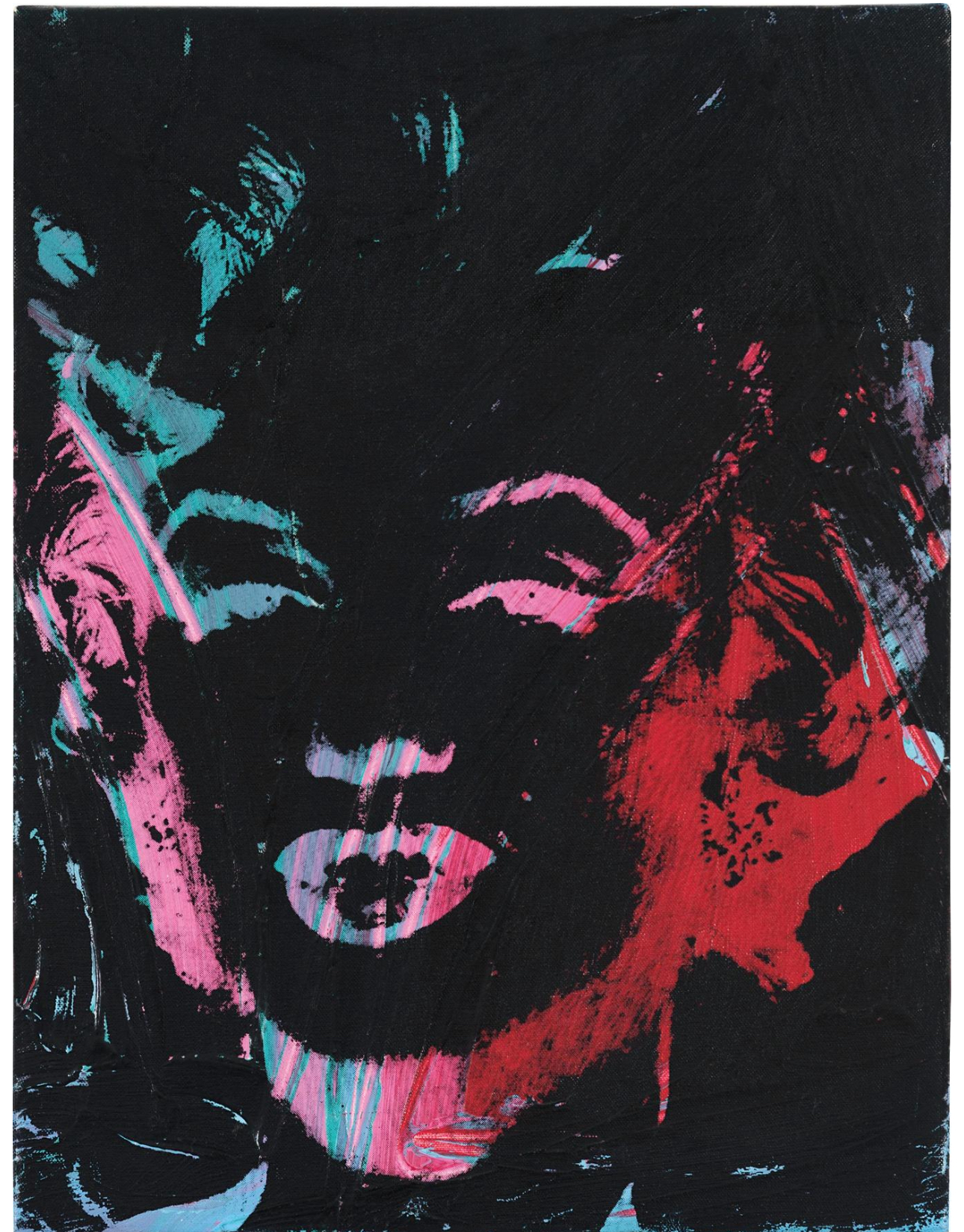
ANDY WARHOL
1 Colored Marilyn (reversal series), 1979
Oil and silkscreen inks on canvas
18 1/4 x 13 3/4 inches (46.4 x 34.9 cm)
Signed, titled and dated “1 Colored Marilyn reversal series 1979 Andy Warhol” on the reverse
Provenance
Bruno Bischofberger Gallery, Zurich
Douglas S. Cramer, Los Angeles (acquired from the above in 1984)
At once utterly familiar and hauntingly subversive, 1 Colored Marilyn from Andy Warhol’s Reversals series marks the artist’s celebrated return to one of his most enduring images. Executed in 1979, the work stands as an eloquent distillation of Warhol’s Reversals, a radical and innovative series the artist conceived that same year and continued to pursue through 1986. Here, the iconic features of Marilyn Monroe are expressed in negative, with gestural swirls of turquoise, hot pink and cadmium red, coalescing under the inky depths of a strong black screen with palpable intensity.
Marilyn (Reversal), 1979-1986
Christie’s London: 6 March 2017
Estimated: GBP 1,000,000 – 1,500,000
GBP 1,205,000
Andy Warhol (1928-1987) (christies.com)
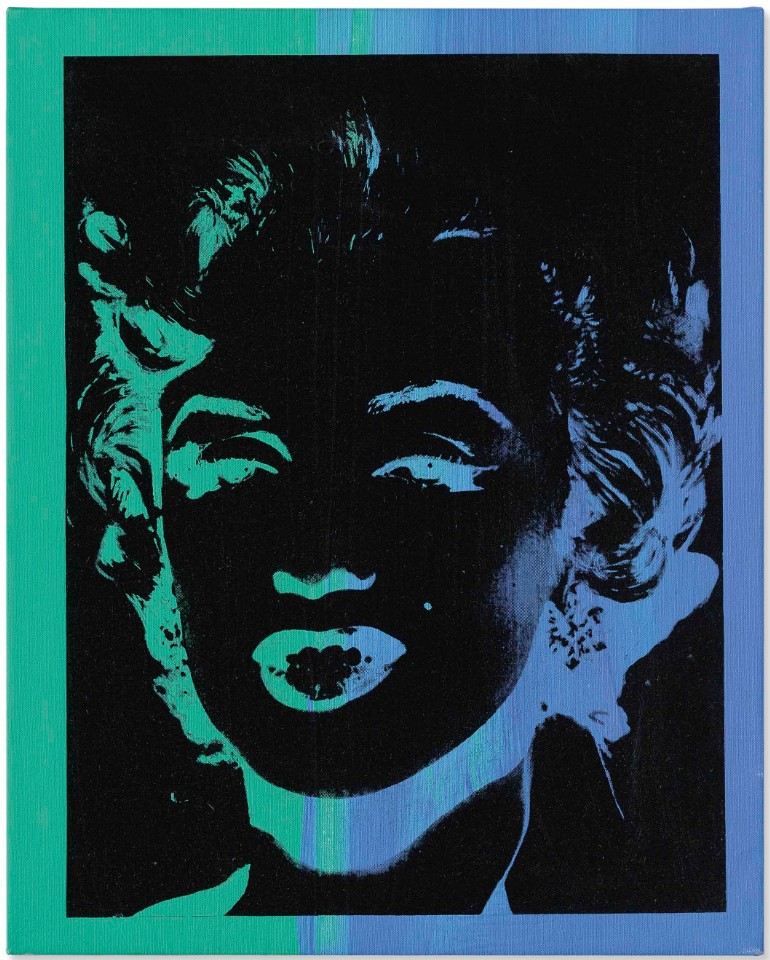
ANDY WARHOL
Marilyn (Reversal), 1979-1986
Acrylic and silkscreen ink on canvas
20.1 x 15.9 inches (51 x 40.5cm)
Stamped ‘Andy Warhol’ (on the overlap)
Andy Warhol’s Marilyn (Reversal) is a tribute to one of the artist’s best loved muses. Considered to be the most successful subject from the Reversal Series, the radiant beauty of Marilyn Monroe provides this work with its iconic subject and lasting resonance, extoled here in an enduring, glowing jewel-like blue and green; a contrast that introduces a sense of electricity to the picture.
Marilyn (Reversal), 1979
Christie’s New-York: 11 May 2015
Estimated: USD 1,200,000 – 1,800,000
USD 2,345,000
Andy Warhol (1928-1987) (christies.com)
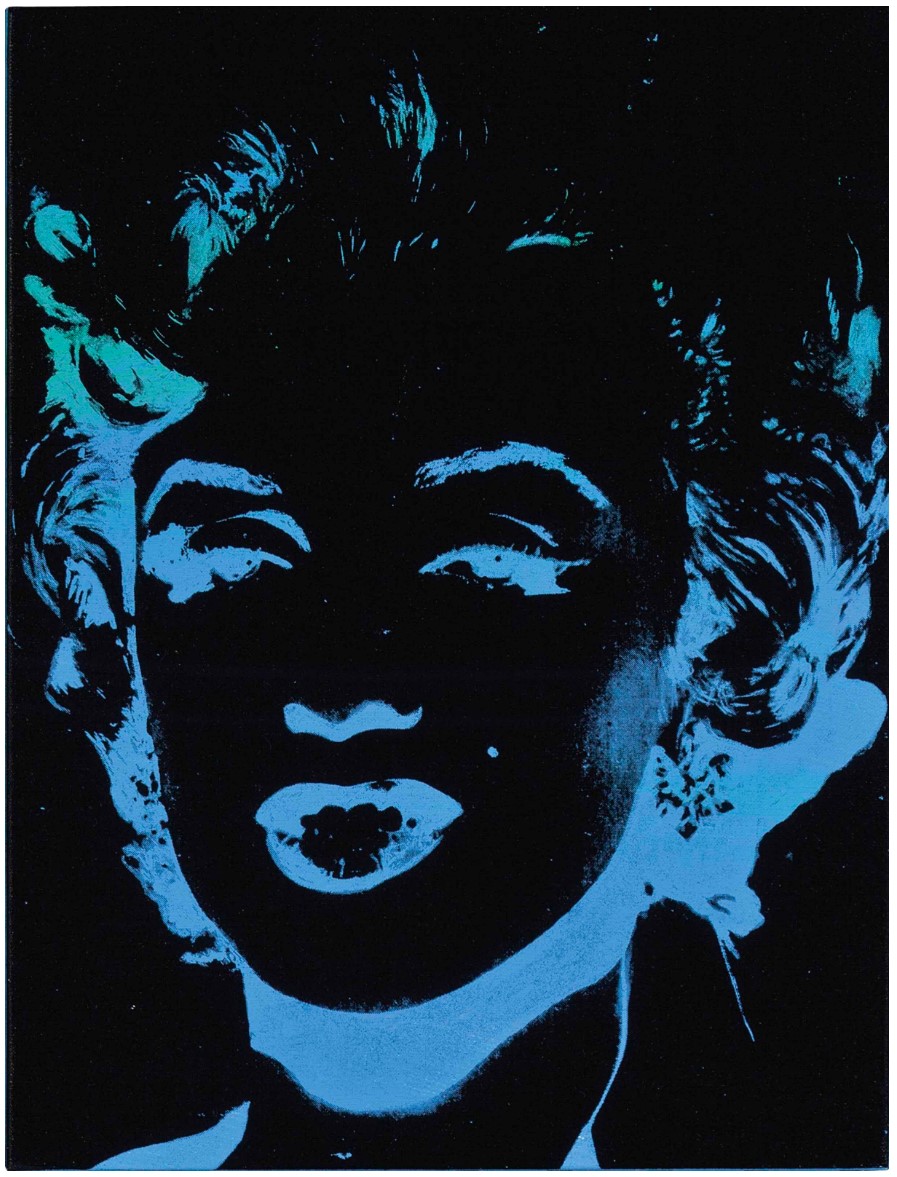
ANDY WARHOL
Marilyn (Reversal), 1979
Synthetic polymer and silkscreen ink on canvas
18 x 13.9 inches (45.7 x 35.2 cm)
Signed, dated, stamped with the Andy Warhol Authentication Inc., stamp
Numbered ‘Andy Warhol 79 A106.066’ (on the overlap)
In Marilyn (Reversal), the familiar features of the glamorous movie star glow in a bright blue and sea green against the saturated black of the screened image. The instantly recognizable features of the actress are clearly visible despite the minimum means with which they have been rendered. There is more to Marilyn (Reversal) than the obvious observations of the bright contrasting color and Warhol’s refreshed approach to composition. Starting with the paintings from the early 1960s, Warhol’s representation of Marilyn has surpassed the fame of the actress herself and has instead become emblematic of Warhol and the themes pervasive throughout his body of work: glamour, beauty and death. The vibrant blue-green background, wholly in keeping with the disco era in which it was created, is in sharp contrast with the eerie x-ray image resulting from the innovative format. This air of mystery brings about a haunting realization that the kind, generous, humble and funny character of the young woman who died a tragic and premature death in 1962 has been overshadowed and is no longer regarded as a relevant part of the story associated with this iconic pop symbol. Essentially, the likeness of the star has been stripped of its humanity. Of all the paintings from this series the Marilyns are the most successful and make the most lasting impression in their haunting intensity. Warhol was a tireless innovator, and the negative images that he used in the Reversal Series show his continuing willingness to experiment.
One Pink/Black Marilyn (Reversal), 1979-1986
Sotheby’s New-York: 12 November 2014
Estimated: USD 1,200,000 – 1,800,000
USD 2,405,000
(#260) Andy Warhol (sothebys.com)
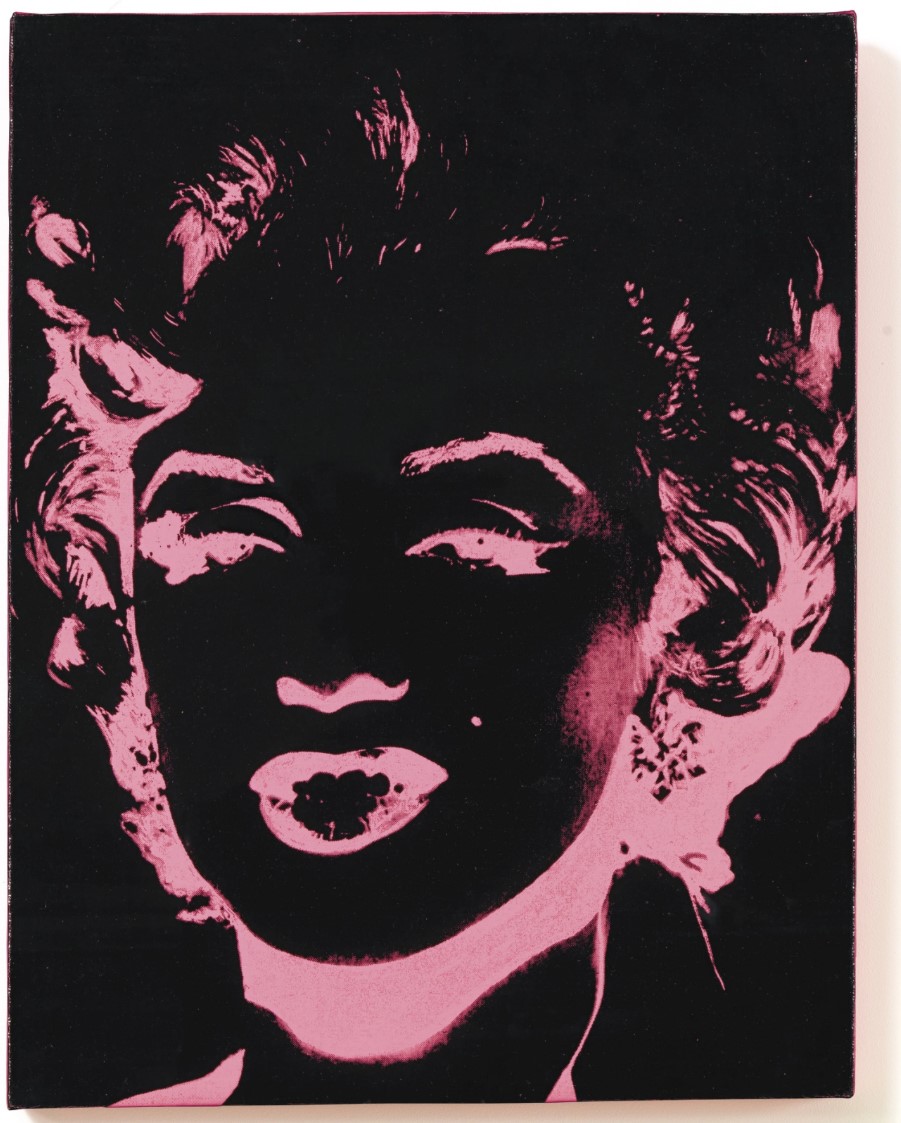
ANDY WARHOL
One Pink/Black Marilyn (Reversal), 1979-1986
Acrylic and silkscreen ink on canvas
18×14 inches (45.7 x 35.6 cm)
Signed on the overlap
Tonally reversed and imitating the appearance of a photographic negative, in One Pink/Black Marilyn from his Reversal Series 1979-1986, Warhol employs his classic method of using acrylic paint and silkscreen ink on a canvas with a deliberate self-awareness. Warhol’s reversal image of Marilyn, however, stands symbolically and visually apart from his original depictions in bright primary colors. One Pink/Black Marilyn, composed with a bright, fluorescent, and processed pink contrasted against the matte, stark black is an enchanting example of the artist’s self-realization of just how processed and recycled his own images had become.
Pink Marilyn (Reversal), 1986
Christie’s New-York: 14 May 2014
Estimated: USD 1,000,000 – 1,500,000
USD 2,165,000
Andy Warhol (1928-1987) (christies.com)
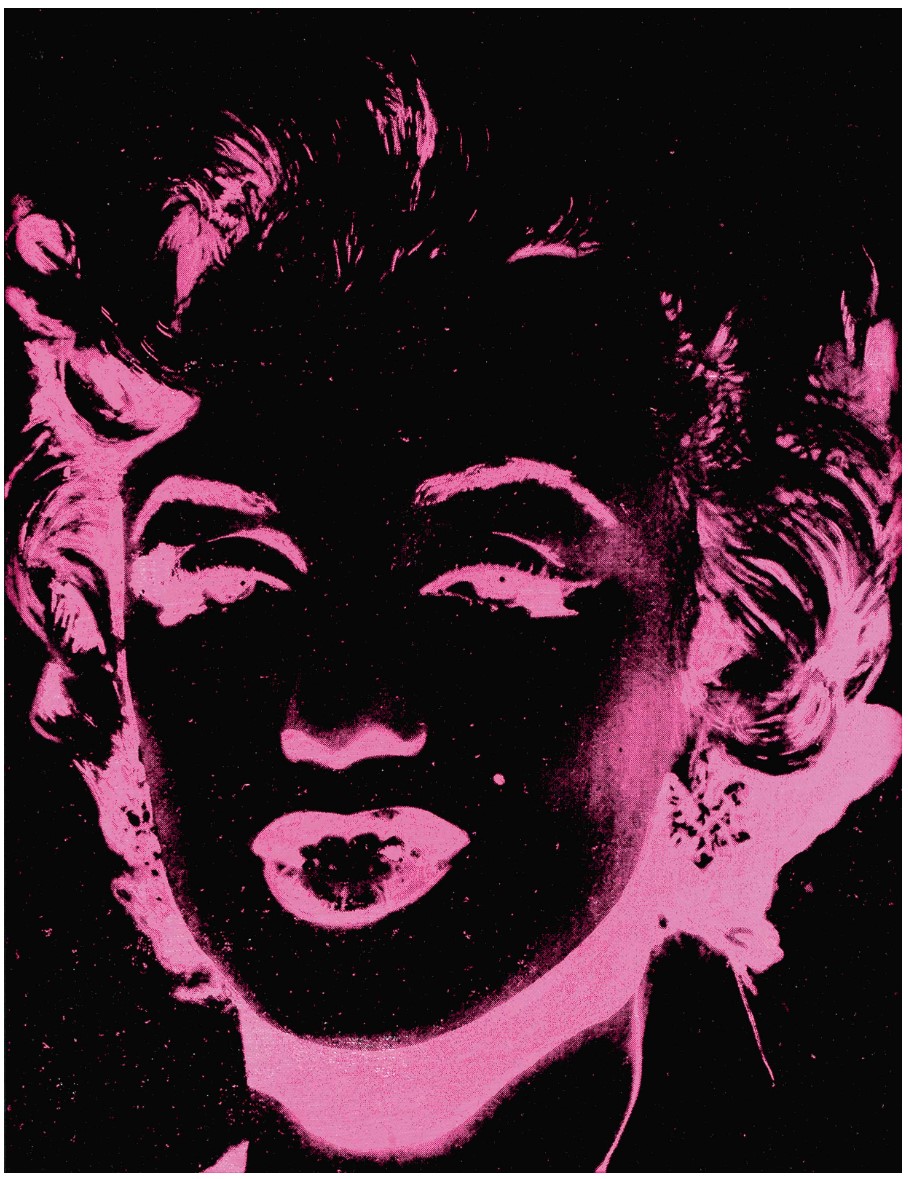
ANDY WARHOL
Pink Marilyn (Reversal), 1986
Synthetic polymer and silkscreen inks on canvas
18×14 inches (45.7 x 35.6 cm)
Signed and dated ‘Andy Warhol 86’ (on the overlap)
In Pink Marilyn (Reversal) , the familiar features of the glamorous movie star glow in an electric bubble gum pink tone against the saturated black of the screened image. The instantly recognizable features of the actress are clearly visible despite the minimum means with which they have been rendered. Warhol was a tireless innovator, and the negative images that he used in the Reversal Series show his continuing willingness to experiment.
Marilyn (Reversal series), 1979-1986
Sotheby’s New-York: 14 November 2013
Estimated: USD 900,000 – 1,200,000
USD 1,925,000
(#230) Andy Warhol (sothebys.com)
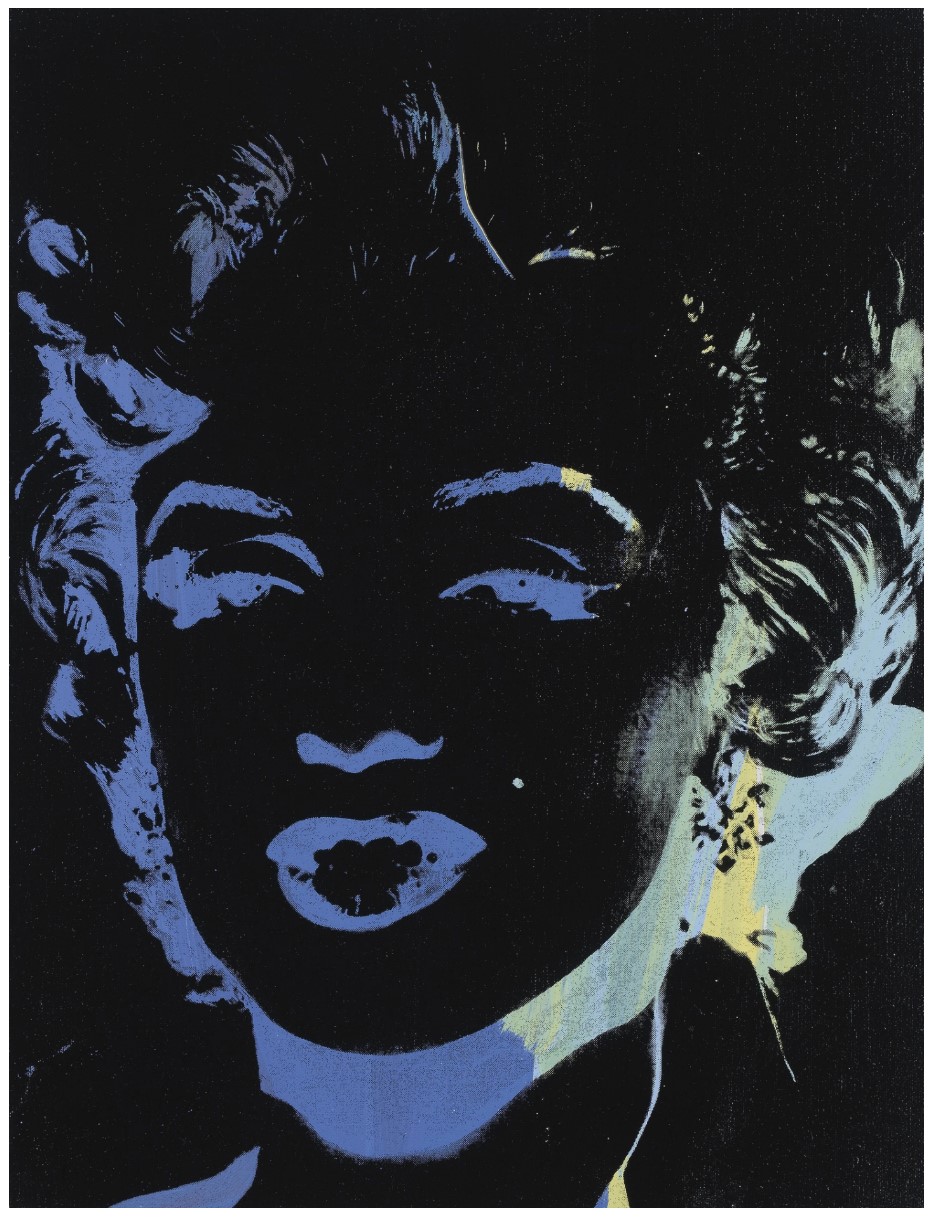
ANDY WARHOL
Marilyn (Reversal series), 1979-1986
Acrylic and silkscreen inks on canvas
18.2 x 14 inches (46.4 x 35.6 cm)
Stamped by the Andy Warhol Art Authentication Board, Inc.
Numbered A118.965 on the overlap
With his silkscreen process now honed to perfection, Marilyn (Reversal Series) from 1979-1986 is one of the best examples from this powerfully post-modern body of work, which pivots on the Duchampian notion of the readymade.
Marilyn (Reversal series), 1979-1986
Sotheby’s London: 13 October 2011
Estimated: GBP 400,000 – 600,000
GBP 469,250
(#41) Andy Warhol (sothebys.com)
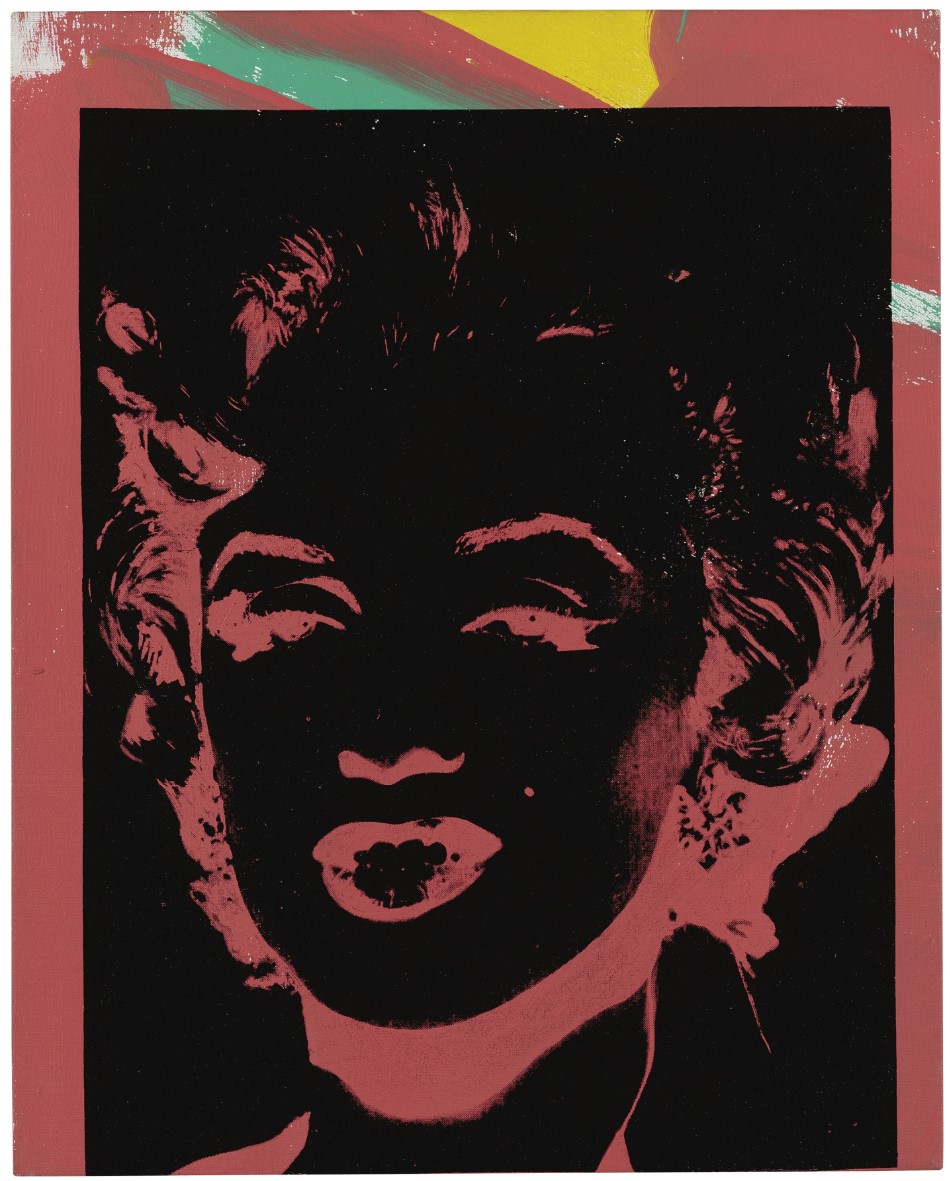
ANDY WARHOL
Marilyn (Reversal series), 1979-1986
Acrylic and silkscreen ink on canvas
20×16 inches (50.8 x 40.7 cm)
Authenticated and stamped by the Andy Warhol Art Authentication Board
Numbered A112.076 on the overlap
Marilyn (Reversal Series), 1979-1986
Christie’s New-York: 11 November 2010
Estimated: USD 400,000 – 600,000
USD 962,500
Andy Warhol (1928-1987) (christies.com)
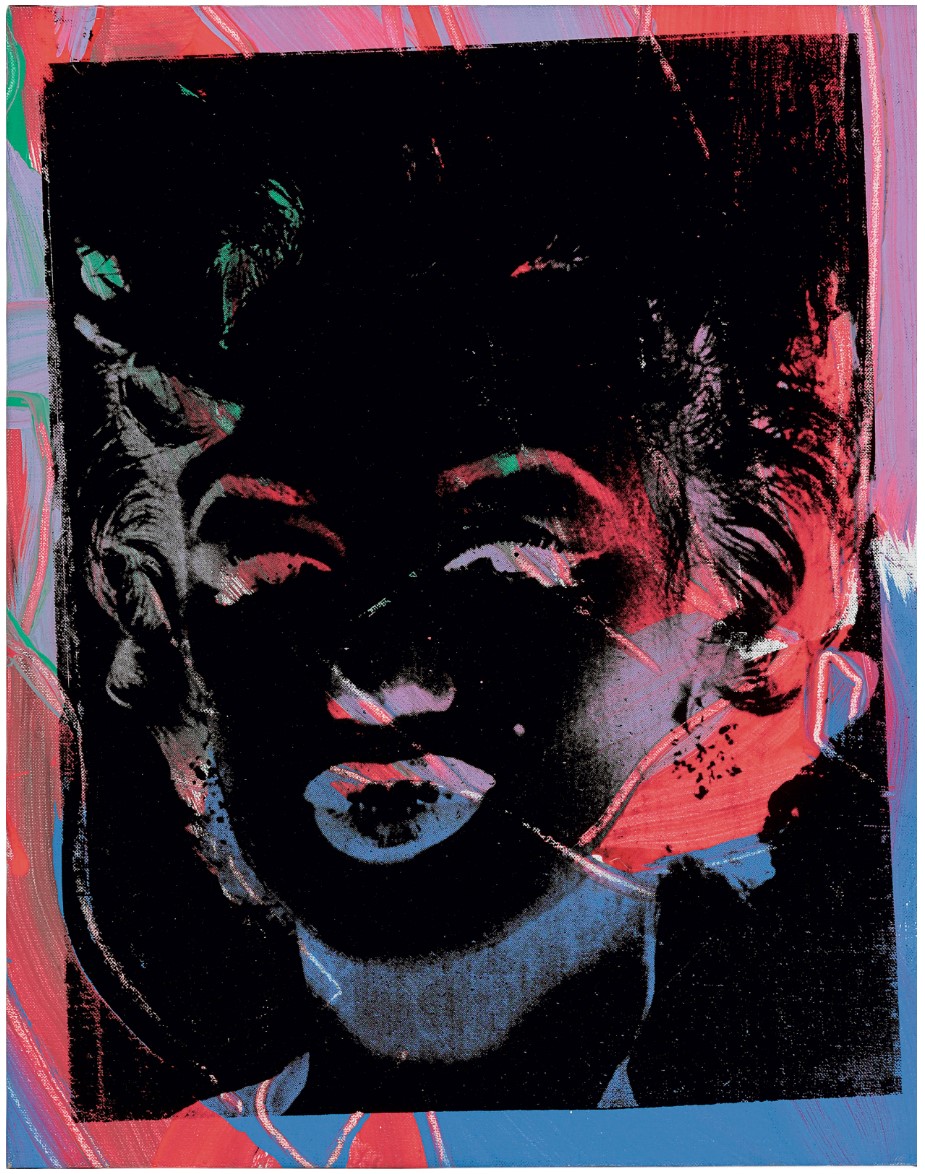
ANDY WARHOL
Marilyn (Reversal Series), 1979-1986
Synthetic polymer and silkscreen ink on canvas
20×16 inches (50.8 x 40.6 cm)
Stamped with signature ‘Andy Warhol’ (on the overlap)
Stamped with the Andy Warhol Art Authentication Board Inc. stamp
Numbered ‘A118.971’ (on the overlap)
Christie’s New-York: 11 May 2005
USD 688,000
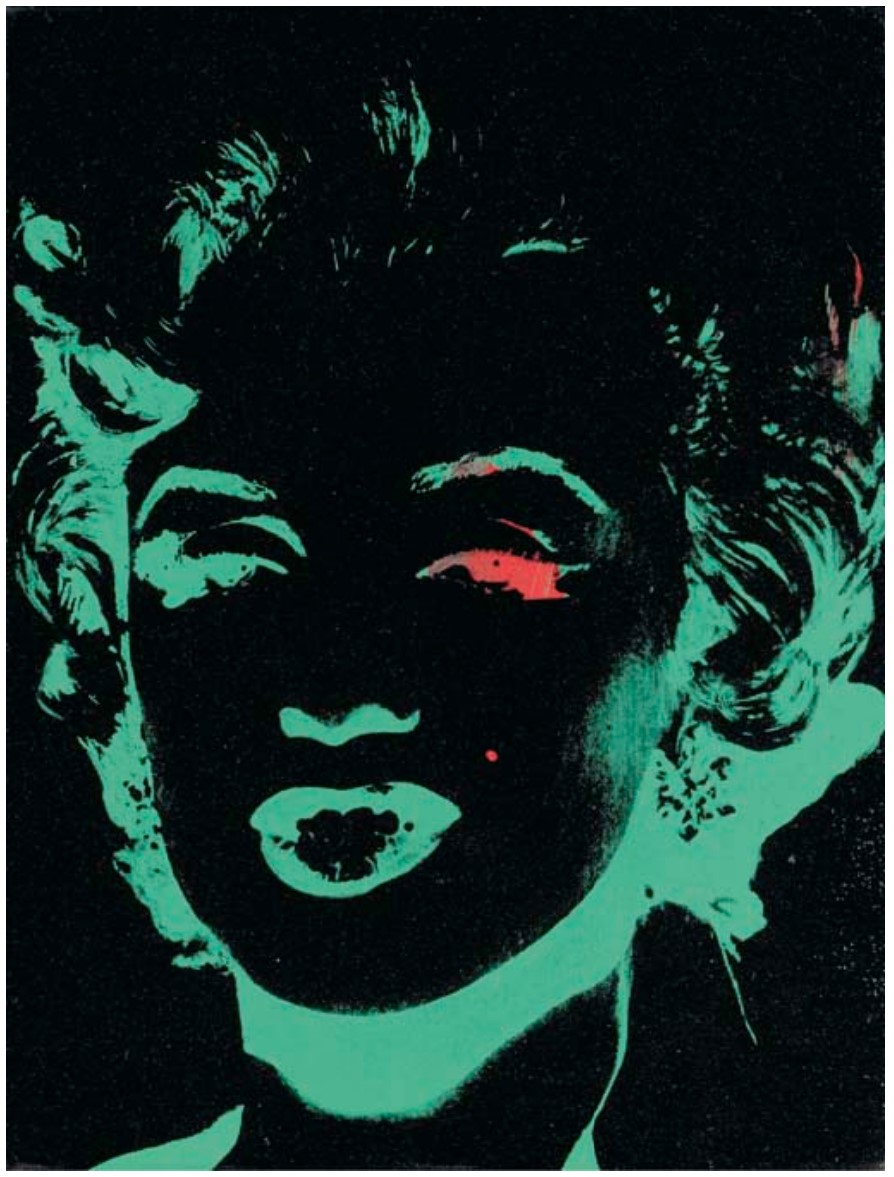 ANDY WARHOL
Marilyn (Reversal), 1979-1986
Synthetic polymer and silkscreen inks on canvas
18.2 x 14 inches (46.4 x 35.5 cm)
Christie’s London: 24 June 2004
GBP 167,650
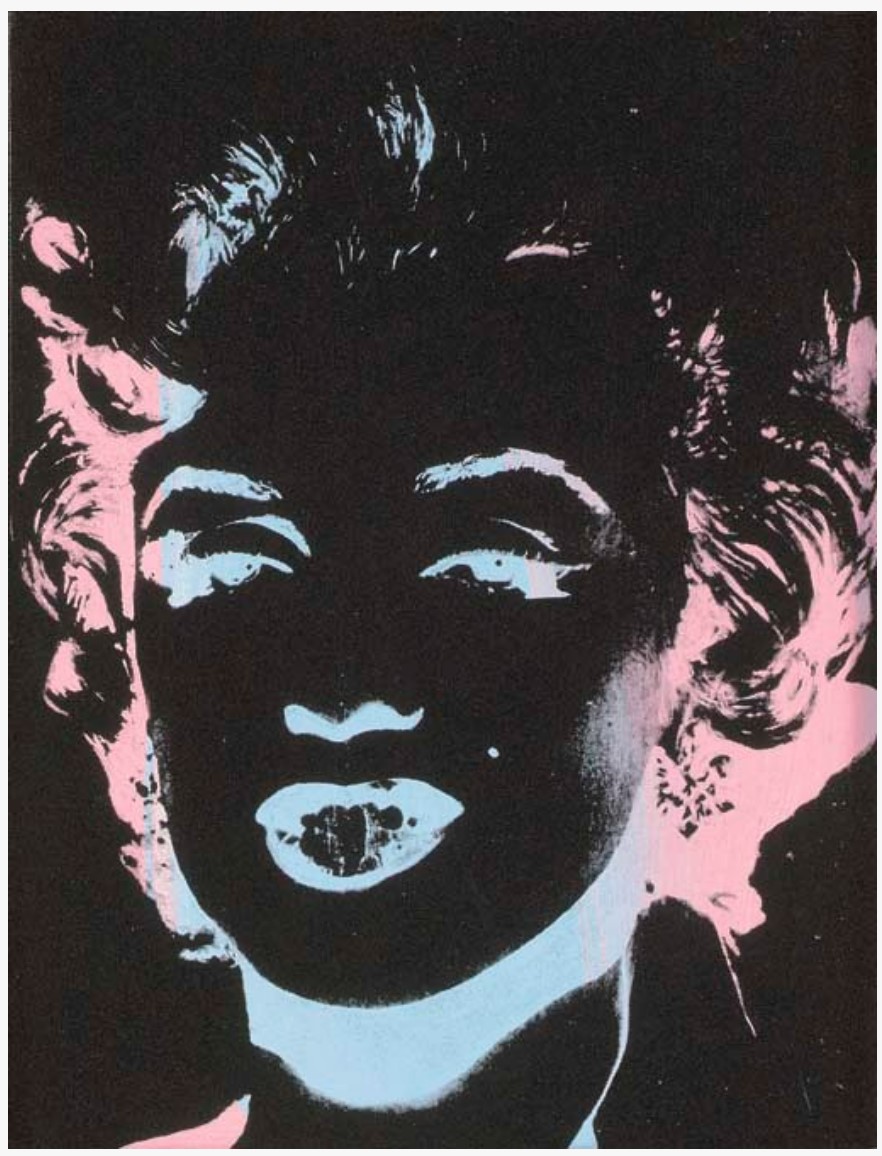
ANDY WARHOL
One Multicolor Marilyn, 1979-1986
Synthetic polymer and silkscreen inks on canvas
18.1 x 13.9 inches (46 x 35.8 cm)