DAVID HOCKNEY (B. 1937)
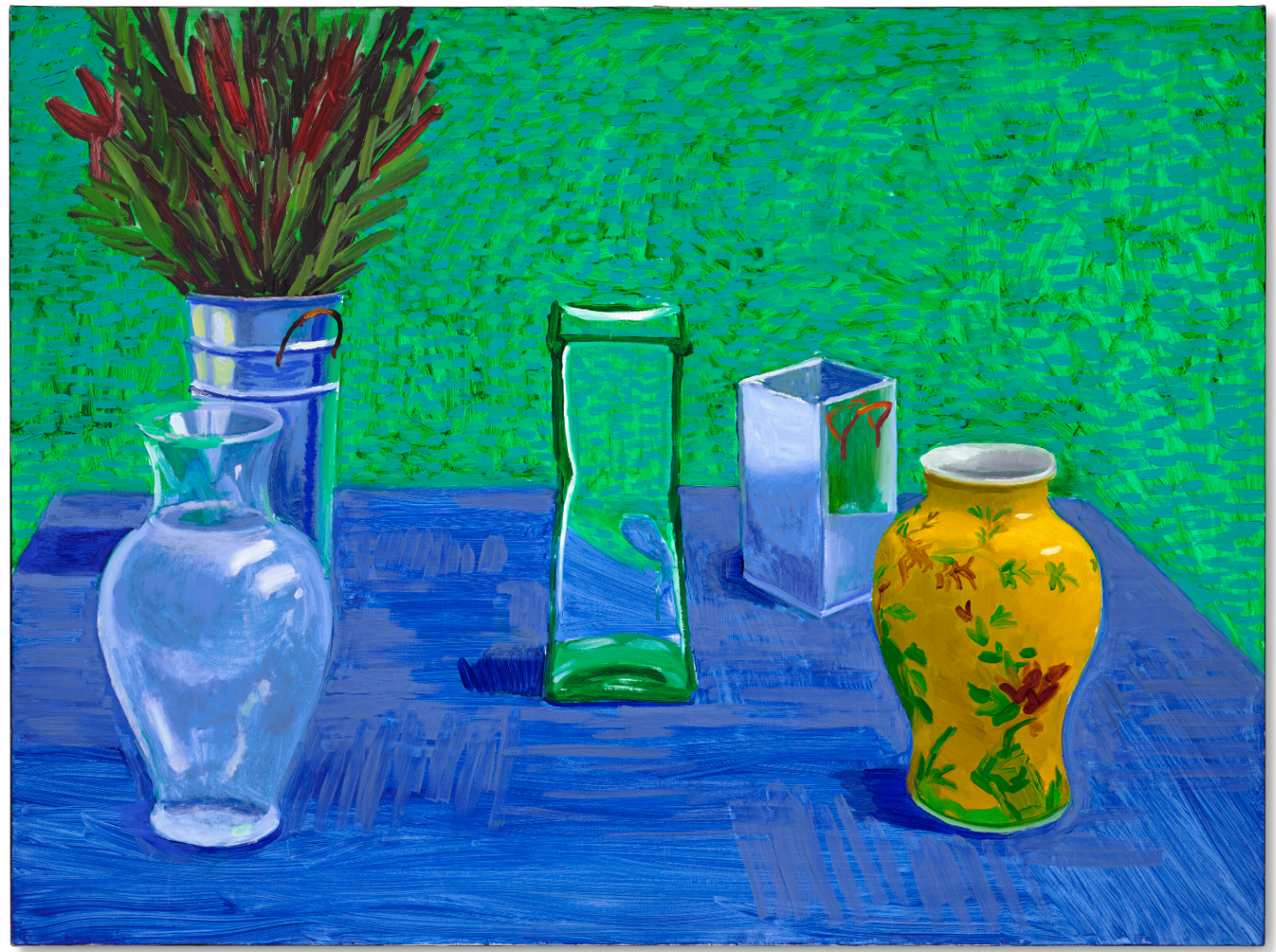
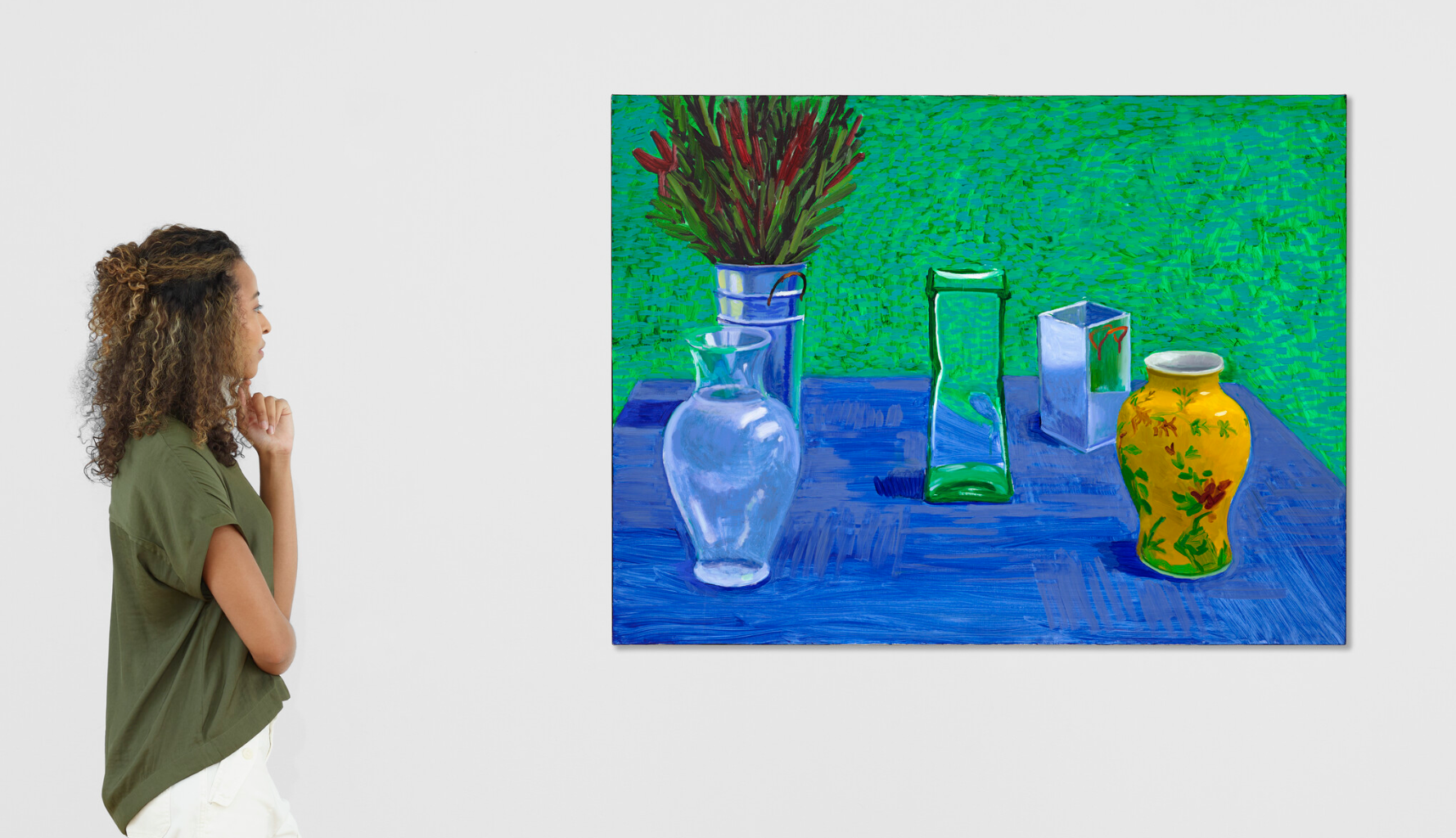
Four Empty Vases, 1996
Oil on canvas
35 3/4 x 47 3/4 inches (90.8 x 121.3 cm)
Signed, titled and dated ‘four empty vases 1996 David Hockney’ (on the reverse)
Provenance
Joan Genser, Palm Beach, acquired directly from the artist
Galerie Maurice Inc., Palm Beach
Acquired from the above by the present owner, 1997
Auction History
Christie’s New-York: 21 November 2024
Estimated: USD 3,500,000 – 5,500,000
USD 8,575,000
DAVID HOCKNEY (B. 1937), Four Empty Vases | Christie’s
David Hockney presents an exceptionally eloquent analysis of color, form, and perspective in Four Empty Vases. Painted in 1996, a critical year for the artist in which he dealt with several personal tragedies, Hockney delved back into the still life genre which he first took up two decades prior, reinvigorating the subject with a new vividity of color and expressiveness of style. This work fluently describes the essential duality of Hockney’s renowned artistic practice, pervaded at once with an underlying light-heartedness and cheer whilst simultaneously probing the serious intellectual and aesthetic questions which Hockney’s oeuvre has grappled with up to the present.
On the brink of his sixth decade, Hockney continued to find solace in art, visiting the Hague to attend the ground-breaking exhibition on Johannes Vermeer at the Mauritshuis. This journey proved profoundly impactful on Hockney’s artistic direction, as he marveled at Vermeer’s masterful use of color, laid in transparent layers of oil paint:
“Seeing how Vermeer handled the paint, and beyond that how he controlled the light on to his subjects, sent me back into the studio with tremendous energy”
The visit precipitated an artistic breakthrough for the artist, revealing a solution for the aesthetic struggles he had been contending with since the 1970s.
“I see in my own painting, continually, as a struggle. I do not think I have found any real solutions yet. Other people might think I have: I don’t. I’m determined to try.”
Against a heavily tilted blue table, Hockney places five meticulously determined objects—three empty glass vases, a metal pail holding a bouquet of flowers, and a Qing dynasty vase in intense imperial yellow. Hockney has a long-lasting fascination and appreciation of Chinese aesthetics and history. In fact, he even wrote a book, China Diary, after his trip to the Middle Kingdom with Stephen Spender in 1980s. These objects seem to almost defy gravity, teetering precipitously, about to plunge down the sloped surface and crash at the viewer’s feet. A strong light bathes the composition from the upper left, allowing Hockney to toy with intricate lighting effects as rays traverse and refract against the varied materials in the scene. Spatially ambiguous, Hockney here moves away from the discursive one-point linear perspective which he had previously employed in earlier still lifes.
While removed from the photorealism current at the time and even the precision seen in his earlier still lifes such as Still Life on a Glass Table, Hockney achieves a naturalism in Four Empty Vases unattainable for either, as here he is able to capture the emotions which he felt when first laying eyes on this scene, as well as the way in which his saw the objects from a multiplicity of perspectives, combining them here into an amalgamated whole. In this respect, the present work reminds of Hockney’s hero Vincent van Gogh’s powerfully emotive works, particularly his Nature morte à la cafetière painted in May of 1888. Beyond matters of subject matter and composition, these two works both revel in the splendid power of southern light. Van Gogh and Hockney, painting from the South of France and Los Angeles respectively, celebrate the powerful effects such strong, warm lighting can have on composition.
“I decided the best place to paint the studies was the far end of the studio, at the top of the stairs, just outside the loo. It might seem peculiar, but that was where the north light came down in just the correct way, at a certain time of day.”
An elegiac consolidation of the personal and the professional, Four Empty Vases powerfully denotes Hockney’s artistic development and ability to continually revise and improve his practice in order to better articulate his lived reality. Despite the deprivation of figures from the scene, his feelings of loss pervade the canvas, powerfully striking the viewer like his earlier Still Life on a Glass Table evokes his lost love for Peter Schlesinger. In this work, Hockney’s mature, expressive style is expertly rendered, hinting at the exciting new directions which the artist would explore into the new millennium.