Introduction
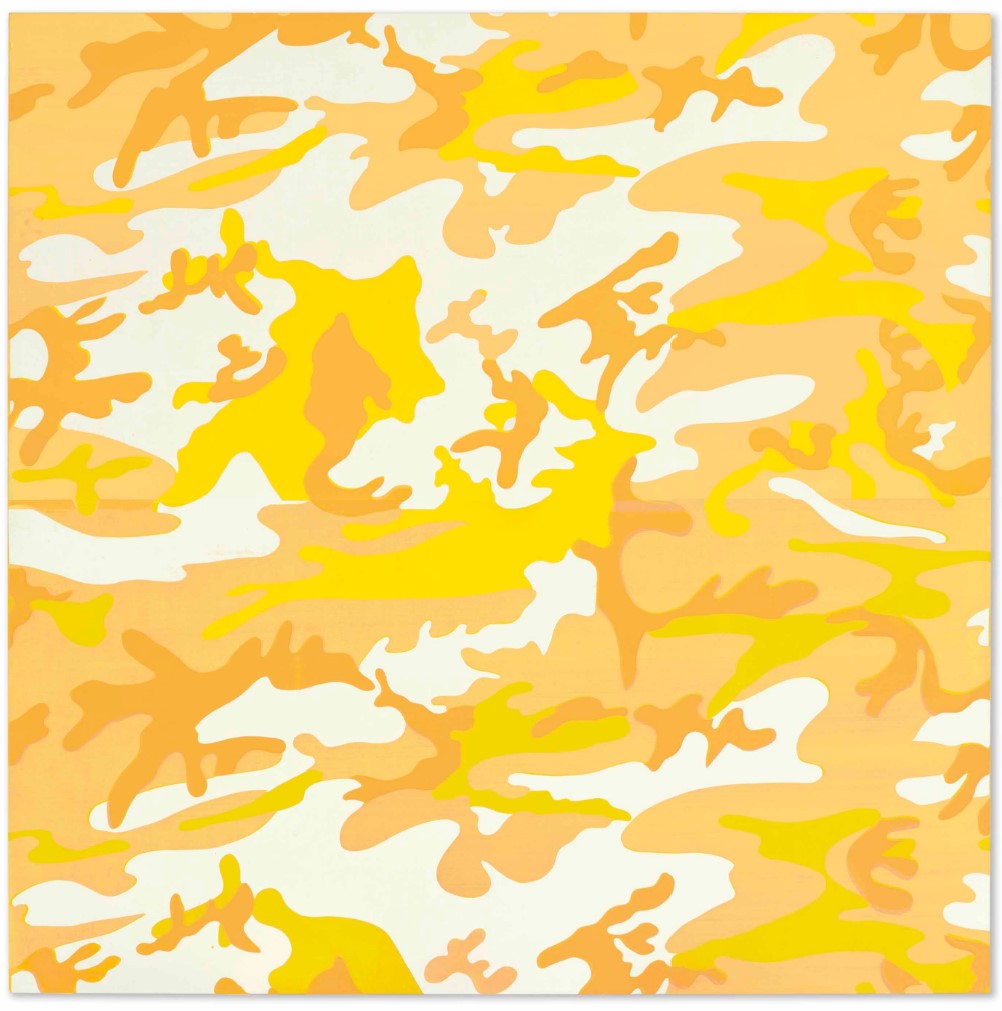
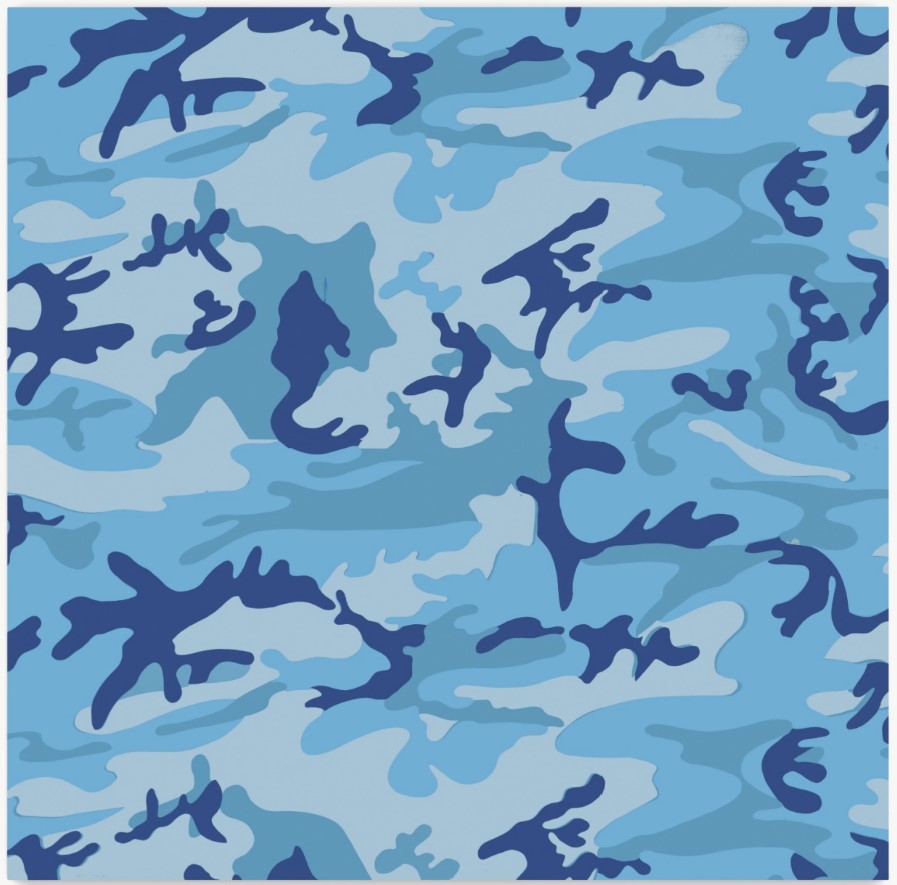
Fascinated with the near religious reverence afforded to painters such as Jackson Pollock and Mark Rothko within his lifetime, this series can be linked conceptually with Warhol’s earlier Rorschach paintings and Oxidation series, in their challenge to the mysticism of a self-professed ‘non-referential’ Abstract Expressionism.
“Camouflage Paintings were the culmination of both his lifelong need to disguise himself and his career-long quest to come up with an art that would make the anti-Pop mandarins of the New York art world look at his work in a more favorable light…
Of course, Andy being Andy, he couldn’t resist tweaking even as he tried to please. ‘What can I do,’ he often asked his Factory workers, including me, ‘that would be abstract, but not really abstract?'”
Bob Colacello
In a perfect visual pun, Warhol uses the army print to wage a sarcastic war on Abstract Expressionism by embracing an elemental pattern that is highly connotative of its original utilitarian and militarized purpose, as well as subsequent uses in fashion – Pop’s greatest ally. Much like Jasper Johns’ iconic Flag paintings, the work is paradoxically purely abstract and highly referential. Camouflage thus refers back to Warhol’s most essential obsession with a shared, mass-produced visual language.
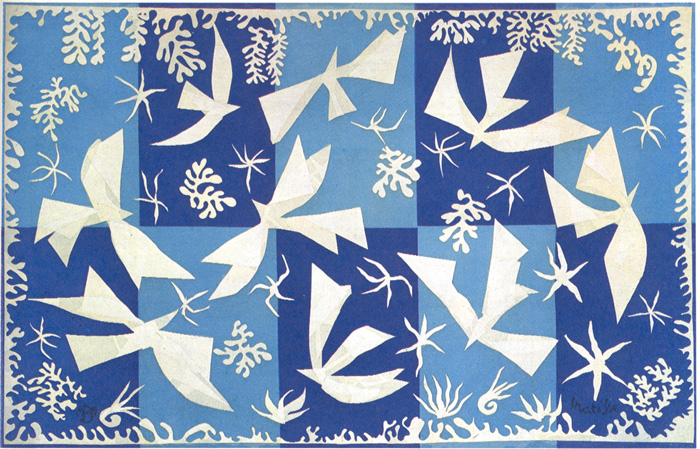 Henri Matisse, Polynesia, The Sky, 1946
Warhol’s initial inspiration for using the ubiquitous print came from his studio assistant Jay Shriver who had been experimenting with painting through this mesh. Of all his series of silkscreen paintings Warhol embraced perhaps the most variety in his use of screens and colors, working originally on a number of tracings from a single swatch of military fabric. At Rupert Smith’s silkscreen studio, Warhol would take great direction over the placement and composition of the screens. Whilst the overall effect is perhaps the most clean-cut amongst his oeuvre, the camouflage pattern allowed Warhol to experiment and exploit the potential for variation within the screen-printing process as well as the ambiguity of signs.
In the later years the camouflage print became a favored motif for Warhol. Acting as an enigmatic ground it appears in other significant silkscreen paintings including the iconic self-portraits from the same year, versions of which reside in the Metropolitan Museum of Art New York and the Philadelphia Museum of Art. In the present work the calming blues imbue the surface with a definite tranquility evocative of art historical references from Chinese landscapes to Monet’s Water Lilies. By arranging discrete fields of color, Warhol references the iconic late cut-outs of Henri Matisse. Exemplified in the masterpiece Polynesia, the Sky from 1946, Matisse’s revolutionary construction of varied mono-tone blue fields provided an abstracted evocation of the natural world. Echoing Matisse’s masterful flattening of perspective and mystification of viewpoint, Warhol indulges in the play between the entrenched cultural and immediate tonal connotations of a blue camouflage print: simultaneously it can be read as land, sea and sky, neatly articulating the endless ambiguity of seemingly clear-cut signs.
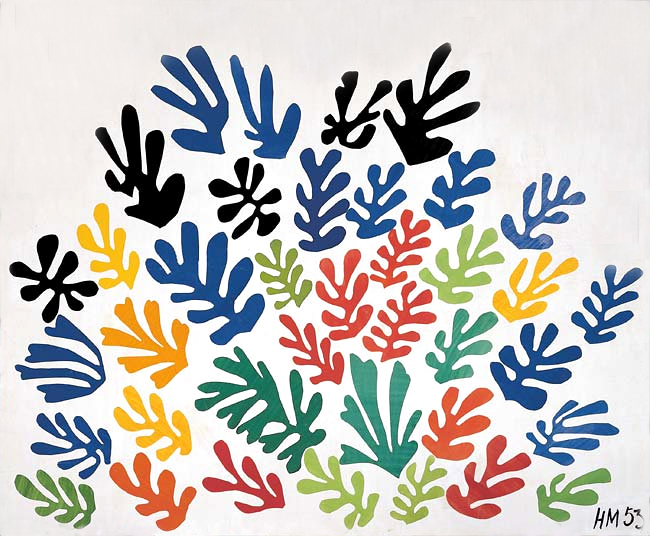
Henri Matisse, La Gerbe, 1953
The Camouflage paintings are among Warhol’s most technically demanding works. They were made at Rupert Smith’s silk-screening studio under the constant supervision of Warhol, who would discuss, in-depth, the progress of each canvas. Warhol would personally place the screens upon the canvas, intentionally positioning them off center and overlapping the edges. Four colors of ink were then selected and squeezed or brushed on by hand, with varying densities and pressures giving rise to a rich surface texture. Warhol’s intention was not to replicate the precision of the original army fabric, but rather to build on the potential for variation latent in the silk-screening process.
“With silk-screening, you pick a photograph, blow it up, transfer it in glue onto silk, and then roll ink across it so the ink goes through the glue. That way you get the same image, slightly different, each time. It was all so simple, quick and chancy. I was thrilled with it.”
The last two years of Warhol’s life were arguably both his busiest and his most trying, as he faced declining health; a stark reminder of the mortality which had been a longstanding obsession of his career.
Auction Results (Chronological)
Camouflage, 1986-87
Sotheby’s London: 4 March 2025
Estimated: GBP 1,800,000 – 2,500,000
GBP 2,480,000 / USD 3,174,400
Camouflage | Modern & Contemporary Evening Auction | 2025 | Sotheby’s
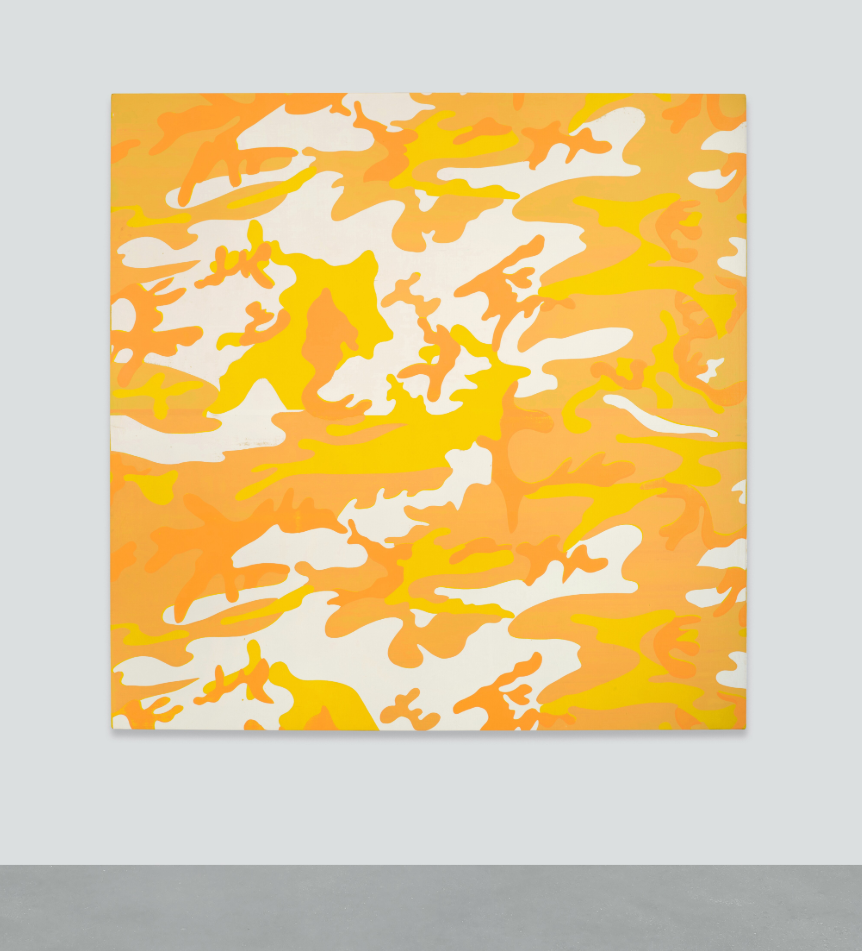
ANDY WARHOL (1928 – 1987)
Camouflage, 1986-87
Acrylic and silkscreen ink on canvas
76 1/4 x 76 1/4 inches (193.7 x 193.7 cm)
Stamped by The Estate of Andy Warhol and by The Andy Warhol Foundation for the Visual Arts
Numbered PA85.040 three times on the overlap
Camouflage, 1986
Christie’s New-York: 22 November 2024
Estimated: USD 600,000 – 800,000
USD 730,800
ANDY WARHOL (1928-1987), Camouflage | Christie’s
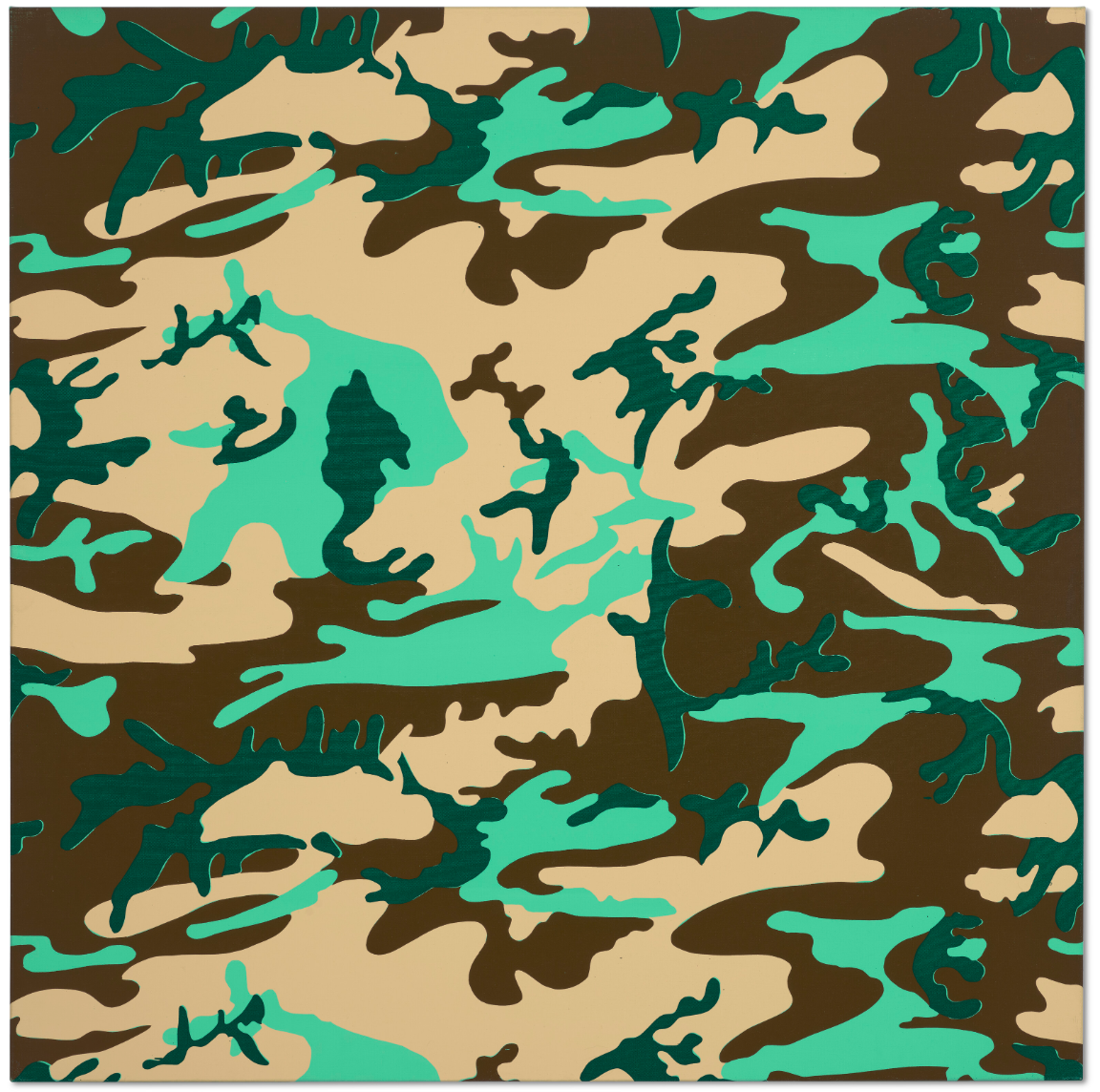
ANDY WARHOL (1928-1987)
Camouflage, 1986
Acrylic and silkscreen ink on canvas
40×40 inches (101.6 x 101.6 cm)
Stamped twice with the Andy Warhol Foundation for the Visual Arts, Inc. and the Estate of Andy Warhol stamps and numbered ‘VF PA85.006′ (on the overlap)
Numbered again ‘PA85.006’ (on the stretcher)
Camouflage, 1986
Christie’s New-York: 17 May 2024
Estimated: USD 60,000 – 80,000
USD 52,920
ANDY WARHOL (1928-1987), Camouflage | Christie’s (christies.com)
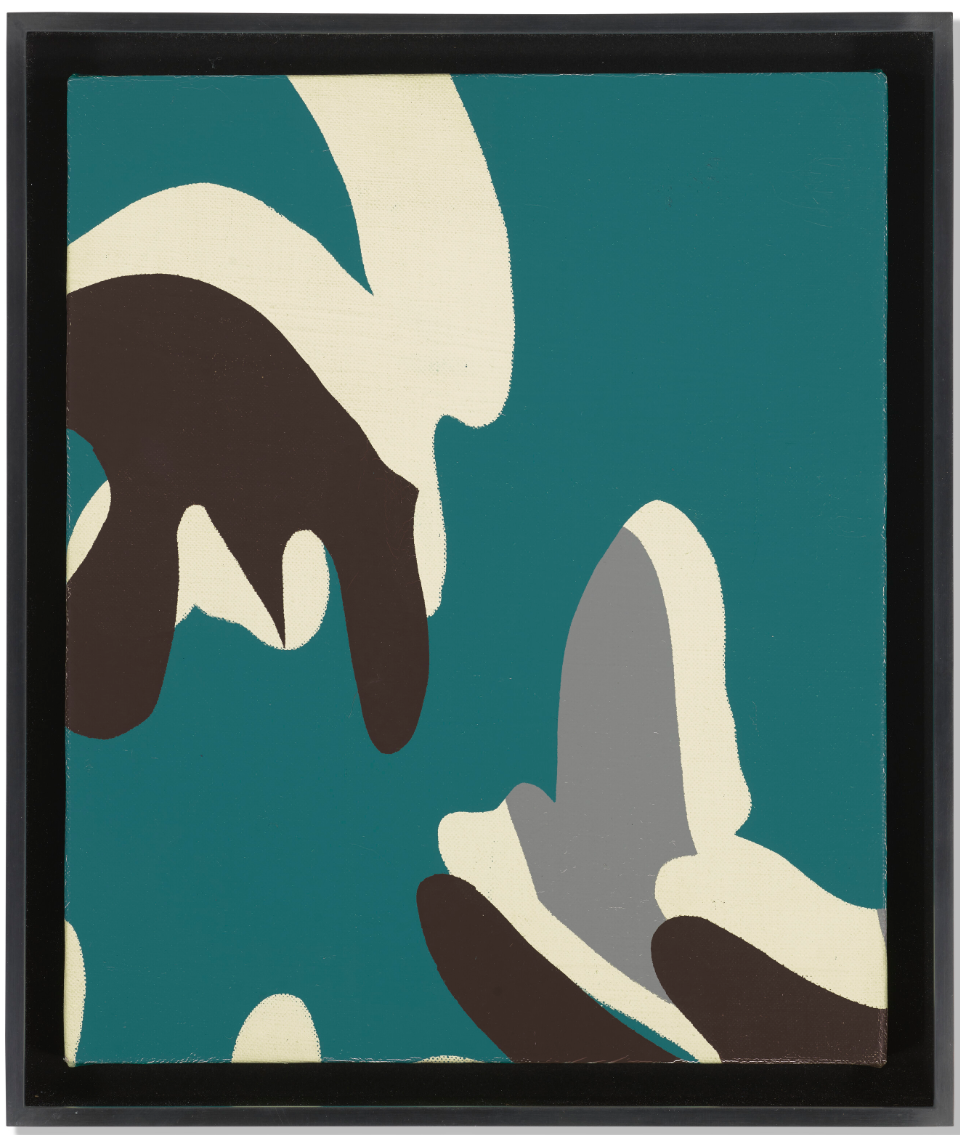
ANDY WARHOL (1928-1987)
Camouflage, 1986
Acrylic and silkscreen ink on canvas
12×10 inches (30.5 x 25.4 cm)
Stamped with the Estate of Andy Warhol and the Andy Warhol Foundation for the Visual Arts, Inc. stamps
Numbered ‘VF PA 85.054’ (on the overlap and on the stretcher)
Stamped again with the Andy Warhol Foundation for the Visual Arts, Inc. stamp (on the reverse)
Monumental Camouflage (80×400)
Camouflage, 1986
Sotheby’s New-York: 13 November 2013
Estimated: USD 2,500,000 – 3,500,000
USD 2,797,000
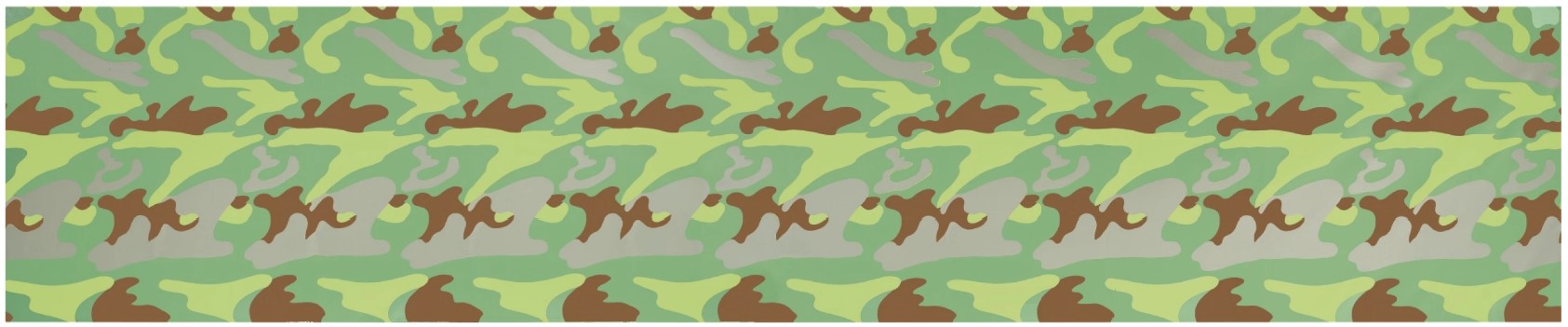 ANDY WARHOL
Camouflage, 1986
Acrylic on canvas
80 x 400 inches (203.2 x 1016 cm)
Spanning over thirty-three feet and reaching more than six feet high, Camouflage is engrossing in scale and mesmerizing in its seemingly limitless repetition. Warhol’s signature serialization aesthetic is flawlessly on display here in the seamless continuation of the camouflage pattern across the vast canvas. Inherently abstract, yet immediately recognizable and laden with distinct social and cultural significance, the camouflage design is transformed in the present work into an even more powerfully elegiac painting. Eerily prophetic of the artist’s death in 1987, it may be the final puzzle in what was a gloriously enigmatic life and body of work. The large scale Camouflage murals have a seductive and suggestive star quality that Warhol always desired, and thus it is fitting that these canvases convey one of his final bursts of creativity. Using a sample of fabric purchased from an Army surplus store as his subject, Warhol manipulates the inherent properties of the camouflage pattern to entirely obfuscate any artistic impulse towards figuration or narrative. In the present work Warhol wholly denies our attempts to glean any meaning from beneath the repeated pattern. Warhol’s genius for irony is seemingly most dramatic in the employment of disguise in the act of revelation. Here, the abstract images refuse revelation and through this denial, the artist appears to be, in the final analysis, unknowable to the viewer.
Camouflage, 1986
Sotheby’s New-York: 10 May 2011
Estimated: USD 1,500,000 – 1,800,000
USD 2,546,500
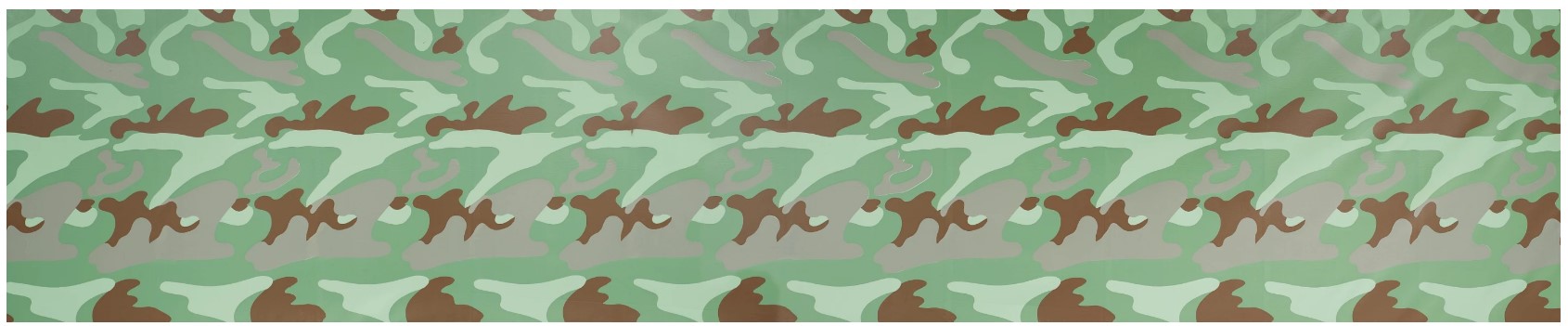
ANDY WARHOL
Camouflage, 1986
Acrylic on canvas
80 x 400 inches (203.2 x 1016 cm)
Camouflage, 1986
Sotheby’s New-York: 11 November 2008
Estimated: USD 3,000,000 – 5,000,000
USD 2,658,500
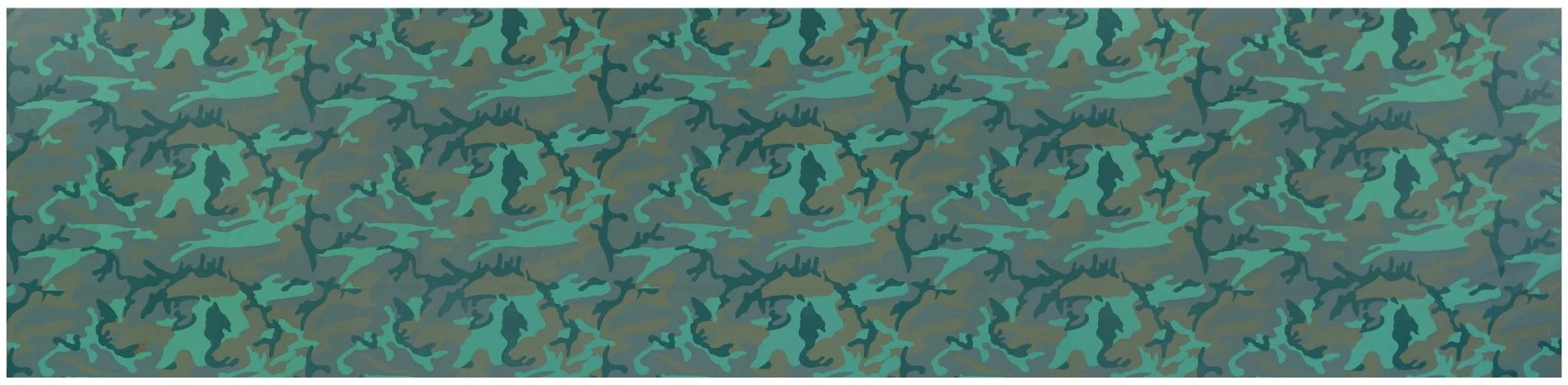 ANDY WARHOL
Camouflage, 1986
Synthetic polymer paint and silkscreen ink on canvas
116×420 inches (294.6 x 1066.8 cm)
Camouflage (76×76)
Camouflage, 1986-87
Sotheby’s London: 4 March 2025
Estimated: GBP 1,800,000 – 2,500,000
GBP 2,480,000 / USD 3,174,400
Camouflage | Modern & Contemporary Evening Auction | 2025 | Sotheby’s
ANDY WARHOL (1928 – 1987)
Camouflage, 1986-87
Acrylic and silkscreen ink on canvas
76 1/4 x 76 1/4 inches (193.7 x 193.7 cm)
Stamped by The Estate of Andy Warhol and by The Andy Warhol Foundation for the Visual Arts
Numbered PA85.040 three times on the overlap
Camouflage from 1987 stands as a seminal example of Andy Warhol’s final forays into abstraction. Executed in the twilight of his career, shortly before his untimely death – and after a decade dominated by celebrity portraiture (1978–1987) – the present work embodies a series of audacious experiments in reconfiguring the utilitarian motif of military camouflage into an exuberant declaration of aesthetic ingenuity. Employing a four-color pattern derived from a swatch of camouflage netting procured at an Army and Navy store on Fifth Avenue, Warhol elevates a design originally intended for concealment and survival into a bold emblem of contemporary culture. Presenting an ostensibly endless expanse of yellow and orange, the composition evokes both the brilliance of military insignia and the playful optimism that characterizes Warhol’s later oeuvre. Meticulous layering of paint and ink, combined with deliberate variances in the repetition of the pattern, produces a dynamic surface in which uniformity is subverted by the interplay of chance and process, thereby underscoring the intrinsic tension between control and spontaneity inherent in Warhol’s signature silkscreen medium. Acting as an enigmatic and unifying ground, Warhol’s Camouflage appears in other significant paintings including the iconic self-portraits from the same year, versions of which reside in the Metropolitan Museum of Art New York and the Philadelphia Museum of Art.
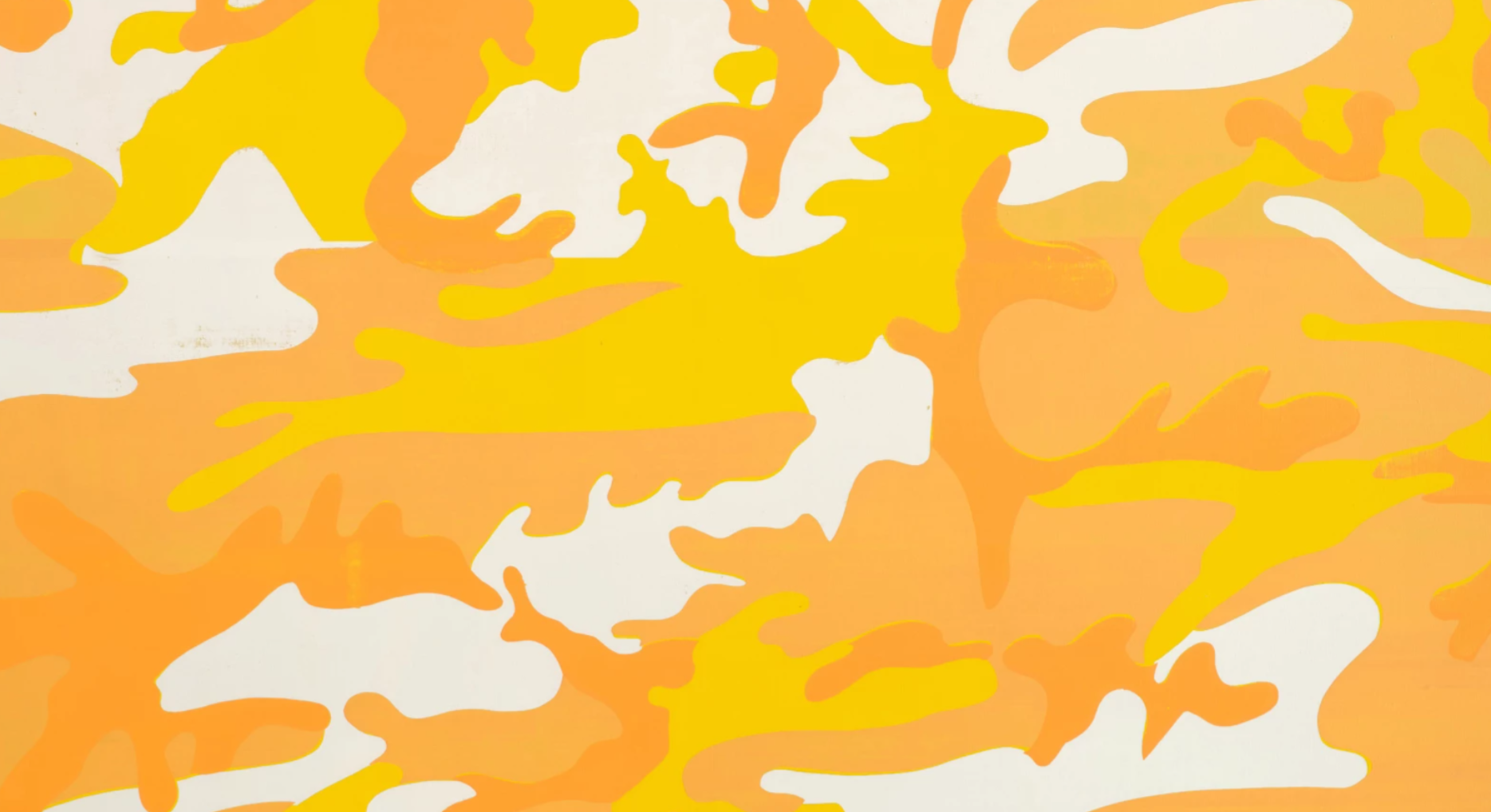
The Camouflage paintings are among Warhol’s most technically demanding works. Warhol’s initial inspiration for using the ubiquitous print came from his studio assistant Jay Shriver who had been experimenting with the material. Later executed at Rupert Smith’s silkscreening studio under the artist’s exacting supervision, Warhol personally placed the screens upon each canvas – intentionally positioning them off center and allowing their edges to overlap – before selecting four distinct ink colors, which were then either squeezed or brushed on by hand. The resulting interplay of vivid warm and acid yellows, and carefully orchestrated patterning not only exemplifies Warhol’s masterful draughtsmanship but also reflects his ongoing fascination with the potential for variation inherent in the silk-screening process.
“With silkscreening, you pick a photograph, blow it up, transfer it in glue onto silk, and then roll ink across it so the ink goes through the glue. That way you get the same image, slightly different, each time. It was all so simple – quick and chancy. I was thrilled with it”
For Warhol, the silk screening possessed an immediacy that imbued each work with an ephemeral quality; a fleeting glimpse into a moment of artistic spontaneity that, paradoxically, achieves a sense of enduring permanence. This duality, of precision and chance, of order and disruption, lies at the very heart of Warhol’s creative vision.
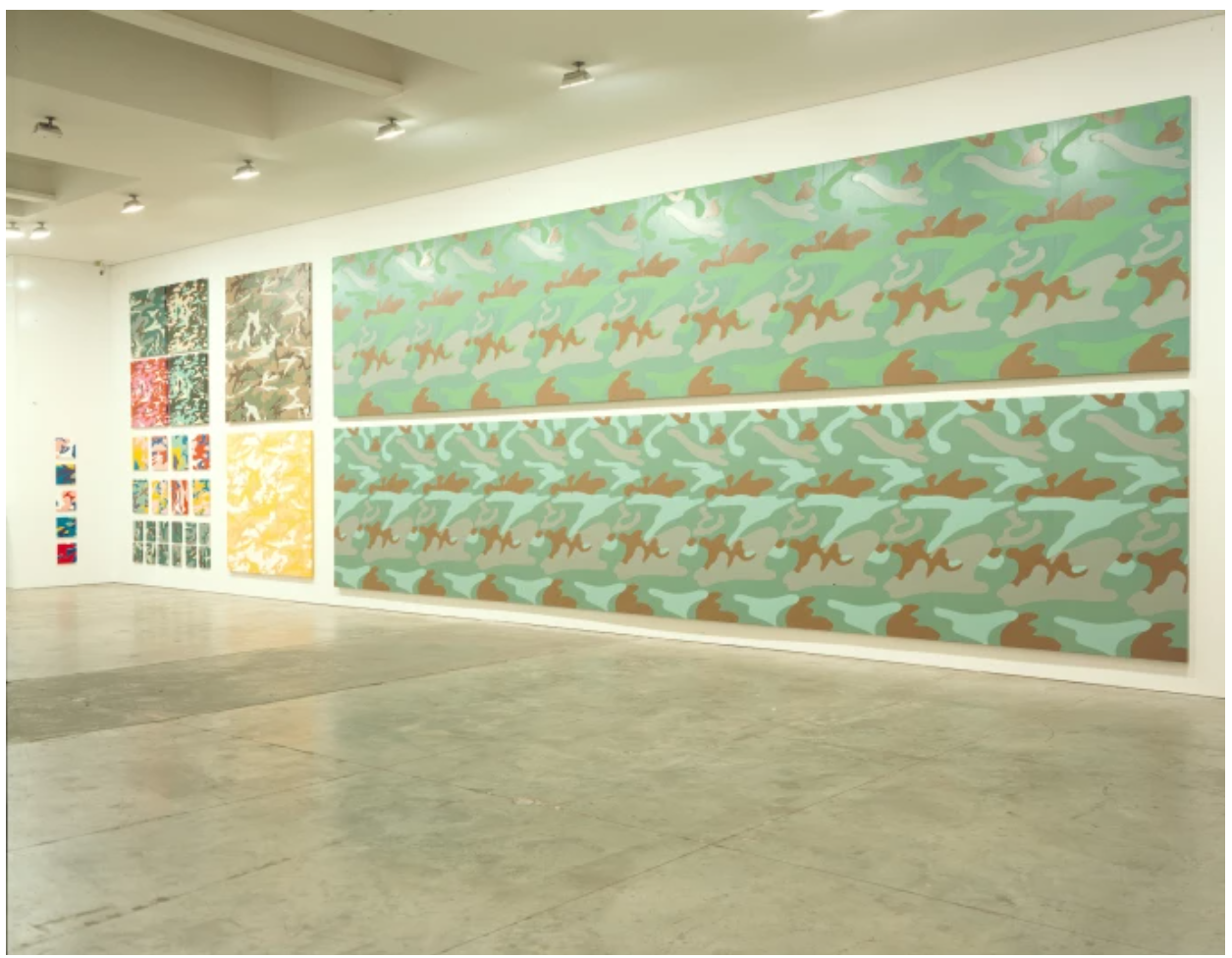
The present work exhibited in New York, Gagosian Gallery, Andy Warhol Camouflage, November 1998 – January 1999.
Photo: Rob McKeever. Courtesy Gagosian Robert McKeever
Deeply intrigued by the near-religious veneration afforded to painters such as Jackson Pollock and Mark Rothko, Warhol’s Camouflage series can be conceptually linked to his earlier Rorschach paintings and Oxidation series. Together, these bodies of work challenge the mystique of a self-proclaimed “non-referential” Abstract Expressionism; a movement that Warhol famously lampooned in the 1960s. In a masterful instance of visual wordplay, he repurposes the utilitarian army print to mount a sardonic critique of Abstract Expressionism, embracing an elemental pattern laden with associations of its original militaristic function and its subsequent adoption in fashion – Pop’s greatest ally. Much like Jasper Johns’ iconic Flag paintings, Camouflage functions within a paradoxical framework, simultaneously abstract and overtly referential. This duality reinforces Warhol’s persistent engagement with and exploration of a shared, mass-produced, and commercially driven visual language, highlighting his continued investment in the interplay between high art and popular culture.
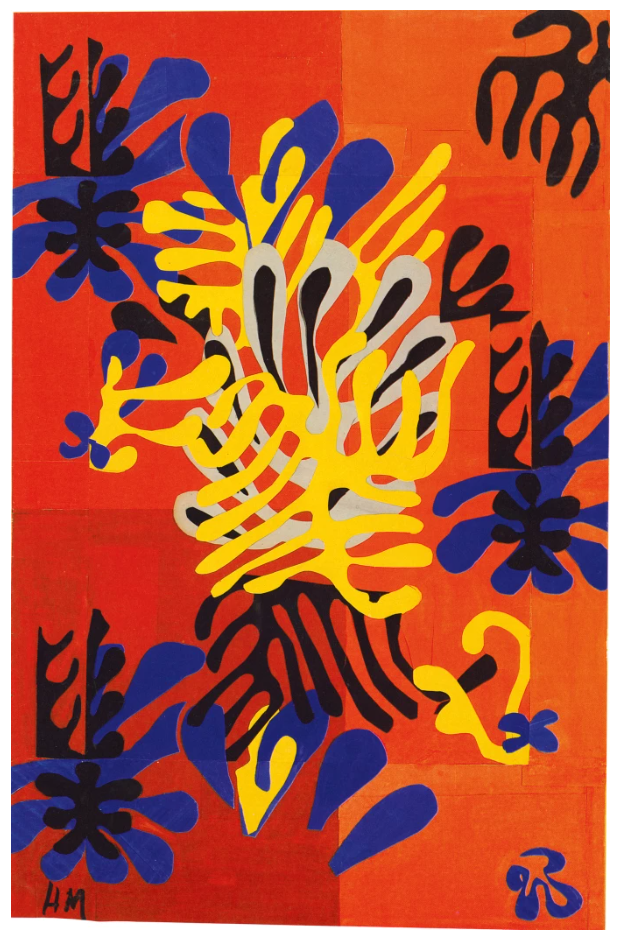
Henri Matisse, Mimosa, 1949. Ikeda Museum of 20th Century Art.
Warhol’s Camouflage series reveals a profound indebtedness to the aesthetic innovations of Henri Matisse. From his early days at Carnegie Tech – where he first encountered Matisse’s later cut-outs, notably Le Gerbe (1953) – Warhol absorbed the vibrant, curving lines and bold decorative patterns that would later inform his reimagining of the camouflage motif. The luminous, dynamic qualities of Matisse’s cut-outs find a resonant echo in Warhol’s layered silkscreen approach, where the interplay of ink produces a collage-like effect reminiscent of Matisse’s expressive environments. Frequent visits to New York, even while he resided in Pittsburgh, allowed Warhol to immerse himself in Matisse exhibitions, further cementing the influence of the French master on his evolving output. Warhol’s lyrical line drawings, intense use of color, and penchant for pattern-on-pattern designs attest to an enduring admiration for Matisse, a legacy indelibly woven into the fabric of his Camouflage series.
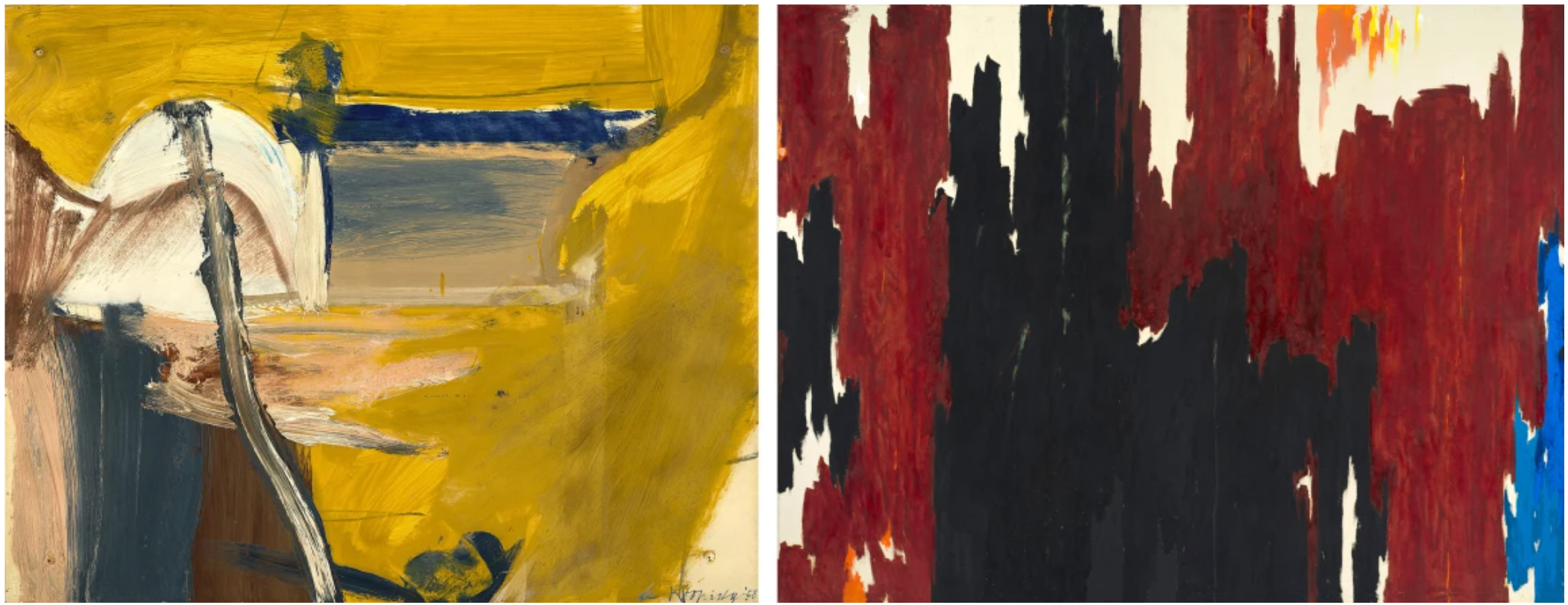
Left: Willem de Kooning, Untitled, 1958. Solomon R. Guggenheim Museum, New York. Image The Solomon R. Guggenheim Foundation Peggy Guggenheim Collection, Venice, 1976 Art © 2023 The Willem de Kooning Foundation/Artists Rights Society (ARS), New York
Right: Clyfford Still, Untitled, 1960. Metropolitan Museum of Art, New York.
Image: The Metropolitan Museum of Art/Art Resource/Scala, Florence
The last two years of Warhol’s life were arguably both his busiest and his most trying, as he faced declining health; a stark reminder of the mortality which had been a longstanding obsession of his career.
Camouflage (Blue), 1986
Sotheby’s New-York: 11 May 2016
Estimated: USD 2,500,000 – 3,500,000
USD 2,890,000
ANDY WARHOL
Camouflage (Blue), 1986
Acrylic and silkscreen ink on canvas
76×76 inches (193×193 cm)
Camouflage, 1987
Christie’s New-York: 12 May 2015
Estimated: USD 1,500,000 – 2,000,000
USD 2,285,000
Andy Warhol (1928-1987), Camouflage | Christie’s
ANDY WARHOL
Camouflage, 1987
Synthetic polymer and silkscreen inks on canvas
76×76 inches (193×193 cm)
Stamped with the Estate of Andy Warhol stamps and the Andy Warhol Authentication Board Inc. Numbered ‘PA85.040’ (on the overlap)
Christie’s New-York: 10 November 2010
USD 1,094,500
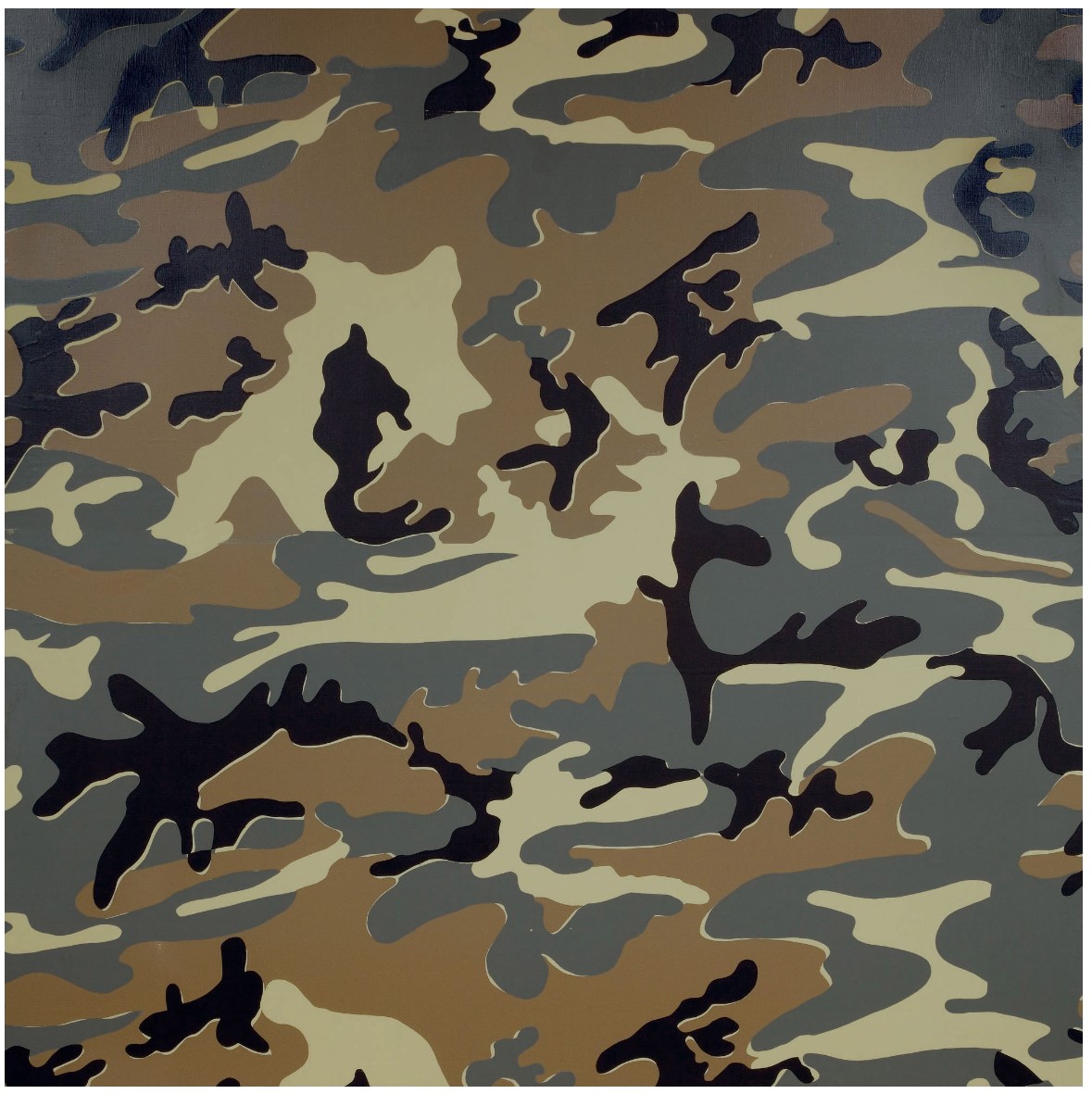
ANDY WARHOL
Camouflage, 1987
Synthetic polymer and silkscreen ink on canvas
72×72 inches (182.8 x 182.8 cm)
Stamped twice with the Estate of Andy Warhol stamps
Stamped twice with the Andy Warhol Foundation for the Visual Arts, Inc. stamps
Numbered ‘PA85.032’ (on the overlap)
Christie’s New-York: 15 May 2000
USD 193,000
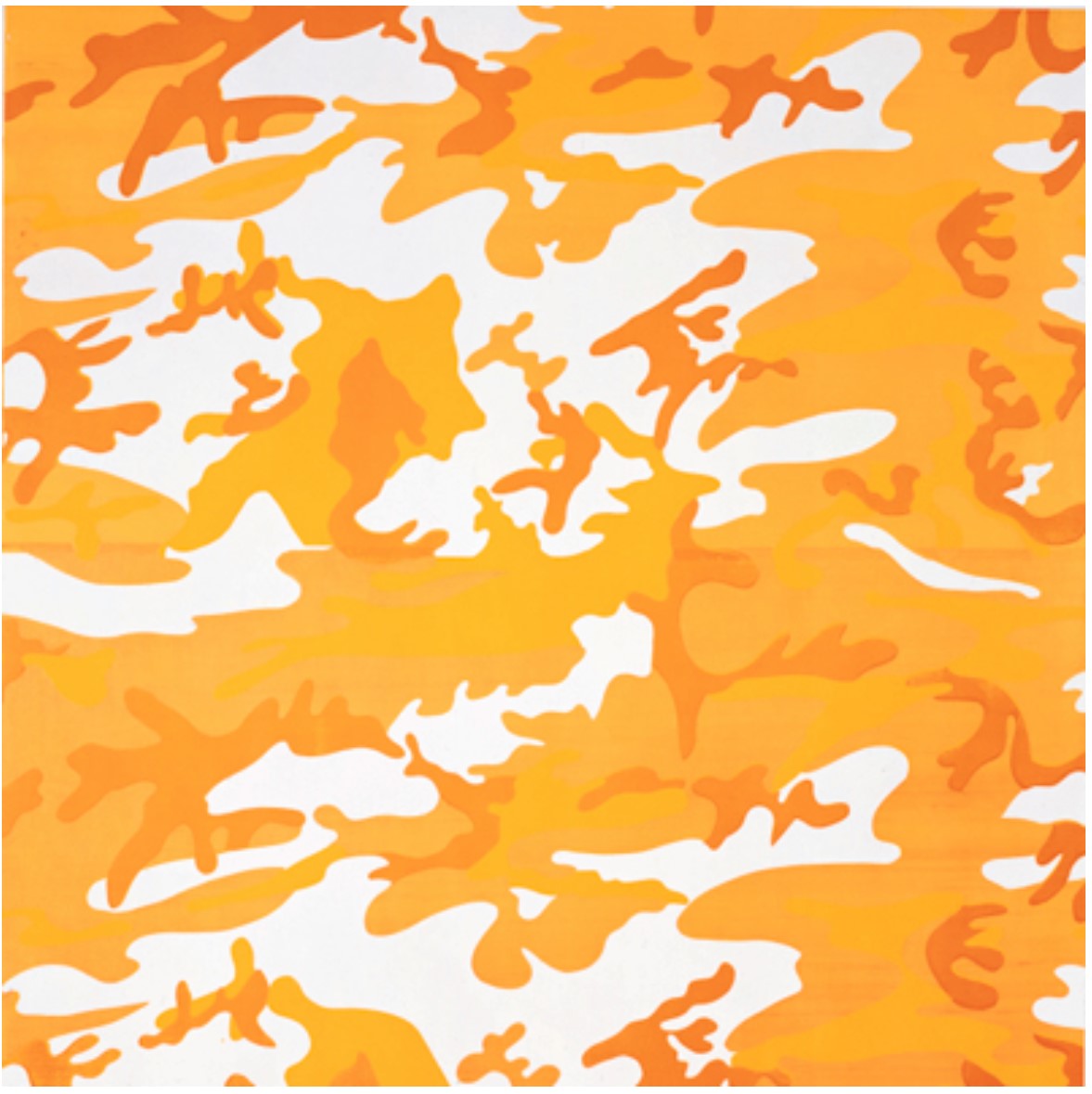
ANDY WARHOL
Camouflage, 1986
Synthetic polymer and silkscreen ink on canvas
72×72 inches (182.8 x 182.8 cm)
Camouflage (40×40)
Camouflage, 1986
Christie’s New-York: 22 November 2024
Estimated: USD 600,000 – 800,000
USD 730,800
ANDY WARHOL (1928-1987), Camouflage | Christie’s
ANDY WARHOL (1928-1987)
Camouflage, 1986
Acrylic and silkscreen ink on canvas
40×40 inches (101.6 x 101.6 cm)
Stamped twice with the Andy Warhol Foundation for the Visual Arts, Inc. and the Estate of Andy Warhol stamps and numbered ‘VF PA85.006′ (on the overlap)
Numbered again ‘PA85.006’ (on the stretcher)
Camouflage, 1987
Christie’s New-York: 12 May 2015
Estimated: USD 500,000 – 700,000
USD 737,000
Andy Warhol (1928-1987), Camouflage | Christie’s
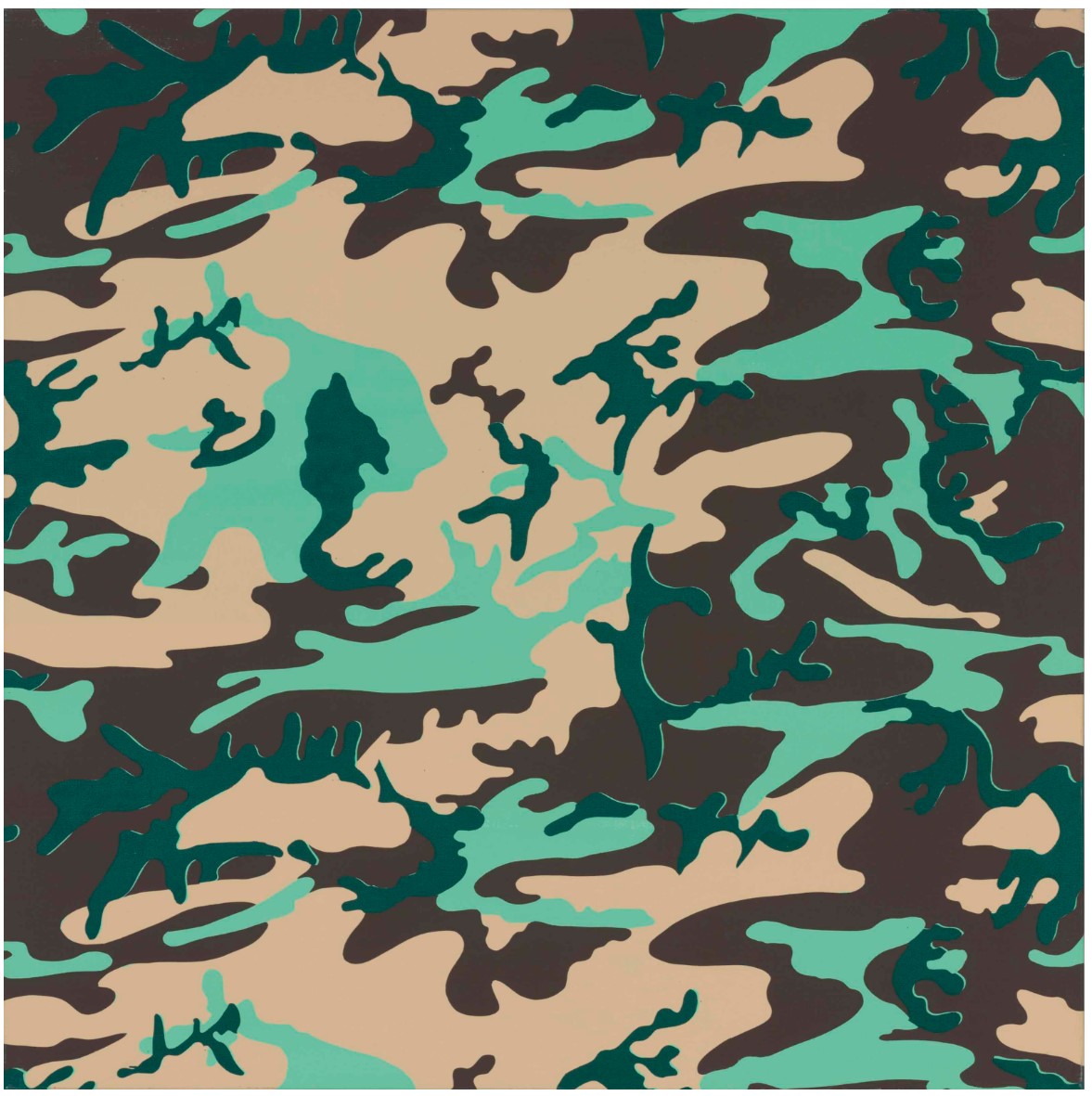
ANDY WARHOL
Camouflage, 1987
Synthetic polymer and silkscreen inks on canvas
40×40 inches (101.6 x 101.6 cm)
Stamped with the Estate of Andy Warhol stamp
Stamped twice with the Andy Warhol Authentication Board, Inc. stamp
Numbered ‘PA85.002’ (on the overlap)
Small Camouflage
Camouflage, 1986
Christie’s New-York: 14 November 2019
Estimated: USD 120,000 – 180,000
USD 187,500
Andy Warhol (1928-1987), Camouflage | Christie’s
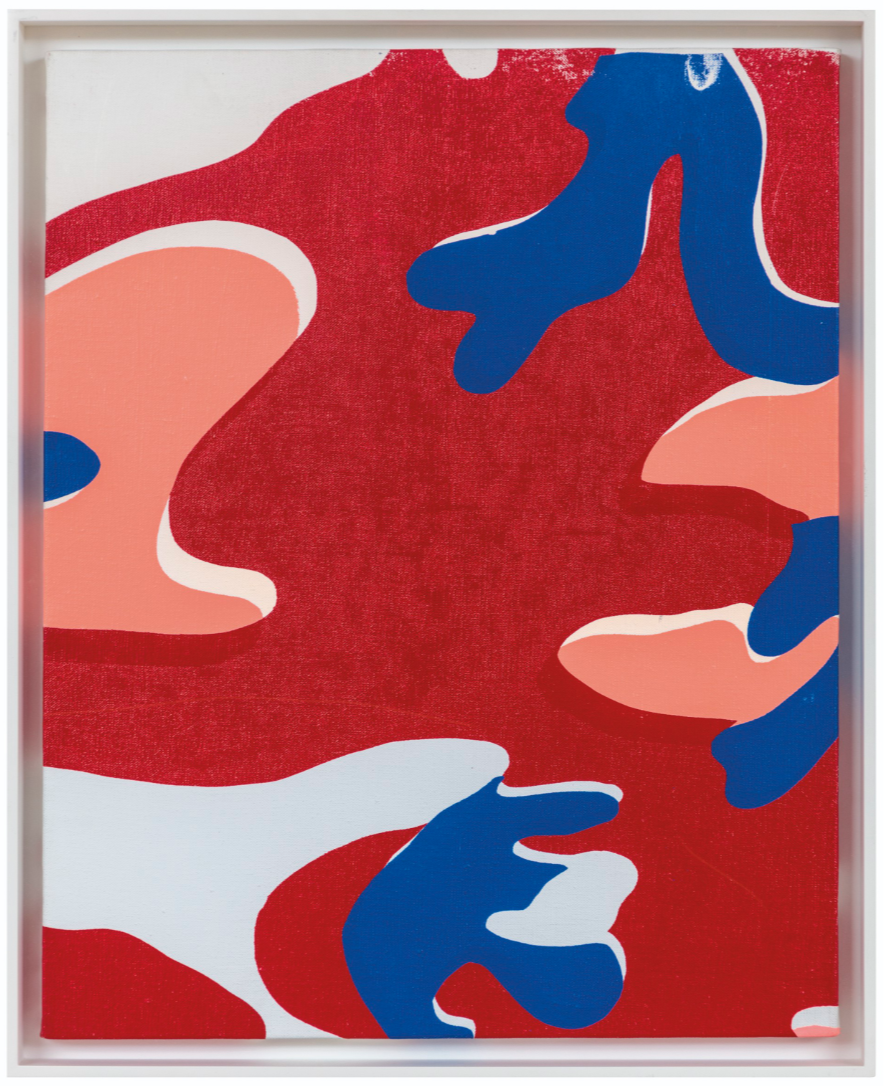
ANDY WARHOL
Camouflage, 1986
Acrylic and silkscreen ink on canvas
20×16 inches (50.8 x 40.6 cm)
Stamped with the Estate of Andy Warhol and the Andy Warhol Foundation for the Visual Arts, Inc. Numbered ‘VF PA85.021’ (on the overlap)
Camouflage, 1986
Christie’s New-York: 18 May 2018
Estimated: USD 50,000 – 70,000
USD 100,000
Andy Warhol (1928-1987), Camouflage | Christie’s
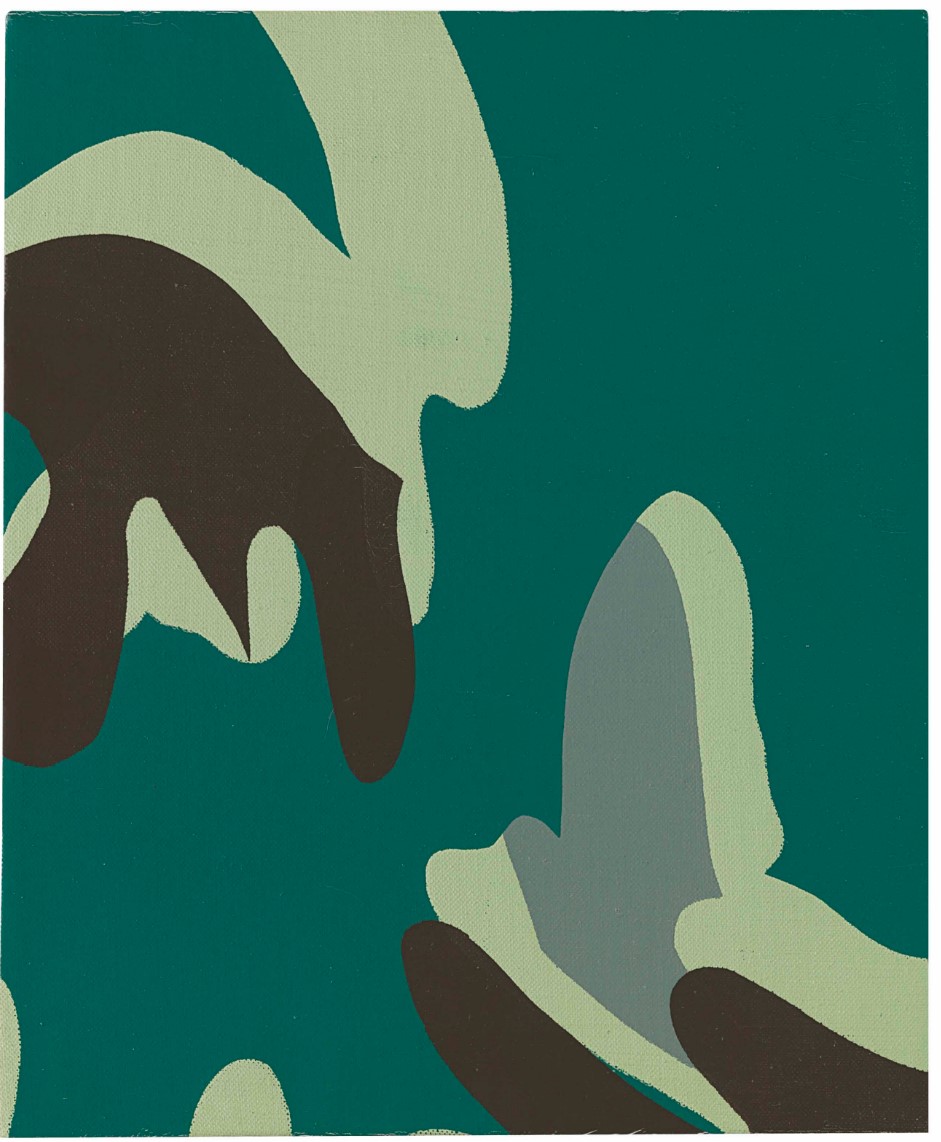
ANDY WARHOL
Camouflage, 1986
Synthetic polymer and silkscreen inks on canvas
11 7/8 x 9 7/8 inches (30.1 x 25 cm)
Stamped with the Estate of Andy Warhol stamp and the Andy Warhol Foundation for the Visual Arts, Inc.
Numbered ‘PA 85.054’ (on the overlap)
Numbered again ‘PA 85.054’ (on the stretcher)
Stamped again with the Andy Warhol Foundation for the Visual Arts, Inc. stamp (on the reverse)
Camouflage, 1986
Christie’s New-York: 28 September 2017
Estimated: USD 50,000 – 70,000
USD 143,750
Andy Warhol (1928-1987), Camouflage | Christie’s
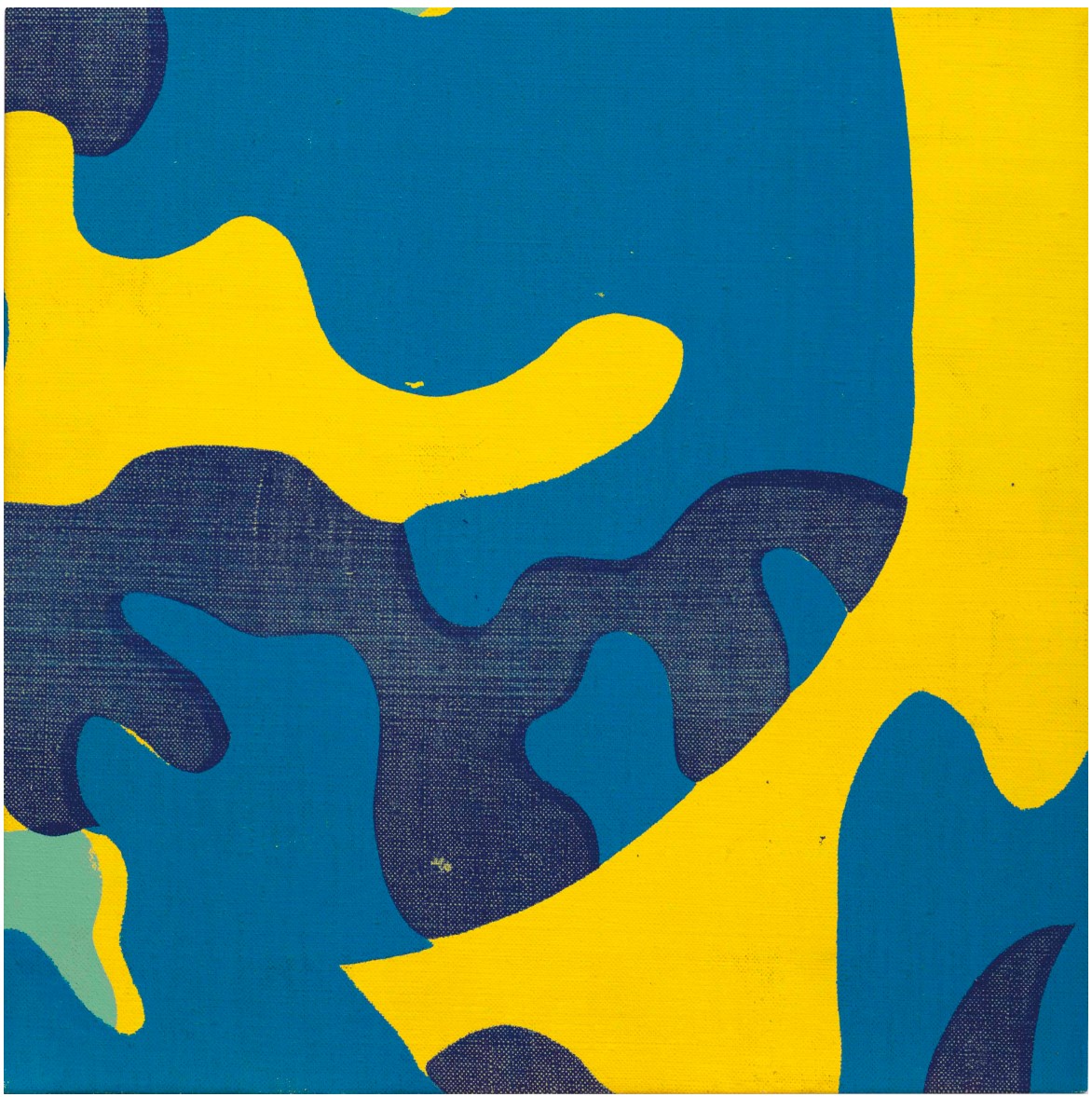
ANDY WARHOL
Camouflage, 1986
Acrylic and silkscreen inks on canvas
12×12 inches (30.5 x 30.5 cm)
Signed, dedicated and dated ‘Paige/ Andy Warhol 86’ (on the overlap)
Stamped with the Estate of Andy Warhol and the Andy Warhol Foundation for the Visual Arts, Inc. Numbered ‘A104.122’ (on the overlap)
Camouflage, 1983
Christie’s New-York: 28 September 2017
Estimated: USD 40,000 – 60,000
USD 62,500
Andy Warhol (1928-1987), Camouflage | Christie’s
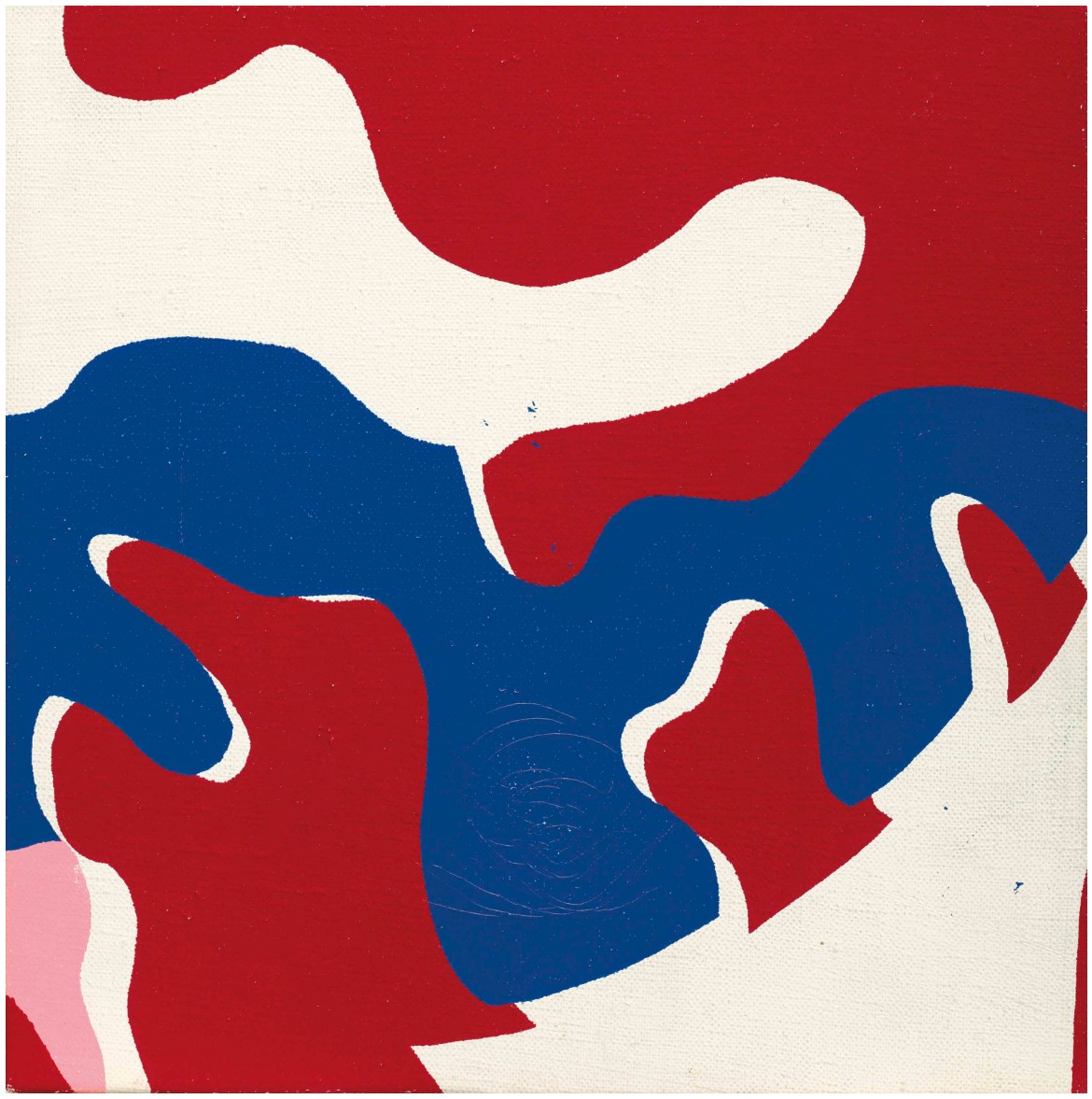
ANDY WARHOL
Camouflage, 1983
Acrylic and silkscreen inks on canvas
9×9 inches (22.9 x 22.9 cm)
Signed, dedicated and dated ‘Paige/ Andy Warhol 83’ (on the overlap)
Stamped with the Estate of Andy Warhol and the Andy Warhol Foundation for the Visual Arts, Inc. Numbered ‘A103.122’ (on the overlap)