Andy Warhol’s obsession with iconic images and brand-name celebrities led him to appropriate famous paintings by other artists as a means of exploring the constructs of fame and legacy themselves. Over the years, Warhol chose subjects that allowed him to explore the duality of public perception and self-projection and his most enduring images resonate with these ideas of identity. Warhol’s depictions of other artists’ works, including Woman in Blue (After Matisse), offer an intriguing play upon this familiar theme and an opportunity to interpret, transform and even commodify the art of his predecessors.
In the early 1980s Warhol produced a number of works based upon the works of Leonardo da Vinci, Pablo Picasso, Edvard Munch and Henri Matisse, among others. These paintings were often faithful reproductions albeit flattened by the silkscreen process and candy colors. Deceptively simple, Warhol’s interpretations of these masterpieces acknowledge their status as commodities -both the works and their creators. Warhol’s version of da Vinci’s Mona Lisa, for example, presents her as a Pop culture phenomenon and cash cow on par with Elizabeth Taylor and Jacqueline Kennedy. Warhol’s paintings of paintings, and their source material, are instantly recognizable; they are high art, and high value, versions of the museum posters owned by millions of people around the world.
From the earliest days of his career, Andy Warhol had a strong appreciation for—and encyclopedic knowledge of—art history. Beginning in 1963 with his reproduction of Leonardo Da Vinci’s Mona Lisa in a series of several paintings, the Pop artist would often return to the annals of visual art for source material.
The genius behind Warhol’s art historical references lies not in his ability to accurately duplicate his predecessors (he left that to the precision of his screening), but to start a conversation about iconic works of art and their place within the cultural consciousness. Like advertising images, logos, or celebrity headshots, famous works of art transcend the museum space and the dusty art historical tome. They take up residence in the present, stripped of many previous allusions and instead existing as icons to be revered, copied, referenced, and put on dorm room posters. They are separated from their referents by so many steps that the aura of the original metamorphoses into something greater than the singular image itself. Warhol understood this transferal of meaning, and through his paintings sought to level the playing field.
“If you want to know all about Andy Warhol, Just look at the surface: of my paintings and films and me, and there I am. There’s nothing behind it.”
Throughout his career, Warhol consistently equated himself to his work and vice versa. His predilection for mass-media tropes and mechanical processes may seem at odds with the highly emotive oeuvre of Edvard Munch, but the two artists had a shared appreciation for tumultuous love and their own mortality. Hidden behind the iconic, oft-reproduced surfaces of their works is a deeply somber inquiry into humanity itself.
Pablo Picasso
Head (After Picasso), 1985
Sotheby’s New-York: 16 November 2023
Estimated: USD 1,000,000 – 1,500,000
USD 2,359,000
Head (After Picasso) | Contemporary Day Auction | 2023 | Sotheby’s (sothebys.com)
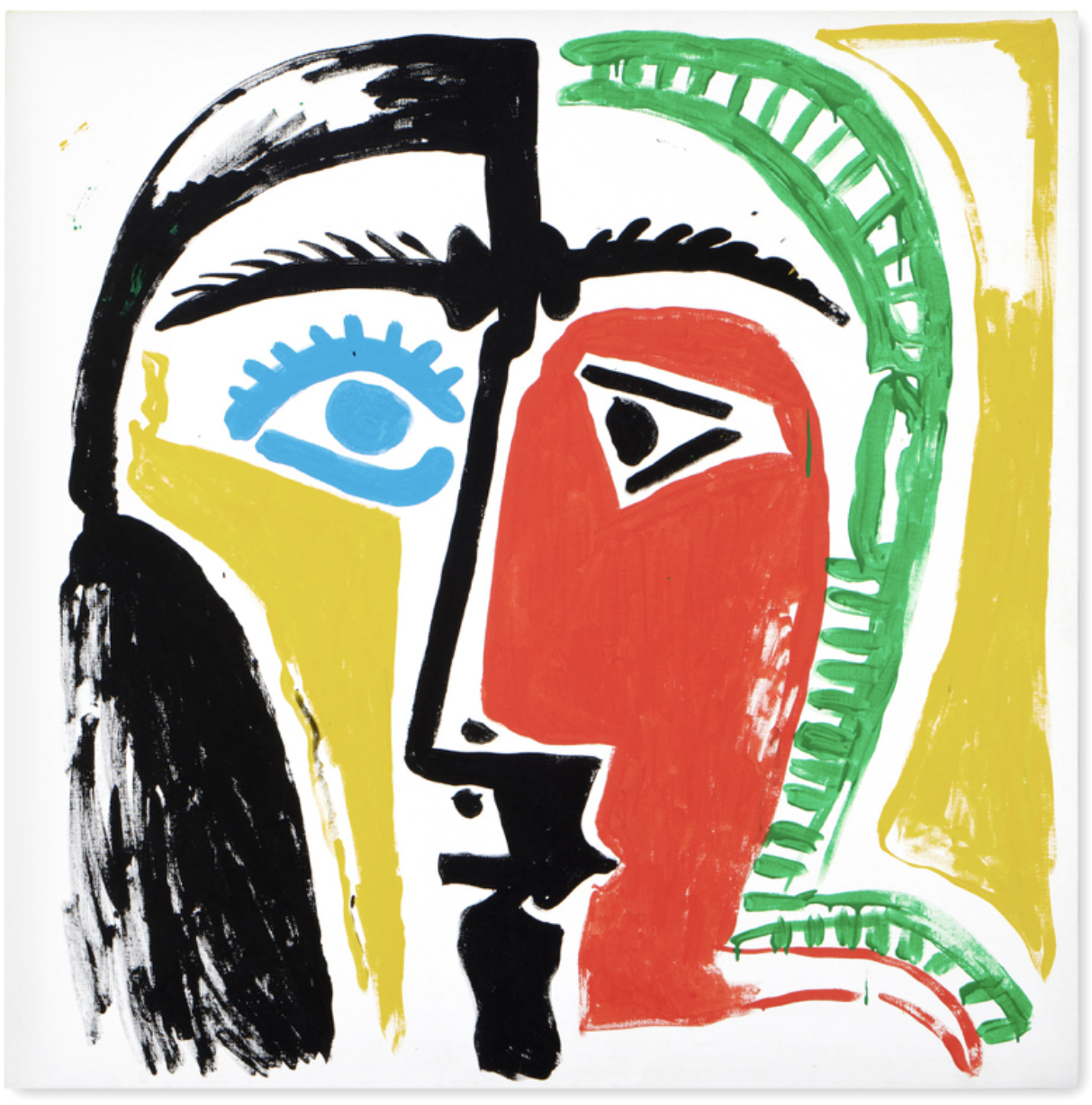
ANDY WARHOL (1928 – 1987)
Head (After Picasso), 1985
Acrylic on canvas
50×50 inches (127×127 cm)
Stamped by the Estate of Andy Warhol and the Andy Warhol Foundation for the Visual Arts Inc., New York and numbered PA37.022 on the overlap
A spectacular convergence between two of history’s most significant artists – Andy Warhol and Pablo Picasso – the present work, Head (After Picasso) from 1985, is an exceptional and conceptually profound work from the latter part of Andy Warhol’s career.
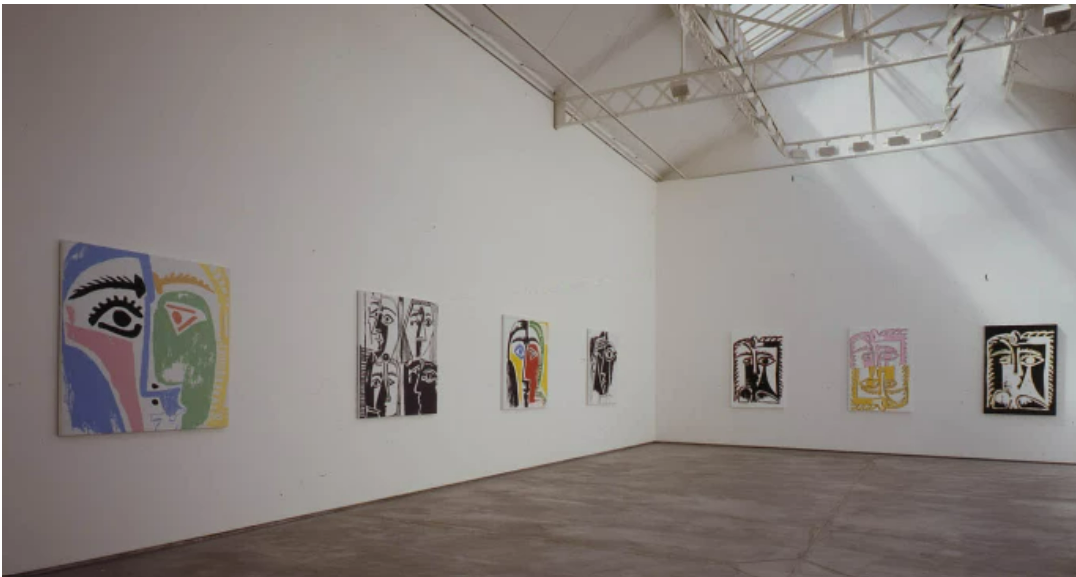
THE PRESENT WORK EXHIBITED AT PARIS, THADDAEUS ROPAC, ANDY WARHOL HEADS (AFTER PICASSO), MAY – JULY 1997.
Warhol’s first foray in painting from the art historical canon was in 1963 when he reproduced Leonardo’s Mona Lisa – undoubtedly the most famous face in all of art history. Exhibited at the Metropolitan Museum in New York the work attracted significant media attention, the fact of which drew in Andy Warhol more so than the painting itself. Warhol subsequently revisited many of the most renowned and recognized works in the history of art by Sandro Botticelli, Edvard Munch, Henri Matisse and Pablo Picasso by repainting, repeating, and renewing these masterpieces in his distinctive and revolutionary aesthetic. When asked whether there is a difference between images taken from advertising, as he had done in his works from the 1960s and 70s, and those taken from art history, Warhol stated, “They are both images. One relates to products, the other to people, or historical events. Both are means of communication… I watch advertising just as much as I go to museums.” (Warhol verso de Chirico, New York, 1982, pp. 48-49).
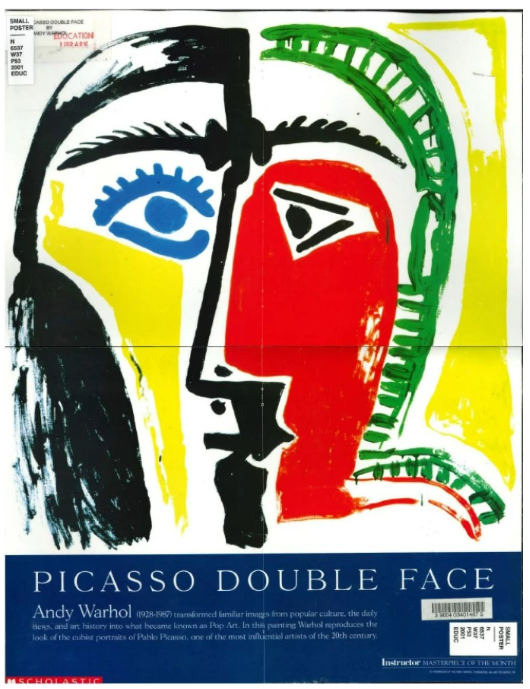
THE PRESENT WORK USED AS A FLYER INSERT IN A SCHOLASTIC INSTRUCTOR MANUAL FOR A SERIES ENTITLED MASTERPIECE OF THE MONTH
Following a period of collaboration with Jean-Michel Basquiat in the mid-1980s, Warhol’s enjoyment for painting was revived and led him to an intensive study of Picasso’s work which eventually culminated in this series of Head (After Picasso). Taking as his point of departure Pablo Picasso’s work on paper, Tête, from 1960 (Christian Zervos, Pablo Picasso, Vol. XIX, no. 392, p. 188, illustrated), Warhol reproduced the image in vibrant reds, greens and yellows onto canvas. For this series, however, Warhol’s method differed significantly from his usual practice of screenprinting which had dominated his practice since the early 1960s. Here, Warhol instead projected a transparency onto the canvas of the black and white reproduction of Picasso’s original picture and sketched an outline of the enlargement. Rather than copying it intricately, Warhol instead used brushy and boldly interpretative strokes to retrace the contours and of the figure. The result is an almost poetic conflagration of the painterly and the precise. Warhol’s bold use of primary colors to present a Tête de femme which is so gesturally wrought results in something entirely unique. Neither entirely Warhol, nor entirely Picasso, Head (After Picasso) encourages us to think critically about Warhol’s artistic project. Here Warhol is encouraging us to reconsider portraiture, which historically in his output is a reflection on a particular person, a celebrity or society dilettante and their specific identity. In Head (After Picasso), Warhol is entirely redefining the context for this portrait, concerned with neither the identity of the sitter nor their comportment, but rather the loss of original identity through a physical and conceptual transformation.
Head (After Picasso), 1985
Christie’s New-York: 15 May 2002
Estimated: USD 60,000 – 80,000
USD 65,725
ANDY WARHOL (1928-1987) , Head (After Picasso) | Christie’s
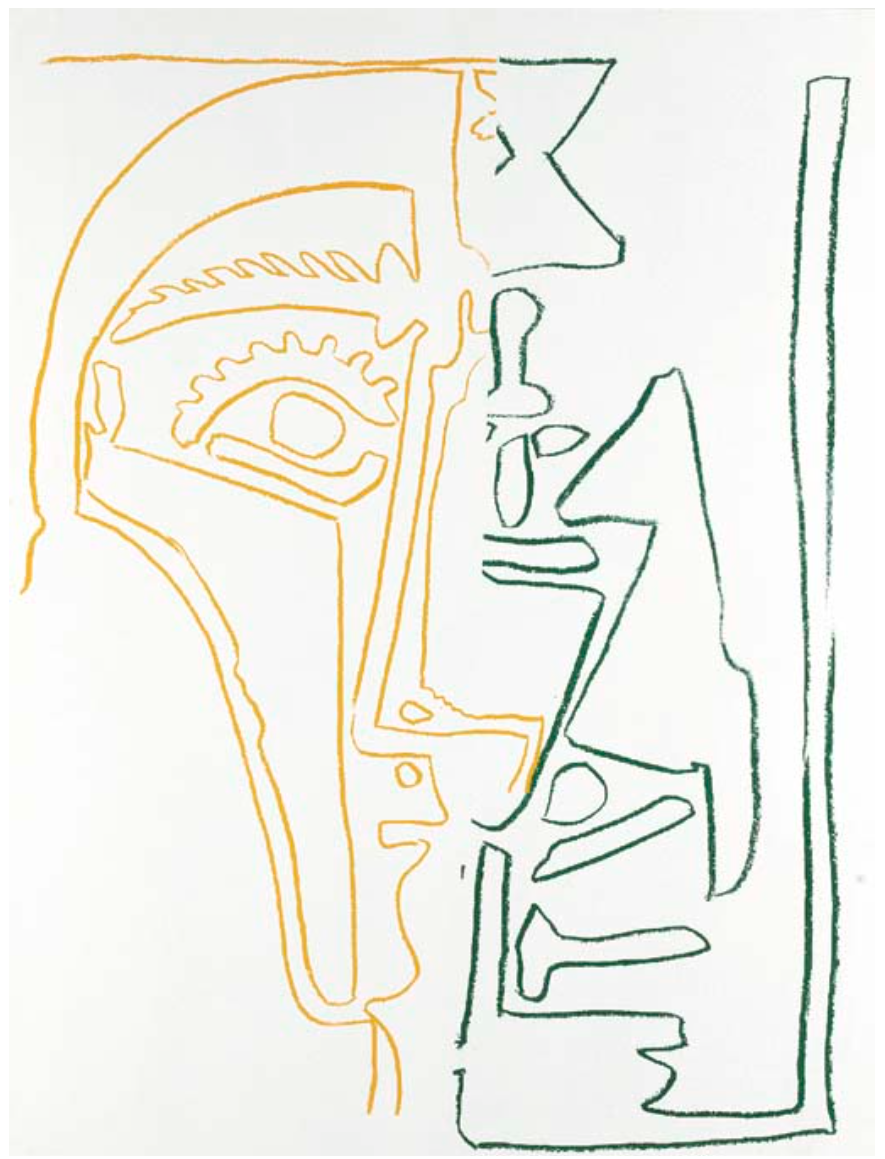
ANDY WARHOL (1928-1987)
Head (After Picasso), 1985
Synthetic polymer and silkscreen inks on canvas
47×36 inches (119.4 x 91.5 cm)
Stamped once with the Estate of Andy Warhol and twice with the Andy Warhol Foundation for the Visual Arts stamps and numbered PA37.001 (on the overlap)
Edvard Munch
1. Eva Mudocci (After Munch)
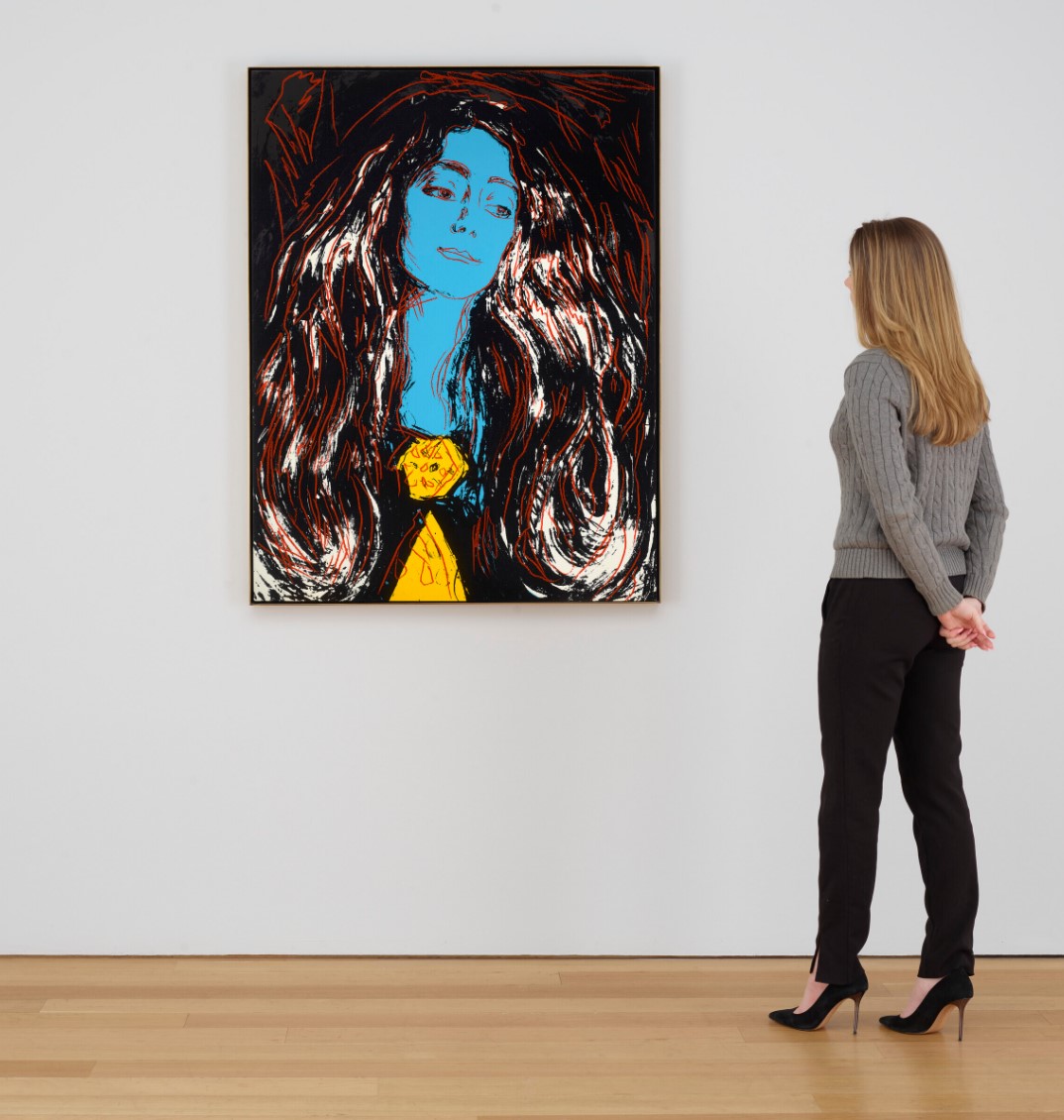
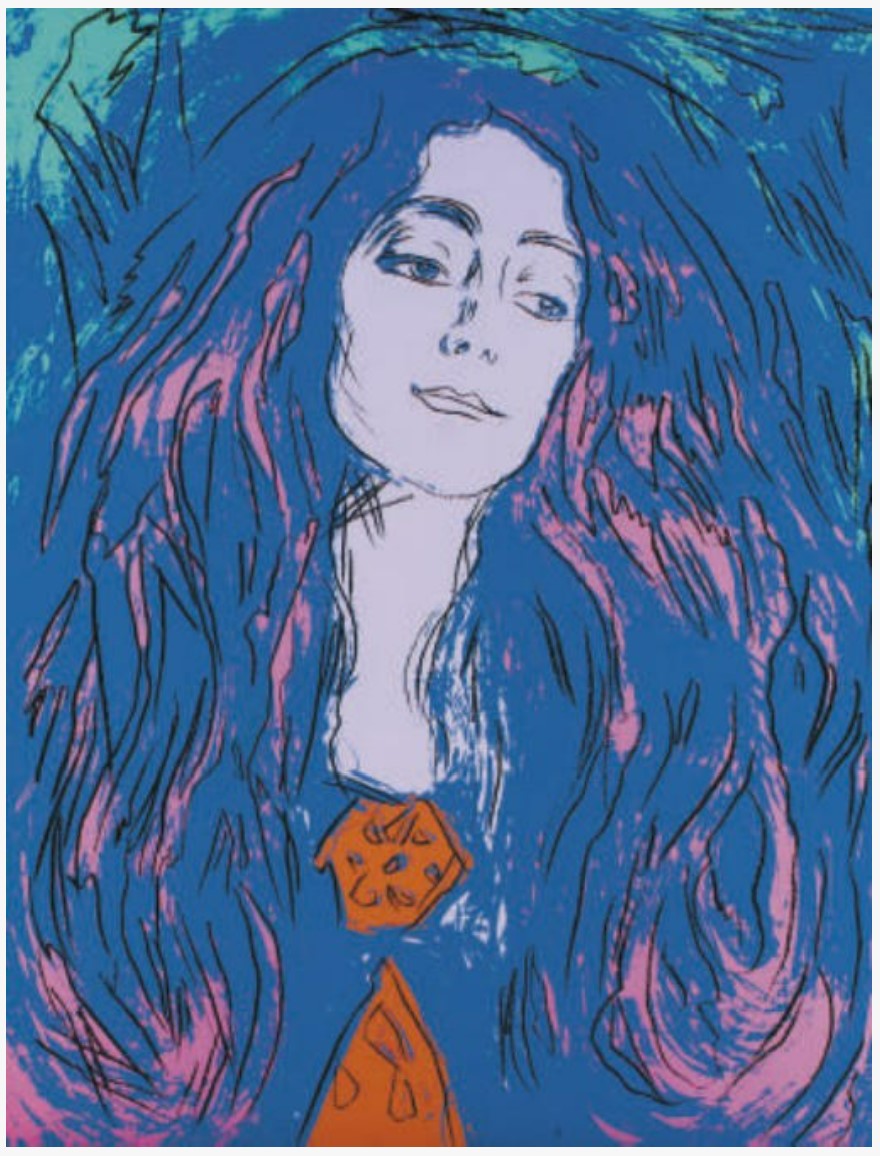
The highly emotive Eva Mudocci (After Munch) is a prime example of Warhol’s interest in translating and digesting works by other artists through his own unique processes. He found himself drawn to the Norwegian painter Edvard Munch on more than one occasion, and the present work is a testament to Warhol’s ability to coax a radical mix of emotive vibrancy and machine-like precision from the famous original.
“The reason I’m painting this way is that I want to be a machine, and I feel that whatever I do and do machine-like is what I want to do.”
Actively railing against the dramatic tendencies of the Abstract Expressionists, Warhol sought to separate himself from the drippy, splashy emotions of his forebears by embracing mass production and reproductive techniques like silkscreening. He operated in a more democratic mode, making ‘high’ art into something more accessible to a population already familiar with works like Botticelli’s Venus, Leonardo’s Last Supper, or Munch’s The Scream while also elevating Hollywood celebrities and Campbell’s soup labels to the level of art historical canon. Warhol often eschewed machismo and ego-driven connections in his art in favor of works that appealed to and resonated with a broad audience.
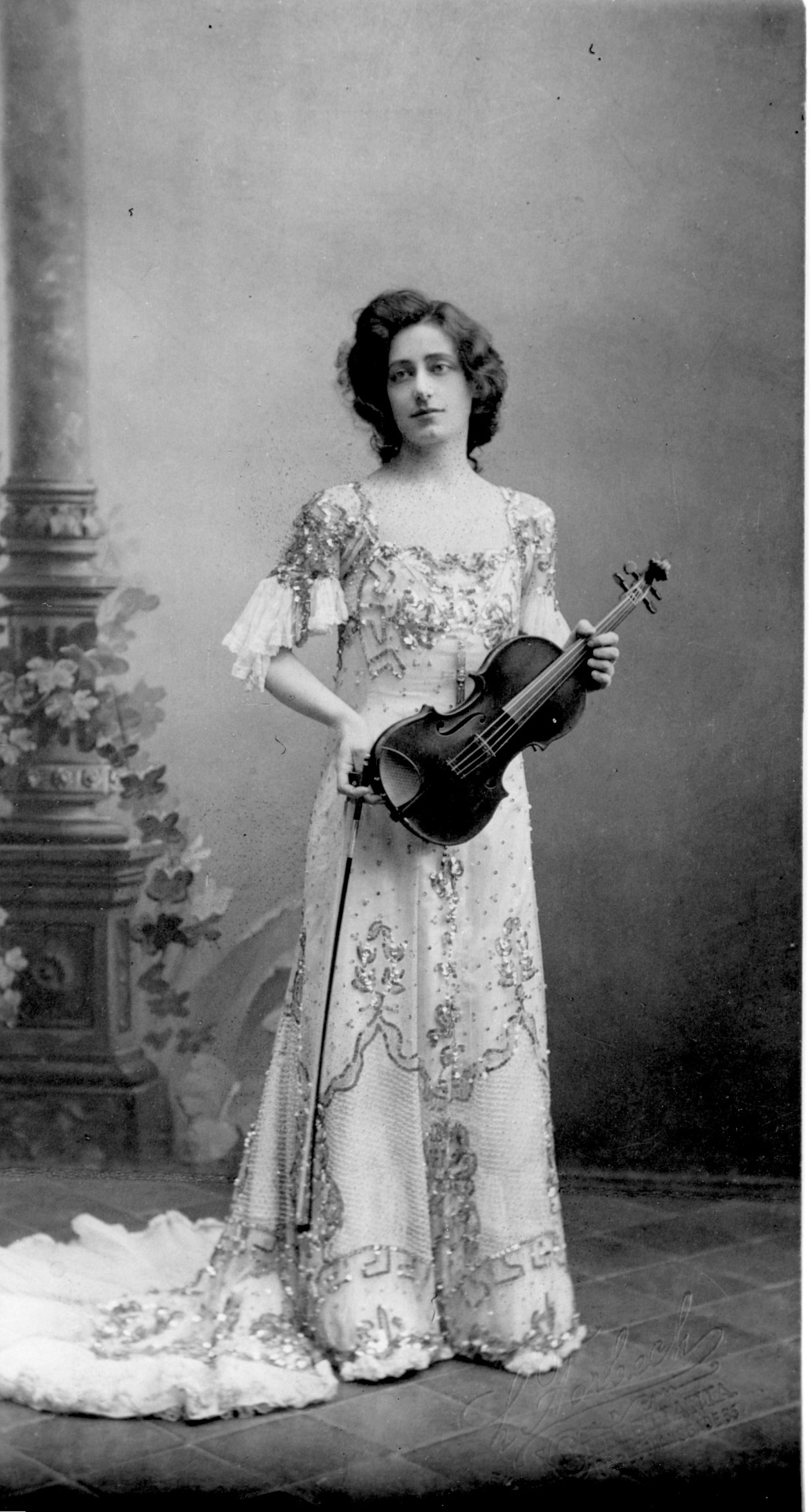
A dynamic composition, the present example depicts a bust-length portrait of the English violinist Evangeline Hope Muddock (who went by the Italianate stage name of Eva Mudocci) adrift in a sea of energetic lines and pools of black. Munch’s original composition is nearly identical and also shows the sitter wearing a large brooch in a ghostly, ethereal style that bolsters the woman’s angelic appearance. Mudocci once recalled: “It was [Munch’s] ambition to make the most perfect portrait of me, but whenever he began a canvas for oils, he destroyed it because he was dissatisfied with it…” (E. Mudocci, quoted in P. Berman and P. Stave, Munch/Warhol and the Multiple Image, New York, 2013, p. 22). Mudocci was also featured in a number of other works by Munch and was a close friend and muse of the painter. In Warhol’s translation, the entire canvas is given over to a prominence of black as the background merges with the swirling lines of the figure’s hair. He highlights Mudocci’s face and slender neck in a bright cerulean blue while the brooch she wears counters the azure tint with a deep yellow. Overlaying the black markings is a lively, frenetic collection of red lines that causes the entire work to vibrate and squirm in an optical realm that is pure Warholian energy.
Warhol’s homage electrifies and invigorates the dark, moody source material by thrusting the quiet portrait into new territory. Munch’s Eva Mudocci (The Brooch) is clearly reproduced through Warhol’s expert silkscreening process, but the end result is decidedly Pop. In 1982, Warhol happened into Galleri Bellman on New York’s 57th Street and was taken by a Munch retrospective made up of over 100 prints and paintings. After several repeat visits and a discussion with the gallery directors, he started work on a series of paintings subtitled After Munch. The four works he chose as his source material included Munch’s instantly recognizable The Scream, as well as the portrait of Eva Mudocci, a self-portrait of the Norwegian artist, and the ethereal Madonna. This was not the first time the Pop icon had been enamored with Munch, however. A visit to the National Gallery and Munch Museet in Oslo in 1971 had piqued his interest, and Warhol had been collecting examples of the artist’s work ever since.
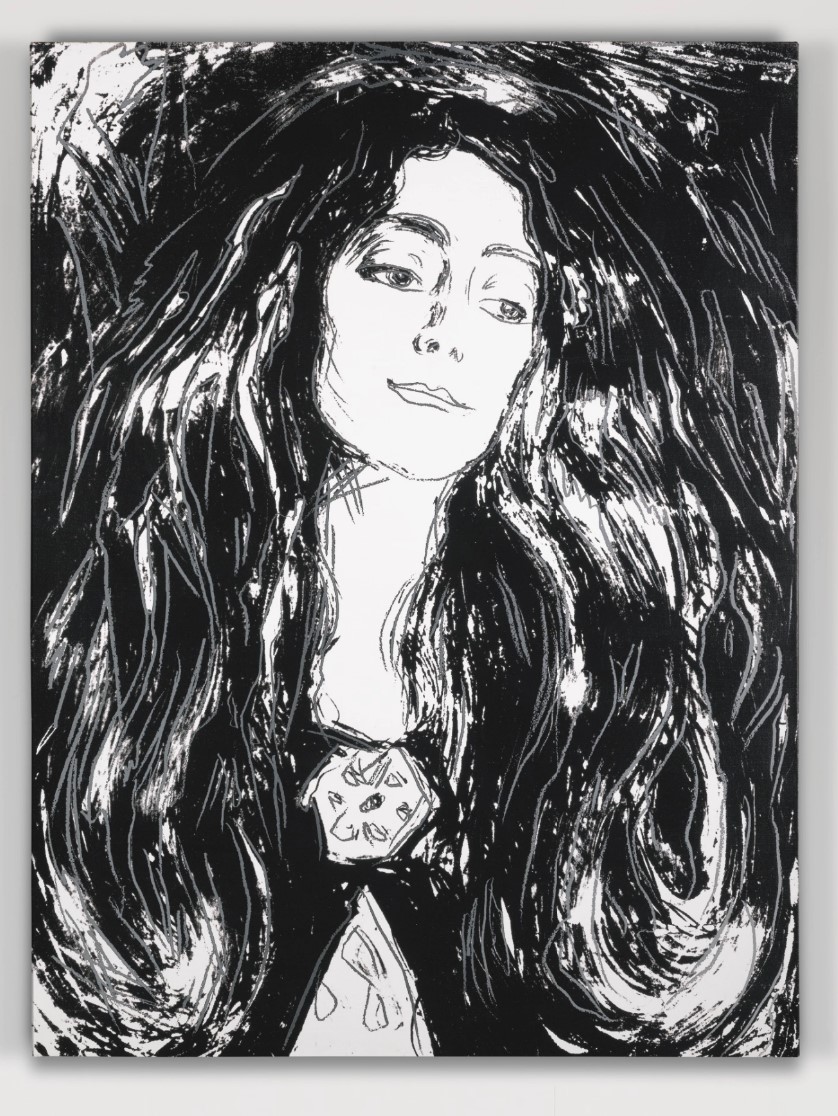
Utilizing as a source one of Edvard Munch’s most iconic prints, The Brooch (Eva Mudocci), Andy Warhol imbues the original image with his trademark Pop sensibility. Maintaining the monochromatic palette of Munch’s famous print, Warhol re-animates the original image. Forming part of a series of paintings inspired by four of Munch’s most well-known works, Warhol’s Eva Mudocci retains the enigmatic facial expression, wildly liberated cascades of hair and distinctive brooch that characterizes Munch’s original. In Warhol’s contemporary re-imagining however, Mudocci takes her place amongst the pantheon of the artist’s iconic female portraits: an early twentieth-century pinup is here elevated to the status of Warhol’s celebrated images of Marilyn Monroe, Jackie Kennedy or Elizabeth Taylor.
Where Warhol’s After Munch series can arguably be seen as a homage from the late Twentieth Century’s master of the serial image to the leading print maker of the late Nineteenth and early Twentieth Centuries, Warhol’s own iteration of Eva Mudocci emphasises and downplays certain elements of Munch’s original. The effect is almost ethereal: Mudocci appears to float within the confines of the image border, seeming to lack any definitive anchor to her surroundings. Siegfried Gohr reinforces this idea in his analysis of the work: “In Warhol’s paraphrase Eva’s pale face seems even more to belong to a different level of reality than her hair, brooch and triangle of dress. The portrait appears to be spirited into another realm…”(Siegfried Gohr quoted in: Exhibition Catalogue, Louisiana, Louisiana Museum of Modern Art, Warhol After Munch, 2010, p. 34). Indeed, Mudocci’s historical eminence is transported into the realm of Warholian Pop culture – her whitened face appearing as though bleached by the flash bulb of Warhol’s famous Big Shot Polaroid camera.
Eva Mudocci (After Munch), 1984
Christie’s New-York: 11 May 2022
Estimated: USD 4,000,000 – 6,000,000
USD 4,740,000
ANDY WARHOL (1928-1987) (christies.com)
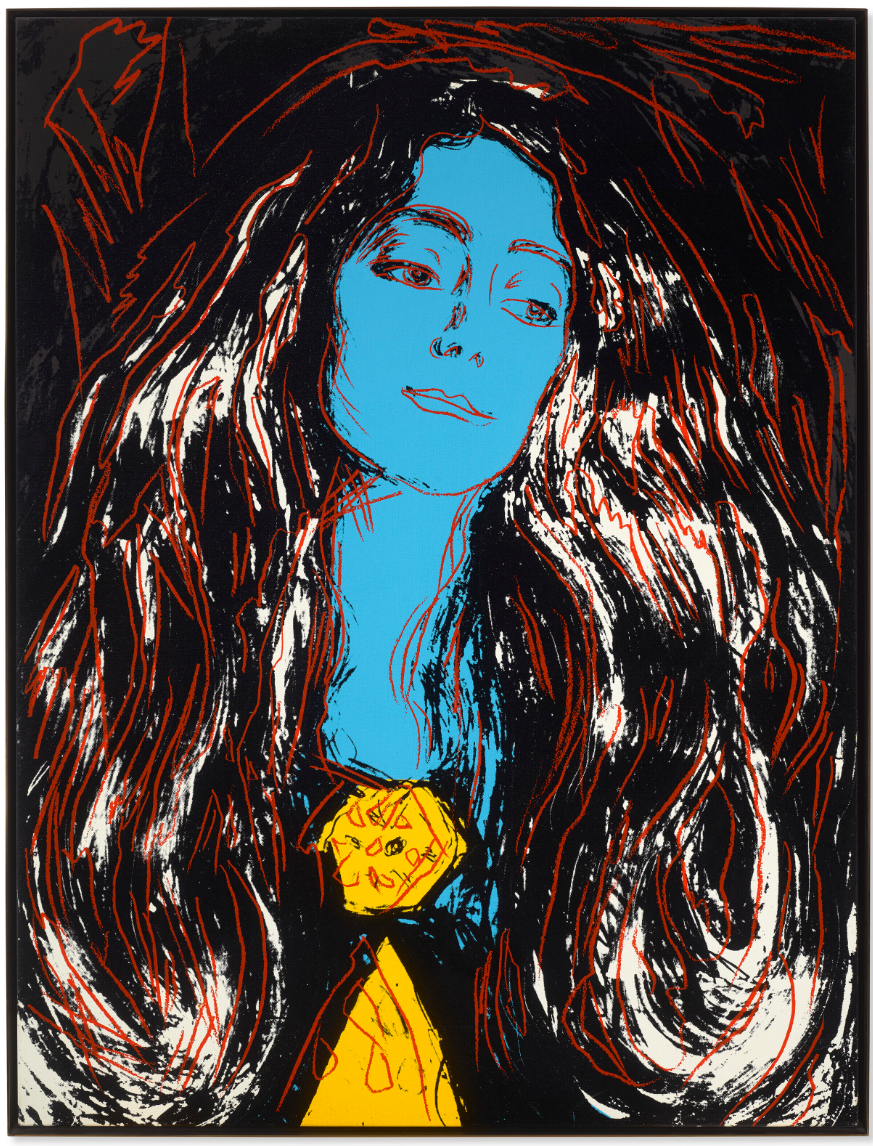
ANDY WARHOL
Eva Mudocci (After Munch), 1984
Acrylic and silkscreen ink on canvas
50×38 inches (127 x 96.5 cm)
Signed, stamped with the Andy Warhol Art Authentication Board, Inc. stamp
Numbered and dated ‘Andy Warhol 84 A121.0610’ (on the overlap)
From the earliest days of his career, Andy Warhol had a strong appreciation for—and encyclopedic knowledge of—art history. Beginning in 1963 with his reproduction of Leonardo Da Vinci’s Mona Lisa in a series of several paintings, the Pop artist would often return to the annals of visual art for source material. The highly-emotive Eva Mudocci (After Munch) is a prime example of Warhol’s interest in translating and digesting works by other artists through his own unique processes. He found himself drawn to the Norwegian painter Edvard Munch on more than one occasion, and the present work is a testament to Warhol’s ability to coax a radical mix of emotive vibrancy and machine-like precision from the famous original.
Eva Mudocci (After Munch), 1984
Sotheby’s London: 12 February 2014
Estimated: GBP 1,000,000 – 1,500,000
GBP 2,322,500
ANDY WARHOL
Eva Mudocci (After Munch), 1984
Acrylic and silkscreen ink on canvas
50.1 x 38 inches (127.3 x 96.6 cm)
Utilizing as a source one of Edvard Munch’s most iconic prints, The Brooch (Eva Mudocci), Andy Warhol imbues the original image with his trademark Pop sensibility. Maintaining the monochromatic palette of Munch’s famous print, Warhol re-animates the original image. Forming part of a series of paintings inspired by four of Munch’s most well-known works, Warhol’s Eva Mudocci retains the enigmatic facial expression, wildly liberated cascades of hair and distinctive brooch that characterizes Munch’s original. In Warhol’s contemporary re-imagining however, Mudocci takes her place amongst the pantheon of the artist’s iconic female portraits: an early twentieth-century pinup is here elevated to the status of Warhol’s celebrated images of Marilyn Monroe, Jackie Kennedy or Elizabeth Taylor.
Eva Mudocci, 1984
Christie’s London: 14 October 2007
Estimated: GBP 500,000 – 750,000
GBP 748,500
Andy Warhol (1928-1987) , Eva Mudocci | Christie’s
ANDY WARHOL
Eva Mudocci, 1984
Synthetic polymer paint and silkscreen inks on canvas
50×38 inches (127 x 96.5 cm)
2. The Scream (after Munch)
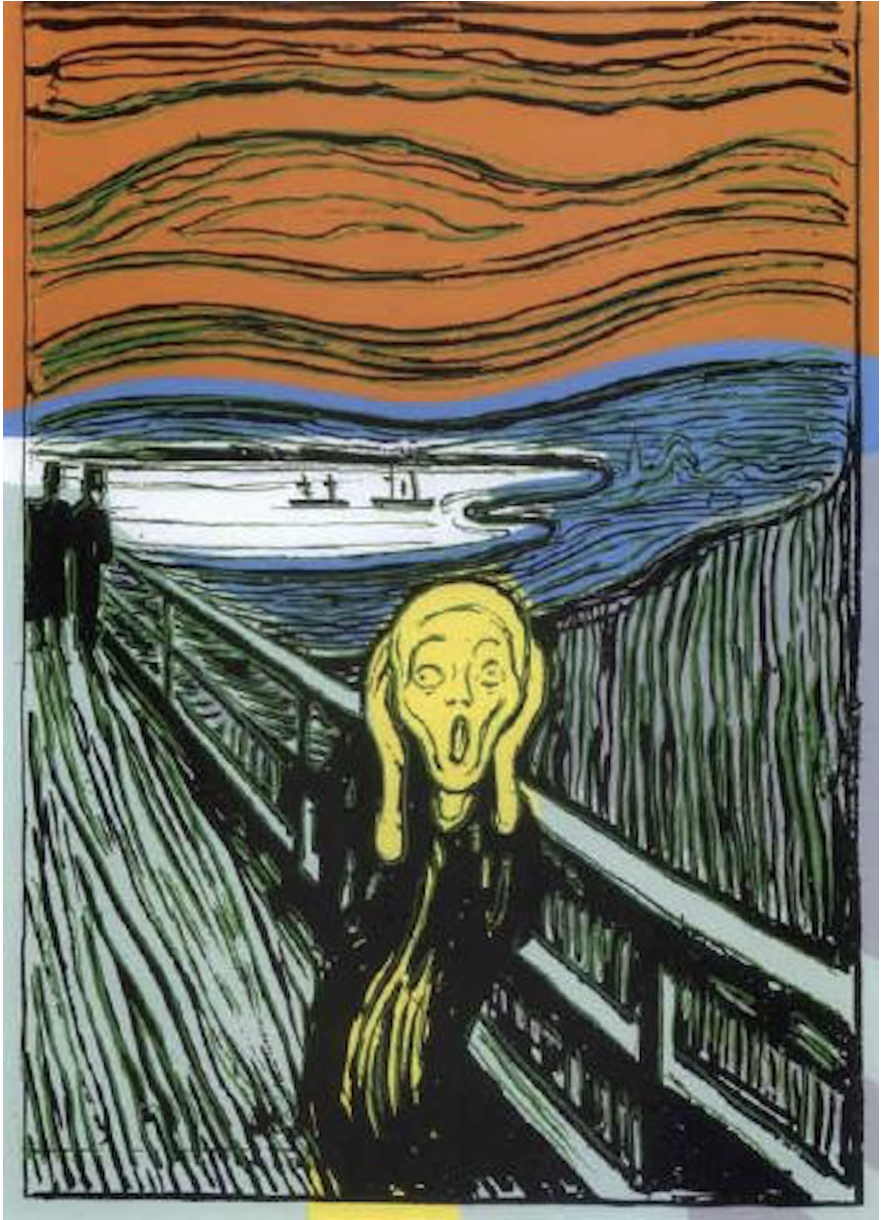
Andy Warhol was the master of appropriation and nowhere is his genius in this field more clearly seen than in the series Art from Art and in The Scream in particular. Just as he had turned Marilyn Monroe, Jackie Kennedy, Electric Chairs and a whole galaxy of 1970s and 1980s celebrities into products of the Warhol machine, so he took the stars of world art and made them his own creations. Through the simple methods of exchanging Munch`s muted, melancholy tones for waves of bright psychedelic intensity and the use of his trademark silkscreen, Warhol transformed the most famous expressionist painting into a signature Warhol. It is a piece of postmodernist brilliance. Warhol in this work converts a painting whose raison d´etre lay in its subjectivity and profundity into an object freed from the subjective, turning the viewer’s attention from the soul of the work to its surface.
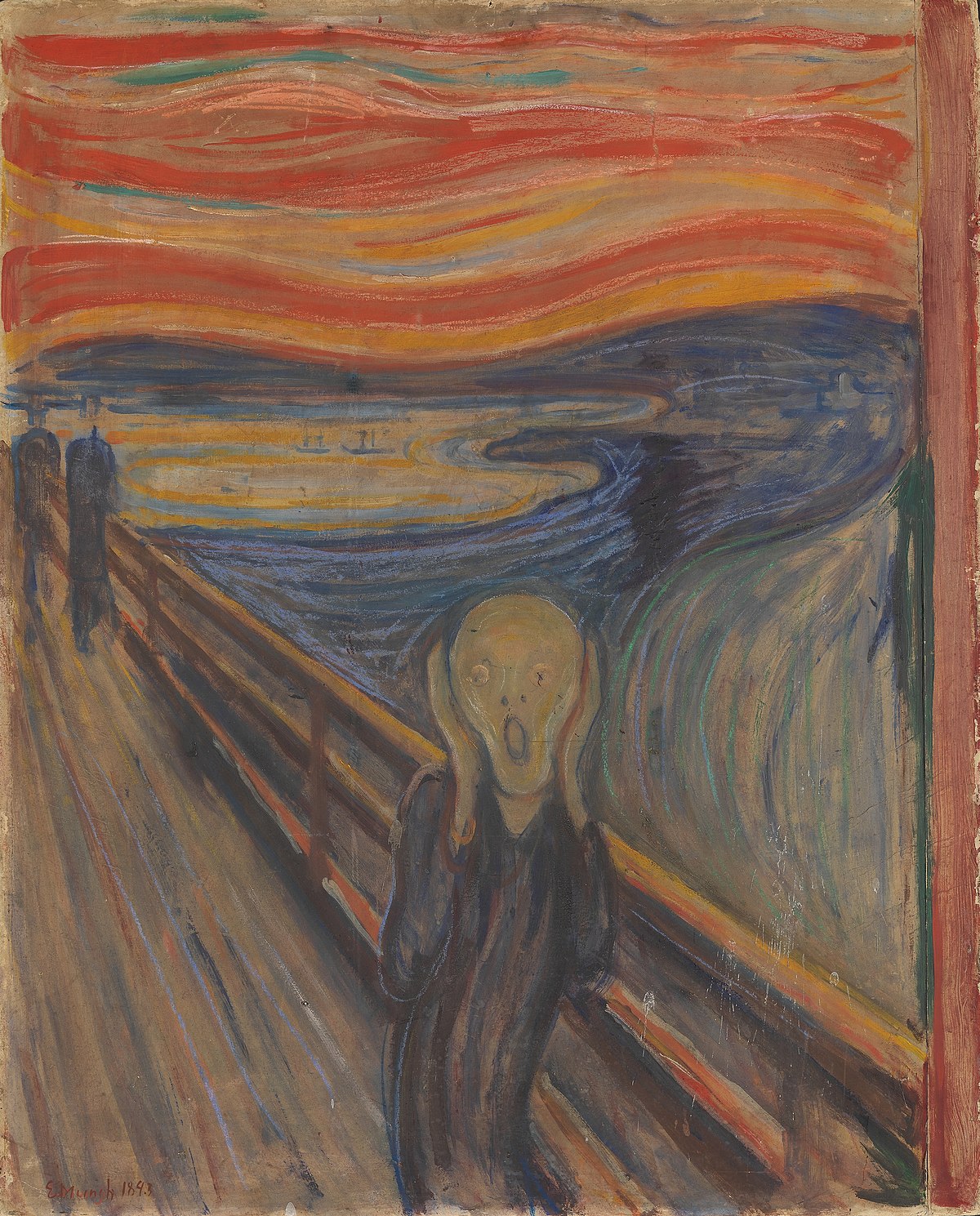
Edvard Munch painted four versions of The Scream (Shrik in his native Norwegian) in 1893. Forming part of his Frieze of Life series, Munch hoped and envisaged that his work would become a secular altarpiece. “One should no longer paint interiors with men reading and women knitting. They must be living individuals who feel, suffer, love, and breathe. I will paint a series of such pictures. People should understand the sacred nature thereof and take off their hats before them as though they were in church.” (Munch in a diary entry, cited in: Christian Gehrer Echoes of the Scream, exhibition catalogue, ARKEN Museum of Modern Art, Munch Museum, 2001, p. 14) An expression of the “great, ceaseless scream passing through nature” (ibid., p. 15), The Scream is an existential cry, an expression of the loneliness of man and of the new human condition in the twentieth century.
Warhol purposefully ignores this emotional content in the work – just as he had in his Race Riots, Electric Chairs, and Death and Disasters series – and concentrates instead on the work as an icon of popular culture. Warhol´s concern lies not with the painting itself but with the contemporary experience of it. Just as Duchamp and Warhol himself had done with Mona Lisa, he desacralizes the painting, both recognizing the way The Scream was in a sense as commercial an object as Mickey Mouse and encouraging that process. We may presume that Warhol would have enjoyed the fact that The Scream now appears not just on tee shirts and coffee mugs but is also available in inflatable doll form and has even starred more than once in The Simpsons. By reproducing The Scream, Warhol both underlines the iconic status of the work and shows how it can also be a mass-produced consumer product – a process unwittingly begun by Munch when he created a lithograph of the work in 1895.
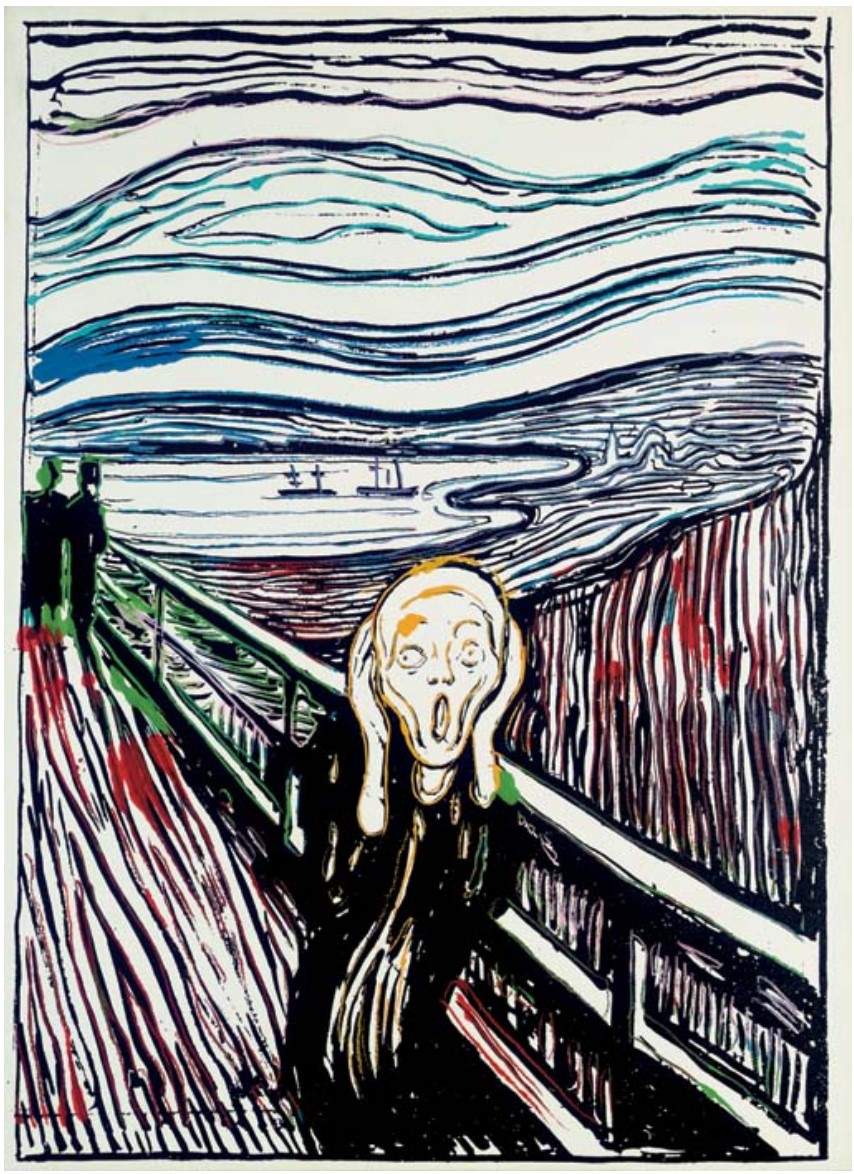
Warhol produced only five canvas versions of The Scream (an unusually small number for him) as part of a series of silkscreen prints which included a number of other Munch works including Eva Mudocci, Self-portrait with Skeleton Arm and Madonna. Warhol had started to use the work of other artists as subjects at the end of the 1970s and in the 1980s after a relatively barren period in his artistic life. In 1979 he began his Reversals and Retrospective series in which he re-examined the more famous aspects of his own body of work. This series featured the re-appearance of Warhol´s reproduction of Leonardo’s Mona Lisa which in turn led to Warhol’s studies of the works of other masters in the Art from Art series. Just as Picasso spent much of his later years analyzing the work of predecessors he admired, so Warhol explored the work of Leonardo, Cranach, Uccello, Raphael, de Chirico and Munch. By simply reproducing their work without comment, Warhol not only made a wonderful postmodern gesture, he could also pay subtle tribute to the works of other masters without compromising his famous ambition – to be a machine.
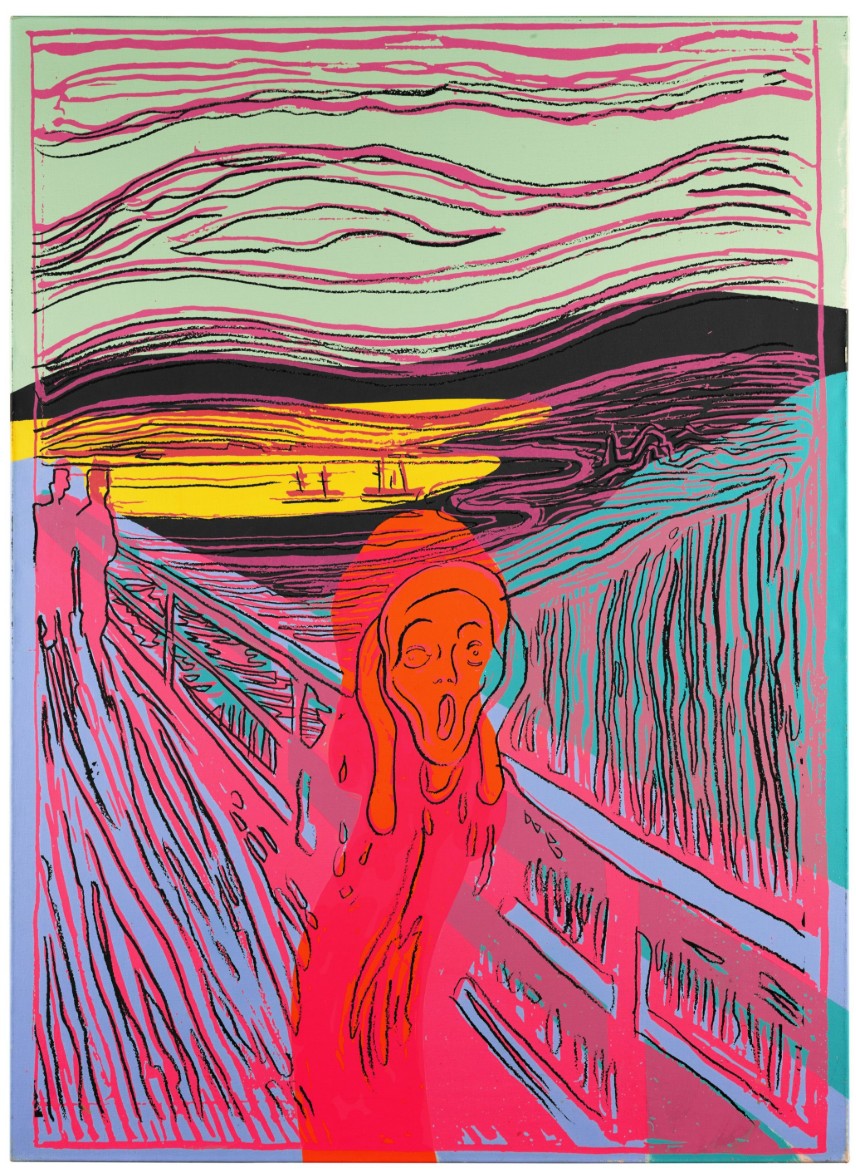
In the present work, the economy of line married to the strong, vibrant colors creates a powerful image. The striking orange in particular hits the retina with force. At the same time, it is also a somewhat humorous image. Painted flesh-pink the central character appears to be not so much a man in the throes of an existential crisis as someone camping it up. Together they create a signature Warhol, another amazing product of the Warhol factory given up to the Pantheon of mass culture images. Thus, just as with a Warhol Marilyn, one recognizes that it is an “Andy Warhol” at least as much as one recognizes Marilyn Monroe herself, so with this extremely rare work one sees the trademark style of Warhol as much as one spot the original masterpiece.
The Scream (After Munch), 1984
Sotheby’s London: 17 September 2025
Estimated: GBP 2,000,000 – 3,000,000
GBP 6,828,000 / USD 9,049,490
ANDY WARHOL (1928 – 1987)
The Scream (After Munch), 1984
Acrylic and silkscreen ink on canvas
52 x 38 1/4 inches (132.4 x 97 cm)
Signed and dated 84 (on the overlap)
Few works are as instantly recognizable, powerful, and emotionally charged as The Scream. Since its creation in the 1890s, Edvard Munch’s haunting depiction of existential dread has become a cultural touchstone, echoing far beyond the canvas into film, fashion, and advertising. Nearly a century after it was painted, Andy Warhol would revisit this modernist masterpiece, bringing his distinctive voice to Munch’s anguished vision to give rise to a new iconic rendition of The Scream.
Warhol’s connection to Munch was deep and long standing, with the artist famously citing the Norwegian painter as “his absolute favourite artist, alongside Matisse” (Tone Lyngstad Nyaas, ed., Munch by Others, Oslo 2012, p. 12). In 1973, Warhol visited the Munch Museum and the National Museum in Oslo at the invitation of Per Hovdenakk, then director of the Munch Museum. The visit left a profound impression on the artist; Warhol, known for his fascination with celebrity and mass-produced imagery, found in Munch’s work a deeply personal form of expression that transcended time and geography. He began collecting Munch’s prints shortly after, even buying a few prints whilst still in Norway. The invitation to visit the Museum came, however, on the back of an earlier meeting between Hovdenakk and Warhol back in 1963, when the Norwegian curator visited Warhol’s studio, known as The Factory, in New York. It was already then that Warhol expressed how fascinating and inspiring he found Munch’s œuvre, notably his experimental printmaking.
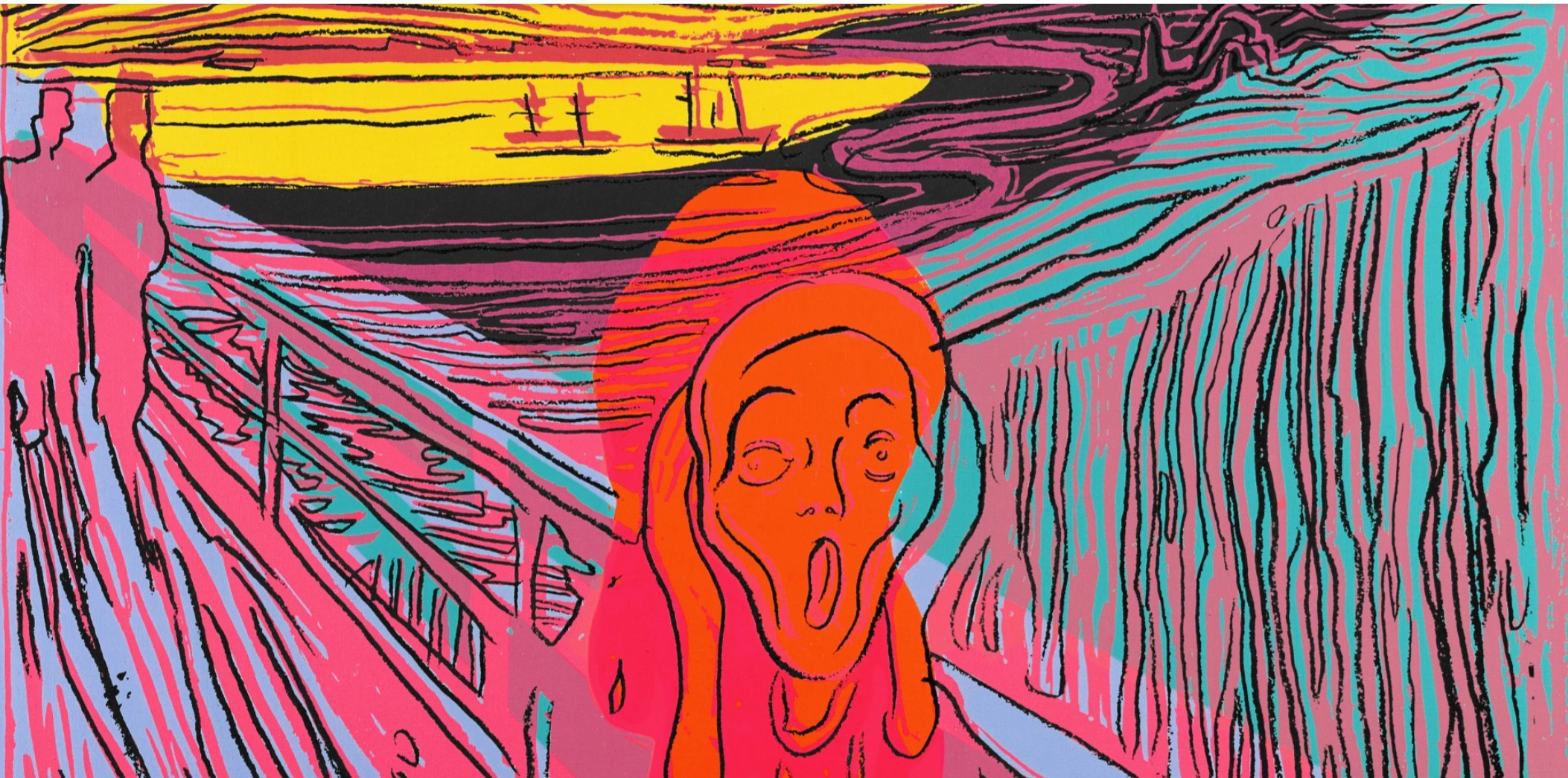
Just a year before Warhol’s visit to Norway, in 1972, a Norwegian art dealer, Tor Uppstrom started his Galleri Bellman in Oslo. Uppstrom showed primarily nineteenth century fine art, including of course, works by Munch. In the early 1980s he met a New York advertising executive Bernie Hodes, partnering with him to open a second Galleri Bellman on 57th Street in New York, which Uppstrom led as president and executive director. The gallery’s debut show in November 1982 featured naturally a very comprehensive exhibition of 126 prints and paintings by Munch, including a rare lithograph of The Scream on loan from the Munch Museum in Oslo.
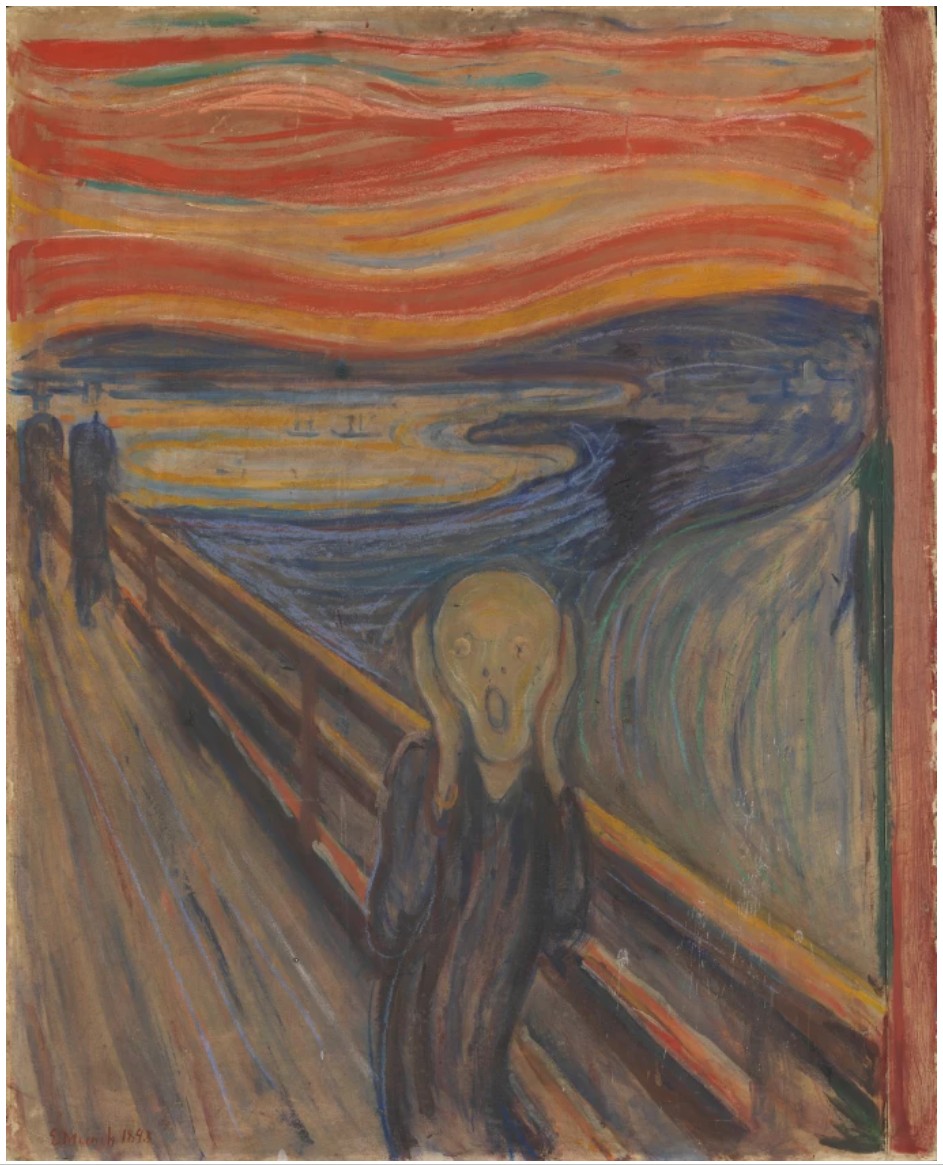
Edvard Munch, The Scream, 1893, oil, tempera, pastel and crayon on cardboard, National Gallery, Oslo © Photo Scala, Florence
Warhol visited the exhibition at Galleri Bellman with Fred Hughes, his business manager, re-encountering Munch’s imagery in a fresh context. This rediscovery, combined with his earlier admiration for the Norwegian master, set the stage for an ambitious project. At the time of the exhibition, the imagery of Munch was fairly untouched. The Scream was of course one of the most recognisable works in the world, nearly as famous as the Mona Lisa, but it had not yet entered into the cultural mainstream. When a few months after the exhibition, Uppstrom visited Warhol’s studio, the two agreed on a commission: Warhol would create fifteen paintings inspired by four of Munch’s most iconic lithographs, five each of three on different subjects that had been presented in the exhibition. Warhol chose Madonna and Self-Portrait with Skeleton Arm, The Brooch (Eva Mudocci), and of course, The Scream. Although the works were signed and dated by Warhol in 1984, it is likely that he completed the series between late 1983 and early 1984, blending his signature silkscreen technique with drawn elements that closely followed Munch’s original lines. Indeed, for each of the works, Warhol made transparencies of the images, drawing all four of them by hand, in a slightly larger size than the original prints. The drawings would then be used as the finishing screen on the even larger sized paintings.
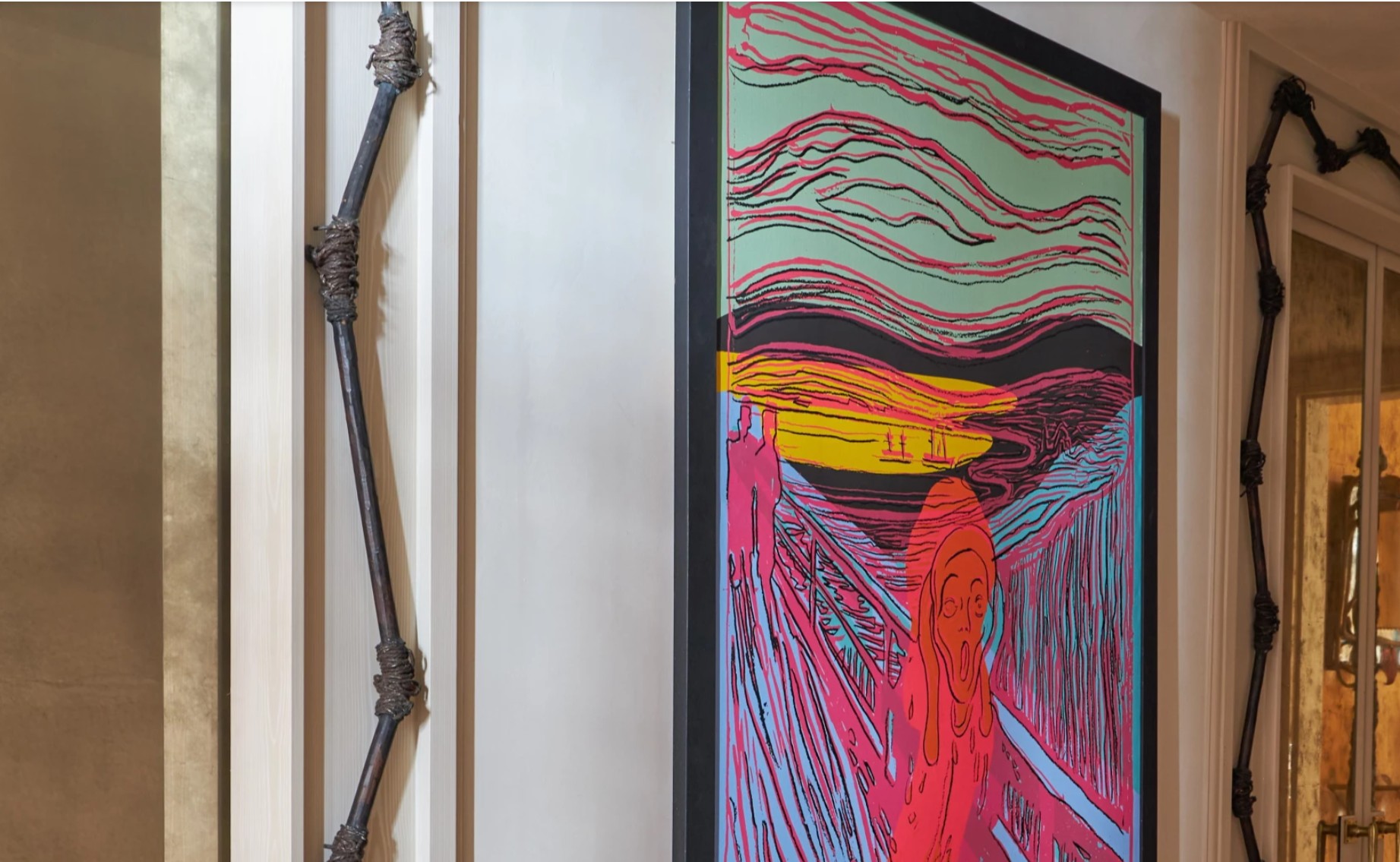
The present work shown in the London home of Pauline Karpidas
In Warhol’s hands, The Scream became not just a reproduction but a reinterpretation. He used five different screens to build the rich, pulsating background, deliberately positioning the image of the screaming figure slightly out of alignment to create a disjointed, unsettling effect. This visual unease mirrored the emotional turbulence at the heart of both artists’ work. For Munch, The Scream captured what he described in his journal as “the great scream in nature”—a panic attack crystallized in paint. For Warhol, it resonated with his own preoccupation with fear, death, and the fragility of fame and identity—themes central to his output after the 1960s. Upon completion, the paintings were delivered to Galleri Bellman in early 1984 but were never shown publicly in New York. Instead, twelve of the fifteen works were sent to the Galleri Bellman location in Stockholm, where they were put up for sale. The remaining three (one of each) were left in New York with Uppstrom’s business partner, Bernie Hodes. This is the first time since 2010 that one of the works appears at auction.
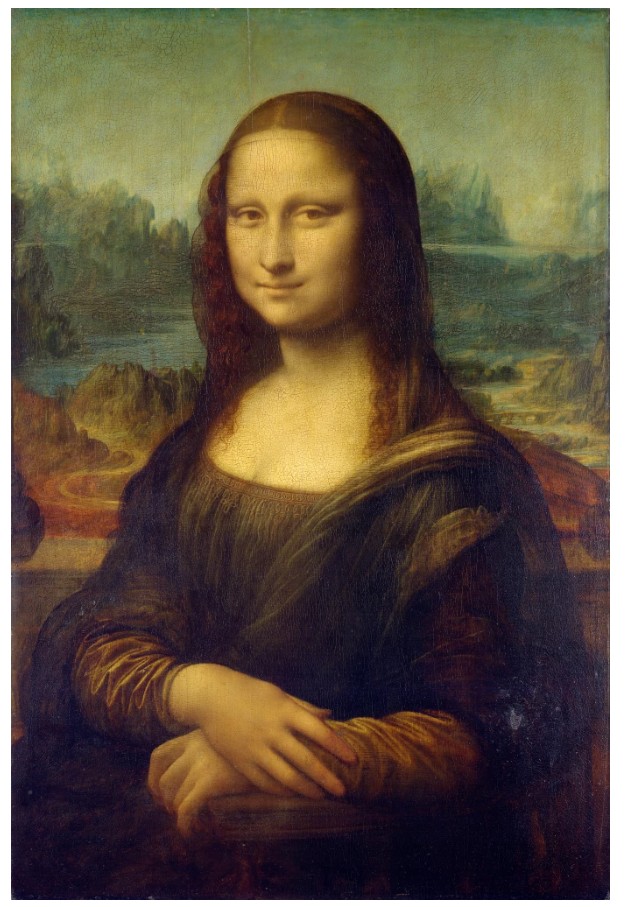
Leonardo da Vinci, Mona Lisa, circa 1503-19, oil on poplar panel, Louvre Museum, Paris
Warhol’s The Scream is a convergence of two artistic minds grappling with the same enduring human condition—anxiety in the face of modern life. In both content and technique, the series bridged two centuries of innovation: Munch’s experimental printmaking and Warhol’s commercial silkscreen revolution. By reproducing The Scream, Warhol both underlined the iconic status of the work to create a signature Warhol, another amazing product in Warhol’s output given up to the Pantheon of mass culture images—a process unwittingly begun by Munch when he created a lithograph of the painting in 1895.
The Scream (After Edvard Munch), 1984
Christie’s London: 7 February 2007
Estimated: GBP 800,000 – 1,200,000
GBP 1,084,000
Andy Warhol (1928-1987) , The Scream (After Edvard Munch) | Christie’s
ANDY WARHOL
The Scream (After Edvard Munch), 1984
Synthetic polymer paint and silkscreen inks on canvas
51.7 x 38 inches (131.4 x 96.5 cm)
Sotheby’s London: 20 June 2006
GBP 1,460,338
ANDY WARHOL
The Scream (after Edvard Munch), 1984
Acrylic and silkscreen ink on canvas
52.2 x 38 inches (132.5 x 96.5 cm)
3. Madonna and Self-Portrait
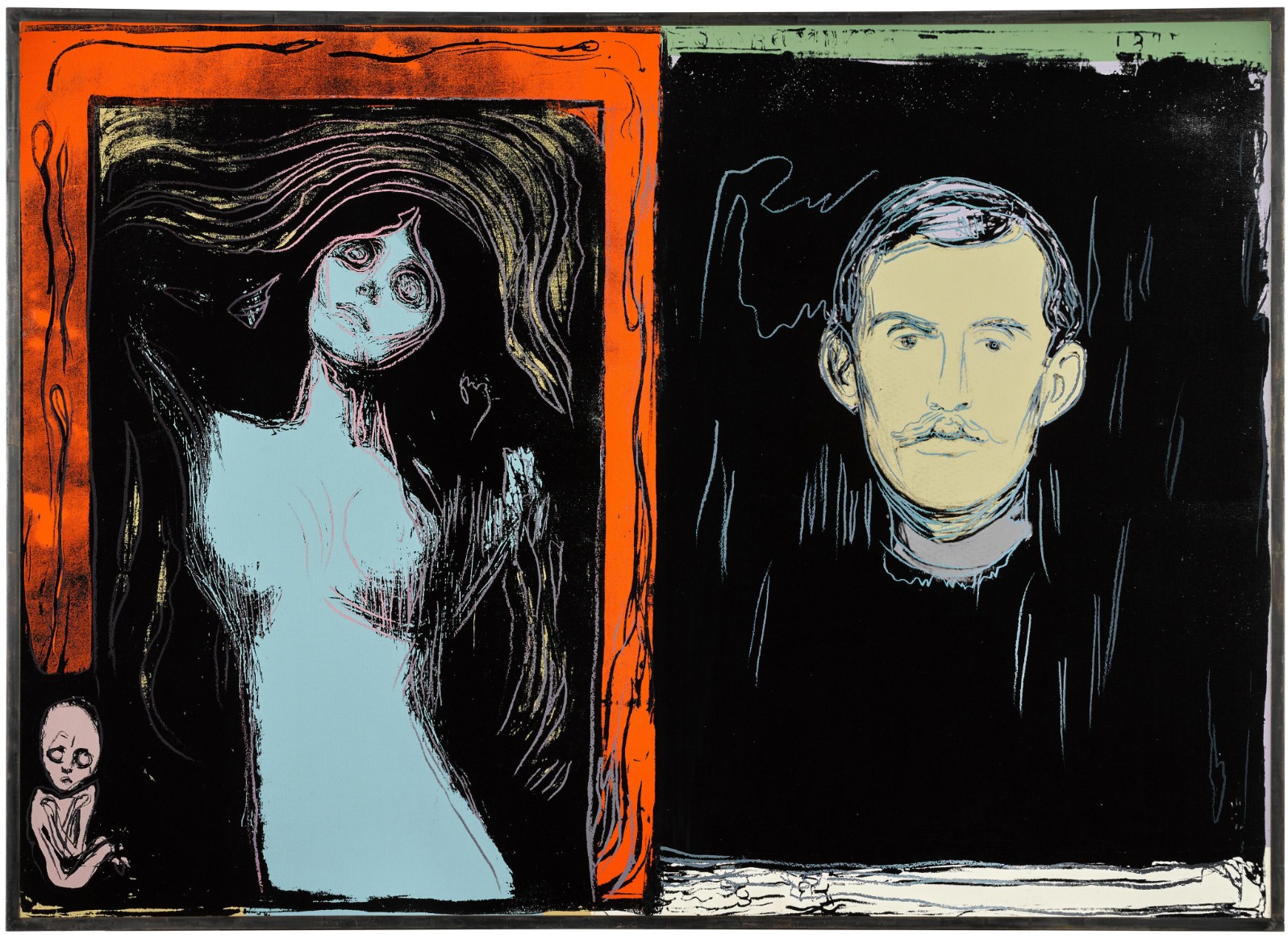
Madonna and Self-Portrait with Skeleton’s Arm (After Munch), 1984
Sotheby’s London: 17 September 2025
Estimated: GBP 1,500,000 – 2,000,000
GBP 2,846,000 / USD 3,885,765
ANDY WARHOL (1928 – 1987)
Madonna and Self-Portrait with Skeleton’s Arm (After Munch), 1984
Acrylic and silkscreen ink on canvas
51 1/8 x 71 inches (129.7 by 180.4 cm)
Signed and dated 84 (on the overlap)
An unequivocal masterwork, Madonna and Self-Portrait (After Munch) stands as one of Andy Warhol’s most virtuosic works. Executed at the apex of his late career and commissioned by Galleri Bellman for his celebrated Art from Art series, this rare and commanding work is one of only five known examples in which Warhol juxtaposes two of Edvard Munch’s most psychologically-charged images: the haunting Madonna and the introspective Self-Portrait with Skeleton Arm. With signature flair and technical precision, Warhol breathes new life into these Expressionist icons, transforming them into Pop elegies. Distinguished by its extraordinary provenance, Pauline Karpidas acquired the present work from the Estate sale of Warhol’s master print maker, Rupert Jansen Smith, who is notably credited with fashioning some of the complex techniques surrounding his Reversal works of the late 1970s.
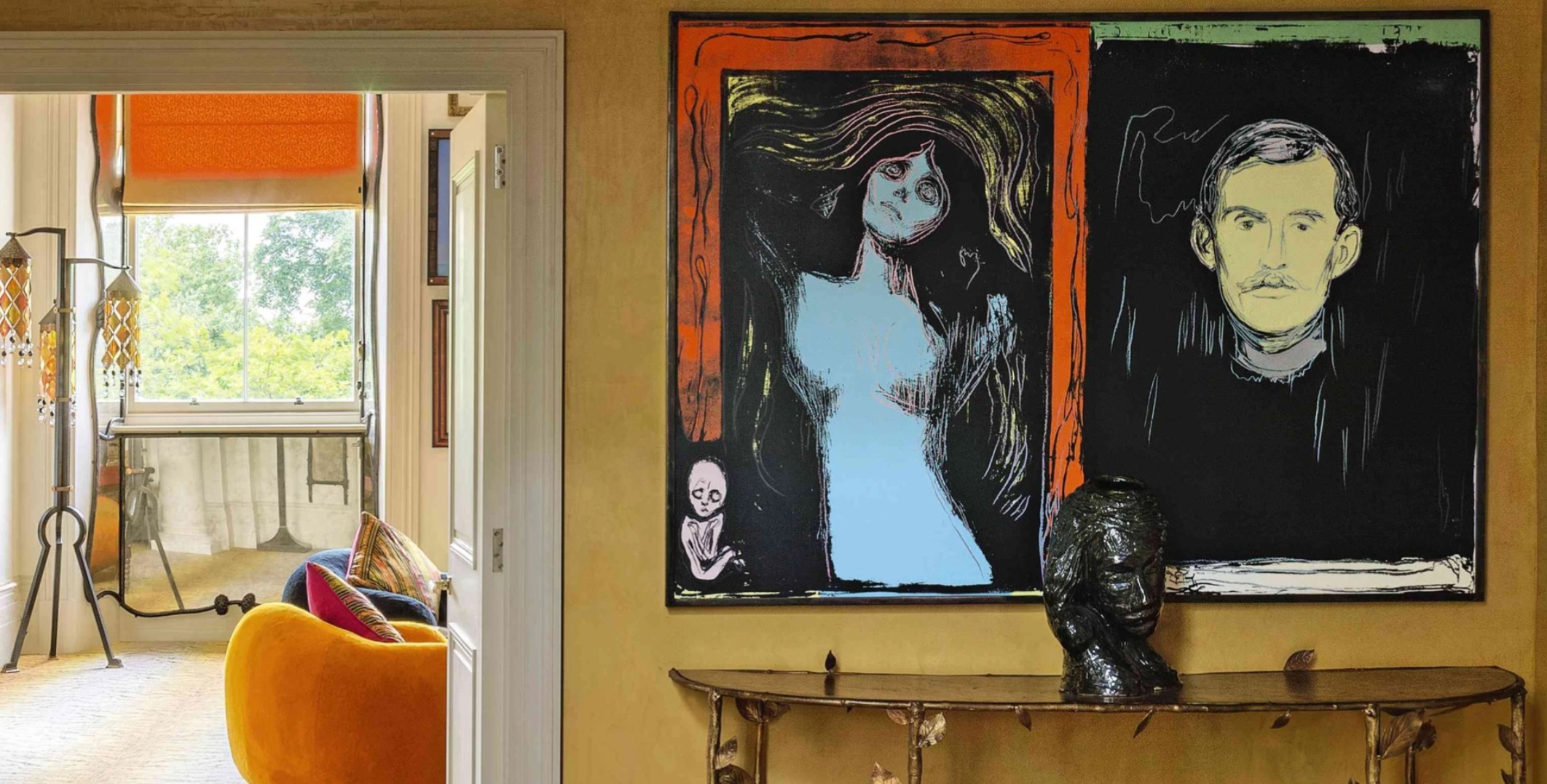
The present work shown in the London home of Pauline Karpidas
Warhol visited an exhibition of Edvard Munch’s paintings and prints in New York at the Galleri Bellman several times in 1982. Captivated by the striking and instantly recognizable motifs of Munch’s work, the idea was born to use this in the continuation of his Art from Art series. The gallery owners Tor Uppstrom and Bernier Hodes commissioned Warhol to produce a series of paintings and prints after learning of Warhol’s fascination with the artist. Warhol admitted Munch was his favorite artist alongside Matisse, born of his 1973 trip to the National Gallery and Munch Museum in Oslo. He owned a number of prints by Munch, even acquiring an example from the exhibition. Roland Augustine, Galleri Bellman’s director at the time, described the process behind the commission, “the motifs were not dictated by the owners of the gallery or me. Andy selected the images. It was decided that there would be three images and five examples of each — fifteen paintings in total. There was a contractual arrangement. The three images were: The Scream, Self-Portrait juxtaposed with the Madonna, and Eva Mudocci.” (Augustine quoted in “Interview with Roland Augustine,” in Munch / Warhol and the Multiple Image, New York 2013, p. 91). With the help of Rupert Jansen Smith, Warhol produced five examples of this painting and a number of trial print proofs. One example is held in the collection of the Astrup Fearnley Samlingen in Oslo.
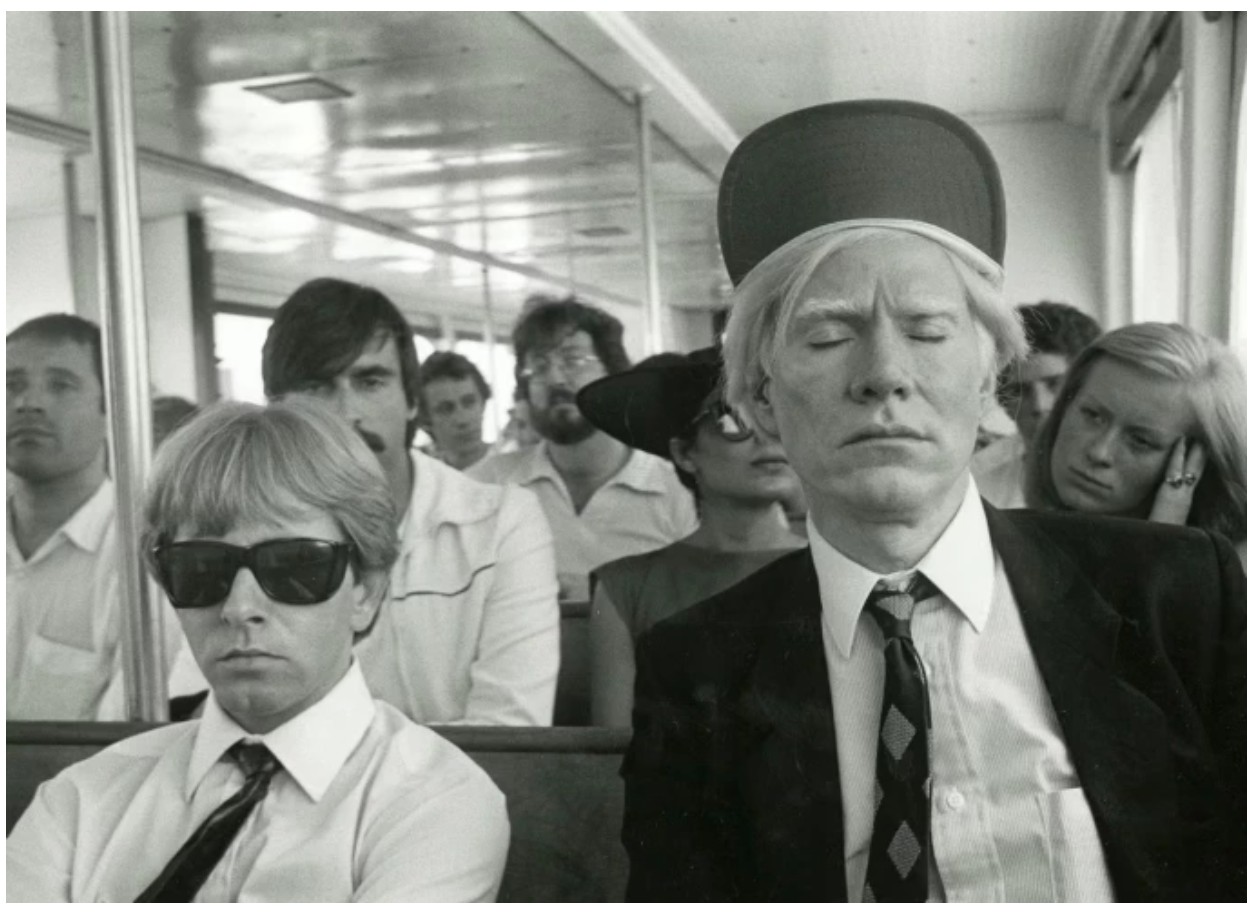
Rupert Jasen Smith and Andy Warhol photographed in New York in 1979 © Bob Colacello / Courtesy the artist and Vito Schnabel Gallery
The present work is a remarkably singular work within his Art from Art series as it is not a direct appropriation of Munch’s imagery. Warhol has reinterpreted this through the juxtaposition of one of the most haunting images of the Madonna and one of the most introspective self-portraits in art history, Munch’s Self-Portrait with Skeleton Arm. The Madonna reinforces Warhol’s preoccupation with powerful female icons. With her head tilted back, and sensually portrayed in the nude, the Madonna is eroticized and separated from the child, eliciting this compelling dialogue between eroticism and religion. Religious iconography seeped into Warhol’s work in the Art from Art series as he reinterpreted many of art history’s most renowned paintings, from Botticelli’s Birth of Venus to Leonardo’s The Last Supper. The choice of Self-Portrait with Skeleton Arm reflects Warhol’s preoccupation with death and the associated self-reflection in his later years. Here, the musing self-portrait—underscored by the skeleton arm acting as a memento mori—is perhaps a portal for Warhol’s own exploration of mortality, religion and his identity. Death had always been a recurrent theme in his work ever since the pioneering 1960s Death and Disaster and Electric Chair series, which was later revived in his series of poignantly contemplative self-portraits just before his untimely death in 1987. After his death, it came to light that the artist had been surreptitiously religious—especially since his near-fatal shooting in 1968. Madonna and Self-Portrait (After Munch) marks Warhol’s growing fascination with his own mortality and religion in a period of greater self-reflection in his later years.
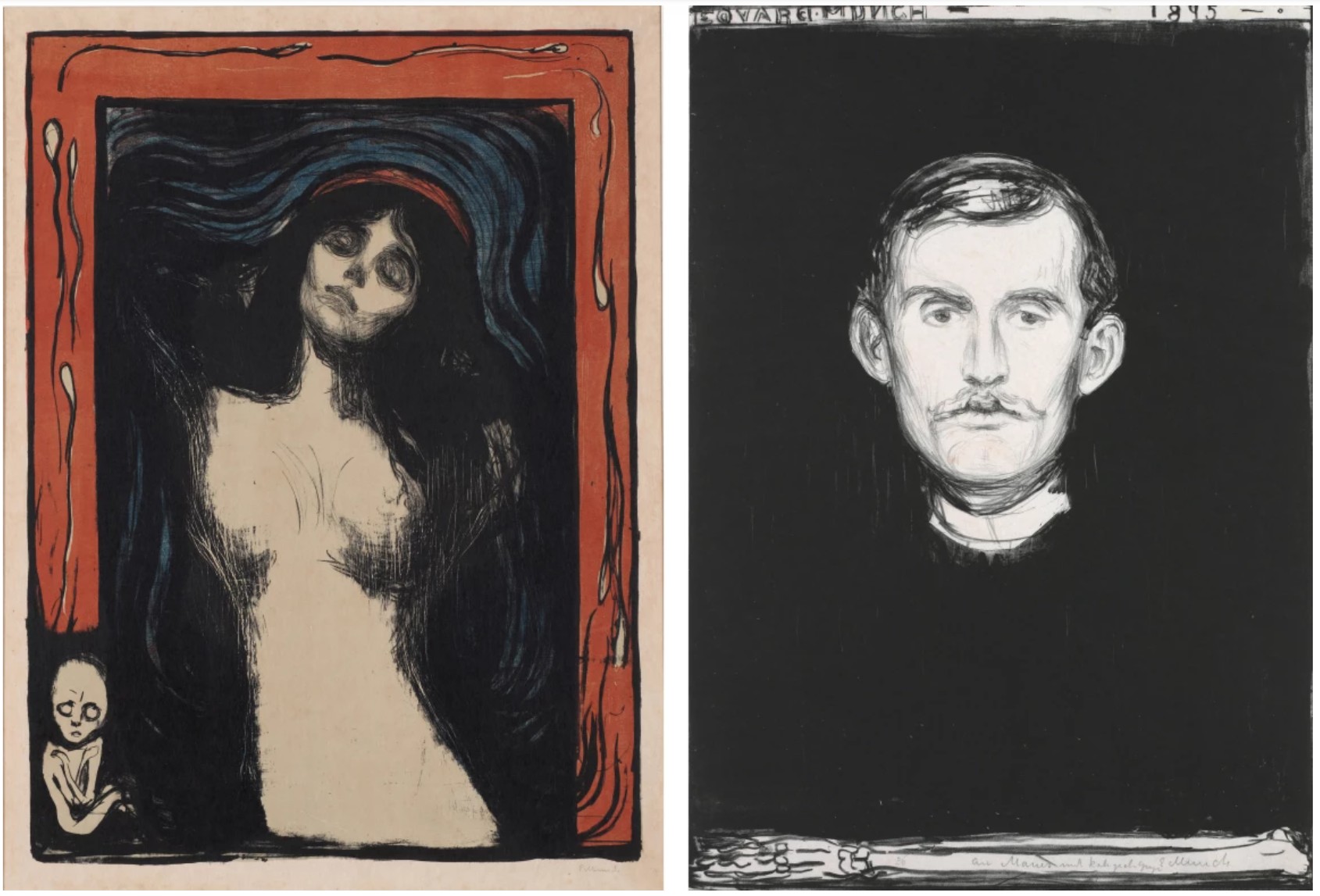 Left: Edvard Munch, Madonna, lithograph on paper, 1895-1902, Ohara Museum of Art, Kurashiki
Right: Edvard Munch, Self-Portrait with Skeleton Arm, lithograph on paper, 1895, National Gallery, Prague
Munch’s most celebrated series, The Frieze of Life, explored the inner psyche of the modern man, with notable examples such as the Madonna, Self-Portrait with Skeleton Arm, The Scream and Anxiety. Munch confronted themes of love, loss, despair and death in this series, and he even repeated many of his most important subjects across the series of paintings and lithographs. Munch’s repetition of his own imagery not only fascinated Warhol, but they were also excellent motifs for his Art from Art series. Where Duchamp took quotidian objects like urinals or bicycle wheels and reframed them into ‘ready-mades’ by giving them an often absurd meaning, Warhol claimed some of art history’s most recognizable images for himself, recasting them in an altered context through his signature Pop aesthetic, as he made them unmistakably his own. In his reinterpretations of Munch’s Madonna and Self-Portrait with Skeleton Arm, Warhol employs bold, flat fields of color reminiscent of advertising—fiery orange, calamite green, and cyan—eliciting a striking hard-edged graphic effect that differs fundamentally from Munch’s emotionally charged, sensually-rendered and complementary hues. While Munch used color to evoke psychological tension, Warhol’s vivid palette serves to stylize and amplify, making the image as instantly recognizable as his Marilyns. Here, Warhol’s trademark style supersedes the art historical source, so the work becomes as much an Andy Warhol painting as a reimagining of Munch. Much like advertising logos or celebrity portraits, these images become detached from their origins, evolving into universal symbols. Warhol understood this, and through his appropriations, he invites viewers to reconsider the meaning and relevance of the iconic in the modern world.
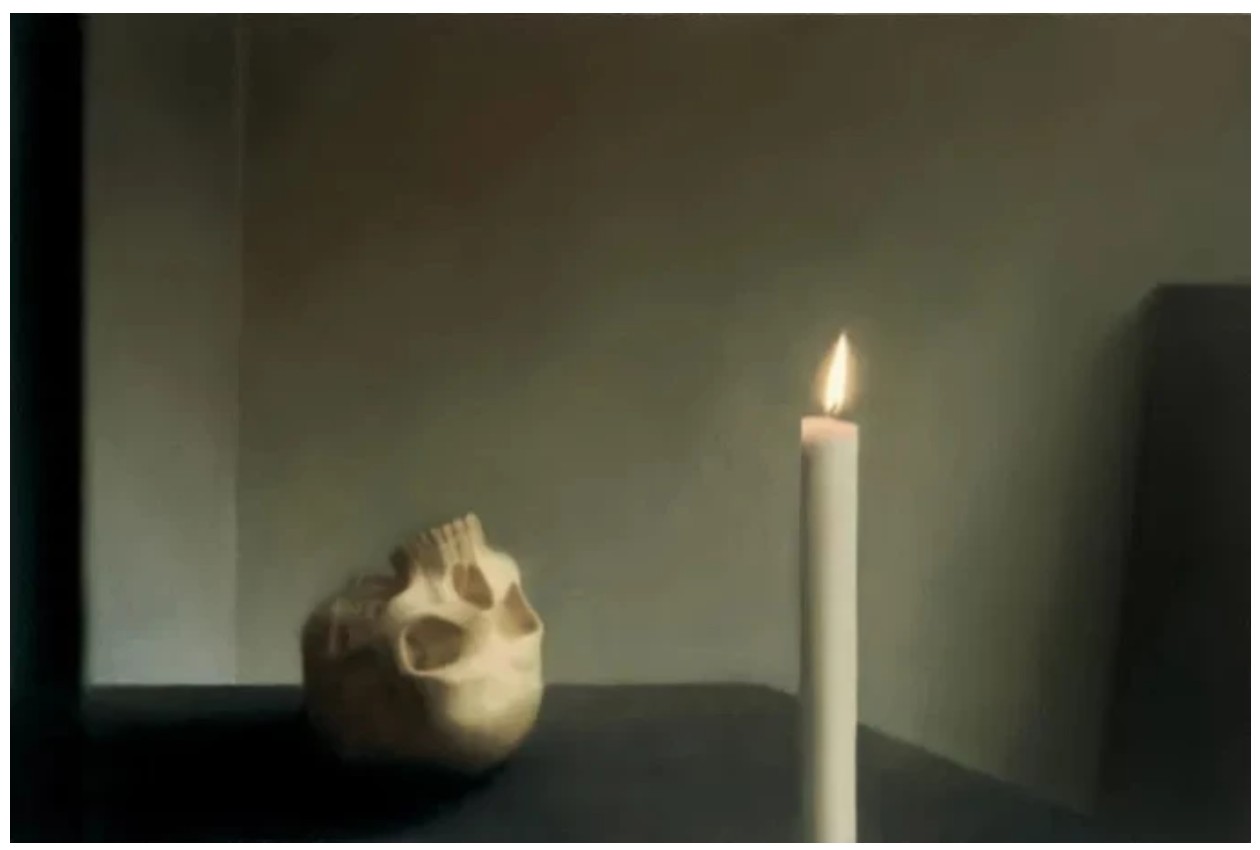
Gerhard Richter, Skull with Candle, 1983, oil on canvas © 2025 Gerhard Richter
Further to this, Warhol’s engagement with Munch’s imagery exemplifies a striking synthesis of line and color. For Munch, color was inseparable from emotion, a vehicle expressing the ineffable and the existential. In contrast, Warhol harnessed chromatic tones to evoke the bold, graphic language and flat surface of advertising, stylizing his subjects with the cool detachment and silkscreen aesthetic of Pop Art.
“If you want to know all about Andy Warhol, just look at the surface of my paintings and films and me, and there I am.”
In 1983, Warhol collaborated on a number of works with Jean-Michel Basquiat and Francesco Clemente whereby he developed tracing as a new technique as he would start the works by tracing a recognizable Pop Art symbol onto a canvas using an overhead projector. For the present work, Warhol photographed two lithographs and then redrew them by hand, as he expertly merges his tracing technique with the established silkscreen practice. Warhol’s intervention is transformative—his lines reinterpret Munch’s into their own stylized and graphic iteration. This is evident in the altered expression of the Madonna: where Munch’s figure’s eyes are languidly shut, Warhol’s Madonna stares wide-eyed into the abyss. The synthesis here generates a new mediation on Munch’s work—one where the emotional power is reduced—as this distinctly Warholian appropriation recontextualizes the Expressionist master’s work for the advertising era.
“A good picture never disappears. A great idea never dies.”
Warhol’s appropriations are by no means replicas; they are reinventions that flatten the distinction between high art and mass culture. Warhol’s After Munch series thus doesn’t merely reproduce: it operates on the level of cultural memory, asking what is left of original meaning when an image is endlessly shared and commodified. Through this lens, Munch’s tormented figures are pulled into the Pop vernacular, stripped of angst and recalibrated for the billboard, and so Warhol claims them not just as subjects, but as Warholian icons.
Christie’s London: 27 June 2011
GBP 937,250
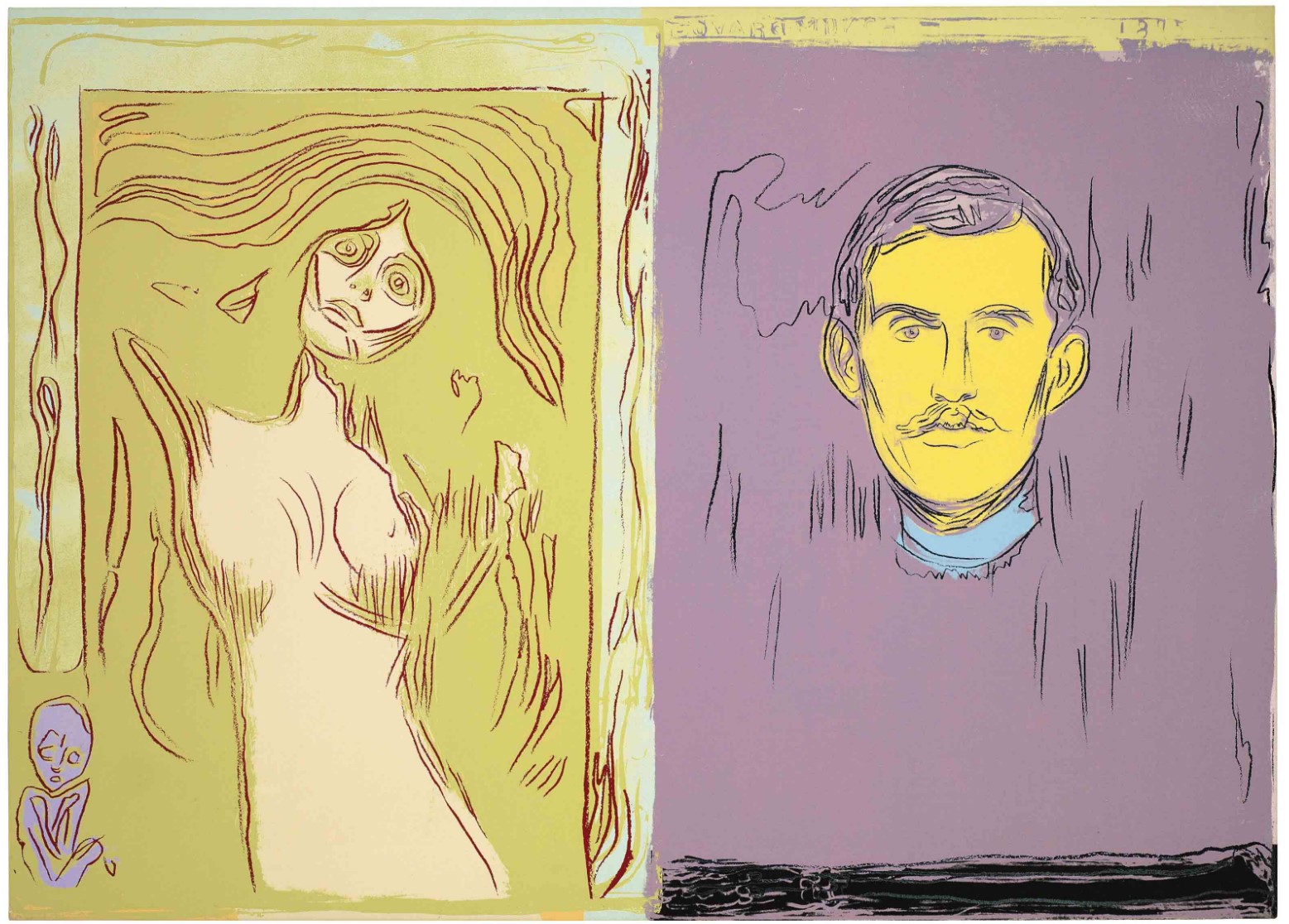
ANDY WARHOL
Madonna and Self-Portrait with Skeleton’s Arm (After Munch), 1984
Acrylic and silkscreen ink on canvas
51×71 inches (129.5 x 180.3 cm)
Andy Warhol’s striking portrait of Edvard Munch and his celebrated painting of the Madonna are among the most enigmatic of Warhol’s works. Executed in 1984, this large canvas adheres to key the Warholian themes of the appropriation of images from popular culture together with his distinctive Pop treatment of line and color. Commanding the left side of the canvas and embellished by the lavish use of the gold-like intensity of an arylide-like yellow, the long flowing hair of the Madonna is transformed by Warhol from the haunting figure in Munch’s original into an icon-like depiction of powerful femininity. Mirroring this is the illuminated face of Munch himself, which boldly stares out from a shroud of purple, skillfully subverting the introspective nature of the original.
Madonna and Self-Portrait with Skeleton’s Arm (After Munch) continues Warhol’s astute examination of the proliferation of visual imagery in post-war American culture. Working in the same vein as his portraits of Hollywood stars such as Liz Taylor, Marilyn Monroe and Elvis Presley, Warhol pursues the Duchampian notion of the readymade by taking as his conceptual starting, two existing paintings by one of the most famous modern artists of the twentieth century. Indeed, Munch himself had executed the Madonna motif in a series of paintings as well as a lithograph, from which Warhol takes his version. The parallels with Warhol continue as like the Pop master’s own representations of himself, Munch’s self-portraits are often haunting psychic studies that confront the viewer frontally, almost photographically.
Warhol’s After Munch series is clearly an extension of his overall examination of the nature of iconicity. Throughout his career he took images of contemporary cultural icons and, through his unique brand of artistic endeavor, turned them from cultural icons into artistic ones. But, as is demonstrated in the present lot, Warhol also turned to art history for inspiration. In addition to Munch, he also appropriated images by Botticelli and Leonardo da Vinci in his constant quest for new material and sources of inspiration. With the proliferation of media, tourism and the globalization of popular culture these images of ‘high art’ had become part of the cultural ‘flotsam and jetsam’ that appeared in advertisements and was reproduced on souvenir postcards and mugs worldwide. By appropriating these images Warhol was celebrating their ‘low-art’ pervasiveness, just like he did with Coca-Cola and Campbell’s soup, but at the same time attempting to re-establish their ‘high-art’ credentials.
The visible vigour in the lines of Madonna and Self-Portrait with Skeleton’s Arm (After Munch) perhaps appears as an unexpected work within his oeuvre, the artist re-introducing some of the expressionism against which he had struggled so long. Yet the fact that the lines are printed, rather than painted with the expressive energy of the original, removes some of that angst, and again highlights the realm of the artificial, the mass-produced and the industrial within which Warhol thrives and which is so suited to our commercial age. And yet the anxieties that lay at the heart of Munch are not so distant from those that were increasingly occupying Warhol at the time of the creation of Madonna and Self-Portrait with Skeleton’s Arm (After Munch). Many of his friends had died within recent years and so Warhol, who had long been fascinated by death, was having serious thoughts about mortality. It is thus not only as an icon that Warhol chose these images as a source, but as the slightest hint of a reference to his own inner turmoil. Just as his self-portraits were coming to take on a more sombre and fatalistic tone, so too in his works after Munch Warhol managed to vent and explore and even coyly expose some of his own personal anxieties.
As the foremost proponent of Pop Art, Warhol had long taken images and objects from popular culture and smuggled them into the realms of high Art. During the late 1970s and early 1980s, though, he began to reverse the process in two ways. On the one hand, he began to turn to his own former subjects, revisiting them and in a sense pointing to the fact that old Warhols had themselves entered popular culture. And on the other hand, he turned to ‘high’ subjects and rendered them in his signature silkscreen style. Da Vinci, Botticelli and here Munch all had their art transformed featuring vivid colour and giving them a contemporary spin whilst retaining a sense of dignity. This was a rebellion against time-honoured and force-fed lessons in the history of art and doubles as a tribute to the artists who, like Warhol, had managed to become cult figures.
Sandro Botticelli
Christie’s New-York: 14 November 2018
USD 4,812,500
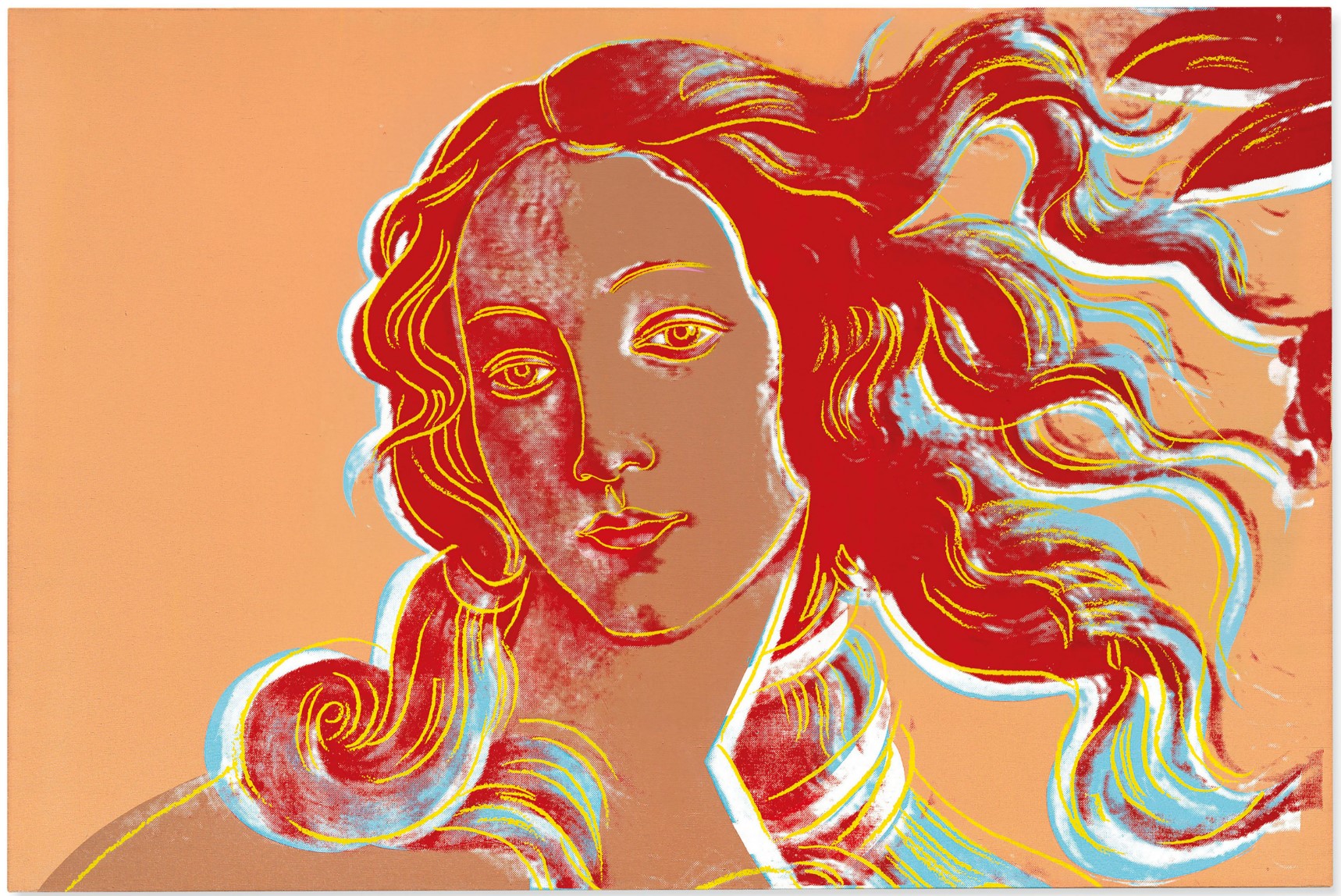
ANDY WARHOL
Birth of Venus (After Botticelli), 1984
Acrylic and silkscreen ink on canvas
48×72 inches (122×183 cm)
Signed ‘Andy Warhol’ (on the overlap)
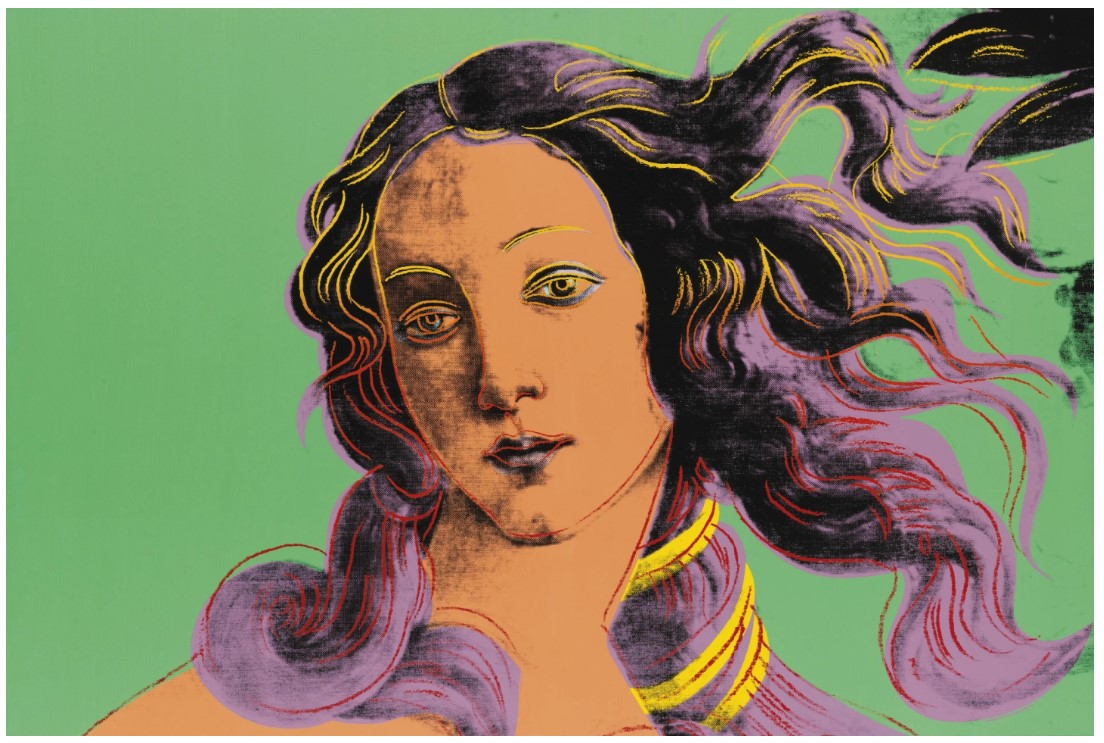
Andy Warhol’s Birth of Venus (After Botticelli) is a radical and breathtaking vision of divine beauty. Executed in 1984 as part of a series of reimagined Quattrocento masterpieces, Warhol’s red Birth of Venus is one of just six large-scale images of Botticelli’s iconic goddess. Of these, four are on canvas and two on linen, each in a different colorway. This original and unique “red” production on canvas, which has been in the same private collection since before Warhol’s death over thirty years ago, is undoubtedly the most romantic. Warhol depicts Venus against a background of salmon pink. For her skin tones, a soft shade of umber is overlaid on pink, while her hair is a deep red, ablaze with accents of electric blue and white. Flourishes of yellow articulate her hair and features. Warhol has cropped and magnified Botticelli’s composition to form a spellbinding portrait, placing Venus in his pantheon of icons, alongside the exalted image of Marilyn Monroe. If Marilyn has been made goddess, here Venus comes to Hollywood.
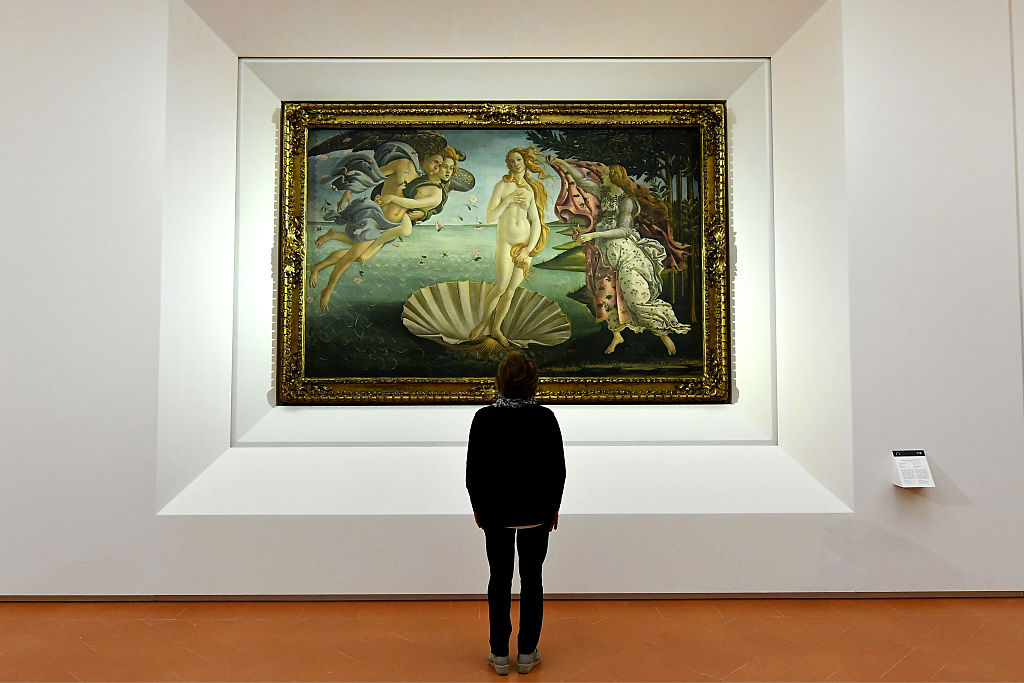
Sandro Botticelli (circa 1445-1510) was one of the great figures of the Italian Renaissance. Praised by Giorgio Vasari for the grace of his compositions, he was renowned for the linear elegance and subtle tones of his figure-painting. Botticelli was also an innovator. He introduced classical myth into a field dominated by religious painting. His Birth of Venus (circa 1484-1486) and its sister painting Primavera (circa 1482), both once owned by the Medici family and now hanging in the Uffizi Gallery in Florence, are recognized as masterpieces. In this quintessential and universally recognized Renaissance painting, Botticelli returned to classical mythology, experiencing a powerful revival during the intellectual Humanism movement that took hold during the 15th century. Botticelli’s life-sized Venus – or Aphrodite in the Greek tradition – emerges nude from the sea out of a shell, surrounded by gods and goddesses, presenting herself as the ultimate symbol of classical beauty. In antiquity, this scene of Venus appearing, or perhaps being born out of the sea, was known as “Venus Anadyomene,” or “Venus rising from the sea,” and came to symbolize female beauty, virginity, eroticism, and purity. Today, Botticelli’s masterpiece is firmly embedded in art historical canon, as a constant inspiration to future generations of artists and, subsequently, as a cultural icon constantly reproduced on coffee mugs, t-shirts, posters and more.
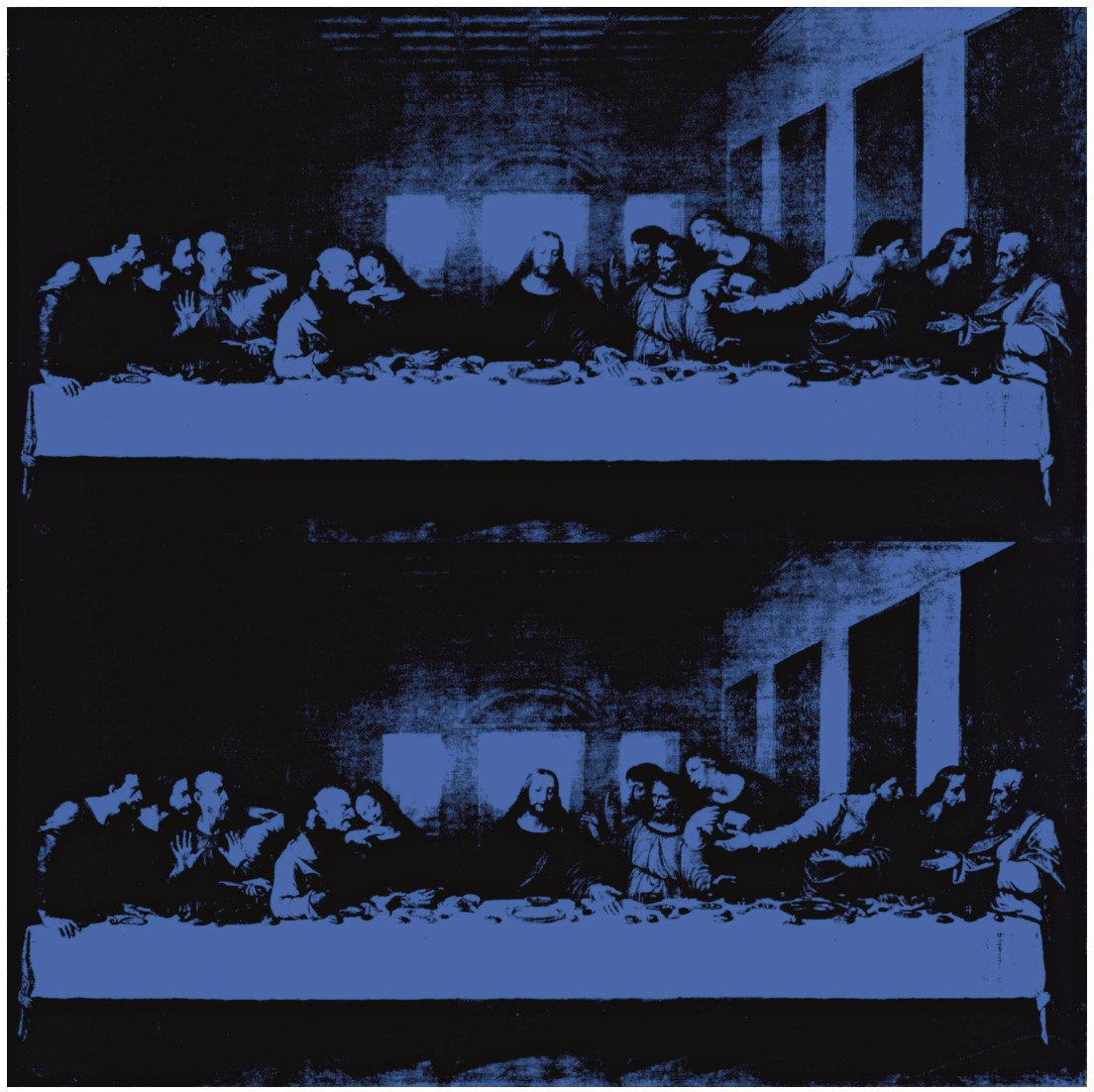
Andy Warhol reinterprets and dramatizes this extraordinary vision. Released from her original context, Venus is reborn in Technicolor, hit with a strobe light, and made into a universalized “Marilyn” for a new age. The conventions of art history are subverted, transmuted, repackaged and democratized. Warhol’s Birth of Venus is one of the outstanding achievements of his later career, looking forward to his final masterworks, the iterated versions of Leonardo da Vinci’s Last Supper.
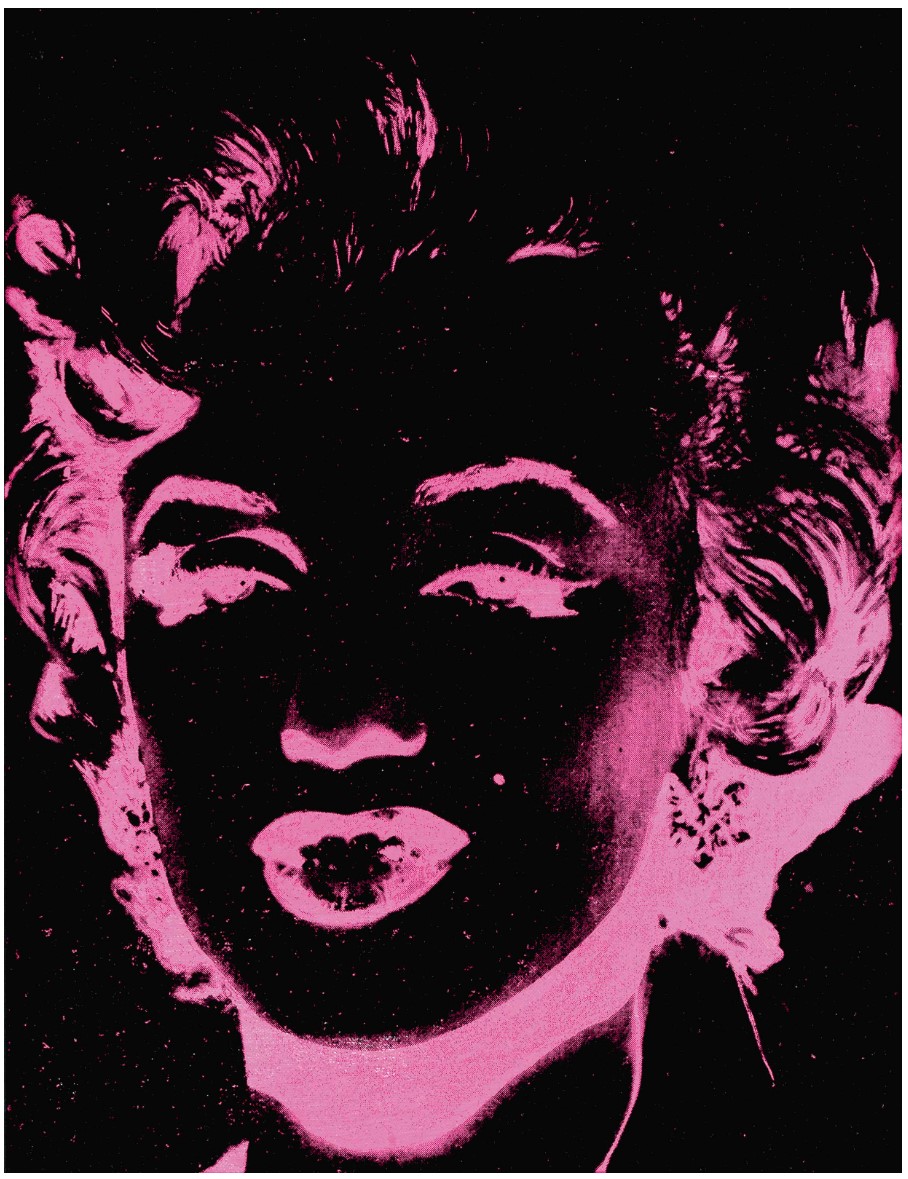 ANDY WARHOL, Pink Marilyn (Reversal), 1986
In the 1960s, Warhol had shocked the art world with the advertising-led flatness of his Coke Bottles and Campbell’s Soup Cans. In the 1970s, his celebrity led to the repetition in different media of many themes that had made him famous. Warhol was rejuvenated, a consummate master of the revolutionary silkscreen process he had initiated nearly two decades earlier. He now combined the medium’s coolly serial mode with an expressive chromatic complexity, a step change from Mona Lisa and other earlier series. Warhol reassessed his art in the Retrospective series of 1978-1879. In his Reversals, he flipped his original colors into negative. His Marilyn (Reversal) images glow with a dark radiance as if ignited from within by their own fame. Warhol’s Pop icons and silkscreen art had advanced from the graphic linearity they once shared with Roy Lichtenstein. Through the genius of Warhol’s vision, they had taken on their own life—or afterlife—in popular culture. They now transcended the American frames of reference that they once embodied, and claimed an important place as milestones in the broader canon of Western art.
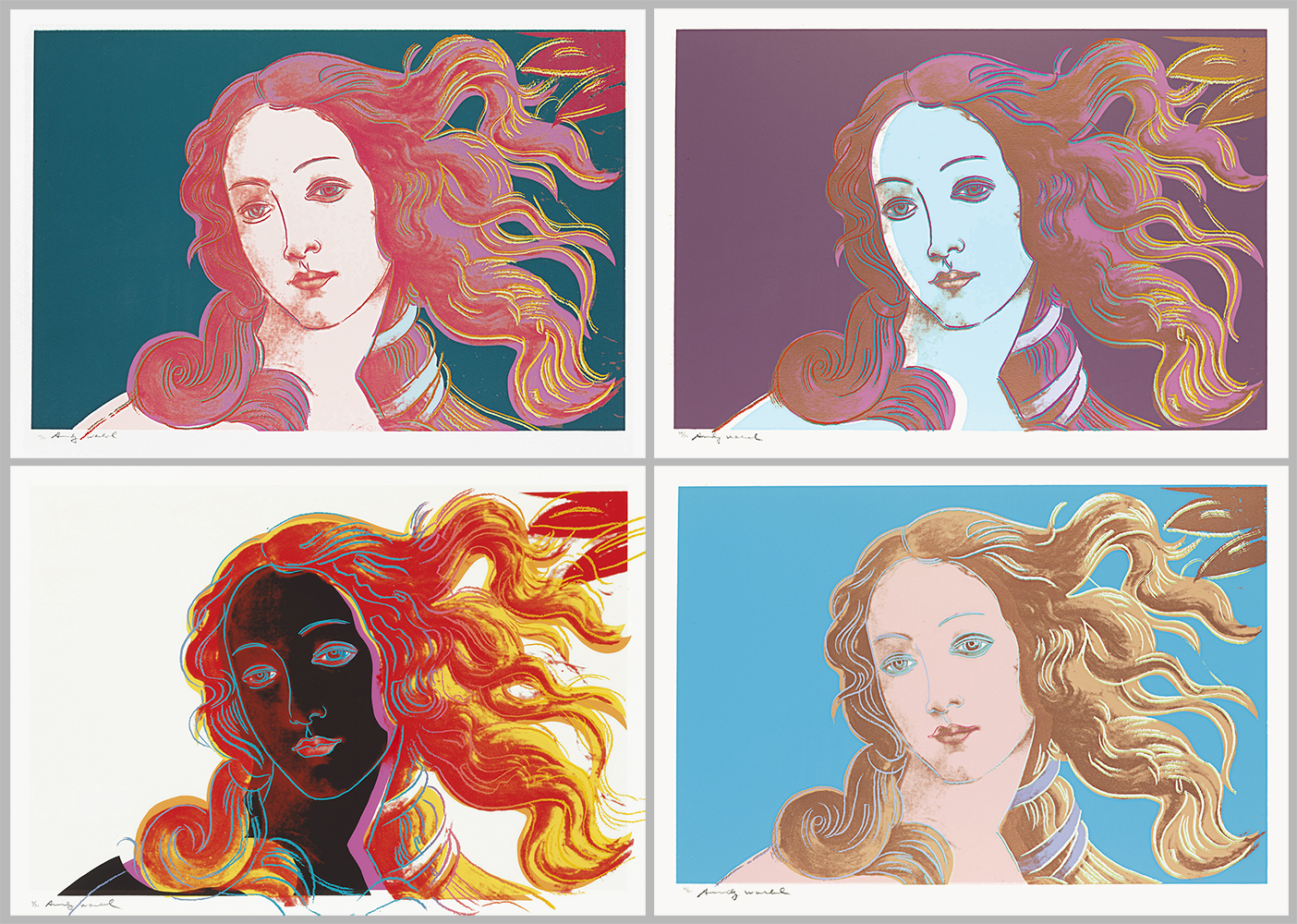
The Details of Renaissance Paintings series of 1984 positions Warhol’s silkscreens alongside the great paintings of the world. The Birth of Venus is at the summit of this series. Although derived from Botticelli, it is the culmination of a profound inquiry into the canonizing power of popular culture. At one level, Warhol’s Venus is “an image of an image, with no reason but a surface reason” (Sherman and Dalton, Andy Warhol, 2009). But if that is all, how has Warhol succeeded in translating Botticelli’s shimmering goddess into one of the world’s most memorable icons? Taking full command of one of the most universally acclaimed paintings in the history of art, Warhol describes the face of love with searing clarity, dramatically ordered color and delicate surface detail to create a timeless image of beauty. Warhol’s Venus may have her origin in a Western ideal, but her reincarnation resonates across the globe. In this red version, the balance of color and detail is revolutionary. Emerging from a background of pure pink and framed by the vibrancy of her rose-red hair lit with ethereal flames, Venus’s lovely face speaks to everyone. The delicate yellow strokes–first drawn by hand before being transferred to a screen–are lovingly applied. Such lyrical details, in concert with the work’s striking assortment of hues, exemplify Warhol’s commitment to line, form, color and process, while responding to the age of television and mass communication.
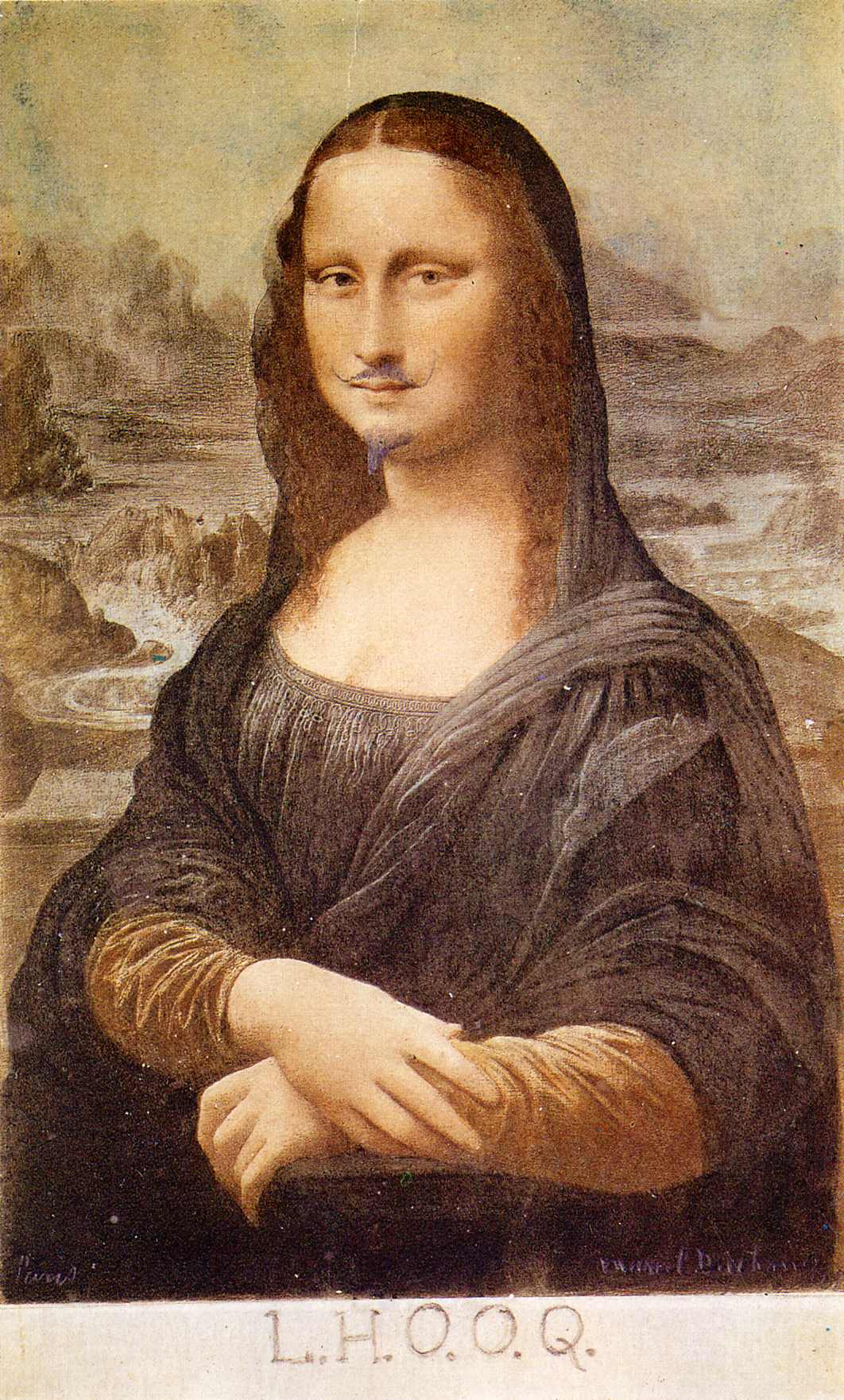
From the outset of Andy Warhol’s career, he chose the most universal images of popular culture to replicate in his silkscreened canvases. In a 1987 interview with Flash Magazine, Warhol aptly stated, “I’m still a commercial artist. I was always a commercial artist.” Indeed, throughout the length of his career spanning three decades, Warhol continuously depicted commercially recognizable subjects – from the quotidian to the exalted – from Campbell’s soup cans and Coca-Cola bottles to Marilyns and Jackies, from car crashes and shoes to Queen Elizabeths and Chairman Maos. What was so revolutionary about Warhol’s oeuvre was the shocking familiarity of his imagery; the appropriation and objectification of his subjects emulated the Duchampian notion of fetishizing the banal and bringing it into the realm of Fine Art. In 1919, Marcel Duchamp took a found object, a postcard of Leonardo da Vinci’s Mona Lisa, drew a moustache on her face and scrawled the letters “L.H.O.O.Q.” beneath the image. When spoken in French, these letters sound like “Elle a chaud au cul” or, in English, “She has a hot ass.” This sly maneuver not only degrades the traditionally exalted art historical figure and her creator, but also introduces the overt practice of appropriating artistic masterpieces as ready-mades. In Duchamp’s wake, Warhol too viewed pop culturally resonant icons, figures and paintings, such as The Birth of Venus, as ready-mades at his disposal, free for manipulating and translating in his signature style.
In Details of Renaissance Paintings and in the series of works inspired by Leonardo da Vinci’s Mona Lisa (c. 1503-1519) and Last Supper (1498), Warhol confronted the ubiquitous images of Art History by intentionally stripping the works of their original artistic intent in favor of their value as a pop cultural symbols. There is certainly an odd irony in appropriating Botticelli’s – or any Old Master’s – laborious, detailed and painstaking painting process into a silkscreen, a mechanical process for mass production that essentially removes the hand of the artist. Subsequently, Warhol transforms this work into an easily reproducible commodity, subverting not only Botticelli’s intention, but the very principles of the art historical tradition.
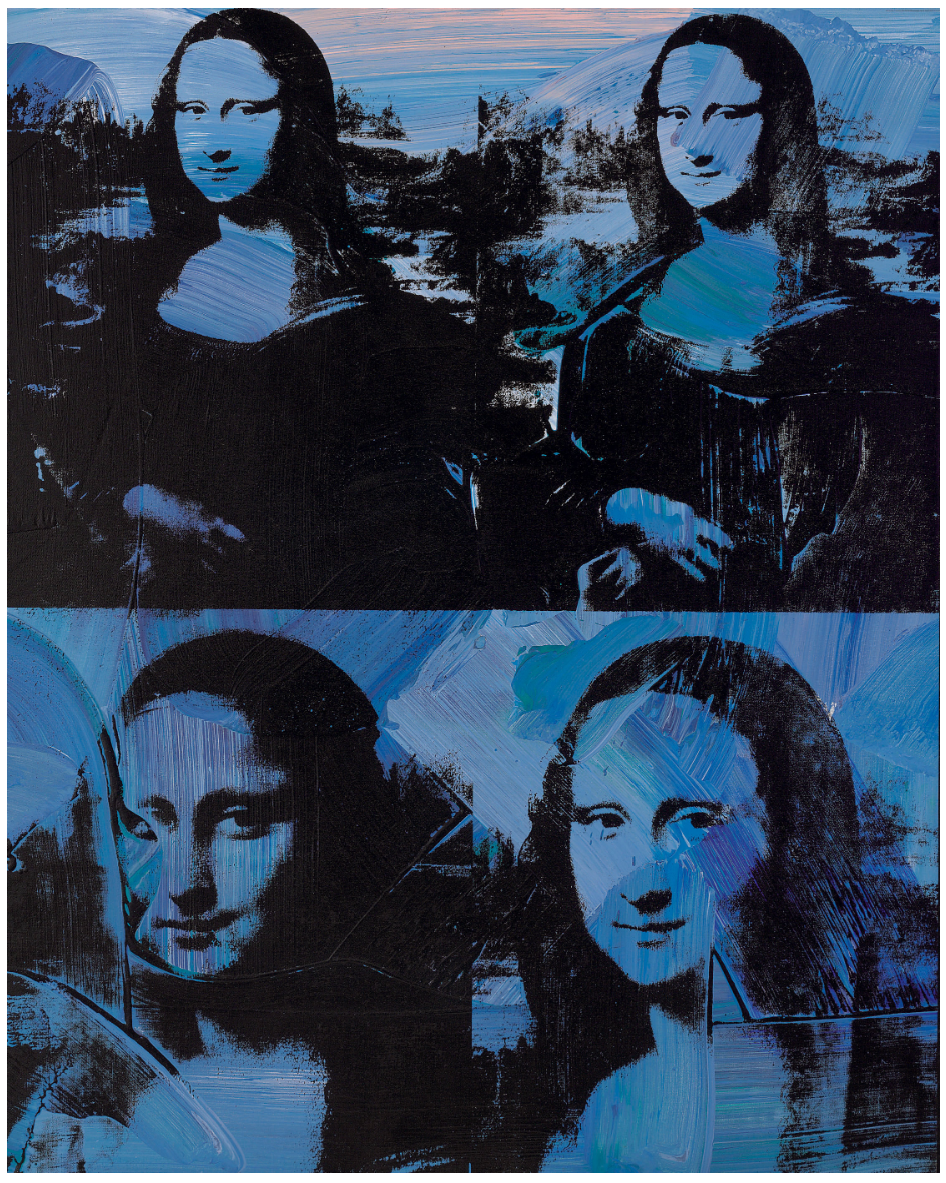
In the present work, the classical symbol of beauty is transmuted in eccentric colors – an eye-catching array of punchy hues. On a background of bright, mint green, Venus’s peach skin radiates, surrounded by a halo of violet curls and outlined in gradations of neon yellow, orange and red. Warhol crops Botticelli’s monumental, mythical scene down to Venus’s face and enlarges it to 48 inches high by 72 inches wide, essentially elevating the image to that of a religious icon in much the same aesthetic manner as Warhol’s early depictions of Marilyn Monroe. The 1964 silkscreen Turquoise Marilyn is almost visually analogous to this Birth of Venus (After Botticelli) from twenty years later. The vibrant green background and unnaturally dramatic and bold facial colors of the present work makes clear reference to his early canvases of the similarly recognizable Marilyn. As Art Historian and Warhol scholar Germano Celant posits, “The history of art is itself another concrete mirage, with its stars and superstars of every age, and Warhol absorbed this too into the magma of his imagination. Alluding to the masters of the Renaissance to Piero della Francesca and Raphael, as well as to Munch and De Chirico, he turned them into dead flowers, so that the absolute subjectivity of art became once again a problem of media communication: a reproduction, cut and edited, with unnatural, technological colors.” (Germano Celant, Super Warhol, p. 10)
Warhol, like Botticelli, was clearly enchanted by his subject. He works with fierce yet tender concentration. It does not seem fanciful to see traces of personal devotion in his homage. Warhol’s Catholic upbringing accorded deep significance to the veneration of images. Like a beautiful Madonna, this goddess is touched with feminine mystery, but is never depersonalized. Andy Warhol’s Venus is the exultation of an icon imbued with humanity by an artist who was never the machine he might pretend to be. Warhol was not merely subverting and challenging the past. By lavishing attention upon every aspect of his painting, he formed a new paradigm of beauty for the postmodern era. The red Birth of Venus is among the most glorious and romantic of his creations. In the post-Pop era, Warhol transcended the boundaries between fine art and popular culture. Selection, appropriation and reproduction were starting points. Editing, magnification and coloration were transformative. His genius of imagination was decisive. Warhol may have said that all he saw was surface. But his achievement was far more complex and infinitely greater. If Botticelli’s Venus was the embodiment of perfect beauty, Warhol could not help but add magic. Andy Warhol’s recasting of the art of the past shows life-heightening iconography in a new light. Two masters are united across five centuries of history. Great art is always learning from its past to fashion itself anew. In Warhol’s wondrous vision, Botticelli’s 15th century Venus is reborn as a brilliant icon, the divine personification of love, floating in time and space.
Sotheby’s New-York: 14 November 2012
USD 5,458,500
ANDY WARHOL
Birth of Venus (After Botticelli), 1984
Acrylic and silkscreen ink on canvas
48×72 inches (121.9 x 182.9 cm)
Signed and dated ’84 on the overlap
Giorgio de Chirico
In 1982, the Museum of Modern Art in New York held a major retrospective of work by the Italian painter Giorgio de Chirico. Inspired by the media coverage of that show, Andy Warhol took images of de Chirico’s work as the subject for a new group of paintings produced that year. Like his paintings of Marilyn Monroe, Liz Taylor and Jackie Kennedy which used material that circulated in the pop culture tabloids, or even works of high art like Leonardo da Vinci’s Mona Lisa, which made a media sensation when it was exhibited in New York in 1963, Warhol drew inspiration from the headliners of the day.
“De Chirico repeated the same images throughout his life. I believe he did it not only because people and dealers asked him to do it, but because he liked it and viewed repetition as a way of expressing himself. This is probably what we have in common.”
Ironically though, the source image for Warhol’s After de Chirico series were not included in the exhibition at MoMA. As art critic Robert C. Morgan reports, a “disclaimer printed in the catalogue and mounted on the exhibition walls stated that works from the late period of the artist (after 1928) suffered a decline and therefore would not be included in the exhibition” (R. Morgan, “A Triple Alliance: de Chirico, Picabia, Warhol,” The Brooklyn Rail, Mar. 1, 2004, n.p.). Thus, a significant portion of the artist’s work was excluded from the exhibition, because as Warhol notes, de Chirico repeated the same compositions as many as a hundred times over the course of his life. It was these very works, excluded from the official history of both art and de Chirico’s production that inspired Warhol. Where MoMA curators felt the artist was repetitive, Warhol found a kindred spirit.
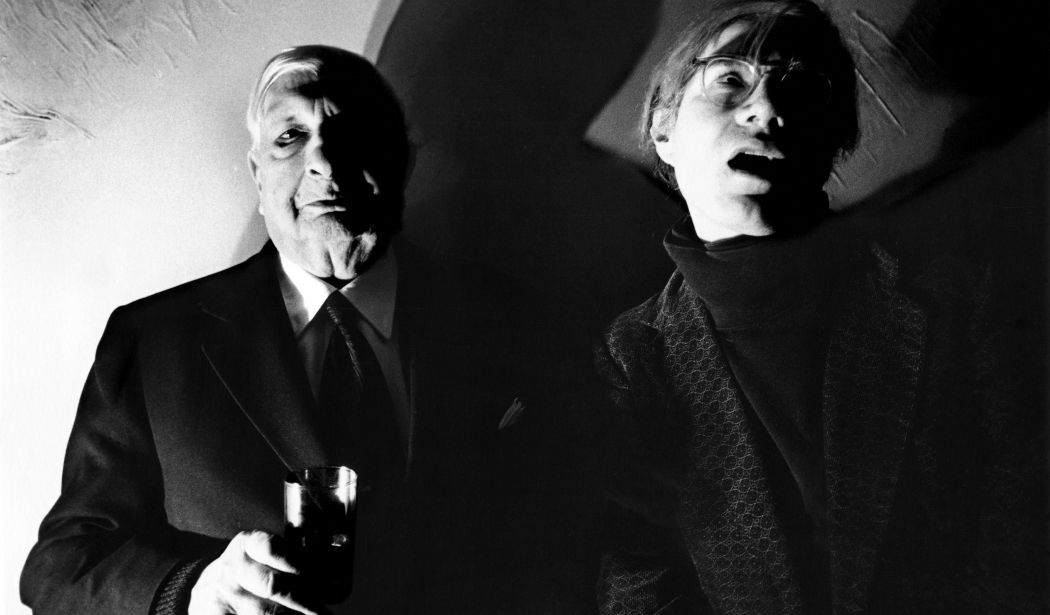
Warhol met de Chirico in 1974 and the two artists developed a strong friendship in the last year of the artist’s life. It was Carlo Berlotti, the Italian collector and businessman who introduced Warhol and de Chirico, who suggested that Warhol adopt de Chirico’s work as his subject matter. The two developed a strong friendship in the final years of the older artist’s life.
“Every time I saw de Chirico’s paintings I felt close to him. Every time I saw him I felt I had known him forever. I think he felt the same way … Once he made the remark that we both had white hair!”
Warhol, who had long been subverting the traditional values of originality, inspiration and handmade spontaneity in art, clearly appreciated the embrace of replication and parody in de Chirico’s much-maligned later work. He became fascinated by de Chirico’s process.
“How did he repeat the same images? Did he project the same image on the canvas? Maybe he did it by dividing the canvas in sections … he could have used a silkscreen!”
Warhol’s first foray in painting from art was in 1963 when he reproduced the Mona Lisa – undoubtedly the most famous face in all of art history. She had recently been on show at the Metropolitan Museum in New York and had stirred up quite a media storm that drew Warhol in, more so than the painting itself. It was not until 20 years later that Warhol truly returned to art history as his main subject. In his Art from Art series, Warhol pays the ultimate form of tribute to the most renowned and recognized works by Leonardo da Vinci, Sandro Botticelli, Edvard Munch, Henri Matisse, and Pablo Picasso by repainting, repeating, and renewing these masterpieces in his own Warholian style.
Warhol, whose name had become synonymous with the contemporary images of his time, actually had very significant ties to the traditional arts as well. He was one of the founding board members of the New York Academy of Art, which opened in 1980 – only two years prior to the production of the present work. It aimed to revive the traditional teaching of fine art from the historical academies, involving drawing from life models and plaster casts, but also from mannequins and previous artistic masters. As the century began to come to a close, this reflective mentality of looking back in history was very much particular to this twilight time (Robert Rosenblum, ‘Warhol as Art History,’ in: Exh. Cat., New York, Museum of Modern Art, Andy Warhol Retrospective, 1989, pp. 25 and 32).
1. The Two Sisters (After de Chirico)
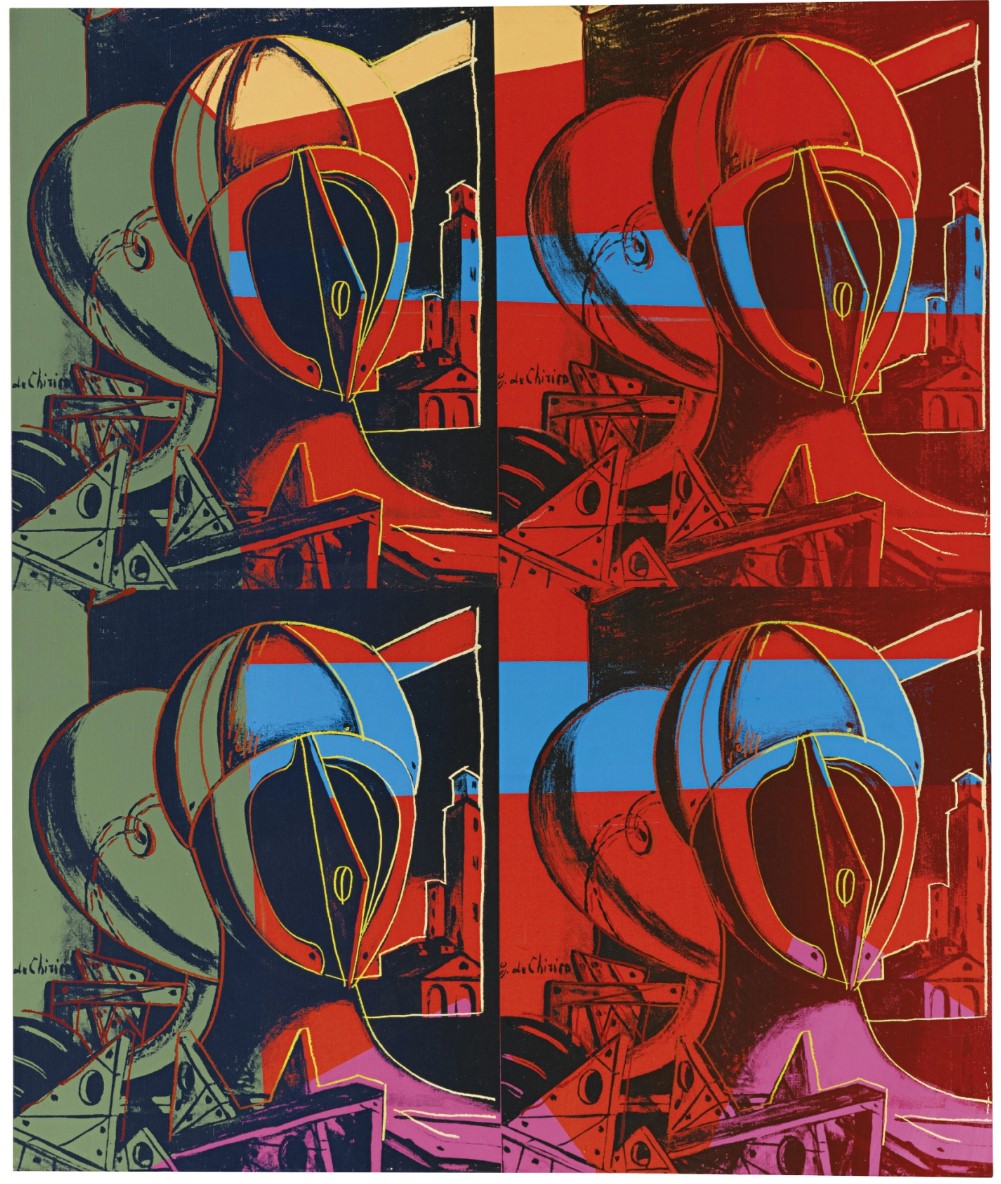
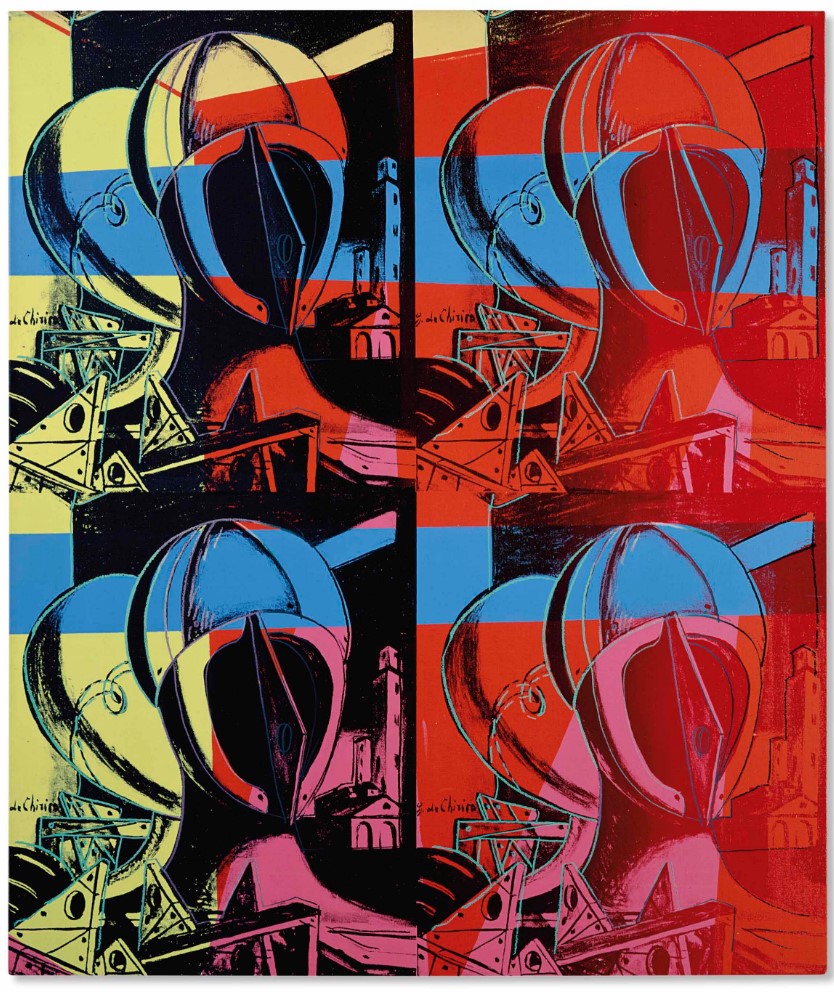
An encounter between two artistic titans – Andy Warhol and Giorgio de Chirico – is orchestrated across the canvas in The Two Sisters (After de Chirico), here Warhol repeats and re-imagines de Chirico’s Oreste e Pilade (1962) four times in striking swathes of brilliant reds, greens, blues, and yellows. As a part of Warhol’s magnificent Art from Art series, the present work appropriates de Chirico’s metaphysical mannequin heads, only to reframe them in a distinctly Warholian aesthetic of bold colors and simplified black accents.
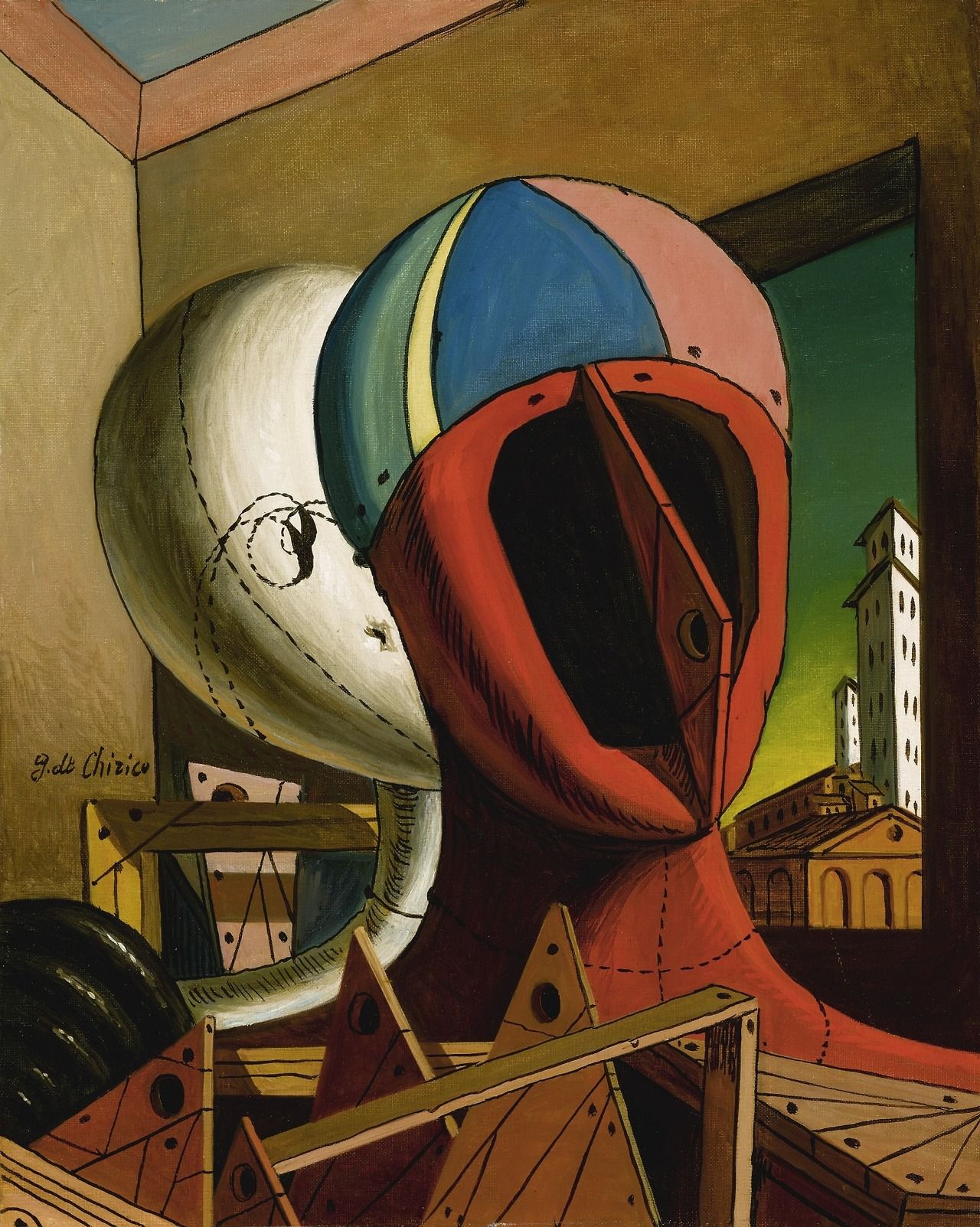
In de Chirico’s painting, the heads of two mannequins, a wooden one in the foreground, and a fabric-covered on behind it, are grouped together in an open-air, yet claustrophobic room. The bell tower of the Cathedral of Ferrara—de Chirico’s hometown made famous in the landscapes of his paintings—is visible through the window behind the mannequin heads. Masks displays all the qualities of de Chirico’s Metaphysical Painting style developed in the 1910s—saturated colors, warm late-in-day Mediterranean light that casts deep, long, raking shadows, and a desolate landscape that bears the trace of occupation but without people in sight. Together these elements contribute to the ominous tones and the dreamlike qualities of the artist’s haunting and uncanny scenes, which would inspire the Surrealists a generation later. After his famed Metaphysical period, the artist would increasingly turn to mannequins as his subject, suggesting the absent figures in his landscapes.
Warhol’s version of de Chirico’s painting repeats its image in a grid of four in a technicolored reorganization of the four colors of the CMYK printing: cyan, magenta, yellow and key black. Blocks of red clash with pink and a blue line traverses the horizontal plane of the canvas twice. According to art historian Robert Rosenblum, Warhol “clearly recognized the positive aspects of de Chirico’s so often maligned later work, namely its full embrace of the possibilities of repetition, of factory-style, of existing works, and its undermining of those traditions of originality, inspiration, and handmade spontaneity which Warhol, in his own ways, had been subverting since the 1960s” (R. Rosenblum quoted in R. Morgan, “A Triple Alliance). Recontextualized through Warhol’s Pop vision, de Chirico’s mannequins are reconnected to their commercial function.
Warhol’s artistic piracy crops de Chirico’s original painting and selectively plucks out certain elements from it, so that they become further emphasized in The Two Sisters (After de Chirico). The blues, reds, greens, and yellows that are carefully contained within the lines of de Chirico’s mannequin heads are given further vibrancy and dynamism by Warhol, who takes this color combination and aggressively silkscreens it across the entire canvas, disobeying all lines and logic. As such, despite the contrast in artistic sensibilities between Warhol and de Chirico, there emerge certain visual affinities and thematic resonances from their engagement. In addition to resonating with de Chirico himself, the present work also recalls Warhol’s own stylized portraits through which he rose to critical acclaim. Like the overwhelmingly repeated faces of Mona Lisa in Thirty Are Better Than One (1963) or Marilyn Monroe in Marilyn x 100 (1962), this is a double portrait hypnotically multiplied four times on the canvas, as to showcase eight faces. In vibrant colors, these generic mannequin heads also make reference to Warhol’s tendency to simultaneously simplify, accentuate, and obscure facial details to the point where all his portraits come to look stylishly alike: a string of faces wearing slightly off-kilter, brightly colored masks or makeup.
The present work is therefore a powerful painting about Warhol repeating de Chirico, but also about Warhol repeating himself. Warhol has most memorably demonstrated the productive potential of appropriation: through repetition, fresh perspectives of the past can be discovered. As such, the present work not only evokes an artistic lineage between two artistic greats, but it is also melancholic in its tendency to look backwards – especially since it was created in the last five years of Warhol’s life. In 1989, two years after his death, the last quarter of the Twentieth Century would come to be known as the ‘Age of Warhol’, and Robert Rosenblum would further claim that Warhol was not only a part of art history, but that he should be remembered as art history – a bold statement that confirms this painting’s status as an icon of art history itself.
The Two Sisters (after de Chirico), 1982
Sotheby’s Hong-Kong: 5 April 2024
Estimated: HKD 7,000,000 – 10,000,000
HKD 9,144,000 / USD 1,169,010

ANDY WARHOL (1928 – 1987)
The Two Sisters (after de Chirico), 1982
Acrylic and silkscreen ink on canvas
50 1/4 x 41 3/4 inches (127.5 x 106 cm)
Signed and dated 82 on the overlap
Mapped out as a shimmering vision of mechanically repetitive, technicolor frames, the iconic The Two Sisters (after de Chirico) orchestrates a collision of two of the greatest artistic minds of the Twentieth Century: Andy Warhol and Giorgio de Chirico. Enacting an astute philosophical contemplation on the power of image-making within the modern age, this work forms part of a series which saw Warhol return to ‘art’ as a subject. Warhol thus shifted the role of the artist from the position of sole creator to one of keen observer and cultural arbiter. As a technically daring and visually stunning embodiment of this claim, The Two Sisters (after de Chirico) holds a poignant place in the history of twentieth-century image making. Here, Warhol repeats and re-imagines de Chirico’s Oreste e Pilade (1962) four times in striking swathes of brilliant reds, greens, blues, and yellows. As a part of Warhol’s magnificent Art from Art series, the present work appropriates de Chirico’s metaphysical mannequin heads, only to reframe them in a distinctly Warholian aesthetic of bold colours and simplified black accents.

Vertical strands of acidic yellow, greens and blues clash with horizontal reds and turquoises marking the mechanical linearity of Warhol’s silkscreen technique. Instantly attributable to the Italian metaphysical painter Giorgio de Chirico, here the image is defamiliarised through impersonal repetition, as if it has been cut from a longer string of prints, or perhaps the negative of a film. By the time the present work was produced, Warhol had already achieved fame and fortune for his stylised silkscreen paintings of the 1960s and ’70s, which transformed images into high-art icons. He endlessly and obsessively repeated the likeness of celebrities, Pop culture icons, and the mass media images over and over again, and in so doing, re-enacted the kind of mechanical reproduction of images that were splashed across the covers of newspapers and television screens. This modus operandi took on another dimension when Warhol began appropriating images not only from contemporary mass culture, but also from the Old Masters and modern giants of the historical art world itself. Warhol first reproduced an iconic art historic image after Leonardo da Vinci’s Mona Lisa was exhibited in New York in 1963 for the first time, certifying that artworks are also party to the fame that fascinated Warhol endlessly. However it was not until the early 1980s that he returned to this theme, taking into his visual repertoire Da Vinci’s The Last Supper, as well as works by Lucas Cranach The Elder, Raphael, Henri Matisse, Pablo Picasso and Edvard Munch.
“[de Chirico] viewed repetition as a way of expressing himself. This is probably what we have in common… The difference? What he repeated regularly, year after year, I repeat the same day in the same painting.”

One of the key influences of Warhol’s artistic style is the media. The artist is particularly interested in the way in which images and stories are sensationalized and commodified, transforming everyday events into headline news. He recognized their ability to make or break a person’s reputation and used this idea to create his own brand of art. It was this fascination with the tabloids that led Warhol to create this body of work after de Chirico. In 1982, the Museum of Modern Art exhibited a de Chirico retrospective, inspiring Warhol to appropriate the work of this Modern Italian master, and producing his own set of After de Chirico paintings that were shown at the Campidoglio in Rome later that year. Similar to Warhol, de Chirico also had the tendency to repeat certain figures and fictions across his body of work – such as mannequins, trains, and empty cityscapes with elongated shadows. In his late years, de Chirico notoriously proceeded to replicate his own masterpieces in full. Oreste e Pilade was itself duplicated by de Chirco as Les Masques in 1973, and then by Warhol via the present work only ten years later in 1982. Both used repetition as a means to explore the relationship between art and mass production, questioning the uniqueness of the artwork in an age of mechanical reproduction. What’s more, both artists were known for their use of bright, bold colors. If Warhol’s Pop Art was characterized by its bright, eye-catching hues, de Chirico’s compositions often featured vivid shades of blue, red, and yellow which are mirrored in the present composition.

GIORGIO DE CHIRICO, ORESTE E PILADE, 1962 © 2024 ARTISTS RIGHTS SOCIETY (ARS), NEW YORK / SIAE, ROME
Warhol’s artistic piracy crops de Chirico’s original painting and selectively plucks out certain elements from it, so that they become further emphasized in The Two Sisters (After de Chirico). The blues, reds, greens, and yellows that are carefully contained within the lines of de Chirico’s mannequin heads are given further vibrancy and dynamism by Warhol, who takes this colour combination and aggressively silkscreens it across the entire canvas, disobeying all lines and logic. Moreover, this painting confers a new meaning to the subject represented by de Chirico. The mannequin, a lifeless figure crafted from wood or plaster, has long captured the imagination of artists across a variety of mediums. In the realm of surrealist art, the mannequin takes on a specific significance, serving as a symbol of the uncanny, and the enigmatic. Many artists such as André Masson, Salvador Dali as well as Hans Bellmer sought to explore the boundaries between reality and the imaginary, the animate and the inanimate through their representation of the mannequin. However, in light of the Pop Art movement, the mannequin as a perfect, unblemished surface constitutes a symbol for the mechanization and dehumanization of modern society, as well as mass production. In this way, Warhol reunites the theme of the mannequin with its commercial nature.

In 1989, two years after his death, the last quarter of the Twentieth Century would come to be known as the ‘Age of Warhol’, with Robert Rosenblum claiming Warhol was not only a part of art history, but that he should be remembered as art history – a bold statement that confirms The Two Sisters (After de Chirico)’s status as an icon of art history itself. The present work is both a celebration of de Chirico’s artistic legacy and a fervent expression of Pop Art, evoking an artistic lineage between two artistic greats in the final years of the artist’s life, establishing his legacy as a titan of twentieth century image making.
Sotheby’s London: 28 June 2016
GBP 1,205,000
 ANDY WARHOL
The Two Sisters (after de Chirico), 1982
Acrylic and silkscreen ink on canvas
50×42 inches (127 x 106.7 cm)
Christie’s New-York: 9 May 2016
USD 1,805,000
ANDY WARHOL
The Two Sisters (After de Chirico), 1982
Acrylic and silkscreen inks on canvas
50×42 inches (127 x 106.7 cm)
Signed and dated ‘Andy Warhol 82’ (on the overlap)
2. Hector and Andromache (After de Chirico)
Hector and Andromache (After de Chirico) holds a poignant place in the history of twentieth-century image making. Vertical strands of acidic greens, reds and blues clash with horizontal reds and turquoises marking the mechanical linearity of Warhol’s silkscreen technique whilst evoking the primary colors of the CMYK printing technique. Instantly attributable to the Italian metaphysical painter Giorgio de Chirico, here the image is defamiliarized through impersonal repetition, as if it has been cut from a longer string of prints, or perhaps the negative of a film.
Sotheby’s London: 10 February 2015
GBP 1,805,000
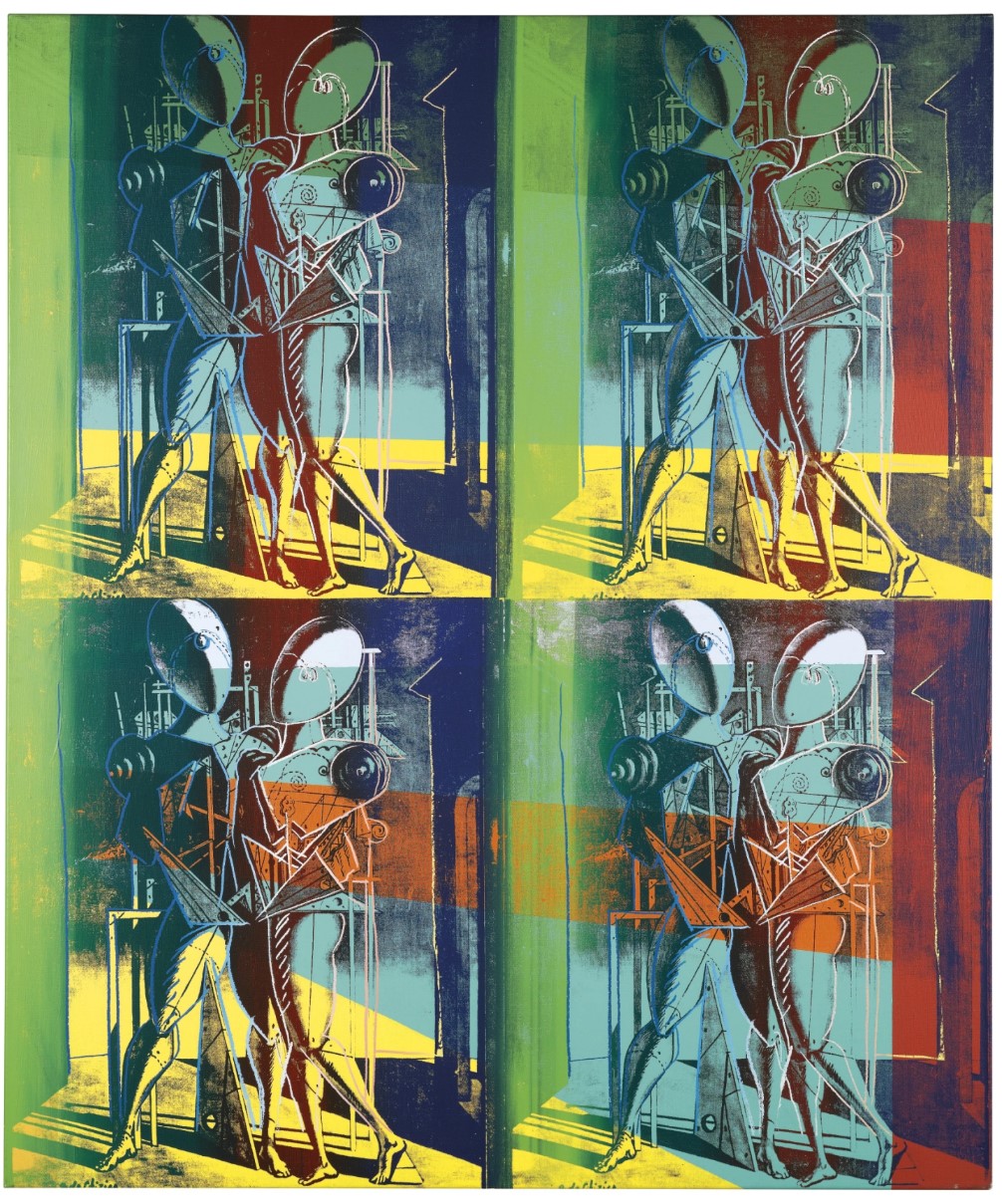 ANDY WARHOL
Hector and Andromache (After de Chirico), 1982
Acrylic and silkscreen ink on canvas
50 x 41.7 inches (127 x 106 cm)
Whilst de Chirico’s tableaus approach the surreal veneer of a dream, Warhol’s practice was intimately bound to a different field of latent desire: the American dream, a realm in which the hopes and fears of the wilful consumer are guided by products and the mass media. The American dream embodies a system of cultural discernment which art stands at the apex of; a hierarchy abolished by Warhol’s distanced, sarcastically neutral and non-critical reproduced visions. Warhol presents the banal and the fantastic with optic equality, vilifying the pervasive power of mass-reproduction without negating the unique power of an image. His idiosyncratically aestheticized process stands testament to a unique and enduringly influential vision, which both commented on and changed the course of art forever.
3. The Poet and His Muse (after de Chirico)
The Poet and His Muse (After de Chirico), 1982
Sotheby’s London: 17 September 2025
Estimated: GBP 600,000 – 800,000
GBP 571,500 / USD 780,295
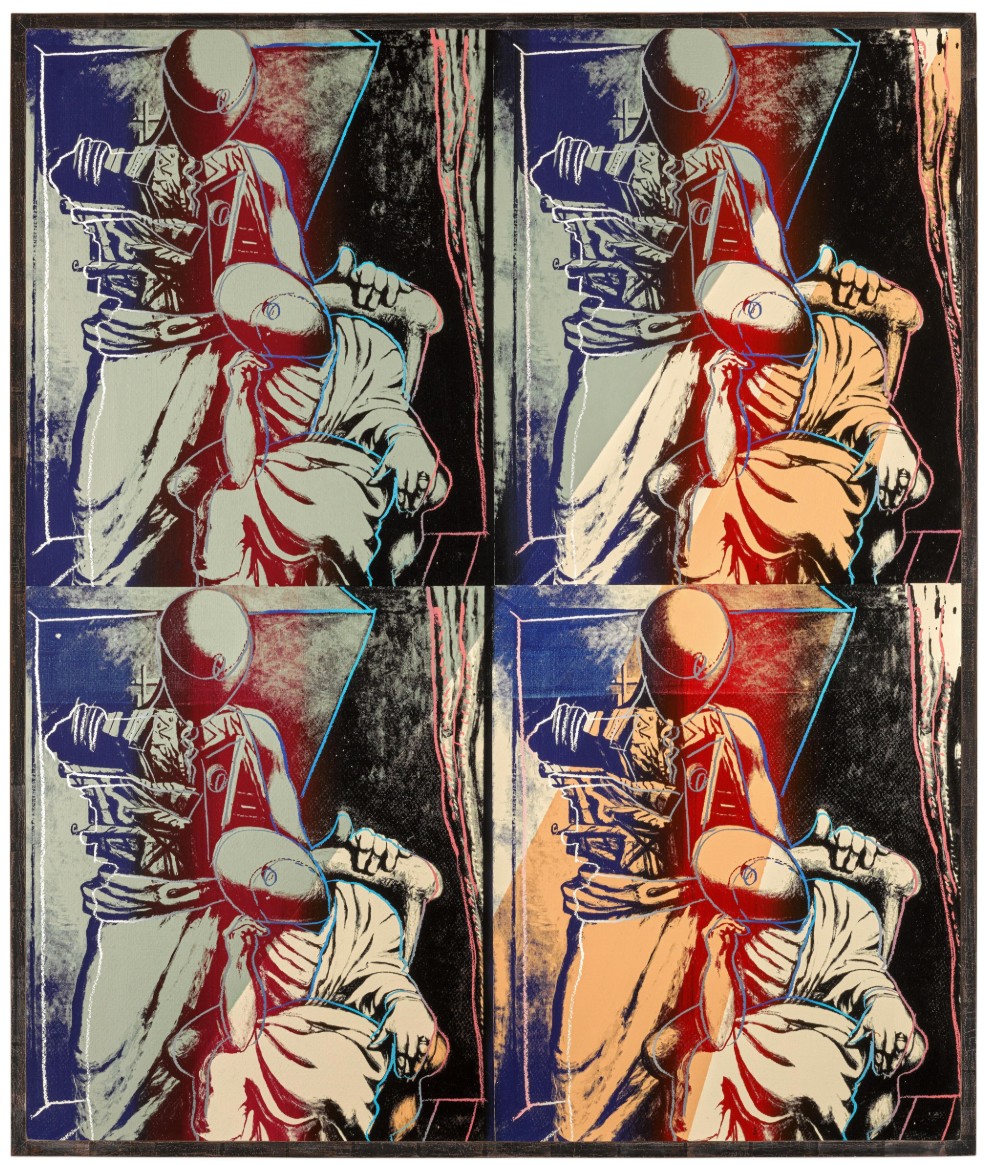
ANDY WARHOL (1928 – 1987)
The Poet and His Muse (After de Chirico), 1982
Acrylic and silkscreen ink on canvas
50×42 inches (127 x 106.5 cm)
Stamped by the Estate of Andy Warhol and the Andy Warhol Foundation for the Visual Arts, Inc.
Numbered PA 38.006 on the overlap
Conjured with an almost spectral aura, Andy Warhol’s The Poet and His Muse (After de Chirico) orchestrates a collision between the king of American Pop and Giorgio de Chirico, the metaphysical painter hailed as the father of the Surrealist metaphysical idiom. Warhol has transformed one of de Chirico’s most recognizable works, The Poet and His Muse from 1925 into a mosaic of four repeated images. The original image depicts the robed and faceless mannequins, the poet standing, the muse sitting in an empty space with sharply perspectival floorboards. De Chirico’s dream-like space is enshrouded by a dark mist that partly reveals the exterior, with a church cross in the background. Warhol’s tight cropping of the image accentuates the claustrophobia of de Chirico’s dream-like composition as the background is lost. His signature screenprinting casts beams of hazy orange and red across the canvas, as cyan, pink and white lines trace the contours with incandescent vitality. The work reveals Warhol’s fascination with Surrealist imagery and its potent imagery. Held in Pauline Karpidas’ collection since its acquisition in 1998, the work is brilliantly complemented by her collection of de Chirico’s work along with works by other Surrealist icons such as Man Ray.
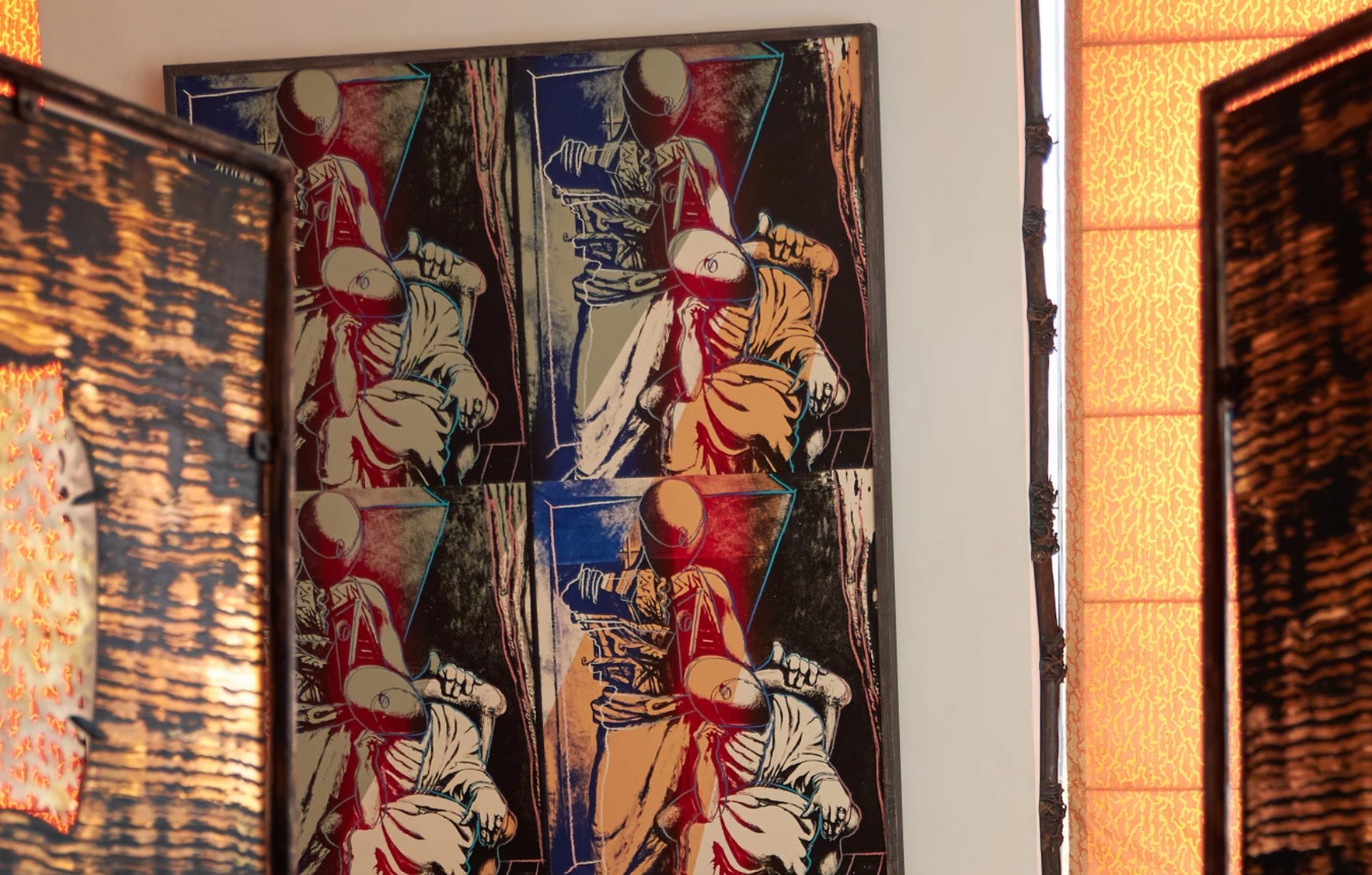
The present work shown in the London home of Pauline Karpidas
In 1982, William Rubin curated a de Chirico retrospective at the Museum of Modern Art, New York, that inspired Warhol to appropriate the work of the Italian master, and produce his own set of After de Chirico paintings. The series itself was commissioned by the Italian-American business Carlo Bilotti whose wife and daughter Tina and Lisa had been memorably captured by Warhol in a 1981 commission. And so many of the works were later shown at the Campidoglio in Rome between November 1982 and January 1983 before also being exhibited in New York at the Marisa del Re Gallery in 1985. Warhol and de Chirico had in fact met in 1970, and held a mutual admiration for each other’s work; the After de Chirico series was then a befitting tribute from Warhol to the metaphysical painter after his death in 1978. Similar to Warhol, de Chirico also had the tendency to repeat certain figures and fictions across his body of work, such as mannequins, trains and empty cityscapes with elongated shadows. In his late years, de Chirico notoriously proceeded to replicate his own masterpieces in full.
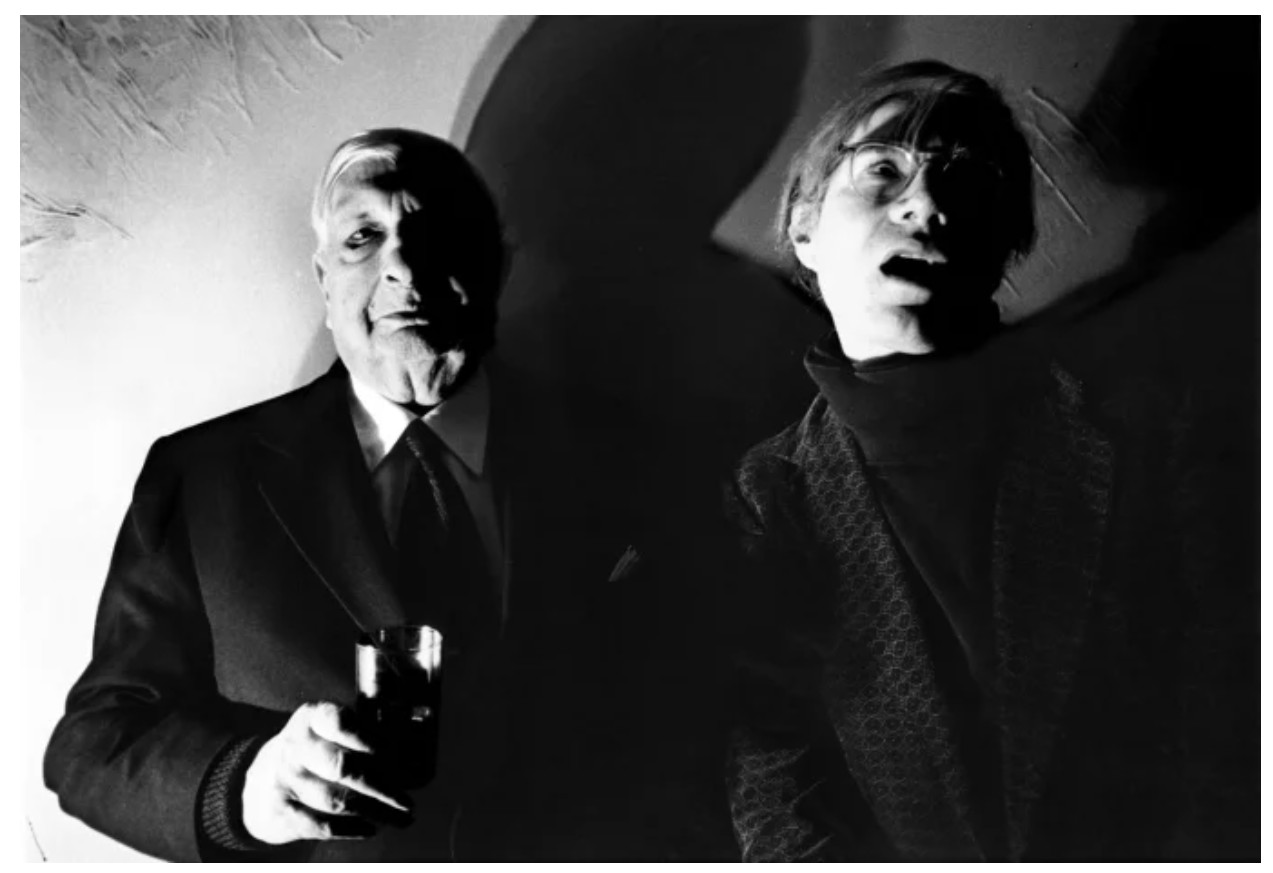
Andy Warhol and Giorgio de Chirico, New York, 1972, Photo: Gianfranco Gorgoni © Maya Gorgoni
The Poet and His Muse was itself duplicated by de Chirico a number of times. Both artists challenged the modernist ethos of authenticity and uniqueness with their stance on replication, arguably the foundation of Warhol’s practice. The synthesis between Warhol and de Chirico is expertly described by Michael R. Taylor, ‘it was [a] reproduction in the exhibition catalogue of Carlo Ragghiati’s image from Critica d’Arte—eighteen nearly identical versions of de Chirico’s The Disquieting Muses, dating from 1945 to 1962, arranged in three neat rows spread over two pages—that made the deepest impression on the younger artist. The gridlike organization recalls the modular format of Warhol’s Pop paintings of soup cans, which represent images of consumer goods arranged in stacked and ordered rows that mimic the repetitive displays in supermarket shelves (Mark R. Taylor, Giorgio de Chirico and the Myth of Ariadne, Philadelphia 2002, p. 164). Many of de Chirico’s later works and what he called his own ‘self-copies’ after 1928 were dismissed and not included in the retrospective. Ironically it was these very works—dismissed by art historians and curators alike—that captivated Warhol’s imagination. Warhol saw strength where art history saw weakness, and with it the After de Chirico series began.
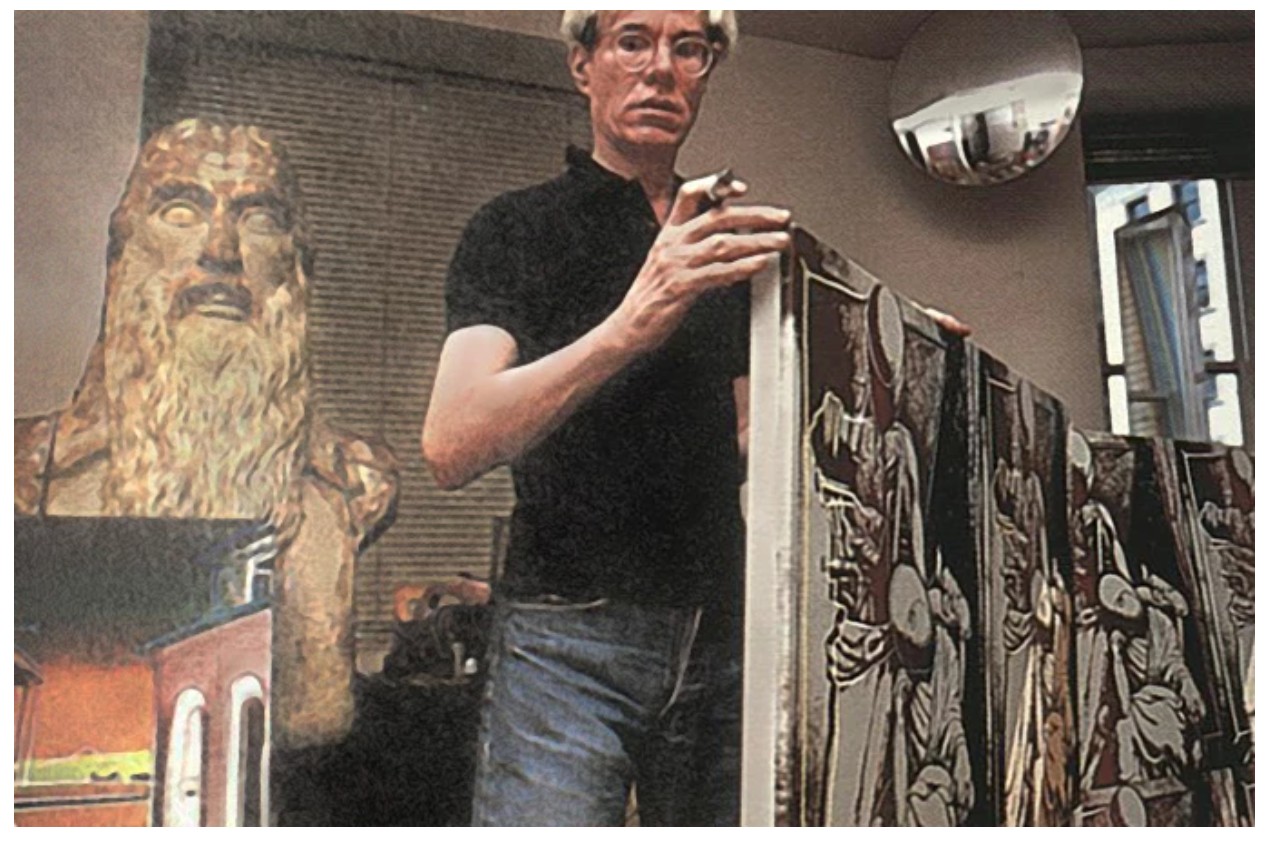
Andy Warhol in his studio © 2025 The Andy Warhol Foundation for the Visual Arts, Inc. / Licensed by DACS, London
Warhol’s artistic piracy crops de Chirico’s original painting and selectively plucks out certain elements from it, so that they become further emphasized in The Poet and His Muse (After de Chirico). The palette in de Chirico’s original is given further vibrancy and dynamism by Warhol, who takes the color combination and aggressively silkscreens it across the entire canvas, adding his own signature graphic and bright lines that delineate the mannequins and background. Moreover, the present work confers new meaning onto the subject represented by de Chirico. The mannequin, a lifeless figure crafted from wood or plaster, has long captured the imagination of artists across a variety of mediums. In the realm of Surrealist art, the mannequin takes on a specific significance, serving as a symbol of the uncanny and the enigmatic. Many artists such as André Masson, Salvador Dalí as well as Hans Bellmer sought to explore the boundaries between reality and the imaginary, the animate and the inanimate through their representation of the mannequin. However, in light of the Pop Art movement, the mannequin as a perfect, unblemished surface constitutes a symbol for the mechanisation and dehumanisation of modern society. In this way, Warhol reappropriates the Surrealist iconography of the mannequin, transforming it into his signature Pop aesthetic. After all, the zeitgeist of the post-modern era would be the appropriation and abstraction of the motifs and icons of the past.
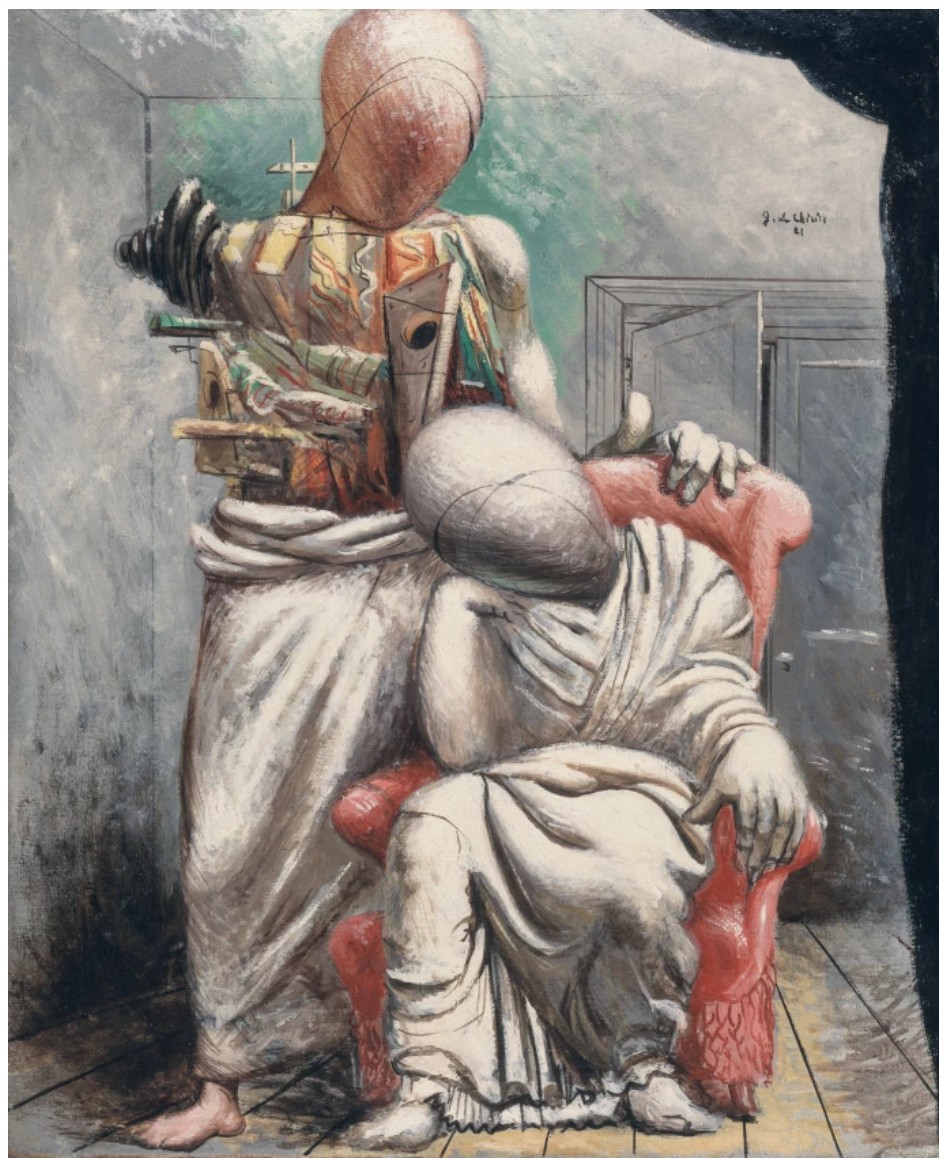
Giorgio de Chirico, The Poet and his Muse, circa 1925, oil and tempera on canvas, Philadelphia Museum of Art, Pennsylvania © DACS 2025 / © Philadelphia Museum of Art / The Louise and Walter Arensberg Collection, 1950 / Bridgeman Images
For de Chirico it was his metaphysical vision—classical allusions, mannequins, trains and empty cityscapes—for Warhol, it was his nostalgic mythologizing of signs, symbols and celebrities. Warhol takes de Chirico’s metaphysical mannequins and breathes new life into their hollow forms, coating them in a synthetic glow that transforms nostalgia into prophecy. Stripping away sentiment, Warhol’s silkscreen process casts the iconic image in a ghostly haze, collapsing time between classical reverie and post-modern critique. In addition to this, the dreamscapes of de Chirico, and indeed these reinterpretations, resonate with Pauline Karpidas’ fascination with Jungian psychology and the associated theory that dreams are the conduit to the subconscious. Indeed, the present work was hung in her bedroom alongside another work from the After de Chirico series. In The Poet and His Muse (After de Chirico), Warhol amalgamates his and de Chirico’s shared artistic visions as he resurrects de Chirico’s powerful iconography and dreamscapes, ushering it into the pantheon of Pop; Warhol perhaps becomes the Poet and de Chirico the Muse, or indeed it is a reflection of Warhol’s Art from Art series, and how high culture was its muse.
4. The Disquieting Muses (after de Chirico)
In The Disquieting Muses (After de Chirico), a kaleidoscopic hybrid is born. Andy Warhol, king of American Pop art, meets Giorgio de Chirico, the Italian metaphysical painter hailed by many as the father of Surrealism. Warhol has repeated four times one of de Chirico’s most famous works, The Disquieting Muses: first painted during the First World War, it depicts a group of strangely adorned mannequins standing in deep shadow on a sharply perspectival landscape of floorboards in front of Castello Estense, in the medieval Italian city of Ferrara. The work is an icon of Modernism and a masterpiece of the melancholic, dreamlike art de Chirico pioneered in the early twentieth century. Warhol’s trademark iterative screen-printing emphasizes the columnar form of the mannequin to the left with a white vertical beam and strafes the overall composition with gorgeous swathes of color. The ground is lit with orange and the shadows glow deep red, while outlines are emphasized in luminous blue and yellow tracery; the doubled skies are suffused with scarlet or green, and rays of magenta and lilac gleam across like diagonal strobe lights. Inspired by de Chirico’s 1982 retrospective at the Museum of Modern Art, New York, Warhol expresses his affinity with the older artist, whose own practice was flavored with repetition and serialization: in The Disquieting Muses (After de Chirico), Warhol reproduces an image that de Chirico himself had repeated countless times during his career and imbues it with a blazing Technicolor afterlife.
Christie’s London: 28 June 2016
GBP 866,500
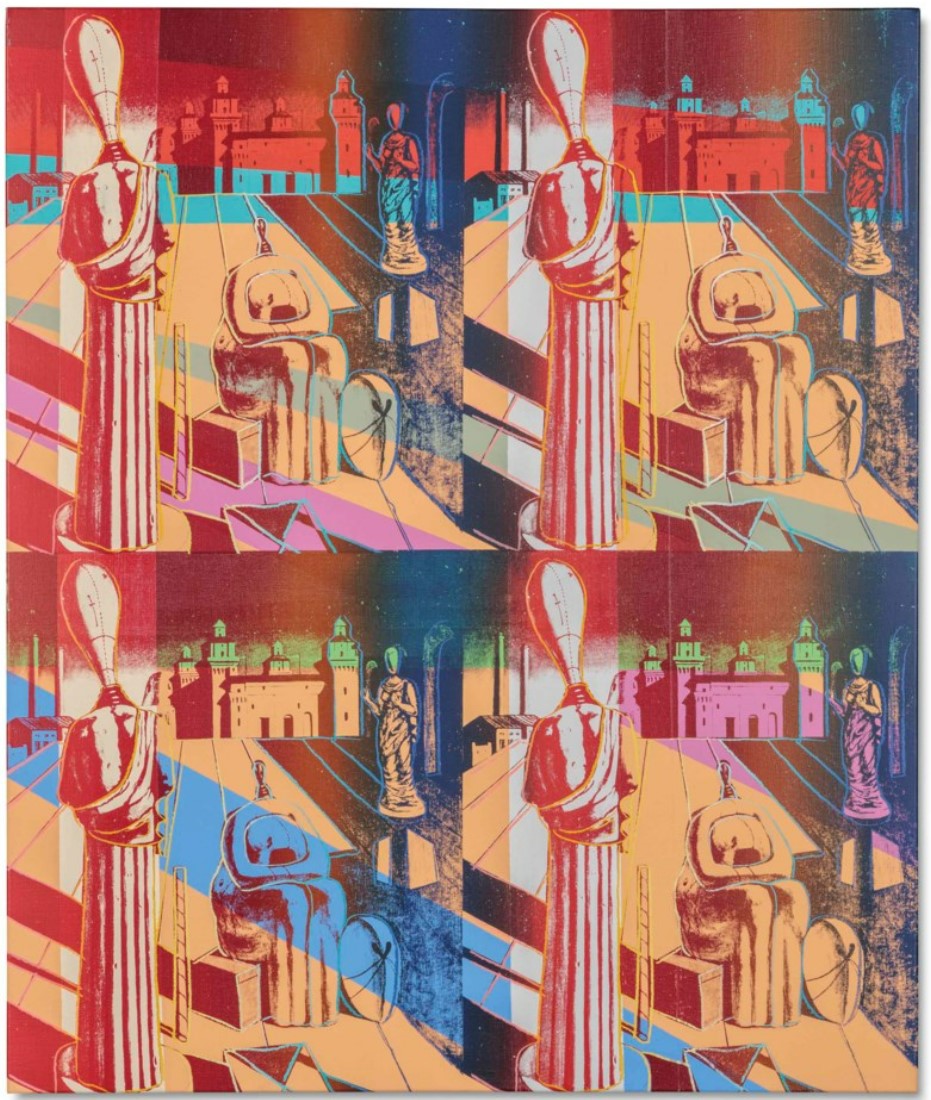
ANDY WARHOL
The Disquieting Muses (After de Chirico), 1982
Acrylic and silkscreen inks on canvas
50.1 x 42.2 inches (127.3 x 107.3 cm)
Lucas Cranach the Elder
Untitled (after Lucas Cranach the Elder: Portrait of a Young Woman), 1984
Van Ham: 3 June 2025
Estimated: EUR 600,000 – 1,000,000
EUR 815,340 / USD 927,205
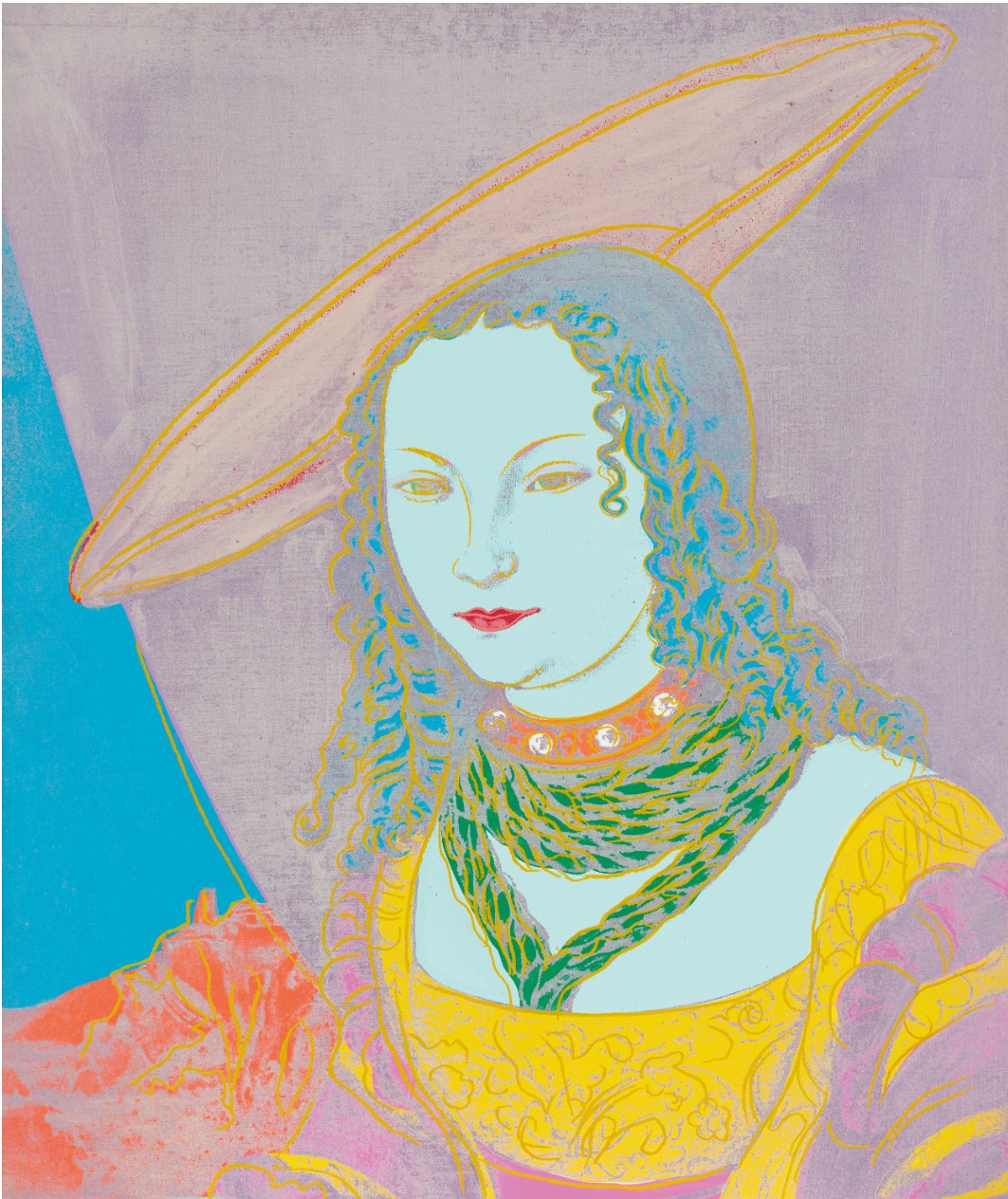
ANDY WARHOL (1928 Pittsburgh, PA/USA – 1987 New York)
Untitled (after Lucas Cranach the Elder: Portrait of a Young Woman), 1984
Acrylic on canvas
40×42 inches (127 x 106.5 cm)
Signed and dated on the folded canvas verso top center: Andy Warhol 84
The untitled silkscreen painting based on the Portrait of a Young Woman by Lucas Cranach the Elder from 1526 (State Hermitage in St. Petersburg) is part of the “Art From Art” series, in which Warhol addressed heavily cropped details of paintings by Old and Modern Masters during the 1980s. Other models for this series were Botticelli’s Venus, works by Paolo Uccello, Leonardo da Vinci, Raphael and artists of classical modernism such as Giorgio de Chirico, Henri Matisse and Edvard Munch. Warhol’s detailed reproductions of iconic works of art history each exist in several variants. Warhol transformed his role models in a similar way to his other motifs, most of which were created from advertising or from his own Polaroid photos. He chose particularly powerful sections, made his pictorial subjects flat and memorable through an intensive, reduced colorfulness and the concentration on a few details. His quotations from earlier works go deeper than the “appropriation art” popular in the mid-1980s and cannot be limited to a “postmodern” strategy.
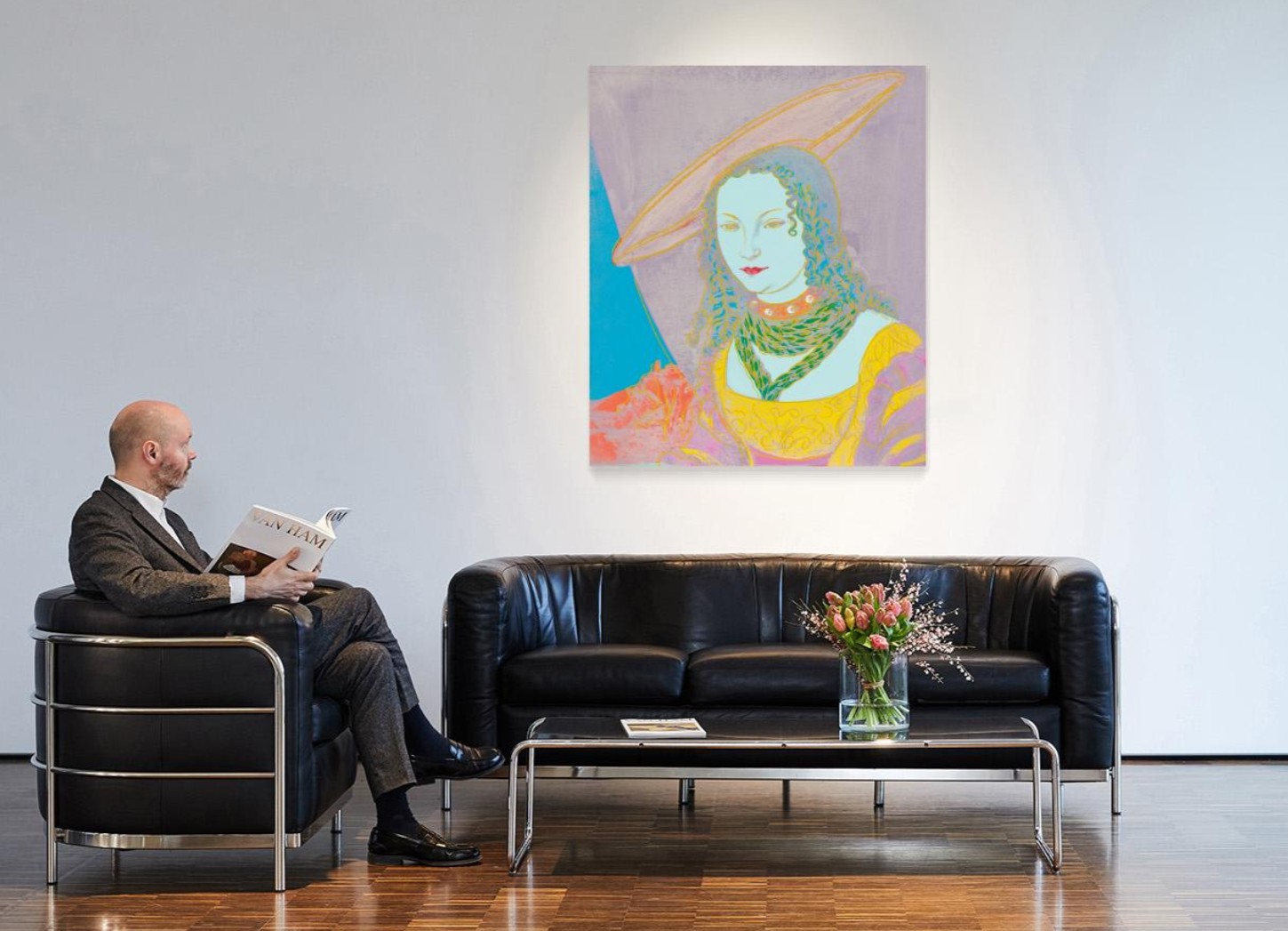
Cranach’s portrait of a young, unmarried woman from the collection of the Hermitage in St. Petersburg is one of at least three variants on this theme, which can be seen in the sense of a typological portrait and not as a portrait of a specific person due to its combination of standardization and variation of individual motifs. Cranach’s flourishing workshop, with its working methods and contemporary success, anticipated much of what had been practiced in Warhol’s Factory since the 1960s.
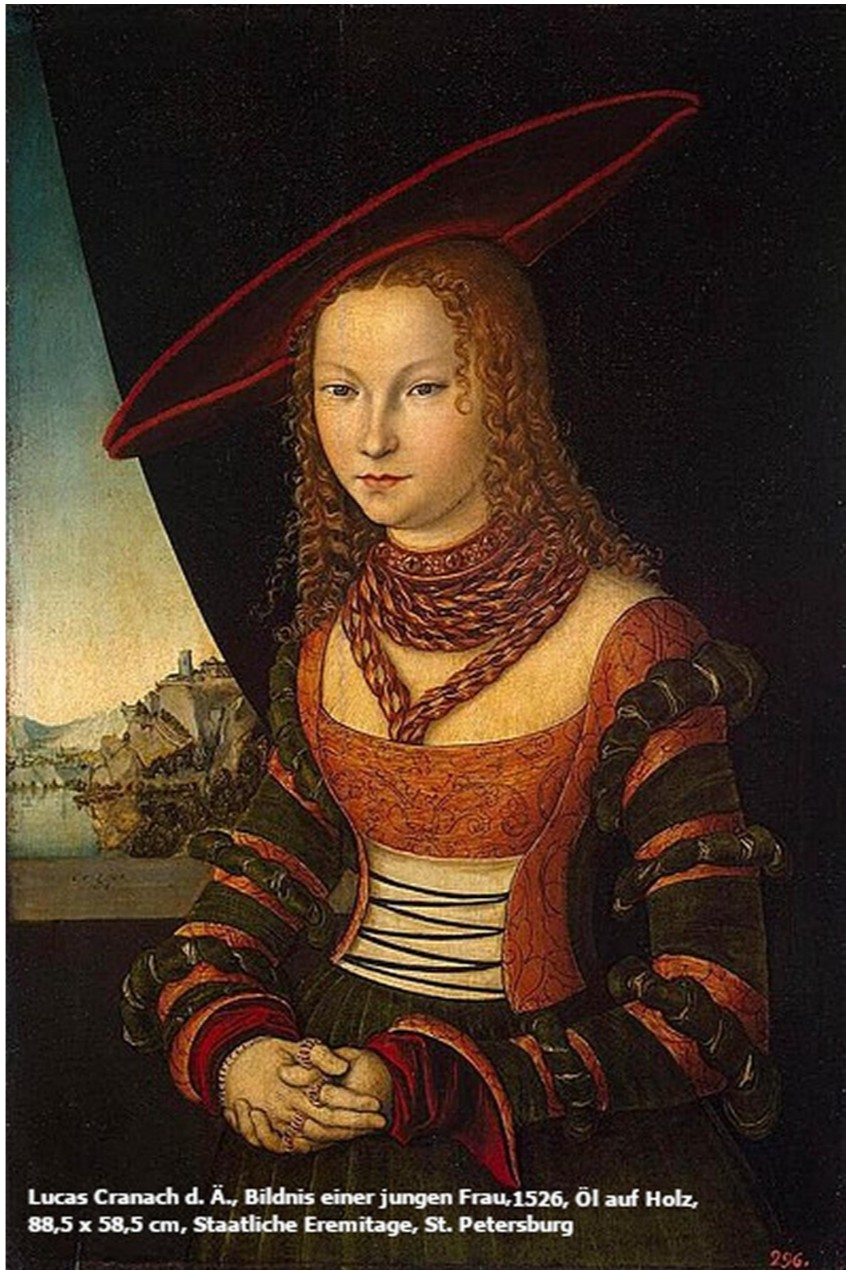
Warhol was obsessed with the theme of the beautiful woman throughout his career, and he transformed his depictions of women with a characteristic, glamouimage. In his own graphic style, he created his own form of advertising icons. Cranach’s young beauty, like Leonardo’s Mona Lisa or the goddesses of Hollywood – Marilyn Monroe and Liz Taylor – and numerous other models of his society portraits became Warholian brand symbols. In this painting after Cranach, he achieved this intensification and condensation by reducing the image section of the original to an almost square form, in which the woman’s face was placed exactly in the center of the picture and strongly emphasized by the coloring. With the focus on light blue, pink and yellow tones and the increased flatness, Warhol’s picture is much more striking and “louder”. His aesthetic frees the portrait from its art-historical ballast and transforms it into a contemporary, consumable icon that no longer has any of the intellectual aura of Cranach’s painting. The art historian Mark Francis characterized Warhol’s late work, of which this painting is an outstanding example according to Cranach, with the following words: “Warhol’s best works owe their power to his ability to concentrate unwaveringly on a seemingly banal or cliché-laden image, hackneyed by indiscriminate repetition (.) and to give this picture new strength, so that it is familiar and ‘new’ at the same time and no one can say whether an admiring, contemptuous or ironic attitude of the artist is behind it.” (Francis, Mark: “The Late Warhol”, in: Andy Warhol. The late work. Exhib. cat. Museum Kunstpalast, Düsseldorf 2004, p. 9) It is the quality and fascination of this picture that it keeps all evaluations in suspense and at the same time is as memorable as an advertising logo.
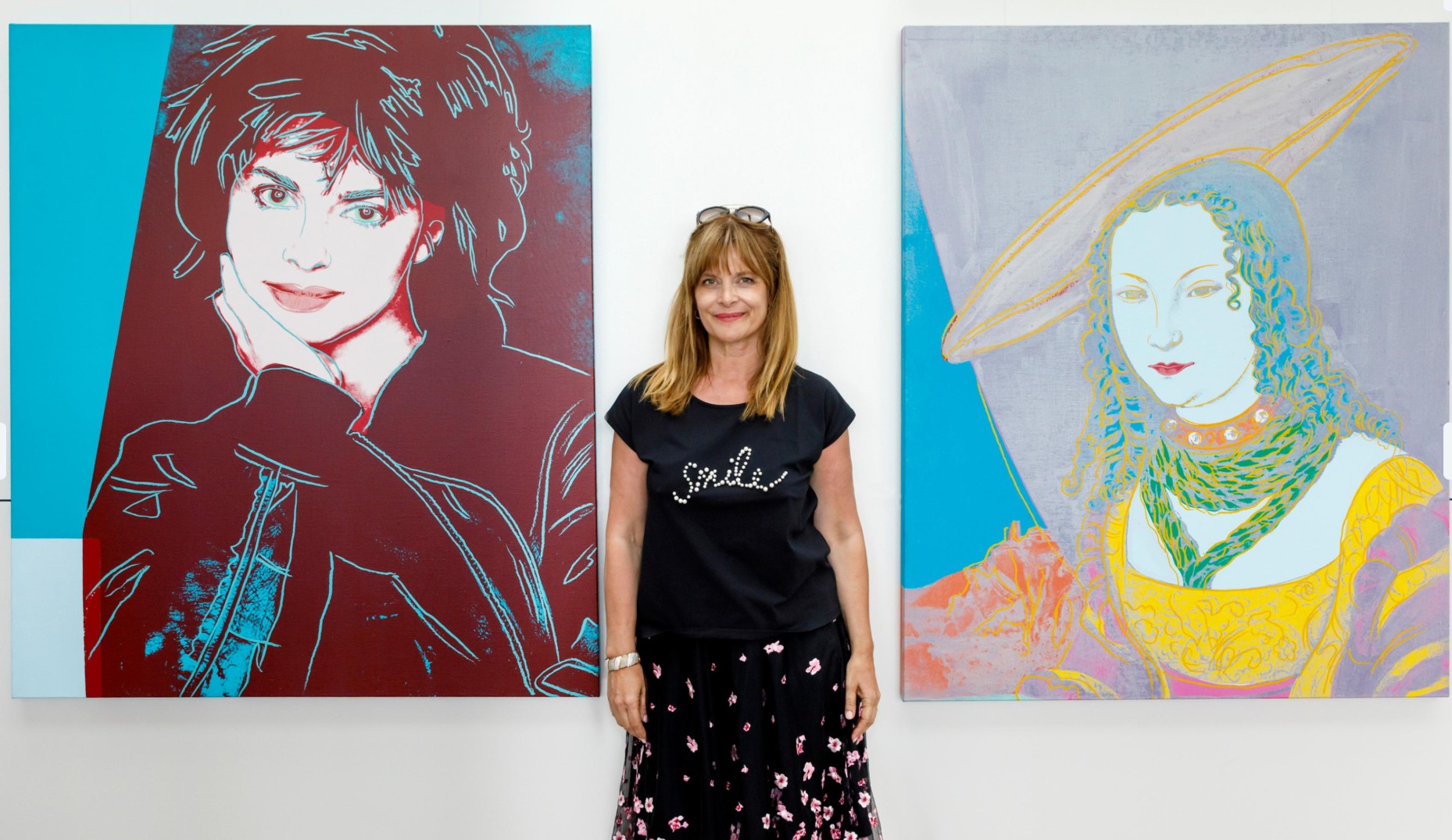
In 1985, the 11th Congress of the International Federation of Gynecology and Obstretics took place in Berlin and was accompanied by an exhibition project entitled “Homage aux Femmes”: 32 selected, internationally active artists were asked to create works on the theme of femininity for the project. To mark the occasion, Bayer AG commissioned Andy Warhol, who held the position of lead artist in this project, to create a work. He created two portraits of women at once, which are to be understood as double portraits: the portrait after Lucas Cranach presented here and the portrait of the actress Nastassja Kinsky. Both works are to be understood as a kind of juxtaposition: the picture of a young woman from past and present times. Both paintings were purchased by Bayer AG in the same year and have since formed a special position in the collection.
Portrait of a Young Woman (After Cranach), 1985
Sotheby’s London: 10 February 2015
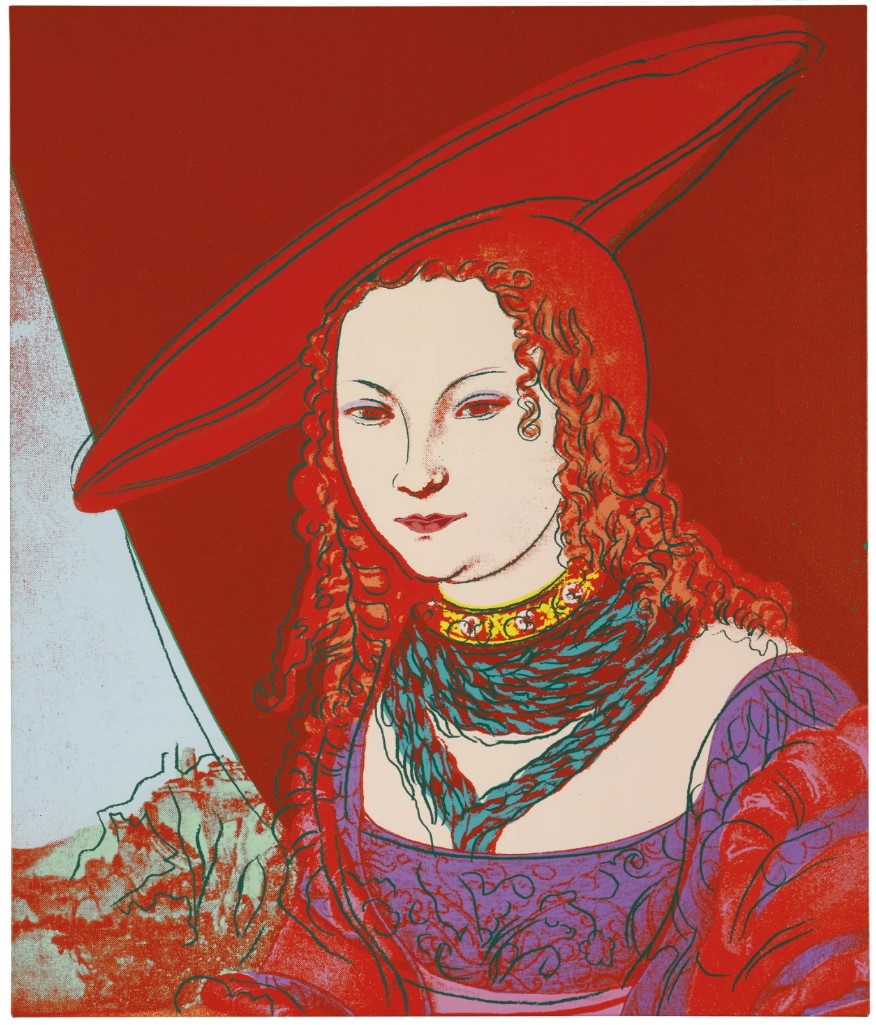
ANDY WARHOL
Portrait of a Young Woman (After Cranach), 1985
Acrylic and silkscreen ink on canvas
50×42 inches (127.3 x 106.7 cm)
Sotheby’s London: 10 February 2015
Singularly defining Andy Warhol’s illustrious corpus of art history paintings, Portrait of a Young Woman (After Cranach) takes for its subject the titular painting by the German Renaissance master Lucas Cranach the Elder and reimagines it with faultless execution in dazzling reds and vibrant yellows. Having built a career transforming the quotidian into mass manufactured high art, in the 1980s Warhol turned his gaze towards the transformation of art history. The series Art from Art, which depicts cropped images of iconic Old Master and Modern paintings, formed a crucial art historical thread in the important last decade of Warhol’s life. An unmitigated masterpiece and the most resolved work from this definitive series, Portrait of a Young Woman (After Cranach) also engages with the Warholian trope of female beauty that punctuates the artist’s most celebrated works; from his mesmerizing renderings of Elizabeth Taylor to his legendary paintings of the Mona Lisa and Marilyn Monroe. In other works from this series Warhol appropriated imagery from the fathers of the Renaissance Paolo Ucello, Leonardo da Vinci and Raphael through to the grands hommes of the Twentieth Century, Giorgio de Chirico, Henri Matisse, Edvard Munch and Pablo Picasso. By lifting these historical masterpieces from the context of the art historical canon, cropping and distorting them, Warhol dismantles their auratic quality and imbues them with a fetishistic, commercialized aesthetic. Just as Warhol’s earlier silkscreens playfully highlighted and satirically commented on the Western consumption of consumer brands, Portrait of a Young Woman (After Cranach) makes a brand icon out of an art historical one.
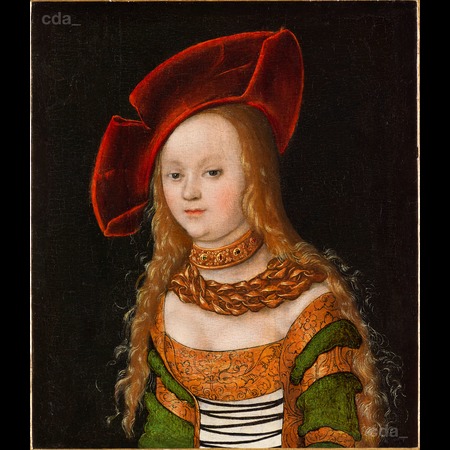
The present work is based on the intimately scaled Portrait of a Young Woman by Lucas Cranach the Elder which adorns the walls of Hermitage Museum in St Petersburg. Minutely rendered, Princess Sibylle of Cleves, the bride of John Frederick of Saxony, pensively stands in an intricately painted dress at a window ledge which opens onto expansive rolling countryside. The perfect archetype of Warhol’s art history paintings, the present work crops and condenses Cranach’s original, and in doing so concentrates on the extraordinary beauty of the sitter’s face and hat. Imitating the essence of each brushstroke, details are simplified to slick, clean lines and colours are amplified to include dazzling ruby reds, purples and greens, which contribute to give the work the celebrated commercialised, fetishistic aura of its maker. We are left to simply admire the sumptuous ripples of pure pigment and lushly applied paint that caress the sitter’s face. Thus, Warhol innovatively transforms an illustrious art historical icon into a veritable Warholian icon. Where Princess Sibylle became the epitome of beauty in Cranach’s oeuvre, in Portrait of a Young Woman (After Cranach) Princess Sibylle becomes the epitome of Warholian beauty; a natural conclusion to his earlier society portraits and paintings of Marilyn Monroe.
Warhol’s brilliant mastery of colour in Portrait of a Young Woman (After Cranach) truly sets it apart from the other works in this important series. The extraordinary conflation of crimson red and deep, opulent violet – a striking combination rarely seen within Warhol’s oeuvre – immediately enthrals and beguiles the viewer with its bold chromatic statement. When compared to the blue version of Portrait of a Young Woman (After Cranach), Warhol’s daring chromatic explorations become all the more evident. The artist has taken the risky decision of placing a sumptuous claret curtain up against the woman’s vivid red hat, reflecting a similar virtuosity of colour that Rothko demonstrated in his mesmeric, red Seagram Murals, held in the Tate Collection, London. As such, Portrait of a Young Woman (After Cranach) is perhaps one of the most nuanced and sensitive explorations of colour in Warhol’s oeuvre.
Following in an esteemed lineage of artist’s fascinated by Cranach’s jewel-like painting (notably Pablo Picasso’s Bust of a woman after Cranach the Younger), and art history as a wider whole, the practice of appropriating masterpieces was endemic amongst Warhol’s fellow Pop painters. A tactic inspired by Marcel Duchamp’s notorious L.H.O.O.Q., in which Duchamp famously drew a moustache on a reproduction of the Mona Lisa, the Pop artists saw culturally resonant icons such as Cranach’s Portrait of a Young Woman as free for manipulation and translation into their signature styles. Roy Lichtenstein’s Rouen Cathedral (Seen at Five Different Times of the Day) is a particularly acute example of this. Here he reproduced Claude Monet’s paintings of Rouen Cathedral, enlarged them and effaced the luxurious texture of Monet’s impasto by replicating the painting with his signature Ben-Day dots. As with Warhol’s Day-Glo silkscreens, Lichtenstein’s Ben-Day alterations absolved the originals of their auratic quality and injected them with the fetishistic sheen of Pop art.
Warhol first began to appropriate imagery from art history in 1963 with his monochrome masterpiece Thirty Are Better Than One, 1963, which depicts a repeating black and white image of arguably the most famous painting in art history; the Mona Lisa. Warhol’s early consumption of art history was more a comment on the reaction to the fame and media frenzy surrounding the display of Leonardo da Vinci’s Mona Lisa at the Metropolitan Museum of Art, New York, than a direct comment on art history itself. When Warhol returned to the subject two decades later however, he approached it with much more distance and clarity, taking the history of art itself as his enigmatic subject.
An apogee in this celebrated series, Portrait of a Young Woman (After Cranach) sits alongside some of the artist’s most important late works. Amongst them is the monumental homage to Leonardo da Vinci’s infamous Last Supper, which represents something of a grand finale to a career in which subversion and irony are the ultimate keynotes. Other seminal works in this iconic series include Warhol’s technicolor take on Edvard Munch’s epoch-defining painting The Scream, his stark monochrome translations of Munch’s Eva Mudocci, and his enthralling renditions of Sandro Botticelli’s divine Goddess in The Birth of Venus. In Portrait of a Young Woman (After Cranach) Cranach’s historical eminence is firmly transported into the realm of Warholian Pop culture – her mesmerizing face appearing in tantalizing color and luxurious brushwork and thus joins the pantheon of beautiful Warholian females that precede her.
Henri Matisse
Christie’s New-York: 11 November 2003
USD 746,700
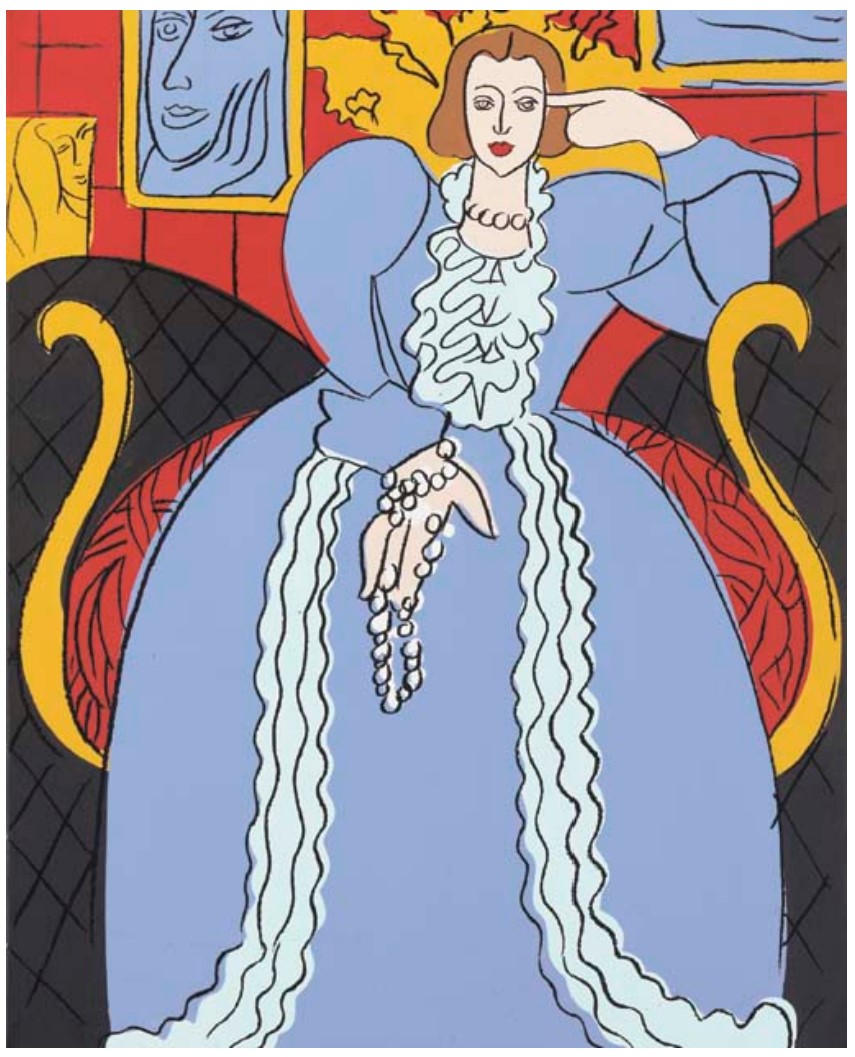
ANDY WARHOL
Woman in Blue (After Matisse), 1985
Synthetic polymer and silkscreen inks on canvas
52×42 inches (132.1 x 106.6 cm)
Stamped with signature ‘Andy Warhol’ (on the overlap)
It is no surprise that this series followed the decade in which Warhol became America’s pre-eminent portraitist. For Warhol, it was perhaps less important that the subjects of his “After” paintings were masterpieces than they were famous. In the 1970s and 80s, Warhol had himself become what Robert Rosenblum called “a celebrity among celebrities, and an ideal court painter to this 1970s international aristocracy that mixed, in wildly varying proportions, wealth, high fashion, and brains” (Andy Warhol Portraits, Exh. Cat., Anthony d’Offay Gallery, London, 1993, p. 144). Through portraiture, Warhol could exploit the duality of fame and identity that fascinated him. As a result, Warhol’s society portraits are consistently contradictory, at times both surprisingly poignant and emotionally insightful despite their slick surfaces. His “portraits” of art historical masterpieces have a similar effect: Woman in Blue (After Matisse) is both reverential and opportunistic -a way for Warhol to paint Matisse and to engineer his own legacy by mining and questioning popular visual culture and history.
Other Artists
Friedrich II, 1986
Ketterer Kunst: 8 December 2023
Estimated: EUR 500,000
EUR 889,000 / USD 933,450
Ketterer Kunst, Art auctions, Book auctions Munich, Hamburg & Berlin
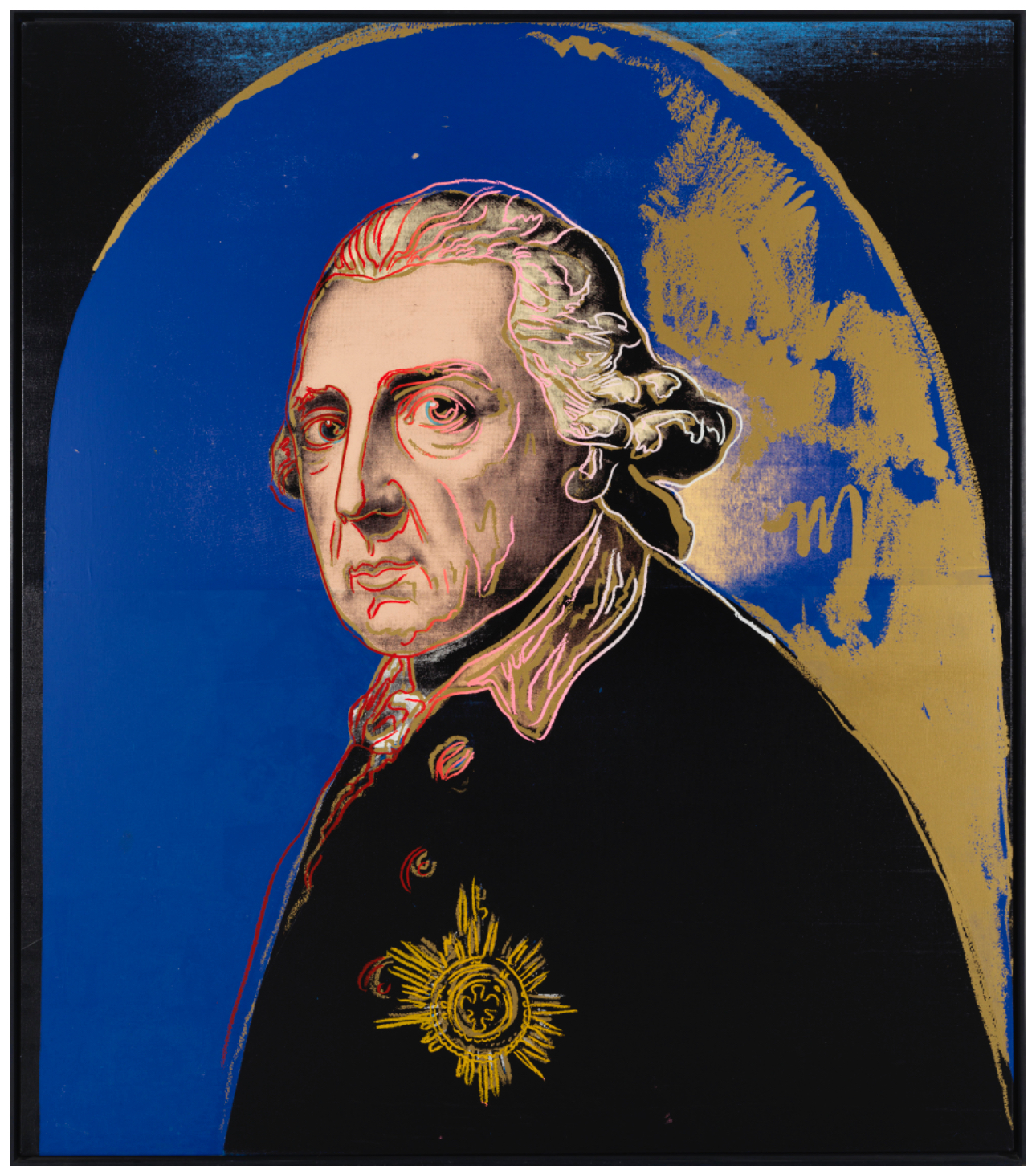
ANDY WARHOL
Friedrich II, 1986
Silkscreen in colors and synthetic polymer on canvas
84.2 x 72 inches
Signed and dated on the reverse
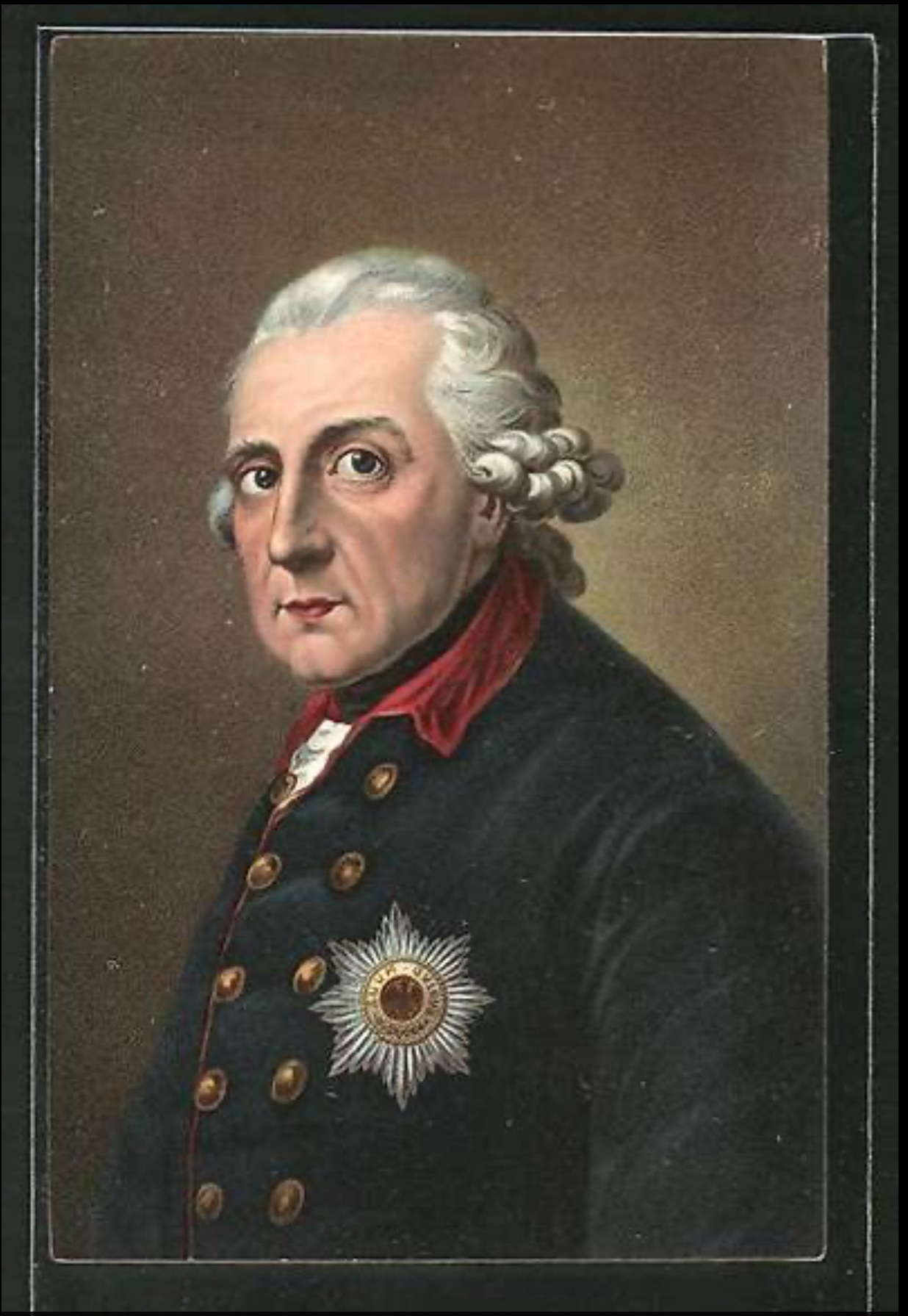
Warhol found the image of Frederick the Great in a painting by Anton Graff. The template itself already is a copy and is now kept at Sanssouci Palace. The portrait of the Prussian king is one of the most famous depictions of him and yet no one knows for sure whether Frederick II actually looked like that. He didn’t like to pose as model, and even then it was clear that pictures fulfilled purposes. They do not aim to depict reality as close and authentic as possible. Images create myths that then become reality. Warhol was occupied with this idea throughout his life. What fascinated Warhol about the figure of Frederick II in 1986? The 200th anniversary of his death night have been the reason, but this alone is certainly not reason enough. The ruler is considered a modern spirit of the Enlightenment of the mid-18th century. It was not just the violence that he himself had to endure from his father that led to the abolition of torture as one of his first reforms. Warhol was aware of how progressive and radical this step was at the time, and 200 years later he still decried brutal and inhumane punishments in the USA in the series “Electric Chair” (1964). Frederick II is also said to have lived out his homosexuality more or less openly, just like his brother Henry of Prussia. The meaning of sexuality in the 18th century and the associated social prohibitions and conventions cannot be transferred to the 20th century and yet, the Prussian king unintentionally became an icon of the self-confident expression of one’s own sexuality. “Let every man seek heaven in his own fashion”, was the most famous quote by the Old Fritz that is still used today when it comes to demanding more tolerance.