Warhol had long been fascinated by the spectacle of death, and the macabre realities of contemporary life. His depiction of the erupting volcano presents a continuation of this obsession. Where his Death and Disaster series of the 1960s was concerned with commonplace cases of tragedy such as traffic collisions, suicides, and fatal city accidents—and appropriated images from newspaper pages and police archives—Vesuvius represents a unique, near-mythological endpoint.
Introduction
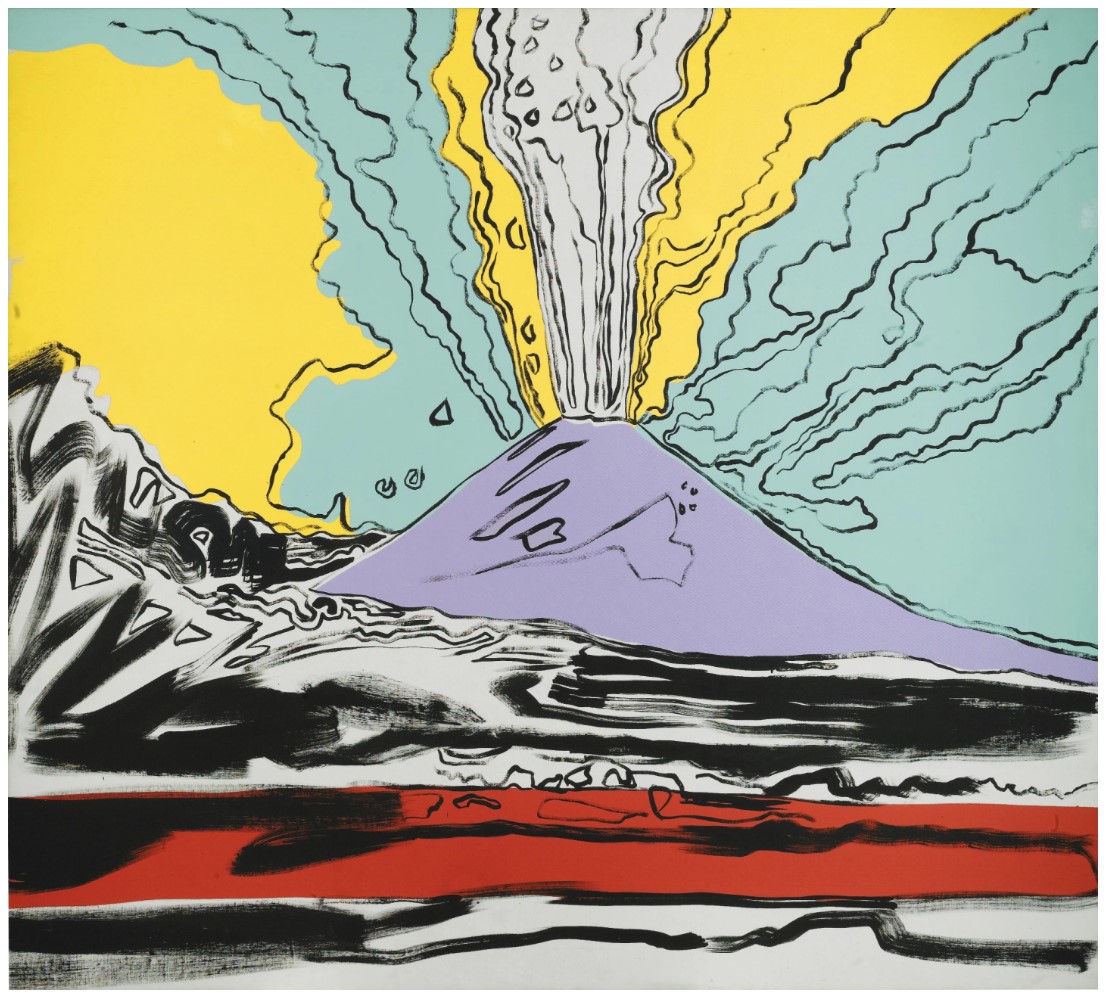
The Vesuvius series was realized for Warhol’s solo exhibition in 1985 at the prestigious Museo di Capodimonte, a hallowed exhibition space usually reserved for Old Masters such as Titian and Caravaggio. In this way, the works were steeped in art historical import from their very inception. Furthermore, to tackle the Volcano as a subject was to take up the mantle of a long line of artists who had historically engaged with its depiction. Vesuvius had surged in popularity as a motif of choice during the era of the Grand Tour in the Eighteenth and Nineteenth Centuries and came to be represented by such artists as Joseph Wright of Derby, and even JMW Turner. In its high key palette of turquoise and pointedly canary yellow, the present work seems an idiosyncratically irreverent Warholian reinterpretation of their legacy. Indeed, it is one that aligns the Vesuvius series with Warhol’s Art after Art series, executed only a few years previously. In these works the artist had appropriated images form Leonardo da Vinci, Lucas Cranach the Elder, Raphael, Henri Matisse, Pablo Picasso, and others, certifying the notion that artworks were also party to the fame and celebrity that fascinated him endlessly.
The Museo di Capodimonte exhibition was only organized after Warhol had participated in a group show curated by the leading Neapolitan dealer, Lucio Amelio, some four years previously. Amelio had used his significant curatorial clout to commission works from a group of artists including Warhol, Joseph Beuys, Keith Haring, and Jannis Kounellis for the show – Terrae Motus – which was held in response to an earthquake in Empoli, just south of Naples. The show firmly placed Naples on the map of the global Contemporary art world, and Warhol’s experience of the city – particularly his encounter with Beuys – made a lasting impression. It is then noteworthy that the present work references the tectonic disaster which provided the contextual background to the earlier group exhibition, taking as its subject that totem of natural beauty and latent destruction that has rendered Naples such a unique and extraordinary city throughout history.
“I painted each Vesuvius by hand, always using different colours so that they can give the impression of having been painted just one minute after the eruption.”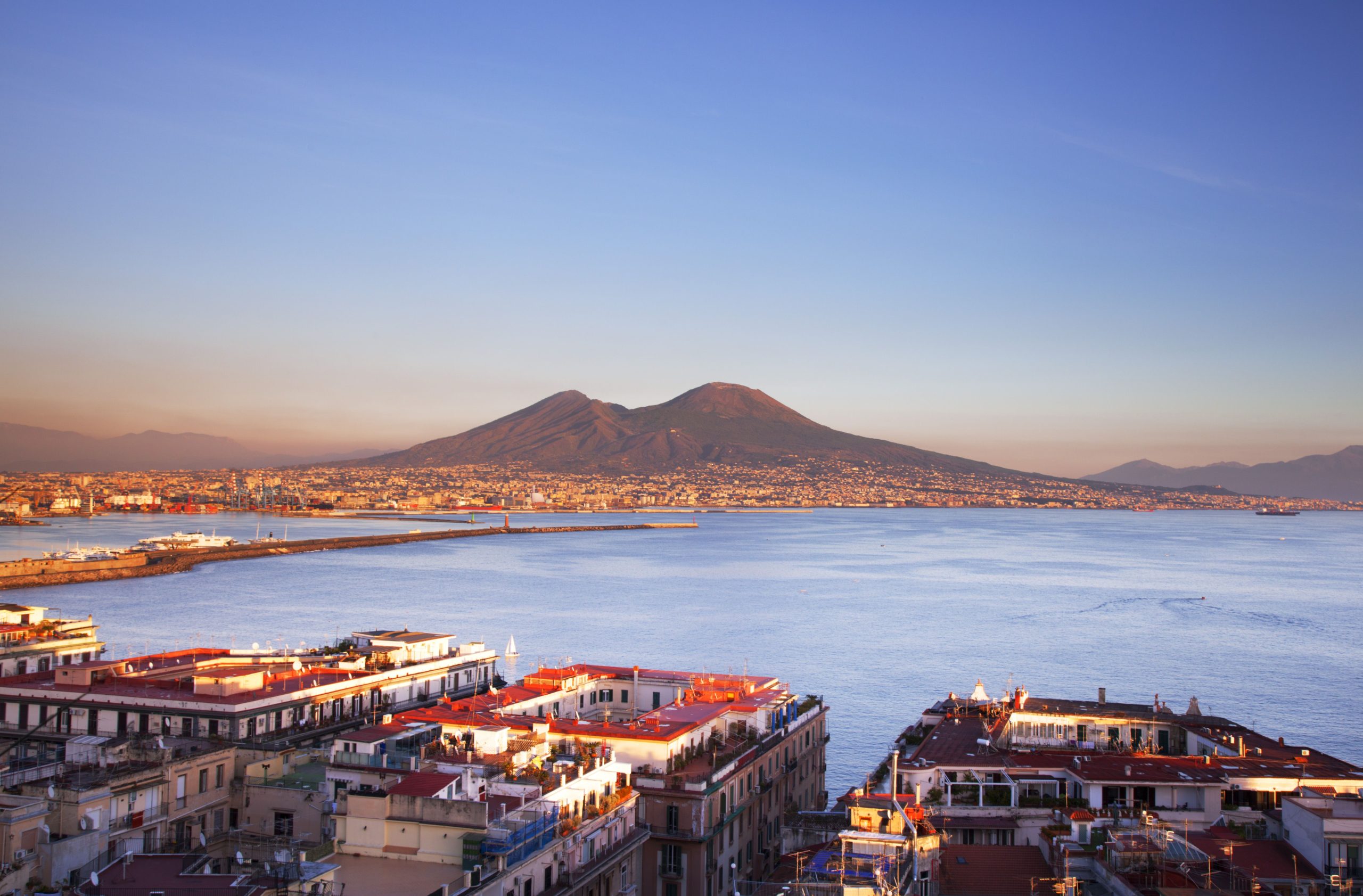
“I realized that everything I was doing must have been death.”
Indeed Vesuvius, not only recalls Warhol’s 1960s praxis in its hand-painted technique. Imbued as it is with the threat of impending catastrophe, it is also redolent of the haunting contemplation of death so sensationally depicted in Warhol’s Suicides, Disasters, Car Crashes and Electric Chairs of the 1960s. The present motif is perhaps most comparable to Warhol’s Atomic Bomb of 1963, sharing not only a similar sort of explosive plume, but also a less explicit approach to death – the sense of morbidity is not an immediate fact, but rather an imminent intimidation, looming over our viewpoint. While it is possible to ascribe some significance to the fact that, in this work, Warhol returned to morbid themes only two years before his own untimely death, in truth, mortality had never been far from his psyche.
“An eruption is an overwhelming image, an extraordinary happening and even a great piece of sculpture.”
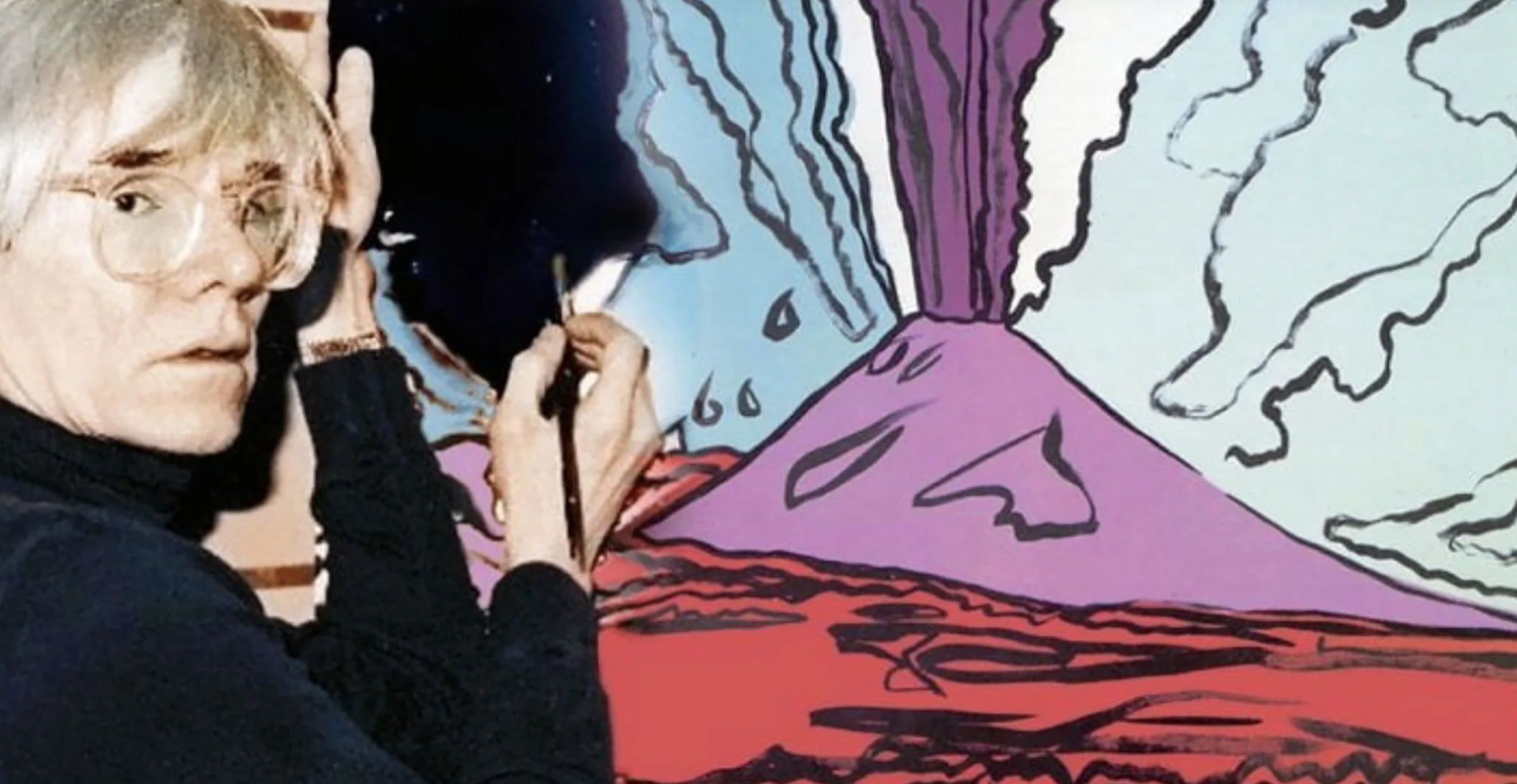
Aside from being an iconic image rich in historical cues, Vesuvius is an ode to Naples. Warhol had first visited the southern Italian city in 1975 at the invitation of the gallerist Lucio Amelio—from whose gallery the present work was acquired—and often compared it to New York with its vibrant, bustling streets and active drag scene. Where Manhattan is defined by its soaring skyscrapers, the Gulf of Naples is landmarked by its very own Mount Vesuvius. It had once razed Pompeii and Herculaneum to the ground in one of history’s deadliest eruptions, and Warhol was captivated by its distant, towering presence. Naples was also a city that held personal significance for the artist: it was here that he first met Joseph Beuys, the mystical titan of post-war German art, in the spring of 1980. The city, writes Michele Bonuomo, was the ideal setting for this meeting of ‘the two most extreme souls of contemporary art … in Naples one can meet to represent and consume impossible passions, always hovering between earth and sky, ecstasy and nightmare’ (M. Bonuomo in ibid., p. 33).
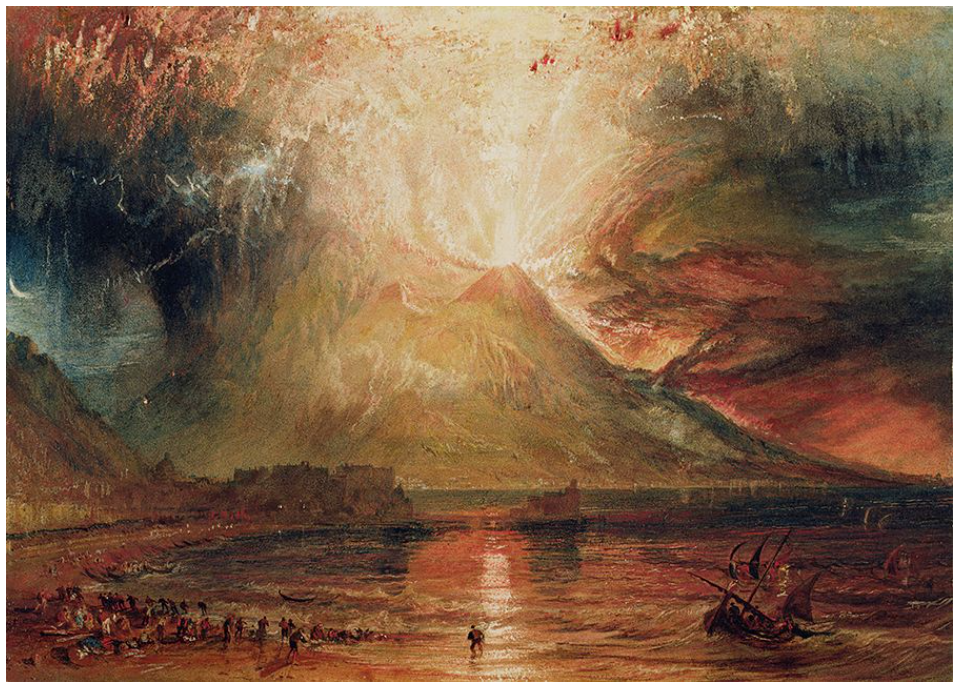
Joseph Mallord William Turner, Vesuvius in Eruption, 1817-1820. Yale Center for British Art, New Haven. Photo: Bridgeman Images.
Warhol’s approach to the subject of Vesuvius speaks to the Romantic painterly tradition, and follows a long line of art-historical depictions including works by J. M. W. Turner and Joseph Wright of Derby. Debuted at the Museo di Capodimonte—the original host institution of the series which has maintained a revered program of Old Master exhibitions since it opened—the Vesuvius paintings revel in this sublime visual language. Edmund Burke’s theory of the sublime, published in 1757, concerns the point where beauty and terror become adjacent. ‘When danger or pain press too nearly, they are incapable of giving any delight, and are simply terrible’, he wrote, ‘but at certain distances, and with certain modifications, they may be, and they are delightful, as we every day experience’ (E. Burke, A Philosophical Enquiry into the Origins of our Ideas of the Sublime and Beautiful, Oxford 1990, p. 37). The terrific power of the natural world is powerfully exhibited by features such as Vesuvius, whose visual grace is matched by its threat of oblivion. Warhol was certainly at home in a city like Naples, but what undoubtedly set it apart was the buzzing vitality that played out within the shadow of potential destruction.
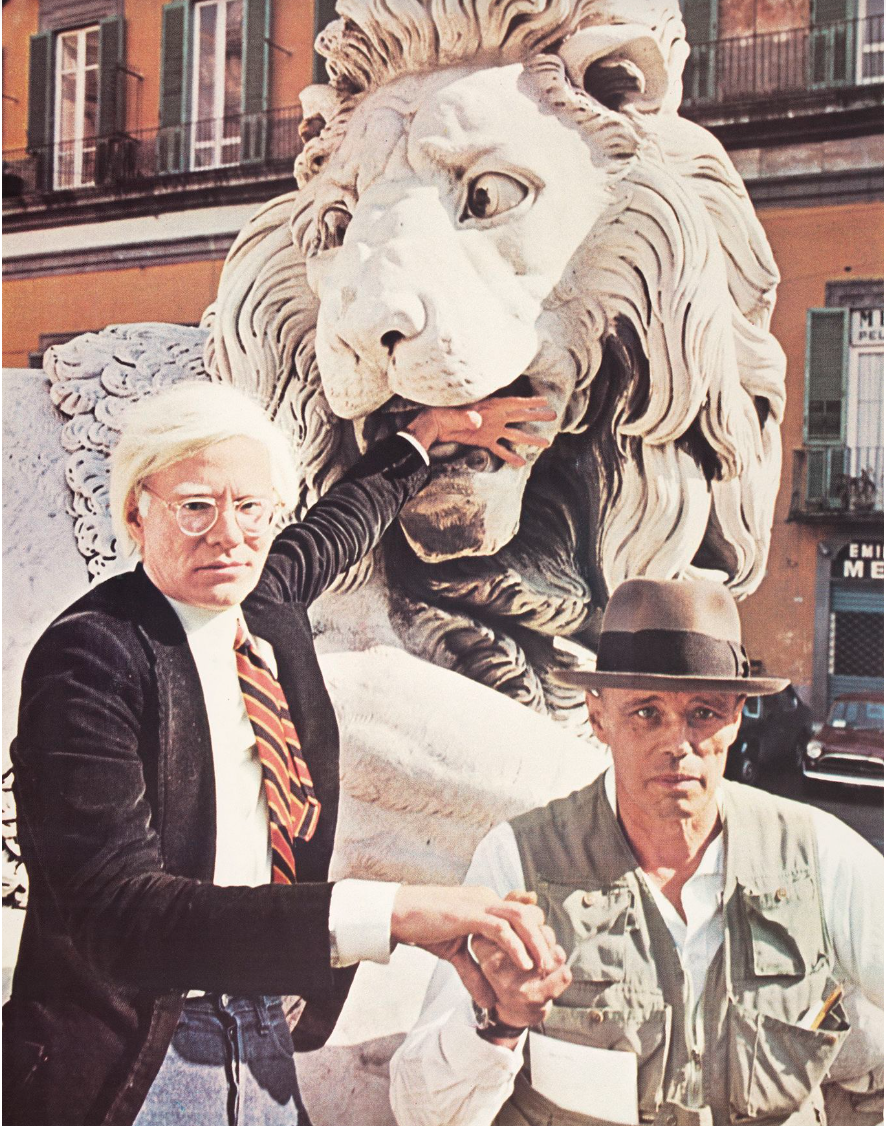
Exhibition poster, Andy Warhol. Joseph Beuys at Lucio Amelio Gallery, Naples, April 1980. Digital Image: Tate/ARTISTS ROOMS.
Warhol had long been fascinated by the spectacle of death, and the macabre realities of contemporary life. His depiction of the erupting volcano presents a continuation of this obsession. Where his Death and Disaster series of the 1960s was concerned with commonplace cases of tragedy such as traffic collisions, suicides, and fatal city accidents—and appropriated images from newspaper pages and police archives—Vesuvius represents a unique, near-mythological endpoint. As a permanent, looming feature of the landscape, it is a visceral reminder of the brevity of our time on earth. Renowned for his ability to fuse terror and beauty, it is little wonder that Warhol joked for a plane to be sent for him the next time Vesuvius erupted so that he could ‘finally have the chance to paint it from life’ (A. Warhol quoted in ibid., p. 35).
Auction Results (Chronological)
Vesuvius, 1985
Christie’s London: 6 March 2025
Estimated: GBP 250,000 – 350,000
GBP 365,400 / USD 467,712
ANDY WARHOL (1928-1987), Vesuvius | Christie’s
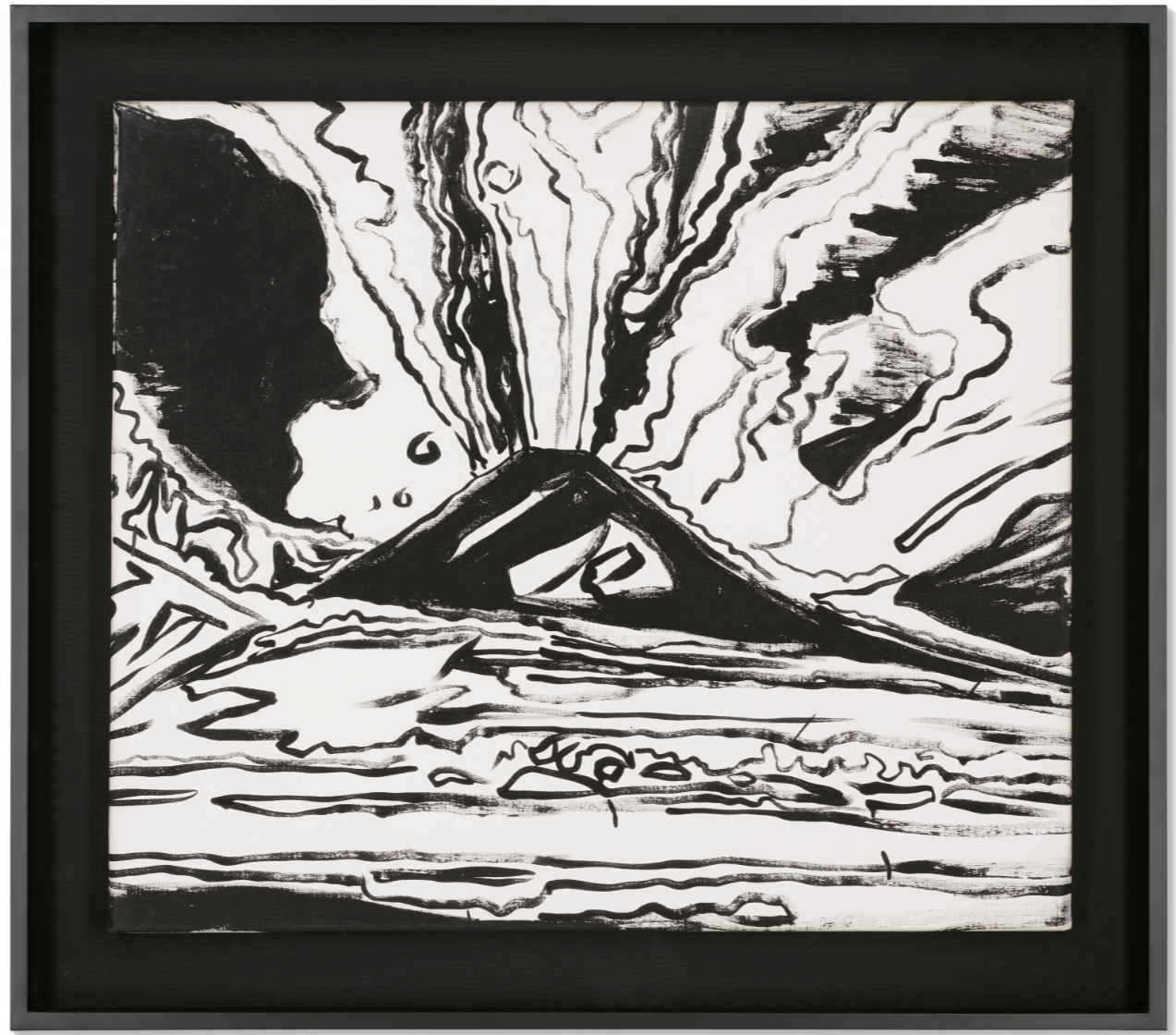
ANDY WARHOL (1928-1987)
Vesuvius, 1985
Acrylic on canvas
28 x 32 1/2 inches (71×82 cm)
Signed and dated ‘Andy Warhol 85’
Stamped with the Andy Warhol Art Authentication Board, Inc. stamp
Numbered ‘A100.111’ (on the overlap)
Vesuvius, 1985
Christie’s London: 10 October 2024
Estimated: GBP 300,000 – 500,000
GBP 604,800 / USD 792,288
ANDY WARHOL (1928-1987), Vesuvius | Christie’s (christies.com)
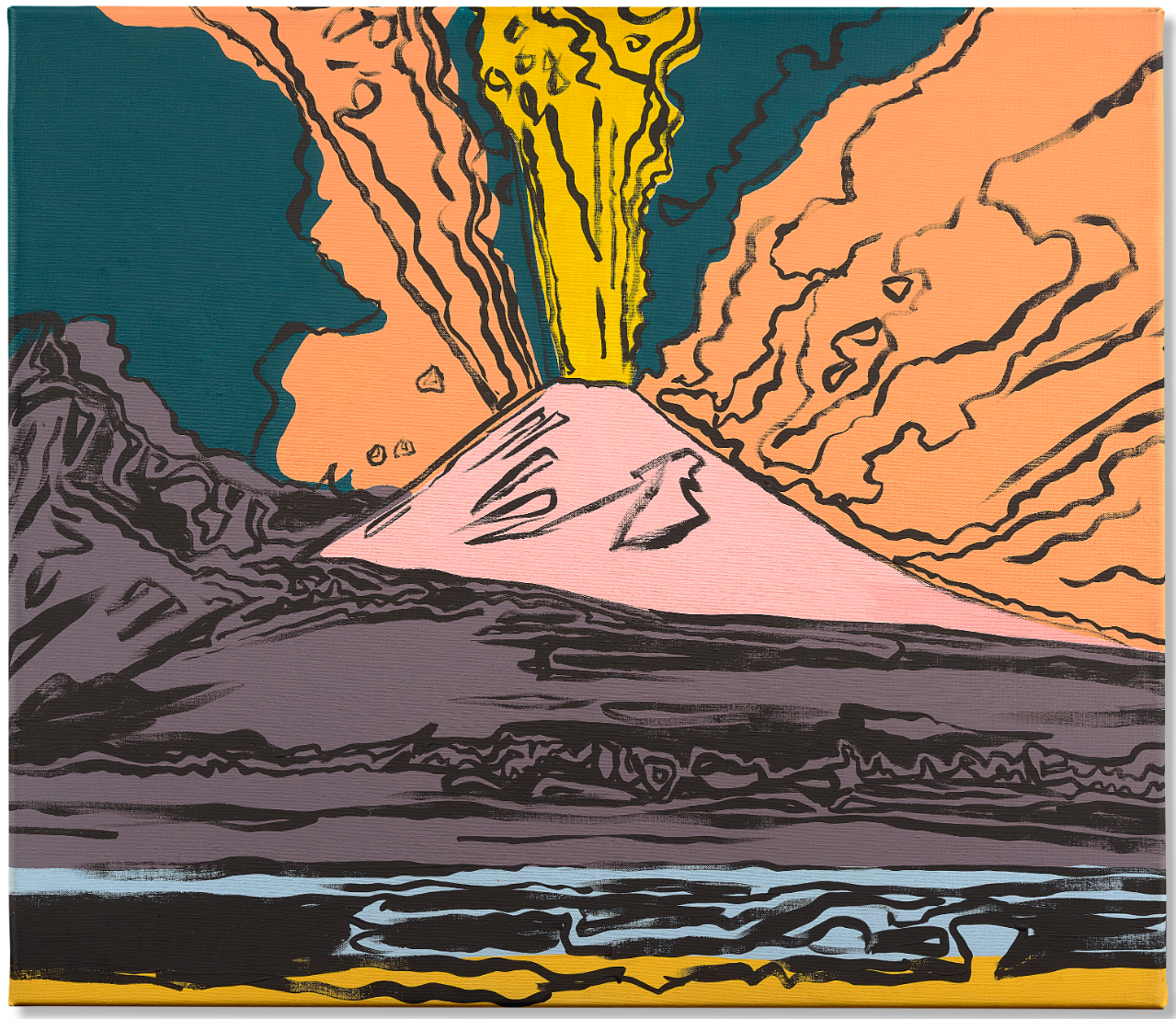
ANDY WARHOL (1928-1987)
Vesuvius, 1985
Acrylic on canvas
28 x 32 1/8 inches (71 x 81.5 cm)
Signed and dated ‘Andy Warhol 85’ (on the overlap)
Vesuvius, 1985
Sotheby’s London: 3 October 2019
Estimated: GBP 280,000 – 350,000
GBP 555,000 / USD 684,676
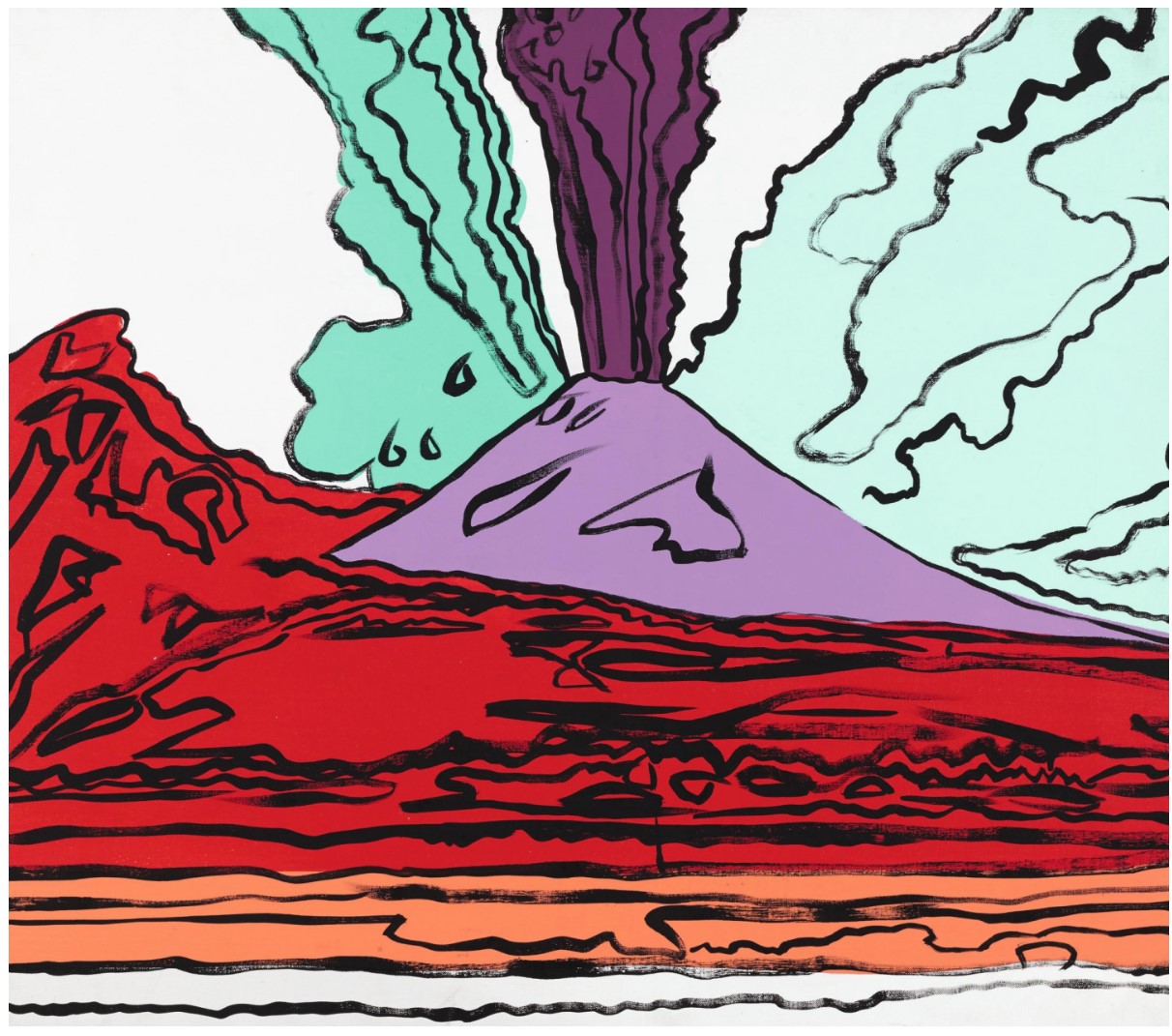
ANDY WARHOL
Vesuvius, 1985
Acrylic on canvas
27.9 x 32.1 inches (70.6 x 81.6 cm)
Vesuvius, 1985
Sotheby’s London: 26 June 2018
Estimated: GBP 800,000 – 1,200,000
GBP 970,000 / USD 1,284,680
ANDY WARHOL
Vesuvius, 1985
Acrylic on canvas
56.5 x 64.4 inches (143.4 x 163.6 cm)
Vesuvius, 1985
Sotheby’s London: 15 October 2015
Estimated: GBP 800,000 – 1,200,000
GBP 1,445,000 / USD 2,235,750
ANDY WARHOL
Vesuvius, 1985
Acrylic and silkscreen ink on canvas
70.7 x 78.9 inches (178.8 x 200.5 cm)
Vesuvius, 1985
Sotheby’s Paris: 6 June 2013
Estimated: EUR 850,000 – 1,000,000
EUR 865,500 / USD 1,132,795
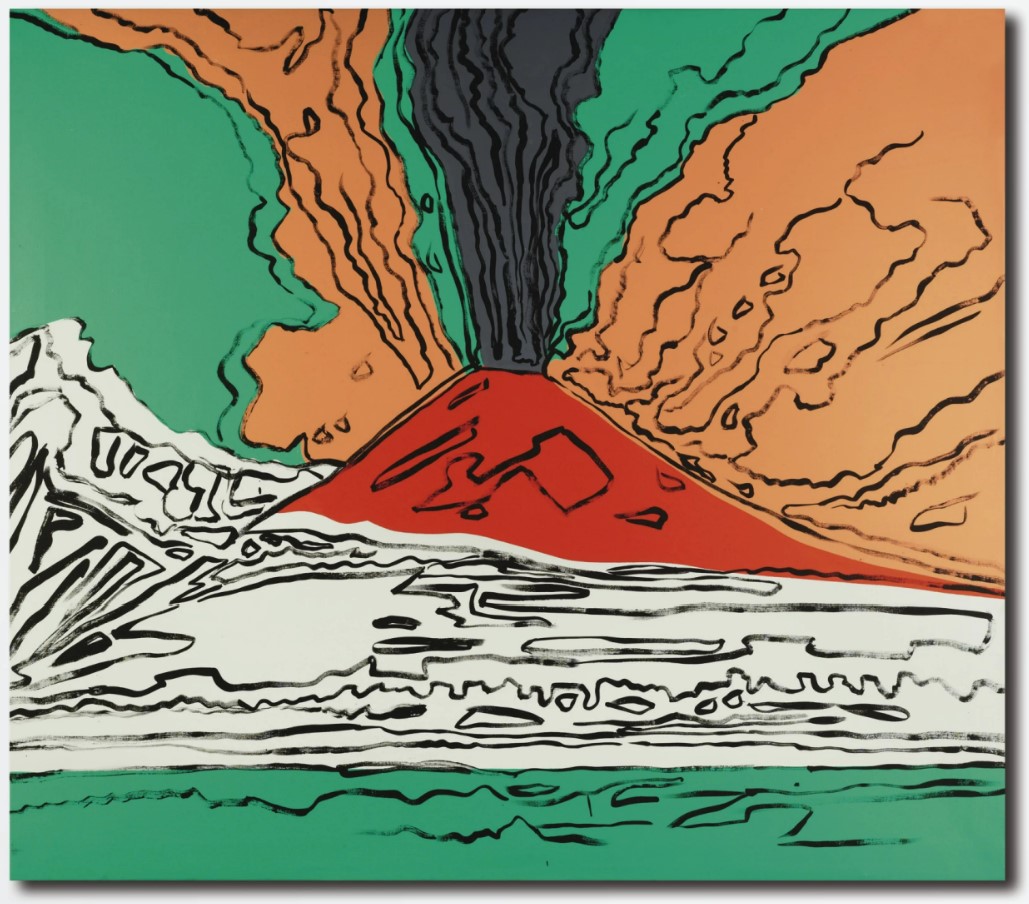
ANDY WARHOL
Vesuvius, 1985
Acrylic on canvas
56.5 x 54.4 inches (143.5 x 163.5 cm)
Vesuvius (70×80)
Vesuvius, 1985
Sotheby’s London: 15 October 2015
Estimated: GBP 800,000 – 1,200,000
GBP 1,445,000 / USD 2,235,750
ANDY WARHOL
Vesuvius, 1985
Acrylic and silkscreen ink on canvas
70.7 x 78.9 inches (178.8 x 200.5 cm)
Vesuvius is one of only a handful of large format canvases in this series, executed by Andy Warhol in 1985. It is characterized by its deft conflation of two of the overarching themes that defined his entire oeuvre: the legacy of art history, and the omnipotence of death. Furthermore, with such esteemed provenance it can be viewed as a singular emblem of the close friendship between Warhol and Ernesto Esposito, a resident of Naples and thus a close Neighbor to the volcano itself. Completed in high key turquoise, yellow, mauve, and scarlet, the base colors of this work project a mood of saturated positivity that seems entirely at odds with the force and horror of a volcanic eruption. Warhol’s idiosyncratically pop palette is only tempered by the torturous twitchings of translucent black which dominate the lower half of the canvas, even appearing in some areas as the staining residue of thick black smoke, burnt onto the layers beneath. This work is also fascinating technically: in the background, and in much of the more improvised expressionist detail, we can observe a return to the hand painted technique that Warhol had favored in the 1960s.
Vesuvius (56×64)
Vesuvius, 1985
Sotheby’s London: 26 June 2018
Estimated: GBP 800,000 – 1,200,000
GBP 970,000 / USD 1,284,680
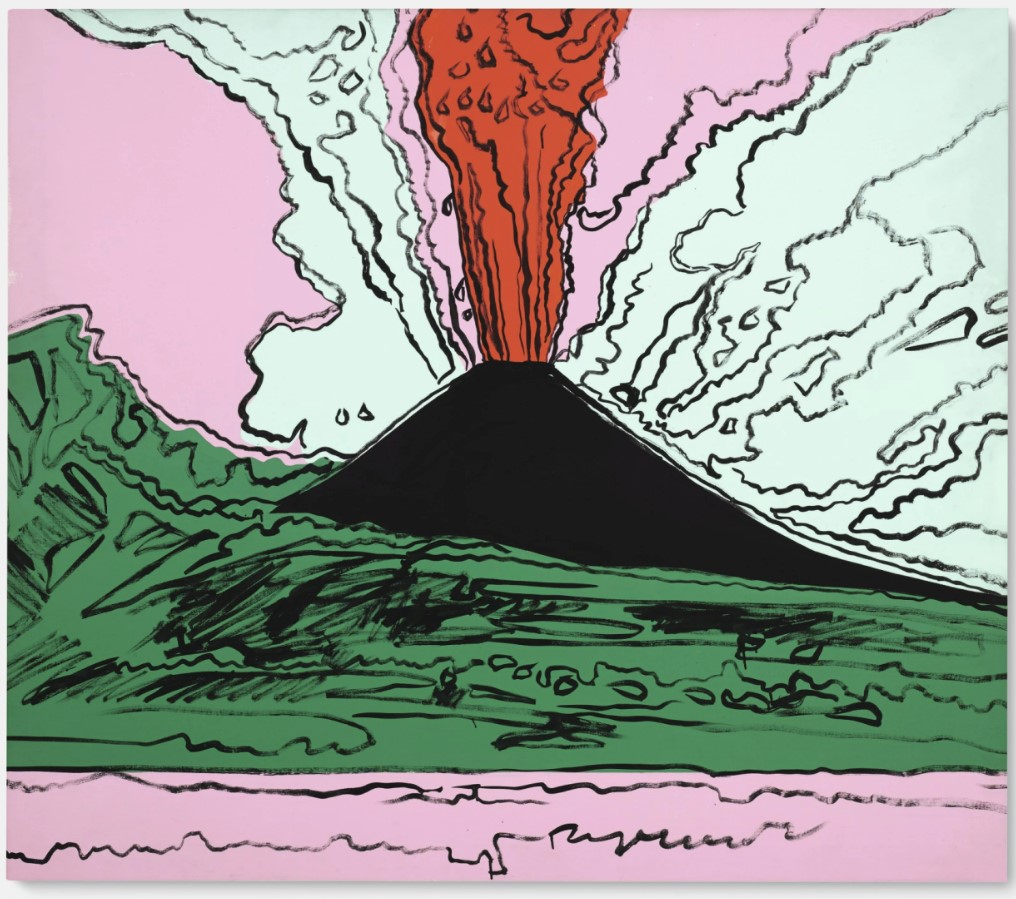
ANDY WARHOL
Vesuvius, 1985
Acrylic on canvas
56.5 x 64.4 inches (143.4 x 163.6 cm)
Created in 1985 Vesuvius is one of only a handful of works from this small eponymous series by Andy Warhol. Enshrining the menacing energy of the iconic Neapolitan volcano, this painting purports the looming threat of annihilation in bold Pop art color. In the present work a strident red volcanic eruption is set against bubble gum pink and bright turquoise plumes of smoke, while the dark silhouette of the volcano itself rises out of a field of emerald green. Unlike other series by the artist, the color fields of the Vesuvius paintings were blocked in by hand, over which Warhol applied a black silkscreen image of his hand drawn rendering of this famous Neapolitan landmark at the moment of violent eruption. Acquired by the present owner from the eminent art dealer Lucio Amelio, this painting has remained in the same Neapolitan collection for over 30 years. With its threat of impending destruction Vesuvius is laced with the theme of deathly tragedy that permeates Warhol’s oeuvre. Revisiting the haunting contemplation of death so sensationally depicted in the Death and Disaster series of the 1960s, Warhol’s work of the 1980s offers a more profound reflection on mortality. Alongside the Vesuvius paintings, Warhol’s series of Crosses, Skulls and Guns reflect a heightened sense of the macabre. Indeed, similar to his Atomic Bomb of 1965, or his Most Wanted Men of 1964, we are not looking at death itself but at its imminence or threat; a spectre that always weighed heavily on the artist. In Vesuvius, Warhol increases the dial on his morbid preoccupations, dramatically presaging his own untimely demise two years later.
Vesuvius, 1985
Sotheby’s Paris: 6 June 2013
Estimated: EUR 850,000 – 1,000,000
EUR 865,500 / USD 1,132,795
ANDY WARHOL
Vesuvius, 1985
Acrylic on canvas
56.5 x 54.4 inches (143.5 x 163.5 cm)
Vesuvius (28×32)
Vesuvius, 1985
Christie’s London: 6 March 2025
Estimated: GBP 250,000 – 350,000
GBP 365,400 / USD 467,712
ANDY WARHOL (1928-1987), Vesuvius | Christie’s
ANDY WARHOL (1928-1987)
Vesuvius, 1985
Acrylic on canvas
28 x 32 1/2 inches (71×82 cm)
Signed and dated ‘Andy Warhol 85’
Stamped with the Andy Warhol Art Authentication Board, Inc. stamp
Numbered ‘A100.111’ (on the overlap)
In his Vesuvius series of 1985, Andy Warhol transferred his obsession with celebrity to the natural world. The group is a remarkable outlier in his career: a collection of sixteen hand-painted works that capture the world’s most famous volcano as it erupts in plumes of smoke and fire. The present work is unique as Warhol’s only monochrome painting of the mountain on this scale. It featured as the back cover for the catalogue of the series’ exhibition at the Museo di Capodimonte, Naples, in 1985. The majority of the works feature bright, crisp colours rendered in acrylic, with the graphic immediacy of the Golden Age of comic books. This version is instead a stark composition of black brushstrokes and lines on a white backdrop. Warhol’s marks have a furious energy and a sense of spontaneity, like an exclamation mark turned into painting form. He wanted each painting to feature ‘the impression of having been painted just one minute after the eruption.’ His favorite colors, he said, were black and white.
“Because most photographs are black and white. These two colours impress our memory for a longer time.”
For all its vivid coloration and Pop irreverence, Warhol’s art is often concerned with mortality. In his celebrated screenprint series of the 1960s, including his Car Crashes and Electric Chairs, he looked at death as a spectacle. With Vesuvius, Warhol turned his eye to nature as the deliverer of extravagant destruction. Mount Vesuvius is a geological embodiment of potential ruin, hulking over the Bay of Naples. It has long attracted artists. For the Romantics of the 18th and 19th centuries such as J. M. W. Turner, it represented the sublime, fearsome power of the natural world—beauty and oblivion tied together. The eighteenth-century French painter Pierre-Jacques Volaire painted over thirty scenes of Vesuvius in eruption, pre-empting the repetition of Warhol’s series, returning again and again to the calamity. Vesuvius enjoys a special place in Warhol’s career. It was his first return to hand-painting since he had started screenprinting in 1962. The series was commissioned for an exhibition at the Museo di Capodimonte, Naples’ prestigious museum of Old Master art. Warhol was only the second contemporary artist to be allowed to exhibit there. He had first visited the Mezzogiorno metropolis in 1975 at the invitation of the gallerist Lucio Amelio. He was immediately captivated by the chaotic city and its towering volcano: a star equal to the Empire State Building and Marilyn Monroe. In 1980 he met the great German mystical artist Joseph Beuys there.
Vesuvius, 1985
Christie’s London: 10 October 2024
Estimated: GBP 300,000 – 500,000
GBP 604,800 / USD 792,288
ANDY WARHOL (1928-1987), Vesuvius | Christie’s (christies.com)
ANDY WARHOL (1928-1987)
Vesuvius, 1985
Acrylic on canvas
28 x 32 1/8 inches (71 x 81.5 cm)
Signed and dated ‘Andy Warhol 85’ (on the overlap)
Standing out within an oeuvre renowned for silkscreen printing, Andy Warhol’s hand-painted series Vesuvius is a climactic ode to the art-historical sublime. Conceived for an acclaimed exhibition at Museo di Capodimonte in Naples in 1985, the series depicts the city’s volcanic landmark at the cataclysmic moment of eruption. The episode is rendered in brilliant psychedelic color: Warhol wanted to give each unique painting ‘the impression of having been painted just one minute after the eruption’ (A. Warhol quoted in S. Cassani, ed., Vesuvius by Warhol, exh. cat. Museo di Capodimonte, Naples 1985, p. 36). In the present example, a pale-pink Vesuvius rises from a vivid purple, turquoise, and lilac landscape. It spews a dazzling plume of yellow into a peach-orange sky. Among the original series of sixteen paintings, the present work is one of only eight executed at this scale and is marked by the use of dramatic dark outlines. Resembling contour lines on a map, their finely brushed execution displays the deftness of Warhol’s painterly hand.
Vesuvius, 1985
Sotheby’s London: 3 October 2019
Estimated: GBP 280,000 – 350,000
GBP 555,000 / USD 684,676
ANDY WARHOL
Vesuvius, 1985
Acrylic on canvas
27.9 x 32.1 inches (70.6 x 81.6 cm)