At the time of their first official introduction in the fall of 1982, Basquiat was a young artist only just gaining establishment recognition, while Warhol had already been an international sensation for nearly twenty years. The duo were first formally acquainted through Bruno Bischofberger, who brought Basquiat to the Factory to have his portrait taken by Warhol. Following the photoshoot, all three had lunch, but Basquiat abruptly left, returning an hour or so later with a still wet painterly iteration of their double Polaroid portrait. Warhol was stunned by Basquiat’s speed, and Dos Cabezas, Basquiat’s portrait, spurred the collaboration that would subsequently blossom.
WORK IN PROGRESS
Introduction
A collaboration between the founding father of Pop art, Andy Warhol, and his much younger Neo-Expressionist protegé, Jean-Michel Basquiat emerges from a period of intense creativity and inspiration in the mid-1980s in which the two artists together created what would become amongst their most powerful and dynamic works. Emerging from different generations and backgrounds, and indeed at different stages in their lives and artistic careers by this point, the mutual respect and admiration that Basquiat and Warhol shared for one another gave forth works of astounding insight, intimacy, and artistic rigor.
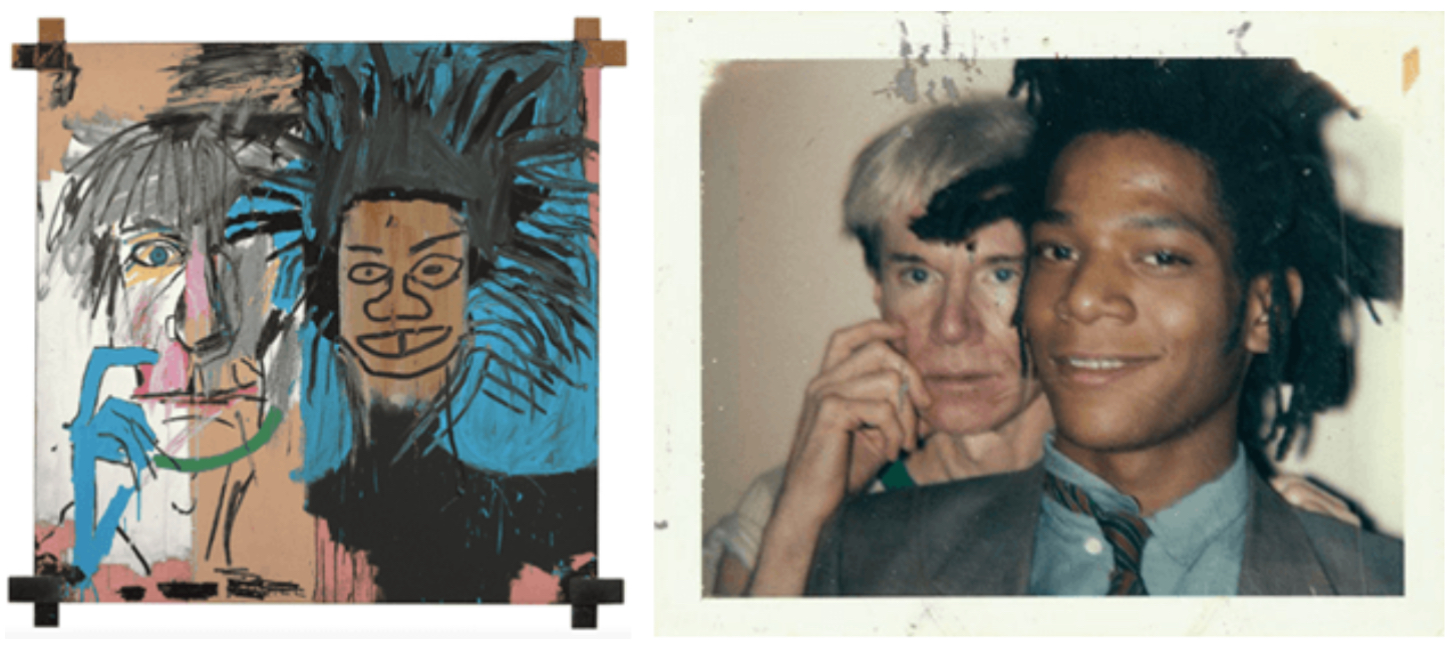
[left] Jean-Michel Basquiat, Dos Cabezas, 1982. Artwork © Estate of Jean-Michel Basquiat. Licensed by Artestar, New York [right] Andy Warhol, Self-Portrait with Basquiat, October 4, 1982. Artwork: © 2021 Andy Warhol Foundation for the Visual Arts / Artists Rights Society (ARS), New York
Basquiat and Bischofberger had for some time discussed the idea of artistic collaboration—its history, conceptuality, and feasibility—and the two postulated that contemporary collaborations could yield interesting results. The following year, Bischofberger connected Basquiat with Warhol and Francesco Clemente, also in his stable, which resulted in 15 works that were exhibited at Bischofberger’s gallery in 1984, and the group apparently dissolved thereafter.
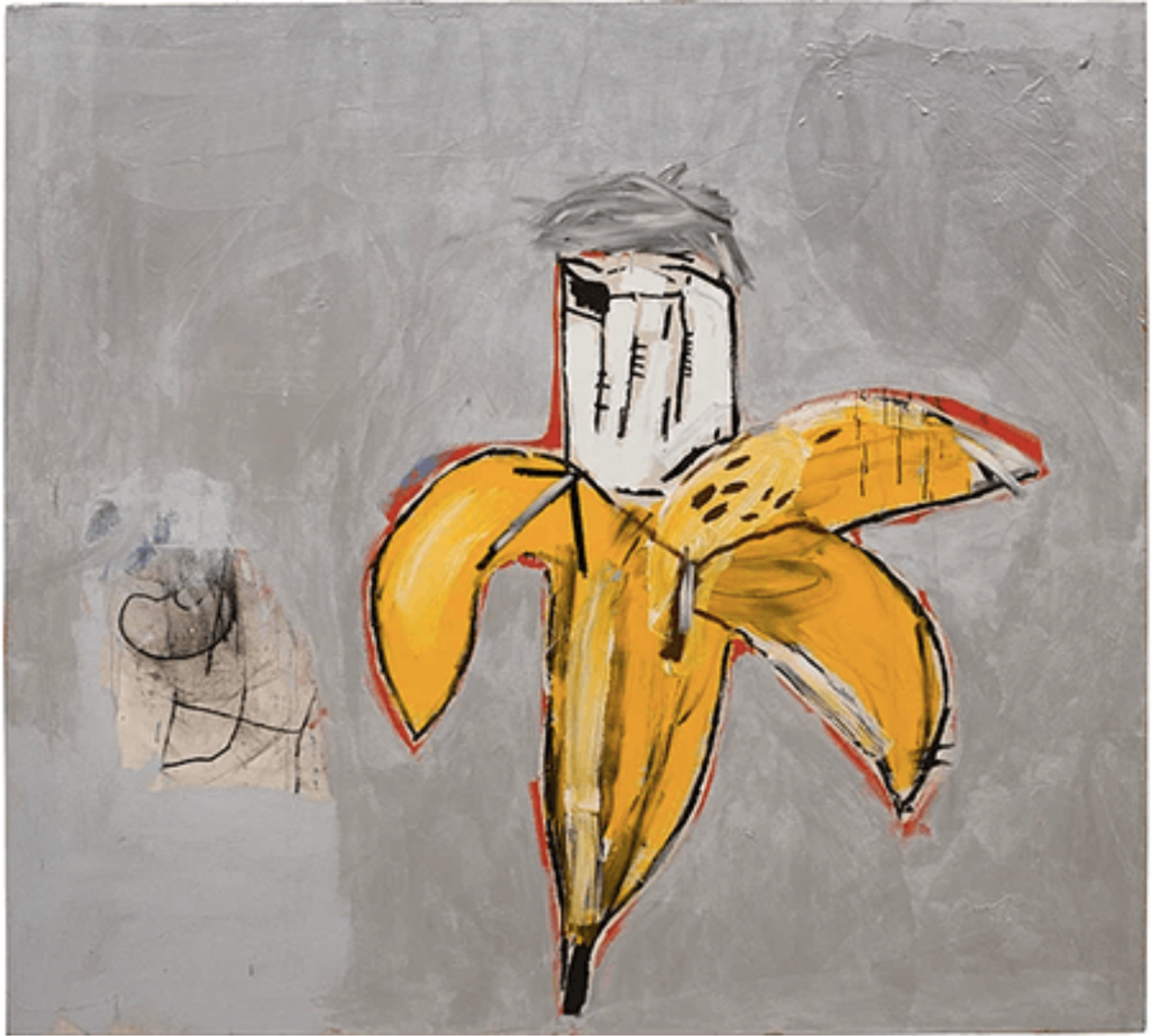
Jean-Michel Basquiat, Brown Spots (Portrait of Andy Warhol as a Banana), 1984. Artwork: © Estate of Jean-Michel Basquiat. Licensed by Artestar, New York
In 1985 Warhol sheepishly admitted to Bischofberger that he and Basquiat had clandestinely kept up their collaborations even after the 1984 exhibition. The two artists had relished working together and, the result was a truly symbiotic relationship that benefitted each artist immensely, inspiring creativity and risk-taking in both partners: Basquiat reinvigorated Warhol’s engagement with painting, and Basquiat tried his hand at screenprinting, Warhol’s preferred medium.
Of their preferred working method, Basquiat remarked, “[Warhol] would start most of the paintings. He’d start one, you know, put… something very concrete or recognizable like a newspaper headline or a product logo and I would sort of deface it and then when I would try to get him to work some more on it, you know, and then I would work more on it. I tried to get him to do at least two things. He likes to do just one hit, you know [laughs] and then have me do all the work after that…We used to paint over each other’s stuff all the time.”
The contrast between the artist’s two most iconic mediums – Warhol’s consciously flat graphically inspired imagery and Basquiat’s coarse, textured oilstick draughtsmanship – is here completely subsumed by the pictorial blend of Warhol and Basquiat’s styles. Keith Haring recalled their mutually beneficial synthesis. “Each one inspired the other to out-do the next. The collaborations were seemingly effortless. It was a physical conversation happening in paint instead of words. The sense of humour, the snide remarks, the profound realizations, the simple chit-chat all happened with paint and brushes. The atmosphere was playful and intense at the same time. Jean-Michel’s painting posture and disregard for technique created a mood of unnerving spectacle. There was a sense that one was watching something being unveiled and discovered for the first time.” (Keith Haring “Painting the Third Mind” in Collaborations: Andy Warhol, Jean-Michel Basquiat, New York, 1988)
Auction Results
Untitled, 1984
Sotheby’s New-York: 13 May 2024
Estimated: USD 15,000,000 – 20,000,000
USD 19,367,500
AUCTION RECORD FOR THE COLLABORATION
Untitled | Contemporary Evening Auction | 2024 | Sotheby’s (sothebys.com)

ANDY WARHOL and JEAN-MICHEL BASQUIAT (1928 – 1987 and 1960 – 1988)
Untitled, 1984
Acrylic, oilstick and graphite on canvas
116 x 165 1/4 inches (294.6 x 419.7 cm)
Collaboration, 1983-1985
Christie’s London: 13 October 2023
Estimated: GBP 1,000,000 – 1,500,000
GBP 1,613,000 / USD 1,957,615
REPEAT SALE
Christie’s New-York: 16 November 2017
Estimated: USD 400,000 – 600,000
USD 924,500
Andy Warhol & Jean-Michel Basquiat (1928-1987 & 1960-1988), Collaboration | Christie’s
REPEAT SALE
Christie’s New-York: 14 May 2014
Estimated: USD 300,000 – 500,000
USD 581,000
Jean-Michel Basquiat (1960-1988) & Andy Warhol (1928-1987) , Collaboration | Christie’s
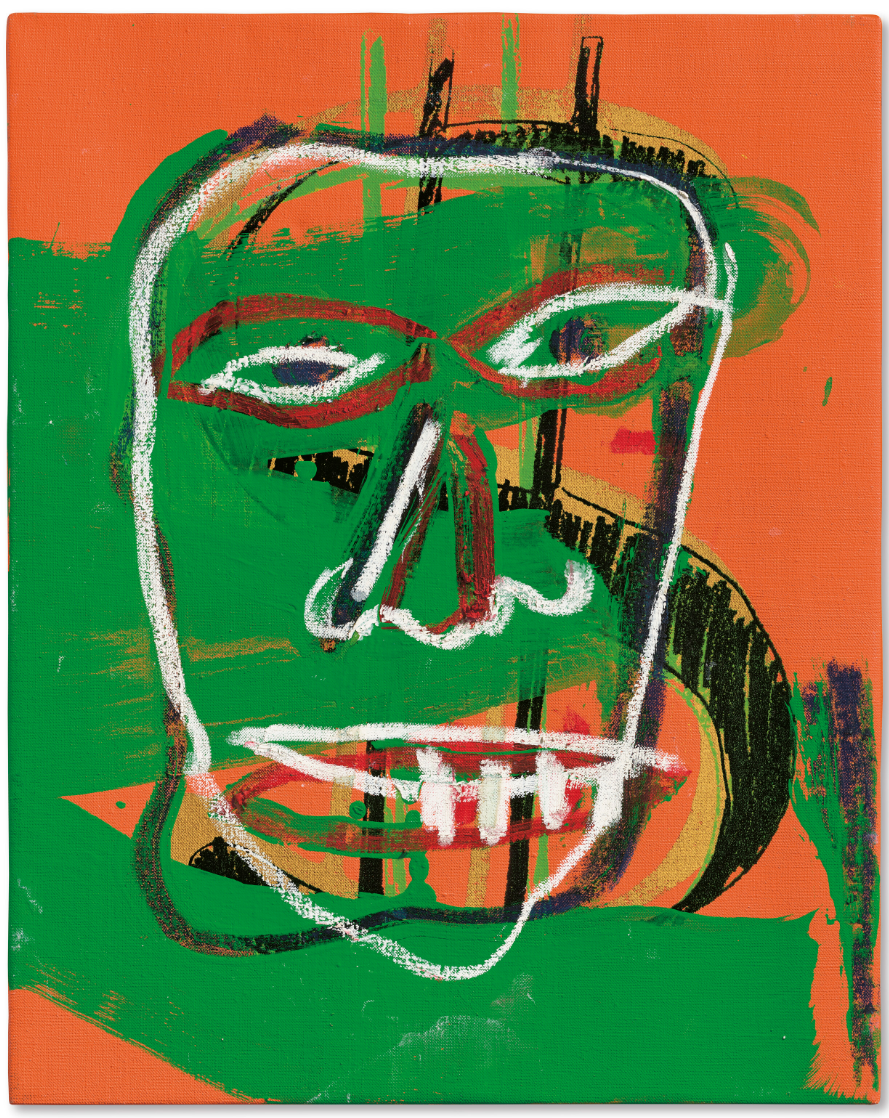
ANDY WARHOL & JEAN-MICHEL BASQUIAT (1928-1987 & 1960-1988)
Collaboration, 1983-1985
Acrylic, oilstick and silkscreen ink on canvas
20×16 inches (51.2 x 40.6 cm)
Eggs, 1986
Christie’s New-York: 18 May 2023
Estimated: USD 150,000 – 200,000
USD 302,400
ANDY WARHOL (1928-1987) AND JEAN-MICHEL BASQUIAT (1960-1988), Eggs | Christie’s (christies.com)
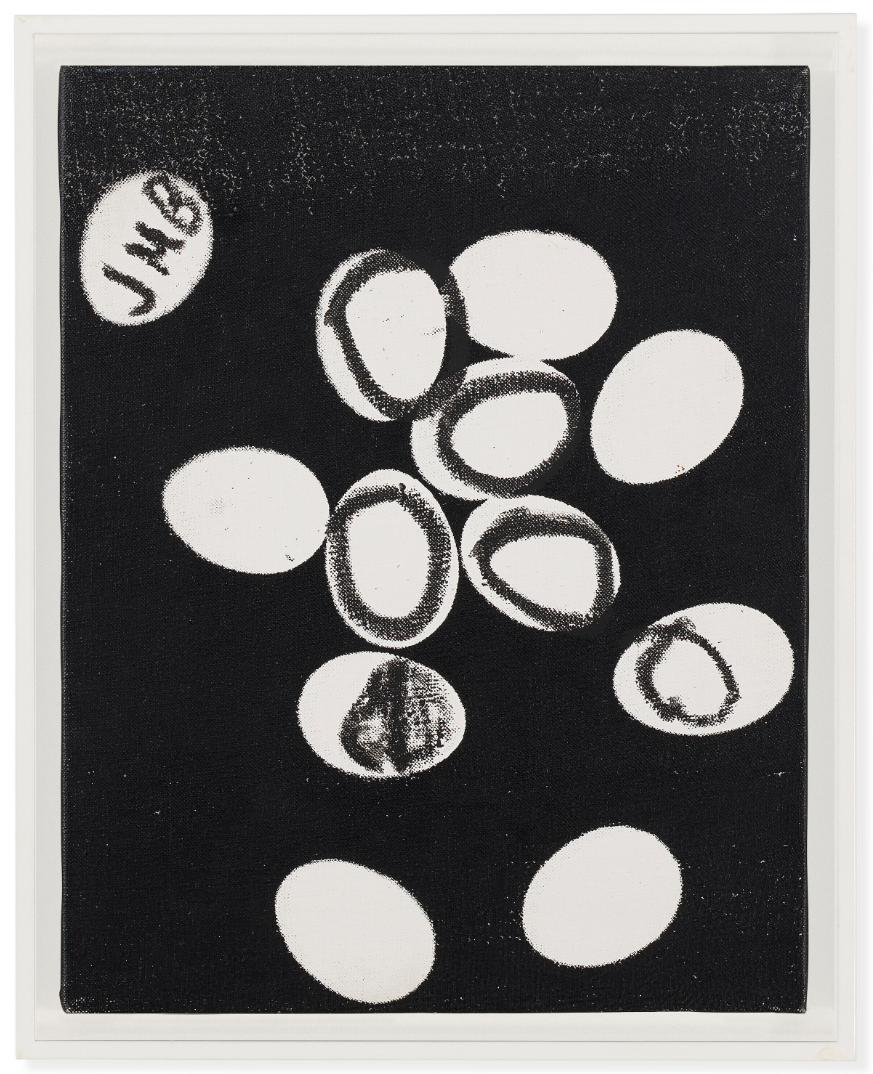
ANDY WARHOL (1928-1987) AND JEAN-MICHEL BASQUIAT (1960-1988)
Eggs, 1986
Acrylic, silkscreen ink and oilstick on canvas
14×11 inches (35.5 x 27.9 cm)
Signed with Jean-Michel Basquiat’s initials ‘JMB’ (upper left)
Stamped with the Estate of Andy Warhol and numbered ‘D100.996’ (on the reverse)
1/2 Keep Frozen, 1984-1985
Christie’s New-York: 17 November 2022
Estimated: USD 2,000,000 – 3,000,000
USD 3,060,000
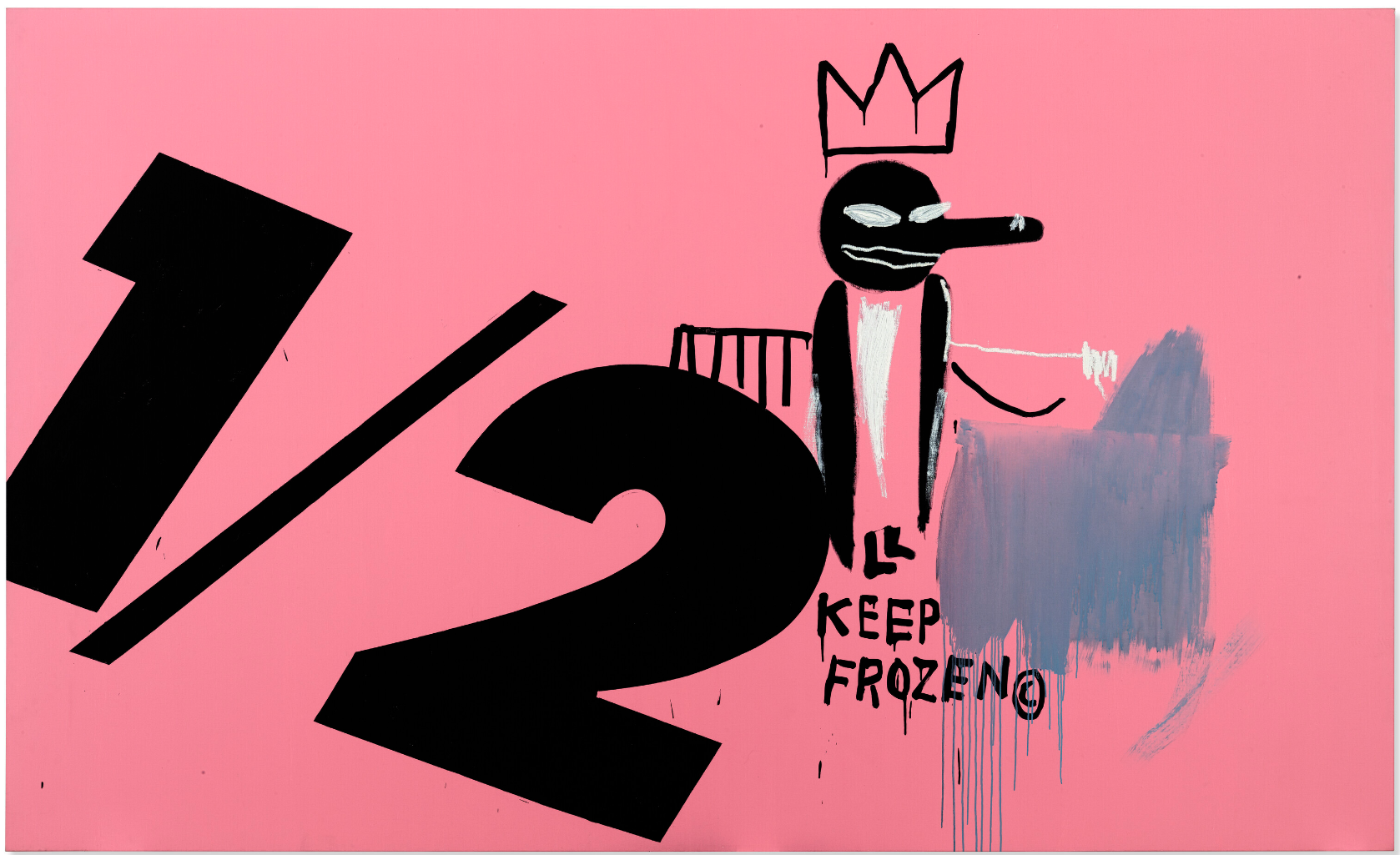
ANDY WARHOL (1928-1987) AND JEAN-MICHEL BASQUIAT (1960-1988)
1/2 Keep Frozen, 1984-1985
Acrylic and oilstick on canvas
76 1/8 x 125 3/4 inches (193 x 319.5 cm)
Signed, stamped with the Estate of Andy Warhol and the Andy Warhol Foundation for the Visual Arts, Inc. stamp
Numbered ‘Andy Warhol Jean-Michel Basquiat PA99.027’ (on the overlap)
GE/Skull, circa 1984-1985
The Collection of Thomas and Doris Ammann
Christie’s New-York: 9 May 2022
Estimated: USD 2,000,000 – 3,000,000
USD 4,620,000
ANDY WARHOL (1928-1987) AND JEAN-MICHEL BASQUIAT (1960-1988), GE/Skull | Christie’s
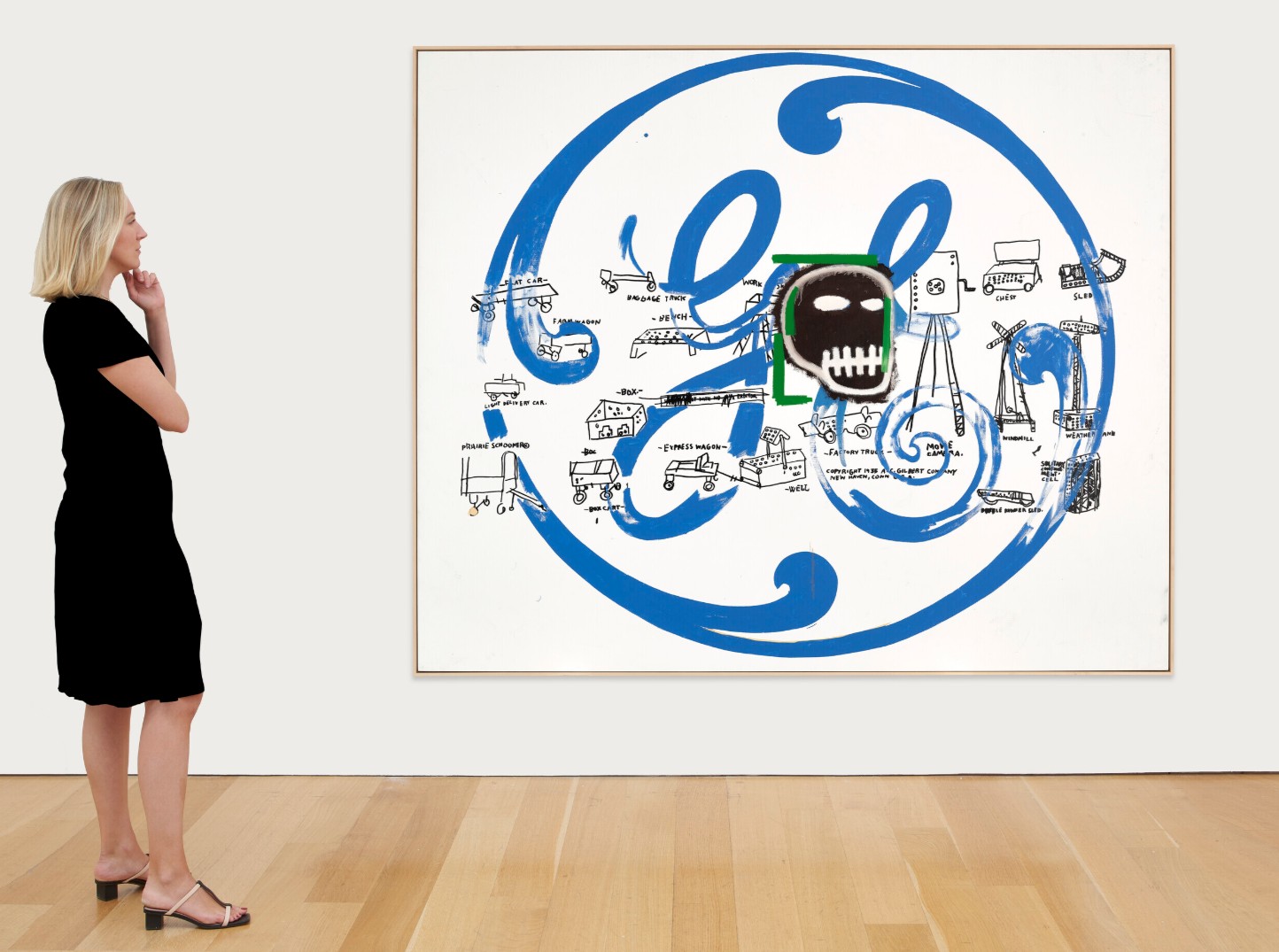
ANDY WARHOL (1928-1987) AND JEAN-MICHEL BASQUIAT (1960-1988)
GE/Skull, circa 1984-1985
Acrylic and silkscreen ink on canvas
76×92 inches (193 x 233.7 cm)
Stamped with the Estate of Andy Warhol and the Andy Warhol Foundation for the Visual Arts, Inc. stamps
Numbered ‘PA 99.040’ (on the overlap)
Numbered again ‘PA 99.040’ (on the stretcher)
Bananas, 1984-1985
Phillips New-York: 23 June 2021
Estimated: USD 4,000,000 – 6,000,000
USD 4,300,000
Jean-Michel Basquiat and Andy Warhol – … Lot 12 June 2021 | Phillips
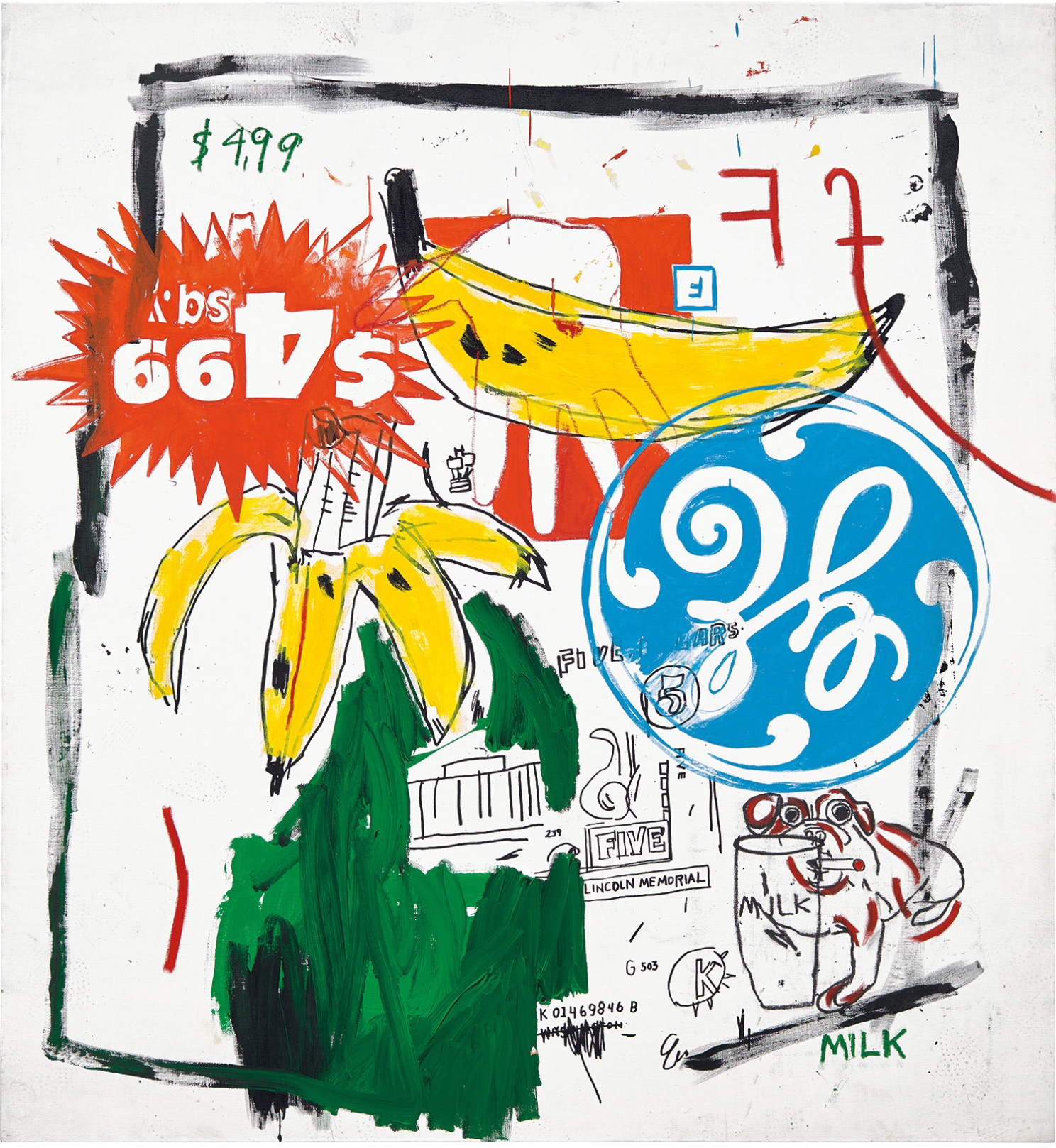
JEAN-MICHEL BASQUIAT and ANDY WARHOL
Bananas, 1984-1985
acrylic, silkscreen ink and oilstick on canvas
87 3/4 x 81 3/8 inches (222.9 x 206.7 cm)
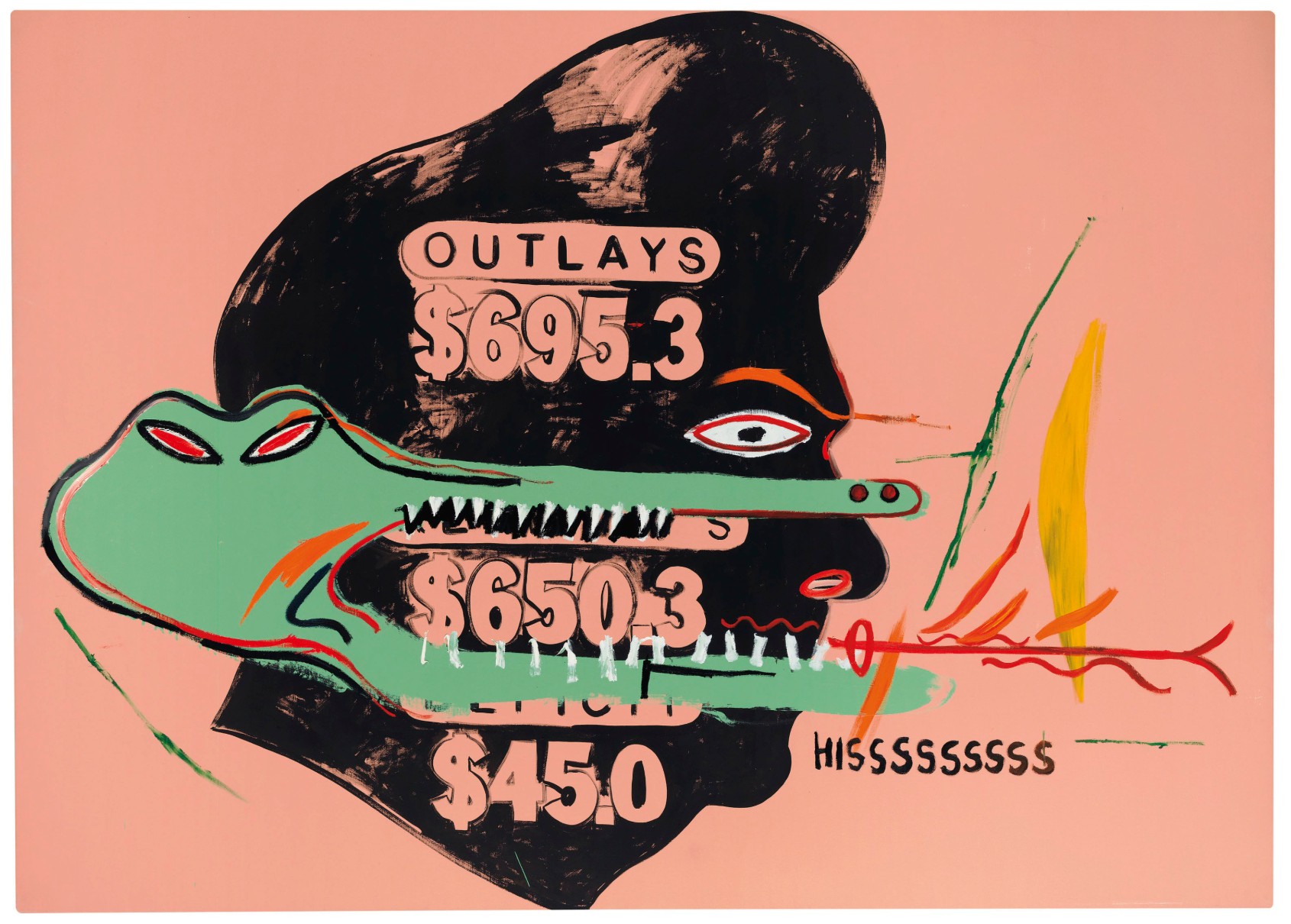
Outlays Hisssssssss (Collaboration #22), 1984-85
Christie’s New-York: 16 November 2018
Estimated: USD 1,000,000 – 1,500,000
USD 2,052,500
ANDY WARHOL (1928-1987) AND JEAN-MICHEL BASQUIAT (1960-1988)
Outlays Hisssssssss (Collaboration #22), 1984-85
Synthetic polymer and silkscreen ink on canvas
76-1/2 x 106-1/2 inches (194.3 x 270.5 cm)
Signed, stamped with the Estate of Andy Warhol and the Andy Warhol Foundation for the Visual Arts, Inc. stamps
Numbered ‘Andy Warhol Jean-Michel Basquiat’ (on the overlap)
Taxi, 45th/Broadway, 1984-85
Sotheby’s New-York: 14 November 2018
Estimated: USD 6,000,000 – 8,000,000
USD 9,443,900
(#20) ANDY WARHOL AND JEAN-MICHEL BASQUIAT | Taxi, 45th/Broadway (sothebys.com)
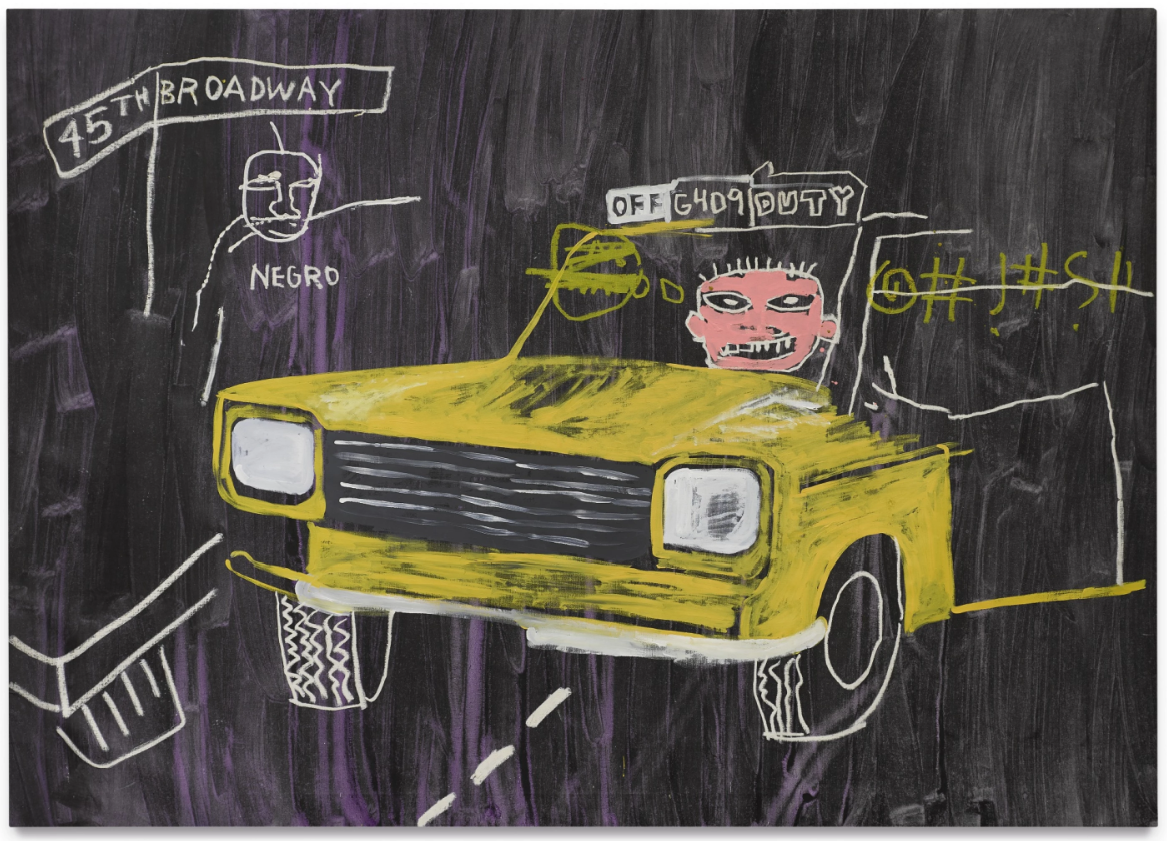
JEAN MICHEL BASQUIAT and ANDY WARHOL
Taxi, 45th/Broadway, 19884-85
Acrylic, oilstick, and silkscreen ink on canvas
77 1/4 x 107 1/4 inches (196.2 x 272.4 cm)
Stamped twice by The Estate of Andy Warhol and The Andy Warhol Foundation for the Visual Arts, Inc., and numbered PA99.057 on the overlap
Paramount Pictures, circa 1985
Christie’s New-York: 16 November 2017
Estimated: USD 1,000,000 – 1,500,000
USD 2,772,500
Andy Warhol & Jean-Michel Basquiat (1928-1987 & 1960-1988), Paramount Pictures | Christie’s
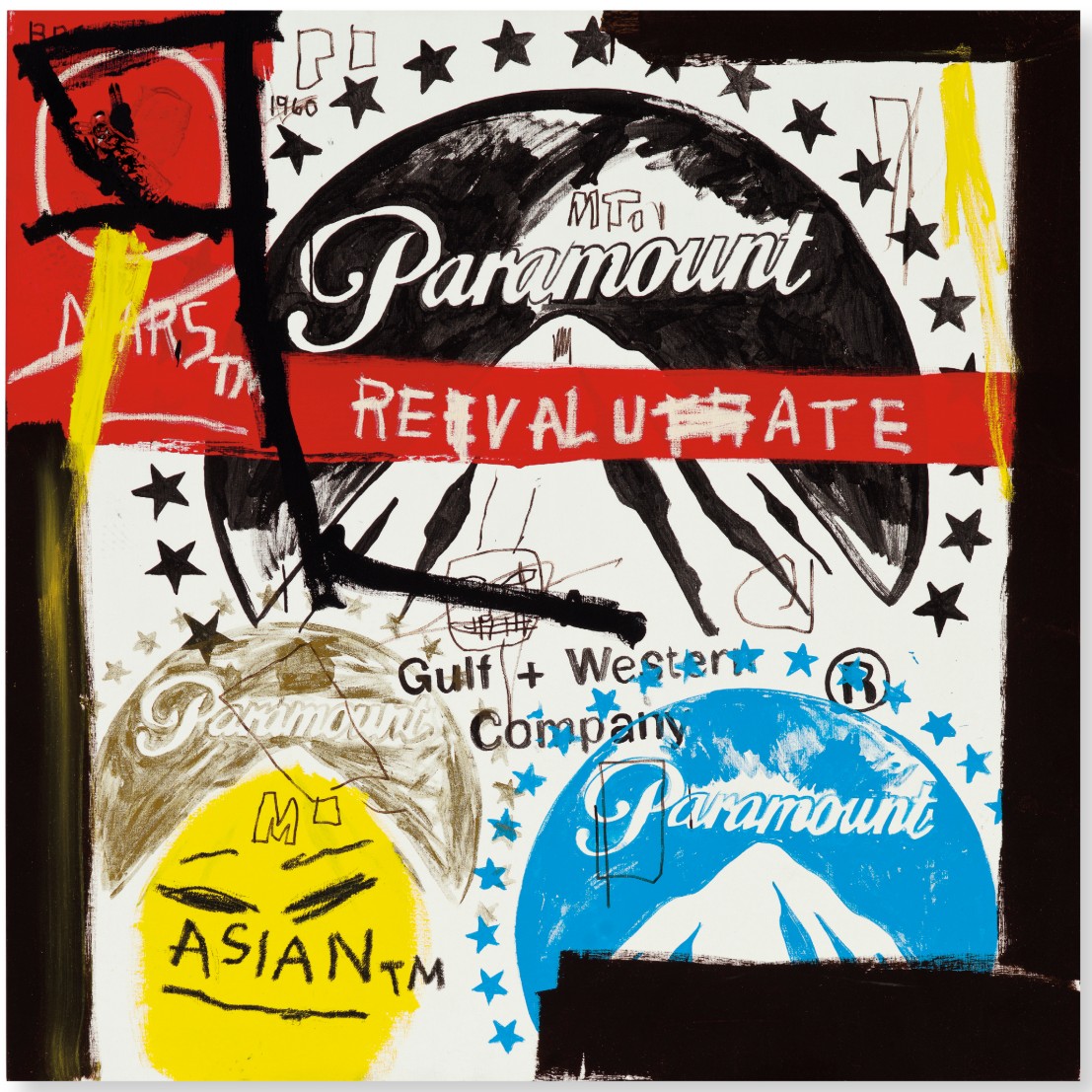
ANDY WARHOL & JEAN-MICHEL BASQUIAT (1928-1987 & 1960-1988)
Paramount Pictures, circa 1985
Synthetic polymer, silkscreen inks and paint tube collage on canvas
48×48 inches (121.9 x 121.9 cm)
Signed and dedicated ‘to Jon Jean-Michel Basquiat’ (on the overlap)
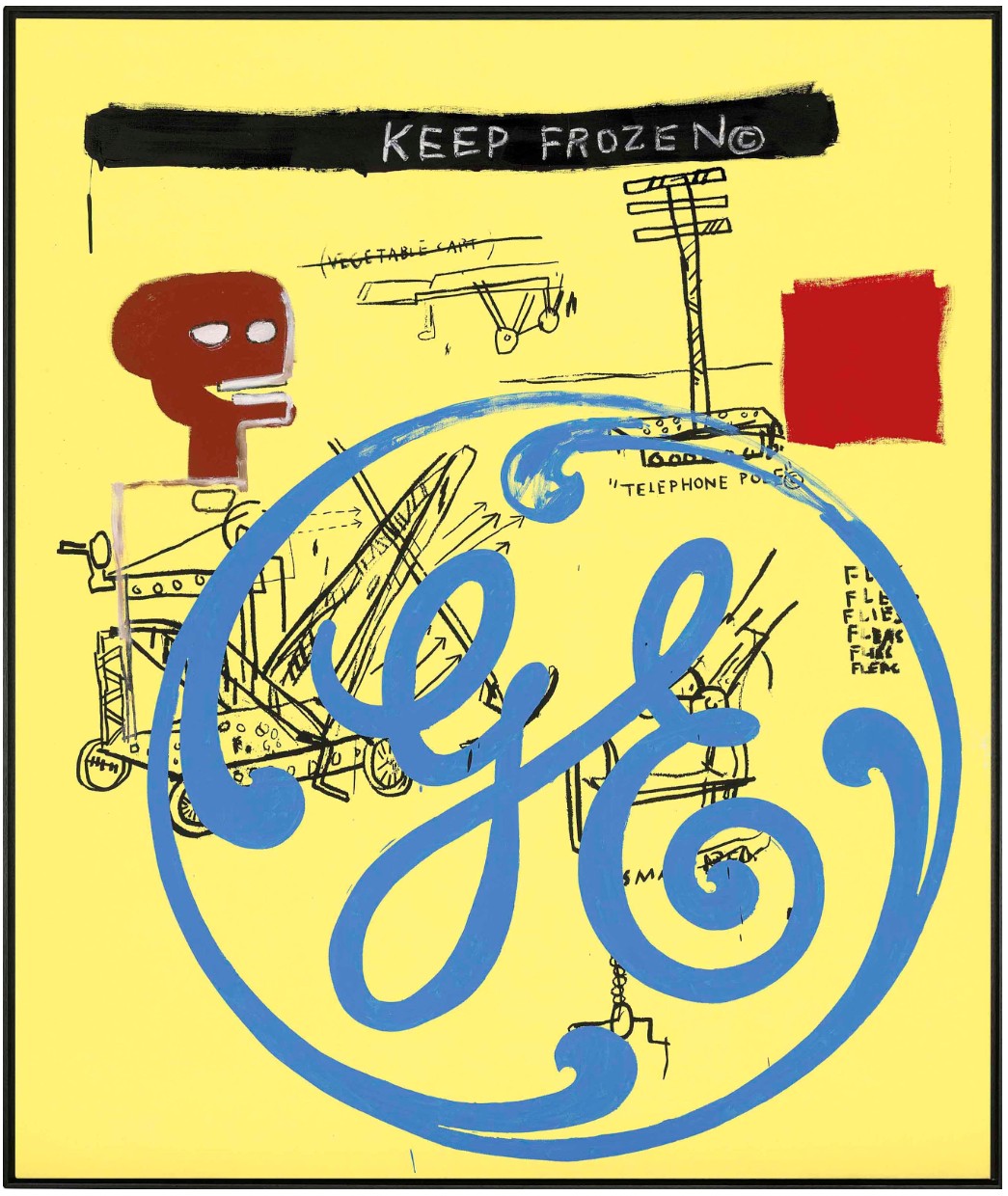
Keep Frozen (General Electric), 1985
Christie’s London: 6 October 2017
Estimated: GBP 1,200,000 – 1,800,000
GBP 1,688,750 / USD 2,206,375
ANDY WARHOL & JEAN-MICHEL BASQUIAT (1928-1987 & 1960-1988)
Keep Frozen (General Electric), 1985
Acrylic and silkscreen on canvas
95×80 inches (241.5 x 203.4 cm)
Sweet Pungent, 1984-85
Sotheby’s London: 28 June 2017
Estimated: GBP 1,400,000 – 1,800,000
GBP 4,433,750 / USD 5,735,490
(#13) Andy Warhol and Jean-Michel Basquiat
ANDY WARHOL & JEAN-MICHEL BASQUIAT (1928-1987 & 1960-1988)
Sweet Pungent, 1984-85
Acrylic, oilstick and silkscreen ink on canvas
96 1/4 by 81 1/8 inches (244.5 x 206.1 cm)
Untitled, 1984
Untitled, 1984
Sotheby’s New-York: 13 May 2024
Estimated: USD 15,000,000 – 20,000,000
USD 19,367,500
AUCTION RECORD FOR THE COLLABORATION
Untitled | Contemporary Evening Auction | 2024 | Sotheby’s (sothebys.com)
ANDY WARHOL and JEAN-MICHEL BASQUIAT (1928 – 1987 and 1960 – 1988)
Untitled, 1984
Acrylic, oilstick and graphite on canvas
116 x 165 1/4 inches (294.6 x 419.7 cm)
A supreme superimposition whereby the detached consumer symbols of Pop meet a streetwise sensibility, Untitled from 1984 resounds with the epic collision and collaboration between two of the most legendary forces of twentieth-century art history: Andy Warhol and Jean-Michel Basquiat. First facilitated by Zurich-based dealer Bruno Bischofberger, this iconic collaboration united two artists from different generations and backgrounds at the zenith of the downtown New York art scene in 1982: Warhol, the revolutionary progenitor of Pop Art working out of The Factory, and Basquiat, the newly rising enfant terrible recognized for his street art in the downtown crucible of New York. Extending the Surrealist methodology of “exquisite corpse” in which various artists collectively assemble a composition by individually adding illustrations in sequence, each artist accumulated image atop image in their signature medium – acrylic for Warhol, oilstick for Basquiat – to result in celebrated corpus of Collaboration paintings, of which the present work is among the fullest and most accomplished.

Untitled is distinguished by its remarkable marriage of Basquiat’s trademark skull-like heads with Warhol’s iconographic commercial symbols, resulting in a composition of brilliant reds, greens, and blues that is made still more remarkable by its monumental scale. Since its initial debut at the seminal exhibition of the Collaborations series at Tony Shafrazi Gallery, New York in 1985, Untitled has also been exhibited at Basquiat x Warhol: Painting Four Hands at Foundation Louis Vuitton, Paris in 2023 as well as BASQUIAT X WARHOL at The Brant Foundation, New York in 2023-2024, two recent and critically acclaimed exhibitions dedicated to the artists’ relationship. Borne from the creative spontaneity that electrified this partnership, the explosive yet harmonious kaleidoscope of quotidian symbols, gestural scrawlings, and talismanic heads in Untitled exhibits a riveting visual and semantic exchange between two of art history’s most inventive minds.

When the two were first introduced to one another in 1982 by Bruno Bischofberger, Basquiat was a young street artist who had only just emerged to mainstream legitimacy while Warhol had reigned the New York avant garde for two decades. Schooled by the gritty aesthetics of his native-New York streets rather than the academy, Basquiat offered a fresh and contrarian perspective that reinvigorated Warhol, even inspiring him to once again use the paintbrush, while the well-established Warhol plugged Basquiat into a vast network that cemented his critical ascendancy. As fellow Pop artist Ronnie Cutrone recalled, “Their relationship was symbiotic. Jean-Michel thought he needed Andy’s fame, and Andy thought he needed Jean-Michel’s new blood. Jean-Michel gave Andy a rebellious image again.” (Ronnie Cutrone cited in: Victor Bockris, Warhol: The Biography, Cambridge 2003, pp. 461-62) Each already prodigious and radically inventive, Basquiat and Warhol’s distinctive artistic styles rivaled each in many ways, as evinced by the dizzying medley of image and color seen in Untitled. Here, the ready-made iconography of Warhol’s screen printing process finds an immediate intervention in the striking, urban attack of Basquiat’s gestural brushwork. Warhol first laid down his images in Untitled by crisply emblazoning graphic imagery – baseball mitts, tennis rackets, sneakers, numbers, and the bright red Zenith electronics logo – to which Basquiat responded by filling in other parts of the canvas with impulsive bravado. Basquiat’s painterly swathes of blue and ivory, freehand childlike scrawls, and skeletal heads dominate the negative space around Warhol’s interspersed images, only to be quickly overlaid again by new barrages of Warhollian illustrations. Warhol’s “½” looms large on the canvas, iterated three times in three different sizes. Reading this fraction as a literal expression of a division between Warhol and Basquiat here would be misleading, however, because the painting is nothing if not shared. Describing their wholly synergetic back-and-forth, Basquiat once recalled, “[Warhol] would put something very concrete or recognizable, like a newspaper headline or a product logo, and then I would try and deface it, and then I would try and get him to work some more on it.” (Jean-Michel Basquiat cited in: Exh. Cat., Basel, Fondation Beyeler, Basquiat, 2010, p. 47)

LEFT: ANDY WARHOL, SELF-PORTRAIT, 1986. IMAGE © TATE, LONDON / ART RESOURCE, NY. ART © 2024 ANDY WARHOL FOUNDATION FOR THE VISUAL ARTS / ARTISTS RIGHTS SOCIETY (ARS), NEW YORK. RIGHT: JEAN-MICHEL BASQUIAT, FLEXIBLE, 1984. PRIVATE COLLECTION. IMAGE © PHILLIPS. ART © 2024 ESTATE OF JEAN-MICHEL BASQUIAT. LICENSED BY ARTESTAR, NEW YORK
Both artists, though so strikingly different, shared a critical disposition as outsiders within the art world – Warhol was a wounded celebrity who preferred to affect the pose of an enigmatic voyeur, and Basquiat was a young African-American prodigy with a growing reputation, but no formal art training. Both artists also looked to popular culture for imagery – Warhol to advertising, newspapers and Hollywood stars; Basquiat to jazz musicians and professional athletes. The dialogue shared between the two artists powerfully manifests across the sweeping surface of Untitled, which embeds fragments of the daring zeitgeist of 1980s America that they respectively defined: the cult of athletic celebrity, the allure of consumer culture, the specter of urban decay. Basquiat’s signature totemic figures, rendered with primal energy and gestural immediacy, confront the viewer with their unvarnished presence, while Warhol’s graphic imagery recalls his earlier portraiture cycle of famed athletes and serves as a prism through which to interrogate the nature of commercial and sports iconography. Ultimately, this remarkable cacophony of image and color in Untitled encapsulates the accelerated energy and cultural milieu of the city that both artists called home, while the monumental, mural-like scale of the canvas testifies to their larger-than-life personas within it.

Pulsating with creative furor, overflowing with wild imagination, Untitled blurs the boundaries between commercial art and street art to perfectly synthesize Warhol’s and Basquiat’s respective artistic legacies. Speaking to the superlative caliber of the present work, curator Dieter Buchhart writes, “Basquiat and Warhol attained the highest complexity and synthesis of their two positions in works such as China Paramount, Untitled, and 6.99. In Untitled, Warhol created a network of athletic goods, including a catcher’s glove and a tennis racket, and loafers. A dialogue in contradictions, this develops into a web of symbols, numbers, signs, objects, heads and surfaces in light blue and ivory, like one of Basquiat’s spaces of knowledge in which the artist combines everything that surrounds him and what he gathers around him.” (Dieter Buchhart, “Basquiat x Warhol: A Dialogue in Contradictions,” in: Exh. Cat., Paris, Fondation Louis Vuitton, Basquiat x Warhol: Painting Four Hands, 2023, p. 24) Such synergy between two divergent visual languages upon a singular canvas testifies to the profoundly symbiotic relationship that the two artists shared. “Each one inspired the other to out-do the next,” Keith Haring observed during one of his visits to the studios of Warhol and Basquiat. “The collaborations were seemingly effortless. It was a physical conversation happening in paint instead of words. The sense of humor, the snide remarks, the profound realizations, the simple chit-chat all happened with paint and brushes.” (Keith Haring, “Painting the Third Mind,” in Exh. Cat., Paris, Fondation Louis Vuitton, Basquiat x Warhol: Painting Four Hands, 2023, pp. 110-111)
Bananas, 1984-1985
Bananas, 1984-1985
Phillips New-York: 23 June 2021
Estimated: USD 4,000,000 – 6,000,000
USD 4,300,000
Jean-Michel Basquiat and Andy Warhol – … Lot 12 June 2021 | Phillips
JEAN-MICHEL BASQUIAT and ANDY WARHOL
Bananas, 1984-1985
acrylic, silkscreen ink and oilstick on canvas
87 3/4 x 81 3/8 inches (222.9 x 206.7 cm)
Executed between 1984 and 1985, Bananas is the product of a fruitful period of collaboration between the founding father of Pop art, Andy Warhol, and Jean-Michel Basquiat, the enfant terrible of Neo-Expressionism. Coming together at different stages of their respective careers, Basquiat and Warhol shared immense mutual respect and admiration for one another and together produced works of astounding insight, intimacy, and intelligence. The present work perhaps stands as an inside joke amongst close collaborators, as that same year, Basquiat conceived Brown Spots (Portrait of Andy Warhol as a Banana) for his first show at Mary Boone that May. The Warholian emblem alludes to his famous album cover art for The Velvet Underground & Nico. Bringing together a discordant assemblage of imagery, Bananas exhibits the paradoxical, sublime concord of the two artists’ collaboration.
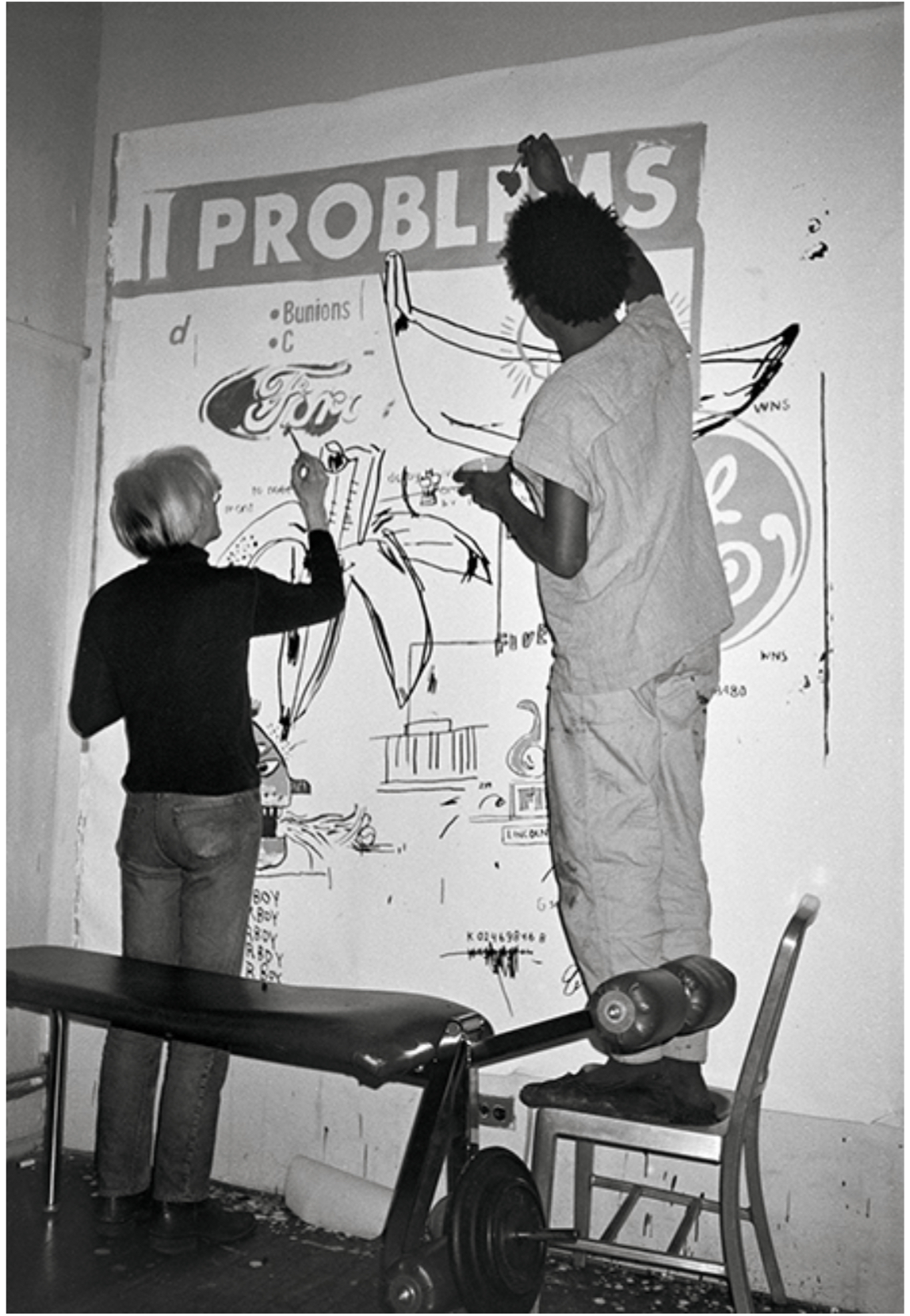
The artists painting Clearboy in Warhol’s studio at 860 Broadway, 1984. © The Andy Warhol Foundation for the Visual Arts, Inc.
According to their shared gallerist Bruno Bischofberger, the present work was Basquiat’s “secret favorite” from the double-collaboration along with Clearboy, 1984-1985. After keeping the present work in his personal collection, Basquiat eventually sold it to Bischofberger. A rare-to-market opportunity, Bananas comes to auction for the first time since it was acquired by an important private collection from the artists’ gallerist.
In Bananas, the layered imagery bears clear traces of each maker: Warhol’s renderings of corporate logos and store prices juxtapose Basquiat’s inversion of the composition. His scrawled bananas, uncontained axioms, and hieroglyphs, occasionally overwhelm Warhol’s iconography, revealing the competitive mischief of the artists’ collaboration. Keith Haring remarked that “painting with Jean-Michel was not easy. You had to forget any preconceived ideas of ownership and be prepared to have anything you’d done completely painted over within seconds.” But the coherence of the composition belies their deep mutual respect. Basquiat and Warhol adhered to a strict thematic vocabulary, recreating icons of consumerism and capitalism, and any incursions into the other artist’s painted territory accentuate the composition rather than erase it. Bananas is an artifact of an immensely important art-historical collaboration; like the librettist and composer of an opera, Warhol and Basquiat operated in unison yet independently of one another to create a discrete and harmonious work of art.
Working separately on a work, Warhol would typically start, often using a projector to trace outlines directly onto canvas. As Vincent Fremont, who had worked in the Factory since 1969, recalled: “Jean-Michel would normally arrive in the afternoon; he was by now buzzed in immediately. He would walk to the back of the studio where Andy painted. Sometimes he would light up a big joint, something no one did at work, and Andy would put up with it… Andy would have already started on some paintings before Jean-Michel’s arrival. Because Basquiat’s working methods involved broad strokes of a paintbrush and oil-stick crayons, Andy made a very important decision: rather than using his silk-screen process… he would now only hand paint his images” (Vincent Fremont, ‘Collaboration Magic: Andy Warhol & Jean-Michel Basquiat’, in: Exh. Cat., Bonn, Art and Exhibition Hall of the Federal Republic of Germany, Ménage à Trois: Warhol, Basquiat, Clemente, 2012, p. 38).
Taxi, 45th/Broadway, 1984-85
Taxi, 45th/Broadway, 1984-85
Sotheby’s New-York: 14 November 2018
Estimated: USD 6,000,000 – 8,000,000
USD 9,443,900
(#20) ANDY WARHOL AND JEAN-MICHEL BASQUIAT | Taxi, 45th/Broadway (sothebys.com)
JEAN MICHEL BASQUIAT and ANDY WARHOL
Taxi, 45th/Broadway, 19884-85
Acrylic, oilstick, and silkscreen ink on canvas
77 1/4 x 107 1/4 inches (196.2 x 272.4 cm)
Stamped twice by The Estate of Andy Warhol and The Andy Warhol Foundation for the Visual Arts, Inc., and numbered PA99.057 on the overlap
As with Basquiat’s most astute and impressive works, the present composition is autobiographical while also addressing a wider racial and socio-cultural dialogue, chronicling an instance of discrimination which was a recurrent event in Basquiat’s everyday experience as a black man in New York City. Previously held in the collection of Gianni Versace, Taxi, 45th/Broadway represents a critical moment in American history as told through the eyes of two of the country’s most predominant artistic geniuses. Capitalizing on the narrative power of imagery, Taxi, 45th/Broadway deftly engages with art history, politics, and race. A black figure, here made invisible in the darkness of night, endures the label “Negro” as he unsuccessfully attempts to hail a cab while a white taxi driver, upon discerning the color of his skin, ignores his plea and and speeds past him, cursing senseless profanities in his direction. Despite Basquiat’s meteoric ascension from downtown graffiti street artist to artist icon of the 1980s New York art scene, of which Warhol was critical in eliciting, his race still prevailed as his primary identifier outside of the realm of the art world, a fact which profoundly frustrated and angered the young artist. The present composition reflects on a deeply personal and demoralizing recurrence in Basquiat’s everyday life, one remembered by Keith Haring: “Being black and a kid and having dreadlocks, he couldn’t even get a taxi. But he could spend $10,000 in his pocket.” (Michael Wines, “Jean Michel Basquiat: Hazards Of Sudden Success and Fame,” The New York Times, September 27, 1988) While experienced more overtly and explicitly by Basquiat, this tension between invisibility and recognition is one that also severely afflicted Warhol, who despite his fame was conflicted by constant introspection. Taxi, 45th/Broadway tempts reading as a double portrait: the black figure undoubtedly represents Basquiat, and the taxicab driver’s frenetic eyes and wiry hair distincts recall Basquiat’s depictions of Warhol.
A vibrant medley of iconography and color that remarkably encapsulates the fast-paced energy and cultural milieu of the city that both artists called home, Taxi, 45th/Broadway reveals Basquiat and Warhol at their most inventive: while fully immersed in their contemporary moment, Basquiat and Warhol also retain a firm grasp on and deployment of twentieth century art history. The frantically scrawled text and chalky blackboard-like surface evoke Cy Twombly’s ‘Blackboard’ paintings, while the discernible strokes of paint recall the gestural brushstrokes of Abstract Expressionism, establishing an underlying engagement with repetition and erasure that reverberates throughout the composition both conceptually and aesthetically. The gestural swathes of paint that comprise the background recall Warhol’s expressive brushwork in his paintings of the 1970s and early 1980s. Each prodigious and radically inventive in their own right, Basquiat and Warhol’s distinctive artistic styles in many ways rivaled and opposed one another: Basquiat’s visceral grafitti-esque gestures and densely populated compositions sharply contrasted the ready-made iconography of Warhol’s screen printing process. Balancing Basquiat’s intensive mark-making and frantic scrawls with the graphic immediacy of Warhol’s screen-printing process, Taxi, 45th/Broadway explores a compositional motif familiar to both of their diverse oeuvres: that of repetition.
The luminous yellow taxi cab provides structural weight to the composition and, recalling Warhol’s most technically intricate paintings in which graphic images rendered in vibrant hues are laid against canvases whose painterly surfaces and viscerally visible brushstrokes complicate the hands-off reproducibility of the screen printing technique. Barely viewable as it zooms past and making no effort to slow down for the pedestrian, the taxi cab speeds through the night. The body of the car is seen only through streaks of vibrant yellow, conveying movement. The hastily outlined elements also recalls Warhol’s use of a projector to trace elements directly onto the canvas, a technique which predominated his earliest series, but which he would remarkably return to for his collaboration paintings with Basquiat in the mid 1980s. Indeed, Taxi, 45th/Broadway offers unparalleled insight into one of the most significant relationships in 20th century art history and reveals the fruitful synthesis of two revolutionary artistic figures.
New Flame, 1985
New Flame, 1985
Sotheby’s London: 28 June 2017
Estimated: GBP 1,700,000 – 2,200,000
GBP 2,408,750
(#14) Andy Warhol and Jean-Michel Basquiat (sothebys.com)
JEAN MICHEL BASQUIAT and ANDY WARHOL
New Flame, 1985
Acrylic, oilstick and silkscreen ink on canvas
79 1/8 x 106 1/8 inches (201 x 269.6 cm)
A symbiotic combination of the quotidian symbols that define Andy Warhol’s iconic Pop canon with the impulsive graffiti vernacular of the young Jean-Michel Basquiat, New Flame is a striking painting by two goliaths of American art. Executed in 1985 and bought from the legendary art dealer Bruno Bischofberger, it offers a poignant portrait that encapsulates the unique spirit of 1980s New York and is testament to one of the most high profile artistic collaborations of the Twentieth Century.
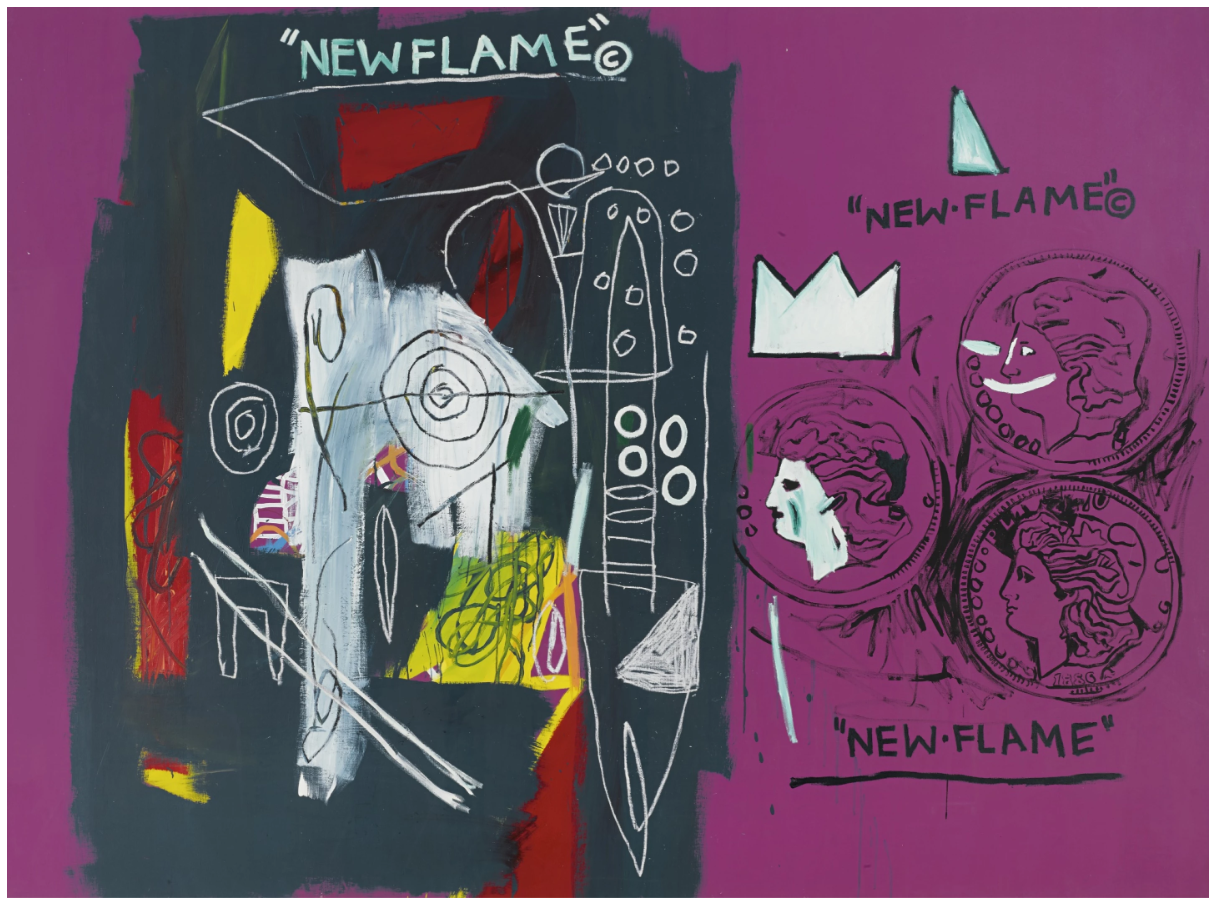
Despite the distinct stylistic differences between the two artists, New Flame evinces a vibrant meeting of two of the most revolutionary minds in contemporary art. In the present work, Warhol outlined three silver dollar coins, which depict the figure of liberty. They recall the artist’s earliest depictions of money from the late 1950s and early 1960s – hand painted drawings of dollar bills and rolled up notes, as well as Warhol’s very first silkscreen works. Subsequently these were coloured in and defaced by Basquiat, a perfect example of the competitive yet symbiotic relationship between the two artists. Perhaps underlining Warhol’s reference to the torch bearing statue of liberty, which was built in 1886 and is the same year as Warhol’s silver dollar coins, Basquiat titled that section of the canvas ‘NEW FLAME’. Through the inclusion of his signature crown in the centre right, Basquiat accredited his SAMO persona to this half of the composition. Almost half of the original pink background is covered with frantic swathes of charcoal black, painted blocks of red and yellow and childlike white scrawls. The gestural black marks and white scribbles evoke both artists’ Abstract Expressionist forebears, in particular Clyfford Still, whilst the consciously naïve scrawls bear the inimitable character of Basquiat’s graffiti days. A vibrant medley of iconography and colour, the contrast between the artist’s two most iconic mediums – Warhol’s consciously flat graphically inspired imagery and Basquiat’s coarse, textured oilstick draughtsmanship – is here completely subsumed by the pictorial blend of Warhol and Basquiat’s style.
Irrespective of the generational gap, both Warhol and Basquiat were outsiders to a degree – Warhol a wounded celebrity who preferred to affect the pose of an enigmatic voyeur and Basquiat a young African-American rebel with a growing reputation but no formal art training. Though the teenage Basquiat had pursued Warhol and had already been to the Factory several times by 1980, Warhol initially remained aloof, at first perceiving Basquiat as a naïf of yet to be determined talent. It was not until 1982 that Warhol really noticed the young artist. On October 4th, 1982, Warhol wrote in his diary: “Down to meet Bruno Bischofberger (cab $7.50). He brought Jean-Michel Basquiat with him. He’s the kid who used the name ‘Samo’ when he used to sit on the sidewalk in Greenwich Village and paint T-shirts… he was just one of those kids who drove me crazy… And so had lunch for them and then I took a Polaroid and he went home and within two hours a painting was back, still wet, of him and me together” (Andy Warhol quoted in: Pat Hackett, Ed., The Andy Warhol Diaries, New York 1989, p. 462). Basquiat’s endorsement by Bruno Bischofberger encouraged Warhol to recognise the young painter as the serious force that he would come to be known as. Concurrently, the ambitious Basquiat began his professional courtship of Warhol, inaugurated through his theatrically expedient gift of a double portrait of the two of them, a work entitled Dos Cabezas that was also once a part of Tommy Hilfiger’s collection. Gradually, Warhol’s respect for Basquiat solidified, and he commemorated Basquiat with an Oxidation painting and the full length silkscreens of Basquiat in the guise of Michelangelo’s David. Though teaming up with the legendary Warhol was certainly a coup for the twenty-three year old Basquiat, the reciprocity of the collaboration should not be underestimated. Basquiat’s powerful imagery, poetic symbolism, and youthful frenzy reinvigorated Warhol, whose career had been relatively quiescent for the previous decade. With regards to both artistic spirit and their careers, the collaboration could not have come at a better time for both artists: “Jean-Michel thought he needed Andy’s fame, and Andy thought he needed Jean-Michel’s new blood. Jean-Michel gave Andy a rebellious image again” (Ronny Cutrone in: Victor Bockris, Warhol: The Biography, Cambridge, Massachusetts, 2003, p. 461-62).
The mechanics of Warhol and Basquiats’ mutually beneficial creative friendship are here laid bare as stylistic differences blend in harmonious synthesis, giving birth to an entirely new aesthetic language. Thus, New Flame offers a unique insight into one of the most important relationships within the history of contemporary art. As pointed out by their mutual friend Keith Haring in 1988, “For an artist, the most important and most delicate relationship he can have with another artist is one in which he is constantly challenged and intimidated… Jean-Michel and Andy had achieved a healthy balance” (Keith Haring cited in: Exh. Cat., London, Mayor Rowan Gallery, Collaborations: Andy Warhol and Jean-Michel Basquiat, 1988).
Collaboration, 1983-1985
Collaboration, 1983-1985
Christie’s London: 13 October 2023
Estimated: GBP 1,000,000 – 1,500,000
GBP 1,613,000 / USD 1,957,615
REPEAT SALE
Christie’s New-York: 16 November 2017
Estimated: USD 400,000 – 600,000
USD 924,500
Andy Warhol & Jean-Michel Basquiat (1928-1987 & 1960-1988), Collaboration | Christie’s
REPEAT SALE
Christie’s New-York: 14 May 2014
Estimated: USD 300,000 – 500,000
USD 581,000
Jean-Michel Basquiat (1960-1988) & Andy Warhol (1928-1987) , Collaboration | Christie’s
ANDY WARHOL & JEAN-MICHEL BASQUIAT (1928-1987 & 1960-1988)
Collaboration, 1983-1985
Acrylic, oilstick and silkscreen ink on canvas
20×16 inches (51.2 x 40.6 cm)
The 1980s New York Downtown scene was a place of frenzied collaboration. None was more exhilarating than the one between Andy Warhol and Jean-Michel Basquiat, two of the era’s leading lights. The present Collaboration (1983-1985) captures their partnership in full flourish. It features one of Warhol’s iconic Dollar Sign silkscreens in orange, black and shimmering gold, which Basquiat has adorned with a sweep of green paint and a luminous face—possibly a self-portrait—in lines of black, white and red oilstick. The dollar sign was Warhol’s ultimate symbol, an emblem of both his own practice and of the United States. Philosopher Arthur C. Danto wrote, ‘We are all preoccupied with money, and, in its way, [Warhol’s] … dollar sign is as much an emblem of America as the flag’ (A. C. Danto, ‘Andy Warhol Enterprises,’ in Andy Warhol, New Haven 2009, p. 129). The portrait head was one of Basquiat’s own trademark motifs, a method of imprinting and affirming his own identity. Combining Warhol’s slick, controlled style with Basquiat’s youthful rawness, this Collaboration offers a vivid distillation of the two artists’ 1980s practice and their electrifying partnership.
The artists’ collaboration was sparked by a brief encounter. On 2 October 1982, art dealer Bruno Bischofberger invited Basquiat to lunch at Warhol’s Factory. Basquiat was a rising star, who, aged just twenty-one, had already set the international art world aflame. He had just become the youngest artist to ever take part in Documenta. Warhol was the grand master of Pop Art and the reigning figure of New York’s art scene. The meeting was brief. Warhol took a Polaroid of the two artists standing together. Basquiat missed lunch and ran back to his studio. Two hours later, his double portrait painting Dos Cabezas, based on the photograph, arrived at the Factory. Fuelled by mutual admiration and creative ardour, the two soon began working together. They would create around 160 works in less than three years. Earlier this year, their collaboration was the subject of the critically acclaimed exhibition Basquiat x Warhol. Painting 4 Hands at the Fondation Louis Vuitton in Paris.
These collaborative ‘four hand’ pieces often began with a Warhol silkscreen which Basquiat would then overpaint. The two artists sought to combine their voices into one. In the present Collaboration, Basquiat’s lines echo the hatched black layer of the dollar sign—itself originally drawn by Warhol, then replicated through the silkscreen. He blurs his own marks with those of the older artist, and, perhaps, makes a wry nod to his own entanglement with the world the dollar represents. As their friend and contemporary Keith Haring said: ‘Jean-Michel and Andy had achieved a healthy balance. Jean respected Andy’s philosophy and was in awe of his accomplishments and mastery of colour and images. Andy was amazed by the ease with which Jean composed and constructed his paintings and was constantly surprised by the never-ending flow of new ideas’ (K. Haring, quoted in S. Belmont, ‘With “Warhol x Basquiat”, Fondation Louis Vuitton Examines One of Art History’s Greatest Collaborations Anew’, Art News, 5 March 2023).
The duo could be irreverent: Warhol created silkscreen works featuring a nude Basquiat in the posture of Michelangelo’s David, while Basquiat painted Warhol as a banana. ‘The entire group,’ writes critic Jackie Wullschläger, ‘reads like an extended conversation, veering between chatter, jokes, evolving thoughts, flashes of insight and outbursts of monologue’ (J. Wullschläger, ‘Basquiat x Warhol at Fondation Louis Vuitton—sparks fly in dazzling collaborations’, Financial Times, 6 April 2023). Their relationship was founded on enormous respect. ‘I’d never seen Andy so close with anyone,’ recalls art dealer Jeffrey Deitch, ‘and I’d never seen Jean so close with anyone—these guys really loved each other’ (J. Deitch, quoted in H. Shepherd, ‘Warhol and Basquiat: The Art World’s Most Notorious Bromance’, Sleek, 6 September 2017). Warhol let no other artist alter and efface his own silkscreens. Emblematic of both Warhol and Basquiat’s unique energies, Collaboration stands as testament to an intimate partnership between two artistic trailblazers.
1/2 Keep Frozen, 1984-1985
1/2 Keep Frozen, 1984-1985
Christie’s New-York: 17 November 2022
Estimated: USD 2,000,000 – 3,000,000
USD 3,060,000
ANDY WARHOL (1928-1987) AND JEAN-MICHEL BASQUIAT (1960-1988)
1/2 Keep Frozen, 1984-1985
Acrylic and oilstick on canvas
76 1/8 x 125 3/4 inches (193 x 319.5 cm)
Signed, stamped with the Estate of Andy Warhol and the Andy Warhol Foundation for the Visual Arts, Inc. stamp
Numbered ‘Andy Warhol Jean-Michel Basquiat PA99.027’ (on the overlap)
Standing over six feet tall and ten feet wide, 1/2 Keep Frozen is an imposing painting, immersing the viewer within its vividly hued surface. Painted by Andy Warhol and Jean-Michel Basquiat in 1984/85, this is one of the Collaborations that the celebrated artists made together during that period. In these, the two painters, one an established figure of the global art scene and the other a rising star, turned the canvas into an arena in which to play, joust and perform. These works were the product of the inter-generational friendship between Warhol and Basquiat and were also vehicles for that friendship. Within the vast expanse of the picture surface, the two very different characters are thrown into relief the one by the other. The crisp finish of Warhol’s contribution in the form of the ‘1/2’ are countered by the raw energy of the tuxedo-wearing penguin and writing on the other side. Basquiat has included several of his most recognized motifs in this painting, including the copyright symbol and the three-pointed crown.
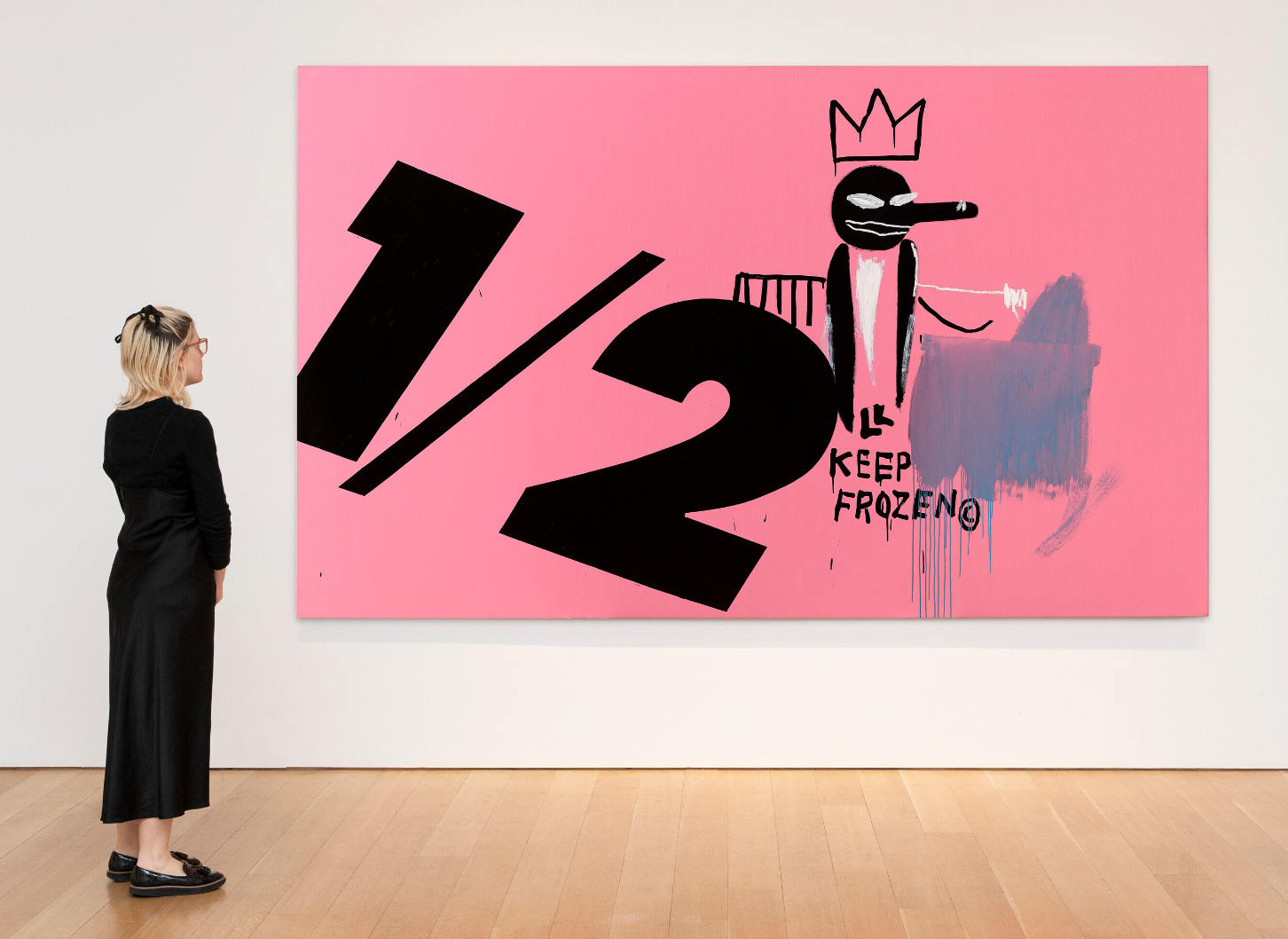
Both artists had an ineffable eye for composition, a factor that is plainly evident in 1/2 Keep Frozen. In this picture, Warhol’s ‘1/2’ is crisp, emblazoned, appropriately enough, across half of the vast expanse of the picture surface. It encapsulates the nature of the collaboration in itself, with the whole picture divided between the two artists. This was a motif that featured in several of Warhol’s collaborations with Basquiat. Warhol’s ‘1/2’ is large and bold, but incredibly economic in its appearance. Next to it, Basquiat picks up on the use of black, yet to very different effect with its drips, legible brushstrokes and variations in texture. Basquiat’s mark-making is highly gestural, emphatically hand-made, be it the area that has been seemingly effaced in a lavender-grey or the dripping from the scrawled words, ‘Keep Frozen’. Similarly, the narrow white ovals of the eyes on the tuxedo-wearing penguin ensure that the individual brushstrokes can be traced, a contrast with the sheen of Warhol’s opening salvo. While Warhol’s ‘1/2’ has laid his territorial claim to half of the canvas in this picture, Basquiat has countered not only with his style, but also his content. He has included the copyright symbol which he used in a number of works, staking out his own intellectual property. This scrawled symbol is all the more potent in its use by an artist who had formerly written his words on the walls of New York as part of the graffiti duo SAMO. For Basquiat the copyright symbol is a wry invocation to the realms of legalese. It has been rendered expressionistically, creating a deliberate discord between style and content, his street art background colliding with this protective establishment symbol. Basquiat is using it to illustrate and even infiltrate the hierarchies at work in the art world and in society at large, marking out his own territory while encroaching on that of others.
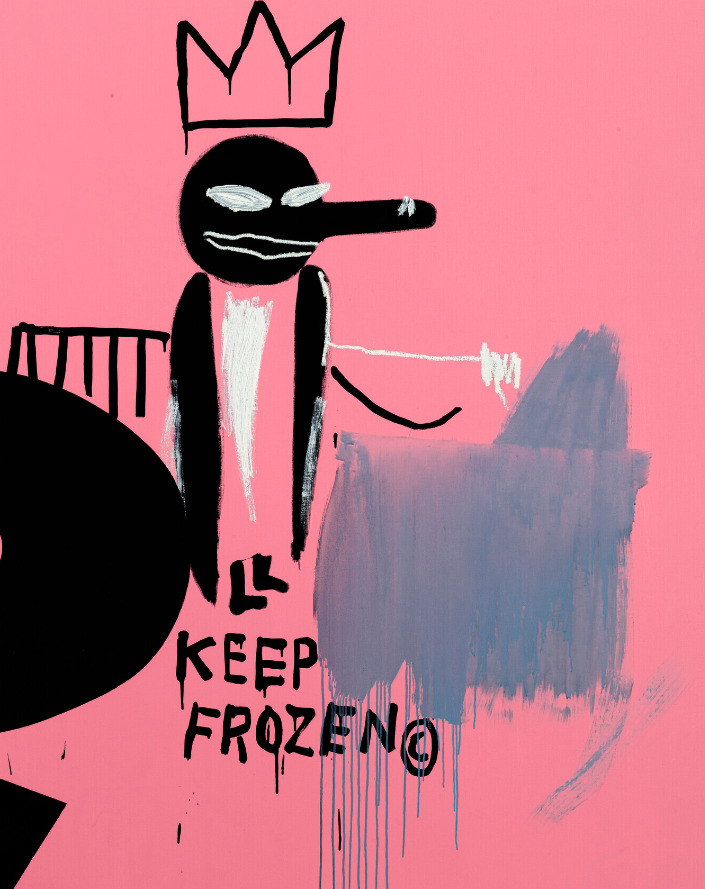
Basquiat’s zone within the painting is dominated by the besuited penguin, adopted from the international symbol recommending that food is frozen. This appropriation of an image from the world of popular consumer culture echoes Warhol’s use of print sources for his own iconic Pop works. However, Basquiat has turned the benign penguin of frozen food fame into a more sinister symbol through its narrowed eyes and sketched grin. In a sense, this is a penguin more reminiscent in tone of Batman’s adversary. However, Basquiat has used the black paint to emphasise this as a black figure, arguably the most recurrent theme in his art. It is telling that in Amoco, another of the Collaborations from this period, Basquiat showed a similar penguin in militaristic dress, brandishing a flaming torch. In some of his pictures of a penguin, Basquiat included a top hat, an attribute of Baron Samedi, the loa or spirit of death in the Vodou belief tradition of Haiti, where Basquiat’s father was raised. Baron Samedi featured in several of Basquiat’s paintings through the years, and his symbolism pervades even more. This adds a dark potency to the penguin in 1/2 Keep Frozen. Even the phrase ‘Keep Frozen’, used both in this picture and in Amoco, takes on a more profound aspect. Is this a question of preservation, or self-preservation? Is this an incitement to stasis, and if so, is the penguin encouraging us to escape it? Basquiat’s work is filled with an energy that rails against any notion of the status quo that such a phrase might introduce.
Paramount Pictures, circa 1985
Paramount Pictures, circa 1985
Christie’s New-York: 16 November 2017
Estimated: USD 1,000,000 – 1,500,000
USD 2,772,500
Andy Warhol & Jean-Michel Basquiat (1928-1987 & 1960-1988), Paramount Pictures | Christie’s
ANDY WARHOL & JEAN-MICHEL BASQUIAT (1928-1987 & 1960-1988)
Paramount Pictures, circa 1985
Synthetic polymer, silkscreen inks and paint tube collage on canvas
48×48 inches (121.9 x 121.9 cm)
Signed and dedicated ‘to Jon Jean-Michel Basquiat’ (on the overlap)
Provenance
Jon Gould, New York, gift from Andy Warhol
Acquired from the above by the present owner
The result of an innovative collaboration between two of the most culturally significant artists of the 20th century, Paramount Pictures blends together the distinctive styles of Andy Warhol and Jean-Michel Basquiat, together with the heady atmosphere of 1980s New York. Painted in 1985, this work dissolves the boundaries between mass media and street art, merging the two distinct artistic identities together on one canvas. The heated expression of Basquiat’s gestural impulsivities contrasted with the cool commercialism of Warhol’s pop culture are described by a friend of both artists, Keith Haring, as being, “a physical conversation happening in paint instead of words. The sense of humor, the snide remarks, the profound realizations, the simple chit-chat all happened with paint and brushes… There was a sense that one was watching something being unveiled and discovered for the first time” (K. Haring, “Painting the Third Mind,” Collaborations: Andy Warhol and Jean-Michel Basquiat, exh. cat., Mayor Rowan Gallery, London, 1988).
Initially inspired by art dealer Bruno Bischofberger in 1983, the collaboration between Warhol and Basquiat was first part of an organized project which also included the Italian artist Franceso Clemente, however the relationship between the two Americans grew into a larger two- year artistic partnership. Paramount Pictures is an exciting amalgamation of Warhol and Basquiat’s visions; a base of three painted Paramount Pictures logos in various colors and sizes, visibly Warhol’s contribution, overlaid with Basquiat’s red, white, black, and yellow additions of text, figure, and gestural strokes, the painting is a palimpsest of ideas and styles. A red strip of Basquiat’s paint reaches both ends of the canvas, his iconic text and strikethrough of letters telling the viewer to “reevaluate,” however Basquiat’s messages are always layered, provoking the viewer to wonder his purpose and intention. In repeating the Paramount Pictures logo, Warhol borrows the household symbol to signify not only the company, but the filmmaking industry as well–perhaps in an effort to encourage the viewer to reevaluate what we see on the silver screen. Warhol’s Hollywood imagery evokes Ed Ruscha’s iconic appropriation of the 20th Century Fox logo (Large Trademark with Eight Spotlights, 1962. Whitney Museum of American Art), yet contrary to the LA artist, the New York sentiments of Warhol and Basquiat twist the Hollywood commentary to one of mundane cynicism.
The Paramount Pictures logo also has an important and specific connection to Jon Gould, who was gifted the painting by Andy Warhol and was the Vice President of Corporate Communications at Paramount Pictures. Andy Warhol and Jon Gould were together between the years of 1981 and 1985, during which time Jon lived with Andy in his stays in New York. According to Bob Colacello, Warhol spent a good deal of time and effort winning over Jon’s affection, and was desperate for his attention and love. Indeed, in Jon’s presence Warhol was vulnerable in a way that deviated from the distant and mechanical persona he typically employed in his life as well as his work. Due to their closeness, Jon was the recipient of many gifts from Warhol including the present Paramount Pictures.
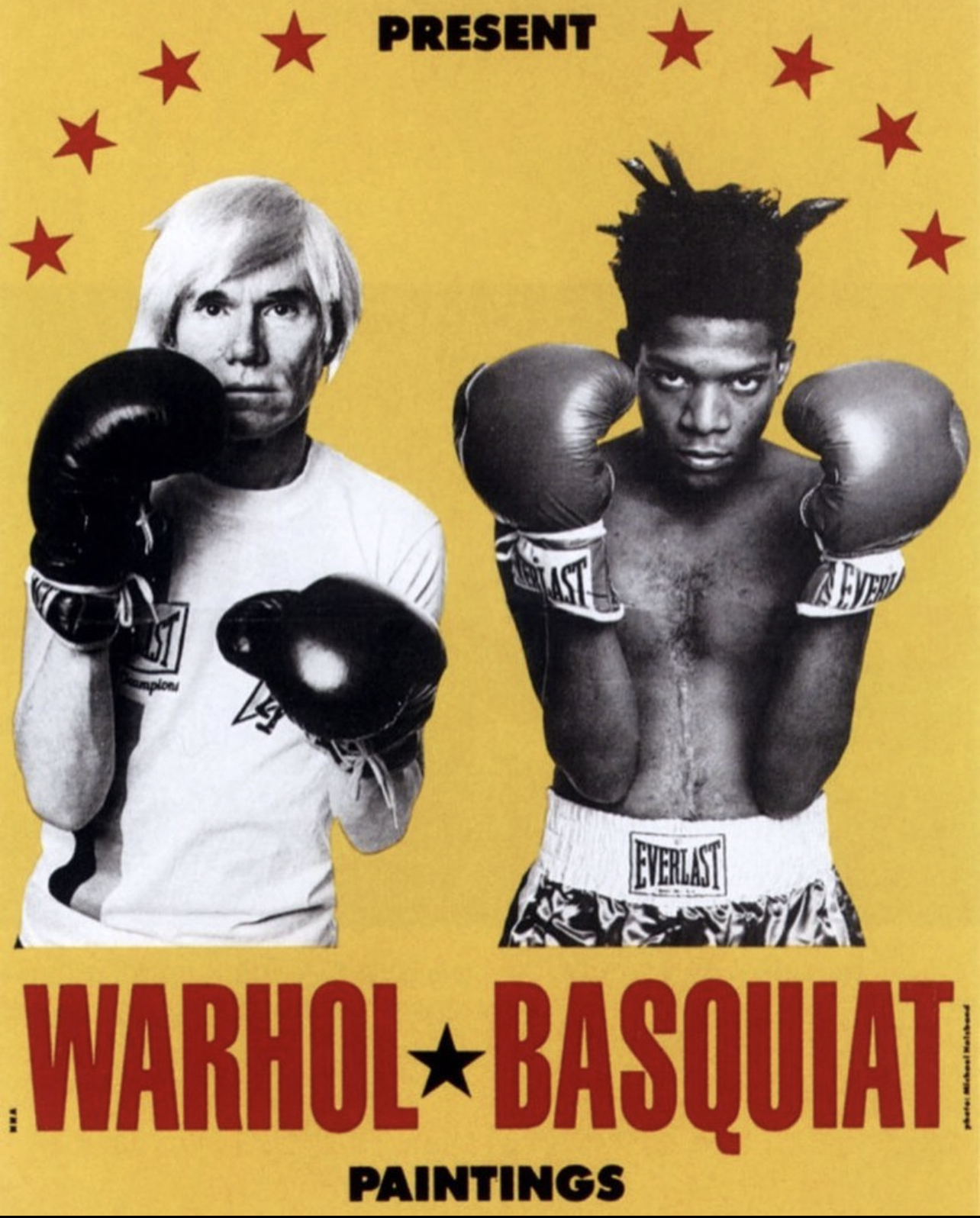
This collaboration brought together two icons of the New York art world. Not only producing an innovative body of work, but also providing a platform on which mentor and protégé could create together. Basquiat represented the generation of artists to come after Warhol’s legacy and balanced his admiration for Warhol with an eagerness to challenge him as well, recollecting the experience: “[Warhol] would start most of the paintings. He’d start one, you know, put… something very concrete or recognizable like a newspaper headline or a product logo and I would sort of deface it and then when I would try to get him to work some more on it, you know, and then I would work more on it. I tried to get him to do at least two things. He likes to do just one hit, you know [laughs] and then have me do all the work after that… We used to paint over each other’s stuff all the time” (J.-M. Basquiat, quoted in B. Johnston and T. Davis, ‘I Have to Have Some Source Material Around Me: Interview 1985’, in D. Buckhart and S. Keller (eds.), Basquiat, exh. cat., Fondation Beyeler, Ostfildern, 2010, p. xxxi). Warhol matched Basquiat’s method of working by abandoning the silkscreen and painting only by hand, leveling the playing field in the match between these two painters, a notion realized in the 1985 promotional image for the Tony Shafrazi Gallery opening of the two artists, side-by-side, clad in boxing gloves.
Basquiat admired Warhol’s work and in turn, Warhol was captivated by Basquiat’s youthful energy, the two coming together as equals in their collaboration. The viewer’s eye moves from a recognizable image to an enigmatic one all within the same canvas. Not only does this pairing reveal the difference in the social and political concerns of both artists, but also shows how easily these themes intersect–deeply personal sentiments of Basquiat bleeding into the popular culture icons of Warhol, making the personal public and the public personal. In doing so, Warhol’s reflections on logos, products, and mass culture represent the artist just as Basquiat represents himself through expressive painting. Both introduce something uniquely their own in the styles that have made them icons.
Sweet Pungent, 1984-85
Sweet Pungent, 1984-85
Sotheby’s London: 28 June 2017
Estimated: GBP 1,400,000 – 1,800,000
GBP 4,433,750 / USD 5,735,490
(#13) Andy Warhol and Jean-Michel Basquiat
ANDY WARHOL & JEAN-MICHEL BASQUIAT (1928-1987 & 1960-1988)
Sweet Pungent, 1984-85
Acrylic, oilstick and silkscreen ink on canvas
96 1/4 by 81 1/8 inches (244.5 x 206.1 cm)
Provenance
Galerie Bruno Bischofberger, Zurich
Acquired from the above by the present owner in 2008
From the inimitable collection of fashion designer Tommy Hilfiger, Jean-Michel Basquiat and Andy Warhol’s collaborative work Sweet Pungent is a painting of great significance. In 1983, fortuitous circumstances enabled the inauguration of a unique and perhaps unlikely collaboration between the founding father of Pop art, Andy Warhol, and the art world’s latest Neo-Expressionist prodigy, Jean-Michel Basquiat. The original idea came from Swiss art dealer Bruno Bischofberger whose initial suggestion was to also incorporate Francesco Clemente in a tripartite endeavour. While the three artists worked together, it soon became clear that it would just be two artists continuing the collaboration: Warhol and Basquiat. By the spring of 1984, they had begun secretly working on their own collaborations. Created in 1984-85, Sweet Pungent offers a unique insight into one of the most important relationships within the history of contemporary art and evinces a perfect partnership between aesthetic pioneers from different generations. We encounter a playful selection of quotidian symbols whose mutual juxtaposition spark riveting semantic games. The historical significance of Sweet Pungent is enforced by its notable exhibition history, having been shown in the blockbuster exhibition Pop Life: Art in a Material World, which travelled from Tate Modern in London, to the Hamburger Kunsthalle and The National Gallery of Canada in Ottawa.Emerging as a revolutionary figure in the 1960s, Warhol had been at the heart of the art establishment for over twenty years by the time he met Basquiat. However, as noted by art historian Robert Pincus Witten, it seemed that “In the 70s, Warholism had superseded Warhol” as he received critical admonishment for a decade dominated by the portrait commissions (Robert Pincus-Witten, ‘Entries: Big History, Little History’, Arts Magazine, No. 54, April 1980, p. 184). Extremely concerned about his public reception, at the dawn of the 1980s, the artist was desperate to inaugurate “the Return of Andy Warhol” (Ibid.). Schooled by the graffiti of the streets rather than the academy, Basquiat and his fresh perspective offered the essential injection of life that Warhol was looking for to revive his career. For Basquiat, the well-connected Warhol plugged him into a network that helped cement his critical ascendancy. As fellow Pop artist Ronnie Cutrone recounted, “Jean-Michel thought he needed Andy’s fame, and Andy thought he needed Jean-Michel’s new blood. Jean-Michel gave Andy a rebellious image again” (Ronnie Cutrone cited in: Victor Bockris, Warhol: The Biography, Cambridge 2003, pp. 461-62). The late 1980s would thus become some of the most productive years of Warhol’s career, resulting in some of his greatest works such as the legendary series of Fright Wig self-portraits. As explained by Keith Haring, “Jean brought back a much-needed touch of mischief that had been disappearing from the Factory agenda. But, he also brought an atmosphere of obsessive production that left its mark long after the collaborations had stopped” (Keith Haring, ‘Painting the Third Mind’, 1988, in: Exh. Cat., Milwaukee, Milwaukee Art Museum, Andy Warhol: The Last Decade, 2009, p. 205).
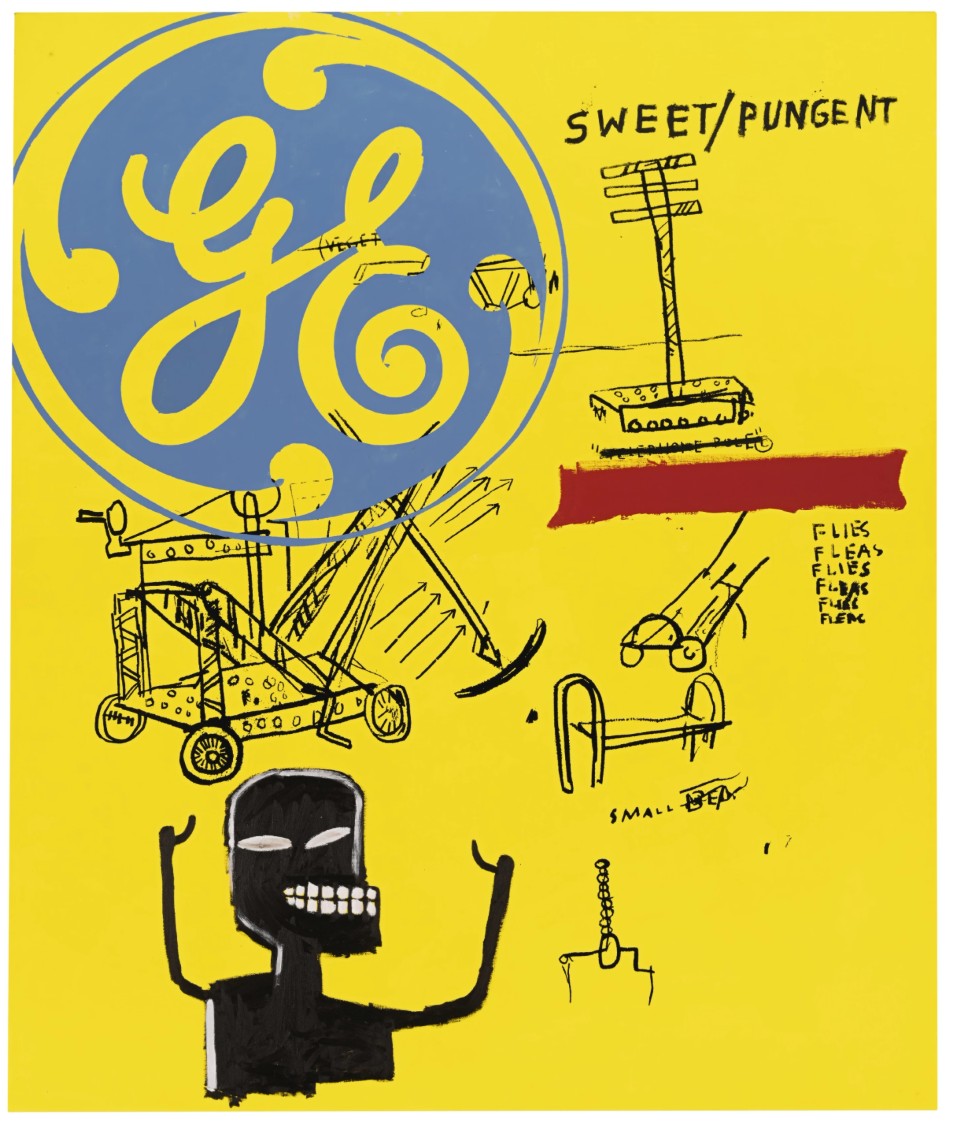
Sweet Pungent is a prime example of their symbiotic relationship. To create the present work, Warhol laid down the background and added his handmade graphic imagery, in this instance the General Electric logo. Basquiat recalled, “He would put something very concrete or recognisable, like a newspaper headline or a product logo, and then I would try and deface it, and then I would try and get him to work some more on it” (Jean-Michel Basquiat cited in: Exh. Cat., Basel, Fondation Beyeler, Basquiat, 2010, p. 47). In Sweet Pungent Basquiat responded and reacted, he modified by filling in parts of the canvas with childlike scrawls, he painted blocks of colour while the final addition of a central figure was executed in his signature style. With fists raised and a skull-like face, the character in the left hand corner conjures the quintessential figure in Basquiat’s work. Depicted with both of his hands thrust jubilantly in the air, this gesture is both evocative of the stance of a victorious boxer and also a doubling of the gloved fist of the Black Power Salute. Continuing to riff on Middle American mores and culture, Warhol illustrates the recognisable General Electic brand logo, a symbol of the American economy that Warhol repeats in some of his most celebrated collaborations with Basquiat. Mimicking the slick smooth lines of his infamous silkscreens, the GE logo is meticulously hand painted over Basquiat’s diagrammatic line drawings. It had been twenty years or thereabouts since Warhol had painted by hand, choosing for these collaborations to compete with the young pretender and eschew the indolent comfort of the silkscreen. Thereafter, a jousting unfolds, played out mark by mark on the surface. As Keith Haring wrote in his insightful essay of 1988, ‘Painting The Third Mind’: “For an artist, the most important and delicate relationship he can have with another artist is one in which he is constantly challenged and intimidated. This is probably the only productive quality of jealousy. The greatest pleasure is to be provoked to the point of inspiration… Painting with Jean-Michel was not easy. You had to forget any preconceived ideas of ownership and be prepared to have anything you’d done completely painted over within seconds… Andy loved the energy with which Jean would totally eradicate one image and enhance another… Layers and layers of images and ideas would build toward a concise climax” (Keith Haring, op. cit., pp. 203-04). Representing the climactic moment of this extraordinary creative relationship, the quality of Sweet Pungent mirrors the quality and depth of friendship between these two iconic contemporary masters. The mechanics of a mutually beneficial creative rapport are laid bare as stylistic differences blend in harmonious synthesis, giving birth to an entirely new aesthetic language.
Keep Frozen (General Electric), 1985
Keep Frozen (General Electric), 1985
Christie’s London: 6 October 2017
Estimated: GBP 1,200,000 – 1,800,000
GBP 1,688,750 / USD 2,206,375
ANDY WARHOL & JEAN-MICHEL BASQUIAT (1928-1987 & 1960-1988)
Keep Frozen (General Electric), 1985
Acrylic and silkscreen on canvas
95×80 inches (241.5 x 203.4 cm)
Provenance
Galerie Bruno Bischofberger, Zurich
Acquired from the above by the present owner in 2010
Measuring nearly two-and-a-half metres high and emblazoned with a dramatic collation of seemingly random imagery that ranges from the painted to the printed and from diagrams to an iconic corporate logo, Keep Frozen is a classic ‘collaboration painting’ made by Andy Warhol and Jean-Michel Basquiat at the height of their partnership in 1985. These ‘collaboration’ paintings, which number around 130 examples made between 1984 and 1985, form the main body of work for both of these now legendary artists during these years, as well as marking important new developments taking place in each artist’s work. Indeed, for Basquiat especially, the collaboration paintings he made with Warhol represent much of the main focus of his aesthetic interest during these years. This is an often-overlooked aspect of these works, which was signified not only by the enormous amount of importance Basquiat placed upon the first show of these works at the Shafrazi Gallery in 1985 but also by his arranging (after Warhol’s death and, tragically, shortly before his own) of another major exhibition of such pictures subsequently held at the Mayor Gallery, David Grob Ltd and The Mayor Rowan Gallery in London in 1988. As Tony Shafrazi, the gallerist who hosted the first landmark exhibition of these works at his gallery in New York in September 1985, has recalled, this unique collaboration between arguably the two painterly giants of the 1980s was one that pushed both artists’ work into new, groundbreaking directions while also championing and reflecting the pervasive spirit of collaborative, immediate, almost DIY creativity that distinguished so much of the new Downtown art scene in New York in the mid- 1980s. Playful, dynamic, cross-cultural and trans-generational, Warhol and Basquiat’s collaboration was both a symbol of and an important influence upon many of the young post-modernists, appropriationists and deconstructivists of this time. It was a creative partnership that, as Shafrazi has pointed out, effectively ‘cancelled the traditionally modernistic idea that one thing had to come after another.’ ‘I think … it was a tremendously important, historically energizing and unique event’, he has said. Here were ‘two totally different kinds of artists, different styles, different ages, one more formal for 20 years and the other a brilliant young star, working together, painting over – changing – obliterating – altering – making new paintings. Can you imagine that? It had to do with a certain dialectic, and it was so important because it made a lot of other art look tame by comparison’ (T. Shafrazi, quoted in ‘Interview: Tony Shafrazi speaks with Dieter Burckhart, May 2011’ in Warhol & Basquiat, exh. cat. Arken Museum of Modern Art, Copenhagen, 2011, p. 88).
Warhol and Basquiat’s collaboration paintings originated as a privately arranged continuation, between these two unlikely friends, of an earlier three-way collaboration between Basquiat, Warhol and Francesco Clemente that had been instigated by the artists’ dealer Bruno Bischofberger. Through these works, Basquiat and Warhol had found the experience of working together so stimulating that throughout 1984 (without Clemente), they continued to paint together regularly at Warhol’s famous Factory in New York. For much of the next two years, culminating in the Shafrazi exhibition in September ’85, the closeness and intensity of this shared painterly adventure grew as their ‘collaborative’ paintings came to catalogue and express something of the unique friendship that existed between these two famous but very different painters. ‘I was the one who helped Andy Warhol paint!’ Basquiat triumphantly remembered. ‘It had been twenty years since he’d touched a brush. Thanks to our collaboration, he was able to rediscover his relationship to painting … Andy would start most of the paintings. He would start one and put something very recognisable on it, or a product logo, and then I would sort of deface it. Then I would try to get him to work some more on it, and then I would work some more on it. I would try to get him to do at least two things. He likes to do just one hit, and then have me do all the work after that’ (J-M. Basquiat, quoted in Jean Michel Basquiat, exh. cat. Museo Revoltella, Trieste, 1999).
Keep Frozen is a painting that dates from the height of the two artists’ collaboration and has been executed in at least three of what Basquiat called ‘hits’. Firstly, over a smooth, monochrome, acid yellow background, a series of drawings of mechanical apparatus by Basquiat has been silkscreened in black. Over these printed images that evidently ape Warhol’s trademark silk-screening technique, Warhol has painted, by hand and in blue, the logo of the General Electric company. After this Basquiat has completed the painting by adding the head of a ‘Gri’-like figure (top-left), a red square (top-right) and the copyrighted logo ‘Keep Frozen’ written on a black strip of paint across the top of the work. Both logos, ‘Keep Frozen’ and the ‘GE’ of the General Electric company were elements familiar to each artist’s work at this time and here they have been brought together into a humorous coalition. Basquiat’s seemingly laughing ‘Gri’ figure takes the place of the penguin that normally accompanied the ‘Keep Frozen’ logo in other collaboration pictures. In this way and by exchanging roles – Basquiat silkscreening, and Warhol using a brush – a cohesive, strongly diagrammatic painting has been created in which the random, arbitrary immediacy of Basquiat’s style here appears to have been given a Warholian – General Electric – seal of approval.
As in many of the most successful collaboration paintings, Warhol’s cool, impersonal, corporate-America style is energized and made edgy, unnerving and new again by the intervention of the raw, urban, attack of Basquiat’s inimitable and intuitive brushwork. This contrast between apparently cold, corporate rationalism and the warm, neurotic and fragile humanity of Basquiat’s unfiltered impulses creates a fascinating pictorial dialectic. It was a dialectic that evidently intrigued and motivated the two painters to ever further collaborative exploration, and it is one that that attains what Keith Haring – probably the most eloquent recorder of these collaborative sessions – described in terms of what William S. Burroughs once called the ‘third mind’ – that moment when ‘two amazing minds’ become fused ‘together to create a third totally separate and unique mind’.
‘Jean-Michel and Andy were from different generations and different sociological backgrounds. They had radically different painting styles and equally different aesthetics. They were at different stages of their lives and different levels of their own development. Physically, the only trait they had in common was their hair. Somewhere though, they found a common ground and established a healthy relationship … Jean respected Andy’s philosophy and was in awe of his accomplishments and mastery of colour and images. Andy was amazed by the ease with which Jean composed and constructed his paintings and was constantly surprised by the never-ending flow of new ideas. Each one inspired the other to outdo the next. The collaborations were seemingly effortless. It was a physical conversation happening in paint instead of words. The sense of humour, the snide remarks, the profound realizations, the simple chit-chat, all happened with paint and brushes. I visited them at the Factory several times while they were painting together. The atmosphere was playful and intense at the same time. Jean-Michel’s painting posture and disregard for technique created a mood of unnerving spectacle. There was a sense that one was watching something being unveiled and discovered for the first time. It seemed to push him to new heights. Andy returned to painting with beautiful, delicate lines, carefully laid onto the canvas. The drips and gestures immediately reminded me of the earliest Warhol paintings I had seen. The new scale had forced him to develop an even richer draughtsmanship. The lines flowed onto the canvas…It was truly an event. There were canvases hanging all over the Factory. They worked on many at the same time, each idea inspiring the next. Layers and layers of images and ideas would build towards a concise climax. It was exciting to visit the Factory at this time … For me, the paintings which resulted from this collaboration are the perfect testimony to the depth and importance of their friendship. The quality of the painting mirrors the quality of the relationship. The sense of humour which permeates all the works recalls the laughter which surrounded them while they were being made. They are truly an invention of what William S Burroughs called “The Third Mind” – two amazing minds fusing together to create a third totally separate and unique mind’ (K. Haring, ‘Painting the Third Mind’, 4 October 1988, New York City, reproduced in Collaborations: Andy Warhol, Jean-Michel Basquiat, exh. cat. The Mayor Gallery, London, 1988, n.p.).
Outlays Hisssssssss, 1984-85
Outlays Hisssssssss, 1984-85
Christie’s New-York: 16 November 2018
Estimated: USD 1,000,000 – 1,500,000
USD 2,052,500
ANDY WARHOL (1928-1987) AND JEAN-MICHEL BASQUIAT (1960-1988)
Outlays Hisssssssss (Collaboration #22), 1984-85
Synthetic polymer and silkscreen ink on canvas
76-1/2 x 106-1/2 inches (194.3 x 270.5 cm)
Signed, stamped with the Estate of Andy Warhol and the Andy Warhol Foundation for the Visual Arts, Inc. stamps
Numbered ‘Andy Warhol Jean-Michel Basquiat’ (on the overlap)
Provenance
Galerie Bruno Bischofberger, Zurich
Estate of Andy Warhol, New York
The Andy Warhol Foundation for the Visual Arts, New York
Private collection
Anon. sale; Phillips de Pury & Company, New York, 10 November 2005, lot 40
Private collection, Europe
Acquired from the above by the present owner
The bond that existed between Jean-Michel Basquiat and Andy Warhol may have originated in the attraction between opposites but it was also rooted in a deep and instinctive union between two lonely and brilliant outsiders. Both artists operated on the fringes of mainstream convention, deflecting the psychological and sociological obstacles in their lives into the language of art. Forging distinctive brands, each responded to the myths and horrors of modern life with ironic ambivalence. Thus, despite their ostensible differences in age, race, class and sexuality, it seems somehow fitting that their art would come together in collaboration. Outlays Hisssssssss (Collaboration #22) provides a visual record of the infamous friendship between two of the most recognizable and influential artists of the last century, perfectly illustrating the melding of seemingly disparate parts into one voice.
A crocodile head with gaping jaws is layered over the unmistakable profile of Ronald Reagan. Facing the same direction, the two elements appear to speak in unison, confusing monster and man. Warhol’s clear and pointed application of logo-like iconography, which incorporates an image from popular culture and bold text, contrasts with the frenzied and painterly marks of Basquiat’s gestural impulsiveness, particularly on the right side of the canvas, although his scrawled addition of “HISSSSSSSSS” in black ink melds the two elements together, resulting in an intense visual potency.
Both Ronald Reagan and the crocodile appear in other works by Warhol and Basquiat, respectively. After refusing a commission from New York magazine for a 1980 Ronald Reagan cover, Warhol began incorporating images of the president into his works, as he considered politicians to be celebrities in the same capacity as other cultural icons. Although in some instances Warhol reversed the black and white areas of the Reagan head, his introduction of the black profile in this case has been interpreted as a variation on Basquiat’s black caricature heads, providing racial overtones.
Basquiat’s crocodile, which references his Haitian roots, was added on top of Warhol’s initial image application. When collaborating, Warhol often painted the canvas first, leaving plenty of space for Basquiat to animate. The younger artist explained, “Andy would start most of the paintings. He would start one and put something very recognizable on it, or a product logo, and then I would sort of deface it. Then I would try to get him to work some more on it, and then I would work some more on it. I would try to get him to do at least two things. He likes to do just one hit, and then have me do all the work after that’ (J-M. Basquiat, quoted in Jean Michel Basquiat, exh. cat. Museo Revoltella, Trieste, 1999).
As in many of the most successful collaboration paintings, Warhol’s cool, impersonal, corporate-America style is energized and made edgy, unnerving and new again by the intervention of the raw, urban, attack of Basquiat’s inimitable and intuitive brushwork. This contrast between cold rationalism and the warm, neurotic and fragile humanity of Basquiat’s unfiltered impulses creates a fascinating pictorial dialectic. It was a dialectic that evidently intrigued and motivated the two painters to ever further collaborative exploration, and it is one that that attains what Keith Haring—probably the most eloquent recorder of these collaborative sessions—described in terms of what William S. Burroughs once called the ‘third mind’—that moment when ‘two amazing minds’ become fused ‘together to create a third totally separate and unique mind.”
Haring described their collaborative sessions as being, “a physical conversation happening in paint instead of words. The sense of humor, the snide remarks, the profound realizations, the simple chit-chat all happened with paint and brushes…There was a sense that one was watching something being unveiled and discovered for the first time” (K. Haring, “Painting the Third Mind,” Collaborations: Andy Warhol and Jean-Michel Basquiat, exh. cat., Mayor Rowan Gallery, London, 1988). Although Basquiat and Warhol were formally introduced in 1982, they did not begin to work together until 1984. In the interim they developed a close friendship, exercising, dining and partying together, even sharing the occasional pedicure session. Basquiat admired Warhol’s work and in turn, Warhol was captivated by Basquiat’s youthful energy, the two coming together as equals in their collaboration.
Outlays Hisssssssss (Collaboration #22) epitomizes the infamous bond between the two artists and their unique expressive styles. Not only does this pairing reveal the difference in the social and political concerns of both artists, but also shows how easily the themes intersect—deeply personal sentiments of Basquiat bleeding into the popular culture icons of Warhol, making the personal public and the public personal. In doing so, Warhol’s reflections on logos, products and mass culture represent the artist just as Basquiat represents himself through expressive painting. Both introduce something uniquely their own in the styles that have made them icons.