Food, particularly the changing habits of American consumption, was a theme that ran throughout Warhol’s career. From some of his earliest works, such as his 1961 painting Advertisement (Staatliche Museen zu Berlin, Nationalgalerie, Collection Marx, Berlin) which prominently features the Pepsi Cola logo, through to his early drawings of Campbell’s soup cans and his iconic Coca-Cola bottles, the burgeoning mass production of food proved fertile ground for Warhol. Along with Roy Lichtenstein and Claes Oldenburg, Warhol was a child of the Depression era and as such he was only too aware of the struggle that his mother went through to put food on the table for her family. This struck a chord with him, one which remained with him throughout his life. Indeed, when recalling the origins of his famous Campbell’s Soup Cans paintings he remembered those days with mixed emotion. “Many an afternoon at lunchtime Mom would open a can of Campbell’s for me, because that’s all we could afford,” he said. “I love it to this day”‘ (A. Warhol, quoted by R. Heidie, quoted in V. Bockris, The Life and Death of Andy Warhol, London, 1998, p. 144).
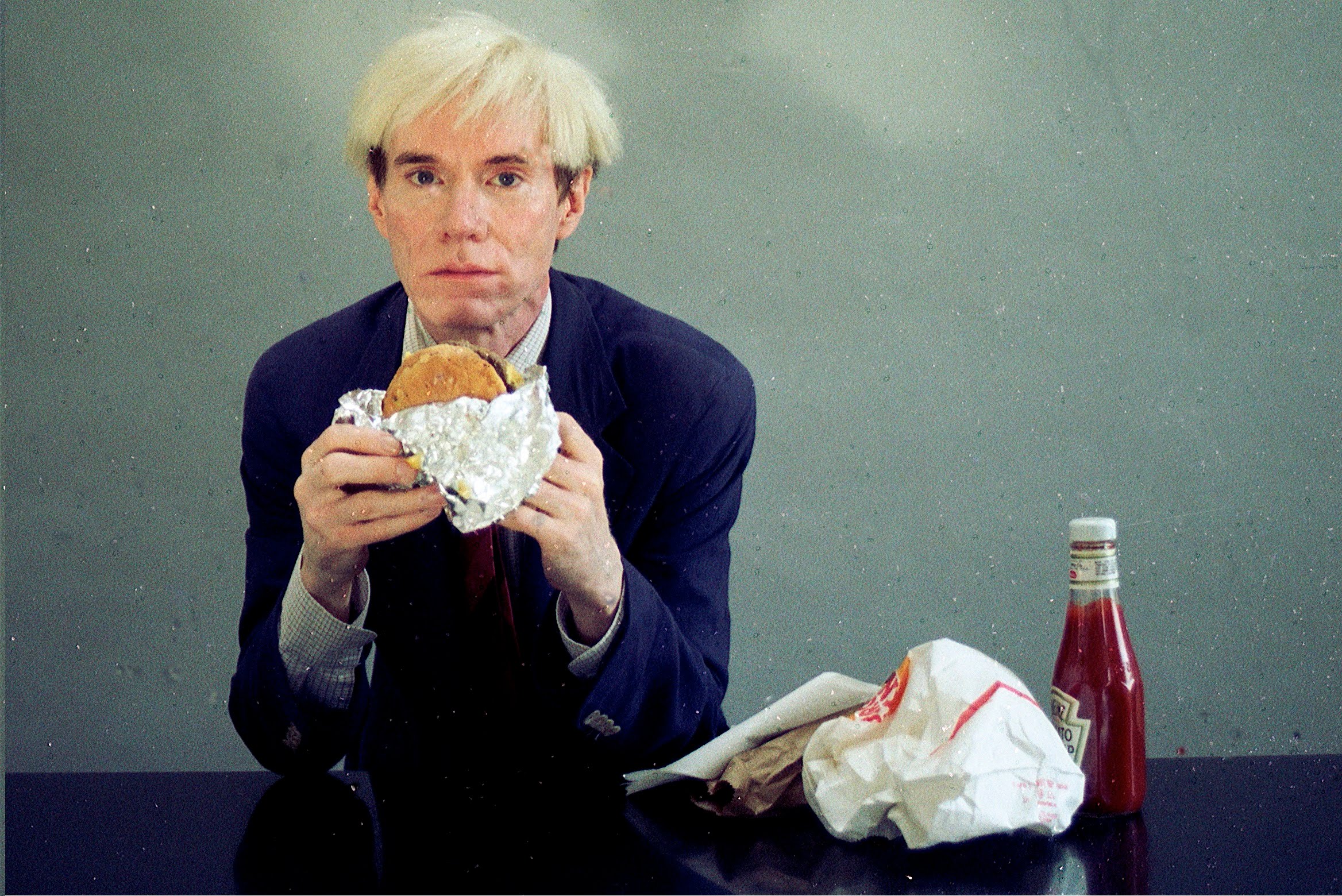
By the time Hamburger was painted the elevation of the burger to that of a global icon was complete. The golden arches of McDonald’s had become as ubiquitous as Coke and by the mid-1980s had even begun its march into Asia having opened its first store in Hong Kong in 1975, becoming its first restaurant in the region that included Greater China, Singapore, South Korea and Taiwan. Speaking about the democratizing nature of American consumer products, Warhol once said “What’s great about this country is that America started the tradition where the richest consumers buy essentially the same things as the poorest. You can be watching TV and see Coca-Cola, and you know that the President drinks Coke, Liz Taylor drinks Coke, and just think, you can drink Coke, too. A Coke is a Coke and no amount of money can get you a better Coke than the one the bum on the corner is drinking. All the Cokes are the same and all the Cokes are good. Liz Taylor knows it, the President knows it, the bum knows it, and you know it.’ (A. Warhol, The Philosophy of Andy Warhol: From A to B and Back Again, London, 1975, pp. 100-101). By the mid-1980s the same could be said about the billions of humble hamburgers produced by American fast food chains around the world and Hamburger has become a potent symbol of the continued importance of American culture around the world.
Warhol spent much of his career striving to capture on canvas the constantly shifting nature of modern society. From the soft power of celebrity to the commercial might of the growing consumer culture Warhol’s perceptive practice reflected back a view of America to itself, and he found that his distinctive form of Pop art was the perfect vehicle for doing so. Works such as Hamburger demonstrate that these ideas were still important to Warhol, and the size, visual power and vibrancy of this particular example prove that they still excited and challenged him nearly three decades after he first explored them.
Hamburger (50×68)
Hamburger, 1985
Christie’s New-York: 9 July 2020
Estimated: USD 2,000,000 – 3,000,000
USD 2,535,000
Andy Warhol (1928-1987), Hamburger | Christie’s
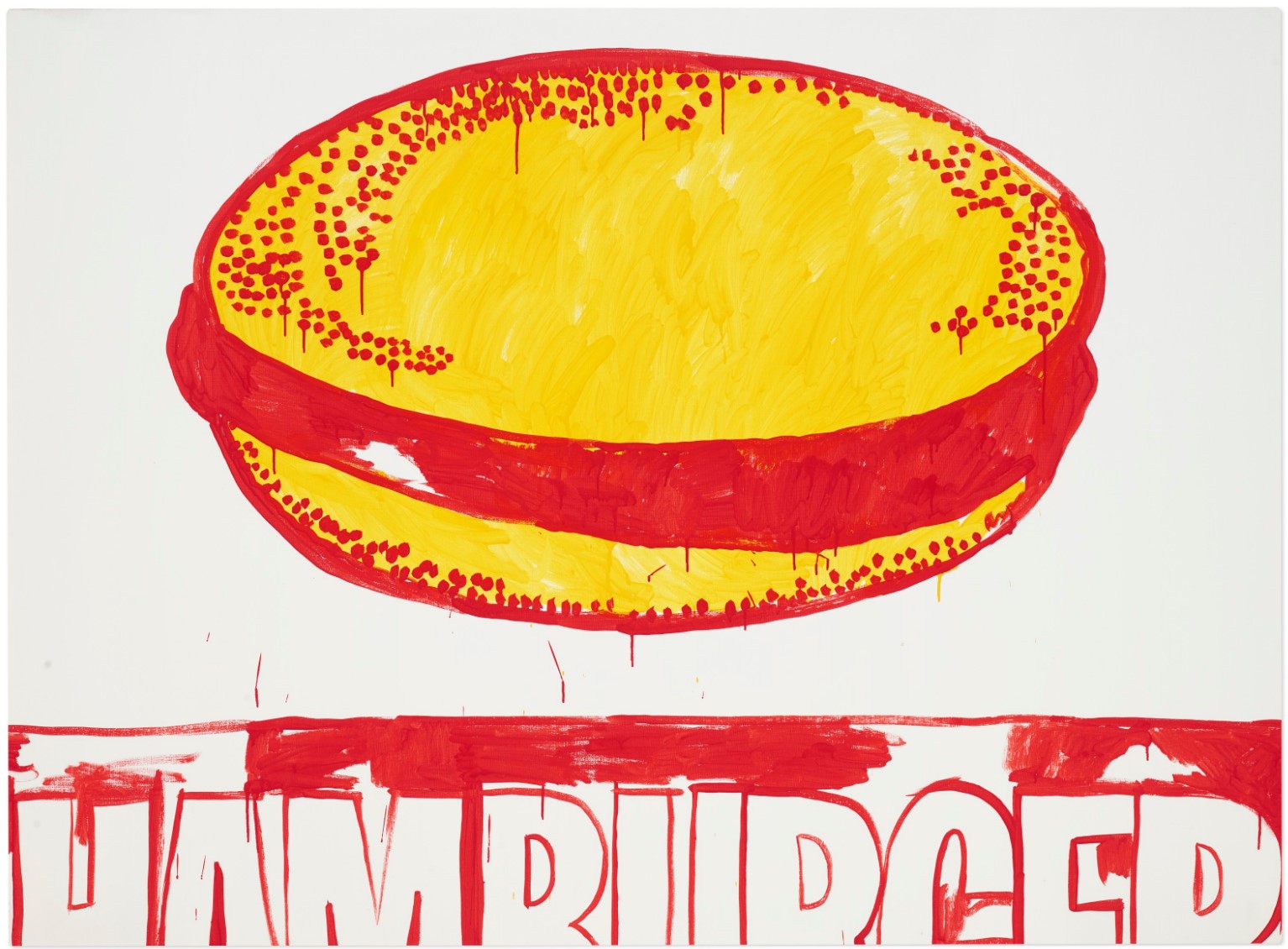
ANDY WARHOL
Hamburger, 1985
Acrylic on canvas
50×68 inches (127 x 172.7 cm)
Stamped with the Estate of Andy Warhol and the Andy Warhol Foundation stamps
Numbered ‘VF PA10.612’ (on the overlap)
This large-scale painting, featuring one of America’s most enduring cultural symbols, demonstrates the remarkable endurance of Andy Warhol’s visionary career, and his life-long role as one of the most perceptive cultural critics of his generation. From his earliest days as an artist, Warhol examined American society through the lens of Pop art, a visual language derived from advertising and the mass media, to produce iconic works that questioned the country’s role in the world. From his groundbreaking paintings of Campbell’s soup cans and Coca-Cola bottles in the early 1960s to his later reproductions of advertisements found in the newspaper classifieds, for over two decades Warhol was a perceptive artist who traced the rise of the consumer society and reflected back what he saw in a way that he knew his audience would understand. Painted in 1985, towards the end of his career, Hamburger not only sees Warhol return to one of his most important subject matters, but he also continues to act as one of the most prophetic cultural commentators of his generation, constantly updating both his artistic practice with his persistently insightful view of the world.
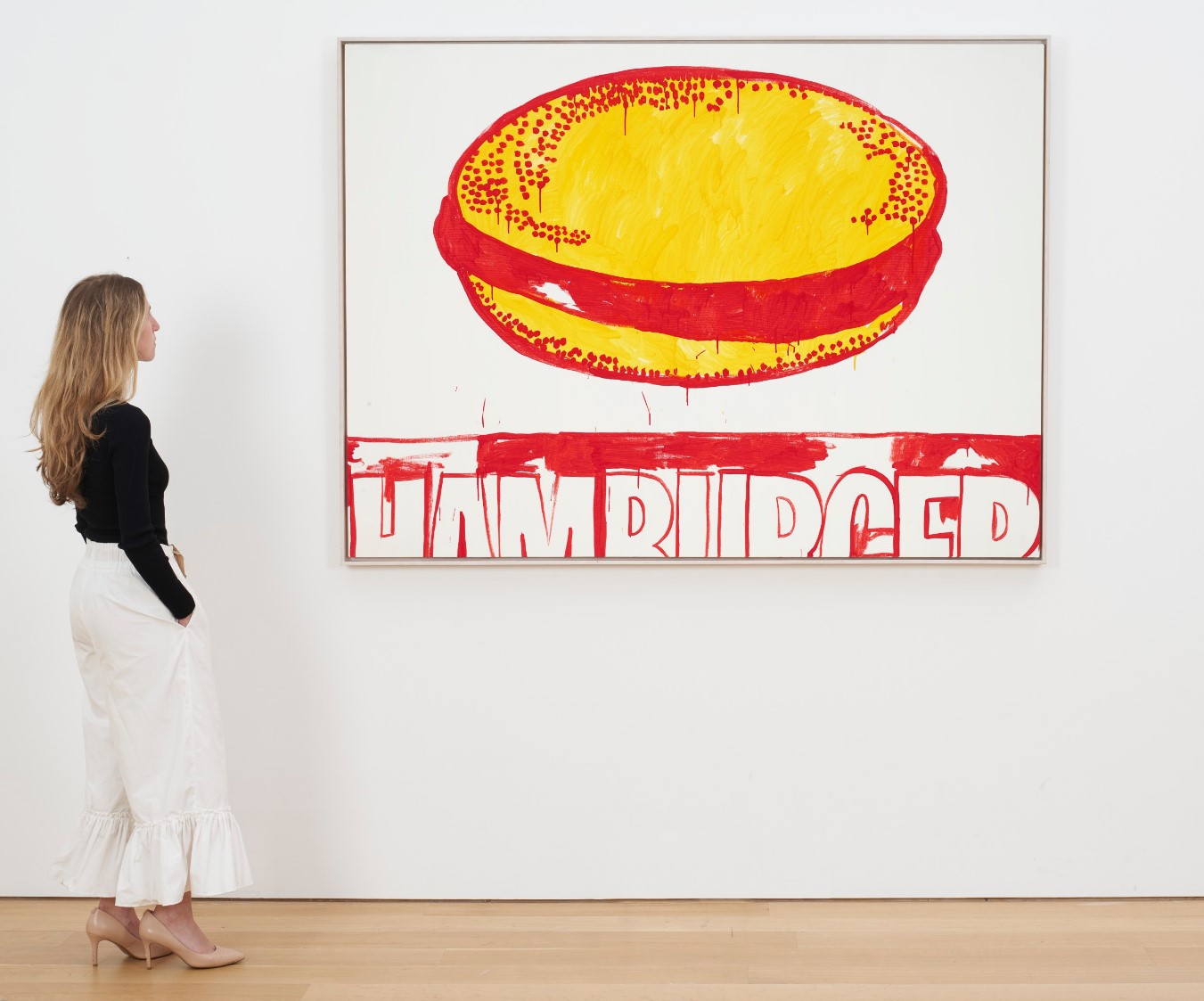
Across a canvas measuring nearly six foot across, Warhol depicts a single, solitary juicy hamburger; painted in a striking palette of red and yellow, Warhol renders the sandwich with a series of rapidly executed—almost expressionistic—brushstrokes that depict the golden surface of the toasted bun with a palpable sense of dynamism—the epitome of fast food. While the deep yellow defines the surface of the buns, the succulent patties are produced by dramatic swaths of red pigment. So rapidly executed were these brushstrokes that trails of red pigment run down the surface of the canvas like the succulent juices of the meat escaping from the freshly cooked burger. Unlike the deliberate flatness of his earlier Pop masterpieces, in Hamburger, Warhol introduces a highly stylized form of chiaroscuro by adding a series of red dots to the edges of the burger buns to give a sense of depth and three-dimensionality. Finally, as if to emphasize the unflinching nature of his composition, underneath the sandwich, Warhol writes out the word ‘hamburger’ in bold, capital letters audaciously proclaiming his subject matter with unwavering brashness. The painterly style of this particular work—the rapidly executed brushwork, the animated sense of energy—recalls Warhol’s early days as a commercial illustrator. The graphic quality of his hand-painted burgers also recalls some of the artist’s earliest Pop works, including other quintessentially American icons such as those featured in Coca-Cola [1] painted in 1961. However, while in these early works Warhol was clearly still formulating his Pop aesthetic, the present work displays a bold confidence that could only have been gained through years of continuous advancement.
Hamburger (16×20)
Hamburger, 1985-1986
Sotheby’s New-York: 15 November 2018
Estimated: USD 120,000 – 150,000
USD 175,000
(#448) ANDY WARHOL | Hamburger
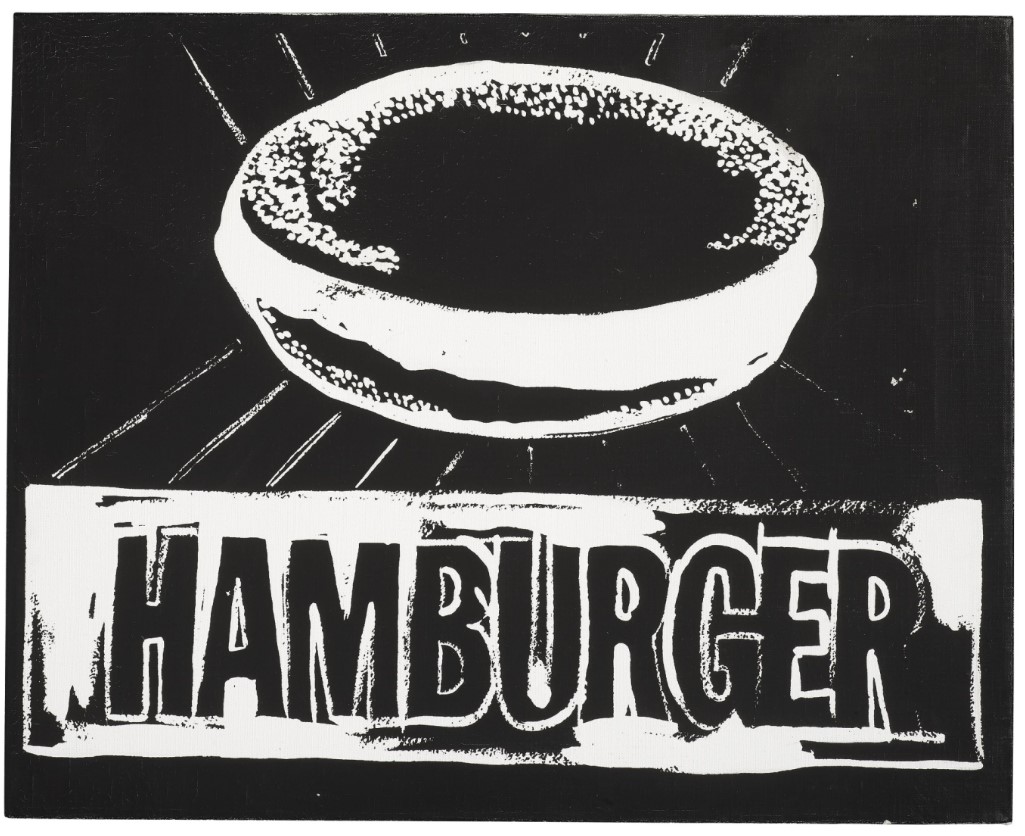 ANDY WARHOL
Hamburger, 1985-1986
Silkscreen ink on canvas
16×20 inches (40.6 x 50.8 cm)
Stamped twice by the Estate of Andy Warhol and twice by The Andy Warhol Foundation for the Visual Arts, Inc.
Numbered PA10.007 twice on the overlap, and on the stretcher
Hamburger, circa 1985-86
Christie’s New-York: 4 March 2016
Estimated: USD 100,000 – 150,000
USD 106,250
Andy Warhol (1928-1987), Hamburger | Christie’s
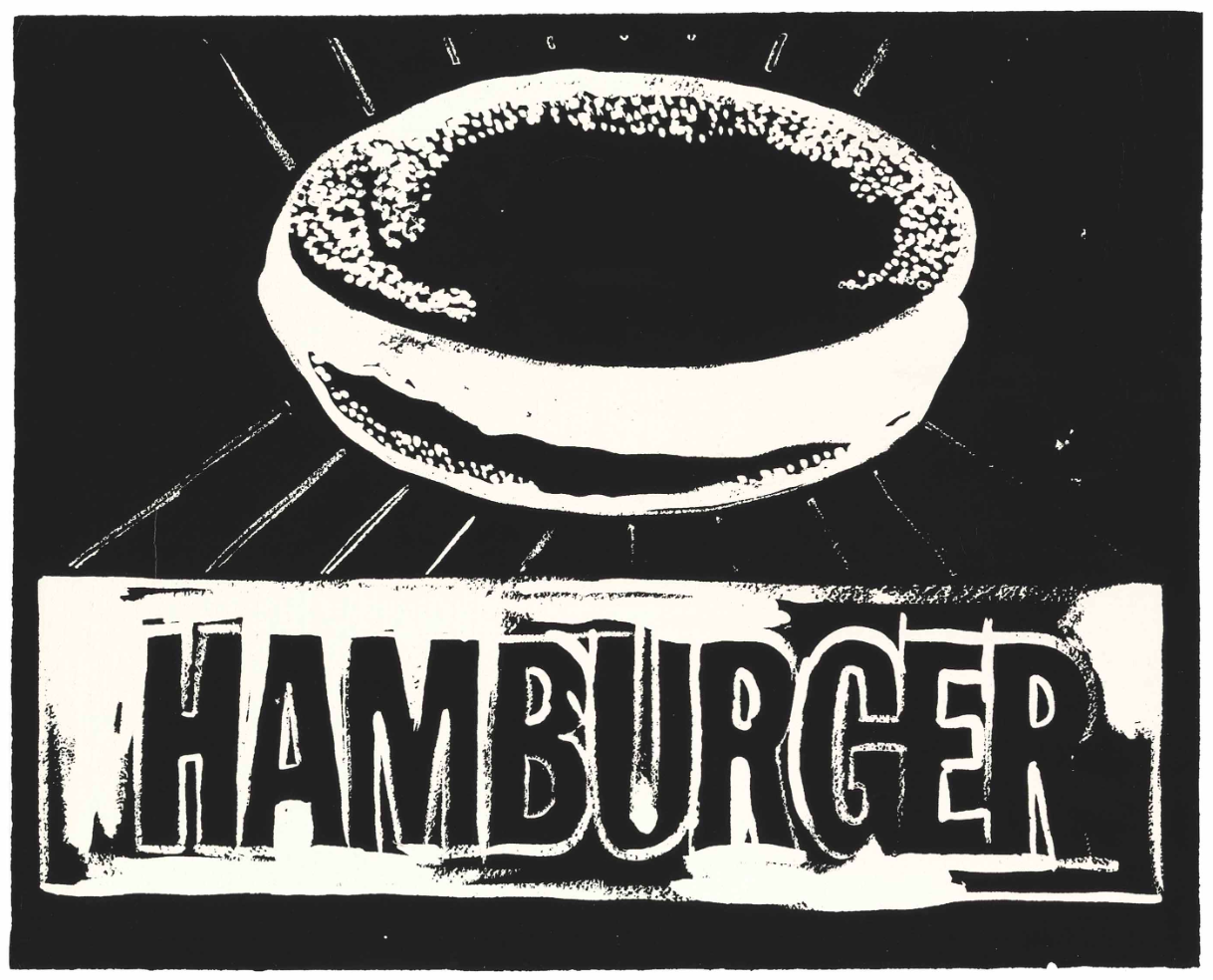
ANDY WARHOL (1928-1987)
Hamburger, circa 1985-86
Synthetic polymer and silkscreen ink on canvas
16×20 inches (40.6 x 50.8 cm)
Stamped twice with the Estate of Andy Warhol and the Andy Warhol Foundation for the Visual Arts, Inc. stamps
Numbered twice ‘PA10.504’ (on the overlap and on the stretcher)
Many of Andy Warhol’s most instantly recognizable works feature images of food products, for example, the Campbell’s Soup Cans, Coca-Cola bottles, Del Monte peaches, and, in this case, a silkscreened image of a hamburger. Rendered in a black and white color scheme with bold outlines and the tag line “Hamburger” spread beneath, this work at once reveals and exploits the relationship between advertisements and art that was central to Warhol’s enduring oeuvre. Beginning his career as a commercial illustrator, Warhol frequently appropriates graphic design and promotional or marketing materials for his artwork. The text below the burger is drawn in capital letters, and the burger is surrounded by radiating lines, recalling the end scene of an animated commercial, where the final product is being awarded to the viewer. The background of the text is intentionally off-register, a stylistic quality Warhol utilizes to align his pictures with the grainy quality of newspaper advertisements. Treating the hamburger like a Marilyn portrait, Warhol first simplifies the overall drawing, addressing only the defining characteristics of the subject. The flatness of the bun and the uncomplicated nature of the ingredients draw parallels to its ubiquitous nature. It is not a juicy, extravagantly topped burger, but a stereotype of the food, giving the image a representational, rather than handcrafted attribution. Warhol often inverted his traditional colored representations into negatives, adding the subtitle “Reversal” to portraits. This dramatic choice illuminates the shadows of the image and casts a darker interpretation on the Hamburger’s subject matter. The significance of the hamburger meat as a creation of edible flesh alludes to this malevolent theme that is unique to the inverted prints.
The artist’s career-long obsession with concepts of mass production and consumerism are evident in Andy Warhol’s study of the Hamburger. The factory-like construction of fast food franchises piqued Warhol’s interest, and in The Philosophy of Andy Warhol, the artist writes “The most beautiful thing in Tokyo is McDonald’s. The most beautiful thing in Stockholm is McDonald’s. The most beautiful thing in Florence is McDonald’s. Peking and Moscow don’t have anything beautiful yet” (A. Warhol, The Philosophy of Andy Warhol, Orlando, 1975, p.71). Warhol identifies with the theory that, no matter what class a person belongs to, everyday brand names, such as McDonald’s, are consumed in the same manner. The audience of a print advertisement or commercial knows, and trusts, that they can enjoy the same Coca-Cola or hamburger as a celebrity.
Born in 1928, immediately before the Great Depression, to a middle class family in Pittsburgh, Warhol lived through an era of War-time food rationing. As he aged, American eating habits shifted dramatically with an economic boom and the invention of the “supermarket.” Inspired by this new wave of corporation culture and consumerism, the Hamburger represents an everyday luxury available at a minimal cost with little to no effort. Warhol relished in the convenience of ready-made meals, so much so that he considered opening a series of ANDY-MATS – “The Restaurant for the Lonely Person,” serving microwaved frozen meals in TV booths. Hamburger is preceded by a number of food-consumption-themed short films made in the 1960’s, including Eat (1963), which is a single take of Robert Indiana eating a mushroom, slowed down to the length of forty-five minutes, and the series Mario Banana #1 and Mario Banana #2 (1964), in which Mario Montez devours a banana on camera. Perhaps this Hamburger, printed between 1985 and 1986, was in part inspired by an earlier artistic project, 66 Scenes from America (1982), produced by Jᴓrgen Leth, which Andy Warhol participated in. In a single three-minute take, Warhol quickly ingests a Burger King Whopper, which he chose over two neutrally-packaged burgers, before looking into the camera and announcing, “My name is Andy Warhol and I just finished eating a hamburger.”
Hamburger, circa 1985-86
Christie’s New-York: 14 May 2014
Estimated: USD 80,000 – 120,000
USD 173,000
Andy Warhol (1928-1987) , Hamburger | Christie’s
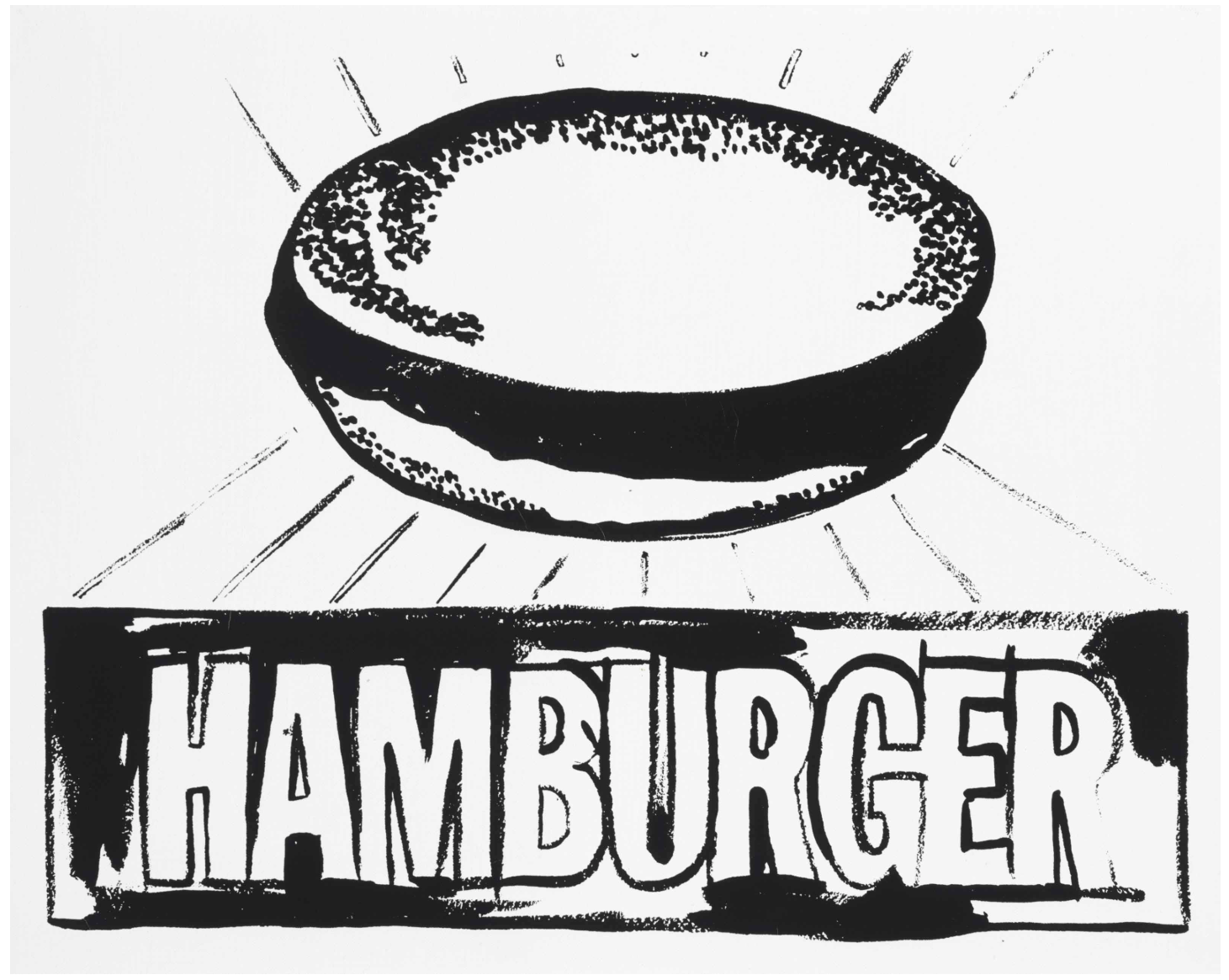
ANDY WARHOL (1928-1987)
Hamburger, circa 1985-86
Synthetic polymer and silkscreen ink on canvas
16×20 inches (40.6 x 50.8 cm)
Stamped twice with the Estate of Andy Warhol and the Andy Warhol Foundation for the Visual Arts, Inc. stamps
Numbered ‘PA10.284’ (on the overlap and on the stretcher)
Hamburger, 1986
Sotheby’s New-York: 12 November 2009
Estimated: USD 90,000 – 120,000
USD 243,500
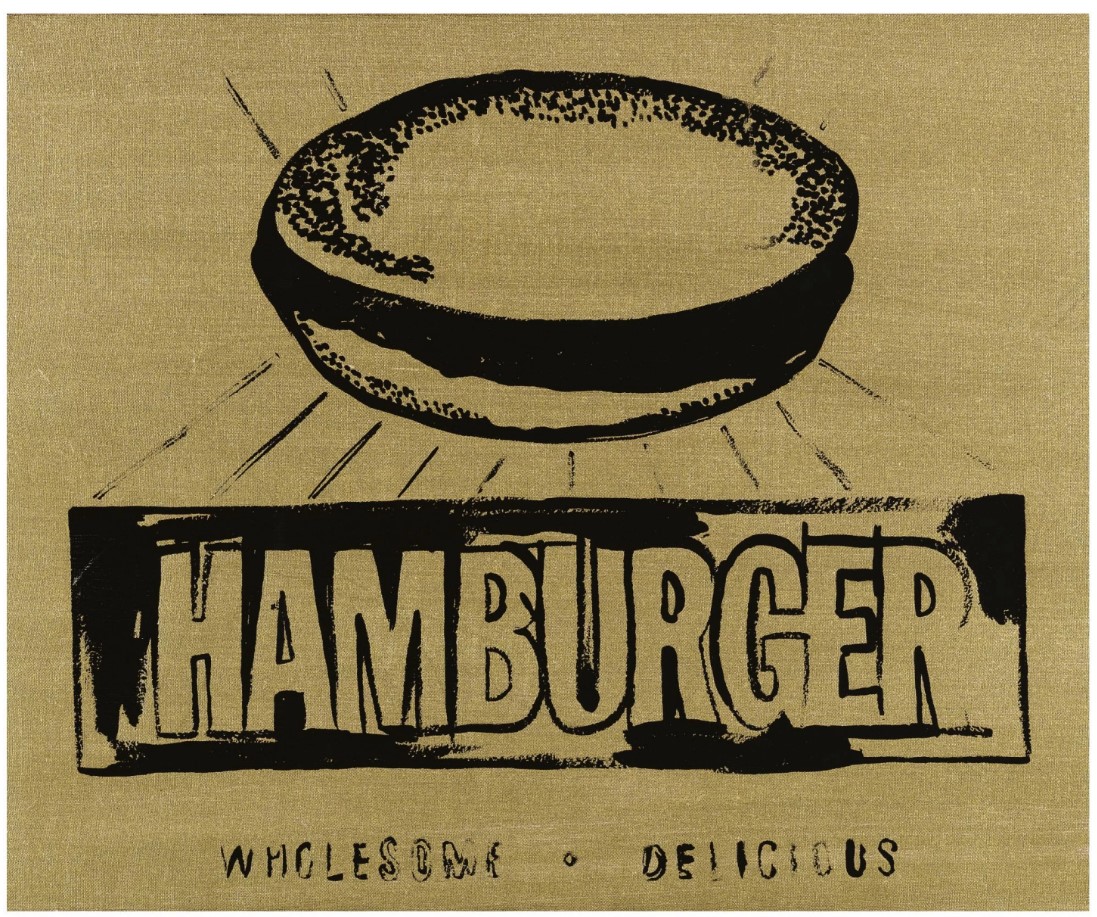 ANDY WARHOL
Hamburger, 1986
Synthetic polymer paint and silkscreen ink on canvas
16×20 inches (40.6 x 50.8 cm)
Stamped by the Estate of Andy Warhol and by the Andy Warhol Foundation for the Visual Arts Inc. Numbered VF PA10.111 on the overlap
Hamburger (10×12)
Hamburger, 1986
Phillips New-York: 20 November 2024
Estimated: USD 100,000 – 150,000
USD 139,700
Andy Warhol – Modern & Contemporar… Lot 172 November 2024 | Phillips
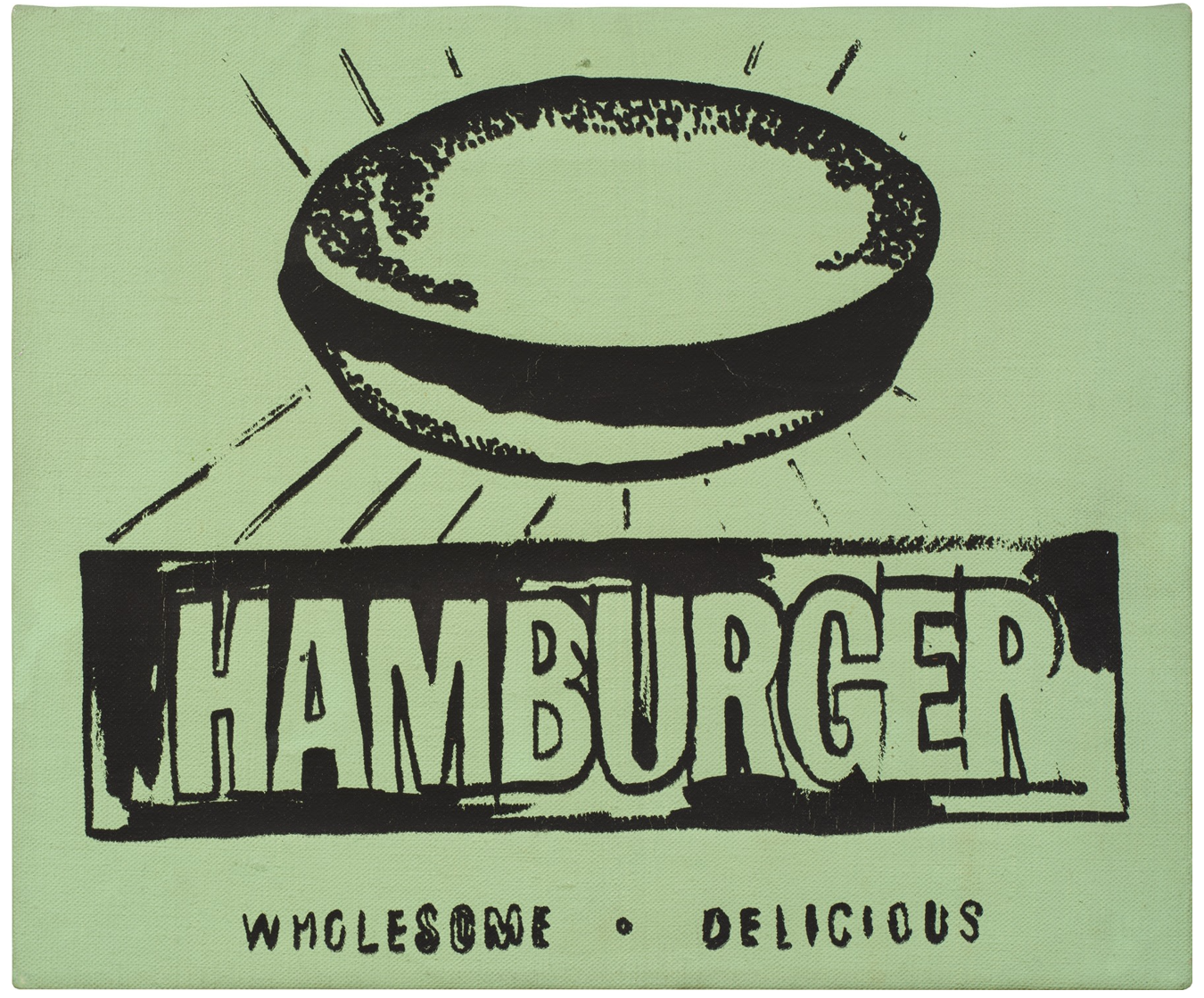
ANDY WARHOL
Hamburger, 1986
Acrylic and silkscreen ink on canvas
10×12 inches (25.4 x 30.5 cm)
Signed, dedicated and dated “to Stuart / Andy Warhol 86” on the reverse
Hamburger, 1986
Phillips New-York: 16 November 2022
Estimated: USD 80,000 – 120,000
USD 176,400
Andy Warhol – 20th Century & Conte… Lot 171 November 2022 | Phillips
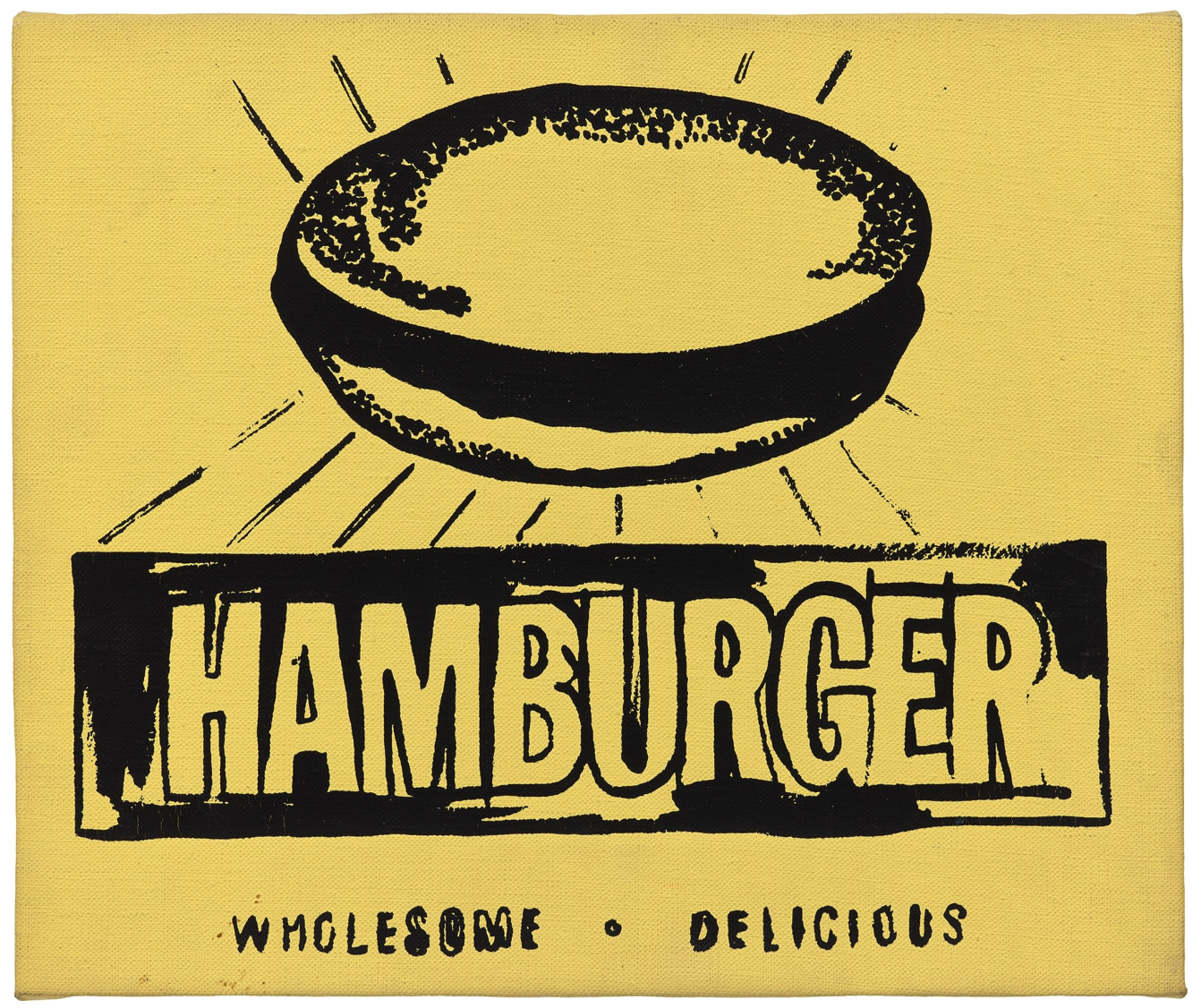
ANDY WARHOL
Hamburger, 1986
Acrylic and silkscreen ink on canvas
10×12 inches (25.4 x 30.5 cm)
Inscribed, dedicated and dated “I certify that this is an original painting by Andy Warhol completed by him in 1986 / for Daniella [sic]” on the overlap
Stamped with the artist’s signature on the reverse
Hamburger (Green), 1985-1986
Christie’s New-York: 2 December 2020
Estimated: USD 80,000 – 120,000
USD 137,500
Andy Warhol (1928-1987), Hamburger (Green) | Christie’s
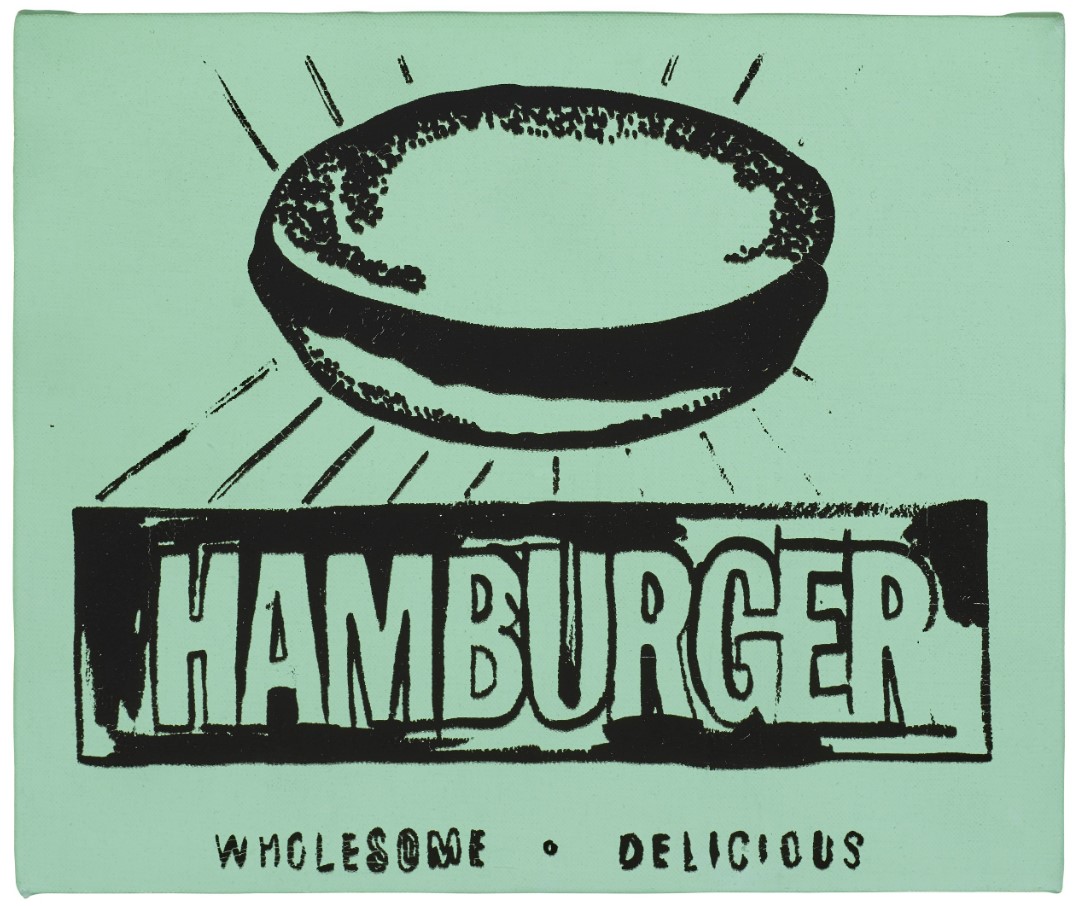
ANDY WARHOL (1928-1987)
Hamburger (Green), 1985-1986
Acrylic and silkscreen ink on canvas
10×12 inches (25.4 x 30.5 cm)
Signed, inscribed, numbered and dated ‘don/Andy Warhol 86’ ‘A492.102’ (on the overlap)
Hamburger, 1986
Christie’s New-York: 27 September 2018
Estimated: USD 80,000 – 120,000
USD 162,500
Andy Warhol (1928–1987), Hamburger | Christie’s
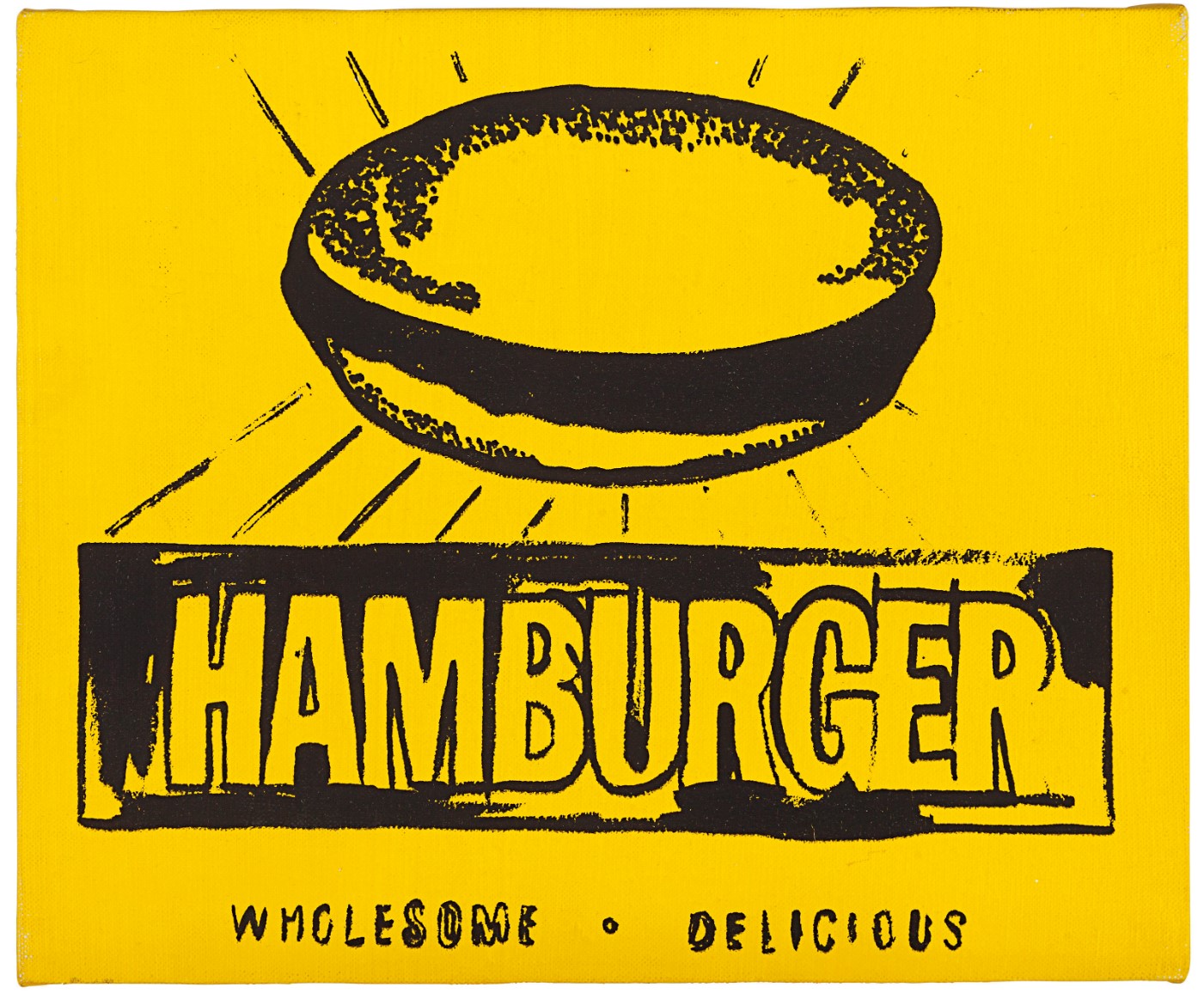
ANDY WARHOL (1928–1987)
Hamburger, 1986
Synthetic polymer and silkscreen ink on canvas
10×12 inches (25.4 x 30.5 cm)
Signed, dedicated and dated ‘Patrick / Andy Warhol 86’ (on the overlap)
Hamburger, 1986
Sotheby’s London: 6 October 2017
Estimated: GBP 120,000 – 180,000
GBP 81,250
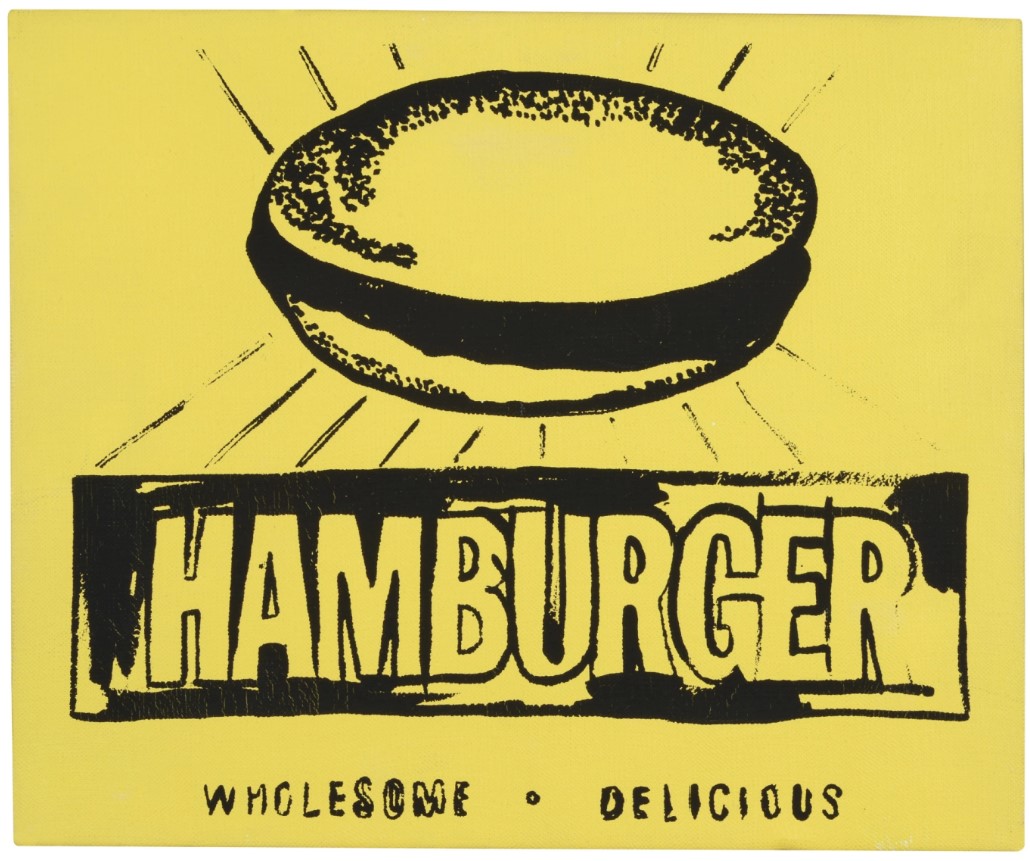 ANDY WARHOL
Hamburger, 1986
Acrylic and silkscreen ink on canvas
10 x 11 7/8 inches (25.5 x 30 cm)
Signed and dated 86 on the overlap
Hamburger, 1986
Christie’s Paris: 8 December 2016
Estimated: EUR 60,000 – 80,000
EUR 152,500
ANDY WARHOL (1928-1987), Hamburger | Christie’s
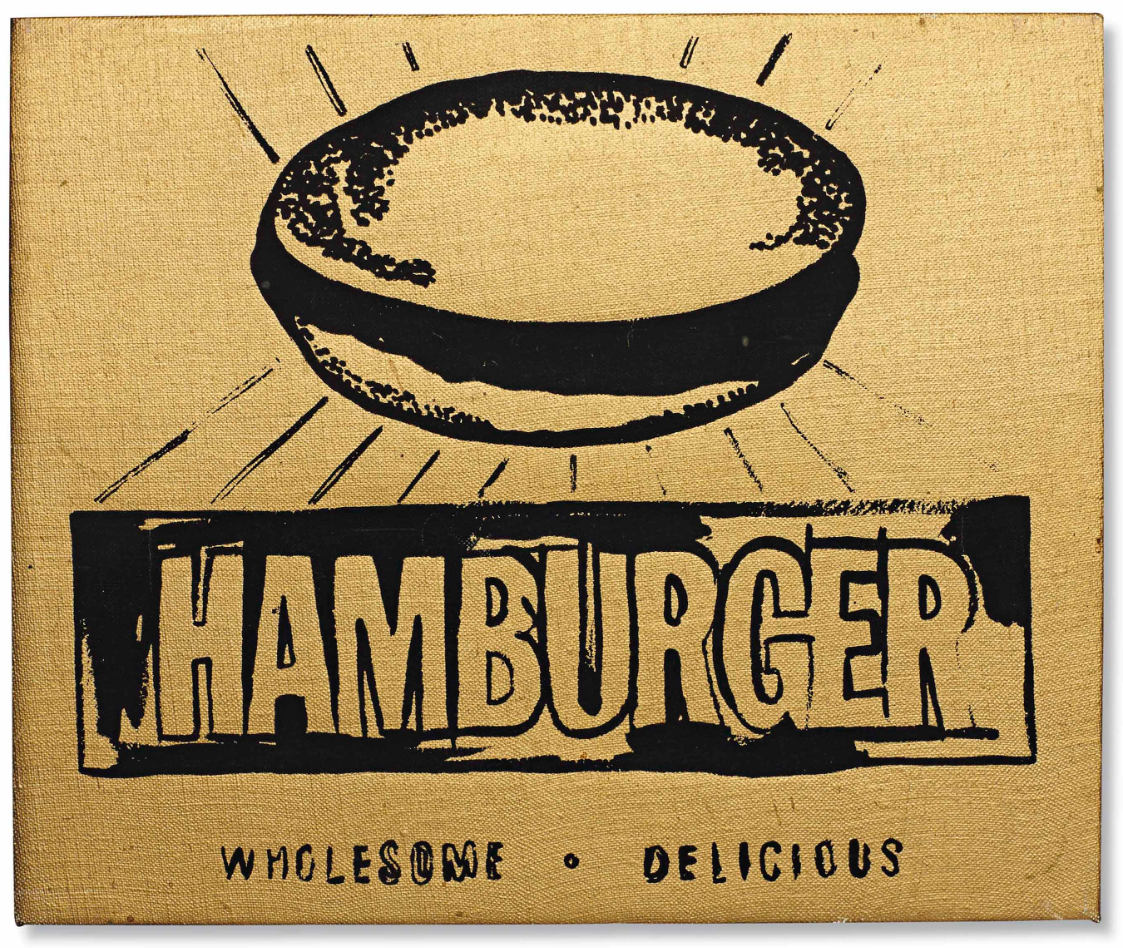
ANDY WARHOL (1928-1987)
Hamburger, 1986
Acrylic and silkscreen ink on canvas
10 x 11 3/4 inches (25.5 x 30 cm)
Signed, dated ‘August Andy Warhol 86’ (on reverse)
Hamburger, 1986
Sotheby’s New-York: 12 May 2016
Estimated: USD 50,000 – 70,000
USD 137,500
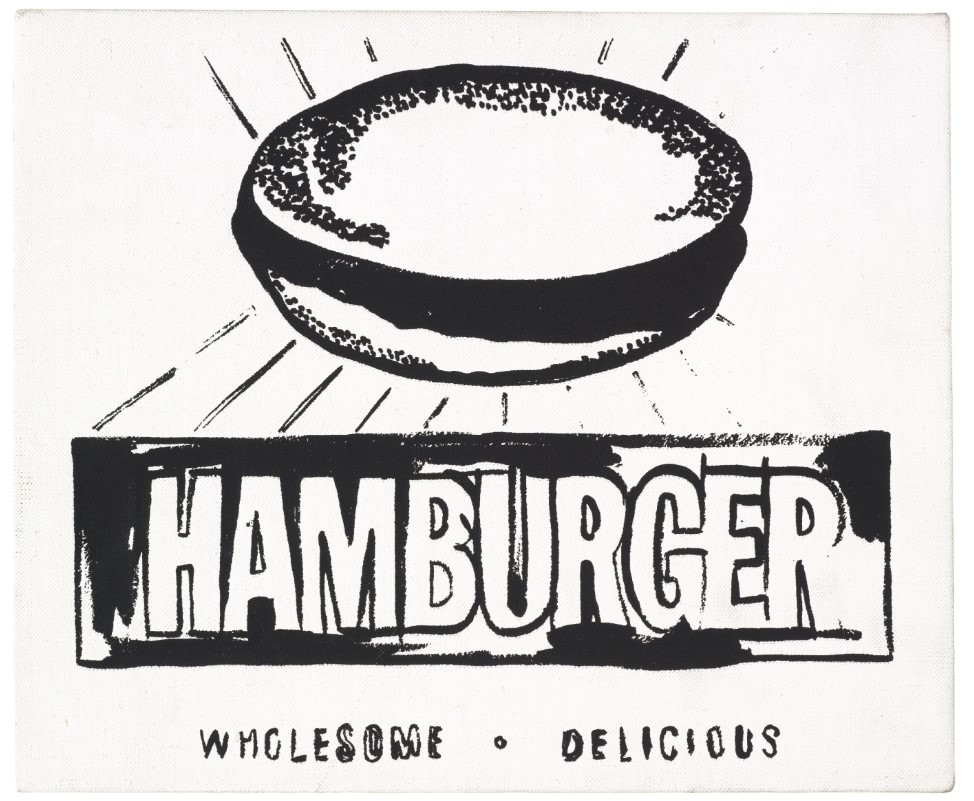 ANDY WARHOL
Hamburger, 1986
Acrylic and silkscreen ink on canvas
10×12 inches (25.4 x 30.5 cm)
Signed, dated 86, and dedicated paige on the overlap
Hamburger (Green), 1986
Christie’s London: 17 October 2014
Estimated: GBP 60,000 – 80,000
GBP 92,500
Andy Warhol (1928-1987), Hamburger (Green) | Christie’s
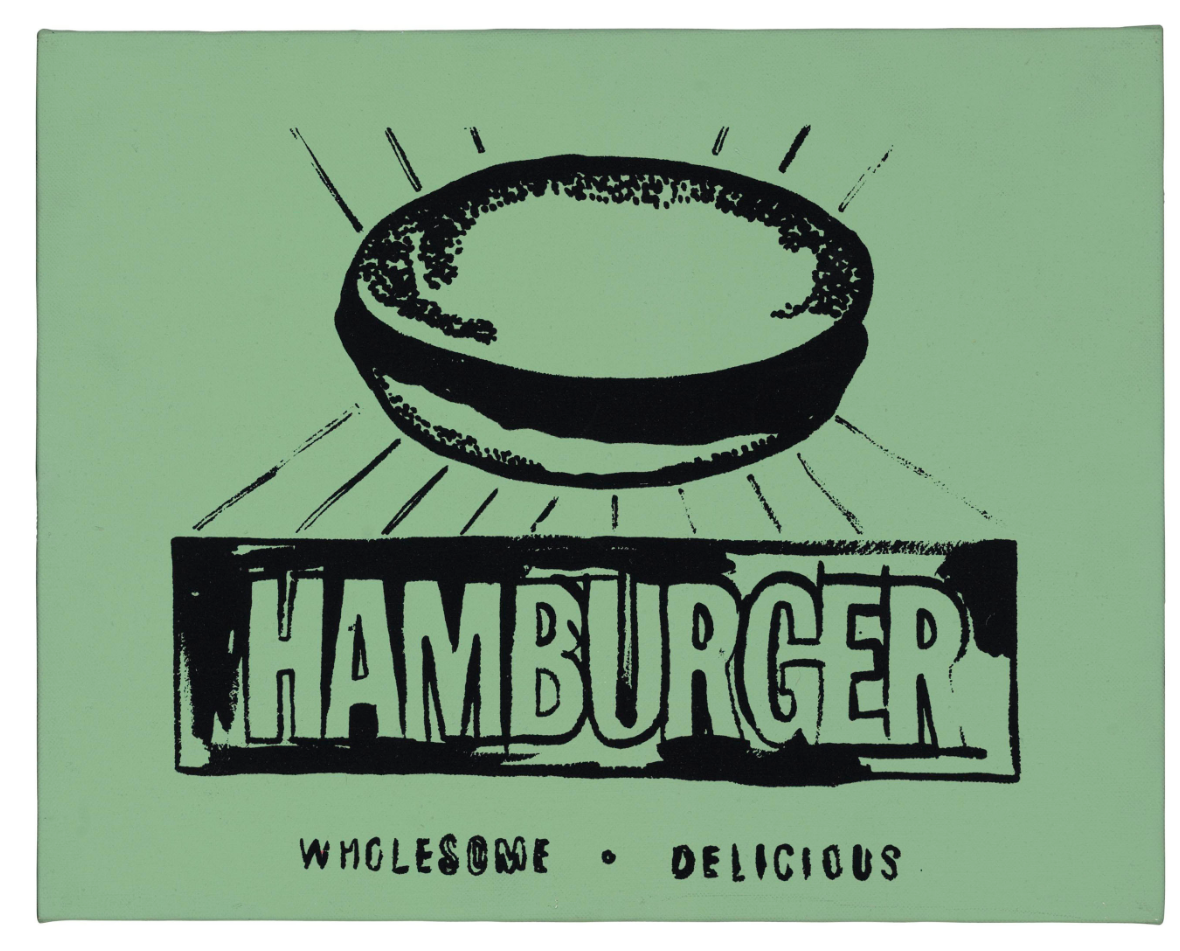
ANDY WARHOL (1928-1987)
Hamburger (Green), 1986
Synthetic polymer and silkscreen ink on canvas
10 7/8 x 13 7/8 inches (27.6 x 35.4 cm)
Stamped twice with the Estate of Andy Warhol and the Andy Warhol Foundation for the Visual Arts, Inc. stamps
Numbered twice ‘PA10.227’ (on the overlap and on the stretcher)
Hamburger, 1986
Christie’s New-York: 6 March 2014
Estimated: USD 100,000 – 150,000
USD 167,000
Andy Warhol (1928-1987) , Hamburger | Christie’s
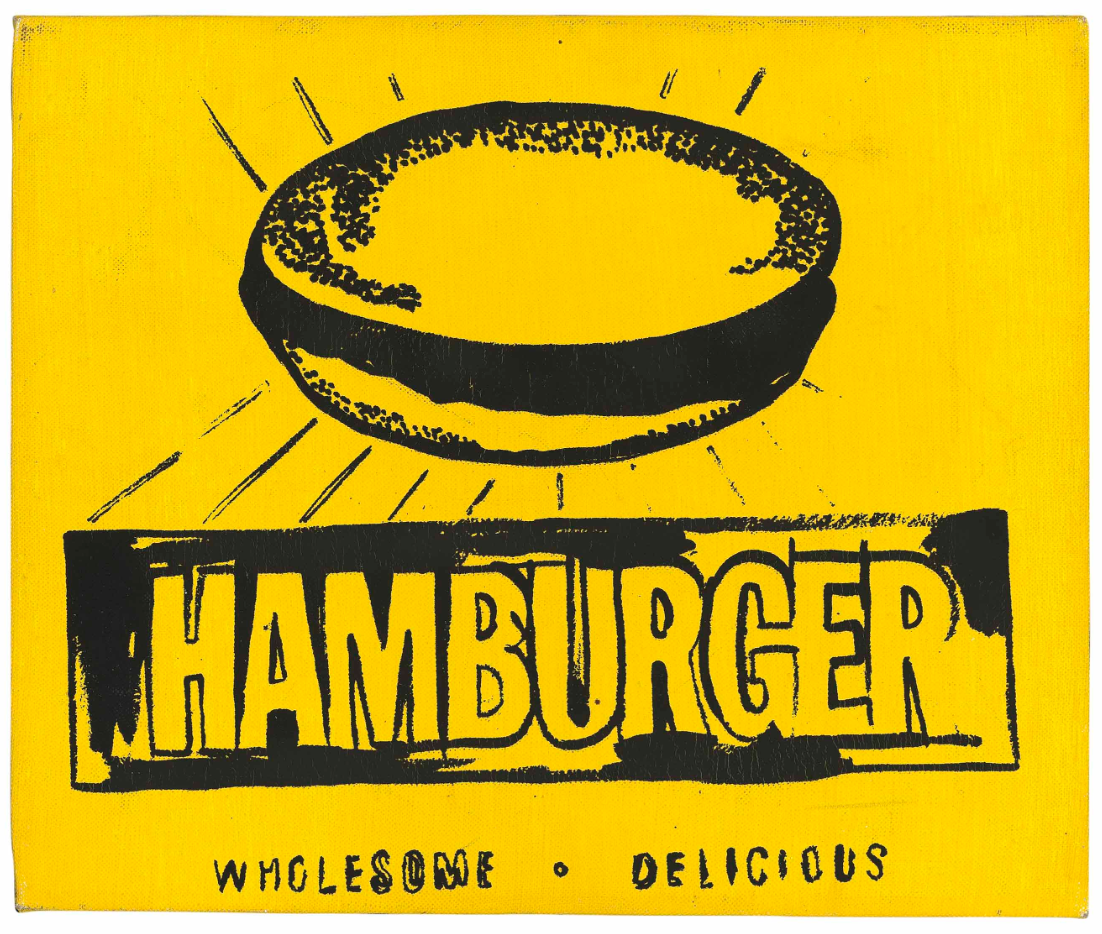
ANDY WARHOL (1928-1987)
Hamburger, 1986
Synthetic polymer and silkscreen ink on canvas
10×12 inches (25.4 x 30.5 cm)
Signed, inscribed and dated ‘SAM Andy Warhol 86’ (on the overlap)