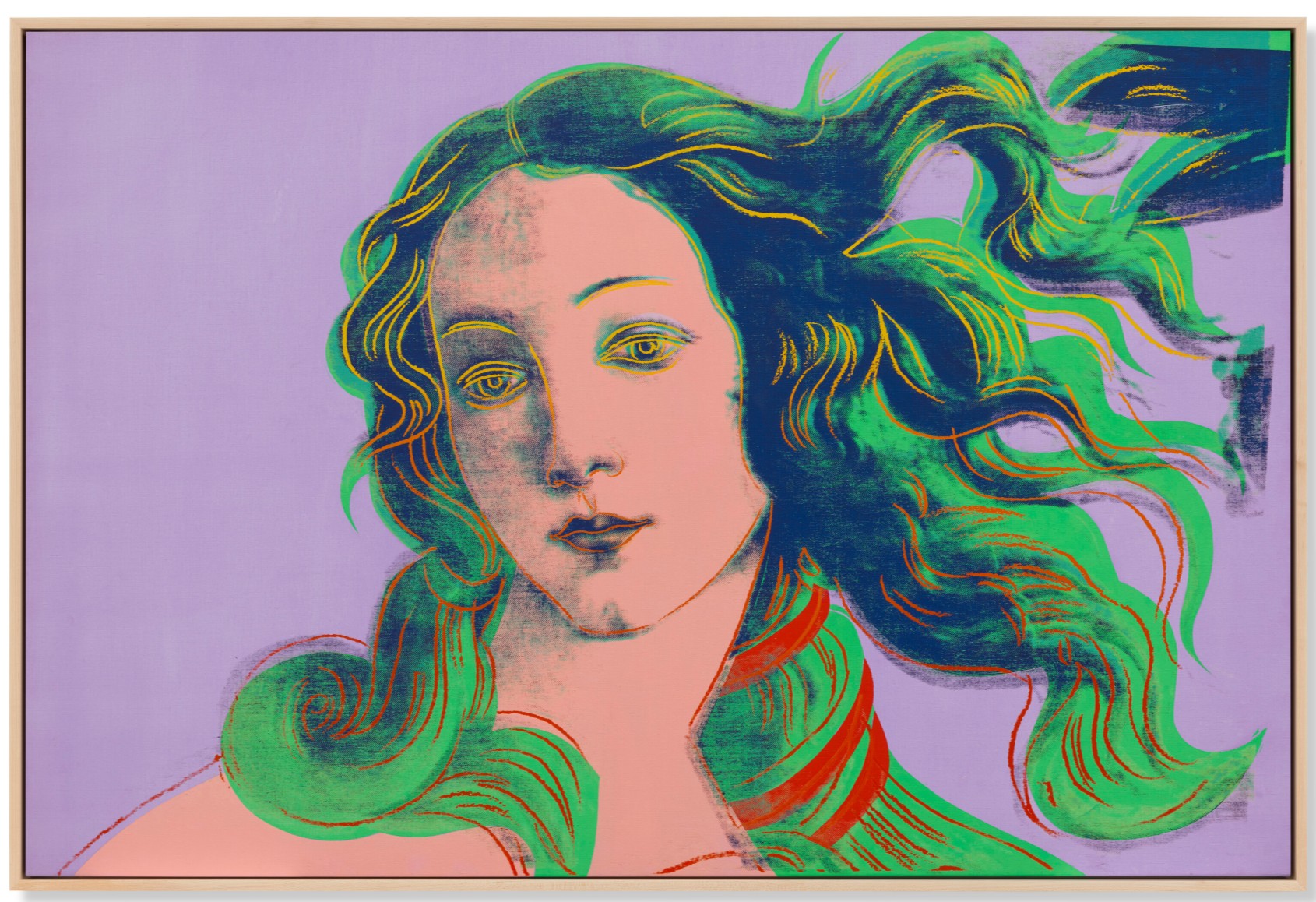
A mesmeric reflection on beauty, fame, and immortality, Details of Renaissance Paintings (Sandro Botticelli, Birth of Venus, 1482) is an enrapturing encapsulation of Andy Warhol’s retrospective and contemplative last decade. Made just over two decades after Warhol’s first forays into silkscreen paintings, the present work witnesses the Pop master return to the historical subjects and femme fatales which first won him acclaim. Like his earlier Mona Lisa works, here Warhol establishes a dialogue between modernity and the past, querying Botticelli’s lasting fame while reinterpreting one of the Old Master’s most renowned compositions. Immortality had an even more potent draw to Warhol as he began to consider his own place in the art historical canon. By introducing his own vernacular symbols, Warhol eliminates the temporal distance formerly separating the work from the present, democratizing Botticelli for a contemporary audience. Warhol’s Details series engages other Old Master compositions—Leonardo da Vinci’s Annunciation and Paolo Uccello’s St. George and the Dragon—as well as Botticelli’s Venus. Throughout the decade, he deepened his engagement with the past, incorporating contemplations on Raphael and Lucas Cranach into his work as well as his continuing engagement with Leonardo. His revitalized interest in the Italian Renaissance explored in this series anticipates his final, ultimate gesture—The Last Supper, widely considered to be Warhol’s most significant series.
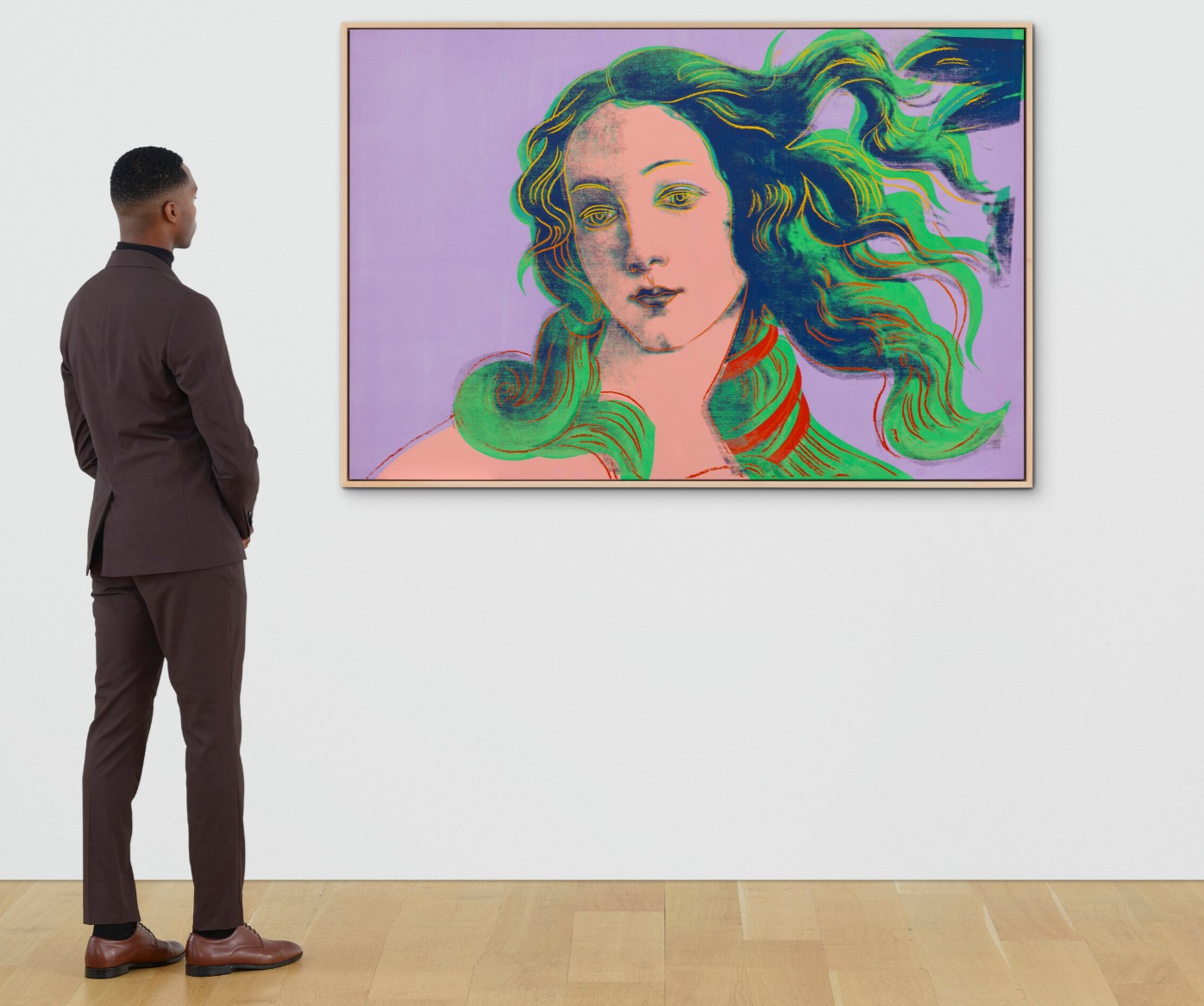
Warhol’s mature engagement with his predecessors parallels the careers of several of his contemporaries, including Pablo Picasso, whose late career is replete with obsessive reinterpretations of Diego Velázquez’s Las Meninas. As Picasso himself noted, “If someone set out to copy Las Meninas… I would try to do it in my way, forgetting Velázquez… So, little by little, I would paint my Meninas which would appear detestable to the professional copyist; they wouldn’t be the ones he would believe he had seen in Velásquez’s canvas, but they would be ‘my’ Meninas” (quoted in C. Rafart I Planas, Museu Picasso Guide, Barcelona, 1998, p. 94). Warhol follows Picasso’s lead, not merely reproducing Botticelli’s famous canvas, but reinterpreting it in his iconic Pop style. In this way, Warhol transforms the original referent into a wholly new and original work incorporating modern concerns.
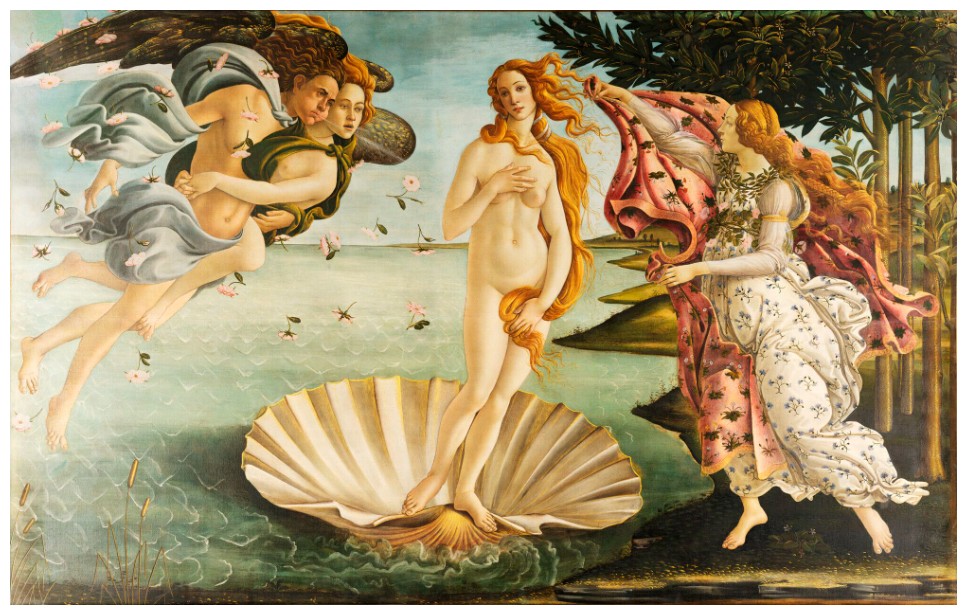
Sandro Botticelli, The Birth of Venus, circa 1485. Galleria degli Uffizi, Florence.
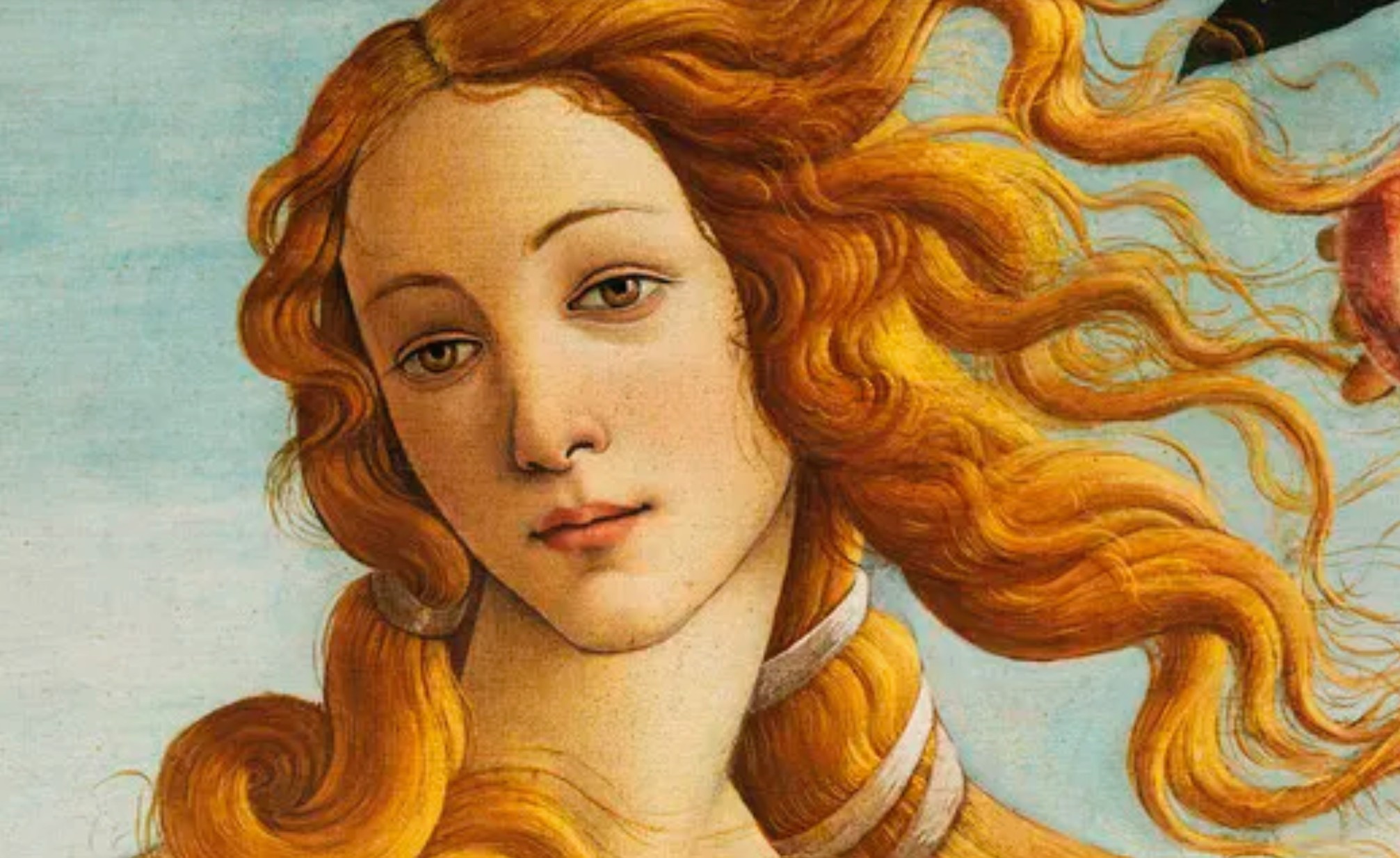
In Warhol’s version of Venus, the artist divorces the titular subject from the rest of Botticelli’s composition, excising the nymphs and wind god as well as the goddess’s notoriously nude body. By fixating his canvas on Venus’s bust, Warhol recreates the work in the style of his famous female portraits of Marilyn Monroe and Elizabeth Taylor. His ingenuity is further demonstrated his ability to manipulate his silk screen process to replicate Botticelli’s original painted effects. In the original canvas, Botticelli subtly molds the left of Venus’s face in shadow as she turns away from the light. Warhol replicates this effect in his version, creating a blurred crosshatching over aspects of the forehead and cheekbone, reframing Botticelli’s original painterly effects with contemporary processes.
The vibrant colors which Warhol incorporated into Venus’s hair—green, red, and yellow—complete her transformation from Roman goddess to contemporary icon, reimagined within Warhol’s pantheon of celebrities as another Marilyn. As the art historian Laszlo Glozer notes, “In Warhol’s version, Botticelli’s Venus is reduced to a cinemascope close-up of the face. This keeps all the advantages of the noble original though in Warhol’s work it looks as if she is fresh from the beauty salon with an artificial sun illuminating the fiery tints just added to her hair” (“A Guest Performance on the Painters’ Olympus,” in J. Schellmann, ed., Andy Warhol: Art from Art, exh. cat., Edition Schellmann, Cologne, 1994, p. 8).
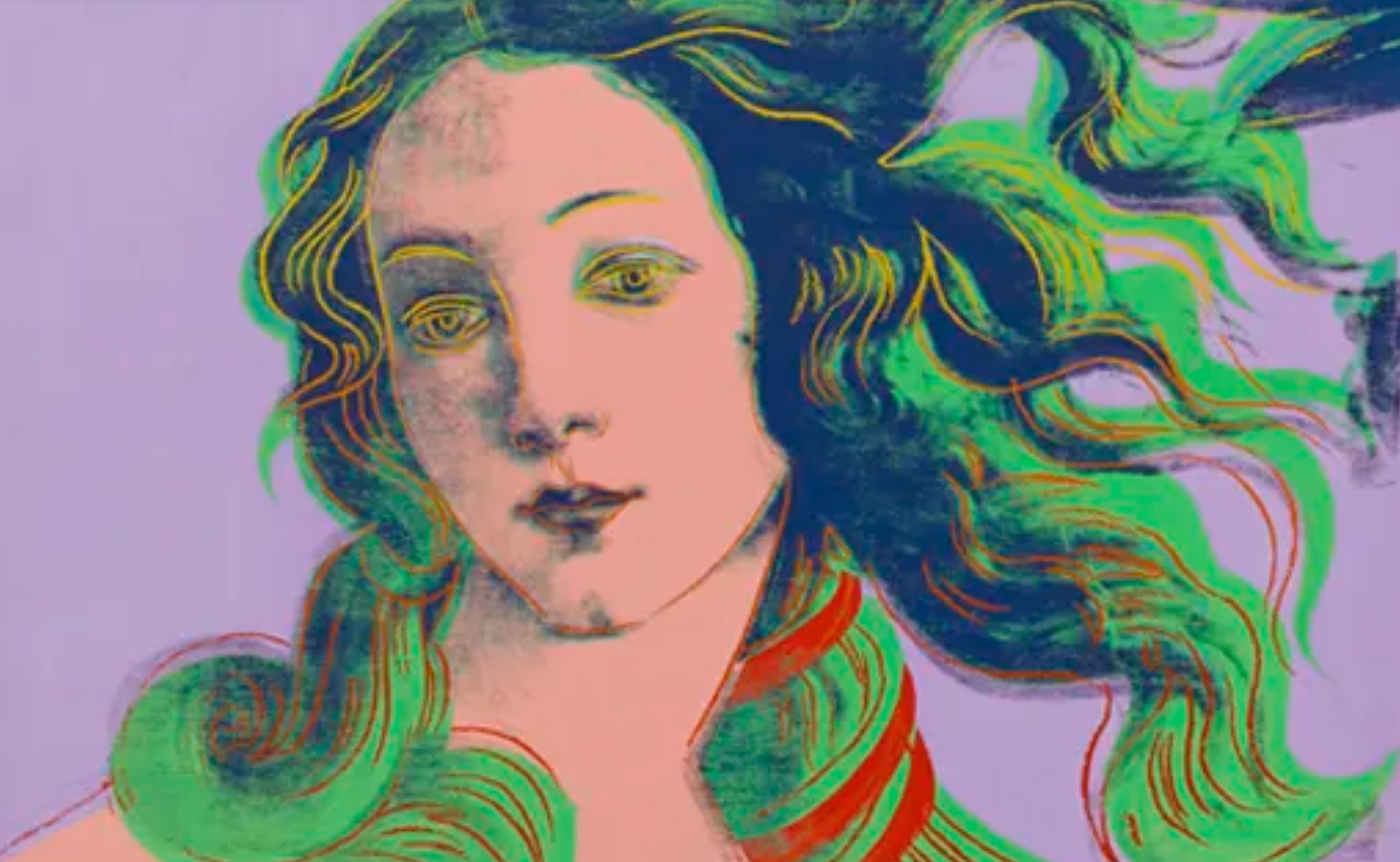
The yellow highlights added by Warhol are the closest correspondence to Botticelli’s version of Venus, hinting at her golden blonde locks. Botticelli was himself performing a fifteenth-century version of Warhol’s appropriative method with his painting, taking many of his figures from recently excavated antiquities. In this case, the Florentine artist was adapting the ancient Greek sculpture Venus de’ Medici into his classically inspired painting, mimicking the sculpture’s modest posture and tilted head for his painted Venus. The sculpture was then as famous as Leonardo’s Mona Lisa is today, attracting astounding amounts of attention after its rediscovery. It was soon incorporated into the famous collection of the powerful Medici family, who also commissioned Botticelli’s painting. Botticelli’s audience would have immediately recognized his insertion of the sculpture’s form into his painting, just as we today immediately see Botticelli’s Birth of Venus as we view the present work. At the time, Venus—the goddess of love—was her own sort of secular celebrity, constantly appearing in art and poetry as a Renaissance Marilyn Monroe, and Botticelli’s choice to paint her fully nude was a provocative and instantly controversial decision; his painting was the first fully nude female figure since antiquity. Fascinatingly, the sculpture retained its original gold gilding around the figure’s hair when Botticelli was copying the work, paralleling the golden locks of the painted Venus in the fifteenth-century painting, which in turn inspired Warhol’s yellow highlights. Now lost, this golden gilding demonstrates the enduring power of artistic elements throughout millennia, a theme which continually obsessed Warhol in his last decade.
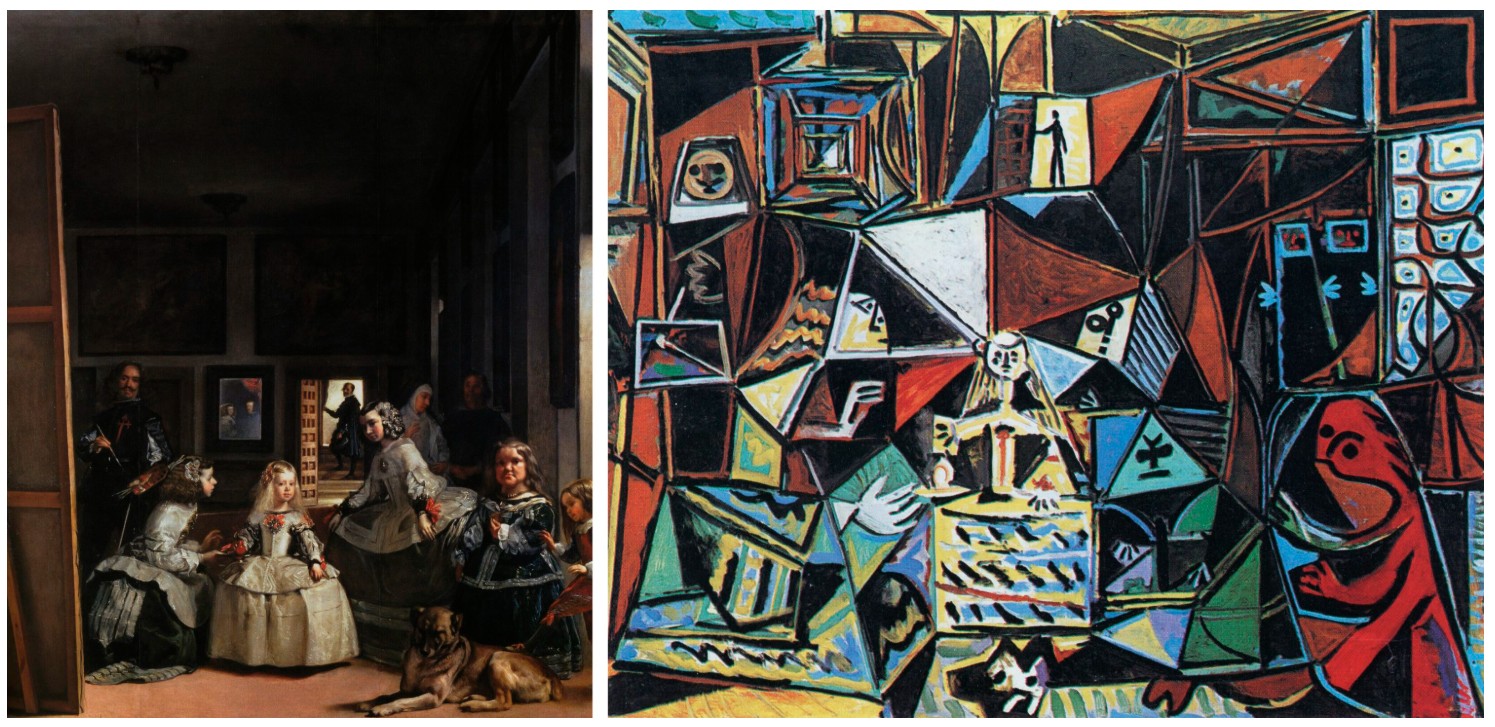
Left: Diego Velázquez, Las Meninas, 1656. Museo del Prado, Madrid.
Right: Pablo Picasso, Las Meninas, 1957. Museu Picasso de Barcelona. © 2026 Estate of Pablo Picasso / Artists Rights Society (ARS), New York.
In 1957, when Warhol was still a successful commercial artist working for fashion magazines, he went on a world tour with his close friend Charles Lisanby. The two alighted to Rome and then Florence, where Warhol visited practically every church and museum, broadening his visual vocabulary to include the Old Masters. His visit to the Uffizi gallery placed him face-to-face with the painting he would go on to reimagine almost thirty years later. For his source imagery, the artist relied upon a 19th-century art encyclopedia which was kept around the Factory. By referencing a much later copy after the original Birth of Venus, Warhol expands his commentary on the immortality of art, incorporating centuries of visual replications, translations, and reinterpretations into a singular tableau. Bridging past and present, with a keen eye towards his own future legacy, Warhol makes Botticelli’s icon his own.
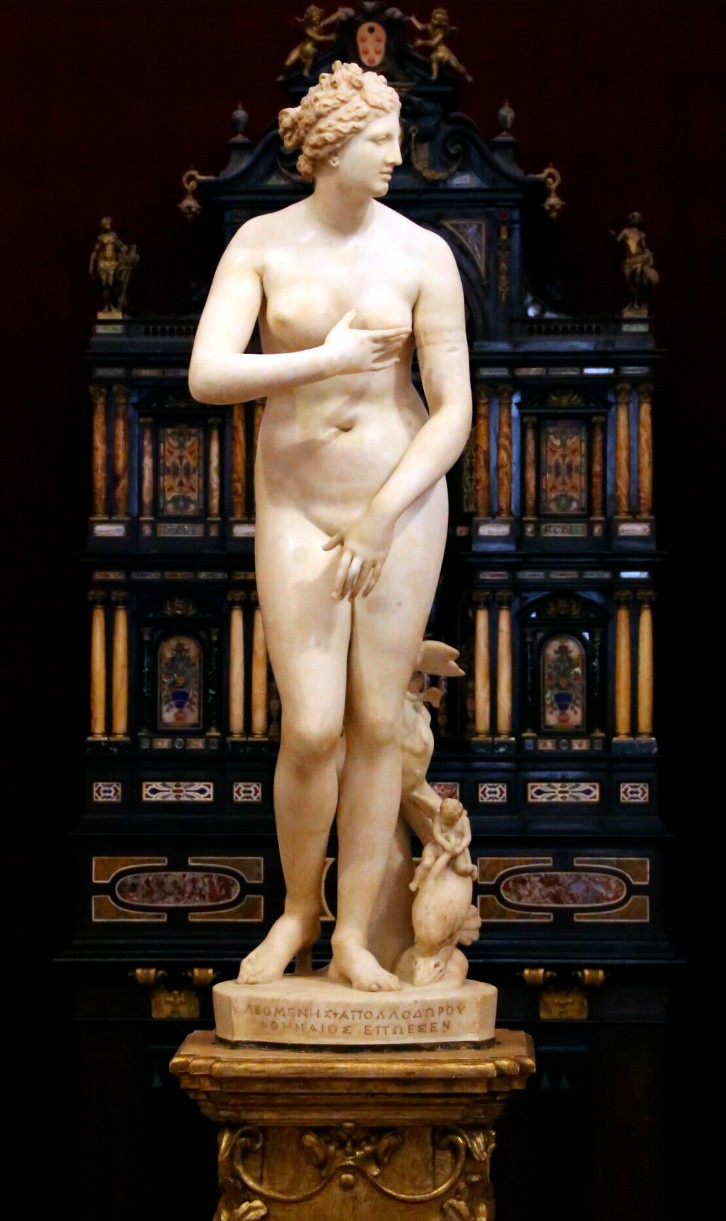
Venus de’ Medici, 1st century BCE. Uffizi Gallery, Florence.
In reimagining Botticelli’s Birth of Venus through the charged immediacy of his silkscreen process, Warhol forges a compelling dialogue between Renaissance ideals and late twentieth-century visual culture. By isolating, enlarging, and chromatically transforming Venus’s visage, he reframes a foundational icon of Western art as a contemporary emblem of fame, beauty, and perpetual reinvention. The work encapsulates Warhol’s late fascination with artistic lineage and the endurance of images across time, revealing how appropriation can both revive and redefine the past. In doing so, Warhol not only pays homage to Botticelli but also affirms his own place within the continuous, ever evolving history of art.
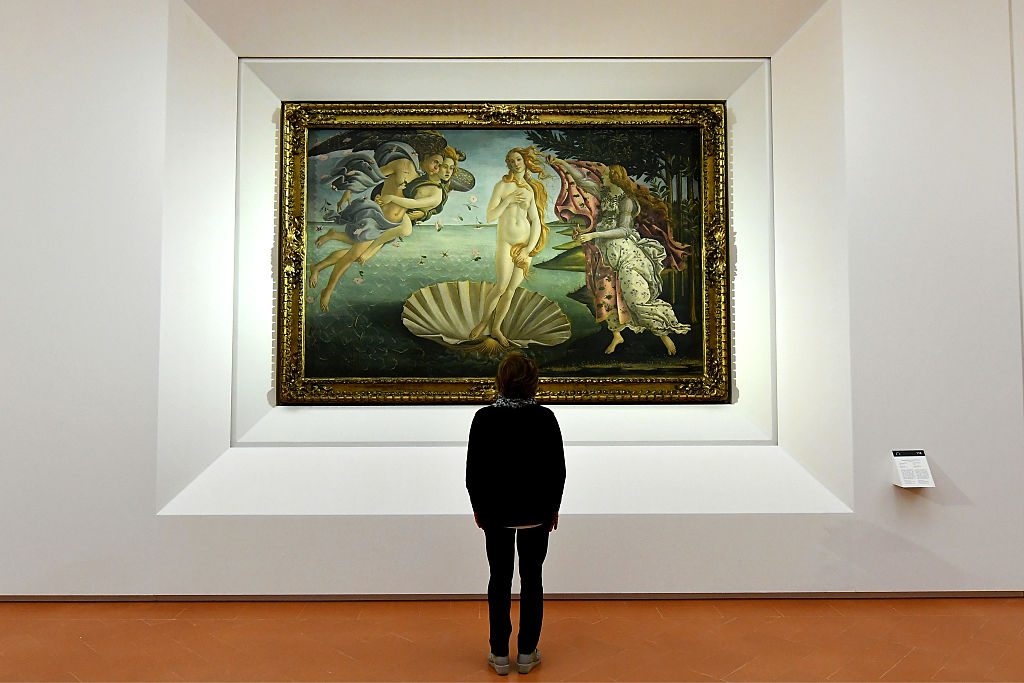
Sandro Botticelli (circa 1445-1510) was one of the great figures of the Italian Renaissance. Praised by Giorgio Vasari for the grace of his compositions, he was renowned for the linear elegance and subtle tones of his figure-painting. Botticelli was also an innovator. He introduced classical myth into a field dominated by religious painting. His Birth of Venus (circa 1484-1486) and its sister painting Primavera (circa 1482), both once owned by the Medici family and now hanging in the Uffizi Gallery in Florence, are recognized as masterpieces. In this quintessential and universally recognized Renaissance painting, Botticelli returned to classical mythology, experiencing a powerful revival during the intellectual Humanism movement that took hold during the 15th century. Botticelli’s life-sized Venus – or Aphrodite in the Greek tradition – emerges nude from the sea out of a shell, surrounded by gods and goddesses, presenting herself as the ultimate symbol of classical beauty. In antiquity, this scene of Venus appearing, or perhaps being born out of the sea, was known as “Venus Anadyomene,” or “Venus rising from the sea,” and came to symbolize female beauty, virginity, eroticism, and purity. Today, Botticelli’s masterpiece is firmly embedded in art historical canon, as a constant inspiration to future generations of artists and, subsequently, as a cultural icon constantly reproduced on coffee mugs, t-shirts, posters and more.
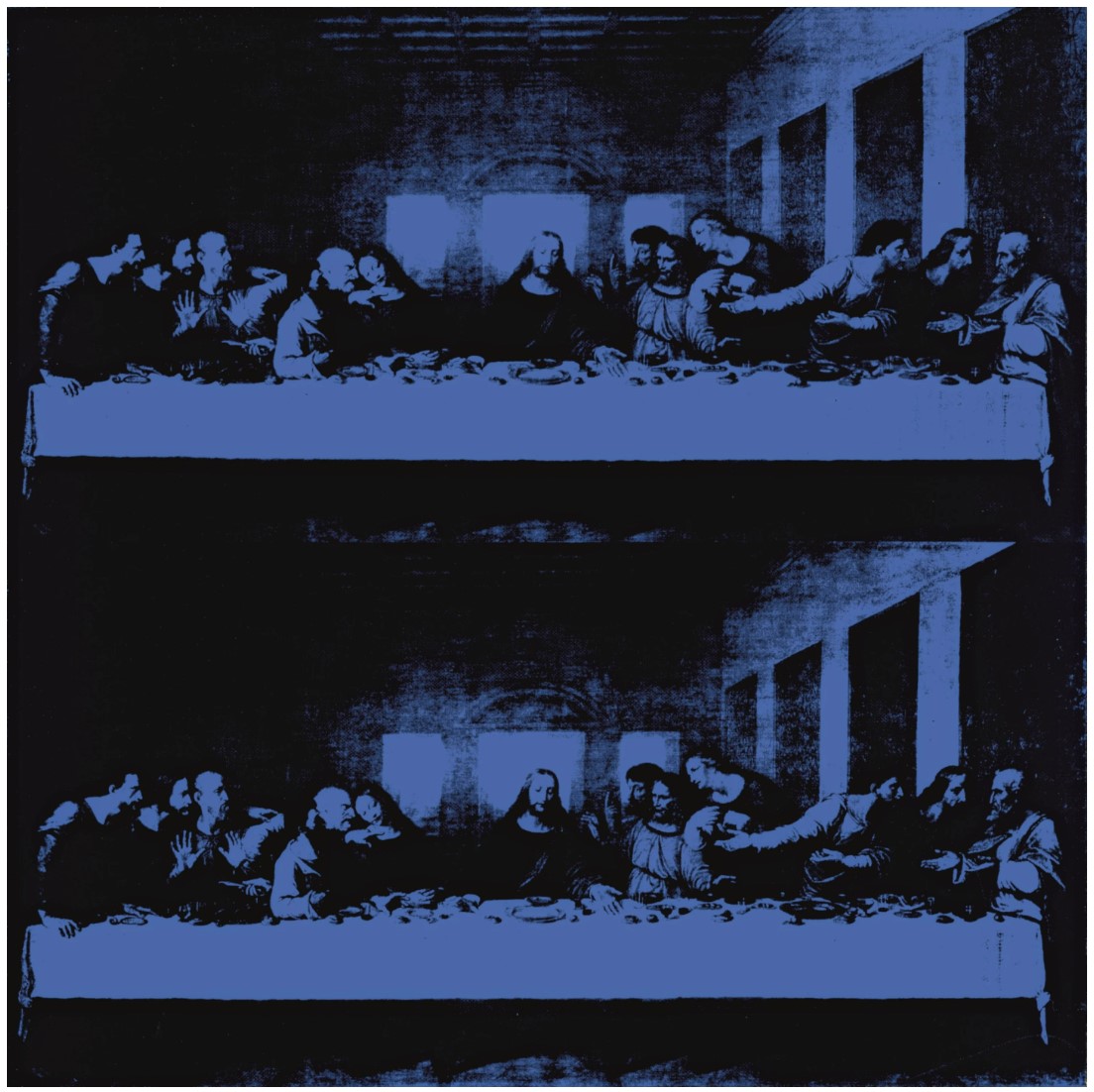
Andy Warhol reinterprets and dramatizes this extraordinary vision. Released from her original context, Venus is reborn in Technicolor, hit with a strobe light, and made into a universalized “Marilyn” for a new age. The conventions of art history are subverted, transmuted, repackaged and democratized. Warhol’s Birth of Venus is one of the outstanding achievements of his later career, looking forward to his final masterworks, the iterated versions of Leonardo da Vinci’s Last Supper.
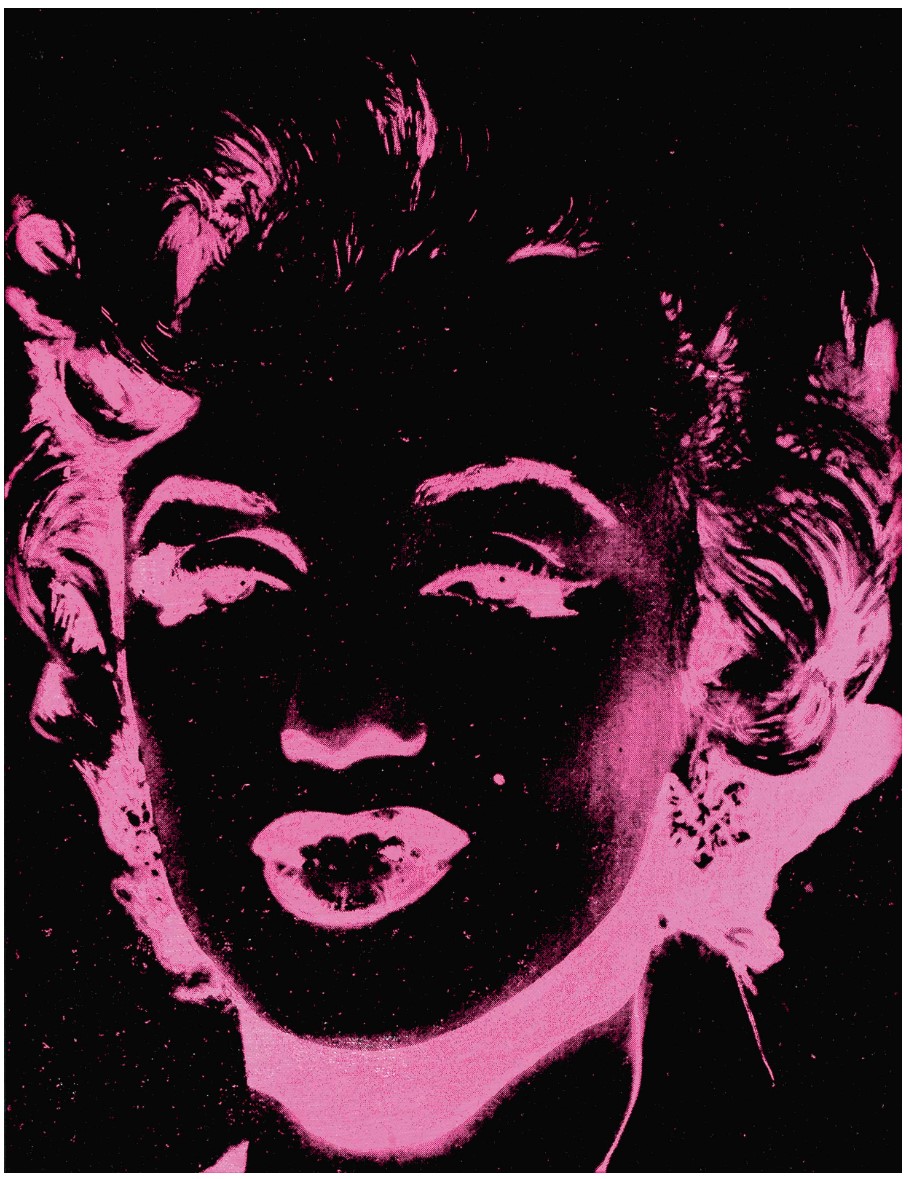 ANDY WARHOL, Pink Marilyn (Reversal), 1986
In the 1960s, Warhol had shocked the art world with the advertising-led flatness of his Coke Bottles and Campbell’s Soup Cans. In the 1970s, his celebrity led to the repetition in different media of many themes that had made him famous. Warhol was rejuvenated, a consummate master of the revolutionary silkscreen process he had initiated nearly two decades earlier. He now combined the medium’s coolly serial mode with an expressive chromatic complexity, a step change from Mona Lisa and other earlier series. Warhol reassessed his art in the Retrospective series of 1978-1879. In his Reversals, he flipped his original colors into negative. His Marilyn (Reversal) images glow with a dark radiance as if ignited from within by their own fame. Warhol’s Pop icons and silkscreen art had advanced from the graphic linearity they once shared with Roy Lichtenstein. Through the genius of Warhol’s vision, they had taken on their own life—or afterlife—in popular culture. They now transcended the American frames of reference that they once embodied, and claimed an important place as milestones in the broader canon of Western art.
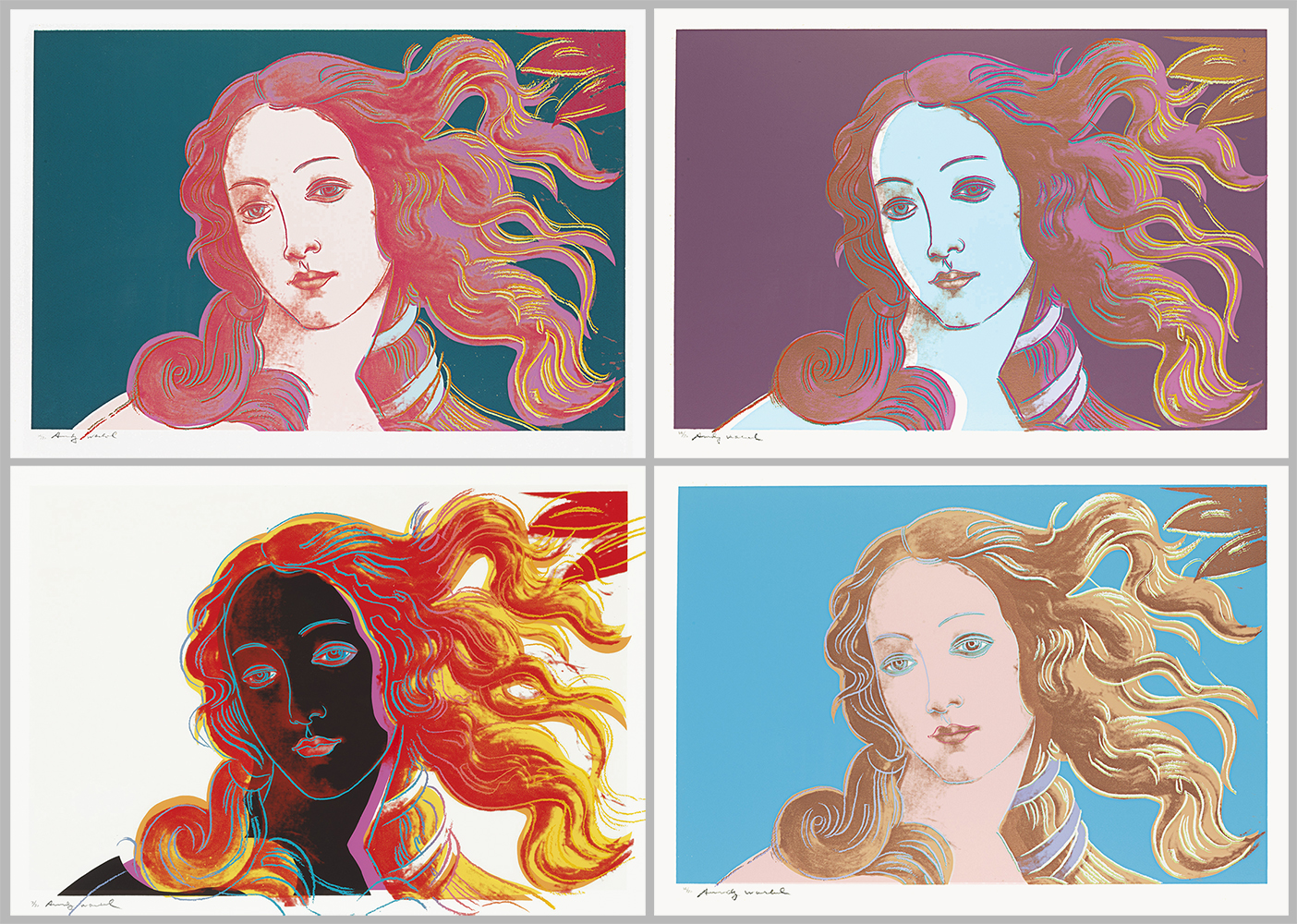
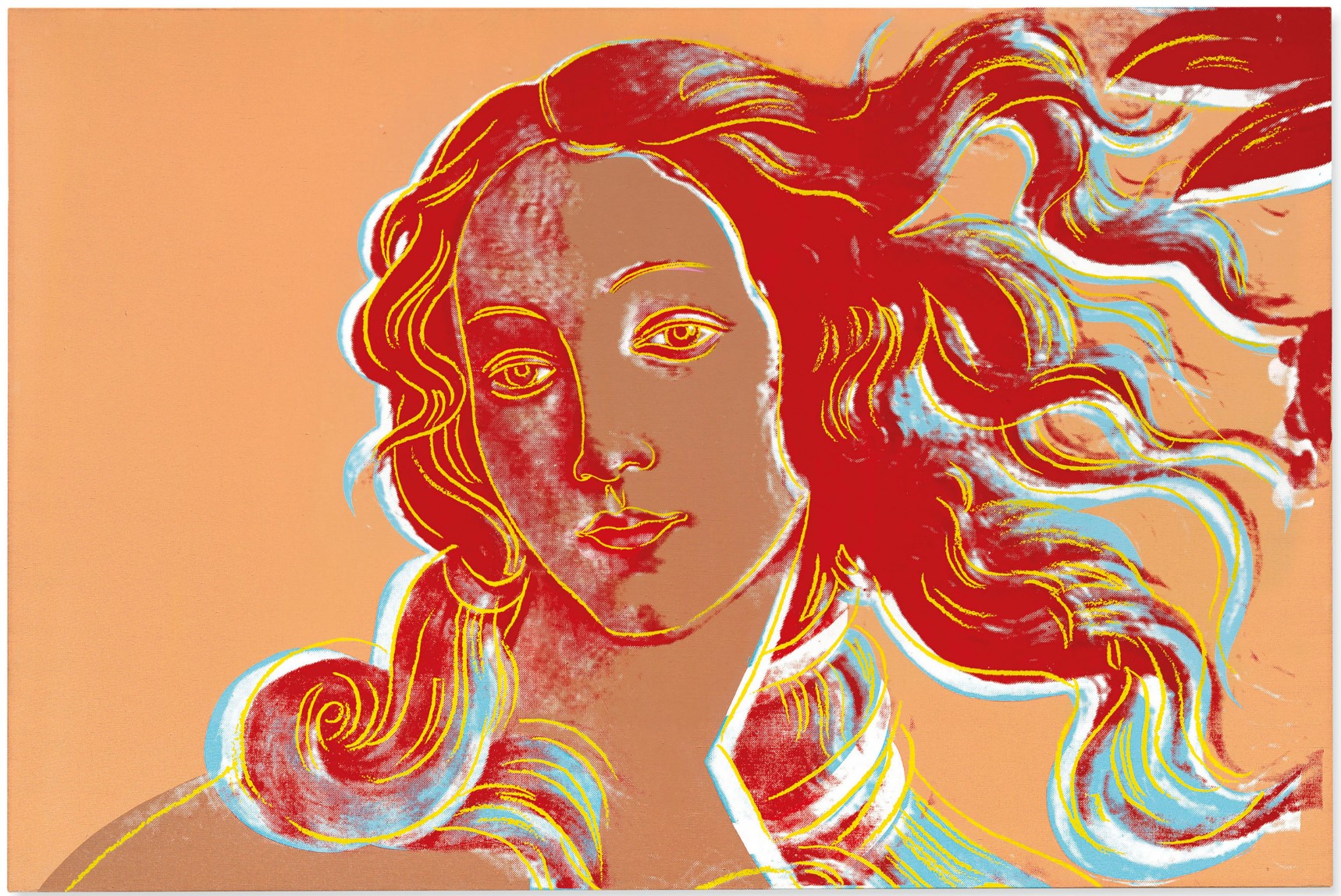
The Details of Renaissance Paintings series of 1984 positions Warhol’s silkscreens alongside the great paintings of the world. The Birth of Venus is at the summit of this series. Although derived from Botticelli, it is the culmination of a profound inquiry into the canonizing power of popular culture. At one level, Warhol’s Venus is “an image of an image, with no reason but a surface reason” (Sherman and Dalton, Andy Warhol, 2009). But if that is all, how has Warhol succeeded in translating Botticelli’s shimmering goddess into one of the world’s most memorable icons? Taking full command of one of the most universally acclaimed paintings in the history of art, Warhol describes the face of love with searing clarity, dramatically ordered color and delicate surface detail to create a timeless image of beauty. Warhol’s Venus may have her origin in a Western ideal, but her reincarnation resonates across the globe. In this red version, the balance of color and detail is revolutionary. Emerging from a background of pure pink and framed by the vibrancy of her rose-red hair lit with ethereal flames, Venus’s lovely face speaks to everyone. The delicate yellow strokes–first drawn by hand before being transferred to a screen–are lovingly applied. Such lyrical details, in concert with the work’s striking assortment of hues, exemplify Warhol’s commitment to line, form, color and process, while responding to the age of television and mass communication.
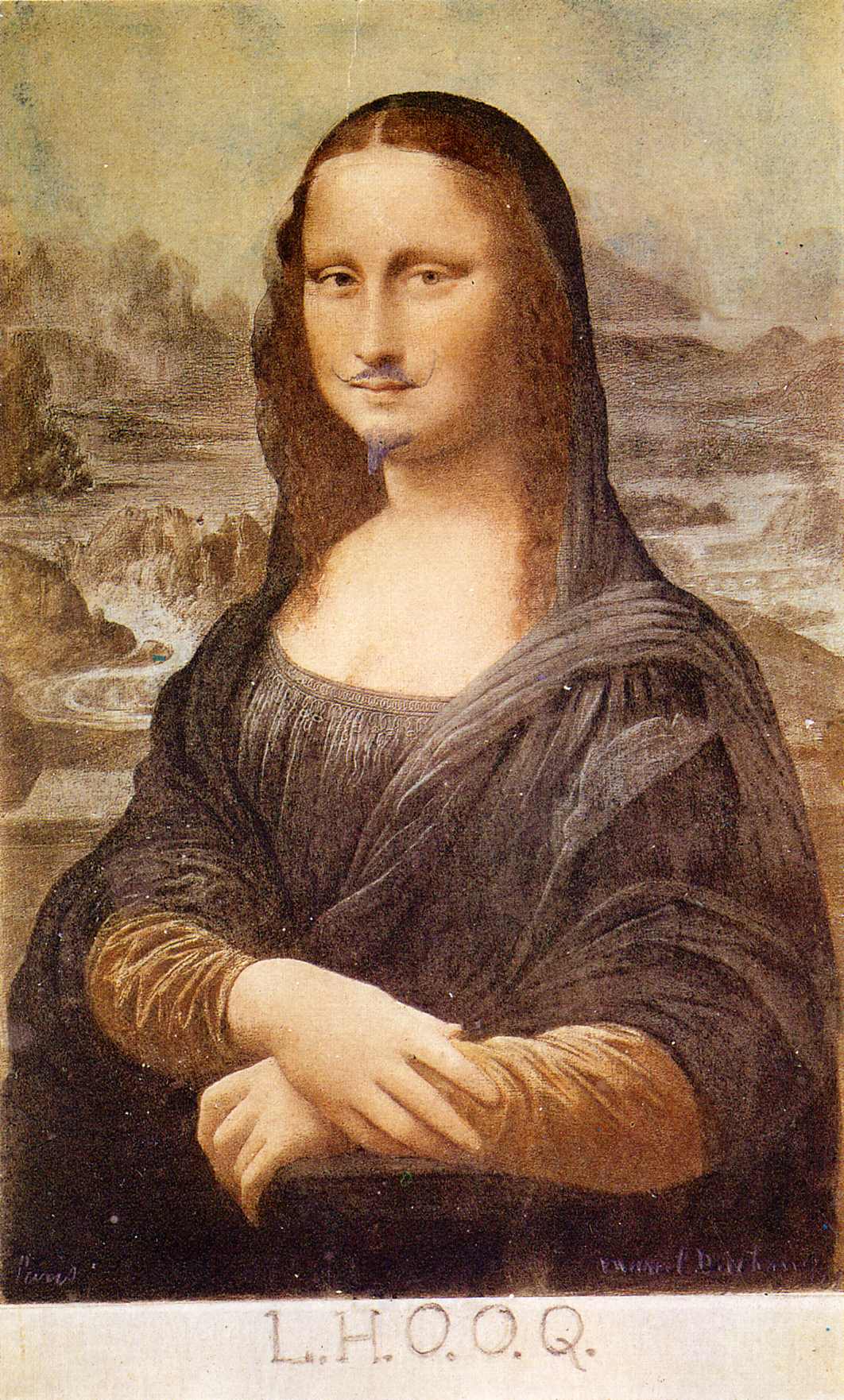
From the outset of Andy Warhol’s career, he chose the most universal images of popular culture to replicate in his silkscreened canvases. In a 1987 interview with Flash Magazine, Warhol aptly stated, “I’m still a commercial artist. I was always a commercial artist.” Indeed, throughout the length of his career spanning three decades, Warhol continuously depicted commercially recognizable subjects – from the quotidian to the exalted – from Campbell’s soup cans and Coca-Cola bottles to Marilyns and Jackies, from car crashes and shoes to Queen Elizabeths and Chairman Maos. What was so revolutionary about Warhol’s oeuvre was the shocking familiarity of his imagery; the appropriation and objectification of his subjects emulated the Duchampian notion of fetishizing the banal and bringing it into the realm of Fine Art. In 1919, Marcel Duchamp took a found object, a postcard of Leonardo da Vinci’s Mona Lisa, drew a moustache on her face and scrawled the letters “L.H.O.O.Q.” beneath the image. When spoken in French, these letters sound like “Elle a chaud au cul” or, in English, “She has a hot ass.” This sly maneuver not only degrades the traditionally exalted art historical figure and her creator, but also introduces the overt practice of appropriating artistic masterpieces as ready-mades. In Duchamp’s wake, Warhol too viewed pop culturally resonant icons, figures and paintings, such as The Birth of Venus, as ready-mades at his disposal, free for manipulating and translating in his signature style.
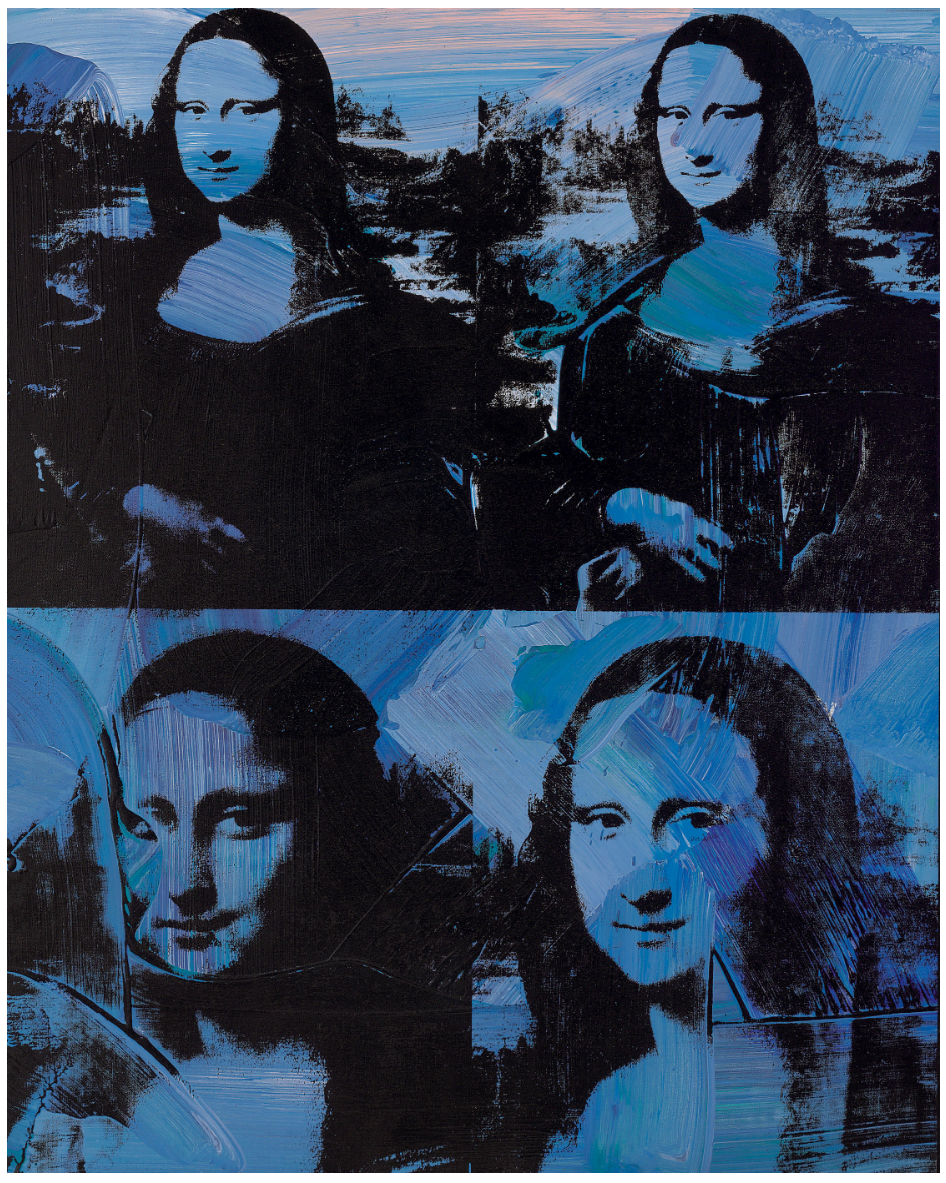
In Details of Renaissance Paintings and in the series of works inspired by Leonardo da Vinci’s Mona Lisa (c. 1503-1519) and Last Supper (1498), Warhol confronted the ubiquitous images of Art History by intentionally stripping the works of their original artistic intent in favor of their value as a pop cultural symbols. There is certainly an odd irony in appropriating Botticelli’s – or any Old Master’s – laborious, detailed and painstaking painting process into a silkscreen, a mechanical process for mass production that essentially removes the hand of the artist. Subsequently, Warhol transforms this work into an easily reproducible commodity, subverting not only Botticelli’s intention, but the very principles of the art historical tradition.
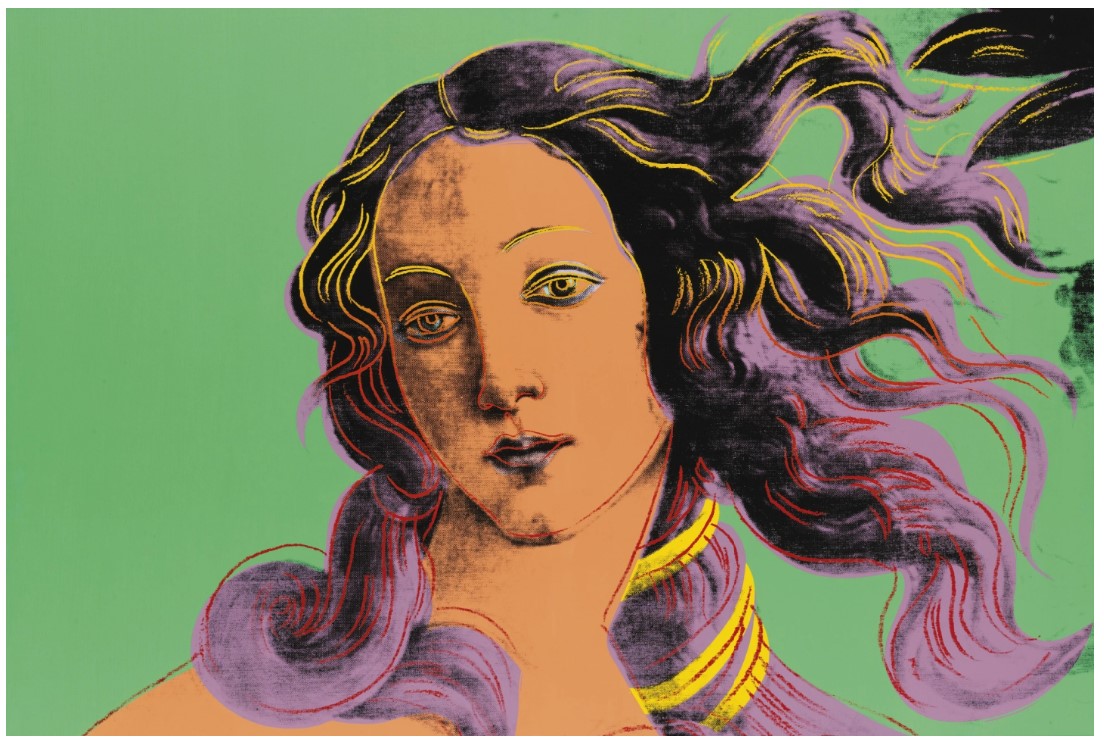
In the present work, the classical symbol of beauty is transmuted in eccentric colors – an eye-catching array of punchy hues. On a background of bright, mint green, Venus’s peach skin radiates, surrounded by a halo of violet curls and outlined in gradations of neon yellow, orange and red. Warhol crops Botticelli’s monumental, mythical scene down to Venus’s face and enlarges it to 48 inches high by 72 inches wide, essentially elevating the image to that of a religious icon in much the same aesthetic manner as Warhol’s early depictions of Marilyn Monroe. The 1964 silkscreen Turquoise Marilyn is almost visually analogous to this Birth of Venus (After Botticelli) from twenty years later. The vibrant green background and unnaturally dramatic and bold facial colors of the present work makes clear reference to his early canvases of the similarly recognizable Marilyn. As Art Historian and Warhol scholar Germano Celant posits, “The history of art is itself another concrete mirage, with its stars and superstars of every age, and Warhol absorbed this too into the magma of his imagination. Alluding to the masters of the Renaissance to Piero della Francesca and Raphael, as well as to Munch and De Chirico, he turned them into dead flowers, so that the absolute subjectivity of art became once again a problem of media communication: a reproduction, cut and edited, with unnatural, technological colors.” (Germano Celant, Super Warhol, p. 10)
Warhol, like Botticelli, was clearly enchanted by his subject. He works with fierce yet tender concentration. It does not seem fanciful to see traces of personal devotion in his homage. Warhol’s Catholic upbringing accorded deep significance to the veneration of images. Like a beautiful Madonna, this goddess is touched with feminine mystery, but is never depersonalized. Andy Warhol’s Venus is the exultation of an icon imbued with humanity by an artist who was never the machine he might pretend to be. Warhol was not merely subverting and challenging the past. By lavishing attention upon every aspect of his painting, he formed a new paradigm of beauty for the postmodern era.
Auction Results
Details of Renaissance Paintings (Sandro Botticelli, Birth of Venus, 1482), 1984
Christie’s New-York: 18 May 2026
Estimated: USD 5,000,000 – 7,000,000
USD 9,103,000
ANDY WARHOL (1928-1987)
Details of Renaissance Paintings (Sandro Botticelli, Birth of Venus, 1482), 1984
Acrylic and silkscreen ink on canvas
48×72 inches (122×183 cm)
Stamped twice with the Estate of Andy Warhol and the Andy Warhol Foundation for the Visual Arts, Inc. stamps
Numbered ‘PA 36.005’ (on the overlap)
Warhol isolates the central element from Botticelli’s Birth of Venus, concentrating on Venus’s visage and billowing hair. Emphasizing the original’s contours and implementing his signature Pop colors of pink, green, yellow, and red, the artist rejuvenates the original work, making the enduring icon anew. By introducing his own vernacular symbols, Warhol eliminates the temporal distance formerly separating the work from the present, democratizing Botticelli for a contemporary audience. Warhol’s Details series engages other Old Master compositions—Leonardo da Vinci’s Annunciation and Paolo Uccello’s St. George and the Dragon—as well as Botticelli’s Venus. Throughout the decade, he deepened his engagement with the past, incorporating contemplations on Raphael and Lucas Cranach into his work as well as his continuing engagement with Leonardo. His revitalized interest in the Italian Renaissance explored in this series anticipates his final, ultimate gesture—The Last Supper, widely considered to be Warhol’s most significant series.
Birth of Venus (After Botticelli), 1984
Christie’s New-York: 14 November 2018
Estimated: USD 2,500,000 – 3,500,000
USD 4,812,500
Andy Warhol (1928-1987), Birth of Venus (After Botticelli) | Christie’s
ANDY WARHOL
Birth of Venus (After Botticelli), 1984
Acrylic and silkscreen ink on canvas
48×72 inches (122×183 cm)
Signed ‘Andy Warhol’ (on the overlap)
Andy Warhol’s Birth of Venus (After Botticelli) is a radical and breathtaking vision of divine beauty. Executed in 1984 as part of a series of reimagined Quattrocento masterpieces, Warhol’s red Birth of Venus is one of just six large-scale images of Botticelli’s iconic goddess. Of these, four are on canvas and two on linen, each in a different colorway. This original and unique “red” production on canvas, which has been in the same private collection since before Warhol’s death over thirty years ago, is undoubtedly the most romantic. Warhol depicts Venus against a background of salmon pink. For her skin tones, a soft shade of umber is overlaid on pink, while her hair is a deep red, ablaze with accents of electric blue and white. Flourishes of yellow articulate her hair and features. Warhol has cropped and magnified Botticelli’s composition to form a spellbinding portrait, placing Venus in his pantheon of icons, alongside the exalted image of Marilyn Monroe. If Marilyn has been made goddess, here Venus comes to Hollywood.
The red Birth of Venus is among the most glorious and romantic of his creations. In the post-Pop era, Warhol transcended the boundaries between fine art and popular culture. Selection, appropriation and reproduction were starting points. Editing, magnification and coloration were transformative. His genius of imagination was decisive. Warhol may have said that all he saw was surface. But his achievement was far more complex and infinitely greater. If Botticelli’s Venus was the embodiment of perfect beauty, Warhol could not help but add magic. Andy Warhol’s recasting of the art of the past shows life-heightening iconography in a new light. Two masters are united across five centuries of history. Great art is always learning from its past to fashion itself anew. In Warhol’s wondrous vision, Botticelli’s 15th century Venus is reborn as a brilliant icon, the divine personification of love, floating in time and space.
Birth of Venus (After Botticelli), 1984
Sotheby’s New-York: 14 November 2012
Estimated: USD 1,000,000 – 1,500,000
USD 5,458,500
ANDY WARHOL
Birth of Venus (After Botticelli), 1984
Acrylic and silkscreen ink on canvas
48×72 inches (121.9 x 182.9 cm)
Signed and dated ’84 on the overlap
In 1984, Andy Warhol turned his focus away from his ubiquitous silkscreens of brand name objects and society portraits and instead turned toward the History of Art itself. He embarked on the series Details of Renaissance Paintings, depicting cropped images of renowned and universally recognized Old Master paintings from the 15th century. The present work by Warhol, Birth of Venus (After Botticelli) (1984), appropriates the titular painting by the Renaissance master Sandro Botticelli and reimagines it as a bright and cartoonish Pop painting. In other works of this series, Warhol borrowed imagery from Leonardo’s The Annunciation (1472-1475) and Paolo Uccello’s St. George and the Dragon (c. 1470). By cropping and distorting the original scale and color palette, Warhol transformed these familiar Renaissance paintings from the canon of Art History into kitschy, fetishized spin-offs. Just as Warhol’s silkscreened works from the 1960s radically exalted – yet simultaneously mocked – the commodification of American consumer brands and products, his works from Details of Renaissance Paintings point to the similar way in which we consume artistic masterpieces.
In the present work, the classical symbol of beauty is transmuted in eccentric colors – an eye-catching array of punchy hues. On a background of bright, mint green, Venus’s peach skin radiates, surrounded by a halo of violet curls and outlined in gradations of neon yellow, orange and red. Warhol crops Botticelli’s monumental, mythical scene down to Venus’s face and enlarges it to 48 inches high by 72 inches wide, essentially elevating the image to that of a religious icon in much the same aesthetic manner as Warhol’s early depictions of Marilyn Monroe. The 1964 silkscreen Turquoise Marilyn is almost visually analogous to this Birth of Venus (After Botticelli) from twenty years later. The vibrant green background and unnaturally dramatic and bold facial colors of the present work makes clear reference to his early canvases of the similarly recognizable Marilyn. As Art Historian and Warhol scholar Germano Celant posits, “The history of art is itself another concrete mirage, with its stars and superstars of every age, and Warhol absorbed this too into the magma of his imagination. Alluding to the masters of the Renaissance to Piero della Francesca and Raphael, as well as to Munch and De Chirico, he turned them into dead flowers, so that the absolute subjectivity of art became once again a problem of media communication: a reproduction, cut and edited, with unnatural, technological colors.” (Germano Celant, Super Warhol, p. 10)