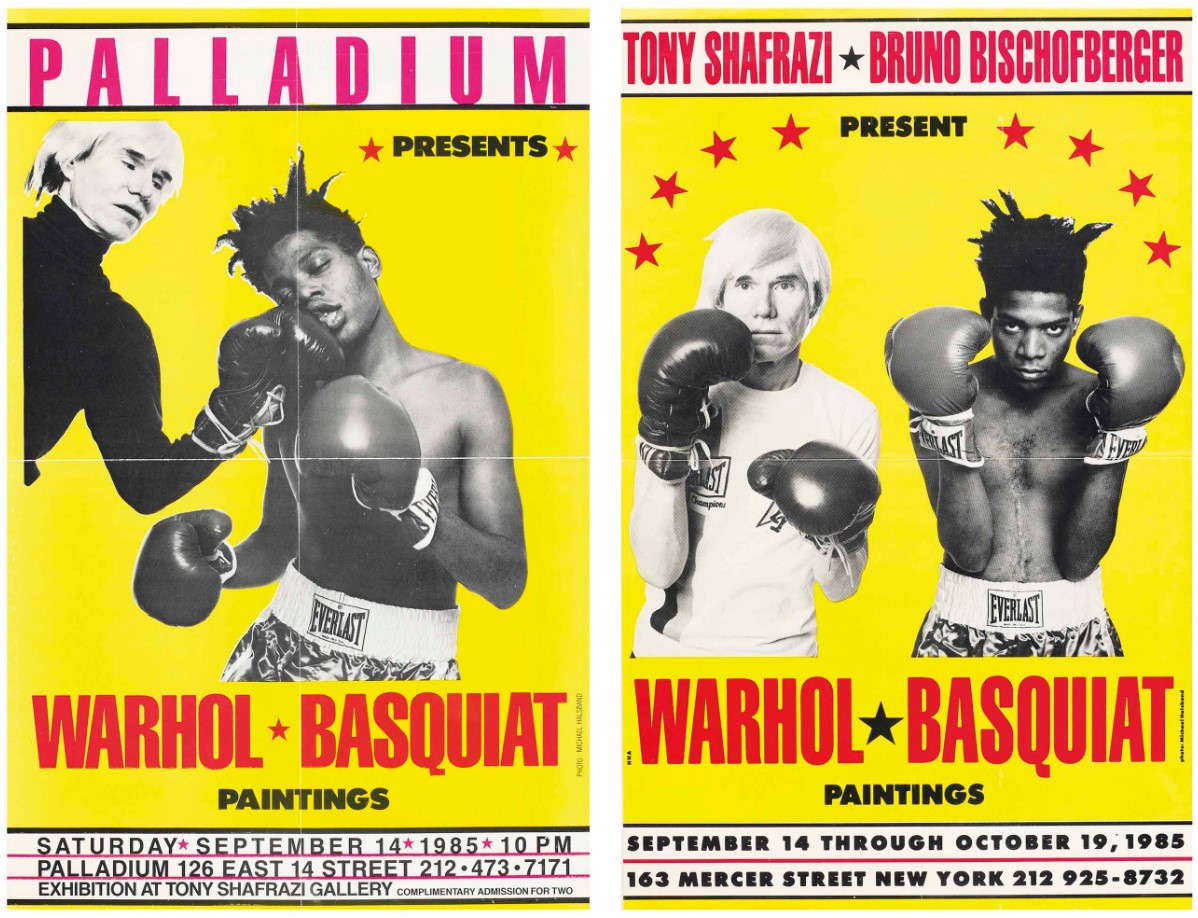
The present work offers a unique window into the relationship between the ringleader Warhol and the wunderkind Basquiat, two individually eminent artistic voices of the Twentieth Century whose fertile partnership spawned the production of over 100 collaborative paintings, while also fundamentally impacting the development of one another’s distinctive styles. Prior to the initiation of their relationship at the instigation of the legendary Zurich gallerist Bruno Bischofberger in 1983, Basquiat obsessively revered Warhol, attempting on several occasions to meet his role model—Warhol being the progenitor of the graphic Pop art style that paved the way for the young painter. In turn, Warhol was enamored by Basquiat’s infectious charisma and energy, a youthful fervor exemplified when Basquiat zealously painted a double portrait of the two artists and had it delivered to the Factory within hours of meeting Warhol, the canvas still wet. They would paint several portraits of each other over the course of their impassioned and volatile relationship, both infatuated with each other’s celebrity and artistic genius. Notably, Basquiat’s unwavering enthusiasm prompted Warhol to pick up a paintbrush after almost 20 years of eschewing painting in favor of the silkscreen.
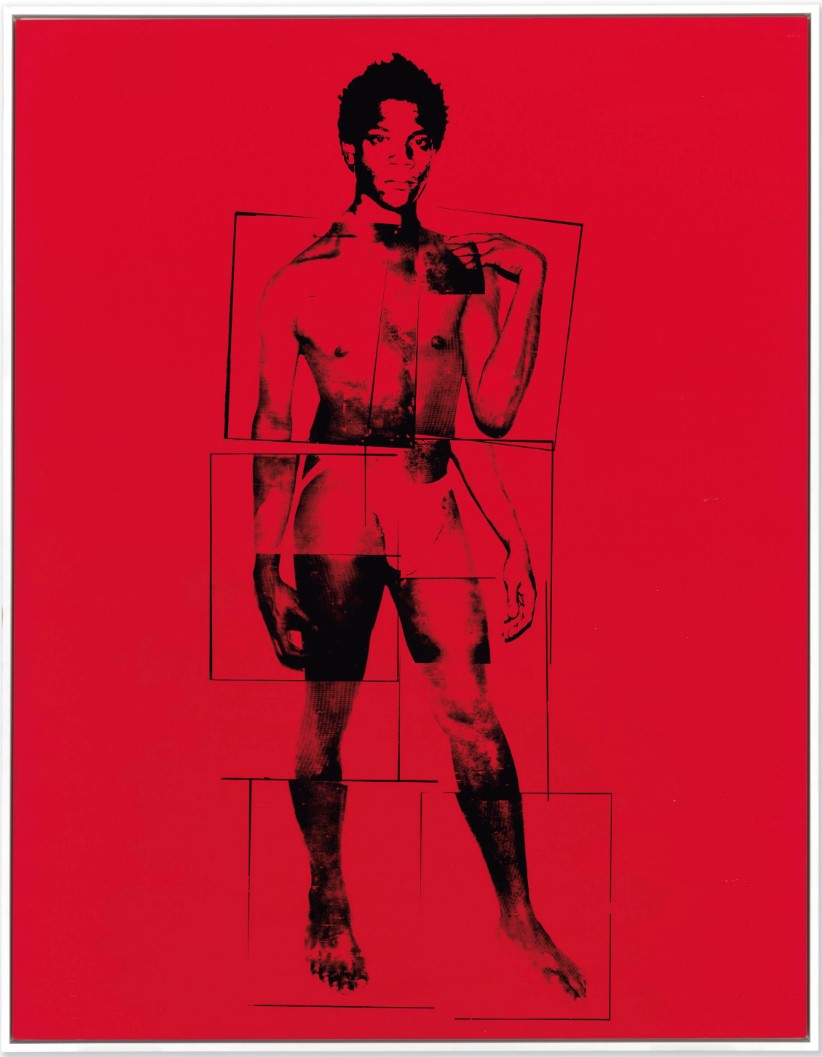
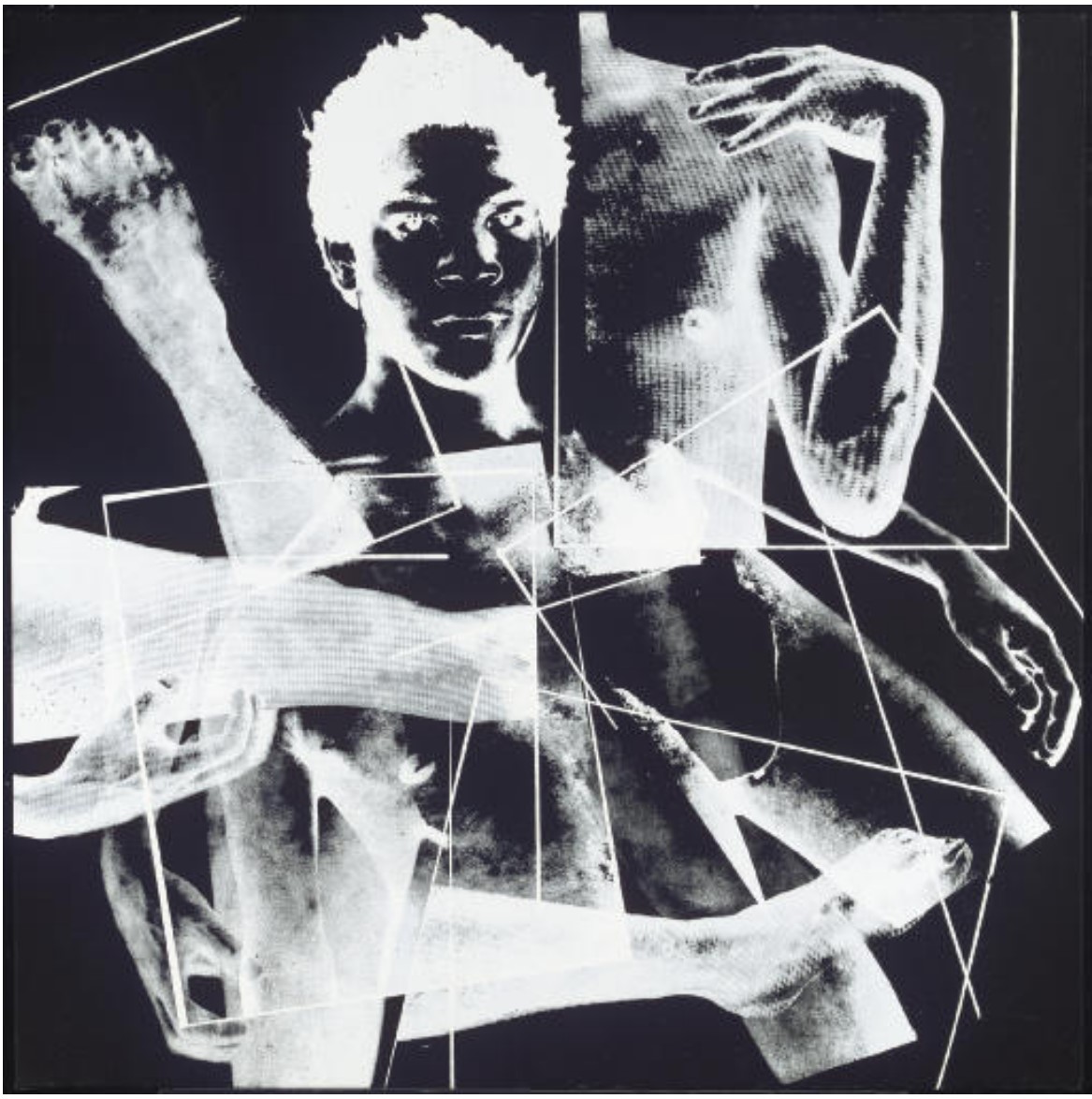
Warhol’s portraits of Basquiat took three different formats. The first portraits feature a full face, silk-screened onto the “oxidized” canvases Warhol used in his series of Piss paintings, in which he achieved a patinated effect from the chemical reaction between metallic paint and urine. These paintings were later followed by two versions of Basquiat as David– with the various parts either assembled into a complete body or shuffled in a psychedelic whirl of flesh as in the present painting. Both Warhol and Basquiat were known to project personas of ironic ambivalence as a defense mechanism to cope with the pressures of life; Warhol frequently refers to “gluing himself together” in his diaries, as if he must compose his personality before facing the world. Jean-Michel Basquiat appears to reflect this fractured state of being, in which one must gather together parts of the self in order to construct an identity. Reviving the photographic negative technique used in his Reversals series, the painting’s stark inverted shadows possess a translucency that recalls x-ray imagery or ghostly apparitions, which appears to expose mortality’s fragile nature– a concept made all the more poignant by the fact that both artists would be dead within four years of the portrait’s completion.
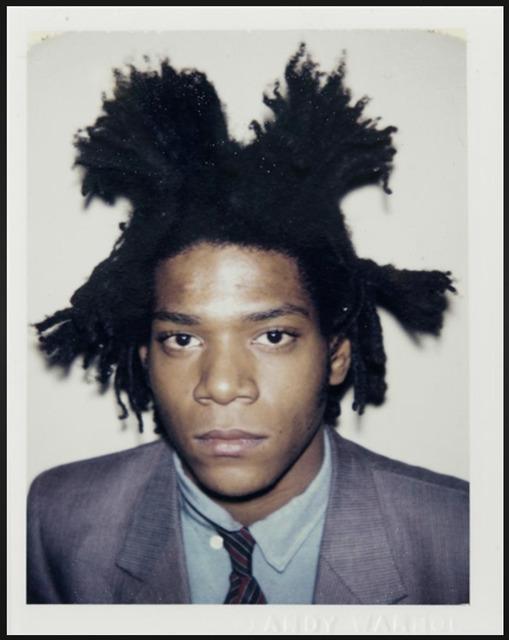
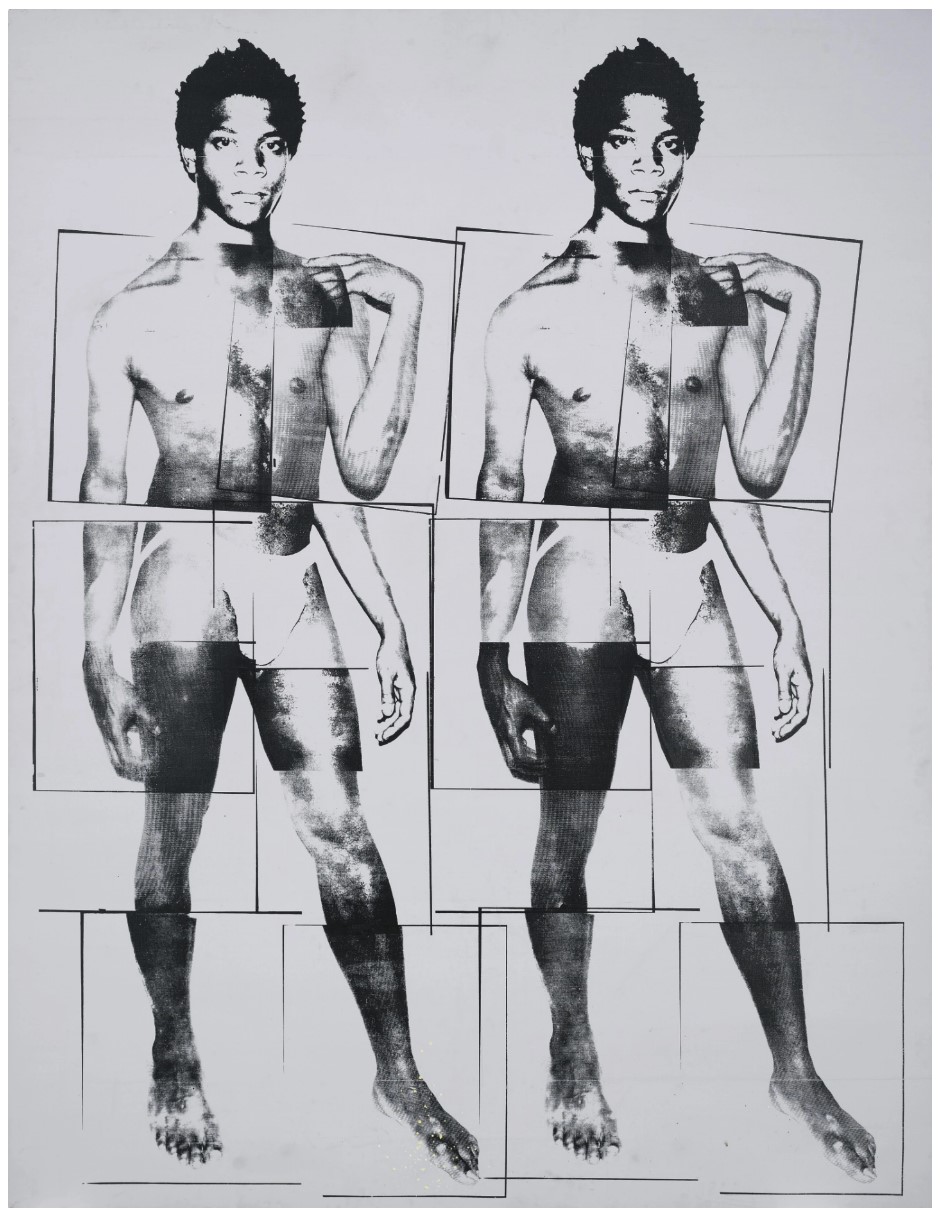
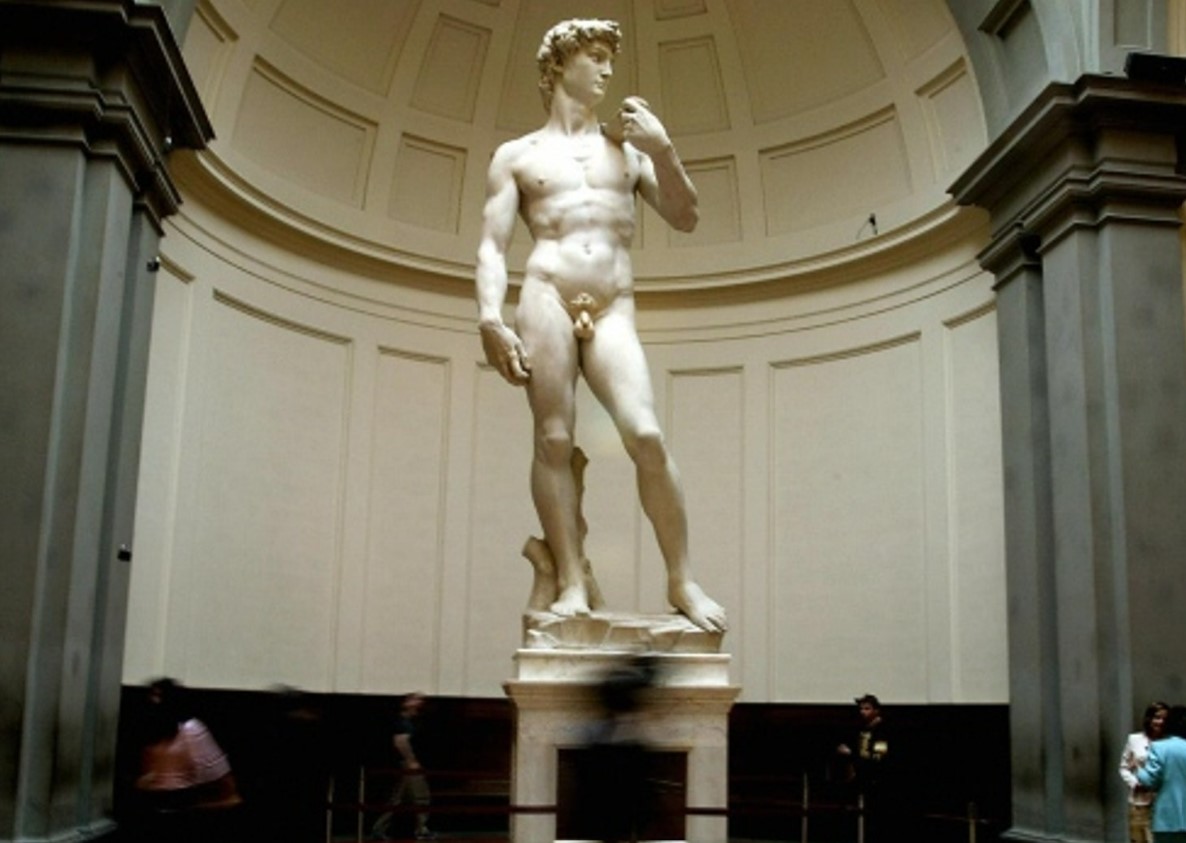
Warhol was undoubtedly captivated not only by the gifted Basquiat’s prowess, but also by the beauty of the painter’s young athletic body, bared here to emulate the heroicism of the classical Greek male ready for battle. In 1983, Warhol captured Jean-Michel in a series of revealing Polaroids. Stripped down to only a white jockstrap and his body carefully posed to mimic Michelangelo’s sensational David, each of Warhol’s snapshots of Basquiat zooms in on a particular section of the artist’s figure. To create the silkscreen template employed for Portrait of Jean-Michel as David, Warhol stacked the square images against one another like the building blocks of a puzzle, resulting in the fragmentary and disjunctive figure seen duplicated in the present work. Warhol pays particular attention to Basquiat’s hands, here multiplied in various gestural motions, a nod to Warhol’s admiration for the painter’s dexterity and innate talent as draftsman.
Yet, while Basquiat reinvigorated Warhol’s energies, there was also an implicit competition that Warhol most certainly felt in the presence of his younger counterpart—an impending challenge to his throne. In the present work, Warhol assumes the role of authority, helpful in Basquiat’s rise to fame through Warhol’s introductions and legitimation. In acting as creator, signaled by the collage-like accumulation of polaroids that visually represents Warhol’s “building” a perfect specimen, Warhol aggressively asserts his own sense of predominance over his mentee. Of course Warhol respected and admired his student, but in stepping back and admiring what he created, he projects his eminent, paternal status. In making explicit reference to David, moreover, Warhol aligns himself with Michelangelo, a self-conscious assertion of art historical dominance.
Portrait of Jean-Michel as David revisits a widely celebrated composition that Warhol first developed in the seminal 1963 painting Double Elvis, the frontally posed male figure duplicated before the same luminous silver background. Not only does Warhol’s self-citation twenty years after he painted Double Elvis conceptually align with the artist’s well-documented, boundary-pushing interest in seriality and repetition, but referencing his past paintings also signifies the artist’s own self-aggrandization in the present work. Meanwhile, the doubling of Basquiat’s figure formally emphasizes the notion of mechanical reproduction, reading clearly from left to right as his left footsteps outward, pictorially punctuating the figures rolling off an assembly line. The present work, while an alluring model of Warhol’s outstanding visual bravura, is significant for the light it sheds into the dynamic between the two paramount artists—a private glimpse into what was an exceedingly public affair.
“It was like some crazy-art world marriage, and they were the odd couple. The relationship was symbiotic. Jean-Michel thought he needed Andy’s fame, and Andy thought he needed Jean-Michel’s new blood. Jean-Michel gave Andy a rebellious image again.”
(Ronny Cutrone in Victor Bockris, Warhol: The Biography, Cambridge, 2003, pp. 461-462)
Basquiat’s anxieties about race, about being a token African-American presence in a rarefied, white-dominated art world, make the notion of the David-and-Goliath subtext all the more personal and pertinent. In this picture, one wonders whether blindness to issues of color, deliberate irony or a desire to show his young protegé as a gleaming, Messianic superman led Warhol to present Basquiat in negative, captured in searing white against a black background. The Pop guru has used the visual idiom of his Reversal series, which usually revisited or reimagined the themes that had become part of the Warholian canon earlier in his career, to deliberate effect, adding to the electric appearance of the picture while bringing to light a complex– and ultimately, as is ever the case with the enigmatic Warhol, ambiguous and unresolved– mixture of issues and insights.
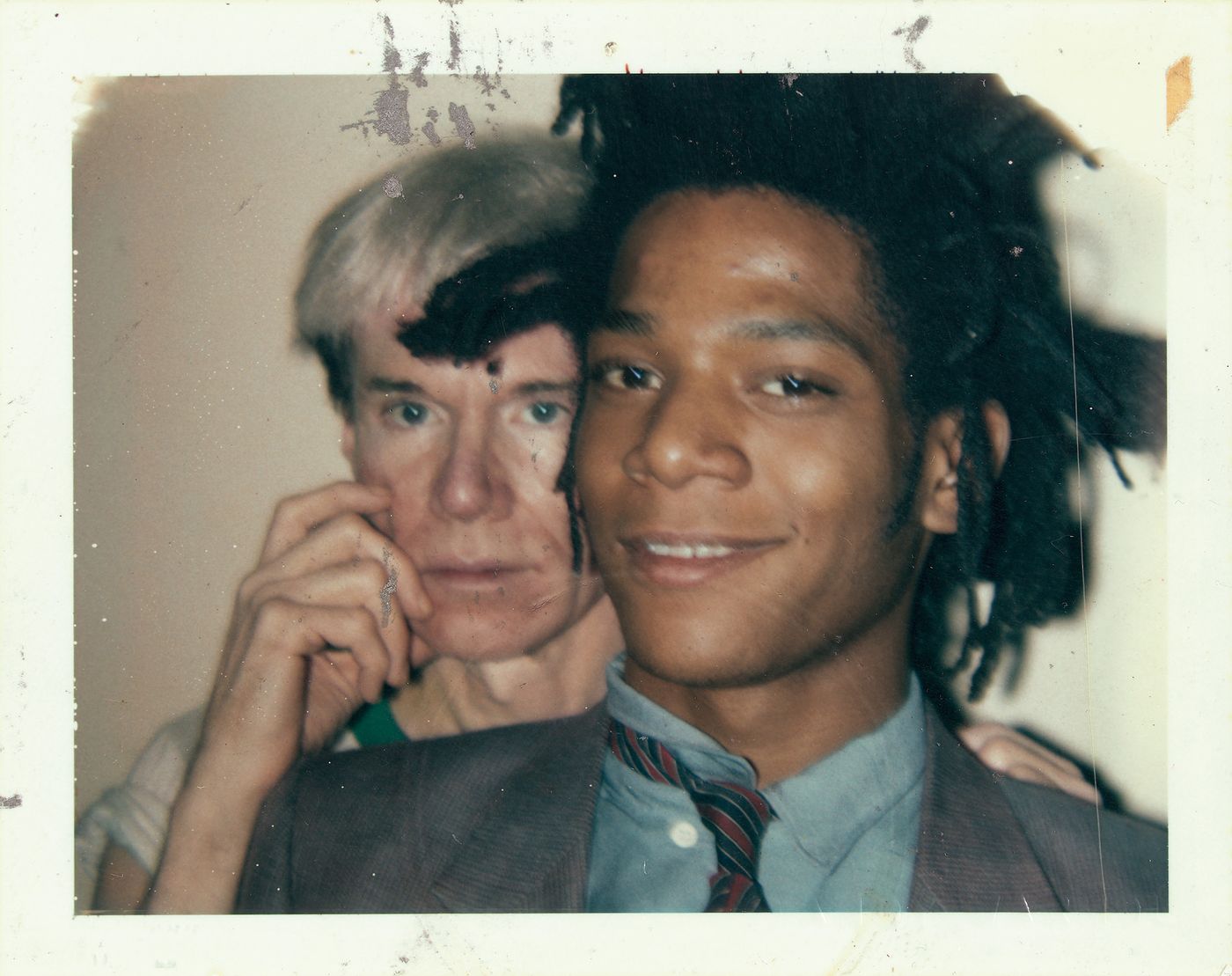
The meeting between Warhol and Basquiat marked the beginning of a new phase in both of the artists’ lives. Warhol had initially been wary of the wild-haired youth who had tried on numerous occasions to insinuate himself into the Factory. It was not until Basquiat was formally introduced to Warhol at a lunch organized by Bruno Bischofberger in the autumn of 1982 that they began to establish their relationship. As a representative of Warhol and a business partner in Interview magazine, Bischofberger had a privileged arrangement, in that he could bring younger artists to the Factory to have a portrait done in exchange for one of their own works. For the young Basquiat, Warhol was an art world deity, a hero and an example. He was so struck by the encounter that he ran off and painted a dual portrait showing himself with Warhol, and returned the still dripping canvas only two hours later, a speed of execution that impressed even the veteran of Pop Art.
On a more personal level, this rejuvenation and new energy were also reflected in the fact that the pair shared a personal trainer at the time, working out together– the dynamism of the broken-up forms may even be intended to reflect Basquiat’s motions while exercising. By 1984, Basquiat was already being fêted as a great artist, a force to watch. Warhol was particularly fascinated with him, and the pair would produce a number of paintings together. While the reaction to their collaborations was somewhat mixed, it nonetheless demonstrates the importance that many artists of the day ascribed to the young painter. Basquiat was cutting-edge enough to be considered able to give Warhol back his own edge, and in turn, Warhol found that the enthusiasm and directness of his young protégé was rubbing off on him, prompting a new creativity that rejuvenated his painterly output.
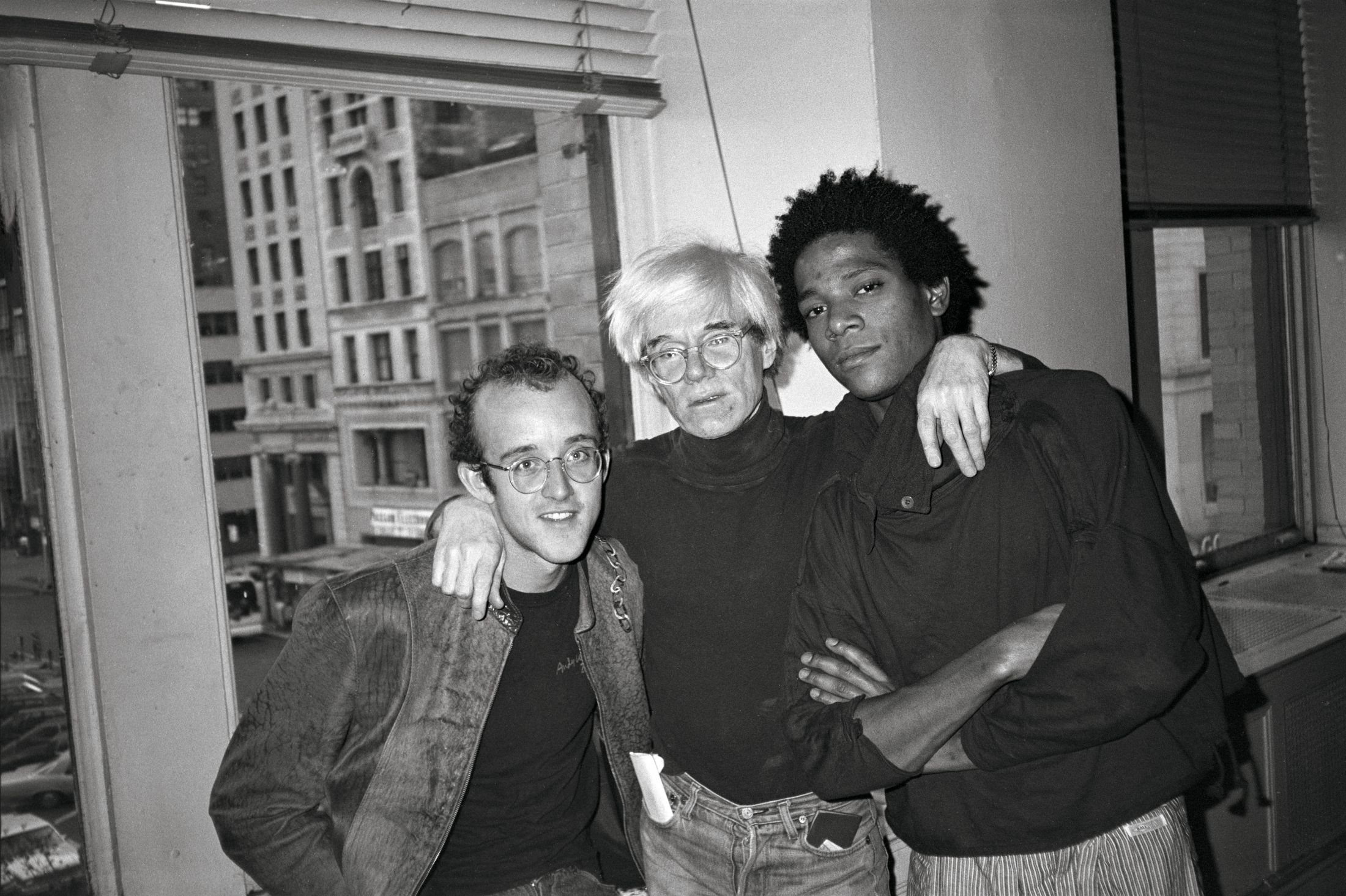
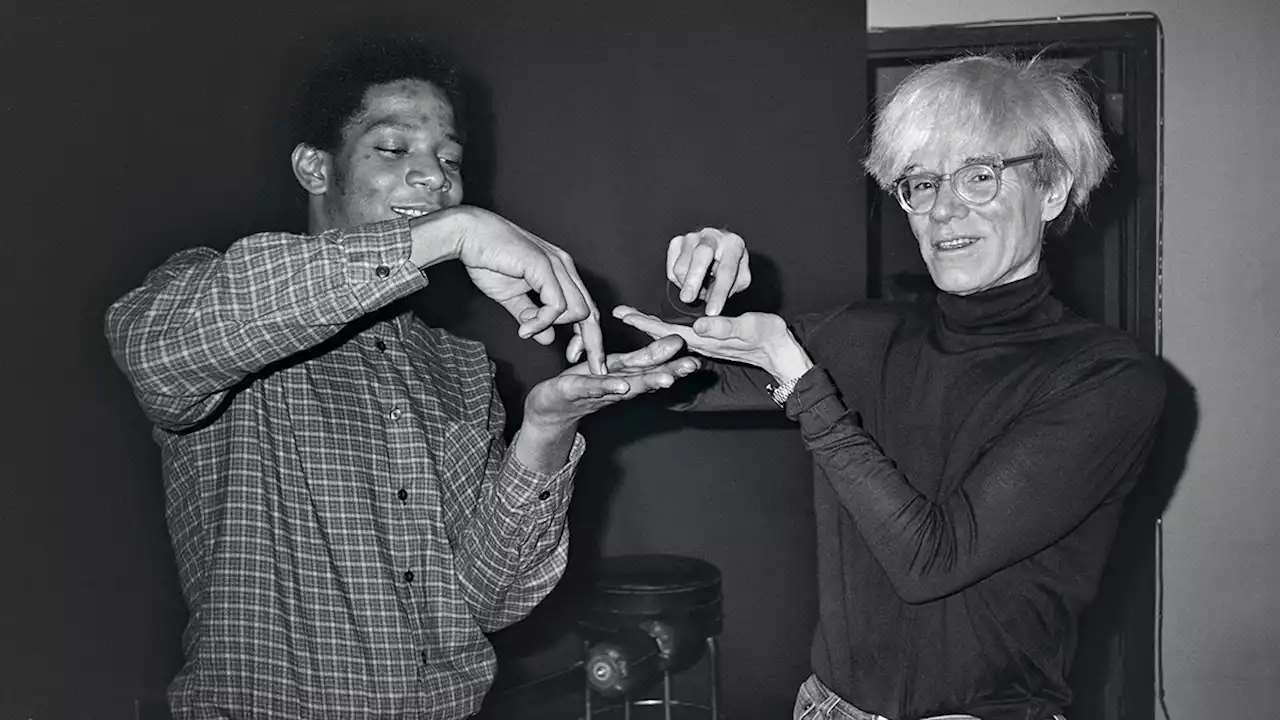
Taking Basquiat under his wing, Warhol behaved as a hyper-cool father figure to the painter– the ultimate art world mentor. The filial bond that existed between Basquiat and Warhol may have originated in an attraction between opposites, but it was also rooted in a deep and instinctive union between two lonely and gifted outsiders. Both artists operated on the fringes of mainstream convention, deflecting the psychological and sociological obstacles in their lives into the language of art. Thus, despite their differences in age, race, background and sexuality, it seems somehow fitting that they would come together as friends. They had complete trust in one another when it came to their work, fueled by a mutual respect that each would record in their portraits of one another. In the spring of 1984, Basquiat painted an homage to his mentor for his first show at the Mary Boone Gallery– a portrait of Warhol as a speckled banana in honor of his famous album design for the Velvet Underground. According to Phoebe Hoban, Basquiat’s biographer, Warhol painted the portrait of Basquiat as David to return the compliment. Through the fractured portrayal of Basquiat, Warhol fetishizes the artist’s body in a calculated expression of erotic attraction that reworks the classic canon of art into a commentary on the complexities of modern identity and fame. In doing so, he not only sustains his interest in the artifice of representation but has also created a lasting testimony to a troubled and brilliant young artist who would never grow old.
Jean-Michel Basquiat
Christie’s New-York: 10 November 2021
USD 40,091,500
ANDY WARHOL
Jean-Michel Basquiat, 1982
Metallic pigment, acrylic, silkscreen ink and urine on canvas
40×40 inches (101.6 x 101.6 cm)
Stamped with the Estate of Andy Warhol and the Andy Warhol Foundation for the Visual Arts, Inc. stamps and numbered ‘VF PO50.762’ (on the overlap)
In this striking 1982 painting, Andy Warhol admits the young Jean-Michel Basquiat to his pantheon of twentieth century cultural icons. At just 23 years old and producing some of the most iconic works of his career, Basquiat alongside icons such as Marilyn Monroe, Elizabeth Taylor, and Elvis Presley, was a figure who defined creativity in the American century. The gleaming image of the young artist also celebrated the remarkable friendship between the two men: Warhol, the established master of Pop Art, and Basquiat, the brash wunderkind of the New York art scene. Thought to be the only example in private hands, this rare and deeply personal work dates from a period which marked the highpoint of Basquiat’s painterly authority, and which also saw a bold new inventiveness appear in Warhol’s work.

Both artists, in their own unique ways, redefined the very framework of twentieth century art, and have done much to shape the current cultural landscape; from music to fashion, and YouTube to TikTok, their visual philosophy remains as relevant today as it ever did. Warhol’s depiction of Basquiat stands as the only known portrait executed in oxidation form, and one of its sister paintings is housed in the permanent collection of the Andy Warhol Museum in Pittsburgh. The third example of this painting stayed with Jean-Michel Basquiat for his entire life, and still remains in the artist’s estate. The exceptional clarity of this particular screened image, along with the uniform distribution of the oxidation, marks the present work as a highly accomplished and intoxicating composition. This example has been privately held in the Collection of Peter Brant for nearly two decades, and during that time has been widely exhibited, including most recently at the Whitney Museum’s 2018 critically acclaimed retrospective, Andy Warhol: From A to B and Back Again.
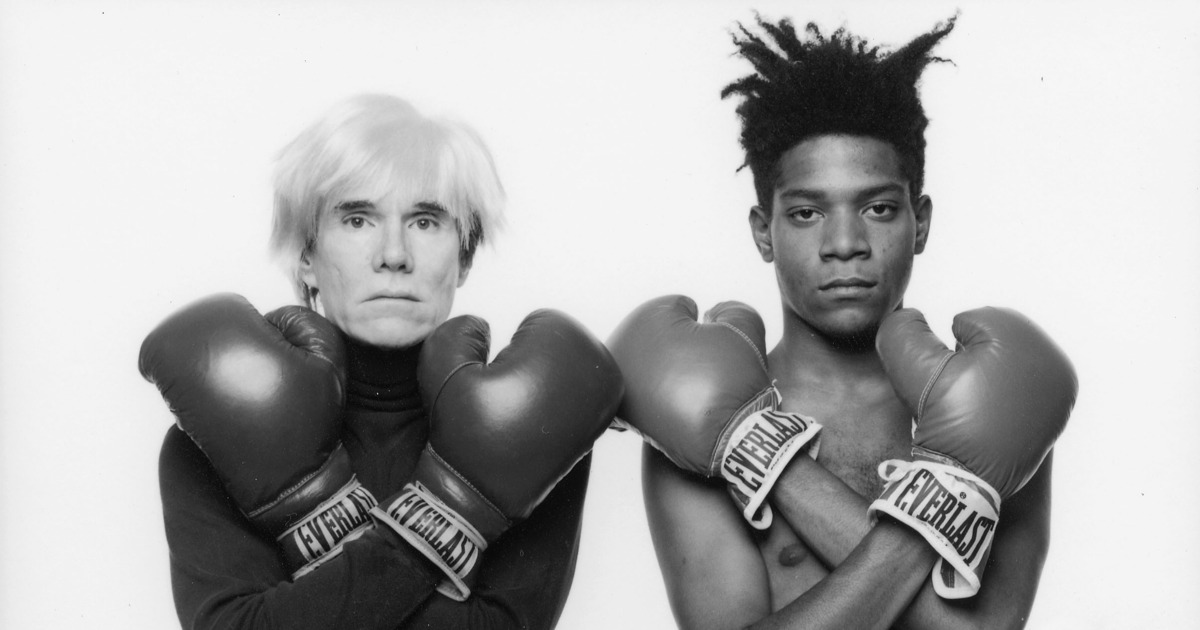
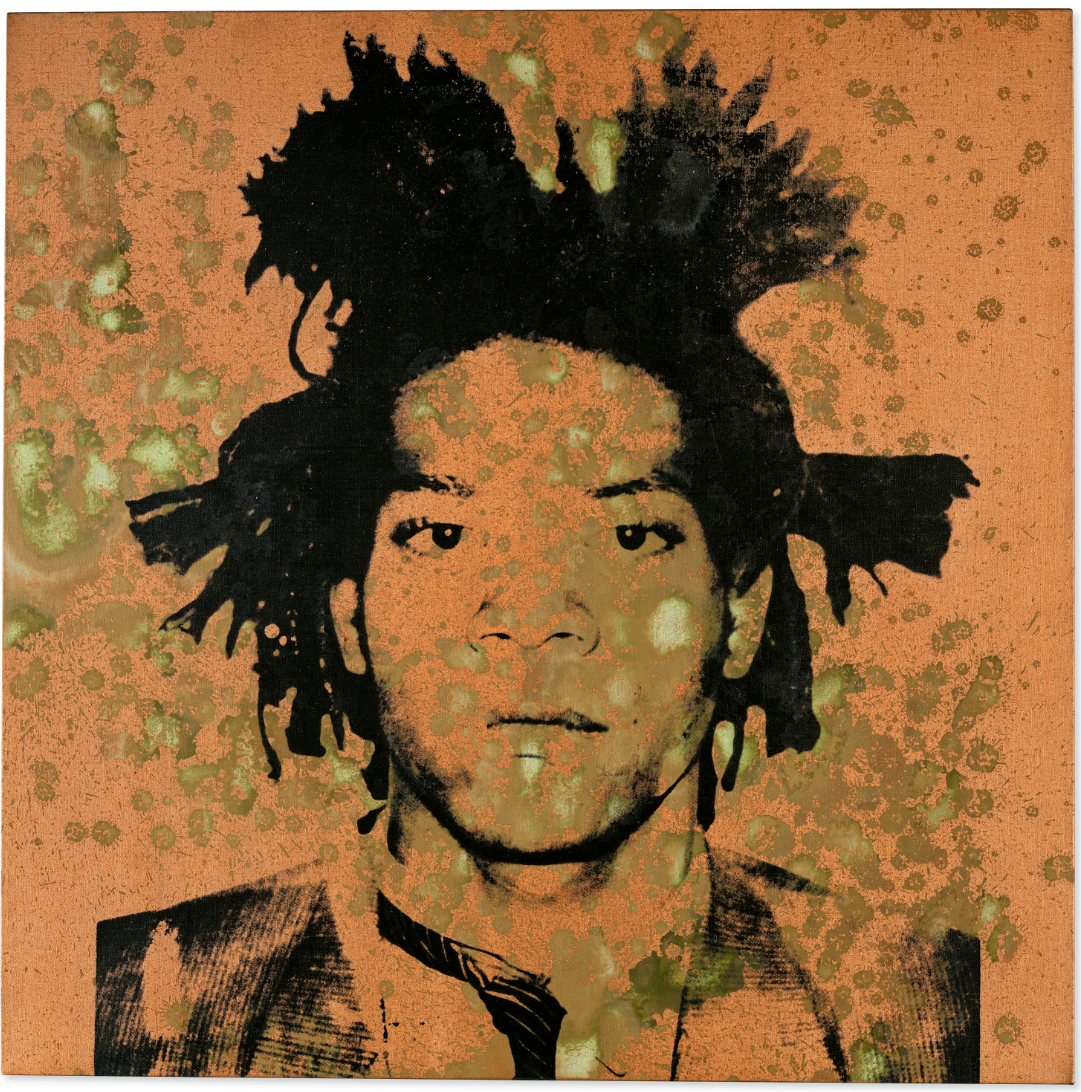
From the shimmering copper surface of this 40×40 inch canvas, the larger-than-life face of Jean-Michel Basquiat stares out at us with supreme authority. Wearing his hair like a crown, his direct stare is powerful, and although his expression conveys no emotion, we sense that we are in the presence of greatness. This feeling is, in part, due to the clarity of Warhol’s screened image; by using just the right amount of paint and applying the correct amount of consistent pressure as the inks are pushed through the screen, we are left with an image in which even the smallest and most insignificant detail is lavishly rendered. The sharp contours of Basquiat’s jawline are contrasted with the chiaroscuro shadows that envelope the rest of his face; his eyes show pinpoints of light that are reflected in his iris; and the individual eyelashes and weave of his jacket are depicted with precision. This exactness is contrasted by the bursts of oxidation that orbit around Basquiat’s head, like stars in the young artist’s universe. Warhol has clearly taken the time to celebrate young friend’s likeness as that of a singular figure.
In choosing to depict Jean-Michel Basquiat in this way, Warhol elevates the 23-year-old artist to the status of an icon’s icon. In doing so, he is inducted into a body of work that includes Gold Marilyn Monroe, 1962 (Museum of Modern Art, New York), and his shimmering Silver Liz [Ferus Type], 1963 (Andy Warhol Museum, Pittsburgh). Warhol reserved his use of metallic paint for only a select few of his subjects. In addition to Monroe and Taylor, Elvis Presley and Jacqueline Kennedy were two of the subjects afford this honor.
In addition, by rendering Basquiat’s likeness against a shimmering ground, Warhol also anoints Basquiat as a literal icon as well as a symbolic one. While growing up in Pittsburgh, the young Andrew Warhola lived in the fervently Catholic Ruska Dolina, the Ruthenian section of Pittsburgh. He would regularly go to mass with his Slavic grandmother where they would pray before a large shimmering altarpiece studded with religious icons of the Holy Family and other saints. This habit continued throughout his life, and even in New York, Warhol would regularly slip into the back of the St. Vincent Ferrer church on Lexington Avenue to pray in the presence of the mosaic icons that decorate the walls of the church.
In 1982, the year in which Warhol painted Jean-Michel Basquiat, the veteran artist was undergoing something of a resurgence. After a decade spent working mainly on commissions from society hostesses or midwestern businessmen keen to be immortalized in his Pop style aesthetic, Warhol became reinvigorated with the act of painting and embarked on a period of remarkable innovation. This was due in part to his developing friendship with a generation of younger, more avant-garde artists. Among them was Jean-Michel Basquiat to whom Warhol was formally introduced by the dealer Bruno Bischofberger, and soon the pair developed an unlikely friendship.
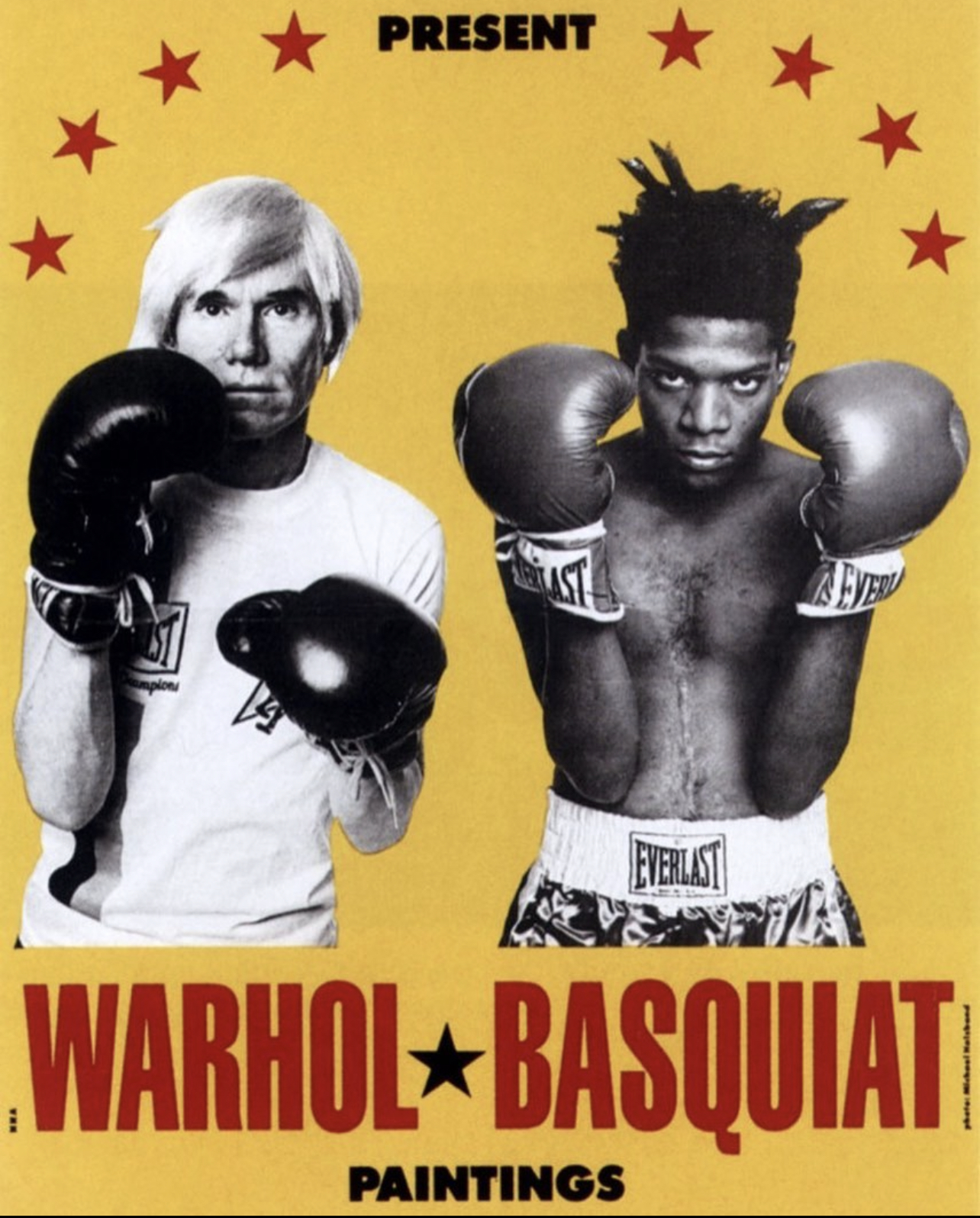
People have speculated about whether Warhol was using Basquiat, or whether Basquiat was using Warhol. Basquiat defined a new genre of art and expression, and Warhol admired him for his ability to capture the essence of 1980s New York city street culture. Conversely, Basquiat admired Warhol for his status in the art world and the two became friends. It has been assumed that it was Warhol who had pestered Basquiat to allow him to paint him his portrait, but Fab 5 Freddy—a member of the downtown underground creative scene—has said that it was actually Basquiat who approached Warhol with the idea. The younger artist had admired Warhol’s Oxidation paintings from the 1970s, and loved of the idea of being immortalized in this way. Whatever the actual chain of events, the two formed an incomparable relationship that dominated the art world in New York in the 1980s. Fellow artist Ronnie Cutrone remembered, “It was like some crazy-art world marriage and they were the odd couple. The relationship was symbiotic. Jean-Michel thought he needed Andy’s fame, and Andy thought he needed Jean-Michel’s new blood. Jean Michel gave Andy a rebellious image again” (R. Cutrone quoted in Warhol: The Biography by Victor Bockris, Cambridge, 2003, pp.461-2). This unlikely pairing soon became a fixture on the New York art-world party circuit and was frequently pictured together on the cover of magazines, on television, in the paper. Basquiat became a member of Warhol’s entourage and was credited with renewing Warhol’s interest in painting on canvas, which had dwindled somewhat since its heyday in the 1960s.
Screened on the abstract ground of an oxidation painting, Jean-Michel Basquiat is an exceedingly rare example of Warhol’s work, as his portraiture is normally straightforward in its figuration. These oxidation paintings are thought to be nods to his Abstract Expressionist predecessors and contemporaries, including Jackson Pollock, and are some of the artist’s only known abstract works. With this portrait, Warhol firmly captures a unique essence of his friend and fellow artist, while simultaneously announcing Basquiat’s admission into the shrine of glittering icons that helped to define the cultural landscape of the past fifty years.
Portrait of Jean-Michel as David
Sotheby’s New-York: 13 May 2014
USD 3,189,000
 ANDY WARHOL
Portrait of Jean-Michel as David, 1984
Acrylic and silkscreen ink on canvas
90 x 69.5 inches (228.6 x 176.5 cm)
Signed and dated ’84 on the overlap
Almost four centuries after Michelangelo majestically carved his monumental David out of a single block of Carrara marble, Andy Warhol executed Portrait of Jean-Michel as David, a superbly rendered, complexly layered, and remarkably intimate characterization of his collaborator, protégé, friend and sometimes competitor Jean-Michel Basquiat. Standing at an immense 90 inches tall, Warhol’s painting of the Adonic young Basquiat standing doubled in the classical Renaissance contrapposto mirrors the original David in scale, towering over the viewer to convey the extensive prominence and rising power of Basquiat’s art-world star during this period in the mid-1980s. As the peerless Michelangelo played God, creating man from inanimate material, this rare painting sees Warhol experimenting with his own divine endowments as the undisputed godfather of Pop art.
The present work offers a unique window into the relationship between the ringleader Warhol and the wunderkind Basquiat, two individually eminent artistic voices of the Twentieth Century whose fertile partnership spawned the production of over 100 collaborative paintings, while also fundamentally impacting the development of one another’s distinctive styles. Prior to the initiation of their relationship at the instigation of the legendary Zurich gallerist Bruno Bischofberger in 1983, Basquiat obsessively revered Warhol, attempting on several occasions to meet his role model—Warhol being the progenitor of the graphic Pop art style that paved the way for the young painter. In turn, Warhol was enamored by Basquiat’s infectious charisma and energy, a youthful fervor exemplified when Basquiat zealously painted a double portrait of the two artists and had it delivered to the Factory within hours of meeting Warhol, the canvas still wet. They would paint several portraits of each other over the course of their impassioned and volatile relationship, both infatuated with each other’s celebrity and artistic genius. Notably, Basquiat’s unwavering enthusiasm prompted Warhol to pick up a paintbrush after almost 20 years of eschewing painting in favor of the silkscreen.
Reel Basquiat
Christie’s New-York: 12 May 2015
USD 3,973,000
ANDY WARHOL
Reel Basquiat, 1984
Synthetic polymer and silkscreen ink on canvas
90×70 inches (228.5 x 177.8 cm)
Jean-Michel Basquiat
Christie’s New-York: 12 November 2007
USD 1,273,000
ANDY WARHOL
Jean-Michel Basquiat, 1984
Synthetic polymer and silkscreen ink on canvas
40×40 inches (101.6 x 101.6 cm)
A faceted, kaleidoscopic painting executed in the 40×40 inch square format Warhol typically reserved for his full-face portraits, Jean-Michel Basquiat derives from a sequence of Polaroid photographs Warhol took of Basquiat in August of 1983. A scrambled puzzle of body parts, the layered images create a sense of movement similar to the dynamic stop-motion photography of Edward Muybridge. Yet, the segments show Basquiat posed in the static, statuesque form of Michelangelo’s colossal sculpture David, taken piece by piece with Warhol’s Big Shot portrait camera.