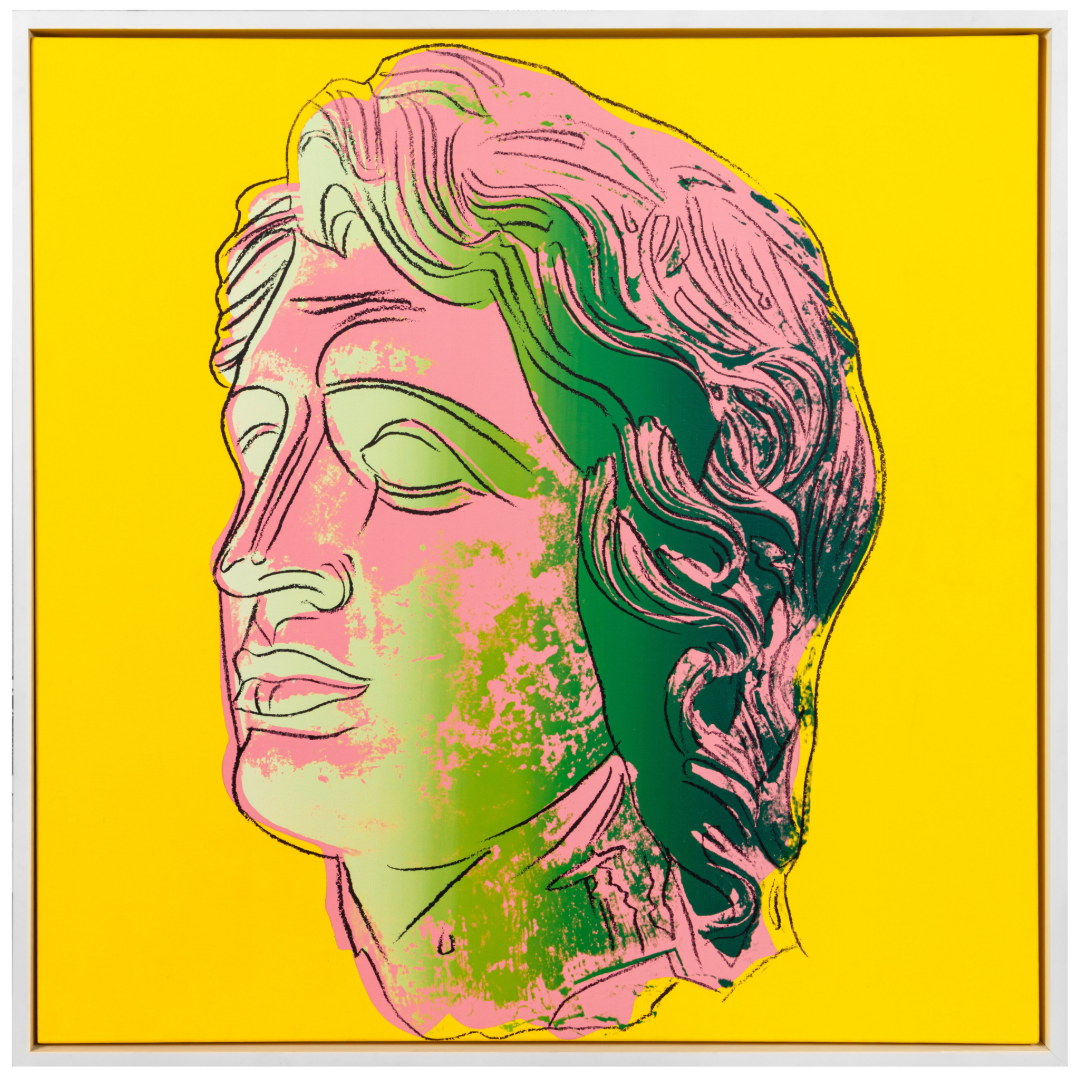
ANDY WARHOL (1928 – 1987)
Alexander the Great, 1982
Acrylic and silkscreen ink on canvas
40×40 inches (101,5 x 101,5 cm)
Bears the stamps of the Estate of Andy Warhol (on the overlap)
Provenance
Coskun Fine Art, London
Private Collection, Paris (acquired from the above in 2001)
Auction History
Sotheby’s Paris: 23 October 2026
Estimated: EUR 1,800,000 – 2,500,000
EUR 2,176,000 / USD 2,437,555
Andy Warhol | Alexander the Great | Surrealism and Its Legacy | 2026
The relationship between Iolas and Warhol embodies a rare combination of love, artistic devotion, and steadfast loyalty. In 1952, Iolas was the first to welcome Andy Warhol’s very first gallery exhibition at his New York gallery. He had met Warhol in 1945; Warhol was no more than seventeen years old at the time and was working as a commercial illustrator. Shortly before their deaths, they both died in 1987, it was Iolas who presented Warhol’s final exhibition during his lifetime, in Milan: a series of works inspired by Leonardo da Vinci’s Last Supper.
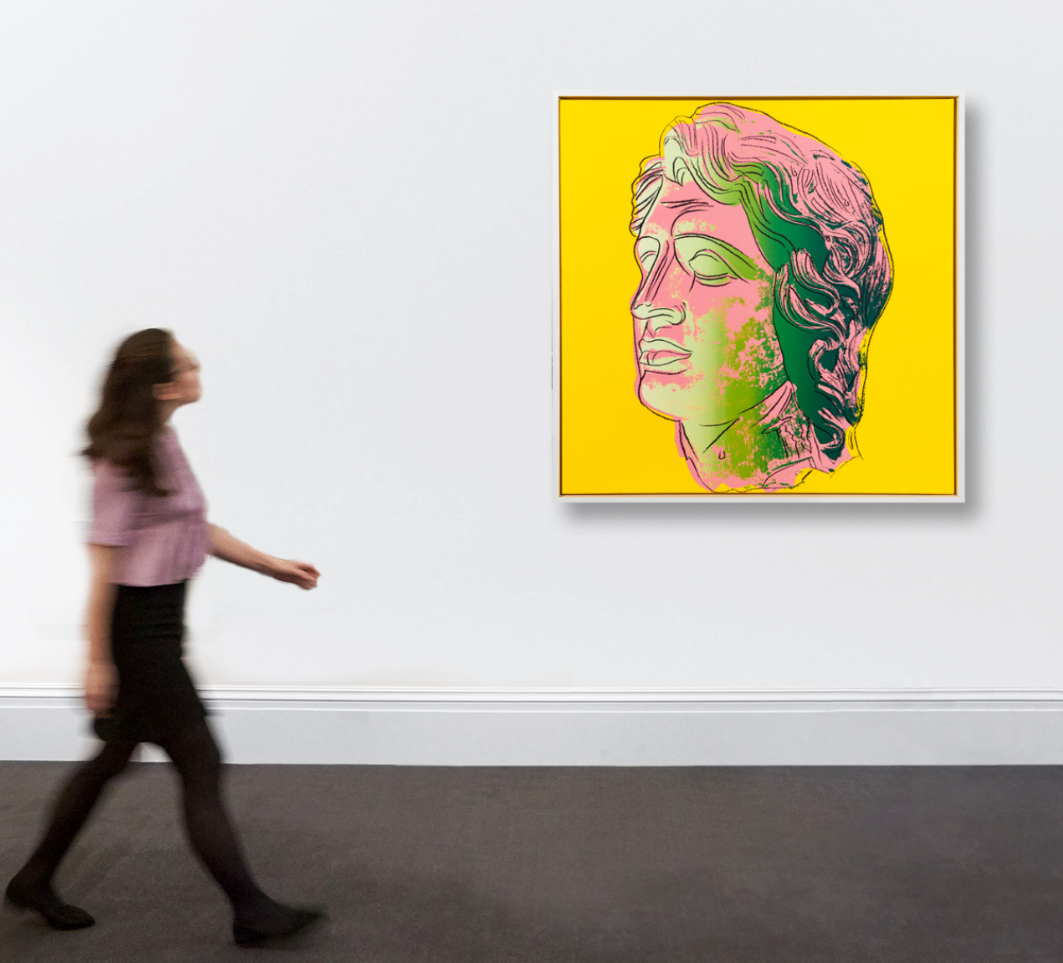
Dating from 1982, Alexander the Great is a revealing work within this extraordinary context, brilliant and glamorous in both its splendor and its decadence. The work is extremely rare in its canvas version. What is best known is the portfolio of two profile screenprints, produced in an edition of twenty-five, in addition to sixty-five artist’s proofs. These were commissioned by Iolas from Warhol for the legendary exhibition The Search for Alexander, held at the Met at the end of 1982.
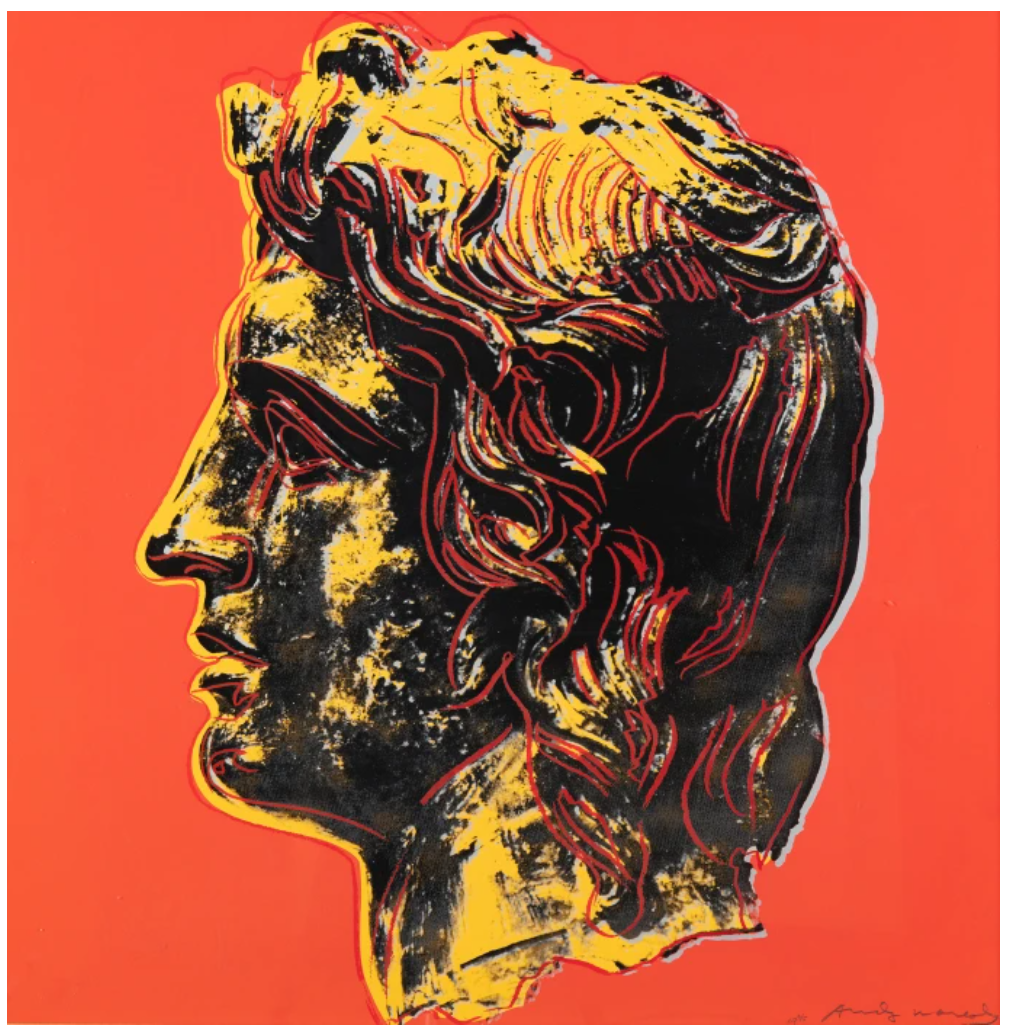
Andy Warhol, Alexander the Great, screenprint on Lenox Museum Board
Beyond the specific circumstances of the exhibition devoted to the quasi-mythological figure of the great conqueror, the kingdom of Macedonia, of which he became king in 336 BC, extended as far as Persia and the borders of the Indus, and philosopher, he was a pupil of Aristotle, the choice of Alexander belongs to a broader movement within Warhol’s work: the emergence, during the 1980s, of historical figures among the constellation of contemporary stars who surrounded him. Thus the Mona Lisa in 1980, Goethe in 1982, and Beethoven in 1987 joined the highly “select” circle of friends, actors and stars, political celebrities, patrons, and jet-set figures whose portraits Warhol produced and who revered him as their favorite portraitist.
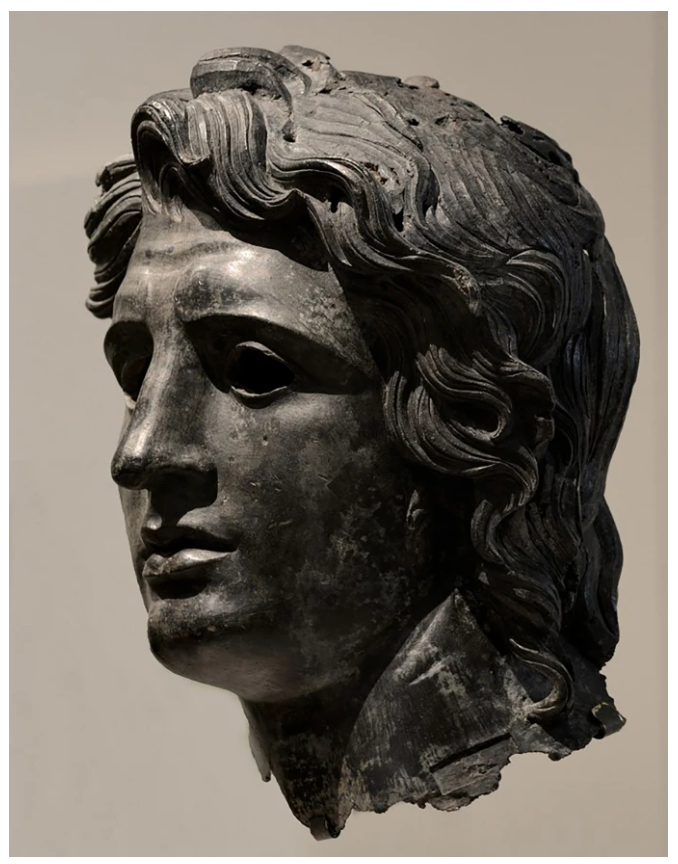
Head of Alexander the Great, bronze, Greek or Roman, Late Hellenistic to Hadrianic
ca. 150 BCE — 138 CE, Metropolitan Museum of Art, New York (on loan)
Somewhat in the manner of Hyacinthe Rigaud or Gainsborough, to evoke only the seventeenth and eighteenth centuries, Warhol excelled at portraying the personalities who surrounded him. What is unprecedented here, if one may say so, and indeed the term is almost paradoxical in this context, is the dissemination of the portrait through the medium of screenprinting. The portrait becomes an object of mass production and consumption. With a subject such as Alexander, one is reminded of the coins and medals which, in Antiquity and well into the Renaissance, served as vehicles for popularizing the likenesses of monarchs.
Yet it seems to us that this unique and rare work depicting Alexander the Great is, in every sense of the word, more akin to an icon: first because it is unique; because the magnificent fluorescent yellow background is not without evoking the gold backgrounds of ancient icons; and because the very figure of the portrait is precious and worthy of adoration. Nevertheless, inspired by a photograph of a bronze bust of the king of Macedon, Alexander the Great, in this work, which retains something of the original ronde-bosse or three-dimensional sculptural form, acquires the dimension of a res in the original Latin sense of the word, in other words, a thing. This is Pop art in its most primitive and purest form.

The epic dimension of this large Alexander the Great canvas continues in the implicit homage it pays to the truly mythical dealer Alexander Iolas. The man whom some nicknamed Alexander the Great was born in Alexandria into a Greek bourgeois family. Handsome and young, he pursued dance professionally, notably with Balanchine. In 1944, he eventually devoted himself to his career as an art dealer, in which he quickly made his mark. A pioneer in developing a network of art galleries, he introduced nothing less than Surrealism, including Brauner, Magritte, Max Ernst, Lalanne, and others, to the United States, as well as Ed Ruscha to the East Coast.
A highly charismatic figure, he possessed the elegance of being an artist among artists. Through the powerful and sexy figure of Alexander the Great, Warhol could hardly have paid him a more brilliant tribute.