In 1981, Warhol created a series he called the Myths or New Myths, in which he selected ten American mythical figures from the realm of popular culture, television, comic books and film. Warhols selection process was incredibly rigorous, but eventually he narrowed his scope to ten essential characters, the most resonating of which evoke a post-war America in its youth and the consumerism that drove its growth. In his Myths series from 1981, Andy Warhol tackles the question of who are the American myths of the twentieth century? Warhol sought to find images that captured and captivated us as did the gods and goddesses in ancient Greece and Rome. This is not an unfamiliar subject for Warhol, who spent most of his career trafficking in icons of the age. Since the beginning of his career, Warhol had a preternatural gift for transforming banal objects into motifs of an era – soup cans, dollar bills and coke bottles were just some of the many objects that Warhol sought to elevate into symbols of the modern world. In this series Warhol was more explicit in his intentions to find the gods of the modern American Olympus. In a world obsessed with pop culture, Warhol deems our gods to be Superman, Santa Claus, Mickey Mouse, Dracula, The Wicked Witch of the West, Uncle Sam, Howdy Dowdy, King Kong and Mammy.
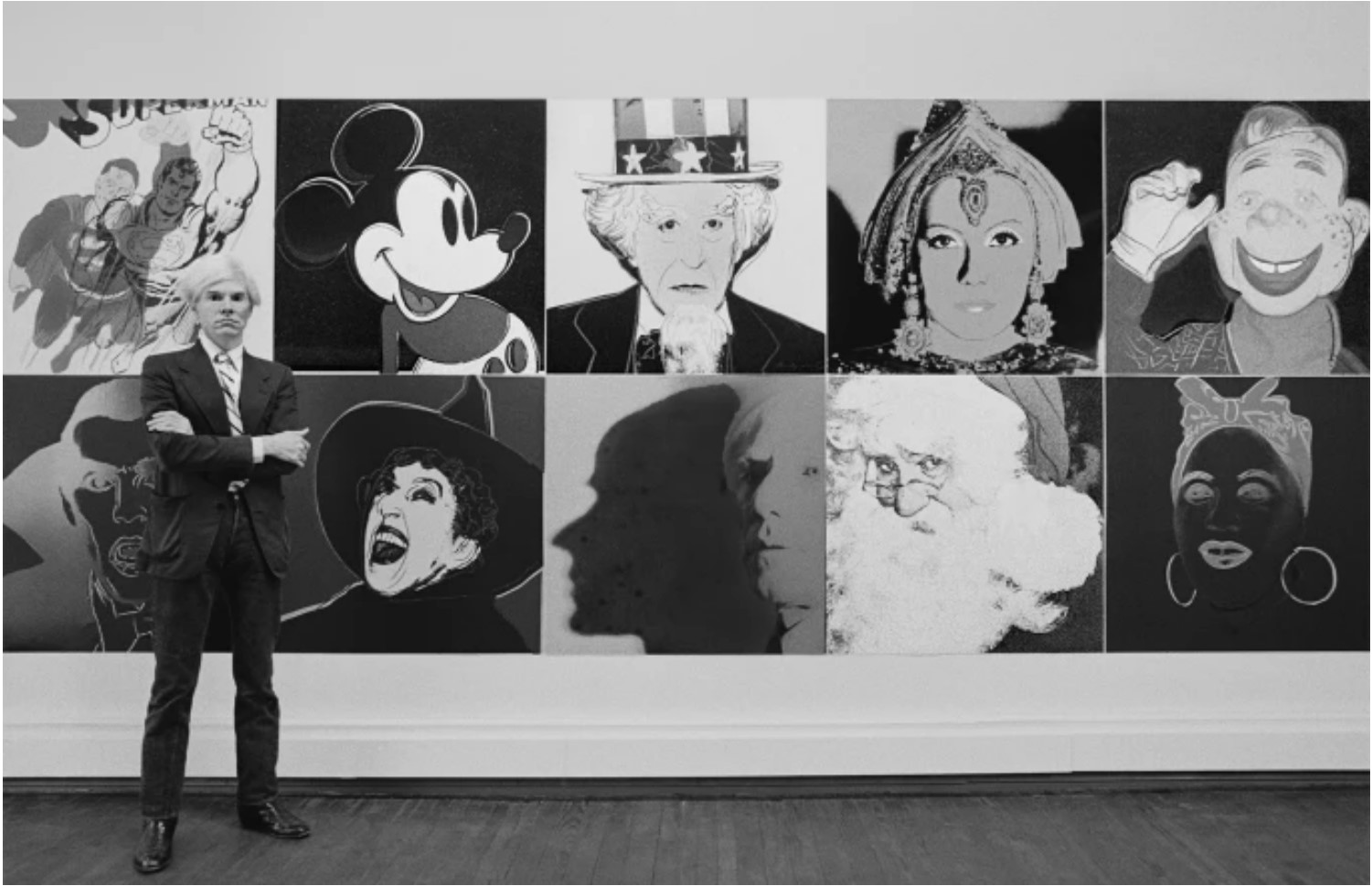
Ever the iconoclast, ever willing to plunder the wealth of images generated in our media-saturated world, during the late 1970s and early 1980s Warhol began to choose subjects for his images in a more reflective and self-reflexive way. This resulted in works such as the Reversals, where he created a strange and sombre negative of images that had become instantly recognizable as the work of the master. Meanwhile, in the Myths he tackled the theme of celebrity that had for so long been his source and his obsession in an exciting new way. Instead of taking stars, he took icons of a different sort, a fictitious pantheon. These were the personalities of popular culture, of fiction and the mass media, of television, comics, mythology, film. So, alongside Dracula, Warhol created images of Superman, Mickey Mouse, Santa Claus, Uncle Sam, Mammy, Howdy Doody, The Witch, Greta Garbo as The Star and a self-portrait as The Shadow. The process of selection for these ten characters was hugely rigorous. Warhol in fact took many photographs and scanned many source materials, discarding other ideas such as Mother Goose and the Tooth Fairy.
The ‘celebrities’ to whom Warhol was now turning were figments of the public perception, strange ciphers of the modern consciousness. These had their origins in different sources. Garbo was here used as the archetype for the generic Hollywood star, an untouchable staple of modern life and the modern media. A comic-strip image of Superman, that all-American superhero, was used, while Warhol also managed to get his hands on a Howdy Doody puppet, adding a sense of portraiture to his depiction of the television character who had colored and shaped so many childhood memories for people of Warhol’s generation and later. And for the witch, he managed to convince Margaret Hamilton, who had played the Wicked Witch of the West in the 1939 classic film The Wizard of Oz, to reprise her role four decades later, as he knew her from his neighborhood.
Myths, one of Warhol’s most sought-after print portfolios, epitomizes the artist’s ability to identify and distil American popular culture into powerful and iconic images. Created in 1981, Myths consists of ten screen prints published by gallerist Ronald Feldman. The pieces contained within the series include Dracula, Howdy Doody, Mammy, Mickey Mouse, Santa Claus, Superman, The Shadow, The Star, The Witch, and Uncle Sam. The Myths portfolio is a compendium of American entertainment idols. Many of Warhol’s chosen subjects in the series date back to the early days of TV and film. For example, Howdy Doody was a children’s television show that first aired in 1947, while The Star features Greta Garbo. Figures such as the cackling Wicked Witch of the West from The Wizard of Oz and the costumed flying figure of Superman function as heroes and villains; mythological embodiments of good and evil. Depicting fictional figures from television, film and popular folklore, using rich colors and diamond dust, Warhol pays a nostalgic homage to the characters that featured heavily in both his childhood and a shared American cultural consciousness.
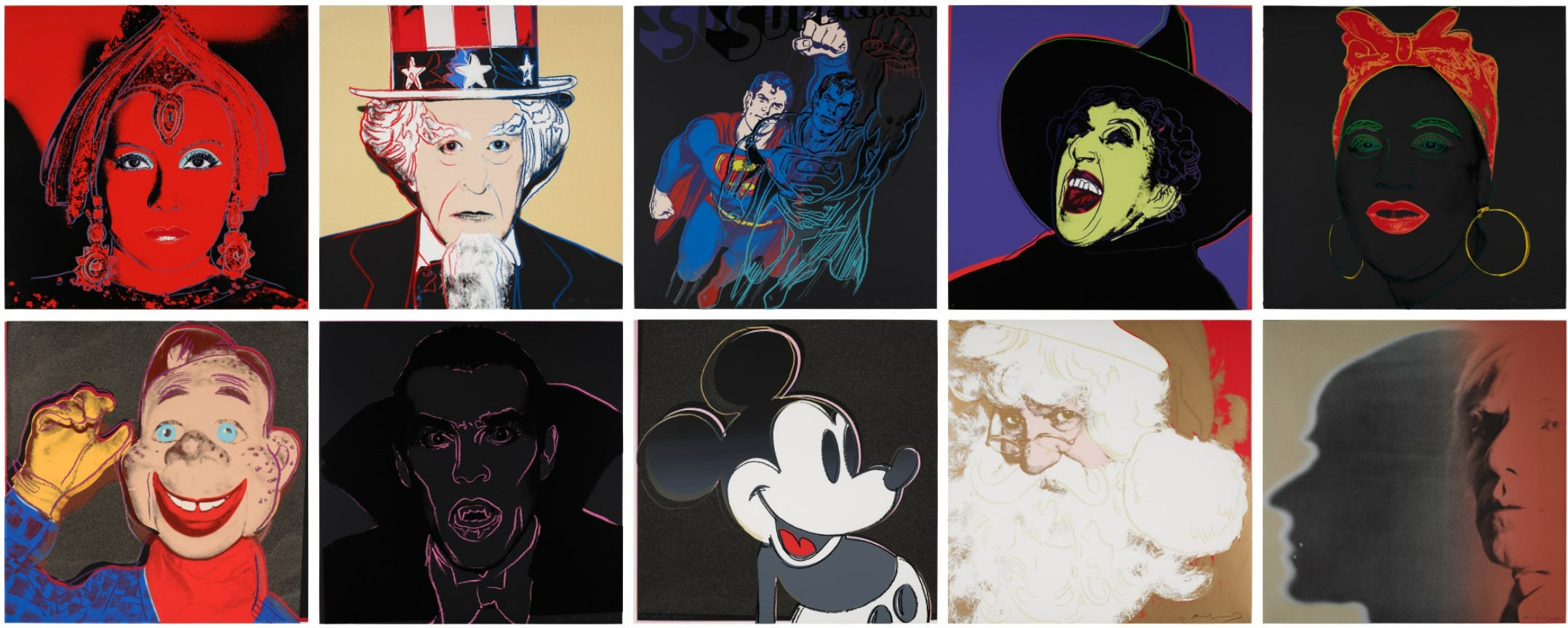
Warhol did not appropriate existing imagery, for Dracula and Uncle Sam, the artist called upon actors and friends to recreate these archetypal characters. Warhol then took Polaroid photographs which became the source material for his screen prints. This elaborate process, involving makeup and costumes, resulted in dynamic images imbued with movement and vivid color. Warhol even included an image of himself as The Shadow, a crime-fighting hero from the 1930’s radio show. The artist looks out from the picture plane as a shadowy, enigmatic figure. The process of selection for these ten characters was hugely rigorous. Warhol in fact took many photographs and scanned many source materials, eventually discarding other possibilities such as Mother Goose and the Tooth Fairy. Like all of Warhol’s embellished portraits, many of the Myths themselves are fictions of the image that they are meant to portray.
“I looked for ideas on the New Myth series…But I think the best thing we decided to do is to have people come and dress up in the costumes and we’ll take the pictures ourselves, because that way there’s no copyright to worry about.”
As Metcalf has written, “What is the difference between Marilyn Monroe, a Campbell’s Soup Can, Uncle Sam, Golda Meir, O. J. Simpson, and Mickey Mouse? Nothing, say the portraits of Andy Warhol. They are all icons of America’s modern mythology of celebrity. Icons that sell…To paraphrase Joseph Campbell, mythology is the organization of metaphorical figures that connote a state of mind, that transcend their specific place or time… To paraphrase Andy Warhol’s portraits, the mythology of America is celebrity, the gods and demigods are those who can sell through their mass-produced images, and the course of action we, as a culture, are called to is to consume. These portraits record an American culture transformed from hero- to celebrity-worship and the role of cultural icon as celebrity, a commodity, and a piece of commercial art that sells. Through these portraits, Warhol both documented and encouraged the collapse of separation between individual, logo and myth. The celebrity is no longer an individual, but a brand name, a logo.” (Ibid., p. 6)
“What’s great about this country is that America started the tradition where the richest consumers buy essentially the same things as the poorest. You can be watching TV and see a Coca-Cola, and you know that the President drinks Coke, Liz Taylor drinks Coke, and just think, you can drink Coke too. …All the Cokes are the same.”
Yet this prosaic litany of consumer, commodity, and commercialism was recognized by Warhol as a deeper indicator within our culture of a mythic quality we bestow on our celebrities. Warhol’s Myths series recognizes the manufactured quality of public images and serves to “remind us that anyone (living or not, human or mouse) can be a cultural icon that sells, a celebrity. When celebrity is seen through its ability to sell, then being packaged to sell makes one a celebrity.” (Metcalf, Op. Cit., p. 9) Warhol had a profound understanding of this principle, evinced by the cultivation of his own celebrity image as the iconoclastic artist who claimed no deep meaning for his art. Superman is archetypal of the Myths series and, indeed, the whole of Warhol’s conceptual project as an incisive comment on the nature of a society where myths spring from popular culture and heroes are fictional, intertwined with celebrity and commercialization.
The Witch
The Witch (from Myths), 1981
Sotheby’s New-York: 19 November 2025
Estimated: USD 1,200,000 – 1,800,000
USD 1,392,000
The Witch (from Myths) | Contemporary Day Auction | 2025 | Sotheby’s
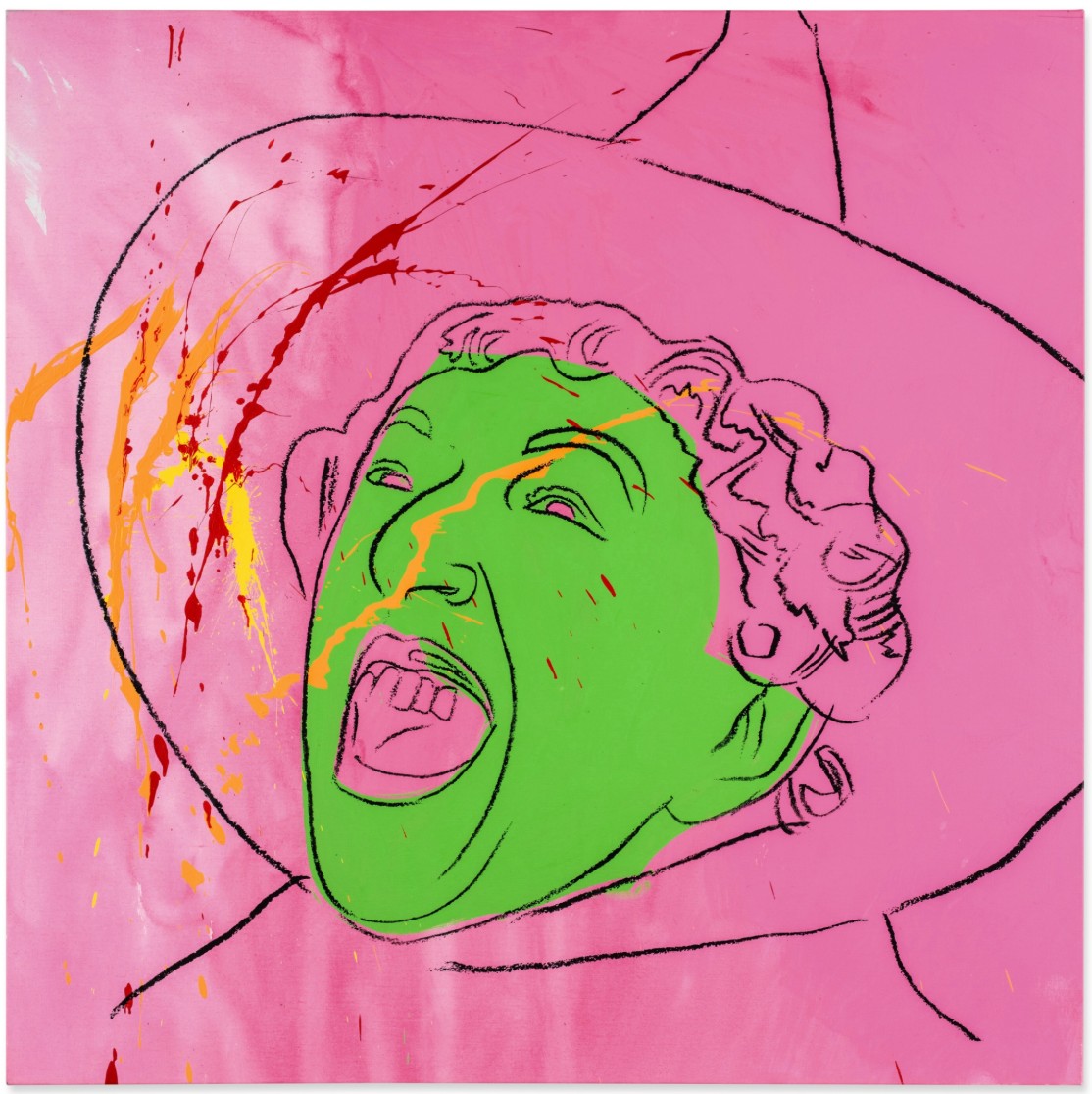
ANDY WARHOL (1928 – 1987)
The Witch (from Myths), 1981
Acrylic and silkscreen ink on canvas
60×60 inches (152.4 x 152.4 cm)
Signed and dated 1981 (on the overlap)
Stamped by the Estate of Andy Warhol and the Andy Warhol Foundation for the Visual Arts, Inc.
Numbered PA51.012 on the overlap and stretcher bar
Andy Warhol’s striking The Witch (From Myths) stands as a testament to Warhol’s undying fascination with popular culture and its role in shaping the American consciousness. Graphically rendered in bright, saccharin hues, the instantly recognizable form of the Wicked Witch of the West from The Wizard of Oz emerges in black lines and bright green from the cotton candy pink colored background. Unmistakably one of the most iconic villains in the history of film, she is depicted mid-scream, or perhaps while laughing maniacally. Paint splatters and a light wash on the left of the canvas foretell the Witch’s watery annihilation at the end of The Wizard of Oz. Warhol intentionally draws upon cultural knowledge of the movie to imbue the painting with a sense of impending doom, juxtaposed with the vibrant tone of the color palette. While themes of death and destruction permeate the artist’s oeuvre–his Electric Chairs and Car Crashes foretell similar ends–the present work is lighthearted and upbeat. It recalls a shared cultural nostalgia rather than a collective trauma. Evidence of Warhol’s singular reverence for the ubiquity of American cultural production and mass media, The Witch (from Myths) is a premier example of Warhol’s work from his celebrated early 1980s period.
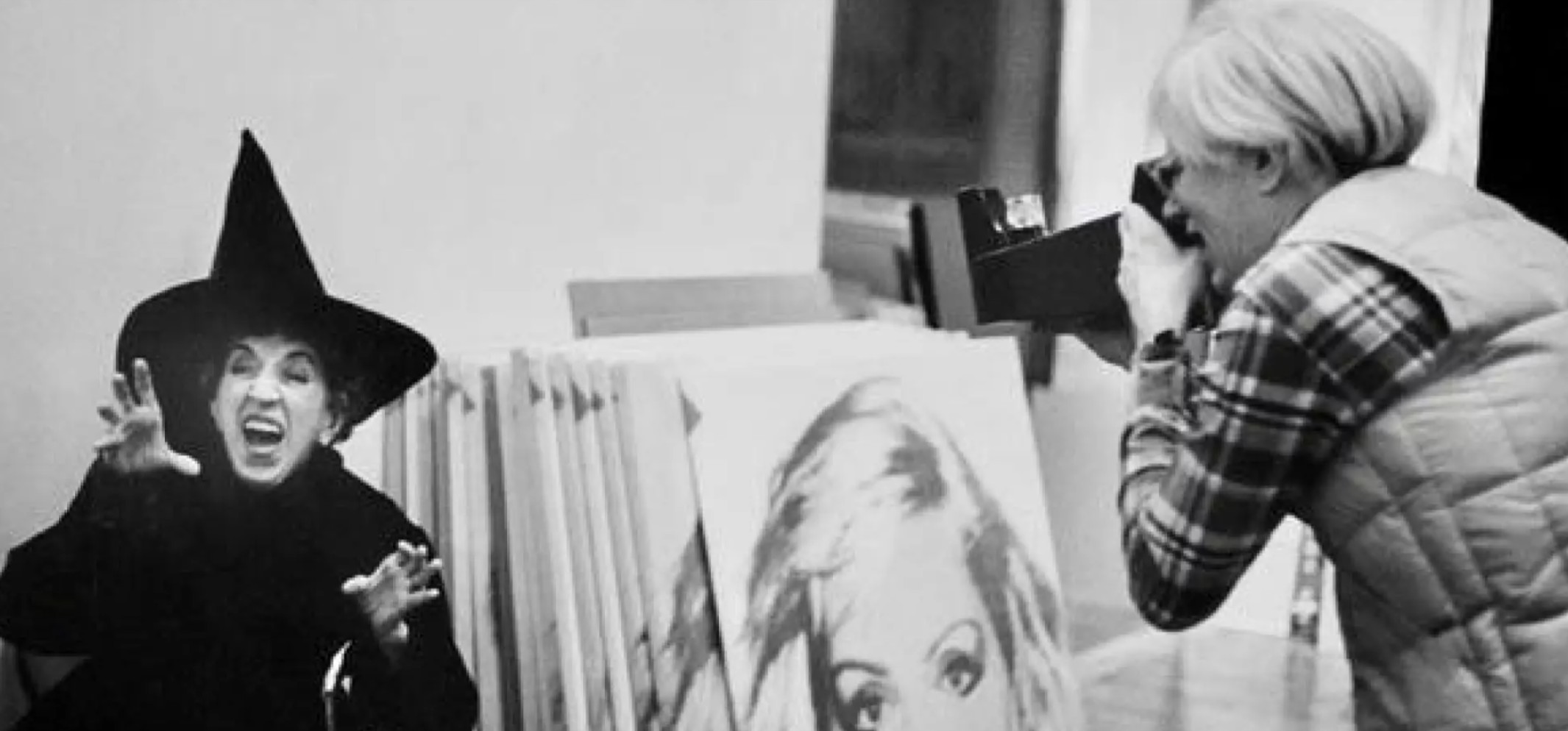
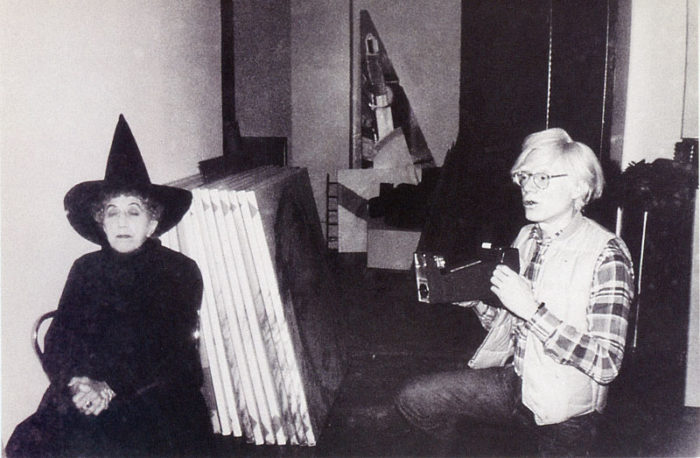
Andy Warhol photographing Margaret Hamilton, 1980.
Artwork © 2025 The Andy Warhol Foundation for the Visual Arts, Inc. / Licensed by Artists Rights Society (ARS), New York.
A unique piece from Warhol’s 1981 Myths series, the present work embodies the way Warhol’s work blends reality and fiction. The series, inspired by a doll the artist found at a flea market, refers not to the myths of ancient times, but the myths upon which contemporary American culture is founded. He originally planned to do a whole series of Disney characters, but settled on nine fictional characters, including Dracula, Santa Claus, Mickey Mouse, and Superman, as well as one image of Warhol himself. While Warhol is widely known for his portraits of real-life celebrities and prominent figures–from Marilyn Monroe to Mao Zedong–he did so using the stylistic signifiers of pop art, removing the images from the people themselves. In his Myths series, however, Warhol takes fictional subjects–including his own public persona–and brings them closer to life. By portraying these figures in the same manner as his portraits of real people, he pushes the characters of the American imagination into reality.
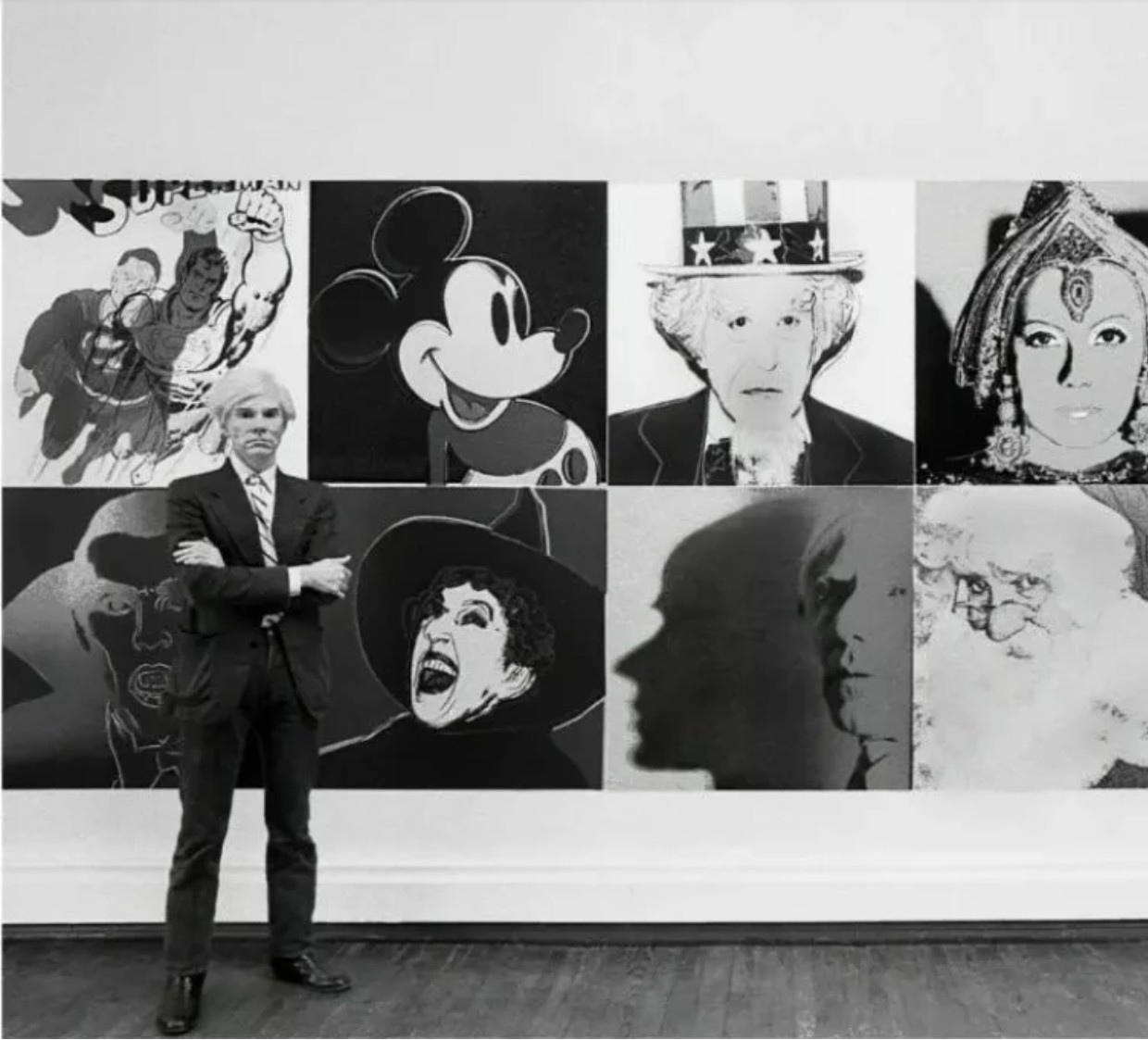
Andy Warhol at R. Feldman Gallery with Myths, 1981. Photo by Robert Levin.
© 2025 Andy Warhol Foundation for the Visual Arts / Artists Rights Society (ARS), New York
Further obfuscating the distinction between reality and fiction, Warhol based several of the myths on polaroid photos he took of people in costume. The present work depicts the actress Margaret Hamilton, who played the Wicked Witch of the West opposite Judy Garland in The Wizard of Oz (1939). Warhol met Hamilton in 1980; he wrote in his diary on August 12:
“I saw Margaret Hamilton, the witch in The Wizard of Oz, and got so excited and went over to her and told her how wonderful she was. She does the Maxwell House commercials now. She’s really small.”
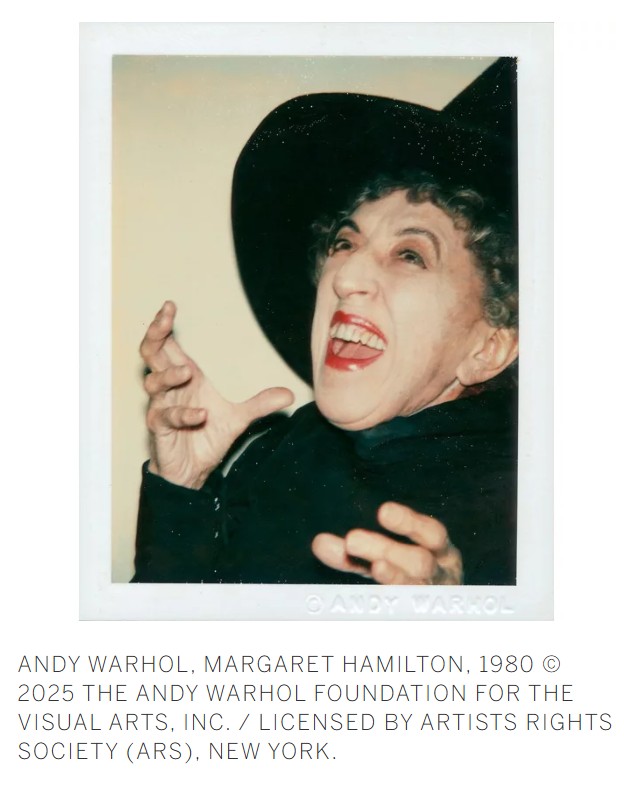
He invited Hamilton to his studio for a photoshoot, where she donned a witch hat and costume to pose for pictures. The reference image for The Witch shows Hamilton making the same screeching face as the eponymous witch in the painting. While the witch’s green face is distinctly of the character, her face itself–its expression and the curly hair bunching up around her ears–comes directly from Hamilton. The Witch (from Myths) is both a portrait of the classic character from 1939 and a portrait of Hamilton in 1980. Warhol intentionally blurs these lines, evoking–like many of his best known works do–the quintessentially modern iconography of cultural saturation. In The Witch (from Myths), Warhol elevates the Witch–both the actor and the character–to mythic status, affirming their role in the canon of American life. His deep engagement with contemporary culture pervades Warhol’s oeuvre. The characters, real or fictional, who populate the American collective consciousness were of real importance to him.
Superman
Superman, 1981
Sotheby’s New-York: 12 May 2015
Estimated: USD 6,000,000 – 8,000,000
USD 14,362,000
(#6) Andy Warhol (sothebys.com)
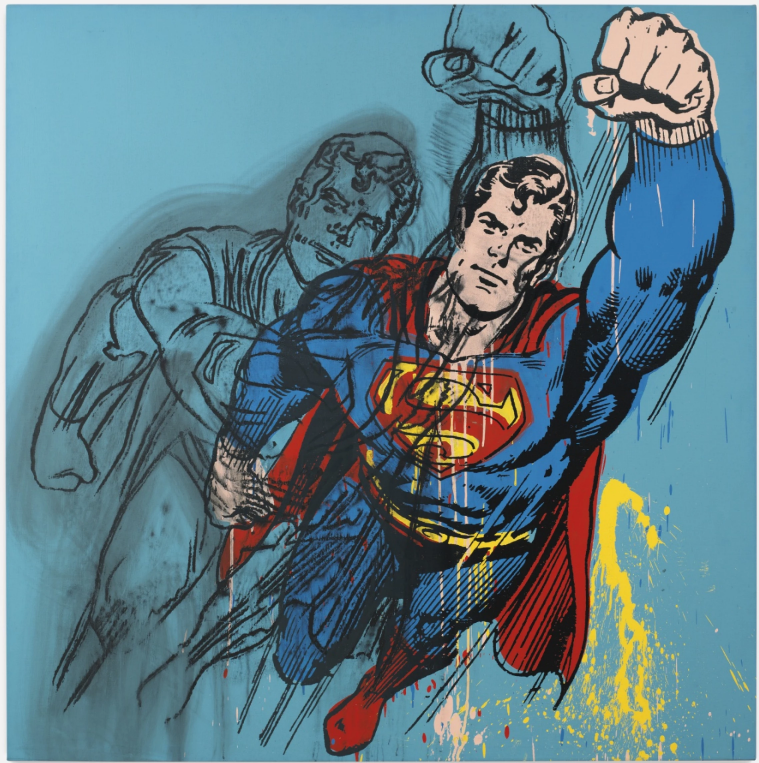
ANDY WARHOL
Superman, 1981
Acrylic and silkscreen ink on canvas
60×60 inches (152.4 x 152.4 cm)
Signed and dated 1981 on the overlap
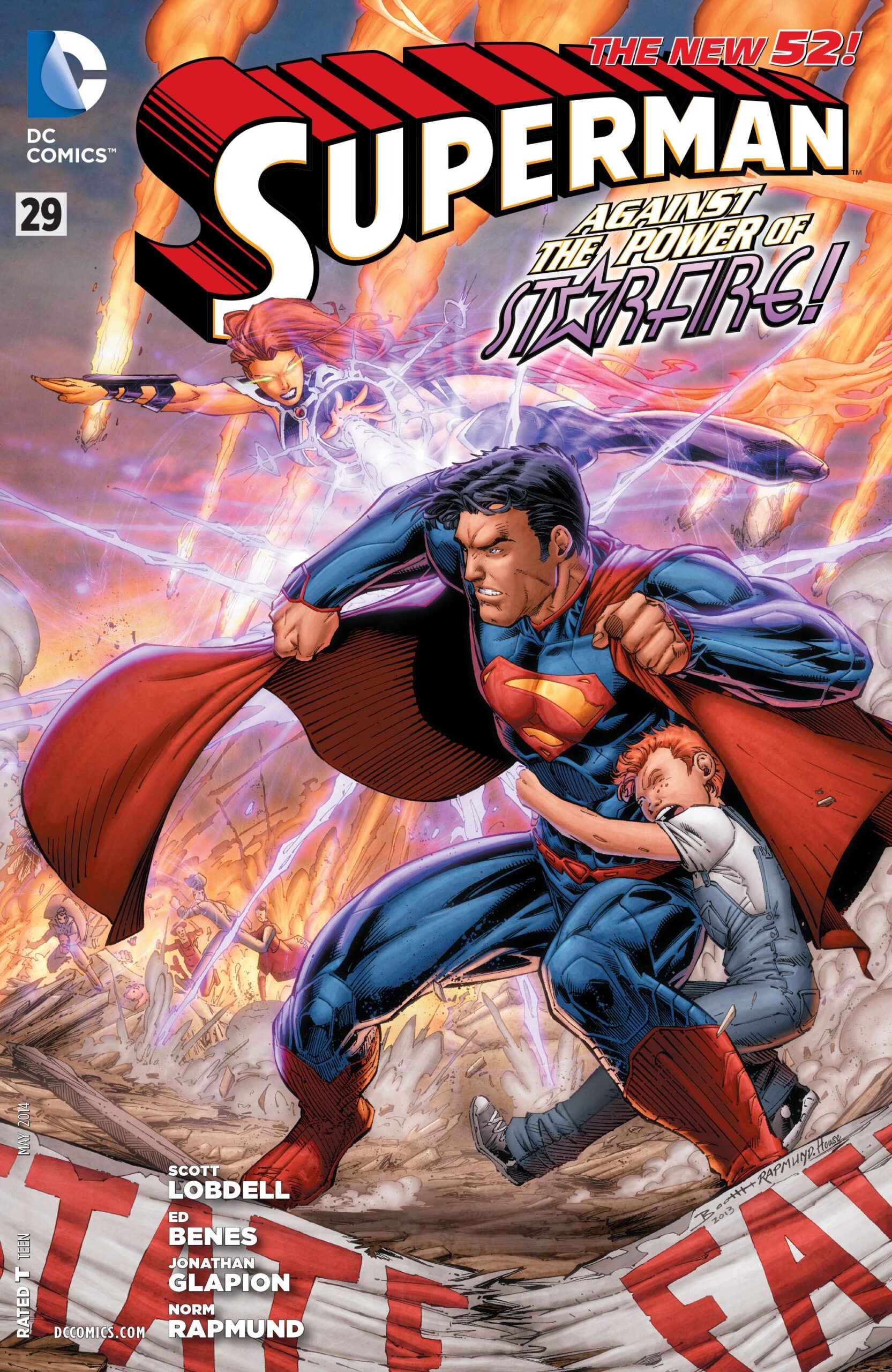
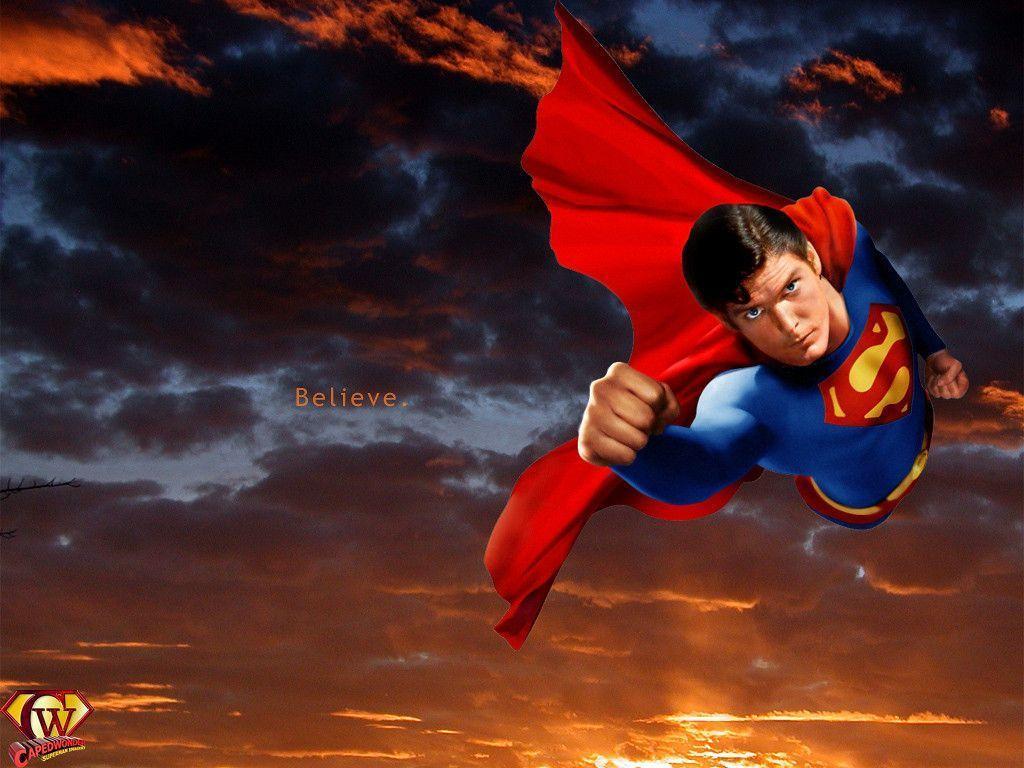
The character of Superman was created by the writer Jerry Siegel and artist Joe Shuster in 1933, and sold to Detective Comics, Inc. in 1938 when it first appeared in print as a daily newspaper comic strip, which ran through May 1966. With the success of his adventures broadcast to the American public across radio serials, television programs, films, newspaper strips, and video games, Superman became the forefather of the superhero genre, helping to establish its primacy within the American comic-book culture. Superman returned to theaters in 1978 in the much-celebrated Superman starring Christopher Reeve, which generated three sequels: most recently, in 2013, the film Man of Steel premiered. Throughout the nearly 80 years in which he has graced our newspapers, comic books, television and film screens, Superman’s appearance has remained constant, thereby imbuing his distinctive identity with potent brand recognition: in addition to his ubiquitous blue costume and red cape, the resounding power of the stylized red-and-yellow S shield on his chest has assumed a symbolic gravitas, becoming a fully integrated part of our collective social consciousness as an inspiring icon of the triumph of good over evil.
Depicted in the full dynamism of his famed power of super-human flight, Andy Warhol’s Superman propels across the canvas, his spectral outline at once doubling his graphic impact and enforcing his surging momentum. Here Warhol returns to the deeply affecting image doubling that he first explored in his Elvis paintings of the early 1960s, calling upon the mechanistic faculties of reproduction and duplication to confer upon his figures an elevated visual profundity. In total parity with the gun-wielding costumed Elvis, Superman here occupies a role entirely apart from his comic book narrative: he becomes one of Warhol’s stars, fully subsumed within the compendium of celebrity portraiture for which the artist is so revered. 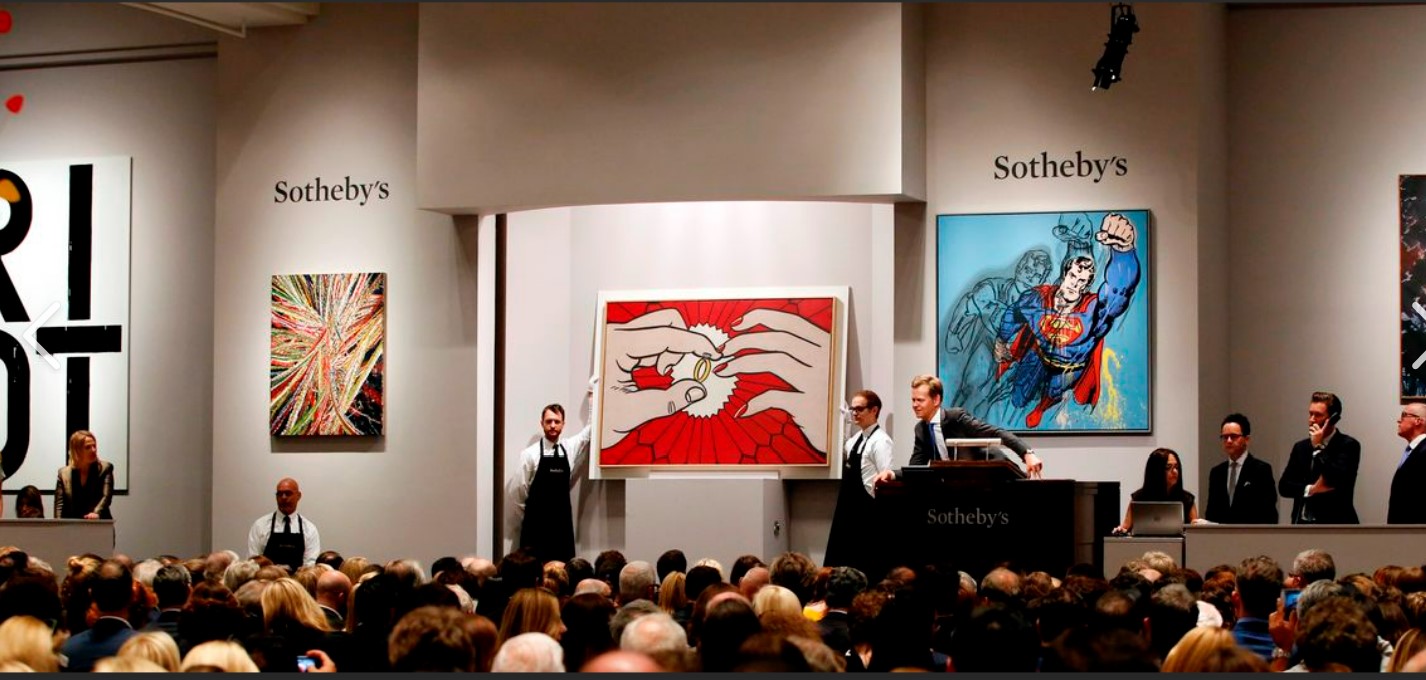
Warhol’s interest in cartoon and comic characters is manifest from the very incipit of his career. In an early rendering of Superman from 1960, Warhol used an appropriated comic strip as the source for his painting in the manner of a Duchampian readymade. The present Superman is the mature incarnation of a cartoon image’s power as developed by Warhol. Unlike the artist’s earlier version, which shares a marked affinity with the comic-strip inspired 1960s paintings of his contemporary Roy Lichtenstein, this Superman composition is cropped so that Superman’s full form occupies the entire height of the canvas and the possibility of narrative, previously evoked through the addition of text, is banished in favor of a singular focus on the central image. Superman is continually fresh, unblemished by age, and un-burdened by the baggage of Western history. Thus, Superman stands symbolically with Warhol’s film beauties, Coca-Cola bottles, and dollar bills. Each of these commodities has been experienced and enjoyed by millions of individuals. As images and ideas, their consumption is pervasive in American culture, which fascinated Warhol.
In addition to being utilised as an emblem of America, Superman was furthermore a subject of the male homoerotic gaze. With his squared jaw and muscular physique, he was rendered a figure of male fantasy and a catalyst for adolescent sexual awakenings for many. Moreover, with his dual identity of Clark Kent, Superman presented a mirror to those homosexual American men during the 1940s and 50s who similarly were forced to live in secrecy, keeping their authentic identity hidden beneath the surface. Seemingly a subject of Warhol’s own desire and homoerotic fantasies, the present lot accentuates Superman’s conventionally handsome and well-groomed appearance, with sculpted muscles and perfectly slicked hair.
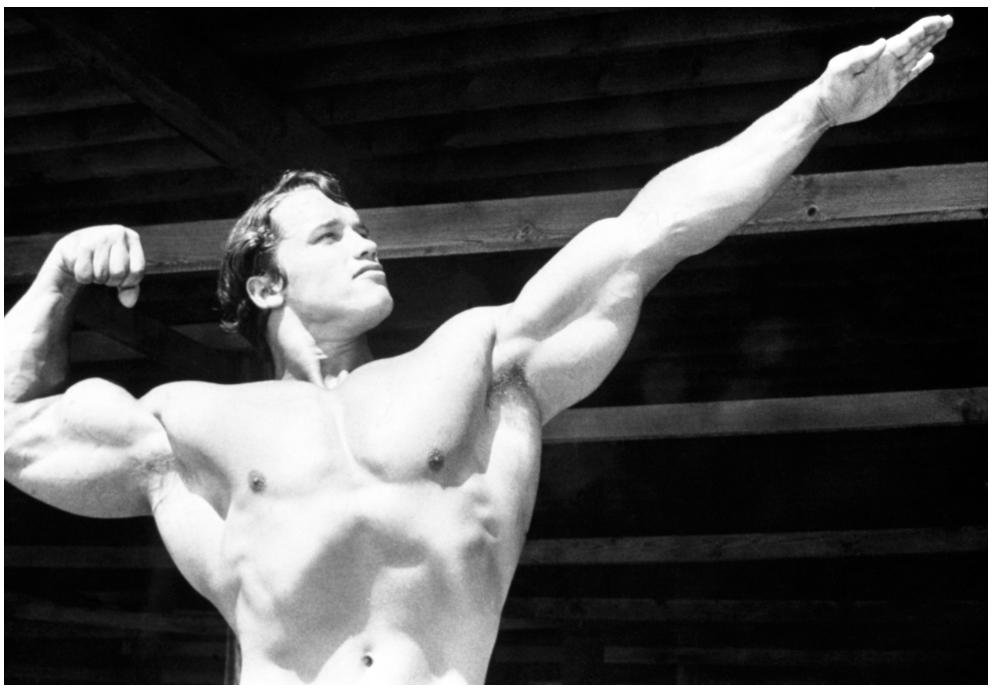
Arnold Schwarzenegger, 1966. Image: Album / Alamy Stock Photo
Central to Superman’s character is his alternate persona, Clark Kent—a seemingly average, shy, and reserved reporter concealed behind glasses. This duality juxtaposes the hypermasculine image, providing motivation for young boys who felt misunderstood or lacked confidence. Clark Kent presents the possibility of having their own alter-ego, mirroring Superman, to which they could aspire. This notion resonates with the traits of Andy Warhol, a notably private and shy figure who lived amidst a flamboyant lifestyle of parties and socializing. Perhaps Warhol thought of his own persona as an alter-ego in some way. His famous quote, “If you want to know all about Andy Warhol, just look at the surface,” wittily encourages others to focus on his public image rather than his inner self, which he was notoriously private about.
The Star
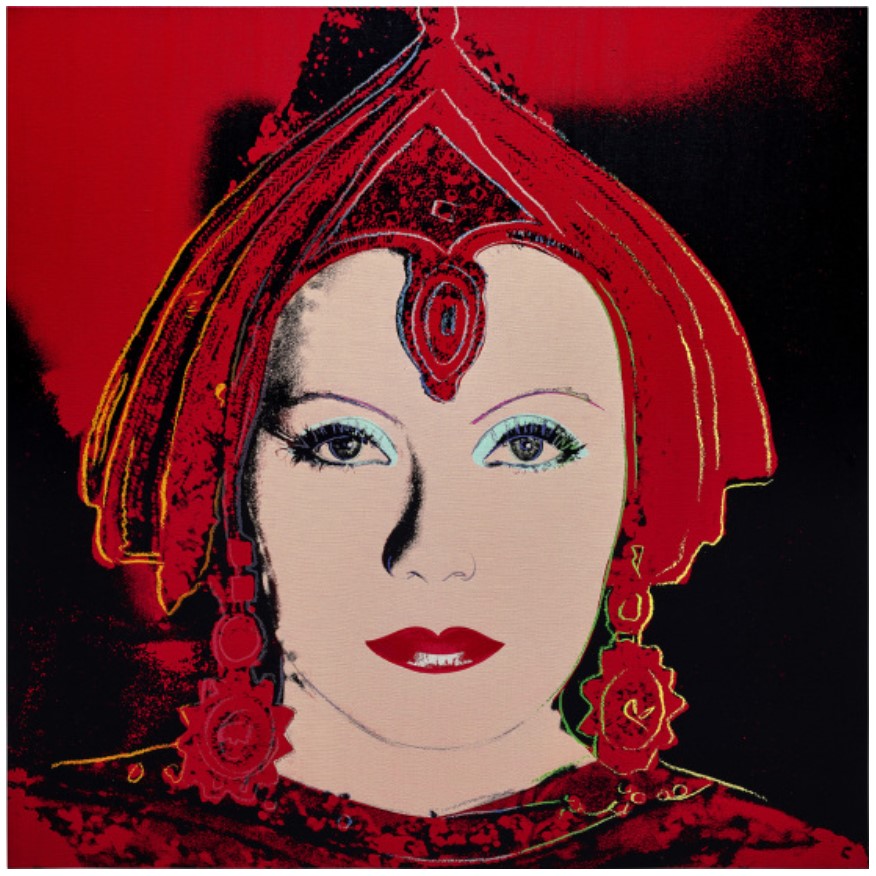
The Star (Greta Garbo as Mata Hari), 1981
Phillips New-York: 18 May 2022
Estimated: USD 7,000,000 – 10,000,000
USD 9,580,000
Andy Warhol – 20th Century & Contemporar… Lot 26 May 2022 | Phillips
ANDY WARHOL
The Star (Greta Garbo as Mata Hari), 1981
Acrylic and silkscreen ink on canvas
60×60 inches (152.4 x 152.4 cm)
Signed “Andy Warhol” on the overlap
“Someone once asked me to state once and for all the most beautiful person I’d ever met. Well, the only people I can ever pick out as unequivocal beauties are from the movies.”
Andy Warhol’s The Star (Greta Garbo as Mata Hari) marks the artist’s celebrated return to one of his most enduring preoccupations: celebrity and commodification. The present work extends the legacy of Warhol’s earliest investigations into these concepts, defined by his now iconic images of starlets such as Marilyn Monroe and Elizabeth Taylor. Closely related to the candy-colored paintings of Marilyn and Liz from the early 1960s, in the present work, Warhol once again displays his prowess with color. Emerging from a lava red background, Warhol articulates the details of Mata Hari’s elaborate costume and boldly offsets Garbo’s luminous skin with blue eyeshadow and scarlet lips. Conceived as part of his Myths series in 1981, The Star is an iconic tribute to one of the major silver screen goddesses in the artist’s Pop pantheon. Rarely seen in public, the present work has resided in the same private collection for over three decades.
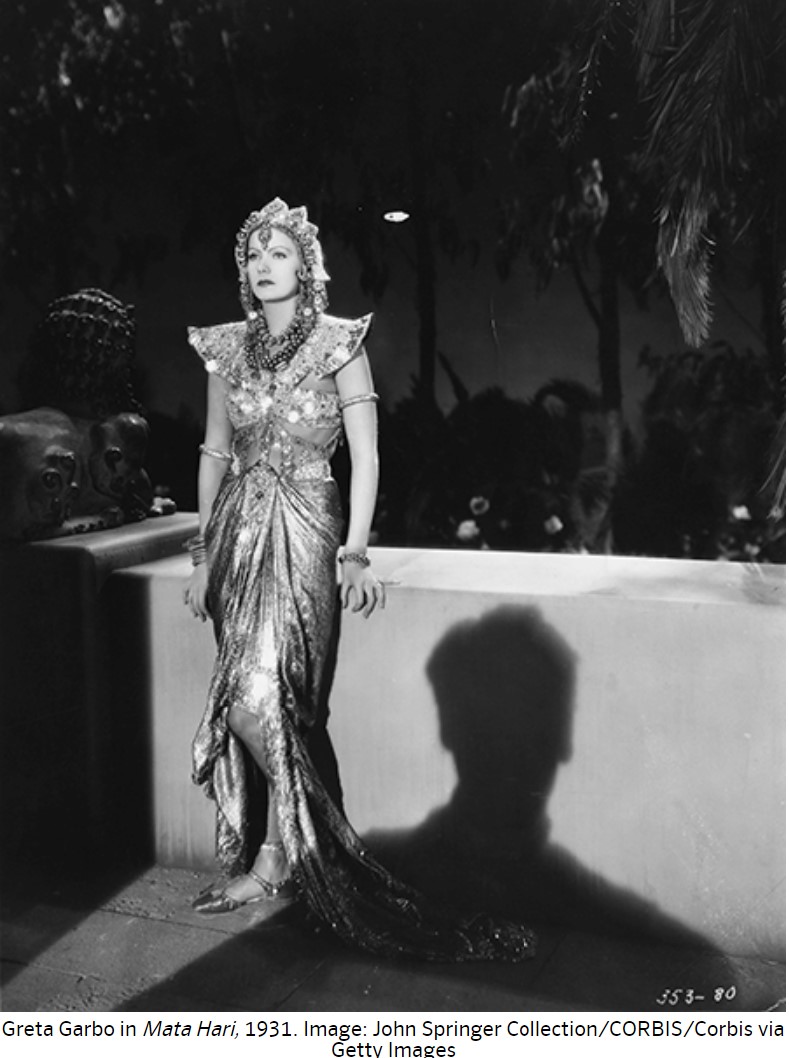
In The Star, Warhol immortalizes Greta Garbo at the peak of her celebrity in the guise of the eponymous character from the 1931 film Mata Hari. Based on the exotic dancer convicted as a German spy during World War I, the film became a sensation in America and Europe, cementing the legend of Mata Hari and the stardom of Garbo. Warhol’s tribute, however, is not celebrating the infamous character the actress played but the iconicity of Garbo herself. While his female icons of the 1960s were born out of his contemporaneous preoccupations with the cult of celebrity, The Star derives from the theme of reinvestigation that embodies the artist’s mature practice from the late 1970s until his death. Here he takes his own visual lexicon developed in the early 1960s one step further by selecting the press photo of the actress in the guise of her character as his source image. Warhol’s insistent link between fame and nostalgia often generated from his appropriation of earlier photography is abundantly present here. Indeed this publicity photo of Garbo predates the painting by nearly half a century and foreshadows her sudden retirement from acting in 1941 at the age of 35 after starring in nearly 30 films. His choice to return to the image some five decades later underlines his fascination with the endurance of iconicity.
The Star forms part of Warhol’s Myths that assembled a cast of ten nostalgic figures from childhood including Santa Claus, Mickey Mouse, Uncle Sam, Howdy Doody, and Superman. As Greg Metcalf notes, “While these mythic figures carry a range of important cultural attributes, their shared celebrity stature arises from their being heroes of commercial art. Each of these cultural icons is also a commercial icon, a ‘logo,’ the symbol of a corporate identity. Each is also an artistic creation from which the artist has been erased.” However, The Star and The Shadow, which sees Warhol place himself in the character of the crime-fighting hero from the 1930s radio show, are distinguished in the series: it is not the characters themselves which act as the protagonist but rather Garbo as Mata Hari and Warhol as The Shadow who are the commercial icons. In so doing he intentionally blurs the boundary between individual and symbol, artist and celebrity, hero and commodity.
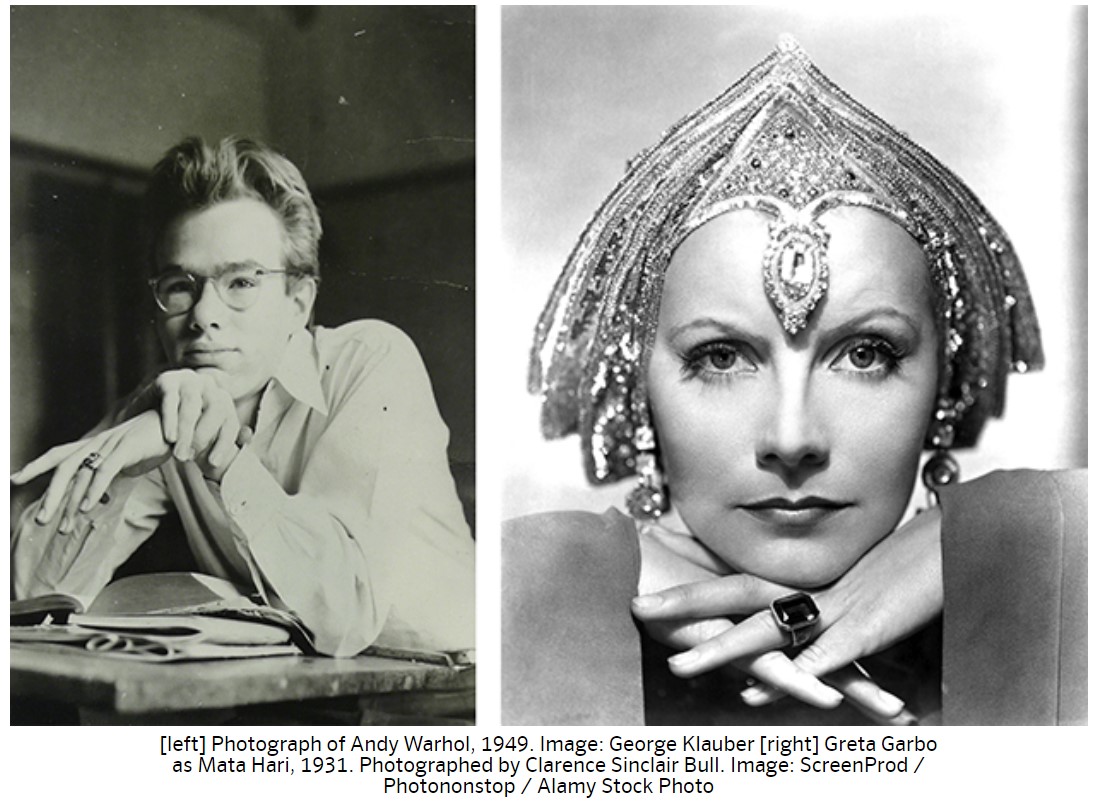
In many ways, Warhol had always felt he and Garbo were two sides of a single coin. Indeed, the elusive Garbo was arguably the Hollywood starlet that impressed Warhol’s sensibility the most. Since his youth, the artist consciously fashioned himself after Garbo, adopting her poses in photographs.
Mickey Mouse
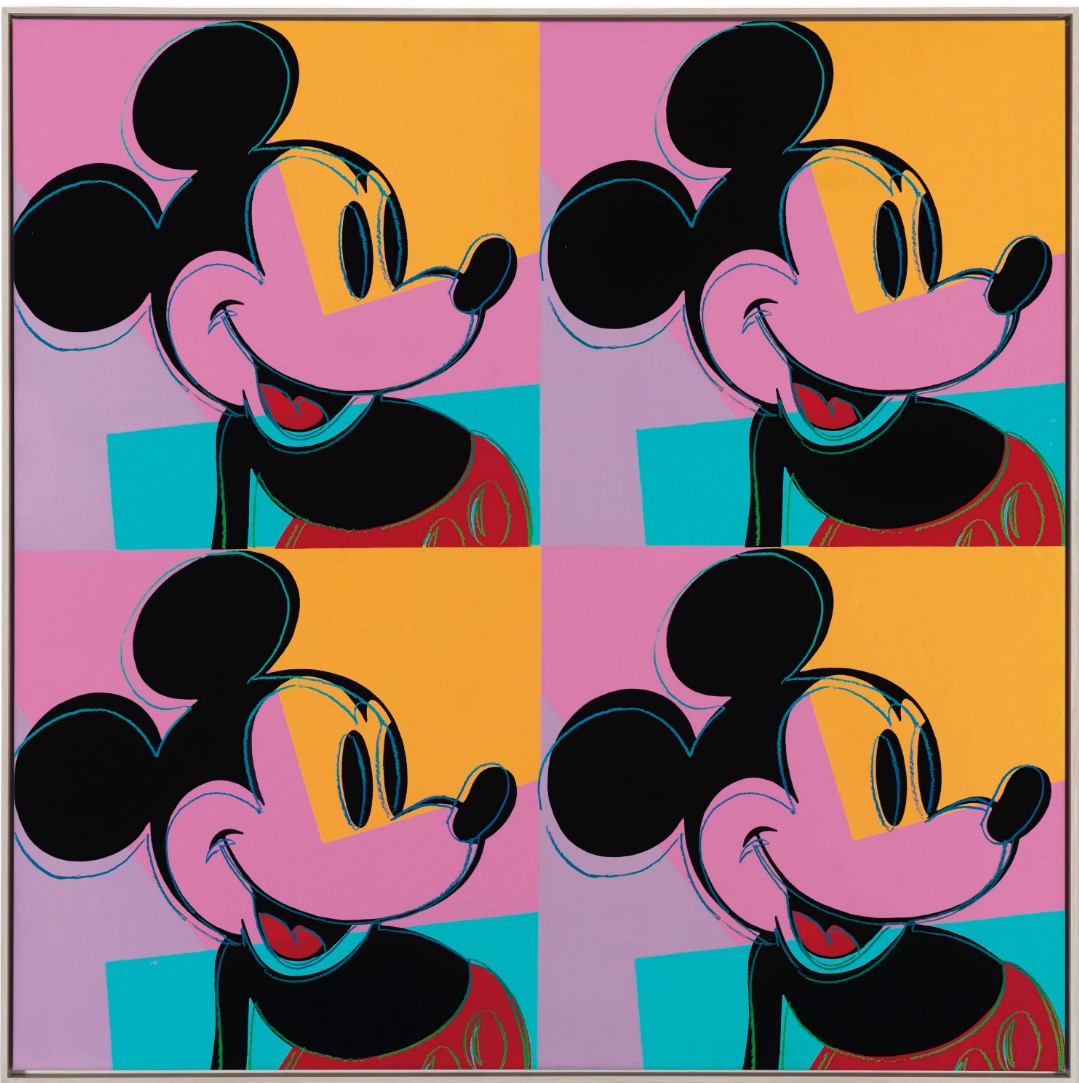
Andy Warhol consistently mentioned Walt Disney as the artist he most admired and the earliest artist to influence him. In light of this fact, it seems obvious that Warhol would turn to one of his earliest influences during the last decade of his life. As an image, Mickey Mouse not only suited his pictorial means but was also laden with meaning: there is perhaps no bigger emblem of childhood itself than Mickey Mouse. In Quadrant Mickey Mouse, Warhol depicts the happy-go-lucky cartoon mouse in classic fashion. Viewed in profile, Mickey’s jaunty round ears and bright, smiling face instantly transport the viewer to childhood reveries spent in front of the television or Sunday paper.
“Yes. I was interested to see how other people did so much of the work. I liked the show so much that I went to see The Fox and the Hound. That movie looked like it was done 50 years ago because the backgrounds were so painterly. But I wish the Whitney show had been larger; I wanted to see more”

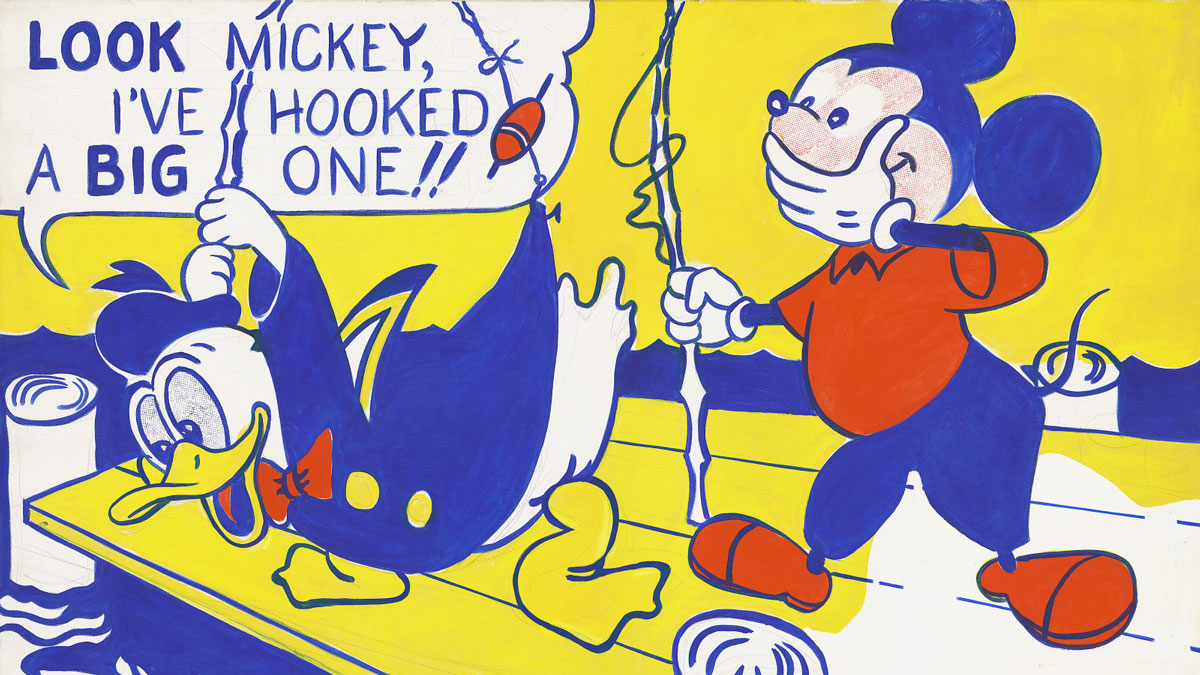
By the time Warhol painted Mickey Mouse, the Disney brand was nearly sixty years old and a global entertainment phenomenon, first appearing to major audiences in the black-and-white “talkie” Steam Boat Willie in 1928. Almost immediately, the Mickey Mouse character spread around the globe, making him the most recognizable cartoon character in history and—perhaps more importantly—a symbol of American innovation and spirit. Mickey played a key role in the development of Pop Art as well. Roy Lichtenstein’s Look Mickey, from 1961, is considered one of the first Pop Art paintings. Warhol, too, first turned to comics as the source of his early work, depicting both Superman and Popeye that same year. Mickey Mouse embodies those first Pop Art impulses while passed through the lens of a mature artist at a seminal moment in his career. The similarities between Warhol’s factory and Disney’s production studios have been oft-cited, but it is each artist’s iconic dominance of the globe—both culturally and commercially—as well as their enduring appeal that most closely links them. Traveling the world, nearly everyone recognizes “Mickey” or a “Warhol” so that the images themselves transform from mere depiction to something larger and more symbolic, achieving icon status.
Andy Warhol idolized Walt Disney as the consummate entrepreneur who created a successful commercial art empire. In this context it is interesting to consider how Warhol’s Factory is similar to an animation studio, with many assistants mechanically producing silkscreened images of art that is not drawn by their own hand but is in concert with a larger cultural product. Walt Disney was himself an illustrator, and Mickey Mouse was one of the first characters created for what would become the Walt Disney media empire as it is known today. In early Mickey Mouse shorts, Disney provided the voice and personality for the animated character. This intermingling of fantasy and reality at the foundation of one of America’s most well-known cultural icons is the perfect subject for Warhol’s composition.
Walt Disney and Mickey Mouse are so intimately intertwined that by silk-screening the simple geometric forms the world recognizes as Mickey Mouse, the man behind the mouse looms large along with everything that his empire has come to mean in America. The result is that both positive feelings and more trying associations emerge from Warhol’s Mickey Mouse: entrepreneurial success, cutting-edge innovation, the production of popular American culture, and nostalgia for the more homegrown varieties of entertainment that cannot compete. This mixture of emotions also reflects aspects of the American transition from the prosperity of the early1960s to the challenging economic and political events of the next few decades.
Quadrant Mickey Mouse, 1981
Christie’s New-York: 12 May 2015
Estimated: USD 3,000,000 – 5,000,000
USD 4,533,000
Andy Warhol (1928-1987) (christies.com)
ANDY WARHOL
Quadrant Mickey Mouse, 1981
Synthetic polymer and silkscreen inks on canvas
60×60 inches (152.4 x 152.4 cm)
Signed and dated ‘Andy Warhol 1981’
Stamped with the Andy Warhol Art Authentication Board, Inc. stamp
Numbered ‘A113.032’ (on the overlap)
Andy Warhol’s Quadrant Mickey Mouse is an intensely exuberant painting, vividly-hued in bisecting planes of lively color, depicting an icon of popular culture—Mickey Mouse. In Quadrant Mickey Mouse, Warhol illustrates the most celebrated cartoon in history in his trademark silkscreen style. He repeats the classic Mickey image four times over in a 2×2 grid as if to illustrate the ubiquity of the image itself, as he had done to great effect in other 4-part canvases such as 4 Marilyns and 4 Jackies. Perhaps the most striking aspect of the painting, though, is Warhol’s abstract use of bisecting planes of color in the painting’s background. The artist was an altogether brilliant colorist, and in Quadrant Mickey Mouse he experiments with vivid combinations of lavender, tangerine, pink and blue. These prisms of shimmering color intersect the Mickey image in offset geometric planes, so that each seems to be viewed through a kaleidoscope, as if passed through the prism of dreams and memory.
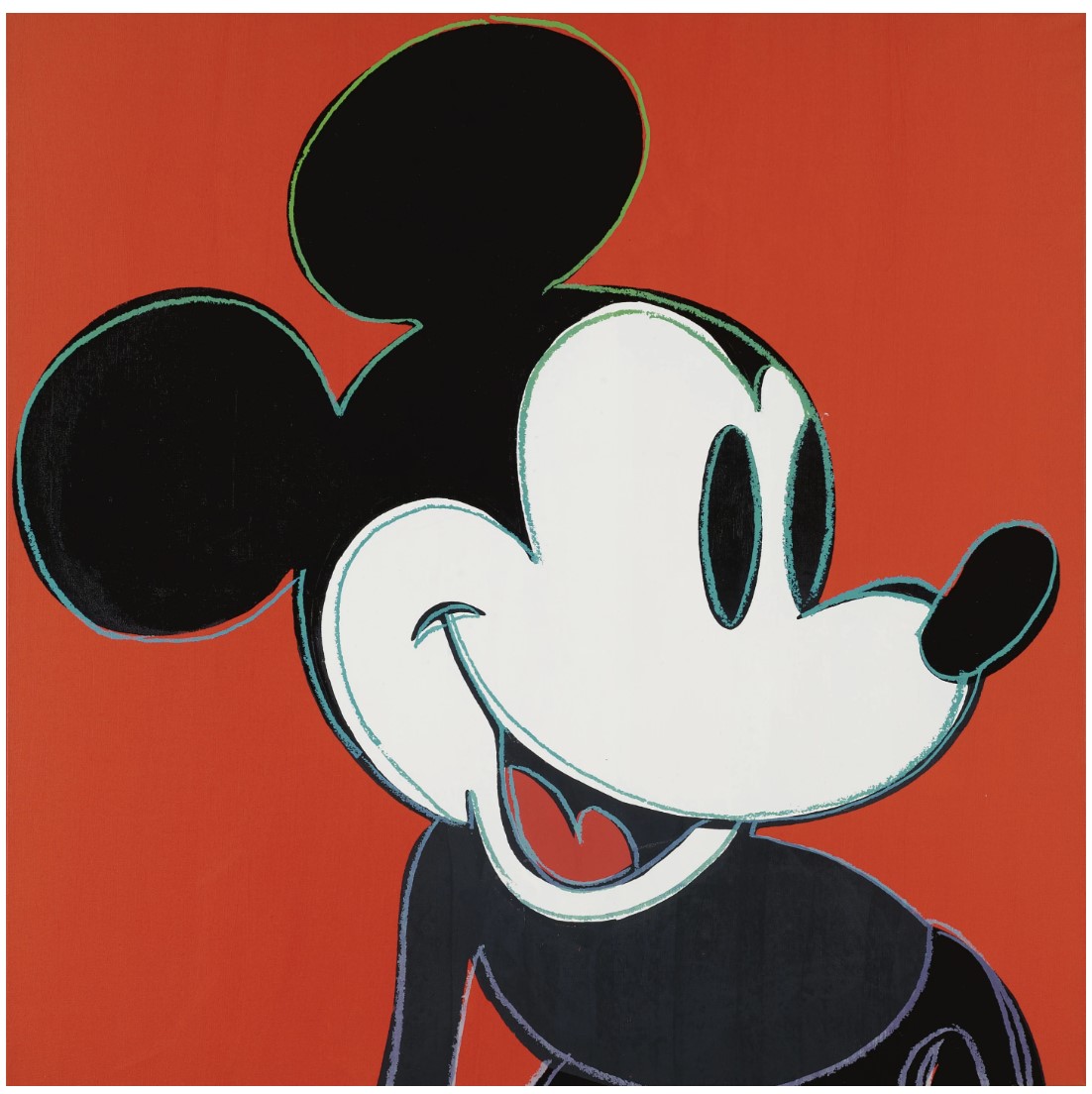
Mickey Mouse (Myth Series), 1981
Sotheby’s New-York: 9 November 2011
Estimated: USD 3,000,000 – 5,000,000
USD 3,442,500
(#8) Andy Warhol (sothebys.com)
ANDY WARHOL
Mickey Mouse (Myth Series), 1981
Acrylic and silkscreen ink on canvas
60×60 inches (152.4 x 152.4 cm)
Signed and dated 81 on the overlap
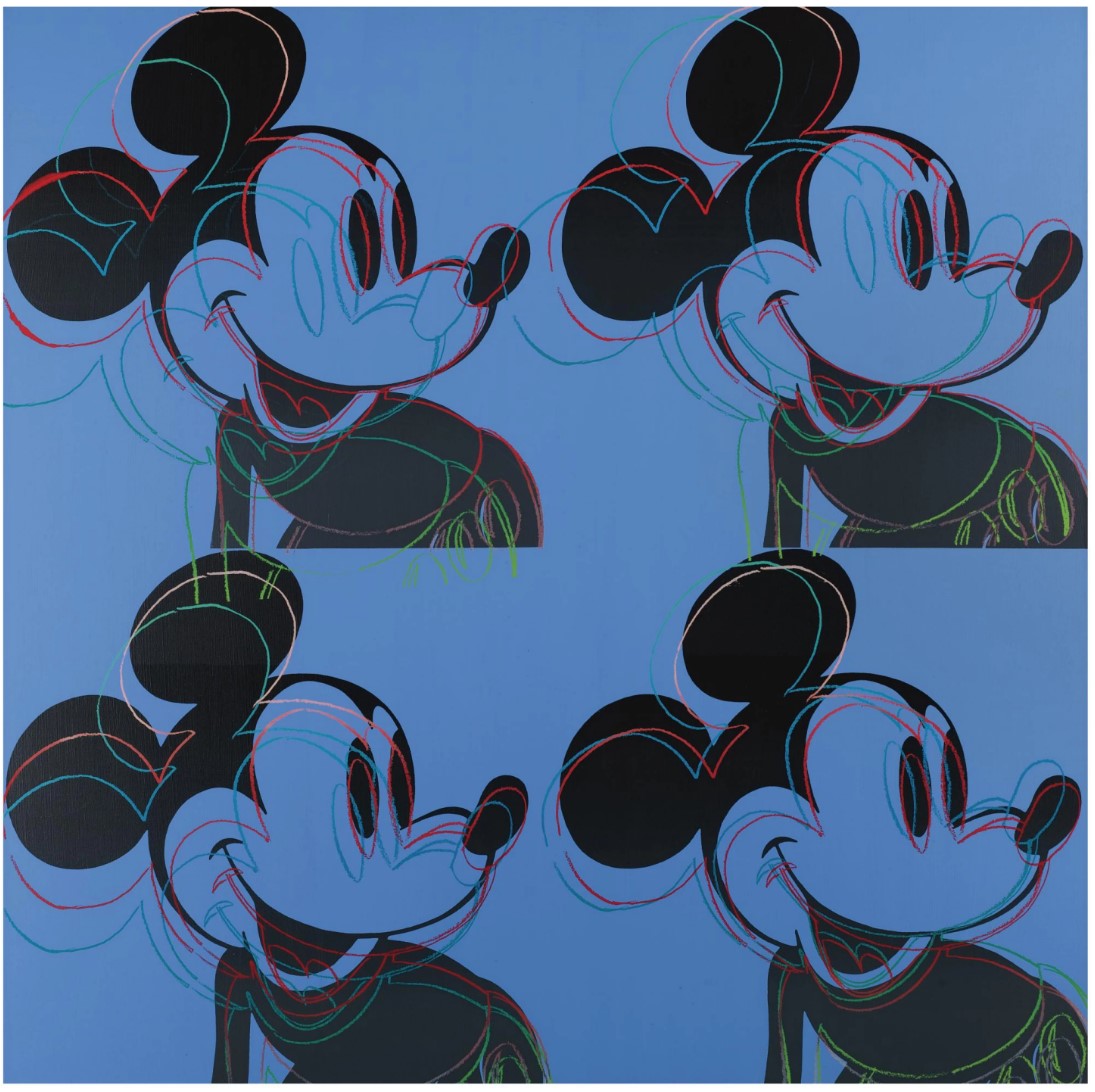
Instantly recognizable and consummately powerful, Mickey Mouse is a distinctive canvas that embodies Andy Warhol’s understanding of the relationship between celebrity and consumer culture in American society. In Warhol’s closely cropped, deadpan representation of Mickey Mouse, the image of carefree play and childhood innocence is conferred with media’s power to create identity and desire. As a Warhol portrait, Mickey Mouse has become more than a celluloid mouse: the canvas has entered the Warhol celebrity pantheon and has been featured in numerous international exhibitions as an important element of Warhol’s oeuvre.
Myths (Mickey Mouse), 1981
Sotheby’s New-York: 15 May 2007
Estimated: USD 1,200,000 – 1,800,000
USD 1,944,000
(#74) Andy Warhol (sothebys.com)
ANDY WARHOL
Myths (Mickey Mouse), 1981
Synthetic polymer and silkscreen ink on canvas
60×60 inches (152.4 x 152.4 cm)
Signed and dated 1981 on the overlap
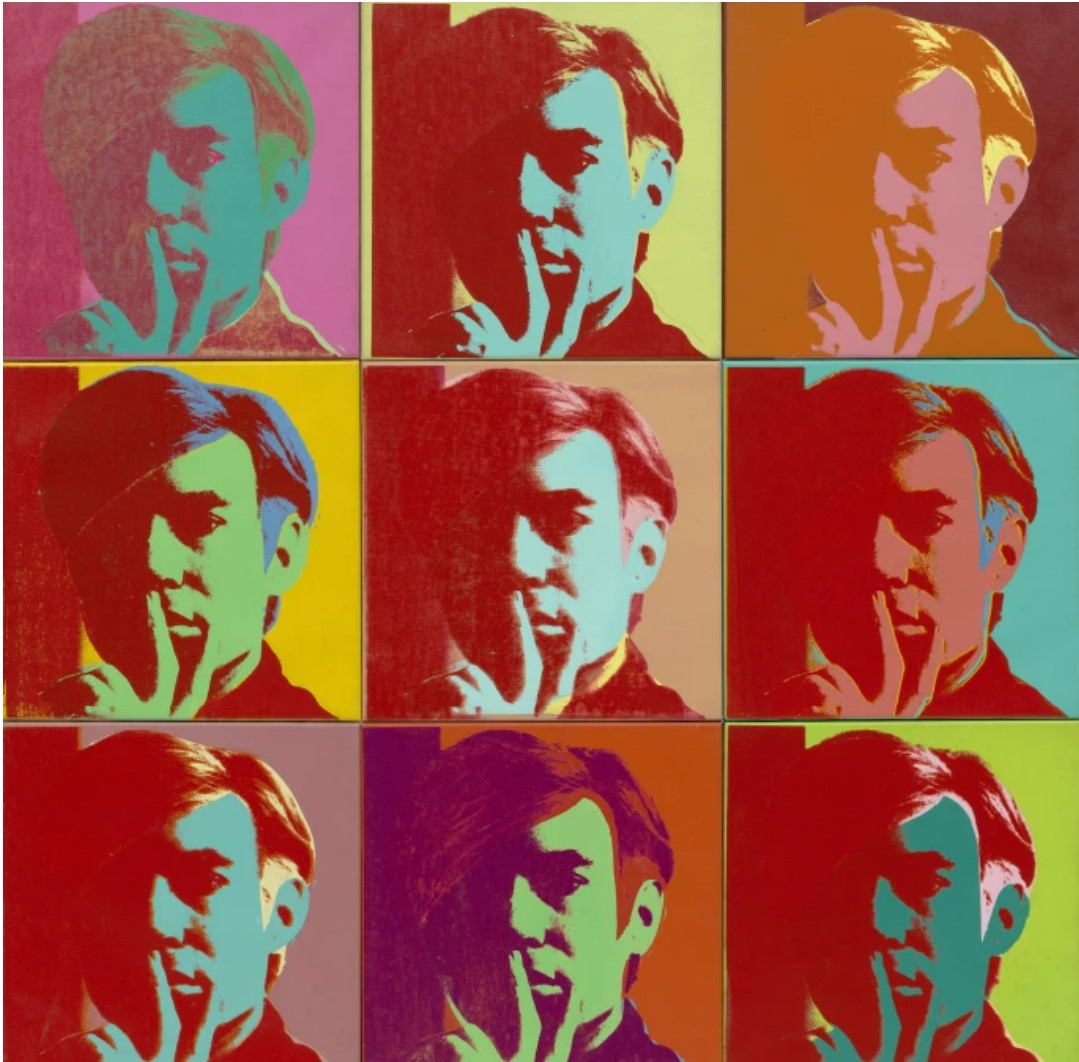
The Shadow
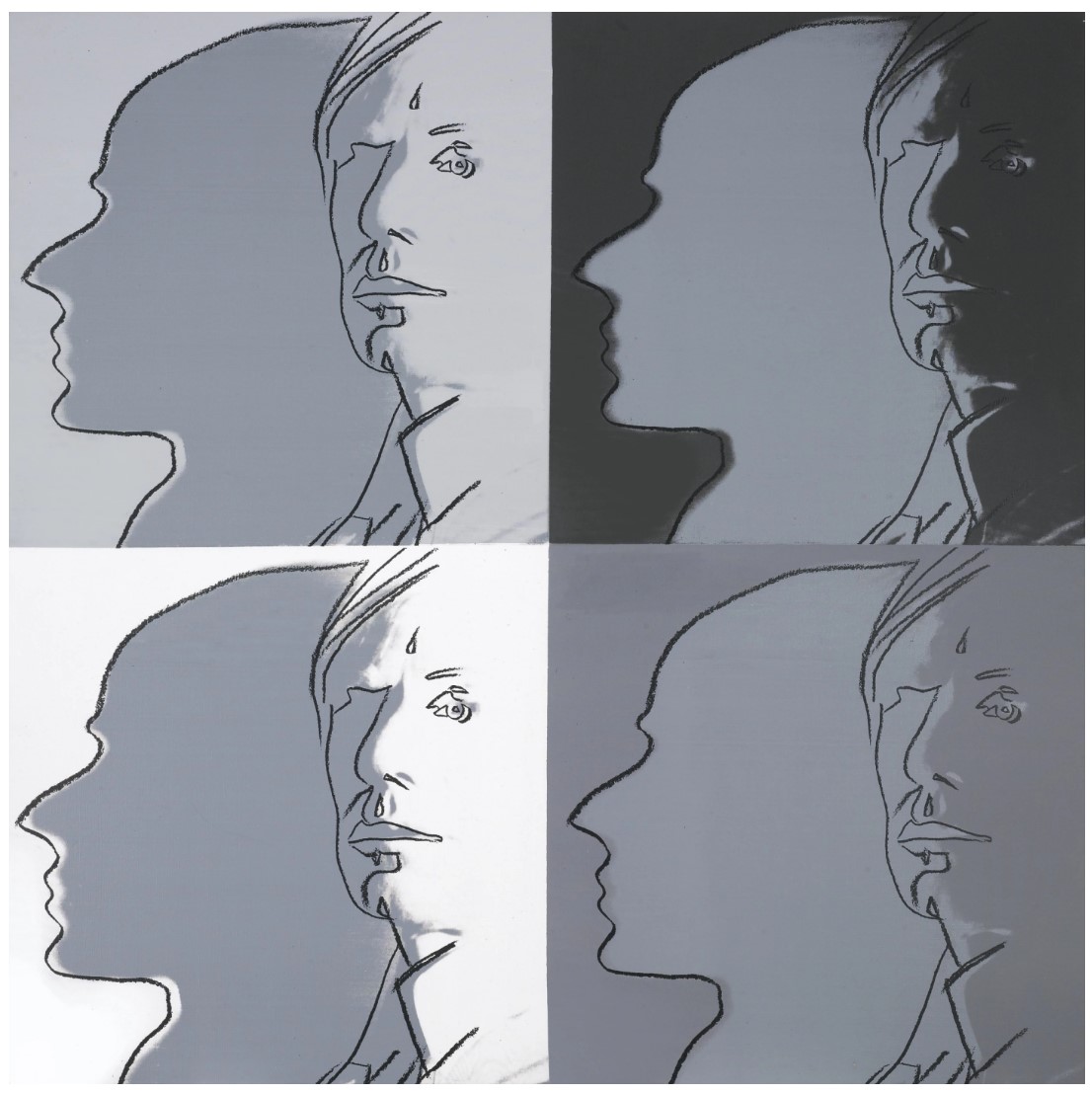
In The Shadow, we see the profile of a Hitchcock-ian shadow as well as its creator, Warhol himself, looking out toward the viewer. With this self-portrait, Warhol neatly inserts himself into the pantheon of American icons. This is an act of extreme hubris, yet it is completely valid. By 1981 Warhol had become the epitome of fame that he was always fascinated by in his early years. He looks out quizzically, as if he is telling his audience “this is what you have created.” However, it is important to note that Warhol makes his shadow the focus of the work rather than his face. By making his shadow the main subject, Warhol demonstrates that he is ironically aware that people are obsessed with the idea of him rather than who he is as a person. The myth of Warhol is the brand that will long outlast the human being, and today we behold a painting whose commentary on American culture will last even longer.
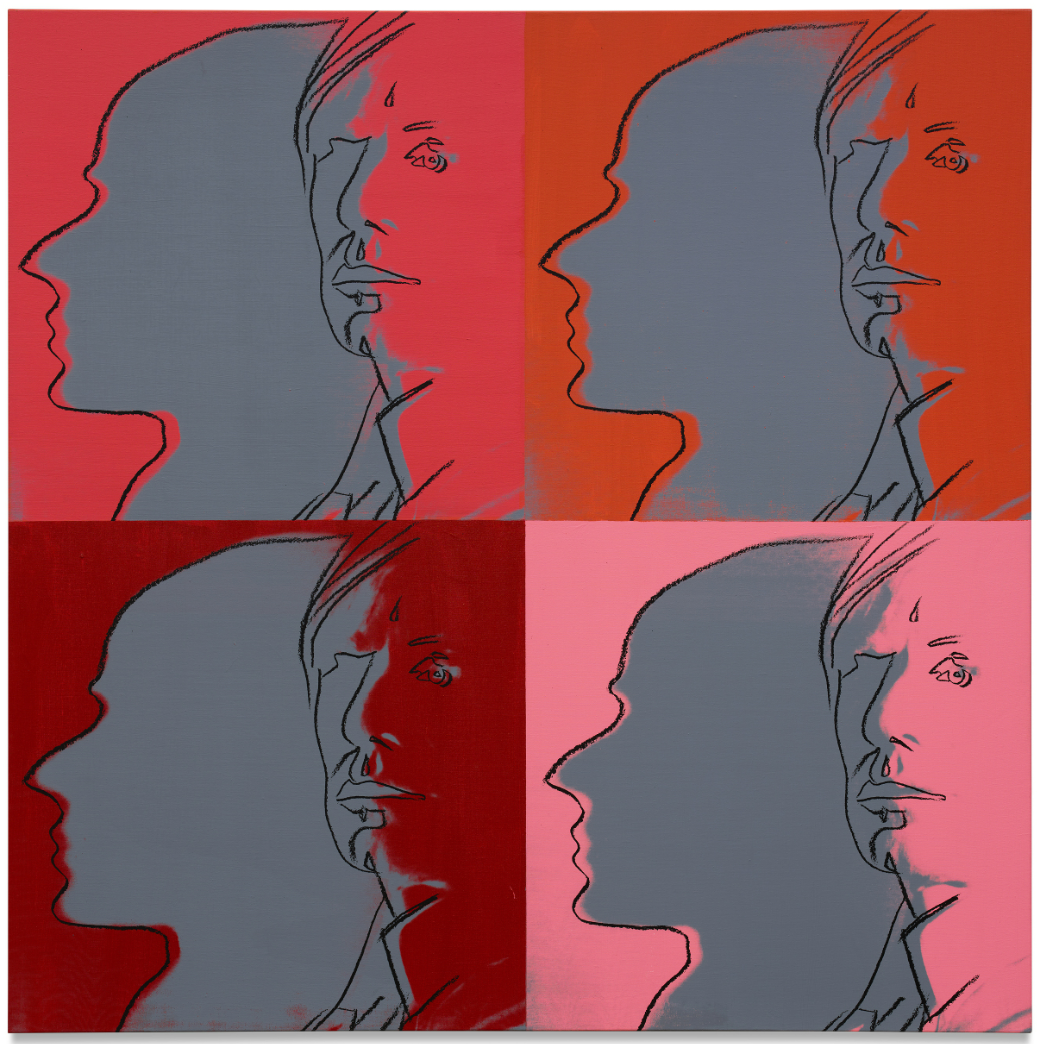
The Shadow presents a resounding image of Warhol as both man and legend, challenging the act of self-depiction with unrivaled experimentation and intensity. The Shadow belongs to Warhol’s Myth series, in which Warhol conjures characters from the pantheon of American popular culture—into which Warhol, notably, places himself. Uncle Sam and Mickey Mouse, Santa Claus and Superman happily coexist in Warhol’s electrically hued court, leaving the viewer struck simultaneously by fascination and anxiety. These are the contemporary celebrity’s predecessors, spectral and saturated in a pumped-up rainbow, and Warhol looks on as both prophetic creator and participant. Marrying themes and processes developed over the course of Warhol’s titanic career, The Shadow joins his punchy self-portraiture and chromatically brilliant silkscreen technique with the recurring shadow motif.
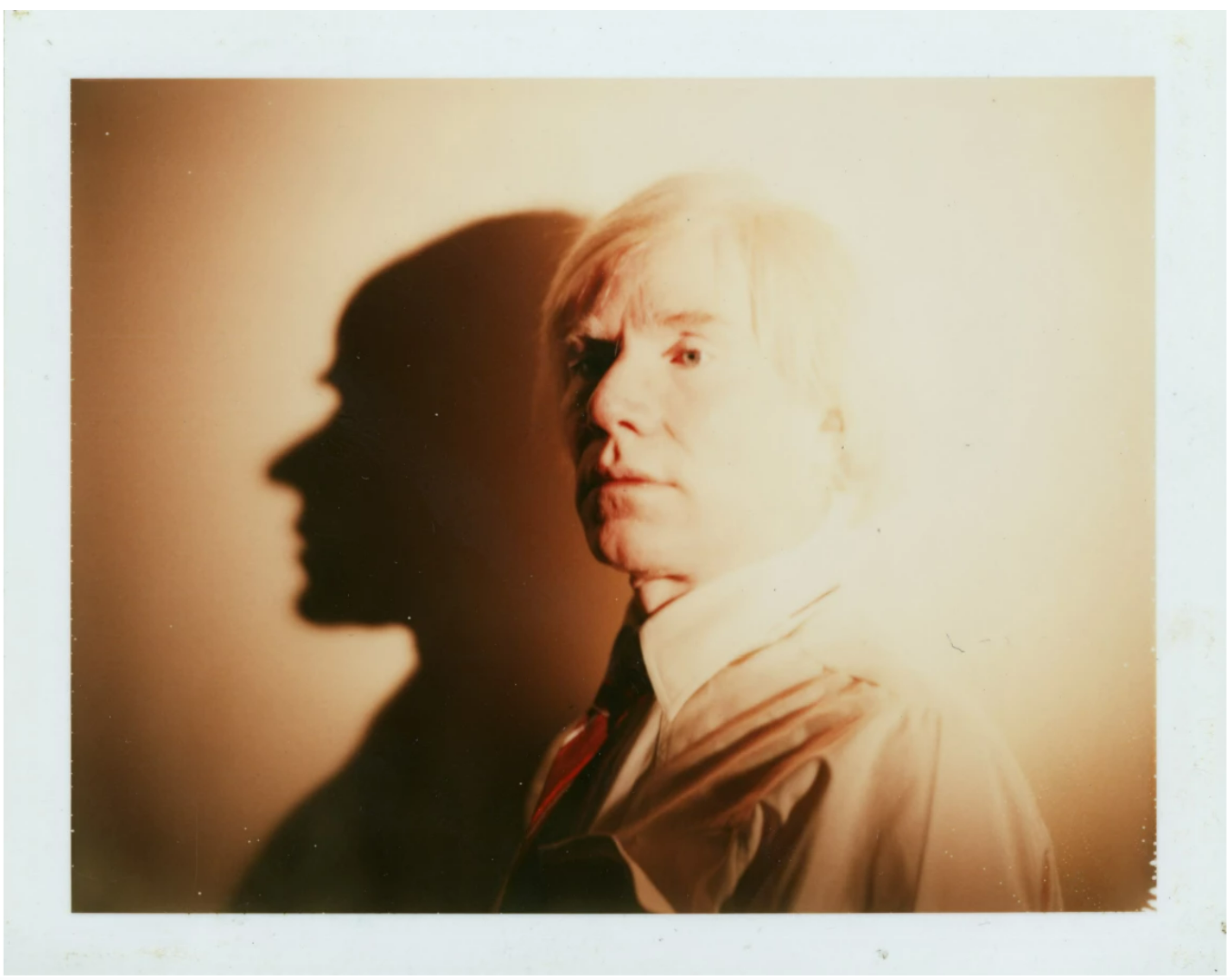
ANDY WARHOL, SELF-PORTRAIT, 1981. THE ANDY WARHOL MUSEUM, PITTSBURGH. IMAGE © THE ANDY WARHOL FOUNDATION FOR THE VISUAL ARTS, INC. COURTESY OF THE ANDY WARHOL MUSEUM AND THE POLAROID MUSEUM. ART © 2023 ANDY WARHOL FOUNDATION FOR THE VISUAL ARTS / ARTISTS RIGHTS SOCIETY (ARS), NEW YORK
Executed just six years before his unexpected death, the artist’s self-effacing portrait in The Shadow reflects Warhol’s lifelong concerns with the transience of life, conveying a prophetic consciousness of his fate. Warhol’s evasive and enigmatic manner of depicting himself is likewise a thread from his earlier production. In his first series of self-portraits as an established artist, created from 1963-64, Warhol shrouds himself in dark sunglasses and a trench coat, but in the present work, he unsheathes himself from his costume, relying only on his shadow to retain an air of inaccessibility. Throughout his entire career, Warhol employed his self-portraiture as a means of identity construction, and in The Shadow we witness the complete conflation of the artist and the sensational style for which he garnered so much fame and attention. In the tireless performance of his carefully preened persona, Warhol established an aura of both exposure and anonymity.
“I’d prefer to remain a mystery. I never like to give my background and, anyway, I make it different all the time I’m asked.”
In the present work, Warhol looks over his shoulder and casts a distorted, elongated shadow on the wall behind him. Under the theatrical lighting exaggerated further by the filter of his Polaroid camera, Warhol and his shadow appear conjoined. He once again calls upon the shadow as a tool, which appeared in his early portraiture and reappeared in his later abstractions. Here, it obscures nearly half of his face, reading as an opaque field and precluding any clear delineation of the contours on his proper right side. Throughout the 1960s, Warhol used the shadow to mystify and obscure his silkscreened icons, harnessing its associated symbolism to enhance a reading of transience and mortality. In the 1970s, he isolated the motif and abstracted it, transforming the shadow from an element of his canvases to the sole subject of them. Warhol’s re-visitation of the motif in the final decade of his career, however, signals his attempts to mask his persistent fears, insecurities and doubts, both serving as an aesthetic and metaphorical aid. Oxymoronically, the shadow, despite its association with darkness and absence, is inherently an ephemeral replication of a physical object: an indication of life. The shadow’s connotative contradictions offer clarity on the inclusion of this self-portrait in his Myths series. This moment of congratulation is met with vulnerability: he has cemented his place as an American icon, but the icons amongst which he situates himself are all notably past, a feeling for and fear of the closeness of an inevitable end.
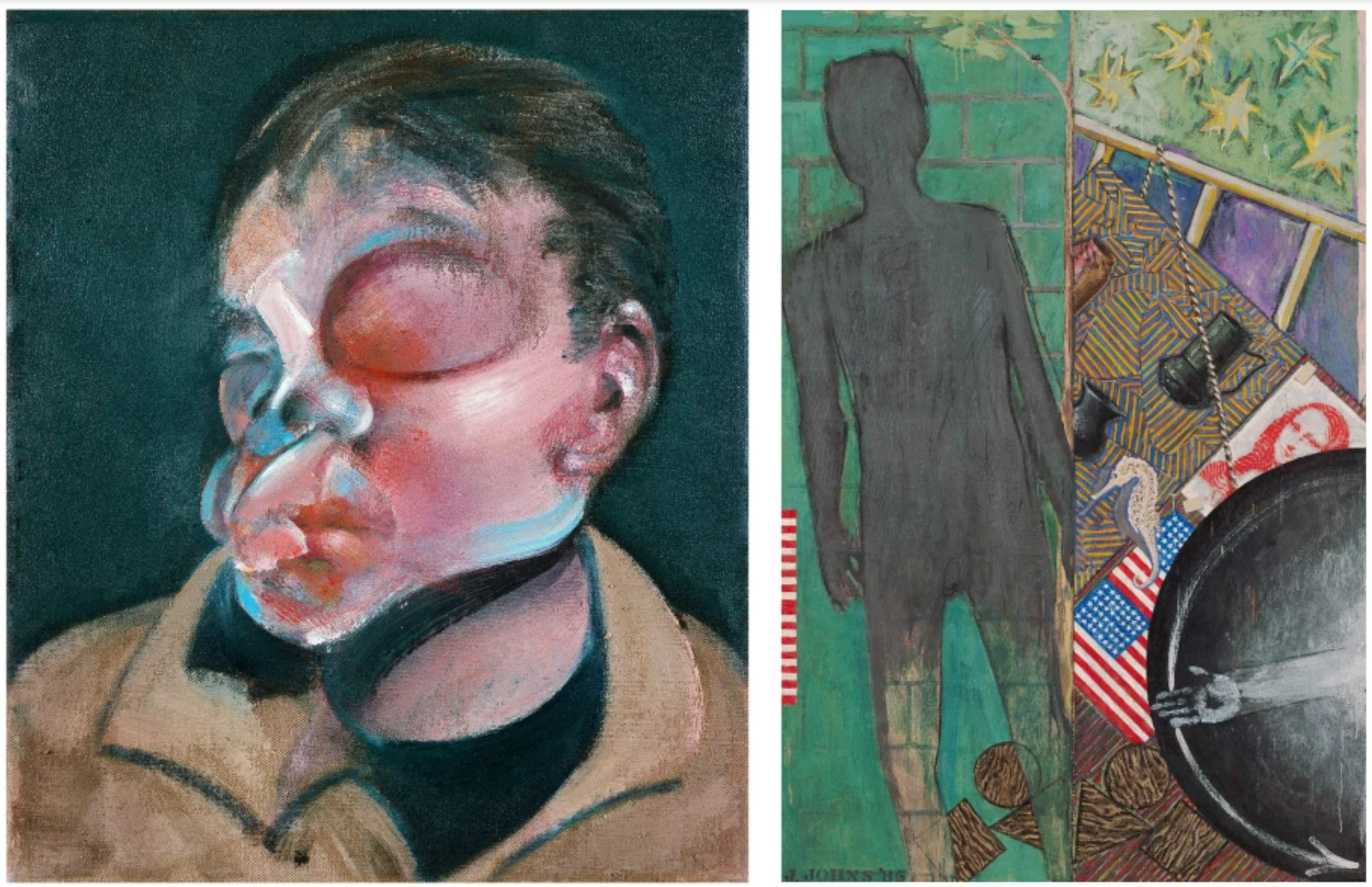
LEFT: FRANCIS BACON, SELF PORTRAIT WITH INJURED EYE, 1972. PRIVATE COLLECTION. ART © THE ESTATE OF FRANCIS BACON / DACS LONDON 2023. ALL RIGHTS RESERVED. RIGHT: JASPER JOHNS, SUMMER, 1985. IMAGE © THE MUSEUM OF MODERN ART/LICENSED BY SCALA / ART RESOURCE, NY. ART © 2023 JASPER JOHNS / ARTISTS RIGHTS SOCIETY (ARS), NY
More than any artist before him, Warhol’s image was inextricably bound to his art, as he lived within the realm of celebrity that his work so crucially examined. The Shadow epitomizes a lifelong obsession with image and identity, life and death, and depicts an artist who had become just as famous as the legion of celebrity sitters he had painted. Here the visage of the artist is of such closely choreographed clarity and obfuscation that we remain desperate to understand him, even once we cease to look. The silkscreen captures every minute detail of his face, from his lips, elegantly outlined, to his gaze over his shoulder. If Warhol’s credo was the seductive surface, here it reaches its apogee – he has compressed his identity, his interiority, his secrets in the totalizing flatness of this canvas. It is in the spectacular moments of introspection that characterize the artist’s last years that his conceptual premise reaches its height: the marriage of man and myth, the confrontation of death, and the incontestable gravity and immortality of Warhol’s work in the contemporary world.
The Shadow, 1981
Sotheby’s New-York: 8 November 2023
Estimated: USD 2,000,000 – 3,000,000
USD 3,085,000
ANDY WARHOL (1928 – 1987)
The Shadow, 1981
Acrylic and silkscreen ink on canvas
60×60 inches (152.4 x 152.4 cm)
Signed and dated 1981, stamped by The Estate of Andy Warhol
Stamped by The Andy Warhol Foundation for the Visual Arts
Numbered PA51.002 (on the overlap and on the stretcher)
Shown in profile in fluorescent scarlet and pink, burgundy and navy, Warhol and his shadow appear four times over in his 1981 The Shadow: a mysterious and haunting immortalization of his meticulously cultivated artistic persona. The artist’s gaze alarmingly direct yet his face shrouded in harsh chiaroscuro. The present work has remained in Emily Fisher Landau’s collection for over two decades, and other works containing this uncanny double portrait are held in such major museum collections as The Museum of Modern Art, New York; The Whitney Museum of American Art, New York and the Tate, London. Lauded for his catalytic recalibrations of American Pop, Warhol, alongside a posse of omnipresent, universally recognizable faces, asserts his status as an icon in his own right.
The Shadow (from Myths), 1981
Sotheby’s New-York: 12 November 2015
Estimated: USD 500,000 – 700,000
USD 1,330,000
(#223) Andy Warhol (sothebys.com)
ANDY WARHOL
The Shadow (from Myths), 1981
Acrylic and silkscreen ink on canvas
60×60 inches (152.4 x 152.4 cm)
Dracula
Dracula (from Myths), 1981
Christie’s London: 15 October 2007
Estimated: GBP 500,000 – 700,000
GBP 513,300
Andy Warhol (1928-1987) (christies.com)
ANDY WARHOL
Dracula (from Myths), 1981
Acrylic and silkscreen inks on canvas
60×60 inches (152 x 152.5 cm)
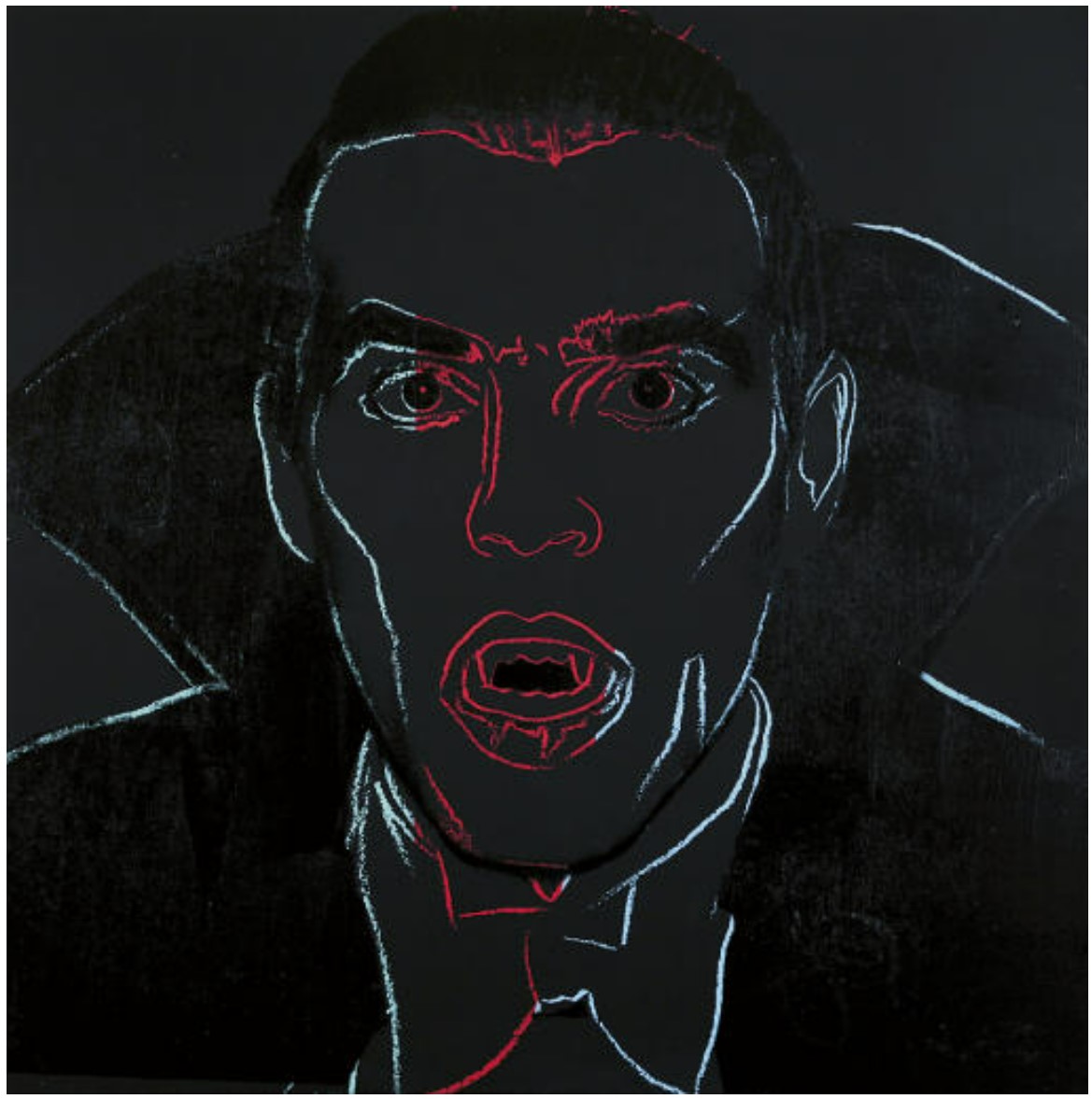
Looming from the shadows, materializing within the black canvas, Dracula appears, baring his fangs. He has been captured on the canvas through a darker-than-dark area depicting his cloak and hair and through lines that are sparse flashes of incandescent color, adding to the sense of the immaterial, the unreal, the apparition. For this is not a celebrity per se, but instead a monster, a spectral figure. And, crucially, a fictitious one.
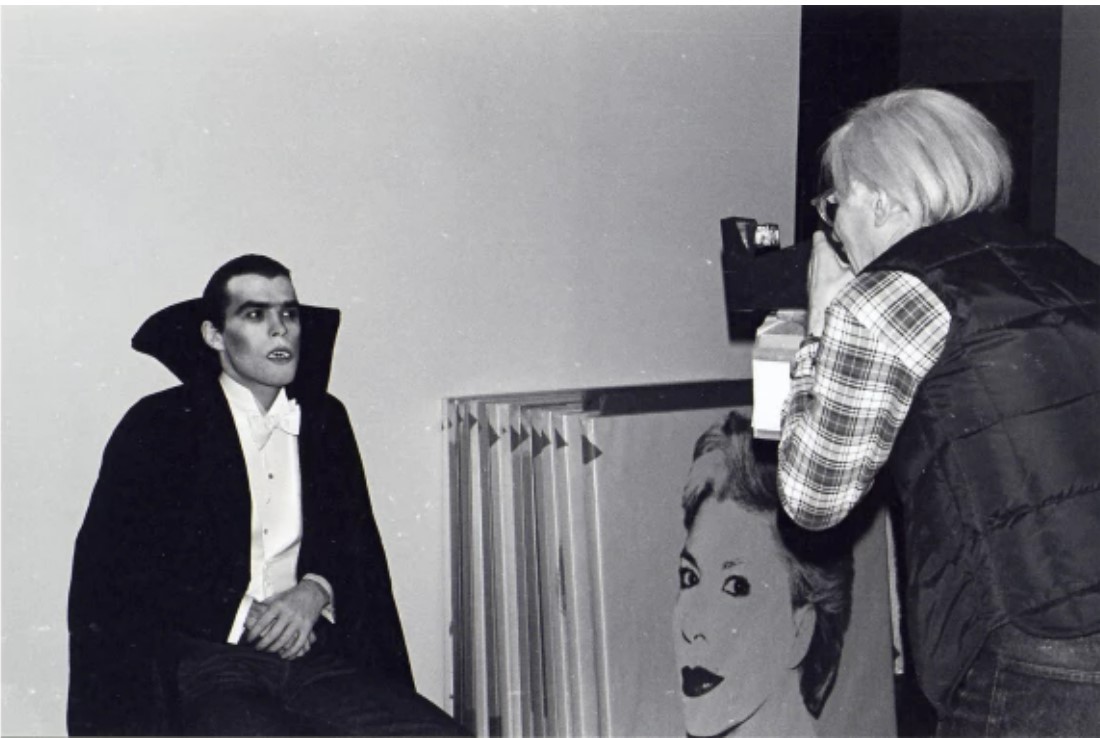
Instead of using an old classic film still, as he had in his 1963 work The Kiss (Bela Lugosi), he managed to arrange for a friend of his, male model Sean McKeon, to dress up as the vampire count. On the one hand, he benefited from using a clearly good-looking man in the role of the suave vampire, and on the other hand managed also to introduce some contextual irony. The idea of taking a male model and presenting him as a vampire is itself a reflection of attitudes towards the bold and the beautiful, all the more acid in tone in its homosexual subtext, which is barely ‘sub’ at all. This aspect of the theme and of the fancy-dress posturing is all the more intriguing in Dracula because of the strange nature of Warhol’s relation with McKeon.

Dracula, 1981
two unique polaroid prints
each: 4¼ x 3⅜ inches (10.8 x 8.6 cm)
The fact that Warhol chose his friend and admirer McKeon to play Dracula in his picture is all the more intriguing because of the autobiographical nature of the theme. For Warhol himself had been dubbed ‘Drella’ by Ondine, a nickname that stuck (and was used in the title of Lou Reed and John Cale’s posthumous tribute to the Pop svangali, Songs for Drella). This was a conflation of Dracula and Cinderella, reflecting two aspects of Warhol’s personality of the vampire and the princess. These were two marginal characters infiltrating society in their different ways, just as Warhol was, and it is this aspect that is at the heart of Dracula. The stock-horror theme has become a part of a modern canon of new saints and archetypes, and has been smuggled into the hallowed art galleries, into the realm of so-called ‘high art’.
Uncle Sam
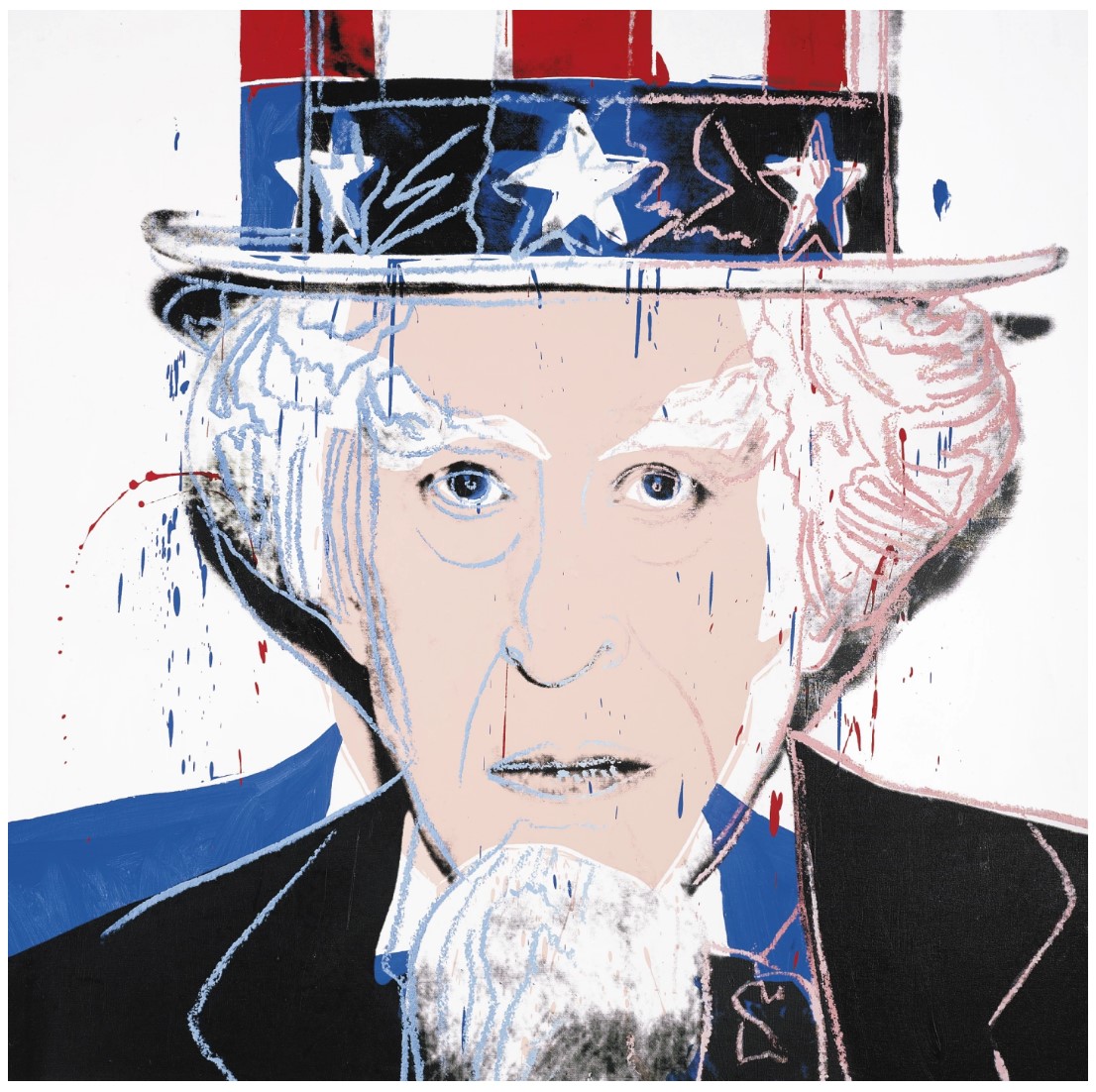
Uncle Sam (from Myths), 1981
Sotheby’s New-York: 12 November 2015
Estimated: USD 600,000 – 800,000
USD 1,210,000
(#222) Andy Warhol (sothebys.com)
ANDY WARHOL
Uncle Sam (from Myths), 1981
Acrylic and silkscreen on canvas
60×60 inches (152.4 x 152.4 cm)
Andy Warhol’s monumental representation of one of the most iconic figures of American patriotism is a colorful tour de force that is simultaneously playful and intense. Uncle Sam is rendered in bold hues of red, white and blue. Loosely sketched lines and splatters of paint create a striking juxtaposition against the solid blocks of color that define Uncle Sam’s form, their exuberance softening the effect of the massive figure’s hypnotizing stare.
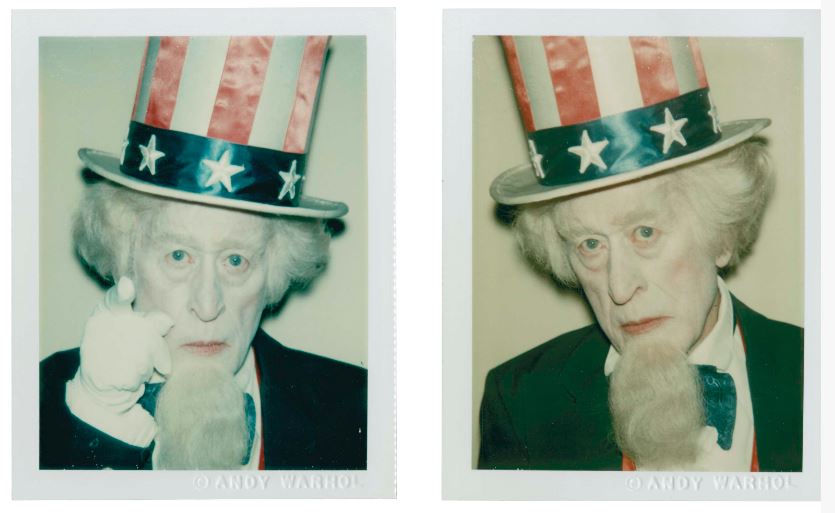
Uncle Sam, 1981
two unique polaroid prints
each: 4¼ x 3⅜ inches (10.8 x 8.6 cm)
The celebrity of this American icon is implied in the formal qualities of the work: the stark white background and undefined features of Uncle Sam’s face imply the over-exposed effect commonly created by a camera flash, and it seems as if Uncle Sam is standing in front of dozens of flashing cameras and adoring fans. From our point of observation, we are caught up in the frenzy of celebrity-worship, yet the legend of Uncle Sam and what he represents to America transcends celebrity and reaches the status of god or demi-god.
Howdy Doody
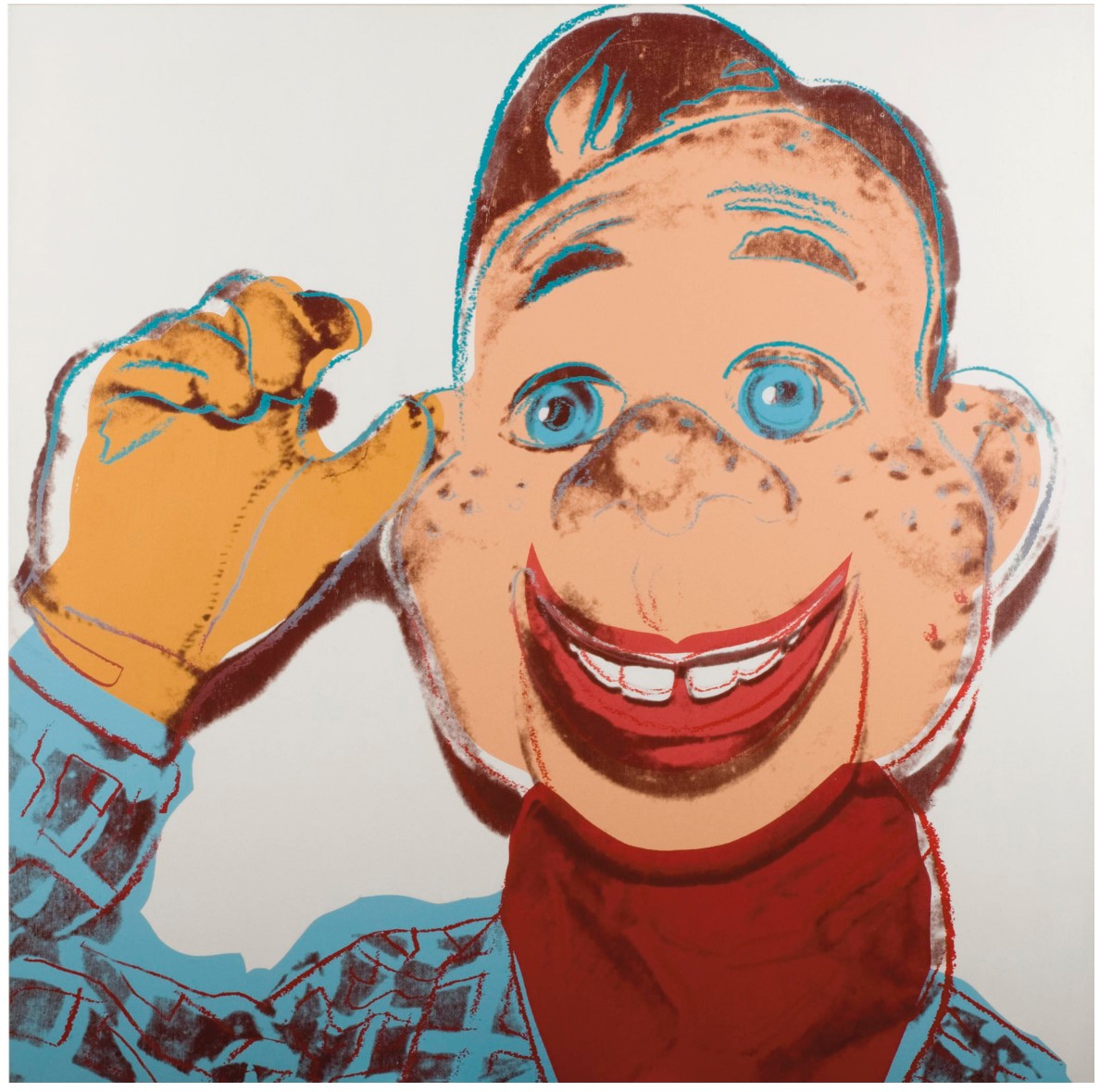
Howdy Doody (from Myths), 1981
Christie’s New-York: 8 November 2011
Estimated: USD 750,000 – 850,000
USD 866,500
Andy Warhol (1928-1987) (christies.com)
ANDY WARHOL
Howdy Doody (from Myths), 1981
Synthetic polymer and silkscreen inks on canvas
60×60 inches (152.4 x 152.4 cm)
A pioneer in children’s programming, the Howdy Doody show ran on NBC from 1947 to 1960. Because it was broadcast in color, NBC (then owned by RCA) used the show in part to sell color television sets. Like Mickey Mouse, the Howdy Doody character became a powerful marketing tool. In 1955, a merchandise catalog listed 24 pages of officially licensed Hoody Doody products. In the present work, Warhol exaggerates the character’s most iconic features; the mouth is rendered in an upturned, clownlike smile and overlaid with tracing that adds a three-dimensional quality to the two-dimensional character. This technique (also used in Superman) causes the outlines to reverberate, much like a cartoonist draws around a figure to suggest movement.
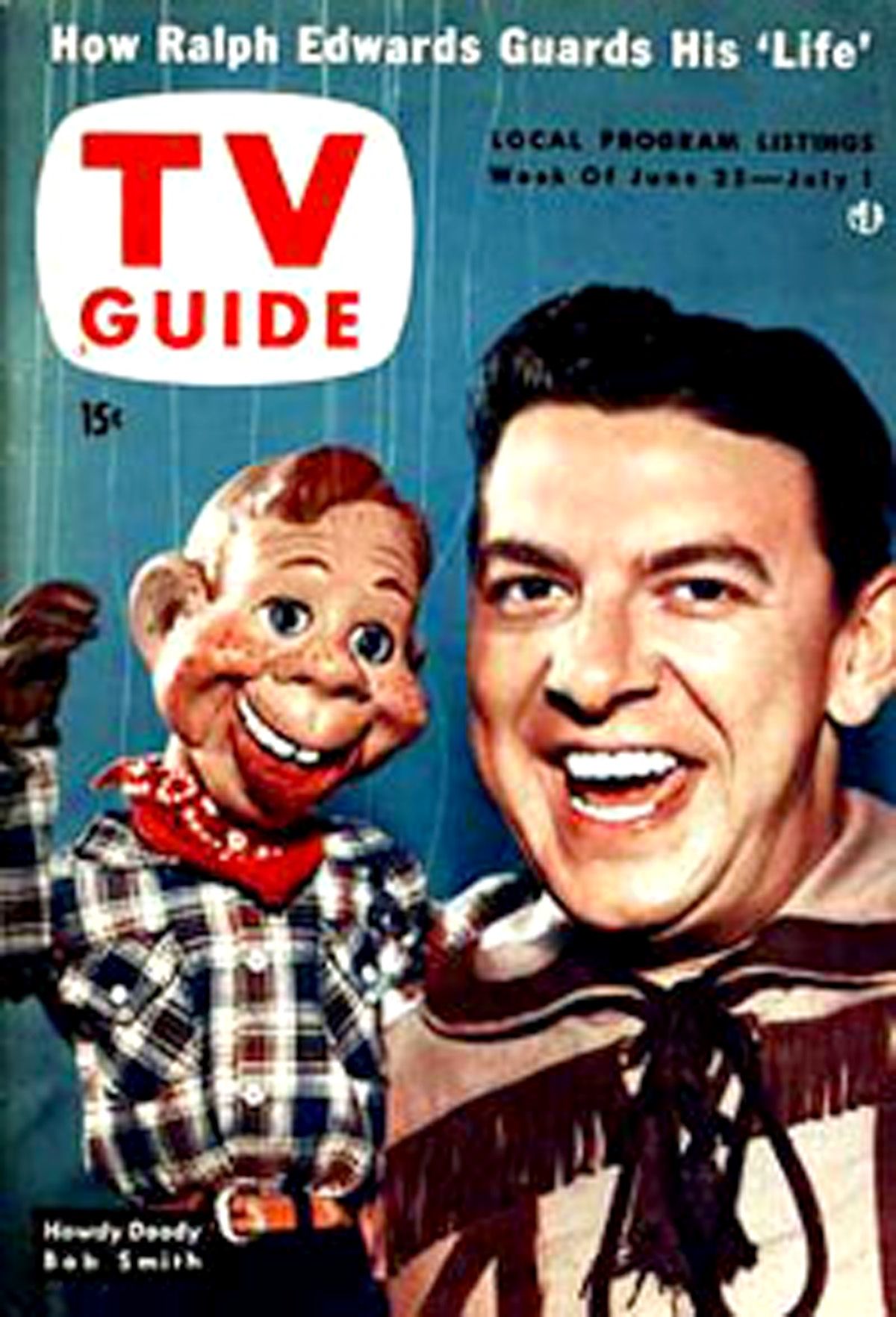
Measuring 60×60 inches (the largest size of the series), Warhol’s Howdy Doody truly engulfs the viewer in its monumental scale. Indeed, Warhol understood that modern myths were made on television. As he did in the 1960s with Elvis, Marilyn and Liz, Warhol elevates his subject’s status in American culture to mythic proportions by literally enlarging his subjects. The owner of the original Howdy Doody puppet brought it to Warhols studio and allowed the artist to photograph it from multiple angles. As Warhol later found out, this was one of three original puppets used in filming the show. With Howdy Doody, Warhol christens a modern canon of new saints and archetypes, ones culled from popular culture and elevated to the realm of high art.
Santa Claus
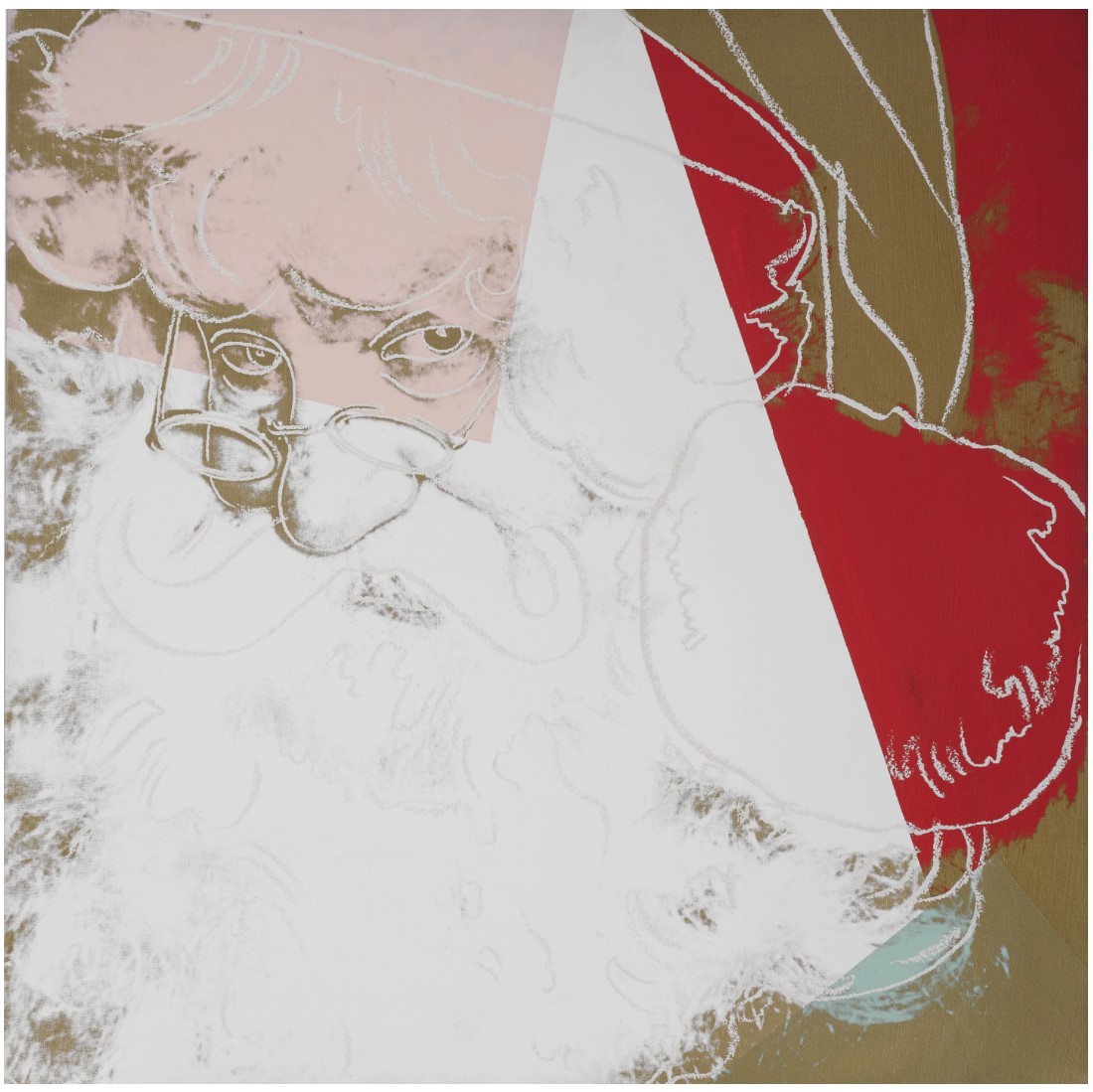
Santa Claus (From Myths), 1981
Sotheby’s New-York: 17 November 2017
Estimated: USD 400,000 – 600,000
USD 399,000
(#232) Andy Warhol (sothebys.com)
ANDY WARHOL
Santa Claus (From Myths), 1981
Acrylic, silkscreen ink and diamond dust on canvas
40×40 inches (101.6 x 101.6 cm)
Equally ardent was Warhol’s interest in Santa Claus, a fictitious character recognizable around the world, and in this sense, a ‘celebrity’ as much as Marilyn Monroe or Liz Taylor. Thus it comes as so surprise that Warhol made Santa Claus one of ten mythical icons that constituted his 1981 Myths series. While Andy Warhol kept his devout Catholicism close to chest, his love of Christmas he did not. Those who knew Warhol well were aware of his obsession with Christmas. He adored color, excess and festivity, associated with the holiday season, as evident in a number of kitsch illustrations and greetings cards, he created since the 1950s when working as a commercial illustrator, and the festive Polaroids, like the one with Truman Capote clad in festive garb.

Myths (Santa), 1981
Unique polaroid print
4.2 x 3.4 inches (10.8 x 8.5 cm)
It is impossible to truly know the man behind the beard on the Polaroid portrait of Santa Claus that Warhol used for the present work, however it seems that the artist’s intent in creating this character is to pit our childhood idealism against the cynicism of adulthood. Beneath the typology of “Santa” there lurks a man with a sly, subversive smile that can win the affections of small children with toys and treats. Like in Warhol’s Ladies and Gentlemen, we are facing here a figure that lives in two worlds, fantasy and reality, and Warhol leaves the viewer with the option open.
Myths (Multiple)
Myths (Multiple), 1981
Sotheby’s London: 25 March 2021
Estimated: GBP 2,000,000 – 3,000,000
GBP 2,314,000
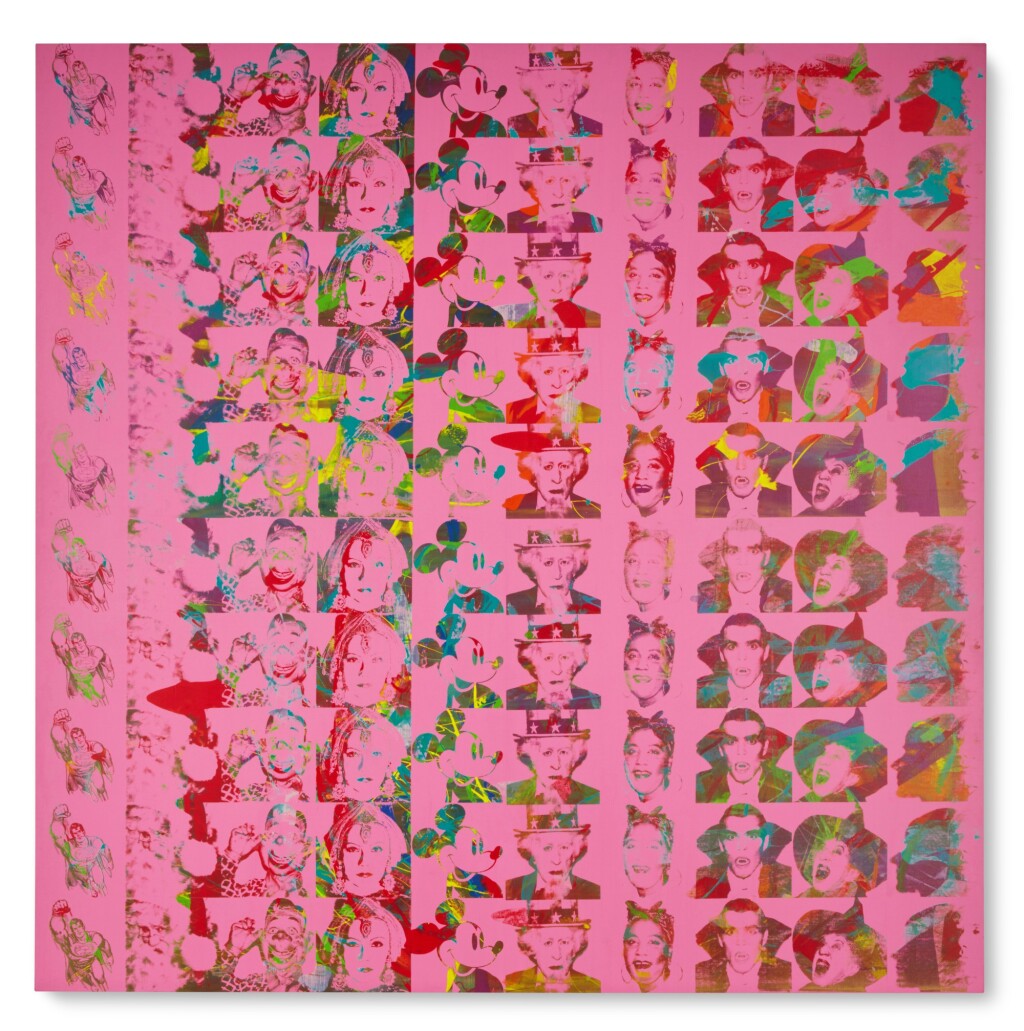
ANDY WARHOL
Myths (Multiple), 1981
Acrylic and silkscreen ink on canvas
100×100 inches (254×254 cm)
Signed and dated 1981 on the overlap
Stamped by The Andy Warhol Art Authentication Board
Numbered PA51.015 on the overlap
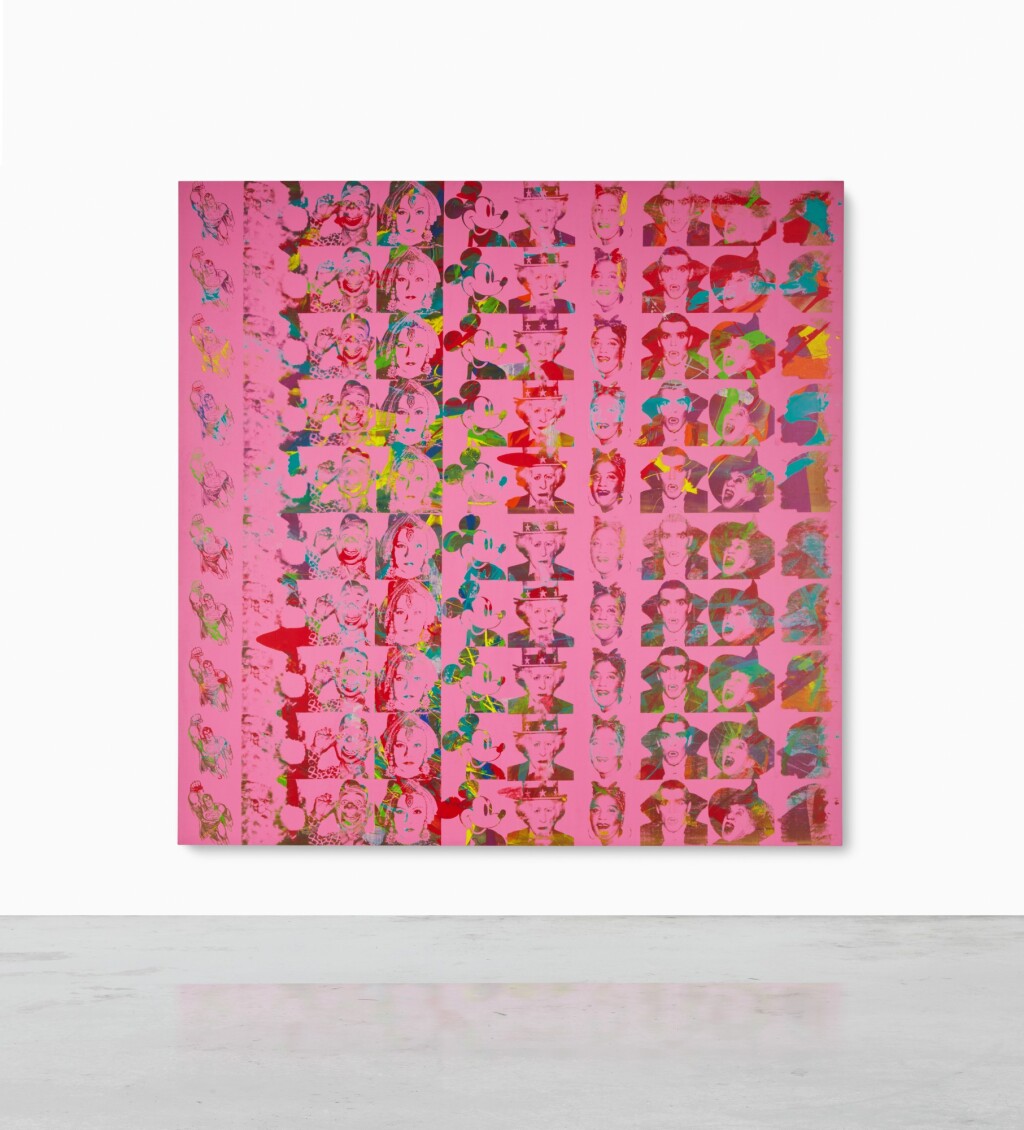
An electrifying example from the Myths series of 1981, the present work embodies Andy Warhol’s singular insight into the bombastic relationship between celebrity and consumer culture in American society. An image of absolute iconic gravitas, Myths (Multiple) depicts instantly recognizable figures from American pop culture: Superman, Santa Claus, Howdy Doody, Greta Garbo, Mickey Mouse, Uncle Sam, Mammy, Dracula and the Wicked Witch of the West pervade the surface of the canvas in high-key tones of bubblegum pink, red, turquoise, yellow and lime green. Amongst these serially reproduced pop culture icons is the vertical repetition of Warhol’s own self-image as the character The Shadow. Posing as the crime-fighting hero from the 1930s radio show, Warhol has presented himself as part of this pantheon of commercial icons, as he intentionally blurs the boundary between individual and symbol, artist and celebrity, hero and commodity.
Drawing upon such early investigations, the present work takes Warhol’s obsession with commercial logos, fame and celebrity into the fictional realm, as Warhol depicts beloved characters of the silver screen. Yet the composition remains analogous to his earlier work: “What is the difference between Marilyn Monroe, a Campbell’s Soup Can, Uncle Sam, Golda Meir, O. J. Simpson, and Mickey Mouse? Nothing, say the portraits of Andy Warhol. They are all icons of America’s modern mythology of celebrity. Icons that sell…To paraphrase Joseph Campbell, mythology is the organization of metaphorical figures that connote a state of mind, that transcend their specific place or time… To paraphrase Andy Warhol’s portraits, the mythology of America is celebrity, the gods and demigods are those who can sell through their mass-produced images, and the course of action we, as a culture, are called to is to consume. These portraits record an American culture transformed from hero-to-celebrity worship and the role of cultural icon as celebrity, a commodity, and a piece of commercial art that sells. Through these portraits, Warhol both documented and encouraged the collapse of separation between individual, logo and myth. The celebrity is no longer an individual, but a brand name, a logo” (G. Metcalf cited in: Ibid., p. 6).
Myths (Multiple) showcases Warhol’s revolutionary silkscreen technique, a tool that allowed the artist to convey a radical reinvention of social critique and observation. As opposed to mere illustration, silk-screening permitted Warhol to investigate the intense media craze that shaped American culture through television, film, print, and radio channels. The process was also evocative of a strict mechanical function, fundamentally positioning the artist as machine. Through the silkscreen technique, images are created, repeated, and produced en-mass, recalling the production of simple commercial goods at large-scale factories, many of which were Warhol’s chosen subjects. Though particularly reflective of his contemporary culture, the artist’s obsession with film and television characters – an infatuation that spectacularly unfolds on the surface of the present work – can be traced back to a particular moment during his childhood when, at the age of ten, he received a signed photograph of Shirley Temple after writing her a plethora of fan letters. From that point on, movies and magazines became forms of motivational escape from the mundanity of his hometown, Pittsburgh, in the 1930s. Indeed, the characters on the surface of Myths (Multiple) are some of America’s most beloved – the Wicked Witch of the West first appeared on American screens in 1939 as part of The Wizard of Oz, one of the first films to use Technicolor, and one that would become an American pop culture icon. Howdy Doody was the main character in a children’s television show that aired in 1947, while the hugely popular Adventures of Superman television series, based on comic books of the same title, aired in 1952, creating a high-powered franchise that would become one of America’s largest in the television and film industry.
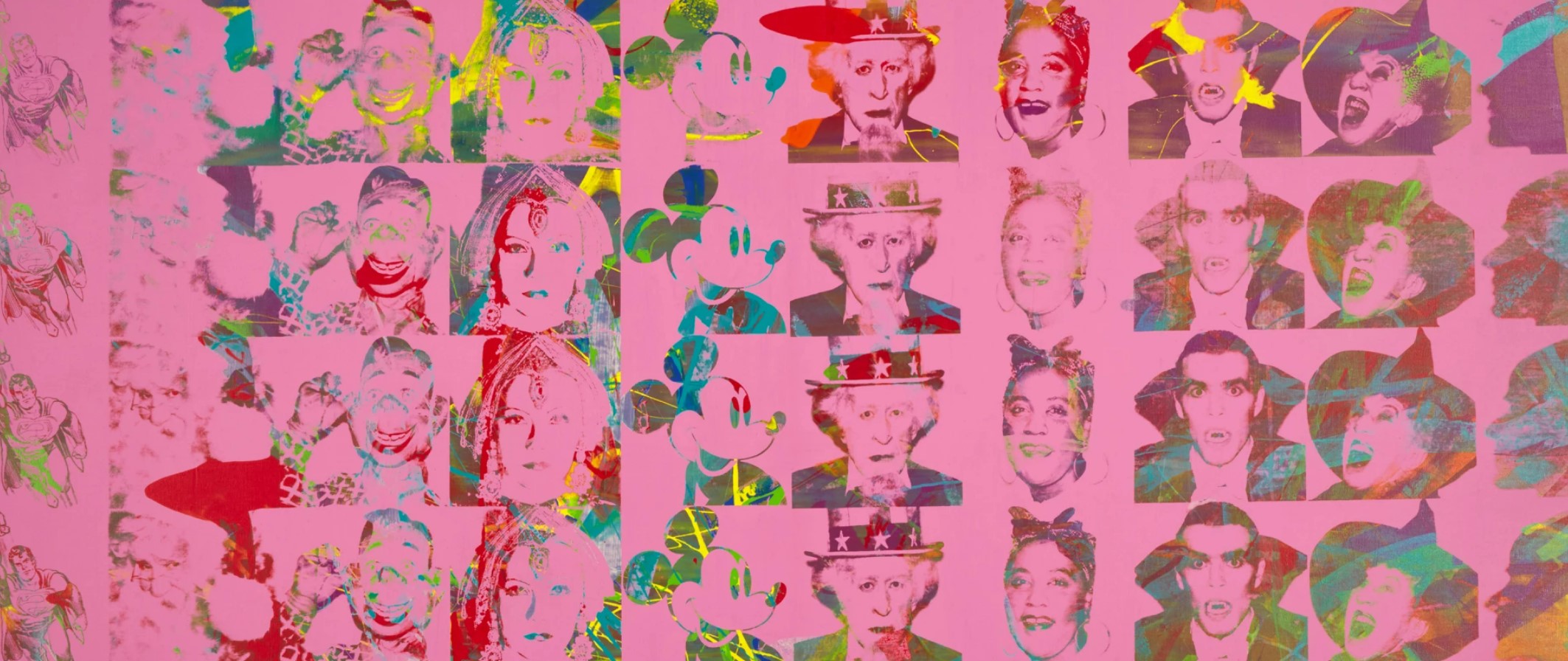
A powerful coalescence of the most emblematic characters of twentieth century film and television, Myths (Multiple) testifies to Warhol’s mastery over contemporary visual culture in America. The present work is imbued with an inherent fascination in the idea of heroes and villains, and indeed mythological archetypes of good and evil. Vividly depicted in the artist’s singular Pop Art aesthetic, the present work exemplifies characters integral to a shared American cultural consciousness, while elevating instantly-recognizable, mass media imagery into the realm of fine art.