Introduction
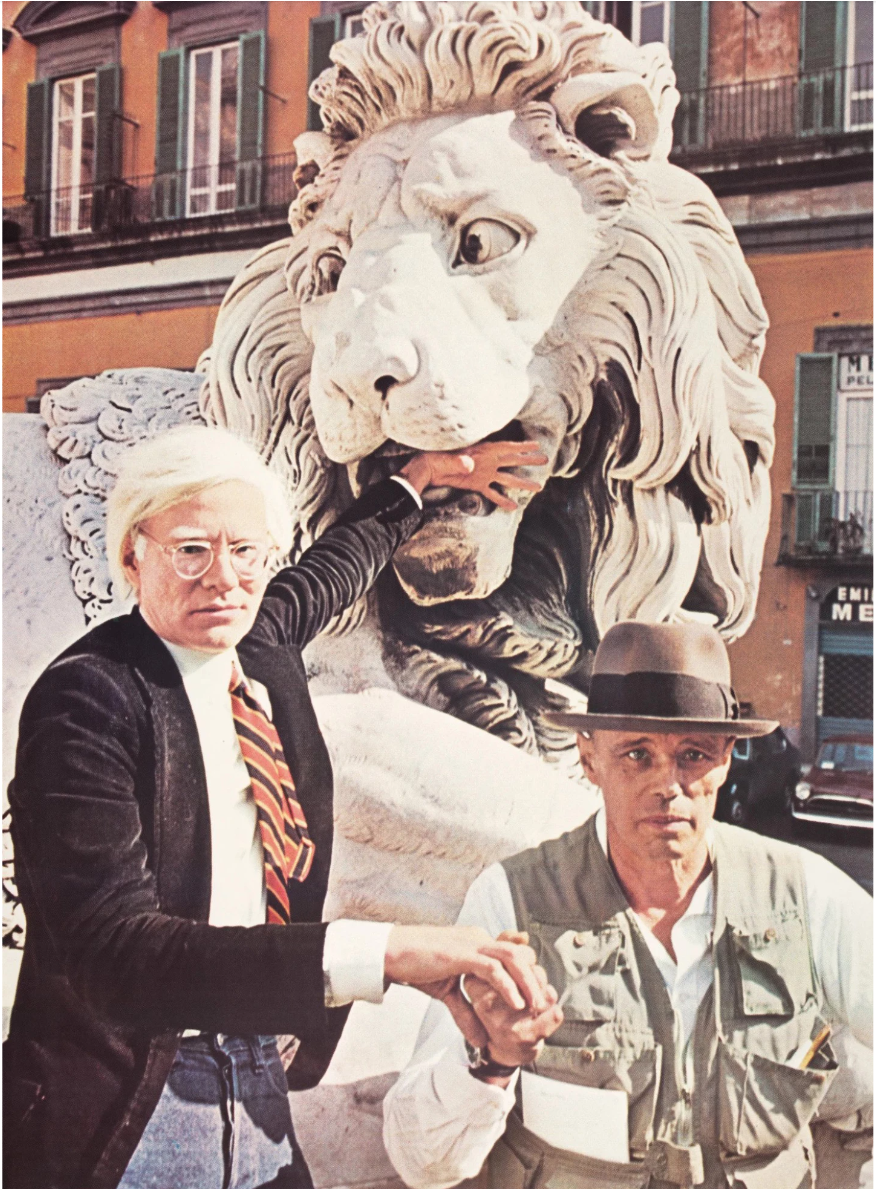
Warhol and Beuys, the two giants of American and German post-war art, met for the very first time at a Warhol exhibition in May 1979 at Galerie Hans Mayer. “For those who witnessed them approaching each other across the polished granite floor,” recalls David Galloway, “the moment had all the ceremonial aura of two rival popes meeting in Avignon” (David Galloway, “Beuys and Warhol: Aftershocks,” Art in America, July 1988, p. 121). This momentous and historic moment led to one of Warhol’s most fascinating series of portraits, in which the now iconic face of Beuys was forever immortalized in the quintessentially Warholian body of silkscreen portrait paintings. In November that same year, the two artists met again, this time in New York at Beuys’ major retrospective at the Solomon R. Guggenheim Museum. It was here that the idea for this celebrated series was born, when Warhol captured Beuys in his habitual uniform of felt hat and sleeveless jacket in a sequence of Polaroid photographs that would form the fundamental basis of the works. Executed just one year after their initial meeting, the present work encompasses the vastly polarized yet equally radical advancements in post-war transatlantic art by “the two extreme souls of contemporary art”: Warhol and Beuys (Michele Bonuomo, Exh. Cat., Naples, Museo di Capodimonte, Vesuvius by Warhol, 1985, p. 33).
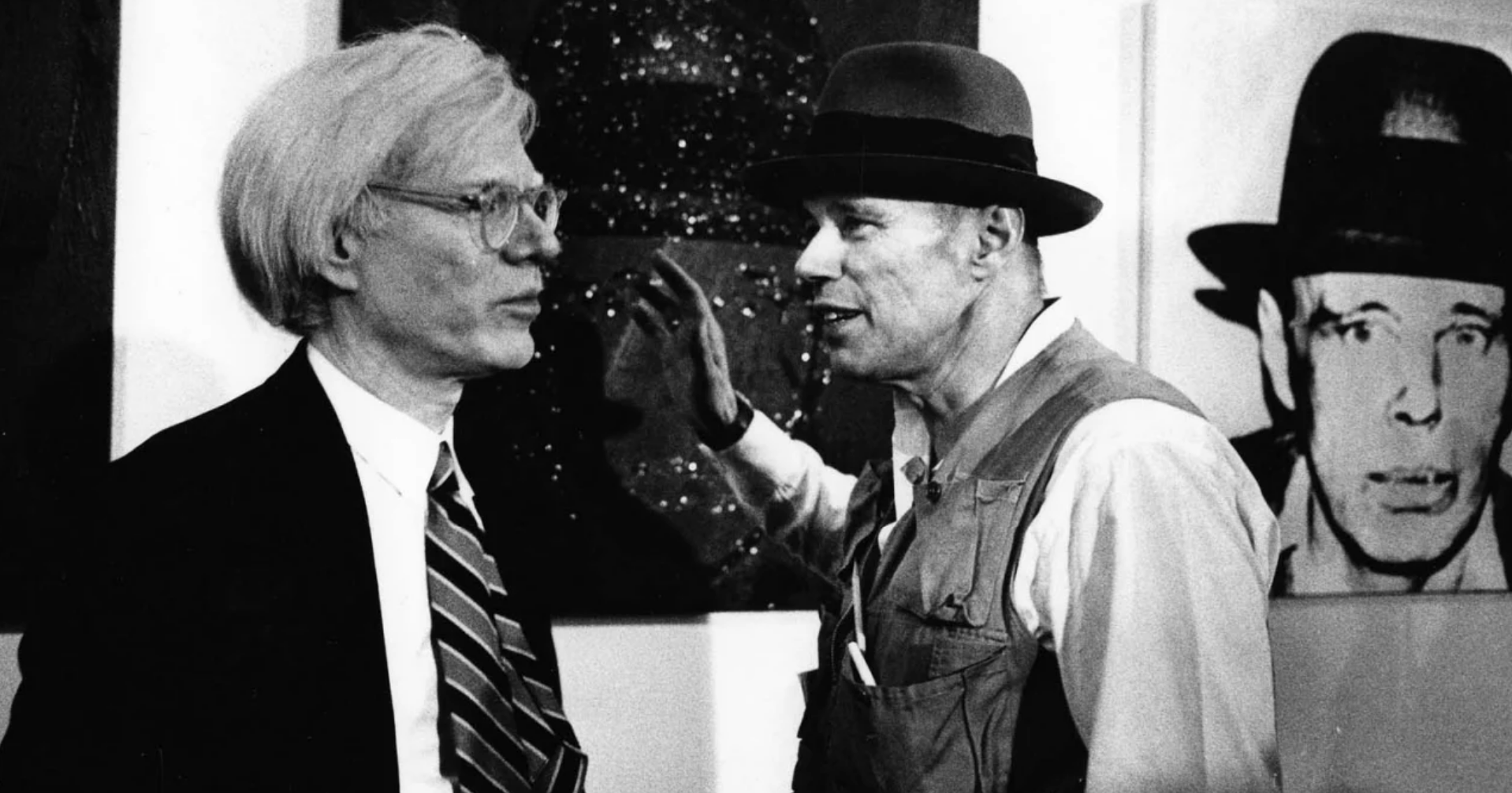
ANDY WARHOL AND JOSEPH BEUYS AT THE OPENING OF ANDY WARHOL JOSEPH BEUYS, LUCIO AMELIO GALLERY, 1980. PHOTO © NINO LO DUCA. ART © 2023 ANDY WARHOL FOUNDATION FOR THE VISUAL ARTS / ARTISTS RIGHTS SOCIETY (ARS), NEW YORK
By addressing and appropriating the mass reproduction of images in popular media, Warhol effectively transformed the parameters of visual culture within America and, indeed, within Contemporary art; his iconic body of portraiture can be seen to have irrefutably influenced today’s hyperawareness of wealth, celebrity, and consumerist culture. In contrast, Joseph Beuys’ philosophically based practice sought to heighten human perception, and was characterized by his creative, participatory role in shaping society and politics. Born in Germany in 1921, Beuys became widely recognized for his humanistic, almost spiritual approach to anthroposophy, social philosophy and environmental trends, ultimately endeavoring to create a ‘gesamtkunstwerk’ or what he believed was ‘a total work of art.’ Despite the stark disparities between Warhol’s and Beuys’ respective projects, their practices found a remarkable symbiosis; after their initial meeting in Düsseldorf in 1979, the two artists were to maintain an enduring respect for one another. It was precisely at this meeting that Warhol took the Polaroid photo of Beuys that, as demonstrated in the present work, would become the source of the Pop artist’s portraiture series depicting the self-appointed shaman of the European avant-garde.
Evincing an elegant union of two distinct artistic personas, Joseph Beuys is a subtly self-referential painting, fusing Warhol’s lifelong infatuation with celebrity, consumerism and material culture with Beuys’ more somber investigations of humanism, social philosophy, and politics. Warhol, the progenitor of Pop and catalyst for a new cultural age, and Beuys, a radical who didactically transformed the landscape of both conceptual and performance art, were each pioneering leaders in their own spheres, both leaving behind respectively profound legacies. They were, as Michele Bonuomo attests: “Two opposite stories, two antithetical selves [who] deliberately chose the ideal place to observe and get mixed up with each other.” (Michele Bonuomo, Exh. Cat., Naples, Museo di Capodimonte, Vesuvius by Warhol, 1985, p. 33) Warhol’s series of portraits of Beuys potently conveys this majestic union of the material and the spiritual, the artificial and the natural worlds that each artist occupied and explored.
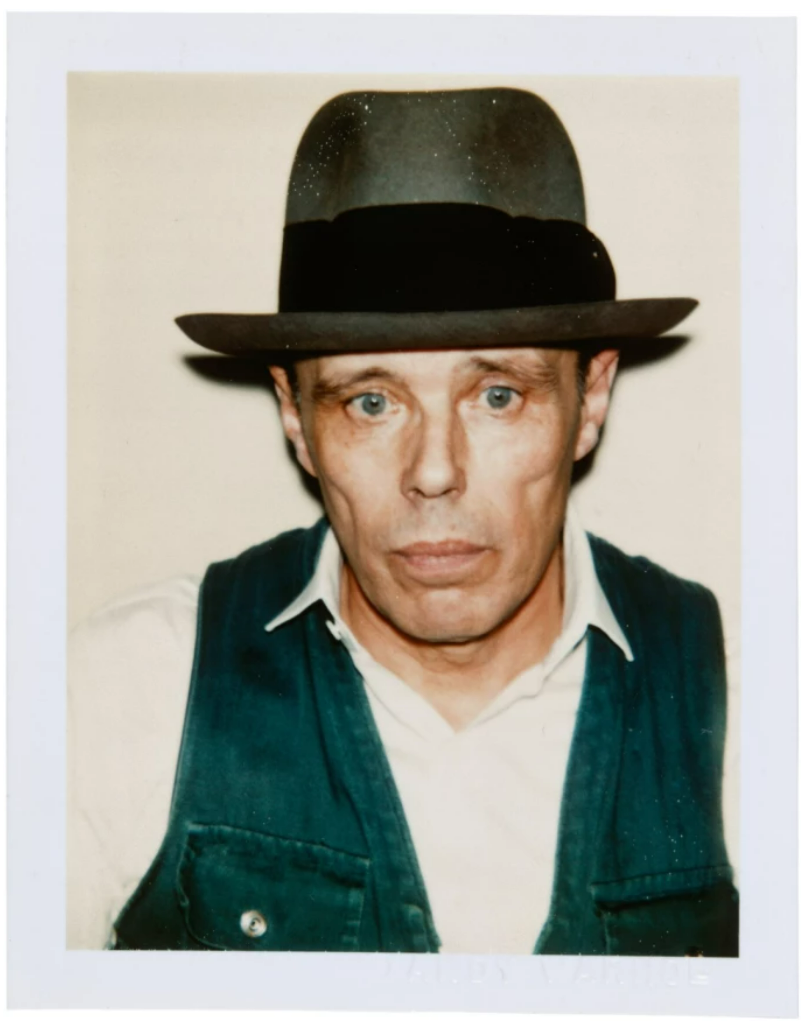
ANDY WARHOL, JOSEPH BEUYS, 1980. CENTRE GEORGES POMPIDOU, PARIS.
IMAGE © CNAC/MNAM, DIST. RMN-GRAND PALAIS / ART RESOURCE, NY.
ART © 2023 ANDY WARHOL FOUNDATION FOR THE VISUAL ARTS / ARTISTS RIGHTS SOCIETY (ARS), NEW YORK
“Beuys was everything Andy was not: intellectual, political, anti-fashionable. At the press conference after the Naples opening, Beuys went on and on about art and history and philosophy, while Andy sat there staring at São Schlumberger’s emerald ring.”
BOB COLACELLO, HOLY TERROR: ANDY WARHOL CLOSE-UP, NEW YORK 1990, P. 445
Warhol’s famous diamond dust portrait of Joseph Beuys has something of the epic and the adulatory about it. It is an aspect that is not at all inappropriate for a portrait of an artist whose status within his own lifetime was such that he inspired followers, devotees, and believers amongst what was a broad and ever-widening entourage. Beuys’ reputation and the shamanic example he set as an artist concerned with the social reform of the world rather than with mere aesthetics or the history of art gained him an almost mystical status in the eyes of many. By the late 1970s, although recent critical attention to his mid-1970s work had grown increasingly cold, Warhol too, had been enshrined as a god in the pantheon of twentieth century art. Both artists were, and indeed still are, considered by many to be the twin giants of American and European Post-War art. Today, the names ‘Beuys’ and ‘Warhol’ signify as much a worldview and a phenomenon as they do each artist’s work or person.
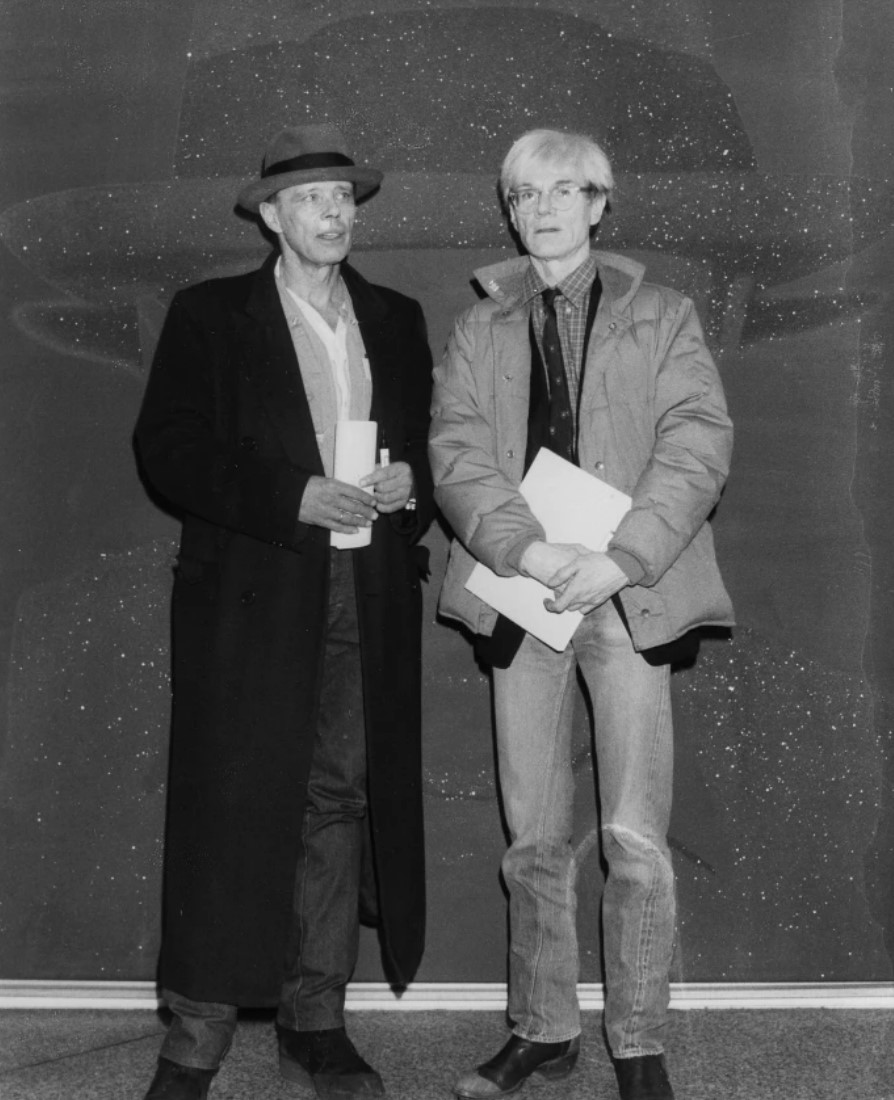
Aware of this and of each other’s status as the high-priests of two very different but not at all fundamentally opposed systems of artmaking, their meeting and indeed the manner of it took on a greater significance than either man would have wanted. Surprisingly, the two artists did not meet until 1979. Beuys had always been very wary of America (its capitalist values and cultural imperialism being the cause of much conflict in his native Germany) and as a consequence, he did not travel to or exhibit in the United States very often. For his famous healing performance/encounter with a coyote (a symbol of the ancient unspoiled pre-Columbian America) in a New York Gallery in 1974, he had insulated himself from everything to do with the United States by having himself delivered to the gallery in an ambulance and wrapped entirely in felt.
“We had breakfast with Joseph Beuys, he insisted I come to his house and see his studio and the way he lives and have tea and cake; it was really nice. He gave me a work of art which was two bottles of effervescent water which ended up exploding in my suitcase and damaging everything I have, so I can’t open the box now, because I don’t know if it’s a work of art anymore or just broken bottles. So if he comes to New York I’ve got to get him to come and sign the box because it’s just a real muck.”
This action Beuys appropriately, if also somewhat humorously, named I like America and America likes me. It is an ironic title that could also be applied to his relationship with Warhol. The nature of this muted and cordial relationship between these two figureheads of late twentieth century art is one of historic significance and will no doubt excite the curiosity of historians of art and culture for many years. It is one that is perhaps best described by the following anecdote recorded in Warhol’s diary for Sunday 8th March, 1981 in Dusseldorf.
Auction Results
Joseph Beuys, 1980
Sotheby’s London: 26 June 2024
Estimated: GBP 400,000 – 600,000
GBP 456,000 / USD 578,208
ANDY WARHOL (1928 – 1987)
Joseph Beuys, 1980
Acrylic and silkscreen ink on canvas
40×40 inches (101.6 x 101.6 cm)
Signed and dated 1980 (on the reverse)
Joseph Beuys, 1982
Ketterer Kunst: 8 December 2023
Estimated: EUR 250,000
EUR 317,500 / USD 333,375
Ketterer Kunst, Art auctions, Book auctions Munich, Hamburg & Berlin
ANDY WARHOL
Joseph Beuys, 1982
Acrylic with silkscreen and diamond dust on canvas
19.8 x 15.9 inches (50.5 x 40.5 cm)
Signed and dated on the reverse
Joseph Beuys, 1980
Sotheby’s New-York: 15 November 2023
Estimated: USD 600,000 – 800,000
USD 1,016,000
Joseph Beuys | Contemporary Evening Auction | 2023 | Sotheby’s (sothebys.com)
ANDY WARHOL (1928 – 1987)
Joseph Beuys, 1980
Acrylic and silkscreen ink on canvas
40×40 inches (101.6 x 101.6 cm)
Signed and dated 80 (on the overlap)
Joseph Beuys (Reversal), 1983
Sotheby’s London: 25 March 2021
Estimated: GBP 800,000 – 1,200,000
GBP 1,067,700 / USD 1,464,810
ANDY WARHOL
Joseph Beuys (Reversal), 1983
Acrylic, silkscreen ink and diamond dust on canvas
84×70 inches (213.4 x 177.8 cm)
Signed and dated 83 on the reverse
Joseph Beuys (40×40)
Joseph Beuys, 1980
Sotheby’s London: 26 June 2024
Estimated: GBP 400,000 – 600,000
GBP 456,000 / USD 578,208
ANDY WARHOL (1928 – 1987)
Joseph Beuys, 1980
Acrylic and silkscreen ink on canvas
40×40 inches (101.6 x 101.6 cm)
Signed and dated 1980 (on the reverse)
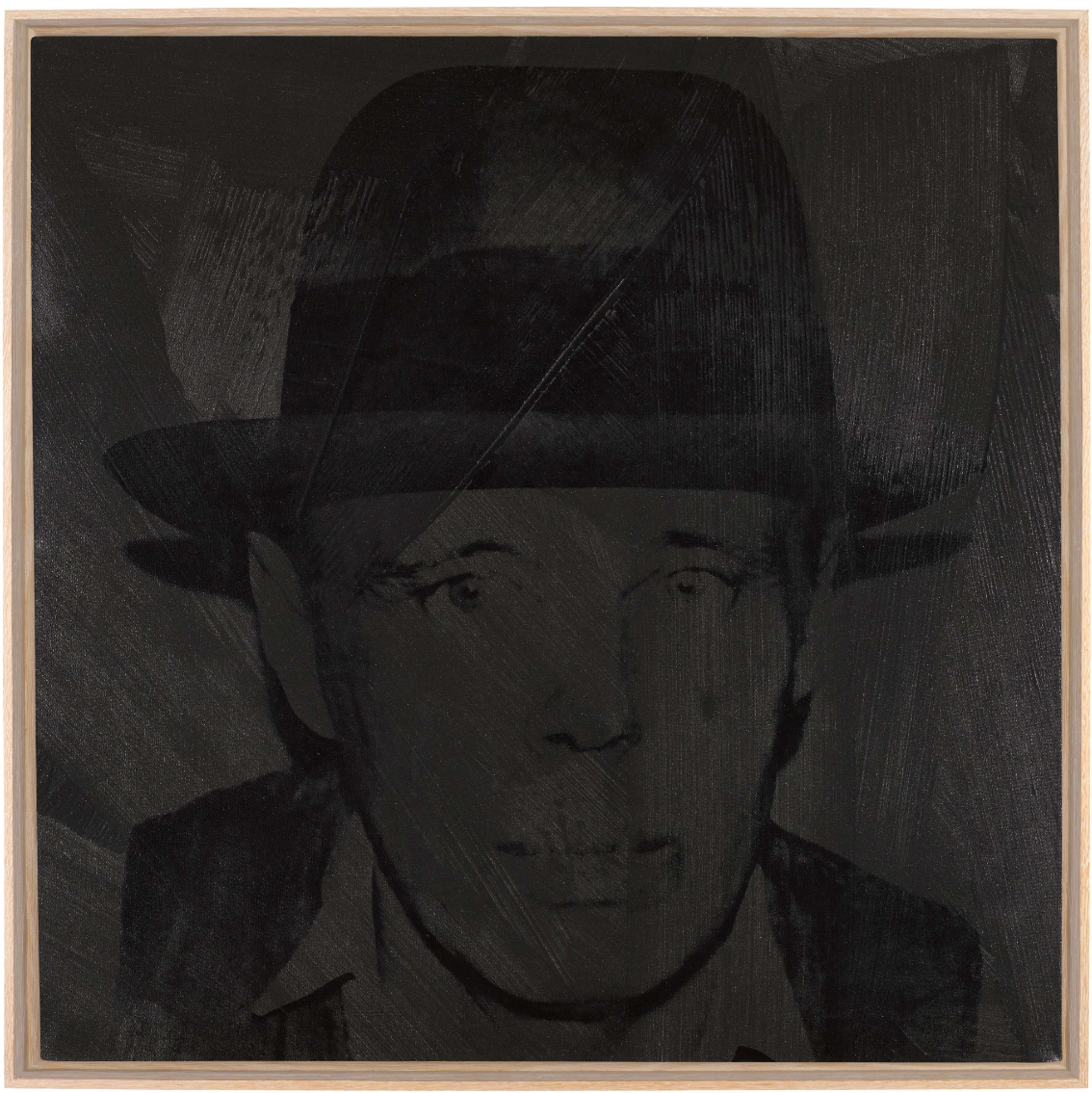
A powerful example of Andy Warhol’s renowned silkscreen portraits, the present work achieves a remarkable fusion of resemblance and individuality.
Andy Warhol pioneered the Pop Art movement and revolutionized the New York City art scene with his iconic depictions of consumer culture and mass media imagery. Starting in the early 1960s, his work explored the relationship between advertising, fame and artistic expression through a multitude of media. Beuys was a legend in his own right, and a pioneer of conceptual art who used unconventional materials and performance to convey his ideas. Working as a teacher, performance artist and theorist, Beuys’s work reflected concepts of humanism, sociology, and his strong belief that art possesses the power to affect social and political change. The two artists crossed paths multiple times after their initial encounter, most notably during the installation of Beuys’s major retrospective at the Solomon R. Guggenheim Museum in New York in November 1979. It was on this occasion that the idea for this celebrated series of portraits was initiated. Beuys then visited Warhol’s studio, The Factory, to have his picture taken, coincidentally arriving at the very moment when Georgia O’Keeffe was being photographed. Warhol relied on his Polaroid Big Shot camera to immortalize the timeless image of Beuys in his distinctive and iconic felt hat and sleeveless jacket. These Polaroid photographs subsequently became the foundation for a series of screen-printed portraits created between 1980 and 1986.
The present portrait is both mysterious and alluring, with Warhol’s stylistic choice to paint over the black silkscreen with black paint, forcing the viewer to lean into the canvas. The work is an archetypal example of Warhol’s silkscreen printing process.
“You pick a photograph, blow it up, transfer it in glue onto silk, and then roll ink across it so the ink goes through the silk but not through the glue. That way you get the same image, slightly different each time.”
Once silkscreened, Warhol further added sweeps of expressive brushwork, embedding a sense of dynamism and energy through the textured surface thus building on a painterly dimension onto the flatness of the silkscreen. Despite the black monochrome surface, the subject of the present composition is instantly recognizable – with his unwavering gaze and stark physiognomy, Beuys directly confronts the viewer. However, the tone of the work widely departs from Warhol’s shimmering and glamorous portraits from the 1970s, such as his famous depictions of Marilyn Monroe. By 1980, the year in which the present work was executed, Warhol had indeed shifted his interest to the psychological intensity of his sitter, perhaps the reason why he also developed a strong interest in Beuys. Replacing the fluorescent flashiness of Warhol’s 1970s celebrity portraiture, Joseph Beuys explores instead a deeper plane of existence.
The first exhibition of Warhol’s portraits of Beuys took place at Galleria Lucio Amelio in Naples in April 1980 – this was the very first time when the different iterations of such portraits appeared together. This groundbreaking moment marked the beginning of the official association between the two iconic figures. Testifying to their importance, other iterations of Beuys’s portraits by Warhol are held in the permanent collections of prestigious museums worldwide, including Tate Modern in London, the Museum of Modern Art in New York and Louisiana Museum of Art in Denmark.
Joseph Beuys, 1980
Sotheby’s New-York: 15 November 2023
Estimated: USD 600,000 – 800,000
USD 1,016,000
Joseph Beuys | Contemporary Evening Auction | 2023 | Sotheby’s (sothebys.com)
ANDY WARHOL (1928 – 1987)
Joseph Beuys, 1980
Acrylic and silkscreen ink on canvas
40×40 inches (101.6 x 101.6 cm)
Signed and dated 80 (on the overlap)
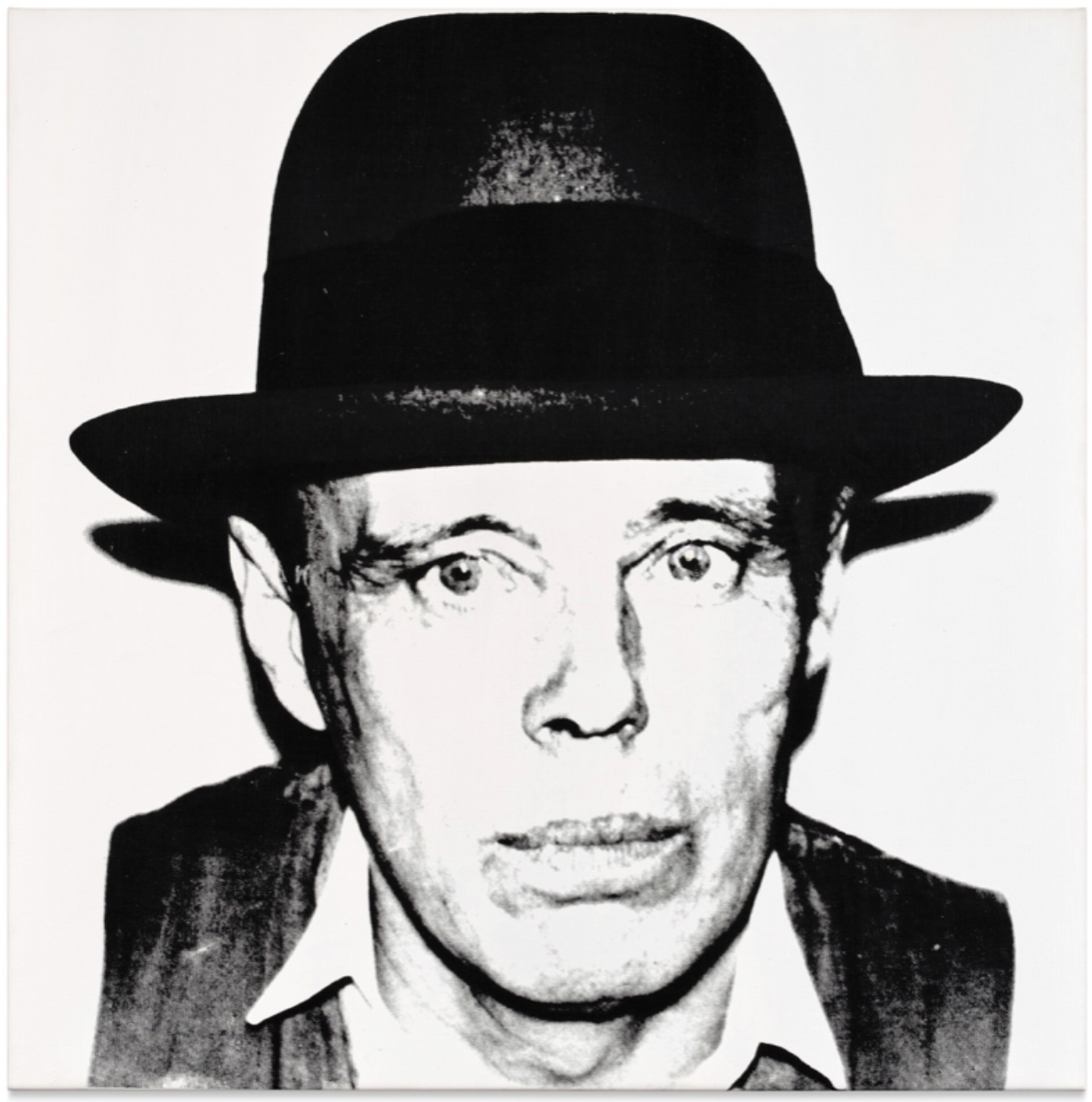
A bold exemplar of Andy Warhol’s iconic silkscreen portraits, Joseph Beuys from 1980 achieves a brilliant collision of likeness and divergence. Warhol and Beuys, the two giants of American and German post-war art, met for the very first time at a Warhol exhibition in May 1979 at Galerie Hans Mayer. “For those who witnessed them approaching each other across the polished granite floor,” recalls David Galloway, “the moment had all the ceremonial aura of two rival popes meeting in Avignon” (David Galloway, “Beuys and Warhol: Aftershocks,” Art in America, July 1988, p. 121). This momentous and historic moment led to one of Warhol’s most fascinating series of portraits, in which the now iconic face of Beuys was forever immortalized in the quintessentially Warholian body of silkscreen portrait paintings. In November that same year, the two artists met again, this time in New York at Beuys’ major retrospective at the Solomon R. Guggenheim Museum. It was here that the idea for this celebrated series was born, when Warhol captured Beuys in his habitual uniform of felt hat and sleeveless jacket in a sequence of Polaroid photographs that would form the fundamental basis of the works. Executed just one year after their initial meeting, the present work encompasses the vastly polarized yet equally radical advancements in post-war transatlantic art by “the two extreme souls of contemporary art”: Warhol and Beuys (Michele Bonuomo, Exh. Cat., Naples, Museo di Capodimonte, Vesuvius by Warhol, 1985, p. 33).
ANDY WARHOL AND JOSEPH BEUYS AT THE OPENING OF ANDY WARHOL JOSEPH BEUYS, LUCIO AMELIO GALLERY, 1980. PHOTO © NINO LO DUCA. ART © 2023 ANDY WARHOL FOUNDATION FOR THE VISUAL ARTS / ARTISTS RIGHTS SOCIETY (ARS), NEW YORK
By addressing and appropriating the mass reproduction of images in popular media, Warhol effectively transformed the parameters of visual culture within America and, indeed, within Contemporary art; his iconic body of portraiture can be seen to have irrefutably influenced today’s hyperawareness of wealth, celebrity, and consumerist culture. In contrast, Joseph Beuys’ philosophically based practice sought to heighten human perception, and was characterized by his creative, participatory role in shaping society and politics. Born in Germany in 1921, Beuys became widely recognized for his humanistic, almost spiritual approach to anthroposophy, social philosophy and environmental trends, ultimately endeavoring to create a ‘gesamtkunstwerk’ or what he believed was ‘a total work of art.’ Despite the stark disparities between Warhol’s and Beuys’ respective projects, their practices found a remarkable symbiosis; after their initial meeting in Düsseldorf in 1979, the two artists were to maintain an enduring respect for one another. It was precisely at this meeting that Warhol took the Polaroid photo of Beuys that, as demonstrated in the present work, would become the source of the Pop artist’s portraiture series depicting the self-appointed shaman of the European avant-garde.
ANDY WARHOL, JOSEPH BEUYS, 1980. CENTRE GEORGES POMPIDOU, PARIS. IMAGE © CNAC/MNAM, DIST. RMN-GRAND PALAIS / ART RESOURCE, NY. ART © 2023 ANDY WARHOL FOUNDATION FOR THE VISUAL ARTS / ARTISTS RIGHTS SOCIETY (ARS), NEW YORK
Evincing an elegant union of two distinct artistic personas, Joseph Beuys is a subtly self-referential painting, fusing Warhol’s lifelong infatuation with celebrity, consumerism and material culture with Beuys’ more somber investigations of humanism, social philosophy, and politics. Warhol, the progenitor of Pop and catalyst for a new cultural age, and Beuys, a radical who didactically transformed the landscape of both conceptual and performance art, were each pioneering leaders in their own spheres, both leaving behind respectively profound legacies. They were, as Michele Bonuomo attests: “Two opposite stories, two antithetical selves [who] deliberately chose the ideal place to observe and get mixed up with each other.” (Michele Bonuomo, Exh. Cat., Naples, Museo di Capodimonte, Vesuvius by Warhol, 1985, p. 33) Warhol’s series of portraits of Beuys potently conveys this majestic union of the material and the spiritual, the artificial and the natural worlds that each artist occupied and explored.
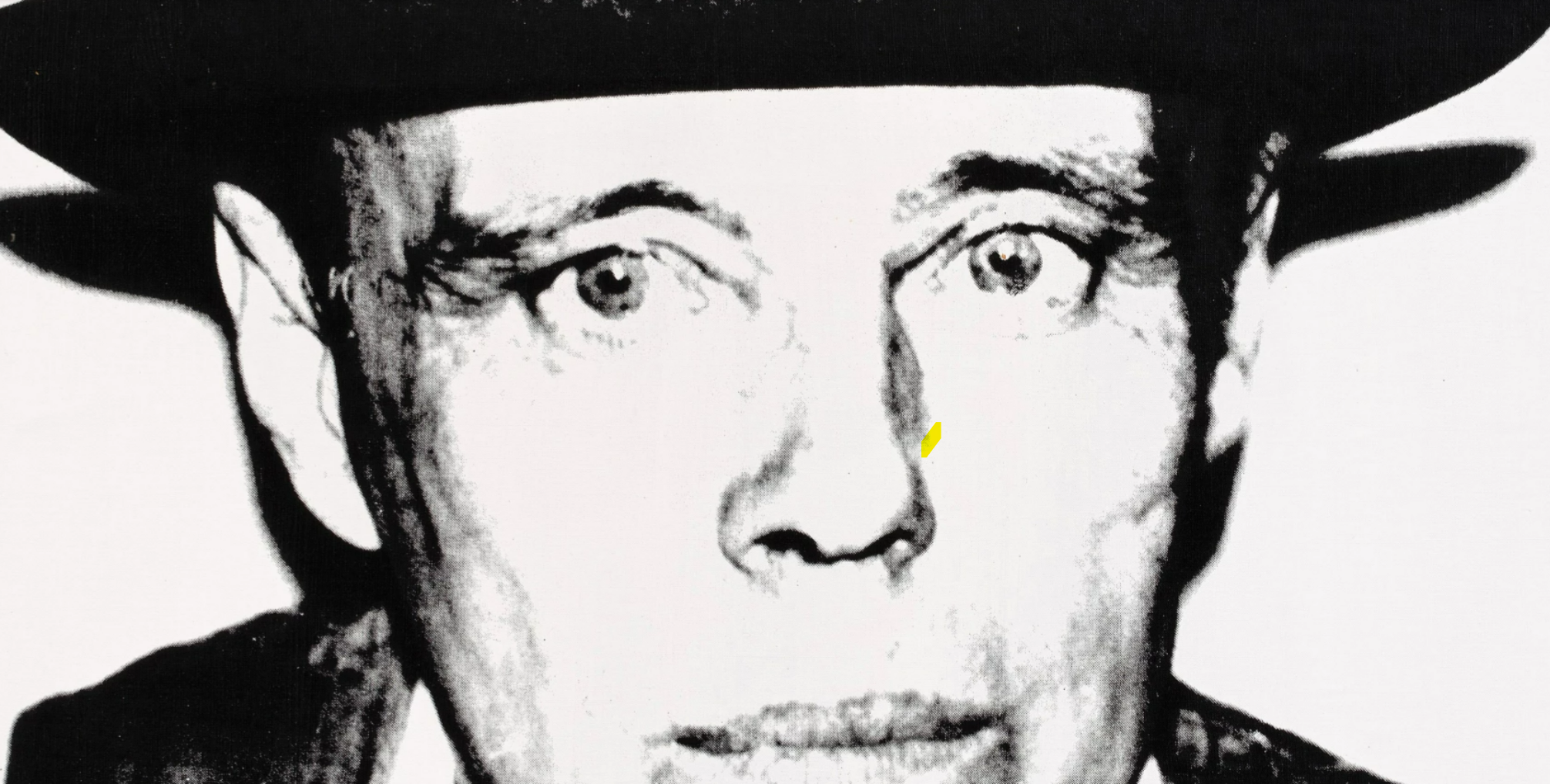
In its refined elegance and heightened sobriety, the monochrome Joseph Beuys indicates a larger transition within Warhol’s oeuvre which would, over the next decade, grow increasingly meditative and introspective in nature. Once the sovereign chronicler of the ’60s cult of mass media and glossy fame, Warhol had, by 1980, shifted his focus to subjects of greater psychological intensity and emotive depth; marked by such series as the Last Suppers, Shadows, and Rorschachs, Warhol’s works of the 1980s draw far closer to the metaphysical concerns of Beuys’ practice than his output of the preceding decades. In particular, the artist’s own somber visage as depicted in the renowned Fright Wig self-portraits of 1986, composed just a year before the artist’s death, seems to invoke Joseph Beuys as precedent, both confronting the viewer with an unblinking stare and stark physiognomy.
Joseph Beuys (Diamond Dust), 1980
Sotheby’s London: 5 October 2018
Estimated: GBP 700,000 – 1,000,000
GBP 802,000 / USD 1,050,970
(#32) ANDY WARHOL | Joseph Beuys (Diamond Dust)
ANDY WARHOL
Joseph Beuys (Diamond Dust), 1980
Acrylic, silkscreen ink and diamond dust on canvas
40×40 inches (101.6 x 101.6 cm)
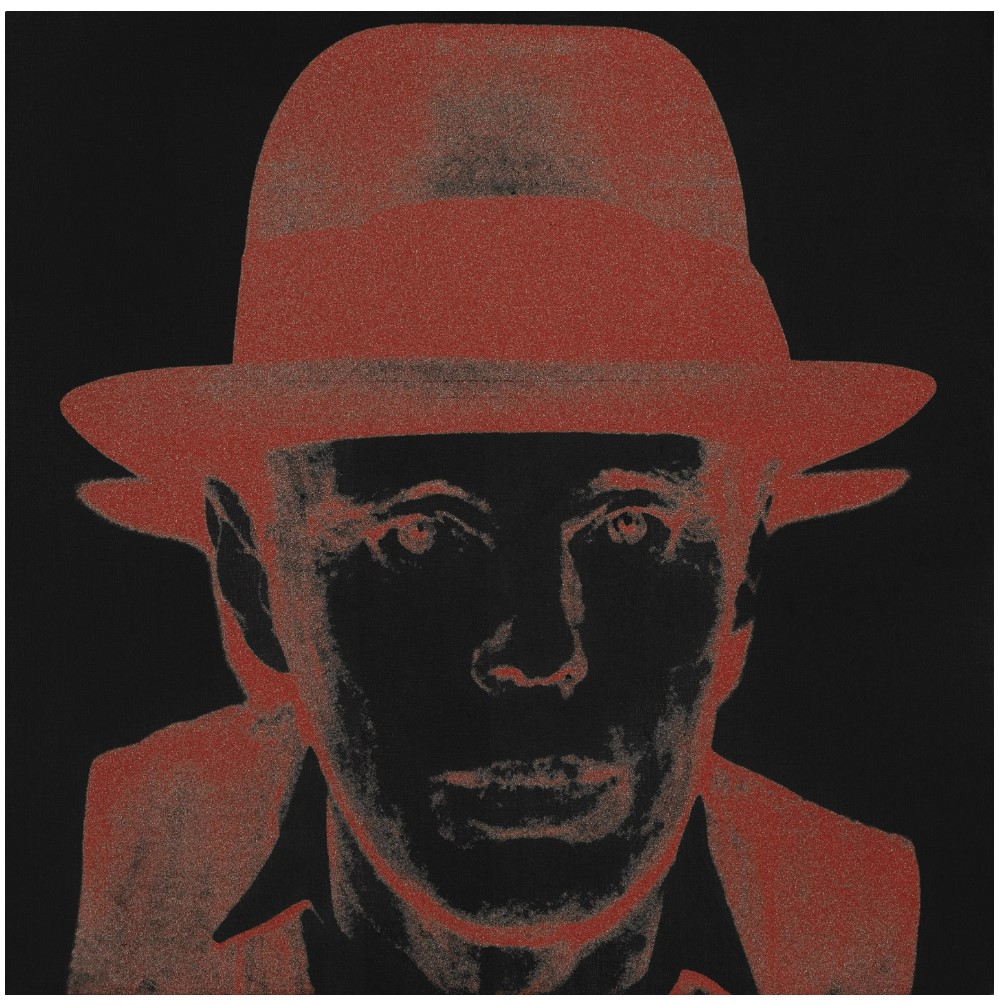
Rendered in dazzling, sparkling vermilion juxtaposed against a deep, vast black, Andy Warhol’s 1980 painting Joseph Beuys (Diamond Dust) presents an entrancing depiction of the greatest shaman of twentieth-century art history: Joseph Beuys. Warhol and Beuys, the twin giants of American and German post-war art, met for the very first time on 18th May 1979 in Hans Mayer’s Dusseldorf gallery, in an event of legendary status. This momentous and historic moment would lead to one of Warhol’s most fascinating series of portraits, in which the now iconic face of Beuys would become forever immortalized in the quintessentially Warholian body of diamond dust paintings. In November that same year, the two artists would meet again, this time in New York at Beuys’ major retrospective at the Guggenheim Museum. It was here that the idea for this celebrated series was initiated, when Warhol captured Beuys in his habitual uniform of felt hat and sleeveless jacket in a sequence of Polaroid photographs that would form the fundamental basis of the works. Characterised by the vibrant intensity of its resplendently glistening red diamond dust alongside a contemplative, brooding blackness, the present work encompasses the vastly polarised yet equally radical advancements in post-war transatlantic art by “the two extreme souls of contemporary art”: Warhol and Beuys (Michele Bonuomo, Exh. Cat., Naples, Museo di Capodimonte, Vesuvius by Warhol, 1985, p. 33).
Joseph Beuys (Diamond Dust) is a poignantly self-referential painting that draws together Warhol’s lifelong infatuation with celebrity, consumerism and material culture and Beuys’ more somber investigations of humanism, social philosophy and politics. Warhol, as the progenitor of Pop and catalyst for a new cultural age, and Beuys, as a radical who didactically transformed the landscape of both conceptual and performance art, were each pioneering leaders in their own right whose respective legacies on the course of contemporary art history have been nothing short of profound. They were, as Michele Bonuomo attests, “Two opposite stories, two antithetical selves [who] deliberately chose the ideal place to observe and get mixed up with each other” (Michele Bonuomo in: ibid., p. 33). Warhol’s series of portraits of Beuys potently conveys this majestic union of the material and the spiritual, the artificial and the natural worlds that each artist occupied and explored. Conceived at the dawn of a new decade, the series would also usher in a new Warhol who was growing increasingly retrospective and introspective. Once the sovereign chronicler of the ’60s cult of mass media and glossy fame, Warhol had, by 1980, shifted his focus to a greater psychological intensity. The sober visage in the renowned ‘Fright Wig’ self-portraits of 1986, composed just a year before the artist’s death, have a clear precursor in Joseph Beuys (Diamond Dust): both confront the viewer with an unblinking stare and stark physiognomy. The fluorescent flashiness of his 1970s celebrity portraiture is replaced by a more direct interest in the sitter’s inner-essence and humanity. In this context, the shimmering, scintillating glitz of the diamond dust becomes a powerful meditation on the superficiality of modern life when confronted by the inevitability of the human condition.
Ethereal and otherworldly, Joseph Beuys (Diamond Dust) encapsulates the famously mysterious and elusive character of Beuys. Warhol’s paintings of the German artist were created using his innovative technique of silkscreen ink and acrylic on canvas, derived in turn from an initial Polaroid photograph. This was blown-up into a negative and used to trace the subject’s features onto the canvas. The details were then painted directly onto the work using acrylic paint, before converting the negative into a silkscreen that was used to print the photographic image in ink over the painted canvas. In the present work, the resulting portrait of Beuys maintains a striking resemblance to its photographic negative, eternally preserving in paint the celestial and revered image of the artist. That the shadow of the rim of Beuys’ hat, as captured in the original Polaroid, is incorporated into the artwork further heightens the allusion to a wraithlike and shadowy afterlife, and indeed Bonuomo has evocatively described the series as “enigmatic portraits, cold moonghosts” (Michele Bonuomo in: ibid., p. 33). Sublimely and sumptuously painted, Warhol’s portrayal of his German counterpart remains today a monumental eulogy to the unparalleled talents of two of the most influential artists of the Twentieth Century.
Joseph Beuys (20×16)
Joseph Beuys, 1982
Ketterer Kunst: 8 December 2023
Estimated: EUR 250,000
EUR 317,500 / USD 333,375
Ketterer Kunst, Art auctions, Book auctions Munich, Hamburg & Berlin
ANDY WARHOL
Joseph Beuys, 1982
Acrylic with silkscreen and diamond dust on canvas
19.8 x 15.9 inches (50.5 x 40.5 cm)
Signed and dated on the reverse
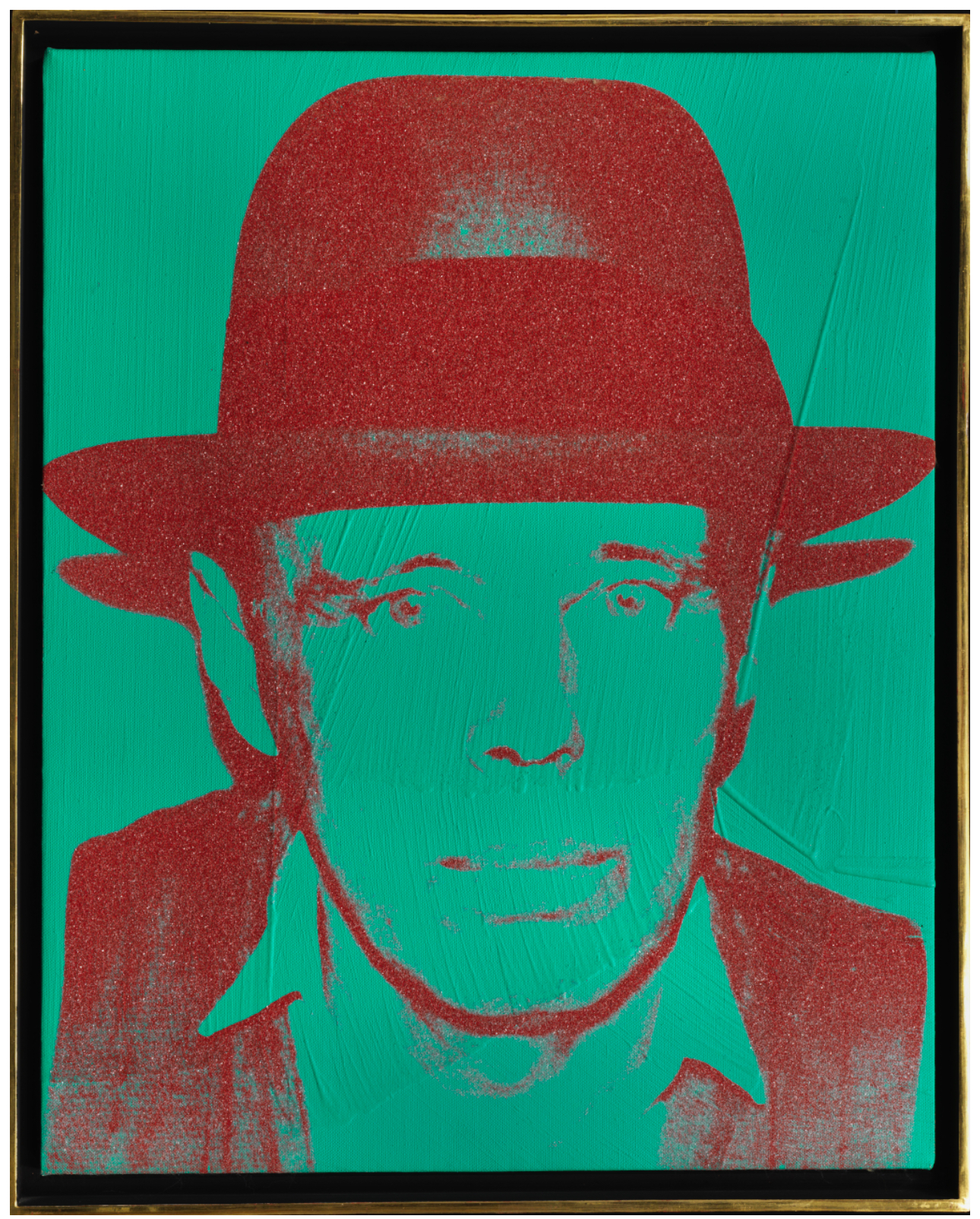
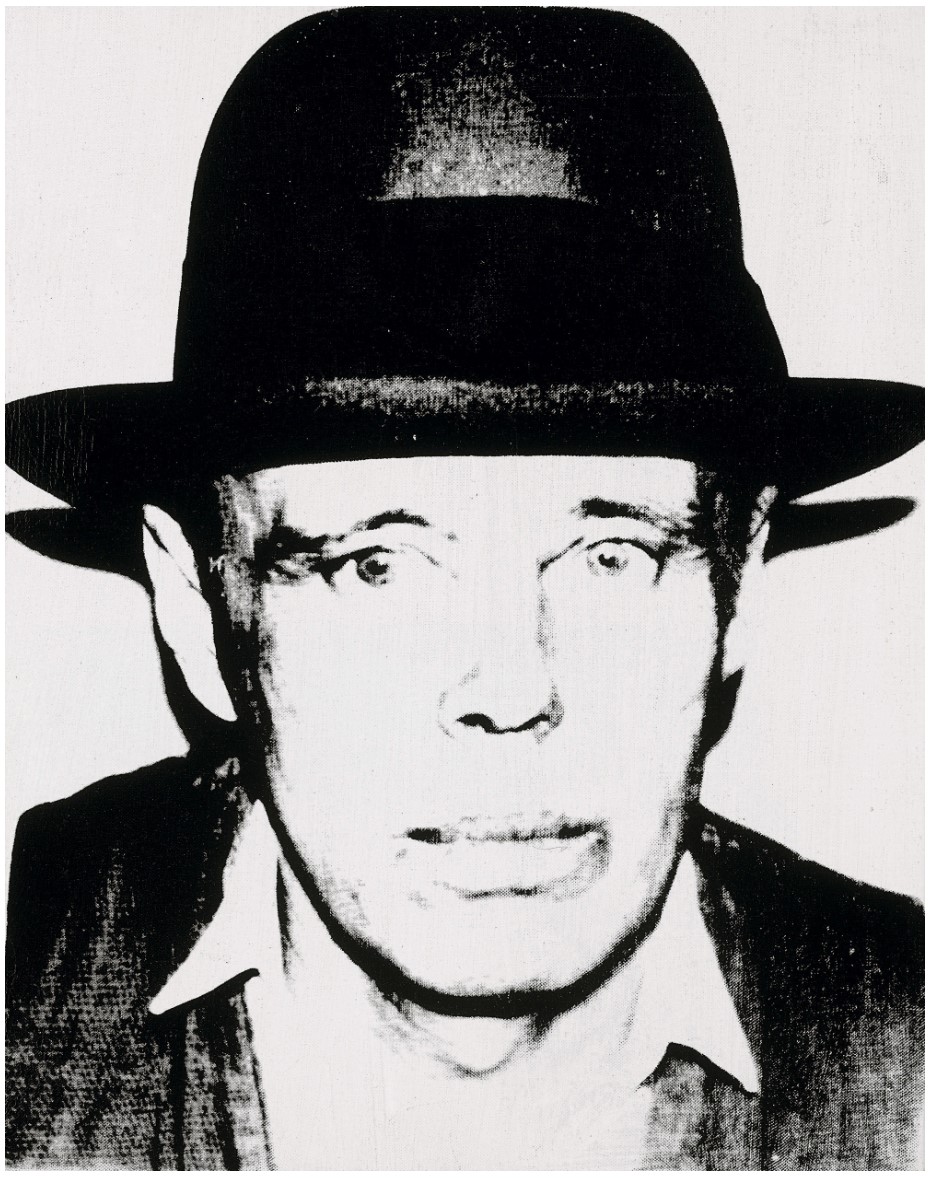
Silvia Menzel opened her gallery on Leibnitzstrasse in Berlin in 1982. Over the many years of her collecting activities, she had become acquainted with many artists and even was friends with some of them. Her first exhibition featured works by Joseph Beuys, Fetting and Andy Warhol. In addition to early drawings from 1954 to 1958, Andy Warhol also made some smaller pictures available to her. The present picture, which was acquired from the gallery in 1983, is a typical work by the great pop artist. In his depiction of Joseph Beuys he captured the important German conceptual artist with his essential identifying feature: the hat. His photo shows the myth of Beuys par excellence; it has become an icon in itself. The template is a Polaroid, the creation of which the Berlin collector Dr. Erich Marx describes as follows: “While we set up the Beuys exhibition at the Guggenheim Museum in late October 1979, Joseph Beuys, Andy Warhol and I met before the opening of another Beuys exhibition at Galerie Feldmann. Warhol and I watched Beuys making a self-portrait by painting over a photo canvas with a thin asphalt substance. While Beuys was working, I talked to Andy about a portrait of Beuys. Andy Warhol invited us to the Factory the next day. The photos were also shot that day, ..” (Heiner Bastian, Beuys Rauschenberg Twombly Warhol. Marx Collection, Munich 1982 p. 136). [EH]
Christie’s New-York: 10 November 2010
USD 362,500
ANDY WARHOL
Joseph Beuys, 1980
Synthetic polymer and silkscreen ink on canvas
20×16 inches (50.8 x 40.6 cm)
Joseph Beuys (Reversal), 1983
Joseph Beuys (Reversal), 1983
Sotheby’s London: 25 March 2021
Estimated: GBP 800,000 – 1,200,000
GBP 1,067,700 / USD 1,464,810
ANDY WARHOL
Joseph Beuys (Reversal), 1983
Acrylic, silkscreen ink and diamond dust on canvas
84×70 inches (213.4 x 177.8 cm)
Signed and dated 83 on the reverse
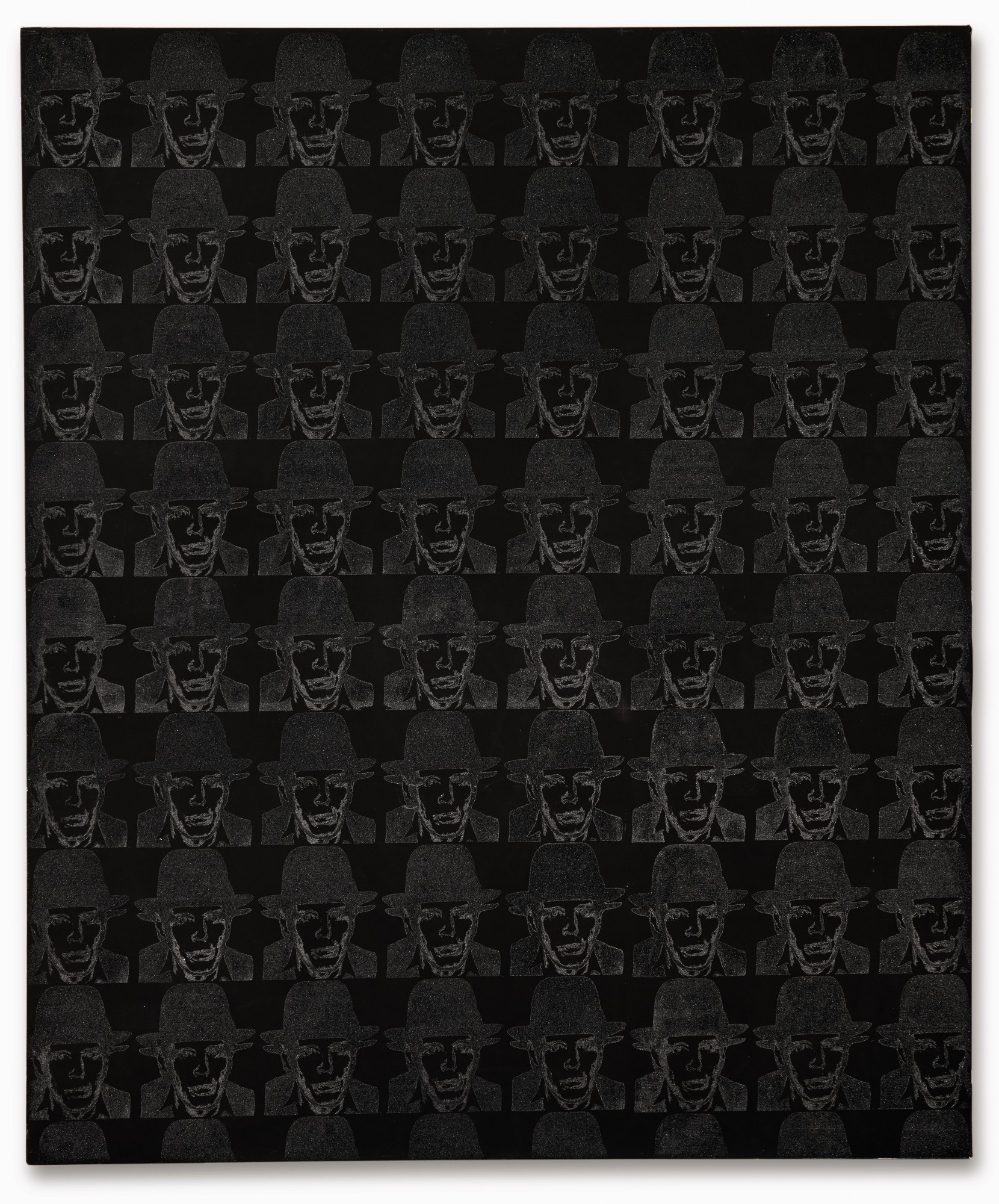
Achieving a scintillating collision of two icons of twentieth century art, Joseph Beuys (Reversal) from 1980 sees Andy Warhol depict his equally influential German contemporary, Joseph Beuys, in a momentous grid of repeated silkscreen negatives. Despite the black monochrome of the silkscreened images, the subject of Warhol’s shimmering homage is instantly recognizable as Beuys by the signature trilby hat, repeated 64 times across the towering canvas. Reversing the image so as to illuminate the refined contours of his subject’s face in striking negative, Warhol’s application of diamond dust elevates the prestige of his sitter, distinguishing Beuys as an artistic figurehead worth immortalizing. Indeed, marking the centenary of Beuys’s birth, 2021 will see over 30 museum exhibitions of the artist’s work take place across the globe. Chiming with the celebratory tone of 2021 as a year to celebrate Beuys’s art, Andy Warhol’s painting enshrines this creative genius in glittering diamond dust. Warhol’s use of ‘diamond dust’ (in fact a form of ground glass provided by Warhol’s assistant Ronnie Cutrone) was first used in his Shadow paintings of 1979 where it lent these enigmatic works a further layer of ambiguity, by reflecting light and shadows on the surface of the canvas. Later applied to his Shoes as well as to his portraits of Beuys, it added to these works the glittering aura of stardust as well as an enigmatic and mysterious quality, that was perhaps more appropriate in the case of Beuys. Always maintaining an eye towards the iconic, Warhol’s reversal portraits of Beuys present the German artist in his full mystical glory. Turning the artist into a star, without slipping into the kitsch that had categorized such works as his celebrity portraits, Warhol shows Beuys, donning his customary felt hat and sleeveless jacket, with his face, glittering with stardust emerging like an apparition from a bleak dark background. It is a portrait of ‘Beuys – the phenomenon’ and ‘Beuys – the myth’ in very much the same way as Warhol was mythologising himself in his own shadow self-portraits at this time. A fitting tribute, the portrait clearly demonstrates Warhol’s respect for Beuys as both man and artist. It was a respect that was clearly mutual. Over the next few years, until Beuys’ death in 1986, Beuys and Warhol would meet cordially and maintain a wary but respectful friendship even though their art and its outlook on life would remain distinctly different.
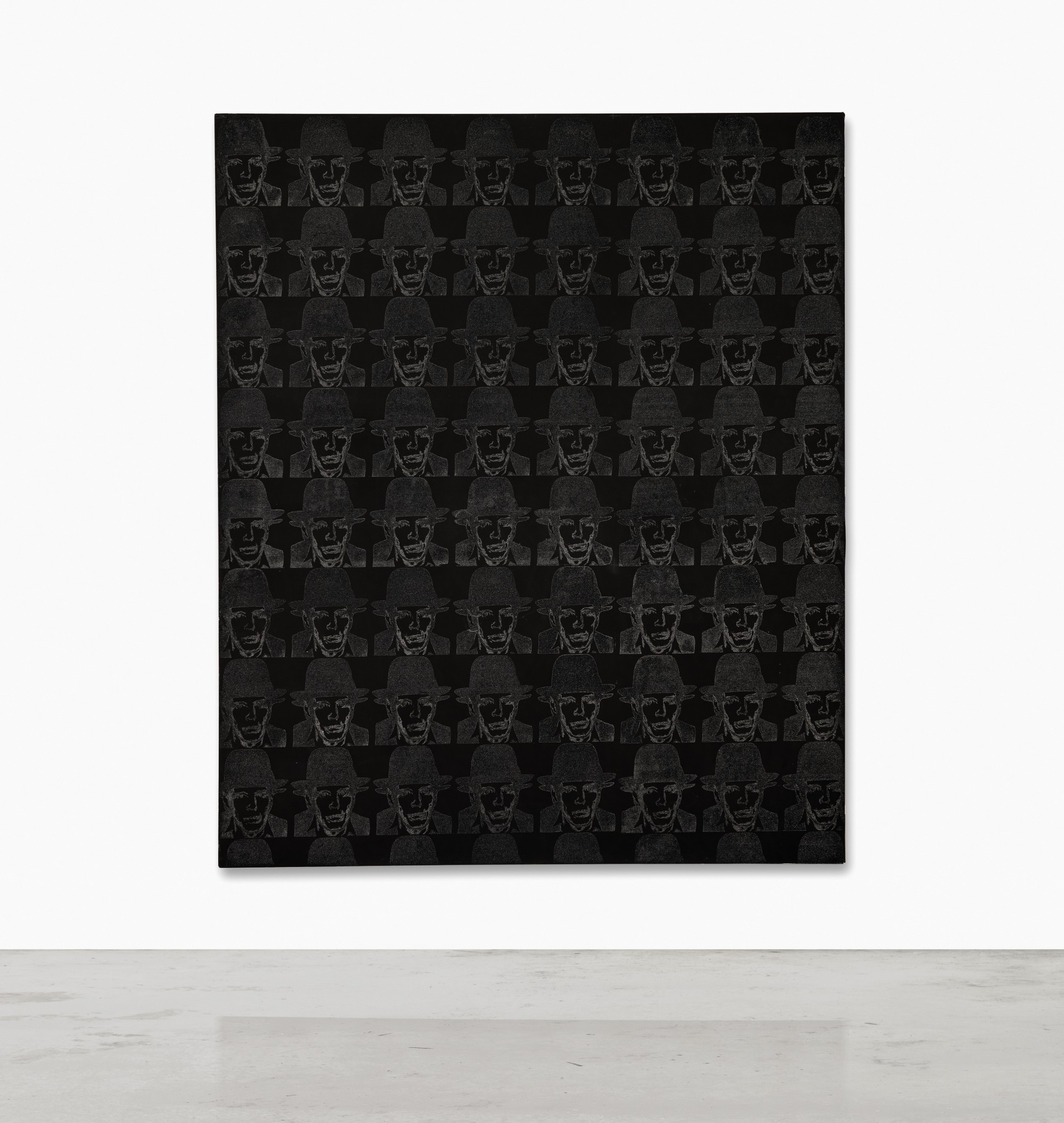
Testifying to the significance of the present work, versions of Warhol’s portraits of Beuys reside in the collections of several esteemed museum in Beuys’ German homeland, including the Hamburger Banhof, Berlin, the Neue Galerie, Kassel and the Museum Schloss Moyland, Bedburg, while others reside in such internationally renowned collections as The Museum of Modern Art, New York, Tate, London, Art Institute of Chicago, Philadelphia Museum of Art and Scottish National Gallery, among others. Within this rarefied group, the present work stands as a particularly emphatic articulation of post-war art at a remarkable intersection; a dazzling treatise upon the relationship between two of the most profoundly influential artists of the Twentieth Century.
Joseph Beuys (Monumental)
Joseph Beuys, 1981
Christie’s London: 22 June 2005
Estimated: GBP 1,300,000 – 1,800,000
GBP 1,688,000 / USD 3,068,050
Andy Warhol (1928-1987) (christies.com)
ANDY WARHOL
Joseph Beuys, 1981
Synthetic polymer paint and silkscreen inks with diamond dust on canvas
100×80 inches (254 x 200 cm)
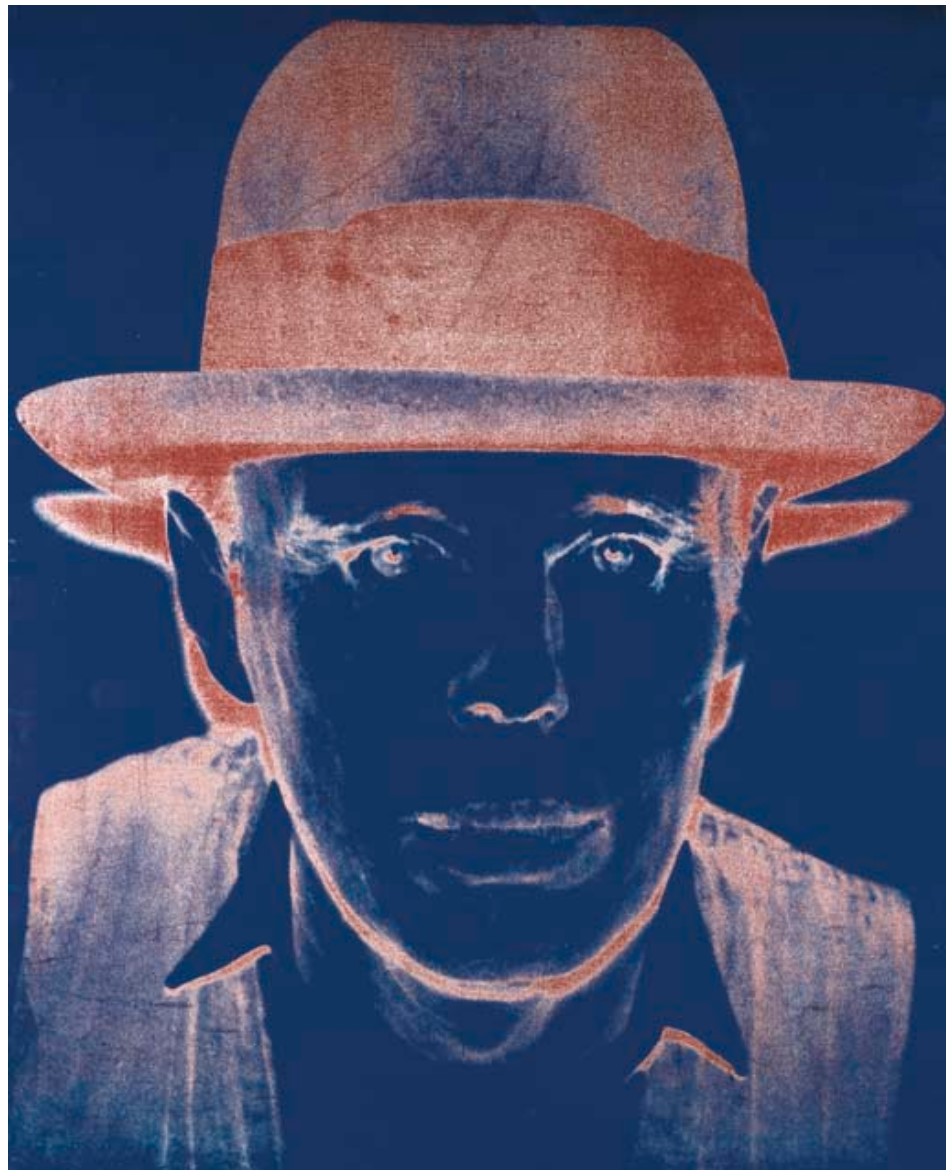
Warhol’s famous diamond dust portrait of Joseph Beuys has something of the epic and the adulatory about it. It is an aspect that is not at all inappropriate for a portrait of an artist whose status within his own lifetime was such that he inspired followers, devotees, and believers amongst what was a broad and ever-widening entourage. Beuys’ reputation and the shamanic example he set as an artist concerned with the social reform of the world rather than with mere aesthetics or the history of art gained him an almost mystical status in the eyes of many. By the late 1970s, although recent critical attention to his mid-1970s work had grown increasingly cold, Warhol too, had been enshrined as a god in the pantheon of twentieth century art. Both artists were, and indeed still are, considered by many to be the twin giants of American and European Post-War art. Today, the names ‘Beuys’ and ‘Warhol’ signify as much a worldview and a phenomenon as they do each artist’s work or person.
Aware of this and of each other’s status as the high-priests of two very different but not at all fundamentally opposed systems of art-making, their meeting and indeed the manner of it took on a greater significance than either man would have wanted. Surprisingly, the two artists did not meet until 1979. Beuys had always been very wary of America (its capitalist values and cultural imperialism being the cause of much conflict in his native Germany) and as a consequence, he did not travel to or exhibit in the United States very often. For his famous healing performance/encounter with a coyote (a symbol of the ancient unspoiled pre-Columbian America) in a New York Gallery in 1974, he had insulated himself from everything to do with the United States by having himself delivered to the gallery in an ambulance and wrapped entirely in felt. This action Beuys appropriately, if also somewhat humorously, named I like America and America likes me. It is an ironic title that could also be applied to his relationship with Warhol.
According to David Bourdon, when the two artists first met ‘officially’ in May 1979 at Hans Mayer’s gallery in Düsseldorf, the auspiciousness of the occasion was duly observed. ‘For those who witnessed the two men approaching each other across the polished granite floor’ one writer recalled,’ the moment had all the ceremonial aura of two rival popes meeting in Avignon.’ (David Galloway, ‘Beuys and Warhol: Aftershocks,’ in: Art in America, July 1988, p. 121) Bourdon also says that it was on this occasion that Warhol took his customary polaroids of Beuys; the pictures which would later form the basis of his celebrated portraits of the German artist. In contrast Heiner Bastian has said that these polaroids were taken at his own instigation when the two artists met in New York in November 1979 for the occasion of Beuys’ retrospective exhibition at the Guggenheim. Either way, Warhol, as his diary records, was busy working on the first portraits of Beuys in January 1980 and went on to create three different versions: black on black, black on white and, as in the case of this large version from 1981, ‘black’ (in fact a dark Prussian blue) and red. The latter two types also used a negative ‘reversal’ image of Beuys in a way that emphasized the ‘mythic’ status of the artist and were sprinkled with ‘diamond dust.’
Warhol’s use of ‘diamond dust’ (in fact a form of ground glass provided by Warhol’s assistant Ronnie Cutrone) was first used in his Shadow paintings of 1979 where it lent these enigmatic works a further layer of ambiguity, by reflecting light and shadows on the surface of the canvas. Later applied to his Shoes as well as to his portraits of Beuys, it added to these works the glittering aura of stardust as well as an enigmatic and mysterious quality, that was perhaps more appropriate in the case of Beuys. Always maintaining an eye towards the iconic, Warhol’s reversal portraits of Beuys present the German artist in his full mystical glory. Turning the artist into a star, without slipping into the kitsch that had categorised such works as his celebrity portraits, Warhol shows Beuys, donning his customary felt hat and sleeveless jacket, with his face, glittering with stardust emerging like an apparition from a bleak dark background. It is a portrait of ‘Beuys – the phenomenon’ and ‘Beuys – the myth’ in very much the same way as Warhol was mythologising himself in his own shadow self-portraits at this time. A fitting tribute, the portrait clearly demonstrates Warhol’s respect for Beuys as both man and artist. It was a respect that was clearly mutual. Over the next few years, until Beuys’ death in 1986, Beuys and Warhol would meet cordially and maintain a wary but respectful friendship even though their art and its outlook on life would remain distinctly different. The nature of this muted and cordial relationship between these two figureheads of late twentieth century art is one of historic significance and will no doubt excite the curiosity of historians of art and culture for many years. It is one that is perhaps best described by the following anecdote recorded in Warhol’s diary for Sunday 8th March, 1981 in Dusseldorf. ‘We had breakfast with Joseph Beuys, he insisted I come to his house and see his studio and the way he lives and have tea and cake, it was really nice. He gave me a work of art which was two bottles of effervescent water which ended up exploding in my suitcase and damaging everything I have, so I can’t open the box now, because I don’t know if it’s a work of art anymore or just broken bottles. So if he comes to New York I’ve got to get him to come and sign the box because it’s just a real muck’ (Pat Hackett (ed.), The Andy Warhol Diaries, New York 1989, p. 361).