Throughout his life Andy Warhol was obsessed with idea of death and at times was almost overcome by a paralyzing fear of dying. Worries about his own mortality are present to a greater or lesser degree in a large number of his works, but none demonstrate it so clearly as his Gun paintings from 1981-82. Gun unites two of the obsessions that characterize Pop legend Andy Warhol’s oeuvre: Americana and death.
Introduction
From 1981 to 1983, Warhol produced a series series depicting firearms, at a time when the artist’s critical success reached even more immense heights. In these late years in his life, Warhol engaged with a new host of ontologically loaded imagery, most notably guns, knives, and crosses. Enmeshed with notions of American democracy, glamour, and tragedy, guns are wielded by Tinsel town stars, Average Joes, and criminals alike.
“Some people, even intelligent people, say that violence can be beautiful. I can’t understand that, because beautiful is some moments, and for me those moments are never violent”
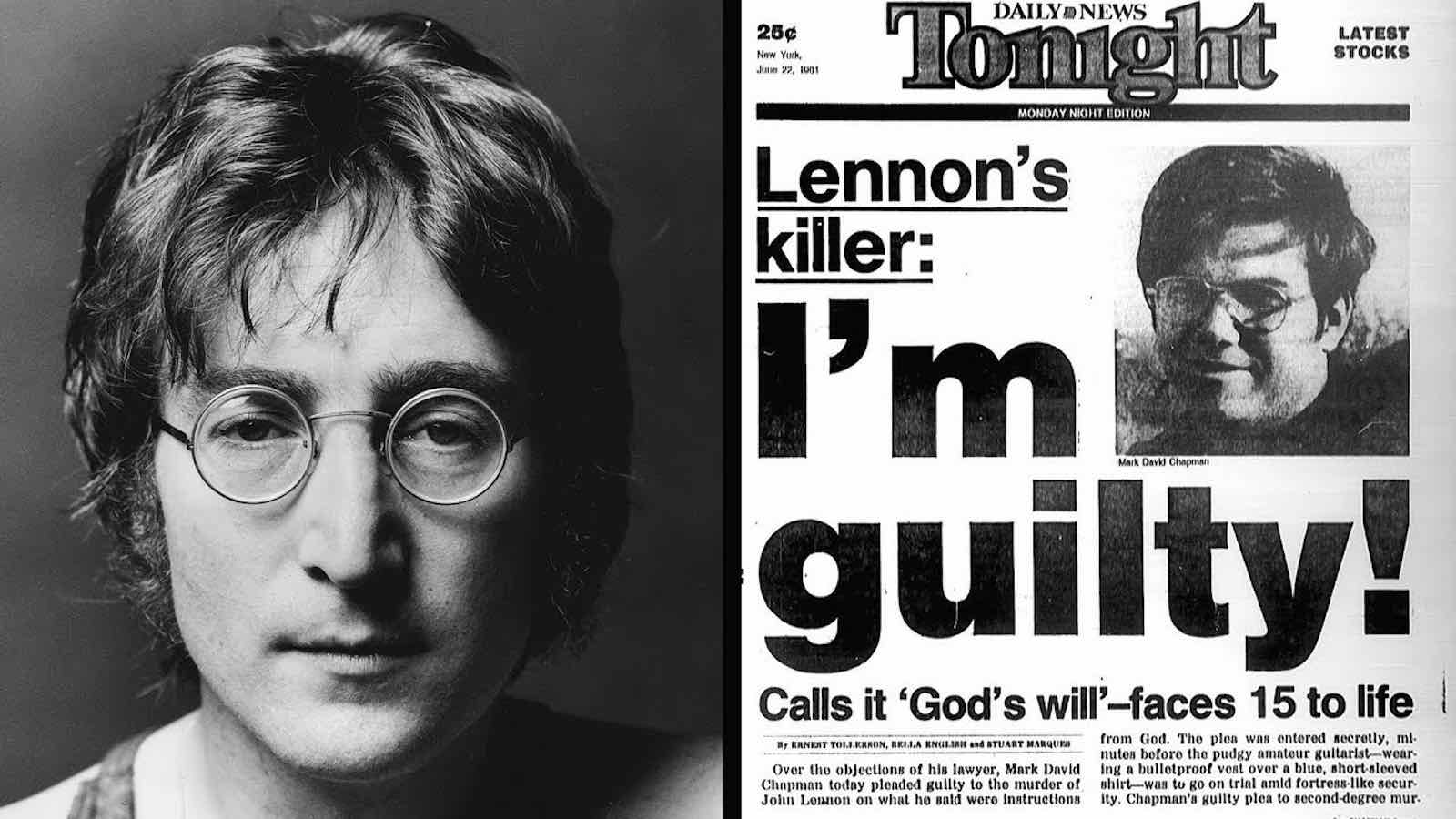
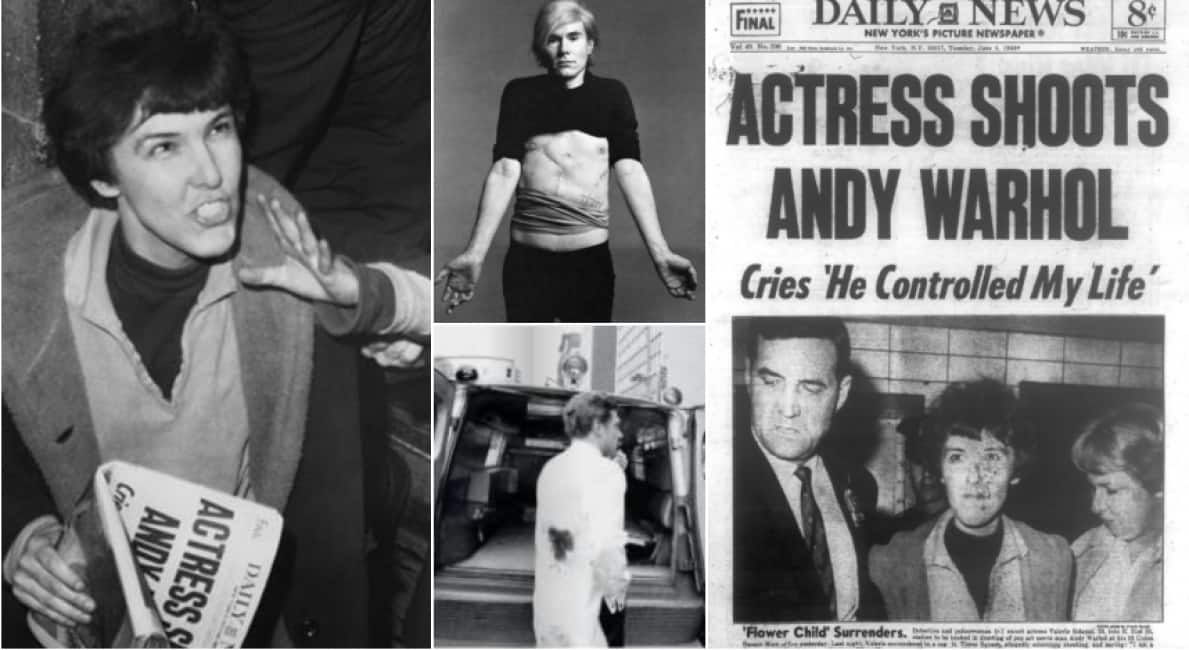
The latter category was at the forefront of everyone’s minds at the time of Gun’s creation just one year after John Lennon was assassinated and the same year that an assassination attempt was made on President Ronald Reagan. Gun violence was also a profoundly personal topic for Warhol, who suffered a traumatic shooting at the hands of feminist writer, Valerie Solanas, when she attempted to murder him in June of 1968. Thus Gun, bold and graphic, is at once a depiction of a detached and decontextualized symbol and also a deeply personal, cathartic working-through of a trauma that colored the last two decades of Warhol’s life. As with Warhol’s most compelling work, Gun leverages the superficies of American cultural icons to puncture real human depths.
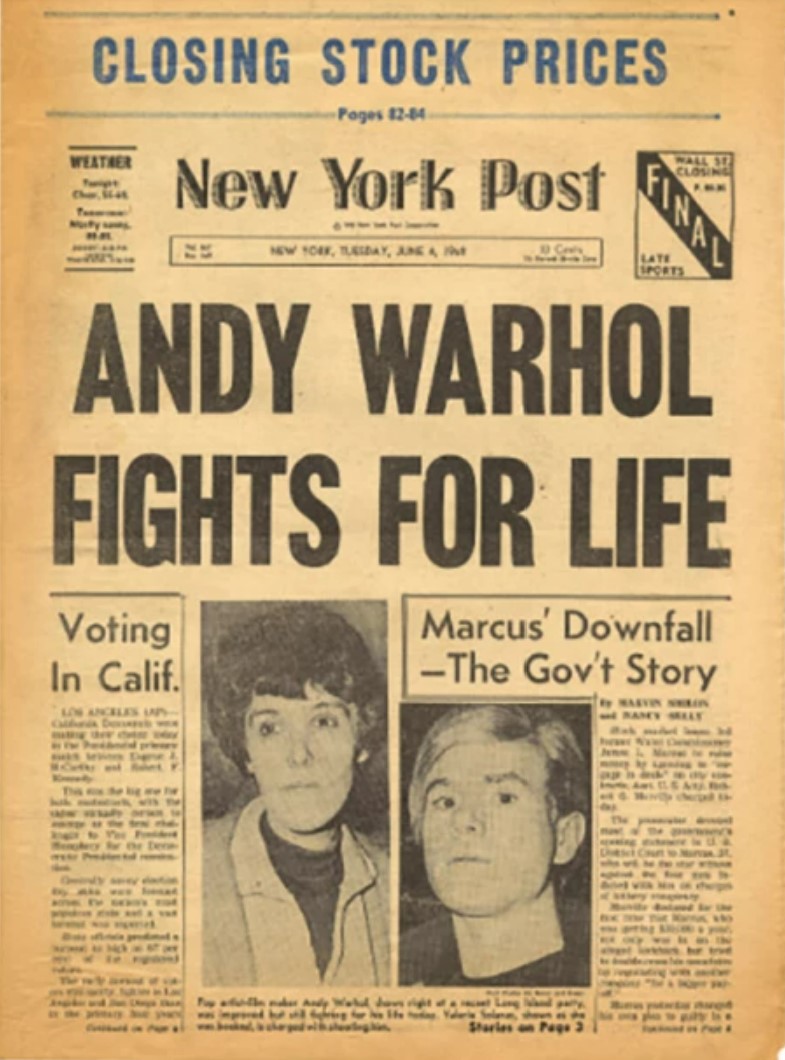
“Since I was shot, everything is such a dream to me. I don’t know what anything is about”
Of course, death and violence were not new topics for Warhol; these were distinctive and recurrent themes that ran through his oeuvre. The artist became obsessed with news reports of violent deaths in the early 1960s. In an attempt to both exorcise the tragic and disturbing images that dominated the media cycle and paint a psychological portrait of a nation always hungry for the next tragedy, Warhol commenced his Death and Disasters series. These works depict decontextualized, repeating car crashes and suicides among other morbid imagery in a cool silkscreen style. Around the same time, the artist was making paintings in tribute to Marilyn Monroe, who had died in 1962; these works sought to both canonize her and deconstruct her celebrity persona in the wake of her death.
In the 1970s on the heels of the 1968 attempt on his life, Warhol produced a series featuring repeating images of a human skull in a contemporary take on the memento mori as represented in 17th century Spanish and Dutch Vanitas paintings. The cheerful high-key coloring of these works puts them at odds with their macabre content.
“I can’t say anything about [death] because I’m not ready for it”
Decontextualized and somewhat abstracted depictions of knives, guns, and crosses—what has been referred to as an unholy trinity—were to follow in the 1980s. To the artist, these emblems were deeply embedded in the American psychology at that time; in particular, Warhol viewed the handgun as a distinctly American object. Warhol’s personal diaries from the period revealed an increasing preoccupation with dying, referencing in their dry, anxious tone both death in the news and death among figures in his personal life.
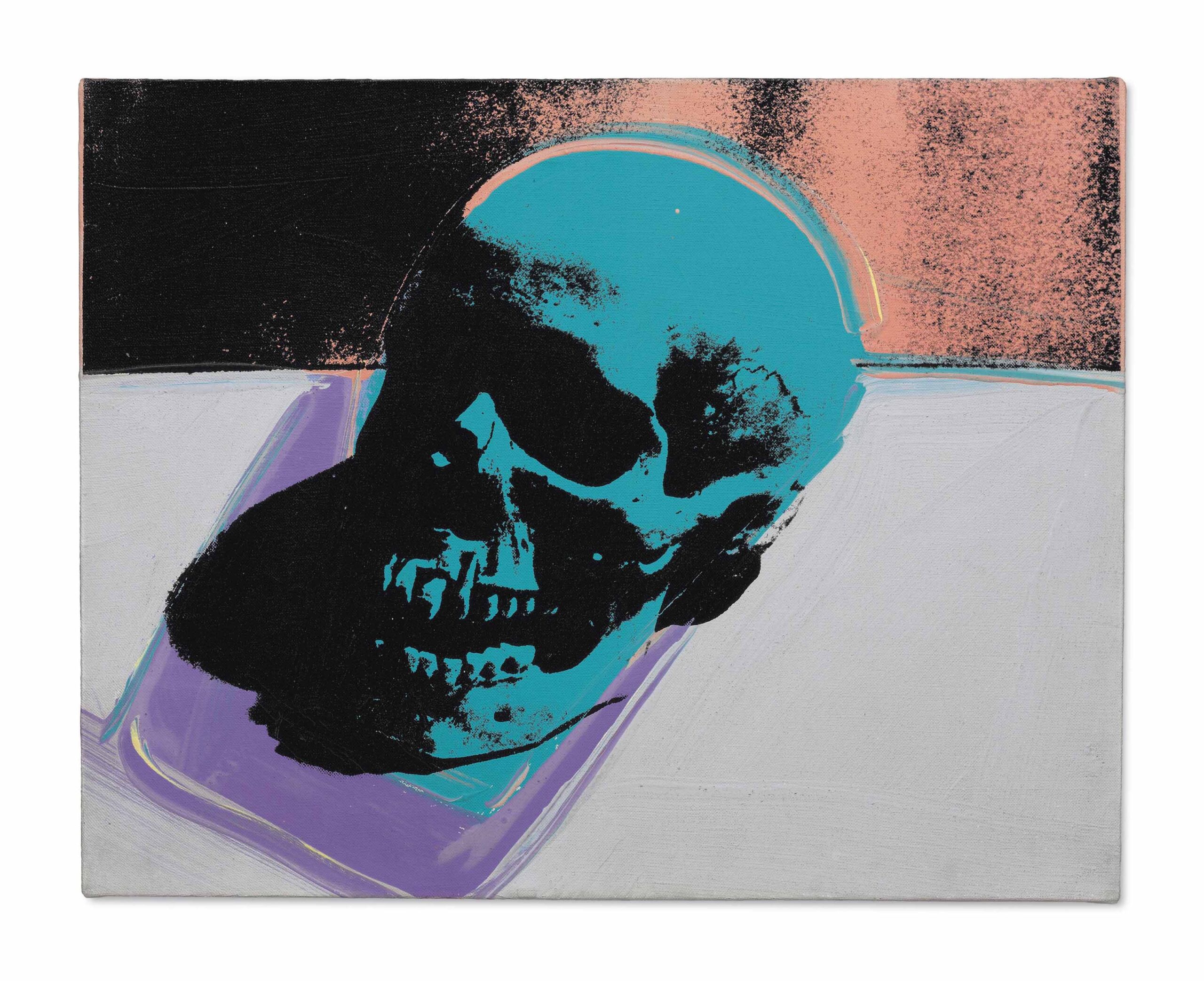
ANDY WARHOL, Skull, 1977
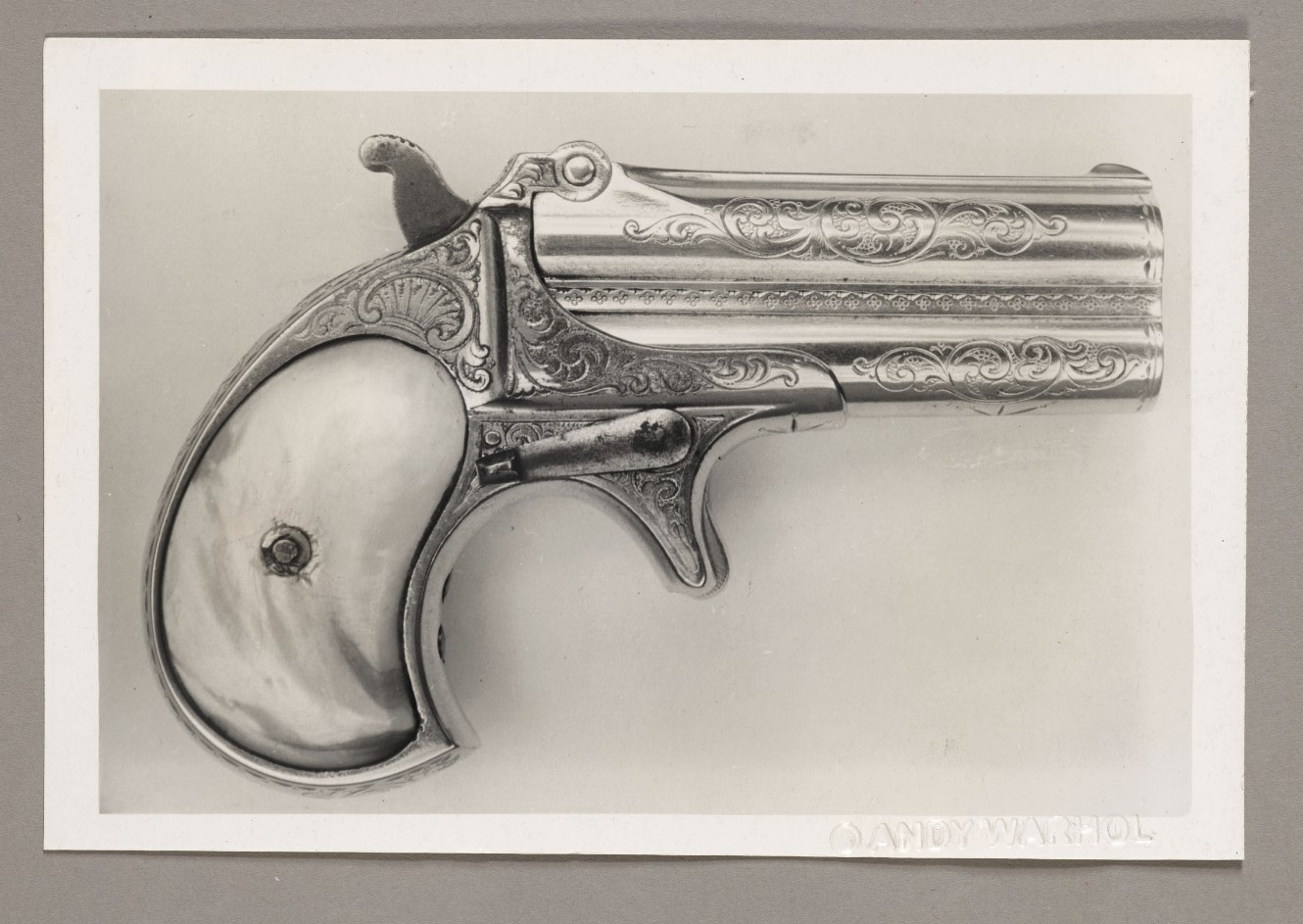
While the gun featured in the present work is made to appear anonymous or generic, it is in fact the snub-nosed model that Valerie Solanas, the feminist author of the 1967 SCUM Manifesto (“Society for Cutting Up Men”), brought to The Factory on 3 June 1968 when she made an attempt to end Warhol’s life in response to a spat over her play. Two of her bullets punctured Warhol’s left side, hitting key organs; the emergency surgery that followed left both irreversible psychological damage and severe scarring that would criss-cross the artist’s torso for the rest of his life. There was a level of unreality or detachment in the shooting for Warhol, a cartoonish onomatopoetic element that finds its visual expression in Gun. The anxieties that emerged from the shooting for Warhol may have been reignited by a death threat that the artist received in 1981. An unknown musician had delusions that Warhol had stolen the Rolling Stone song “Miss You” from him and passed it along to Mick Jagger. The threat made Warhol extremely anxious and led him to hire a security guard and seek out increasingly impenetrable disguises for himself.
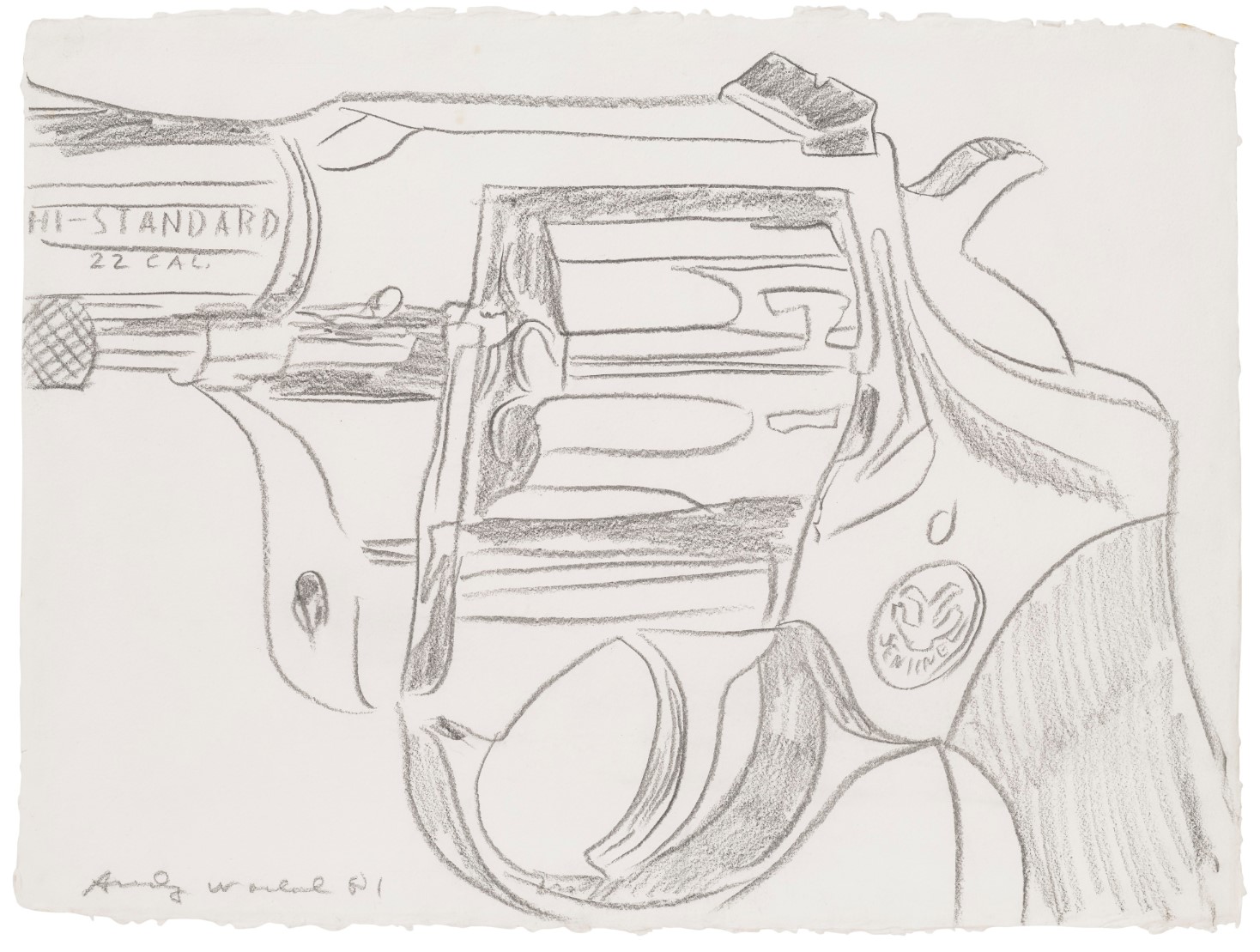
ANDY WARHOL
Gun, 1981
Graphite on paper
23.5 x 32 inches (59.7 x 81.3 cm)
Signed and dated ‘Andy Warhol 81’ (lower left)
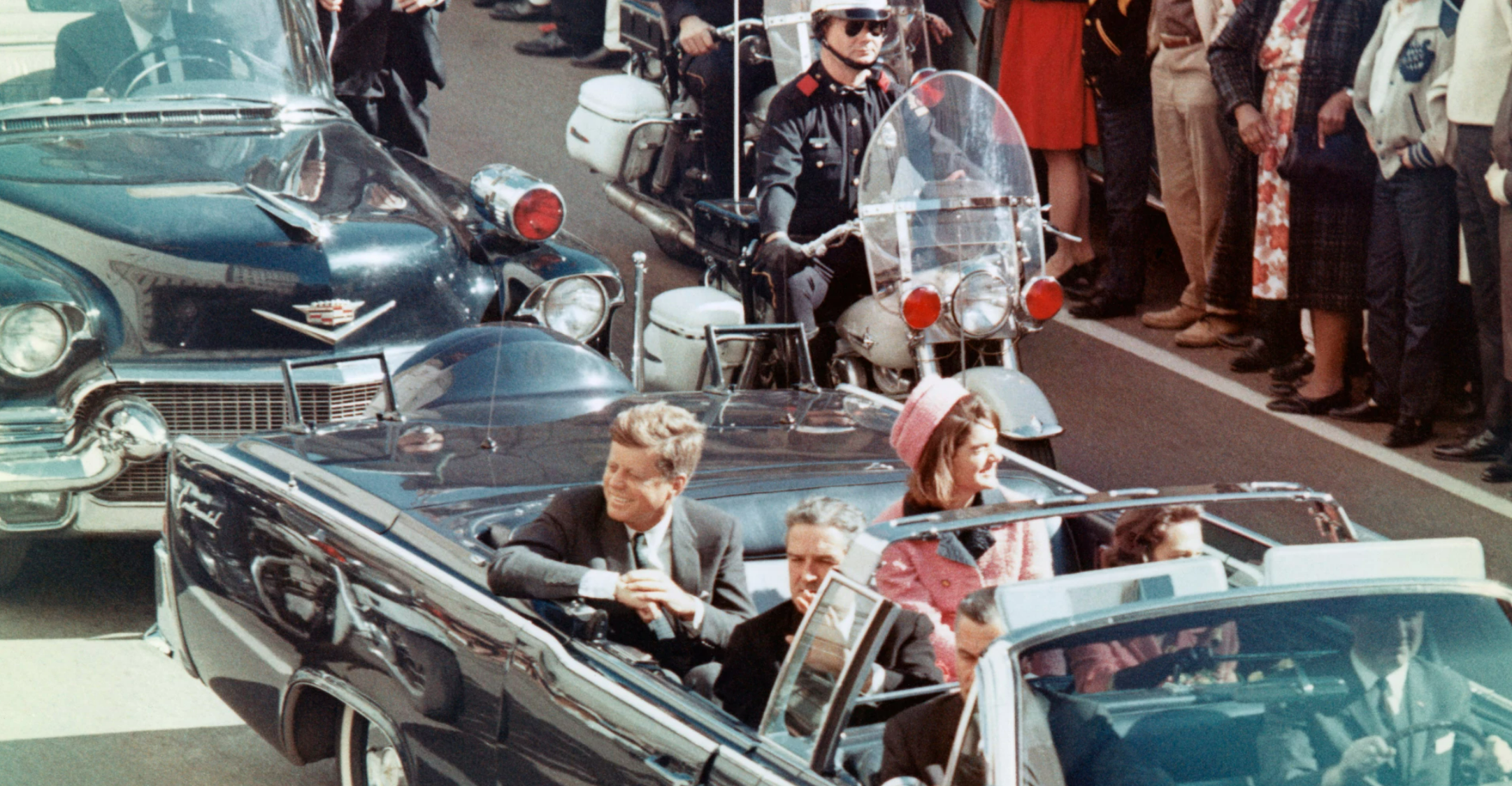
While guns personally affected Warhol at the time of the 1968 assassination attempt and 1981 death threat, both events that likely inspired the making of Gun, firearms were simultaneously at the fore of the contemporary collective American consciousness. In 1963 in Dallas, John F. Kennedy was assassinated using a mail-order gun; this tragic event prompted citizens to question the nation’s firearm regulatory policies. Subsequent assassinations of major figures like Martin Luther King, Jr., Senator Robert F. Kennedy, and Malcolm X made congressional action a necessity, and the Gun Control Act, which regulated interstate gun sales, was passed in 1968. The 1980 assassination of John Lennon and the 1981 assassination attempt on President Ronald Reagan in the nation’s capital led to the amending of the 1968 Gun Control Act with the Brady Handgun Violence Prevention Act in 1993, which mandated background checks on buyers of firearms. Gun regulation has remained a hot-button issue in the United States. At the time of Gun’s creation, the gun debate was as au courant as it is today; Warhol is nothing if not eternally contemporary.
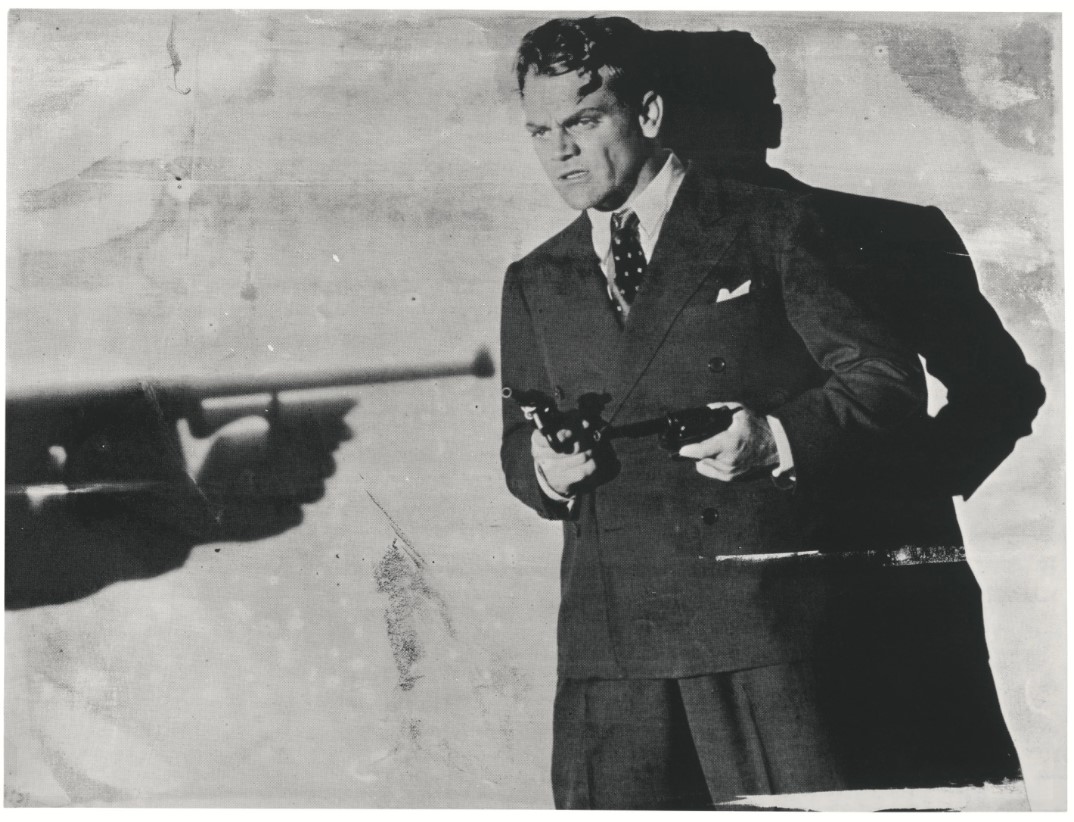
On one level, Gun captures the simplistic American glamour of guns. A seductive and streamlined prop, the red firearm echoes Hollywood culture and Warhol’s early depictions of it in such seminal works as Cagney and Triple Elvis. Yet on another level, Gun is the work of a mature Warhol. It is a testament to an artist traumatized by personal experiences of gun violence—threats on his life—and affected by the impassioned national conversation surrounding firearms that followed a series of high-profile assassinations. At the same time, the cool, impassive work doubles as a documentarian effort to capture the 1980s American consciousness. Like a bullet, the loaded Gun ricochets between detachment and engagement, between superficiality and depth, never quite settling on one, forever drolly ambiguous: definitively Warholian.
ANDY WARHOL
Untitled (Gun)
Unique Polaroid
3 x 4.6 inches (7.8 x 11.7 cm)
This large picture with its multiple images of a menacing revolver dominate the surface of the canvas. The repeated images of the pistol mimic the slow-motion action of the gun being prepared for firing, becoming a fetishized object which conveys both power and death. Yet when viewed in the company of Warhol’s earlier bold canvases from the early 1960s its sleek and shiny surface presents itself as another desirable consumer object, implying that Warhol has joined in the adulation of this product of industry and technology. The very process by which Guns has been created, through the transferal of a photographic source to silkscreen, illustrates Warhol’s participation in a similar industrial process. This is an artform that is perfectly suited to the era of factories and capitalism; yet the cool, objective distance that Warhol maintained in creating Guns is itself ironic. Warhol appears here to engage in the entire visual language of weaponry, of the gun as a status symbol, as a tool that begets violence; which is all the more pertinent because Warhol, whose pictures often touched upon the subject of death, had deeply personal associations with guns.
Warhol’s series of Gun paintings were created at the same time that he was also making pictures of knives. While the slick presentation of Guns implies a certain ambivalence and detachment on the part of the artist, he himself had been the victim of a shooting, as had his pictures. For, in an almost comic episode that curiously prefigured the later attempt on his life, four of Warhol’s Marilyn pictures had been shot by a fellow artist, Dorothy Podber. A friend of Billy Name’s, she had been in the Factory in 1964 and had seen these pictures stacked against a wall. She asked Warhol if she could shoot them; not taking her seriously, he agreed and was surprised to see her remove a gun from her handbag and take a shot that passed through the canvases. Initially, Warhol was shocked, though he subsequently renamed each picture, resulting in the so-called Shot Marilyns. This lack of anticipation of violence in others reached a tragic new level when, in 1968, Valerie Solanas shot Andy Warhol. A feminist writer whose works included the SCUM Manifesto (SCUM was an acronym for “Society for Cutting Up Men”), Solanas hovered on the fringes of Warhol’s Factory crowd, even appearing in one of his films. On June 3, 1968, she appeared at the Factory and, when Warhol appeared, shot at him and at his friends, also hitting Mario Amaya. Warhol himself gave an account of this incident that nearly ended his life,
“… as I was putting the phone down, I heard a loud exploding noise and whirled around: I saw Valerie pointing a gun at me and I realized she’d just fired it. I said “No! No, Valerie! Don’t do it!” and she shot at me again. I dropped down to the floor as if I’d been hit I didn’t know if I actually was or not. I tried to crawl under the desk. She moved in closer, fired again, and then I felt horrible, horrible pain, like a cherry bomb exploding inside me.”
Warhol never fully recovered his health and bore extensive scars from the shooting and subsequent drastic surgery for the rest of his life. Therefore, he was in a special, qualified position to understand the devastation that a gun can wreak. The seemingly inscrutable Guns therefore shows a subject that had incredibly profound associations for the artist. Victor Bockris, in his book The Life & Death of Andy Warhol, states that the gun used in this picture and its sister-works was the “the same snub-nosed .32 that Valerie Solanas had shot him with” (V. Bockris, Ibid., 1989, p. 453). This work is thus filled with the artist’s poignantly acute awareness of the weapon’s latent potential for destruction.
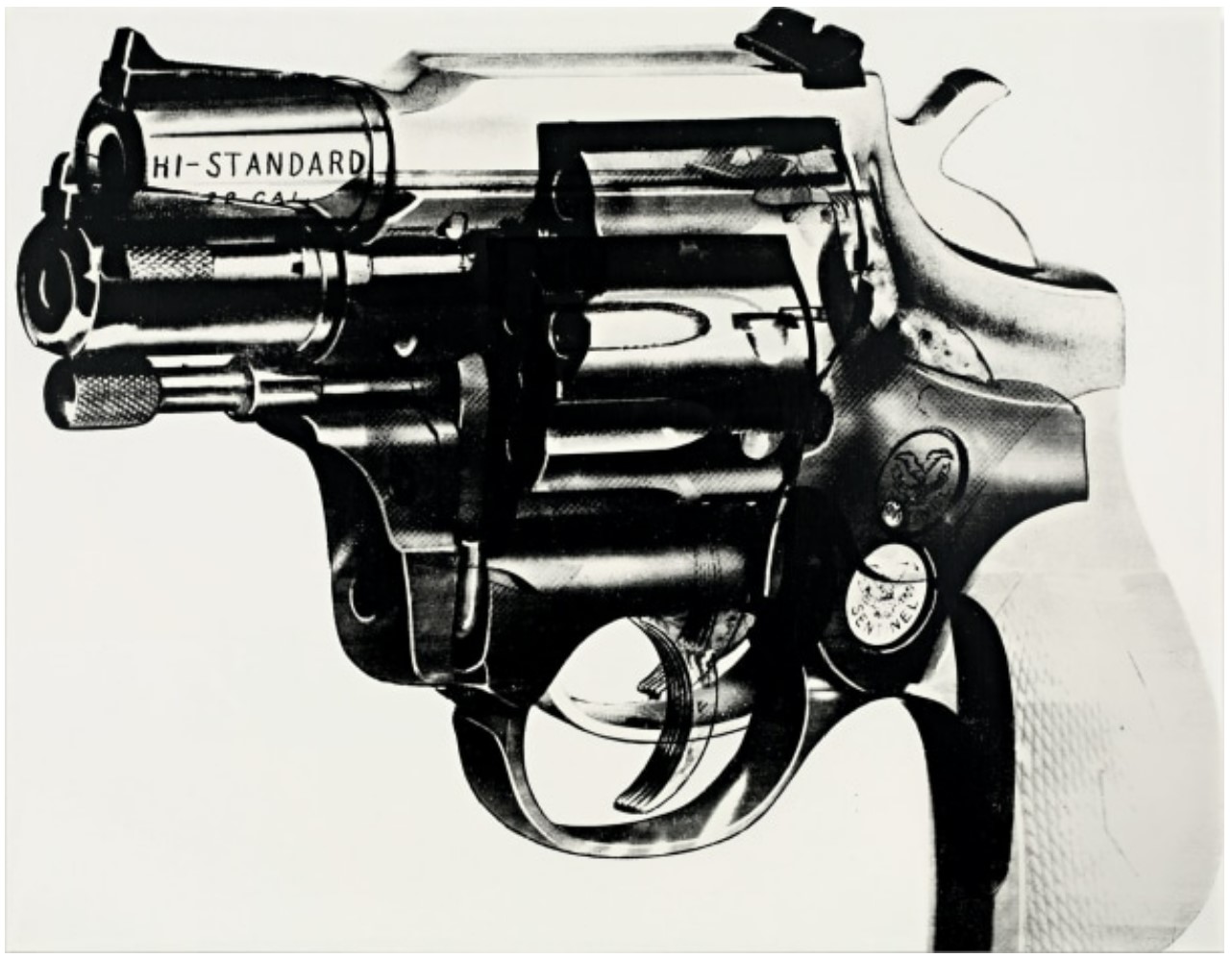
Gun, 1981-1982
Acrylic and silkscreen ink on canvas
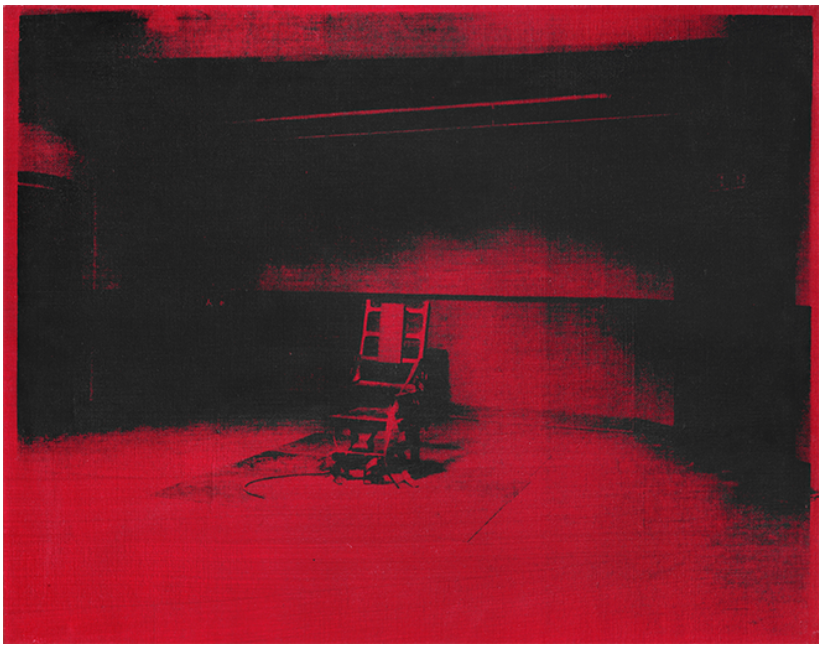
But Gun, 1981-1982, is more than just a continuation of Warhol’s morbid subject matter after a thirteen-year hiatus; it is a form of therapy, where Warhol chooses to revisit the demons of his past in order to cope with their lasting physical and psychological scars. With any observer, as with Warhol himself, when he is confronted with images of dreadful weight, the pictures bequeath the viewer with a deeply emotional and reflective catharsis in observation—the gun functions much in the same way that a portrait of the electric chair does: it simultaneously frightens us, warns us, and teaches us to avoid encountering it. For Warhol, voluntarily reencountering the gun that nearly took his life was one way to battle his demons in his art.
Auction Results
2024 Auction Results
#1. Gun, 1981-1982
Estimated: USD 650,000 – 850,000
USD 907,200

Gun, 1981-1982
Acrylic and silkscreen ink on canvas
16 x 19 7/8 inches (40.6 x 50.5 cm)
Stamped with the Estate of Andy Warhol and the Andy Warhol Foundation for the Visual Arts, Inc. stamps (on the overlap)
Numbered ‘PA15.024’ (on the stretcher)
Stamped again with Andy Warhol Foundation for the Visual Arts, Inc. stamp (on the reverse)
#2. Guns, 1981
Phillips London: 10 October 2024
Estimated: GBP 450,000 – 650,000
GBP 571,500 / USD 748,665
Andy Warhol – Modern & Contemporary … Lot 28 October 2024 | Phillips
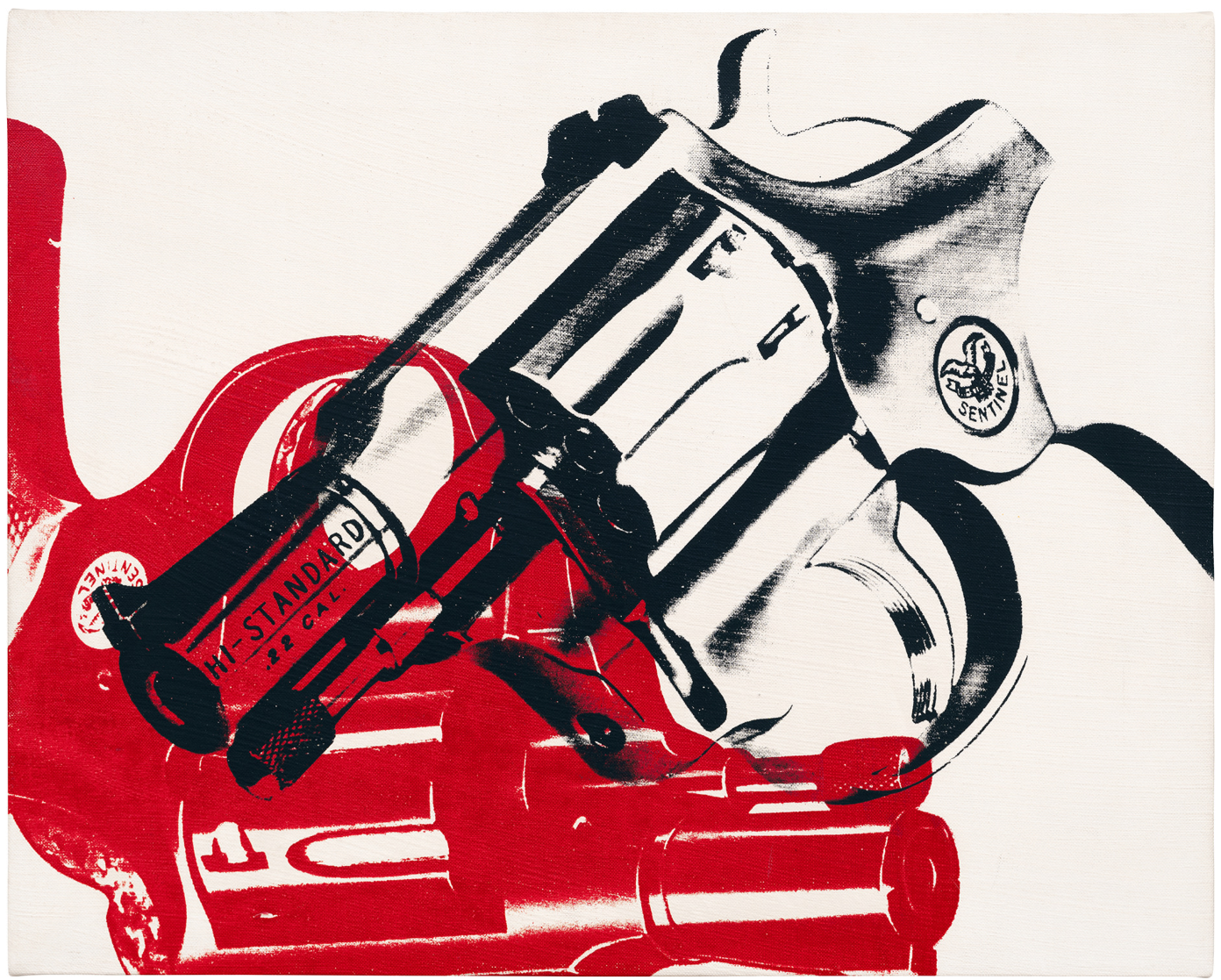
ANDY WARHOL
Guns, 1981
Synthetic polymer paint and silkscreen ink on canvas
16×20 inches (40.6 x 50.5 cm)
Signed and dated ‘Andy Warhol 81’
Stamped with the Andy Warhol Foundation for Visual Arts, Inc. stamp
Numbered ‘A101.984’ on the overlap
2023 Auction Results
Guns, 1981
Christie’s Paris: 7 June 2023
Estimated: EUR 400,000 – 600,000
EUR 604,800
Andy Warhol (1928-1987), Guns | Christie’s
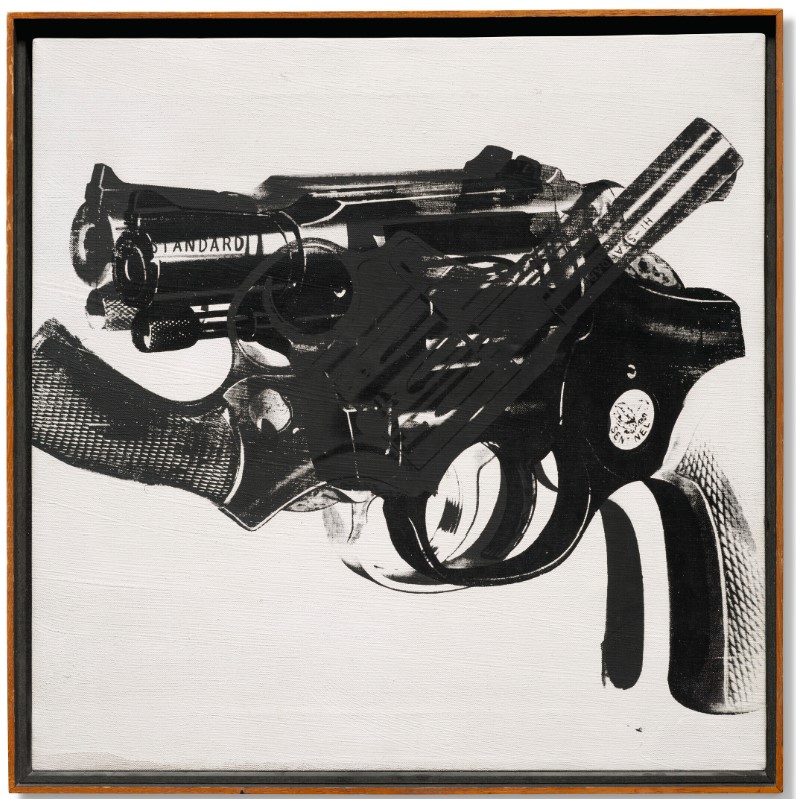
ANDY WARHOL (1928-1987)
Guns, 1981
Acrylic and silkscreen on canvas
20 1/8 x 19 7/8 inches (51 x 50.6 cm)
Signed and dated ‘Andy Warhol 81’ (on the overlap)
Guns (70×90)
Gun, 1981
Christie’s New-York: 9 November 2015
Estimated: USD 8,000,000 – 12,000,000
USD 11,925,000
Andy Warhol (1928-1987), Gun | Christie’s

ANDY WARHOL
Gun, 1981
Acrylic and silkscreen inks on canvas
70 x 90.1 inches (177.8 x 228.9 cm)
Stamped twice with the Estate of Andy Warhol and the Andy Warhol Foundation for the Visual Arts., Inc. stamps and numbered ‘PA15.061’ (on the overlap)
In the present work, a handgun is rendered as an iconic and highly evocative object. Its arresting red coloring could just as easily allude to blood as to Coca-Cola cans. The pistol is tilted to provide a three-quarter view, which allows the viewer to peer down the gun’s barrel. The gun has been depicted with meticulous detail; its sleek barrel reads “HI-STANDARD .22 CAL.,” a label that could be viewed as detached, imposing, or threatening or alternatively as providing a sense of safety and security. The pistol’s white highlights and bold black outlines evoke newsprint, calling to mind contemporaneous depictions of guns in tabloid stories and print advertisements. In the present work, the artist has overlaid two screens in a hallucinatory effect. This aesthetic reads like a blurred film still, calling to mind Warhol’s earlier homage to film noir in his 1962 paintings of a handgun-sporting James Cagney (based on a still from gangster movie Angels with Dirty Faces) as well as the artist’s 1963 Triple Elvis [Ferus Type]. The “double-vision” at work also alludes to the artist’s psychic discombobulation after having been shot by Valerie Solanas.
Gun, 1981-1982
Christie’s New-York: 13 May 2015
Estimated: USD 9,000,000 – 12,000,000
USD 10,245,000
Andy Warhol (1928-1987), Gun | Christie’s
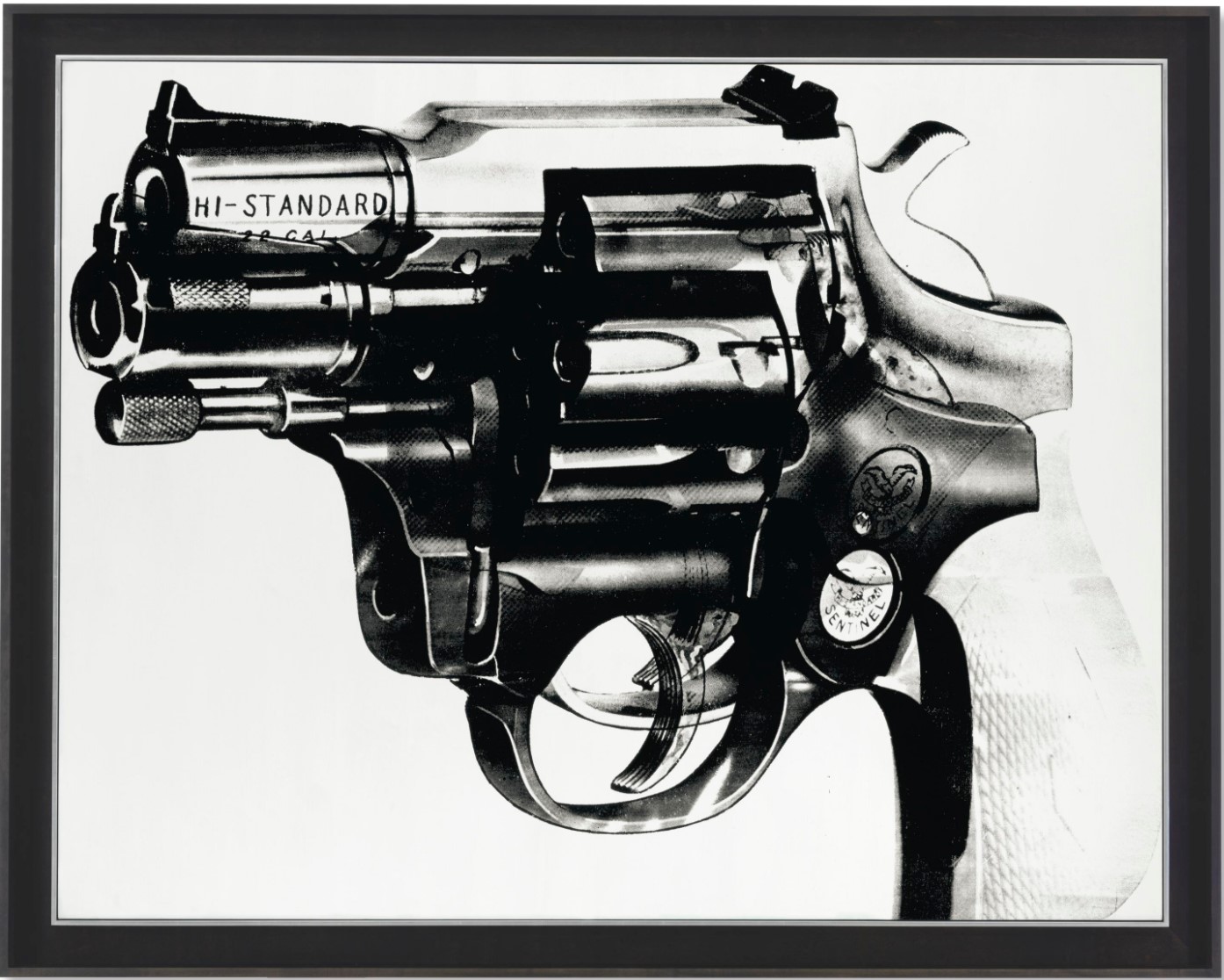
ANDY WARHOL
Gun, 1981-1982
Acrylic and silkscreen ink on canvas
70.2 x 90.1 inches (178.4 x 228.9 cm)
Executed across a vast canvas that stretches larger than life-size, Warhol’s Gun looms over the viewer, hovering in a way that the memory of Solanas’ shooting must have hovered in Warhol’s own mind. The visual stridency of the painting’s large-scale is emphasized by the overall crispness of the screening and its perfect execution, which lends a palpable sense of ironic elegance to the image that is undeniably contemporary. The starkness of its limited palette of black silkscreen ink upon a vast background of pure, white acrylic conveys a sublime elegance that recalls his best paintings of the 60s. Though each handgun is presented from a side-angle perspective, Warhol has tilted each one ever so slightly to present a ¾ view, which allows the viewer to peer into the gun’s barrel, a slightly-skewed perspective that draws attention into its empty (or not empty) barrel. Though Warhol’s canvas appears straightforward, by overlaying two separate screens together on top of each other, the guns harken from Warhol’s own dreams and recollections of that terrible event nearly two decades earlier. Incredibly—and perhaps not coincidentally—a diary entry from this period describes a death threat that Warhol received on May 4, 1981, which prompted a new wave of paranoia that is palpably felt through the magnitude and power of the painting. By the following day, a hired-guard was stationed at Warhol’s studio and he had purchased several props and wigs to disguise himself.
Phillips New-York: 10 May 2012
USD 7,026,500
ANDY WARHOL
Gun, 1981-1982
Acrylic and silkscreen ink on canvas
70.1 x 90.1 inches (178.1 x 228.9 cm)
One of the most remarkable features of Warhol’s canvas is the meticulous detail expressed in the impression. Normally a messy and indefinite process in terms of its final product, Warhol’s silkcreening typically produces blotches of too much or too little shading where ink has run through the image reproduced on the screen placed on canvas.
Yet here we witness certain intricacies that are rare in Warhol’s oeuvre: at the far left, we can see the exact structure of the lower gun’s barrel, each dimple below it in perfect form. In addition, the gorgeous shading on each trigger makes for a delicate and fascination impression, where each piece of metal appears translucent. Warhol succeeds in creating one of his most photorealistic works, where the impression of acrylic appears more like the skilled focus of a lens.
Guns, 1982
Christie’s New-York: 10 November 2010
Estimated: USD 1,800,000 – 2,200,000
USD 4,450,500
Andy Warhol (1928-1987) , Guns | Christie’s
ANDY WARHOL
Guns, 1982
Synthetic polymer and silkscreen inks on canvas
56.2 x 80.1 inches (142.9 x 203.5 cm)
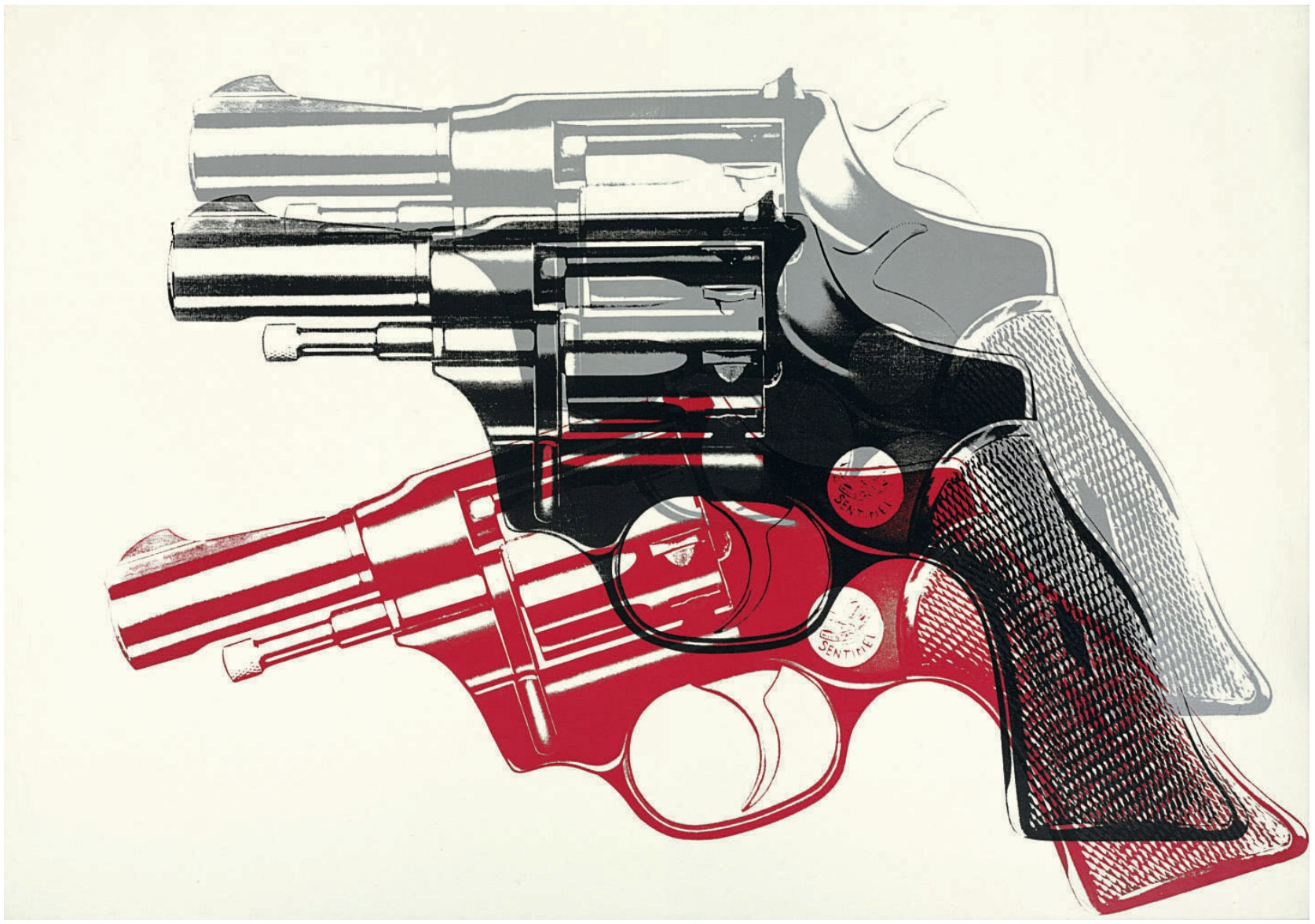
Throughout his life Andy Warhol was obsessed with idea of death and at times was almost overcome by a paralyzing fear of dying. Worries about his own mortality are present to a greater or lesser degree in a large number of his works, but none demonstrate it so clearly as his Gun paintings from 1981-82. This large picture with its multiple images of a menacing revolver dominate the surface of the canvas. The repeated images of the pistol mimic the slow motion action of the gun being prepared for firing, becoming a fetishized object which conveys both power and death. Yet when viewed in the company of Warhol’s earlier bold canvases from the early 1960s its sleek and shiny surface presents itself as another desirable consumer object, implying that Warhol has joined in the adulation of this product of industry and technology. The very process by which Guns has been created, through the transferal of a photographic source to silkscreen, illustrates Warhol’s participation in a similar industrial process. This is an artform that is perfectly suited to the era of factories and capitalism; yet the cool, objective distance that Warhol maintained in creating Guns is itself ironic. Warhol appears here to engage in the entire visual language of weaponry, of the gun as a status symbol, as a tool that begets violence; which is all the more pertinent because Warhol, whose pictures often touched upon the subject of death, had deeply personal associations with guns.
Guns (20×20)
Guns, 1981
Christie’s Paris: 7 June 2023
Estimated: EUR 400,000 – 600,000
EUR 604,800
Andy Warhol (1928-1987), Guns | Christie’s
ANDY WARHOL (1928-1987)
Guns, 1981
Acrylic and silkscreen on canvas
20 1/8 x 19 7/8 inches (51 x 50.6 cm)
Signed and dated ‘Andy Warhol 81’ (on the overlap)
“They brought me back from the dead—literally, because I’m told that at one point I was gone…As I was coming down from my operation, I heard a television going somewhere and the words ‘Kennedy’ and ‘assassin’ and ‘shot’ over and over again. Robert Kennedy had been shot…It was all so strange to me, this background of another shooting and a funeral—I couldn’t distinguish between life and death yet, anyway, and here was a person being buried on the television right in front of me.”
Guns, 1981
Sotheby’s New-York: 17 May 2019
Estimated: USD 500,000 – 700,000
USD 800,000
ANDY WARHOL
Guns, 1981
Acrylic and silkscreen ink on canvas
20×20 inches (50.8 x 50.8 cm)
Guns, 1981
Christie’s New-York: 16 November 2006
Estimated: USD 350,000 – 450,000
USD 520,000
Andy Warhol (1928-1987) , Guns | Christie’s
ANDY WARHOL
Guns, 1981
Synthetic polymer and silkscreen inks on canvas
20 1/2 x 20 inches (51.4 x 50.8 cm)
Signed, inscribed and dated ‘To Tommy Andy Warhol 81’
Numbered with the Estate of Andy Warhol number A691.104 (on the overlap)
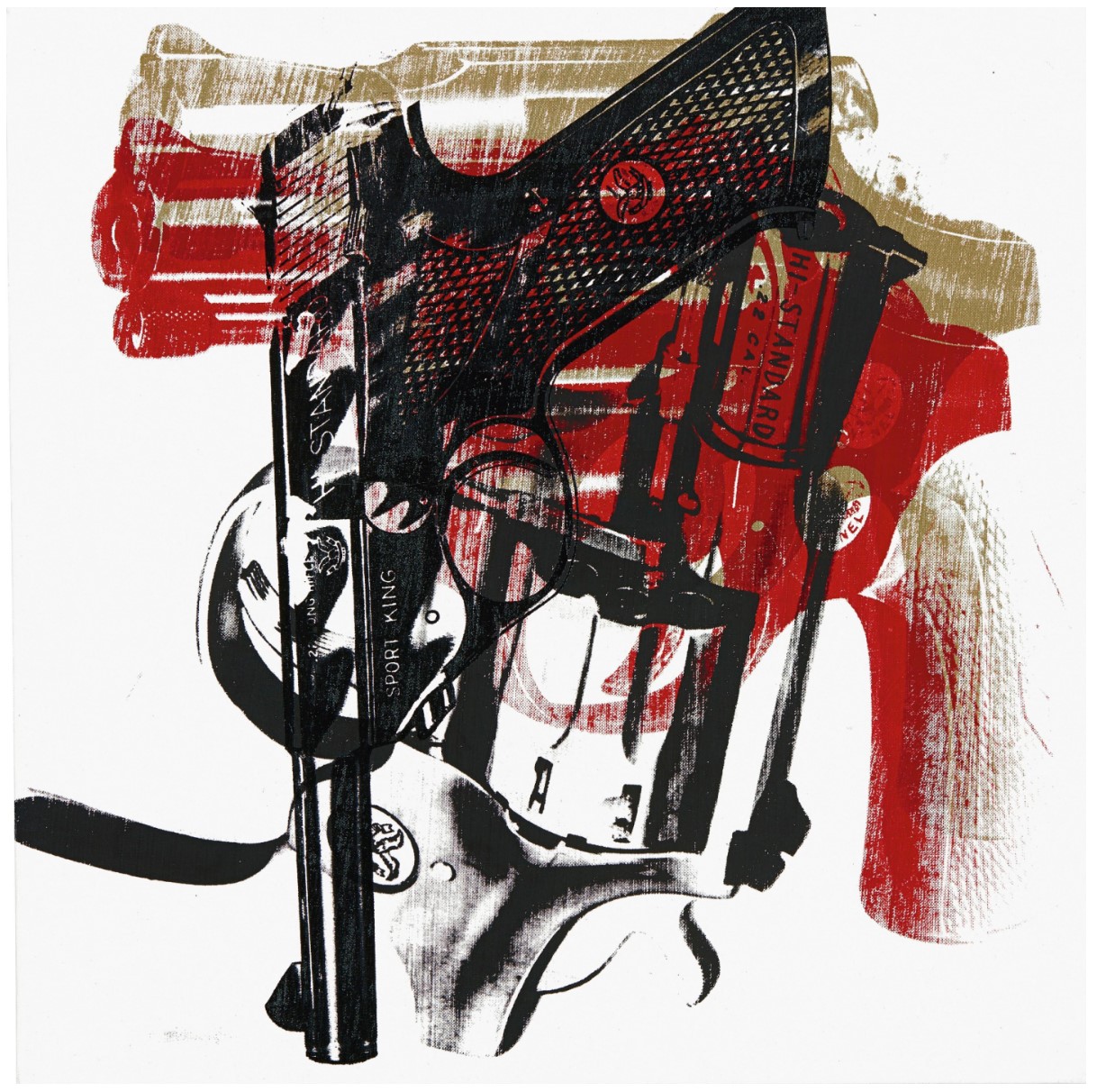
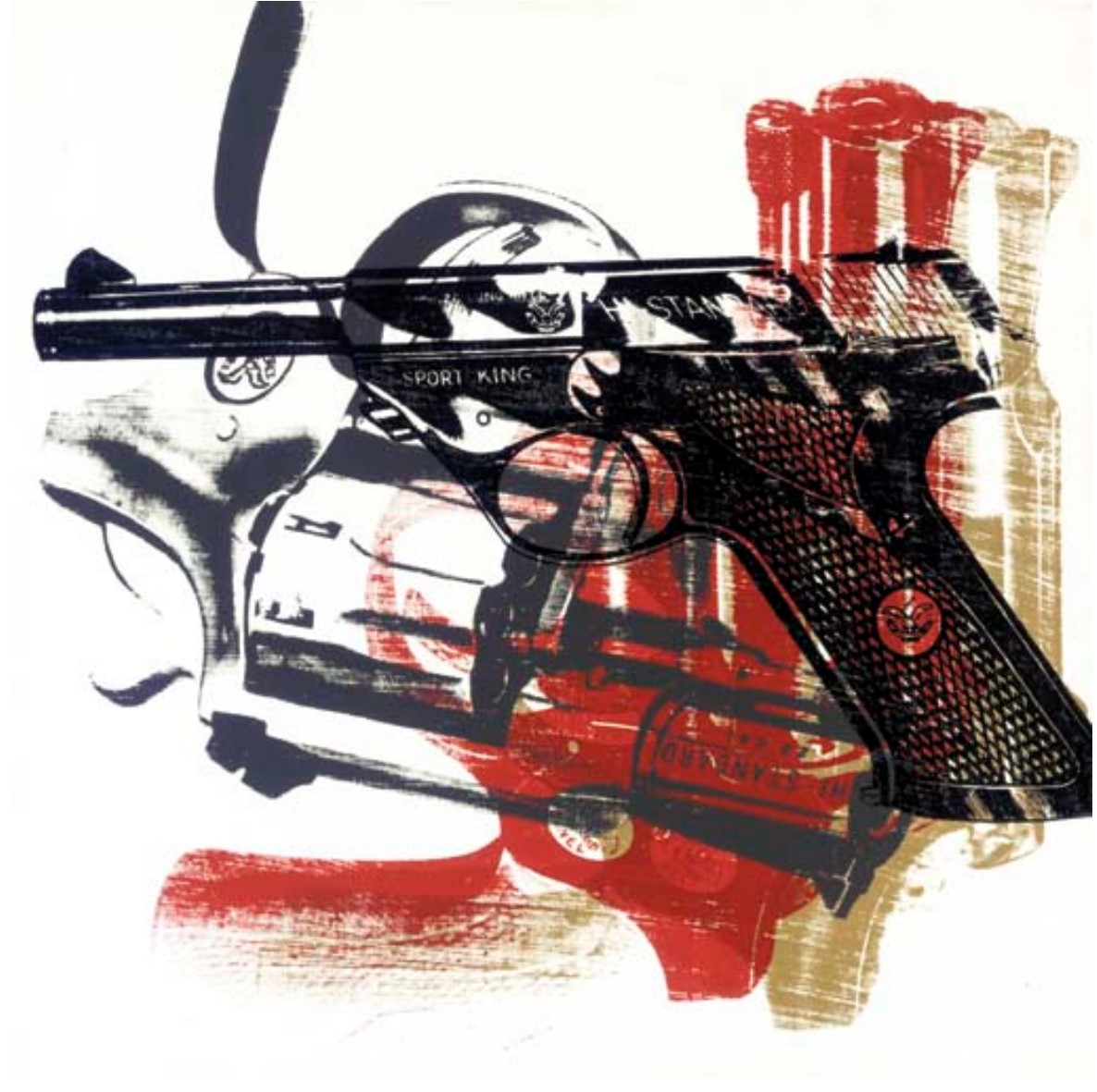
Stripped of any personal or cultural context, Guns is unexpectedly beautiful. The serial repetition of the guns in black, red and gold recalls the multi-screen Self Portrait series from the 1970s. The gun brings an extreme range of connotations to mind, of murder and warfare or of childhood toys and the banality of violence in American culture. The multiplicitous nature of the image of the gun appealed to Warhol’s penchant for ambiguity. This painting was acquired from Warhol by Tommy Mottola, the President of Sony Records, along with a second, black and white composition (shown opposite). Despite being a complex allegorical motif, Warhol treats the gun formally, removing emotion from the composition and thereby encouraging the viewer to project their own as part of the experience.
Guns (16×20)
Guns, 1981
Phillips London: 10 October 2024
Estimated: GBP 450,000 – 650,000
GBP 571,500 / USD 748,665
Andy Warhol – Modern & Contemporary … Lot 28 October 2024 | Phillips
ANDY WARHOL
Guns, 1981
Synthetic polymer paint and silkscreen ink on canvas
16×20 inches (40.6 x 50.5 cm)
Signed and dated ‘Andy Warhol 81’
Stamped with the Andy Warhol Foundation for Visual Arts, Inc. stamp
Numbered ‘A101.984’ on the overlap
A powerful and blunt symbol of the violence that continues to characterize so much of our modern world, Andy Warhol’s Guns combines the artist’s astute understanding of the iconographic power of everyday, consumer items with his own, more complex relationship to questions of mortality and death. With a forensic detachment, Warhol magnifies and closely crops the titular objects here, the source image reproduced and rotated so that the two pistols appear interlocked with one another, emphasized through simple but stark contrasts of red, black, and white. Created in 1981, the present work belongs to Warhol’s late series of Guns paintings, examples of which now reside in the permanent collections of major institutions including the Tate Collection in London and the San Francisco Museum of Modern Art. Closely related to the contemporaneous Knife paintings and the more conceptual Oxidation and Shadow paintings, this late series highlights Warhol’s profound sensitivity to images, and his singular ability to transform them into powerful, provocative symbols of an American post-war landscape shaped by commodity consumption, the cult of celebrity, and the strangely intertwined existence of glamour, tragedy, and everyday violence. Even in Warhol’s iconic images of Marilyn Monroe or Jackie Kennedy, tragedy and violence operate in direct dialogue with beauty and fame, connections made all the more explicit when the artist first embarked on his Death and Disaster series in 1962, just months before completing his first silkscreened portraits of Monroe. Taken from a sensational front-page tabloid headline, 129 Die in Crash marked the beginning of this important series, and inaugurated the critical role played by thematic treatments of death and violence in Warhol’s practice as serially repeated images of car crashes, race riots, and electric chairs took their place alongside the smiling faces of celebrities and Campbell’s Soup cans.
Andy Warhol, Electric Chair (Red), 1964, The Philadelphia Museum of Art. Image: Philadelphia Museum of Art, Gift of Mr. and Mrs. David N. Pincus, 1979, Artwork: © The Andy Warhol Foundation for the Visual Arts, Inc. / Licensed by DACS, London
Although Warhol’s childhood had been marked by sickness and physical frailty, in 1968 the artist suffered a shocking confrontation with gun violence and his own mortality when he was shot at close range by Valerie Solanas, the radical feminist and Factory-goer whose SCUM Manifesto called for ‘civic-minded, responsible, thrill-seeking females’ to ‘overthrow the government, eliminate the money system, institute complete automation and eliminate the male sex.’ Near-fatal, this assassination attempt would haunt Warhol for the rest of his life, leaving him deeply scarred in both physical and psychological terms, twinned conditions sensitively captured in Alice Neel’s moving 1970 portrait, and in his own series of Skulls from 1976.
“As I was putting the phone down, I heard a loud exploding noise and whirled around: I saw Valerie pointing a gun at me and I realized she’d just fired it. I said “No! No, Valerie! Don’t do it!” and she shot at me again. I dropped down to the floor as if I’d been hit I didn’t know if I actually was or not. I tried to crawl under the desk. She moved in closer, fired again, and then I felt horrible, horrible pain, like a cherry bomb exploding inside me.”
As Victor Bockris has suggested, the pistol depicted here and in other works from the series created little over a decade after the attack is in fact ‘the same snub-nosed .32 that Valerie Solanas had shot him with.’ Taken together, the Guns paintings thus stand as a powerful record of individual and collective trauma, touching not only on Warhol’s own experience, but as representative of the shocking acts of violence that punctuated the last decades of the 20th century with assassination attempts on presidents, prominent civil rights activists, and cultural icons like John Lennon. If movie stars and the cult of celebrity defined Warhol’s idea of 20th-century glamour, his images of the tools of violence – electric chairs, knives, guns – draw out the darker underside of the so-called ‘American century’, evoking Warhol’s familiar visual language of fetishized everyday commodities to expose the banality and ubiquity of this violence lurking just beneath the surface. Tellingly, Warhol had originally envisioned presenting his Guns and Knives alongside his Dollar Sign paintings at the Leo Castelli Gallery in January 1982; although the former were removed from the show at the last minute, the close conceptual connections made by the artist between these distinct bodies of work speaks powerfully to Warhol’s vision of contemporary American culture and the convergence of money, consumerism, power, and violence.
Gun, 1981-1982
Estimated: USD 650,000 – 850,000
USD 907,200
Gun, 1981-1982
Acrylic and silkscreen ink on canvas
16 x 19 7/8 inches (40.6 x 50.5 cm)
Stamped with the Estate of Andy Warhol and the Andy Warhol Foundation for the Visual Arts, Inc. stamps (on the overlap)
Numbered ‘PA15.024’ (on the stretcher)
Stamped again with Andy Warhol Foundation for the Visual Arts, Inc. stamp (on the reverse)
Gun, 1981
Christie’s New-York: 14 May 2021
Estimated: USD 400,000 – 500,000
USD 625,000
ANDY WARHOL (1928-1987), Gun | Christie’s (christies.com)
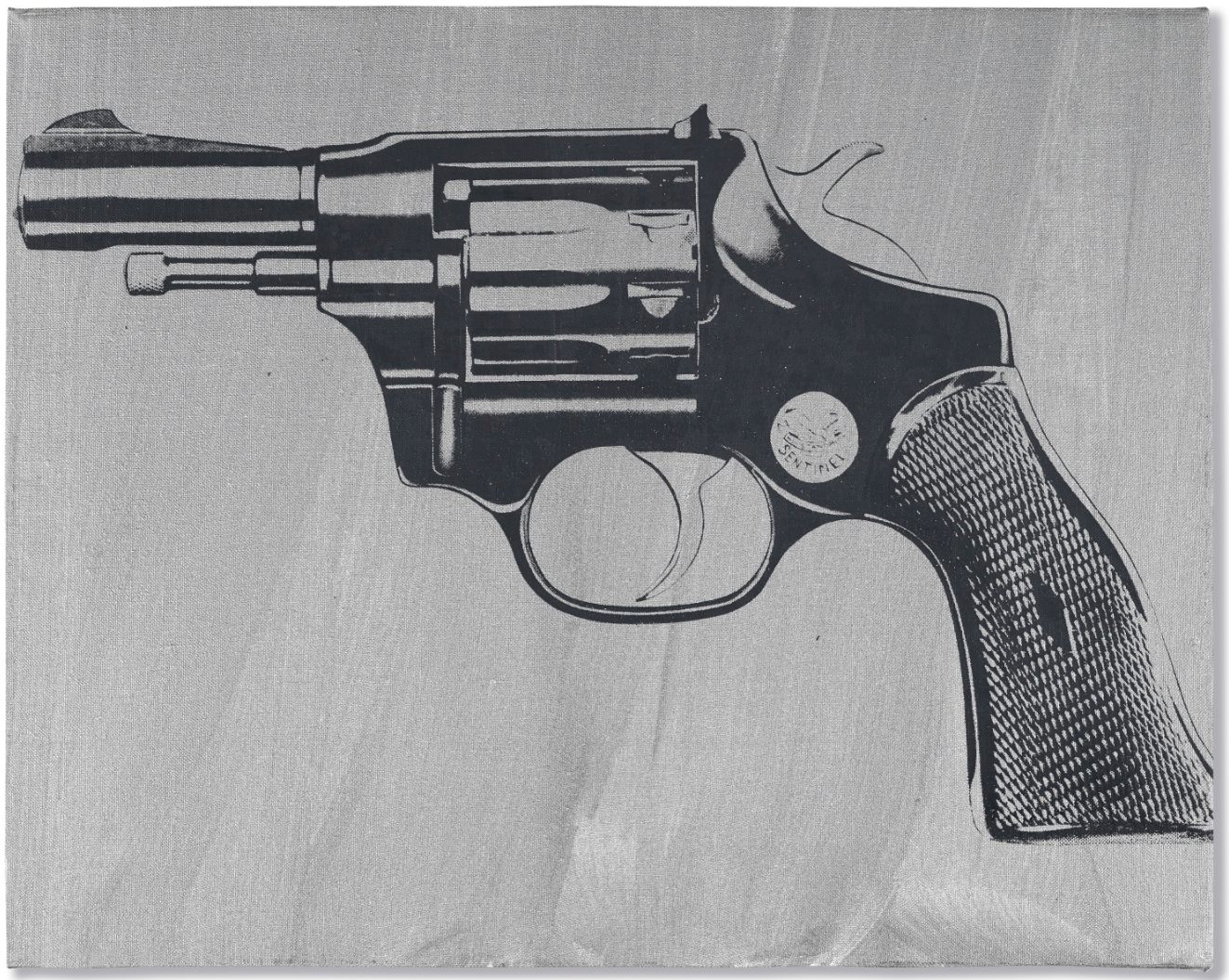
ANDY WARHOL (1928-1987)
Gun, 1981
Acrylic and silkscreen ink on canvas
16×20 inches (40.6 x 50.8 cm)
Stamped with the Estate of Andy Warhol and the Andy Warhol Foundation for the Visual Arts stamps
(on the reverse)
Stamped with the Estate of Andy Warhol and the Andy Warhol Foundation for the Visual Arts stamps
(on the overlap)
Numbered ‘PA15.009’ (on the stretcher)
“While creating an inventory of American superstars and supermarket favorites, [Warhol] also compiled an anthology of the American way of death, from car crashes and race riots to the electric chair itself. … And it turned out, too, that the most commonplace instruments of death, guns and knives…would eventually turn up in Warhol’s art as isolated objects, as iconic in their spaceless environments as the famous Campbell’s soup can that launched his international fame.”
(R. Rosenblum, Andy Warhol, Knives: Paintings, Polaroids and Drawings, Salon Verlag, Cologne, 1998)
Gun, 1981-1982
Christie’s New-York: 16 November 2018
Estimated: USD 600,000 – 800,000
USD 912,500
Andy Warhol (1928-1987), Gun | Christie’s
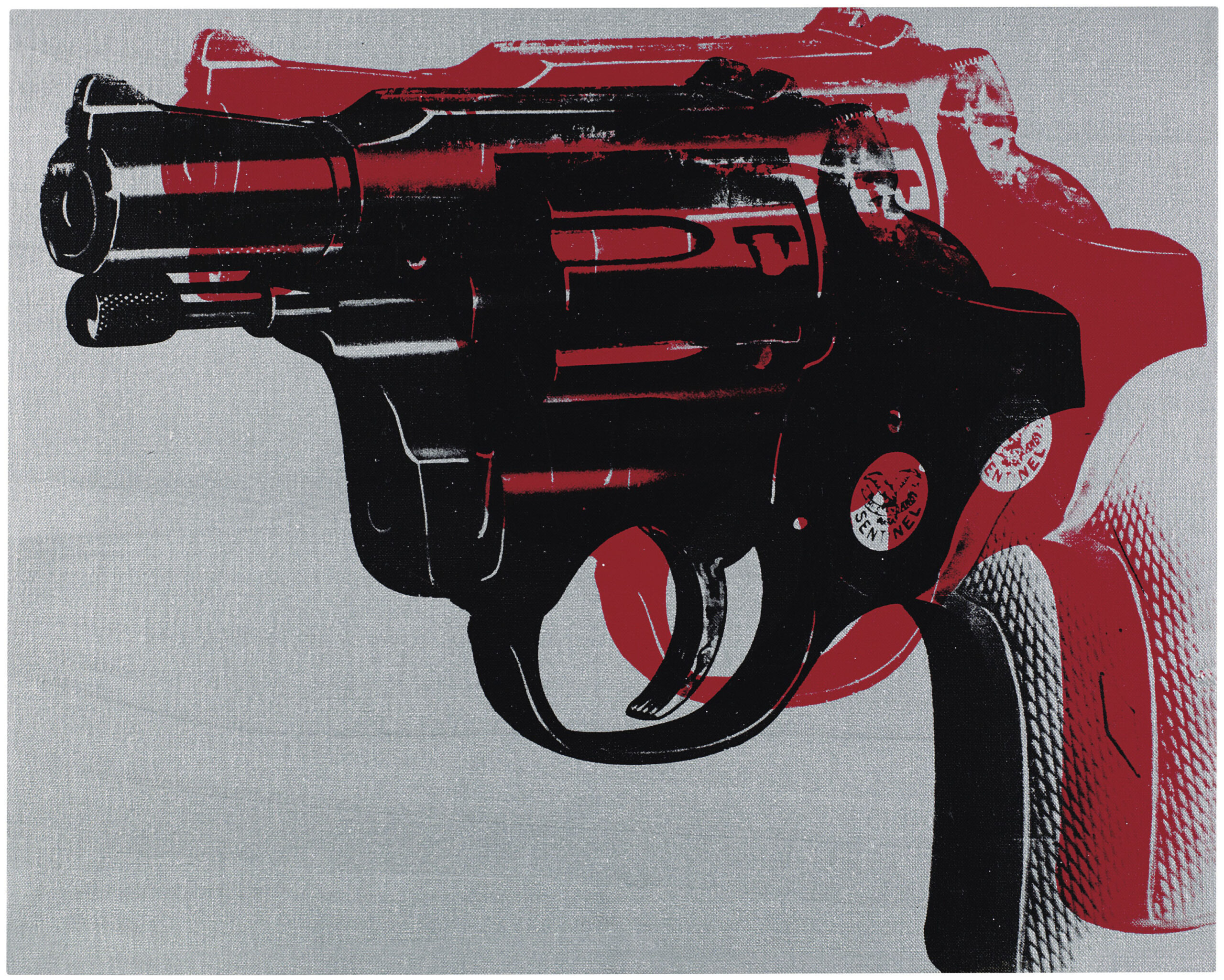
ANDY WARHOL
Gun, 1981-1982
Synthetic polymer and silkscreen ink on canvas
16 x 19.9 inches (40.6 x 50.5 cm)
Guns, 1981-1982
Sotheby’s New-York: 12 November 2015
Estimated: USD 300,000 – 400,000
USD 538,000
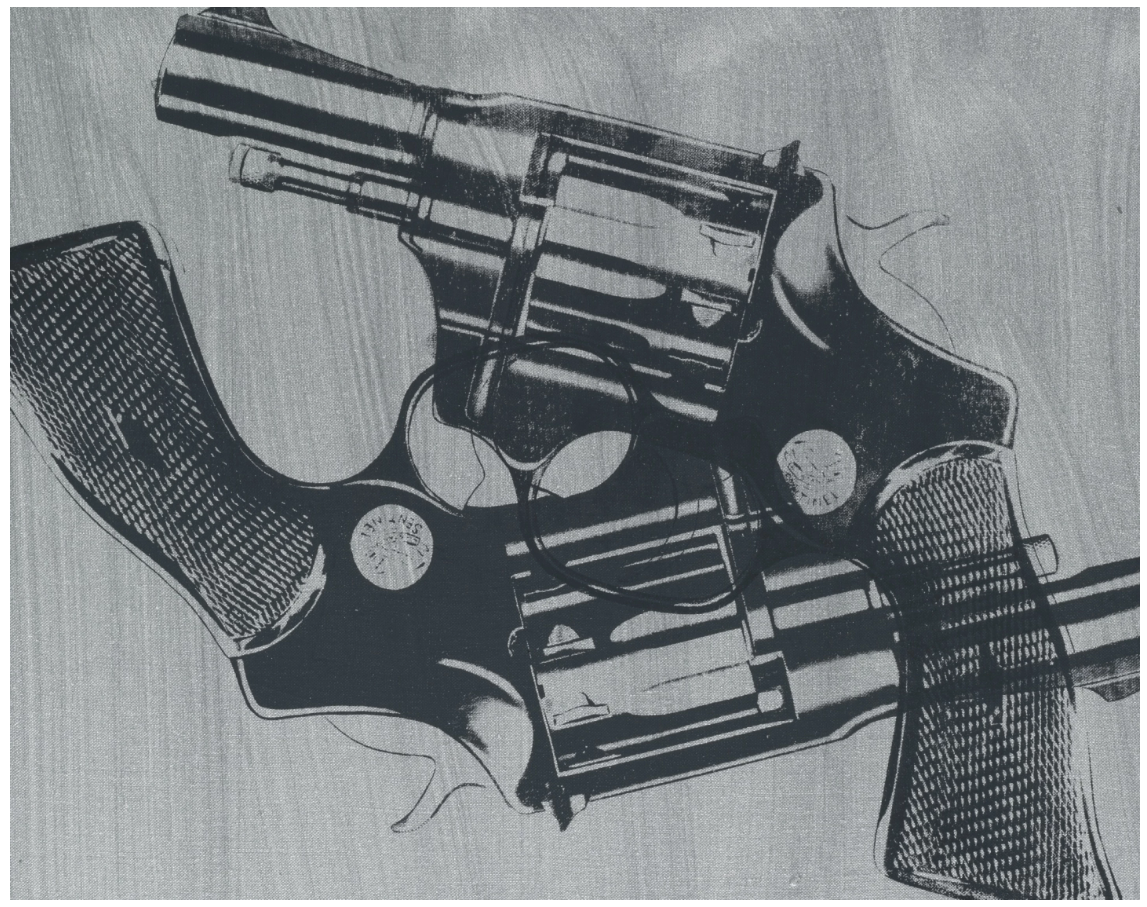
ANDY WARHOL
Guns
Acrylic and silkscreen ink on canvas
16×20 inches (40.6 x 50.8 cm)
Coolly realized in shades of gun-metal grey, the present work brusquely depicts a .32 snub-nose pistol, similar to the one used against Andy Warhol in 1964 when he was shot and almost killed by Valerie Solanas. Warhol’s fascination with power is evidenced throughout his oeuvre where he often used the subject of death or it’s implication to compliment, contextualize and humanize prominent social superstars such as Marilyn Monroe or Jackie Kennedy, or at other times depicting it more directly such as in his Electric Chairs, Skulls and Death and Disasters series. The present work is without doubt loaded with provocation. Yet despite its extremely personal implications, Warhol maintained that his paintings did not have a political agenda; instead he aimed to portray America as he saw it, creating social and cultural observations rather than commenting on their effect. Firearms have been a topic of explosive controversy and contentious debate in America for decades, yet we are presented with a side-on view of the weapon, neither being threatened nor invited by its presence. With a silvery lick of paint, Warhol coyly holds a mirror up to society, draws attention to some of its most extreme and prominent issues and allows the individual readings from different viewers to play out in their own accord. The gun is presented as a shimmering ethereal object that dissolves into its greyish ground and hypnotically rotates on its axis. Aimed both toward itself and into the surrounding space of the canvas, it is as much a symbol of American heroism, power and freedom as it is of death, violence and fear.
Guns, 1981
Christie’s New-York: 14 May 2014
Estimated: USD 400,000 – 600,000
USD 605,000
Andy Warhol (1928-1987) , Guns | Christie’s
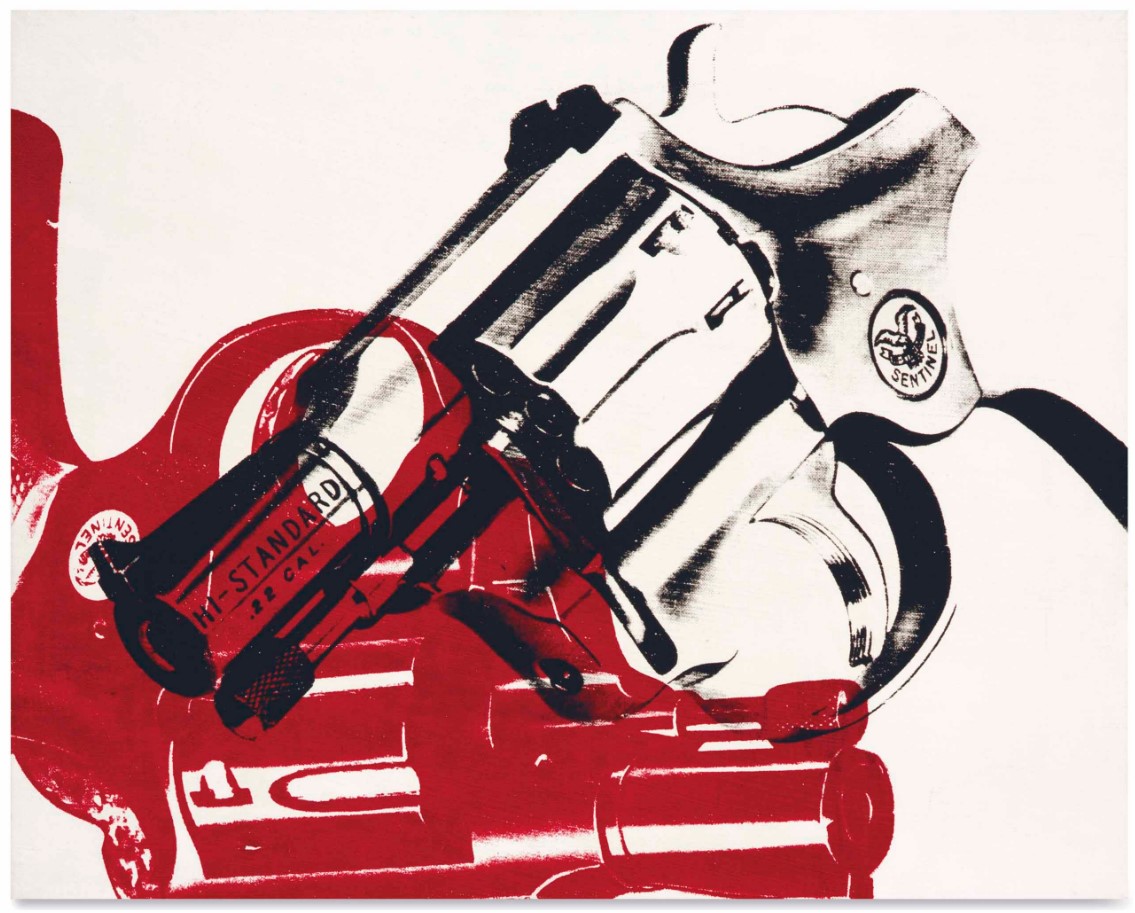
ANDY WARHOL
Guns, 1981
Synthetic polymer and silkscreen inks on canvas
16 x 19 7/8 inches (40.6 x 50.5 cm)
Signed and dated ‘Andy Warhol 81’
Stamped with the Andy Warhol Foundation for the Visual Arts, Inc.
Numbered ‘A101.984’ (on the overlap)
Warhol’s Guns of 1981 captures the artist’s deepest and darkest fears of mortality in sleek imagery of two overlaid revolvers. The artist positions the revolvers in an almost cinematic arrangement creating a sense of movement and mystery on the canvas. Both violent and seductive, one can imagine why Warhol was fascinated with this imagery – an extension of his obsession with death and disasters as well as the Hollywood projection of masculinity. For this work, the ubiquitous handgun layered strikingly in red and black, recalls other Warhol works of male icons as well such as Double Elvis, 1963 and cCagney of 1962-1964 “. These Hollywood stills of Presley and Cagney present the male protagonist as a potent symbol of masculinity and the gun or rifle they are holding is not seen just an instrument but rather the extension of their power of potential threat and domination. In the present work, a sense of distance from Warhol is evident throughout them all, satisfying an aesthetic that capitalized on his ability to remain aloof. Through the recurrence of a single image and serially reproducing it, a practice the artist used to empty an image of its meaning, Warhol insisted that the viewer encounter the surface. However, the blood red revolver lying over a deadly black counterpart is a reminder of a fateful day in the life Warhol where the colors of life and death also converged; one where the artist, much like the theme of his creations, was on the brink of death.
Gun, 1981
Sotheby’s London: 21 June 2007
Estimated: GBP 220,000 – 280,000
GBP 714,400
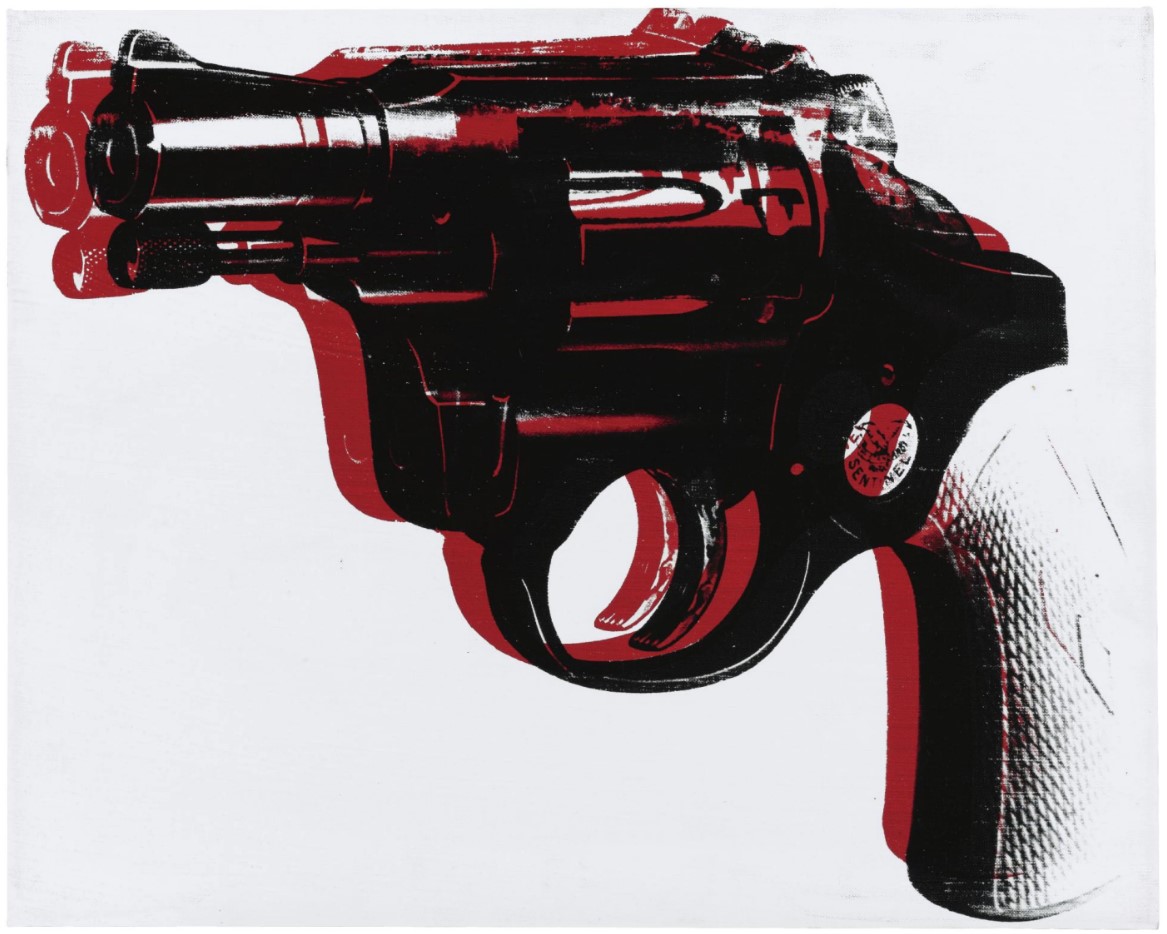
ANDY WARHOL
Gun, 1981
Acrylic and silkscreen ink on canvas
16×20 inches (40.6 x 50.8 cm)
Guns, 1982
Christie’s New-York: 16 May 2007
Estimated: USD 350,000 – 450,000
USD 420,000
Andy Warhol (1928-1987) , Guns | Christie’s
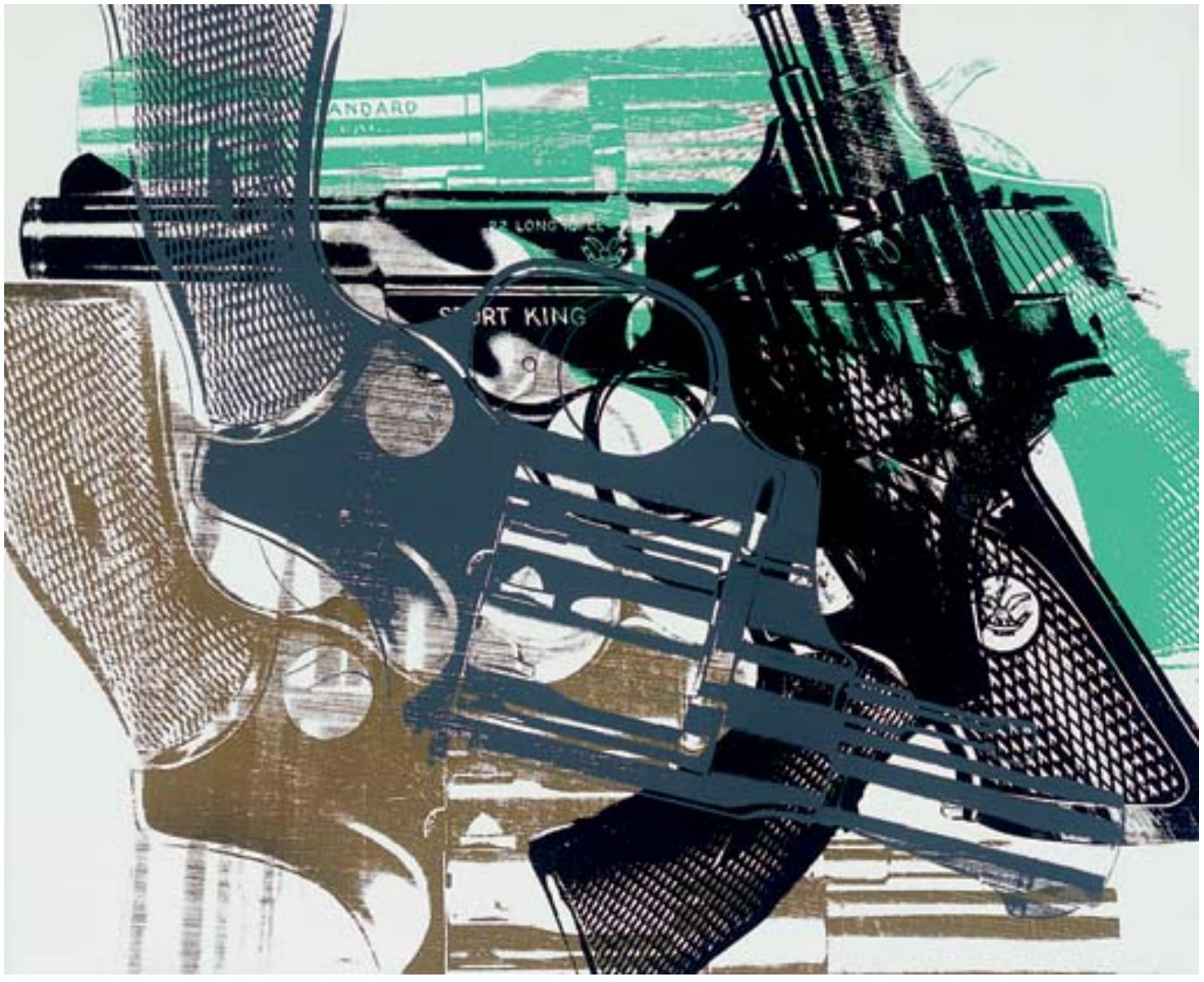
ANDY WARHOL
Guns, 1982
Synthetic polymer and silkscreen inks on canvas
16×20 inches (40.6 x 50.8 cm)
Stamped with the Estate of Andy Warhol and the Andy Warhol Foundation for the Visual Arts stamps
Numbered PA15.040 (on the overlap, reverse and stretcher)