There is perhaps no greater signifier of the American dream than the almighty dollar, and Andy Warhol’s Dollar Signs, painted in 1981 at the dawn of a troubled but financially lucrative decade, are as all-American as apple pie, not to mention Coca-Cola and Campbell’s Soup.
Introduction
In Dollar Sign, Warhol creates a seductive, dreamlike talisman that embodies his personal relationship with, and love of, money. He isolates the “$” sign from the dollar bill and enlarges it to colossal proportions, thereby creating an archetypal symbol that conveys the desire, greed and the relentless pursuit of wealth that lies at the dark heart of the American dream.
“I like money on the wall. Say you were going to buy a $200,000 painting. I think you should take that money, tie it up, and hang it on the wall. Then when someone visited you, the first thing they would see is the money on the wall.”
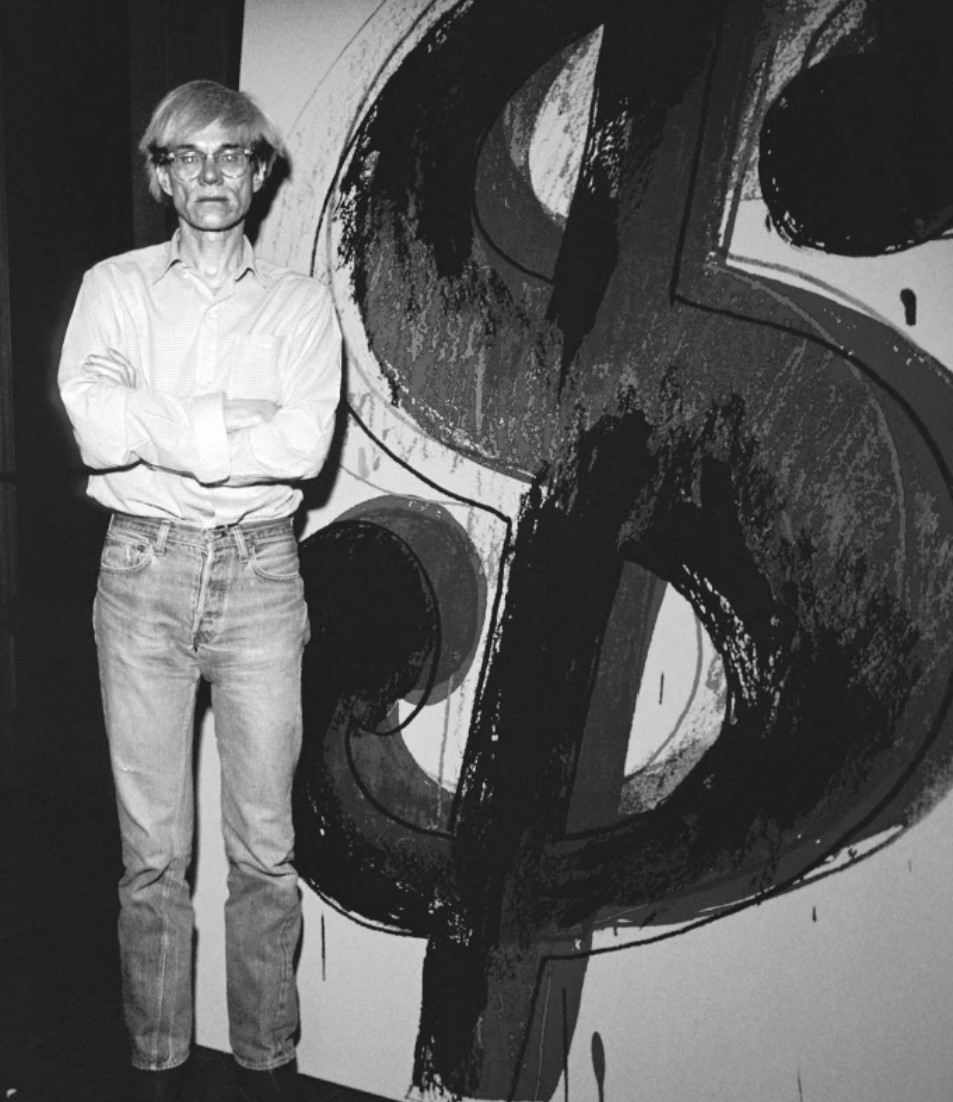
For Warhol, money was a lifelong obsession. He meticulously recorded his daily expenditures with compulsive regularity. Like his fascination with celebrity and religion, Warhol was keenly aware that the power of wealth was shadowed by its evil twin—greed—and to be held in its grasp spelled success on the one hand, and ruin on the other.
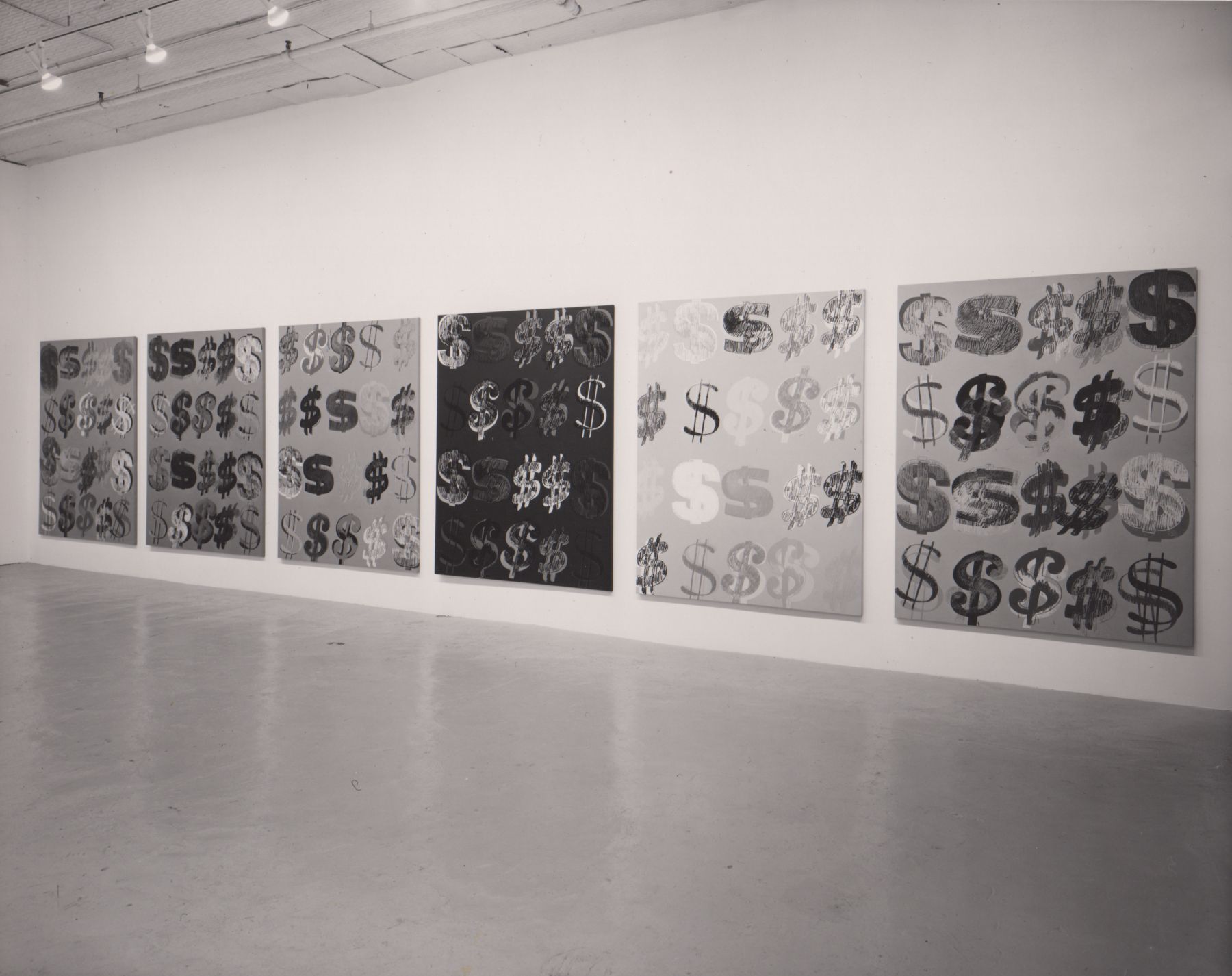
Andy Warhol: Dollar Signs, January 1982, CASTELLI, 142 GREENE STREET
Warhol’s Dollar Sign represents money writ large, rendered in the high-keyed coloration and multiple overlaid screens that define the series, all of which distills the very concept of wealth and power into a massive, wavering “$” sign. Hovering before the viewer, the lurid colors of the “$” symbol create a dizzying cacophony, accentuated by the vigorous up-and-down pencil strokes of Warhol’s original drawing, which is exquisitely captured by the technological complexity of his silkscreen process. Money became an obsession for Warhol and was perhaps his personal biography that drew him to the subject; the artist’s childhood was spent in depression-era Pittsburgh before fleeing to New York City. A playful and colorful distillation of Warhol’s core artistic concerns, Dollar Sign mirrors the artist’s own transformation into an icon of contemporary art and international commercial success. At a time when art was still perceived as an arena for intellectual exclusivity, beyond the vulgar realm of monetary value, Warhol’s deliberate depiction of an instantly recognizable symbol of mass culture – the American dollar – seemed to openly celebrate and embrace consumerism and pop culture. Like his Marilyn and Elvis paintings, Warhol’s dollar paintings are all about desire. Within a society immersed in the pursuit of wealth, his art had become an acquisition that conferred status on its collector. It both intrigued and amused the American artist that his art possesses powers similar to money, as it is capable of stimulating desire and imagination simultaneously.
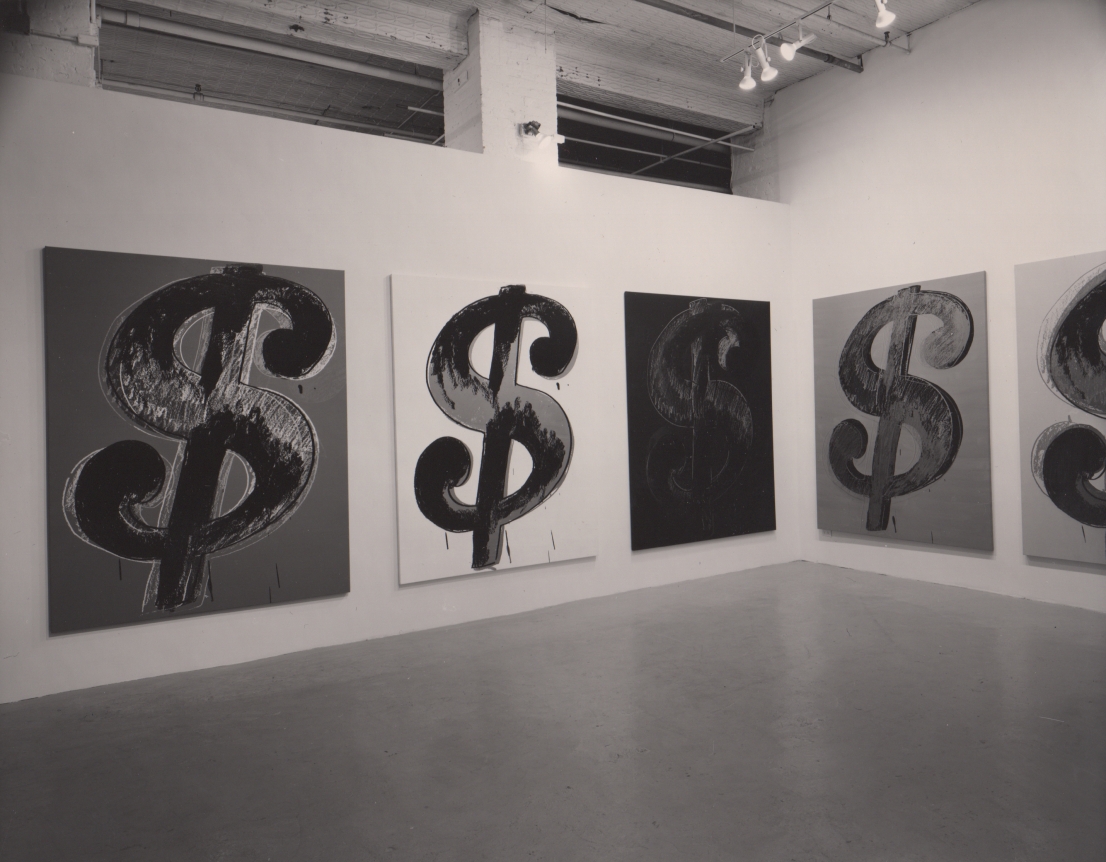
Andy Warhol: Dollar Signs, January 1982, CASTELLI, 142 GREENE STREET
Given their monumental scale, the complexity of the many interwoven screens and the personal symbolism of their imagery, it is clear that Warhol considered the Dollar Signs as a major series that he hoped would regain his critical following and help boost sales. The Dollar Signs were first exhibited at the Castelli Gallery on Greene Street in January of 1982 and became evocative of the entire decade of the 1980s, especially the influx of cash that fueled the art market, making overnight stars of Jean-Michel Basquiat and Julian Schnabel, among others. Warhol’s close friend and chronicler David Bourdon writes, “When they were shown at the Castelli Gallery…they appeared as prophetic emblems of the huge amounts of money that would pour into the art world during the following years. Warhol’s Dollar Signs are brazen, perhaps insolent reminders that pictures by brand-name artists are metaphors for money, a situation that never troubled him” (D. Bourdon, Warhol, New York, 1989, p. 384).
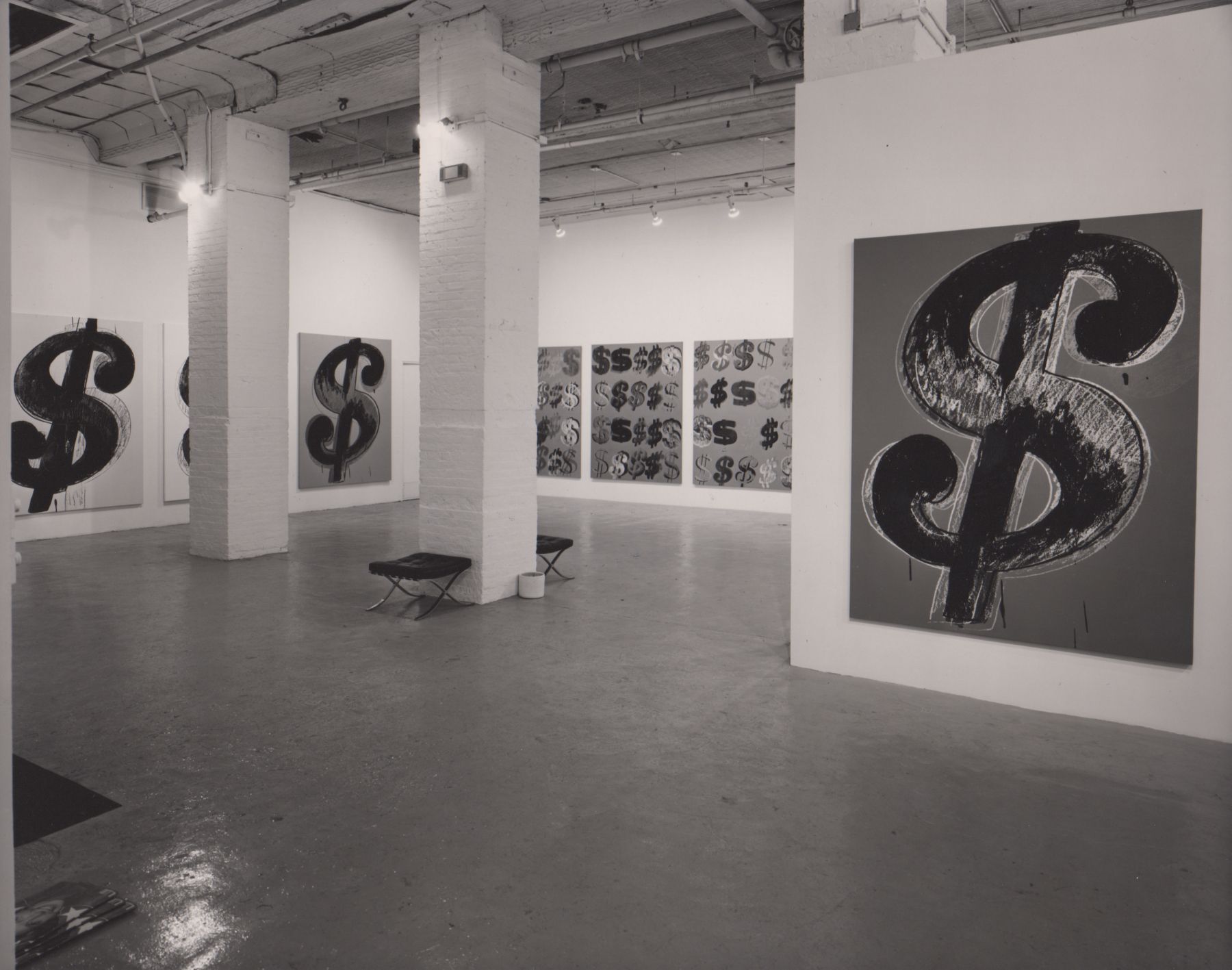
Andy Warhol: Dollar Signs, January 1982, CASTELLI, 142 GREENE STREET
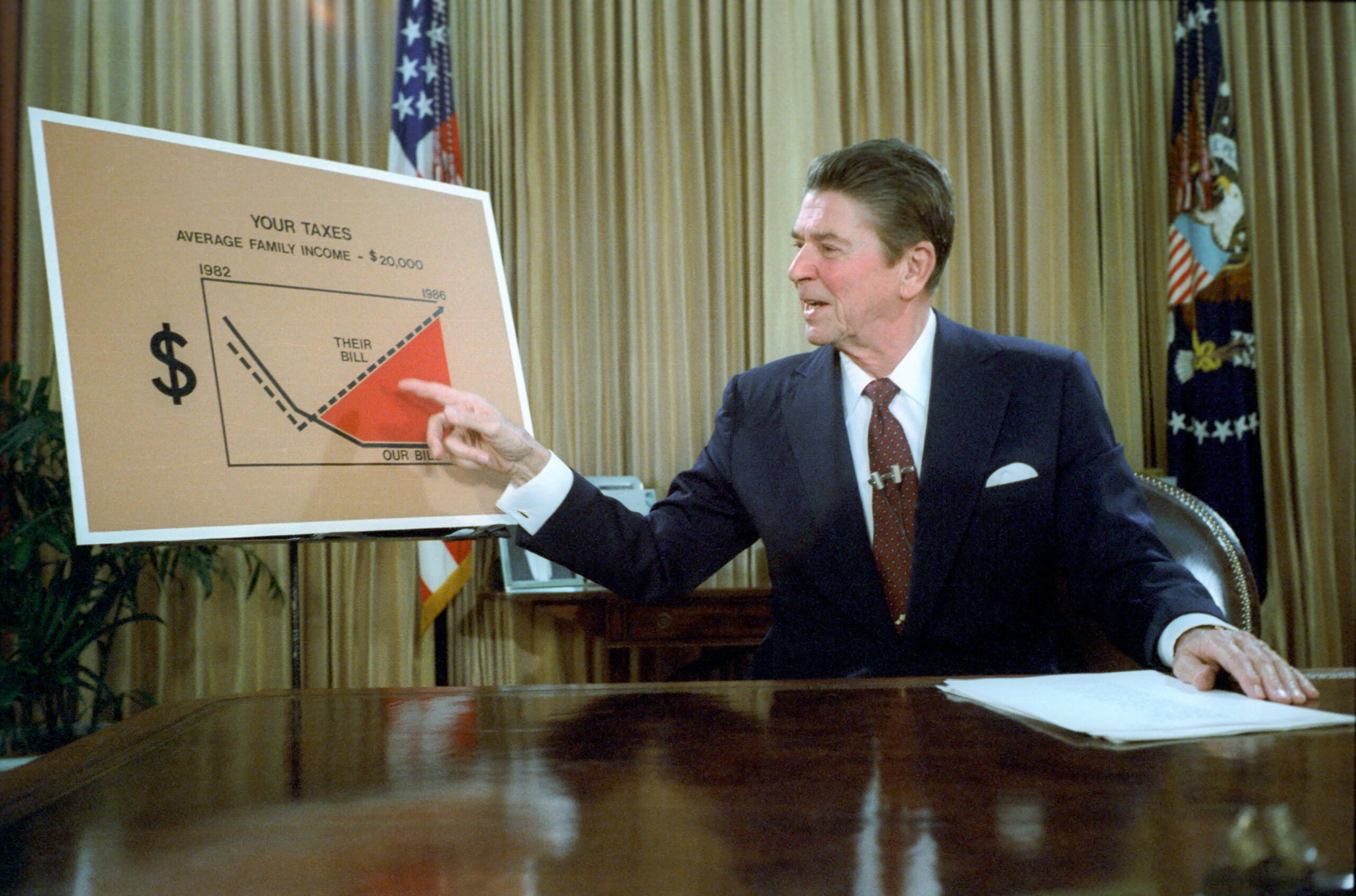
Indeed, Warhol’s paintings have the uncanny ability to evoke the decade in which they were created, while also demonstrating universal truths that lie at the heart of the human condition. Like Warhol’s paintings of Marilyn Monroe, Jackie Kennedy and Campbell’s Soup that conveyed the optimism of the 1960s despite the tragedy that pervaded that decade, Warhol’s Dollar Signs are totemic emblems from a different, albeit similarly legendary, era. Painted in 1981, the Dollar Signs evoke the heady promise of the so-called “Reaganomics” espoused by Ronald Reagan at the beginning of the 1980s and the symbolism of his “Morning in America” ad campaign of 1984. The Reagan era ushered in a prolonged period of rapid economic growth and a booming economy that has come to define that decade, which Warhol’s Dollar Signs so perfectly signified. Warhol even attended the swearing-in of the new president in January 1981 in Washington, D.C.
It is only fitting, then, that Warhol would use the “$” sign for a new series of paintings during an era that marked a turning-point for the nation but also for the artist as well, who considered the new decade a fresh start. Warhol had recently turned 50 and began to seriously reappraise his career. While the decade of the 1970s was marred by an endless array of celebrity portraits that culminated in a rather repetitive and dismal exhibit at the Whitney in 1979, which was largely derided by the press, the 1980s signaled a real change for Warhol, both politically and artistically. In the years that followed, Warhol felt the need to win back his critics, and underwent a period of intense creativity, developing powerful new paintings that remain some of his best work—the Rorschachs, Shadows, Last Supper, Guns and Dollar Bills—speak to Warhol’s most personal fears, hopes and desires.
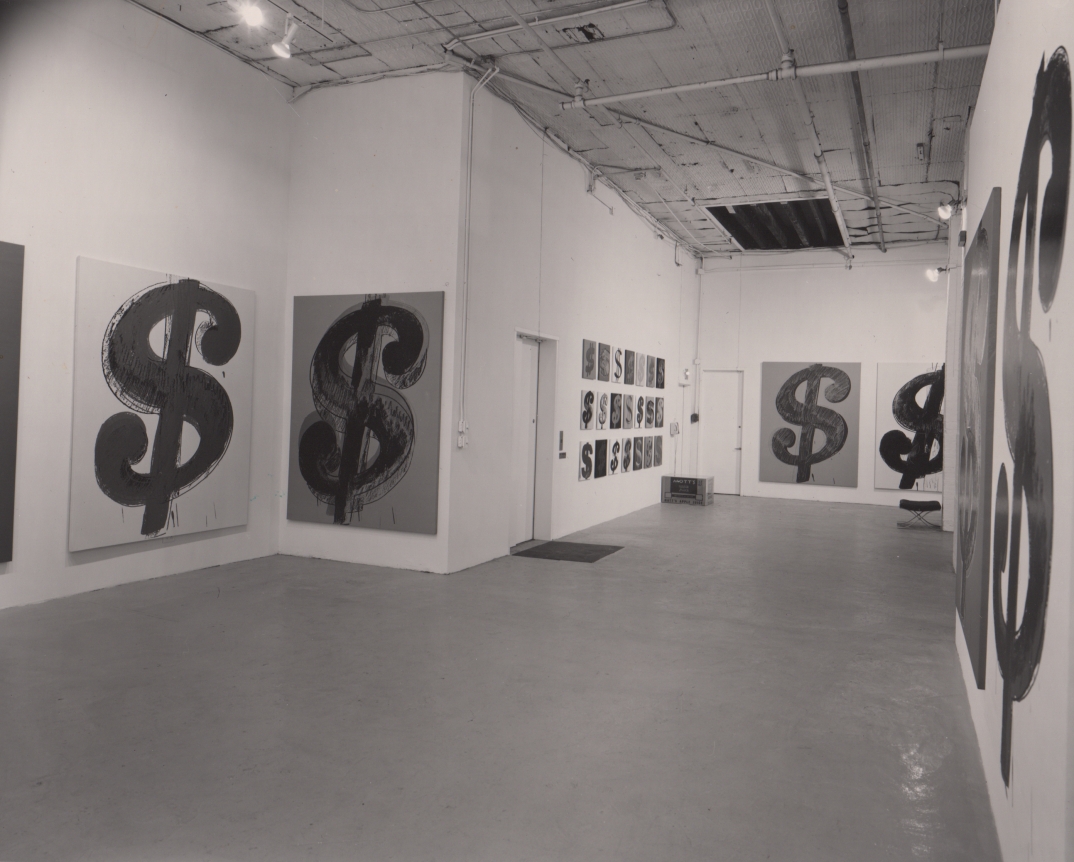
Andy Warhol: Dollar Signs, January 1982, CASTELLI, 142 GREENE STREET
A brilliant colorist, Warhol was particularly skilled in creating emotionally resonant combinations of hues that oscillated between candy-colored and crass. Like the Marilyn “flavors” of 1962, which exhibited a veritable rainbow of brightly colored canvases in Lemon, Orange, Cherry, and more, the Dollar Bills similarly demonstrate a rainbow-like variety, ranging from ethereal blue to lurid yellow and in the present work, a shimmering, ephemeral mirage of glittering gold, bright fuchsia, and dark black. That Warhol is able to marry such seemingly dissonant colors demonstrates the skill that he had honed for two decades, reaching a fever pitch in these spectacularly colored, luridly-hued paintings.
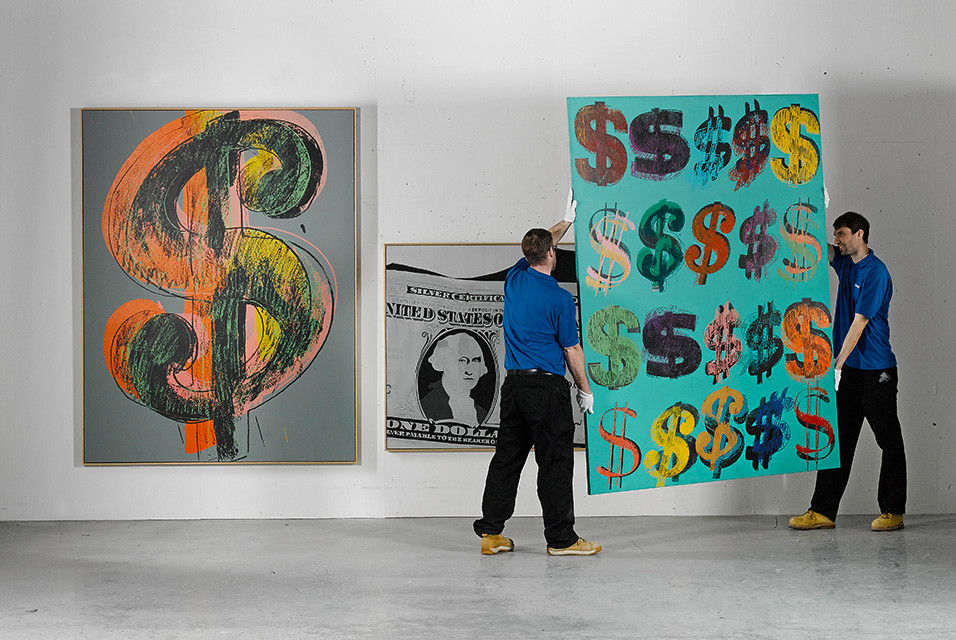
Warhol luxuriated in the use of gold in some of his best works, most notably Gold Marilyn Monore of 1962, and in Dollar Sign, the use of gold has a twofold effect; it recalls the literal gold bars of the U.S. treasury that accredit paper currency, but also hints at a greater symbolism. During the medieval period, gold was often used to symbolize the divine light of the heavens and spiritual illumination. As a child, the Warhola family often worshiped at the Saint John Chrysostom Byzantine Church in Pittsburgh, in which were housed dozens of shimmering golden icons. In Dollar Sign, Warhol depicts a secular symbol in vivid coloration that hints at the emotional and spiritual release of the shimmering gold icons of his youth, which is especially pertinent considering he painted the series during the last decade of his life.
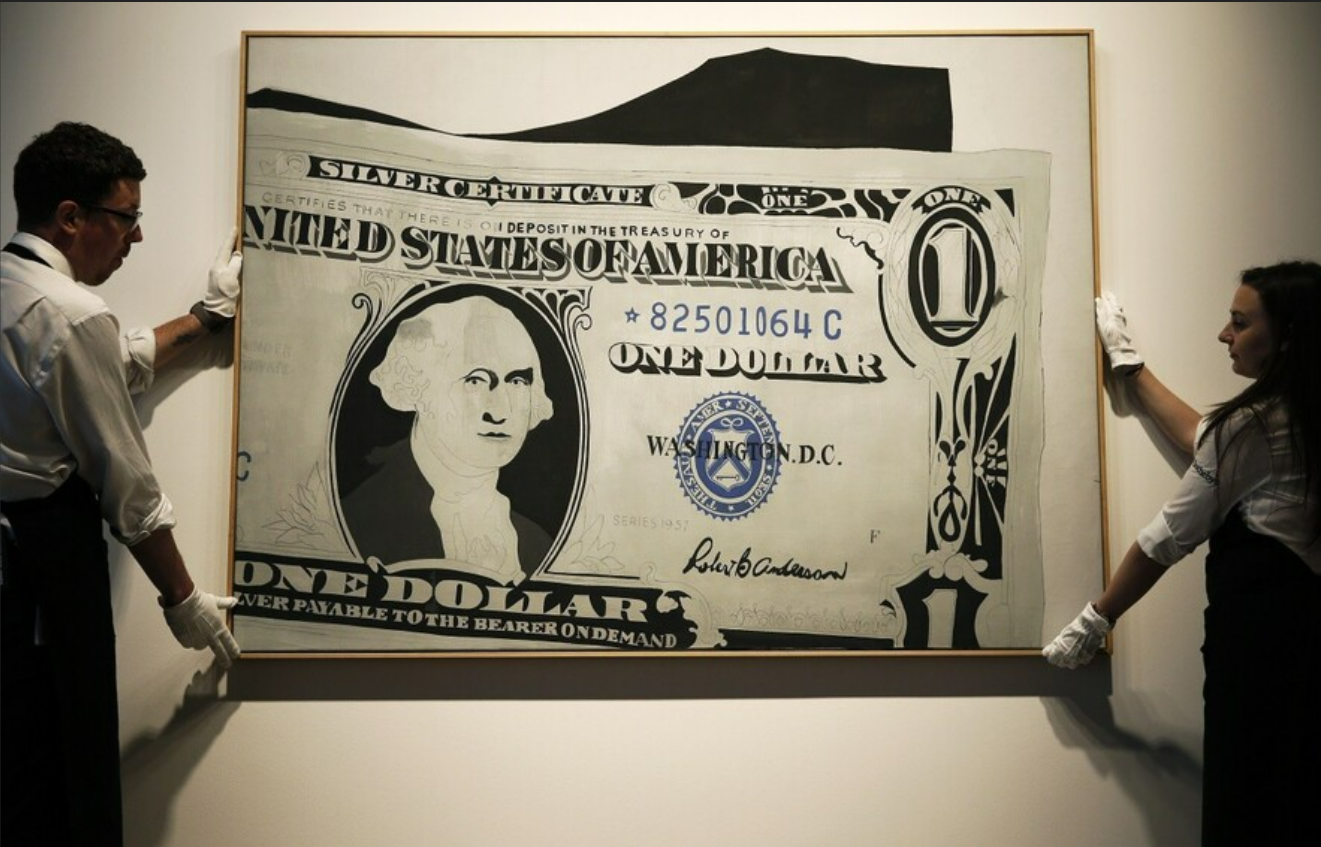
Dollar bills had already featured in his works in the early 1960s, sometimes in drawings, sometimes in sheets of silkscreen looking like bad forgery. But in the early 1980s, in the age that spawned the yuppie and which would culminate in American Psycho and Wall Street and that film’s infamous mantra, ‘Greed is good,’ it was only natural that Warhol should look with fresh eyes at his beloved currency. He took the dollar sign itself as a more mysterious, more generalized, more worship-worthy subject-matter than those earlier images of currency.
Warhol removed any specific denomination, making the Dollar Sign appear as an altarpiece celebrating the currency as an abstract, un-pin-down-able concept, rather than merely resembling the various bills that the artist may or may not have had, as was the case in the works from the early 1960s. Now, free of the 1, 10, 100 that might have limited its value, the Dollar Sign gained its apotheosis. With the background reminiscent of the greenbacks that fill many an American’s wallet or money clip, this picture is filled with the feel of money; the notion of wealth has been mysteriously transferred, albeit not with the greatest sense of modesty, to the picture surface. What, after all, is the point in modesty, Warhol asks? There is no room for it in Dollar Bill, and little room for it in Warhol’s philosophy:
‘Business art is the step that comes after Art. I started as a commercial artist, and I want to finish artist. After I did the thing called ‘Art’ or whatever it’s called, I went into business art. I wanted to be an Art Businessman or a Business Artist. Being good in business is the most fascinating kind of art. During the hippie era people put down the idea of business they’d say, ‘Money is bad,’ and ‘Working is bad,’ but making money is art and working is art and good business is the best art’
Ironically, considering the endemic nature of the dollar– throughout the world it has become a sort of cash franca in so many places– Warhol found that he was unable to find an image that had quite enough impact, enough oomph, in order to be the epitome or archetype of the dollar. And so he resorted to that skill that had earned him some of his own earliest dollars– his draughtsmanship. He drew dollar after dollar, some straight, some slanting, some thick, some thin, some more Pop, some more staid. And these became his sources, Warhol leading to Warhol, a process of self-cannibalism that featured in different ways in several of his works from this period, for instance the Reversals. Dollar Sign appears to be the result of the rare superimposition of several of Warhol’s own renderings, the one lying on top of the other, making it a mirage-like, shimmering, elusive, reflective dollar that hovers before us all the more tantalizingly.
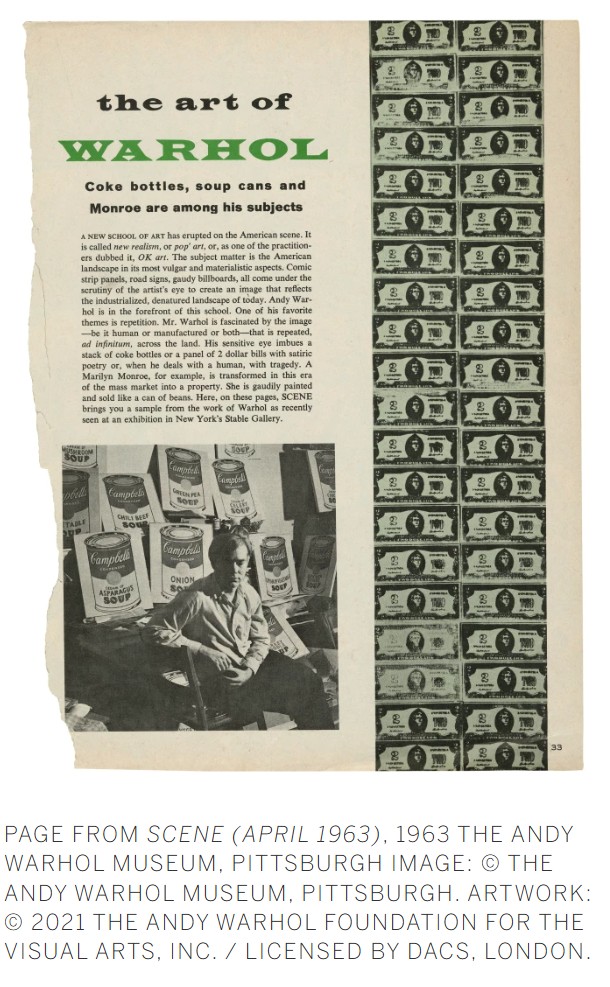
The Dollar Sign paintings debuted at the Leo Castelli Gallery in New York in 1982, their brash confidence mirroring the climate in which they emerged. Warhol’s biographer David Bourdon described the series as “insolent reminders that pictures by brand name artists are metaphors for money” (David Bourdon, Warhol, New York 1989, p. 384). Rather than resist such an interpretation, Warhol embraced it, collapsing distinctions between cultural and economic value and reinforcing his conviction that art and commerce were inseparable. In Dollar Sign, Warhol celebrates a system of exchange in which he willingly participated. The work exemplifies his unparalleled ability to elevate symbols of mass culture into enduring icons, marking a pivotal moment in which the artist’s subject matter and public persona had become inextricably aligned.
Auction Market Overview
WORK IN PROGRESS
2025 Auction Highlights
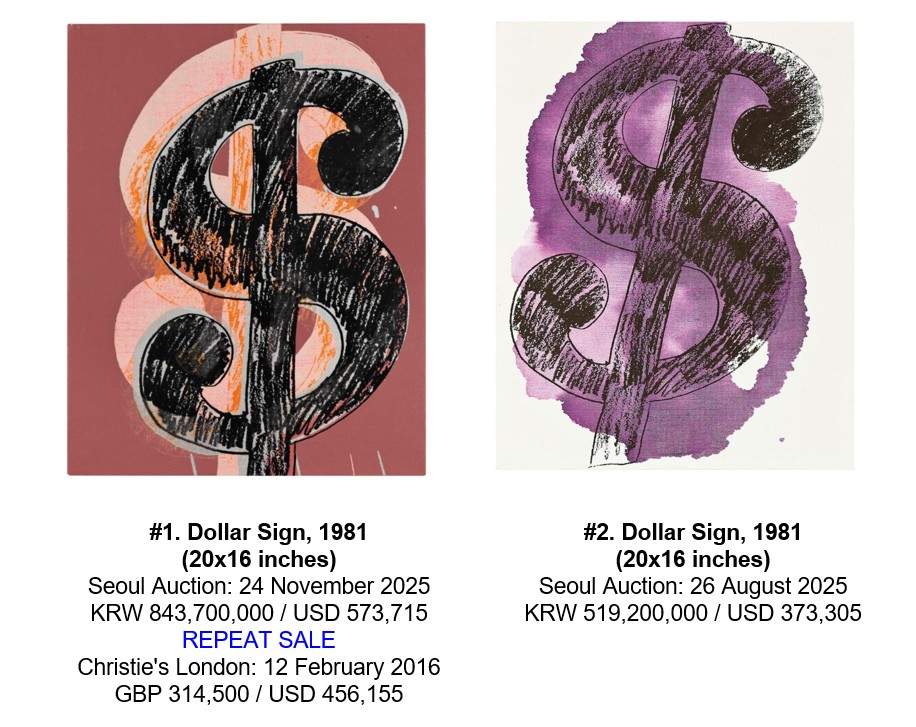
2 lots sold at auction in 2025 for a total turnover of USD 947,020. Both paintings were 20×16 inches and sold at Seoul Auction. The highest price was achieved by a brown/orange triple Dollar Sign that sold at Seoul Auction, on 24 November 2025 for KRW 843,700,000 (USD 573,715). It was a repeat sale, it had sold previously at Christie’s in London, on 12 February 2016, for GBP 314,500 (USD 456,155).
2024 Auction Highlights
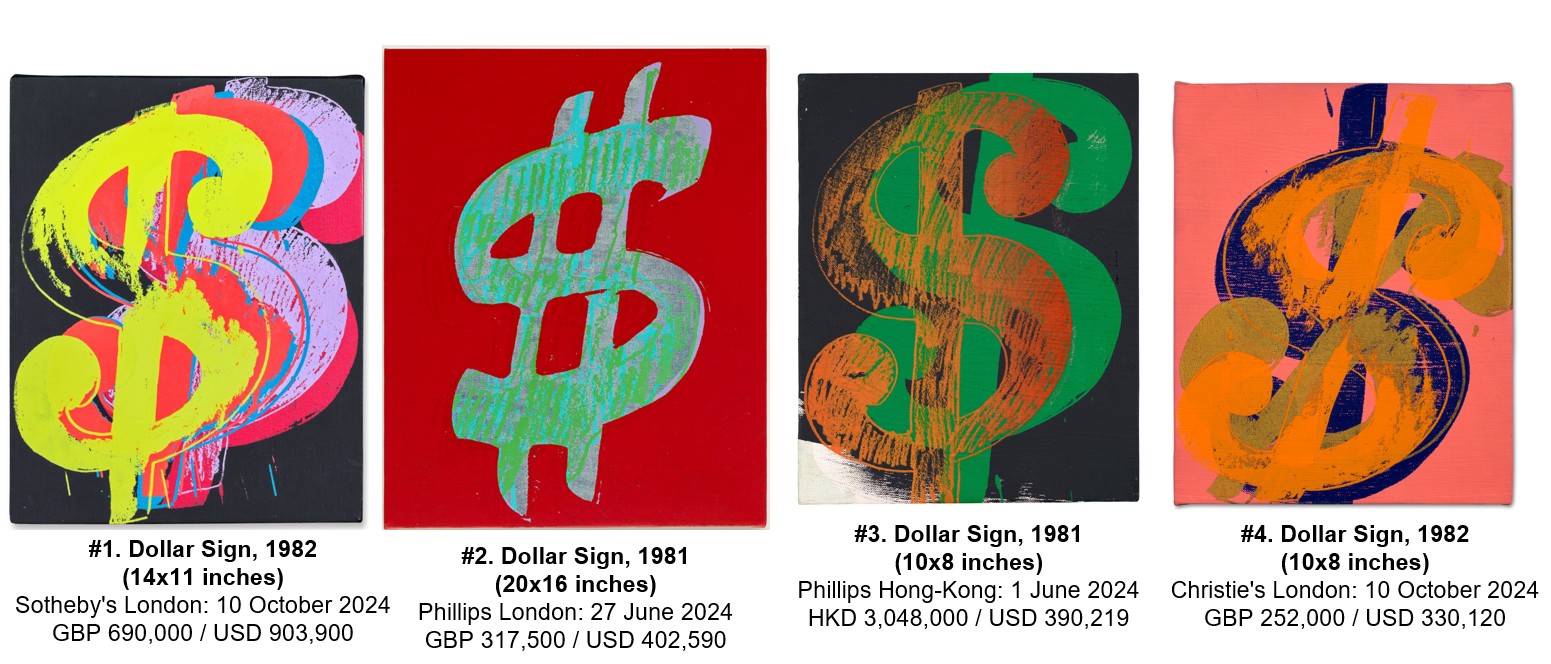
4 Dollar Sign paintings sold at auction in 2024 for a total turnover of USD 2,025,979. Dollar Sign, dated 1982, with an atypical size of 14×11 inches, sold at Sotheby’s in London on 10 October 2024, for GBP 690,000 (USD 903,900), the highest price paid for a Dollar Sign painting in 2024.
2023 Auction Highlights
7 Dollar Sign paintings sold at auction in 2023 for a total turnover of USD 3,051,544.
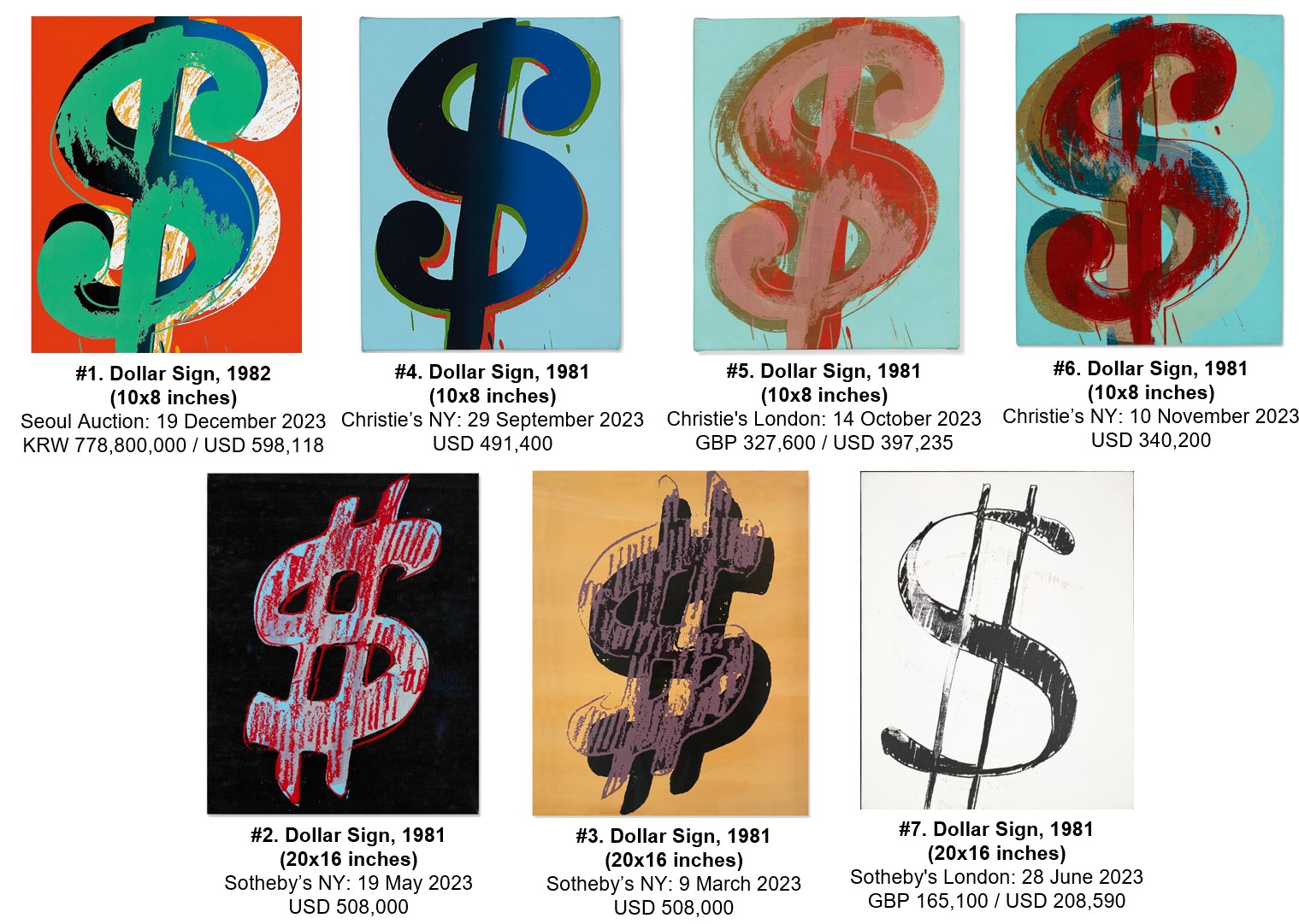
The highest price for 2023 was achieved by Dollar Sign, a 10×8 painting dated 1982, that sold at Seoul Auction, on 19 December 2023 for KRW 778,800,000 (USD 598,118). 4 paintings sized 10×8 inches sold at auction in 2023, whereas 3 paintings sized 20×16 sold at auction in 2023.
2022 Auction Highlights
5 Dollar Sign paintings sold at auction in 2022 for a total turnover of USD 3,003,281.
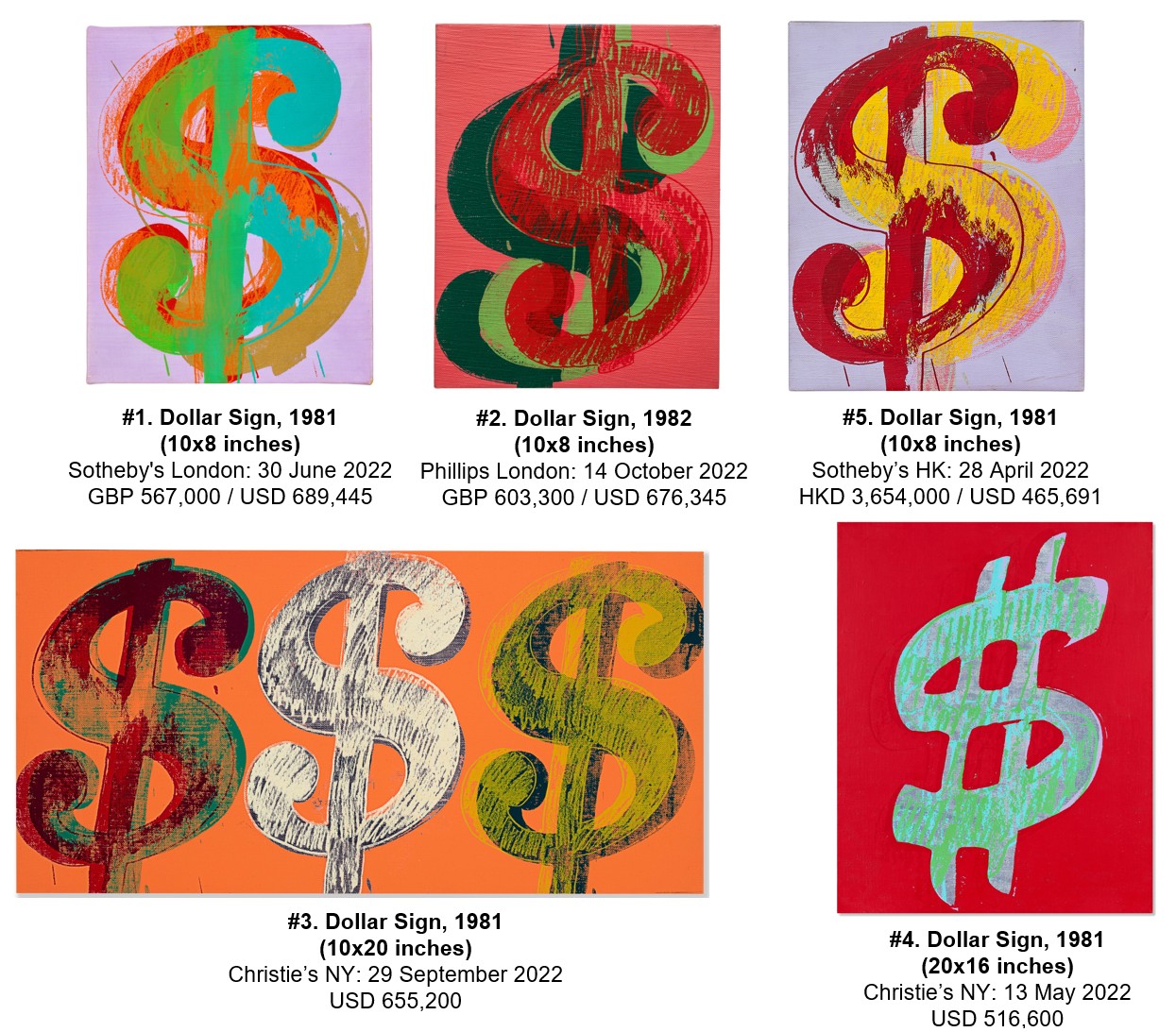
The highest price for 2022 was achieved by Dollar Sign, a painting dated 1981, 10×8 inches, that sold at Sotheby’s, in London, on 30 June 2022, for GBP 567,000 (USD 689,445). 3 paintings sized 10×8 inches sold at auction in 2022, as well as one painting sized 20×16, and a Triple Dollar Sign, sized 10×20 inches, sold at Christie’s in New-York, on 29 September 2022, for USD 655,200.
2026 Auction Results
Dollar Sign, 1981
Contours of Modernity | A Private European Collection
Sotheby’s London: 4 March 2026
Estimated: GBP 300,000 – 400,000
GBP 576,000 / USD 769,480
Dollar Sign | Modern & Contemporary Evening Auction | 2026 | Sotheby’s
REPEAT SALE
Christie’s London: 14 February 2012
Estimated: GBP 180,000 – 250,000
GBP 385,250
Andy Warhol (1928-1987) (christies.com)
ANDY WARHOL (1928 – 1987)
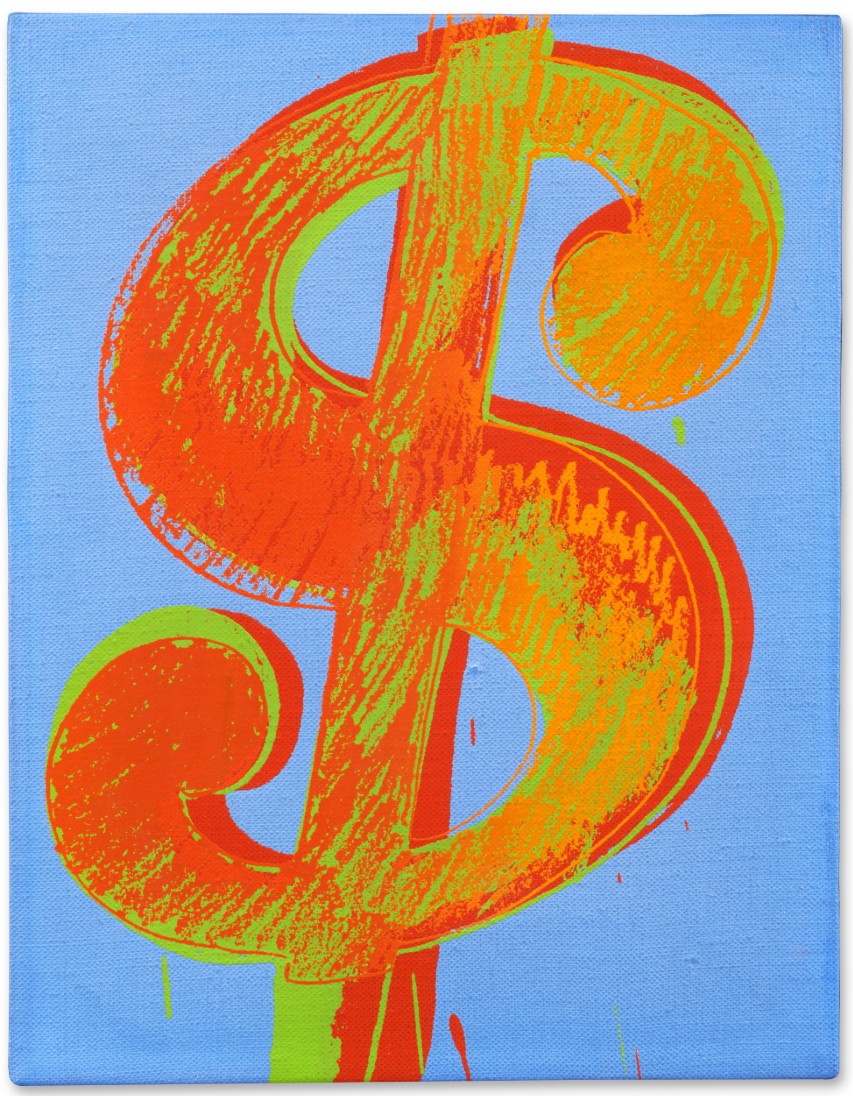
Dollar Sign, 1981
Acrylic and silkscreen ink on canvas
10×8 inches (25.8 x 20 cm)
Signed, dated 81 and dedicated To Enrico (on the overlap)
2025 Auction Results
#1. Dollar Sign, 1981
Seoul Auction: 24 November 2025
Estimated: KRW 650,000,000 – 1,000,000,000
KRW 843,700,000 / USD 573,715
REPEAT SALE
Christie’s London: 12 February 2016
Estimated: GBP 250,000 – 350,000
GBP 314,500 / USD 456,155
Andy Warhol (1928-1987), Dollar Sign | Christie’s
ANDY WARHOL
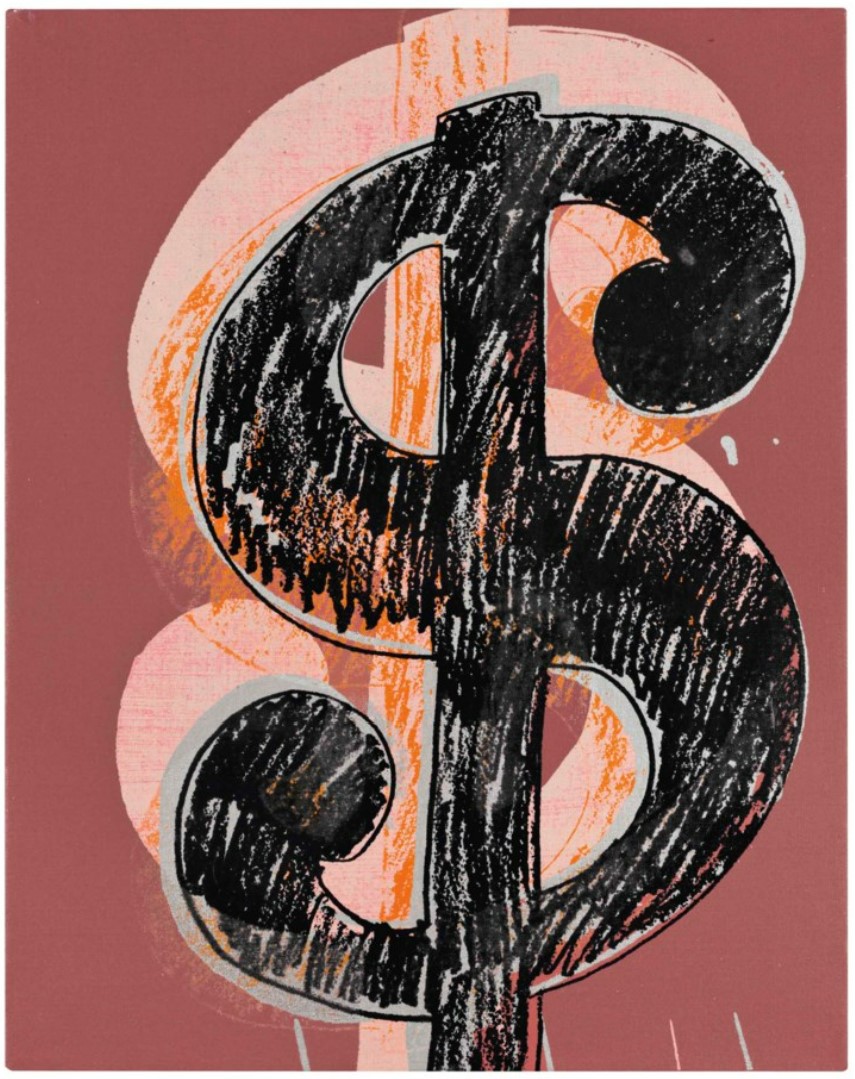
Dollar Sign, 1981
Synthetic polymer and silkscreen ink on canvas
20×16 inches (50.8 x 40.6 cm)
Stamped twice with Andy Warhol Art Authentication Board stamp (on the reverse and the overlap)
Stamped with the Estate of Andy Warhol stamp (on the overlap)
Numbered twice ‘PA30.051’ (on the overlap and the stretcher bar)
#2. Dollar Sign, 1981
Seoul Auction: 26 August 2025
Estimated: KRW 450,000,000 – 800,000,000
KRW 519,200,000 / USD 373,305
ANDY WARHOL
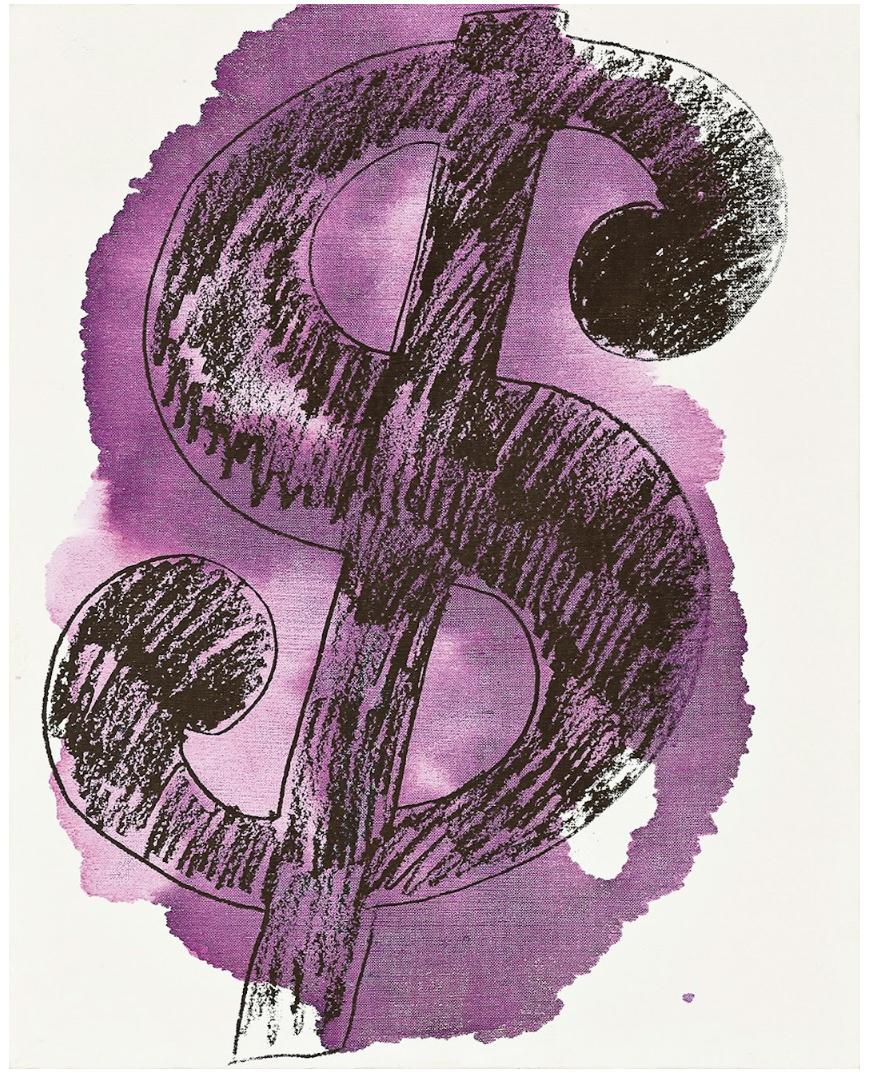
Dollar Sign, 1981
Acrylic and silkscreen ink on canvas
20×16 inches (40.6 x 50.8 cm)
Stamped with the Estate of Andy Warhol stamp and Andy Warhol Art Authentication Board stamp
Numbered ‘PA30.081’ on the overlap
2024 Auction Results
4 Dollar Sign paintings sold at auction in 2024 for a total turnover of USD 2,025,979. Dollar Sign, dated 1982, with an atypical size of 14×11 inches, sold at Sotheby’s in London on 10 October 2024, for GBP 690,000 (USD 903,900), the highest price paid for a Dollar Sign painting in 2024.
XXXXXXXXXX
#1. Dollar Sign, 1982
Sotheby’s London: 10 October 2024
Estimated: GBP 450,000 – 650,000
GBP 690,000 / USD 903,900
Dollar Sign | Contemporary Day Auction | 2024 | Sotheby’s (sothebys.com)
REPEAT SALE
Bonhams London: 1 July 2015
Estimated: GBP 400,000 – 600,000
GBP 409,012 / USD 640,310
Bonhams : Andy Warhol (1928-1987) Dollar Sign 1982
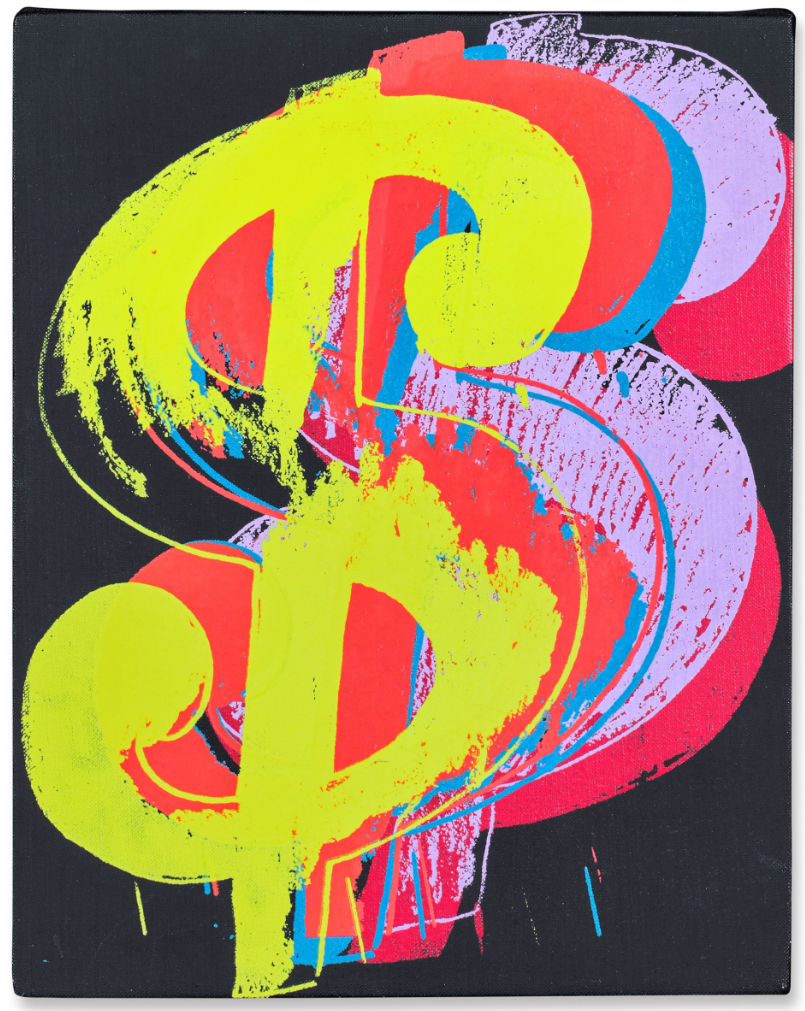
ANDY WARHOL (1928 – 1987)
Dollar Sign, 1982
Acrylic and silkscreen ink on canvas
14 x 10 7/8 inches (35.4 x 27.8 cm)
Signed and dated 82 (on the overlap)
Stamped by the Estate of Andy Warhol and the Andy Warhol Foundation for the Visual Arts, Inc.
Numbered A106.17 on the overlap
#2. Dollar Sign, 1981
Phillips London: 27 June 2024
Estimated: GBP 300,000 – 500,000
GBP 317,500 / USD 402,590
https://www.phillips.com/detail/andy-warhol/UK010424/33
REPEAT SALE
Christie’s New-York: 13 May 2022
Estimated: USD 400,000 – 600,000
USD 516,600
ANDY WARHOL (1928-1987), Dollar Sign | Christie’s
REPEAT SALE
Sotheby’s New-York: 10 May 2012
Estimated: USD 400,000 – 600,000
USD 722,500
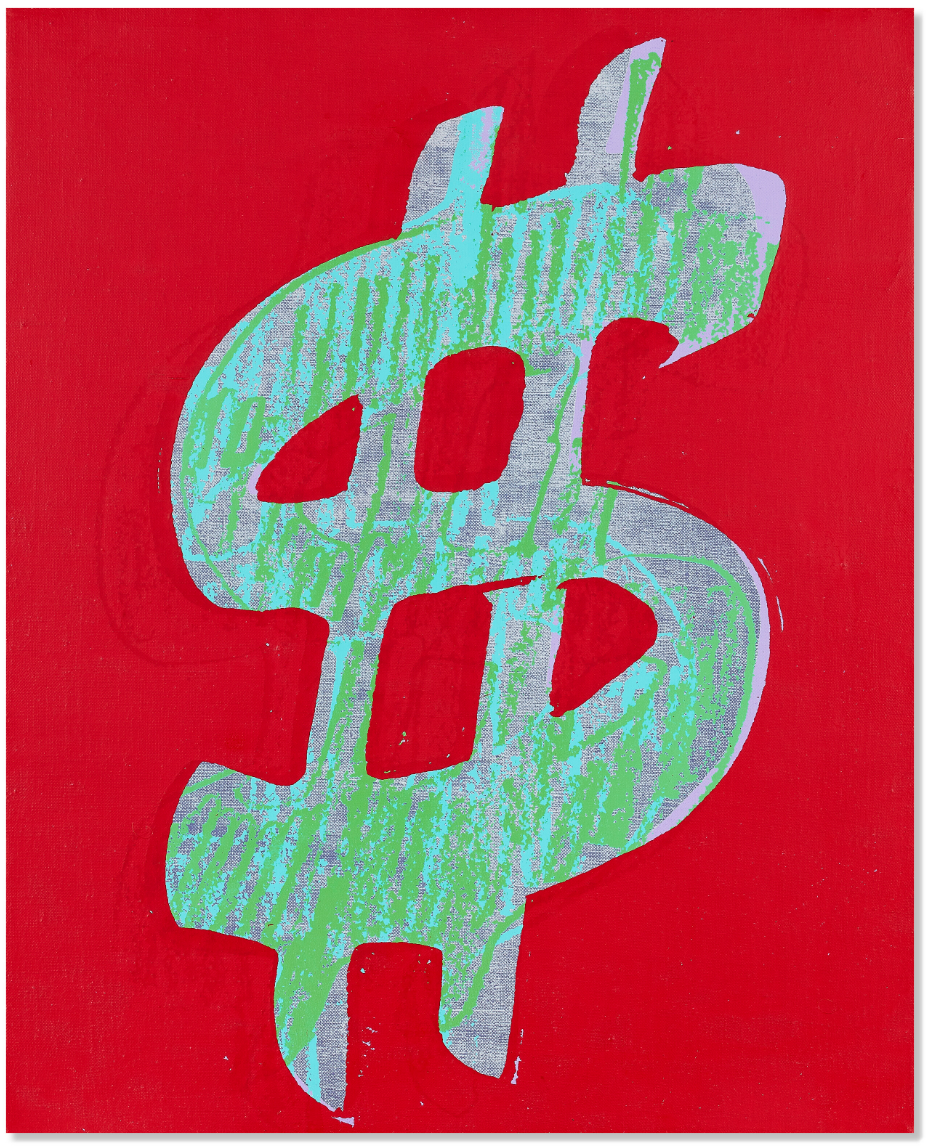
ANDY WARHOL
Dollar Sign, 1981
Acrylic and silkscreen ink on canvas
20 x 15 7/8 inches (50.8 x 40.6 cm)
Stamped with the Estate of Andy Warhol and the Andy Warhol Foundation for the Visual Arts, Inc. stamps
Numbered ‘PA30.086’ on the overlap
Stamped with the Andy Warhol Foundation for the Visual Arts, Inc. stamp on the reverse
#3. Dollar Sign, 1981
Phillips Hong-Kong: 1 June 2024
Estimated: HKD 2,800,000 – 3,800,000
HKD 3,048,000 / USD 390,219
Andy Warhol – Modern & Contemporary Ar… Lot 128 June 2024 | Phillips

ANDY WARHOL
Dollar Sign, 1981
Acrylic and silkscreen ink on canvas
9 7/8 x 7 7/8 inches (25.3 x 20.3 cm)
Signed and dated ‘81 Andy Warhol’ on the overlap
#4. Dollar Sign, 1982
Christie’s London: 10 October 2024
Estimated: GBP 250,000 – 350,000
GBP 252,000 / USD 330,120
ANDY WARHOL (1928-1987), Dollar Sign | Christie’s (christies.com)
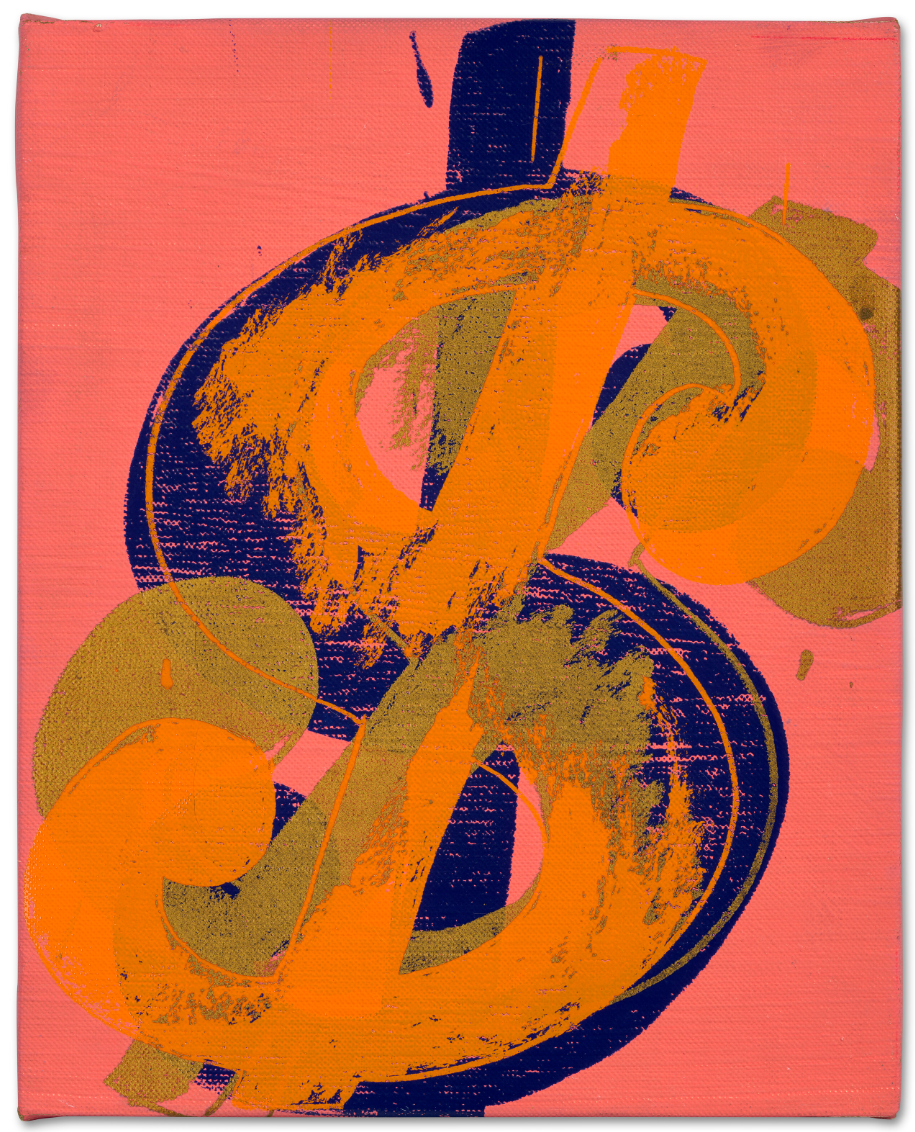
ANDY WARHOL (1928-1987)
Dollar Sign, 1982
Acrylic and silkscreen ink on canvas
10 x 8 1/8 inches (25.5 x 20.5 cm)
Signed and dedicated ‘Andy Warhol to Evelyn’ (on the overlap)
2023 Auction Results
7 Dollar Sign paintings sold at auction in 2023 for a total turnover of USD 3,051,544.
The highest price for 2023 was achieved by Dollar Sign, a 10×8 painting dated 1982, that sold at Seoul Auction, on 19 December 2023 for KRW 778,800,000 (USD 598,118). 4 paintings sized 10×8 inches sold at auction in 2023, whereas 3 paintings sized 20×16 sold at auction in 2023.
XXXXXXXXX
#1. Dollar Sign, 1982
Seoul Auction: 19 December 2023
Estimated: KRW 600,000,000 – 1,200,000,000
KRW 778,800,000 / USD 598,118
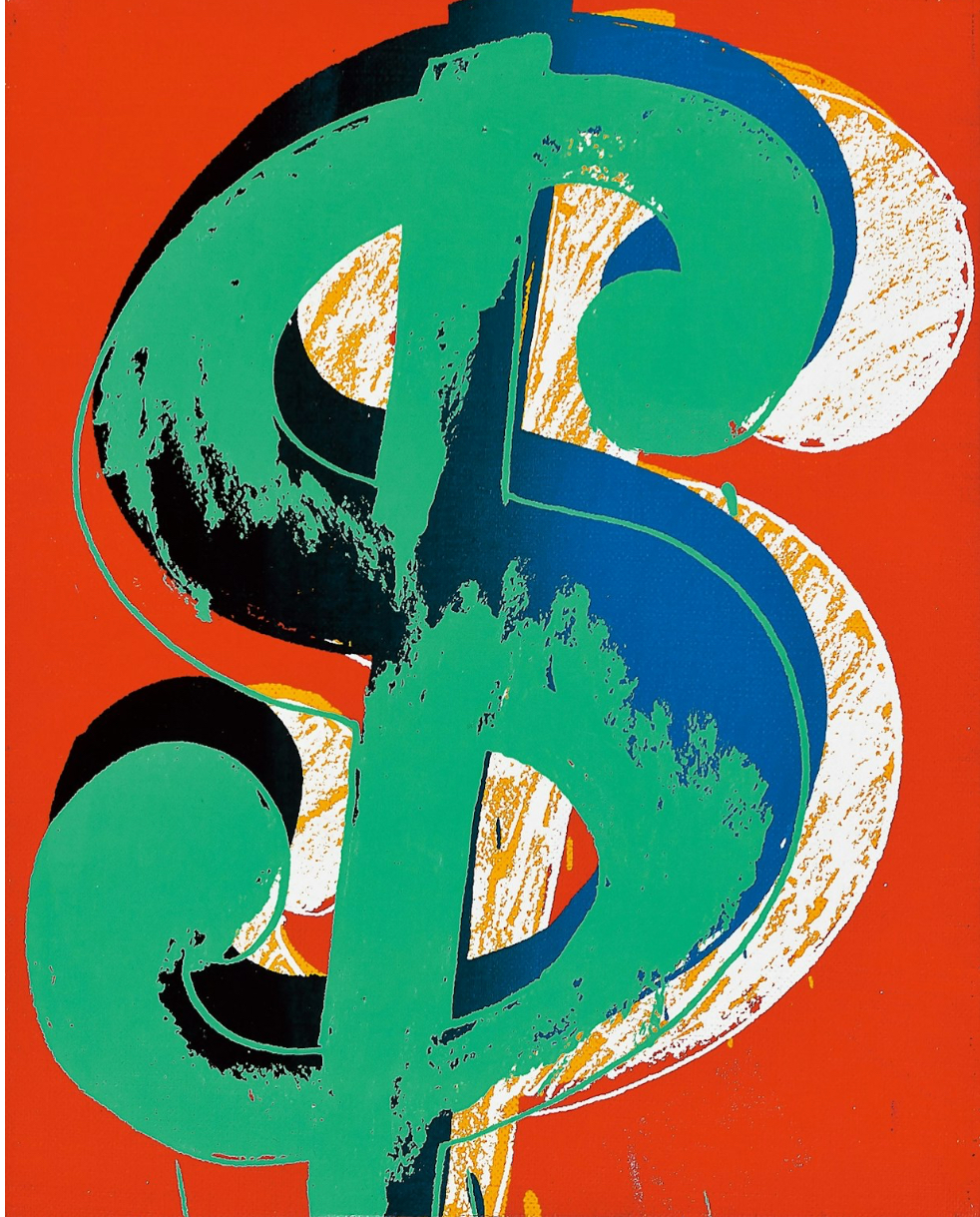
ANDY WARHOL
Dollar Sign, 1982
Synthetic polymer and silkscreen inks on canvas
10 x 7.9 inches (20 x 25.3 cm)
Signed and dated on the overlap
#2. Dollar Sign, 1981
Sotheby’s New-York: 19 May 2023
Estimated: USD 400,000 – 600,000
USD 508,000
Dollar Sign | Contemporary Day Auction | 2023 | Sotheby’s (sothebys.com)
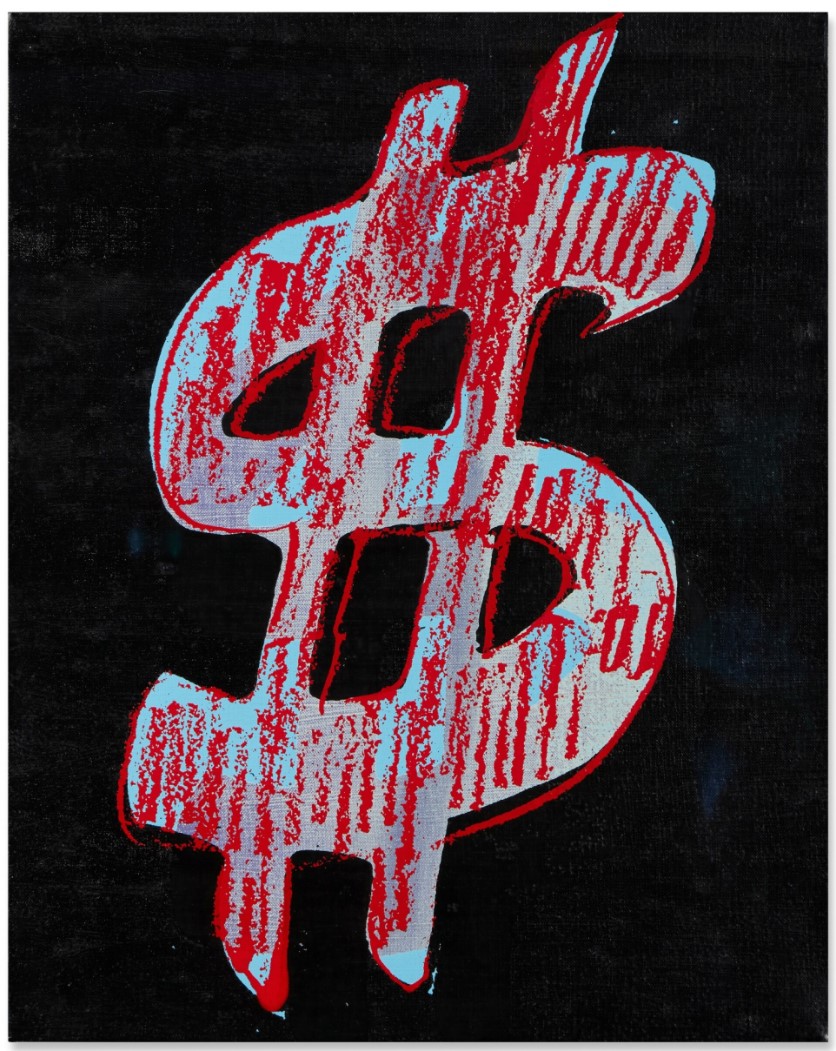
ANDY WARHOL (1928 – 1987)
Dollar Sign, 1981
Acrylic and silkscreen ink on canvas
20×16 inches (50.8 x 40.6 cm)
Signed twice (on the overlap)
#3. Dollar Sign, 1981
Sotheby’s New-York: 9 March 2023
Estimated: USD 400,000 – 600,000
USD 508,000
Dollar Sign | Contemporary Curated | 2023 | Sotheby’s (sothebys.com)
REPEAT SALE
Sotheby’s New-York: 13 May 2015
Estimated: USD 400,000 – 600,000
USD 406,000
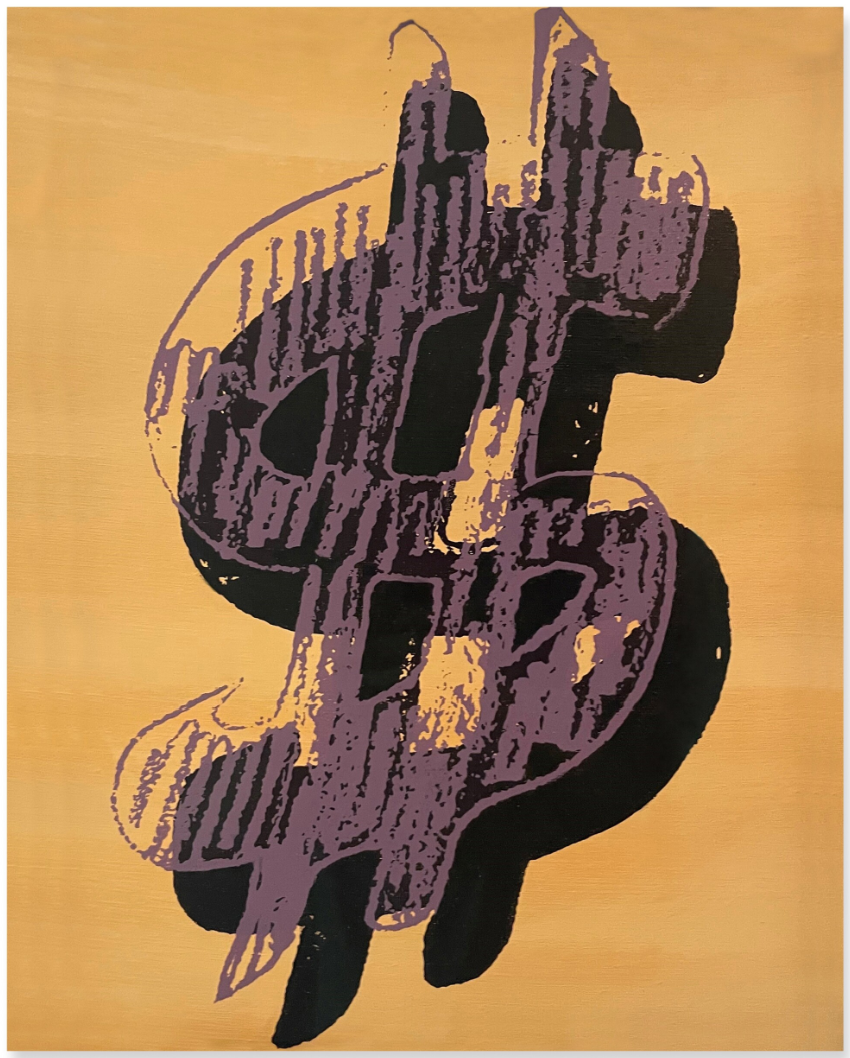
ANDY WARHOL (1928 – 1987)
Dollar Sign, 1981
Silkscreen ink on canvas
20 x 16 1/8 inches (50.8 x 41 cm)
Signed Andy Warhol and dated 81 (on the overlap)
#4. Dollar Sign, 1981
Christie’s New-York: 29 September 2023
Estimated: USD 300,000 – 500,000
USD 491,400
ANDY WARHOL (1928-1987) (christies.com)
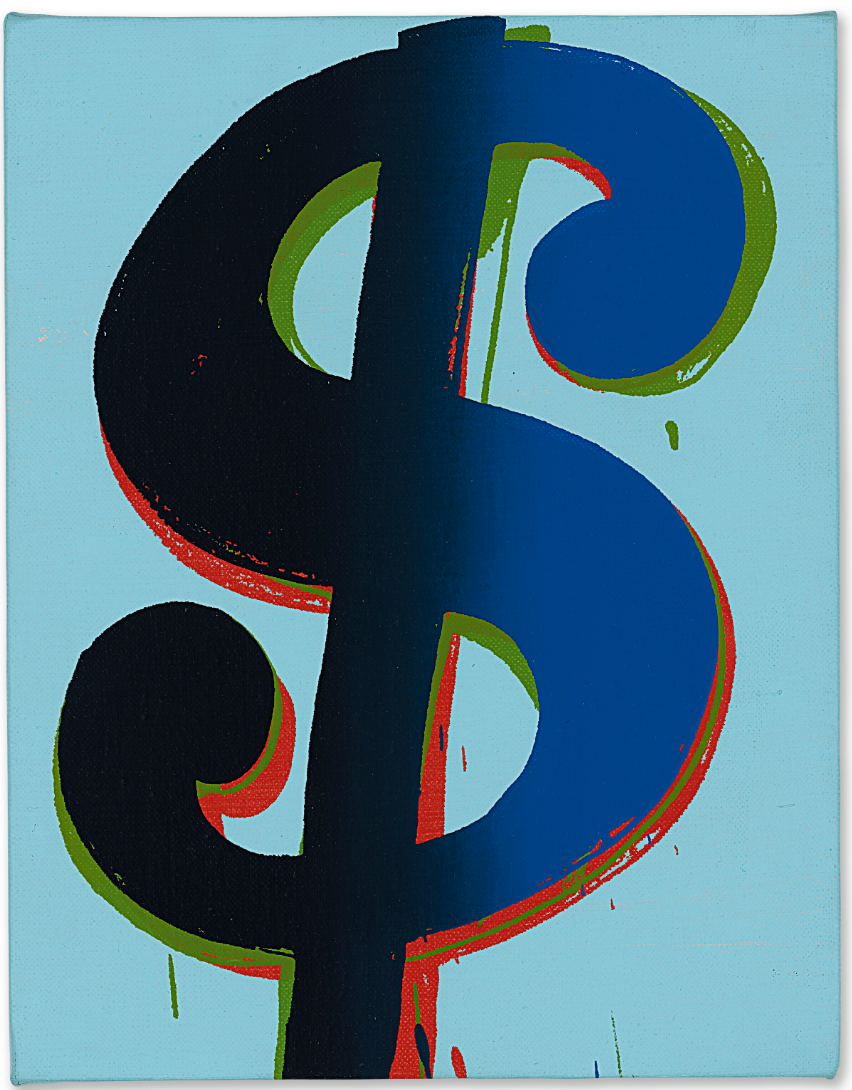
ANDY WARHOL (1928-1987)
Dollar Sign, 1981
Acrylic and silkscreen ink on canvas
10 1/4 x 8 inches (26 x 20.3 cm)
Signed and dated ‘1981 Andy Warhol’ (on the overlap)
#5. Dollar Sign, 1981
Christie’s London: 14 October 2023
Estimated: GBP 300,000 – 500,000
GBP 327,600 / USD 397,235
ANDY WARHOL (1928-1987) (christies.com)
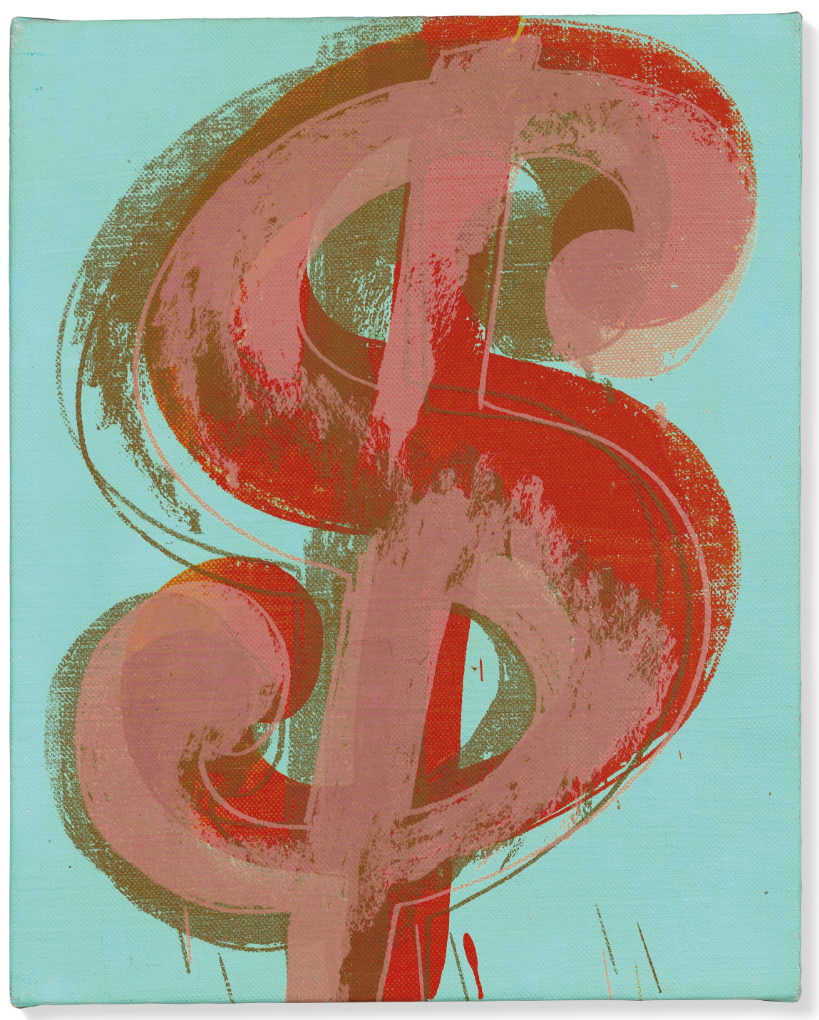
ANDY WARHOL (1928-1987)
Dollar Sign, 1981
Acrylic and silkscreen ink on canvas
9 7/8 x 8 inches (25.2 x 20.2 cm)
Signed, dedicated and dated ‘To Jade Andy Warhol 81’ (on the overlap)
#6. Dollar Sign, 1981
Christie’s New-York: 10 November 2023
Estimated: USD 300,000 – 500,000
USD 340,200
ANDY WARHOL (1928-1987), Dollar Sign | Christie’s (christies.com)
REPEAT SALE
Sotheby’s New-York: 18 November 2016
Estimated: USD 250,000 – 350,000
USD 420,500
(#203) Andy Warhol (sothebys.com)
ANDY WARHOL (1928-1987)
Dollar Sign, 1981
Acrylic and silkscreen ink on canvas
10×8 inches (25.4 x 20.3 cm)
Signed, dedicated and dated ‘to Jennifer 81 Andy Warhol’ (on the overlap)
#7. Dollar Sign, 1981
Sotheby’s London: 28 June 2023
Estimated: GBP 150,000 – 200,000
GBP 165,100 / USD 208,590
Dollar Sign | Modern & Contemporary Day Auction | 2023 | Sotheby’s
REPEAT SALE
Christie’s New-York: 16 May 2019
Estimated: USD 200,000 – 300,000
USD 200,000
Andy Warhol (1928-1987), Dollar Sign | Christie’s
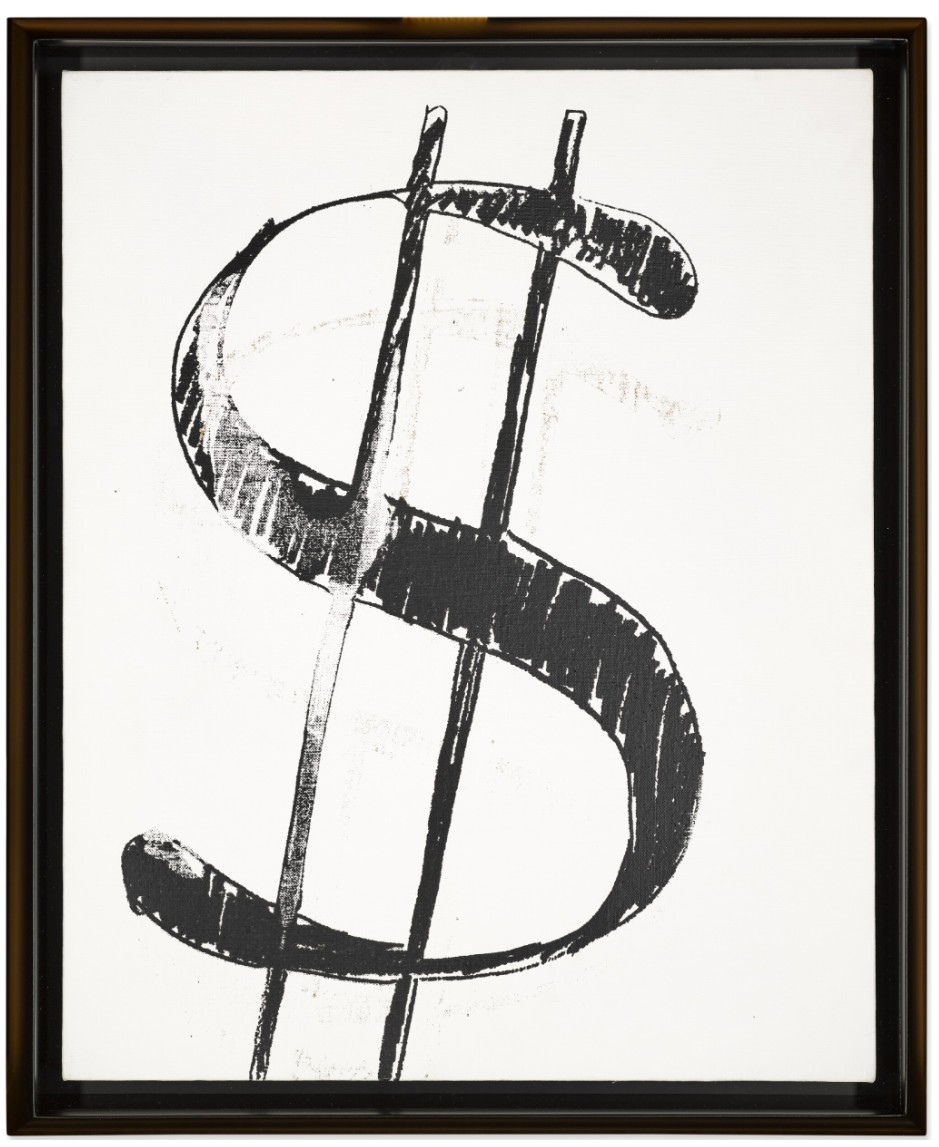
ANDY WARHOL (1928 – 1987)
Dollar Sign, 1981
Acrylic and silkscreen ink on canvas
20×16 inches (50.8 x 40.6 cm)
Stamped by the Estate of Andy Warhol and the Andy Warhol Foundation for the Visual Arts, Inc.
Numbered VF PA30.082 on the overlap
Stamped again by the Estate of Andy Warhol on the reverse
2022 Auction Results
5 Dollar Sign paintings sold at auction in 2022 for a total turnover of USD 3,003,281.
The highest price for 2022 was achieved by Dollar Sign, a painting dated 1981, 10×8 inches, that sold at Sotheby’s, in London, on 30 June 2022, for GBP 567,000 (USD 689,445). 3 paintings sized 10×8 inches sold at auction in 2022, as well as one painting sized 20×16, and a Triple Dollar Sign, sized 10×20 inches, sold at Christie’s in New-York, on 29 September 2022, for USD 655,200.
XXXXXXXXXX
#1. Dollar Sign, 1981
Sotheby’s London: 30 June 2022
Estimated: GBP 300,000 – 500,000
GBP 567,000 / USD 689,445
Dollar Sign | Modern & Contemporary Day Auction | 2022 | Sotheby’s (sothebys.com)
REPEAT SALE
Sotheby’s London: 16 February 2012
Estimated: GBP 180,000 – 250,000
GBP 289,250 / USD 456,905
Results for “andy warhol dollar sign”
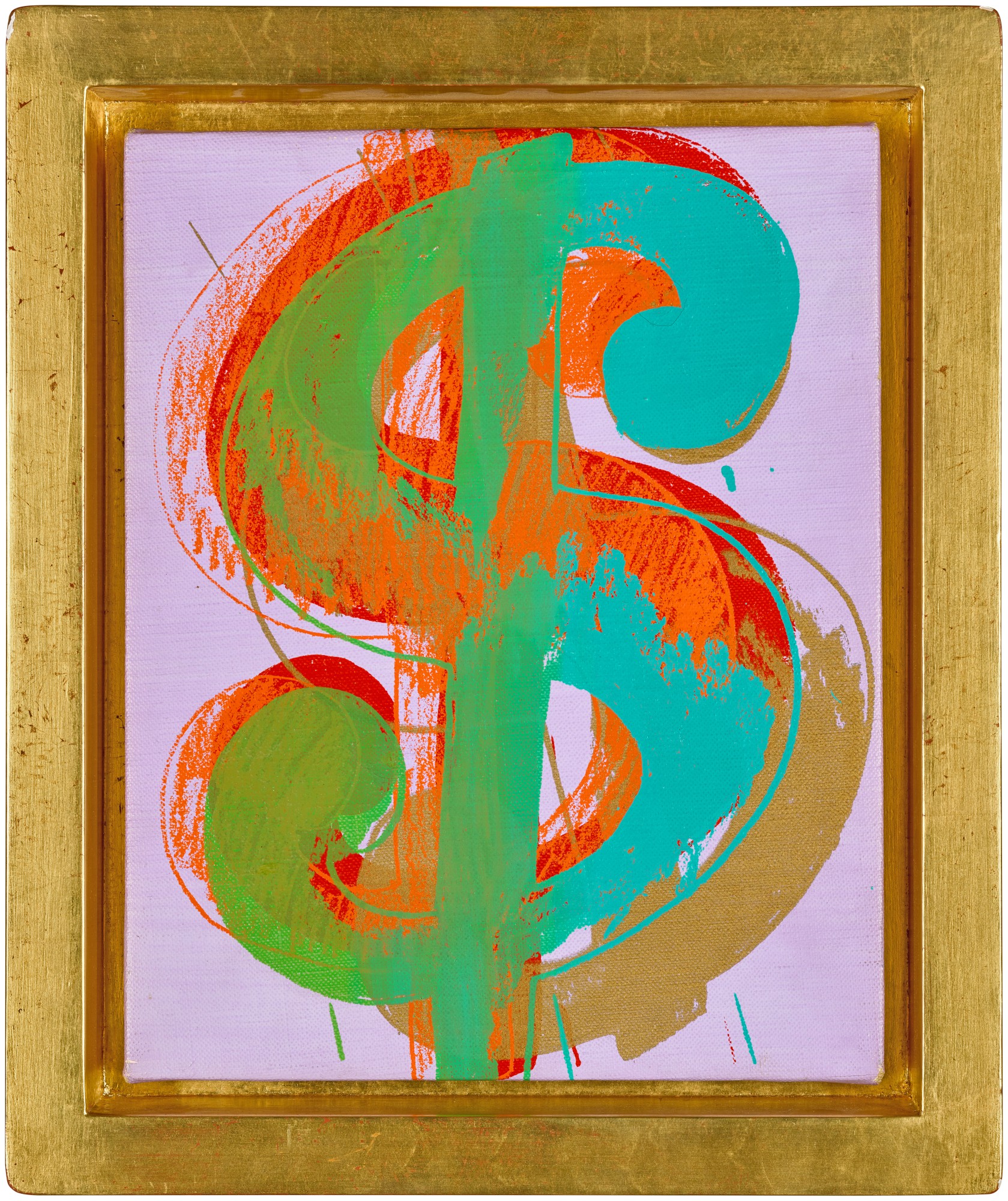
ANDY WARHOL
Dollar Sign, 1981
Acrylic and silkscreen ink on canvas
10.1 x 8.1 inches (25.6 x 20.6 cm)
Signed, dated 81 and dedicated to Lord Jo on the overlap
#2. Dollar Sign, 1982
Phillips London: 14 October 2022
Estimated: GBP 400,000 – 600,000
GBP 603,300 / USD 676,345
Andy Warhol – 20th Century & Contemp… Lot 28 October 2022 | Phillips
REPEAT SALE
Phillips Hong-Kong: 8 June 2021
Estimated: HKD 3,500,000 – 5,500,000
HKD 6,542,000 / USD 843,052
Andy Warhol – 20th Century & Contempora… Lot 23 June 2021 | Phillips
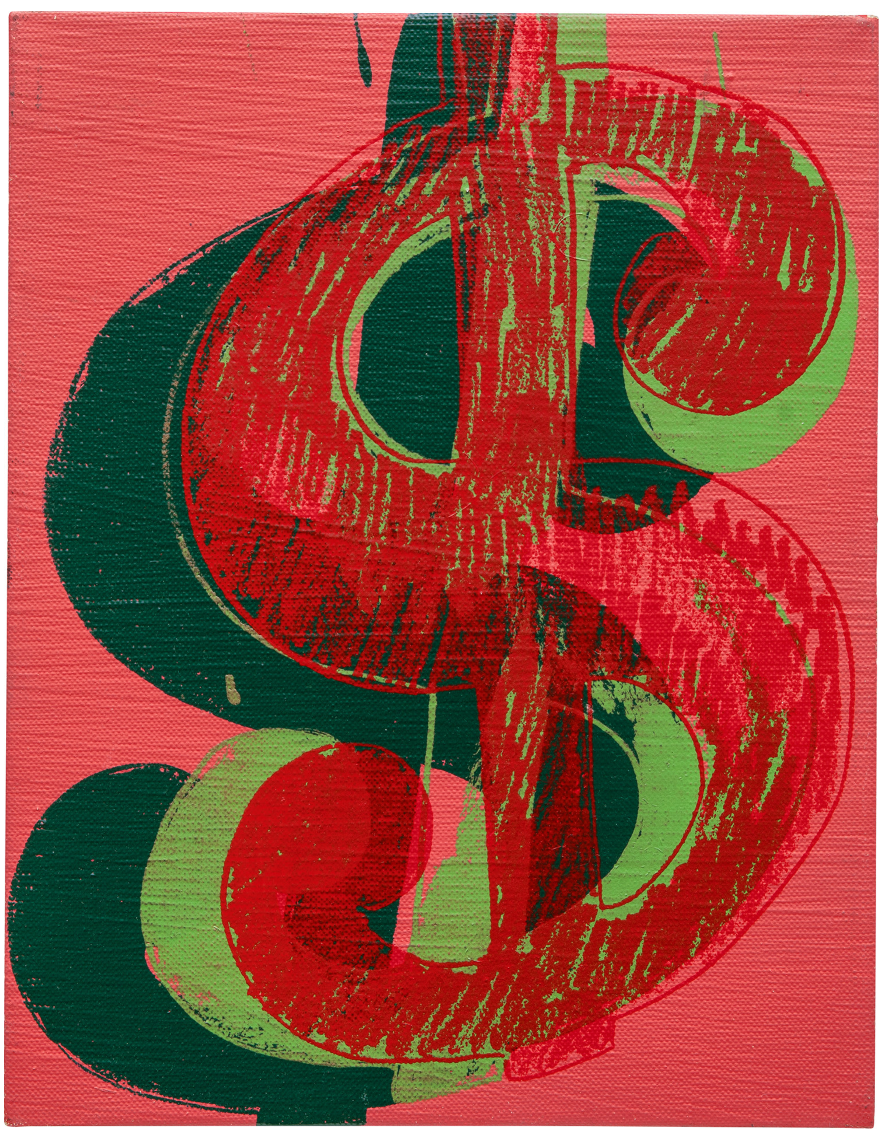
ANDY WARHOL
Dollar Sign, 1982
Acrylic and silkscreen ink on canvas
9 7/8 x 7 7/8 inches (25.3 x 20.3 cm)
Signed and dated ’82 Andy Warhol’ on the overlap
#3. Dollar Sign, 1981
Christie’s New-York: 29 September 2022
Estimated: USD 600,000 – 800,000
USD 655,200
ANDY WARHOL (1928-1987) (christies.com)
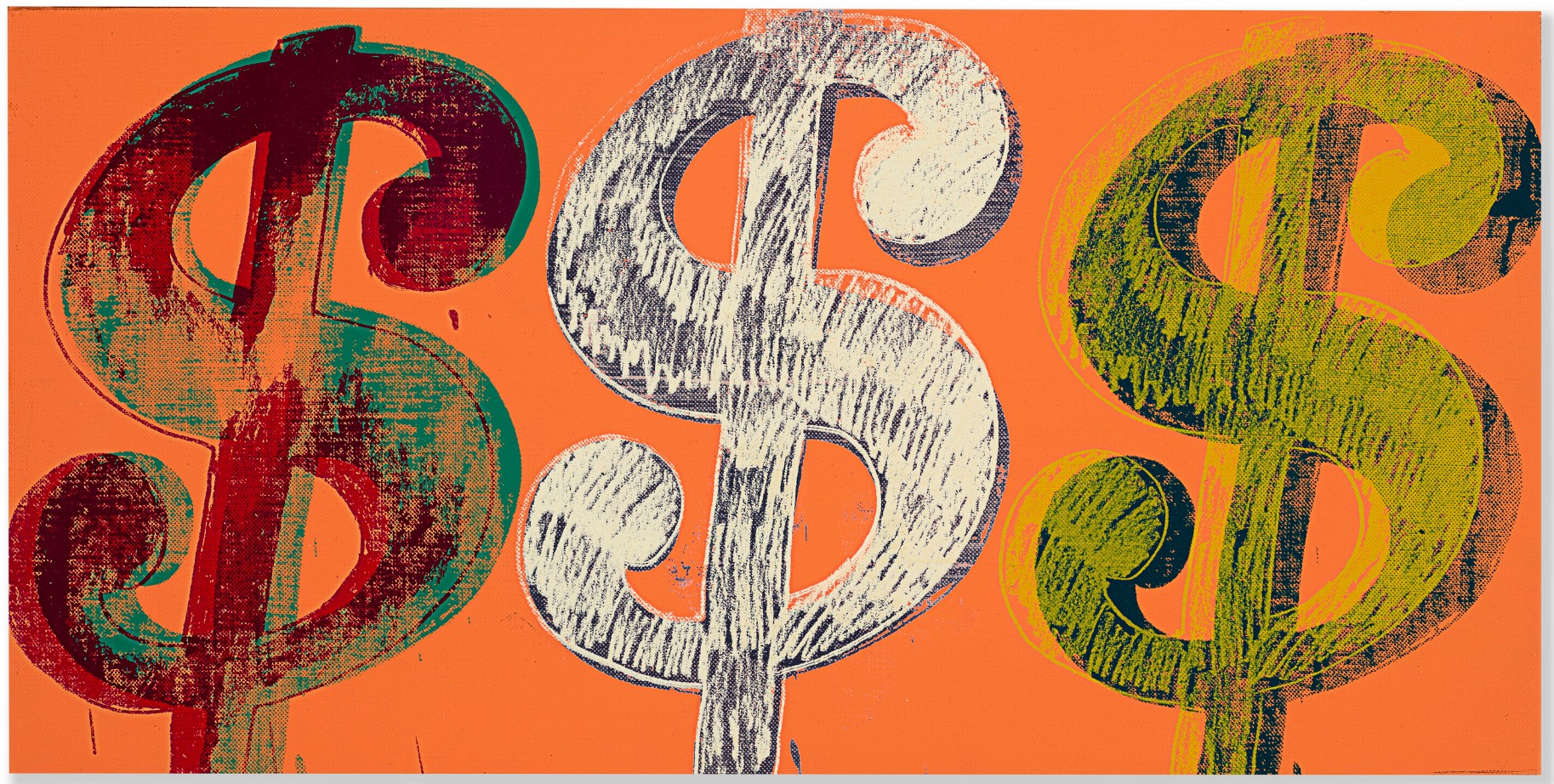
ANDY WARHOL (1928-1987)
Dollar Sign, 1981
Synthetic polymer and silkscreen ink on canvas
10×20 inches (25.4 x 50.8 cm)
Stamped with the Estate of Andy Warhol and Andy Warhol Foundation for the Visual Arts, Inc. stamps
Numbered ‘VF PA30.015’ (on the overlap)
Stamped again with the Andy Warhol Foundation for the Visual Arts, Inc. stamp (on the reverse)
#4. Dollar Sign, 1981
Christie’s New-York: 13 May 2022
Estimated: USD 400,000 – 600,000
USD 516,600
ANDY WARHOL (1928-1987), Dollar Sign | Christie’s
REPEAT SALE
Sotheby’s New-York: 10 May 2012
Estimated: USD 400,000 – 600,000
USD 722,500
ANDY WARHOL
Dollar Sign, 1981
Acrylic and silkscreen ink on canvas
20×16 inches (50.8 x 40.6 cm)
Stamped with the Estate of Andy Warhol and the Andy Warhol Foundation for the Visual Arts, Inc. stamps
Numbered ‘PA30.086’ on the overlap
Stamped with the Andy Warhol Foundation for the Visual Arts, Inc. stamp on the reverse
#5. Dollar Sign, 1981
Sotheby’s Hong-Kong: 28 April 2022
Estimated: HKD 3,200,000 – 5,200,000
HKD 3,654,000 / USD 465,691
Andy Warhol 安迪・沃荷 | Dollar Sign 美元符號 | Contemporary Day Auction | 2022 | Sotheby’s (sothebys.com)
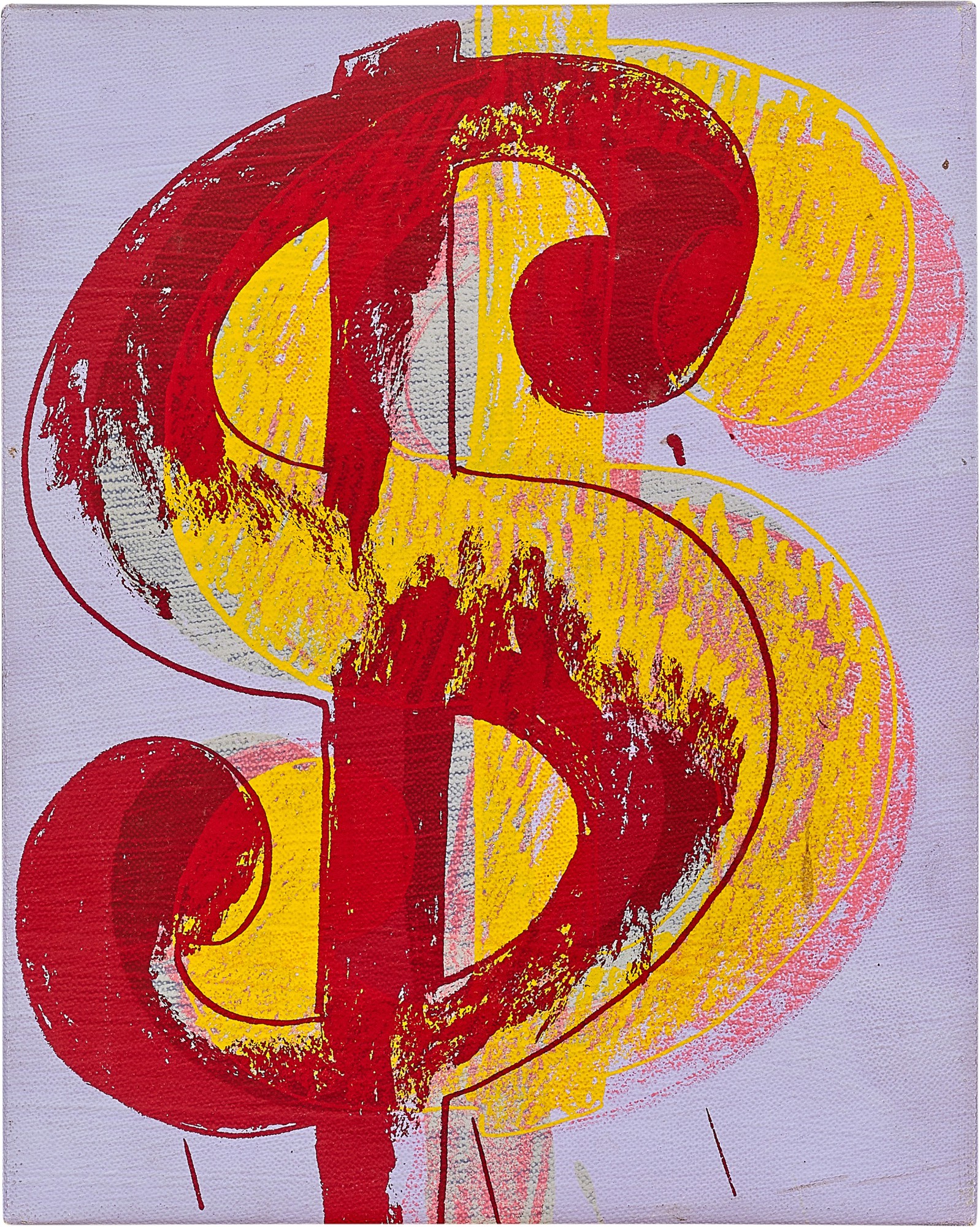
ANDY WARHOL
Dollar Sign, 1981
Acrylic and silkscreen ink on canvas
10×8 inches (25.3 x 20 cm)
Signed, inscribed Happy B to JACK H and stamped by the artist’s foundation on the overlap
2021 Auction Results
#1. Dollar Sign, 1981
Sotheby’s New-York: 19 November 2021
Estimated: USD 450,000 – 650,000
USD 927,500
Dollar Sign | Contemporary Day Auction | 2021 | Sotheby’s (sothebys.com)
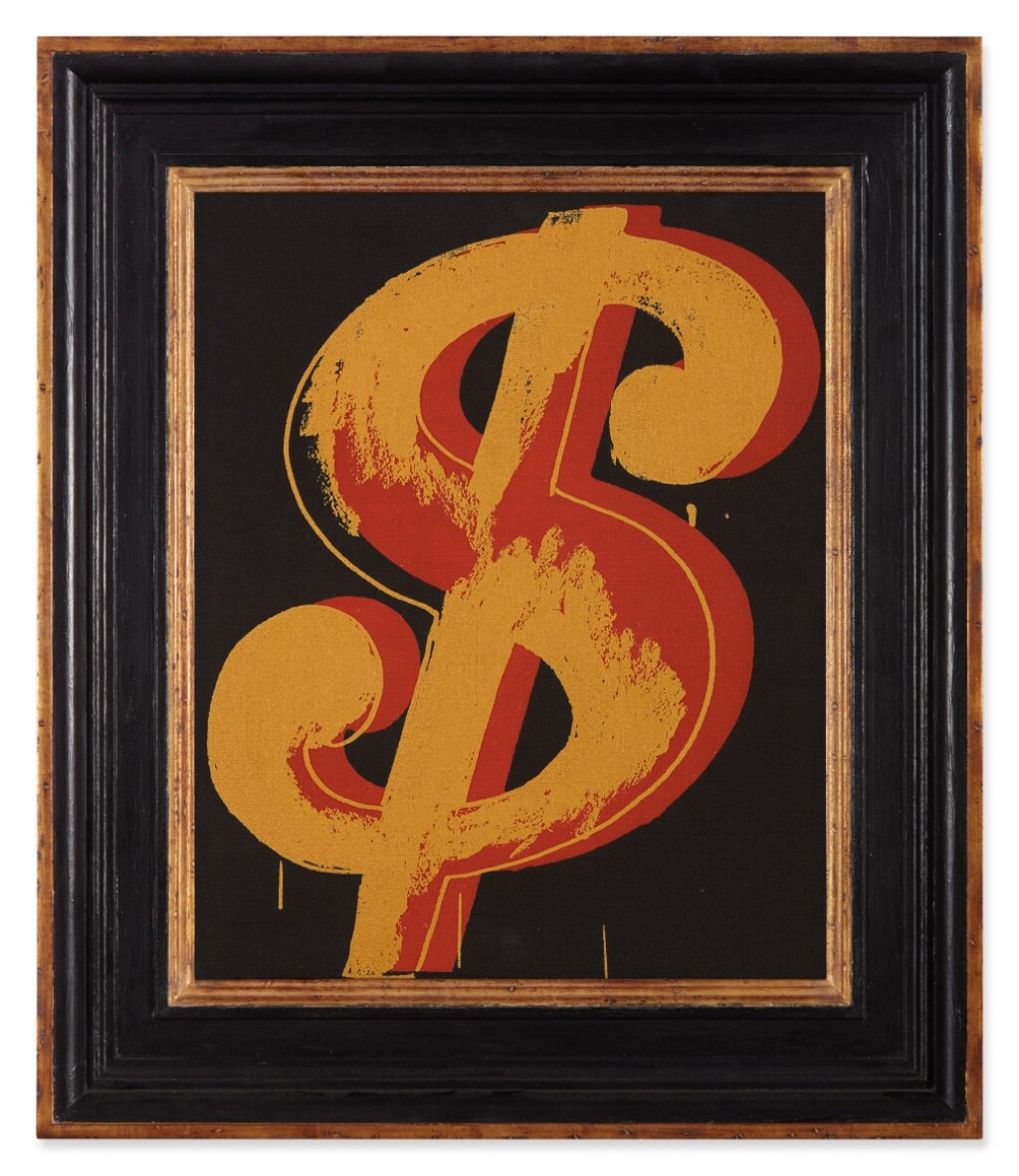
ANDY WARHOL
Dollar Sign, 1981
Acrylic and silkscreen ink on canvas
20×16 inches (50.8 x 40.6 cm)
#2. Dollar Sign, 1982
Phillips Hong-Kong: 8 June 2021
Estimated: HKD 3,500,000 – 5,500,000
HKD 6,542,000 / USD 843,052
Andy Warhol – 20th Century & Contempora… Lot 23 June 2021 | Phillips
ANDY WARHOL
Dollar Sign, 1982
Acrylic and silkscreen ink on canvas
9 7/8 x 7 7/8 inches (25.3 x 20.3 cm)
Signed and dated ’82 Andy Warhol’ on the overlap
#3. Dollar Sign, 1981
Christie’s London: 23 March 2021
Estimated: GBP 300,000 – 400,000
GBP 437,500 / USD 603,448
ANDY WARHOL (1928-1987), Dollar Sign | Christie’s
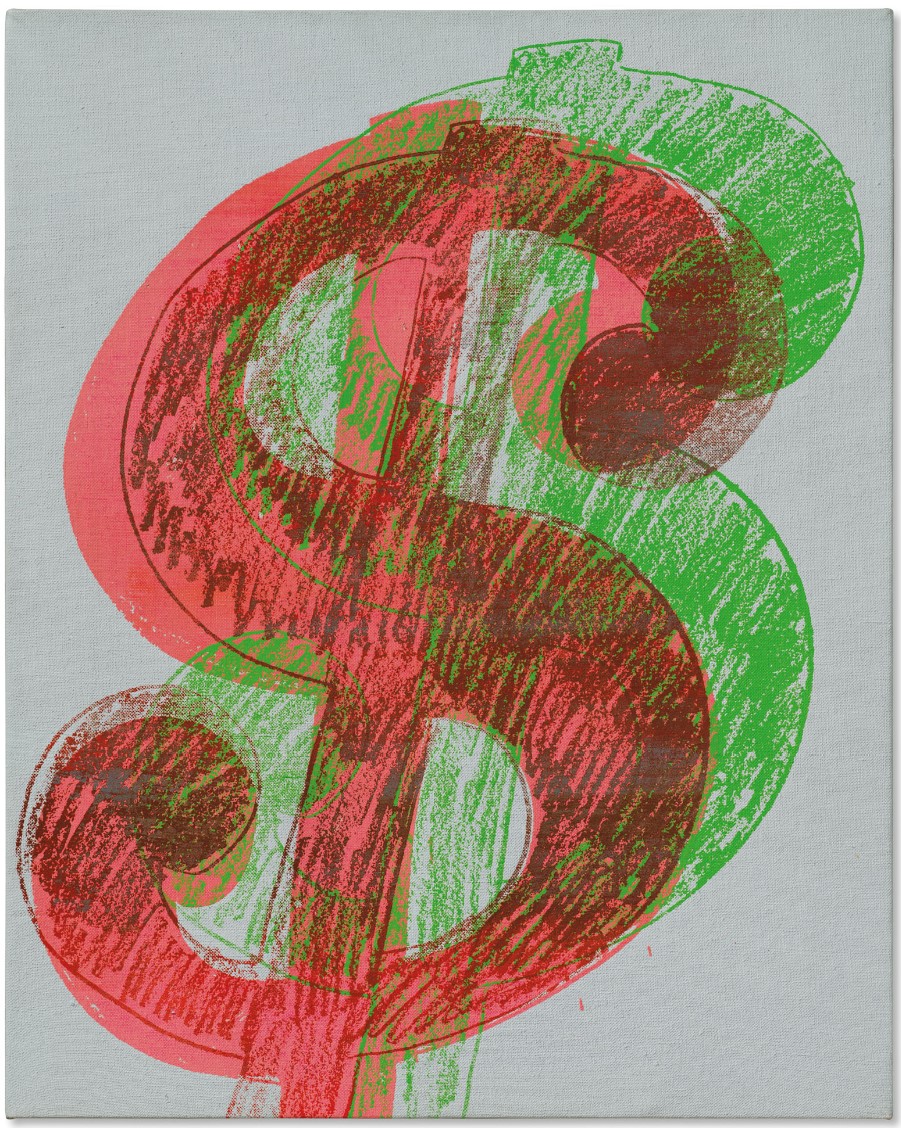
ANDY WARHOL
Dollar Sign, 1981
Acrylic on canvas
20×16 inches (50.8 x 40.6 cm)
Stamped twice with the Estate of Andy Warhol stamp
Numbered ‘A392.102’ (on the overlap)
#4. Dollar Sign, 1981
Sotheby’s New-York: 13 May 2021
Estimated: USD 300,000 – 500,000
USD 478,800
Dollar Sign | Contemporary Art Day Auction | 2021 | Sotheby’s (sothebys.com)
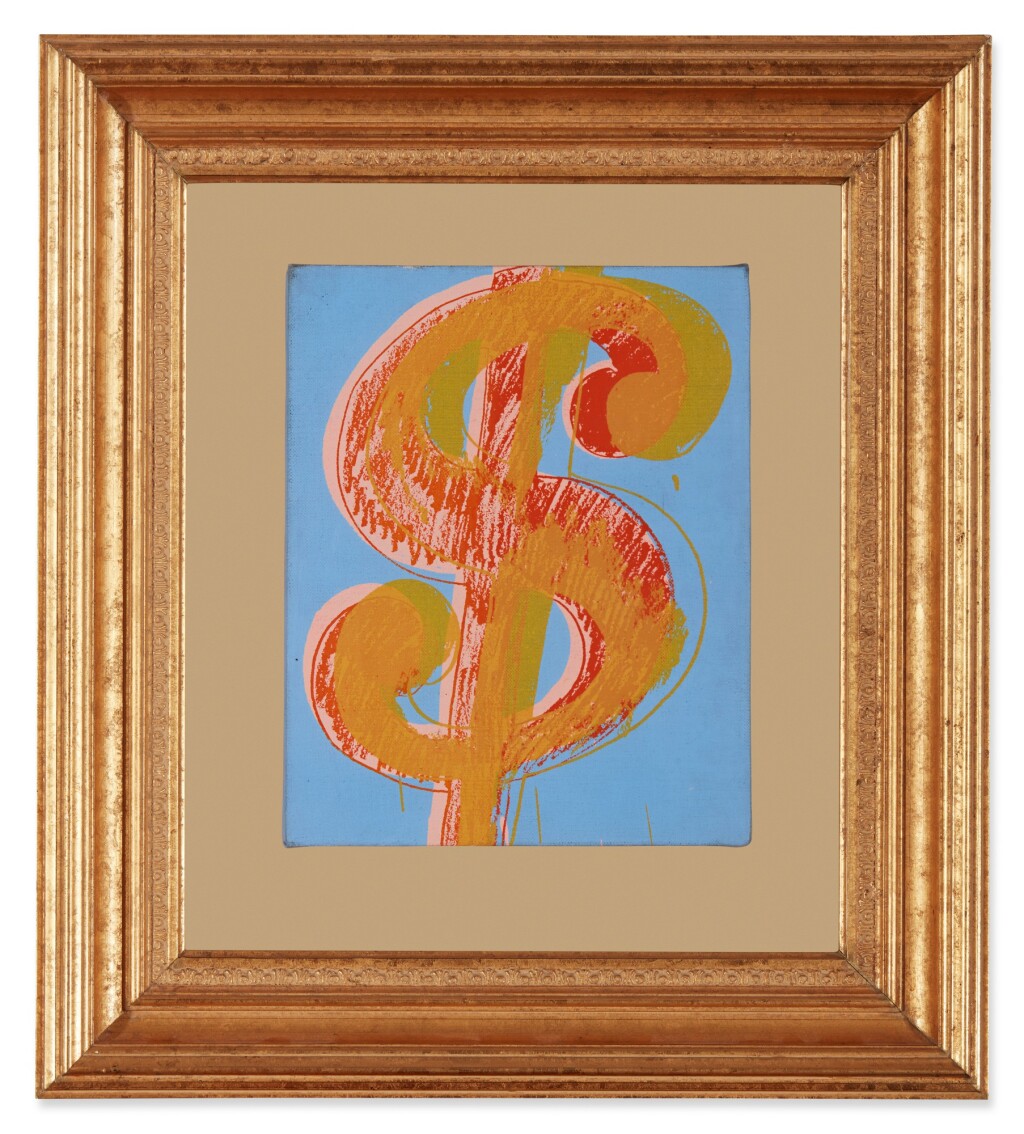
ANDY WARHOL
Dollar Sign, 1981
Acrylic and silkscreen ink on canvas
10×8 inches (25.4 x 20.3 cm)
2020 Auction Results
#1. Dollar Sign, 1981
Christie’s Hong-Kong: 1 December 2020
Estimated: HKD 46,000,000 – 56,000,000
HKD 50,650,000 / USD 6,533,850
Andy Warhol (1928-1987) (christies.com)
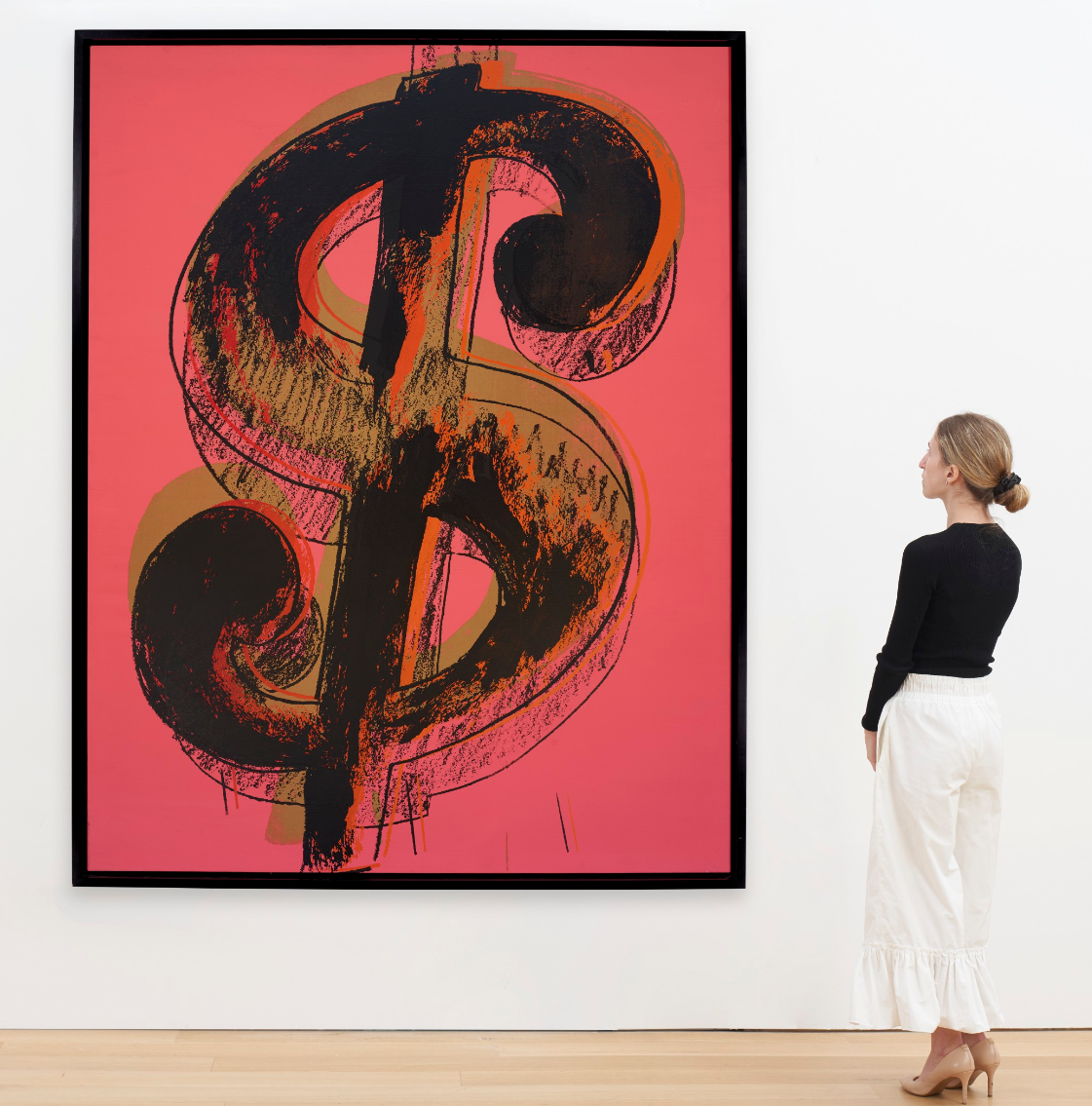
ANDY WARHOL
Dollar Sign, 1981
Acrylic and silkscreen ink on canvas
90×70 inches (229 x 178 cm)
Signed and dated ‘Andy Warhol 81’ (on the overlap)
#2. Dollar Sign, 1982
Sotheby’s New-York: 17 November 2020
Estimated: USD 250,000 – 350,000
USD 528,200
Dollar Sign | Contemporary Art Day Auction | 2020 | Sotheby’s (sothebys.com)
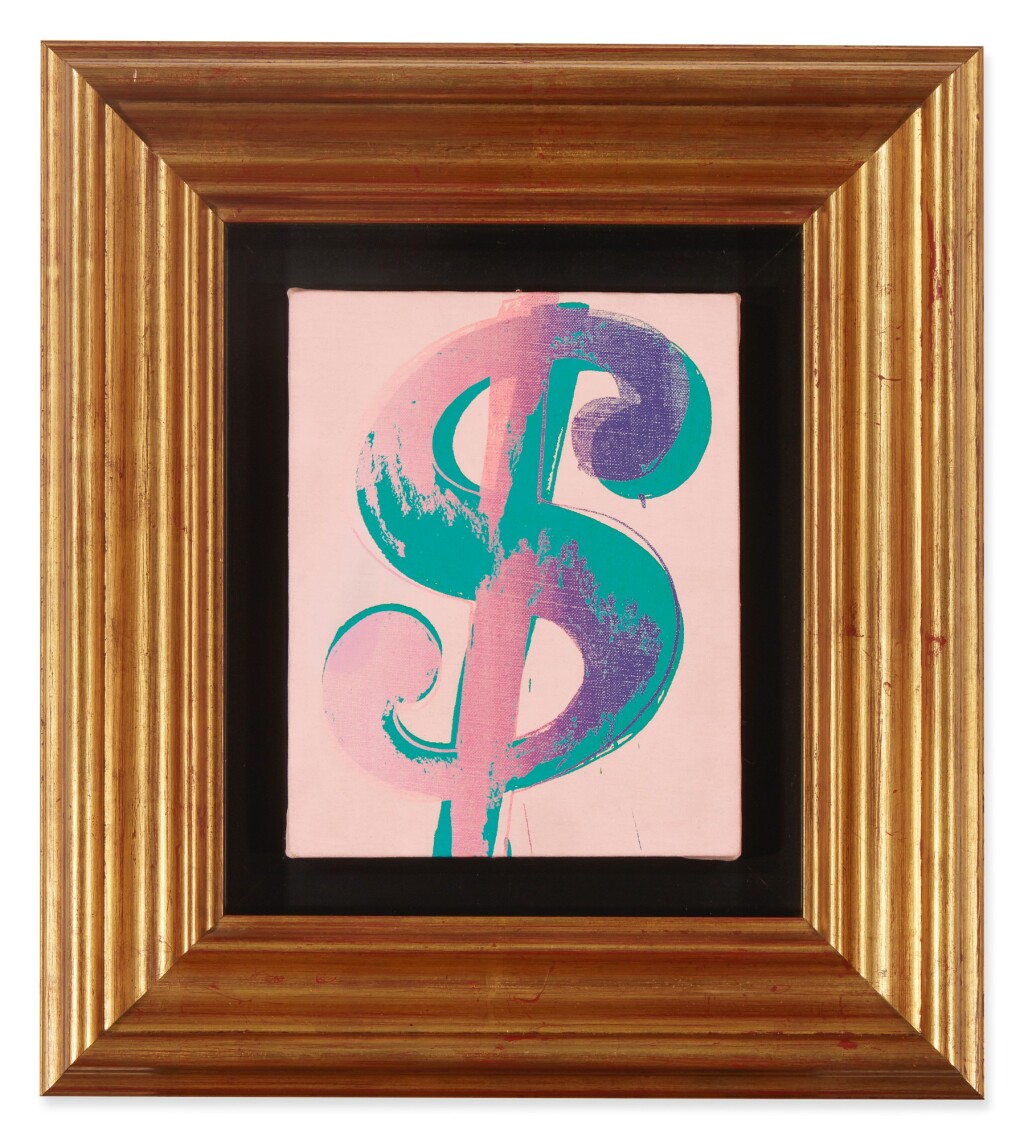
ANDY WARHOL
Dollar Sign, 1982
Acrylic and silkscreen ink on canvas
10×8 inches (25.4 x 20.3 cm)
#3. Dollar Sign, 1981
Sotheby’s New-York: 30 June 2020
Estimated: USD 450,000 – 650,000
USD 500,000
ANDY WARHOL | DOLLAR SIGN | Contemporary Art Day Auction | 2020 | Sotheby’s
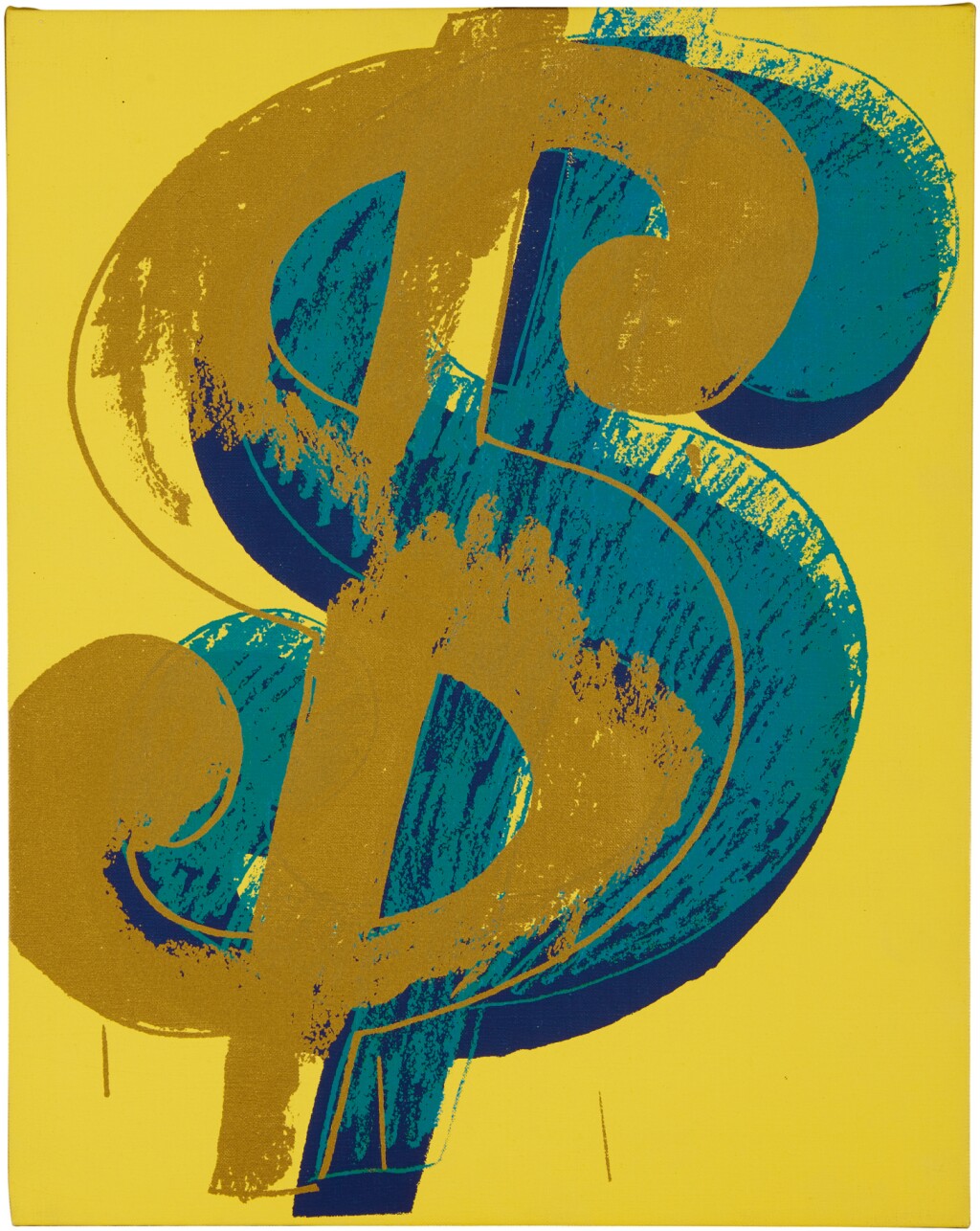
ANDY WARHOL
Dollar Sign, 1981
Acrylic and silkscreen ink on canvas
20.1 x 16 inches (51.1 x 40.6 cm)
#4. Dollar Sign, 1981
Christie’s New-York: 7 October 2020
Estimated: USD 400,000 – 600,000
USD 450,000
Andy Warhol (1928-1987), Dollar Sign | Christie’s
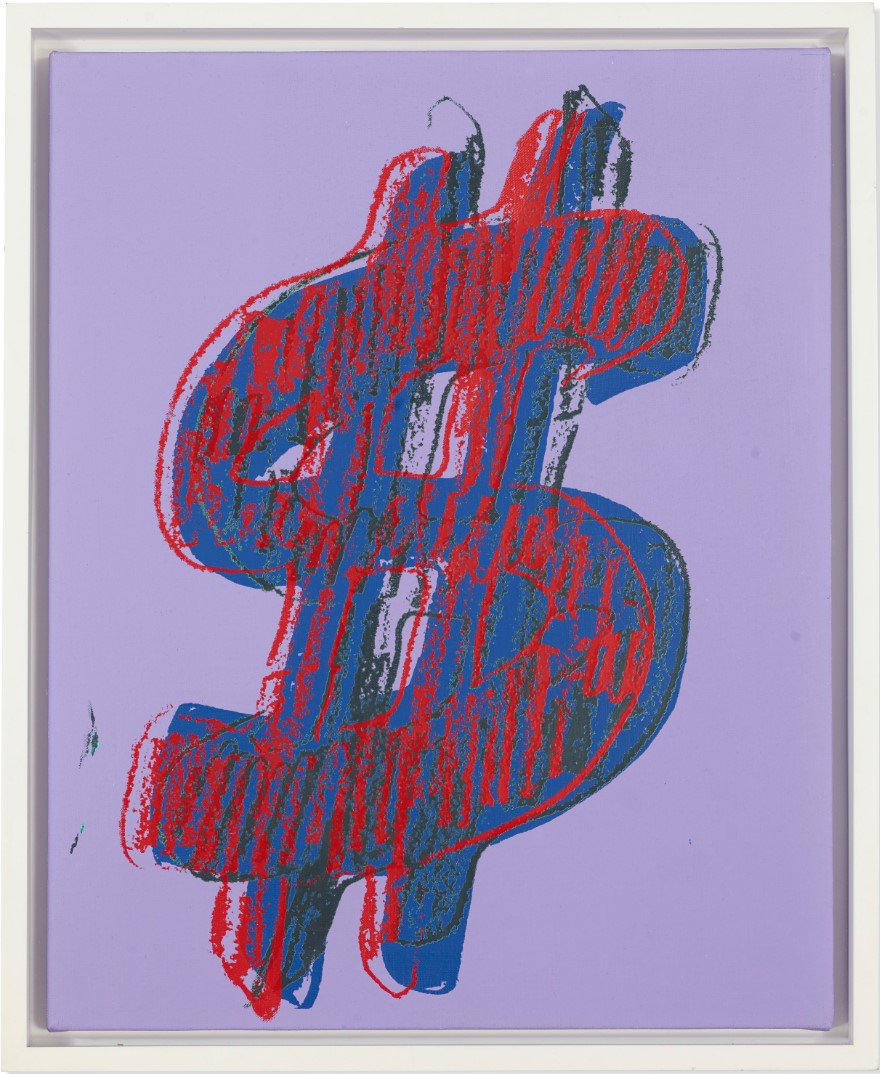
ANDY WARHOL
Dollar Sign, 1981
Acrylic and silkscreen ink on canvas
20×16 inches (50.8 x 40.6 cm)
Signed and dated ‘Andy Warhol 81’ (on the overlap)
#5. Dollar Sign, 1981
Christie’s Hong-Kong: 10 July 2020
Estimated: HKD 2,200,000 – 3,200,000
HKD 2,250,000 / USD 290,300
Andy Warhol (1928-1987) (christies.com)
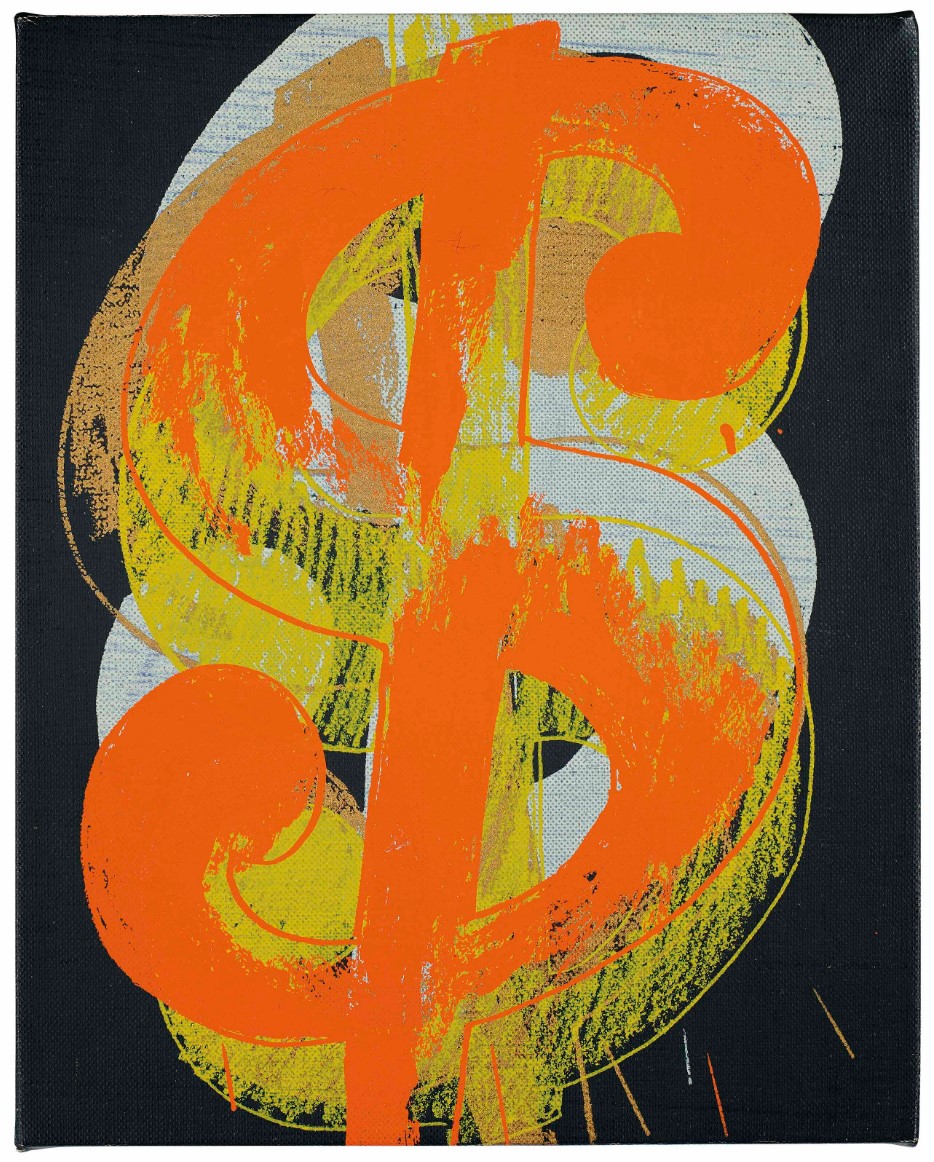
ANDY WARHOL
Dollar Sign, 1981
Acrylic and silkscreen ink on canvas
10×8 inches (25×20 cm)
2019 Auction Results
Dollar Sign (90×70)
Dollar Sign, 1981
Christie’s Hong-Kong: 1 December 2020
Estimated: HKD 46,000,000 – 56,000,000
HKD 50,650,000 / USD 6,533,850
Andy Warhol (1928-1987) (christies.com)
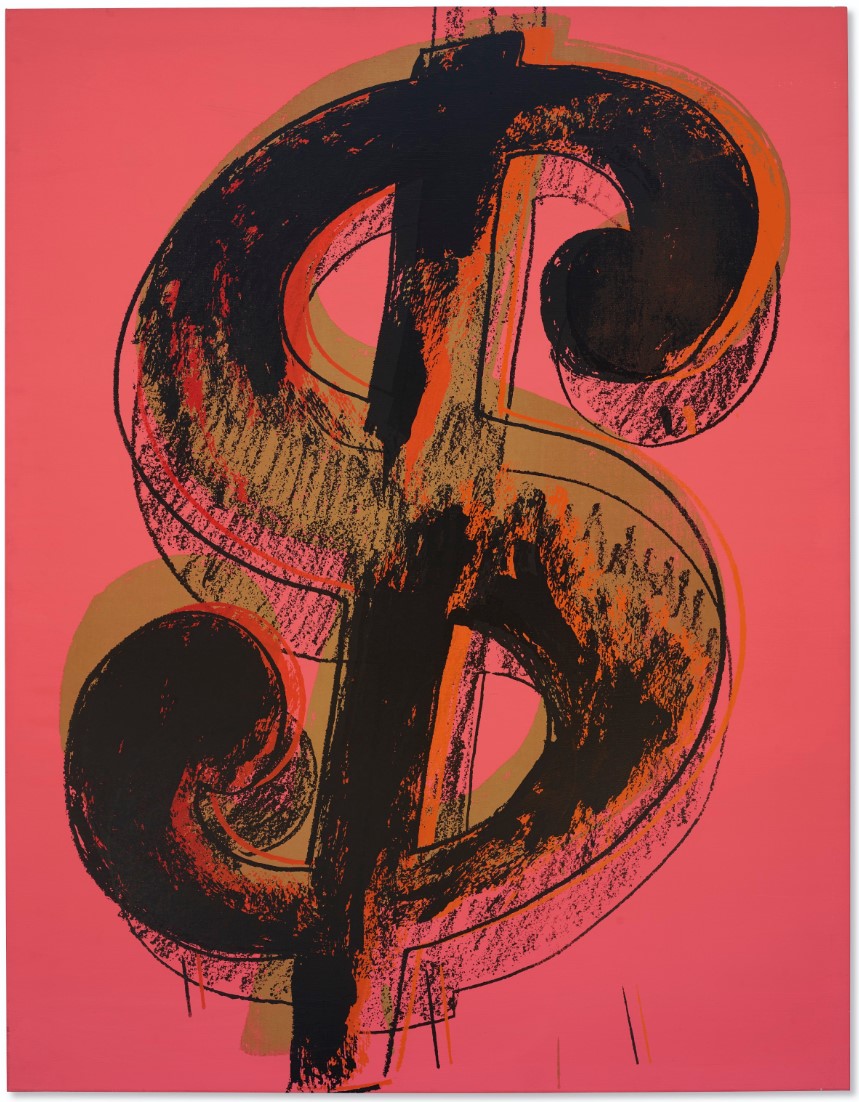
ANDY WARHOL
Dollar Sign, 1981
Acrylic and silkscreen ink on canvas
90×70 inches (229 x 178 cm)
Signed and dated ‘Andy Warhol 81’ (on the overlap)
Dollar Sign is a superb example of Warhol’s unique visual style, with its bold palette of bright magenta, deep black, and rich vermillion, enhanced with a shining layer of gold. Warhol luxuriated in the use of gold in some of his best works, most notably Gold Marilyn Monroe of 1962 (Museum of Modern Art, New York). In Dollar Sign, the use of gold has a twofold effect; it recalls the literal gold bars of the U.S. Treasury that underpins the system of paper currency, but also hints at a greater—more spiritual—symbolism. During the medieval period, gold was often used to symbolize the divine light of the heavens and spiritual illumination. As a child, the artist’s family often worshiped at the Saint John Chrysostom Byzantine Church in Pittsburgh, which houses dozens of shimmering golden icons. In Dollar Sign, Warhol depicts a secular symbol in vivid coloration that hints at the emotional and spiritual release of the shimmering gold icons of his youth.
In this particularly dynamic version of his iconic motif, we can see the origins of Warhol’s original drawings, magnified up to a huge scale. He highlights the clean outlines and the individualized hatching, rendering them highly visible, adding to the visual impact of the work as a whole. When working on the Dollar Sign series, Warhol found he was unable to find an existing image of the dollar sign that had the exact impact he desired. To resolve the situation he resorted to the skill that supported him during the early years of his career, his draftsmanship. He drew dollar after dollar sign, some straight, some slanting, some thick, some thin, some more Pop, some more staid. The vigorous up-and-down pencil strokes of Warhol’s original drawing are thus exquisitely captured and enlarged by the technological complexity of his silkscreen process. The fact that the source image was one that Warhol created himself marks his Dollar Sign paintings out as a rarity within his body of work. It is the subject rather than the actual image of money that concerns Warhol, a clever and revolutionary return to his earlier works of dollar bills in which he essentially printed his own money.
Dollar Sign, 1981
Sotheby’s New-York: 16 November 2017
Estimated: USD 5,000,000 – 7,000,000
USD 5,873,000
(#53) Andy Warhol (sothebys.com)
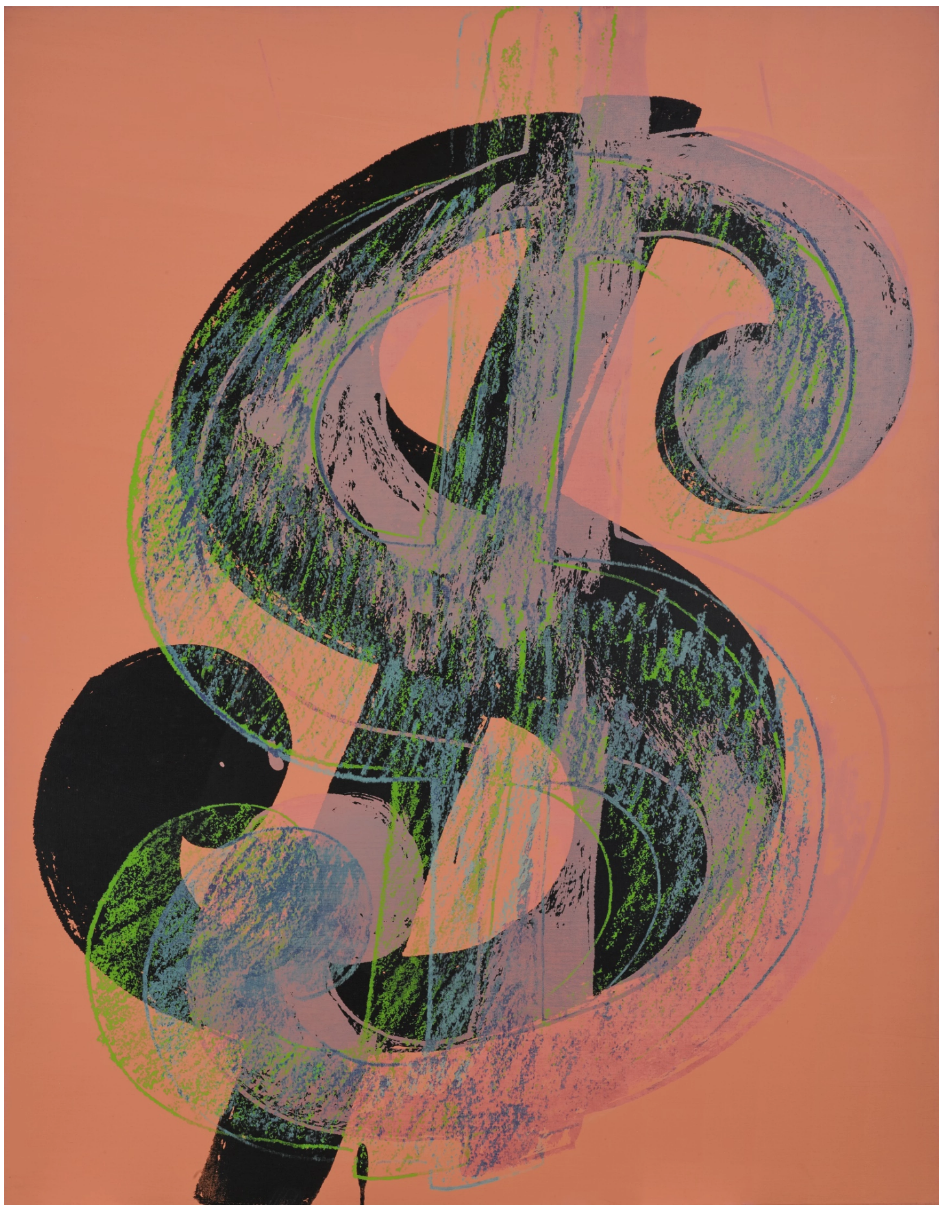
ANDY WARHOL
Dollar Sign, 1981
Acrylic and silkscreen ink on canvas
90×70 inches (228.6 x 177.8 cm)
Signed and dated 81 on the overlap
Dollar Sign perfectly captures Andy Warhol’s extraordinary ability to appropriate, subvert, and reinvent the motifs of consumer culture using his inimitable Pop aesthetic. Forming a part of the iconic Dollar Signs that were executed in 1981, the present work is a magnificent explication of one of Warhol’s primary, career-long, concerns: the social, cultural and creative potential of the American dollar as a signifier of status and wealth. Executed in monumental proportions, Dollar Sign is an absolute explosion of color and impresses through a mix of powerful and fluorescent orange, green, blue and lilac tones. The larger-than-life dollar sign is silkscreened in Warhol’s idiosyncratic printing technique against a sleek, flat background. While painterly in essence, the graphic quality is very much palpable through the vivid and expressive movement of line, particularly the hatchings visible in the lower half of the sweeping S shape. With an exceptional combination of color and line, Dollar Sign forms a stunning visual alliteration of Warhol’s iconic art/money dialectic. Articulated in expressive colors and extolling the graphic fluency of Warhol’s stylized dollar sign drawings, the present work is archetypal of the chromatic brilliance and graphic aesthetic that defines this celebrated series. Extremely rare, Dollar Sign is one of only a few works from this pivotal body of work that is signed by the artist himself.
Dollar Sign, 1981
Christie’s New-York: 16 May 2017
Estimated: USD 6,000,000 – 8,000,000
USD 7,191,500
Andy Warhol (1928-1987) (christies.com)
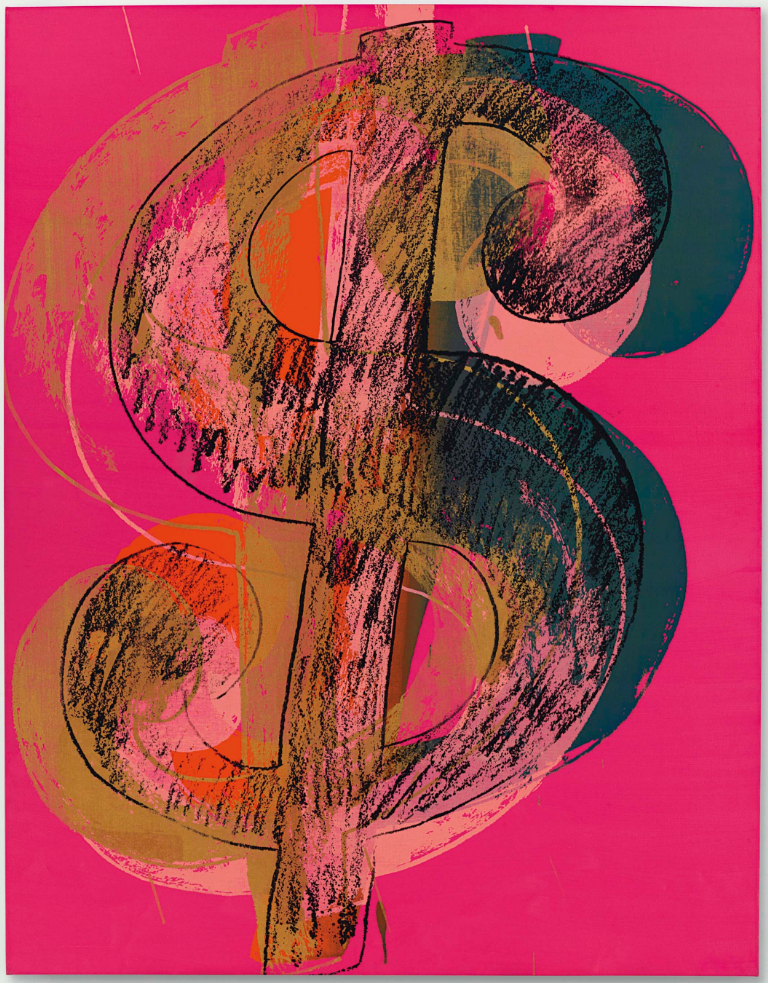
ANDY WARHOL
Dollar Sign, 1981
Synthetic polymer and silkscreen inks on canvas
90×70 inches (229×178 cm)
Stamped twice with the Estate of Andy Warhol stamp and the Andy Warhol Foundation for the Visual Arts Inc. stamp (on the overlap)
Numbered twice ‘PA30.075’ (on the stretcher bar)
Warhol’s Dollar Sign represents money writ large, rendered in the high-keyed coloration and multiple overlaid screens that define the series, all of which distills the very concept of wealth and power into a massive, wavering “$” sign. Hovering before the viewer, the lurid colors of the “$” symbol create a dizzying cacophony, accentuated by the vigorous up-and-down pencil strokes of Warhol’s original drawing, which is exquisitely captured by the technological complexity of his silkscreen process. The lurid, otherworldly palette that Warhol creates—especially the shimmering gold, dark black shadows and underlying fuchsia red—accentuates its disorienting effect, beckoning the viewer much like an ancient totem or flashing neon sign. Indeed, Warhol captures and extracts the essence of money itself—its pleasures and its excesses—in this monumental statement. At once lyrical and crass, Dollar Sign evokes the emotional release that accompanies an influx of cash, from the big money “cha-ching” of a casino jackpot to the simple pleasure of an ATM machine as it kicks out tens and twenties with an efficient whir and click.
Dollar Sign, 1981
Sotheby’s London: 1 July 2015
Estimated: GBP 4,000,000 – 6,000,000
GBP 4,685,000 / USD 7,334,250
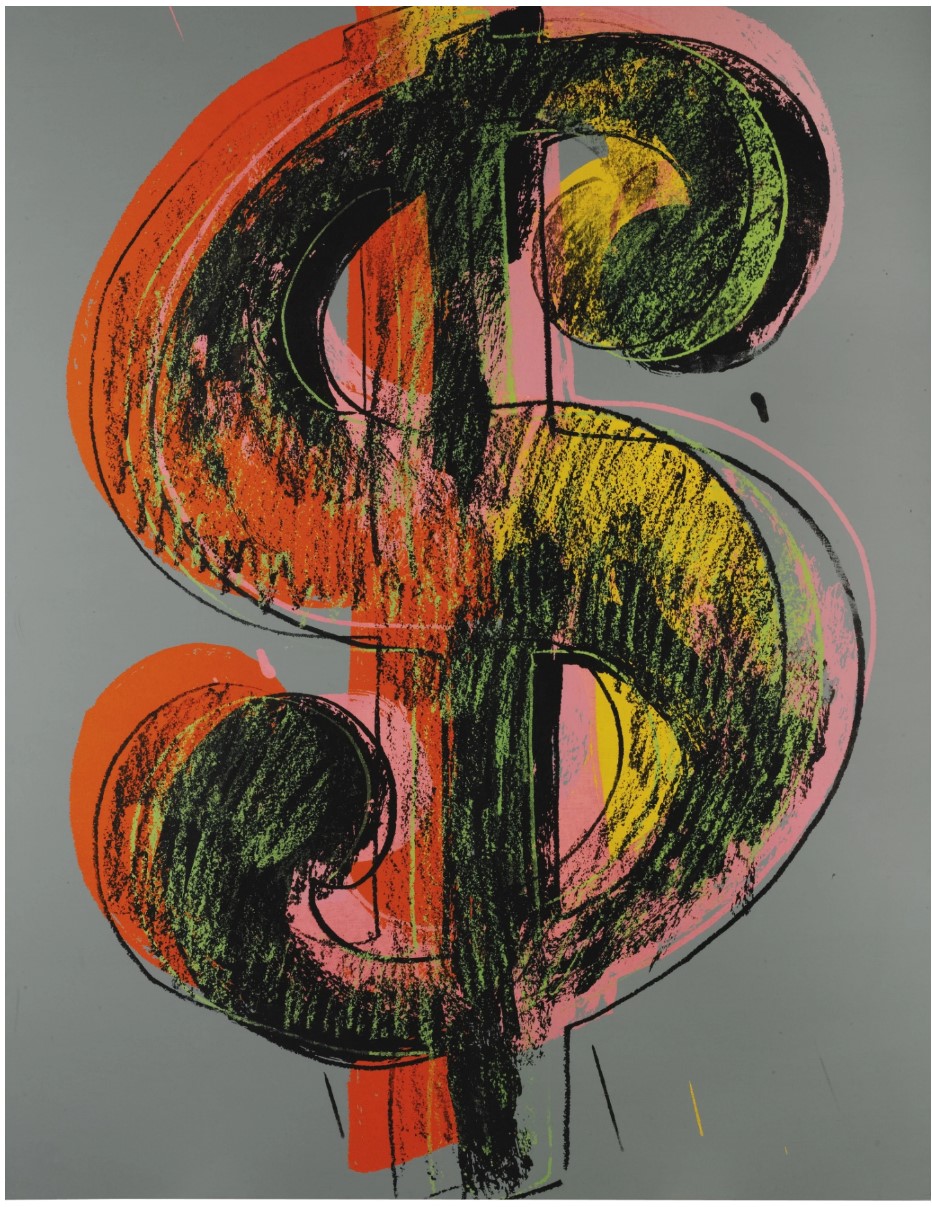
ANDY WARHOL
Dollar Sign, 1981
Acrylic and silkscreen ink on canvas
90×70 inches (229×178 cm)
Signed on the overlap
Commanding monumental proportions, the imposing Dollar Sign canvas impresses through a mix of powerful and fluorescent pink, yellow, orange and green tones. The larger-than-life dollar sign is silkscreened in Warhol’s idiosyncratic printing technique against a sleek and flat blue-grey background. While painterly in essence, the graphic quality is very much palpable through the vivid and expressive movement of line, particularly the hatchings visible in the lower half of the sweeping S shape.
Dollar Signs, 1981
Sotheby’s London: 1 July 2015
Estimated: GBP 4,500,000 – 6,500,000
GBP 6,925,000 / USD 10,840,910
(#25) Andy Warhol (sothebys.com)
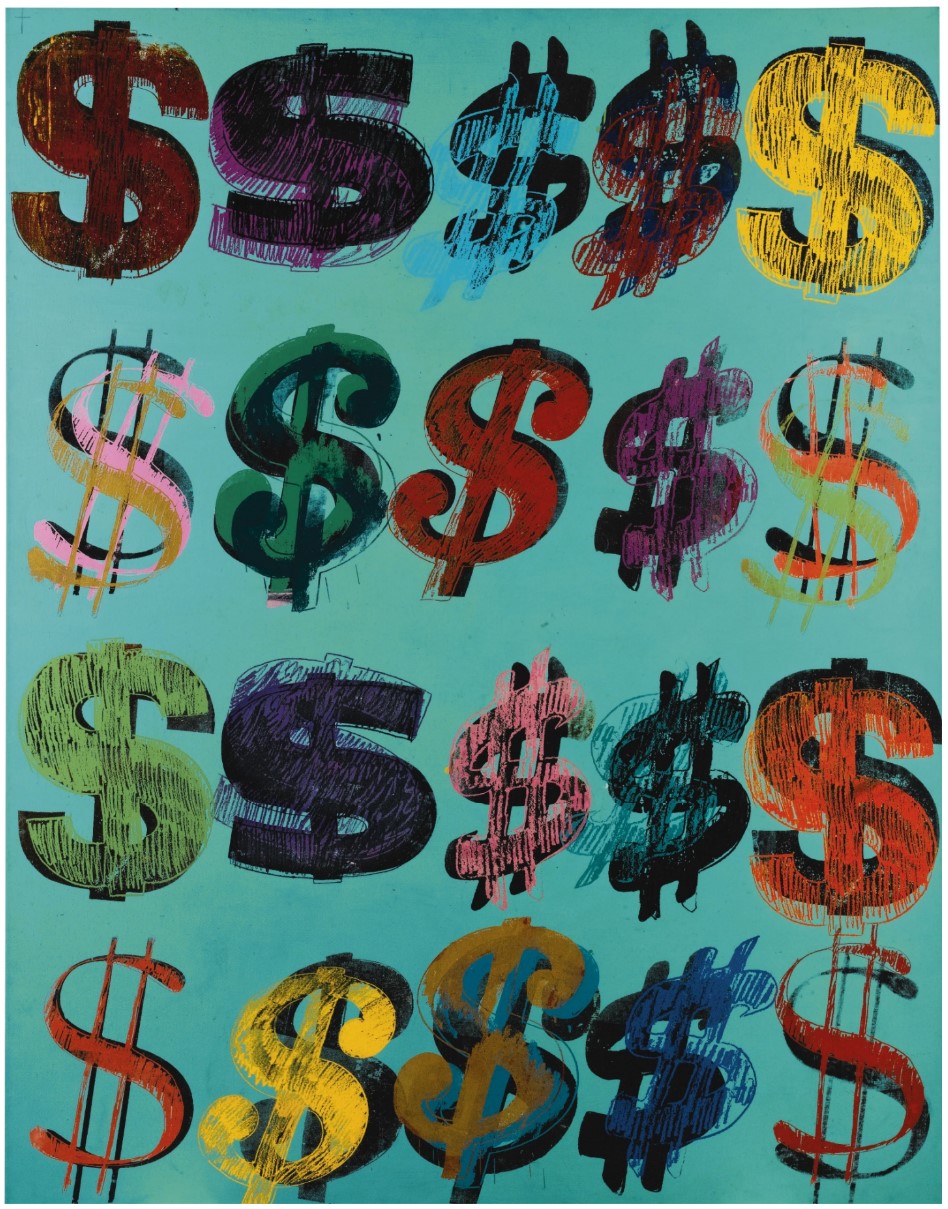
ANDY WARHOL
Dollar Signs, 1981
Acrylic and silkscreen ink on canvas
90×70 inches (228.5 x 178cm)
Andy Warhol’s Dollar Signs is an explosion of color on canvas. This work explores in magnificent diversity the multifaceted aesthetic and conceptual potency of perhaps the world’s most recognizable symbol: the dollar sign. The incessant repetition of this omnipotent logo of American currency transforms the canvas into a polyphony of color in which each chromatic tone is explored in its full spectrum ranging from light to dark, soft to strong, subtle to exalted. The gestural expression of each individual symbol exudes a vibrant and dynamic composition that is juxtaposed by the minimal, grid-like structure in which the schema of dollar signs is loosely arranged. Exceedingly rare, Dollar Signs is the first monumental canvas with multiple dollar signs from Warhol’s famed eponymous series to appear for public sale in decades. Masterful in composition, each of the twenty-dollar signs is labor-intensively printed and overprinted via Warhol’s idiosyncratic silkscreen technique; arranged in four rows of five-dollar signs, the canvas becomes a joyous taxonomy of color, shape, form, and texture. The extensive compositional range oscillates from bold and compact to thin and curvilinear, from precise print to silhouette-like shadows, from graphical precision to gestural abundance. Exposing Warhol’s vast visual and creative cosmos in its entirety, the vibrant and exuberant colors of each symbol is a manifestation of Warhol’s visual and material obsession with the ubiquitous icon of American currency.
Dollar Sign, 1981
Christie’s New-York: 12 May 2015
Estimated: USD 7,500,000 – 8,500,000
USD 8,789,000
Andy Warhol (1928-1987) (christies.com)
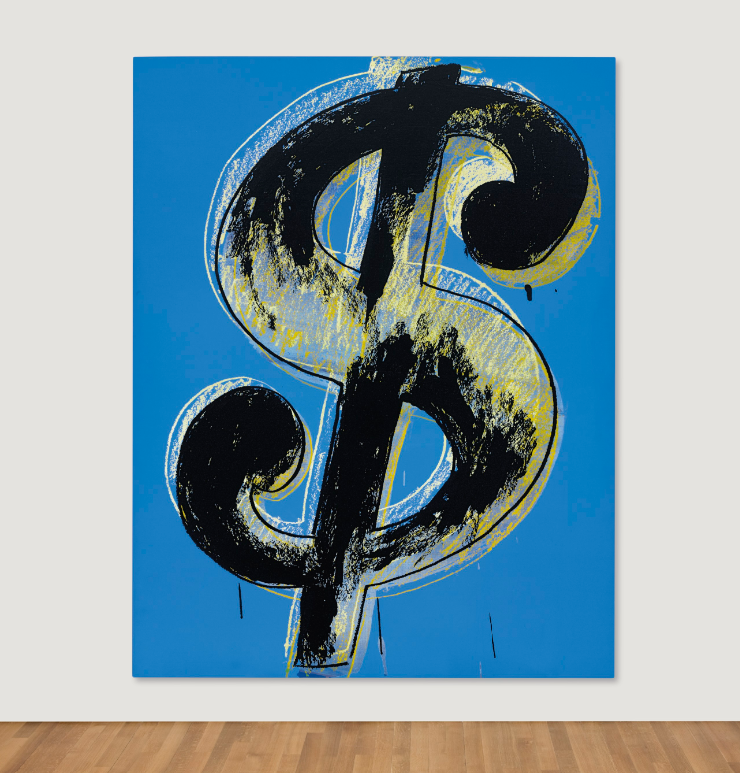
ANDY WARHOL
Dollar Sign, 1981
Synthetic polymer and silkscreen inks on canvas
90×70 inches (228.5 x 177.8 cm)
Stamped with the Andy Warhol Art Authentication Board, Inc. stamp (on the overlap)
The coloration of Dollar Sign is nearly bombastic, as varying shades of golden hues and black radiate outward from a background of ethereal blue. In Dollar Sign, the use of these colors has a twofold effect; it recalls the literal gold bars of the U.S. treasury that accredit paper currency, but also hints at a greater symbolism. When combined with the heavenly sky-blue of the painting’s background, Warhol’s use of the color golden yellow in Dollar Sign might even recall the shimmering icons of Warhol’s Eastern European Catholic upbringing. As a child, the Warhola family often worshiped at the Saint John Chrysostom Byzantine Church in Pittsburgh, in which were housed dozens of shimmering golden icons. During the medieval period, gold was often used to symbolize the divine light of the heavens and spiritual illumination and blue often had the same connotation. In Dollar Sign, Warhol depicts a secular symbol in vivid coloration that hints at symbolic representations of heaven and the divine, which is especially pertinent considering he painted the series during the last decade of his life.
Dollar Sign (Yellow), 1981
Sotheby’s London: 30 June 2014
Estimated: GBP 3,000,000 – 4,000,000
GBP 4,002,500 / USD 6,820,475
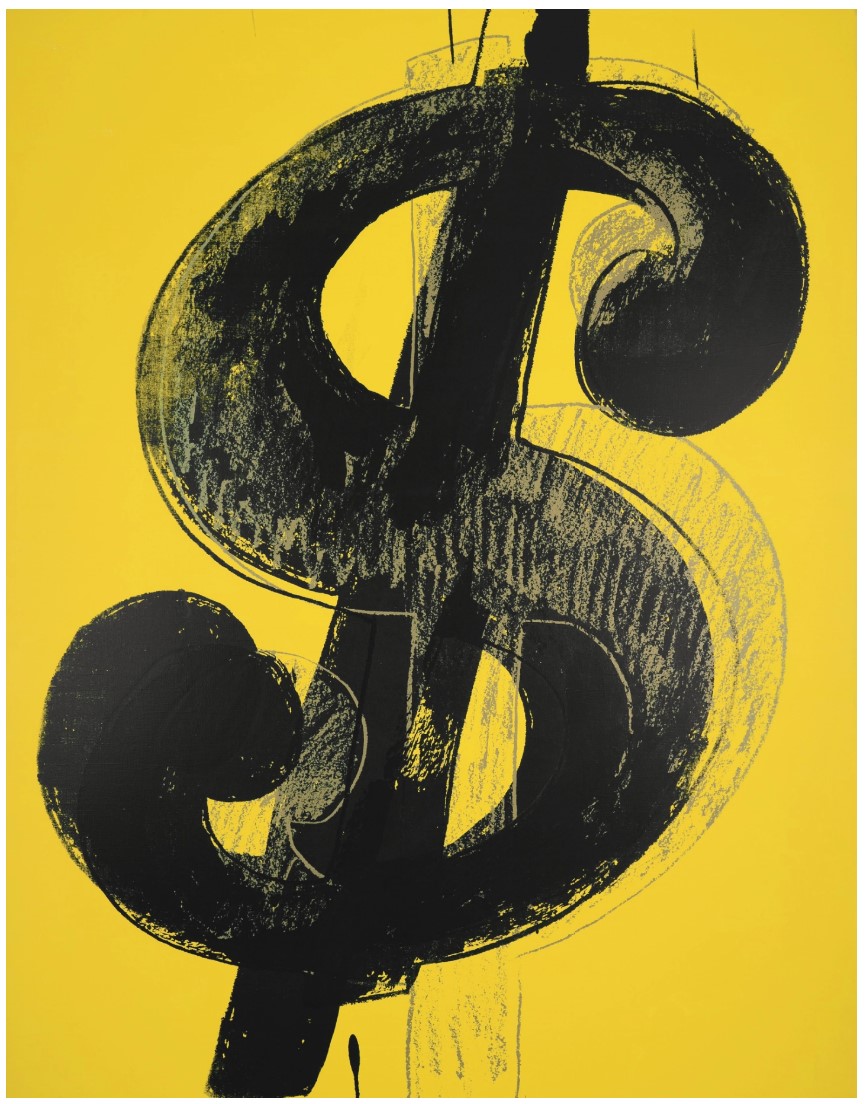
ANDY WARHOL
Dollar Sign (Yellow), 1981
Acrylic and silkscreen ink on canvas
90×70 inches (229×178 cm)
Epic in scope and monumental in scale, Dollar Sign (Yellow) superbly encapsulates Andy Warhol’s ability to utilise and re-invent a potent symbol of consumerist driven culture through his inimitable Pop aesthetic. Forming part of the iconic series of Dollar Signs which the artist worked on in 1981, the present work is a magnificent explication of one of Warhol’s primary, career-long, concerns: the social, cultural and creative potential of the American dollar as signifier of status and wealth. Originally based on an ink drawing of a dollar sign by Warhol himself, the present work emblazons the motif in deep blacks and warm earthy tones against a vibrant yellow background, packing a highly arresting visual punch. One of the most instantly recognizable Warholian themes, the dollar sign reflects the complete synthesis of art and money within his oeuvre, as well as its creator’s own apotheosis from unknown commercial artist to international high-art superstar. First exhibited at Leo Castelli’s Greene Street gallery in 1982, the grandly-scaled Dollar Signs afford an insight into Warhol’s enduring fascination with American commodity culture. Filling the expanse of the vast canvas, this larger-than-life symbol of wealth is rendered with the immaculate clarity of Warhol’s silkscreen technique, which had reached a peak of exquisite stylistic assurance by this mature phase of the artist’s career.
Dollar Sign, 1981
Christie’s New-York: 9 November 2010
Estimated: USD 2,500,000 – 3,500,000
USD 5,122,500
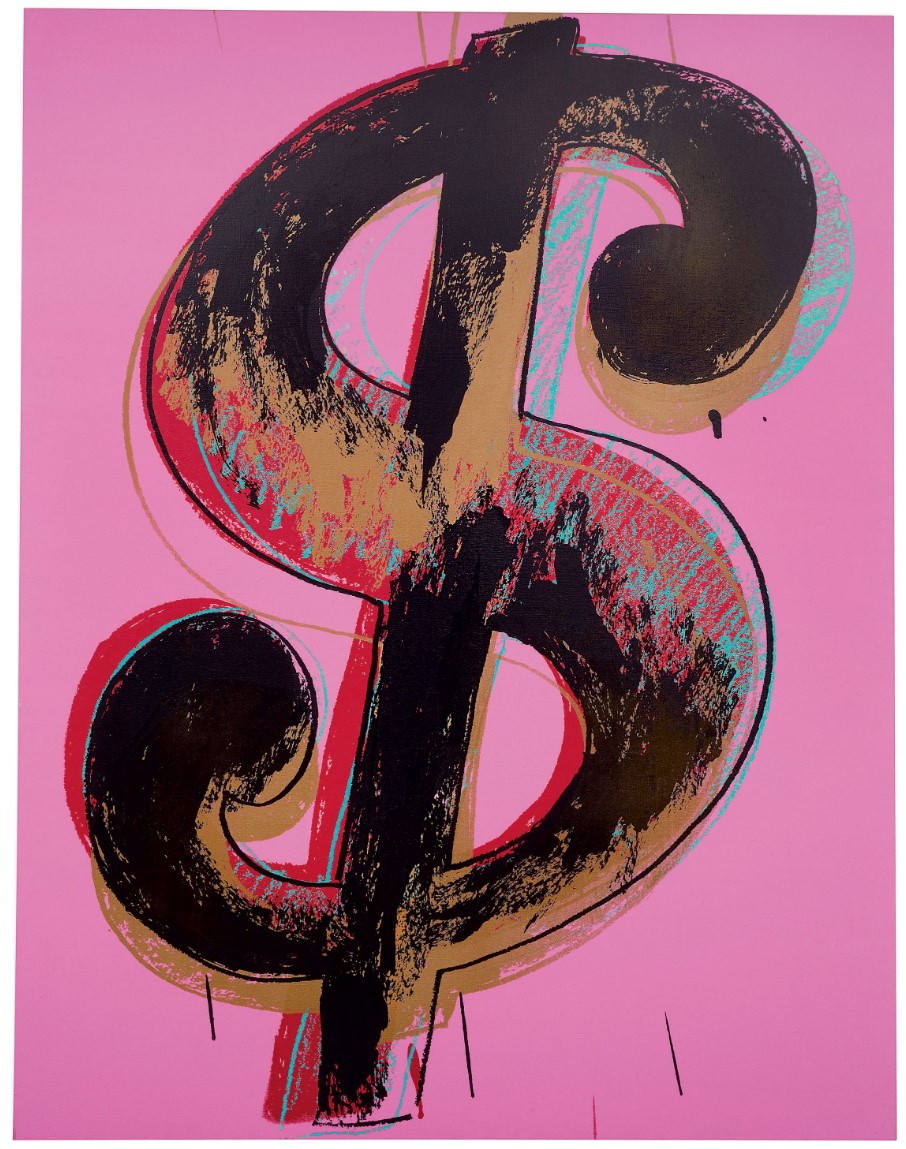
ANDY WARHOL
Dollar Sign, 1981
Synthetic polymer and silkscreen ink on canvas
90×70 inches (229×178 cm)
Stamped twice with the Estate of Andy Warhol stamp
Stamped four times with the Andy Warhol Foundation for the Visual Arts, Inc. stamps
Numbered ‘PA30.076’ (on the overlap and on the reverse)
Dollar Sign is a superb example of Warhol’s unique visual style, with its luxurious palette of magenta, deep red and bright electric blue with a rich layer of gold. In this particularly dynamic version of his iconic motif, we can see traces of Warhol’s own original drawings, magnified up to a huge scale. He highlights the clean outlines and the individualized hatching, rendering them highly visible, adding to the visual impact of the work as a whole.
Dollar Sign, 1981
Christie’s London: 30 June 2008
Estimated: GBP 1,200,000 – 2,000,000
GBP 1,553,250 / USD 3,092,820
Andy Warhol (1928-1987) (christies.com)
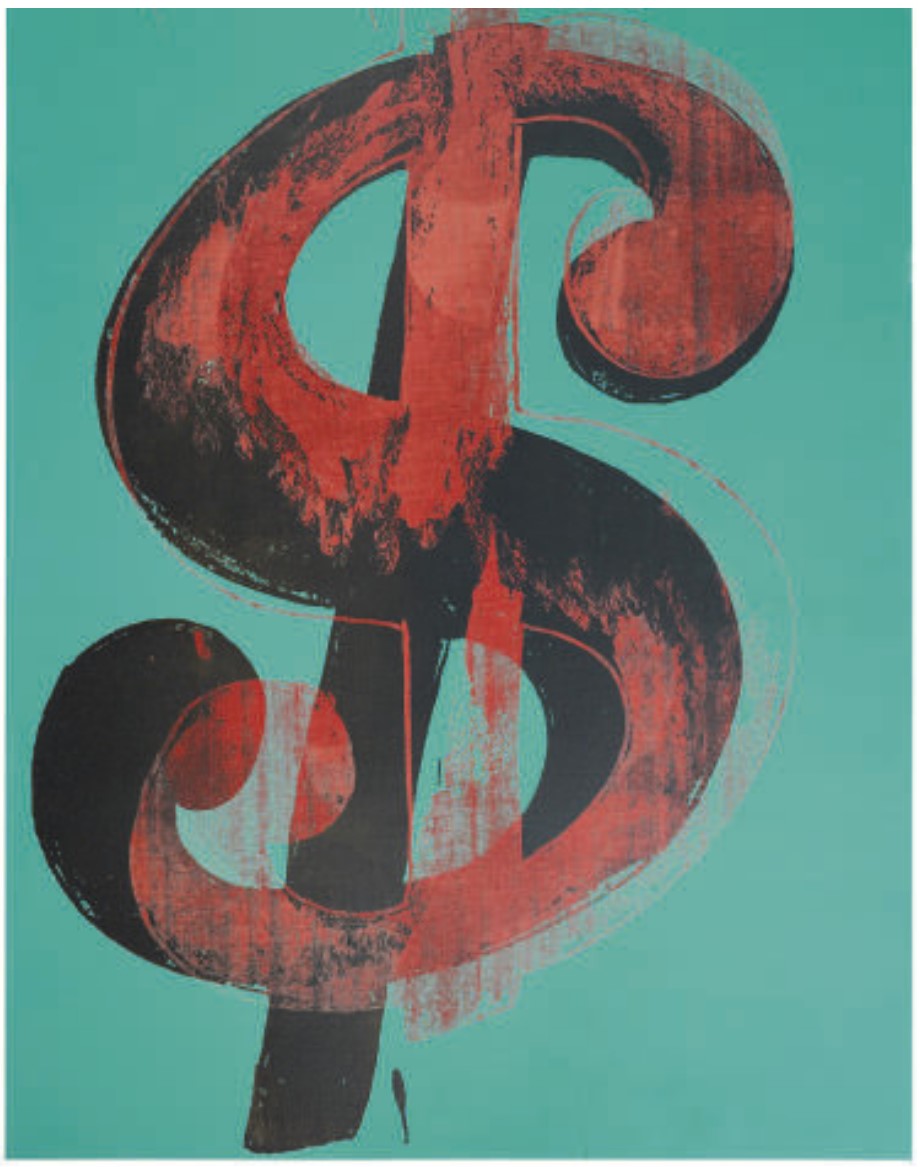
ANDY WARHOL
Dollar Sign, 1981
Synthetic polymer paint and silkscreen inks on canvas
90×70 inches (228.6 x 177.8 cm)
With the Estate of Andy Warhol stamp
With the Andy Warhol Foundation for the Visual Arts stamp
Numbered ‘VF.PA30.046’ (on the overlap)
With the background reminiscent of the greenbacks that fill many an American’s wallet or money clip, this picture is filled with the feel of money; the notion of wealth has been mysteriously transferred, albeit not with the greatest sense of modesty, to the picture surface.
Dollar Sign, 1981
Christie’s London: 17 October 2006
Estimated: GBP 400,000 – 600,000
GBP 1,464,000 / USD 2,738,470
Andy Warhol (1928-1987) , Dollar Sign | Christie’s
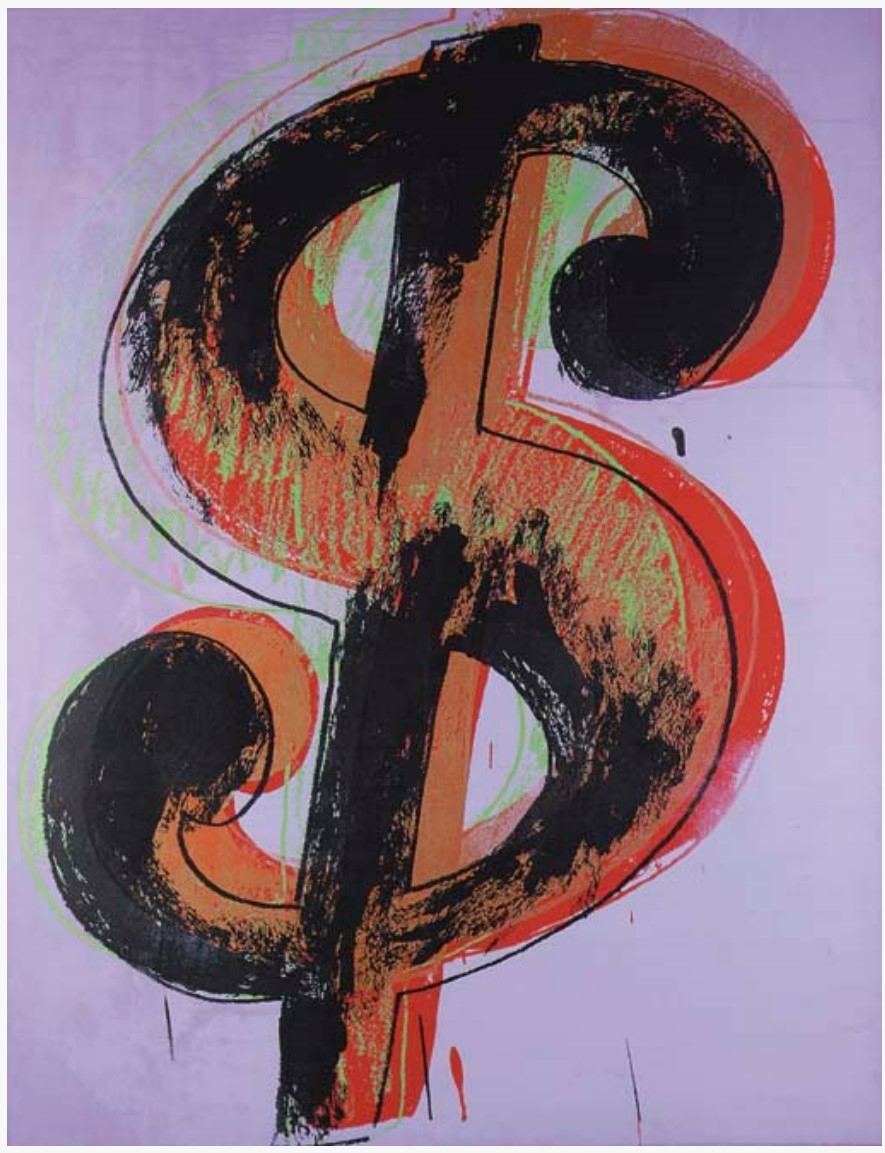
ANDY WARHOL
Dollar Sign, 1981
Synthetic polymer paint and silkscreen inks on canvas
90.1 x 70 inches (229×178 cm)
Executed in 1981, Warhol’s Dollar Sign appears to be a monument to money. One of the most recognized symbols in the entire world has been spread across the vast canvas. Warhol began to paint images of dollar bills in the early 1960s, producing canvases arrayed with endless grids of bank notes. The Dollar Bills came about when Warhol claimed to have run out of ideas and decided to ask a friend what he should paint next. Returning to the subject in the 1980s, he isolated the dollar sign and replicated that symbol in paintings in a sketchy, improvisational style. The dollar sign shown here on such a huge scale was taken from his own drawings, but the addition of the stenciled colors gives the work a solidity, as though this were a picture of a great sculpture. The sense of rebellion and indictment in Dollar Sign is increased by its lively colors. Warhol has taken the solid symbol of American money and has filled it with a lively Pop aesthetic. But is this a celebration of money and capitalism, or is it an ironic indictment? As is so often the case with Warhol, there is no simple answer. Throughout his life and career, he showed a continued fascination with the stars and symbols of our age, and in many ways the Dollar Sign is more pertinent, more internationally recognized, than his Marilyns or Jackies. In this sense, it fits in with much of the rest of his oeuvre, singing on the canvas with its simple iconic strength.
Dollar Sign, 1981
Christie’s London: 8 February 2006
Estimated: GBP 400,000 – 600,000
GBP 2,584,000 / USD 4,499,100
Andy Warhol (1928-1987) (christies.com)
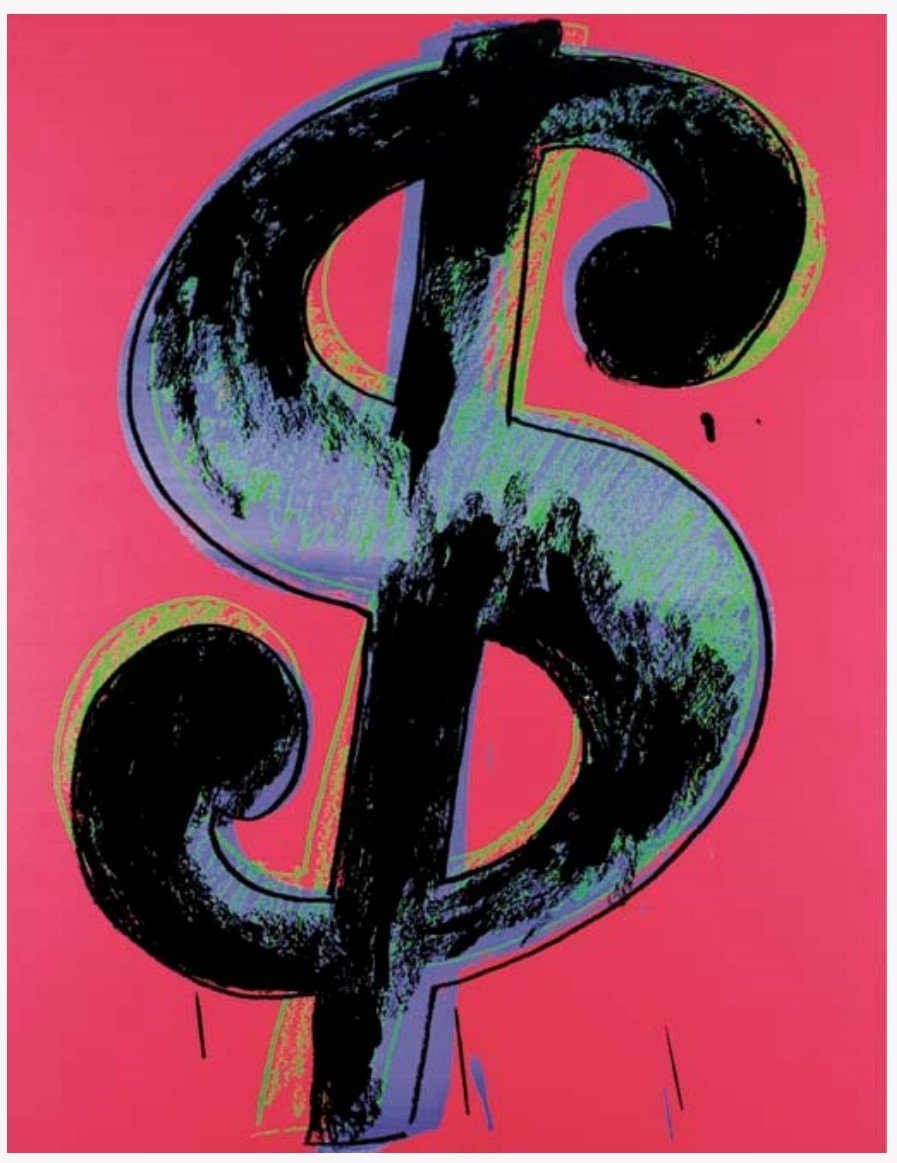
ANDY WARHOL
Dollar Sign, 1981
Synthetic polymer paint and silkscreen inks on canvas
90.9 x 70.1 inches (229×178 cm)
The sense of rebellion and indictment in Dollar Sign is increased by its lively colors. Warhol has taken the solid symbol of American money and has filled it with a lively Pop aesthetic. These are the loud colors of the Disco age. There is a free-style feel to the draughtsmanship of the source image, which was indeed a drawing of Warhol’s own, designed to mimic the jazzy, slanting typography of advertising. This artistic treatment appears as an insolent assault on the dignity of the dollar itself. At the same time, like several of his series during the late 1970s and early 1980s, Dollar Sign shows Warhol revisiting the territories and themes of his earlier works, for instance the trailblazing Dollar Bill pictures of the early 1960s, works which challenged the viewer’s preconceptions of art and authenticity. Ultimately, as with so many of his most successful works, Dollar Sign remains inscrutable and Sphinx-like, allowing us to chew over its riddle and to wonder whether Warhol was as ingenuous and superficial as he liked people to believe…
Dollar Sign, 1981
Christie’s New-York: 8 November 2005
Estimated: USD 700,000 – 900,000
USD 1,304,000
Andy Warhol (1928-1987) (christies.com)
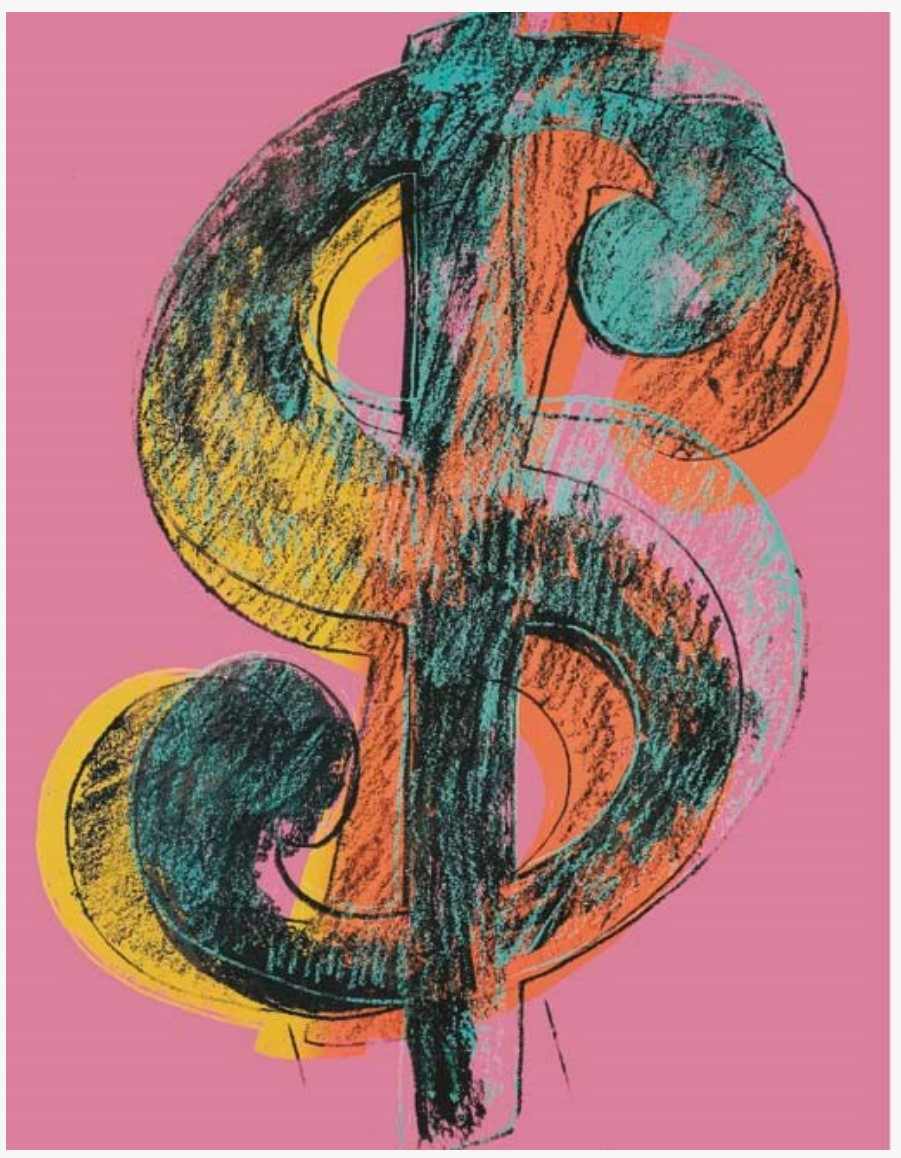
ANDY WARHOL
Dollar Sign, 1981
Synthetic polymer paint and silkscreen inks on canvas
90×70 inches (228.6 x 177.8 cm)
Andy Warhol was the ultimate arbiter of American culture. Through his four decades of production, he successfully extracted the essence of each of those distinct eras. Beginning in the 1950s, the dollar sign was a constant motif in his work that morphed to match the changing times. Reflecting the dynamic of that decade, the Dollar Signs of 1981 are the most garish and flagrantly capitalistic of all of these incarnations. The present example is one of the most exuberant and the ultimate expression of Warhol’s personal fascination with money. These final Dollar Signs no longer take the entire bill as their object. Instead Warhol has chosen to depict only the screaming icon of money–the isolated “$.” Monumental in scale, Dollar Sign reverberates with contrasting day-glow colors and intersecting sinuous lines. The dollar sign was Andy Warhol’s Holy Grail and then he made it ours.
Dollar Sign (20×16)
Dollar Sign, 1981
Phillips London: 27 June 2024
Estimated: GBP 300,000 – 500,000
GBP 317,500 / USD 402,590
https://www.phillips.com/detail/andy-warhol/UK010424/33
REPEAT SALE
Christie’s New-York: 13 May 2022
Estimated: USD 400,000 – 600,000
USD 516,600
ANDY WARHOL (1928-1987), Dollar Sign | Christie’s
REPEAT SALE
Sotheby’s New-York: 10 May 2012
Estimated: USD 400,000 – 600,000
USD 722,500
ANDY WARHOL
Dollar Sign, 1981
Acrylic and silkscreen ink on canvas
20 x 15 7/8 inches (50.8 x 40.6 cm)
Stamped with the Estate of Andy Warhol and the Andy Warhol Foundation for the Visual Arts, Inc. stamps
Numbered ‘PA30.086’ on the overlap
Stamped with the Andy Warhol Foundation for the Visual Arts, Inc. stamp on the reverse
Provenance
Estate of Andy Warhol, New York
The Andy Warhol Foundation for the Visual Arts, New York
Gagosian Gallery, New York
Private Collection, Europe
Max Lang Gallery, New York
Private Collection, Los Angeles
Sotheby’s, New York, 10 May 2012, lot 221
Private Collection
Christie’s, New York, 13 May 2022, lot 127
Acquired at the above sale by the present owner
Dollar Sign, 1981
Sotheby’s London: 28 June 2023
Estimated: GBP 150,000 – 200,000
GBP 165,100 / USD 208,590
Dollar Sign | Modern & Contemporary Day Auction | 2023 | Sotheby’s
REPEAT SALE
Christie’s New-York: 16 May 2019
Estimated: USD 200,000 – 300,000
USD 200,000
Andy Warhol (1928-1987), Dollar Sign | Christie’s
ANDY WARHOL (1928 – 1987)
Dollar Sign, 1981
Acrylic and silkscreen ink on canvas
20×16 inches (50.8 x 40.6 cm)
Stamped by the Estate of Andy Warhol and the Andy Warhol Foundation for the Visual Arts, Inc.
Numbered VF PA30.082 on the overlap
Stamped again by the Estate of Andy Warhol on the reverse
Provenance
Estate of Andy Warhol, New York
The Andy Warhol Foundation for the Visual Arts, Inc., New York
Kantor Gallery, Los Angeles
Private Collection, Los Angeles
Phillips, London, 16 October 2014, Lot 156
Private Collection
Christie’s, New York, 16 May 2019, Lot 747
Acquired from the above by the present owner
Executed in 1981, nearly two decades after the first of Warhol’s money paintings, Dollar Sign is a playful example of Andy Warhol’s lifelong fascination with consumerism. Counted among the most iconic series of Warhol’s seminal oeuvre, the single Dollar Sign encapsulates the artist’s masterful practice of subverting and revitalizing the symbols of consumerism within the Pop aesthetic. One of the most recognizable logos anywhere in the world, the “$” sign is simultaneously a symbol of the American Dream and an international denominator for wealth.
Dollar Sign, 1981
Sotheby’s New-York: 19 May 2023
Estimated: USD 400,000 – 600,000
USD 508,000
Dollar Sign | Contemporary Day Auction | 2023 | Sotheby’s (sothebys.com)
ANDY WARHOL (1928 – 1987)
Dollar Sign, 1981
Acrylic and silkscreen ink on canvas
20×16 inches (50.8 x 40.6 cm)
Signed twice (on the overlap)
Dollar Sign perfectly captures Andy Warhol’s extraordinary ability to appropriate, subvert, and reinvent the motifs of consumer culture using his inimitable Pop aesthetic. Money became an obsession for Warhol: “I like money on the wall. Say you were going to buy a… painting. I think you should take that money, tie it up, and hang it on the wall. Then when someone visited you the first thing they would see is money on the wall” (Andy Warhol, The Philosophy of Andy Warhol, New York and London 1975, p. 180). Perhaps, it was Warhol’s personal biography that drew him to the subject; the artist’s childhood was spent in depression-era Pittsburgh before fleeing to New York City. Created in 1981, the work captures the zeitgeist of the 1980s, a decade in which financial wealth surged after the dispiriting economic recession of the 1970s. Residing in the same permanent collection for over 10 years, Warhol presents an equally painterly and graphic depiction of the American symbol of currency in sky blue, deep red, and black. A playful and colorful distillation of Warhol’s core artistic concerns, Dollar Sign mirrors the artist’s own transformation into an icon of contemporary art and international commercial success.
Dollar Sign, 1981
Sotheby’s New-York: 9 March 2023
Estimated: USD 400,000 – 600,000
USD 508,000
Dollar Sign | Contemporary Curated | 2023 | Sotheby’s (sothebys.com)
REPEAT SALE
Sotheby’s New-York: 13 May 2015
Estimated: USD 400,000 – 600,000
USD 406,000
ANDY WARHOL (1928 – 1987)
Dollar Sign, 1981
Silkscreen ink on canvas
20 x 16 1/8 inches (50.8 x 41 cm)
Signed Andy Warhol and dated 81 (on the overlap)
Provenance
Chuck Valentine, San Francisco
Private Collection, Mexico
Sotheby’s New York, 13 May 2015, lot 238
Private Collection, New York
Martin Lawrence Galleries, Las Vegas
Acquired from the above by the present owner
Dollar Sign, 1981
The Collection of Douglas S. Cramer
Sotheby’s New-York: 19 November 2021
Estimated: USD 450,000 – 650,000
USD 927,500
Dollar Sign | Contemporary Day Auction | 2021 | Sotheby’s (sothebys.com)
ANDY WARHOL
Dollar Sign, 1981
Acrylic and silkscreen ink on canvas
20×16 inches (50.8 x 40.6 cm)
Stamped by the Estate of Andy Warhol and The Andy Warhol Foundation for the Visual Arts, Inc.
Numbered PA30.050 on the reverse
Also numbered PA30.050 on the stretcher
Provenance
Leo Castelli Gallery, New York (LC #1239)
The Estate of Andy Warhol
The Andy Warhol Foundation for the Visual Arts, Inc., New York
Gagosian Gallery, New York
Collection of Robert Shapazian, Los Angeles
Christie’s New York, 11 November 2010, lot 134
Acquired from the above by the present owner
Dollar Sign encapsulates Andy Warhol’s masterful practice of subverting and revitalizing the symbols of consumerism within the Pop aesthetic. Counted among the most iconic series of Warhol’s seminal oeuvre, the present work is a testament to the artist’s career-long dissemination of cultural discourse. With Dollar Sign, Warhol delineates our societal relationship with the namesake motif in a vibrant statement of color. Amber and gold undulations caress the curves of the sleek shape of the S, paring down at the boundaries of the shape to give way to an imposing shade of race-car red. Collapsing the boundaries behind graphics and painting in Dollar Sign, Warhol utilizes his prerogative as a cultural icon to address the interdependence of art with money. With astounding foresight, Warhol charges the ubiquitous symbol as both a barometer and a criticism of American culture – bridging the dichotomous gap between high and low art in a masterful archetype of social critique.
Dollar Sign, 1981
Christie’s London: 23 March 2021
Estimated: GBP 300,000 – 400,000
GBP 437,500 / USD 603,448
ANDY WARHOL (1928-1987), Dollar Sign | Christie’s
ANDY WARHOL
Dollar Sign, 1981
Acrylic on canvas
20×16 inches (50.8 x 40.6 cm)
Stamped twice with the Estate of Andy Warhol stamp
Numbered ‘A392.102’ (on the overlap)
With its iconic form rendered in searing tones of red and green, Dollar Sign is an electrifying work from one of Andy Warhol’s best-known series. Created in 1981, these paintings mark the apogee of a career that began two decades earlier with seminal images of America’s new idols: from Campbell’s Soup and Coca-Cola, to Elvis Presley and Marilyn Monroe. In Dollar Sign, Warhol takes on the most powerful symbol of consumerist society, bathing it in vivid hues like an emblem within a shrine. The series followed on from his earlier sequence of Dollar Bills, produced during the 1960s. By the 1980s, the idea of turning money into art had taken on a new pertinence, evocative of the booming commercial art world that took New York by storm during the so-called period of ‘Reaganomics’. For Warhol, whose entire practice held a mirror up to society, it was the ultimate coup. Examples from the series are held in collections including Tate, London, the Museum of Contemporary Art Amsterdam and the Musée d’Art Moderne et d’Art Contemporain, Nice.
Dollar Sign, 1981
Christie’s New-York: 7 October 2020
Estimated: USD 400,000 – 600,000
USD 450,000
Andy Warhol (1928-1987), Dollar Sign | Christie’s
ANDY WARHOL
Dollar Sign, 1981
Acrylic and silkscreen ink on canvas
20×16 inches (50.8 x 40.6 cm)
Signed and dated ‘Andy Warhol 81’ (on the overlap)
Dollar Sign, 1981
Sotheby’s New-York: 30 June 2020
Estimated: USD 450,000 – 650,000
USD 500,000
ANDY WARHOL | DOLLAR SIGN | Contemporary Art Day Auction | 2020 | Sotheby’s
ANDY WARHOL
Dollar Sign, 1981
Acrylic and silkscreen ink on canvas
20.1 x 16 inches (51.1 x 40.6 cm)
Dollar Sign perfectly captures Andy Warhol’s extraordinary ability to appropriate, subvert, and reinvent the motifs of consumer culture using his inimitable Pop aesthetic. Forming a part of the iconic Dollar Signs that were executed in 1981, the present work is a magnificent explication of one of Warhol’s primary, career-long, concerns: the social, cultural and creative potential of the American dollar as a signifier of status and wealth. Dollar Sign is an absolute explosion of color and impresses through a mix of powerful and sunshine yellow, vibrant teal, midnight blue and metallic gold. While painterly in essence, the graphic quality is very much palpable through the vivid and expressive movement of line, particularly the hatchings visible in the lower half of the sweeping S shape of the dollar sign. With an exceptional combination of color and line, Dollar Sign forms a stunning visual alliteration of Warhol’s iconic art/money dialectic. Articulated in expressive colors and extolling the graphic fluency of Warhol’s stylized dollar sign drawings, the present work is archetypal of the chromatic brilliance and graphic aesthetic that defines this celebrated series.
Dollar Sign, 1981
Christie’s New-York: 14 November 2019
Estimated: USD 300,000 – 500,000
USD 387,000
Andy Warhol (1928-1987), Dollar Sign | Christie’s
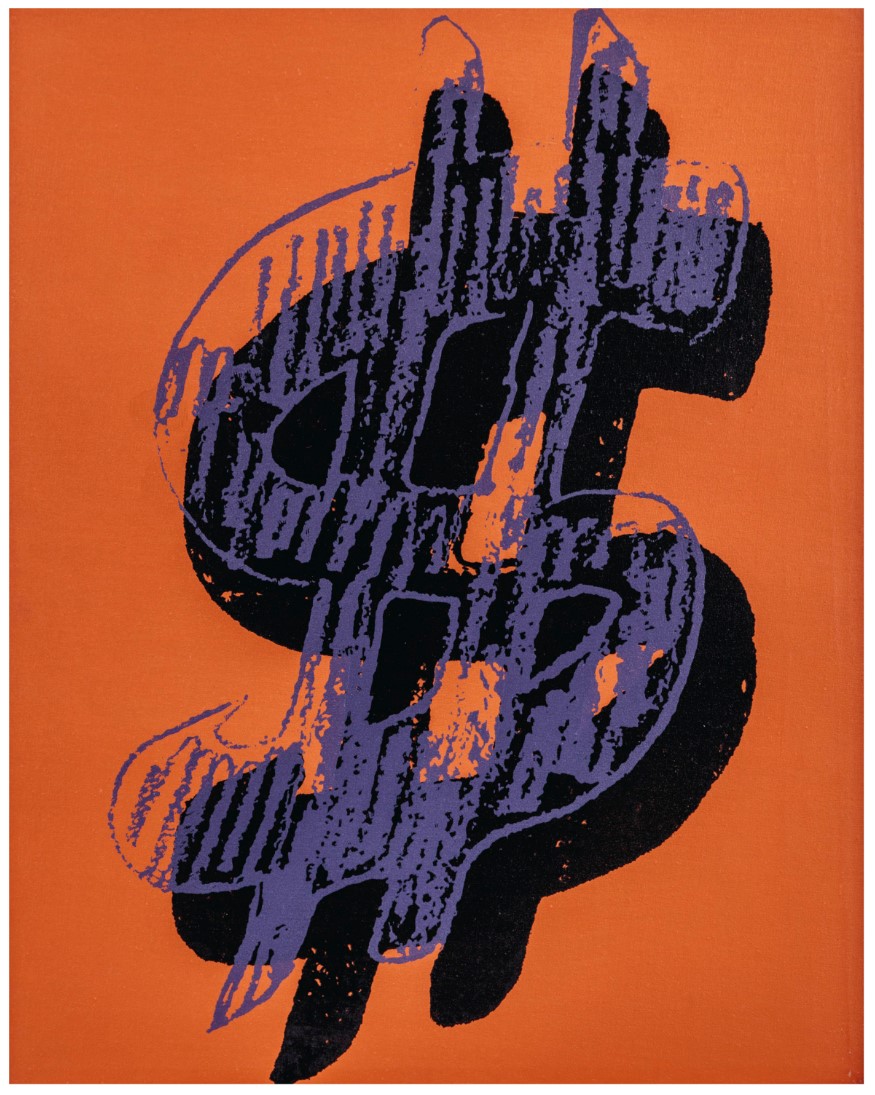
ANDY WARHOL
Dollar Sign, 1981
Acrylic and silkscreen ink on canvas
20×16 inches (50.8 x 40.6 cm)
Signed and dated ‘Andy Warhol 81’ (on the overlap)
Dollar Sign, 1982
Sotheby’s New-York: 17 November 2017
Estimated: USD 300,000 – 400,000
USD 362,500
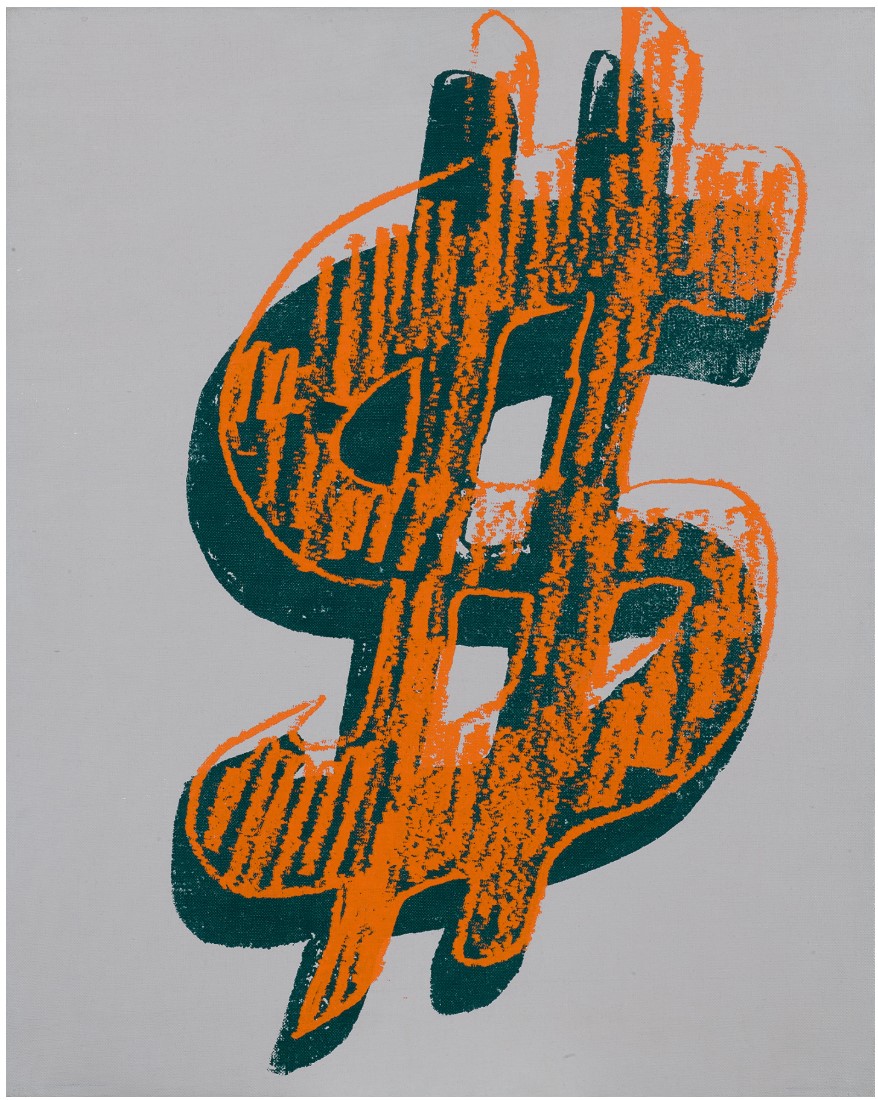 ANDY WARHOL
Dollar Sign, 1982
Acrylic and silkscreen ink on canvas
20×16 inches (50.8 x 40.6 cm)
Signed and dedicated Happy B. Lucio. on the overlap
Dollar Sign, 1981
Christie’s New-York: 16 November 2017
Estimated: USD 400,000 – 600,000
USD 516,500
Andy Warhol (1928-1987), Dollar Sign | Christie’s
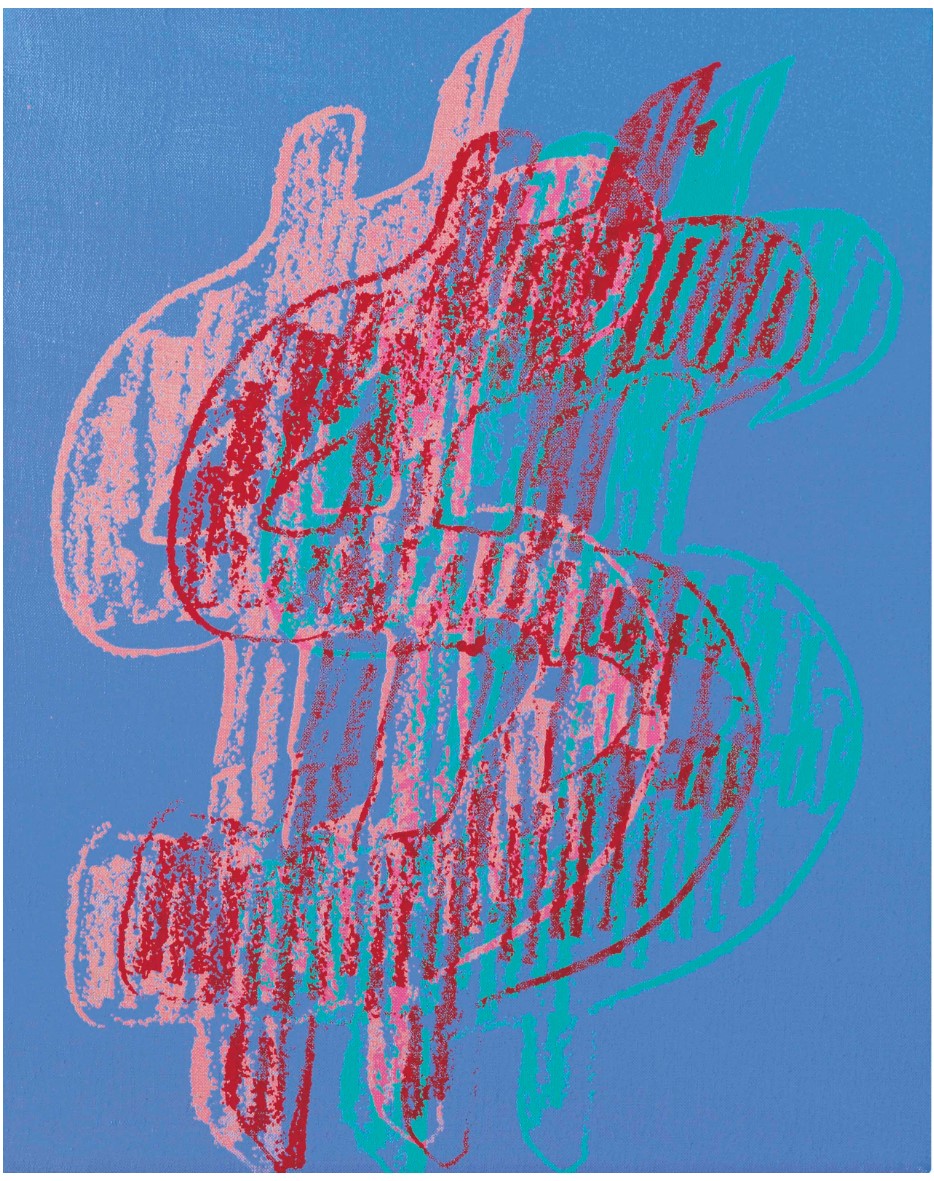
ANDY WARHOL
Dollar Sign, 1981
Sythentic polymer and silkscreen inks on canvas
20×16 inches (50.8 x 40.6 cm)
Stamped twice with the Andy Warhol Foundation for the Visual Arts Inc. and the Estate of Andy Warhol stamps
Numbered ‘PA30.022’ (on the overlap)
Numbered again ‘PA30.022’ (on the stretcher)
Dollar Sign, 1981
Christie’s New-York: 16 November 2017
Estimated: USD 400,000 – 600,000
USD 444,500
Andy Warhol (1928-1987), Dollar Sign | Christie’s
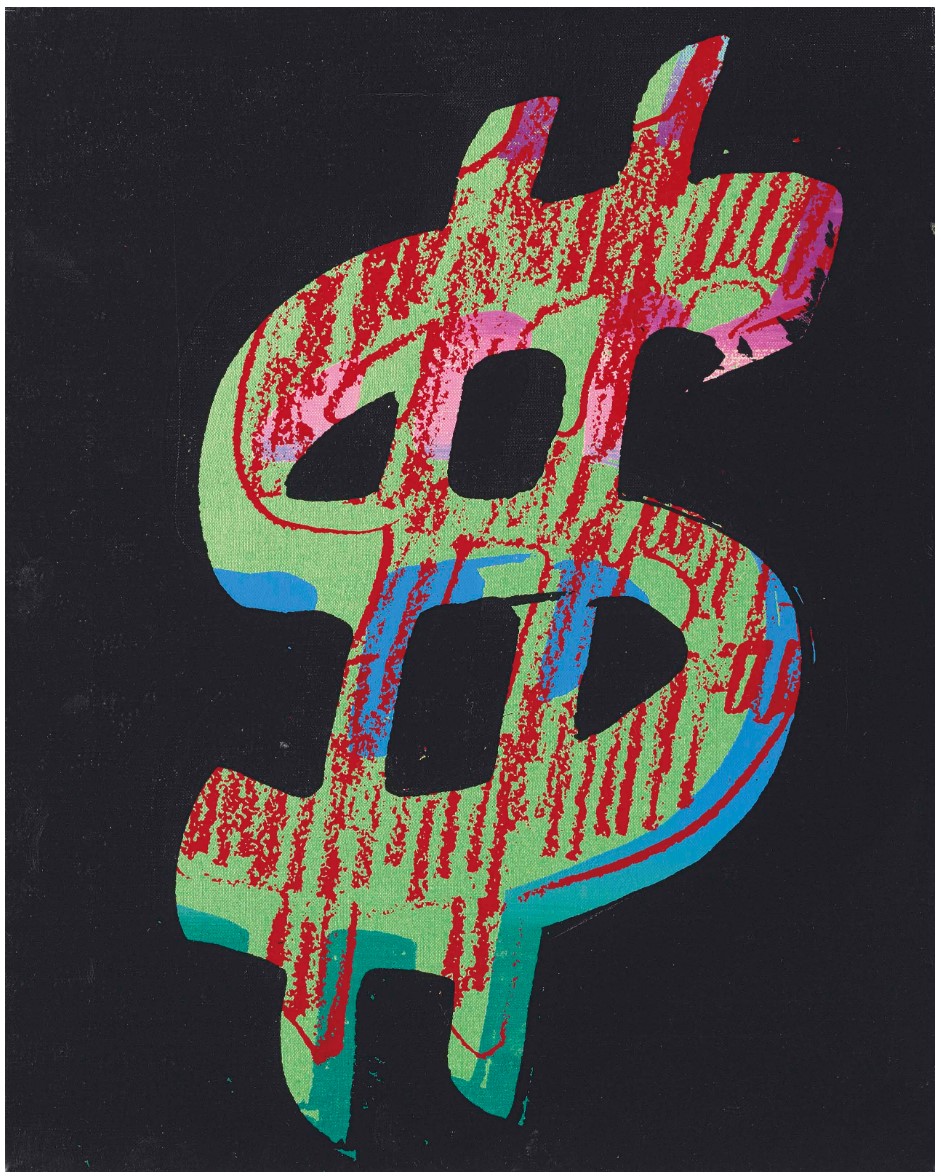
ANDY WARHOL
Dollar Sign, 1981
Synthetic polymer and silkscreen inks on canvas
20×16 inches (50.8 x 40.6 cm)
With his Dollar Sign paintings from the early 1980s Warhol returned to using his own drawings as source material, something he had not done since his earliest years as an artist, making these paintings rare works in the artist’s oeuvre. They merge two distinct styles, bringing together the best aspects of both the early Warhol and the late. They possess aspects of the luxurious hand-drawn sketches from early in the artist’s career and they project the ironic vision of Warhol the mature artist, avatar of the Modern and the postmodern, who created some of the most instantly recognizable artworks of the postwar era. Working with one essential form, Warhol created a series or works allowing for an almost unlimited range of possibilities for the exploration of color, texture and shape. The artist turned a universally recognized symbol into a captivating body of work, one that expresses both the desires and fantasies of the era in which Warhol lived and that projects his own dreams, too. The Dollar Sign paintings are on par with his most powerful and resonant images of wealth, power and celebrity. His paintings held up a mirror to our visions of riches and success, reflecting them back at us. Big-time art is big-time money Warhol once observed, and in these works he zeroes in on the intersection between the value of art and the value of money, locating them in one and the same artwork.
Dollar Sign, 1981
Sotheby’s New-York: 19 May 2017
Estimated: USD 300,000 – 400,000
USD 516,500
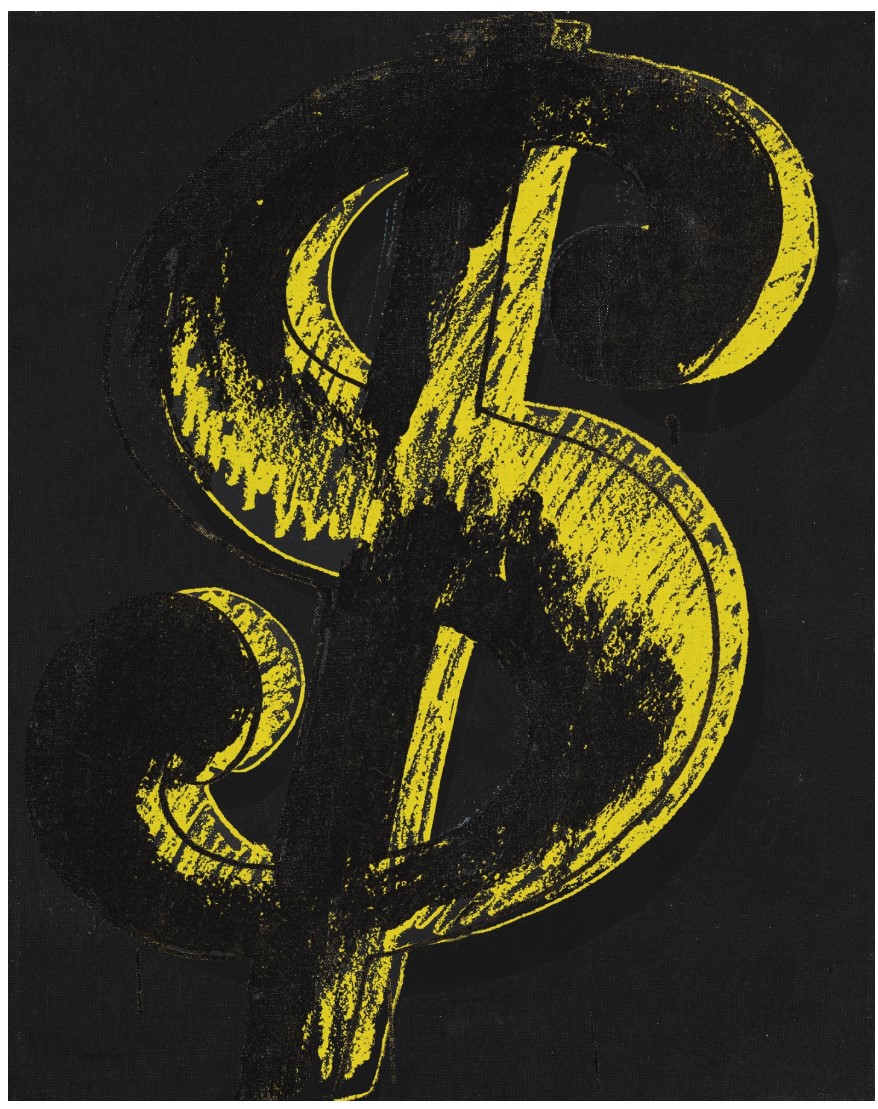
ANDY WARHOL
Dollar Sign, 1981
Acrylic and silkscreen ink on canvas
20×16 inches (50.8 x 40.6 cm)
Dollar Sign, 1981
Sotheby’s London: 10 October 2016
Estimated: GBP 450,000 – 650,000
GBP 509,000
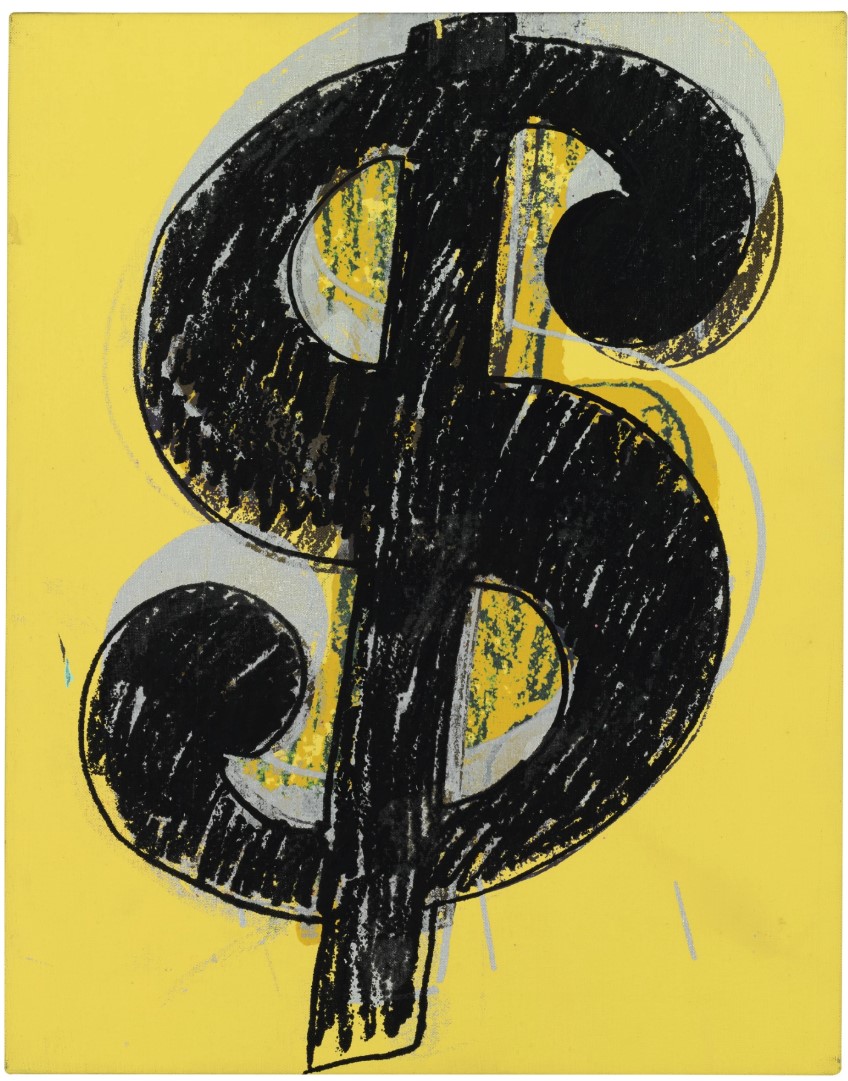 ANDY WARHOL
Dollar Sign, 1981
Acrylic and silkscreen ink on canvas
20×16 inches (50.8 x 40.6 cm)
Signed and dated 81 on the overlap
Dollar Sign, 1981
Sotheby’s New-York: 12 May 2016
Estimated: USD 350,000 – 450,000
USD 478,000
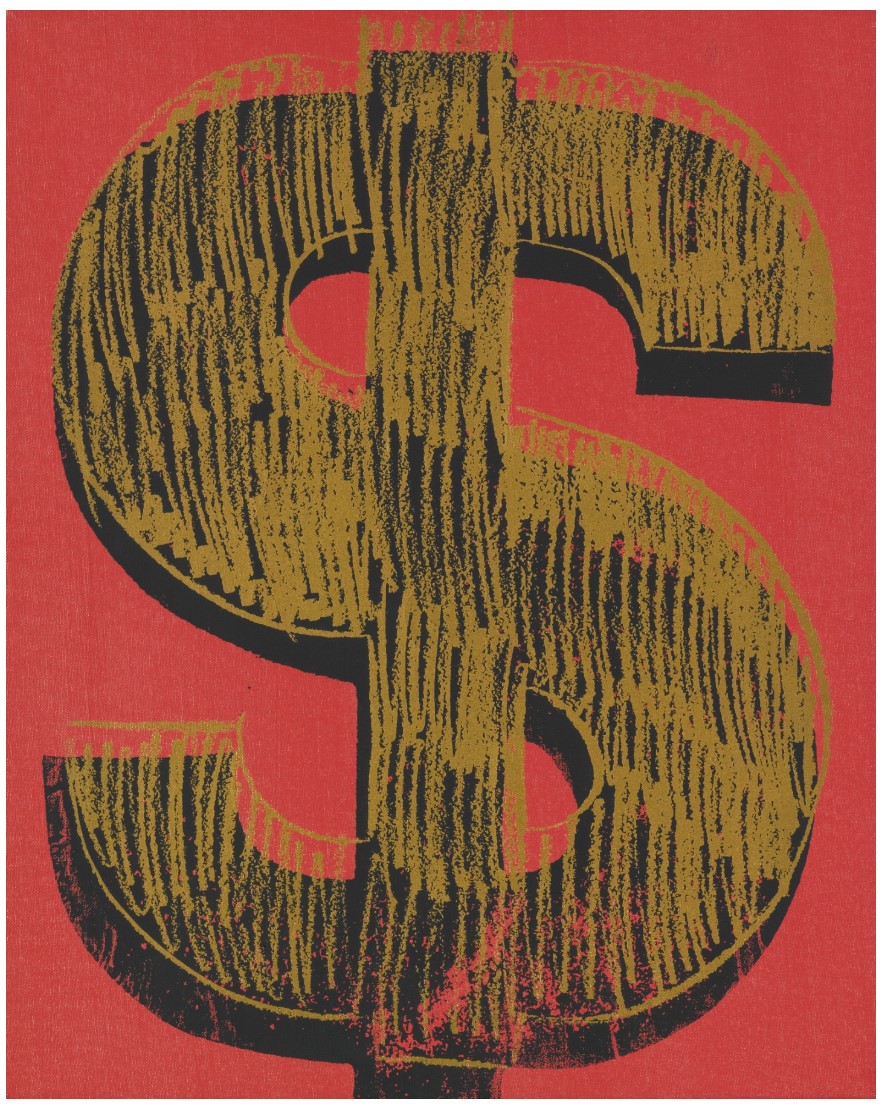
ANDY WARHOL
Dollar Sign, 1981
Acrylic and silkscreen ink on canvas
20×16 inches (50.8 x 40.6 cm)
Dollar Sign, 1981
Christie’s London: 12 February 2016
Estimated: GBP 250,000 – 350,000
GBP 314,500
Andy Warhol (1928-1987), Dollar Sign | Christie’s
ANDY WARHOL
Dollar Sign, 1981
Synthetic polymer and silkscreen ink on canvas
20×16 inches (50.8 x 40.6 cm)
Dollar Sign, 1981
Sotheby’s New-York: 15 May 2013
Estimated: USD 400,000 – 600,000
USD 521,000
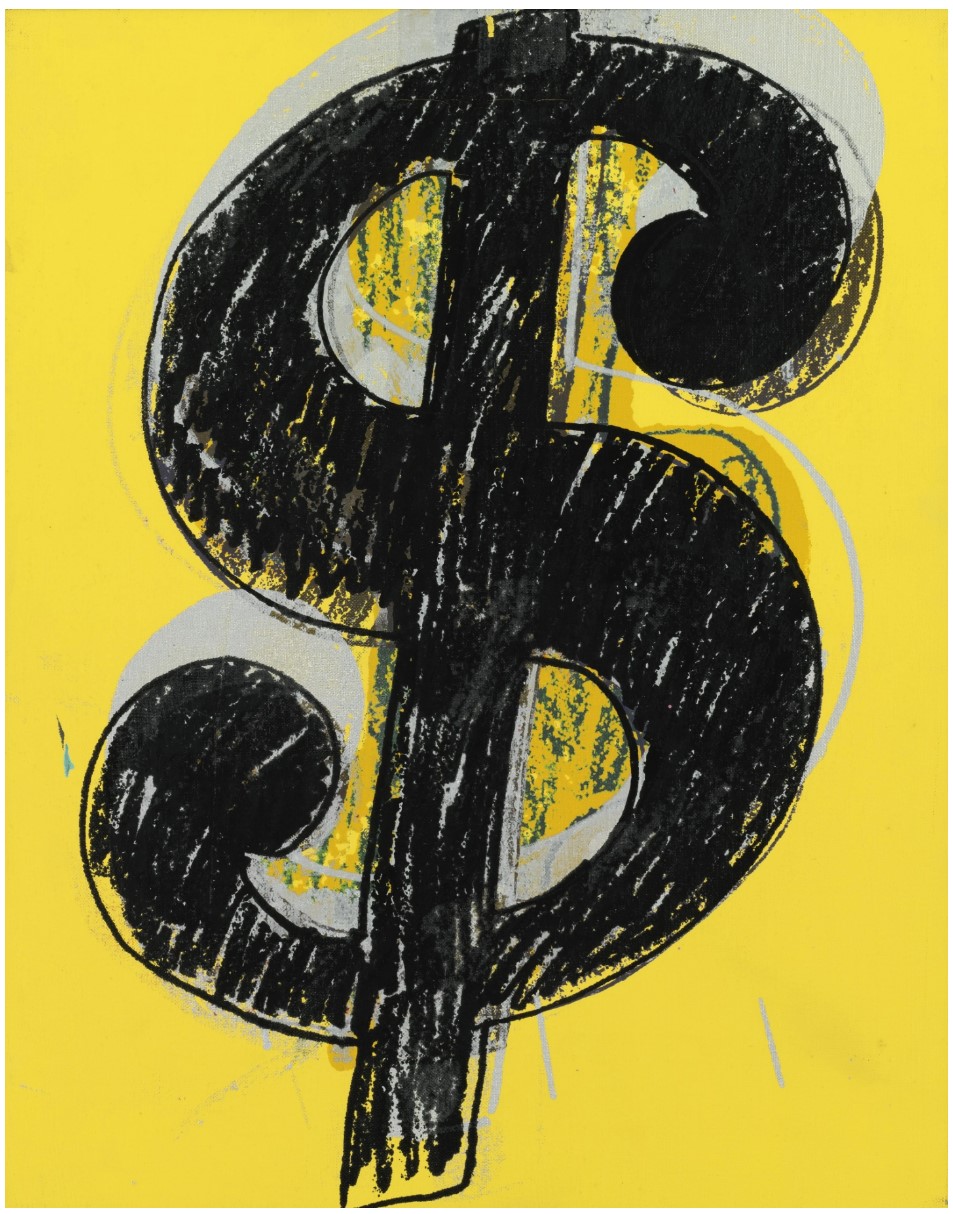
ANDY WARHOL
Dollar Sign, 1981
Acrylic and silkscreen ink on canvas
20×16 inches (50.8 x 40.6 cm)
Dollar Sign, 1981
Sotheby’s New-York: 14 November 2012
Estimated: USD 400,000 – 600,000
USD 554,500
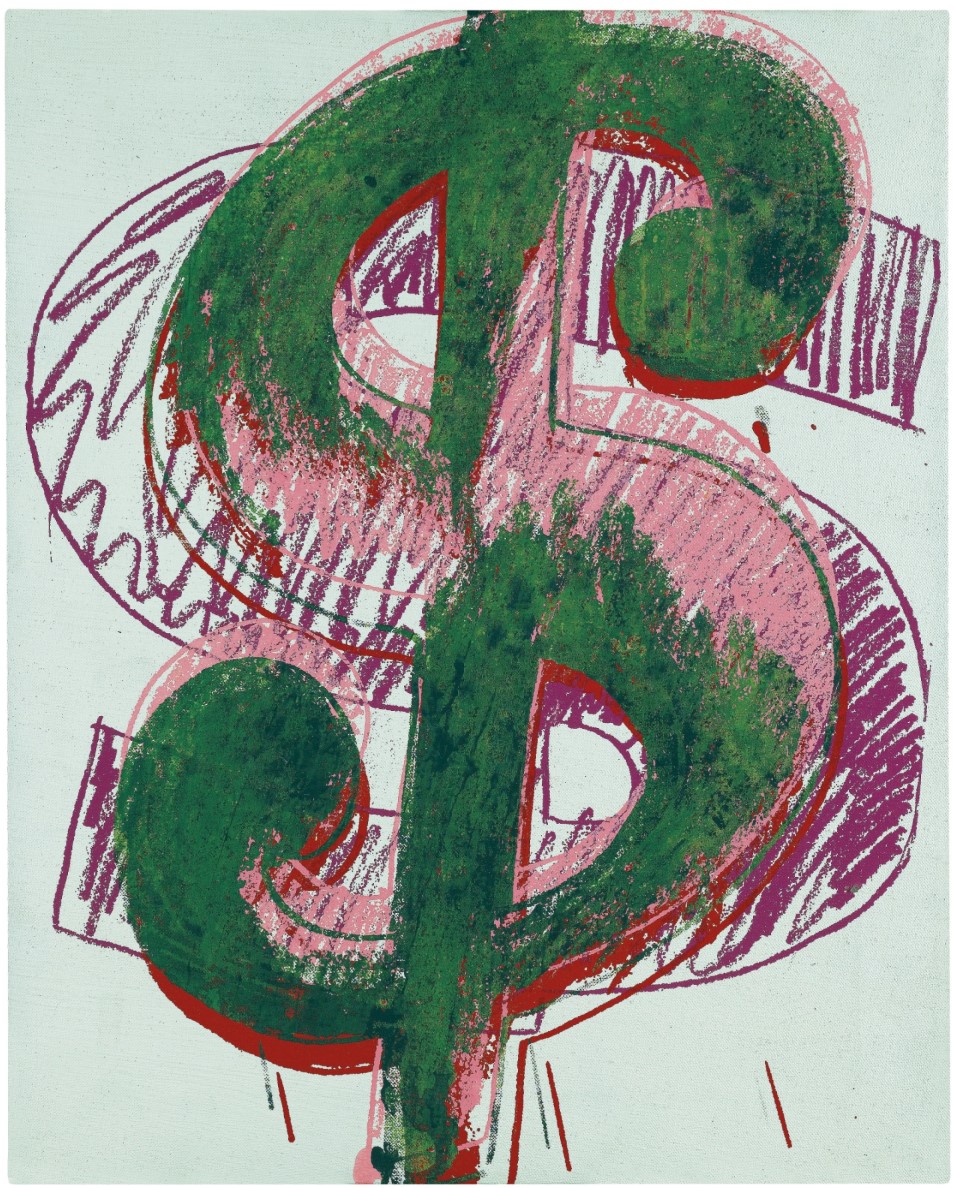
ANDY WARHOL
Dollar Sign, 1981
Acrylic and silkscreen ink on canvas
20×16 inches (50.8 x 40.7 cm)
Dollar Sign, 1981
Sotheby’s New-York: 10 May 2012
Estimated: USD 400,000 – 600,000
USD 722,500
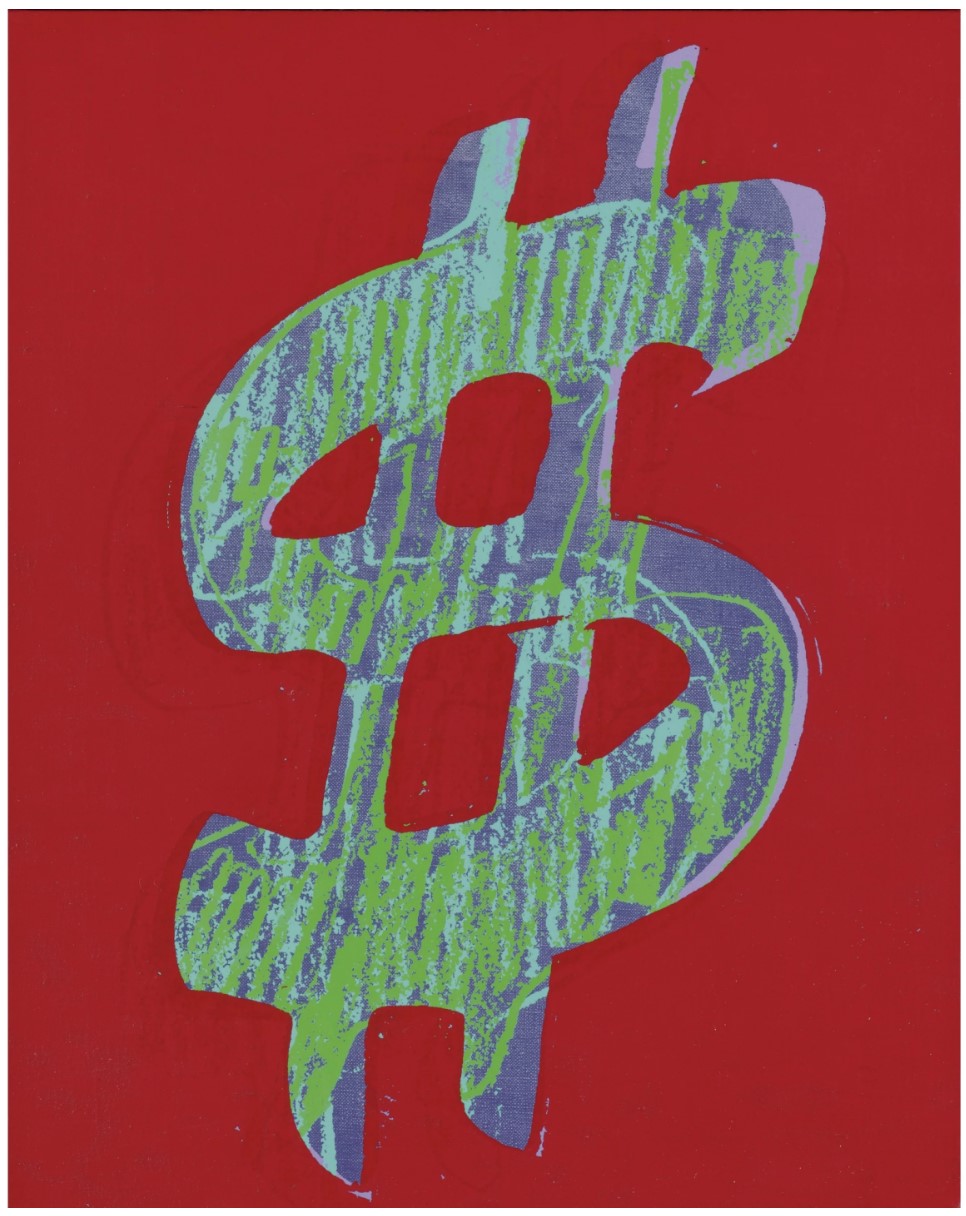
ANDY WARHOL
Dollar Sign, 1981
Synthetic polymer paint and silkscreen ink on canvas
20×16 inches (50.8 x 40.7 cm)
Dollar Sign, 1981
Christie’s New-York: 9 November 2011
Estimated: USD 400,000 – 600,000
USD 782,500
Andy Warhol (1928-1987) (christies.com)
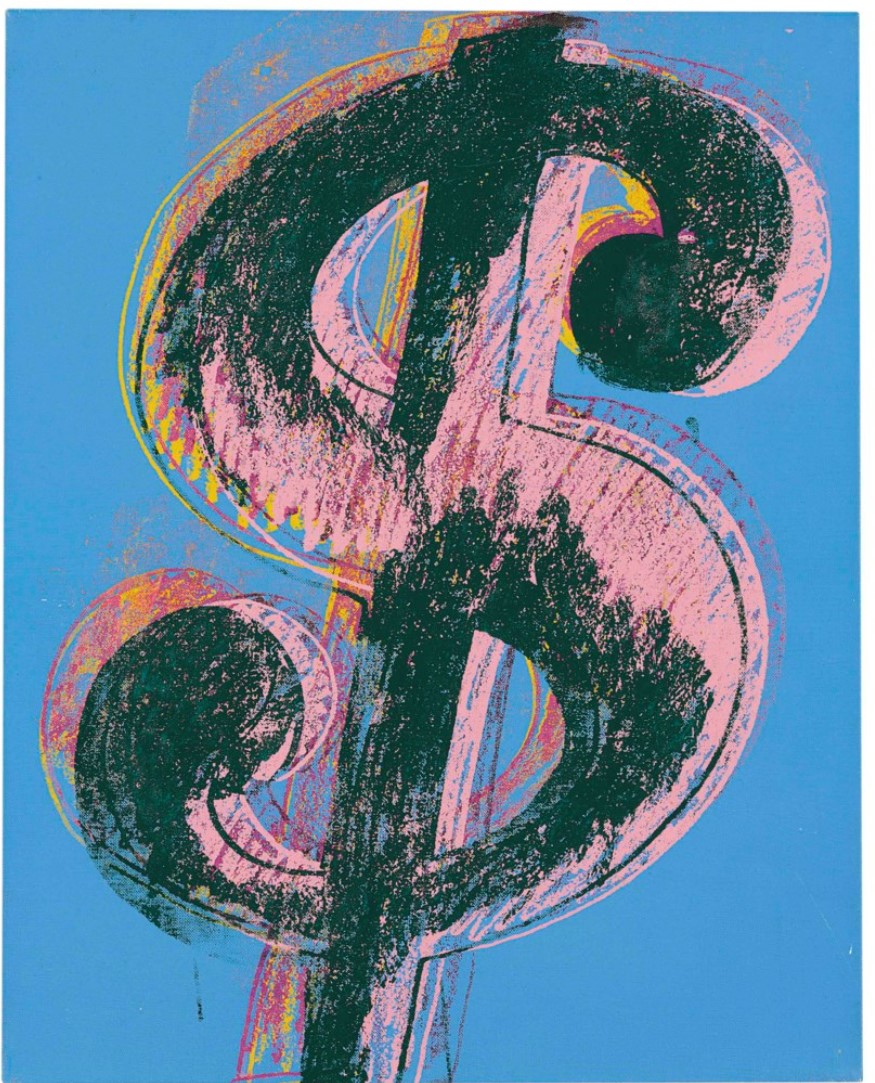
ANDY WARHOL
Dollar Sign, 1981
Synthetic polymer paint and silkscreen ink on canvas
20×16 inches (50.7 x 40.7 cm)
Signed and dated ‘Andy Warhol 81’ (on the overlap)
Dollar Sign, 1981
Sotheby’s New-York: 11 May 2011
Estimated: USD 250,000 – 350,000
USD 506,500
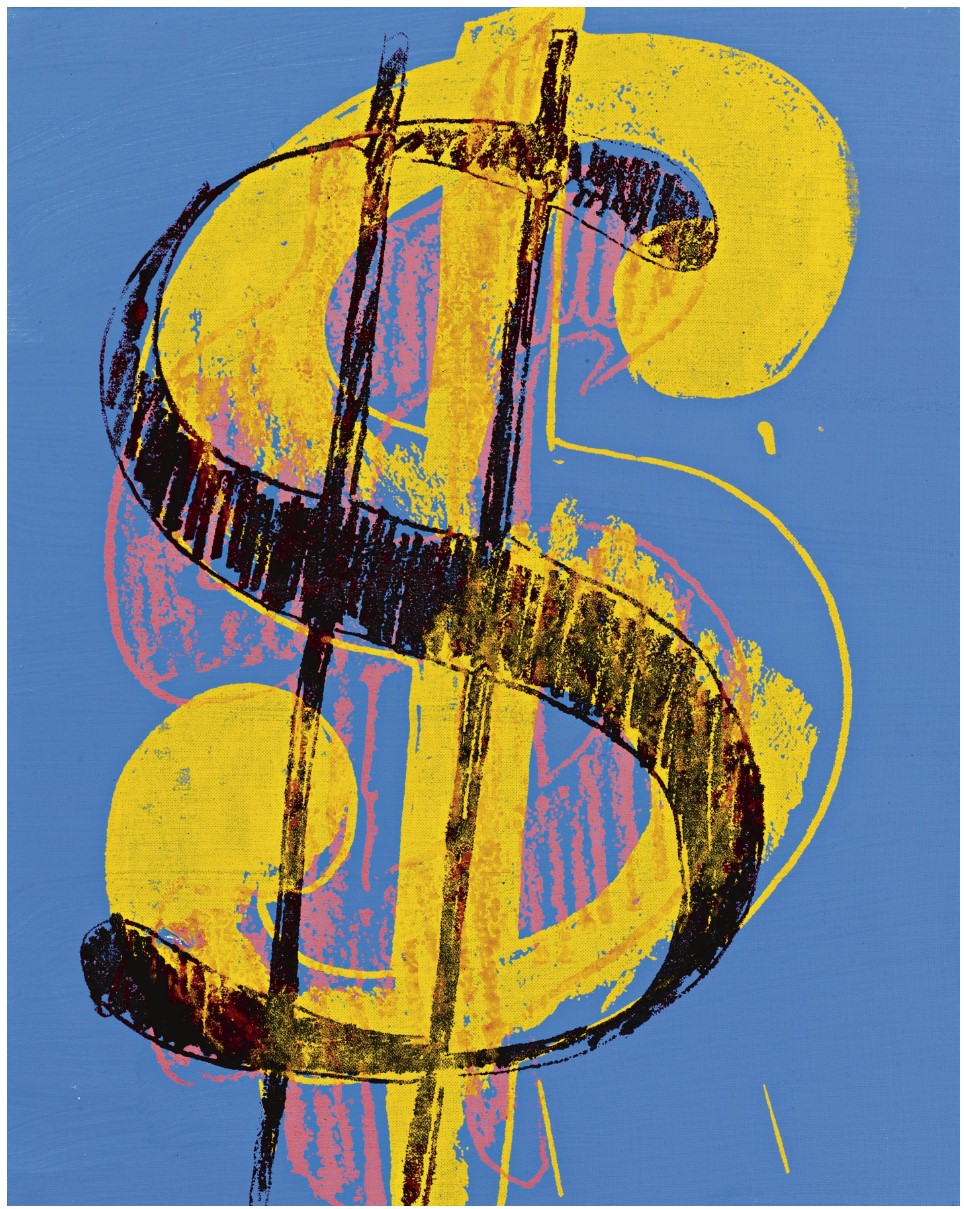
ANDY WARHOL
Dollar Sign, 1981
Synthetic polymer paint and silkscreen ink on canvas
20×16 inches (50.8 x 40.6 cm)
Dollar Sign (10×8)
Dollar Sign, 1981
Contours of Modernity | A Private European Collection
Sotheby’s London: 4 March 2026
Estimated: GBP 300,000 – 400,000
GBP 576,000 / USD 769,480
Dollar Sign | Modern & Contemporary Evening Auction | 2026 | Sotheby’s
REPEAT SALE
Christie’s London: 14 February 2012
Estimated: GBP 180,000 – 250,000
GBP 385,250
Andy Warhol (1928-1987) (christies.com)
ANDY WARHOL (1928 – 1987)
Dollar Sign, 1981
Acrylic and silkscreen ink on canvas
10×8 inches (25.8 x 20 cm)
Signed, dated 81 and dedicated To Enrico (on the overlap)
Provenance
Private Collection, New York (a gift from the artist)
Private Collection, New York (thence by descent from the above)
Christie’s, London, 14 February 2012, lot 2 (consigned by the above)
Acquired from the above sale by the present owner
Andy Warhol’s Dollar Sign from 1981 belongs to one of the most celebrated bodies of work from the artist’s late career. Executed nearly two decades after his first Dollar Bill paintings, this renewed engagement with overtly financial imagery allowed Warhol to probe with characteristic candor the porous boundary between fine art and commerce. Set against a rich lilac-blue ground, the solitary dollar sign is rendered in saturated tones of orange and red, and spans the height of the canvas. Isolated and enlarged, the motif assumes an almost totemic presence that is at once seductive, declarative and unmistakably iconic.
Dollar Sign, 1982
Christie’s London: 10 October 2024
Estimated: GBP 250,000 – 350,000
GBP 252,000 / USD 330,120
ANDY WARHOL (1928-1987), Dollar Sign | Christie’s (christies.com)
ANDY WARHOL (1928-1987)
Dollar Sign, 1982
Acrylic and silkscreen ink on canvas
10 x 8 1/8 inches (25.5 x 20.5 cm)
Signed and dedicated ‘Andy Warhol to Evelyn’ (on the overlap)
Provenance
Acquired directly from the artist by the present owner in 1982
Iconic, audacious, and unmistakable, Andy Warhol’s Dollar Sign (1982) is emblazoned with the symbol of the American dream. One of the Pop artist’s most celebrated late series, the vivid dollar sign encapsulates his masterful exploration of the visual language of desire. Here, it is tripled in deep purple, vermillion and gleaming gold against a searing fuchsia backdrop. Warhol gifted the present work to its owner, Professor Evelyn Welch, on the occasion of her wedding in 1982. It has remained in her collection ever since. A Renaissance scholar who studied at Harvard University before moving to the United Kingdom in 1981, Welch encountered Warhol in New York’s nightlife scene: he was a friend of her brother, the actor and filmmaker John Stockwell. She is the mother of the musician Florence Welch.
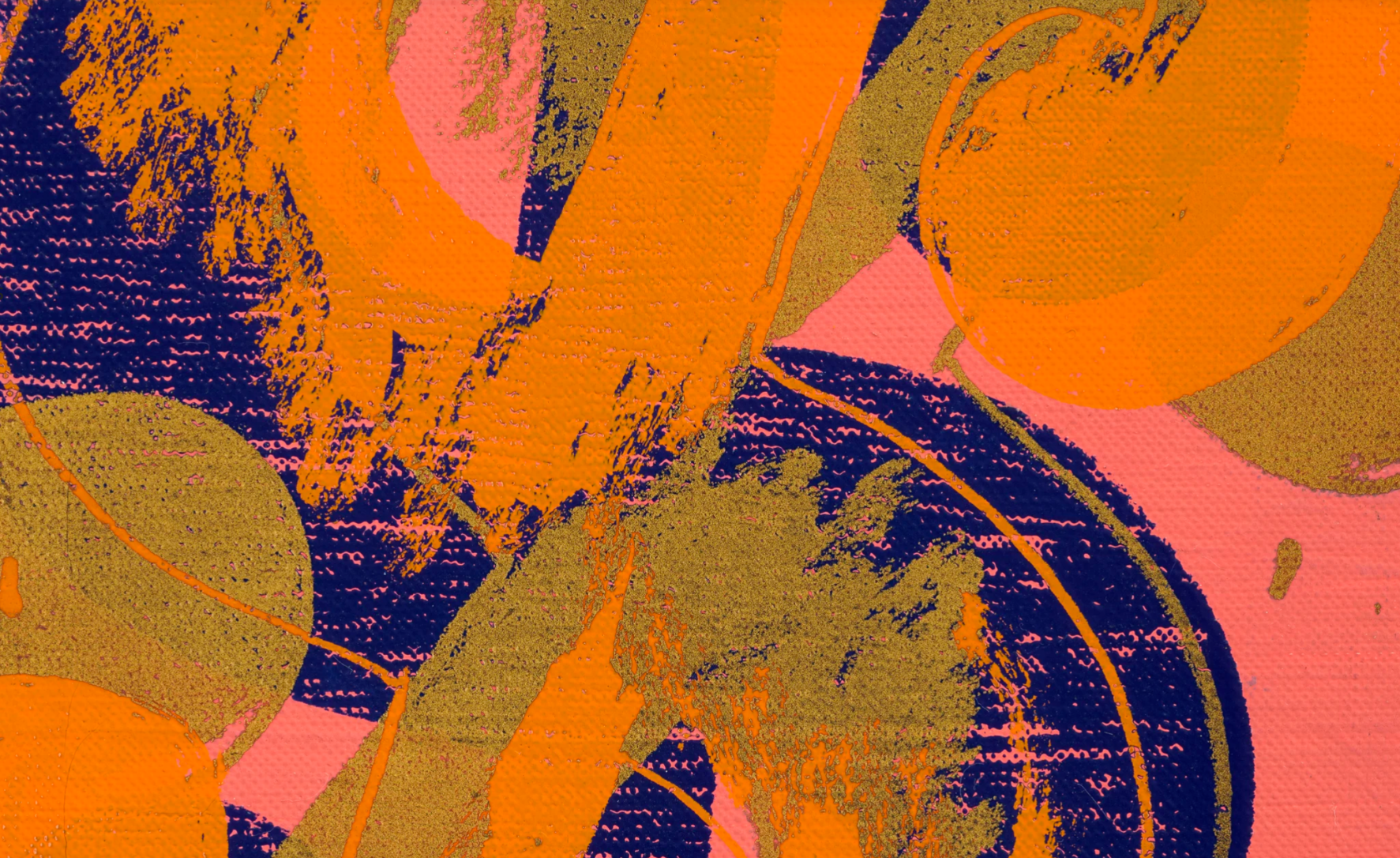
Warhol’s fascination with money can be traced throughout his career. His very first silkscreened works, created in the early 1960s, were based on his own hand-drawn images of one- and two-dollar bills. He once observed that ‘American money is very well designed, really. I like it better than any other kind of money’ (A. Warhol, quoted in The Philosophy of Andy Warhol: From A to B and back again, Orlando 1975, p. 137). In the 1980s Dollar Sign series, Warhol distilled the dollar to its essential and ubiquitous signifier. Printing onto canvas, he paralleled the mass-production of paper currency itself. Yet the works’ facture was nuanced and varied. Instead of copying a readymade image, Warhol created different silkscreens from his own drawings of the dollar sign. These variously reproduced the symbol’s outline or filled it with solid or partial, scribbled color. He overlaid multiple screenprints at dynamic angles—giving the effect of movement or shadow—and in an array of vibrant tonal combinations.
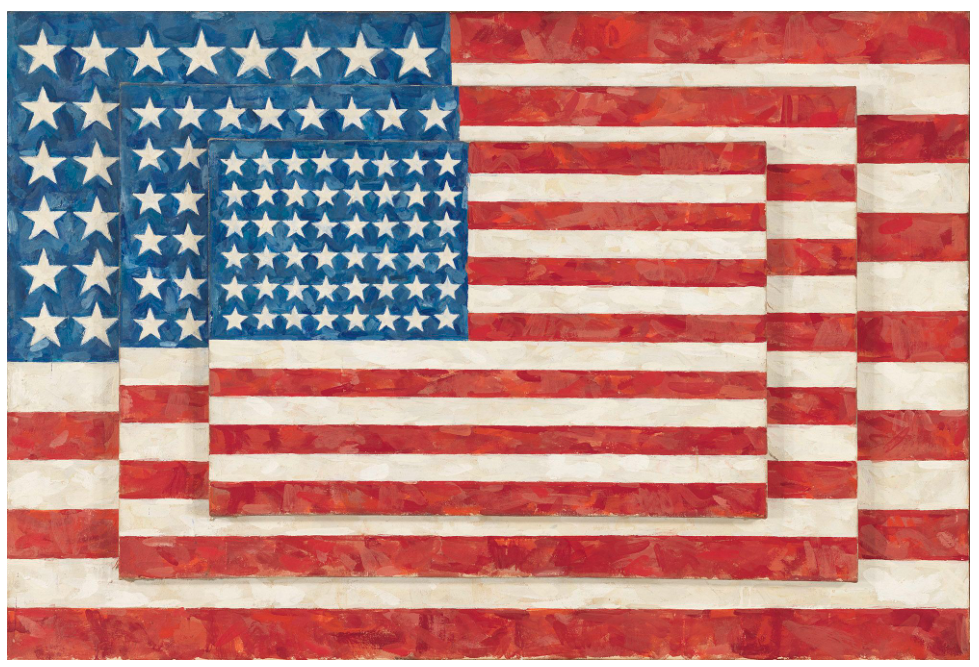
Jasper Johns, Three Flags, 1958. Whitney Museum of American Art, New York. Artwork: © Jasper Johns / VAGA, New York / DACS, London 2024. Digital Image: Whitney Museum of American Art / Licensed by Scala.
The Dollar Sign paintings were first exhibited at the Castelli Gallery, then the epicentre of the New York art scene, in 1982. Reflecting on the show, Warhol’s close friend and art critic David Bourdon said that they ‘appeared as prophetic emblems of the huge amounts of money that would pour into the art world during the following years’. They hung as ‘brazen, perhaps insolent reminders that pictures by brand-name artists are metaphors for money, a situation that never troubled [Warhol]’ (D. Bourdon, Warhol, New York 1989, p. 384). What’s more, the works coincided with the neoliberal ‘Reaganomic’ policies launched by President Ronald Reagan at the beginning of the 1980s. Warhol’s emblem shines like a beacon of economic growth. With its opulent golden paint, the present work nods to bullion and gold standards, while also evoking the gilded haloes of Byzantine icons and saints. Exalted to the realm of the sacred, Warhol’s dollar sign seems to satirically herald modern-day capitalism as America’s preferred ideological system, or indeed its faith. Other examples from the series are held in notable international collections including Tate, London; the Museum of Contemporary Art, Amsterdam; and the Musée d’Art Moderne et d’Art Contemporain, Nice.
Dollar Sign, 1982
Sotheby’s London: 10 October 2024
Estimated: GBP 450,000 – 650,000
GBP 690,000 / USD 903,900
Dollar Sign | Contemporary Day Auction | 2024 | Sotheby’s (sothebys.com)
REPEAT SALE
Bonhams London: 1 July 2015
GBP 409,012
Bonhams : Andy Warhol (1928-1987) Dollar Sign 1982
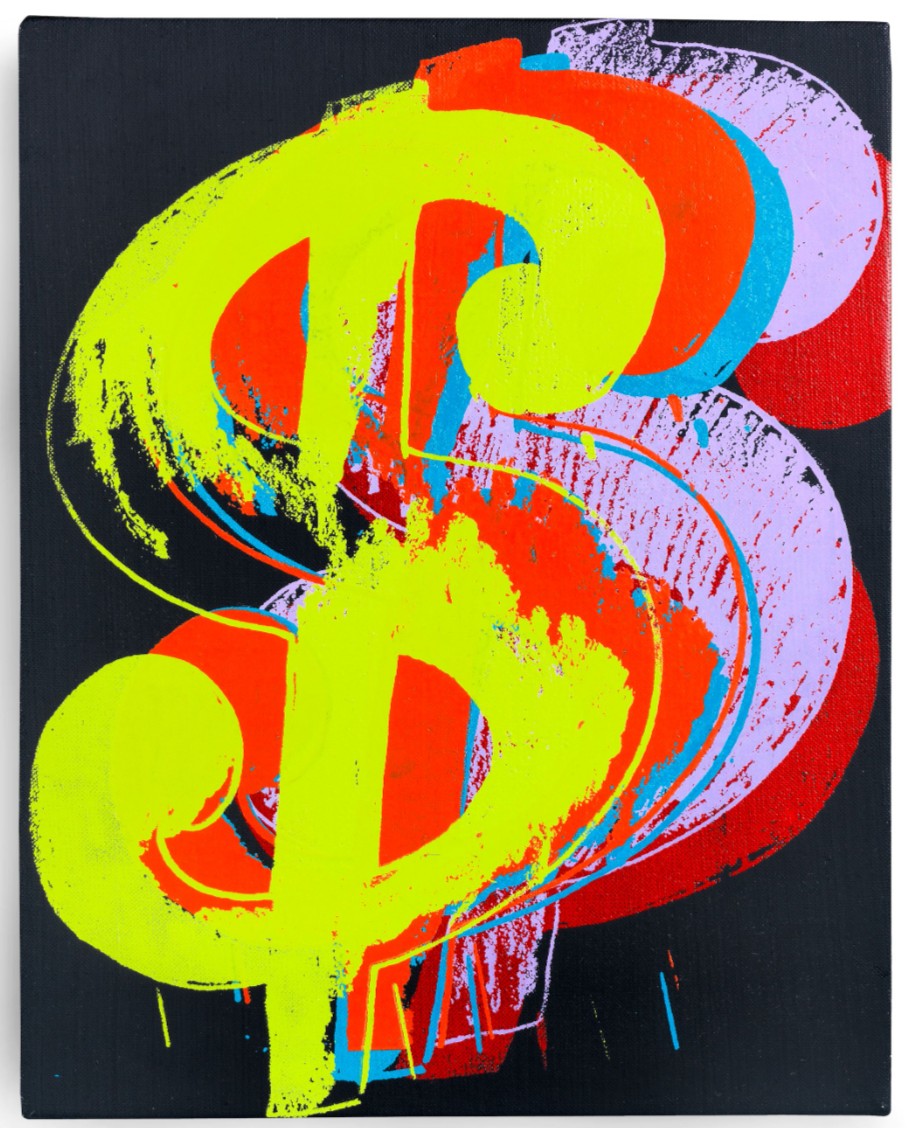
ANDY WARHOL (1928 – 1987)
Dollar Sign, 1982
Acrylic and silkscreen ink on canvas
14 x 10 7/8 inches (35.4 x 27.8 cm)
Signed and dated 82 (on the overlap)
Stamped by the Estate of Andy Warhol and the Andy Warhol Foundation for the Visual Arts, Inc.
Numbered A106.17 on the overlap
Provenance
Estate of the artist, New York
Kantor Gallery, Los Angeles
Private Collection
Bonhams, London, 1 July 2015, lot 21
Acquired from the above by the present owner
Executed nearly two decades after his first series of Money Paintings, Andy Warhol’s present Dollar Sign from 1982 marks the pinnacle of the artist’s career-long engagement with consumerism and the visual language of American capitalism. Drawing parallels to his earlier iconic works, which used motifs such as the Coca-Cola logo and the famous Campbell’s Soup Cans, Warhol isolates here the ultimate symbol of wealth: the dollar sign. By reducing the subject to this single, potent emblem, Warhol transcends his earlier explorations of commerce, focusing not on the objects that can be bought but on the symbol of the exchange itself. In Dollar Sign, the currency becomes a logo, an abstract representation of both the American Dream and more broadly, of wealth. In this exceptional example from the series, Warhol presents five distinct impressions of the dollar sign, overlapping in vibrant, contrasting colors against a deep black background. The richness of the paint and the vivid palette of yellow, orange, blue, purple, and red screens create a dynamic visual interplay, amplifying the intensity of the symbol.
The boldness and clarity of the motif, combined with the large size of the screens filling almost the entire plane of the canvas, elevate this work above others in the same series. Unlike much of Warhol’s oeuvre, which feature imagery from mass media and celebrity photographs, the Dollar Sign series is based on Warhol’s own hand-drawn depiction of the dollar symbol. Unable to find an existing image that met his exacting standards, Warhol created his own, demonstrating his often-overlooked skills as a draughtsman. The sketchy, gestural quality of the dollar sign in Dollar Sign harkens back to Warhol’s early career as a commercial illustrator, a role that allowed him to break into the New York art scene.
Dollar Sign, 1981
Phillips Hong-Kong: 1 June 2024
Estimated: HKD 2,800,000 – 3,800,000
HKD 3,048,000 / USD 390,219
Andy Warhol – Modern & Contemporary Ar… Lot 128 June 2024 | Phillips
ANDY WARHOL
Dollar Sign, 1981
Acrylic and silkscreen ink on canvas
9 7/8 x 7 7/8 inches (25.3 x 20.3 cm)
Signed and dated ‘81 Andy Warhol’ on the overlap
Provenance
Gifted by the artist to the present owner
Executed at the height of Andy Warhol’s pivotal career, Dollar Sign is an instantly recognizable work by the artist, hailing from his iconic and eponymous series. Drawing from Warhol’s lifelong fascination with commodity culture, the present work encapsulates the inextricable relationship between art and wealth through his implementation of the ubiquitous ‘$’ motif. Warhol’s earlier painting series such as Coca Cola and Campbell’s Soup confronted the dichotomy between high and low art, which ultimately came to define his significant oeuvre. In the present work, the artist takes the same approach by borrowing recognizable images, whereby reinventing the dollar symbol and amplifying it as Pop Art. The present iteration focuses even tighter on the essence of consumerism, utilizing the dollar sign motif as a symbol of cash and the American Dream. This directly subverts the general assumption of the bourgeois and the academic that art is above money. Indeed, in an ironically Warholian way, the Dollar Sign canvas symbolically reflects the artist’s accomplishment as it has become an icon of popular culture itself and thus, a currency in its own right.

Layers of saturated color pulsate through Dollar Sign with the off-set multiple impressions and silhouette of the ‘$’. The printed screen of forest-green creates a striking contrast against the black painted background and a final layer of blazing red is superimposed in a more scribbled format, drawing a direct link to Warhol’s Campbell’s Soup works which too, are powerful in their bold reinvention of what is considered as acceptable in art. Although intricate in size, the enlarged symbol permeates the entire surface of the canvas, signifying the immense power of wealth. Conjuring a sense of three-dimensional depth, these layers are rendered with the immaculate clarity of the artist’s refined silkscreen technique.
Dollar Sign, 1982
Seoul Auction: 19 December 2023
Estimated: KRW 600,000,000 – 1,200,000,000
KRW 778,800,000 / USD 598,118
ANDY WARHOL
Dollar Sign, 1982
Synthetic polymer and silkscreen inks on canvas
10 x 7.9 inches (20 x 25.3 cm)
Signed and dated on the overlap
Dollar Sign, 1981
Christie’s New-York: 10 November 2023
Estimated: USD 300,000 – 500,000
USD 340,200
ANDY WARHOL (1928-1987), Dollar Sign | Christie’s (christies.com)
REPEAT SALE
Sotheby’s New-York: 18 November 2016
Estimated: USD 250,000 – 350,000
USD 420,500
(#203) Andy Warhol (sothebys.com)
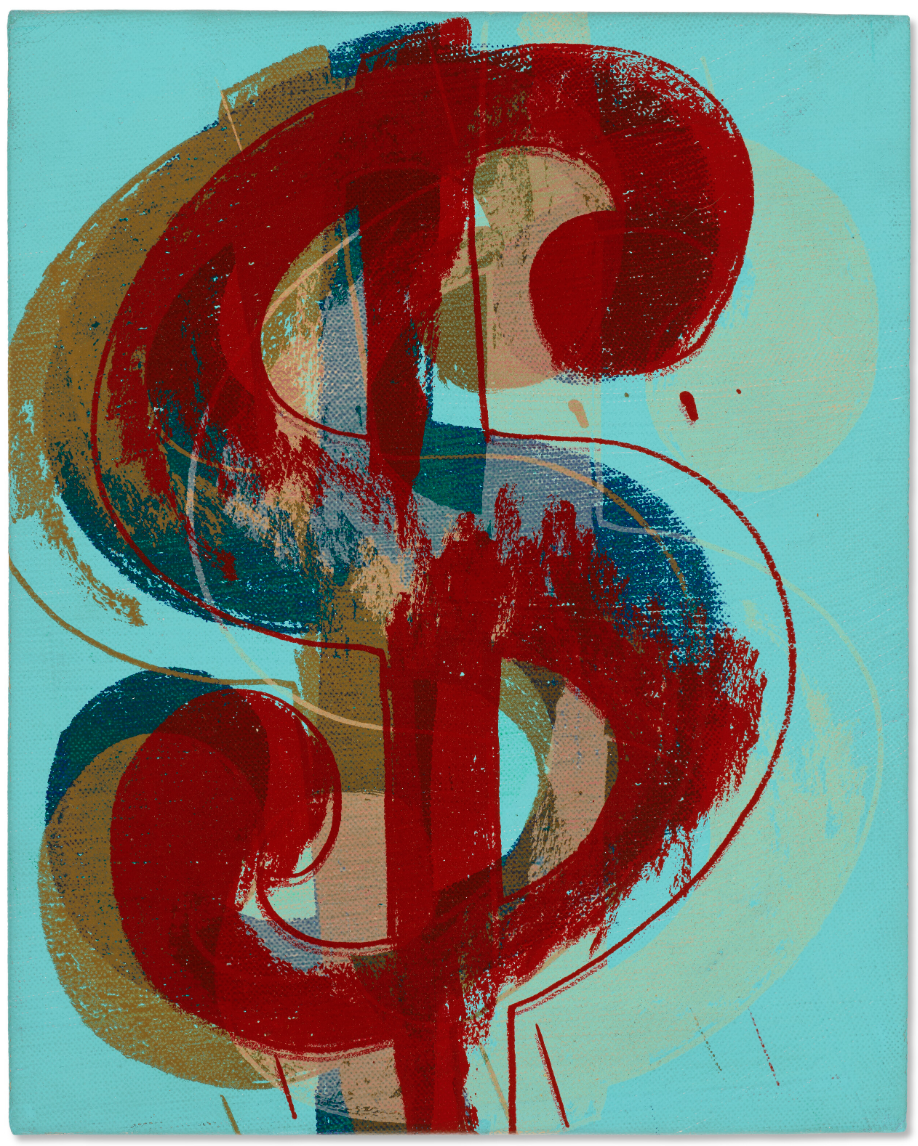
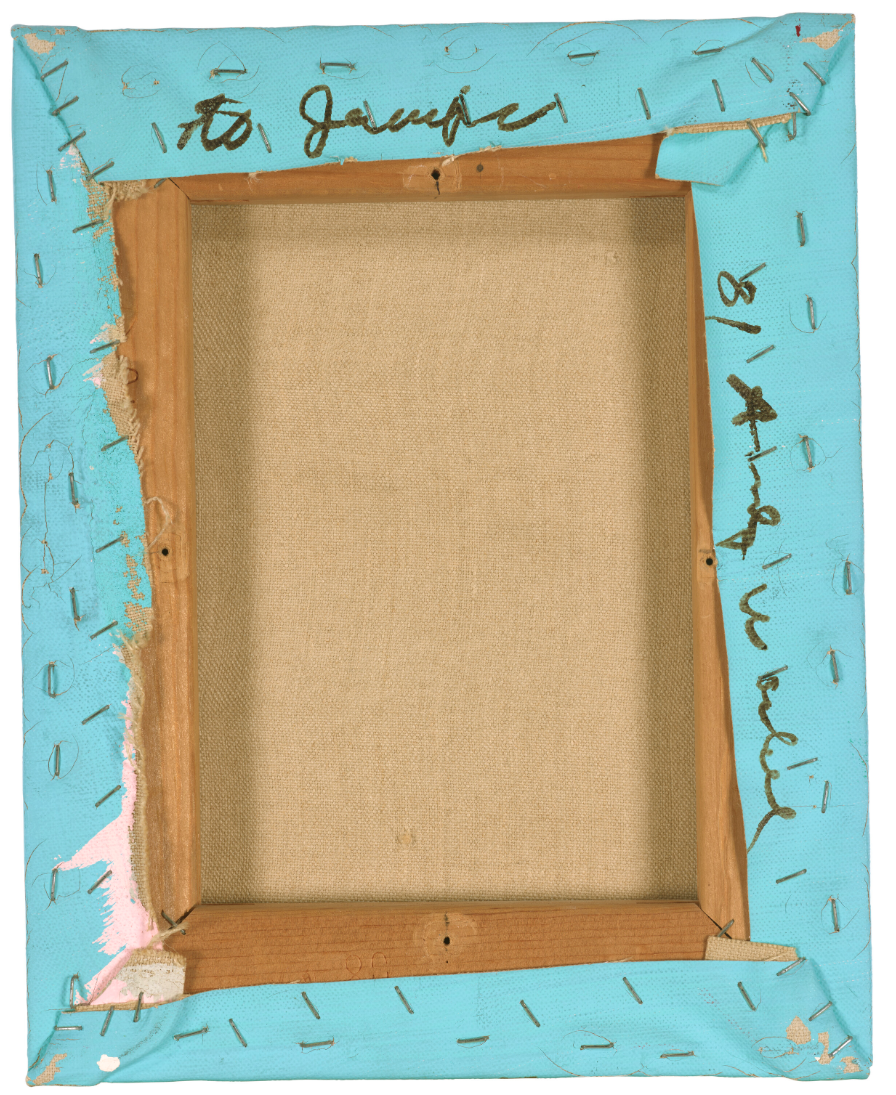
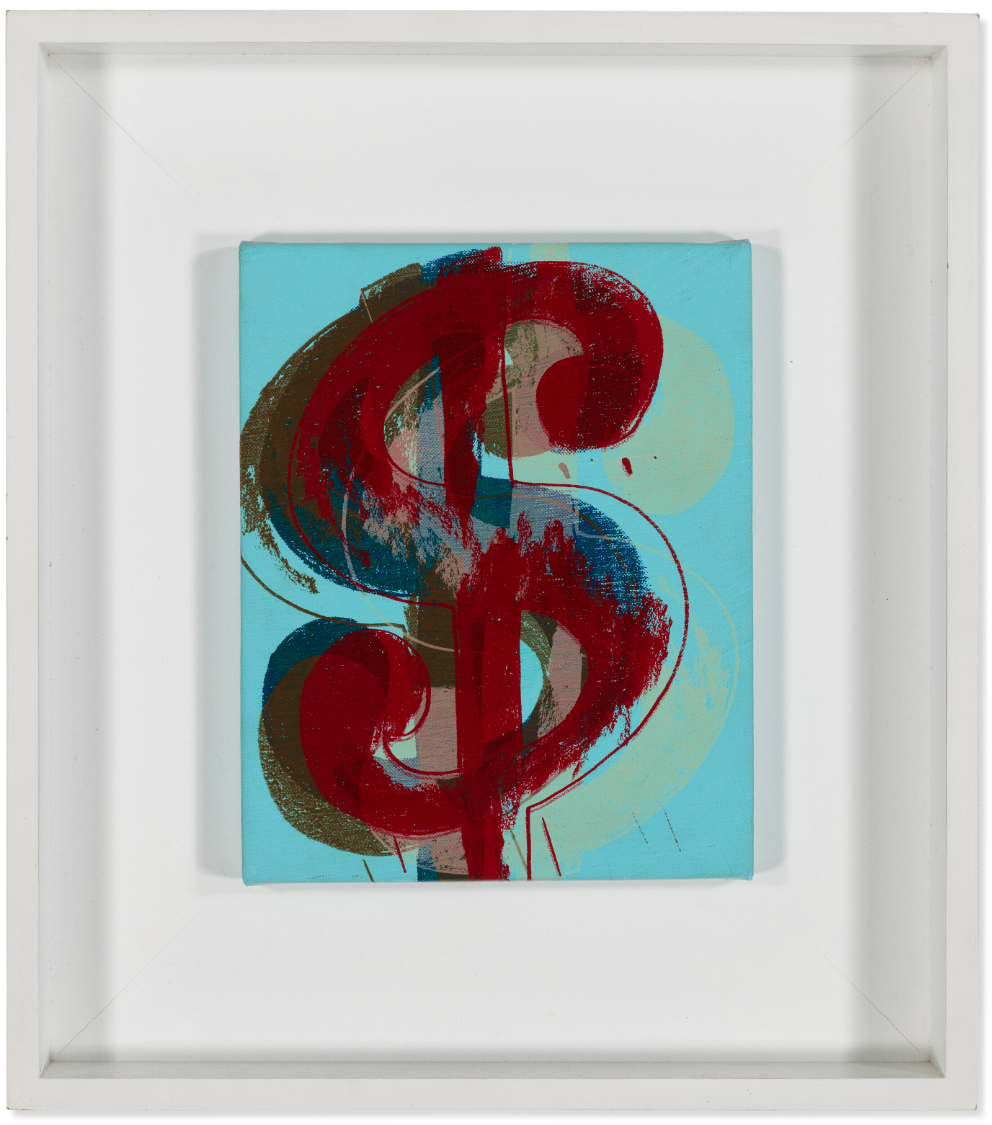
ANDY WARHOL (1928-1987)
Dollar Sign, 1981
Acrylic and silkscreen ink on canvas
10×8 inches (25.4 x 20.3 cm)
Signed, dedicated and dated ‘to Jennifer 81 Andy Warhol’ (on the overlap)
Provenance
Private collection, 1983, gift of the artist
Anon. sale; Sotheby’s, New York, 18 November 2016, lot 203
David Benrimon Fine Art, New York
Acquired from the above by the present owner
“Making money is art and working is art and good business is the best art.”
Dollar Sign, 1981
Christie’s London: 14 October 2023
Estimated: GBP 300,000 – 500,000
GBP 327,600 / USD 397,235
ANDY WARHOL (1928-1987), Dollar Sign | Christie’s
REPEAT SALE
Sotheby’s London: 13 February 2014
Estimated: GBP 180,000 – 250,000
GBP 362,500
ANDY WARHOL (1928-1987)
Dollar Sign, 1981
Acrylic and silkscreen ink on canvas
9 7/8 x 8 inches (25.2 x 20.2 cm)
Signed, dedicated and dated ‘To Jade Andy Warhol 81’ (on the overlap)
Provenance
Jade Jagger Collection, London (acquired directly from the artist)
Anon. sale, Sotheby’s London, 13 February 2014, lot 211
Acquired at the above sale by the present owner
Iconic, audacious, and unmistakable, Andy Warhol’s Dollar Sign is emblazoned with the symbol of the American dream. One of his most celebrated late series, the vivid dollar sign encapsulates the Pittsburgh-born artist’s enduring obsessions: money, celebrity, consumption and mass-production. Layering searing red, pink and gold, the present work’s symbol electrifies the pale blue canvas, reverberating with an onomatopoeic cha-ching. Painted in 1981, by which time Warhol was firmly positioned as the foremost Pop artist of his generation, Dollar Sign speaks to the artist’s own successful navigation of the booming commercial art world. Originally gifted to Jade Jagger, daughter of Warhol’s close friends Mick and Bianca Jagger, the work testifies to the legendary screenprint as the artist’s own form of social currency among the glamorous New York upper echelons. In his signature, brazen style, here, Warhol confronts head-on the ever-relevant connection between art and money.
Dollar Sign, 1981
Christie’s New-York: 29 September 2023
Estimated: USD 300,000 – 500,000
USD 491,400
ANDY WARHOL (1928-1987) (christies.com)
REPEAT SALE
Sotheby’s London: 2 July 2015
GBP 245,000
Results for “andy warhol dollar sign”
ANDY WARHOL (1928-1987)
Dollar Sign, 1981
Acrylic and silkscreen ink on canvas
10 1/4 x 8 inches (26 x 20.3 cm)
Signed and dated ‘1981 Andy Warhol’ (on the overlap)
Provenance
Martin Lawrence Galleries, Beverly Hills
Jem Alexander Galerie, Westchester
Their sale; Sotheby’s, New York, 5 November 1987, lot 167
Private collection
Anon. sale; Sotheby’s, London, 2 July 2015, lot 225
Acquired at the above sale by the present owner
Painted in 1981, Dollar Sign is an iconic example of one of Andy Warhol’s most enduring and instantly- recognizable motifs. The Dollar Sign paintings were first shown in 1982 at the Castelli Gallery – the epicenter of New York’s art world at the time. Indeed, the Greene Street gallery space was entirely devoted to Warhol’s bold canvases, each painted in different opulent color schemes. With its exceptionally crisp silkscreen, the smooth gradient from blue to black, and the pale blue background juxtaposed with nuanced shades of tangerine and chartreuse, the present lot shows Warhol at his best and most technically focused.
Dollar Sign, 1981
Sotheby’s London: 30 June 2022
Estimated: GBP 300,000 – 500,000
GBP 567,000 / USD 689,445
Dollar Sign | Modern & Contemporary Day Auction | 2022 | Sotheby’s (sothebys.com)
REPEAT SALE
Sotheby’s London: 16 February 2012
Estimated: GBP 180,000 – 250,000
GBP 289,250 / USD 456,905
Results for “andy warhol dollar sign”
ANDY WARHOL
Dollar Sign, 1981
Acrylic and silkscreen ink on canvas
10.1 x 8.1 inches (25.6 x 20.6 cm)
Signed, dated 81 and dedicated to Lord Jo on the overlap
Provenance
Gagosian, New York
Mulier Mulier Gallery, Knokke-Zoute
Private Collection, Belgium
Sotheby’s, London, 16 February 2012, Lot 250
Acquired from the above by the present owner
Executed nearly two decades after the first of Warhol’s money paintings, the single Dollar Sign series of the early 1980s provides the ultimate expression of his lifelong fascination with consumerism. Like Warhol’s first Pop paintings which examined the relationship between big business and the common man through enlarged icons of consumerism like Coca Cola and Campbell’s Soup, Warhol here similarly takes the currency of this relationship and presents it with all the brazen euphoria synonymous with that decade. No longer taking the entire bill as their subject but instead focusing upon the unabashed icon of money – the isolated ‘$’ – Warhol hones in on arguably the biggest brand of all. One of the most recognizable logos anywhere in the world, the ‘$’ sign is simultaneously a symbol of the American Dream and an international denominator for wealth. Isolated on a rich lavender ground, the currency symbol takes on an almost totemic status. Pulsating through the saturated layer of pure colour, off-set multiple impressions of the ‘$’ motif in shades of red, orange, green and gold appear to throb against the background. Filling the entire height of the small-scale canvas, this oversized symbol of wealth is rendered with the immaculate clarity of Warhol’s perfected silkscreen technique. Money became an obsession for Warhol, and was perhaps his personal biography that drew him to the subject; the artist’s childhood was spent in depression-era Pittsburgh before fleeing to New York City.
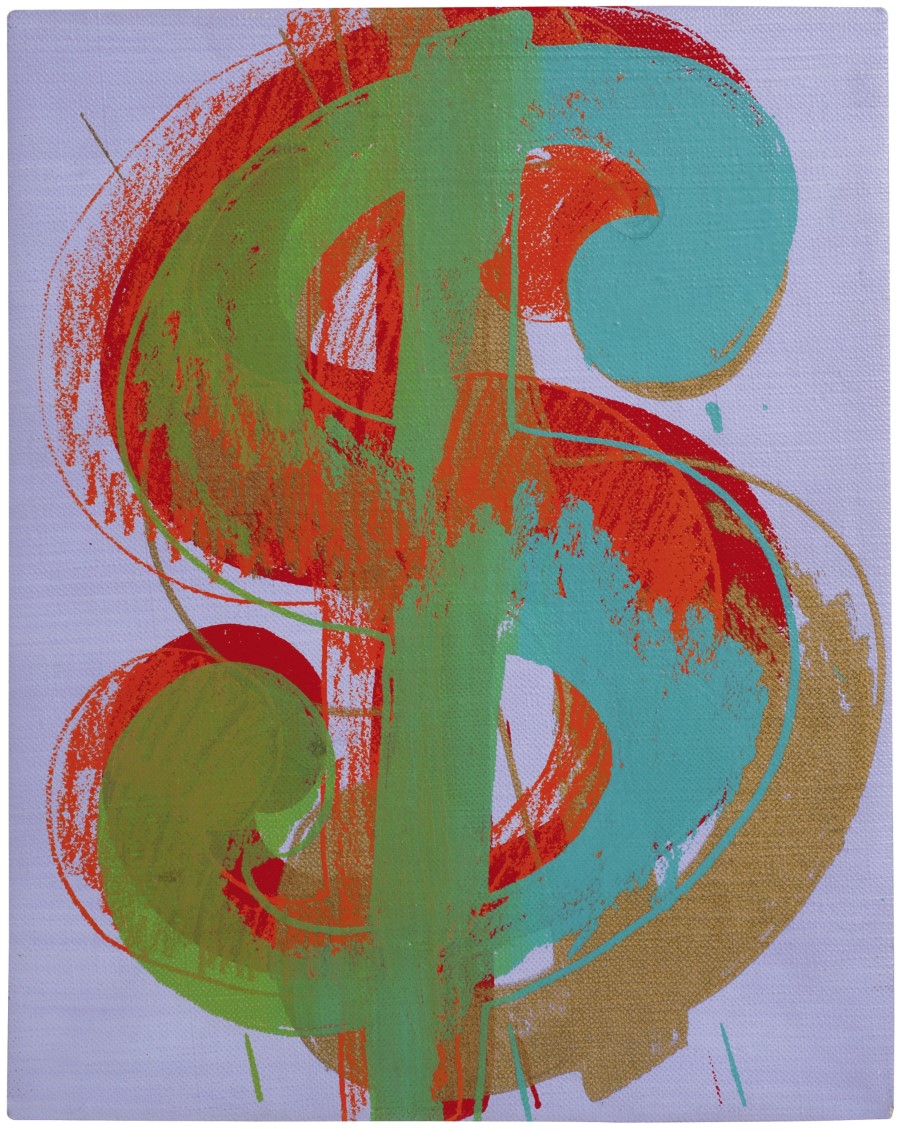
ANDY WARHOL
Dollar Sign, 1981
Acrylic and silkscreen ink on canvas
10×8 inches (25.4 x 20.3 cm)
Dollar Sign, 1981
Sotheby’s Hong-Kong: 28 April 2022
Estimated: HKD 3,200,000 – 5,200,000
HKD 3,654,000 / USD 465,691
Andy Warhol 安迪・沃荷 | Dollar Sign 美元符號 | Contemporary Day Auction | 2022 | Sotheby’s (sothebys.com)
ANDY WARHOL
Dollar Sign, 1981
Acrylic and silkscreen ink on canvas
10×8 inches (25.3 x 20 cm)
Provenance
Collection of Jack Heinz, New York
Lansberg Gallery, Paris
Private Collection, Switzerland
Acquired from the above by the present owner
Dollar Sign, 1982
Phillips London: 14 October 2022
Estimated: GBP 400,000 – 600,000
GBP 603,300 / USD 676,345
Andy Warhol – 20th Century & Contemp… Lot 28 October 2022 | Phillips
REPEAT SALE
Phillips Hong-Kong: 8 June 2021
Estimated: HKD 3,500,000 – 5,500,000
HKD 6,542,000 / USD 843,052
Andy Warhol – 20th Century & Contempora… Lot 23 June 2021 | Phillips
ANDY WARHOL
Dollar Sign, 1982
Acrylic and silkscreen ink on canvas
9 7/8 x 7 7/8 inches (25.3 x 20.3 cm)
Signed and dated ’82 Andy Warhol’ on the overlap
Provenance
Barrington Gallery, New York
Private Collection, Germany (acquired from the above in 1993)
Sotheby’s, London, 11 February 2015, lot 168
Private Collection (acquired at the above sale)
Phillips, Hong Kong, 8 June 2021, lot 23
Acquired at the above sale by the present owner
The present iteration of his instantly recognizable series is particularly alluring, composed of a painted vermillion background onto which a printed screen marks the forest-green silhouette of a dollar symbol. A second symbol is printed on top, in bill-green, and the final layer is a more-scribbled rendering of the ‘$’ but in a shade of red that draws a direct link to his Campbell’s Soup works which too, are powerful in their bold reinvention of what is allowed in art. Whilst both signature series epitomize Warhol’s fascination with commodity culture, the dollar symbol motif focuses even tighter on its essence: cash, directly subverting the historically general presumption of the bourgeois and the academic that art is above money. Indeed, in an ironically Warholian way, the ‘$’ canvas symbolically reflects his accomplishment as it has become an icon of popular culture itself and thus, a currency in its own right.
Dollar Sign, 1981
Sotheby’s New-York: 13 May 2021
Estimated: USD 300,000 – 500,000
USD 478,800
Dollar Sign | Contemporary Art Day Auction | 2021 | Sotheby’s (sothebys.com)
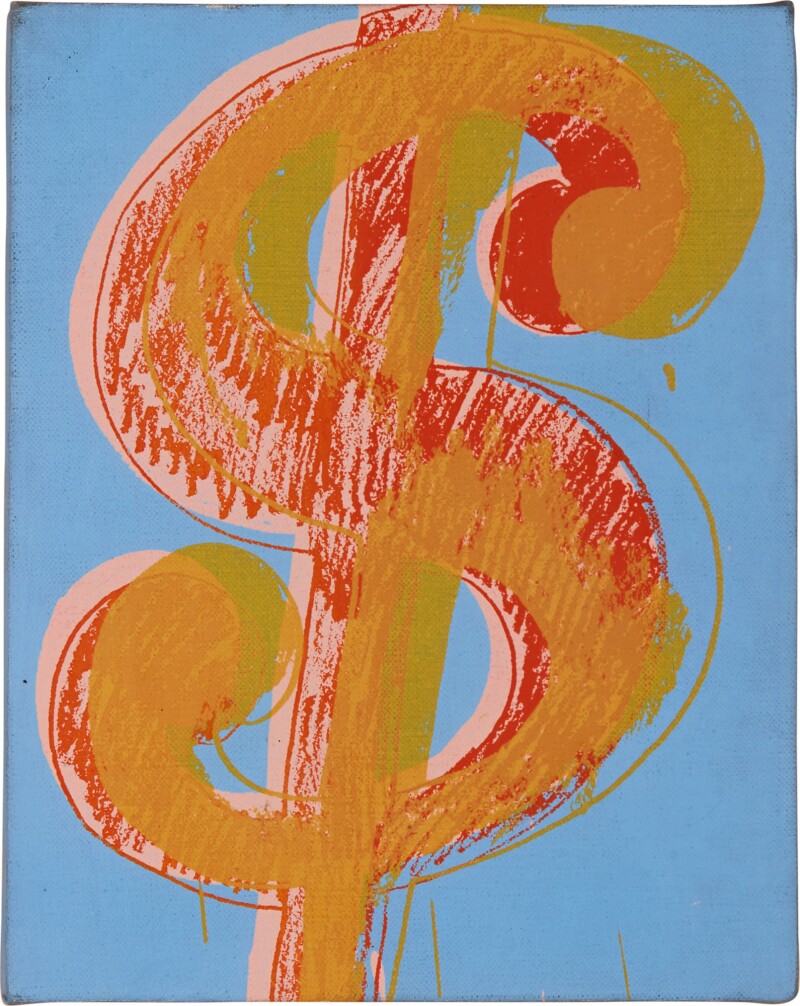
ANDY WARHOL
Dollar Sign, 1981
Acrylic and silkscreen ink on canvas
10×8 inches (25.4 x 20.3 cm)
Provenance
Collection of Keith Haring (acquired directly from the artist in 1983)
Gift of the above to the present owner in 1984
Dollar Sign perfectly captures Andy Warhol’s extraordinary ability to appropriate, subvert, and reinvent the motifs of consumer culture using his inimitable Pop aesthetic. The present work was given as a gift to his friend and fellow artist Keith Haring in 1983, a testament to their respect for one another during the height of their stardom. Perhaps, it was Warhol’s personal biography that drew him to the subject; the artist’s childhood was spent in depression-era Pittsburgh before fleeing to New York City. Created in 1981, this series captures the zeitgeist of the 1980s, a decade in which financial wealth surged after the dispiriting economic recession of the 1970s.
A combination of periwinkle, crimson red, soft pink, chartreuse, and gold, Warhol presents an equally painterly and graphic depiction of the American symbol of currency. A playful and colorful distillation of Warhol’s core artistic concerns, Dollar Sign mirrors the artist’s own transformation into an icon of contemporary art and international commercial success.
Dollar Sign, 1982
Sotheby’s New-York: 17 November 2020
Estimated: USD 250,000 – 350,000
USD 528,200
Dollar Sign | Contemporary Art Day Auction | 2020 | Sotheby’s (sothebys.com)
REPEAT SALE
Christie’s London: 28 June 2012
Estimated: GBP 120,000 – 180,000
GBP 217,250
Andy Warhol (1928-1987) , Dollar Sign | Christie’s
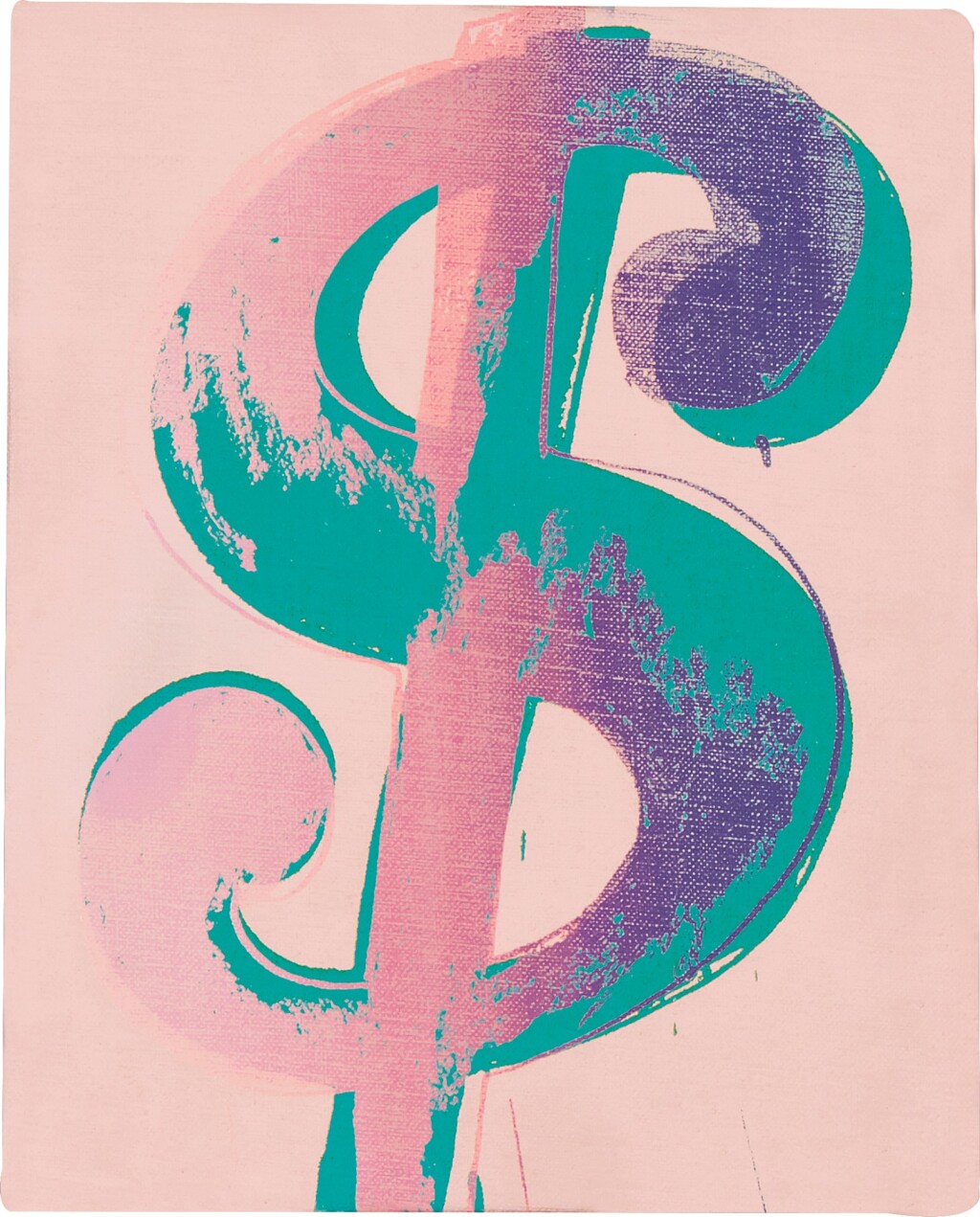
ANDY WARHOL
Dollar Sign, 1982
Acrylic and silkscreen ink on canvas
10×8 inches (25.4 x 20.3 cm)
Provenance
Private Collection, New York (gift of the artist)
Sotheby’s, New York, 27 February 1990, Lot 220
Private Collection (acquired from the above sale)
Christie’s, London, 28 June 2012, Lot 241
Acquired from the above sale by the present owner
Dollar Sign, 1981
Christie’s Hong-Kong: 10 July 2020
Estimated: HKD 2,200,000 – 3,200,000
HKD 2,250,000 / USD 290,300
Andy Warhol (1928-1987) (christies.com)
ANDY WARHOL
Dollar Sign, 1981
Acrylic and silkscreen ink on canvas
10×8 inches (25×20 cm)
Signed, inscribed and dated ‘Iolas Andy Warhol 81’ (on the reverse)
Provenance
Alexander Iolas, New York
Private Collection, New York
Private Collection, New York, by descent from the above
Acquired from the above by the present owner, 2013
Crackling with iconic energy, Dollar Sign (1981) is a jewel-like work from one of Andy Warhol’s most celebrated late series. Against a deep purple background, four superimposed silkscreens – in orange, yellow, glittering gold and pale blue – come together to depict a vivid dollar sign. Warhol prepared his screens by filling their stencil outlines with gestural, pencilled scrawls, which vibrate in the present work’s dynamic, off-kilter printing; sparks of colour fly as if the sign is ablaze. Painted in 1981, the Dollar Signs evoke the heady promise of the socalled ‘Reaganomics’ espoused by Ronald Reagan at the dawn of the 1980s, which ushered in a prolonged era of economic growth. Warhol had even attended the swearing-in of the new president on 20th January, 1981, in Washington, D.C. The Dollar Signs were first exhibited at the Castelli Gallery on Greene Street in January the following year, and became particularly evocative of the booming art world of 1980s New York, which made overnight stars of Jean-Michel Basquiat and Julian Schnabel, among others.
Dollar Sign, 1982
Sotheby’s London: 27 June 2019
Estimated: GBP 400,000 – 600,000
GBP 471,000 / USD 597,109
(#142) ANDY WARHOL | Dollar Sign (sothebys.com)
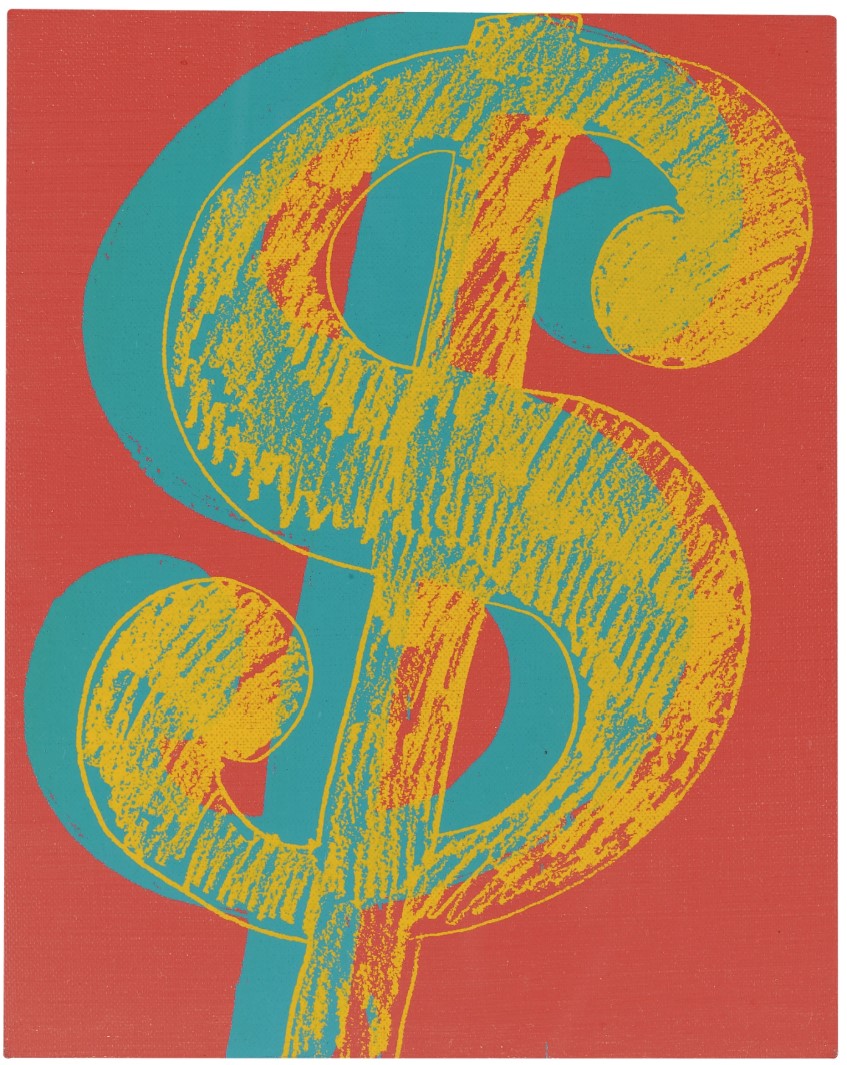
ANDY WARHOL
Dollar Sign, 1982
Acrylic and silkscreen ink on canvas
10×8 inches (25.4 x 20.3 cm)
Dollar Sign, 1981
Christie’s New-York: 16 November 2018
Estimated: USD 250,000 – 350,000
USD 408,500
Andy Warhol (1928-1987) (christies.com)
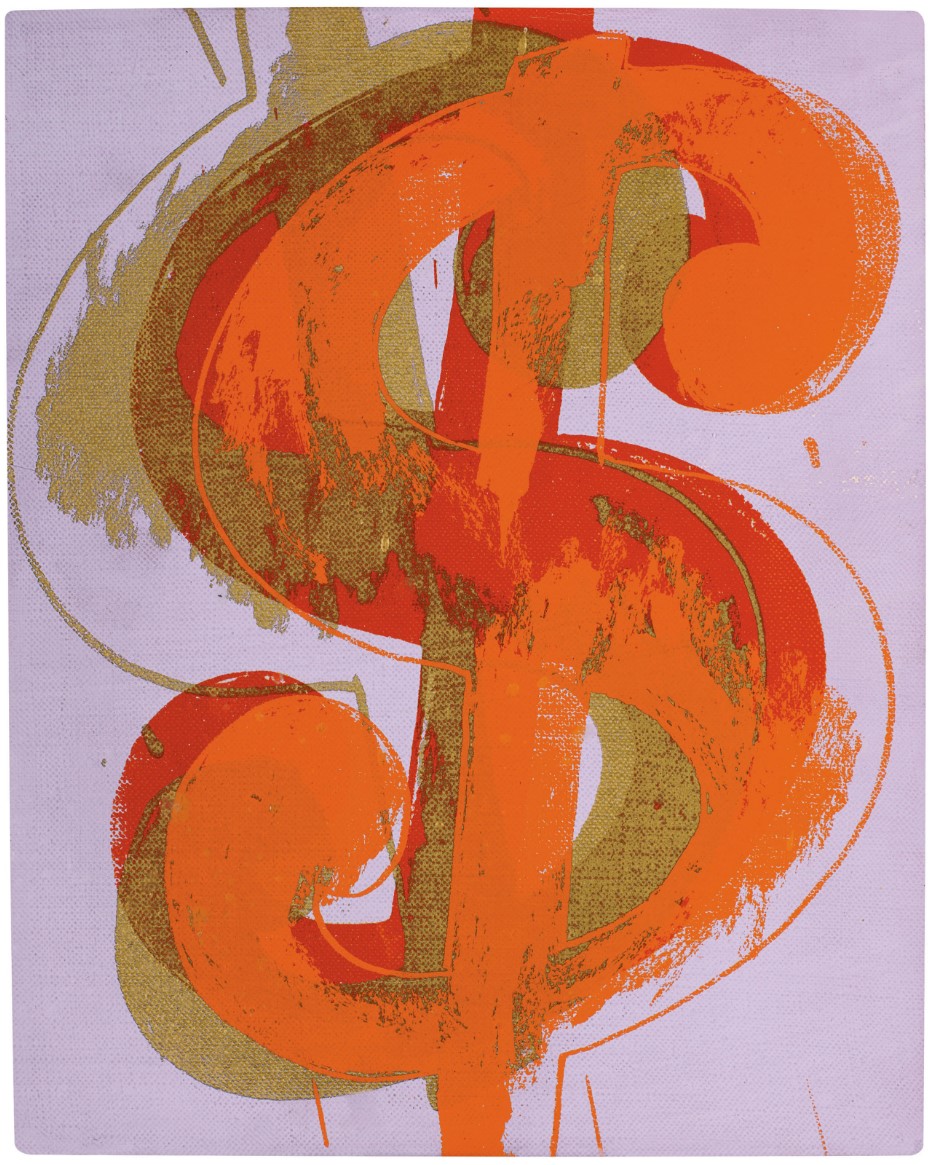
ANDY WARHOL
Dollar Sign, 1981
Synthetic polymer and silkscreen ink on canvas
10×8 inches (25.4 x 20.3 cm)
Signed, dedicated and dated ‘Marina Schiano Andy Warhol 81’ (on the overlap)
Provenance
Marina Schiano, Brazil, acquired directly from the artist
Acquired from the above by the present owner, circa 2000
Dedicated on the reverse of the painting to Marina Schiano, a muse of Yves Saint Laurent’s, this Dollar Sign is a prime example of how Andy Warhol was fond of gifting his small paintings to close friends and acquaintances. Andy was said to be quite enraptured by Schiano and even put her on the cover of Interview magazine in 1980, just one year before dedicating this painting to her. Rendered on a cool lavender background, the warm, autumnal tones of the dollar sign pop out to the viewer, becoming almost three-dimensional. Ultimately, this small but full-of-life painting not only demonstrates Warhol’s masterful ability to create lasting pop works of art but also his thoughtfulness and dedication towards his friends and acquaintances.
Dollar Sign, 1982
Sotheby’s London: 20 September 2018
Estimated: GBP 200,000 – 300,000
GBP 730,000 / USD 966,245
(#6035) ANDY WARHOL | Dollar Sign (sothebys.com)
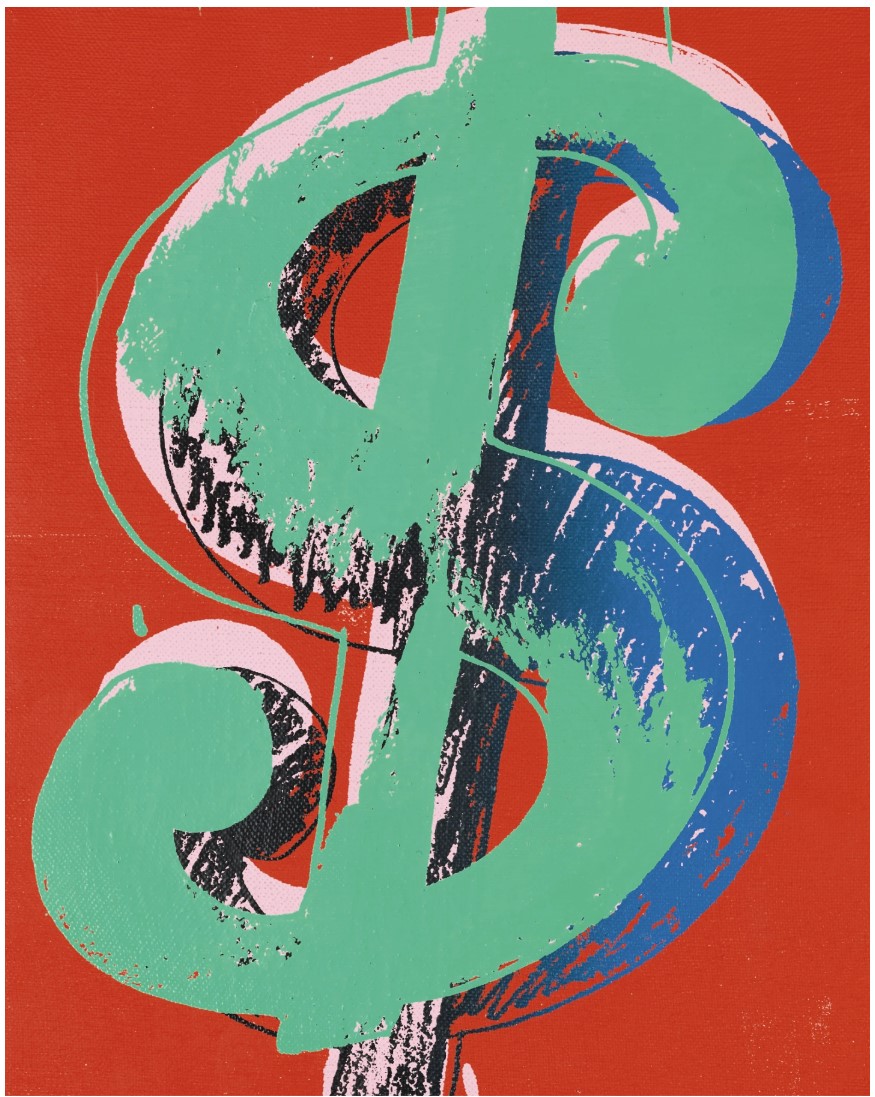
ANDY WARHOL
Dollar Sign, 1982
Acrylic and silkscreen ink on canvas
10×8 inches (25.4 x 20.3 cm)
Signed, dated 82 and variously inscribed on the overlap
Variously inscribed on the stretcher
Signed and dedicated David, Philip on the reverse
Provenance
David Whitney, New York (a gift from the artist in June 1984)
The Estate of David Whitney, New York (by descent)
Sotheby’s, New York, 15 May 2008, Lot 213
Acquired from the above by the present owners
Dollar Sign, 1981
Christie’s New-York: 3 March 2017
Estimated: USD 250,000 – 350,000
USD 187,500
Andy Warhol (1928-1987), Dollar Sign | Christie’s
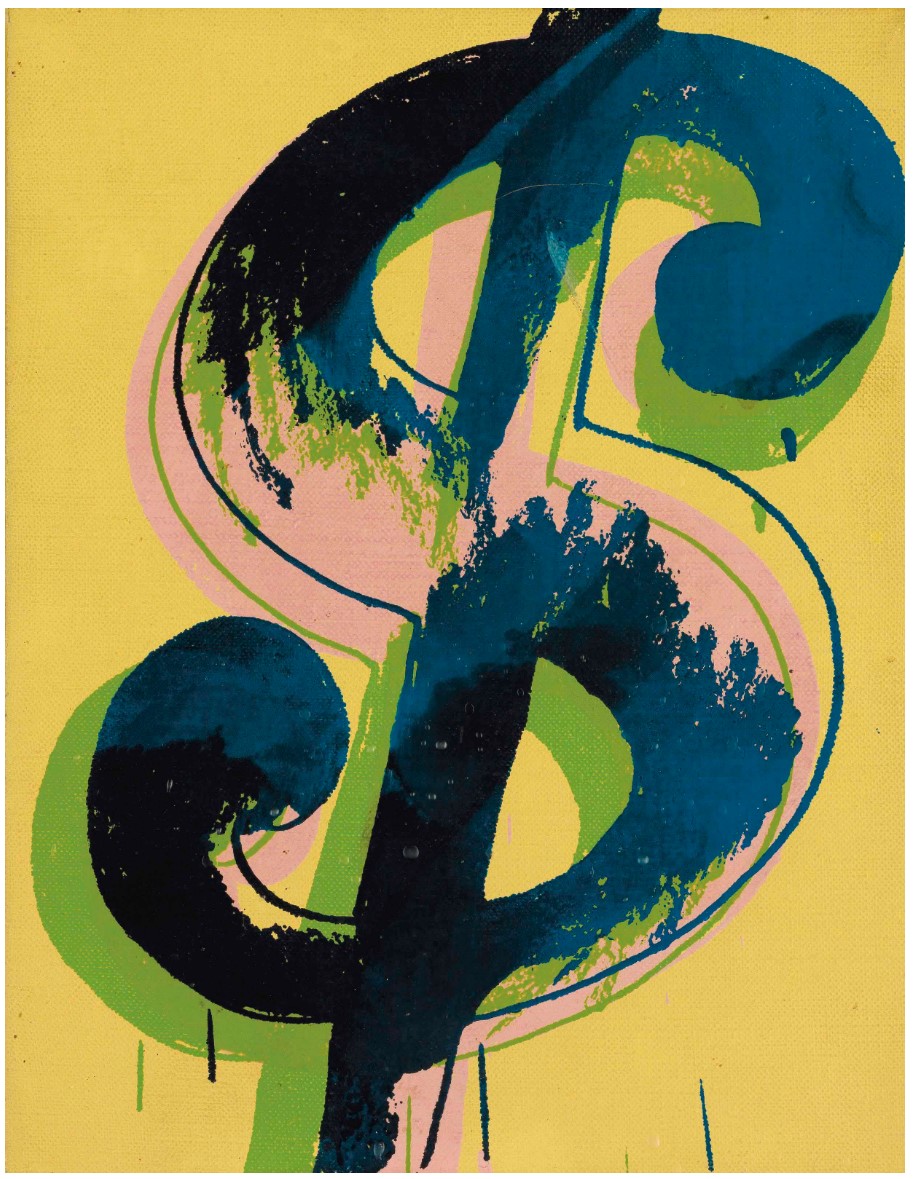
ANDY WARHOL
Dollar Sign, 1981
Silkscreen inks on canvas
10.2 x 8 inches (26 x 20.3 cm)
Signed, dedicated and dated ‘to camela [sic.] & earl Andy Warhol 81’ (on the overlap)
Provenance
Acquired directly from the artist by the present owner
Dollar Sign, 1980
Sotheby’s London: 29 June 2016
Estimated: GBP 250,000 – 350,000
GBP 323,000 / USD 436,195
(#174) Andy Warhol (sothebys.com)
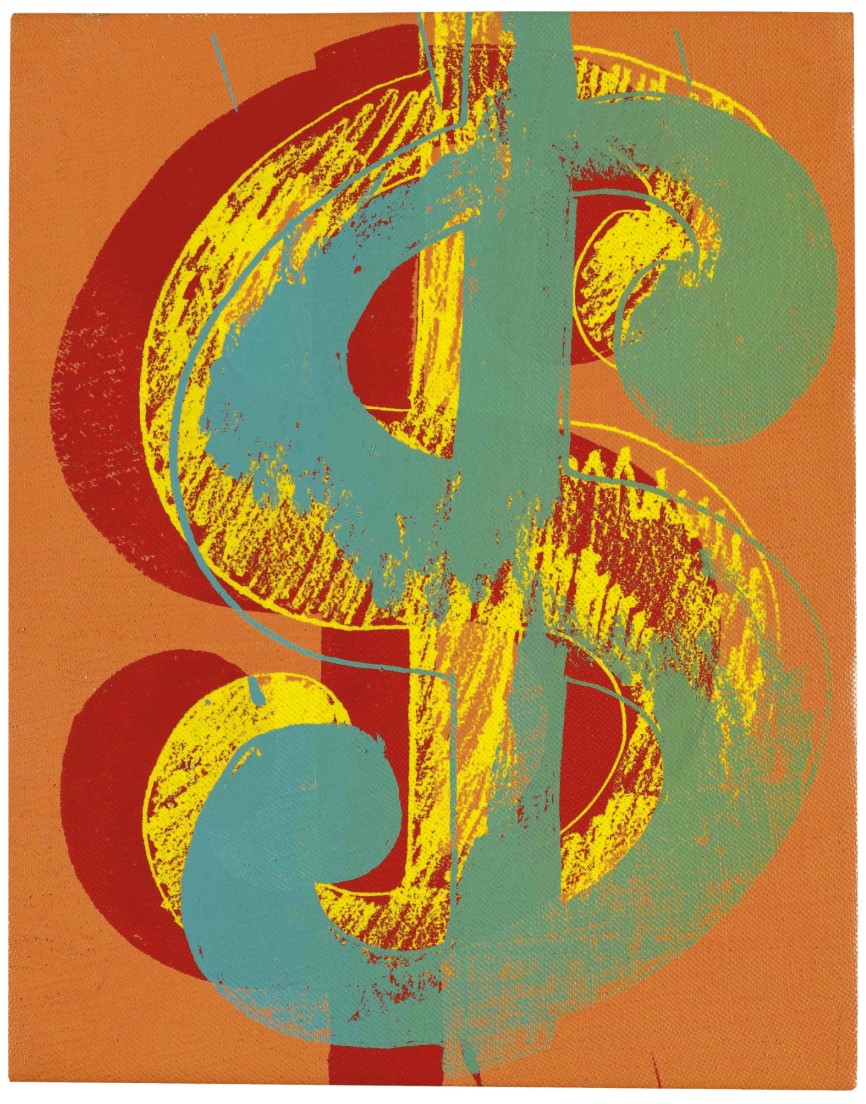
ANDY WARHOL
Dollar Sign, 1980
Acrylic and silkscreen ink on canvas
10×8 inches (25.4 x 20.3 cm)
Signed, dated 80 and dedicated To Noreen on the overlap
Provenance
Jack and Noreen Rounick Collection, USA (acquired from the artist)
Sotheby’s, New York, 19 May 1999, Lot 294
Acquired from the above by the present owner
Masterful in its execution, the present work shows Warhol’s mature refinement of the silk-screening technique. A distinctly fauvist choice of colours; rich orange and red, light yellow and a bright turquoise, are combined with a bold chromatic segregation. By adding layer after layer of paint in a new vibrant hue only broken up by frenzied but secure hatching, Warhol plays with the illusion of a flat canvas and adds a lively dynamic to the image. By the time he had begun working on his dollar signs, the very act of buying one of Warhol’s works bestowed status and societal appreciation on a collector. The newly acquired trophy on one’s wall acted at the same time as the ultimate sign for financial success and power.
Dollar Sign, 1982
Sotheby’s New-York: 3 March 2016
Estimated: USD 350,000 – 450,000
USD 370,000
(#53) Andy Warhol, Dollar Sign (sothebys.com)
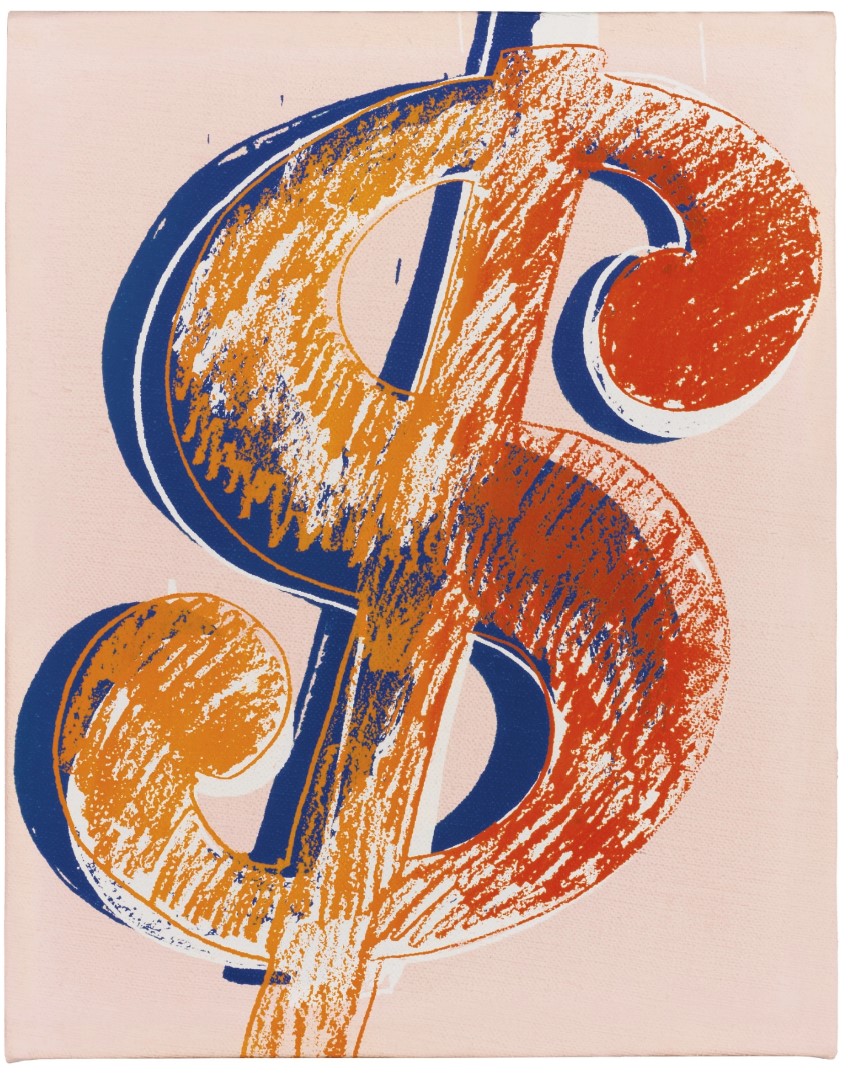
ANDY WARHOL
Dollar Sign, 1982
Acrylic and silkscreen ink on canvas
10×8 inches (25.4 x 20.3 cm)
Signed and dated 82 on the overlap
Provenance
Athos and Dede Pratesi, New York (gift of the artist in 1982)
By descent to the present owner from the above
The fiery hue, bold symbolism, and superb execution of Andy Warhol’s Dollar Sign (1982) establish this painting as a blazing Pop emblem of modern consumerism. Similar to his infamous images of Marilyn Monroe and Campbell’s Soup Cans, the Dollar Sign paintings are repetitions of a cultural icon; in this case, Warhol investigates the power of the dollar sign with all the artistry and painterly flair of a portraitist. Dollar Sign (1982) is also, however, a declaration by Warhol of his personal, lifelong dedication to extravagance and indulgence. The work was given to luxury linen magnate Athos Pratesi by Warhol himself, a marker of the appreciation for that extravagant lifestyle that both men shared. Pop icon and personal tribute, weighty symbol and cheeky commentary, Dollar Sign (1982) is that rare work of art that is aesthetically, historically, and conceptually astounding.
Dollar Sign, 1981
Christie’s Paris: 8 December 2015
Estimated: EUR 250,000 – 350,000
EUR 457,500 / USD 497,450
ANDY WARHOL (1928-1987) (christies.com)
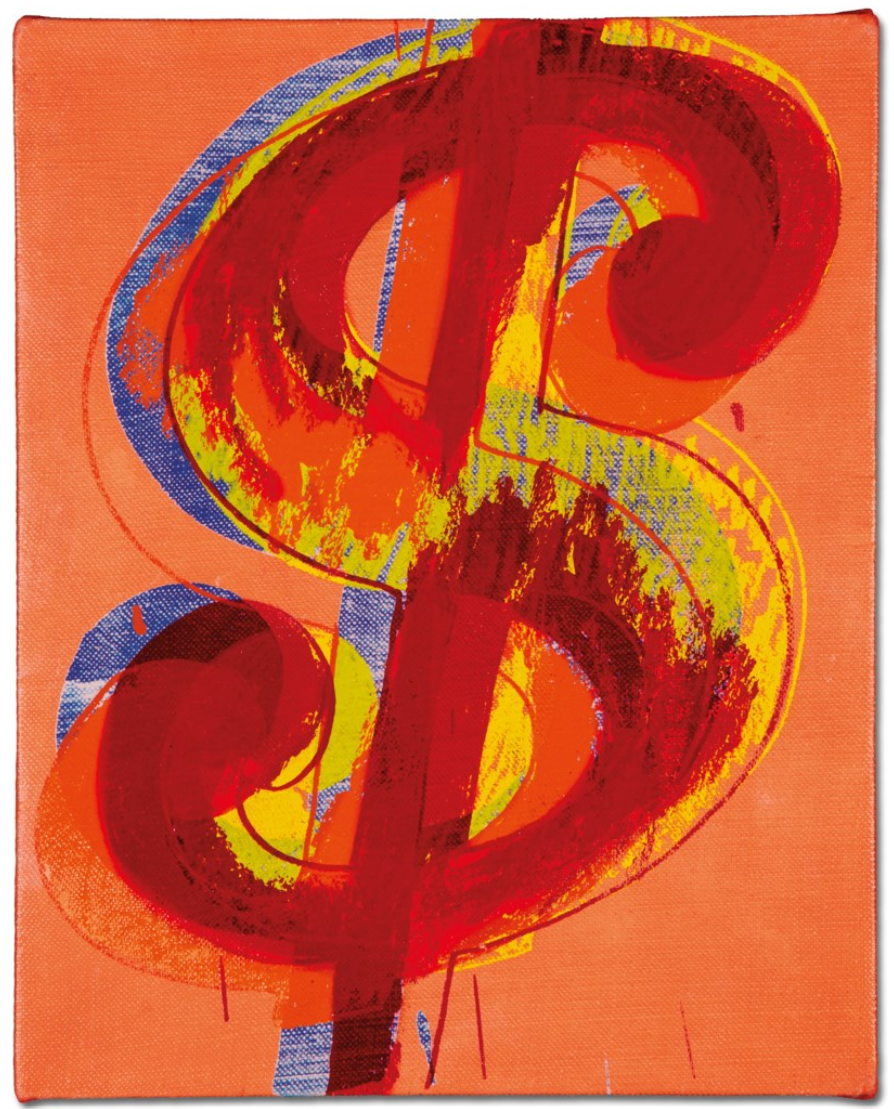
ANDY WARHOL (1928-1987)
Dollar Sign, 1981
Acrylic and silkscreen ink on canvas
10×8 inches (25.5 x 20.3 cm)
Signed, dated and dedicated ’81 Andy Warhol to Miguel’ (on reverse)
Provenance
Gift from the artist
Dollar Sign, 1981
Sotheby’s London: 1 July 2015
Estimated: GBP 200,000 – 300,000
GBP 509,000 / USD 794,985
Results for “andy warhol dollar sign”
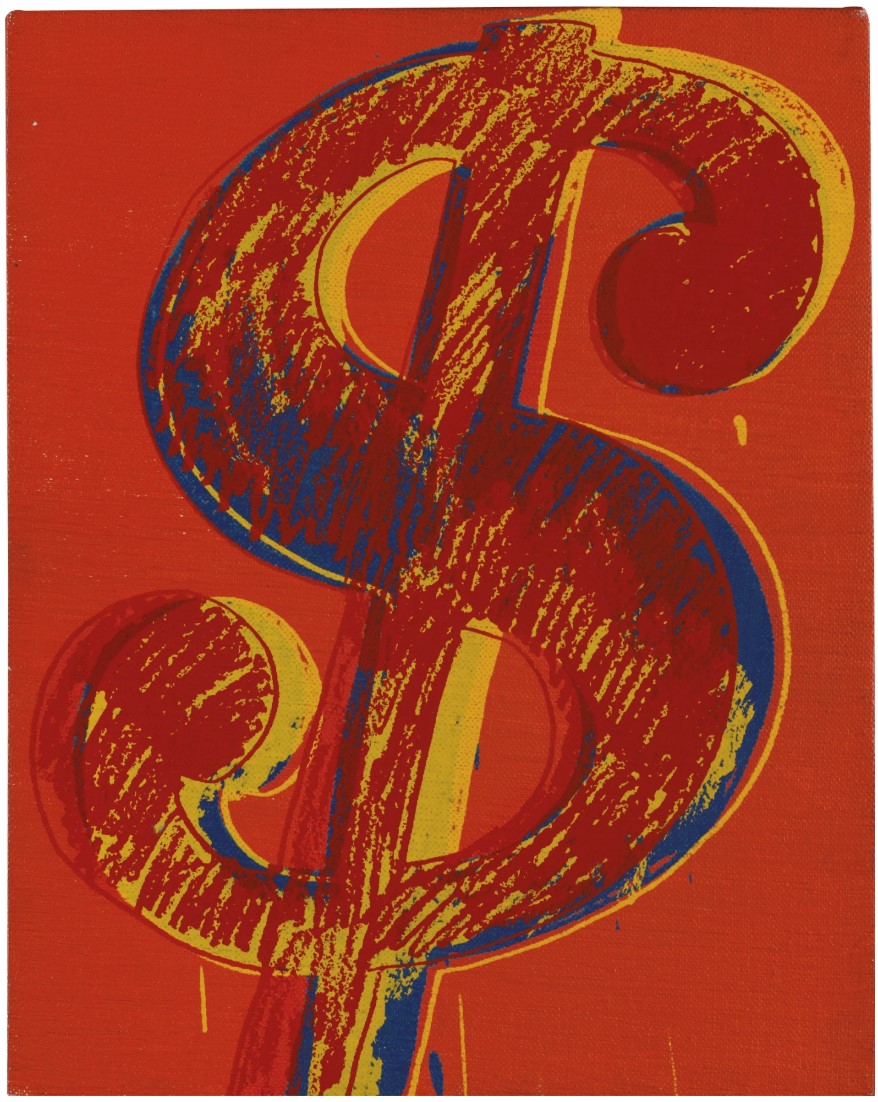
ANDY WARHOL
Dollar Sign, 1981
Acrylic and silkscreen ink on canvas
10 x 7.9 inches (25.5 x 20 cm)
Sotheby’s London: 1 July 2015
GBP 545,000
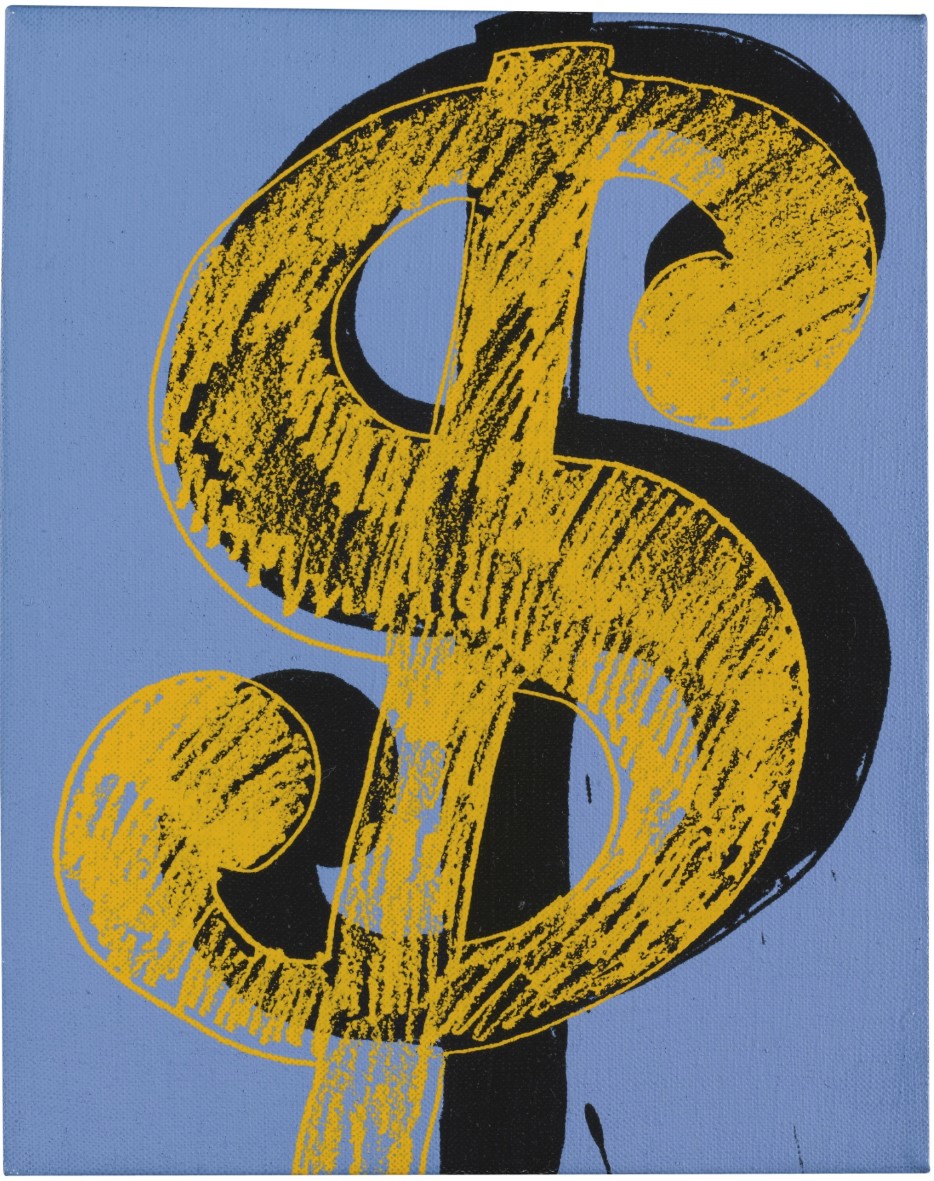
ANDY WARHOL
Dollar Sign, 1982
Acrylic and silkscreen ink on canvas
10 x 7.9 inches (25.4 x 20 cm)
Dollar Sign, 1982
Christie’s London: 1 July 2015
Estimated: GBP 200,000 – 300,000
GBP 266,500 / USD 416,235
Andy Warhol (1928-1987), Dollar Sign | Christie’s
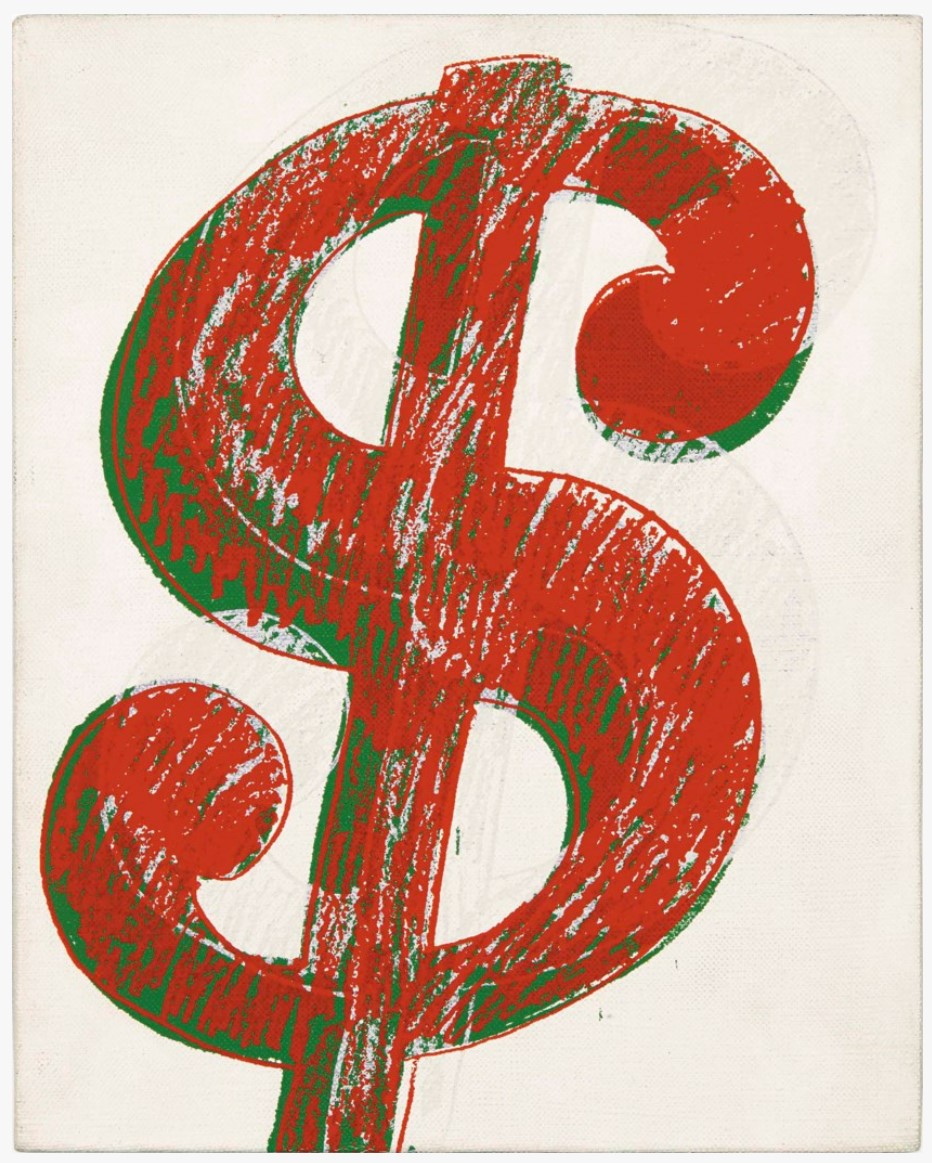
ANDY WARHOL
Dollar Sign, 1982
Acrylic and synthetic polymer on canvas
10×8 inches (25.5 x 20.5 cm)
Signed ‘Andy Warhol’ (on the overlap)
Provenance
Anzai Art Offce, Tokyo
Anon. sale, Sotheby’s London, 23 October 1997, lot 155
Acquired at the above sale by the present owner
A bombastic and brazen celebration of the ‘buck’, Andy Warhol’s Dollar Sign presents the viewer with one of the most crucial motifs of his oeuvre. Executed in 1982, this work belongs to Warhol’s seminal Dollar Sign series that he had begun in 1981 and was created the same year of his infamous eponymously named exhibition at the Castelli Gallery in New York. The crucial subject of US dollar bills made an early appearance in Warhol’s oeuvre: while first examples can be found in drawings he made as a highly successful a commercial illustrator in the 1950s, the motif notably appeared in tandem with his pioneering discovery of the screen printing, the medium which would propel him to fame, and resulted in the Dollar Bills of 1962. Dollar Sign appears to be the result of the rare superimposition of several of Warhol’s own drawings, one lying on top of the other, making it a mirage-like, shimmering, elusive, reflective dollar that hovers before us all the more tantalizing. While the sequential layering of beautifully screened red, green and white colour captures the mechanical process of screen printing, the gestural, intuitively drawn hatching speaks with a gestural immediacy, adding a heightened visual impact.
Sotheby’s New-York: 13 May 2015
USD 406,000
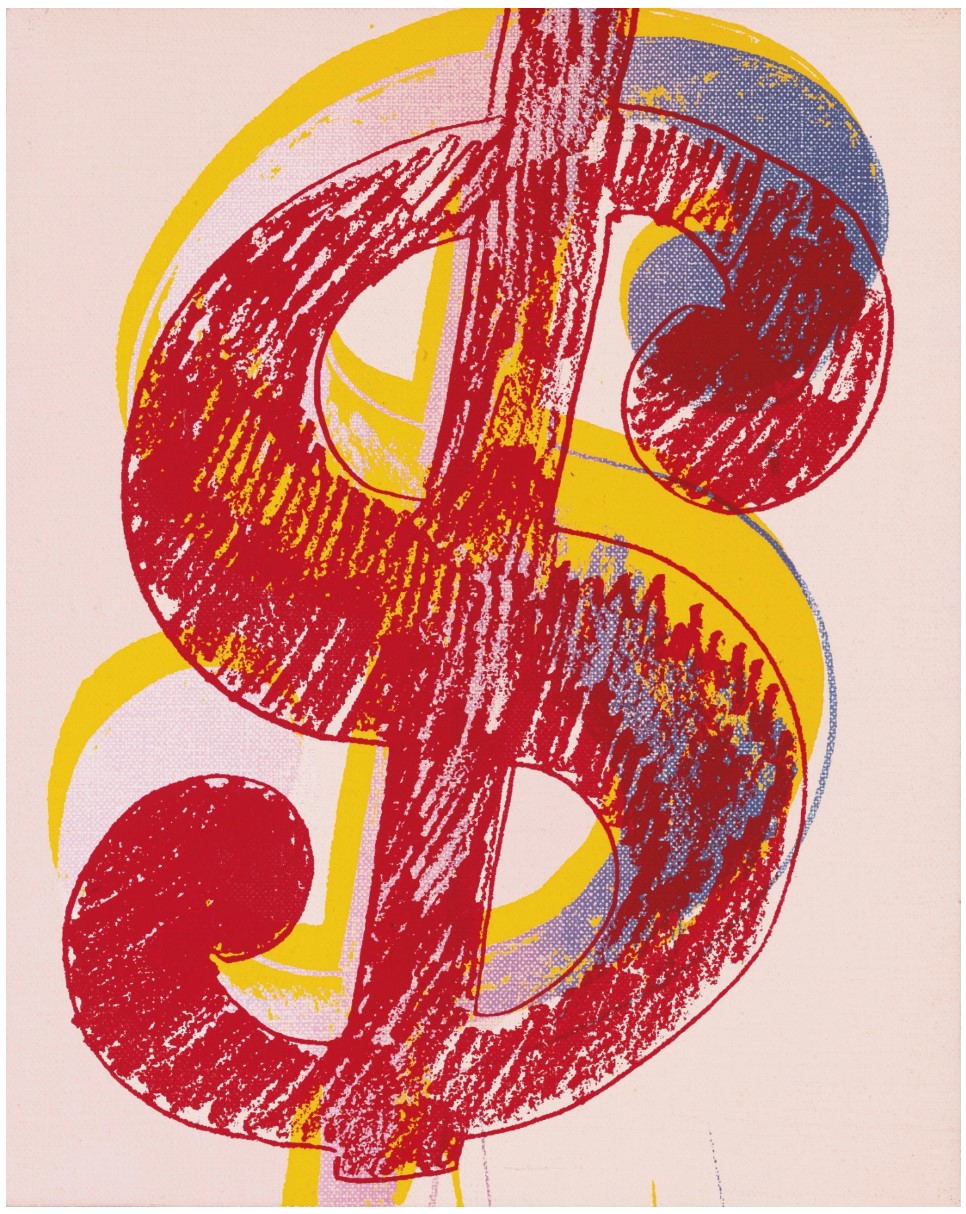
ANDY WARHOL
Dollar Sign, 1981
Acrylic and silkscreen ink on canvas
10×8 inches (25.4 x 20.3 cm)
Dollar Sign, 1981
Christie’s New-York: 12 May 2015
Estimated: USD 300,000 – 500,000
USD 413,000
Andy Warhol (1928-1987), Dollar Sign | Christie’s
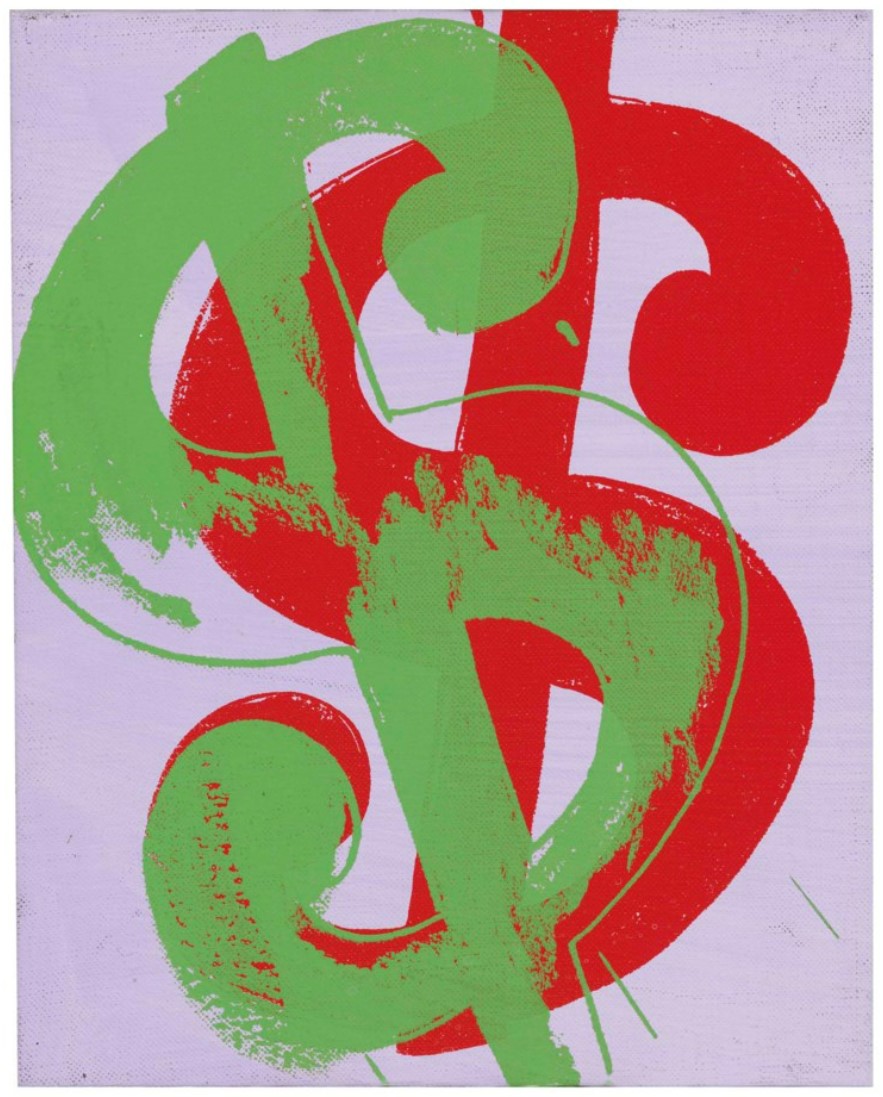
ANDY WARHOL
Dollar Sign, 1981
Synthetic polymer and silkscreen ink on canvas
10×8 inches (25.5 x 20.5 cm)
Signed, inscribed and dated ‘Jon/Andy 81’ (on the reverse)
Provenance
Jon Gould, New York, acquired directly from the artist
By descent from the above to the present owner
Inscribed “Jon/Andy 81” on the back, this vibrant Dollar Sign in bold red-and-green on lavender, is virtually a Valentine to both Jon Gould (Warhol’s boyfriend at the time) and the mighty dollar. As Warhol put it in his diaries on April 16, 1981, “And then I decide that I should try to fall in love and that’s what I’m doing now with Jon Gould…” (A. Warhol, The Andy Warhol Diaries, P. Hackett (eds.),New York, 1989, p. 372). Andy was so smitten with Gould that at one point, Warhol actually had his Factory assistants silkscreen some hearts as a Valentine’s Day present for Jon. Warhol had first met the handsome young Paramount Pictures executive in late 1980, shortly after his previous lover, Jed Johnson, had left. He was instantly infatuated with Gould, sending him roses daily and plying him with expensive gifts and trips. (Warhol even gave him a double strand of pearls, and, on an early weekend trip together, photographed him wearing it on the beach). Warhol, of course, also had his eye on the bottom line; he perceived Gould as a potential conduit to Hollywood. “…so my crush on him will be good for business,” he observed, shortly after meeting him. (ibid, p. 374).
Twenty-five years the artist’s junior, Gould would be Warhol’s longest and last romantic relationship. Although it began as a long-distance relationship, since Gould was based in Los Angeles, the two lived together in Warhol’s townhouse when Gould was in New York. Andy also suggested that he would help Gould build an art collection. Although many of the works in the Gould collection were gifts from the artist, Gould made a point of actively acquiring contemporary art. (Bob Colacello, Holy Terror, HarperCollins, New York, 1990, p. 467.) Warhol was obviously obsessed with Jon Gould, an obsession that didn’t end until Gould left him, moving back to Los Angeles in 1985, a year before his death from AIDS. But Warhol had always been obsessed with money, as documented in his journals, which meticulously note the cost of every cab ride. He also liked to give dollars—and his Dollar Signs–as gifts. “And money is the best gift, so I gave Jon and Peter [Wise] each $100 in one-dollar bills….And Jon I gave $80 of Susan B. Anthony Dollars” (A. Warhol Diaries, May 4, 1981, p. 377).
The artist first began depicting U.S. dollars early in his career. In the 1950s he drew a money tree, and in 1961 he created a small master series of dollar bills. The subject also inspired a paradigm shift in his art: Warhol’s very first silkscreens were of dollar bills. “I started [silk-screening] when I was printing money. I had to draw it, and it came out looking too much like a drawing, so I thought wouldn’t it be a great idea to have it printed. Somebody said you could just put it on silkscreens” (Glenn O’Brien interview with Andy Warhol, High Times, No. 24, August, 1977, p. 34.) So Warhol took several of his dollar drawings to a printing shop, which converted them into hand-cut silkscreens (David Bourdon, Warhol, Henry N. Abrams, New York, 1989, p. 108.) Money was also the perfect subject for the grid format Warhol used for serial images such as the Soup Cans; his famous 200 One Dollar Bills was shown at Eleanor Ward’s Stable Gallery in 1962. Indeed, one story has it that it was Ward who, flipping through her wallet, told Warhol that if he painted her a dollar bill, she would give him a show. But Warhol himself explained that, “I just paint things I always thought were beautiful, things you use every day and never think about. I’m working on soups and I’ve been doing some paintings of money. I just do it because I like it.” (D. Bourdon, Warhol, p. 90.)
As the 1980s ushered in a decade notorious for conspicuous consumption, Warhol gave the money theme his own ironic spin, creating the Dollar Sign series. Among the most Warholian of his images, The Dollar Signs powerfully merge many of the artist’s signature traits: his marketing and branding genius, his take on art as a commodity, his drawing skills and his saturated Pop palette. First shown at the Leo Castelli gallery in January, 1982, the Dollar Signs are a literal manifestation of one of Warhol’s most famous quotes, “I like money on the wall. Say you were going to buy a $200,000 painting. I think you should take that money, tie it up and hang it on the wall. Then when someone visited you, the first thing they would see is the money on the wall.” (Andy Warhol, The Philosophy of Andy Warhol, Harcourt Brace Jovanovich, New York, 1975, p. 134.)
The provenance and personal inscription on Dollar Sign lends this piece a particular poignancy. But, like all Warhol’s images in the series, it is also a potent graphic reference to the monetary symbol as the ultimate American logo.
Sotheby’s London: 12 March 2015
GBP 383,000
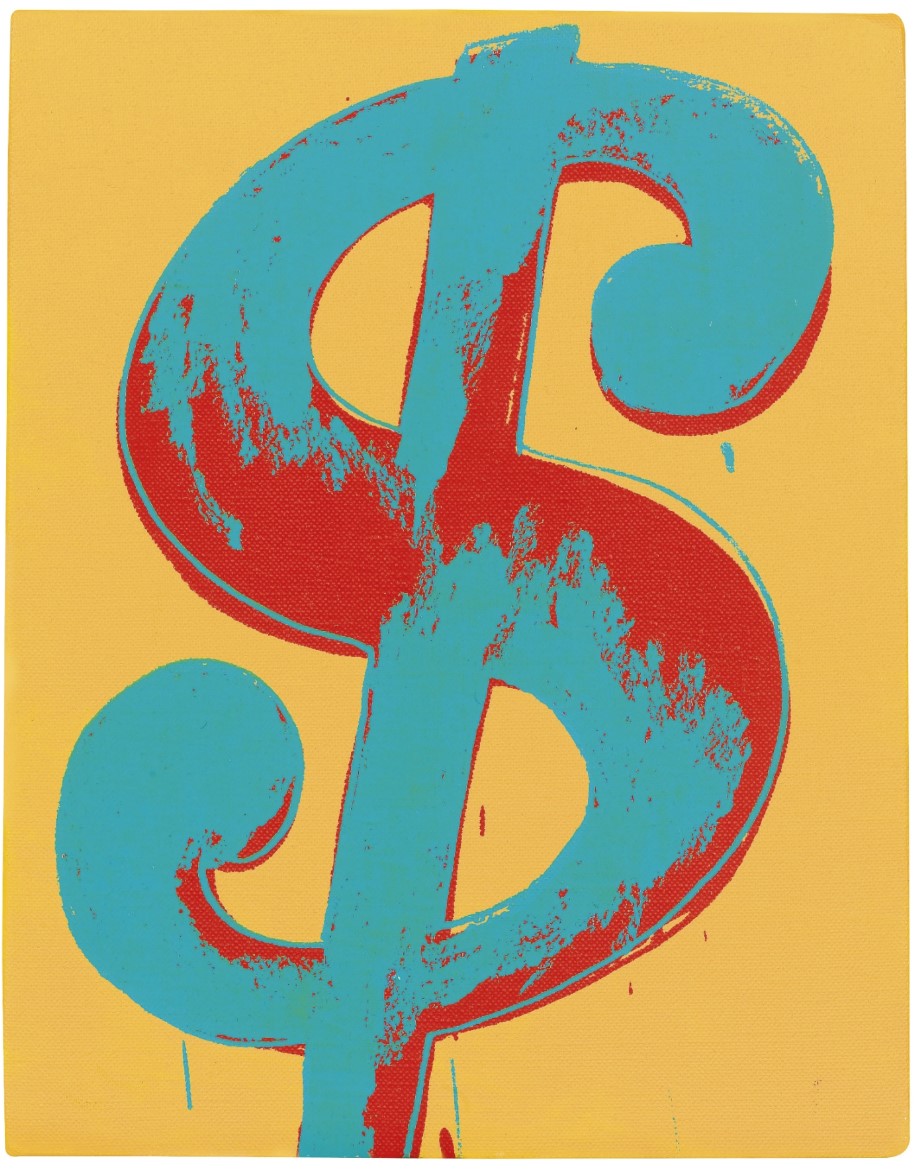
ANDY WARHOL
Dollar Sign, 1982
Acrylic and silkscreen ink on canvas
9.9 x 7.9 inches (25×20 cm)
Sotheby’s New-York: 5 March 2015
USD 610,000
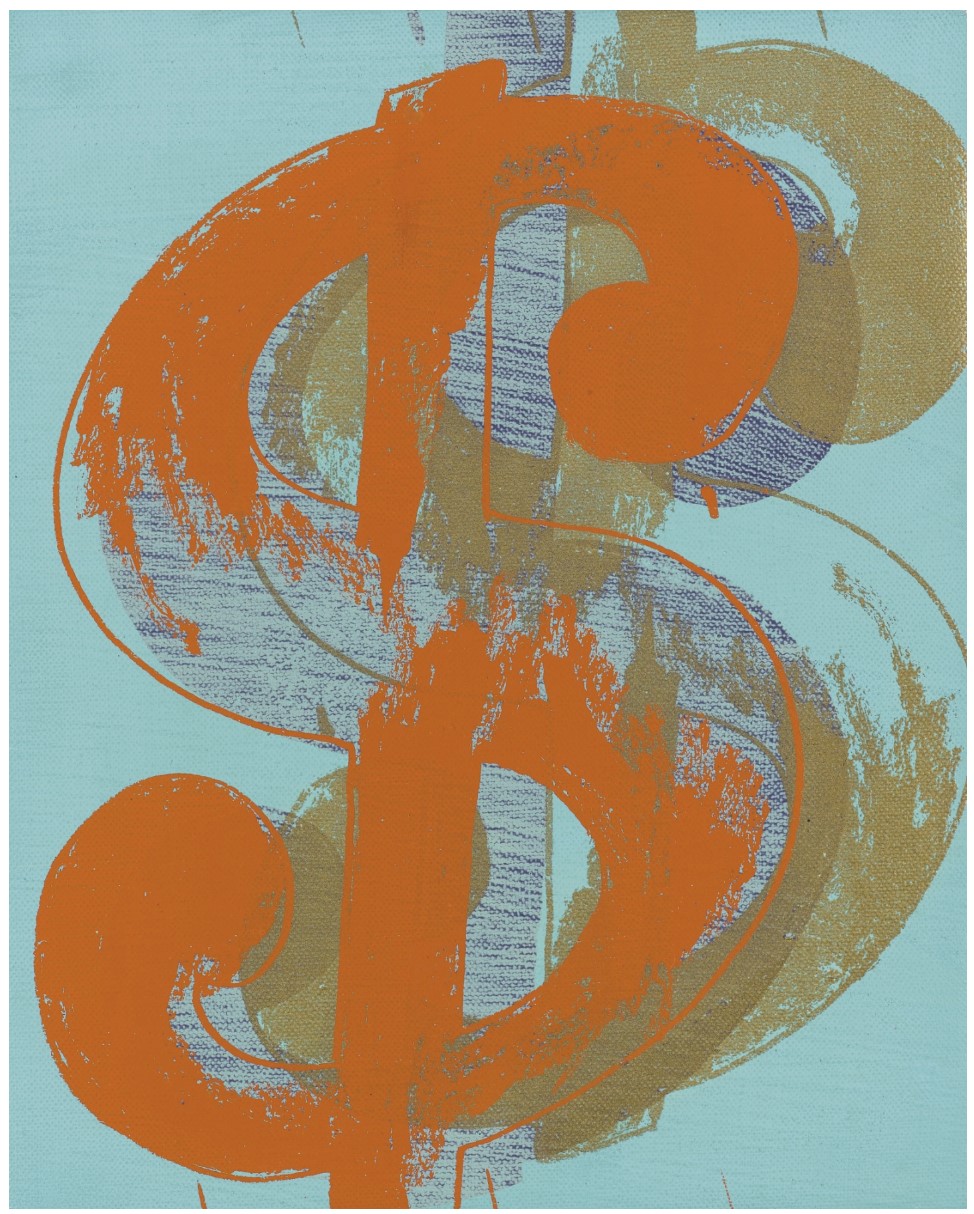
ANDY WARHOL
Dollar Sign, 1981
Acrylic and silkscreen ink on canvas
10×8 inches (25.4 x 20.3 cm)
Sotheby’s London: 11 February 2015
GBP 413,000
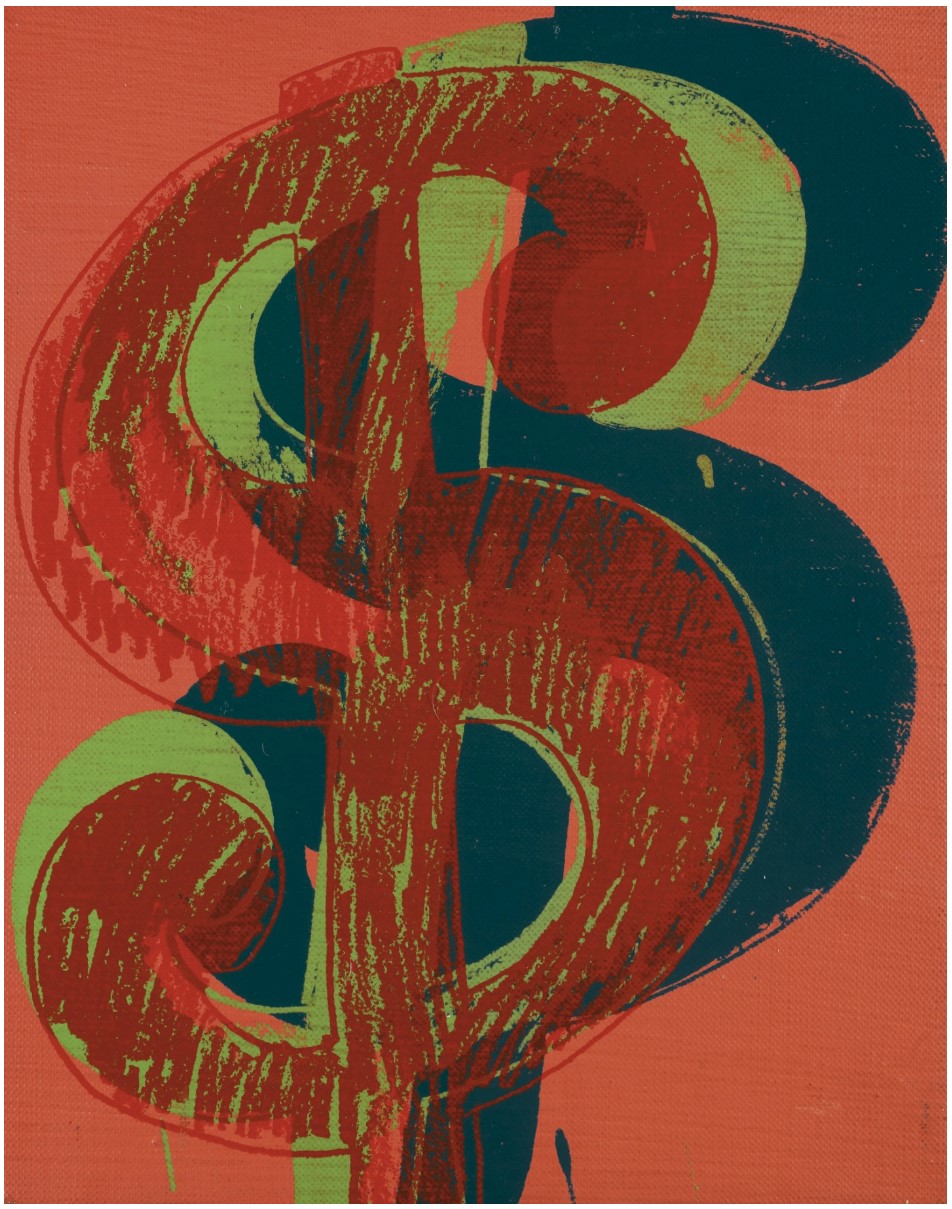
ANDY WARHOL
Dollar Sign, 1982
Acrylic and silkscreen ink on canvas
10.1 x 8 inches (25.8 x 20.5 cm)
Christie’s New-York: 12 November 2014
USD 485,000
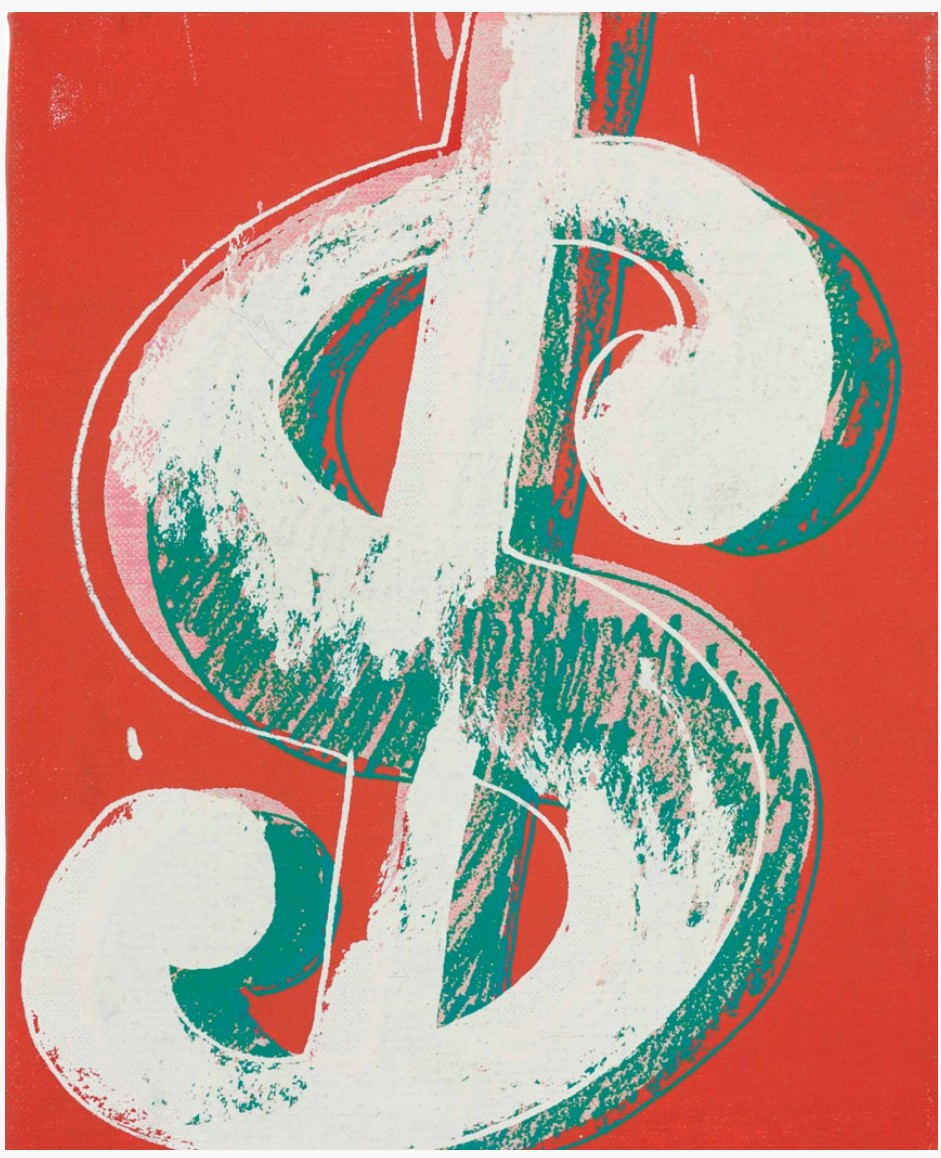
ANDY WARHOL
Dollar Sign, 1981
Synthetic polymer and silkscreen inks on canvas
10.1 x 7.9 inches (25.7 x 20 cm)
Dollar Sign, 1981
Christie’s Paris: 3 December 2014
Estimated: EUR 250,000 – 350,000
EUR 397,500
ANDY WARHOL (1928-1987) , Dollar Sign | Christie’s
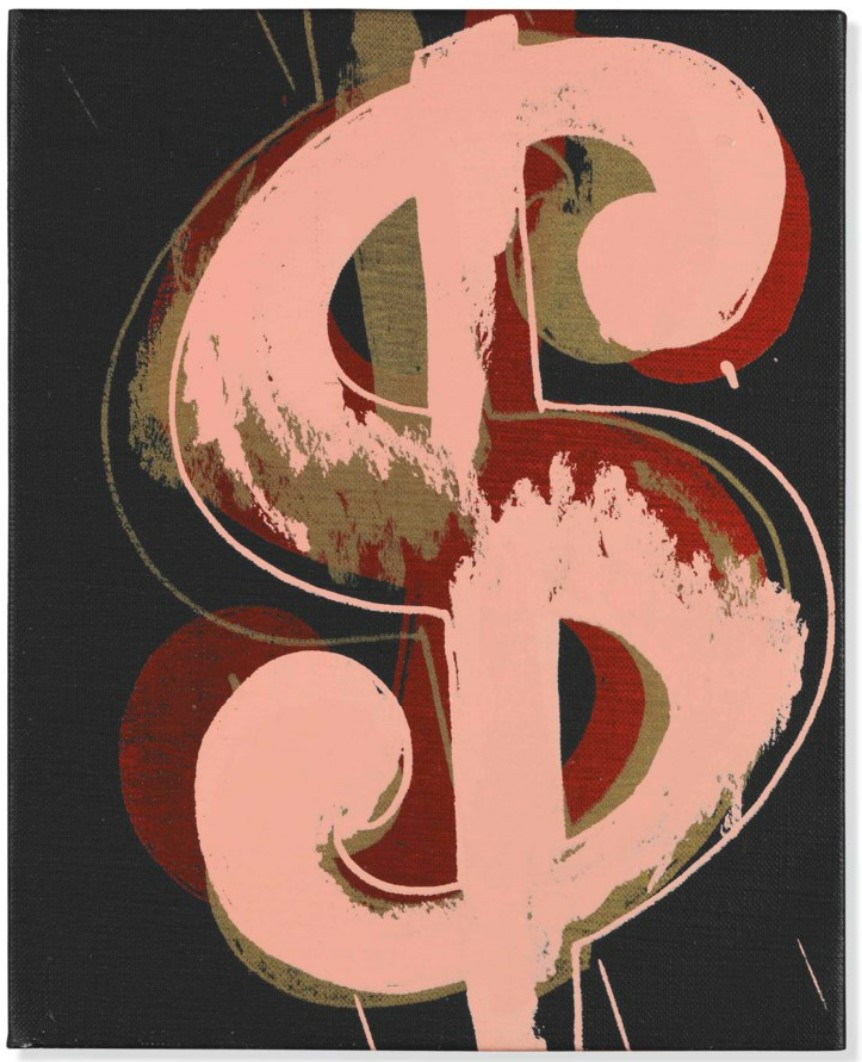
ANDY WARHOL
Dollar Sign, 1981
Synthetic polymer and silkscreen ink on canvas
10×8 inches (25.5 x 20.5 cm)
Numbered ‘PA30.011’ (on the stretcher)
Stamped with The Estate of Andy Warhol and the Andy Warhol Foundation for the Visual Arts, Inc. stamps
and numbered ‘PA30.011’ (on reverse)
Provenance
Gagosian Gallery, Beverly Hills
Private Collection, Pittsburgh (purchased in 1998)
Purchased from the above by current owner
Produced in 1981, these two Dollar Signs draw inspiration from the pop aesthetic developed by Warhol and whose codes he had mastered perfectly by this stage. The superposition of the pink, gold and brownish red on a black background for one, and green, pink and purple against a blue background for the other, show the extent of a palette designed to detach the symbol from its own reality. As is often the case with Warhol at the turn of the 1970s and 1980s, his work looks back to his early pieces from the start of the 1960s. Here he returns to Dollar Bills which he had explored through design and screen-printing, although he removes the medium to preserve only the essence – this symbol whose semiotics he aims to examine. Warhol loves its shape and the perception it gives people: American money is very well-designed, really. I like it better than any other kind of money.”
Warhol’s message in these Dollar Signs can be read in two ways and is therefore consciously ambivalent. In fact, by making the dollar the subject of his art in its own right, he glorifies its reach, embracing the relationship between his painting and the money it brings to him, as well as to others who have understood the working of the art market. Nevertheless, by pointedly acknowledging the value of money and the superficiality which goes with it, he also puts into perspective a society which has raised money to the same level as art.
Dollar Sign, 1981
Christie’s Paris: 3 December 2014
Estimated: EUR 250,000 – 350,000
EUR 361,500
ANDY WARHOL (1928-1987) , Dollar Sign | Christie’s
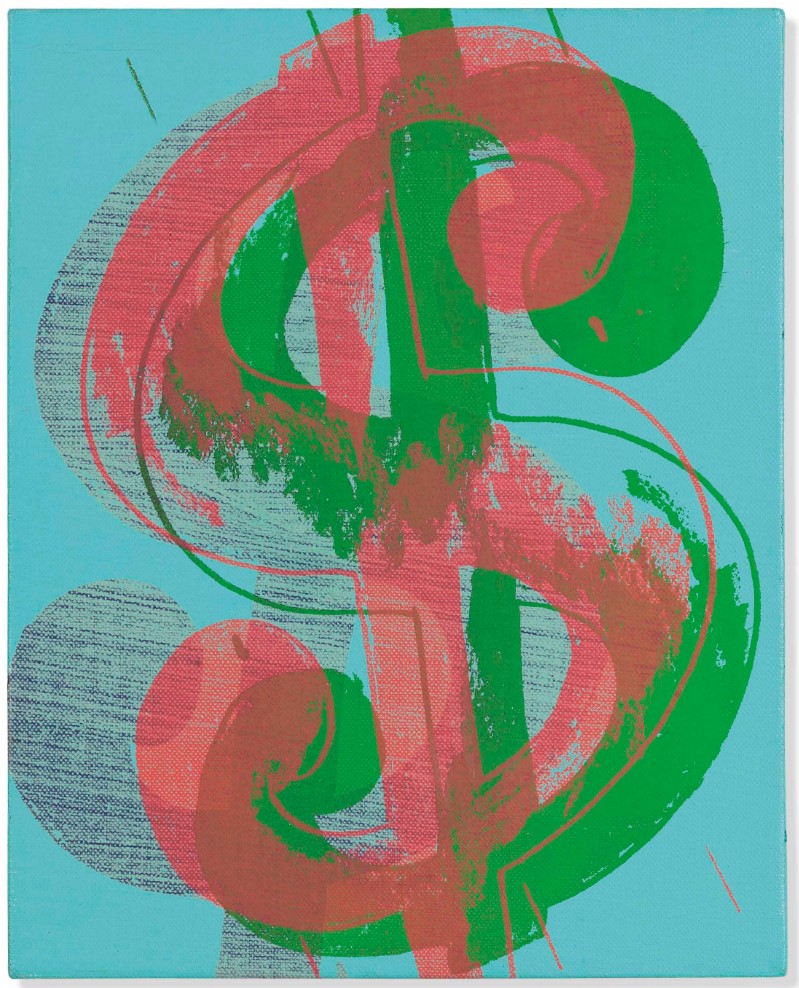
ANDY WARHOL (1928-1987)
Dollar Sign, 1981
Synthetic polymer and silkscreen inks on canvas
10×8 inches (25.4 x 20.3 cm)
Stamped by The Estate of Andy Warhol and the Andy Warhol Foundation for the Visual Arts, Inc. Numbered ‘PA30.066’
Provenance
Gagosian Gallery, Beverly Hills
Private Collection, Pittsburgh (purchased in 1998)
Purchased from the above by current owner
Sotheby’s New-York: 14 November 2013
USD 425,000
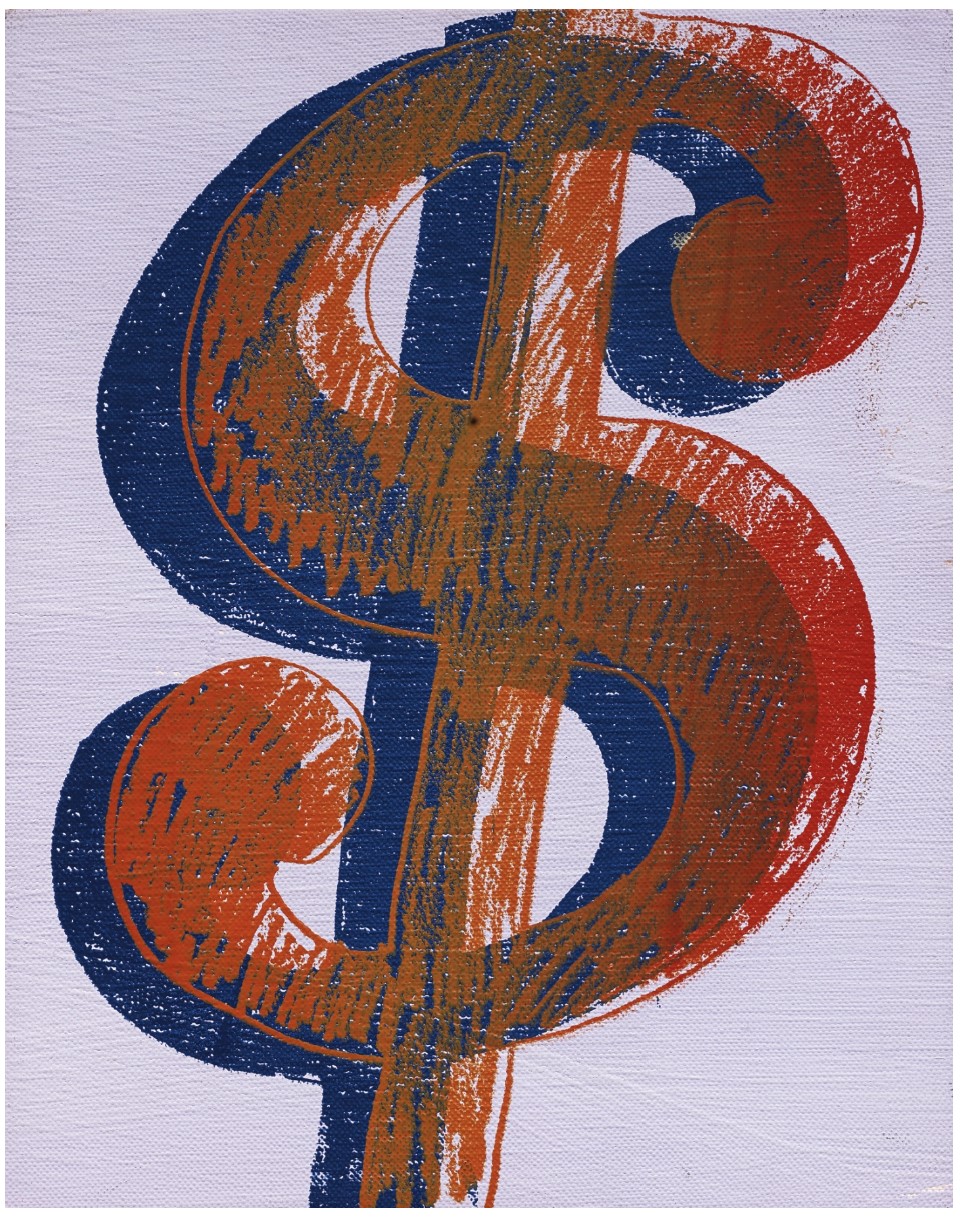
ANDY WARHOL
Dollar Sign, 1981
Acrylic and silkscreen ink on canvas
10×8 inches (25.4 x 20.3 cm)
Dollar Sign, 1981
Christie’s New-York: 16 May 2013
Estimated: USD 400,000 – 600,000
USD 459,450
Andy Warhol (1928-1987) , Dollar Sign | Christie’s
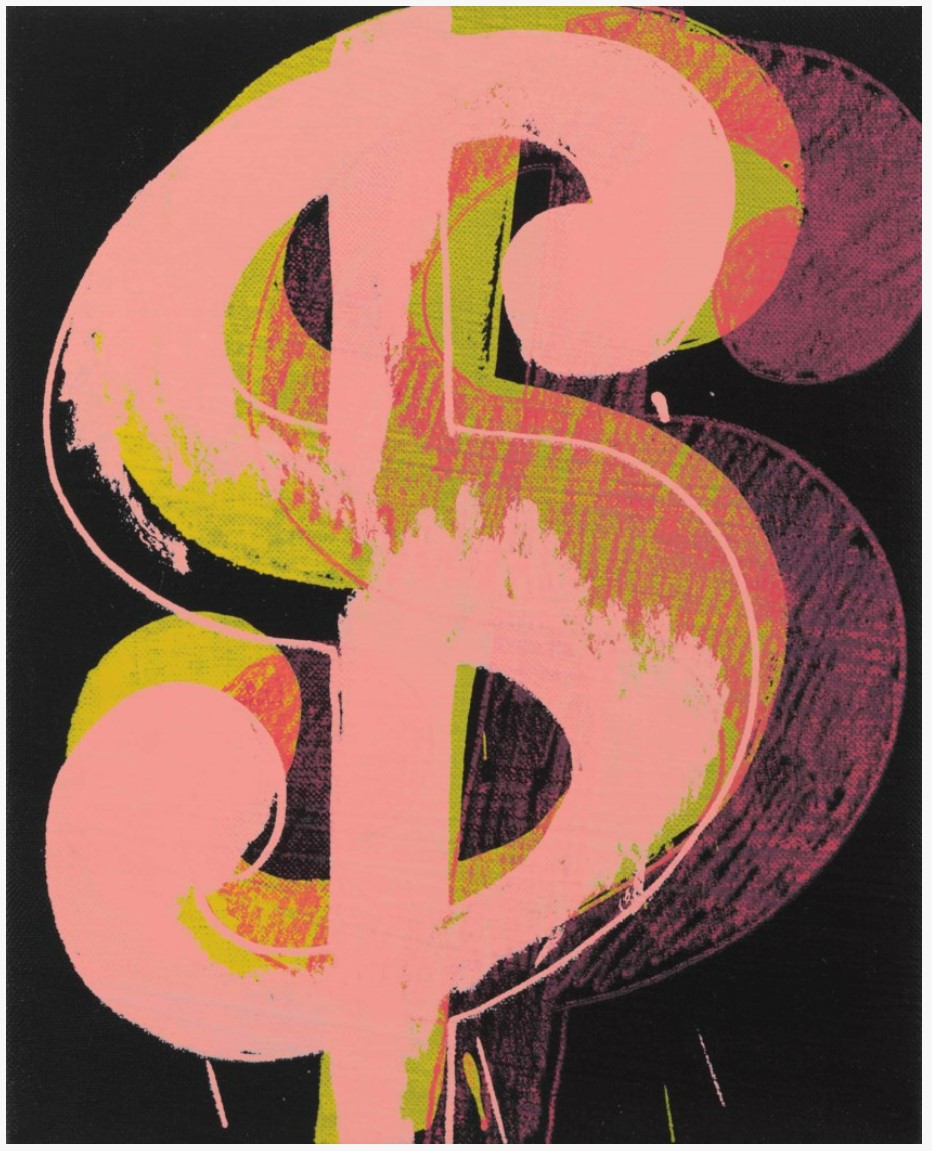
ANDY WARHOL
Dollar Sign, 1981
Synthetic polymer and silkscreen inks on canvas
10×8 inches (25.4 x 20.3 cm)
Signed and dated ‘Andy Warhol 81’ (on the reverse)
Provenance
Acquired from the artist by the present owner, 1981
It would be fitting that throughout his career he would continue to revisit the depiction of one of the most successful and recognised symbols of our age, featuring in his drawings and sheets of silkscreen from the early 1960s. But in the early 1980s, in the age that spawned the yuppie that would culminate in American Psycho and Wall Street and that film’s infamous mantra, ‘Greed is good,’ it was only natural that Warhol should look with fresh eyes at his beloved currency. He took the dollar sign itself as a more mysterious and more worship-worthy subject-matter than those earlier images of currency where they were depicted more as bad forgeries. He removed any specific denomination, making the Dollar Sign appear as an altarpiece celebrating the currency as an abstract, rather than merely resembling the various bills that the artist may or may not have had. In this scope, Dollar Sign is a celebration of the dollar, of the United States, of wealth and capitalism while simultaneously delivering a deliberate and calculated statement about the art market and the value attached to pictures. This sense of rebellion and indictment in Dollar Sign is increased by the use of lively colours. These are the loud colours of the Disco age; glowing and shining before our eyes. He has taken the solid symbol of American money and has filled it with a lively Pop aesthetic transforming it into something distinctively Warholian. With Warhol, who was never as ingenuous as he liked to appear, nothing is ever as simple as the surface of the picture, despite whatever he may have said to the contrary. It is this fascinating and playful ambiguity, underlined with a little hint of genuine and serious intent and content, that makes Warhol’s Dollar Sign so engaging.
Dollar Sign, 1982
Christie’s New-York: 15 November 2012
Estimated: USD 350,000 – 450,000
USD 698,500
Andy Warhol (1928-1987) (christies.com)
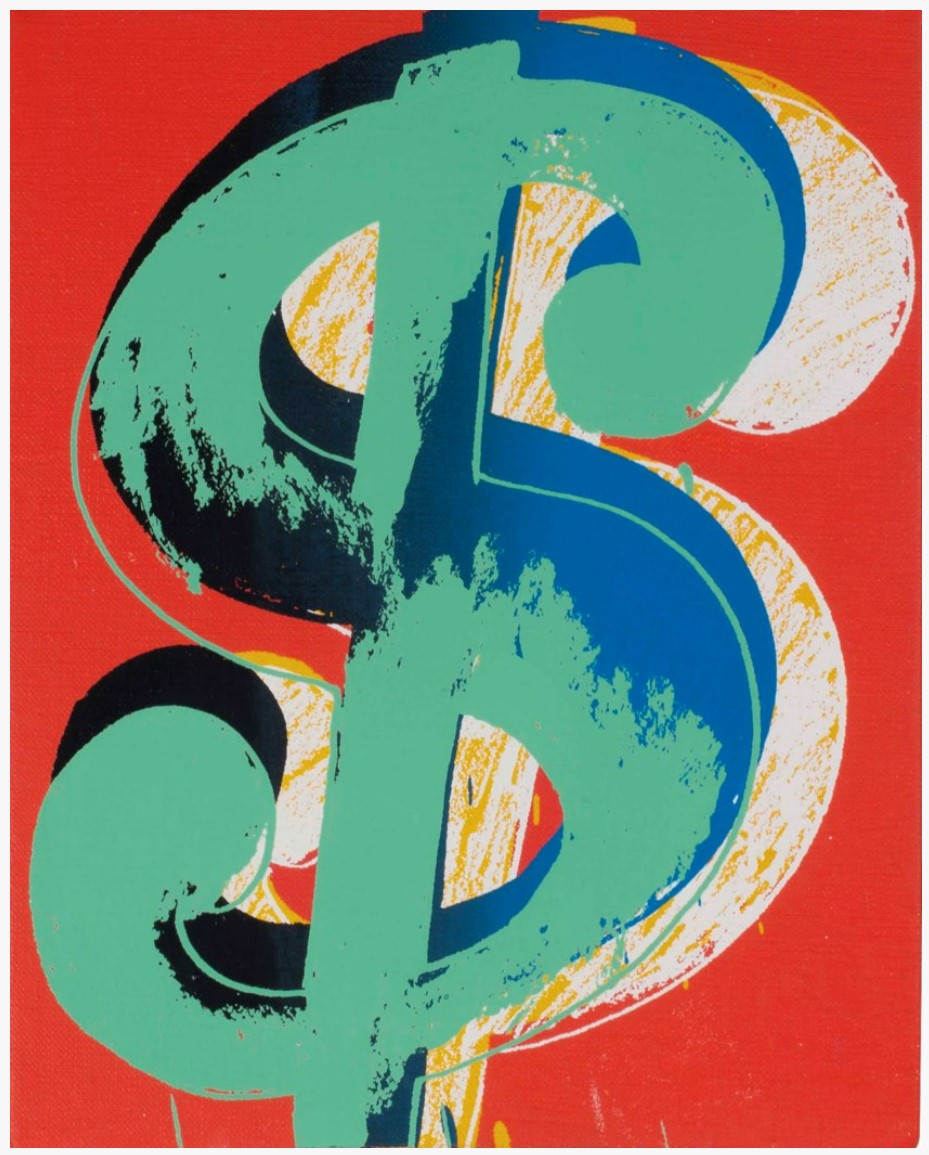
ANDY WARHOL
Dollar Sign, 1982
Synthetic polymer and silkscreen inks on canvas
10×8 inches (25.4 x 20.3 cm)
Signed and dated ‘1982 Andy Warhol’ (on the overlap)
Provenance
Hamilton-Selway Fine Art, Los Angeles
Galleria Prospettive D’Arte, Milan
Private collection, Europe
Through his artistic interpretation of a dollar sign, Warhol romanticized the relationship between art and money. He develops a visual vocabulary that is both powerful and provocative; a visual currency that translates beautifully on the rich, red canvas. Through the pulsating, saturated colors in Dollar Sign, Warhol brings this symbol to life in graphic force. Multiple overlaid impressions of the motif, deliberately misaligned, make the dollar sign appear to move and expand beyond its own limits. Warhol’s confident and determined lines and curves construct a burly silhouette. Passages of scribbling and unorthodox flourishes bring attention to the sinuous “S” slashed on the vertical axis. Warhol’s superimposed dollar signs on dollar signs create a multifaceted perception that plays on repetition. It is a symbol so universally ubiquitous that we have become desensitized to it, yet we are still consumed and obsessed by it. It is Warhol’s apt choice of this singular image, both garish and dazzling in its representation, which highlights the artist’s uncanny understanding of American culture. Warhol’s Dollar Sign from 1982 is both powerful and provocative, a tour de force of one of the artist’s most famous symbols. The dollar sign is a symbol, which in the end, is a portrait of the artist himself.
Sotheby’s Paris: 8 December 2011
EUR 348,750
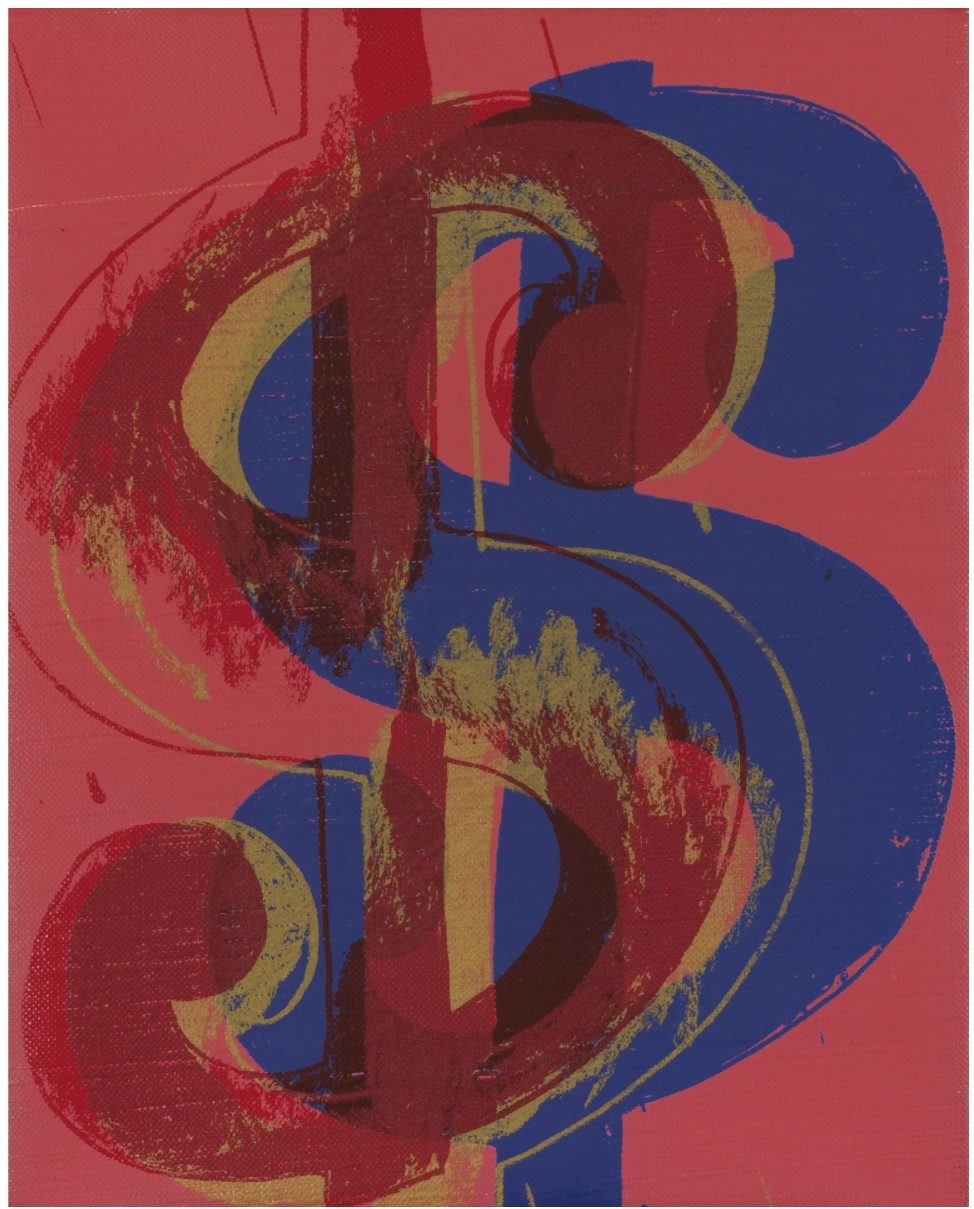
ANDY WARHOL
Dollar Sign, 1981
Acrylic and silkscreen ink on canvas
10×8 inches (25.4 x 20.3 cm)
Sotheby’s New-York: 9 November 2011
Estimated: USD 250,000 – 350,000
USD 698,500
(#1) Andy Warhol (sothebys.com)
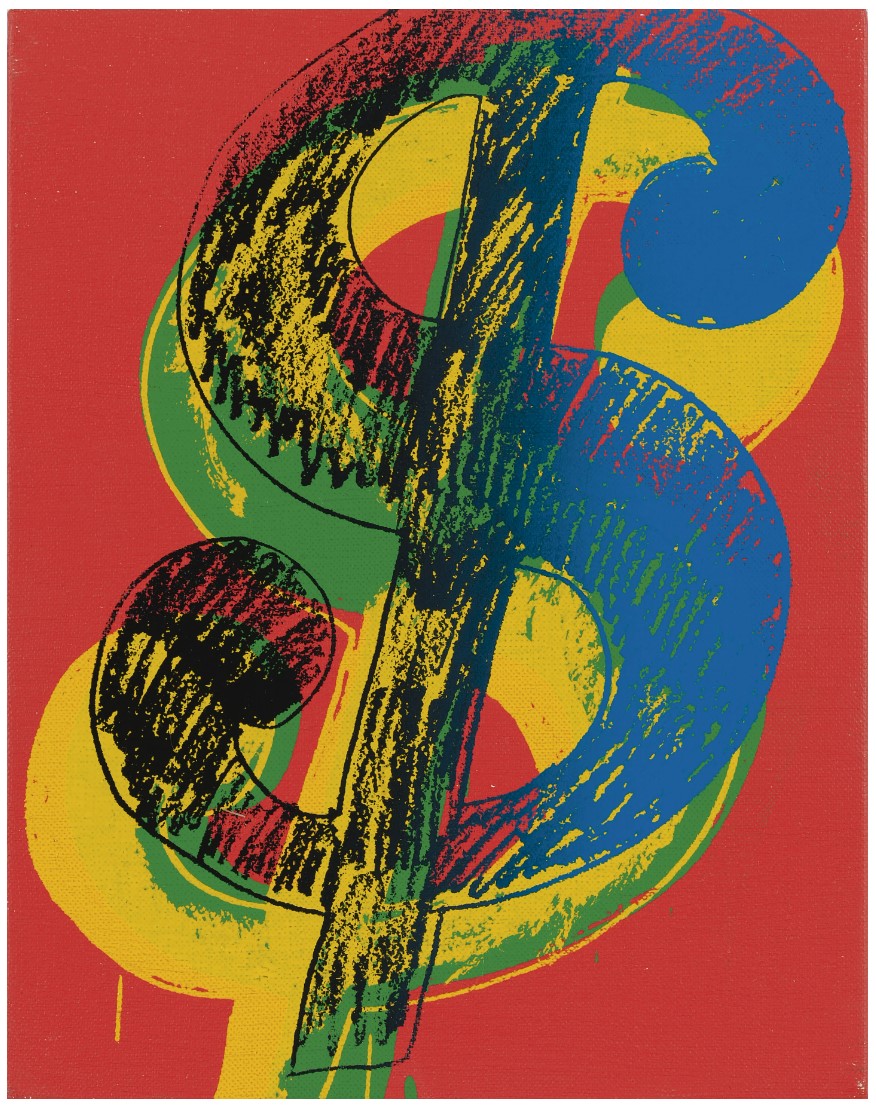
ANDY WARHOL
Dollar Sign, 1982
Acrylic and silkscreen ink on canvas
10×8 inches (25.1 x 20.3 cm)
Sotheby’s New-York: 15 May 2008
Estimated: USD 150,000 – 200,000
USD 1,161,000
(#213) Andy Warhol (sothebys.com)
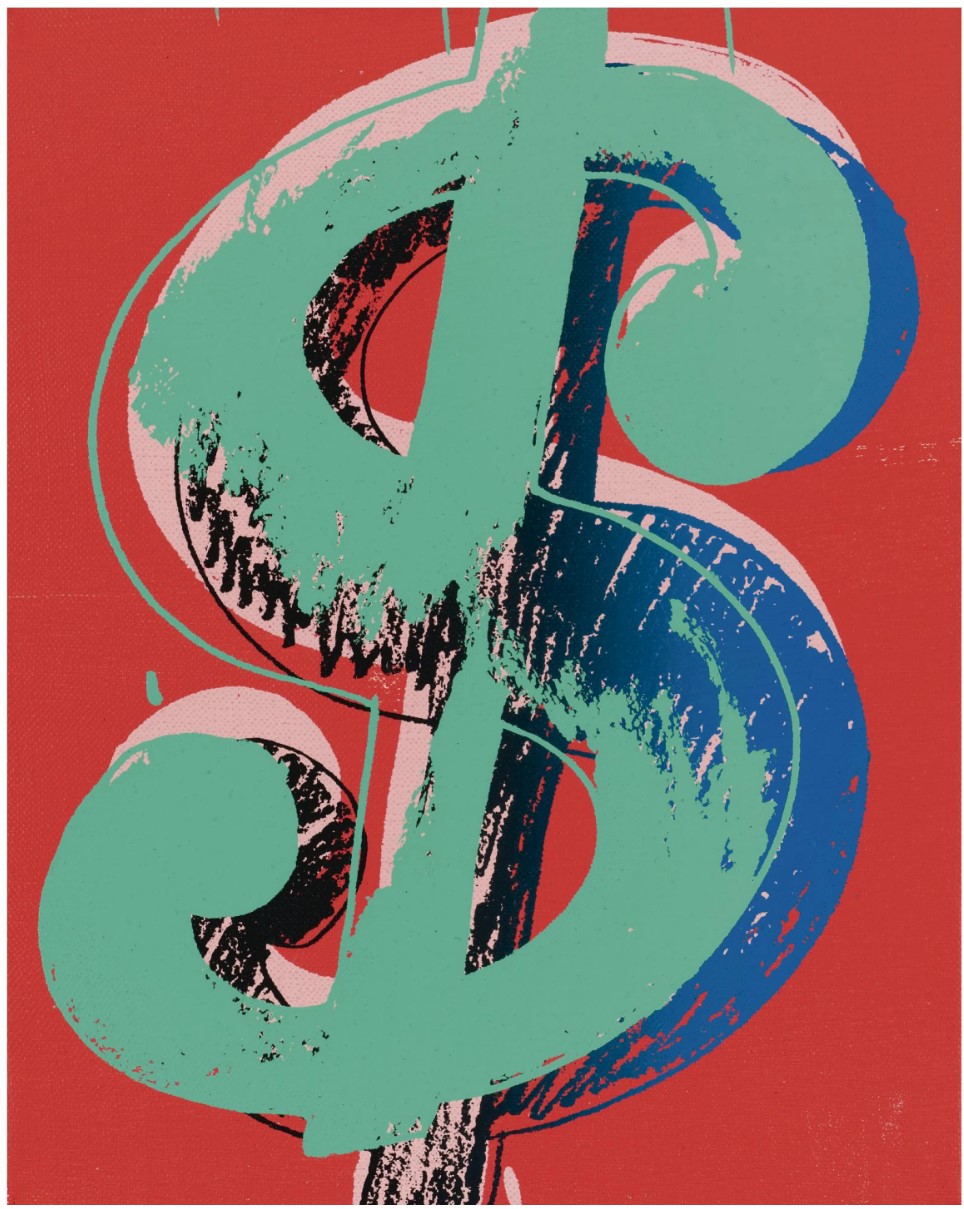
ANDY WARHOL
Dollar Sign, 1982
Acrylic and silkscreen ink on canvas
10×8 inches (25.4 x 20.3 cm)
Signed and inscribed To David and Philip, Love Andy on the reverse
Dollar Sign reflects the complete marriage of art and money. Moving away from his earlier depictions of dollar bills, Warhol’s Dollar Sign series isolate the $, concentrating on the iconic symbol of money – connoting sex, power and status in the most banal of fashions. The vibrant dollar sign pops off the canvas and commands attention and perfectly captures the brazen euphoria synonymous with the 1980s. Dollar Sign is a highly provocative image, quintessentially Warholian: reflecting his personality, shrewd powers of social oberservation and uncanny ability to stay on the forefront of culture and anticipate the next big thing. Dedicated to David Whitney and Philip Johnson and placed in the living room of Whitney’s Big Sur home, Dollar Sign is a powerfully iconic symbol, seemingly brazen in its simplicity and capturing so succinctly Warhol’s love affair with wealth.
Triple Dollar Sign
Dollar Sign, 1981
Christie’s New-York: 29 September 2022
Estimated: USD 600,000 – 800,000
USD 655,200
ANDY WARHOL (1928-1987) (christies.com)
ANDY WARHOL (1928-1987)
Dollar Sign, 1981
Synthetic polymer and silkscreen ink on canvas
10×20 inches (25.4 x 50.8 cm)
Stamped with the Estate of Andy Warhol and Andy Warhol Foundation for the Visual Arts, Inc. stamps
Numbered ‘VF PA30.015’ (on the overlap)
Stamped again with the Andy Warhol Foundation for the Visual Arts, Inc. stamp (on the reverse)
Estimated: USD 750,000 – 950,000
USD 1,205,000
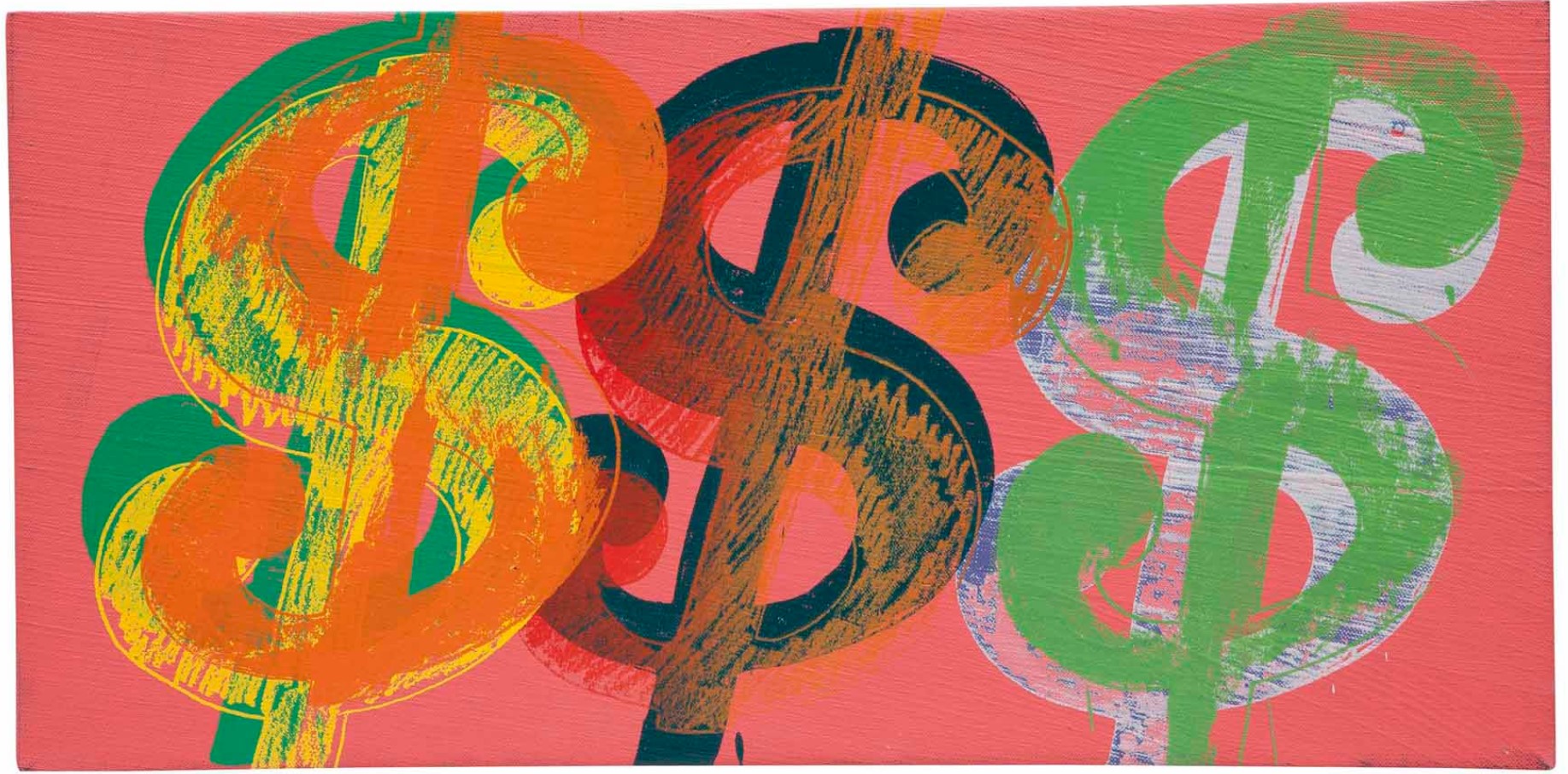
Triple Dollar Sign, 1981-1982
Acrylic and silkscreen ink on canvas
10×20 inches (25.4 x 50.8 cm)
Stamped twice with the Estate of Andy Warhol stamp and numbered ‘A894.102’ (on the reverse)
Estimated: USD 700,000 – 1,000,000
USD 785,000
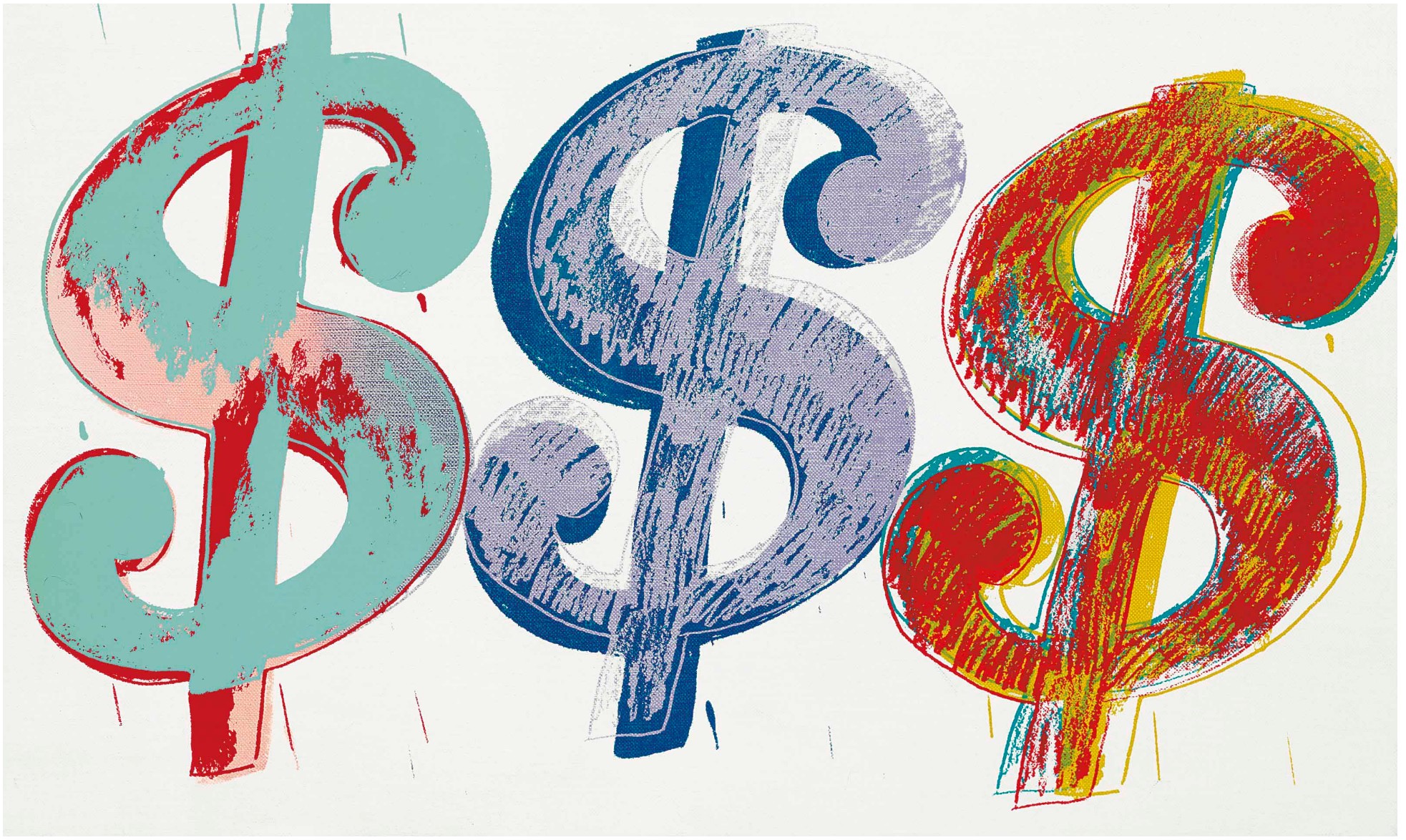
Triple Dollar Sign, 1982
Acrylic and silkscreen inks on canvas
12×20 inches (29×51 cm)
Signed and dated ‘Andy Warhol 82’ (on the overlap)
Stamped with the Andy Warhol Authentication Board, Inc.
Numbered A0134076 (on the reverse)