DAVID HOCKNEY
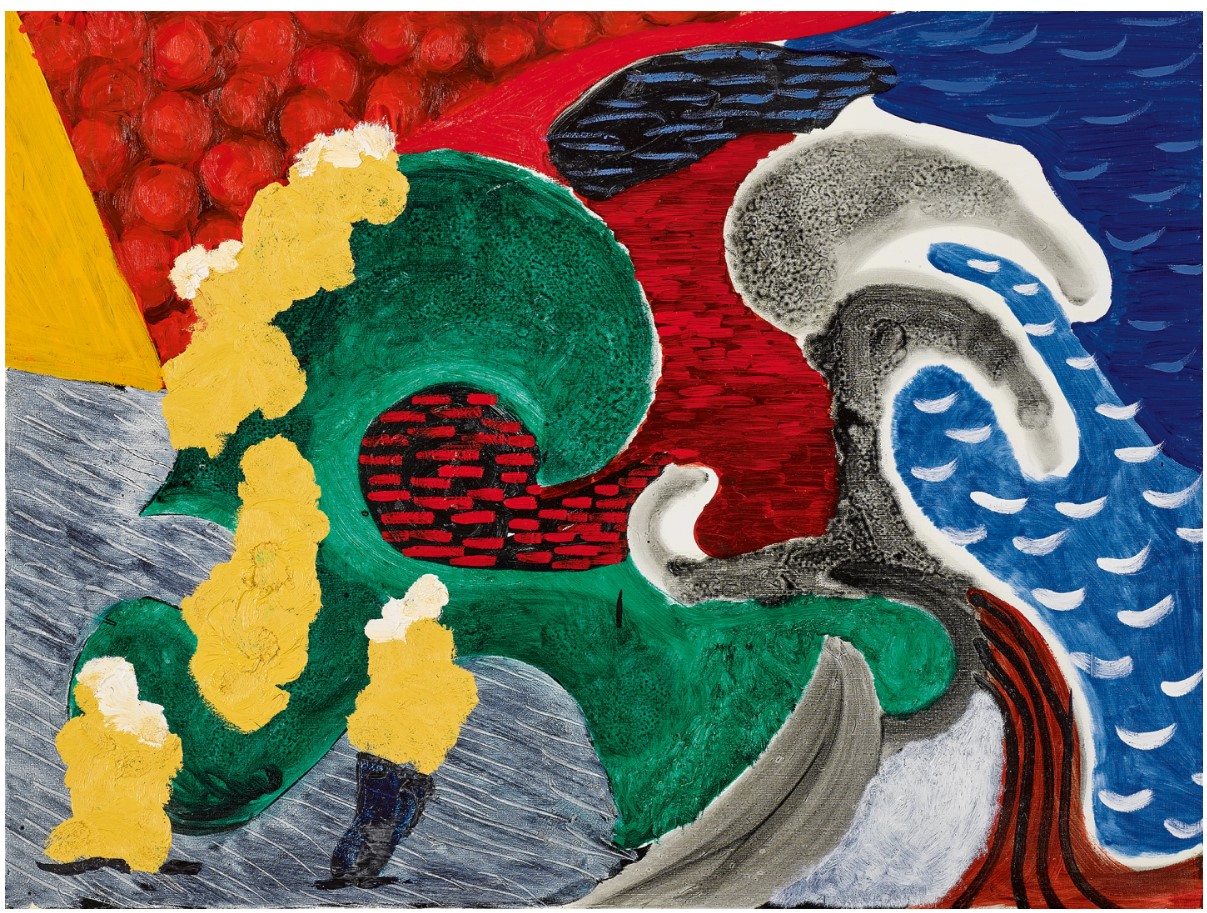
The Only One with Waves, 1991
Oil on canvas
36×48 inches (91.4 x 122 cm)
Signed, titled and dated 1991 on the reverse
Richard Gray Gallery, Chicago
Acquired from the above by the present owner in January 1992
USD 2,175,000
(#149) David Hockney (sothebys.com)
“If you lose your sight you then use sound to locate yourself in space. Whereas, if you can’t locate yourself with sound you probably do sharpen the visual thing. But you’d never know that unless you were an artist. Nobody would know you were seeing better. I mean, I must admit the pleasure of the eyes is very great to me. Just looking at things.
Sometimes it baffles me: why don’t people just look at the world and see how beautiful it is?”
Few artists are as associated with a single motif as Hockney is with swimming pools. The staple of Southern Californian backyards, the pool not only afforded Hockney respite from the grays of England but also provided him with an opportunity to be an observer: of landscape, of people; of colors, of light. Hockney once remarked, “Here in California you see more things, you see differently. You see brighter colors. And I want to use color – I want to get some sunlight in” (David Hockney quoted in Jan Butterfield, “David Hockney: Blue Hedonistic Pools”, The Print Collector’s Newsletter, vol. 10, no. 3, 1979, pp. 73-76). When thinking about Hockney, it is impossible to divorce his interest in pools from his formal interest in depicting light. The present work highlights Hockney’s technique of depicting light learned from his years outside the pool. Light in The Only One with Waves is stronger, more direct, because of the abstracted landscape’s proximity to the water and is further enhanced by the bright bold colors.
While the landscape verges on abstraction, Hockney’s beloved water remains a key feature of the present work. Like Hokusai’s The Great Wave off Kanagawa, Hockney’s wave rises and rolls forward across the canvas, the power of the ocean taking shape behind it. The artist’s use of white space – or void – in his composition, is a further nod to Eastern art philosophy and the Japanese woodblock print tradition. Eschewing traditional Western perspective further renders the elements in the composition to an almost crude and distorted flatness. As Hockney remarked to Lawrence Weschler, it “comes closer to how we actually see—which is to say, not all at once but in discrete, separate glimpses which we then build up into our continuous experience of the world” (Lawrence Weschler, “True to Life,” The New Yorker, 9 July 1984, p. 62).