DAVID HOCKNEY
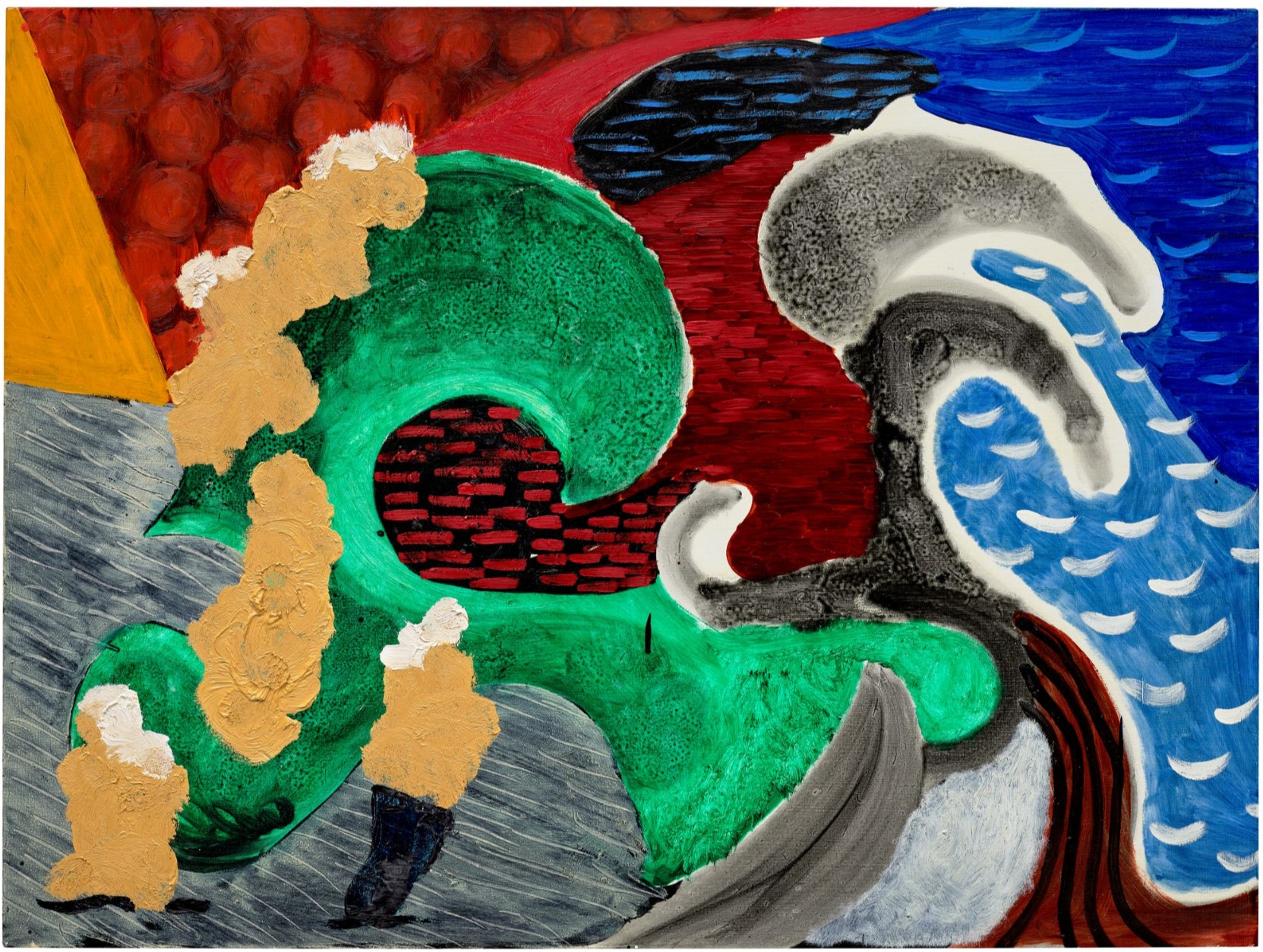
The Only One with Waves, 1991
Oil on canvas
35 7/8 x 48 inches (91.4 x 122 cm)
Signed, titled and dated ‘The Only One with Waves David Hockney 1991’ on the reverse
Provenance
Richard Gray Gallery, Chicago
Private Collection (acquired from the above in January 1992)
Sotheby’s, New York, 17 May 2018, lot 149
Acquired at the above sale by the present owner
Auction History
Property of an Important Collector
Phillips London: 26 June 2026
Estimated: GBP 1,800,000 – 2,500,000
GBP 2,423,000 / USD 3,198,205
David Hockney Modern & Contemporary Art Evening & Afternoon Sale
REPEAT SALE
Sotheby’s New-York: 19 May 2018
Estimated: USD 1,800,000 – 2,500,000
USD 2,175,000
When David Hockney painted The Only One with Waves in 1991, the artist experienced profound changes in his life and his surroundings. Opened up by the world of the stage and spectacle while working on opera sets, Hockney simultaneously turned to the inspiration and respite afforded by the sun-hued vistas of the Southern Californian coast. Realized with a chromatic brilliance and fluid, essentialized style, The Only One with Waves draws upon the themes of his greatest paintings — a journey that has seen Hockney tenderly chronicle his own life through the landscapes and places he inhabited.
“When you live […] close to the sea, when it literally comes up and splashes the windows, it is not the horizon line that dominates, but the close movement of the water itself. It’s like fire and smoke, endlessly changing, endlessly fascinating.”
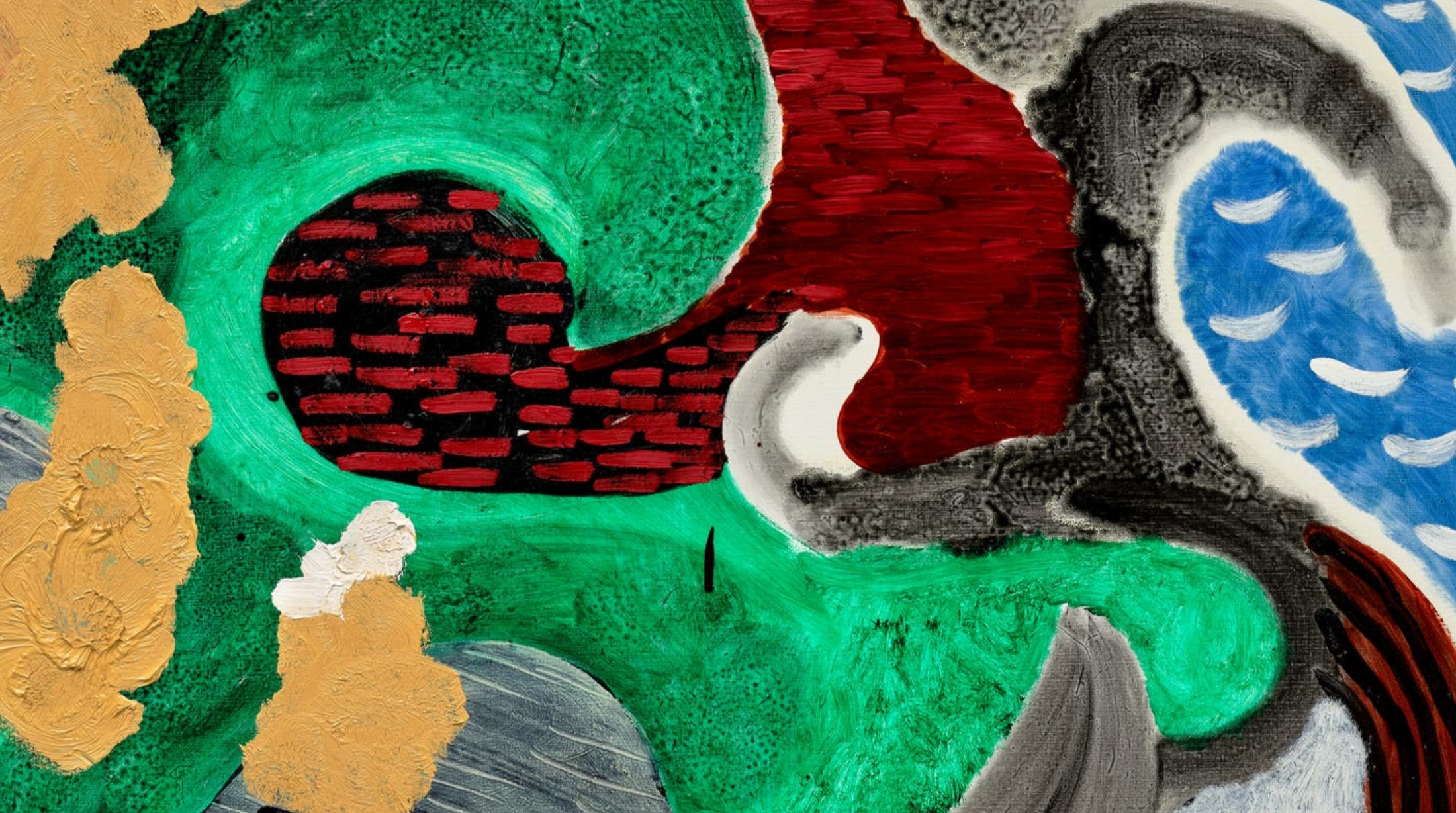
The Only One with Waves was first exhibited in a suite of works presented at Richard Gray Gallery in Chicago at the beginning of 1992. Anticipating the series of Very New Paintings conceived in 1992, Hockney approached the canvas here with the same gusto and tenacity, constructing space as he approached the stage. In abbreviating the elements of the landscape into their key attributes, heightening the sweeping contours and salty foams of breaking waves, using a flattened pictorial space, Hockney communicates a theatrical dynamism. The Only One with Waves marks the ever-present vivacity of Hockney in the middle of his career — an energy that poured into the subsequent years passed in Yorkshire, London and Normandy.
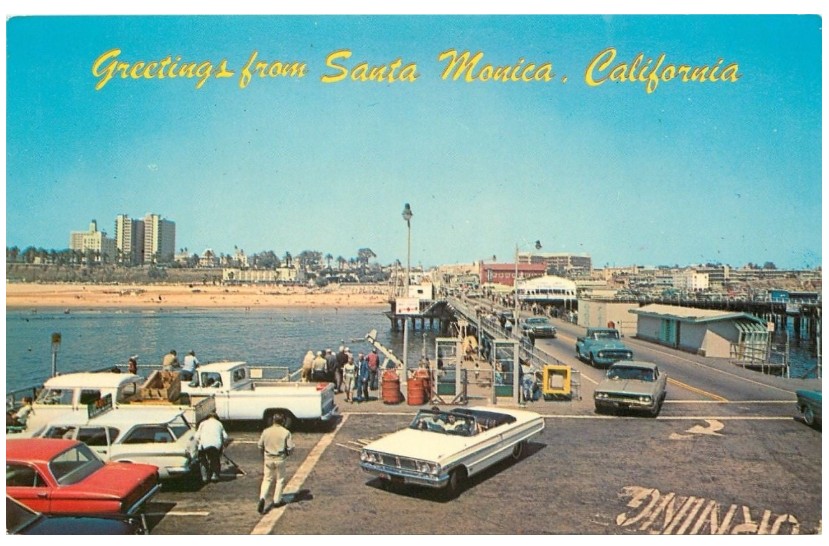
Postcard of Santa Monica Pier, circa 1960
Born in the industrial city of Bradford, West Yorkshire in 1937, as a young student at his local art school and then in London, Hockney looked to the freedom and excitement provided by travel. Having saved enough from the sale of paintings after graduating from the Royal College of Art to travel in 1963 to Egypt and then New York, by 1964 Hockney first arrived in California and set up his studio in Santa Monica. Though Hockney only permanently moved to Los Angeles in the summer of 1978, from his first trip the Southern Californian climate and light left an enduring impression.
“I was brought up in Gothic gloom […] I’m a bit like van Gogh. He’s a northerner who went to the sun. He thought there was more joy in the sun, and I tend to think that as well.”
At the time Hockney painted The Only One with Waves, the artist continued to find fresh stimuli from the simmering light and radiant colours of California while revisiting key subjects that he had scrutinized and refined over the course of his career. From his long-term neighborhood of the Hollywood Hills, by the end of the 1980s Hockney had also purchased a coastal home in Malibu. Maintaining the residence’s bohemian, seaside charm — even painting his bedroom walls inspired by the pinks and greens of a Matisse wallpaper — the house’s vantage point overlooking the Pacific Ocean allowed Hockney to study the wild, capricious forces of the ocean with greater proximity. Breathing new life into Hockney’s lifelong fascination with water’s alchemy, the shimmering fields of his first pool paintings especially resonate here. During his early years in California, Hockney sought to convey the complexities of liquid’s ability to reflect and refract light with veristic precision in A Bigger Splash (1967) or with the looser, serpentine ripples of Sunbather (1966). Using the same sense of pattern-like mark making as the latter yet clarified into shorter, more abbreviated strokes, in The Only One with Waves Hockney emulates the same sparkling waters, except now taking the open expanse of Pacific — a subject he aptly described as ‘the largest swimming pool in the world’. The experience of ‘studying the movement of water’ in Malibu left a lasting impression, leaving Hockney in ‘a profound meditative state’ and energized by the horizon’s ‘endlessly changing, endlessly fascinating’ state.
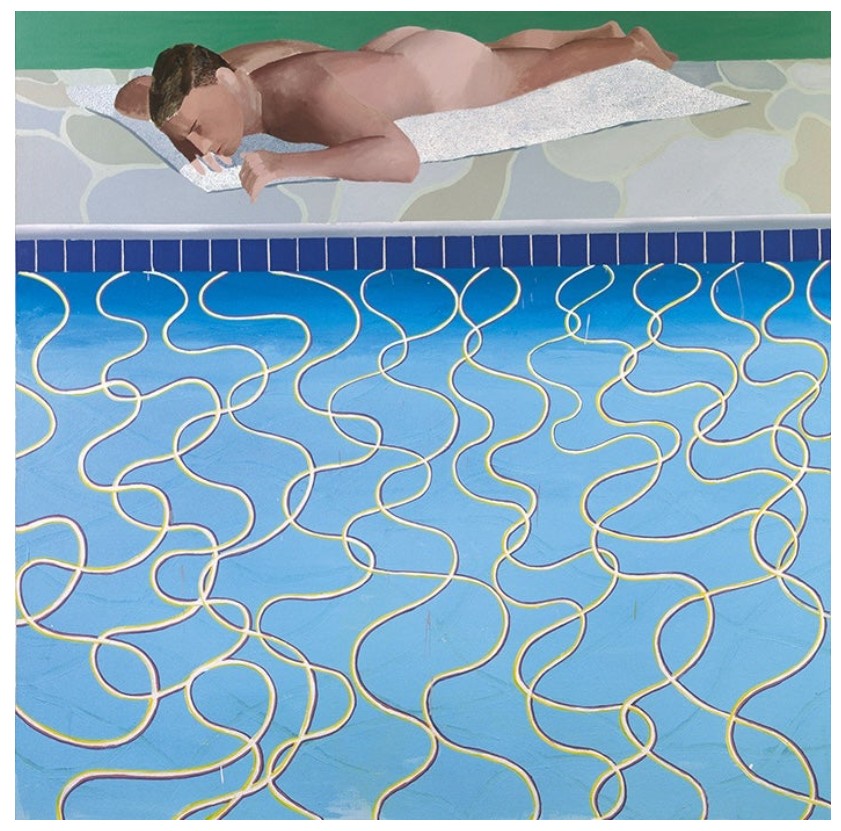
David Hockney, Sunbather, 1966, Museum Ludwig, Cologne. Artwork: © David Hockney
Concurrent to his days spent in Malibu, Hockney continued to develop his interest in art’s broad parameters and its intersection with music, design and performance. Having first seen Puccini’s La Bohème as a boy, Hockney was commissioned by the Lyric Opera of Chicago and the San Francisco Opera to take on the lyric heights of another one of the composer’s classics, Turandot. With his experience producing stage sets including The Rake’s Progress (1975) and The Magic Flute (1978), Turandot was scheduled to open in 1992 and saw Hockney continue to work on ambitious proportions – he even transformed his tennis court in the Hollywood Hills into a studio to fully comprehend the practicalities of staging.
“I said long ago that I thought of all my paintings as drama. Some of my early pictures have titles such as Theatrical Landscape. I was always interested in the theatre because it is about creating illusion in space.”
A project that was shortly followed by the end of 1992 with the production of Richard Strauss’ Die Frau ohne Schatten at London’s Royal Opera, during these years Hockney deepened his understanding of working in ‘three dimensions […] chopping up space using colour, using texture using line’. Placing himself in dialogue with the long legacy of artists from Pablo Picasso to Salvador Dali who explored the arena of theatre and spectacle, Hockney brings forth his understanding of illusions and the elasticity of space in The Only One with Waves. Focusing primarily on the ‘architectural’ dimensions of stage for Turandot, the sweeping roofs of the imperial palace rendered in fictive, luminous color find rich parallel in the curvilinear, natural forms of The Only One with Waves. With the sweeping, looping gestures metaphorically embodying the lyricism of the opera’s high octaves, Hockney’s hearing had been declining in the 1990s: a state that seems to have heightened his ability to intensify the complexity of the visual experience and internal rhythms embodied by the seascape.
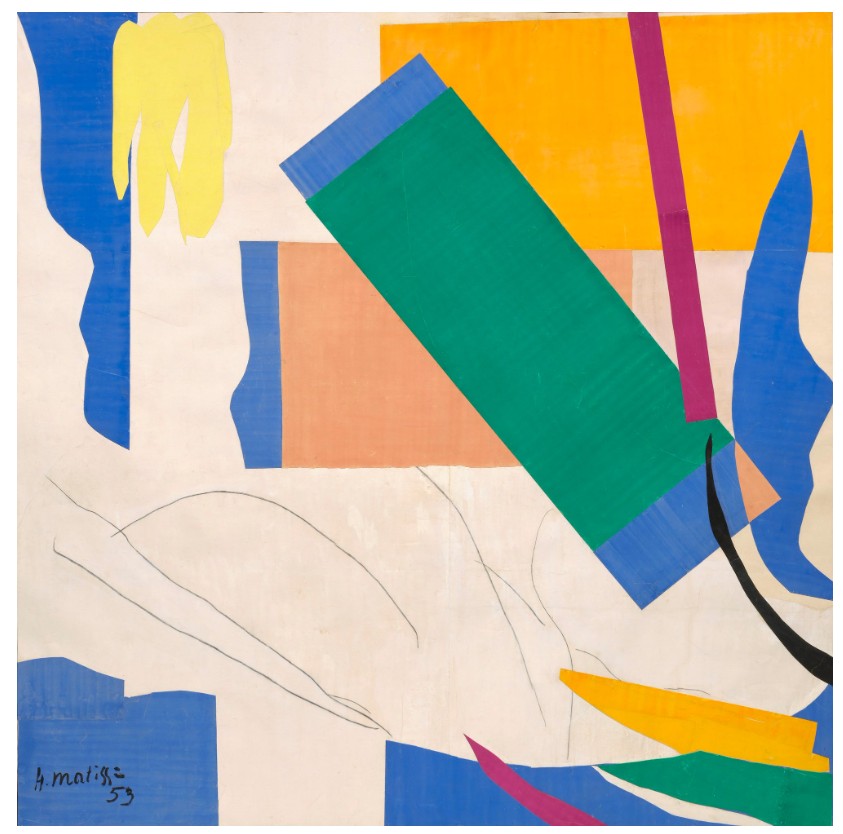
Henri Matisse, Memory of Oceania, 1952-1953, The Museum of Modern Art, New York.
Image: The Museum of Modern Art, New York/Scala, Florence
Radically eluding fixed, single point perspective and realized in a shallow pictorial space, Hockney generates a sense of depth through the layering of the breaking waves and foams, drawing upon the lessons of Analytical Cubism. As Hockney experimented with innovative mediums like photocollage at the beginning of the 1980s to explore perspective through the camera lens, in The Only One with Waves Hockney again combines multiple viewpoints and parallel fragmentation of the surroundings while in color, evoking the Fauves. Connecting to the cutouts of Henri Matisse and his Memory of Oceania, like Matisse who had synthesized his memories of his 1930 trip to Tahiti into their core, essential elements, Hockney uses parallel plains of vivid hues. Working with more descriptive line, Hockney invokes nature’s lasting power and ability to inspire, seeing his passion for place and sensitivity to composition and colour come into sharp focus. An ode to the sea’s raw beauty and frothing sprays, through The Only One with Waves Hockney appeals to the viewer’s most primal senses and offers a glimpse into the joy possible through a life spent on the simple act of observing.