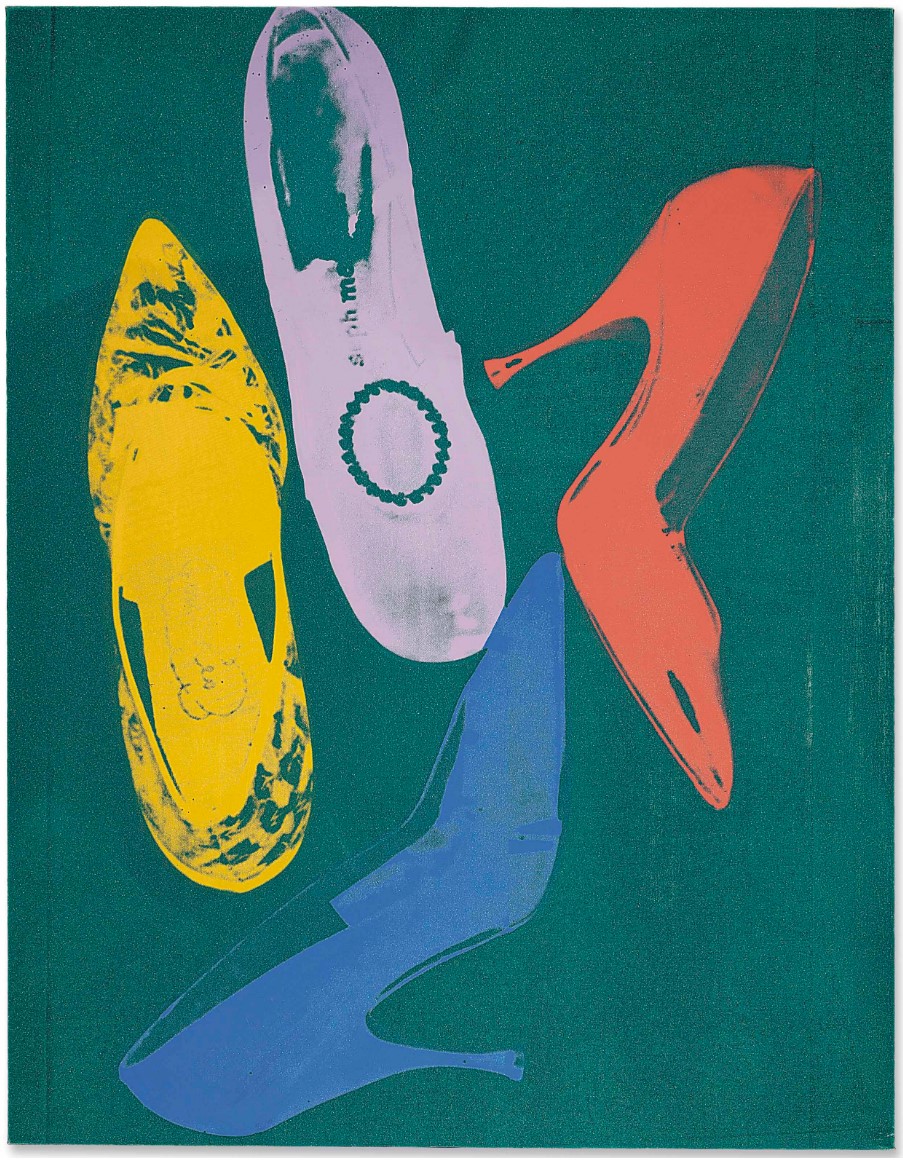
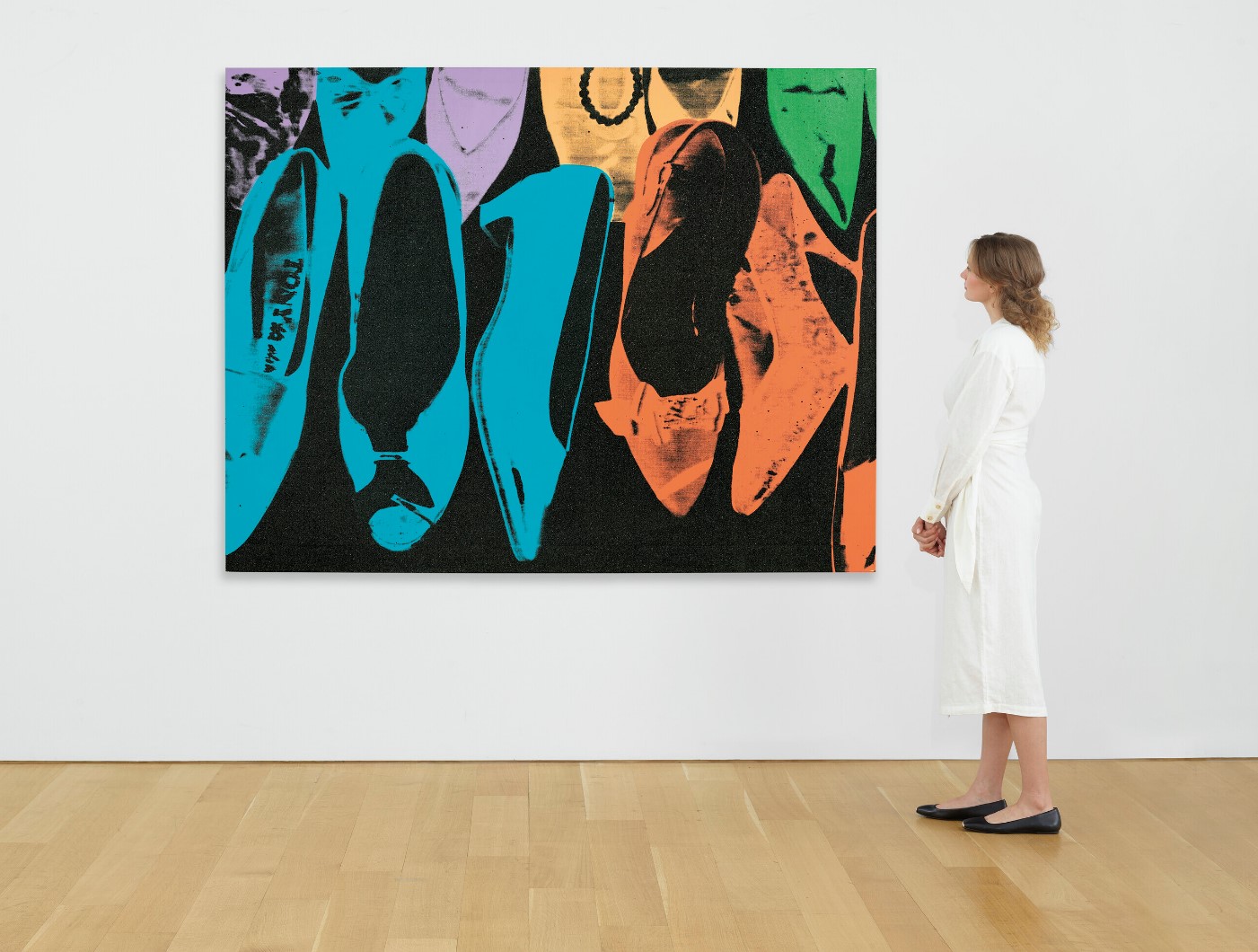
Beautifully stylized and archetypal in their simplicity, Andy Warhol presents the nostalgia and timelessness of the stiletto in his larger-than-life composition, Diamond Dust Shoes, from 1981. Arranged in a seemingly random but clearly staged way, each of Warhol’s shoes possesses a distinct character in its color and positioning, but are, in fact, identical in their epitomizing of a classic sense of elegance, glamour and style. The final finesse of diamond dust to the finish of the canvas only heightens the allure of the shoes and mimics the high gloss finish on the pages of a fashion magazine. Less branded than many of Warhol’s other object series, the shoes are anonymous, silent indicators of a beautiful lifestyle. Always possessing a flair for and interest in fashion, Andy Warhol’s Diamond Dust Shoes both brought him back to his humble beginnings as well as displayed his continual interest in fashion and style.
“I’m doing shoes because I’m going back to my roots. In fact, I think maybe I should do nothing but shoes from now on.”
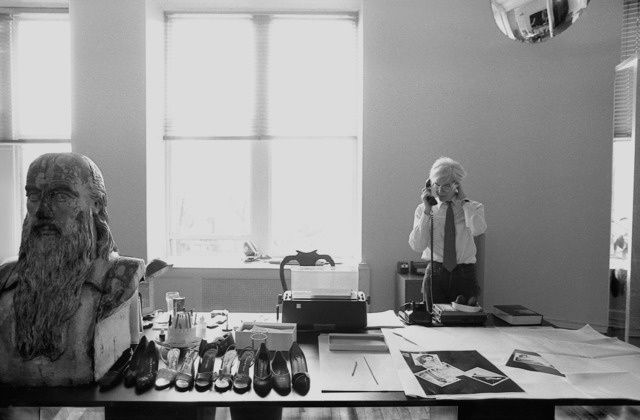
Introduction
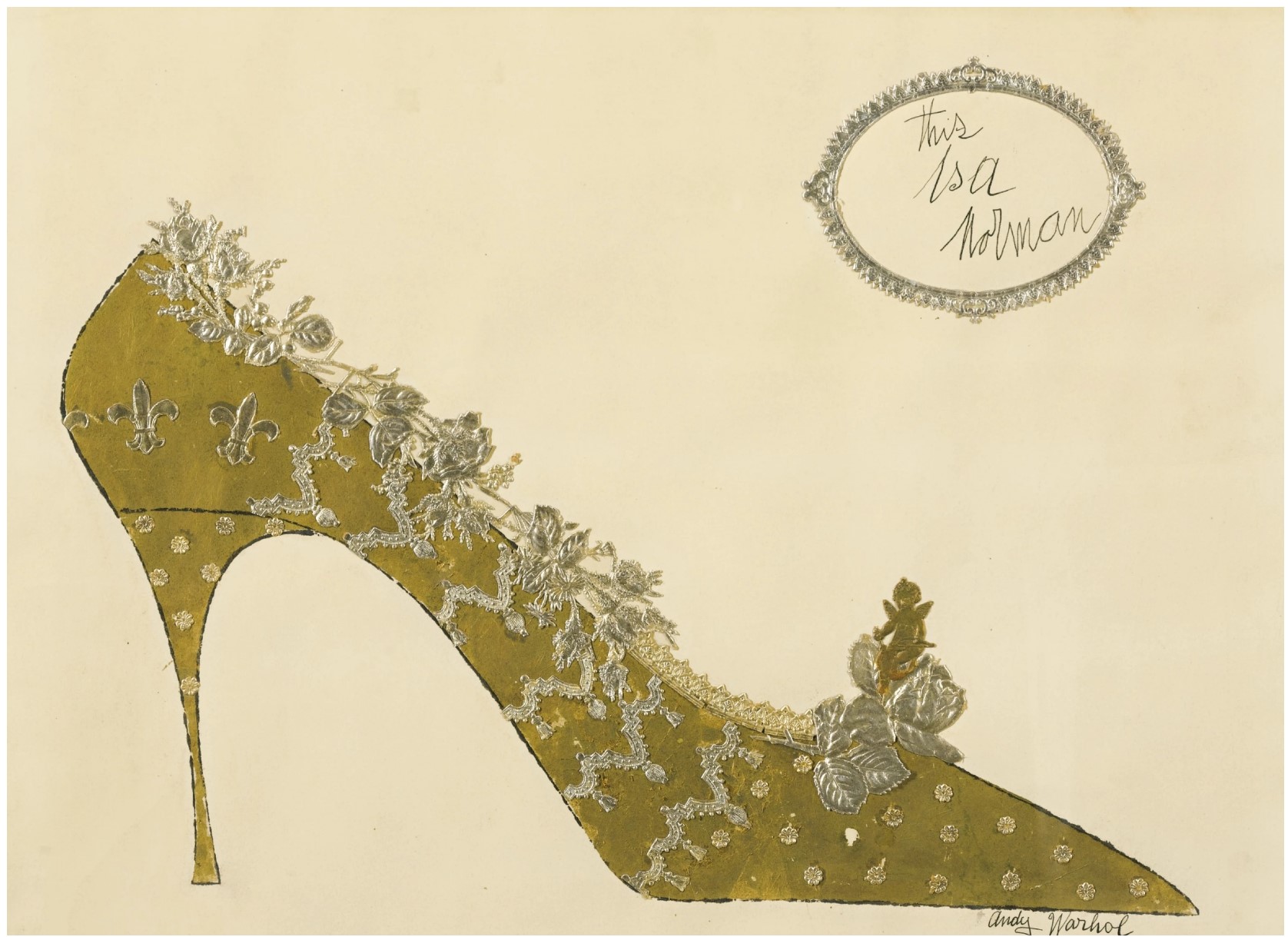
Warhol came to New York in 1949 to pursue a career as a commercial illustrator, an art that, due to the rising influence of commercial photography, was dwindling. Despite this barrier, Warhol’s distinctive, delicate renderings of shoes and other commercial items with their witty whimsicality soon found a market in magazines and newspapers. Soon after, he began to land an array of impressive campaigns, including advertisements for Neiman Marcus and Barney’s New York, as well as a formative collaboration with Richard Avedon’s fashion photos for a Mademoiselle magazine feature, “The Glass Slipper.” Warhol’s success in this field largely had to do with his ability to present a company’s products in an elegant and refined way, yet still maintain a youthful and vivacious approach. Although his commissions ranged in scope and content, shoes clearly dominate this early output, both in his commercial endeavors as well as in his early sketches and drawings. Warhol revealed this early fascination with the shoe as a subject of study in modest ball-point pen drawings showing an array of shoes, as if scattered about the floor of a woman’s boudoir. In Diamond Dust Shoes, the shoes are depicted in a similar fashion-as a laid out still life; a reflection of a young woman’s closet. Warhol’s flair for the extravagant, too, presented itself early, as evident in his gold leaf-plated Babs, an elegantly gilt stiletto drawing executed in 1956.
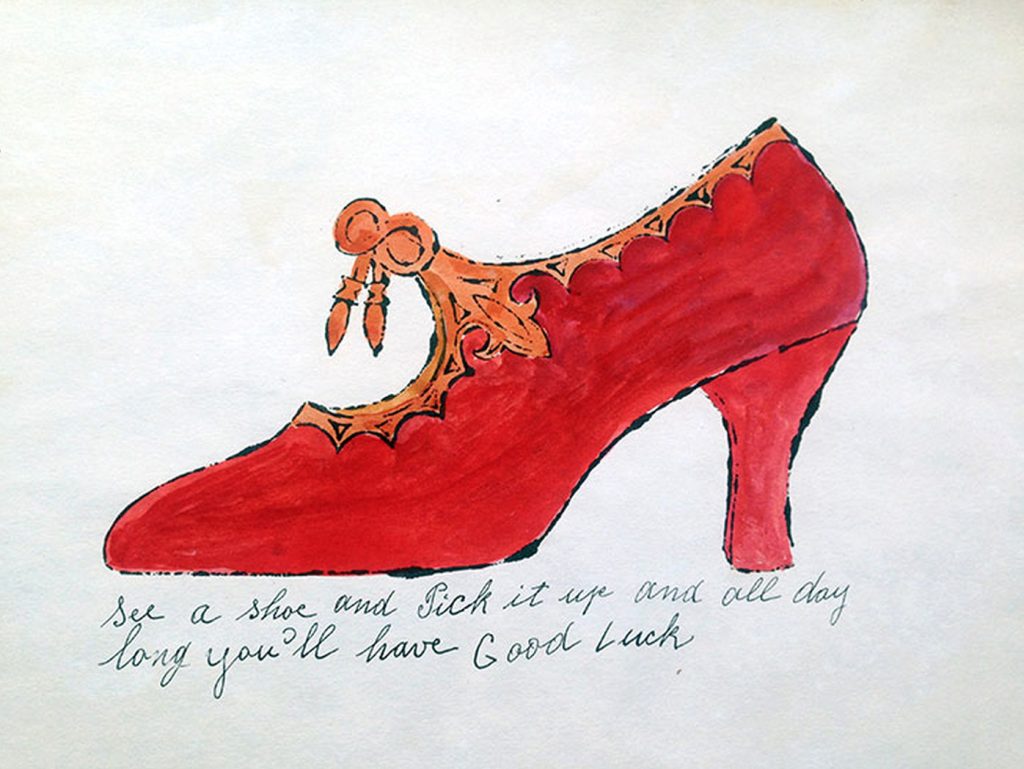
Throughout his career, Warhol was obsessed with luxury, beauty and fame. Evident from these early commissions as well as resonating throughout his career, Warhol constantly surrounded himself with beautiful, interesting and celebrated features of music, art, and fashion. Long before 1980, Warhol’s own position as a celebrity in all three of these categories was solidified, and, as he claimed, the decision to paint the Diamond Dust Shoes was due in large part to wanting to get back to his roots, most likely because of a clear nostalgia for this past moment in his life. Still Diamond Dust Shoes also signifies this glamorous, celebrity for which he was constantly drawn.
Adding to its intrigue, none of the shoes exist in a pair; they are all individual. A pair of shoes reflects a direct relation to a utilitarian product; one wears shoes to protect their feet. When presented in this way as a group of individual objects, each shoe is isolated in its role as a symbol, an icon. With its synecdochic relationship to the body of a woman, the shoe, especially a stiletto, is a sex symbol and can even be extended to its representation of a foot fetish. Just as with many of his other object paintings, while the artist is interested in the form and shape of the object that he is painting, the object is always a larger representative of a bigger theme or sentiment. While the shoe differs from Warhol’s Coca-Cola bottles, or a Campbell’s Soup Can in its anonymity, the power here lies with the international signifier of female sexuality rather than with a commercial product.
A deceptively straightforward motif, Warhol’s preoccupation with shoes is, in actuality, ripe with implications. On the most basic level, Warhol recognized the enormous subtext a pair of shoes communicates: their quality, make and style are fundamental financial status markers, just as they are also a basic means of personal expression. Warhol was thus not only fascinated by the power footwear is capable of conveying, but he also identified his own financial stability with his shoe renderings.
“When I used to do shoe drawings for the magazines, I would get a certain amount for each shoe, so then I would count up my shoes to figure out how much I was going to get. I lived by the number of shoe drawings – when I counted them I knew how much money I had.”
In 1956, Warhol exhibited his Golden Slipper series, featuring gold-leaf collages of intricate and fanciful shoes. As an early indication of what would prove to be Warhol’s lifelong preoccupation with celebrity, his marvelous golden slippers denoted royalty and wealth; humorously, he dedicated selected works in the series to idols such as Elvis Presley, Mae West, Julie Andrews and Judy Garland among others. It was shortly thereafter in 1960 that Warhol abandoned commercial art in pursuit of his own celebrity, as he sought to reinvent himself as one of the most important fine artists of the twentieth century.
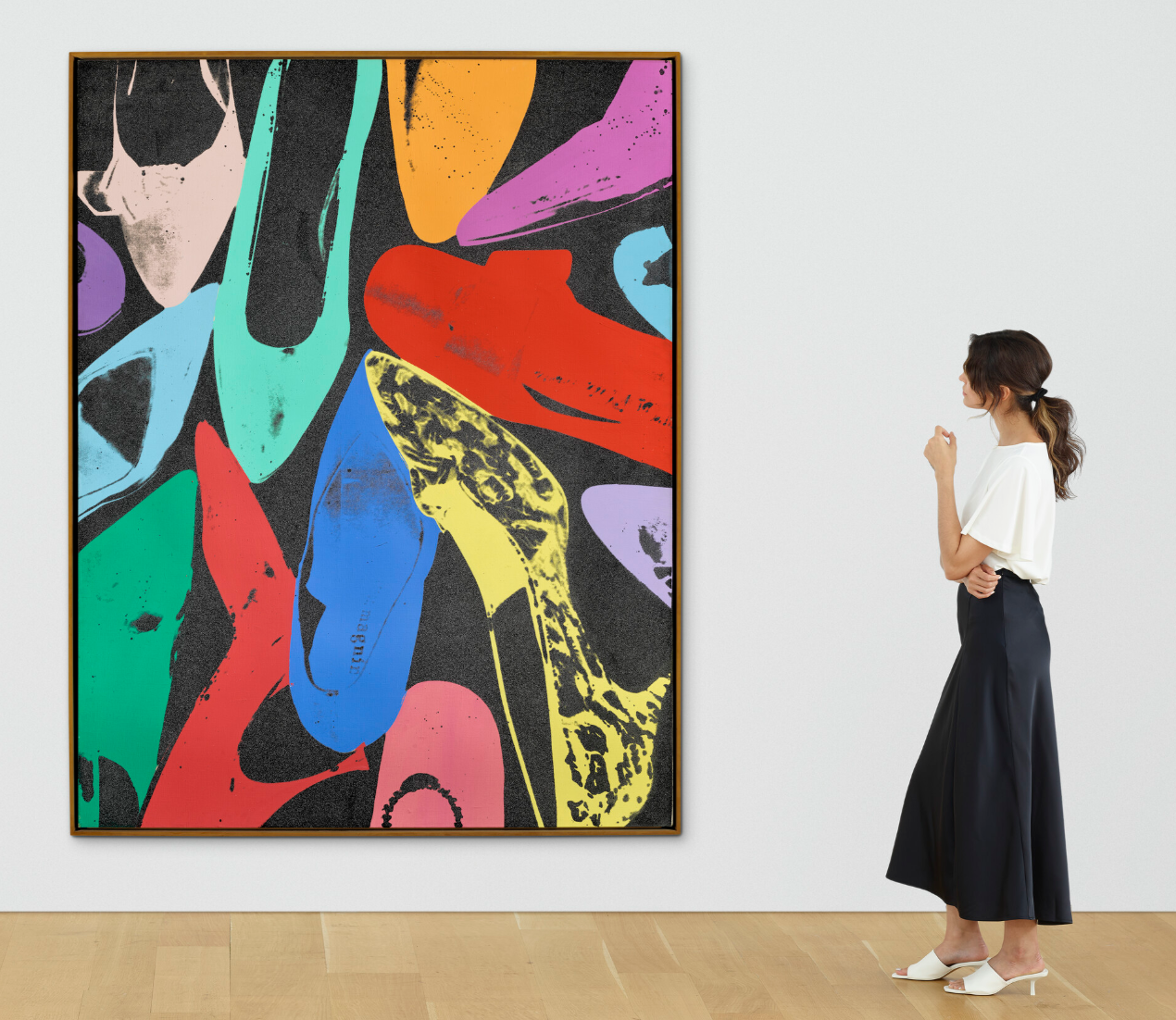
Diamond Dust Shoes radiates with sparkle and zing, as it effortlessly succeeds in elevating the banality of a photograph of scattered shoes to the glory of high art. Vivid and playful, the red, pink and blue tones of the present work most certainly capture the vibrancy of the late 70s and early 80s, particularly as they are offset by the dark shimmer of the painting’s background. The shoes’ inward pointing tips and circular composition also suggest an intoxicating sense of spiraling momentum. It is when activated by light, however, that the work’s true exuberance shines, asserting its own star quality. Clearly a distant cry from the commercially commissioned shoe illustrations of his early career, Warhol’s Diamond Dust Shoes assertively proclaim his later riches and fame. Warhol famously distinguished between to the two phases of his artistic production.
Andy made a total of 48 paintings in this series in three sizes: 27 paintings that were 90 x 70 inches, 17 paintings that were 50 x 42 inches and 4 paintings that were 14 x 18 inches. He only utilized the star-pointed composition in the 50 x 42 inch size and made four other examples besides the painting presently represented.
2026 Auction Results
Diamond Dust Shoes, 1980
Christie’s London: 14 October 2026
Estimated: GBP 1,800,000 – 2,500,000
GBP 2,530,000 / USD 3,327,065
ANDY WARHOL (1928-1987), Diamond Dust Shoes | Christie’s
ANDY WARHOL (1928-1987)
Diamond Dust Shoes, 1980
Acrylic, silkscreen ink and diamond dust on canvas
90×70 inches (229.5 x 177.8 cm)
Signed and dated ‘Andy Warhol 80’ (on the overlap)
2025 Auction Results
Diamond Dust Shoes, 1980
Christie’s New-York: 12 May 2025
Estimated: USD 3,000,000 – 5,000,000
USD 2,954,000
ANDY WARHOL (1928-1987), Diamond Dust Shoes | Christie’s
ANDY WARHOL (1928-1987)
Diamond Dust Shoes, 1980
Acrylic, silkscreen ink and diamond dust on canvas
90×70 inches (228.6 x 177.8 cm)
2024 Auction Results
No lots sold in 2024
2023 Auction Results
Diamond Dust Shoes, 1980
Christie’s New-York: 7 November 2023
Estimated: USD 1,500,000 – 2,000,000
USD 1,683,500
ANDY WARHOL (1928-1987) (christies.com)
ANDY WARHOL (1928-1987)
Diamond Dust Shoes, 1980
Acrylic, silkscreen inks and diamond dust on canvas
90 1/8 x 70 1/8 inches (228.9 x 178.1 cm)
Diamond Dust Shoes, 1980
Sotheby’s London: 12 October 2023
Estimated: GBP 1,200,000 – 1,800,000
GBP 3,315,000 / USD 4,048,113
Diamond Dust Shoes | Contemporary Evening Auction | 2023 | Sotheby’s (sothebys.com)
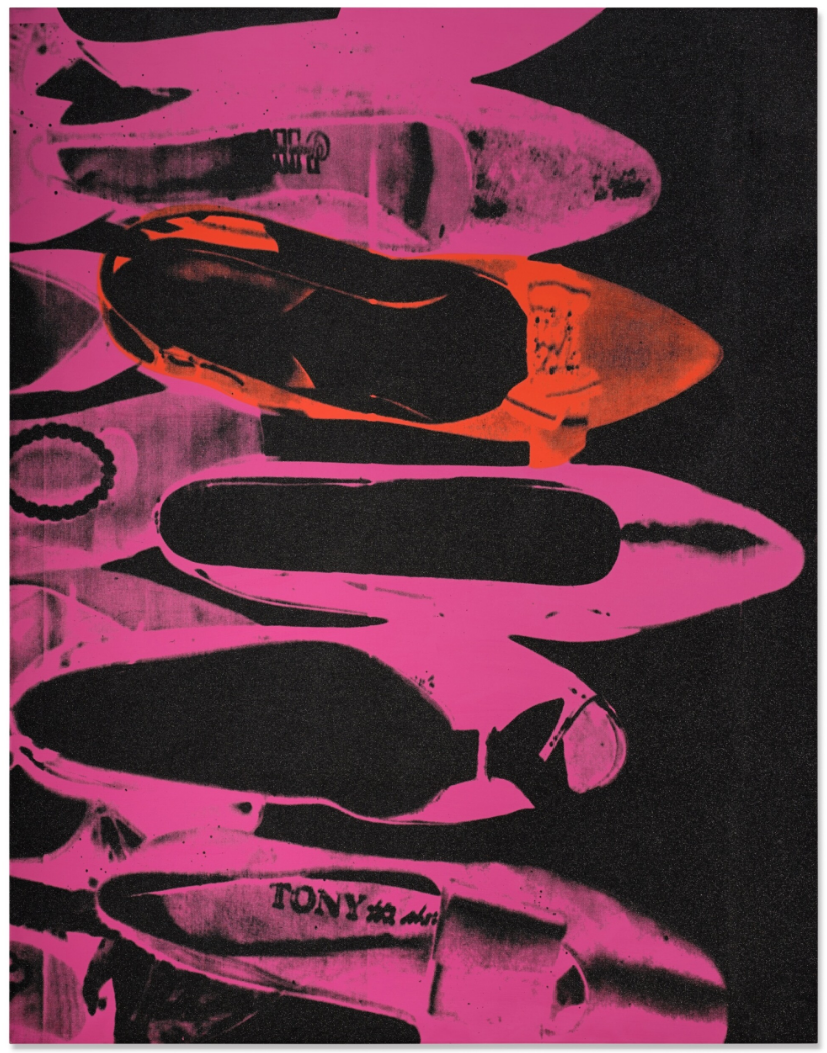
ANDY WARHOL (1928 – 1987)
Diamond Dust Shoes, 1980
Acrylic and silkscreen ink with diamond dust on canvas
90×70 inches (228.6 x 178.1 cm)
Numbered PA70.041 and stamped twice by the Estate of Andy Warhol, New York and the Andy Warhol Foundation for Visual Arts, Inc. (on the overlap)
Also numbered PA70.041 twice (on the stretcher)
Diamond Dust Shoes, 1983
Estimated: USD 800,000 – 1,200,000
USD 945,000
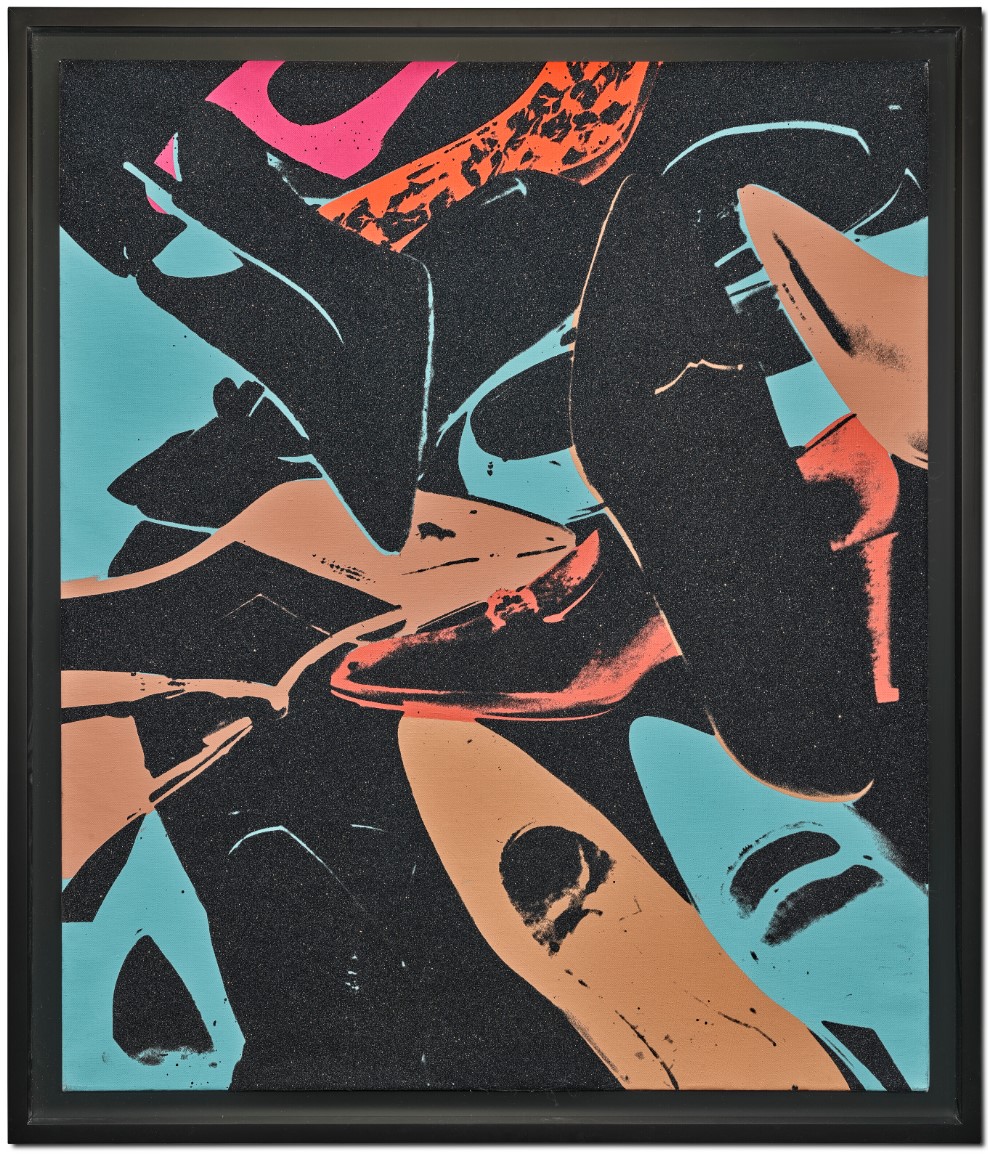
Diamond Dust Shoes, 1983
Acrylic, silkscreen ink and diamond dust on canvas
50 1/8 x 42 1/8 inches (127.3 x 107 cm)
Stamped with the Andy Warhol Foundation for the Visual Arts, Inc. and the Estate of Andy Warhol stamps (on the overlap)
Numbered ‘PA70.058’ (on the stretcher)
2022 Auction Results
Diamond Dust Shoes, 1980
Christie’s New-York: 17 November 2022
Estimated: USD 2,000,000 – 3,000,000
USD 2,580,000
ANDY WARHOL (1928-1987) (christies.com)
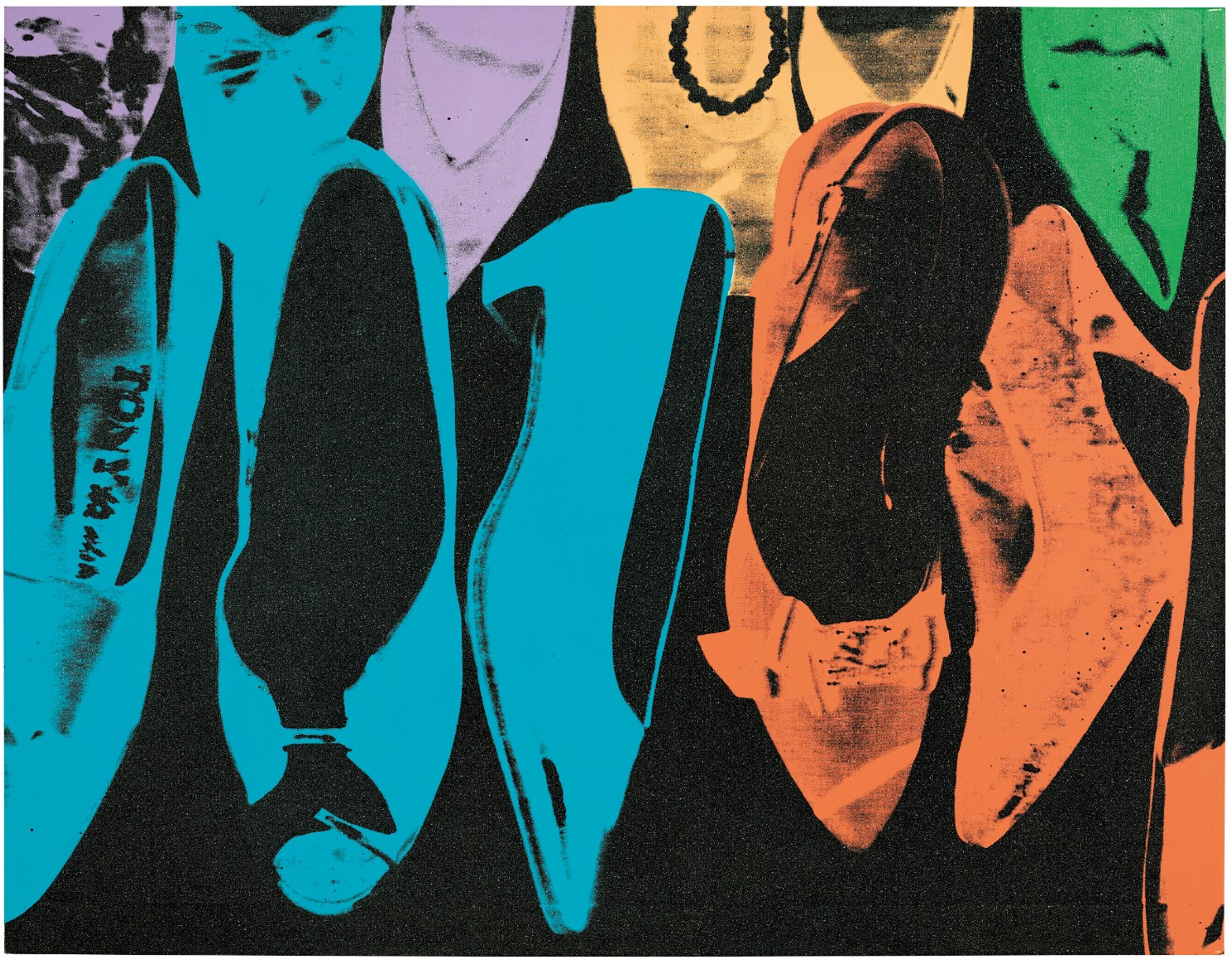
ANDY WARHOL (1928-1987)
Diamond Dust Shoes, 1980
Acrylic, silkscreen ink and diamond dust on canvas
70×90 inches (177.8 x 228.6 cm)
Diamond Dust Shoes, 1980
Bonhams New-York: 15 November 2022
Estimated: USD 1,200,000 – 1,800,000
USD 1,000,000
Bonhams : ANDY WARHOL (1928-1987) Diamond Dust Shoes 1980
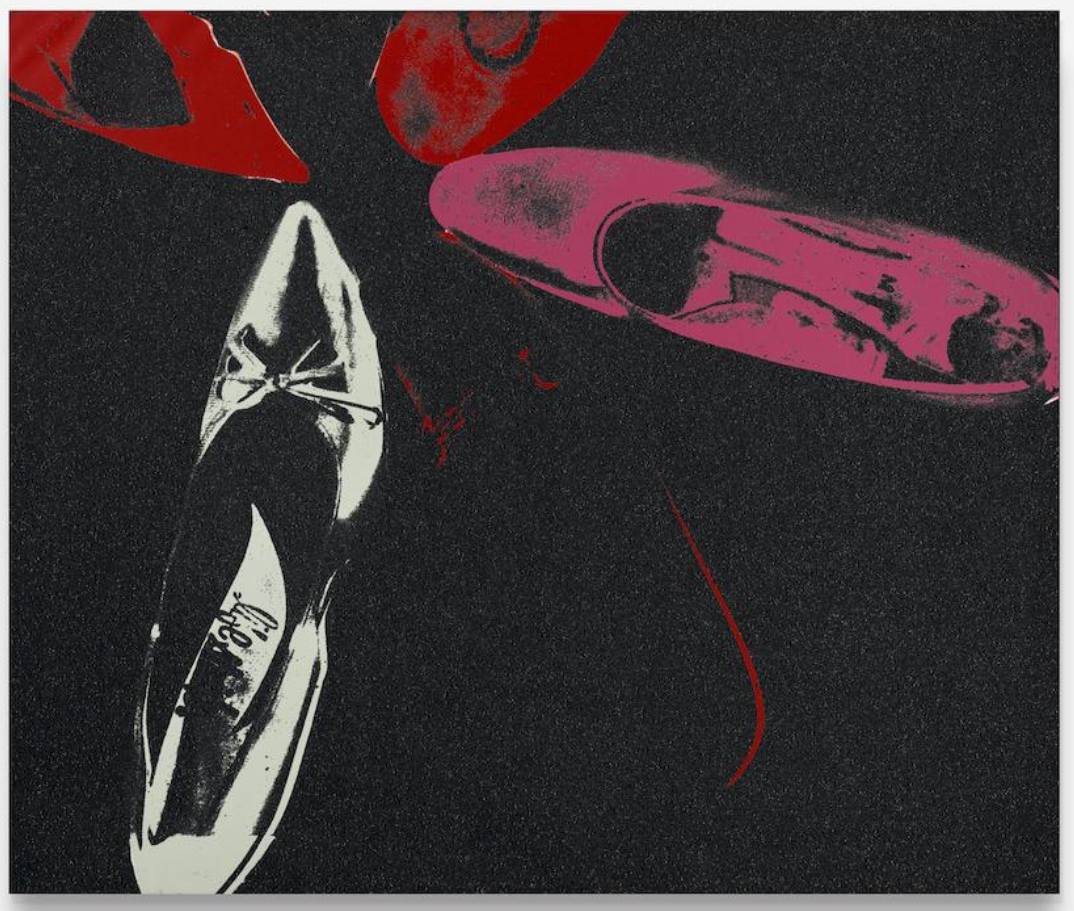
42×50 inches (106.7 x 127 cm)
Numbered PA70 050 on the stretcher bar, with The Estate of Andy Warhol stamp
With the Andy Warhol Foundation for the Visual Arts, Inc. stamp and inscribed VF on the reverse
Diamond Dust Shoes (70×90)
Diamond Dust Shoes, 1980
Christie’s London: 14 October 2026
Estimated: GBP 1,800,000 – 2,500,000
GBP 2,530,000 / USD 3,327,065
ANDY WARHOL (1928-1987), Diamond Dust Shoes | Christie’s
ANDY WARHOL (1928-1987)
Diamond Dust Shoes, 1980
Acrylic, silkscreen ink and diamond dust on canvas
90×70 inches (229.5 x 177.8 cm)
Signed and dated ‘Andy Warhol 80’ (on the overlap)
Provenance
Jablonka Galerie, Cologne
Private Collection
Anon. sale, Sotheby’s New York, 20 November 1997, lot 309
Ivor Braka Ltd., London (acquired at the above sale)
Acquired from the above by The Peter Simon Collection in 1999
Spanning more than two metres in height, Diamond Dust Shoes (1980) is a monumental work from Andy Warhol’s spectacular series of the same name. Standing among the artist’s most deeply personal creations, these glittering works are effectively self-portraits. At the height of his celebrity, Warhol returned to the motif that had first propelled him to fame as a commercial illustrator in the 1950s. Back then, Warhol had been dubbed ‘the Leonardo da Vinci of the shoe trade’ by Women’s Wear Daily. Three decades later, he had taken his place as the undisputed king of Pop Art. ‘I’m doing shoes because I’m going back to my roots’, he said. ‘In fact, I think maybe I should do nothing but shoes from now on’ (quoted in P. Hackett, ed., The Andy Warhol Diaries, New York, 1989, p. 306).
One of Warhol’s earliest assignments as a young illustrator had been a set of shoe drawings for Glamour magazine. His big break, however, came when he was offered a contract with I. Miller Shoes in 1955. The sleek, characterful sketches he produced for the company propelled him into the public eye: across New York, his name became synonymous with shoes. Warhol would make drawings as gifts for friends and professional contacts, later producing an illustrated book entitled À la recherche du shoe perdu. In his hands, shoes became metaphors for fame and success: the artist made around forty drawings of shoes inscribed with the names of celebrities—including Truman Capote, Julie Andrews and James Dean—which he exhibited at the Bodley Gallery in 1956. Transforming ubiquitous, mass-produced footwear into seductive symbols of glamour, these works laid the foundations for his entire practice. The stage was set for the 1960s, where icons such as Campbell’s Soup, Coca-Cola, Marilyn Monroe and Liz Taylor would join his pantheon.
It was not until several decades later that Warhol would return to the shoe. The Diamond Dust Shoes emerged as part of his Retrospective series, in which he revisited some of the most prominent images of his earlier career. In typical Warholian fashion, however, the motif was far from a simple reprisal. As the 1980s dawned, his sparkling heels glittered with new significance. As Vincent Fremont writes, ‘Andy created the Diamond Dust Shoe paintings just as the disco, lamé, and stilettos of Studio 54 had captured the imagination of the Manhattan glitterati. Andy, who had been in the vanguard of the New York club scene since the early 60s, once again reflected the times he was living in through his paintings’ (quoted in Diamond Dust Shoes, exh. cat., Gagosian Gallery, New York, 1999, pp. 8-9). Warhol’s shoes had danced from post-war Pop to post-punk glamour, ushering in the era of Jean-Michel Basquiat, Keith Haring, Madonna and David Bowie.
The Diamond Dust Shoes also spoke more specifically to contemporary fashion. They were based on Polaroids taken by Warhol’s assistant Ronnie Cutrone, capturing a mixture of shoes that the artist had sourced himself and others sent to him by the fashion designer Halston. He and Warhol were close friends, and—along with Liza Minelli, Bianca Jagger and others—were regulars on the Studio 54 club circuit. ‘Ronnie turned the box upside down and dumped the shoes out’, recalls Bob Colacello. ‘Andy liked the way they looked spilled all over the floor. So he took a few Polaroids and had Ronnie take a lot more’ (Holy Terror: Andy Warhol Close Up, New York, 1990, p. 443). Warhol spent time tweaking the various haphazard arrangements of shoes: here, a brand label is visible in the central blue shoe. The results, in all their multicoloured chaos, border on abstraction.
Warhol had been introduced to ‘diamond dust’ in 1979 by his master printer Rupert Smith. He first employed it in his black-on-black shadow paintings that year, as well as in portraits of Joseph Beuys and Georgia O’Keeffe. Dissatisfied with its chalky appearance, he eventually replaced the medium with pulverised glass, which gave a more alluring sheen. Emblazoned upon a black background—anticipating the haunting ‘Fright Wig’ self-portraits he produced later that decade—the shoes glitter like galaxies and constellations in the night sky. They are apt reflections of an artist who shrouded himself in mystery and enigma: ‘if you want to know all about Andy Warhol, just look at the surface of my paintings …. There’s nothing behind it’, he had once said (quoted in G. Berg, ‘Andy, My True Story’, Los Angeles Free Press, March 1967, p. 3). Indeed, for all their glitz, glamour and retrospective poignancy, the Diamond Dust Shoes ultimately give nothing away. Instead they sparkle like broken mirrors, reflecting our dreams, fantasies and desires straight back at us.
Diamond Dust Shoes, 1980
Christie’s New-York: 12 May 2025
Estimated: USD 3,000,000 – 5,000,000
USD 2,954,000
ANDY WARHOL (1928-1987), Diamond Dust Shoes | Christie’s
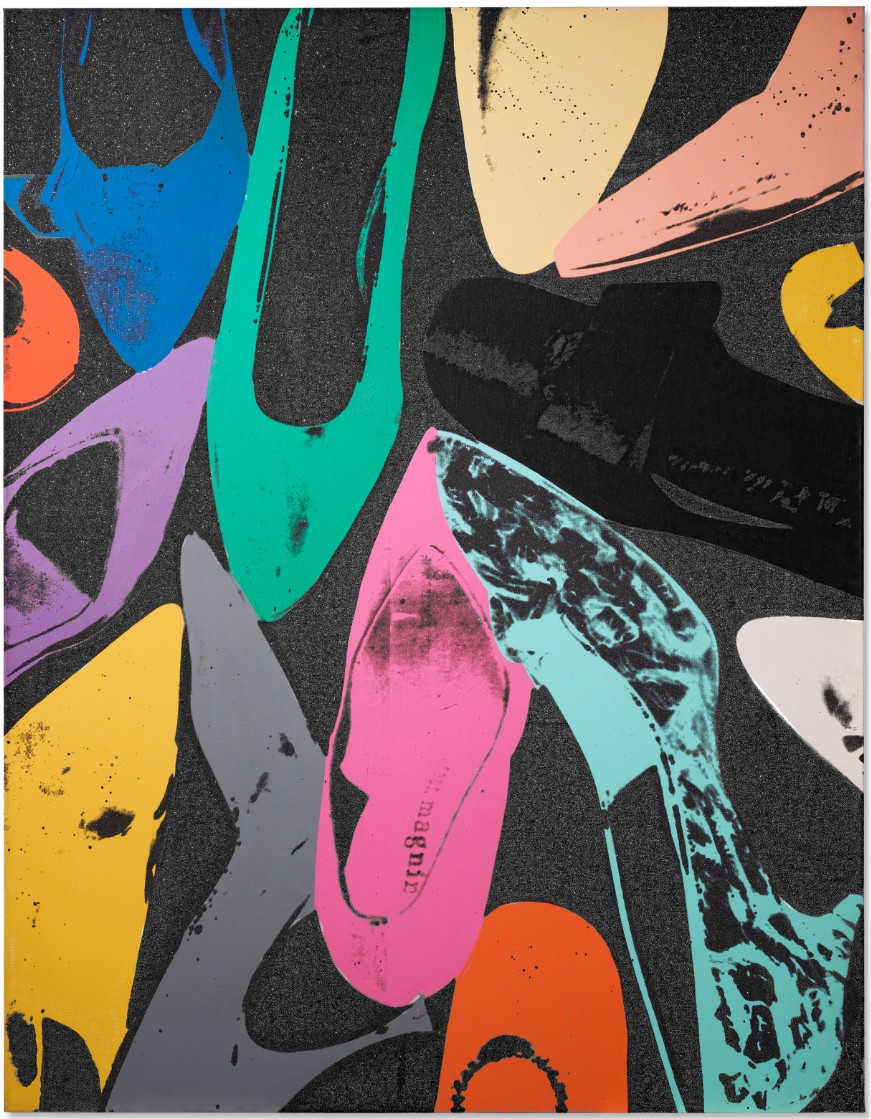
ANDY WARHOL (1928-1987)
Diamond Dust Shoes, 1980
Acrylic, silkscreen ink and diamond dust on canvas
90×70 inches (228.6 x 177.8 cm)
Provenance
Estate of Andy Warhol, New York
Private collection
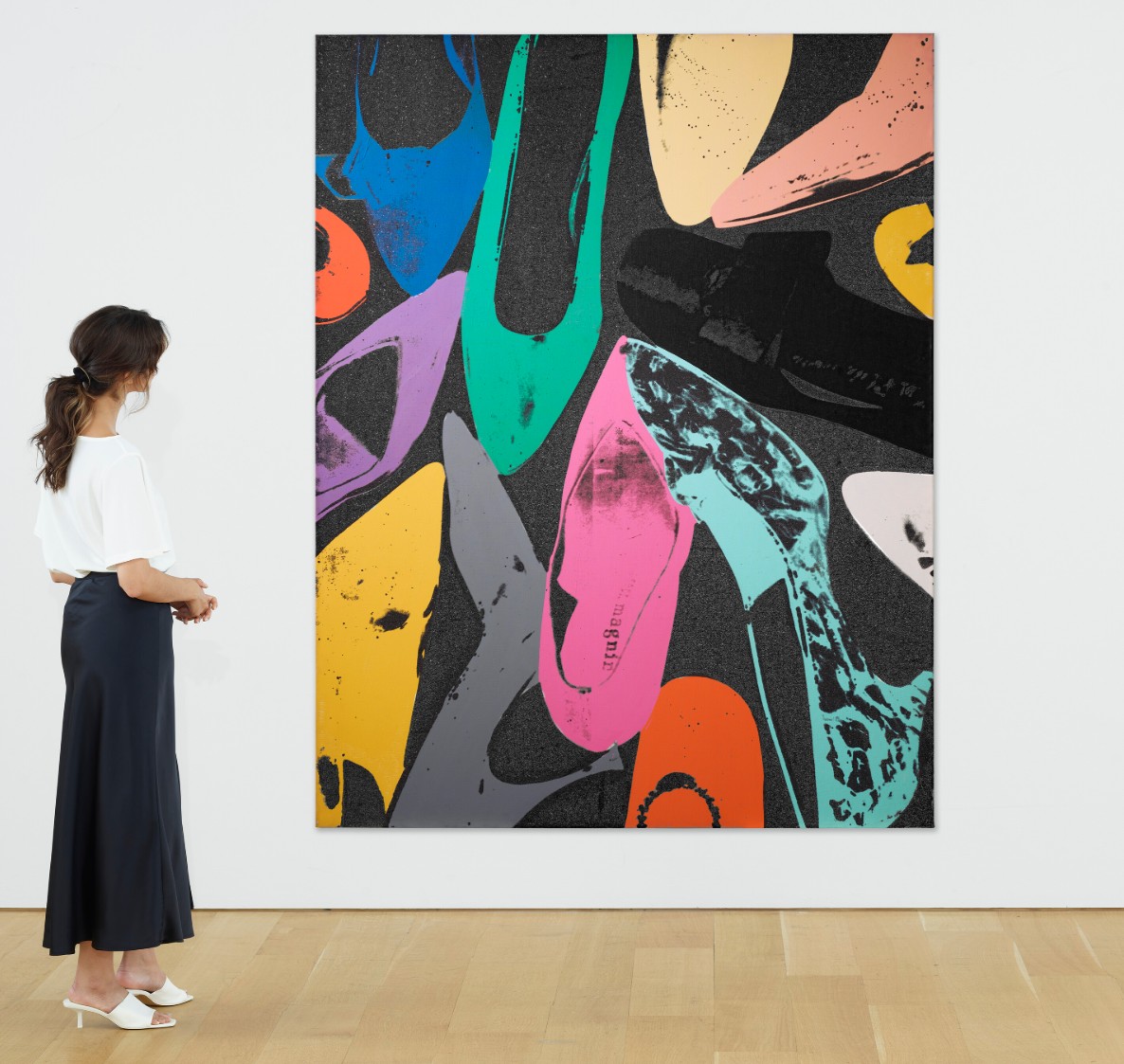
A career-defining work of rare elegance, Diamond Dust Shoes embodies the glamour of Andy Warhol’s New York City at the turn of the 1980s. Its larger-than-life scale mirrors Warhol’s own grand presence, which fueled the art world as we know it today. In a fabulously literal gesture, diamond dust is actually sprinkled upon his vibrant pigments, calling to mind the transcendent sparkle of Dorothy’s ruby slippers or the glowing personalities of Studio 54. Diamond Dust Shoes is an important later work that would help define Warhol’s artistic output before his untimely death in 1987. Exhibited in his epochal 1989 retrospective at the Museum of Modern Art, New York, it distills the entirety of his career, from his beginnings in illustration to the increasingly intimate, autobiographical subject matter of his inventive final years.
“I’m doing shoes because I’m going back to my roots.
In fact, I think maybe I should do nothing but shoes from now on.”
Diamond Dust Shoes, which shines like Warhol’s silver-coated Factory, represents a career-long love of fashion, luxury, and beauty that resonates in our contemporary moment.
The present work has all the opulence suggested by its name. Warhol fills the seven-and-a-half foot by nearly six-foot canvas with his characteristically Pop colors, which are set off by the dark background. The shoes transform into rays emitted by a disco ball or luminescent jewelry. We can see one shoe bearing the monogram of I. Magnin, a storied West Coast luxury brand. The other pumps are brandless, allowing them to become archetypes or pure bursts of pigment. Warhol includes grey, white, and black shoes to complement the brightness of the scene, and each heel, while separated from its pair, feels interconnected. Diamond Dust Shoes therefore exhibits the fantastical, rich disco colors that originated in New York in the 1970s, while reminding us of the icons of monochromatic dressing, from Coco Chanel’s little black dress to Carolina Herrera’s crisp, white dress shirts. Like the ruby slippers of The Wizard of Oz, Diamond Dust Shoes establishes a place for itself within an indispensable sartorial history.
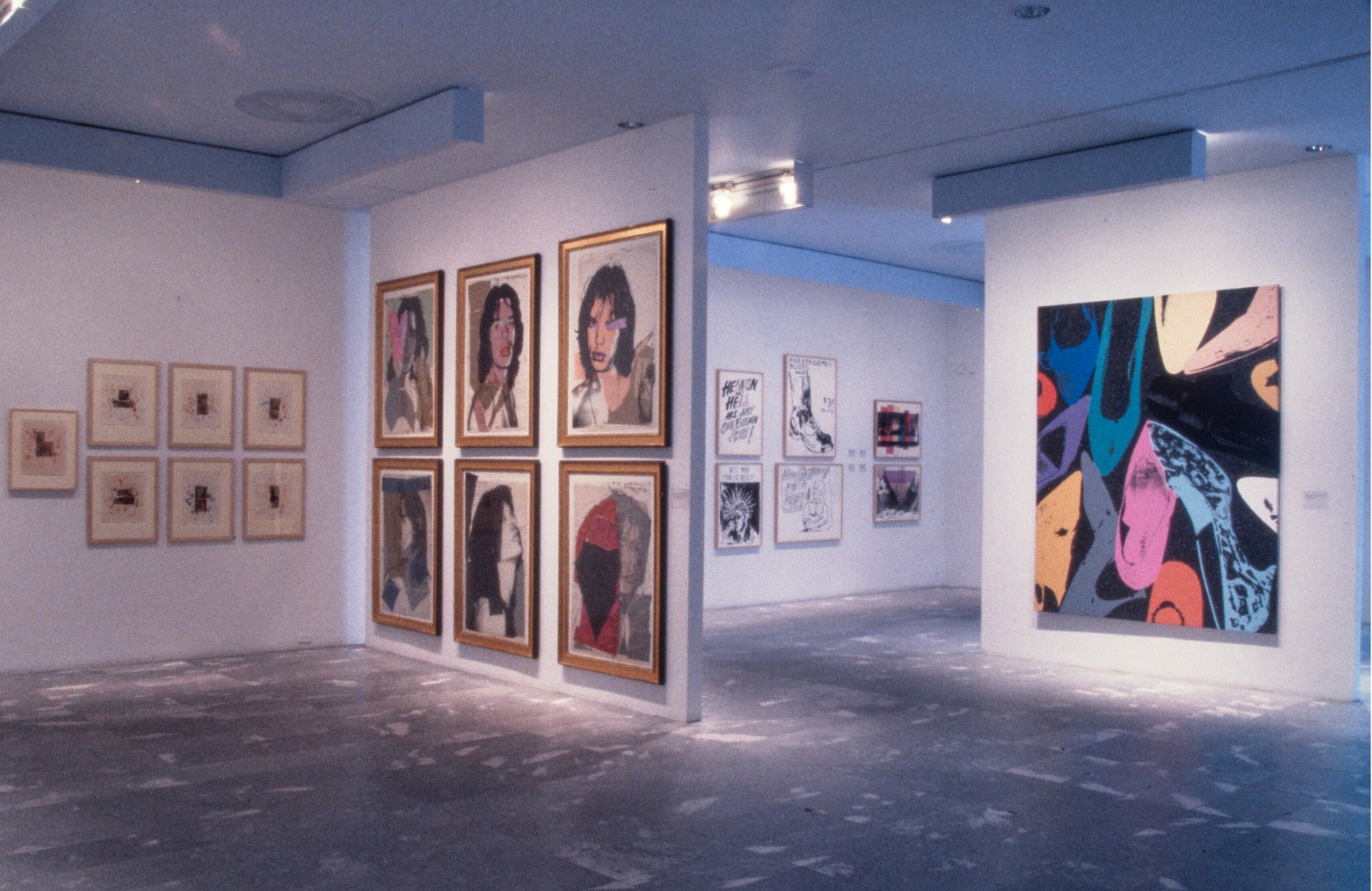
Installation view, Andy Warhol: A Retrospective, February–May 1989. Museum of Modern Art, New York (present lot illustrated). Photo: © The Museum of Modern Art/Licensed by SCALA / Art Resource, NY. Artwork: © 2025 The Andy Warhol Foundation for the Visual Arts, Inc. / Licensed by Artists Rights Society (ARS)
In Diamond Dust Shoes, Warhol pays homage to and reformulates the advertorials that helped launch his career. Rather than being lined up or worn, the heels are partially inside and outside the frame and arranged as if cast off after a party. Warhol finds sumptuousness in this uninhibited arrangement. This unique approach emerged from a storied collaboration that captures the community of artists and designers that comprised New York’s downtown art scene. The Diamond Dust Shoes series began as an advertising commission from Warhol’s friend Roy Halston Frowick, known as Halston. Halston, one of fashion’s most legendary designers, was best known for creating the unmistakable pillbox hat worn by Jacqueline Kennedy at her husband’s inauguration, which would also find its way into Warhol’s silkscreens.
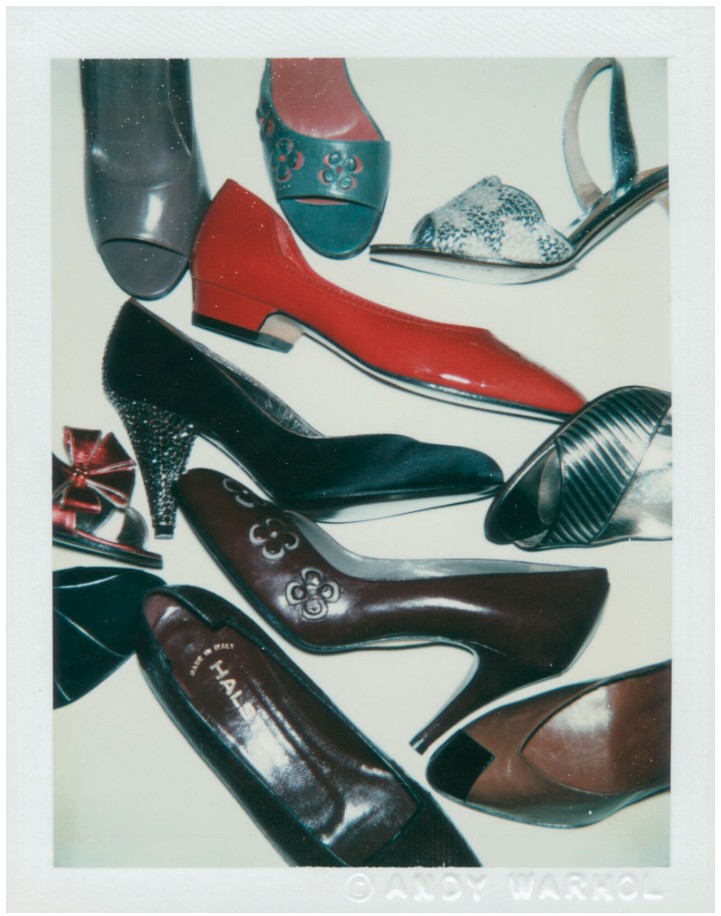
Andy Warhol, Shoes, 1980. © 2025 The Andy Warhol Foundation for the Visual Arts, Inc. / Licensed by Artists Rights Society (ARS).
The artist Victor Hugo, Halston’s boyfriend and a regular at Warhol’s Factory, brought over a bag of shoes, and when his studio manager dumped them on the floor, Warhol liked their unplanned beauty. He then added in shoes from his own collection and photographed them against white paper, which became the source material for the Diamond Dust Shoe series. The photographs were then silkscreened and coated with diamond dust upon the drying pigment. With Warhol’s characteristically interdisciplinary style, this multi-step process combined painting, photography, and printmaking. This labor paid off with a luxurious sheen like the glossy pages of Vogue. Diamond Dust Shoe thus becomes a monument to Warhol’s foundational merging of art and fashion. As co-founder of the Andy Warhol Foundation, Vincent Fremont observes, “The merger of women’s shoes and diamond dust was a perfect fit… Andy created the Diamond Dust Shoe paintings just as the disco, lamé and stilettos of Studio 54 had captured the imagination of the Manhattan glitterati. Andy, who had been in the vanguard of the New York club scene since the early 60s, once again reflected the times he was living in through his paintings” (V. Fremont in Diamond Dust Shoes, exh. cat., New York, Gagosian Gallery, 1999, pp. 8–9). In Diamond Dust Shoe, we experience Warhol’s life and times in all their glory.
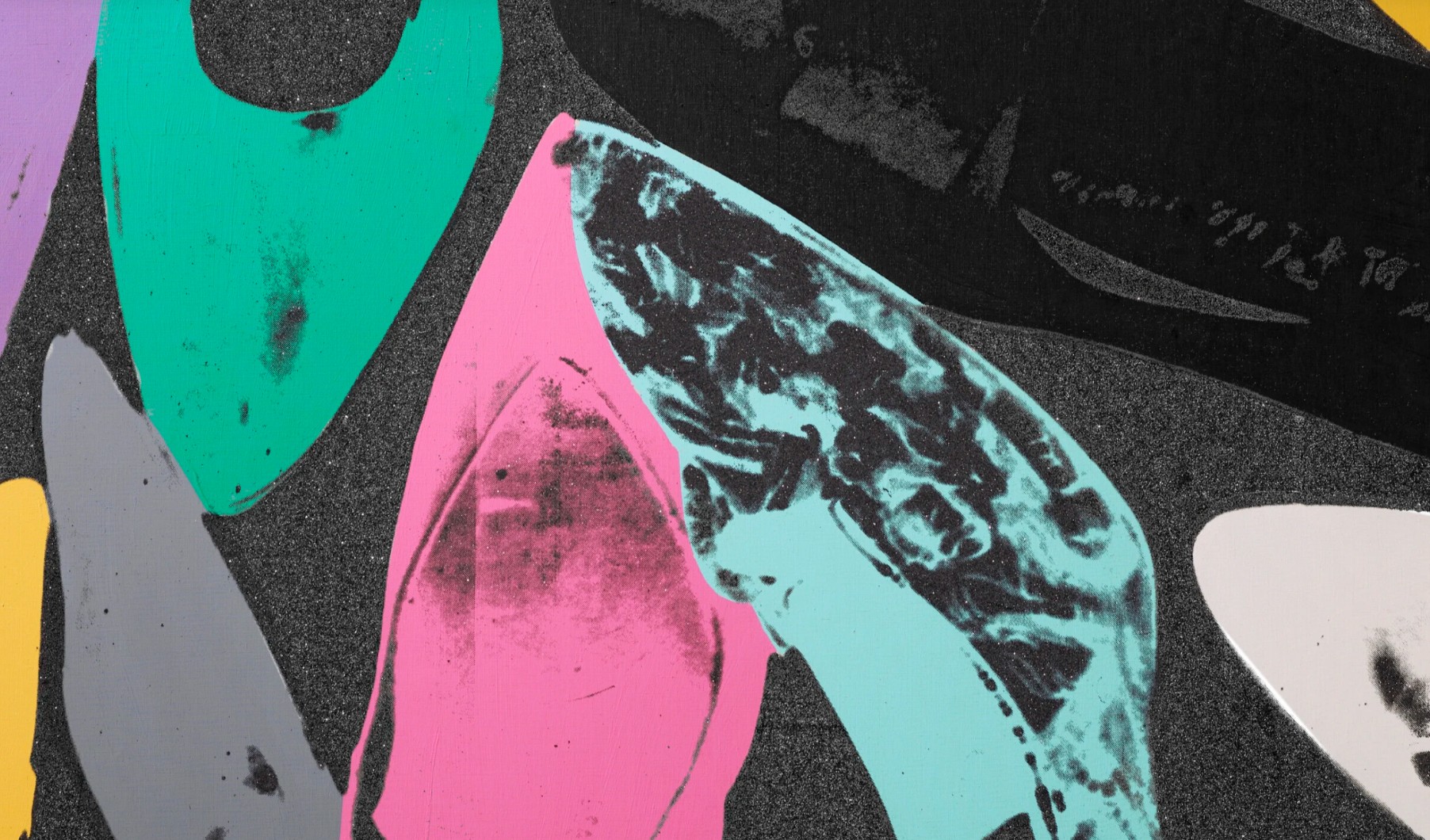
Shoes inspired Warhol for much of his career. They were not only a source of luxury, but also of familiarity and comfort.
“There are three things that always look very beautiful to me:
my same good pair of old shoes that don’t hurt, my own bedroom, and U.S. Customs on the way back home.”
Perhaps this fondness came from his early work in advertising. In the 1950s, Warhol worked for Vogue, Harper’s Bazaar, and the shoemaker I. Miller and Sons, often creating illustrations for footwear advertisements and editorials. Interestingly, the first stiletto heel, according to many accounts, was invented in 1954 by the designer Roger Vivier for Christian Dior. Warhol was always one to absorb the latest trends. His unique style was quickly noticed, and helped set his career up for the massive success that would soon come his way. In addition to this technical skill and delicate eye, there is something tender and youthful in Warhol’s early shoe illustrations. We might therefore see Diamond Dust Shoes as nostalgic for a time before all the fame and riches. Shoes therefore provide a throughline from the beginning of Warhol’s career to his later years. Diamond Dust Shoes is the product of Warhol’s constantly developing visual style, and the final form of his decades-long observation of a dazzling and lavish milieu—indeed, a milieu that he helped to sustain.
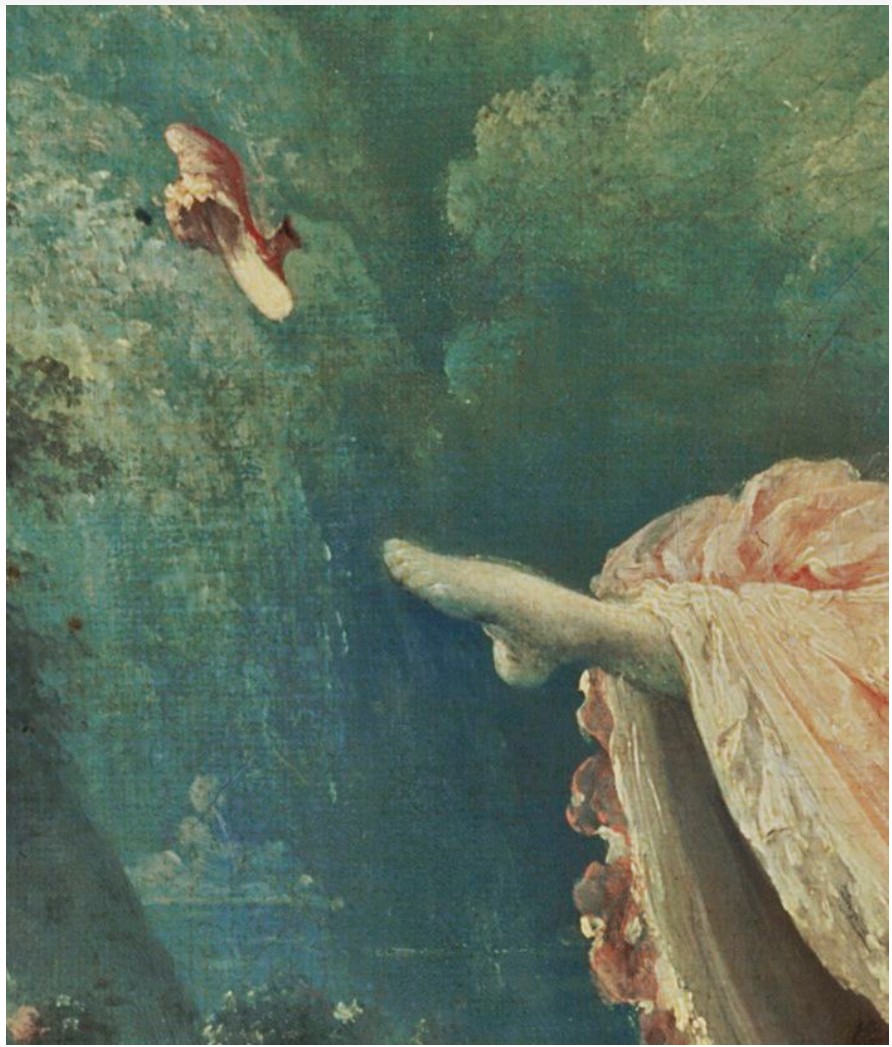
Jean-Honoré Fragonard, The Happy Accidents of the Swing (detail), 1767. Wallace Collection, London.
Diamond Dust Shoes proves the perennial allure and influence of Warhol’s oeuvre. Simultaneously a member of punk and elite social scenes, he used fashion as a means of self-presentation, from the joyous delicacy of his advertising work to the present lot, which shows him at his most opulent. Warhol sought to democratize that opulence and allow each viewer to find and appreciate their own beauty. As he once opined, “If everyone isn’t beautiful, then no one is.” Above all, Diamond Dust Shoes is a timeless work of art that takes on the permanence of its unique media. Though his work is often known for its ephemerality, Warhol’s addition of diamond dust lends a permanence, as if he resolved to remain elegant and enchanting forever—not just for a proverbial 15 minutes. In Diamond Dust Shoes, he accomplishes this goal. It is no mistake that Warhol turned increasingly to self-portraits in his late career. Diamond Dust Shoes could be an abstract self-portrait—an image of the obsession, aspiration, and taste that would characterize his unparalleled career.
Diamond Dust Shoes, 1980
Christie’s New-York: 7 November 2023
Estimated: USD 1,500,000 – 2,000,000
USD 1,683,500
ANDY WARHOL (1928-1987) (christies.com)
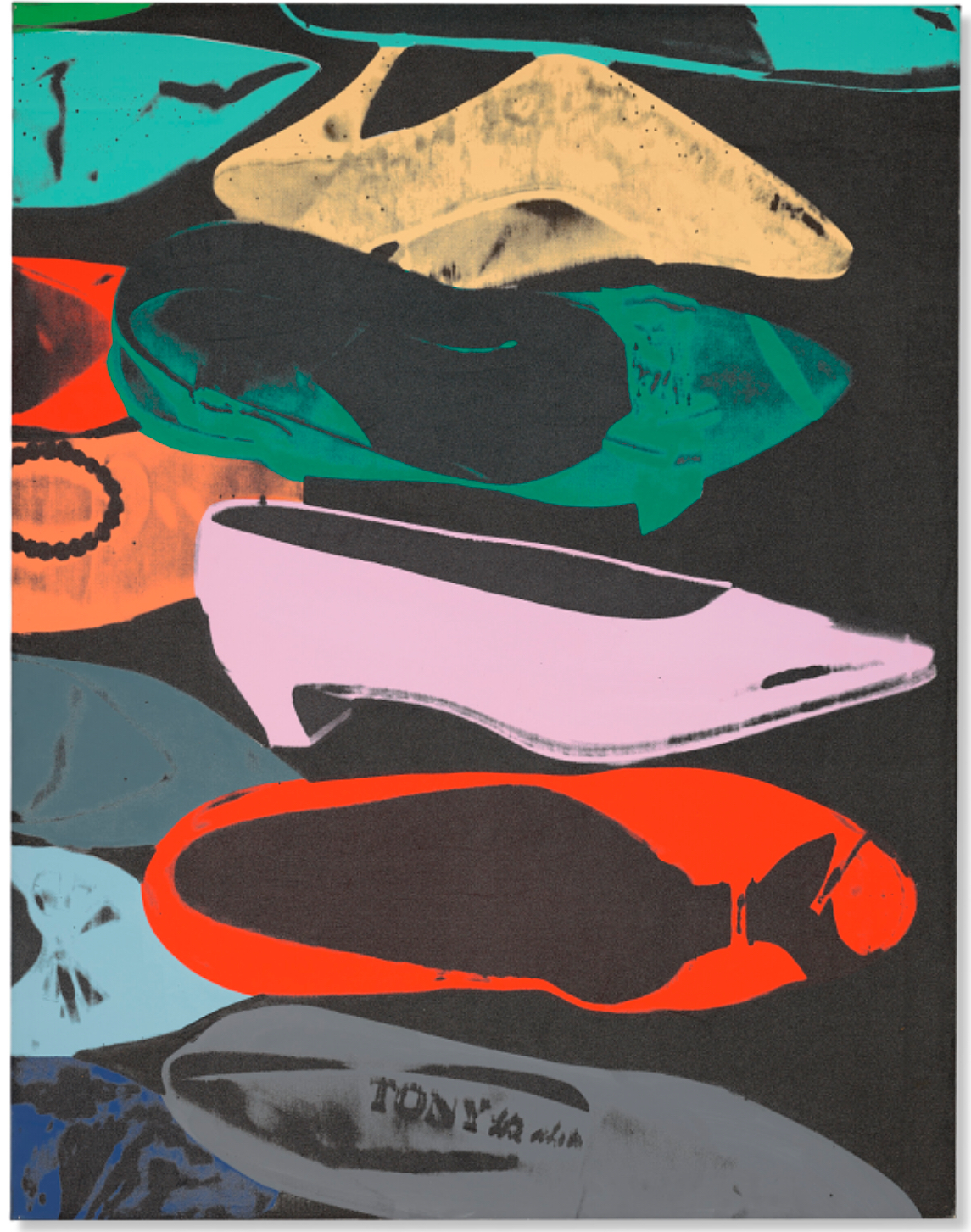
ANDY WARHOL (1928-1987)
Diamond Dust Shoes, 1980
Acrylic, silkscreen inks and diamond dust on canvas
90 1/8 x 70 1/8 inches (228.9 x 178.1 cm)
Provenance
Acquired directly from the artist by the present owner, 1986
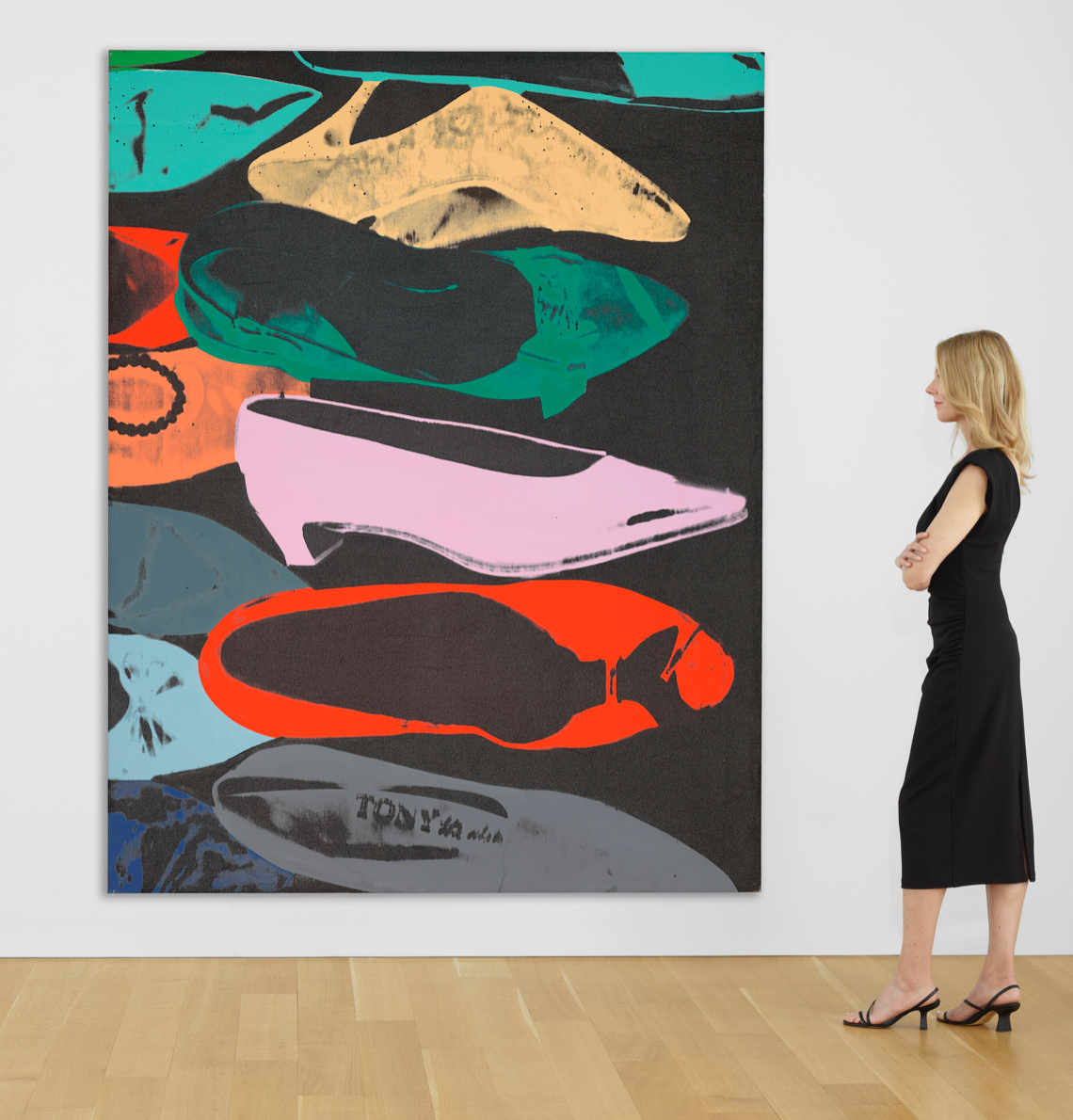
This present work is an early example of a series of canvases that he began in 1980. Honing in on this particular object and symbolism shows how important the imagery from his early career, as well as his personal biography, remained throughout the decades. This striking canvas makes use of Warhol’s signature screenprinting techniques which marry photographic reproduction with saturated areas of color and deep black. Like a Xerox copy with the contrast turned up, expansive swathes of baby blue, crimson, slate, primrose, sea green and pastel yellow boldly represent each shoe, jumping out at the view with a graphic immediacy.
Here Warhol eschews traditional compositional techniques in favor of a more candid image that could have very well been cut from a magazine advertisement. The edges of the canvas frame a line of five central shoes with varying heel heights while other footwear spills off the border. Festooned with diamond dust, the work sparkles with a visual richness that points toward the luxurious goods pictured as well as the lifestyles that could afford such accouterments. As with many of his paintings, the repetition on view here was common throughout his career and plays directly with the notion of mass production and seriality. In the cultural consciousness, diamonds are often seen as a representation of ever-lasting love and eternity, their natural durability standing in as a symbol of strong adoration and commitment. With the Diamond Dust Shoes, Warhol subverts this feeling as the sparkly coating becomes a representation of superficial beauty and fleetingly glamorous lifestyles of the celebrity elite.
Diamond Dust Shoes, 1980
Sotheby’s London: 12 October 2023
Estimated: GBP 1,200,000 – 1,800,000
GBP 3,315,000 / USD 4,048,113
Diamond Dust Shoes | Contemporary Evening Auction | 2023 | Sotheby’s (sothebys.com)
ANDY WARHOL (1928 – 1987)
Diamond Dust Shoes, 1980
Acrylic and silkscreen ink with diamond dust on canvas
90×70 inches (228.6 x 178.1 cm)
Numbered PA70.041 and stamped twice by the Estate of Andy Warhol, New York and the Andy Warhol Foundation for Visual Arts, Inc. (on the overlap)
Also numbered PA70.041 twice (on the stretcher)
Provenance
The Andy Warhol Foundation for the Visual Arts, Inc., New York
Gagosian Gallery, New York
Thomas Ammann Fine Art AG, Zurich
The Mugrabi Collection, New York (acquired from the above in 2010)
Acquired from the above in 2011 by the present owner
The present work, created in 1980, is one of the most dazzling examples of Andy Warhol’s series of Diamond Dust Shoes; a series which shows Warhol at the height of his powers as he combines the luxuriousness of the 1970s Society Portraits with the subversive wit of the 1960s object paintings. Epitomizing the artist’s fascination with consumerism and glamour, the present work simultaneously refers to his beginnings as a commercial and illustrator, reflects the hedonistic, glitzy mood of its contemporary context of creation and points towards his more subdued works of the 1980s. Elegiac and celebratory in equal measure, Diamond Dust Shoes is a monument to both an era and a scene.
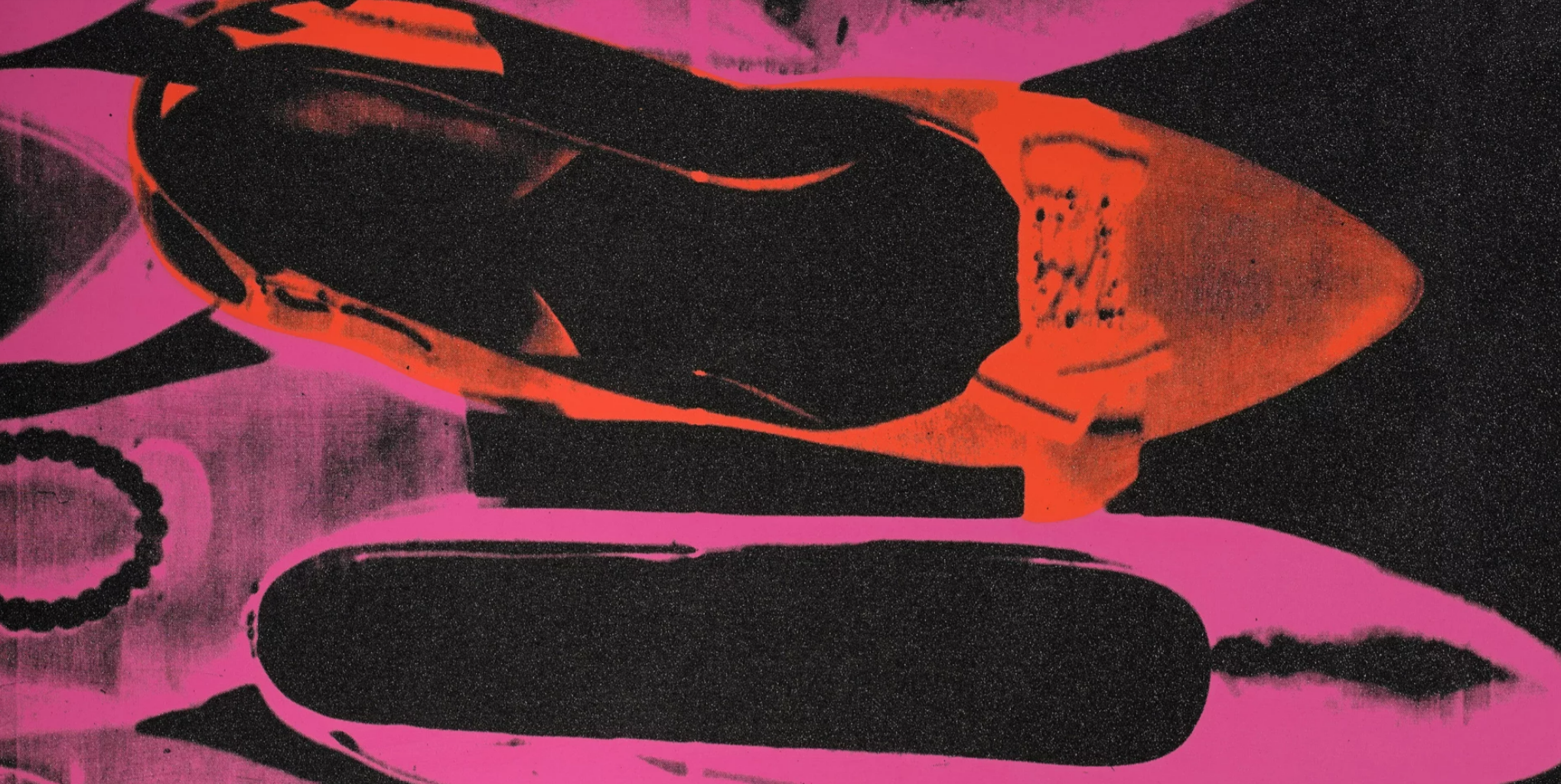
The shoe, as both motif and theme, anonymized beauty and allowed him to explore its implications on contemporary culture, perhaps more subtly than in the portraiture that had occupied him for more than a decade.
Diamond Dust Shoes, 1980
Christie’s New-York: 17 November 2022
Estimated: USD 2,000,000 – 3,000,000
USD 2,580,000
ANDY WARHOL (1928-1987) (christies.com)
ANDY WARHOL (1928-1987)
Diamond Dust Shoes, 1980
Acrylic, silkscreen ink and diamond dust on canvas
70×90 inches (177.8 x 228.6 cm)
Provenance
Leo Castelli Gallery, New York
Acquired by the present owner from the above, 1987
Diamond Dust Shoes, 1980
Christie’s New-York: 16 May 2018
Estimated: USD 2,000,000 – 3,000,000
USD 2,412,500
Andy Warhol (1928-1987) (christies.com)
ANDY WARHOL
Diamond Dust Shoes, 1980
Acrylic, silkscreen inks and diamond dust on canvas
90.2 x 70.1 inches (229.2 x 178.1 cm)
Diamond Dust Shoes, 1980-1981
Christie’s New-York: 11 November 2014
Estimated: USD 1,800,000 – 2,200,000
USD 2,045,000
Andy Warhol (1928-1987) (christies.com)
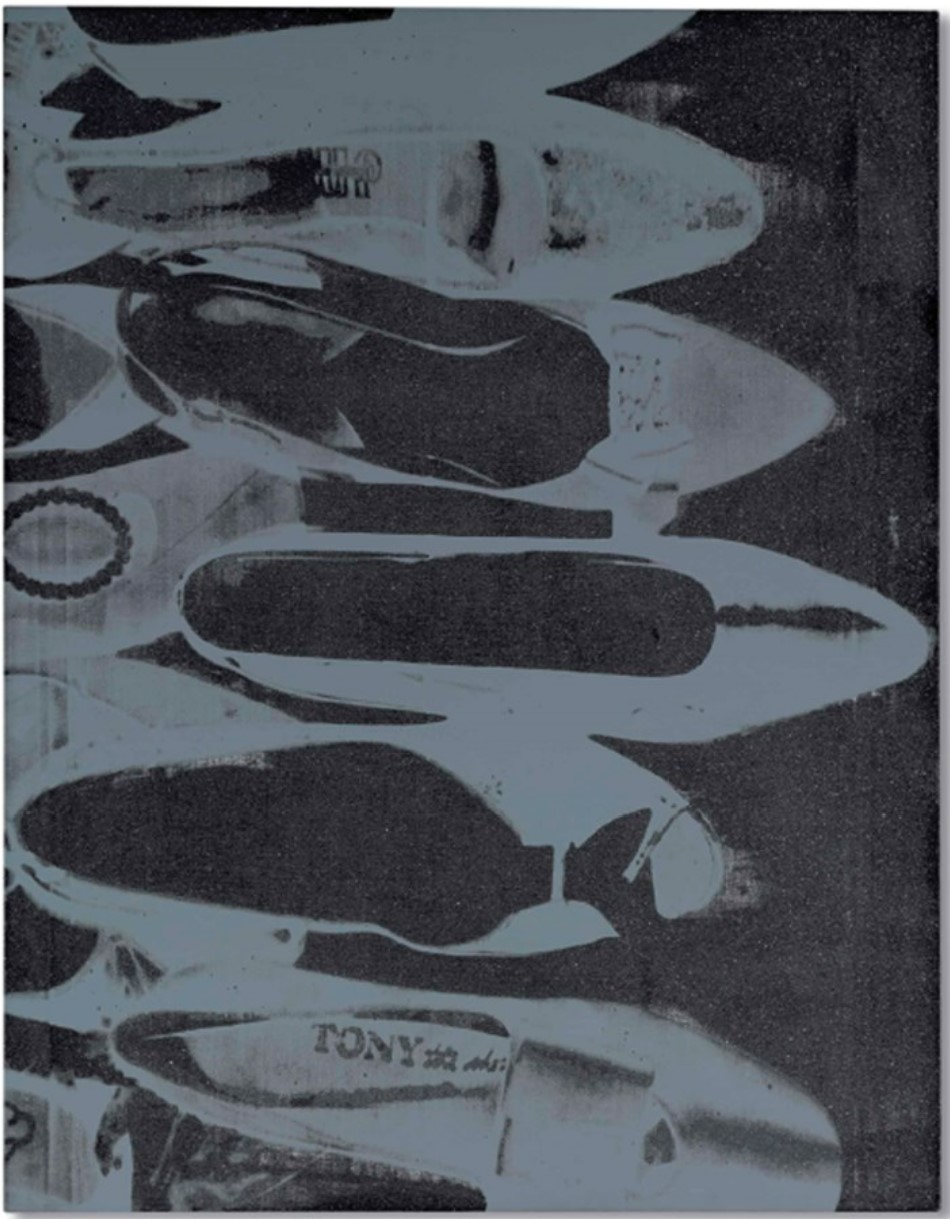
ANDY WARHOL
Diamond Dust Shoes, 1980-1981
Synthetic polymer, silkscreen ink and diamond dust on canvas
90×70 inches (228.6 x 177.8 cm)
Diamond Dust Shoes, 1980
Sotheby’s London: 17 October 2014
Estimated: GBP 750,000 – 1,000,000
GBP 1,336,900
(#31) Andy Warhol (sothebys.com)
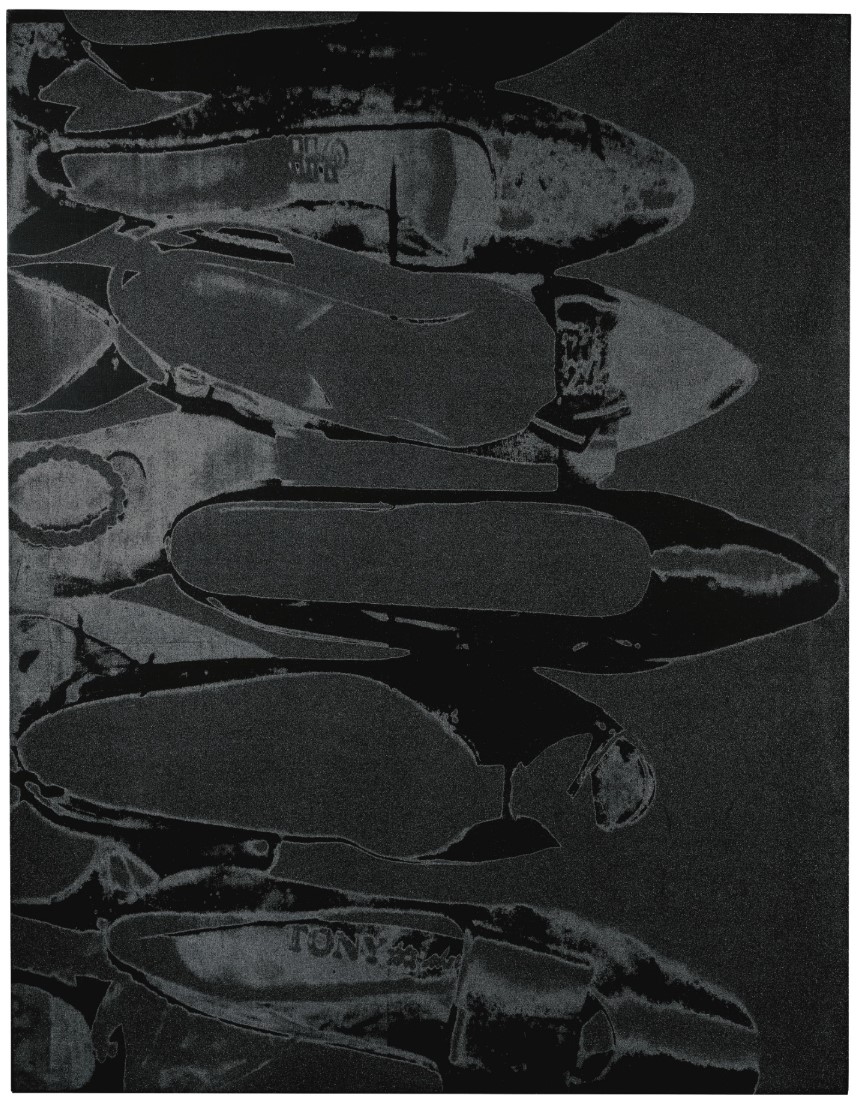 ANDY WARHOL
Diamond Dust Shoes, 1980
Acrylic, silkscreen ink and diamond dust on canvas
90×70 inches (228.1 x 177.8 cm)
Diamond Dust Shoes, 1980
Sotheby’s London: 30 June 2014
Estimated: GBP 900,000 – 1,200,000
GBP 1,594,500
(#46) Andy Warhol (sothebys.com)
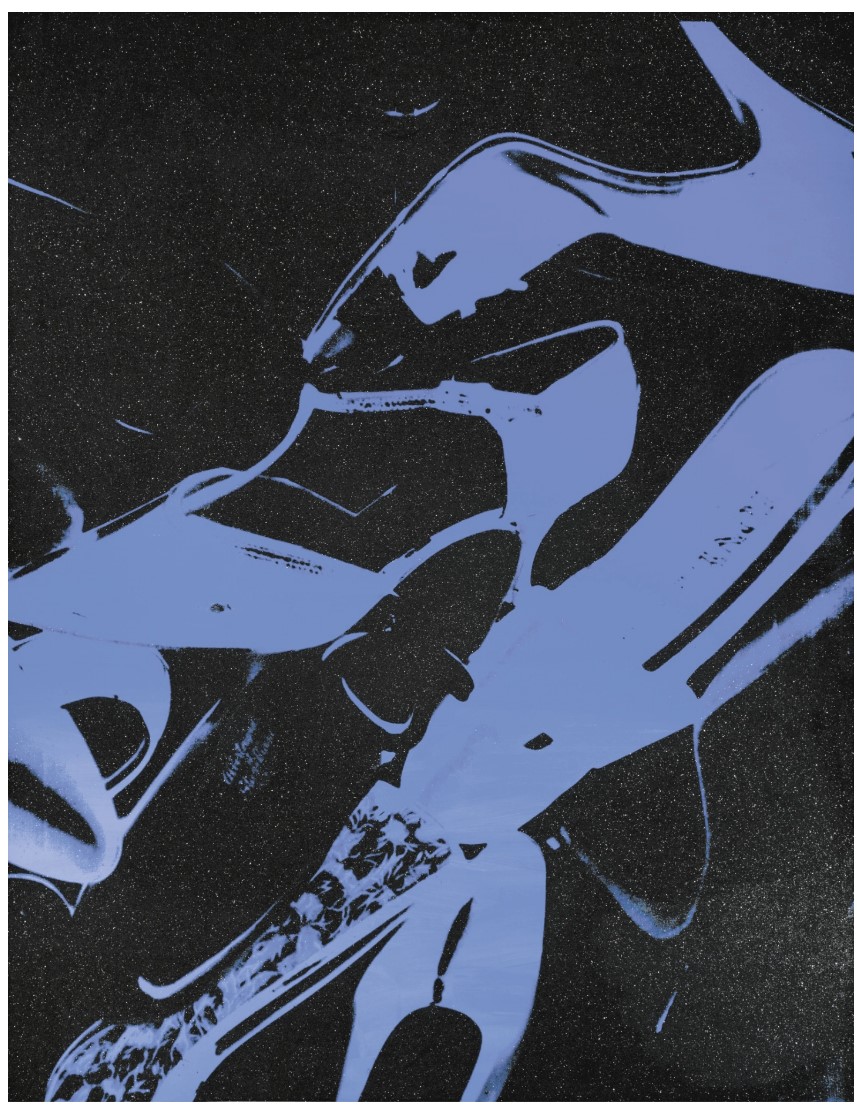
ANDY WARHOL
Diamond Dust Shoes, 1980
Acrylic, silkscreen ink and diamond dust on canvas
90×70 inches (228.1 x 177.8 cm)
Diamond Dust Shoes, 1980
Christie’s New-York: 11 November 2013
Estimated: USD 1,800,000 – 2,200,000
USD 4,925,000
Andy Warhol (1928-1987) (christies.com)
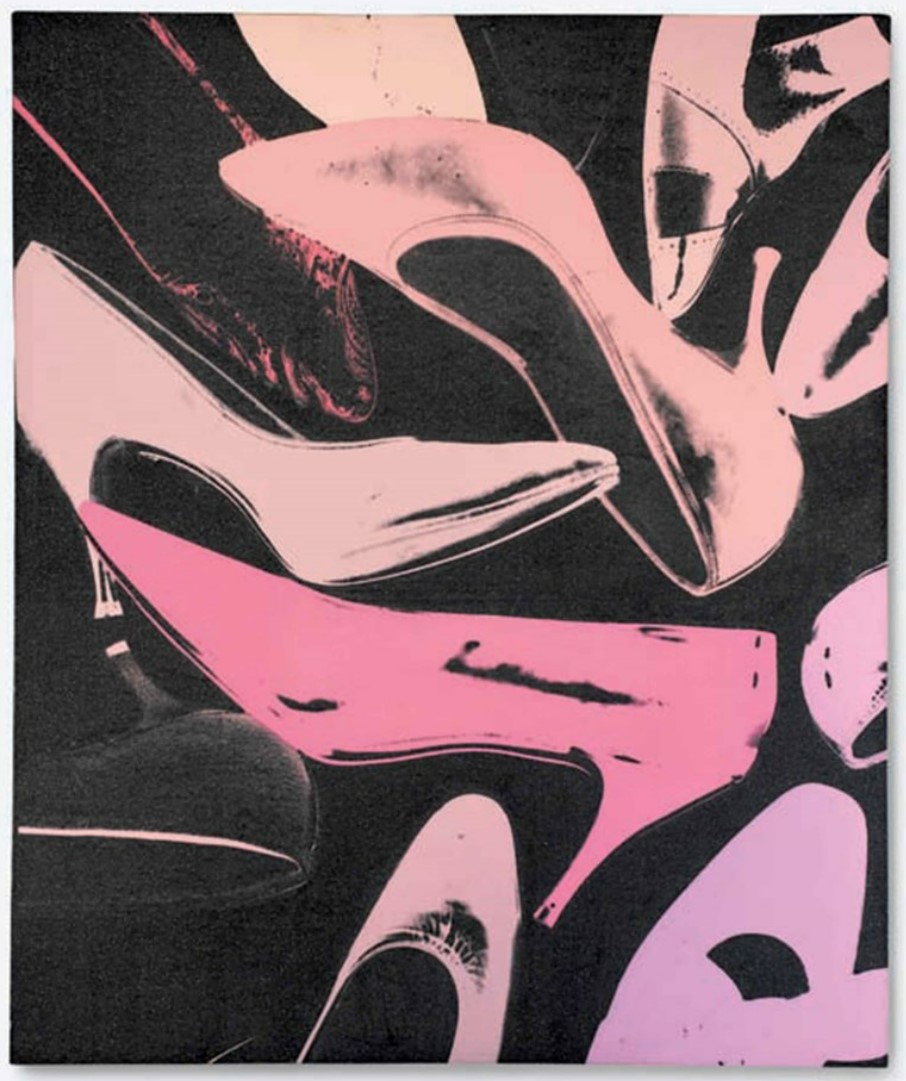
ANDY WARHOL
Diamond Dust Shoes, 1980
Synthetic polymer and silkscreen inks with diamond dust on canvas
83.7 x 69.5 inches (213.5 x 177 cm)
Diamond Dust Shoes, 1980
Sotheby’s New-York: 9 November 2011
Estimated: USD 1,800,000 – 2,500,000
USD 2,098,500
(#53) Andy Warhol (sothebys.com)
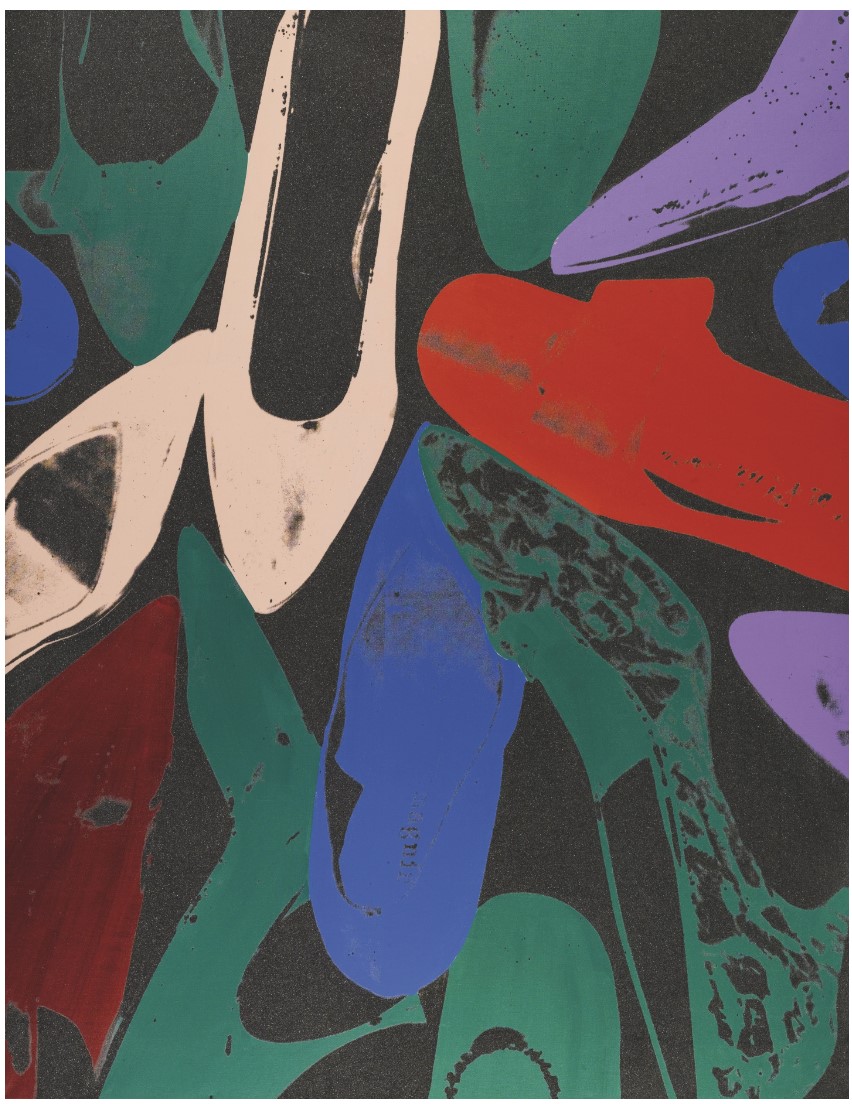
ANDY WARHOL
Diamond Dust Shoes, 1980
Acrylic, silkscreen ink and diamond dust on canvas
90×70 inches (228.6 x 177.8 cm)
Diamond Dust Shoes, 1980-1981
Christie’s New-York: 10 May 2011
Estimated: USD 1,000,000 – 1,500,000
USD 1,874,500
Andy Warhol (1928-1987) (christies.com)
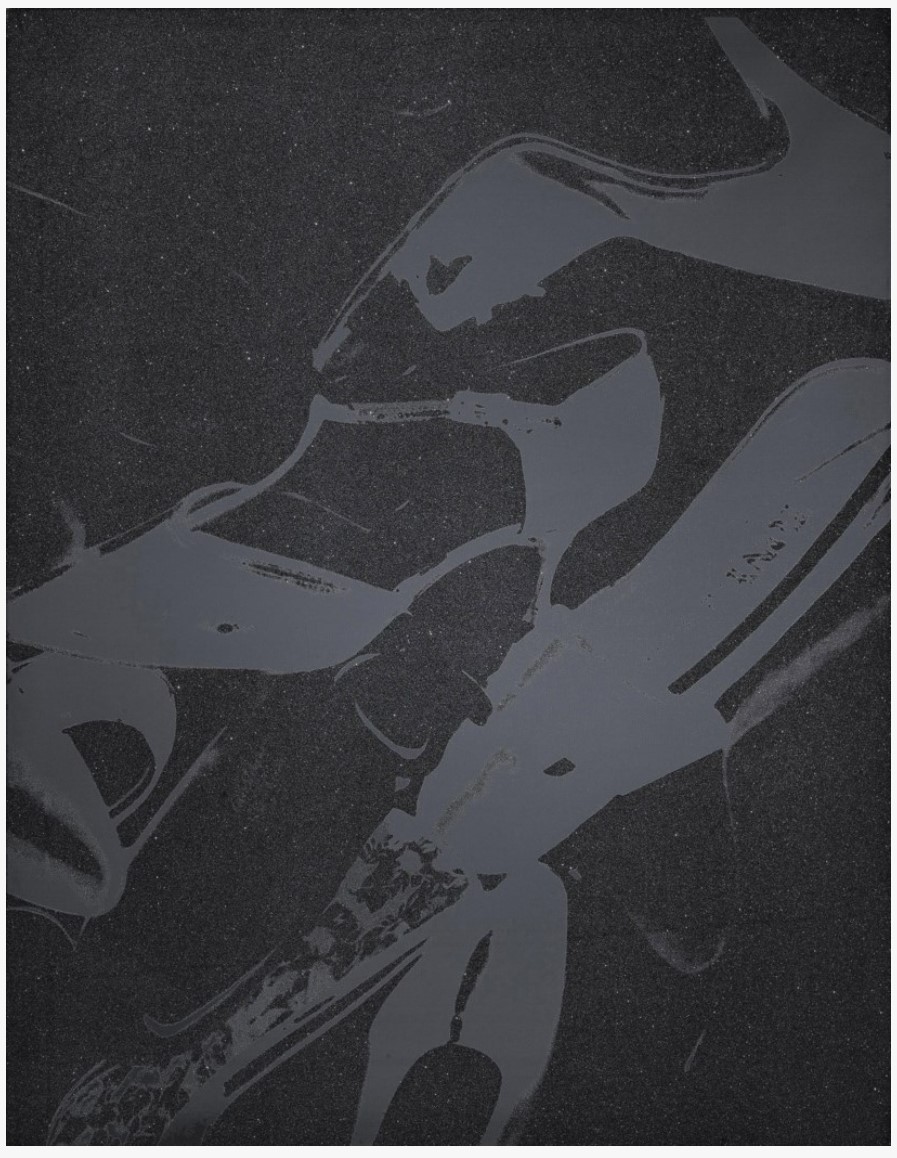 ANDY WARHOL
Diamond Dust Shoes, 1980-1981
Synthetic polymer and silkscreen ink with diamond dust on canvas
90×70 inches (228.7 x 177.8 cm)
Diamond Dust Shoes, 1980
Sotheby’s London: 15 October 2010
Estimated: GBP 1,300,000 – 1,600,000
GBP 1,553,250
(#19) Andy Warhol (sothebys.com)
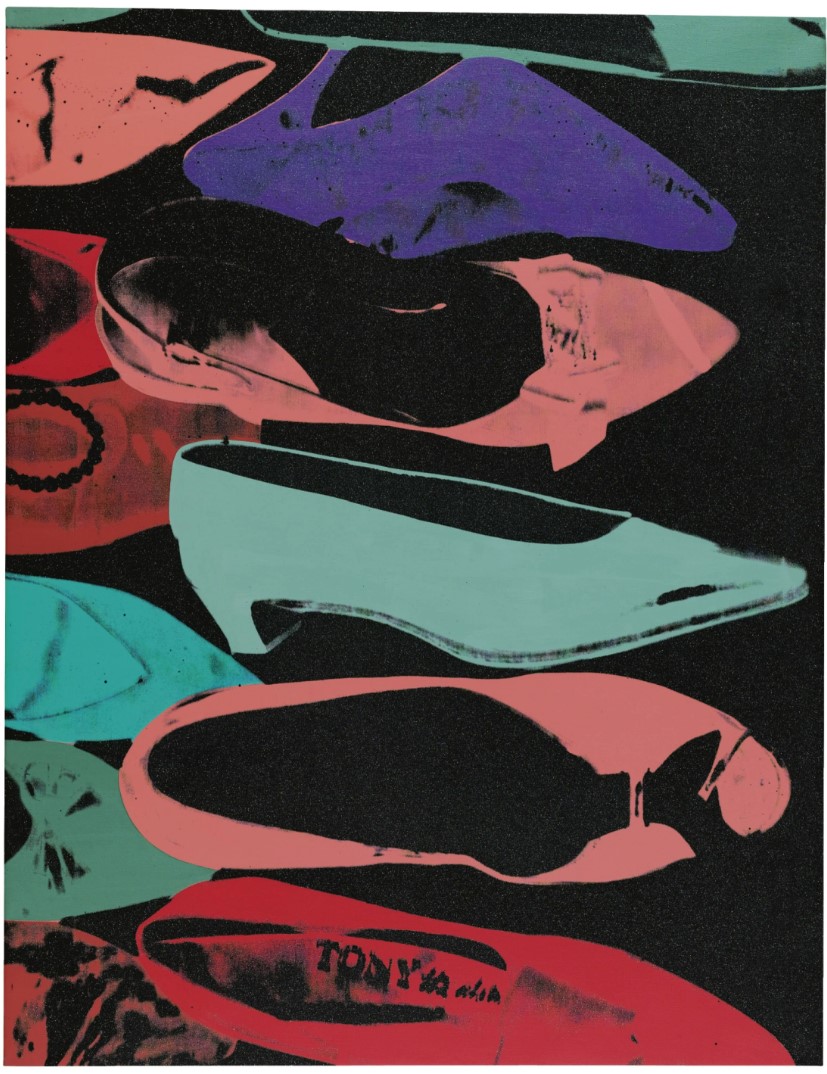 ANDY WARHOL
Diamond Dust Shoes, 1980
Acrylic, silkscreen ink and diamond dust on canvas
90×70 inches (228.6 by 177.8 cm)
Diamond Dust Shoes, 1980
Sotheby’s New-York: 12 November 2008
Estimated: USD 1,500,000 – 2,000,000
USD 1,258,500
(#211) Andy Warhol (sothebys.com)
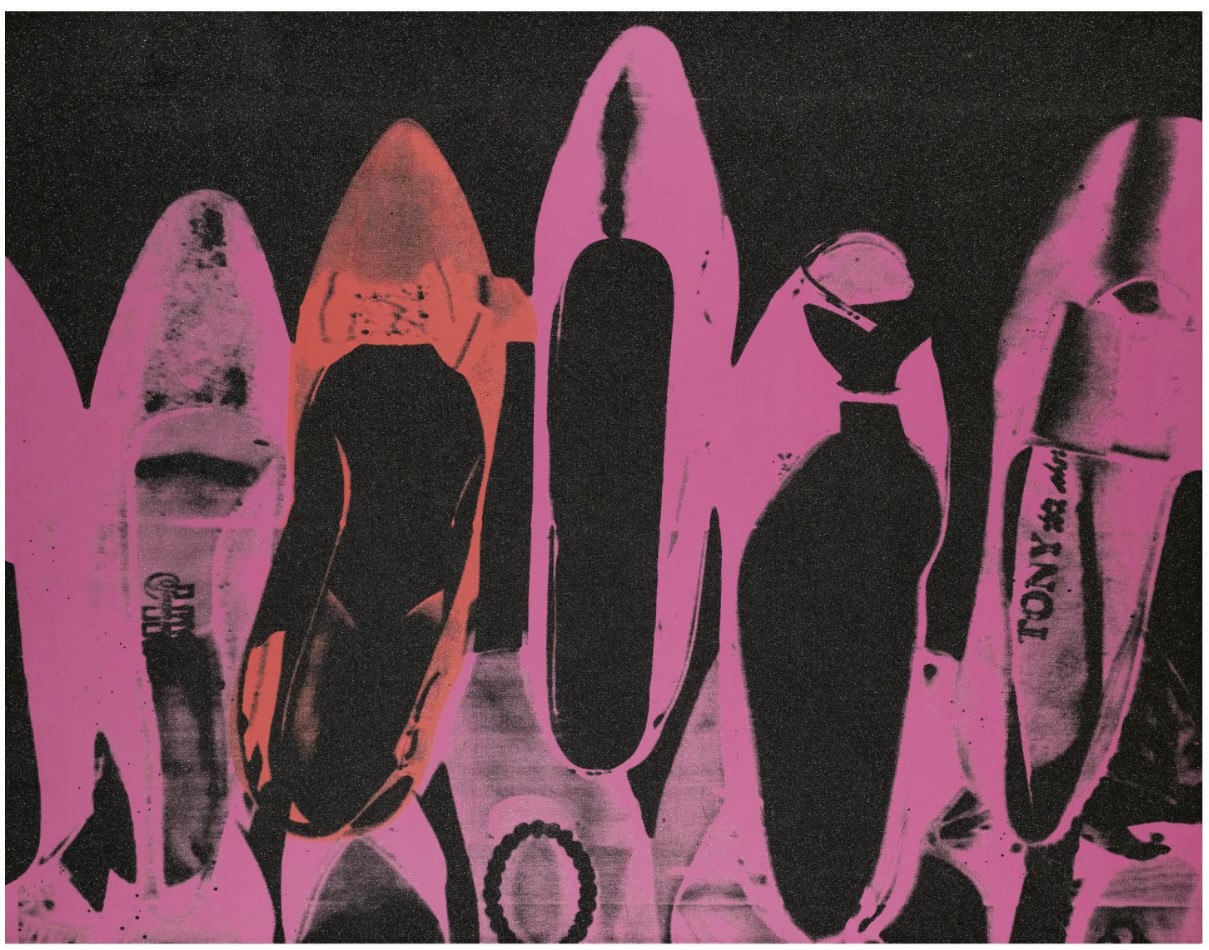 ANDY WARHOL
Diamond Dust Shoes, 1980
Acrylic and silkscreen ink with diamond dust on canvas
90×70 inches (228.6 x 117.8 cm)
Diamond Dust Shoes (50×42)
Diamond Dust Shoes, 1983
Estimated: USD 800,000 – 1,200,000
USD 945,000
Diamond Dust Shoes, 1983
Acrylic, silkscreen ink and diamond dust on canvas
50 1/8 x 42 1/8 inches (127.3 x 107 cm)
Stamped with the Andy Warhol Foundation for the Visual Arts, Inc. and the Estate of Andy Warhol stamps (on the overlap)
Numbered ‘PA70.058’ (on the stretcher)
Diamond Dust Shoes, 1980
Bonhams New-York: 15 November 2022
Estimated: USD 1,200,000 – 1,800,000
USD 1,000,000
Bonhams : ANDY WARHOL (1928-1987) Diamond Dust Shoes 1980
42×50 inches (106.7 x 127 cm)
Numbered PA70 050 on the stretcher bar, with The Estate of Andy Warhol stamp
With the Andy Warhol Foundation for the Visual Arts, Inc. stamp and inscribed VF on the reverse
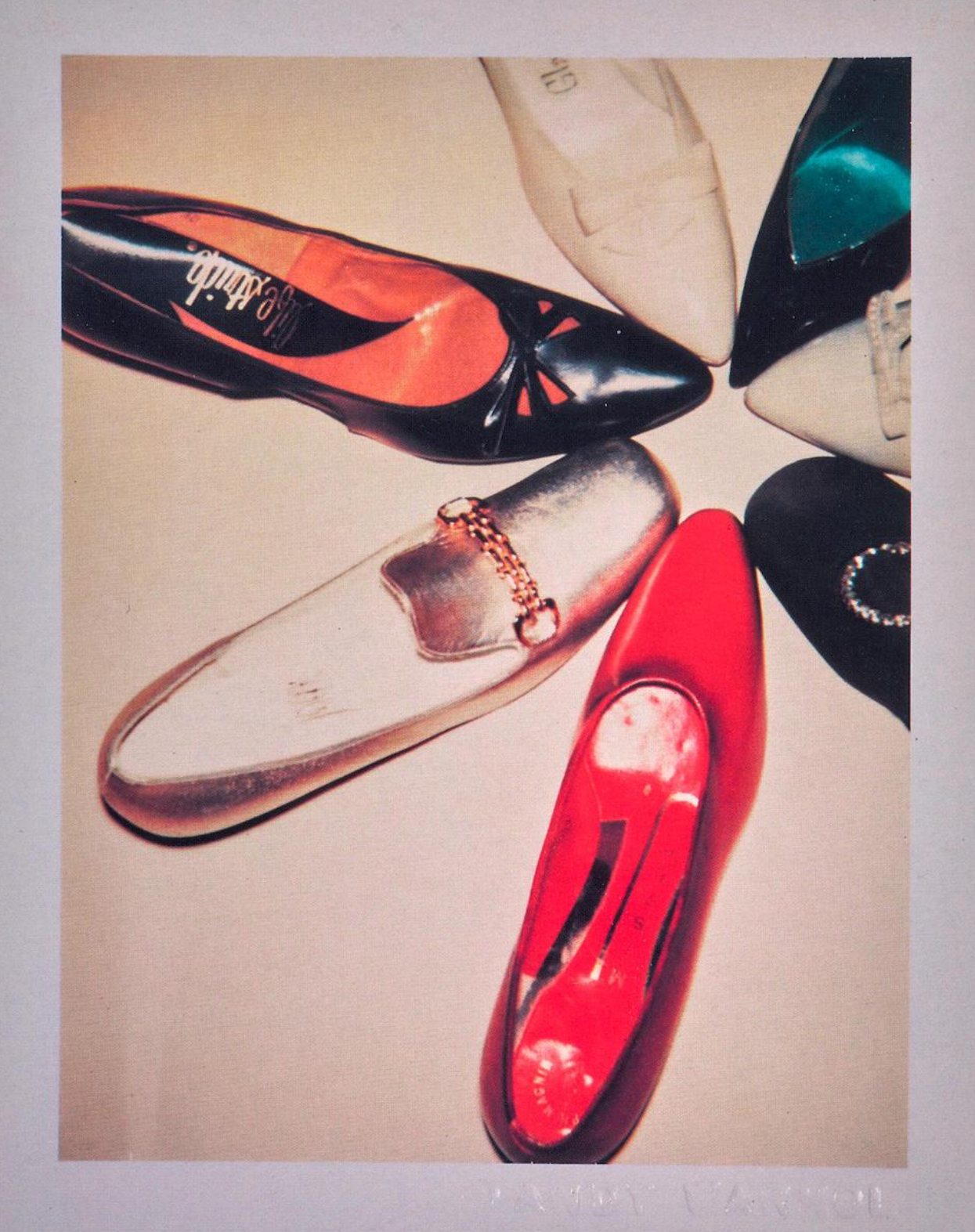
He began to experiment with the diamond dust technique in 1979 when Warhol’s friend and diamond dealer John Reinhold gave him a jar of diamond dust. The diamond dust effect gave the surface of his works a shimmering effect reminiscent of his use of gold leaf in the late 1950s, creating a magical touch of glamour. Andy first utilized the diamond dust effect in the Gem series which depicts diamonds and cut stones with a glittering effect and in his abstract Diamond Dust Shadows series.
The Diamond Dust Shoes series began when Halston sent a box of shoes downtown for an advertisement campaign, when they all fell onto the floor, Warhol liked the way they looked and began to arrange the shoes in different compositions and take Polaroids of them. The Polaroids were silkscreened for this series and the resulting paintings demonstrate how something simple as a shoes can take on a life of their own when arranged as a pointed star and given the lush hues of red, pink, and white.
“I’m doing shoes because I’m going back to my roots. In fact, I think maybe I should do nothing but shoes from now on.”
Andy reflected on his return to his earliest work with the Diamond Dust Shoes series in “The Andy Warhol Diaries” on July 24, 1980 “I’m doing shoes because I’m going back to my roots. In fact, I think maybe I should do nothing but shoes from now on.” The Diamond Dust Shoes series was exhibited in its entirety at Gagosian Gallery New York in 1999.
Diamond Dust Shoes, 1981
Christie’s New-York: 17 May 2017
Estimated: USD 1,000,000 – 1,500,000
USD 1,087,500
Andy Warhol (1928-1987) (christies.com)
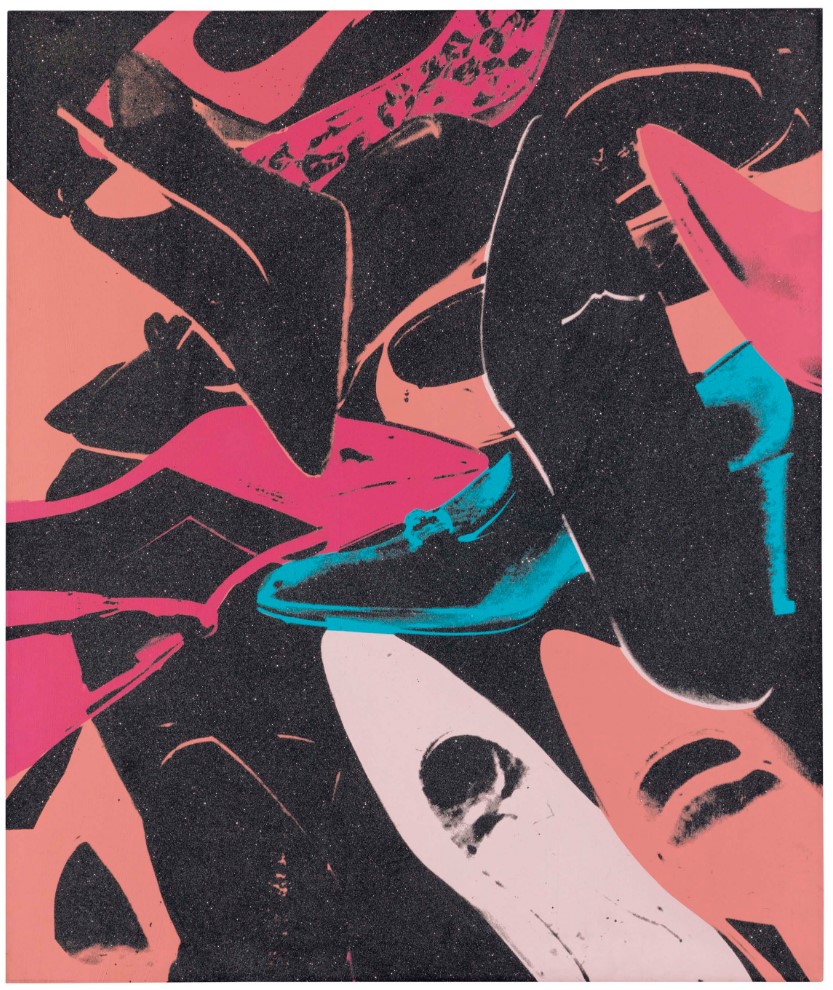
ANDY WARHOL
Diamond Dust Shoes, 1981
Synthetic polymer and silkscreen ink with diamond dust on canvas
50×42 inches (127 x 106.7 cm)