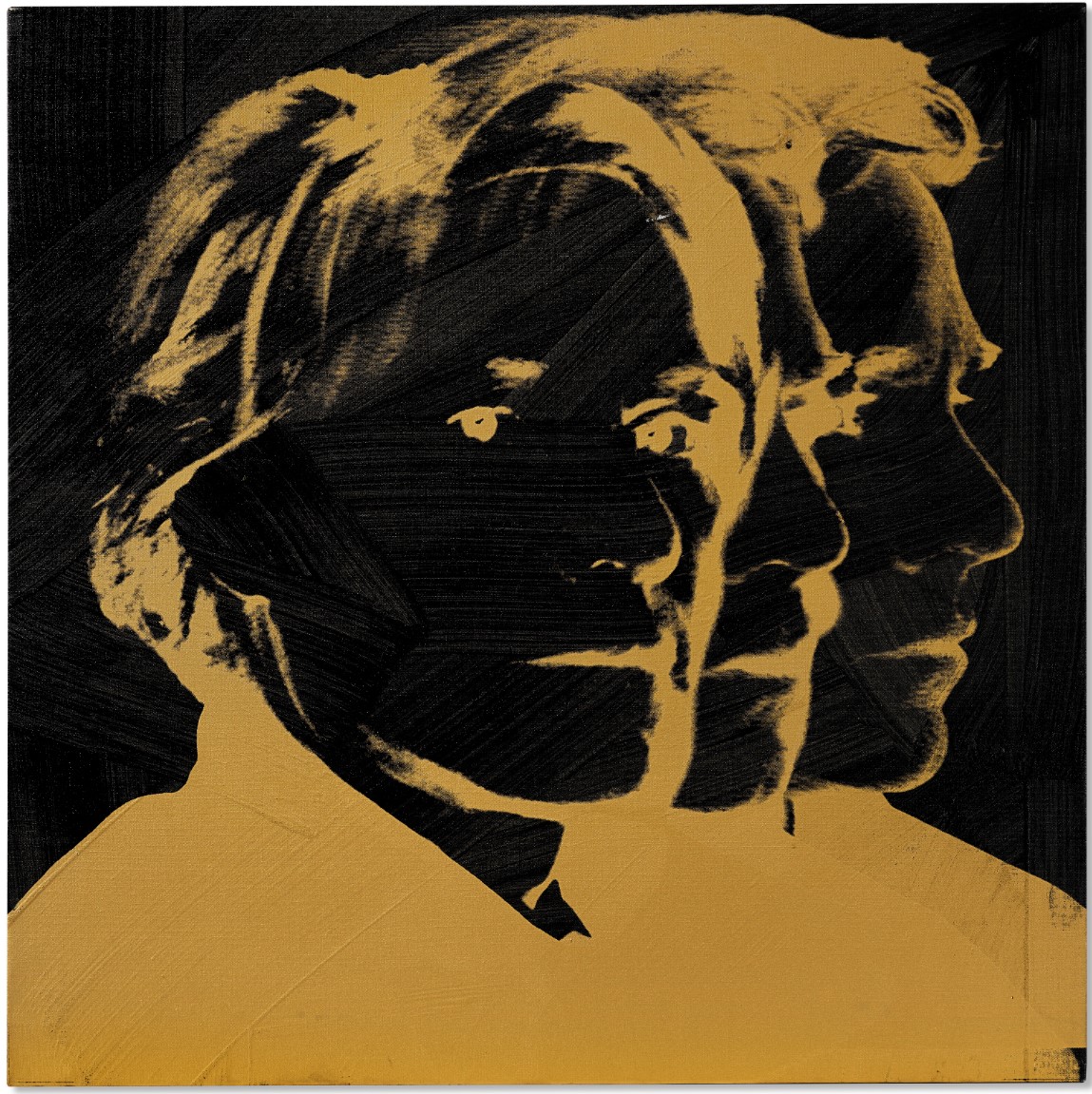
Andy Warhol’s 1978 Self-Portrait occupies an important position in the evolution of self-depiction that dramatically punctuated the artist’s entire artistic career. Warhol’s expert dispersal of the silkscreen broadcasts three different images of the artist simultaneously, brilliantly incorporating the techniques of replication for which his art is most famous.
“If you want to know about Andy Warhol, then just look at the surface of my pictures, my movies and me and there I am; there’s nothing in between.”
In the latter part of the 20th century, Andy Warhol solidified his place amongst the most important and influential self-portraitists in the history of art by paradoxically fusing high society and the avant-garde, ultimately transforming the art of an age and cultivating a lifestyle of celebrity. Throughout his career, Warhol turned to his own visage to create works such as the present painting, filled with immediacy, vivacity, and simultaneously with a strong sense of mystery and intrigue. Renowned for his candid depictions of celebrities such as Marilyn Monroe, Jackie Kennedy, and Liz Taylor, Warhol here steps out from behind the camera and into the glare of its flashbulb, marking the moment that he joins their rank and the birth of Warhol the icon – a paragon of the golden era of Pop and the ultimate arbiter of celebrity glamour.
More than any artist before him, Warhol’s identity and constructed public persona were inextricably bound to his art. The self-portraits thus became the richest and most fertile sites for his own invention. Warhol’s earliest self-portraits were inspired by the feted Detroit collector Florence Barron, who visited his studio in 1963 with Ivan Karp, legendary dealer at the Leo Castelli Gallery, in order to discuss commissioning her own portrait. During this fateful meeting, Karp managed to persuade both artist and patron that a self-portrait would be even more appropriate given Warhol’s blossoming fame following successful shows at the Ferus Gallery in Los Angeles and the Stable Gallery in New York. Throughout Warhol’s oeuvre one can trace the changes in technique and style while Warhol remains a recognizable icon who is as immediately recognizable as Marilyn, Jackie, or Liz. In doing so, he reinvented the medium as part of his vast repertoire of visual languages – and as part of a dialogue between the hand and the machine, and between the private Warhol and his public persona.

Self-Portraits from 1978 were created ten years after Warhol was unexpectedly shot by Valerie Solanas, which left him in the hospital for two months recuperating from surgeries to repair his lungs, esophagus, spleen, liver and stomach; the damage from which he never fully recovered.
“Death can really make you look like a star”
Warhol’s self-portraits from these later years are quite different from his earlier works and reflect the growing concerns that he had with mortality as his life progressed. Themes related to the fragility of human life became ever more prominent in his praxis following the 1968 shooting and can be seen in the triple image of the present work where the artist’s piercing yet absent stare sheds light into his complex inner thoughts. The multiple exposures of the 1978 negative portraits suggest a confused identity fraught with uncertainty as Warhol examines the deep shadows and dark recesses of his own psyche. Throughout his illustrious career, Warhol’s aim was to remove his hand altogether from the making of an artwork, which strongly juxtaposes the three brushstrokes in the bottom right corner read almost like fingerprints intimately tying the artist to the final product.
Indeed, self-portraits are the ultimate example of the irony inherent to his oeuvre: proof that his pictures were designed not to portray or expose truth, but instead to acknowledge the artifice and deception inherent to any form of representation. In Self-Portrait, Warhol presented himself as a complex, constructed fiction. If Andy Warhol’s serial depictions of Elizabeth Taylor, Marilyn Monroe, and Jackie Kennedy decisively declare and eternally reinforce their celebrity, his Self-Portraits at once construct and immortalize his own fame. As historian Robert Rosenblum has noted about Warhol’s portraits: “We end up knowing everything and nothing. So it is that artist’s self-portraits, whether intended as disclosure or as concealment, remain as fictional as their other work…Andy Warhol’s self-portraits constantly shift back and forth between telling us all and telling us nothing about the artist, who can seem, even in the same work, both vulnerable and invulnerable, both superficial and profound” (Robert Rosenblum, “Andy Warhol’s Disguises” in Exh. Cat., St. Gallen Kunstverein Kunstmuseum, Andy Warhol, Self Portraits, 2004).
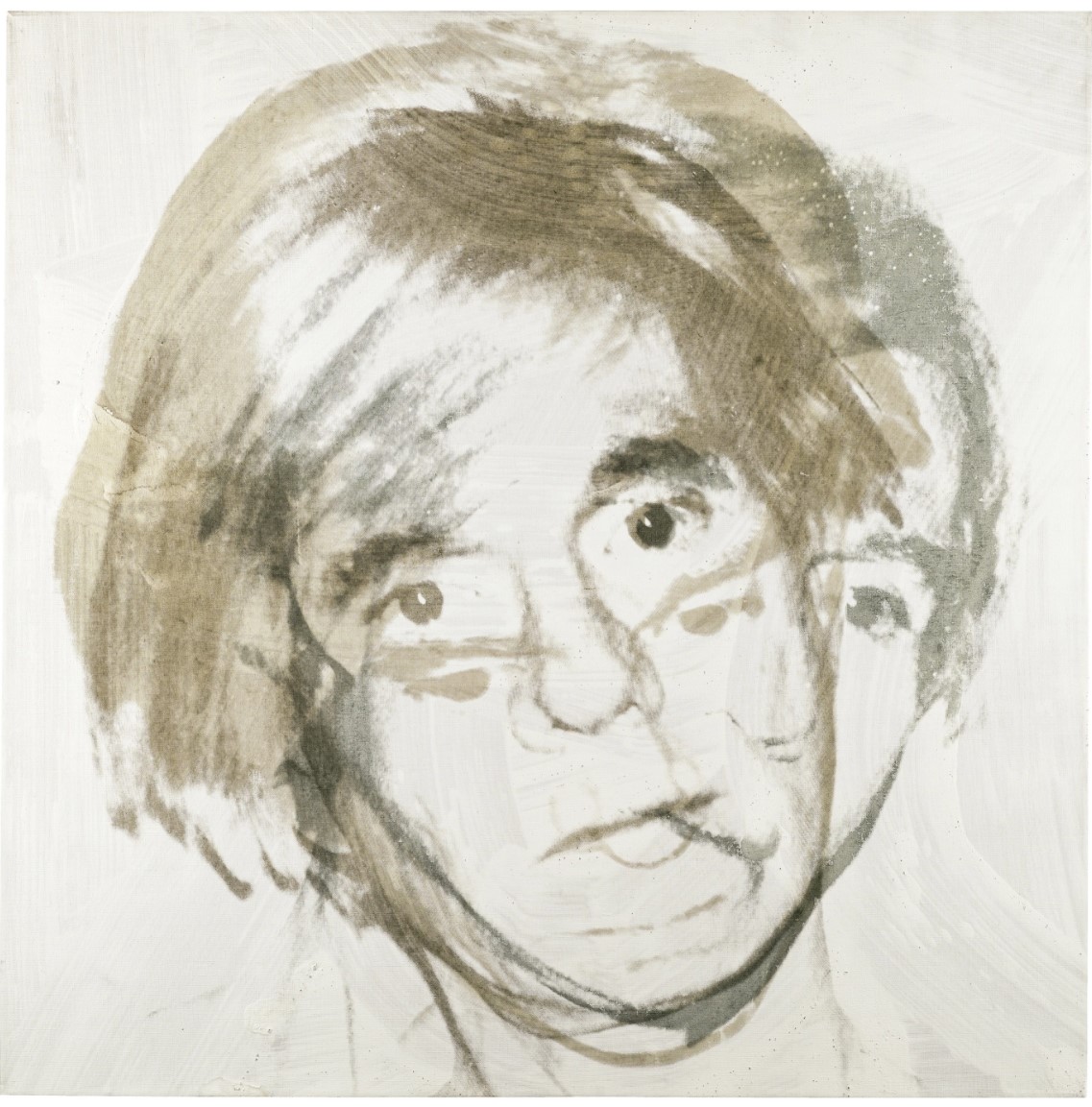
In direct contrast to the cool objectivity of his 1960s works, which sought to eradicate the energetic excesses of Abstract Expressionism with the objective reproduction and depersonalized flat surface of the mechanical silkscreen, Self-Portrait epitomizes Warhol’s later investigation into painterly texture. Its background of semi-transparent, fluid brushstrokes and its subtly inflected palette recalls the aged texture and tonal variation of a vintage sepia photograph. As the visages rotate, multiply and superimpose, a ghostly agglomeration of impressions emerges, eliding the viewer’s perception as the proliferated features refuse coherence in a holistic subject. The work thus imbues the image with a feeling of motion and recalling the filmic progression of stills to convey the passage of time.
Warhol’s earliest silkscreen subject matter was found images lifted from the mass-reproduced media of newspapers, magazines and advertising, but the imagery of Self-Portrait is based on three Polaroid photographs. Here Warhol creates his own icon, independently engineering emblematic imagery. This work was executed after Warhol’s renowned Factory had recently moved from 33 Union Square West to a much larger space at 860 Broadway. The improved environment facilitated the ideological zenith of Warhol’s ‘production’ method wherein he conceived iconic images before collaborating with his team of assistants to multiply these via the silkscreen. Having been initiated in the early 1960s, this approach was now perfected, creating the most exciting and prodigious working environment.
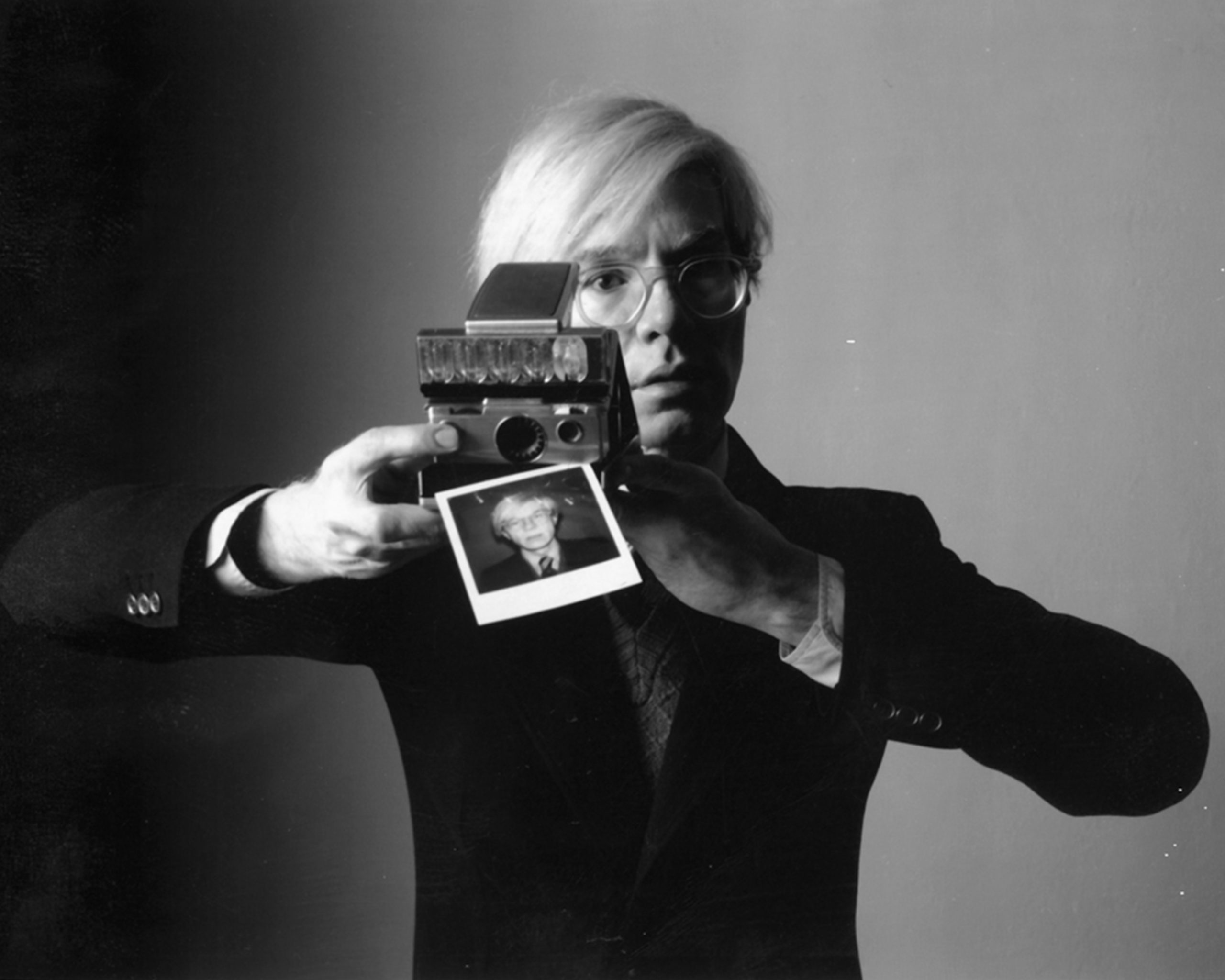
From his earliest photo-booth self-portraits to the final Fright-Wig series, the genre of self-portraiture proved a continual focus for Warhol’s output. Warhol had a complicated attitude towards his own appearance and suffered terribly under the self-destructive belief that he was unattractive. From an early age, he purposefully cultivated an unkempt appearance, primarily by crowning himself with an ever-renewing selection of cheap and ruffled white wigs. Closing the gap between caricature and content, Warhol turned his unique appearance into a symbol of himself, which he then scrutinized and valorized through a lifelong devotion to photographing and painting images of his face. Self-Portrait toys with Warhol’s iconic exterior, which by 1978 was immensely famous and instantly recognizable. No mere fifty-year-old man, Warhol appears here as a legend, not by crafting a window into his personal subjectivity but by imbuing him with monumental self-justification.
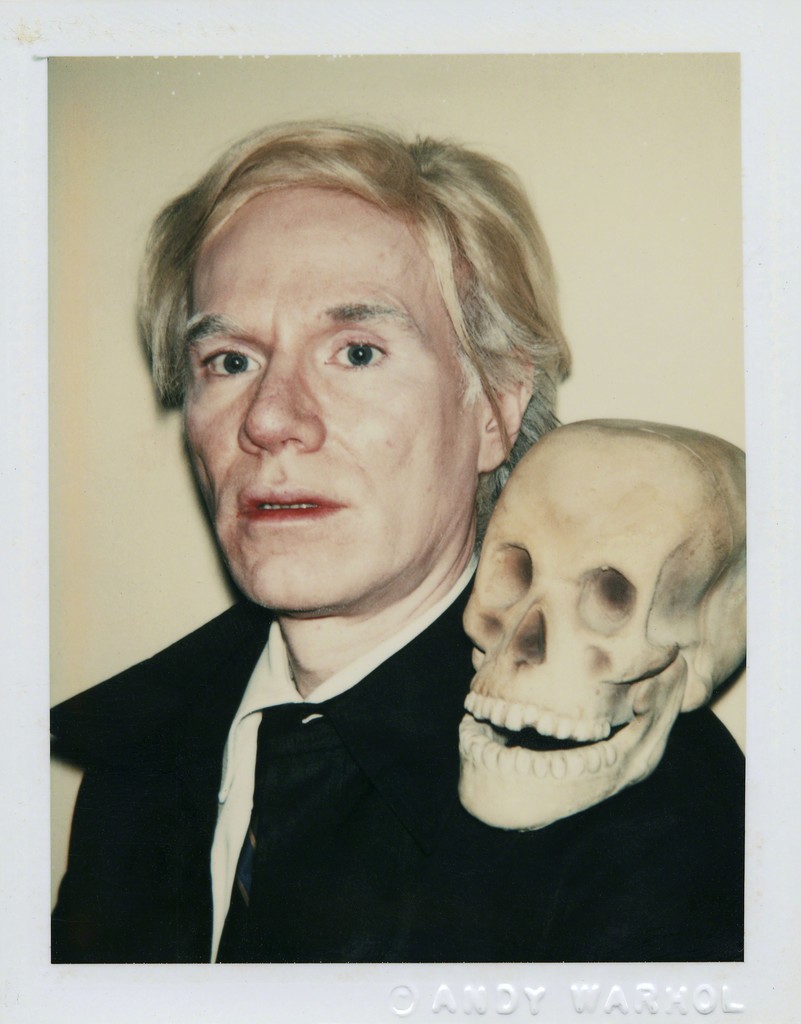
At the same time, the present work embodies a startlingly frank confrontation with the notion of Self, insofar as his preoccupation with death was personal and profound. The Polaroid sources capture Warhol stock-still and wide-eyed, with a frozen blank expression that purposefully aligns his sculptural facial features with the appearance of a skull. Paintings from the same year show Warhol balancing a skull on top of his head or his shoulder, as if a devoted pet.
Auction Results
Christie’s New-York: 16 November 2022
USD 4,260,000
ANDY WARHOL (1928-1987)
Self-Portrait, 1978
Acrylic and silkscreen ink on canvas
40×40 inches (101.6 x 101.6 cm)
Sotheby’s New-York: 17 November 2017
USD 1,775,000
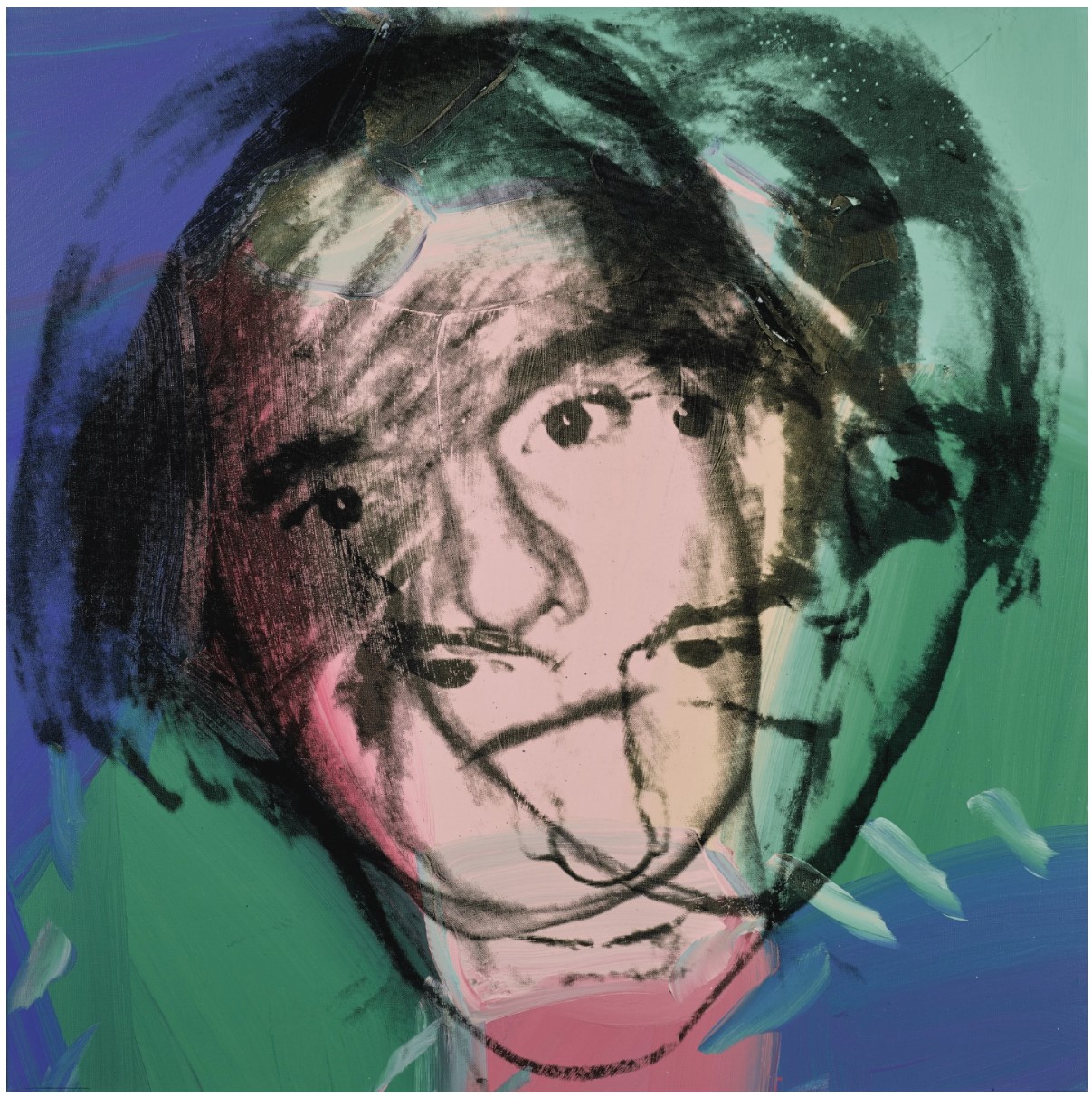 ANDY WARHOL
Self-Portrait, 1978
Acrylic and silkscreen ink on canvas
40×40 inches (101.6 x 101.6 cm)
Continuing the legendary portrait series that preceded it, from those of Elvis Presley, Marilyn Monroe and Jackie Kennedy to Mao Zedong and Lenin – the present self-portrait reveals the artist grappling less with physiognomic likeness and more with the intangible qualities of fame, notoriety and celebrity. The different poses struck by Warhol are equally inscrutable, each containing a fixed stare that seems determinedly devoid of legible emotion. Freed from the representational prerogatives of traditional portraiture, Self-Portrait uses Warhol’s self-image as an impersonal motif to be explored in almost abstract terms.
Christie’s New-York: 16 May 2017
USD 4,167,500
ANDY WARHOL
Self-Portrait, 1978
Synthetic polymer and silkscreen ink on canvas
40×40 inches (101.6 x 101.6 cm)
Signed, inscribed and dated ‘Zurich. Andy Warhol 1978 Elsa Peretti’ (on the overlap)
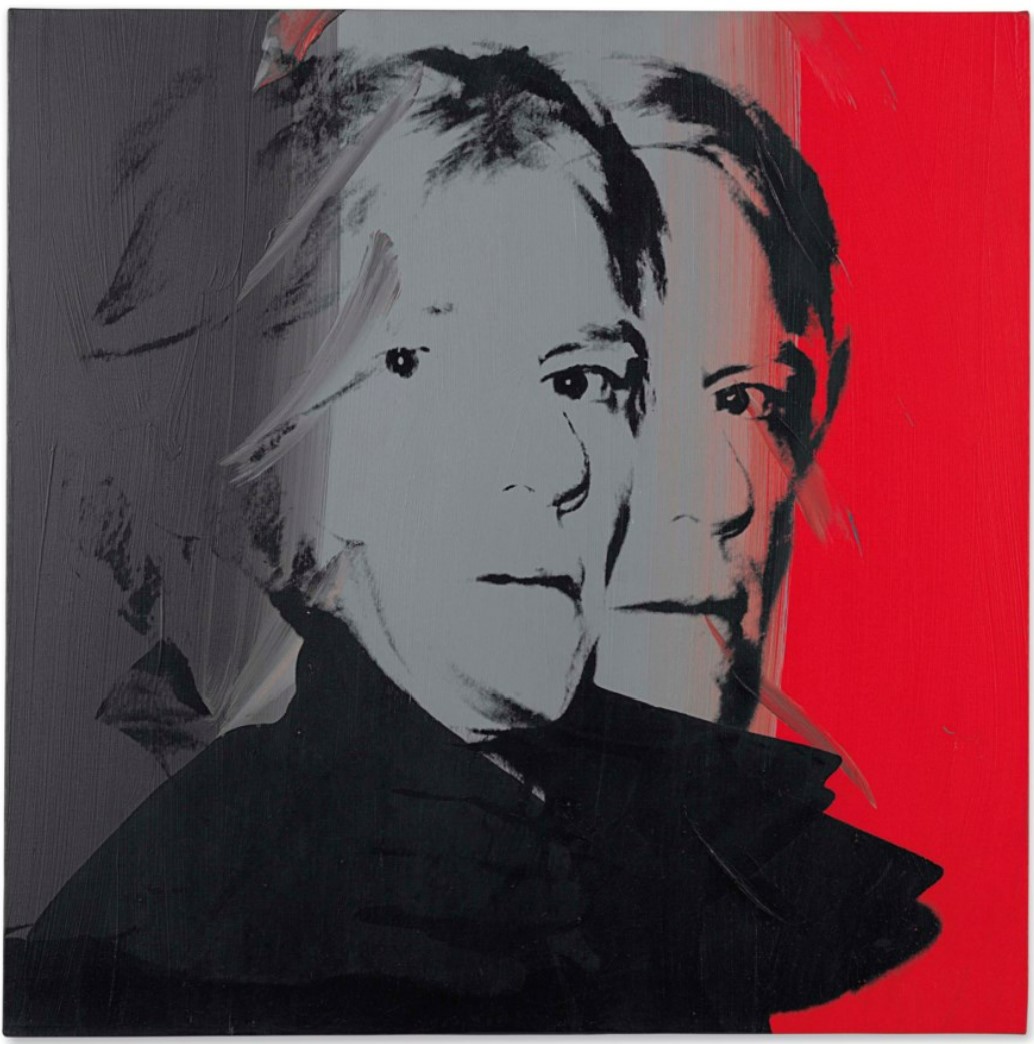
With the collar of his black coat turned upwards and his sideways glance, Warhol’s portrait epitomizes the aesthetic of cool, detached, nonchalance that the artist strove for during his Studio 54 days, contradicting the function of the portrait genre to give access to the person portrayed. This self-portrait from 1978 features a triple image of Warhol, who looks outward from his three-quarter profile from the side of his eyes so that his gaze appears suspicious. The irregularities of his iconic screen-printing process, a medium that replicates mechanical processes by hand, and thus is subject to the variations and discrepancies to produce a unique image, has skewed the second rendering of Warhol’s image, giving it a sharper jaw that the first and resulting in two images of the artist that appear to be two different people or a younger and older version of the same person. Warhol’s double portrait occupies the center of the canvas, in the area rendered silver on the tonal scale between red and black that flank either side of the image.
Sotheby’s London: 12 October 2012
USD 481,250
ANDY WARHOL
Self-Portrait, 1978
Acrylic and silkscreen ink on canvas
40×40 inches (101.6 x 103 cm)