In this body of work, often referred to as the Piss Paintings, Warhol interrogated notions surrounding the status of the artist, and asserted his place within the lineage of conceptual art. It is an alchemical subversive series, richly layered in meaning and inference, and hugely significant within the canon of American art history.
Introduction
The Piss Paintings were all created in 1977 and 1978. To produce them, Warhol prepared canvases with grounds of metallic paint, before inviting certain individuals to urinate across the canvas according to his instructions. Over time, the uric acid would oxidize the metal in the copper paint and create an attractively shimmering patina. Although the act of urination might seem to be the ultimate gesture of desecration, Warhol ironically insisted on the importance of artistic skill in their creation.
“They had technique, too. If I asked someone to do an Oxidation painting, and they just wouldn’t think about it, it would just be a mess. Then I did it myself — and it’s just too much work — and you try to figure out a good design.”
Warhol particularly loved having his assistant Ronny Cutrone contribute these works.
“because he takes a lot of vitamin B so the canvas turns a really pretty color when it’s his piss”
He was so inspired by the painterly effects he achieved through the use of urine as a substitute for paint that he even experimented with brushing urine onto the canvas, although he gave up after finding it too difficult. Warhol chose to focus on the Oxidation paintings at a time in 1970s when he was derided as simply a slavish society portraitist. He strategically used the Oxidation paintings to reassert his vanguard status, along with other abstract series such as the Rorschachs and Shadows. In these works, as in other formative paintings from the 1960s, Warhol challenged Abstract Expressionist conventions and particularly Jackson Pollock as a paradigm of artistic originality and prowess. Vincent Freemont, manager of the artist’s studio at the time of their creation, described the process.
“I can remember watching him creating all these paintings, liking them but not realizing at the time just how important they were… The series that really stands out in my memory are the Piss and Oxidation Paintings, since the process of making these paintings was so unusual… He painted the canvas with different kinds of metallic paints, either gold or copper. Then Ronnie Cutrone, Victor Hugo, and others, including some female participants, were invited into the back room at various times to pee onto the canvas under his direction… This process resulted in amazingly beautiful paintings, both large and small, that have a lot to do with alchemy and chemistry.”
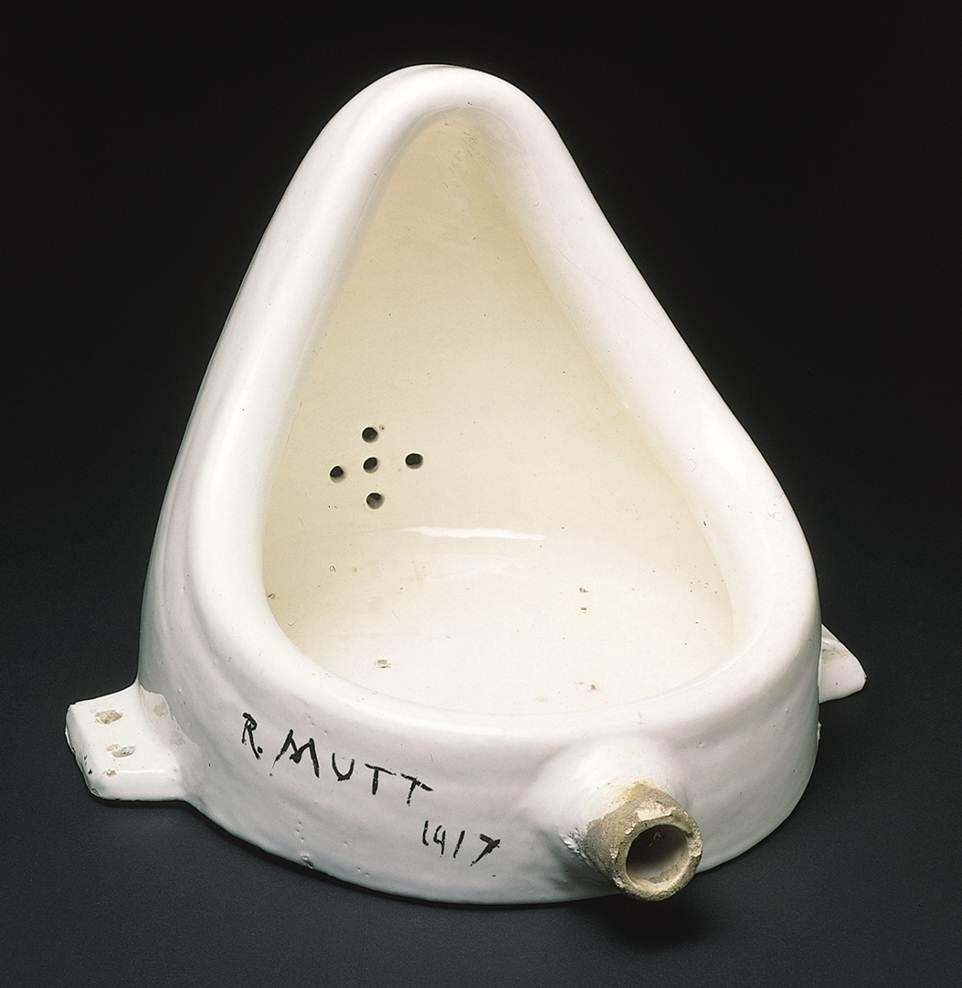
Characteristically, the spectacle that Warhol presided over while creating his Oxidations was an important part of the work. As Cutrone described, working on the Oxidation paintings in the Factory “became almost a sort of performance. Like an Yves Klein kind of thing; with women rolling on the canvas. We would instead bring in boys and girls and have them standing on the big canvases. So the studio would become like a toilet, a giant urinal” (R. Cutrone, quoted in Andy Warhol: The Late Work, p. 92). Warhol’s Oxidations certainly conjure associations with the most famous urinal in the history of art, Marcel Duchamp’s Fountain, an emblem of artistic rebellion since 1917, when it was rejected from the Armory show. Like Duchamp, who questioned the boundaries of art by presenting an upturned urinal on a pedestal as sculpture, Warhol tests the limits of what can be considered painting in the Oxidations.
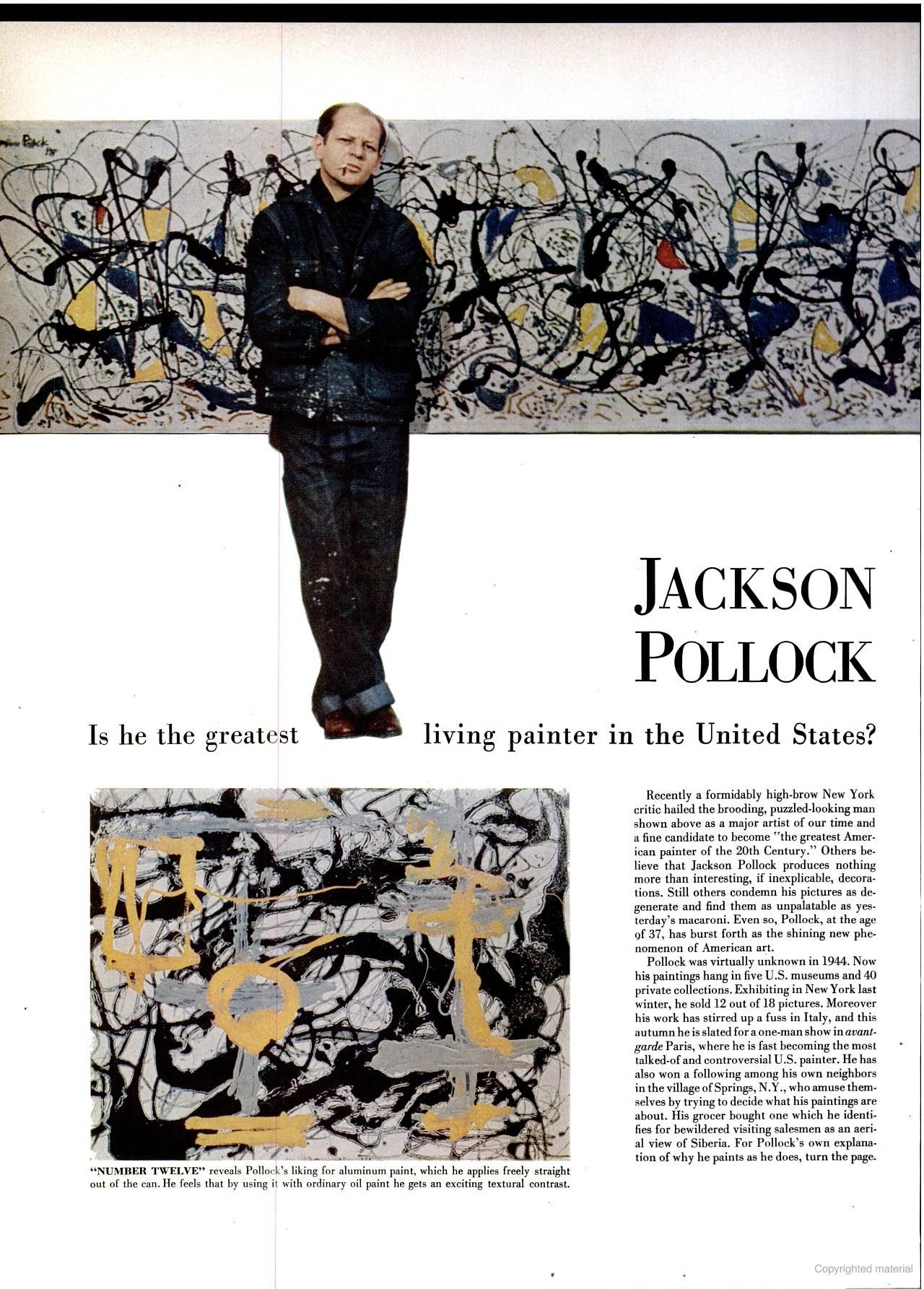
Warhol’s Oxidation Paintings have often been likened to the drip paintings of Jackson Pollock. In terms of style, the parallels are clear. Both bodies of work are based around abstract compositions, bright colors, and gestural linear marks. However, in the Oxidation Paintings, Warhol appears to have been working more in pastiche of Pollock’s legacy than in emulation of it. Pollock’s works were venerated for their sense of gesture; prized above almost any other paintings for being the work of the artist’s own hand. Throughout his career, Warhol had taken a diametrically opposite approach. His silkscreen technique removed any trace of artistic intervention from the face of the canvas, and his Factory studio introduced multiple people to the creation and conception of each artistic endeavor. Moreover, Pollock was notorious for his machismo and bravado; he reputedly urinated on his own canvases before sending them to patrons he didn’t like; and he had famously urinated in Peggy Guggenheim’s fireplace after she cut one of his murals down to size. Thus, the Oxidation Paintings appropriate the infamous gestures of Pollock’s brash masculinity to create works that satirize the linear formulation of his celebrated paintings.
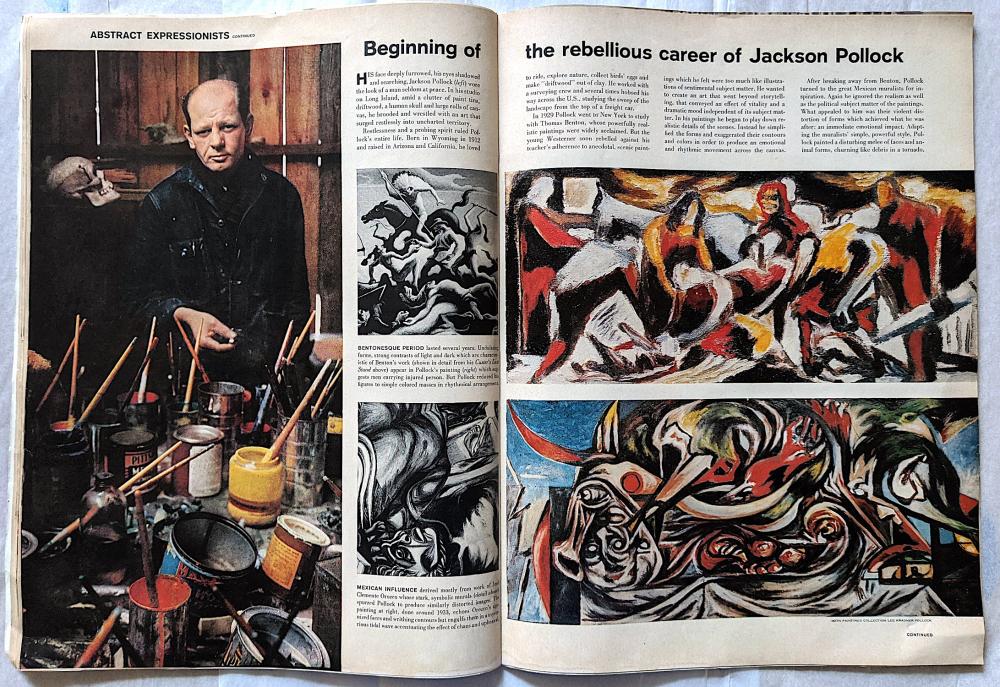
Pollock was hailed by Life magazine as the greatest living artist in America in the summer of 1949, just when Warhol moved to New York after graduating from art school and remained an important figure for Warhol. Famed for his rebellious persona as much as his groundbreaking painting, Pollock was reputed to have urinated on canvases before giving them to clients he didn’t like and urinated in Peggy Guggenheim’s fireplace to protest her cutting down the size of a mural he made. Warhol apparently found Pollock’s macho bravado ridiculous. Warhol played on the phallic connotations of Pollock’s virile flinging of paint by substituting sexual organs for paintbrush. Indeed, a sexual dimension is also present in the Oxidations in the way they allude to practices current in the underground fetish scene in New York, which Warhol frequented.
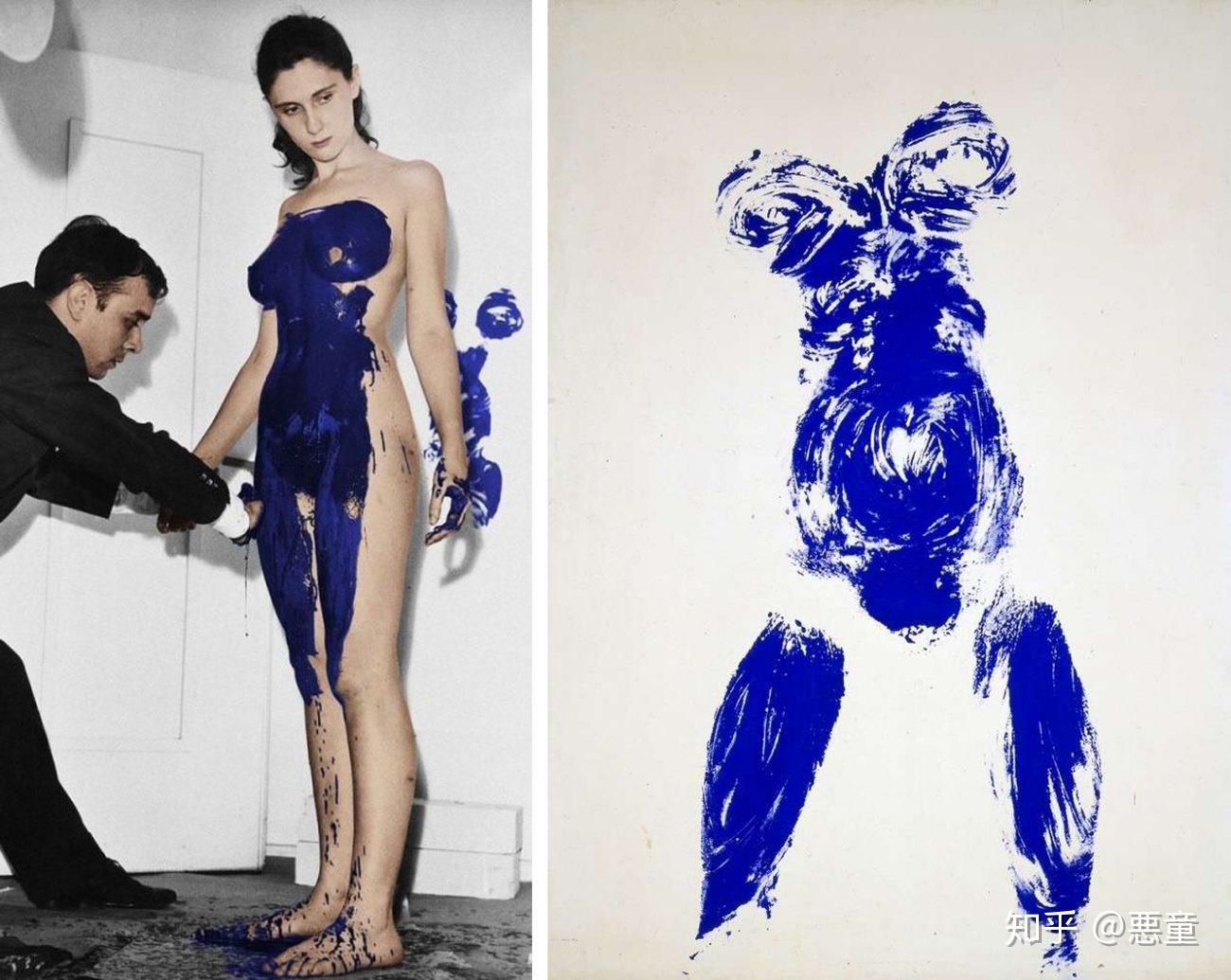
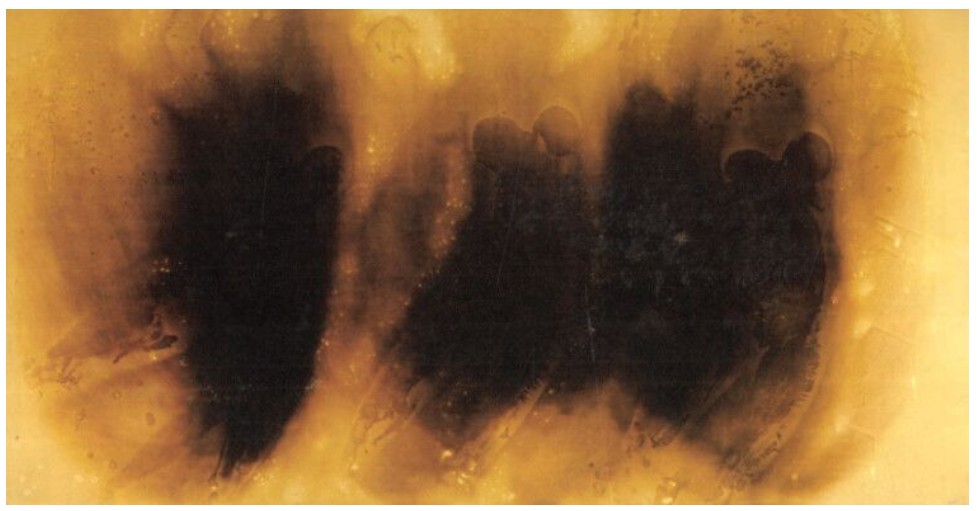
In the interpretation of the present work, we can detect palpable influence from of European conceptual artists Yves Klein and Piero Manzoni. Yves Klein Anthropometry works provide an obvious point of comparison. To create this series, Klein doused female models in blue pigment before dragging and pressing their bodies across prepared paper grounds to create dramatic individual abstract compositions. Like Warhol’s Oxidation Paintings, they situated the artist at a distance from the finished work and removed any notion of gesture. In addition to being a relic of an innovative performance, the present work reveals an energy and ultimately distinctive and beautiful color palette that distinguishes these pieces as independent and seductive aesthetic objects. The slightly sardonic tone of the Oxidation Paintings, as well as the use of human excrement, also calls to mind Piero Manzoni’s celebrated Merda d’Artista works, which consisted of small, labelled cans purporting to contain 30 grams of the artist’s feces. Those works similarly satirized the way that the art public fetishized the work of celebrated artists and glorified it for being the product of their own hand.
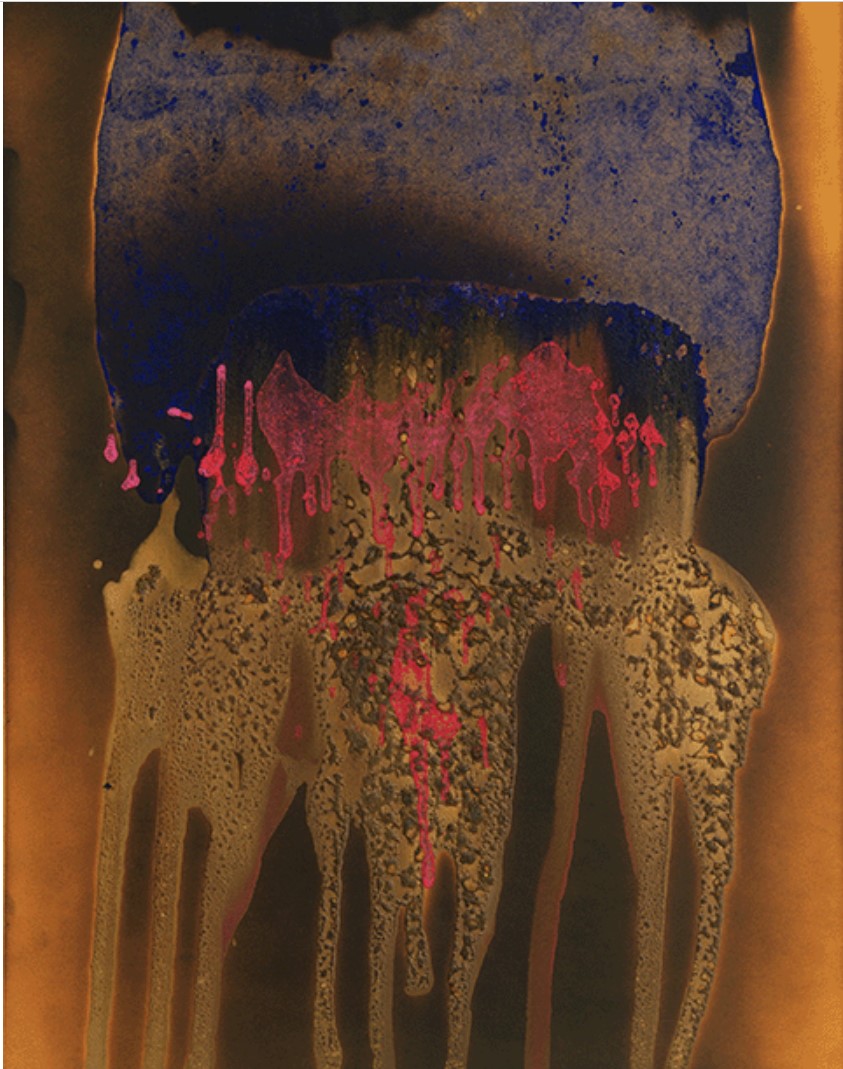
Yves Klein, Untitled (fire-color painting), 1962. The Museum of Modern Art, New York. Image: © The Museum of Modern Art, New York /Licensed by SCALA / Art Resource, NY, Artwork: © Artists Rights Society (ARS), New York / ADAGP, Paris
Although demonstrating Warhol’s keen interest in turning the banal into an object of desire and beauty, the Piss Paintings are strikingly unique within Warhol’s oeuvre; they signify a departure from his silkscreen technique in pursuit of gestural and conceptual abstraction and, in a literal sense, each canvas is entirely original and unreproducible. Combining the legacy of Pollock with those of Klein and Manzoni, these works synthesize groundbreaking advancements in painting in a way that could only be achieved by an artist as daring as Warhol. In pseudo-mocking tone works such as the present, highlight the marked differences between Warhol and his Abstract Expressionist antecedents. Pollock’s works glorified Jackson Pollock; accompanied by the famous Hans Namuth photographs, they showed him as an individual master who created individual masterpieces. Conversely, Warhol’s works showed him as much as the product of a celebrity culture as the arbiter of it: his works were multiples based off images that were ubiquitous and his oeuvre was wholly bounded to his milieu. It has been commented that the Oxidation Paintings are backlashes against his predominant artistic project of the 1970s – the society portraits. In fact, they were created in exactly the same conceptual vein. The characters who were earlier flashed with Warhol’s Polaroid lens and silkscreened onto canvas were, in 1978, invited into the backroom of the factory to help finish the Piss Paintings, each one showing just how much Warhol thought of the legacy of his Abstract Expressionist forbears.
Oxidation (76×52)
Oxidation, 1977-1978
Phillips New-York: 15 November 2022
Estimated: USD 2,000,000 – 3,000,000
USD 2,450,000
Andy Warhol – 20th Century & Contem… Lot 33 November 2022 | Phillips
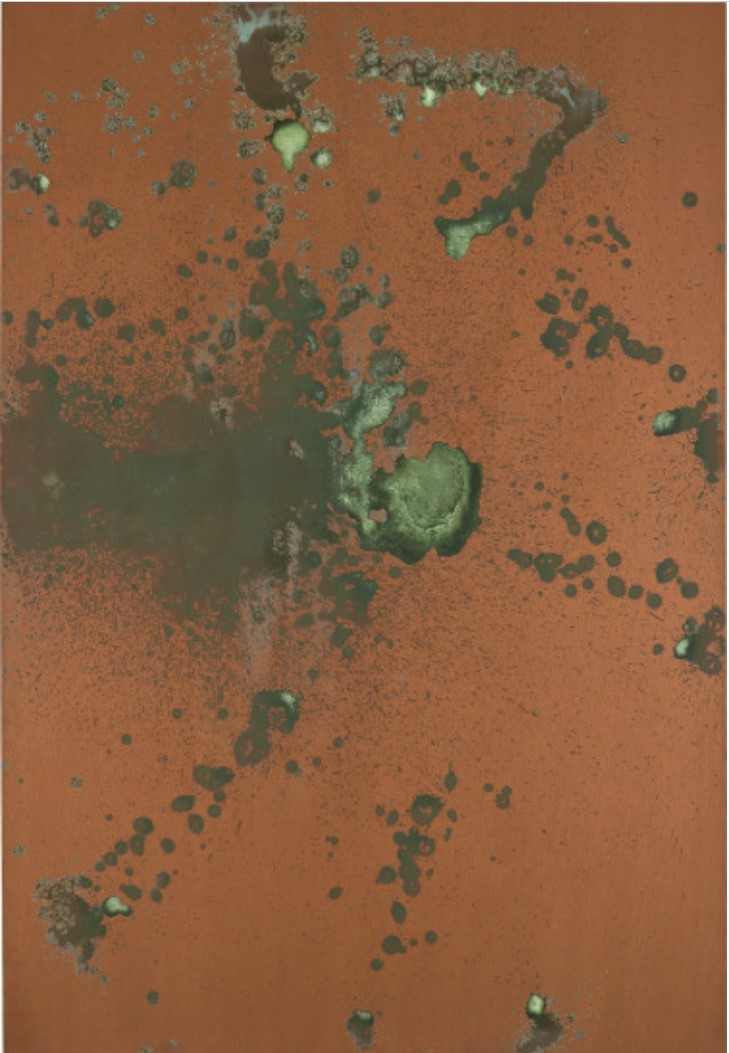
ANDY WARHOL
Oxidation, 1977-1978
Urine and copper paint on linen
76 x 52 1/4 inches (193 x 132.7 cm)
“And then these nice older women were asking me how I’d done them and I didn’t have the heart to tell them what they really were because their noses were right up against them. And it was so crowded.”
The alluringly lustrous expanse of Andy Warhol’s Oxidation, 1977-1978 belies the base material that forms its creation. Presented on a heroic scale akin to the sublime canvases of the Abstract Expressionist movement that dominated the art landscape during his formative years at Carnegie Tech, Warhol conceived just twelve paintings in this scale, with examples held in the permanent collections of the Baltimore Museum of Art and the Museum of Fine Arts, Boston. Formerly held in the prestigious Froehlich Collection, the present work was one of three Oxidation paintings exhibited at documenta 7, Kassel in 1982. Only shown three times in his lifetime, the Oxidations’ inclusion in documenta 7 anointed their status as a radical contribution to the canon of abstraction
Oxidation Painting, 1978
Sotheby’s New-York: 16 May 2018
Estimated: USD 2,500,000 – 3,500,000
USD 3,375,000
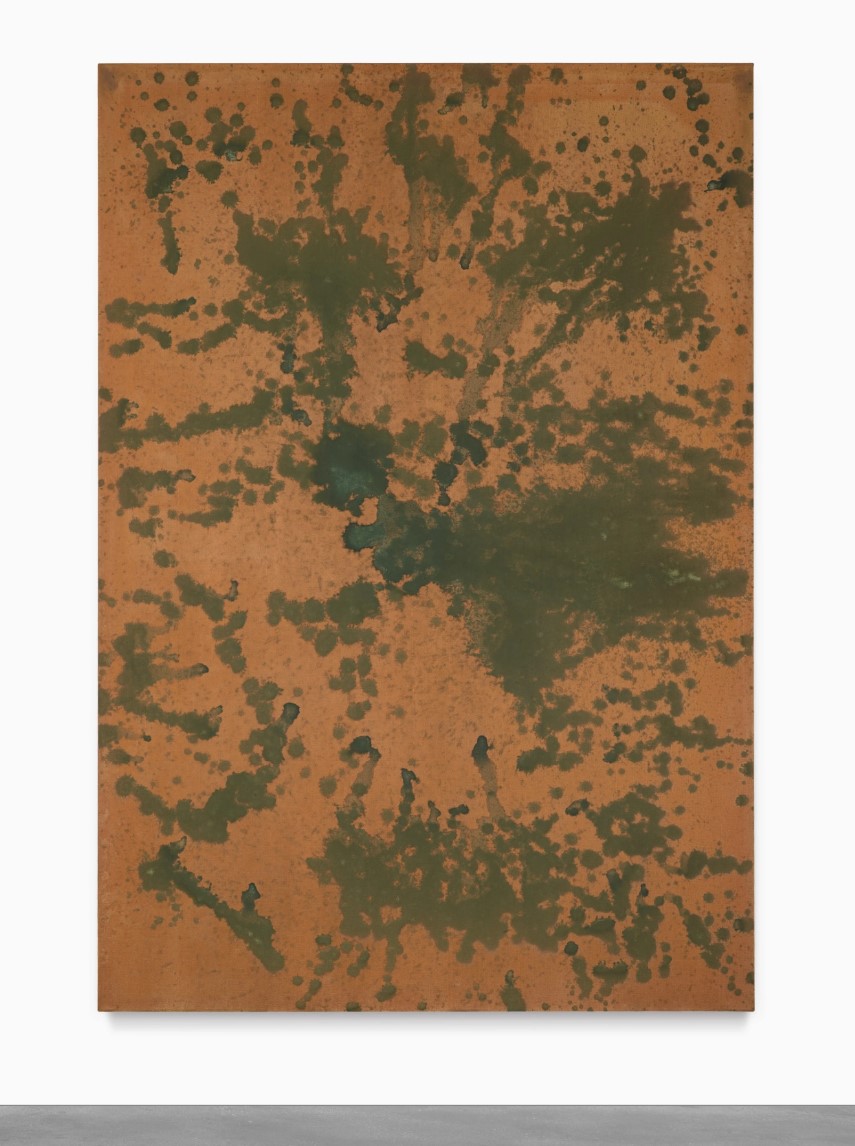 ANDY WARHOL
Oxidation Painting, 1978
Urine and metallic pigment in acrylic on canvas
76×52 inches (193 x 132.1 cm)
Oxidation Painting is a superb example of Andy Warhol’s most conceptually advanced series. In this body of work, often referred to as the Piss Paintings, Warhol interrogated notions surrounding the status of the artist, and asserted his place within the lineage of conceptual art. It is an alchemical subversive series, richly layered in meaning and inference, and hugely significant within the canon of American art history. This work is significant amongst the series for its provenance, having spent 24 years in the collection of The Baltimore Museum of Art, where it was hung as part of the collection and loaned to partner institutions as prestigious as The Metropolitan Museum of Art in New York. It is also exceptional for its composition, which appears more detailed, varied, and complete than many other examples from the series.
Oxidation Painting, 1978
Christie’s New-York: 13 May 2008
Estimated: USD 800,000 – 1,200,000
USD 1,889,000
Andy Warhol (1928-1987) , Oxidation Painting | Christie’s
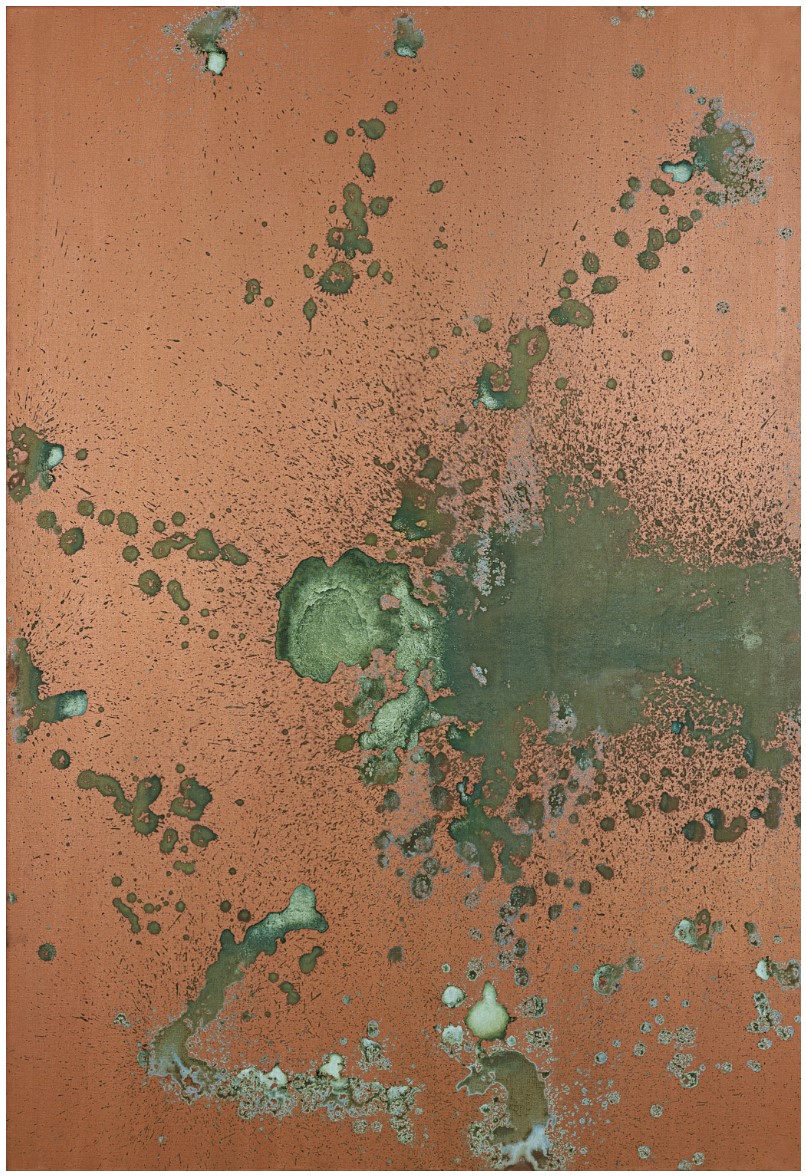
ANDY WARHOL
Oxidation Painting, 1978
Copper metallic pigment and urine on canvas
76×52 inches (193×132 cm)
Warhol chose to focus on the Oxidation paintings at a time in 1970s when he was derided as simply a slavish society portraitist. He strategically used the Oxidation paintings to reassert his vanguard status, along with other abstract series such as the Rorschachs and Shadows. In these works, as in other formative paintings from the 1960s, Warhol challenged Abstract Expressionist conventions and particularly Jackson Pollock as a paradigm of artistic originality and prowess. Pollock was hailed by Life magazine as the greatest living artist in America in the summer of 1949, just when Warhol moved to New York after graduating from art school, and remained an important figure for Warhol. Famed for his rebellious persona as much as his groundbreaking painting, Pollock was reputed to have urinated on canvases before giving them to clients he didn’t like, and urinated in Peggy Guggenheim’s fireplace to protest her cutting down the size of a mural he made. Warhol apparently found Pollock’s macho bravado ridiculous. As Warhol stated, “I asked Larry [Rivers] about Jackson Pollock. ‘Pollock? Socially he was a real jerk,’ Larry said. ‘Very unpleasant to be around.’ I tried to imagine myself in a bar striding over to say, Roy Lichtenstein and asking him to ‘step outside’ because I’d heard he’d insulted my soup cans. I mean, how corny” (A. Warhol, quoted in Andy Warhol: The Late Work, 2004, p. 91). Warhol played on the phallic connotations of Pollock’s virile flinging of paint by substituting sexual organs for paintbrush. Indeed, a sexual dimension is also present in the Oxidations in the way they allude to practices current in the underground fetish scene in New York, which Warhol frequented. As one Factory regular characterized the production of the Oxidations “It was like a Robert Mapplethorpe photograph come alive” (B. Colacello, quoted in Holy Terror: Andy Warhol Close Up, 1990, p. 341).
Characteristically, the spectacle that Warhol presided over while creating his Oxidations was an important part of the work. As Cutrone described, working on the Oxidation paintings in the Factory “became almost a sort of performance. Like an Yves Klein kind of thing; with women rolling on the canvas. We would instead bring in boys and girls and have them standing on the big canvases. So the studio would become like a toilet, a giant urinal” (R. Cutrone, quoted in Andy Warhol: The Late Work, p. 92). Warhol’s Oxidations certainly conjure associations with the most famous urinal in the history of art, Marcel Duchamp’s Fountain, an emblem of artistic rebellion since 1917, when it was rejected from the Armory show. Like Duchamp, who questioned the boundaries of art by presenting an upturned urinal on a pedestal as sculpture, Warhol tests the limits of what can be considered painting in the Oxidations.
Oxidation (40×30)
Oxidation Painting (Diptych), 1978
Edlis Neeson Collection
Christie’s New-York: 19 November 2025
Estimated: USD 900,000 – 1,200,000
USD 1,714,500
ANDY WARHOL (1928-1987), Oxidation Painting (Diptych) | Christie’s
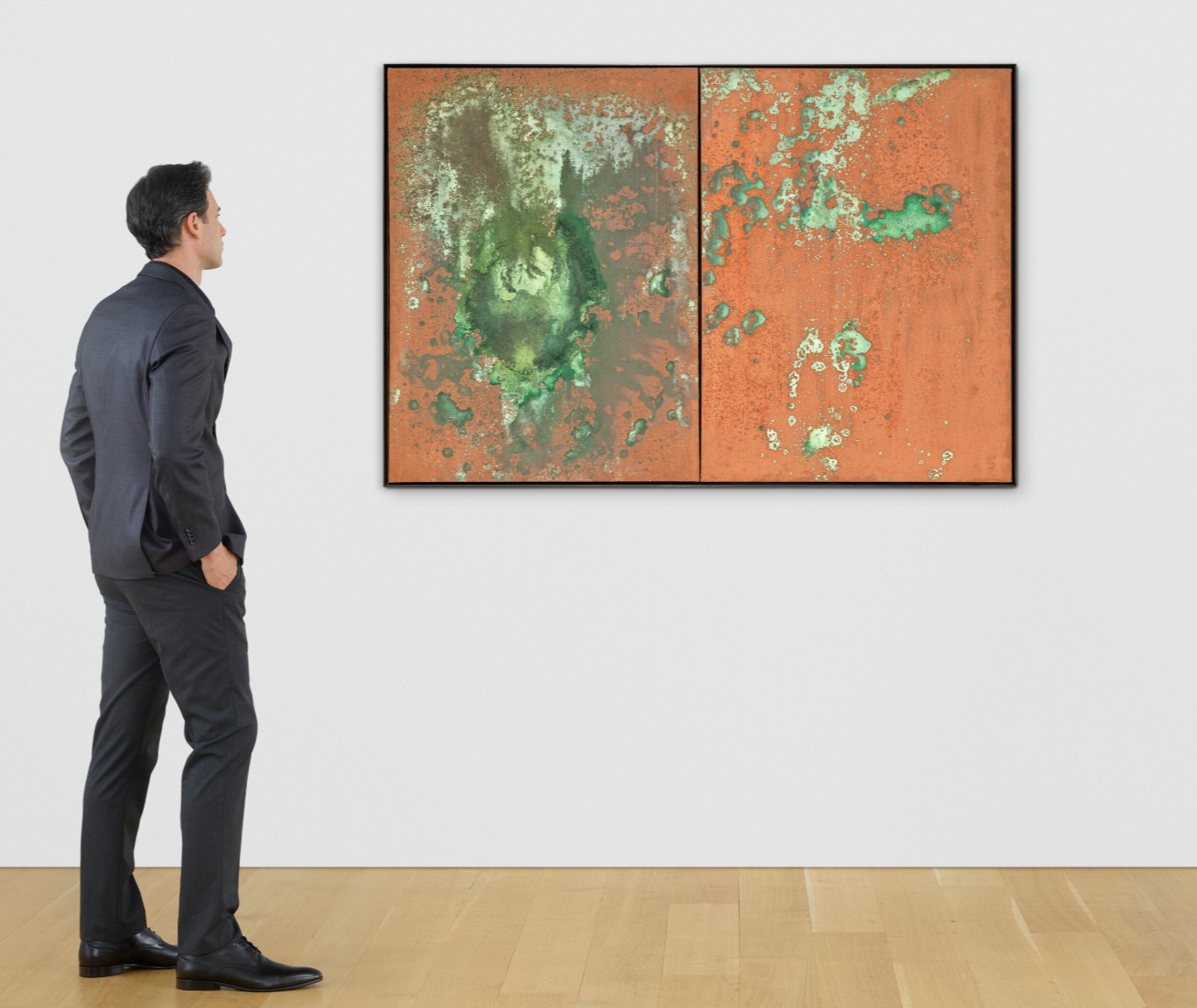
ANDY WARHOL (1928-1987)
Oxidation Painting (Diptych), 1978
Urine and copper paint on linen, in two parts
Each: 40×30 inches (101.6 x 76.2 cm)
Overall: 40×60 inches (101.6 x 152.4 cm)(2)
Signed, dedicated and dated
‘Pour la collection de Flavio Castillo Pontello Andy Warhol 1978’
(on the reverse of each canvas)
Occupying a singular space in the artist’s vaunted oeuvre, Andy Warhol’s Oxidation paintings demonstrate his boundless creativity and endless capacity for radical reinvention. The series was the first since Warhol’s early career to be produced without a photographic element. The present work, one of only three diptychs in the series, is a revelation of Warhol’s bold reimagining of abstraction, offering both formal innovation and astonishing beauty. Celebrating Warhol’s fascination with abstraction, steeped in the visual iconography of the Byzantine Catholic church of Warhol’s youth, and referencing New York queer nightlife scene and the colorful characters flowing into and out of his Factory studio, Oxidation Painting combines the disparate aspects of Warhol’s famously oblique personality into a rare, reflective masterpiece.
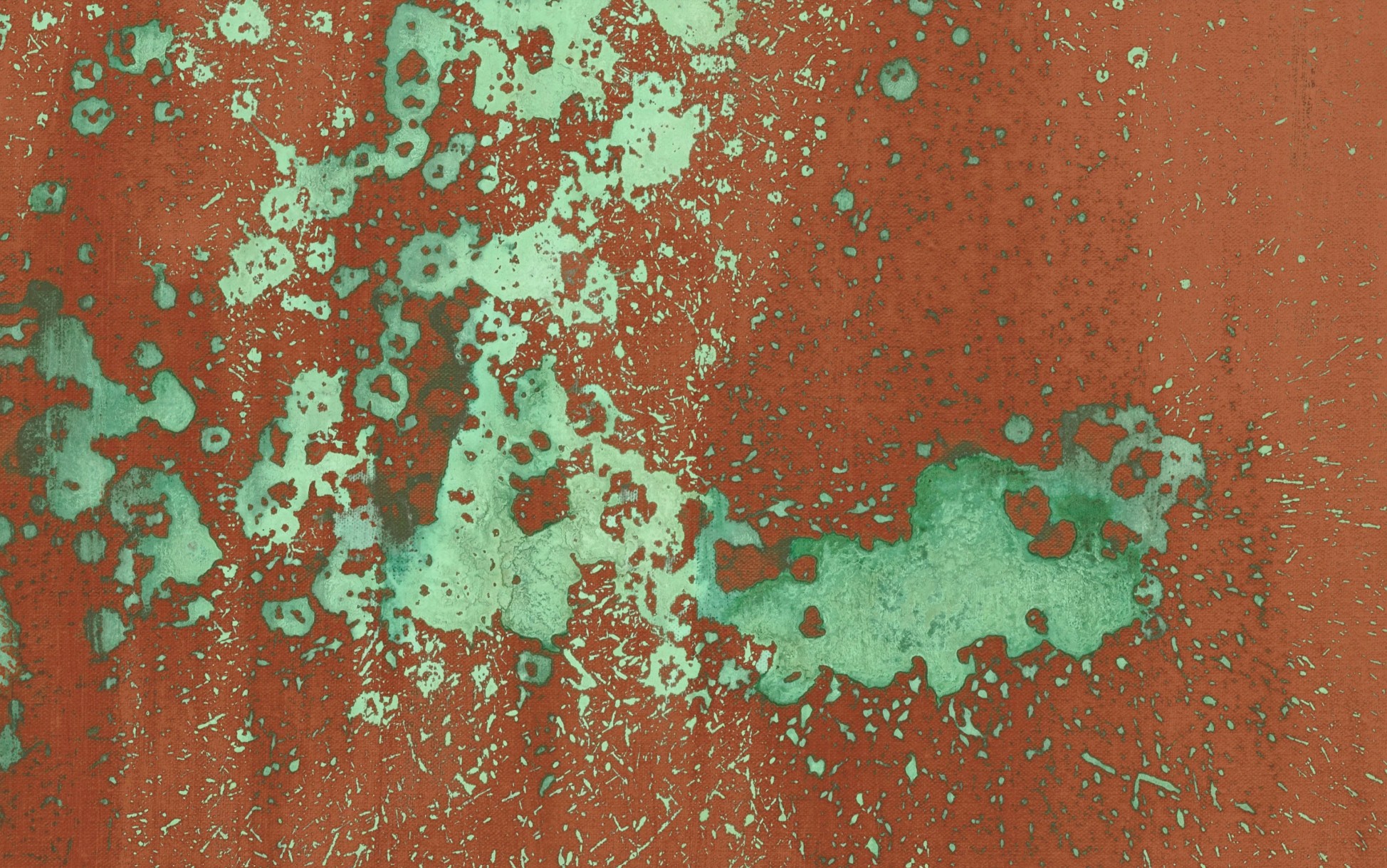
Oxidation Painting expands across two canvases coated in a metallic, bronze-toned paint. Splotches, drops, spills, and pools of varying alchemical stains scatter organically across the canvas surface, creating vivid biomorphic forms complimenting the copper background. The left canvas is almost wholly absorbed by a large, ovular form of darker olive greens and blacks which spread out slowly across the picture plane, gradually giving way to lighter shades dotted with white. The right canvas retains more glittering ground, stains only occasionally interrupting the shimmering surface in more methodical drops and splatters. The work is a riotous display of the artist’s technical achievement in creating a wide range of chemical effects with intricate shifts of color and textural contrasts.
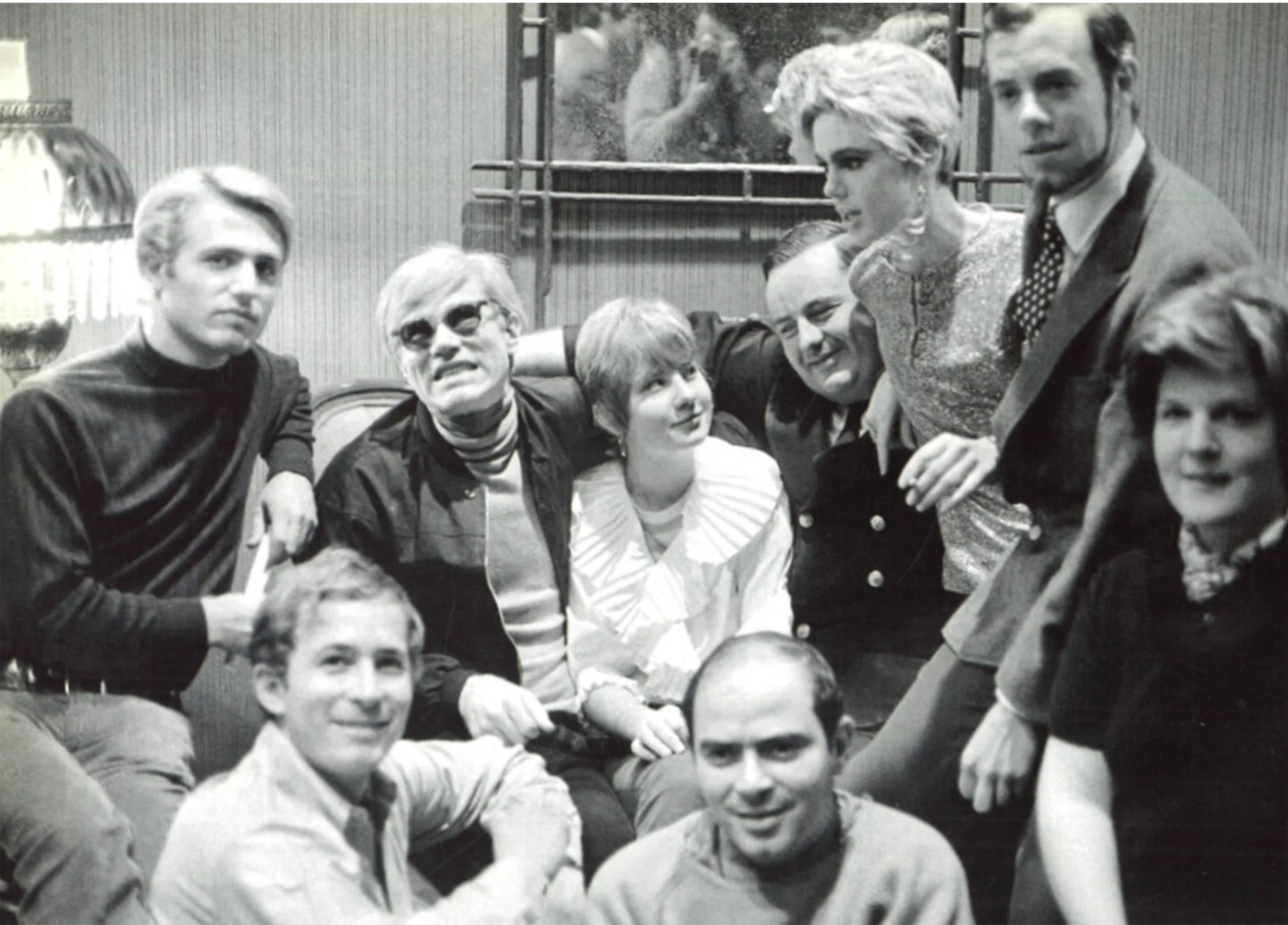
Nat Finkelstein, Group Shot, ICA, Philadelphia, 1965. Photograph by Nat Finkelstein, © Estate of Nat Finkelstein.
Warhol devised novel methods and media for his Oxidation works. He first mixed copper and copper alloy powders with paint, layering the product onto stretched canvases. He and his assistants then applied urine via various mechanisms onto the wet paint, leaving the urine to react chemically with the metallic pigments, achieving the acid green forms which populate the composition. Warhol experimented widely with both the chemical process and the delivery mechanism, consuming different vitamin supplements to subtly alter the urine’s effect and exploring different methods of application—urinating directly on the canvas and collecting urine in containers to distribute in concentrated drips or pours. Through this innovative process, Warhol created a work of optically fascinating art without any marks of the painterly gesture. While literally absorbing the artist, Oxidation Painting avoids the appearance of the artist’s touch, achieving a result eagerly sought after by the Abstract Expressionists.
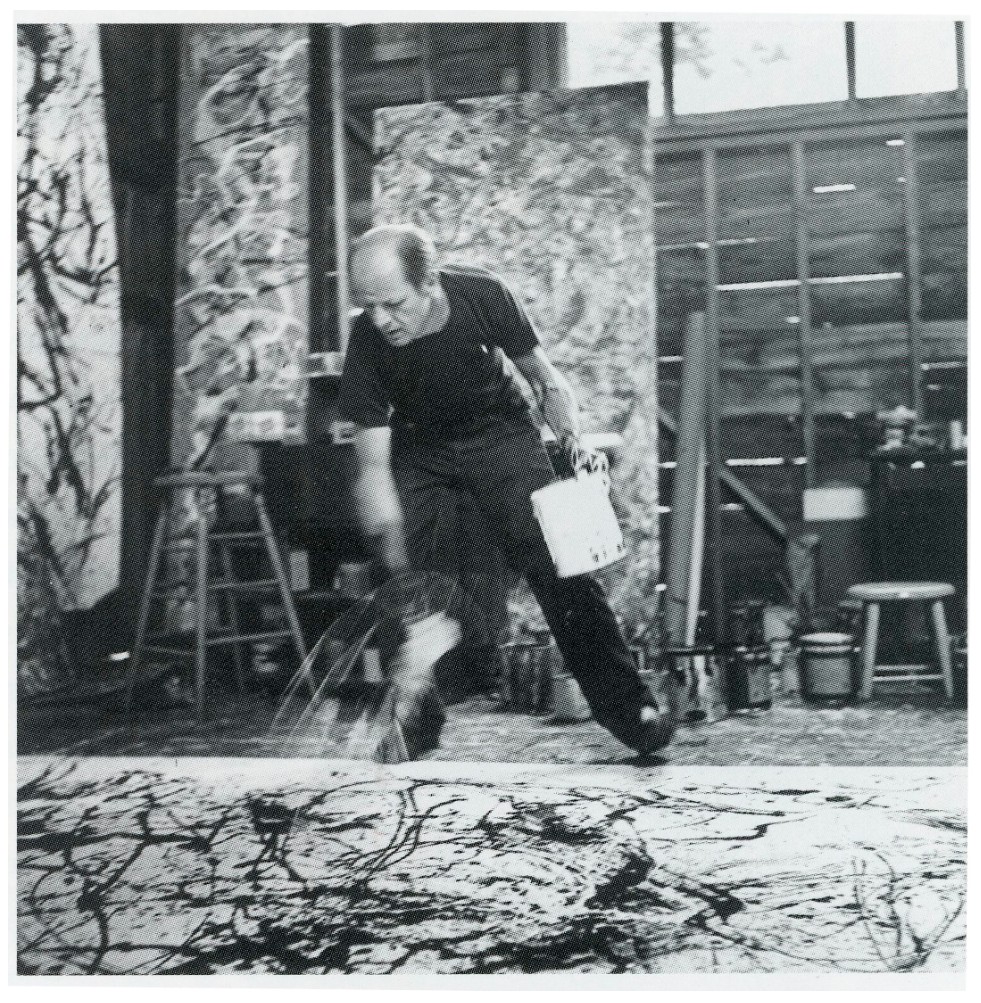
Jackson Pollock painting Autumn Rhythm: Number 30, 1950. Photo: Hans Namuth. Courtesy Center for Creative Photography, University of Arizona © 1991 Hans Namuth Estate. Artwork: © 2025 The Pollock-Krasner Foundation / Artists Rights Society (ARS), New York.
The work resembles Jackson Pollock’s drip paintings in both method and result—Warhol’s collaborator Bob Colacello reports him noting “it’s a parody of Jackson Pollock” (A. Warhol, quoted in N. Printz, The Andy Warhol Catalogue Raisonné Paintings 1976-1978, Vol. 5B, New York, 2018, p. 113). Working with the canvas horizontal on the ground, Warhol challenged Pollock’s status as the preeminent artist of the 20th century. With the Oxidation series, Warhol reasserted himself at the art world’s vanguard after a decade spent making silkscreen portraits critically derided as society portraits. The art historian Rosalind Krauss observed how Warhol decoded Pollock’s “liquid gesture” with his Oxidation paintings while employing his signature Pop art aesthetic. “For Warhol, the Oxidation paintings were simply once again motifs that connected high and low culture—action painting and the world of the baths and their golden showers—along the vector of notoriety or ‘fame’” (R. Krauss, The Optical Unconscious, Cambridge, MA, 1993 p. 276).
The Wilton Diptych, circa 1395-1399. National Gallery, London.
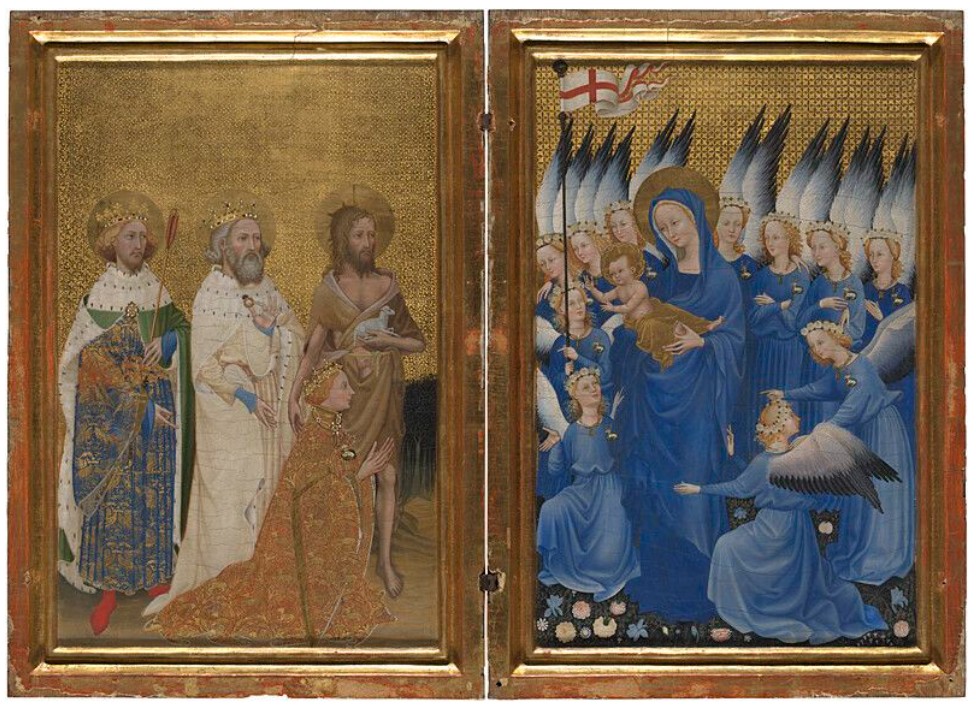
While avant-garde in method and material, Oxidation Painting contains several historical referents. Employing acid on copper has a long tradition in art history, with Old Masters including Albrecht Dürer and Rembrandt using etching—lines incised by acid on copper plate—for many of their graphic masterpieces. The urine was only effective while the copper paint was still wet, requiring Warhol to work rapidly. His wet-on-wet process resembles the buon fresco technique utilized by Michelangelo and Raphael in their famous Vatican paintings, all three artists having to rapidly make irreversible decisions before their ground hardened. Oxidation Painting also enacts a thoroughly traditional form, the diptych, which was widely used through the Middle Ages and Renaissance for religious altarpieces. The work’s copper ground similarly recalls altarpieces, resembling the gold ground icons which populate the Byzantine Catholic Church Warhol attended as a child. The process was simultaneously thoroughly contemporary, operating in parallel with New York’s progressive social scene and situated within the Happening and performance-based aesthetic of the 1960s and 1970s.
Yves Klein, Untitled fire painting (F 81), circa 1961.
© Succession Yves Klein c/o Artists Rights Society (ARS), New York / ADAGP, Paris 2025.
The present work was included in the first public exhibition of the Oxidation paintings in 1978 at Ace Gallery’s booth for the FIAC art fair in Paris. The works were an immediate revelation, with Art International noting how their “bitter beauty and precise bite are striking” (quoted in N. Printz, op. cit., p. 129). Oxidation Painting represents a watershed moment in Warhol’s career, grappling with the art historical tradition and Pollock’s looming legacy while once again revolutionizing the vanguard. Canonically important, the works also provide a tantalizing glimpse into the artist’s internal psyche.
Oxidation Painting, 1977-1978
Christie’s London: 5 October 2018
Estimated: GBP 400,000 – 600,000
GBP 446,750
Andy Warhol (1928-1987), Oxidation Painting | Christie’s
ANDY WARHOL
Oxidation Painting, 1977-1978
Urine and copper paint on canvas
40×30 inches (101.6 x 76.2 cm)
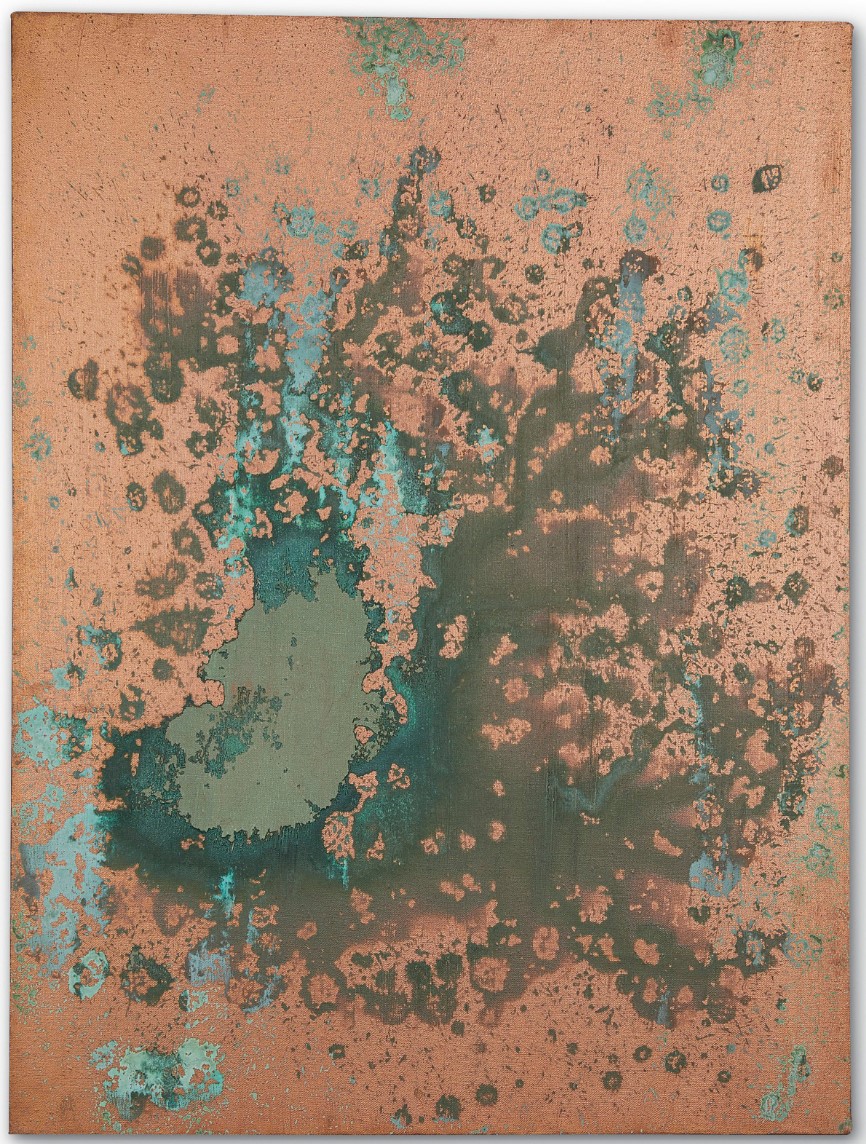
Andy Warhol’s Oxidation paintings are wonderfully paradoxical, at once aesthetically rich and delightedly, and drolly, transgressive. With its coppery iridescence and spontaneous greens, Oxidation Painting, 1978, is an especially striking example from the series. A splash of metallic greens erupts onto the canvas, a shimmering and triumphant burst. Although Oxidation Painting presents a painterly dynamism, Warhol’s methods for realizing the composition were decidedly and notoriously grimy: he would ask members of The Factory or visiting friends to urinate on the copper coated canvases, ultimately reinforcing the communal ethos of the studio. Over time, the reaction of urine on copper resulted in swirling patinas, producing a bold and original take on abstraction, as well as a parody of Jackson Pollock’s pours and splashes. Casually referred to as the ‘piss paintings’, Warhol worked on the Oxidation series for one year only, between 1977 and 1978, although it is possible he tested out the method in
1962, but any work produced is no longer extant. Oxidation Painting exemplifies the abstraction that dominated his practice from the late 1970s until his death in 1987. Although he experimented with a variety of non-figurative techniques in the Shadow and Camouflage series, Oxidation was his only unique method of creating. While urinating itself might seem to require little actual skill, Warhol ironically insisted on and emphasized artistic skill, explaining that ‘they had technique too. If I asked someone to do an Oxidation painting, and they just wouldn’t think about it, it would just be a mess. Then I did it myself – it’s just too much work – and you try to figure out a good design’ (A. Warhol quoted in I’ll Be Your Mirror: The Selected Andy Warhol Interviews, ed. K. Goldsmith, Cambridge, MA, 2004, p. 327). Indeed, he even had preferred participants, favouring the work of his assistant Ronny Cutrone. So inspired was he by the effects achieved, that Warhol briefly experimented by painting with urine, an effort he found
difficult and quickly abandoned. Warhol used the Oxidation paintings as a means of reasserting his vanguard status and to challenge the dominance of Abstract Expressionist conventions, long seen as a paradigm of artistic originality. Famed for his rebellious persona as much as for his ground-breaking canvases, Jackson Pollock allegedly urinated on canvases before giving them to clients he disliked. Warhol apparently found Pollock’s macho swagger ridiculous and unbearable, saying ‘I asked Larry [Rivers] about Jackson Pollock. ‘Pollock? Socially he was a real jerk,’ Larry said. ‘Very unpleasant to be around.’’ (A. Warhol quoted in Andy Warhol: The Late Work, Munich, 2004, p. 91). Characteristically, the spectacle was an essential part of Warhol’s boundary pushing work, and the Oxidation series itself was somewhat of a performance. In Oxidation Painting, the green splatter dances across the surface, impulsive, demonstrative and exuberant.
Oxidation Painting, 1978
Sotheby’s New-York: 14 November 2012
Estimated: USD 500,000 – 700,000
USD 548,500
ANDY WARHOL
Oxidation Painting, 1978
Copper metallic pigment and urine on canvas
50×42 inches (127 x 106.7 cm)
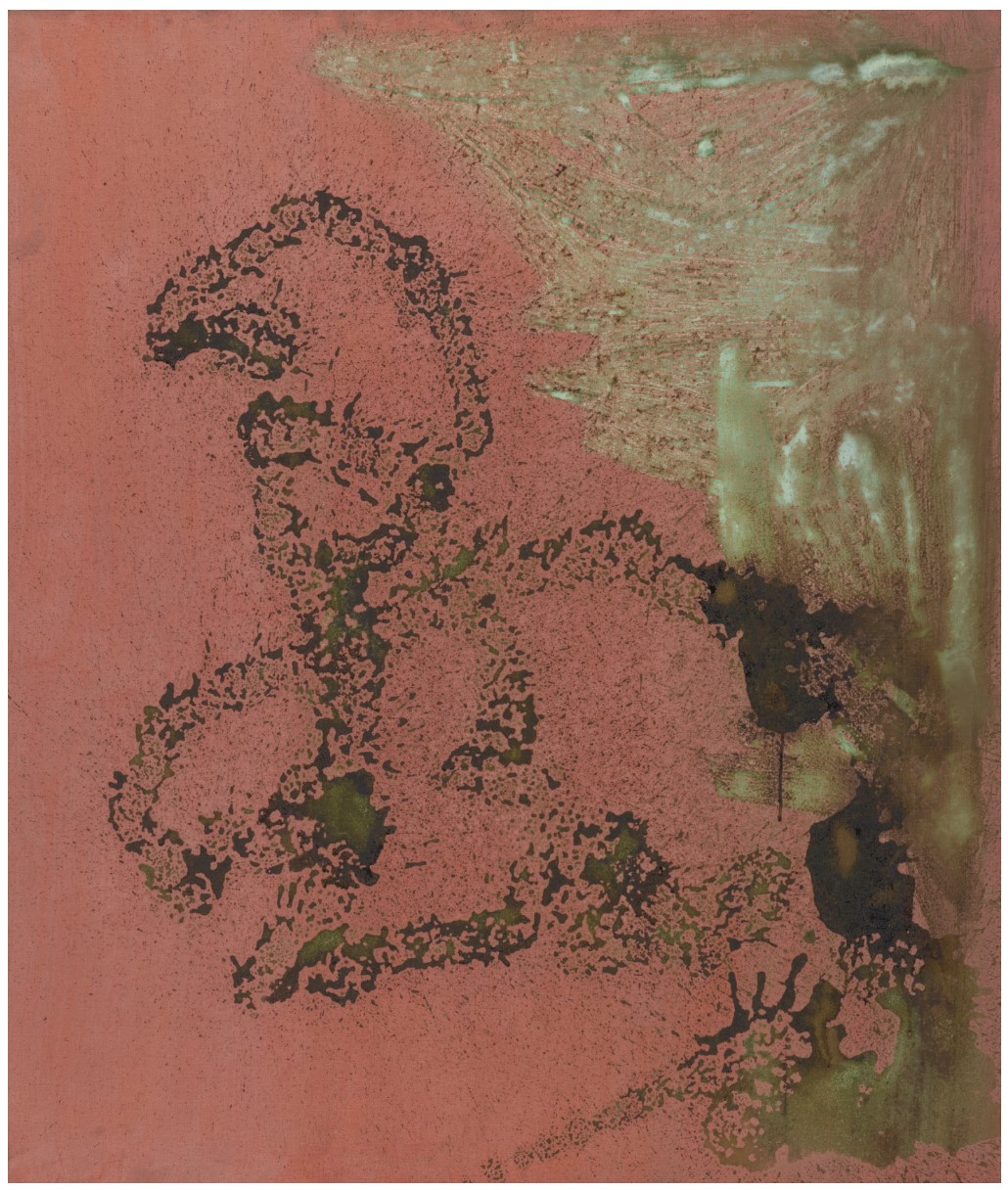
In the early 1960s, Andy Warhol, a burgeoning young artist in New York, was just becoming famous for his silkscreened canvases of pop cultural imagery, yet a single foray in 1962 remained with the artist until his late career in 1978. It was in 1962 that Andy Warhol experimented with his first “Piss Painting,” where he urinated on a canvas, yet he abandoned this method entirely until the late 1970s, when he embarked upon a series of “oxidation paintings,” such as the present work, Oxidation Painting from 1978. For this series of works, Warhol would choose Factory-goers or assistants to urinate on canvases that he pre-coated in copper paint, which oxidizes when in contact with urine. Ronnie Cutrone described the scene in the Factory as “almost a sort of performance. Like an Yves Klein kind of thing; with women rolling on the canvas. We would instead bring in boys and girls and have them standing on the big canvases. So the studio would become like a toilet, a giant urinal.” (Ronnie Cutrone in Andy Warhol: The Late Work, p. 92)
Unlike his typical style of premeditated, mechanically printed silkscreens, the Oxidation Paintings were each completely unique. Here, Warhol had no preexisting template to work from, he simply directed his helpers and let chance take hold. The body, therefore, became the paintbrush with which he created. The Oxidation canvases are characterized by dramatic splashes, energetically sprawled across the canvas – a tangible departure from his predominantly figurative work. Indeed, the abstract Oxidations, along with the Shadows and Camouflages, present divergent aesthetics compared to his typical figurative style.
The dripping effect of the present work visually recalls the painting technique of Jackson Pollock and many of the Abstract Expressionists that preceded Warhol. Known for closely observing the work and trends of the New York Action Painters, Warhol guided his own career in reaction to their work and theory. The Oxidation series presents a sharp juxtaposition between Pollock’s conscious and expressionistic flinging of the paint – a metaphor of masculinity with strong ejaculatory connotations. Warhol takes this gesture and turns it on its head, satirizing the methods traditionally praised as emotional and virile. Further, the chemical reaction of the copper paint and urine creates something wholly new – a metallic green pigment, thus underlining the alchemistic nature of sprinkling the seed and creating something new.
Though Oxidation Painting from 1978 is born from a base and subversive method, the painting itself is striking to behold. The metallic copper background is punctured by an iridescent green with a textured patina. The green spots range from a stream of splashes to a smeared effect along the topand right side of the canvas, which Warhol achieved by brushing urine onto the canvas with a paintbrush. The ironic result of Warhol’s transgressive chemical experimentation with the Oxidation Paintings, is a series full of rich and sumptuously stunning works, unique in Warhol’s vast oeuvre.
Small Oxidation Paintings
Oxidation, 1977-78
Christie’s New-York: 17 May 2024
Estimated: USD 100,000 – 150,000
USD 113,400
ANDY WARHOL (1928-1987), Oxidation | Christie’s
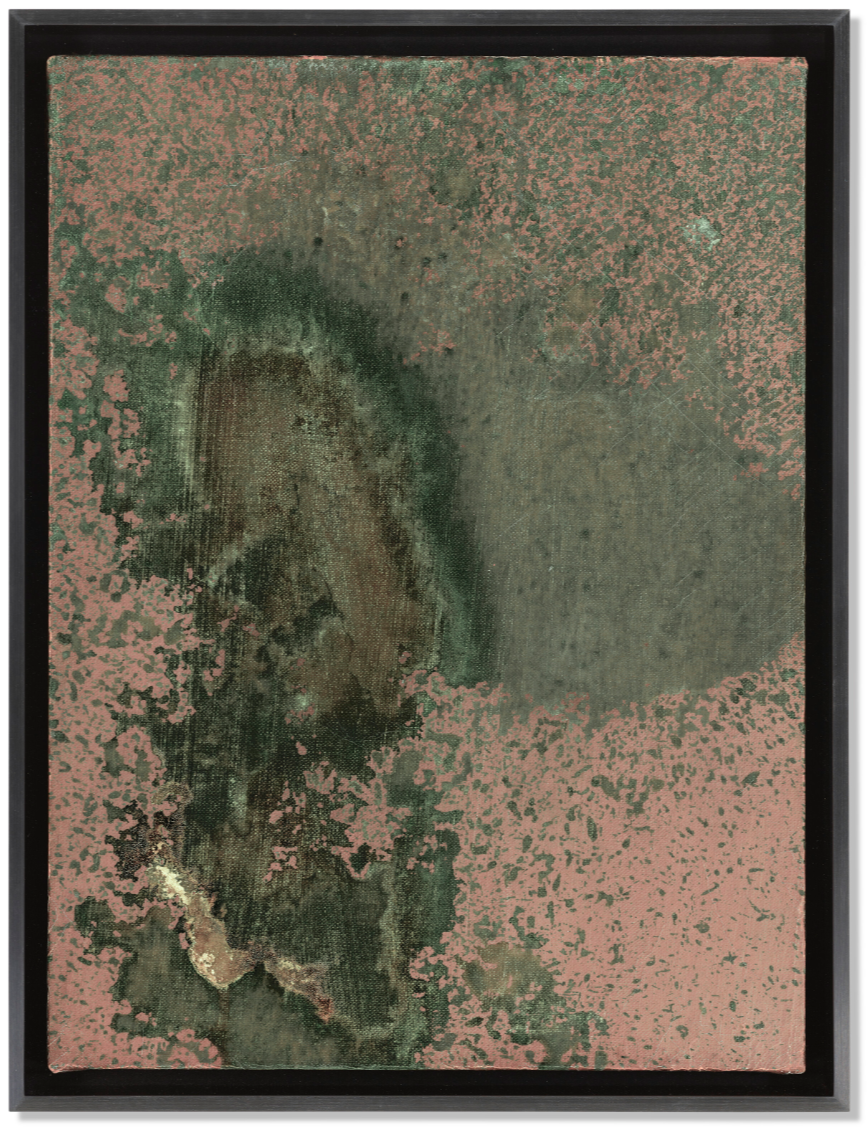
ANDY WARHOL (1928-1987)
Oxidation, 1977-78
Urine and copper paint on canvas
15 1/2 x 11 1/2 inches (39.4 x 29.2 cm)
Signed and dedicated ‘to Heiner love Andy’ (on the reverse)
Oxidation, 1977-78
Christie’s New-York: 10 November 2023
Estimated: USD 300,000 – 500,000
USD 327,600
ANDY WARHOL (1928-1987), Oxidation | Christie’s
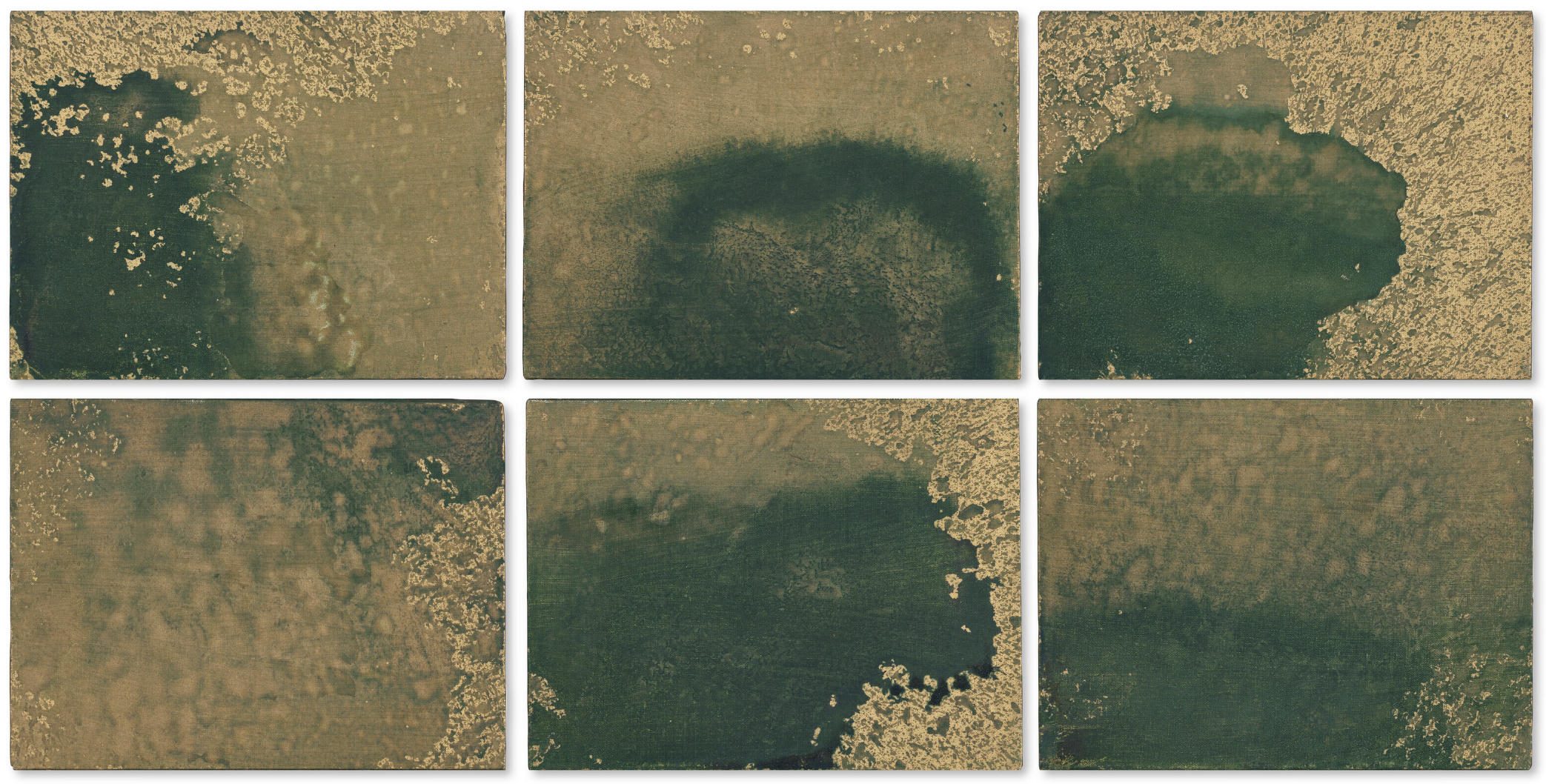
ANDY WARHOL (1928-1987)
Oxidation, 1977-78
Urine and metallic paint on canvas, in six parts
Each: 9×12 inches (22.9 x 30.5 cm)
Overall: 18×36 inches (45.7 x 91.4 cm)
Stamped with the Estate of Andy Warhol and the Andy Warhol Foundation for the Visual Arts, Inc. stamps
Numbered respectively ‘VF PA45.044, VF PA45.046, VF PA45.043, VF PA45.050, VF PA45.047 and VF PA45.058’ (on the reverse of each canvas)
Oxidation Painting, 1978
Christie’s New-York: 19 September 2023
Estimated: USD 80,000 – 80,000
USD 201,600
ANDY WARHOL (1928-1987), Oxidation Painting | Christie’s
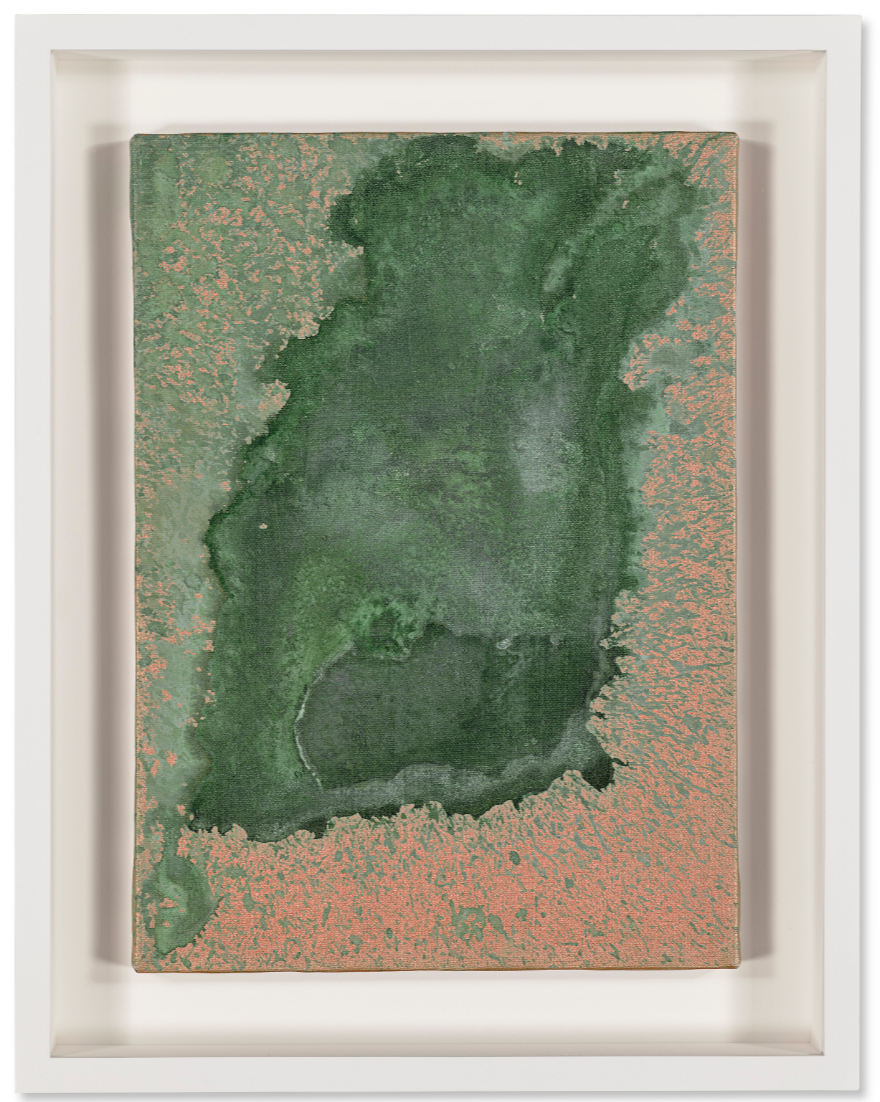
ANDY WARHOL (1928-1987)
Oxidation Painting, 1978
Copper metallic pigment and urine on canvas
14×10 inches (35.6 x 25.4 cm)
Signed and dated ‘Andy Warhol 78’ (on the stretcher)
Oxidation Painting, 1978
Christie’s New-York: 18 May 2017
Estimated: USD 100,000 – 150,000
USD 100,000
Andy Warhol (1928-1987), Oxidation Painting | Christie’s
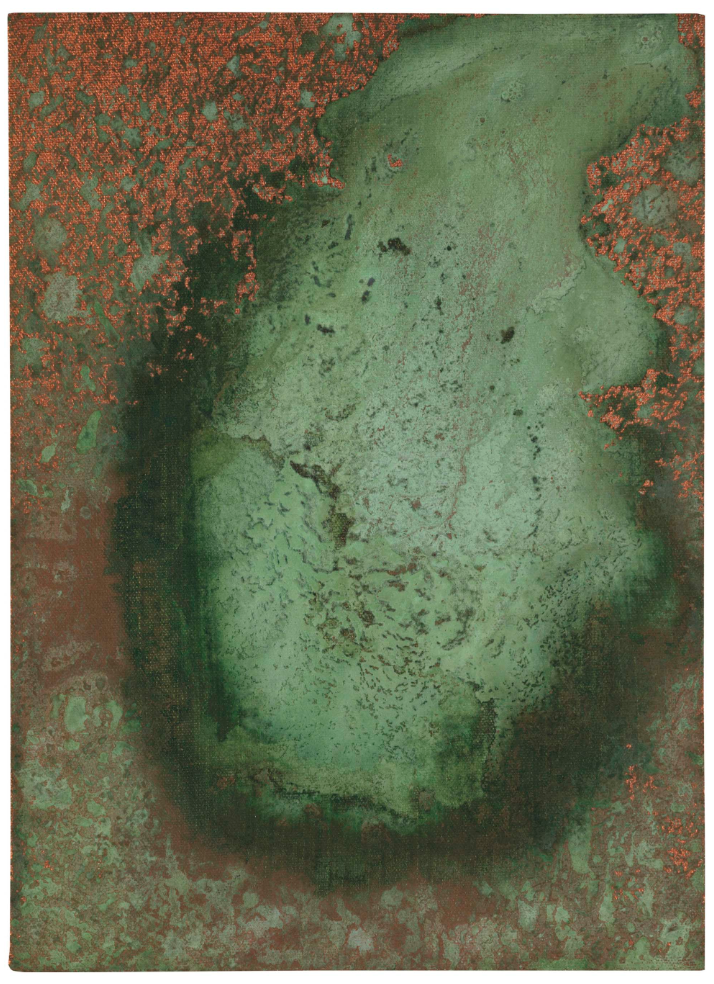
ANDY WARHOL (1928-1987)
Oxidation Painting, 1978
Copper metallic pigment and urine on canvas
13 3/4 x 10 inches (34.9 x 25.4 cm)
Stamped with the Estate of Andy Warhol and the Andy Warhol Foundation for the Visual Arts, Inc. stamps
Numbered ‘PA45.103’ (on the reverse)