With his Reversal Series, Andy Warhol revisited various subject matters from earlier in his career, such as Marilyn Monroe, Chairman Mao, and the Mona Lisa. He flipped the tonal values, layering lighter shades on darker grounds so that his subjects appeared like photographic negatives.
Introduction
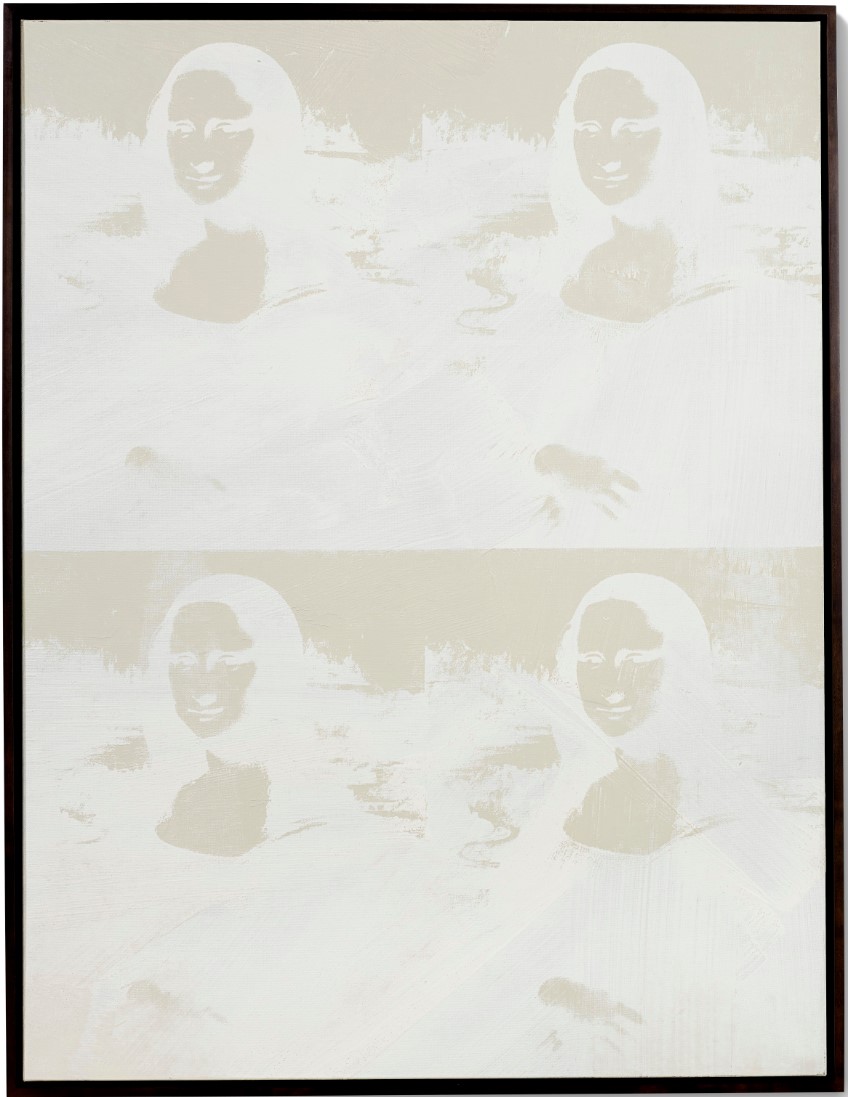
By 1980, Warhol’s silkscreen technique had developed in a series of more gestural paintings that were distinguished by a more casual sketchiness, and he had begun to increasingly use a white-on-white palette to dematerialize his subject into an abstracted, nearly unrecognizable portrait. In this particular work, Warhol also introduces an added layer of visual intrigue as, when viewed under ultraviolet light, the painting glows with added detail, a technique he first investigated in 1966, when he included invisible inks in a series of paintings of the human body. In these four vignettes, each Mona Lisa is rendered slightly differently; her famous enigmatic smile, and the details of her hand or eyes gradually become indistinct in our memory.
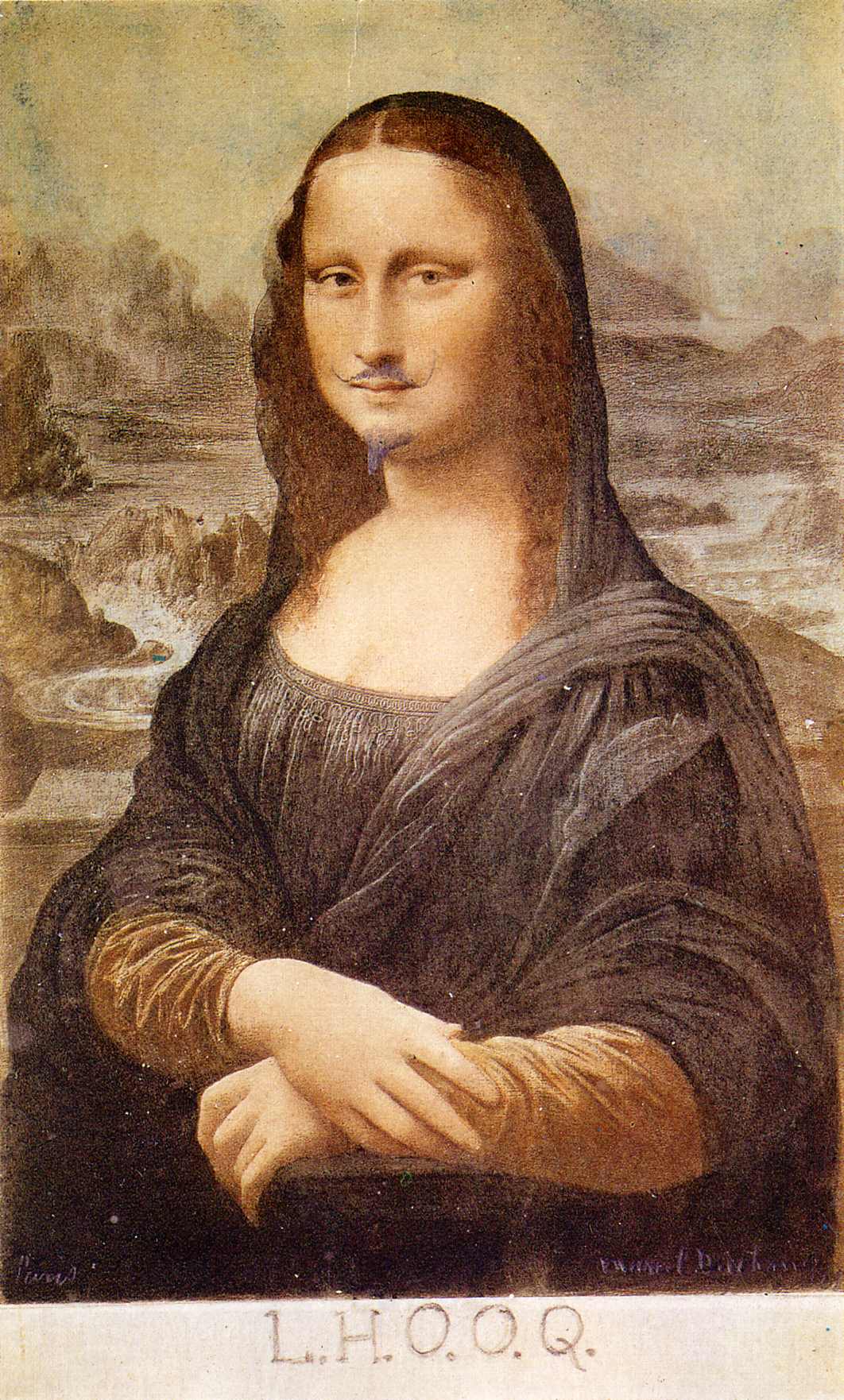
The re-iteration and repetition of iconic personalities and consumer products had long been the very cornerstone of Warhol’s practice – with the renewed conceptual vigor of the Reversals and Retrospectives, this artistic project reached its apotheosis. Roberto Marrone contended that, “Warhol’s ‘appropriating’ of his own imagery in the Reversal and Retrospective series ran parallel to the then current aesthetic of irreverent undermining of the traditional canons of art history and its hierarchical divisions between so-called ‘high’ and ‘low’ art.” (Roberto Marrone in Exh. Cat., Zurich, Galerie Bruno Bischofberger, Andy Warhol: Big Retrospective Painting, 2009, p. 32) 12 Mona Lisas carries this concept of ‘appropriation’ a step further still. Herein, Warhol’s decision to employ the Mona Lisa does not purely allude to Leonardo da Vinci’s sixteenth-century masterpiece, but also to Marcel Duchamp’s wittily acerbic L.H.O.O.Q. from 1919, in which the delicate and enigmatic face of La Gioconda is jokingly defaced by a moustache. Duchamp’s doctored version posed questions regarding conventional assumptions of gender whilst simultaneously imbuing the Mona Lisa –an unassailable and iconic beacon of chastity – with sexual provocation: Duchamp’s choice of title makes reference to a sexual pun in French. With 12 Mona Lisas and its greater series as a whole, Warhol thus explicitly exposes the Duchampian nature of his project: not only does he identify Leonardo’s painting as a readymade to be appropriated and manipulated for a new artistic dialogue, he also identifies his own work as fair game. Taking his cue from a long tradition of artists who have adapted, varied and transformed the art of their predecessors, Warhol, in an act of post-modernist brilliance, expropriated material from his own infamous repertoire of images, transforming his classic Pop iconography with surprising painterly techniques and compositional reconfigurations.
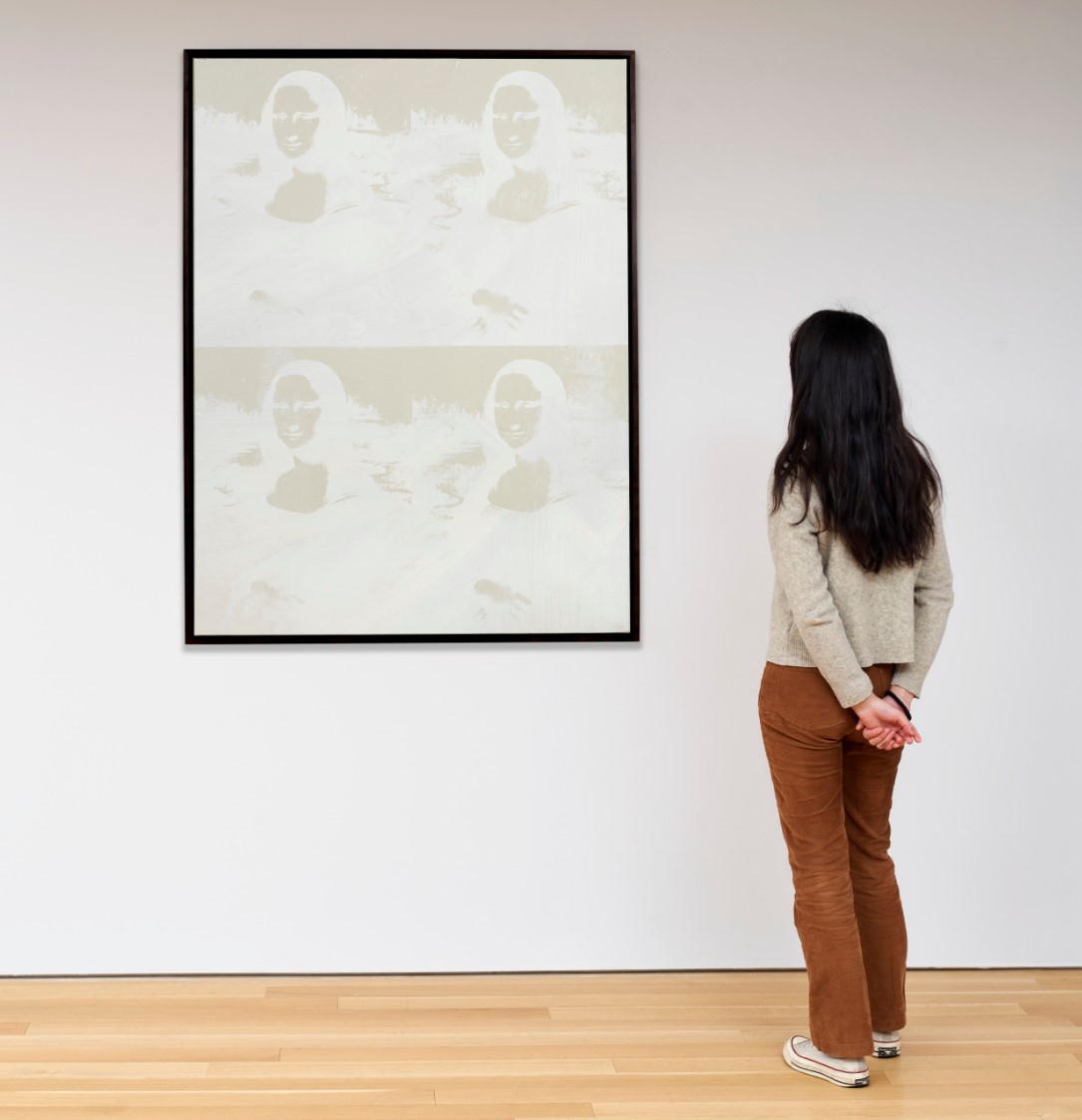
Painted in 1980, with this work Warhol returned his attention to the most famous painting in the world. He first painted Leonardo da Vinci’s masterpiece in 1963, when the painting made a rare visit to the United States of America. It was during its exhibition at the National Gallery of Art in Washington and the Metropolitan Museum of Art in New York, that Warhol became fascinated by the continued power of this centuries old painting. Over 1.6 million people, many of them queuing for hours, saw the painting during its seven week sojourn, accompanied by countless column inches of press coverage and endless hours of TV broadcasts. In this respect the sitter in da Vinci’s enigmatic portrait, Lisa Gherardini—the wife of a prominent Florentine cloth merchant, was like any of Warhol’s other celebrity superstars, namely, Elizabeth Taylor, Elvis Presley or Marlon Brando. In Four White on White Mona Lisas, the artist transforms the familiar portrait into ghostly apparitions that dissolve into the background, and the familiar Mona Lisa of the sixteenth century becomes seductively blurred in our minds.
Warhol was not the first artist to appropriate Leonardo da Vinci’s masterpiece in a more contemporary manner. In 1919, Marcel Duchamp famously adorned a postcard sized reproduction of her famous visage with a mustache and goatee. While Duchamp was attempting to subvert the pretenses of museum and high-art culture, Warhol takes Leonardo’s subject as a readymade icon, the ultimate celebrity of art history, or a brand as famous as Campbell’s Soup and the Brillo Box. In 1963, the painting was particularly well-suited for Warhol since, to celebrate the Mona Lisa‘s arrival in New York, museum vendors and tourist shops sold endless reproductions on coffee cups and tote bags. In fact, the artist’s source image in the 1960s was taken from a Metropolitan Museum’s exhibition brochure.
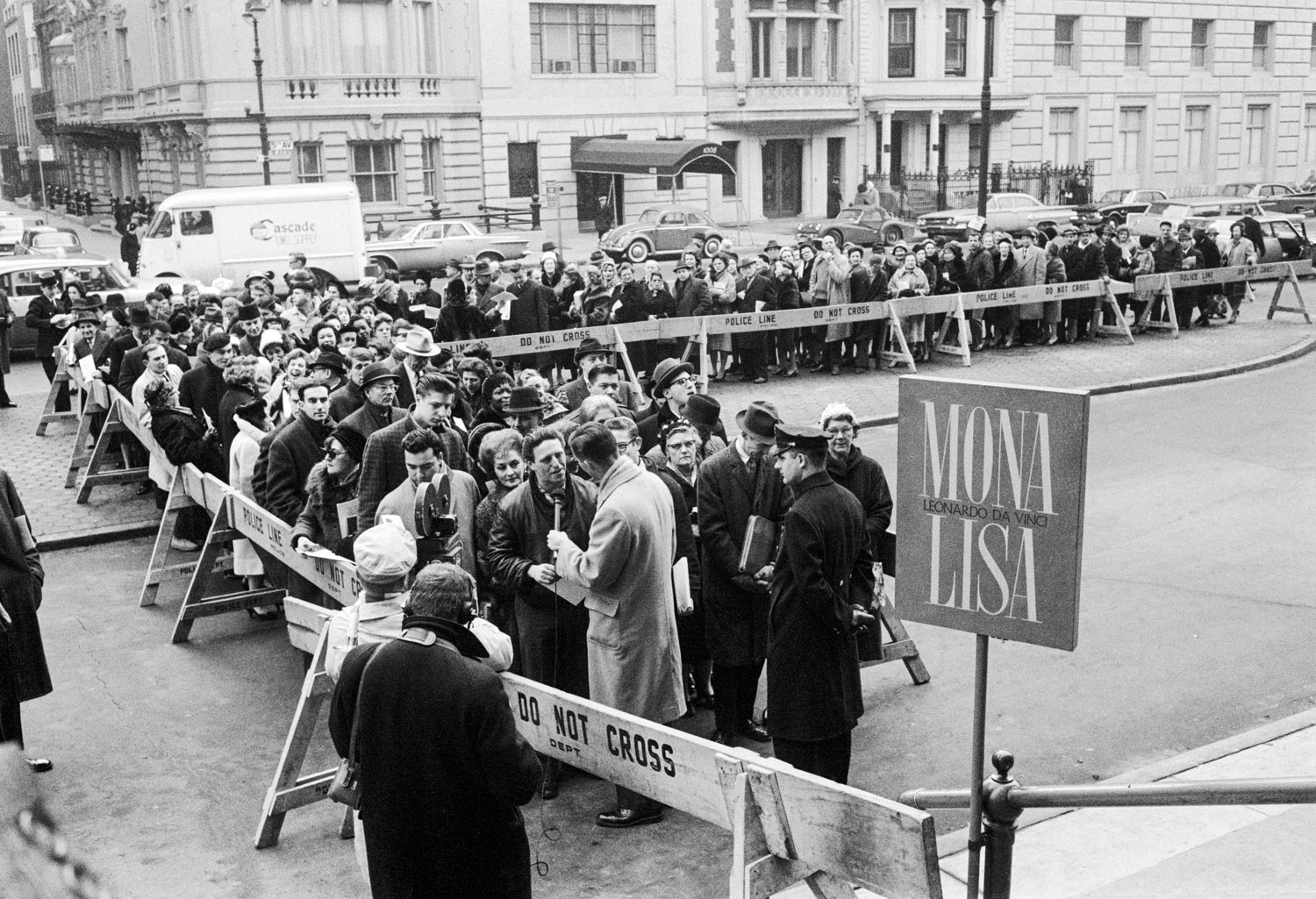
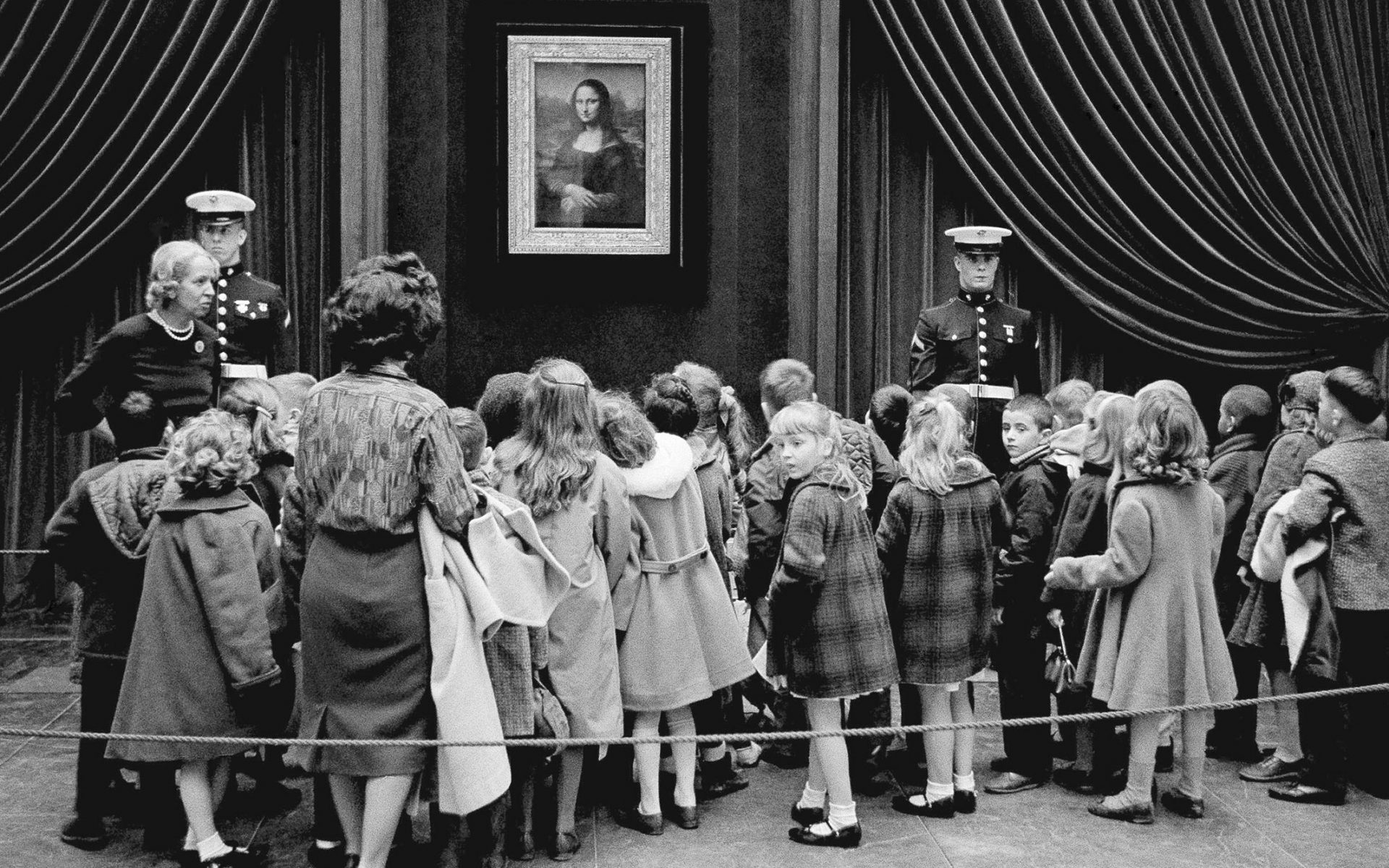
Eighteen years earlier in 1962, Warhol encountered the original Mona Lisa firsthand when the painting travelled to New York for exhibition. Universally considered the most famous (and thereby expensive) work of art in existence, the occasion of the Mona Lisa’s first official tour outside of Europe roused unprecedented attention from the press. Her arrival in America was a major media event, and the exhibition tour to Washington’s National Gallery of Art and New York’s Metropolitan Museum of Art was covered by wave upon wave of photographers, both amateur and professional, each hoping to capture the enigmatic essence of her fame. The press devoted vast column inches in attempting to analyze her beauty and celebrity as the world’s most famous work of art. Her arrival to the United States was unveiled by President John F. Kennedy and his wife, Jackie, as a way of reinforcing Franco-American relations and, indeed, many of the photographers juxtaposed the radiant smile of Jackie with the ‘enigmatic’ one of Mona Lisa. She was a media star in the truest sense of the word and by the end of her trip over 1.6 million people had seen her. Amongst them was a young Warhol, on the cusp of wider creative recognition and embarking on a career which would see him become one of the most famous and celebrated artists of the Twentieth Century.
Warhol was immediately captivated by the Mona Lisa and incorporated the legendary image within his own oeuvre for the first time shortly after its iconic exhibition in 1962. The small corpus of seven preliminary paintings executed between January and February of 1963 denotes Warhol’s first serialization of an art historical work; moreover, the Mona Lisa was to remain the only painting appropriated in this way until the 1980s. Though unimpeachable as a landmark of art history, it was her status as a celebrity and priceless commodity that undoubtedly caught Warhol’s artistic attention. Possessing an unrivalled degree of iconicity and instantly recognizable stardom, the Mona Lisa seems tailor-made for Warholian veneration. Allegedly the portrait of a little-known Florentine lady, ‘Monna’ Lisa Gherardini, painted by Leonardo circa 1503, today Leonardo’s image represents an archetype ingrained within the mass consciousness. Possessing a unique ‘brand identity’ the Mona Lisa enjoyed fame to match the movie stars and celebrities revered by Warhol and a symbolic status to equal the ubiquity of consumer products. The painting’s fragile and precious nature has ensured that it has rarely travelled: her fame being spread almost solely through mechanically reproduced facsimiles. As the most photographed and reproduced work of art in the world, the fascination with the Mona Lisa ‘brand’ extends its legend through replicas and souvenirs as well as books and postcards. She has attained an eternal and immortal status somewhat removed from the humble beginnings of the original painting. Warhol’s decision to utilize the image within his own celebrated corpus further perpetuates the myth and legend of the Mona Lisa.
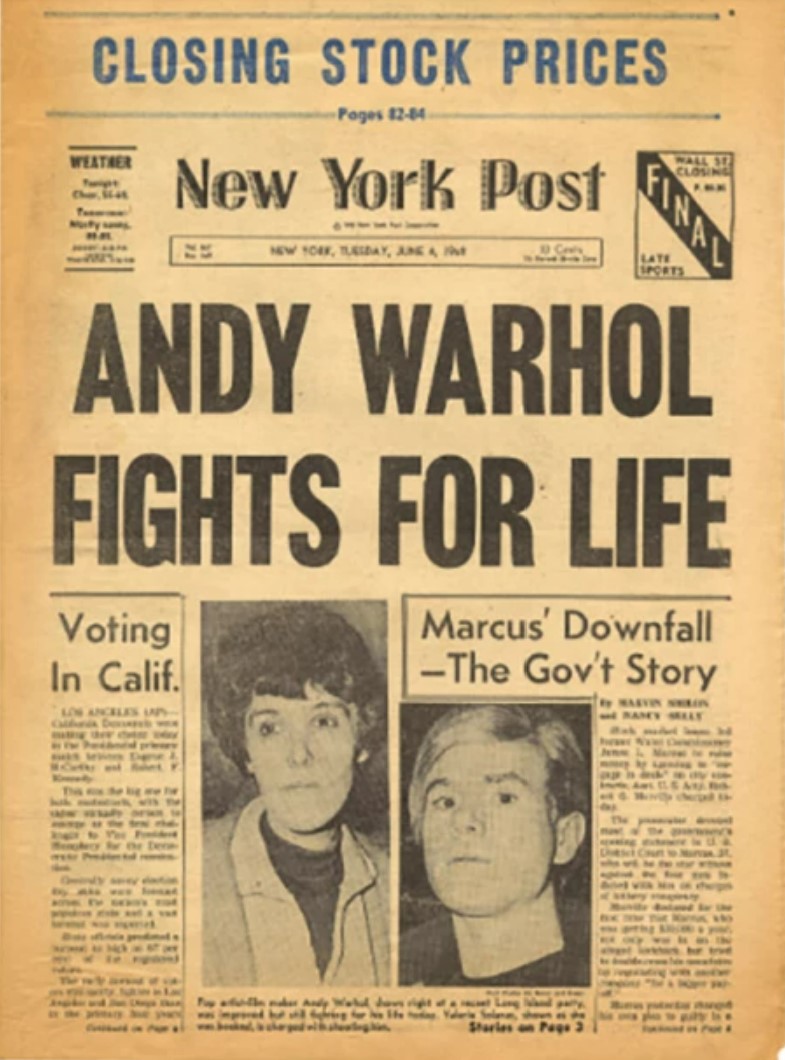
In this 1980 work, Warhol draws on the rebellious spirit of the 1950s and early 1960s, when Jasper Johns’ Flags and Targets forced the viewer to look again at familiar images with a different kind of perception. But Warhol’s increasing preoccupation with mortality—which followed his near-death experience when Valerie Solanas attempted to assassinate him in 1968—is amplified in his works of the late 1970s and early 1980s. During this period, Warhol’s work becomes increasingly personal, still mediating on themes of death and violence, but more often, in terms of his own limited lifespan. His apt plundering of past motifs finds special resonance in Four White on White Mona Lisas, as she represents an image that has endured for over five hundred years. Warhol’s eerie white coloring recalls the Renaissance tradition of casting death masks that preserve the likeness of the recently deceased. Similarly, in his 1980 work, he revisits his 1960s icon by using his past silkscreen, which will preserve his two-toned subject ad infinitum. As the de facto leader of Pop Art, Warhol seamlessly interweaves notions of consumerism, high art, artifice and mortality via the perpetual reproduction of imagery. His super-flat surfaces and silhouettes of ghostly white pigment point to a metaphysical nothingness beyond his glossy surface of paint.
12 Mona Lisas (Reversal Series), 1980
12 Mona Lisas (Reversal Series), 1980
Sotheby’s New-York: 13 May 2014
Estimated: USD 10,000,000 – 15,000,000
USD 11,365,000
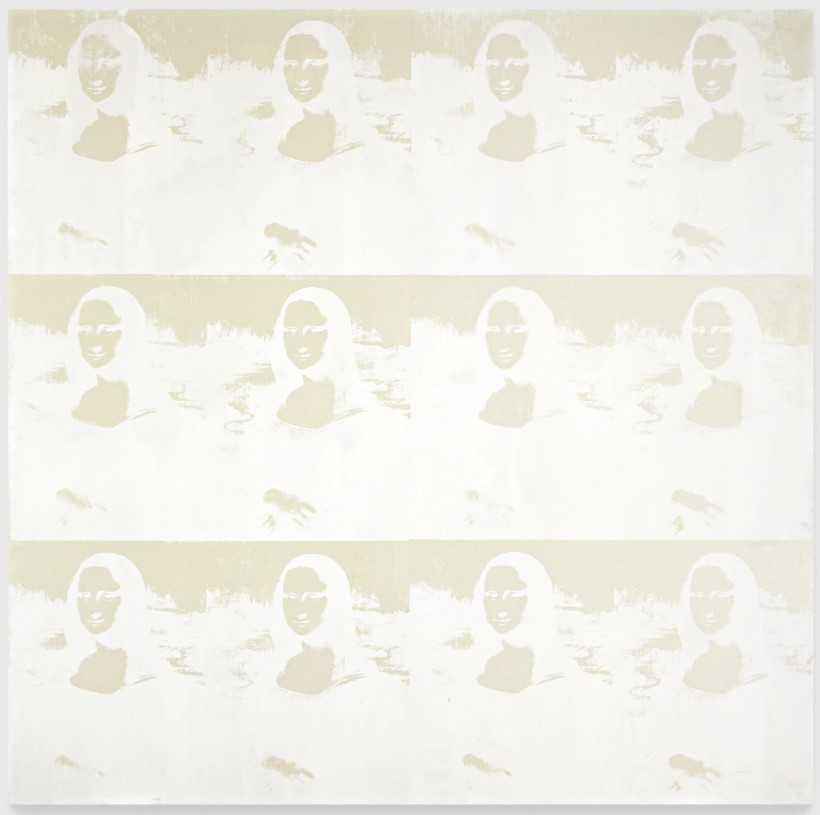
ANDY WARHOL
12 Mona Lisas (Reversal Series), 1980
Acrylic and silkscreen ink on canvas
80×80 inches (203.2 x 203.2 cm)
Articulated in screens of ethereal pearlescent white on a rich ivory ground, the imposing 12 Mona Lisas (Reversal Series) from 1980 is paradigmatic of Andy Warhol’s revered late series in which he revisited and reprised the subjects that propelled him to prominence in the early 1960s. Shown in some of the most important exhibitions of Warhol’s work to date such as the 1989 retrospective at MoMA, and SuperWarhol at the Grimaldi Forum in Monaco, the present work was also prestigiously chosen to represent Andy Warhol during the artist’s lifetime at the 1984 Venice Biennale. Inhabiting a position of utmost importance for Warhol’s late career, 12 Mona Lisas is a work of undeniable beauty and delicate poignancy.
Four Mona Lisas, 1978
Four Mona Lisas, 1978
Christie’s London: 5 March 2026
Estimated: GBP 3,500,000 – 5,500,000
GBP 4,320,000 / USD 5,771,090
ANDY WARHOL (1928-1987), Four Mona Lisas | Christie’s
REPEAT SALE
Christie’s New-York: 12 November 2014
Estimated: USD 2,500,000 – 3,500,000
USD 5,989,000
Andy Warhol (1928-1987), Mona Lisa | Christie’s
REPEAT SALE
Christie’s New-York: 10 November 2010
Estimated: USD 1,800,000 – 2,200,000
USD 3,610,500
Andy Warhol (1928-1987) , Mona Lisa | Christie’s
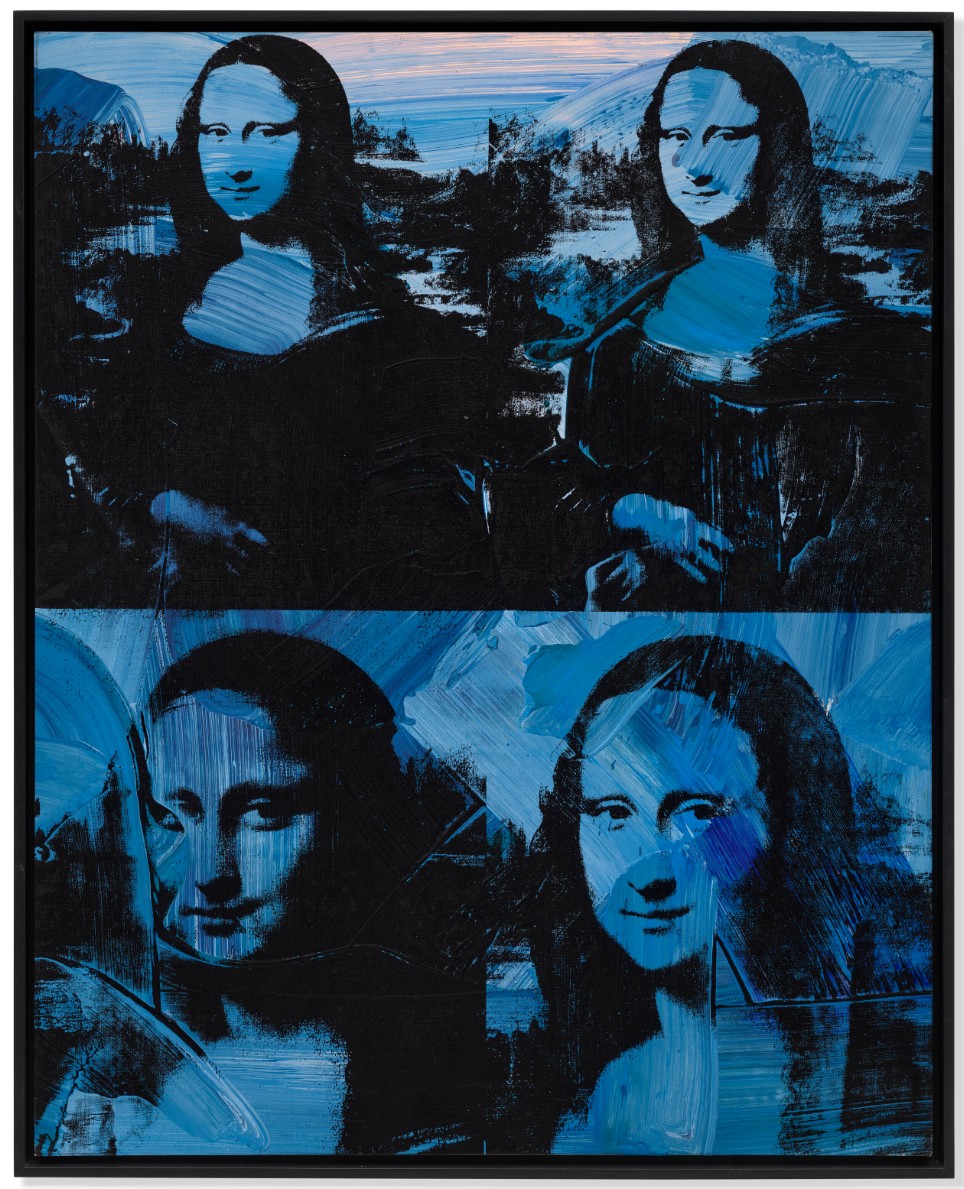
ANDY WARHOL (1928-1987)
Four Mona Lisas, 1978
Acrylic and silkscreen ink on canvas
49-7/8 x 39-7/8 inches (126.7 x 101.3 cm)
Signed and dated ‘Andy Warhol 78’ (on the overlap)
Provenance
Carlo Bilotti, Palm Beach (acquired directly from the artist in 1978)
Anon. sale, Christie’s New York, 13 May 1999, lot 515
Pam and Bob Goergen, Greenwich
Anon. sale, Christie’s New York, 10 November 2010, lot 60
Private Collection, New Jersey
Anon. sale, Christie’s New York, 12 November 2014, lot 77
Acquired at the above sale by the present owner
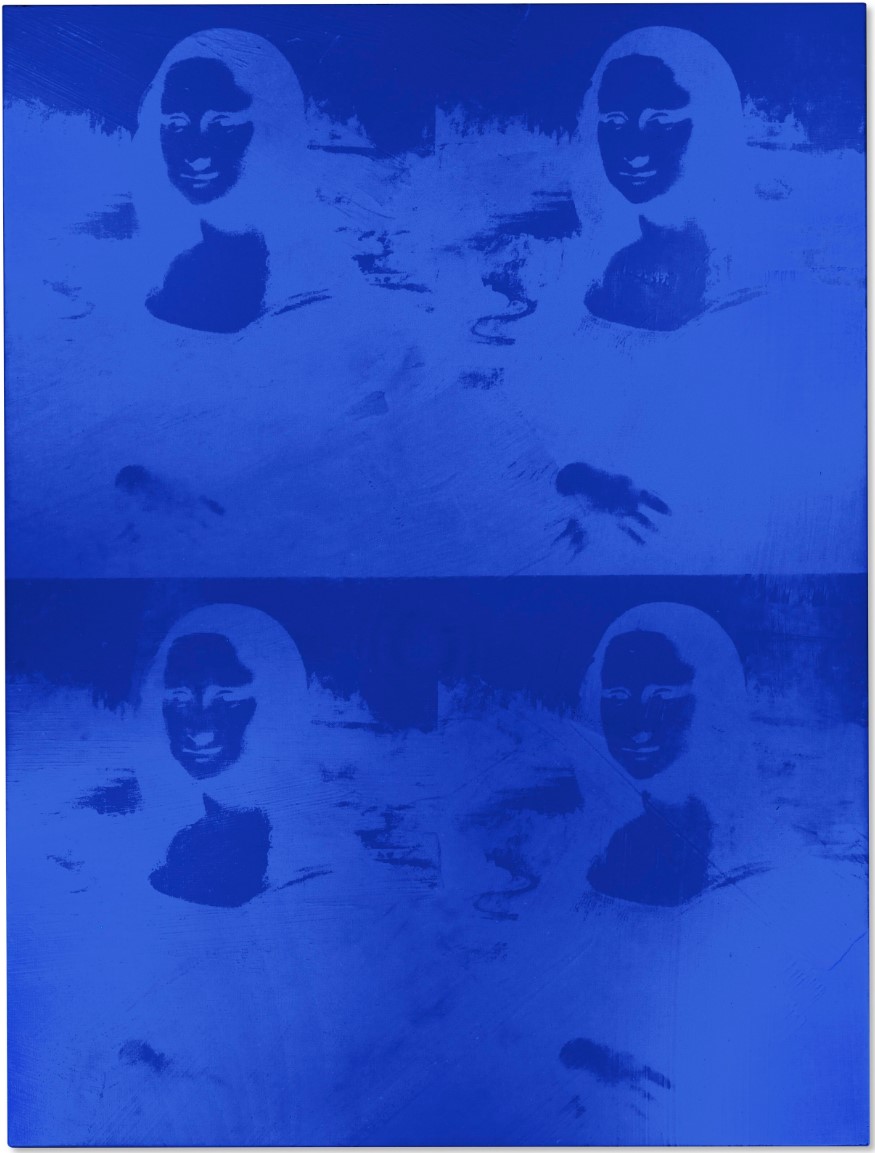
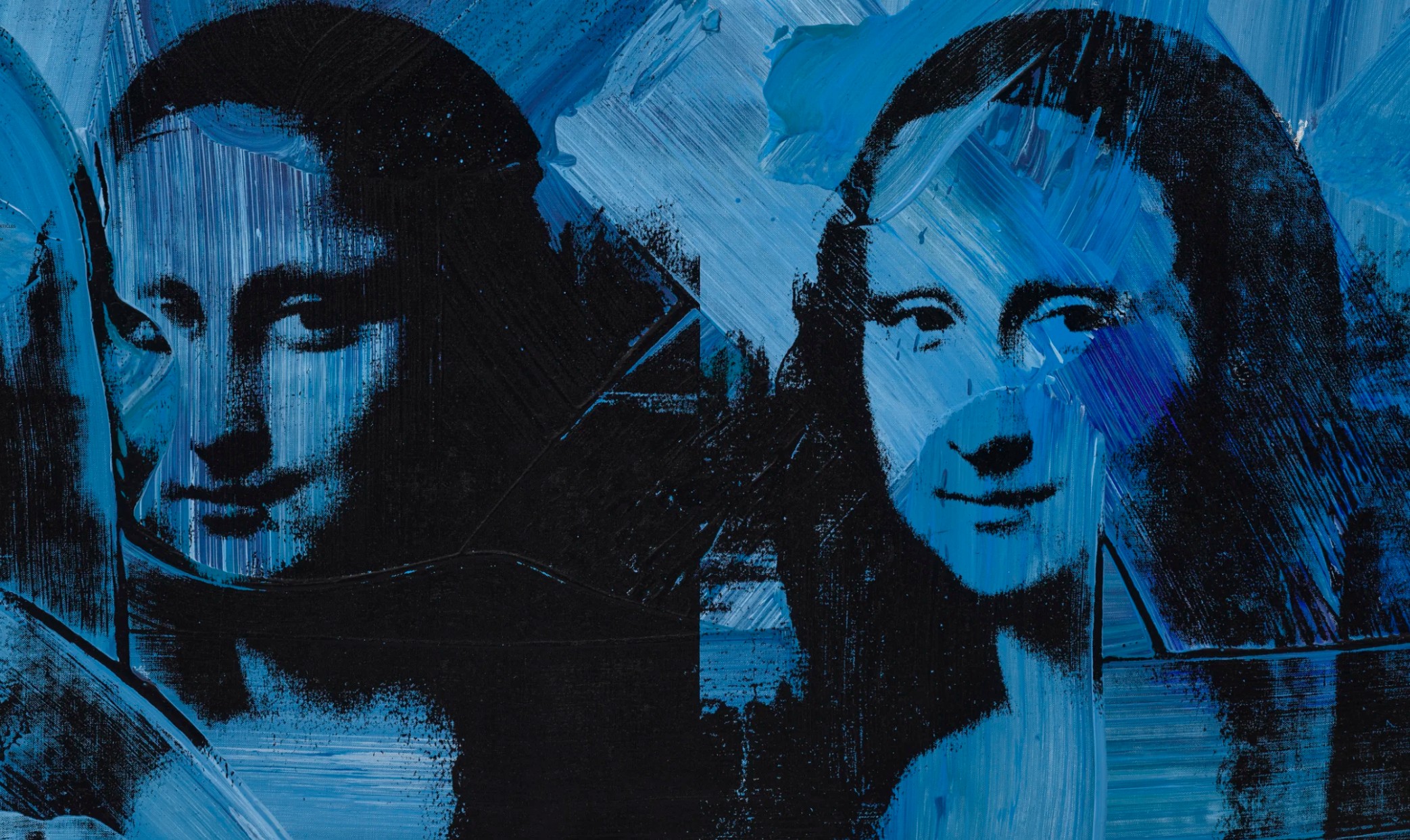
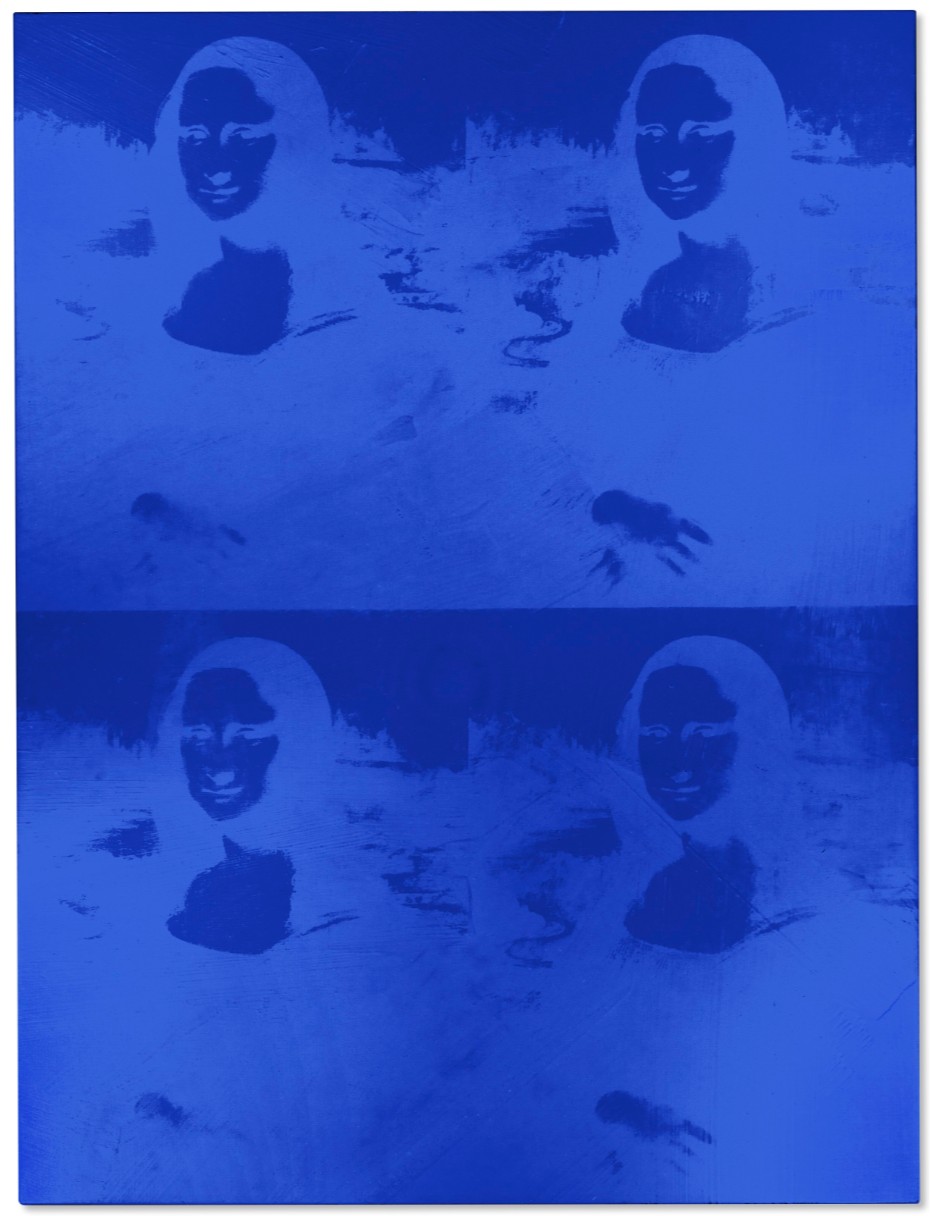
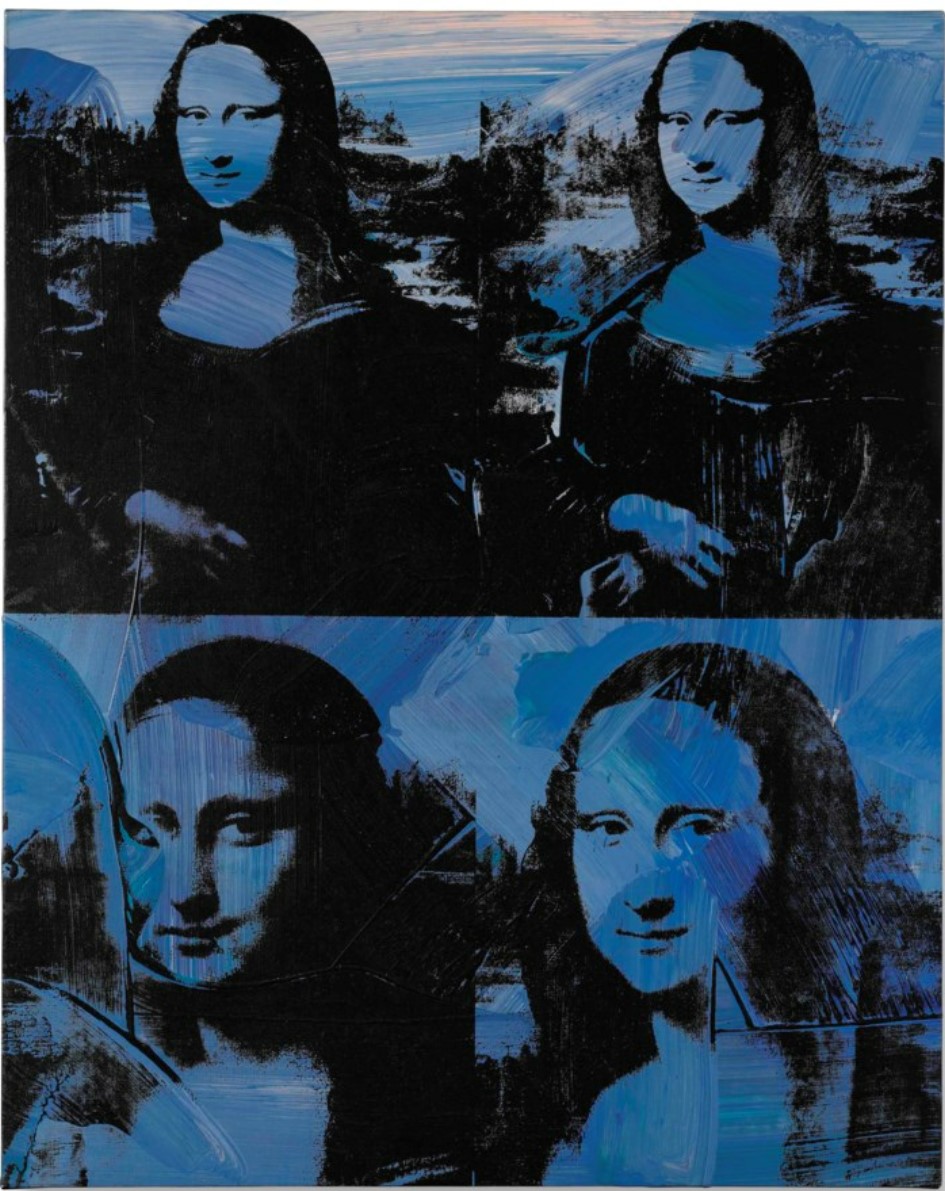
In Andy Warhol’s Four Mona Lisas (1978), the most famous face in art appears four times against a vibrant and painterly blue backdrop. Silkscreened twice in full and twice cropped close to the face, her expression shifts with the shadows of each iteration, alive with timeless mystery. The work is one of six versions of this composition Warhol made in 1978, three of which are in major museum collections. Revisiting a series he had made on the occasion of the Mona Lisa’s visit to the United States in 1963, it offers a dazzling reflection on fame, genius and the eternal life of images. The Renaissance masterpiece becomes a Pop icon, restaged by an artist who was by now an icon himself. The present work was previously owned by the collector and cosmetics magnate Carlo Bilotti, a close friend and patron of Warhol and other artists including Giorgio de Chirico, Roy Lichenstein, Salvador Dalí and Niki de Saint Phalle. In 1998-2000, it toured venues across Europe as part of the large-scale retrospective Andy Warhol: A Factory.
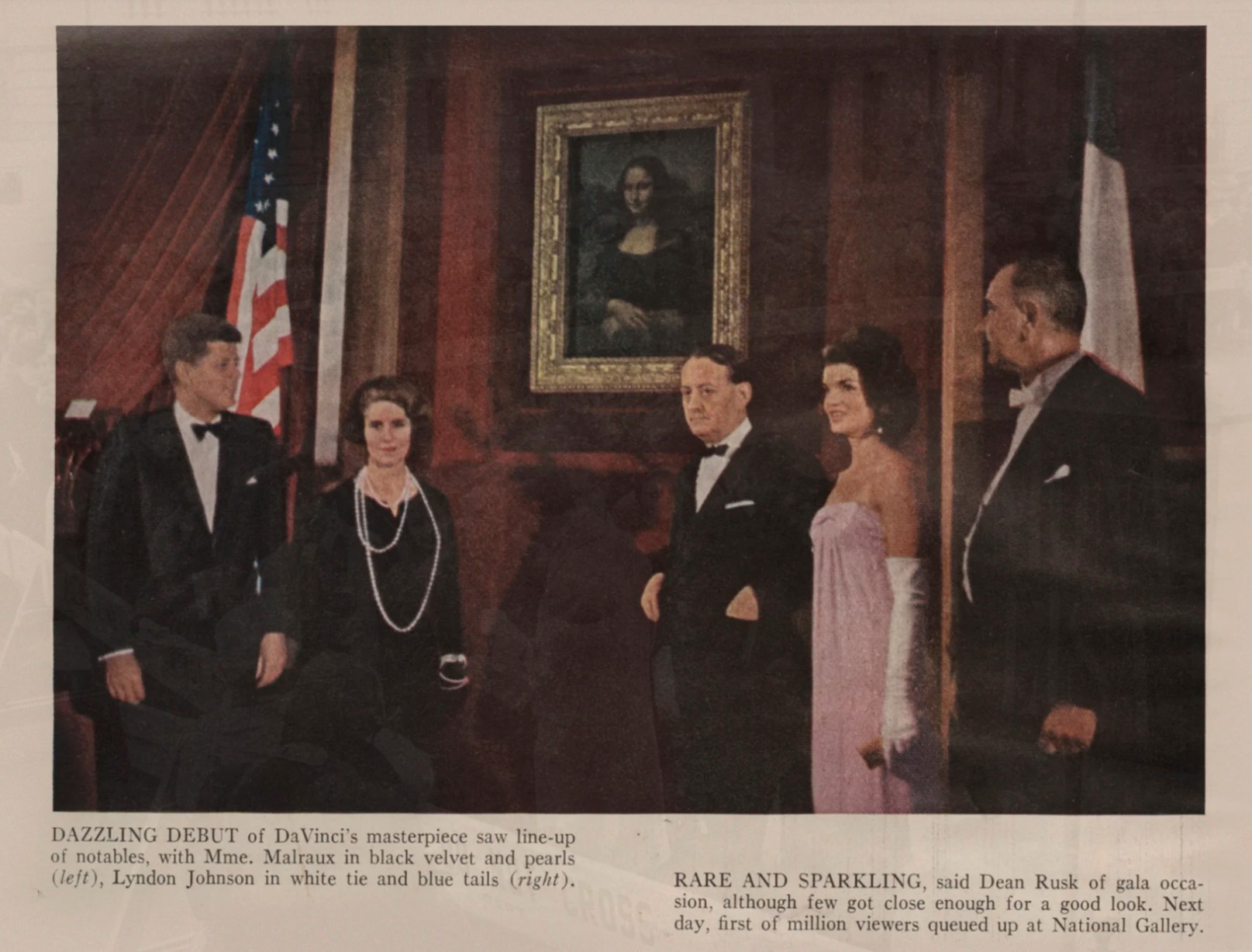
President John F. Kennedy, Madeleine Malraux, André Malraux, First Lady Jacqueline Kennedy and Vice President Lyndon Johnson attend the unveiling of the Mona Lisa at the National Gallery, Washington, D.C., 1963. Photograph by Walter Bennett. Time Magazine, January 18, 1963, Vol LXXXI, No. 3.
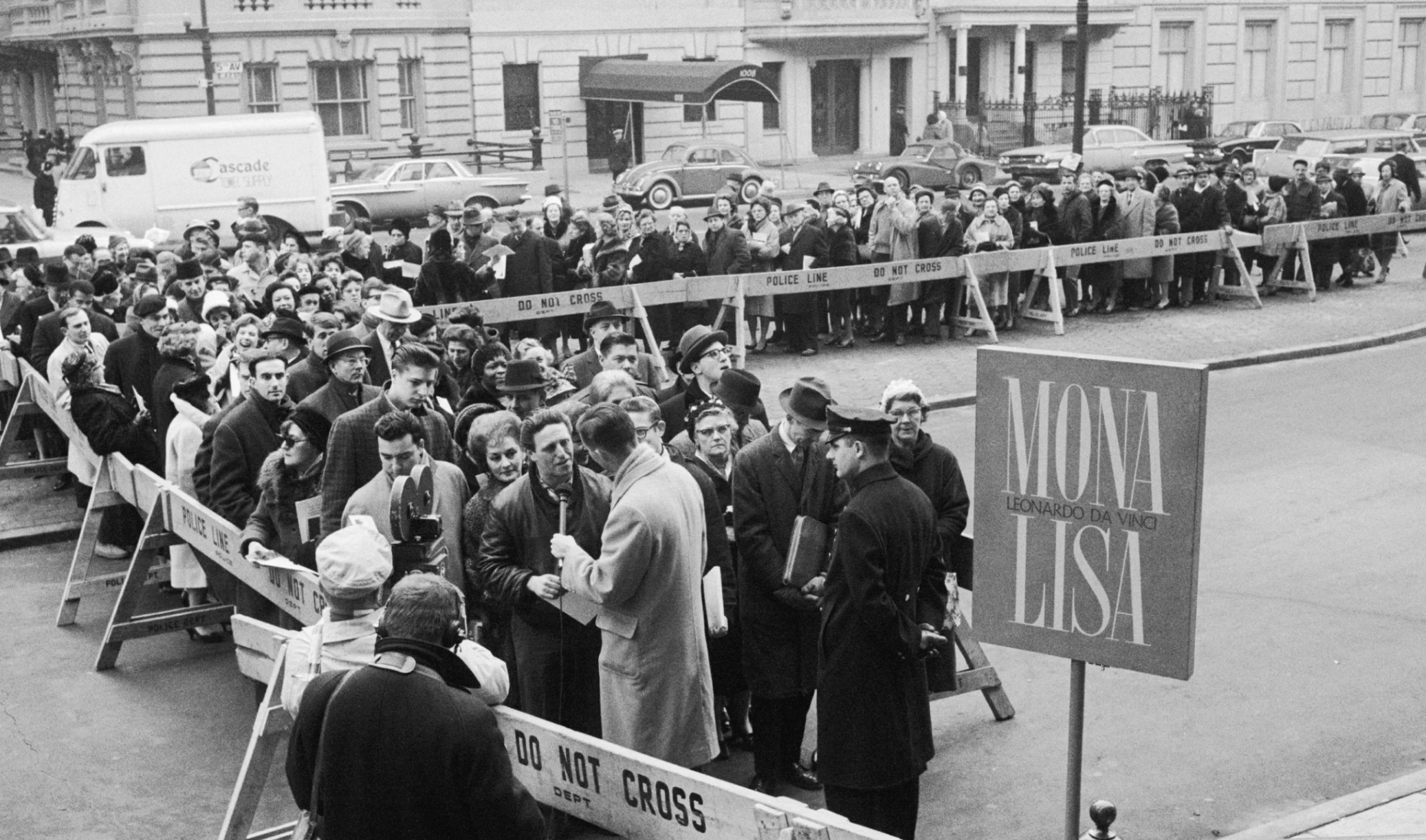
Visitors in line to see the Mona Lisa at The Metropolitan Museum of Art, New York, February 1963.
Photo: Bettmann / Contributor / Getty Images.
The Mona Lisa met the American public early in 1963, having travelled three and a half thousand miles from her home in the Musée du Louvre. The request had been made by First Lady Jacqueline Kennedy through the French Minister of Culture André Malraux, and granted as an opportunity to emphasize the bond between the two nations. Nearly two thousand people waited in the cold to witness the unveiling at the National Gallery in Washington, D.C. Photographers paralleled Jacqueline’s enigmatic smile with the Mona Lisa’s own. The painting moved on a month later to The Metropolitan Museum of Art, New York, where it received over one million visitors, causing hours-long queues up Fifth Avenue. Among the admirers was Warhol, who soon began a series of silkscreen paintings based on images in the Met’s exhibition brochure. By that time the Mona Lisa had caused a media storm, appearing on magazine covers and in newspapers across the country: she was, Warhol recognized, a bona fide American celebrity.
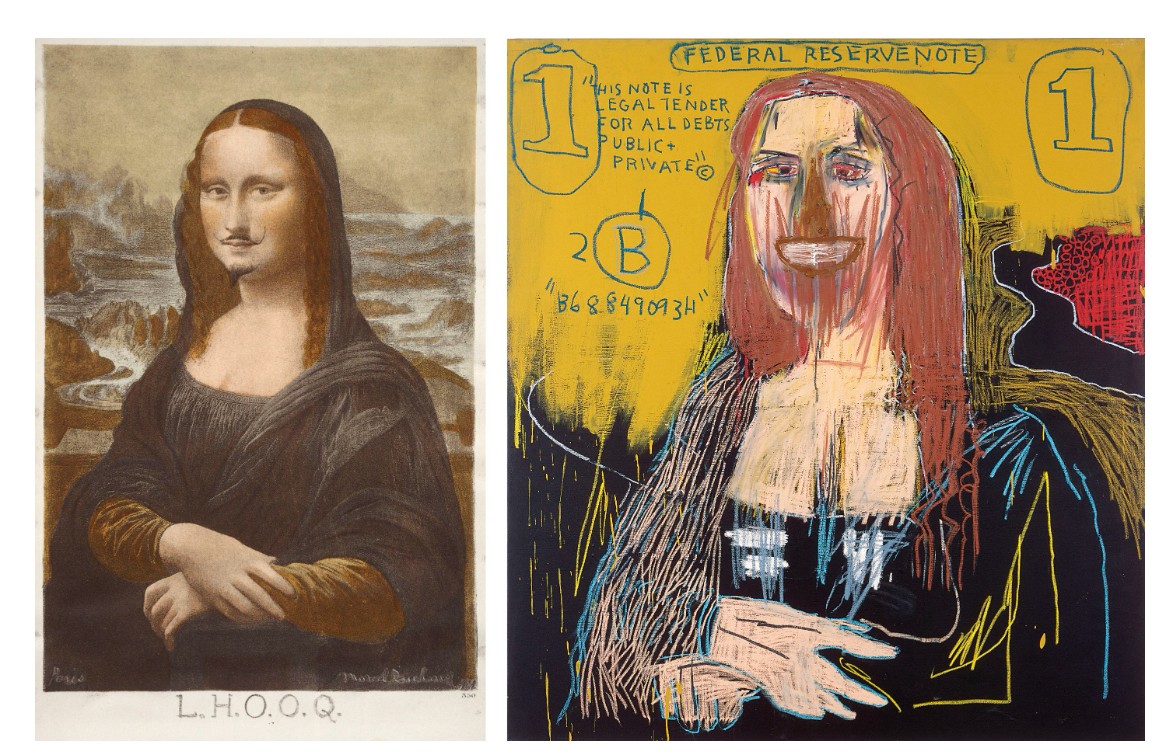
Left: Marcel Duchamp, L.H.O.O.Q. (from Boîte-en-Valise), 1919. Philadelphia Museum of Art, Pennsylvania. Artwork: © 2026 Marcel Duchamp/DACS. Digital image: © 2026 The Philadelphia Museum of Art/Art Resource/Scala, Florence. Right: Jean-Michel Basquiat, Mona Lisa, 1983. © Estate of Jean-Michel Basquiat. Licensed by Artestar, New York.
Warhol was not the first modern artist to riff on the Mona Lisa. She had appeared in paintings by Fernand Léger, Kazimir Malevich and René Magritte. In his famous parody L.H.O.O.Q. (1919), Marcel Duchamp had adorned a postcard-sized copy of the painting with a moustache and goatee. Conflating high art and low commodity, Duchamp’s subversive appropriations inspired Warhol’s own approach to popular culture. As the most reproduced painting in the world, the Mona Lisa was as familiar an icon as the Campbell’s soup cans or Coca Cola bottles he had already enshrined in his paintings.
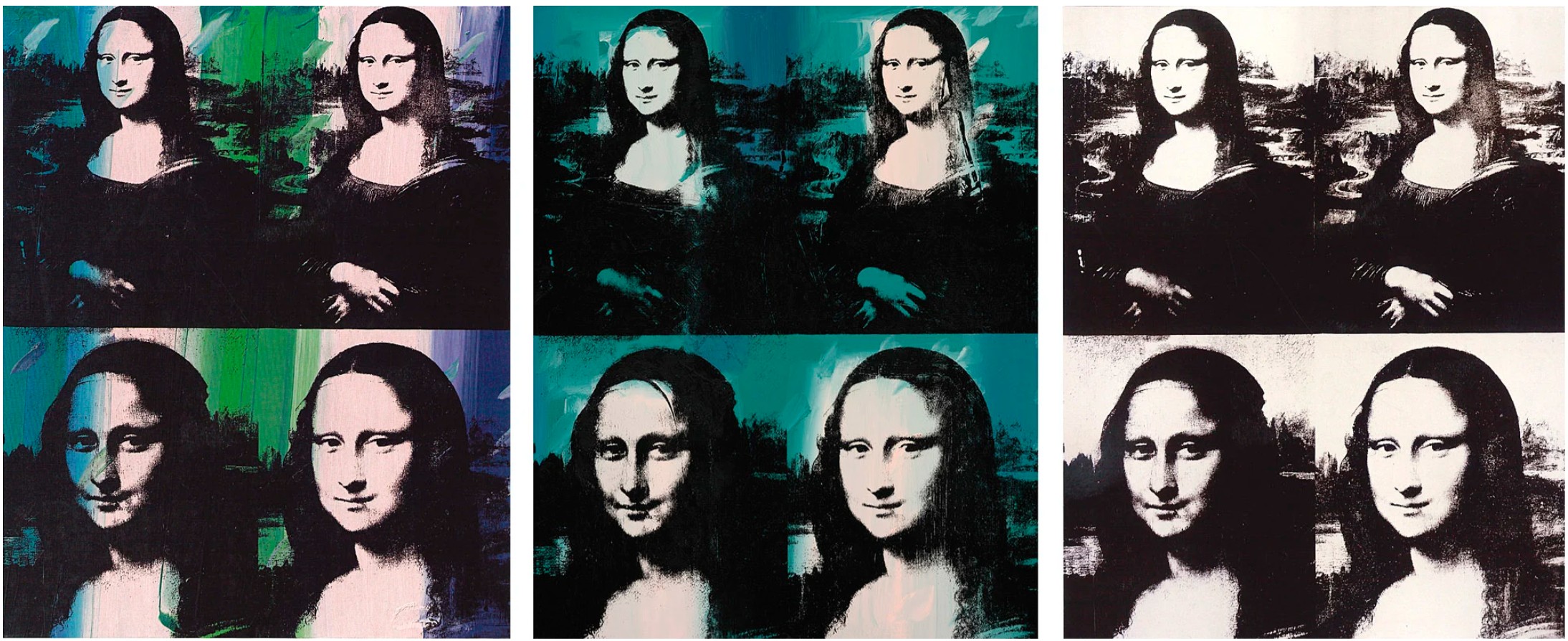
Left: Andy Warhol, Four Mona Lisas, 1978. Museum Barberini, Potsdam. Artwork: © 2026 The Andy Warhol Foundation for the Visual Arts, Inc. / Licensed by DACS, London.
Middle: Andy Warhol, Four Mona Lisas, 1978. Art Institute of Chicago. Digital image: © 2026 The Art Institute of Chicago / Art Resource, NY/ Scala, Florence. Artwork: © 2026 The Andy Warhol Foundation for the Visual Arts, Inc. / Licensed by DACS, London.
Right: Andy Warhol, Four Mona Lisas, 1978. Andy Warhol Museum, Pittsburgh. Artwork: © 2026 The Andy Warhol Foundation for the Visual Arts, Inc. / Licensed by DACS, London.
Warhol understood this as a form of power. Irrespective of the ‘aura’ of the original painting, it was through mass replication that her myth had endured through the twentieth century. Having weathered wartime concealments, a highly publicized theft in 1911 and several attacks of vandalism, she also carried the combination of stardom, beauty and tragedy that drew Warhol to depict the silver-screen sirens Marilyn Monroe and Elizabeth Taylor.
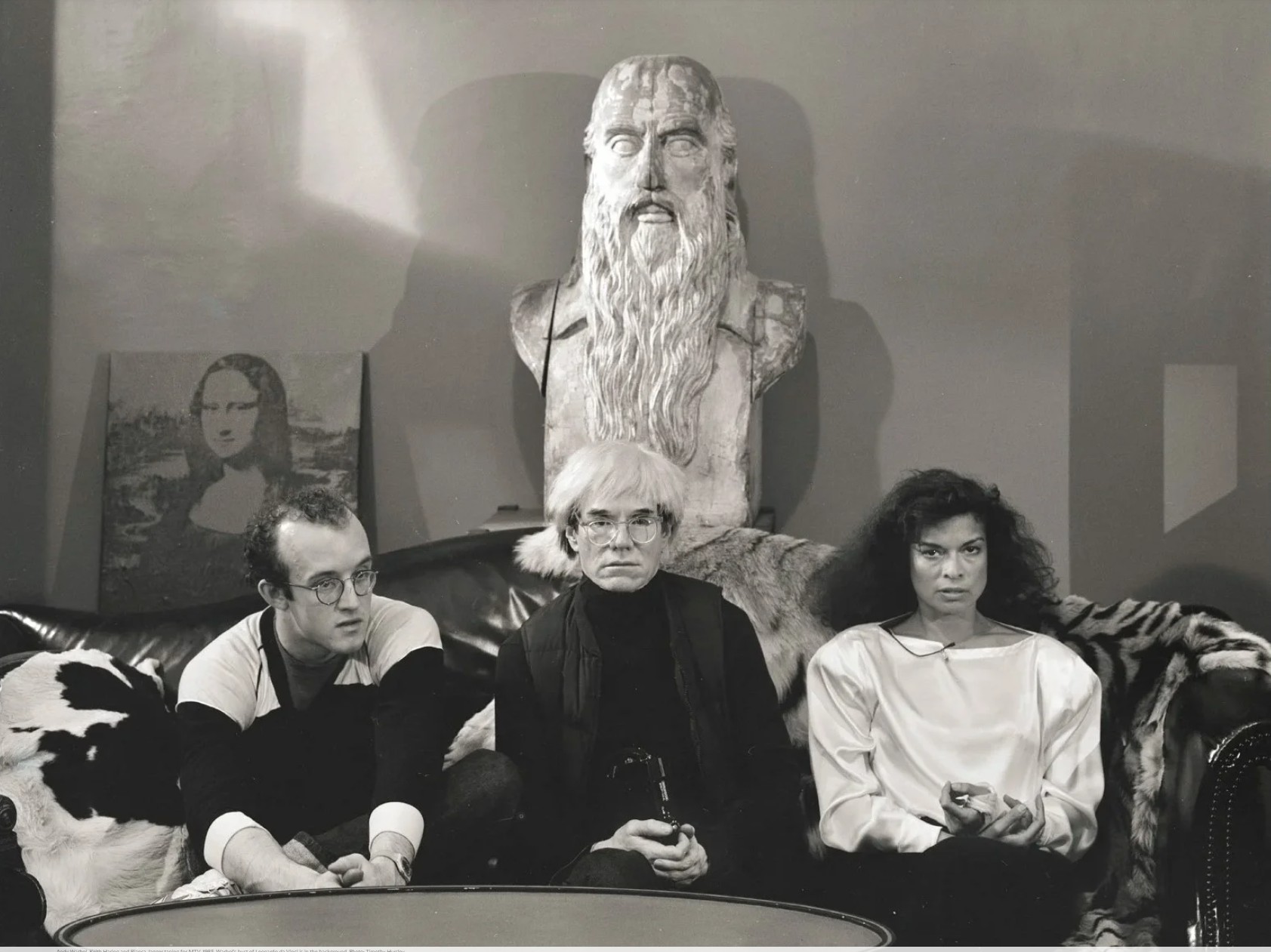
Andy Warhol, Keith Haring and Bianca Jagger taping for MTV, 1985. Warhol’s bust of Leonardo da Vinci is in the background.
Photo: Timothy Hursley.
While he would later turn to other Old Masters in his 1984 Details of Renaissance Paintings series, Warhol was especially fascinated by Leonardo da Vinci. Not only the author of some of art history’s most iconic and spellbinding images, Leonardo was a polymath and brilliant courtier who encompassed the spirit of his era, moving among the elite of Renaissance society. King Francis I was said to have been at his bedside when he died. Warhol aspired to similar status in his own time. He owned a large eighteenth-century wooden bust of Leonardo which is visible in numerous images of the Factory from the 1970s onwards, presiding over studio portraits of Warhol with friends including Jean-Michel Basquiat, Keith Haring and Bianca Jagger. Before Warhol’s death in 1987, Leonardo would serve again as the muse for his final series: an ambitious two-year project centered around The Last Supper, spanning more than a hundred paintings, silkscreens, prints and works on paper.
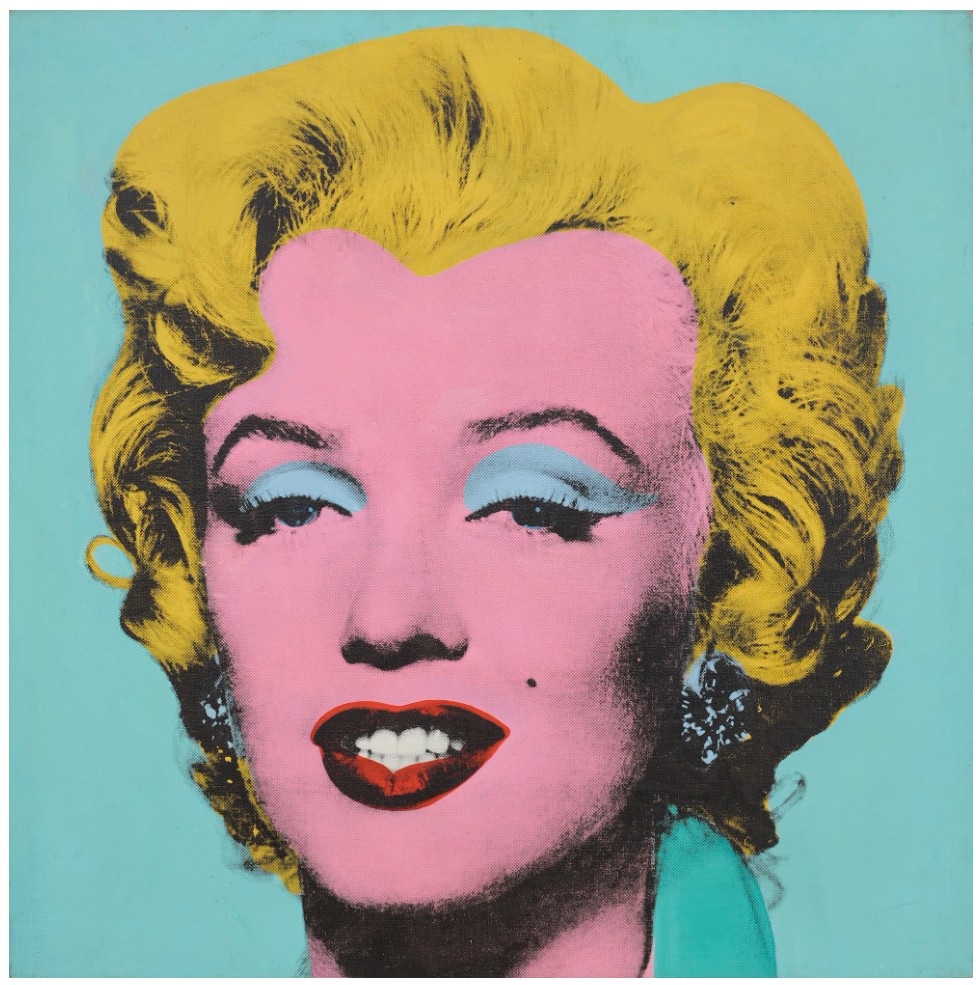
Andy Warhol, Shot Sage Blue Marilyn, 1964. Private collection.
Artwork: © 2026 The Andy Warhol Foundation for the Visual Arts, Inc. / Licensed by DACS, London.
Warhol based his 1963 Mona Lisa silkscreens on the three different images of the painting in the Met pamphlet, showing the full portrait, a cropped headshot and a detail of her hands. In the playfully-titled Thirty Are Better Than One (Brant Foundation, Greenwich), he foregrounded the magic of repetition with a 5 x 6 grid of images. He gave another work, Four Mona Lisas, to his friend Henry Geldzahler, the Met’s Curator of Contemporary Art, who later donated it to the museum’s collection.
It was this composition that Warhol turned to when he made the present painting in 1978. By that time he himself had entered the pantheon of art history, and he was regarding his body of work in a retrospective mood. The early Mona Lisa works had taken on new shades of meaning. A year after the painting’s American tour, Warhol had gone on to depict Jacqueline Kennedy in the aftermath of her husband John F. Kennedy’s assassination. The moment changed the country forever, and Jackie, who had played so pivotal a role in the Mona Lisa’s story, joined Warhol’s cast of tragic heroines.
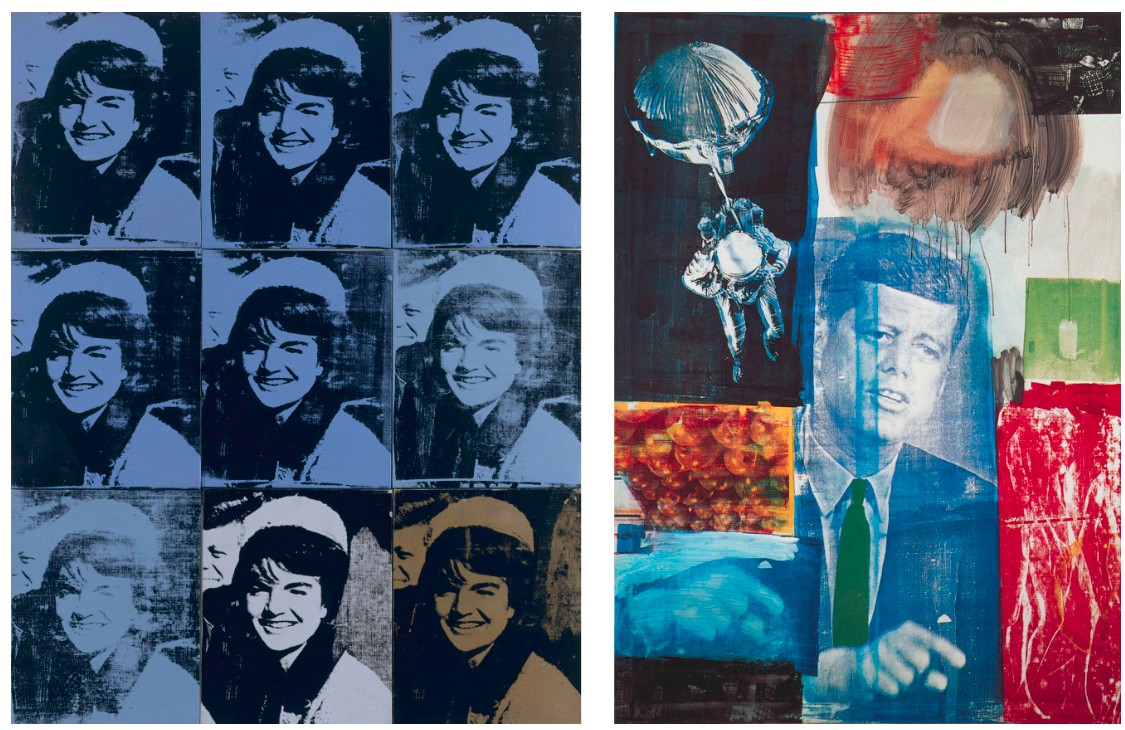
Left: Andy Warhol, Nine Jackies, 1964. The Metropolitan Museum of Art, New York. Artwork: © 2026 The Andy Warhol Foundation for the Visual Arts, Inc. / Licensed by DACS, London. Digital image: © 2026 The Metropolitan Museum of Art/Art Resource/Scala, Florence. Right: Robert Rauschenberg, Retroactive I, 1963. Wadsworth Atheneum, Hartford. Artwork: © 2026 Robert Rauschenberg Foundation/VAGA at ARS, NY and DACS, London.
Where the 1963 paintings had been silkscreened onto bare linen or canvas, Warhol’s new series showcased the gestural, richly colored painted backdrops that he had developed in the intervening years. He applied acrylic pigments mixed with clear binder using a sponge mop, creating vivid, textural grounds that interacted dynamically with the overlaid black ink of the silkscreen. The present work, with its swathes of lapis blue and a glow of light pink towards the upper edge, is in remarkable sympathy with the palette of Leonardo’s original painting. The sweeping strokes introduce varied ridges, striations and interruptions to the four silkscreened images, amplifying the notoriously mercurial quality of the Mona Lisa’s expression.
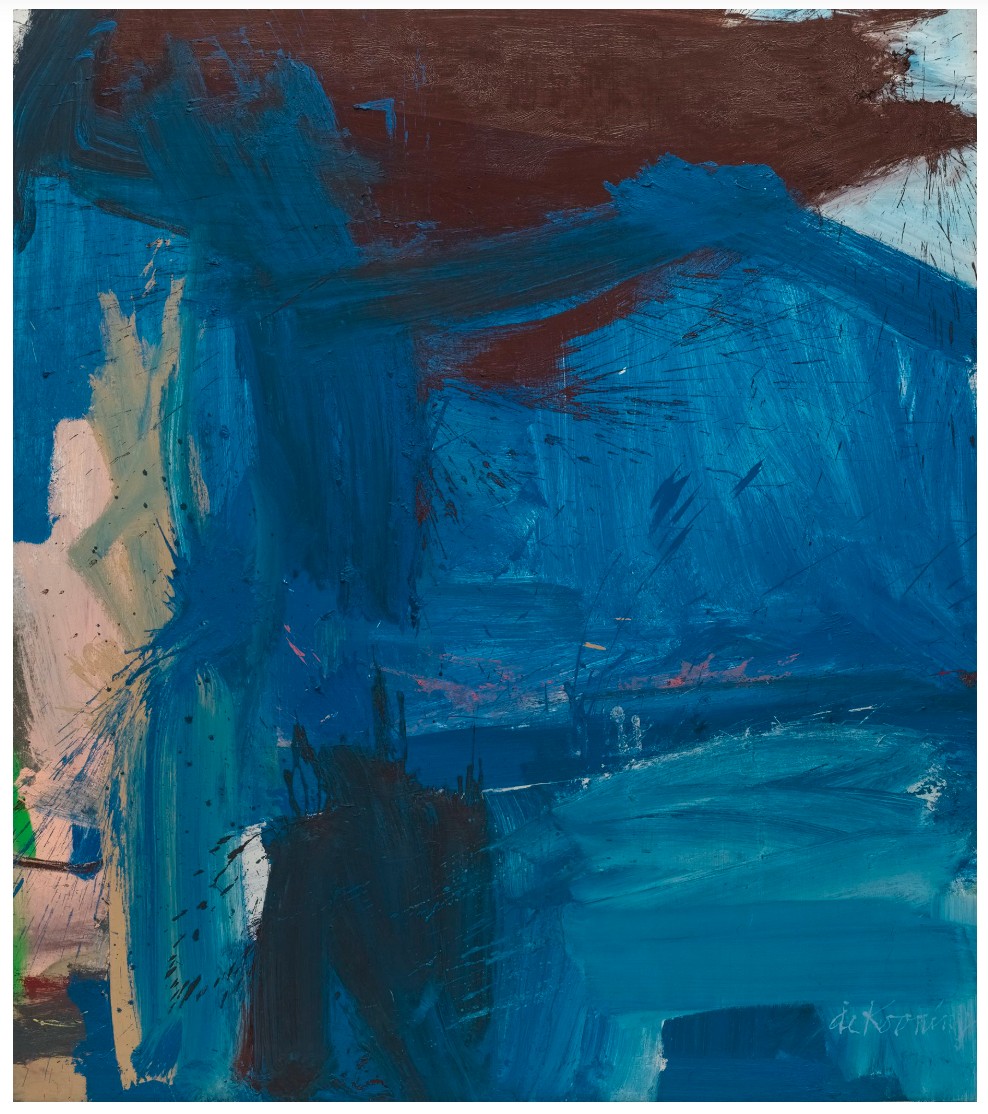
Willem de Kooning, A Tree in Naples, 1960. The Museum of Modern Art, New York. Artwork: © 2026 The Willem de Kooning Foundation / Artists Rights Society (ARS), New York and DACS, London. Digital image: © 2026 The Museum of Modern Art, New York/Scala, Florence.
The painterly chiaroscuro of these works prefigured the near-abstract Shadows series that Warhol began to make towards the end of 1978. They also set the stage for his ensuing series of Retrospectives and Reversals, which combined previous motifs in single canvases or reprised them in photographic negative over flickering, luminous painted grounds. Among the Reversals would be further pictures of the Mona Lisa, rendered ghostly in tones of white and sepia. The painting, with its irresistible trappings of legendary beauty, mass appeal and high culture, seems to have haunted Warhol’s imagination like no other. In Four Mona Lisas, she comes to life again, and again, and again.
Four White on White Mona Lisas, 1980
Four White on White Mona Lisas (Reversal Series), 1980
Christie’s New-York: 12 May 2021
Estimated: USD 3,000,000 – 5,000,000
USD 3,500,000
Andy Warhol (1928-1987), Four White on White Mona Lisas (Reversal Series) | Christie’s
REPEAT SALE
Christie’s New-York: 15 May 2013
Estimated: USD 2,500,000 – 3,500,000
USD 4,379,750
Andy Warhol (1928-1987) , Four White on White Mona Lisas (Reversal Series) | Christie’s
ANDY WARHOL
Four White on White Mona Lisas (Reversal Series), 1980
Acrylic and silkscreen ink on canvas
53×40 inches (134.6 x 101.6 cm)
Signed and dated ‘Andy Warhol 1980’ (on the overlap)
Provenance
Galerie Bruno Bischofberger, Zürich
Private collection, United States, 2000
Anon. sale; Christie’s, New York, 15 May 2013, lot 62
Private collection, New York
Morgan Walker Fine Art, New York
Acquired from the above by the present owner
With his characteristic bravado, in Four White on White Mona Lisas (Reversal Series) Andy Warhol fuses the High Renaissance with Pop Art. Returning to a subject matter he first tackled nearly two decades earlier, Warhol demonstrates that the perceptive eye that first led him to produce his iconic Campbell’s Soup Cans in 1962, never abandoned him in the intervening years. This painting is a preceptive reexamination of the power of the image, and an enduring demonstration of his considerable talents as both an artist and also as one of the dominant cultural forces of the twentieth century. With his characteristic bravado, in Four White on White Mona Lisas (Reversal Series) Andy Warhol fuses the High Renaissance with Pop Art. Returning to a subject matter he first tackled nearly two decades earlier, Warhol demonstrates that the perceptive eye that first led him to produce his iconic Campbell’s Soup Cans in 1962, never abandoned him in the intervening years. This painting is a preceptive reexamination of the power of the image, and an enduring demonstration of his considerable talents as both an artist and also as one of the dominant cultural forces of the twentieth century.
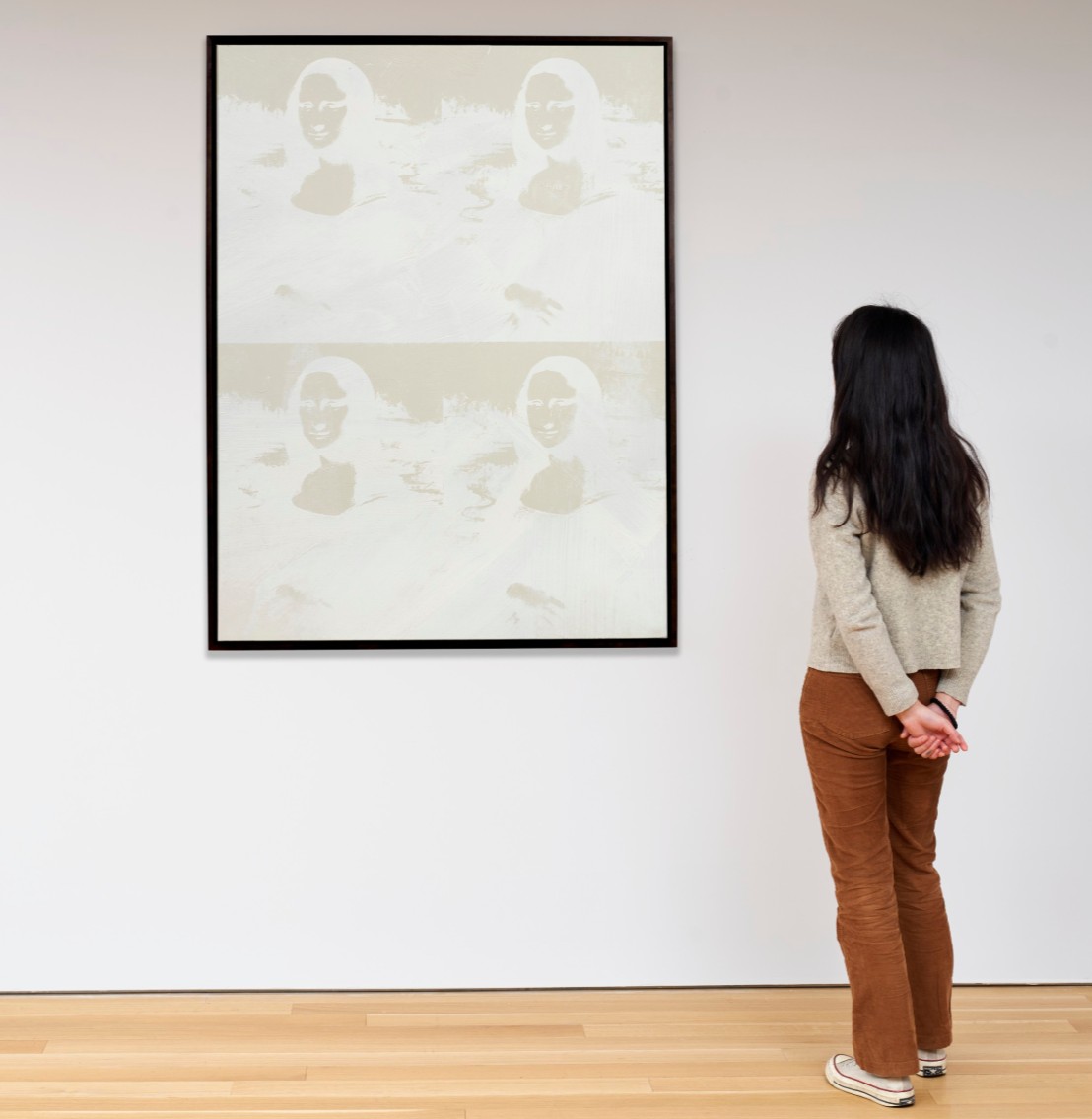
Painted in 1980, with this work Warhol returned his attention to the most famous painting in the world. He first painted Leonardo da Vinci’s masterpiece in 1963, when the painting made a rare visit to the United States of America. It was during its exhibition at the National Gallery of Art in Washington and the Metropolitan Museum of Art in New York, that Warhol became fascinated by the continued power of this centuries old painting. Over 1.6 million people, many of them queuing for hours, saw the painting during its seven week sojourn, accompanied by countless column inches of press coverage and endless hours of TV broadcasts. In this respect the sitter in da Vinci’s enigmatic portrait, Lisa Gherardini—the wife of a prominent Florentine cloth merchant, was like any of Warhol’s other celebrity superstars, namely, Elizabeth Taylor, Elvis Presley or Marlon Brando. In Four White on White Mona Lisas, the artist transforms the familiar portrait into ghostly apparitions that dissolve into the background, and the familiar Mona Lisa of the sixteenth century becomes seductively blurred in our minds.
The present canvas belongs to Warhol’s Reversals Series, a body of work that the artist began in the late 1970s when he revisited subject matter from earlier in his career, including Marilyn Monroe, Chairman Mao, and here, the Mona Lisa. With these works, the artist flipped the tonal values, layering lighter shades on darker grounds so that his subjects appeared like photographic negatives. By 1980, Warhol’s silkscreen technique had developed in a series of more gestural paintings that were distinguished by a more casual sketchiness, and he had begun to increasingly use a white on white palette to dematerialize his subject into an abstracted, nearly unrecognizable portrait. In this particular work, Warhol also introduces an added layer of visual intrigue as, when viewed under ultraviolet light, the painting glows with added detail, a technique he first investigated in 1966, when he included invisible inks in a series of paintings of the human body. In these four vignettes, each Mona Lisa is rendered slightly differently; her famous enigmatic smile, and the details of her hand or eyes gradually become indistinct in our memory. Coated with slick layers of semi-gloss paint, Warhol’s directional brushstrokes create an immediacy that further distances the reverberating Four White on White Mona Lisas. Warhol was not the first artist to appropriate Leonardo da Vinci’s masterpiece in a more contemporary manner. In 1919, Marcel Duchamp famously adorned a postcard sized reproduction of her famous visage with a mustache and goatee. While Duchamp was attempting to subvert the pretenses of museum and high-art culture, Warhol takes Leonardo’s subject as a readymade icon, the ultimate celebrity of art history, or a brand as famous as Campbell’s Soup and the Brillo Box. In 1963, the painting was particularly well-suited for Warhol since, to celebrate the Mona Lisa‘s arrival in New York, museum vendors and tourist shops sold endless reproductions on coffee cups and tote bags. In fact, the artist’s source image in the 1960s was taken from a Metropolitan Museum’s exhibition brochure. Four White on White Mona Lisas, included an even more layered method of appropriation as the work copied Warhol’s past motifs, which replicated the brochure that reproduced the original, four times over. The artist gleefully frees the Mona Lisa of its clear referent, as it has become so intermingled with different stages of Warhol’s own art. Adopted into his iconography, Four White on White Mona Lisas, memorializes Warhol’s own canon of famous women, showing his mastery of appropriation and transformative imagery.
Mona Lisa, 1978
Mona Lisa, 1978
Christie’s New-York: 12 November 2014
Estimated: USD 2,500,000 – 3,500,000
USD 5,989,000
Andy Warhol (1928-1987), Mona Lisa | Christie’s
REPEAT SALE
Christie’s New-York: 10 November 2010
Estimated: USD 1,800,000 – 2,200,000
USD 3,610,500
Andy Warhol (1928-1987) , Mona Lisa | Christie’s
ANDY WARHOL
Mona Lisa, 1978
Synthetic polymer and silkscreen ink on canvas
50.1 x 40.1 inches (127.3 x 101.9 cm)
Signed ‘Andy Warhol’ (on the overlap)
Provenance
Carlo Bilotti, Palm Beach, acquired directly from the artist, 1978
His sale; Christie’s, New York, 13 May 1999, lot 515
Private collection, Greenwich
Anon. sale; Christie’s, New York, 10 November 2010, lot 60
Acquired at the above sale by the present owner
On a cold January night in 1963 nearly two thousand people waited in Washington, D.C. to witness the unveiling of one of the world’s greatest paintings. At the request of first lady Jacqueline Kennedy, the Mona Lisa—Leonardo Da Vinci’s 16th century masterpiece—had traveled three and half thousand miles from her home in the Louvre in Paris to meet her adoring American public. During her two month long visit to the United States, first at the National Gallery of Art and then at the Metropolitan Museum of Art in New York, the exhibition garnered a deluge of media coverage, with her face featured on the front page of dozens of newspapers and magazines across the country and over one and a half million people waiting in line to witness her enigmatic smile.
An avid consumer of popular culture, Andy Warhol would undoubtedly have been aware of the Mona Lisa’s visit, and in 1963 he produced a discreet series of mainly black and white canvases featuring Da Vinci’s famous painting. Fifteen years later, 1978, Warhol turned his attention again to the famous painting and produced Blue Mona Lisa, a bejeweled canvas featuring four images of the most famous face in art history. Arranged in 2 x 2 grid, Warhol used a pair of different screens; one a full length version of the painting complete with her folded hands and the other comprised of a shorter, cropped version showing a more detailed rendition of Mona Lisa’s face. In stark contrast to his earlier Mona Lisa’s which Warhol screened onto a plain white ground, this later version has the black silkscreen ink applied directly on top of an effervescent surface of multi-toned blue hues. By using a wide brush, loaded with blue and white paint, he mixed together gigantic sweeps of pigment producing a surface that not only comes alive with a boundless sense of energy, but also produces an expansive range of color accents that range from pure white right through the blue spectrum to delicate shades of purple and mauve.
That Warhol returned to the Mona Lisa as a suitable subject for his painting after a sojourn of more than a decade speaks to the admiration he had both for the painting itself and also for his Renaissance counterpart. Legendary ever since it was produced, the Mona Lisa is perhaps the most famous image in the history of art; in some contexts, it even personifies high art. Moreover, it is through the power of art that Mona Lisa has attained universal fame and eternal life. No one would remember the sitter, Lisa Gherardini, were it not for Leonardo’s portrait. But far from forgotten, she is among the most recognizable woman in the world. She has reached the kind of immortality only possible when someone is turned into an image or symbol; in this regard she belongs to Warhol’s pantheon of female icons such as Marilyn, Jackie or Liz, only on a higher plane, untainted by irony and tragedy. Five-hundred years after having her portrait painted, Lisa lives on, thanks to the picture’s fame, and becomes the embodiment of fame and an outstanding example of the power of an image, two central concerns in Warhol’s art. Leonardo may have interested Warhol for another reason as well. Leonardo was a brilliant courtier who achieved intimacy with the rich and famous solely by the power of his charm and genius. (When Leonardo died, King Francis I was at his bedside.) Furthermore, Leonardo’s life was a work of art, greater than almost any of his paintings and as such Warhol emulated Leonardo’s capacity to transform his life into art.
The Mona Lisa’s iconic status meant that Warhol was following in an honorable tradition in using it as the subject for his own appropriation. The earliest known example appeared in 1887 when an illustrator known as Sapeck (Eugène Battaille) depicted the famous lady smoking a pipe. This was a play on words referring to a group of artists known as the fumists (literally translated as the Smokists), of whom Sapeck was a leading light. In 1914, a year after the painting was returned to France after having been stolen, Kasimir Malevich produced a scathing commentary on the cult status that the painting had achieved. His collage, Composition with Mona Lisa placed the painting tucked away in the corner of the composition with a large red X over her face and cleavage as a comment on what Malevich saw as the false artistic consciousness that the painting evoked. But perhaps the most famous example was the one produced by Marcel Duchamp, whose L.H.O.O.Q was executed in 1919 when he adorned a cheap reproduction of the Mona Lisa with a moustache and a goatee. When read out loud, the title of Duchamp’s parody sounds like “Elle a chaud au cul” which literally translates as “She has a hot ass.” In 1954 Salvador Dalí painted Self Portrait as Mona Lisa and as late as 1960 René Magritte painted La Joconde in which he characteristically did not paint the image known to the world but nonetheless managed to evoke her essence with a pair of curtains draped to mimic her voluptuous figure and, using a recurrent Magritte motif, a ball with a horizontal slit that mimics the painting’s enigmatic smile.
One of the most striking of Warhol’s later portraits, Blue Mona Lisa shows that the artist had lost none of his power to encapsulate and commemorate the essence of his subjects within the scope of his canvases. Yet here Warhol also challenges Walter Benjamin assertion in his seminal essay “The Work of Art in the Age of Mechanical Reproduction” that modern photographs and copies challenge the celebration of the “original” as they rob it of its authority. But with Blue Mona Lisa, Warhol points to a different conclusion; that it is only because she has been reproduced so many times that she has attained her celebrity status and her universal cultural currency could not have achieved without it.
Two White Mona Lisas, 1980
Two White Mona Lisas, 1980
Sotheby’s London: 10 February 2016
Estimated: GBP 1,300,000 – 1,800,000
GBP 1,385,000
ANDY WARHOL
Two White Mona Lisas, 1980
Acrylic and silkscreen ink on canvas
26.6 x 40 inches (68×102 cm)
Signed and dated 1980 on the overlap
Provenance
Luhring Augustine & Hodes Gallery, New York
Private Collection, New York (acquired from the above in 1985)
Sotheby’s, New York, Contemporary Art Part II, 9 May 1996, Lot 206
Galerie Jérôme de Noirmont, Paris
Galerie Andrea Caratsch, Zurich
Acquired from the above by the present owner in 2006
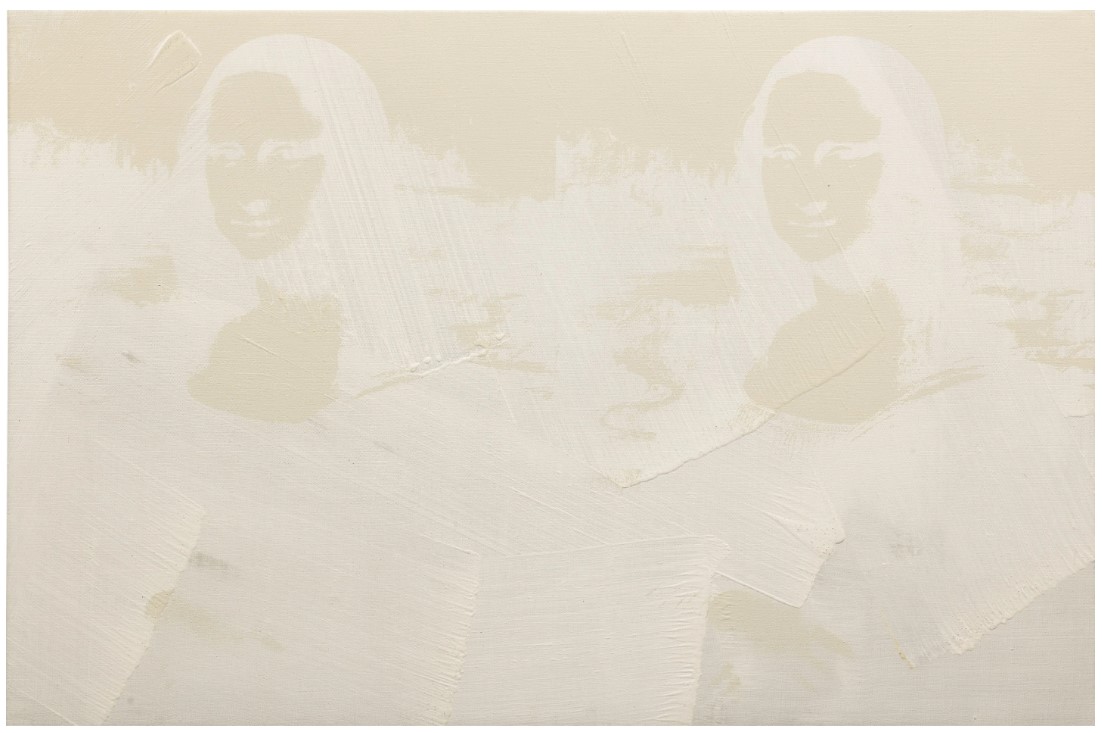
Articulated in screens of ethereal pearlescent white on a rich ivory ground, Two White Mona Lisas from 1980 is paradigmatic of Andy Warhol’s revered late series in which he revisited and reprised the subjects that propelled him to prominence in the early 1960s. First appropriated by Warhol in 1963, Leonardo da Vinci’s iconic Renaissance masterpiece here resurfaces in the artist’s oeuvre seventeen years later. Once again La Gioconda is re-presented in serial grid-formation; however Warhol’s monochrome tonal values are reversed. Choosing a delicate minimalist colour palette, Warhol at once invites associations with innovations in contemporary painting (such as the ascendancy of Robert Ryman and his aesthetic association with white pigment) whilst instilling a melancholic dialogue inexorably connected to a rumination on mortality.
Eighteen years earlier in 1962, Warhol encountered the original Mona Lisa first-hand when the painting travelled to New York for exhibition. Universally considered the most famous (and thereby expensive) work of art in existence, the occasion of the Mona Lisa’s first official tour outside of Europe roused unprecedented attention from the press. Her arrival in America was a major media event, and the exhibition tour to Washington’s National Gallery of Art and New York’s Metropolitan Museum was covered by wave upon wave of photographers, both amateur and professional, each hoping to capture the enigmatic essence of her fame. The press devoted vast column inches in attempting to analyse her beauty and her celebrity as the world’s most famous work of art. Her arrival to the United States was unveiled by President John F. Kennedy and his wife, Jackie, as a way of reinforcing Franco-American relations, and, indeed, many of the photographers juxtaposed the radiant smile of Jackie with the ‘enigmatic’ one of Mona Lisa. She was a media star in the truest sense of the word and by the end of her trip over 1.6 million people had seen her. Amongst them was a young Warhol, on the cusp of wider creative recognition and embarking on a career which would see him become one of the most famous and celebrated artists of the Twentieth Century.
Warhol was immediately captivated by the Mona Lisa and incorporated the legendary image within his own oeuvre for the first time shortly after its iconic exhibition in 1962. The small corpus of seven preliminary paintings executed between January and February of 1963 denotes Warhol’s first serialisation of an art historical work; moreover, the Mona Lisa was to remain the only painting appropriated in this way until the 1980s. Though unimpeachable as a landmark of art history, it was her status as a celebrity and priceless commodity that undoubtedly caught Warhol’s artistic attention. Possessing an unrivalled degree of iconicity and instantly recognisable stardom, Leonardo’s Mona Lisa seems tailor-made for Warholian veneration.
The reiteration and repetition of iconic personalities and consumer products had long been the very cornerstone of Warhol’s practice – with the renewed conceptual vigour of the Reversals and Retrospectives, this artistic project reached its apotheosis. Roberto Marrone contended that, “Warhol’s ‘appropriating’ of his own imagery in the Reversal and Retrospective series ran parallel to the then current aesthetic of irreverent undermining of the traditional canons of art history and its hierarchical divisions between so-called ‘high’ and ‘low’ art” (Roberto Marrone in: Exh. Cat., Zurich, Galerie Bruno Bischofberger, Andy Warhol: Big Retrospective Painting, 2009, p. 32). Two White Mona Lisas carries this concept of ‘appropriation’ a step further still. Herein, Warhol’s decision to employ the Mona Lisa does not purely allude to Leonardo da Vinci’s sixteenth-century masterpiece, but also to Marcel Duchamp’s acerbic L.H.O.O.Q. from 1919, in which the delicate and enigmatic face of La Gioconda is jokingly defaced by a moustache. Duchamp’s doctored version posed questions regarding conventional assumptions of gender whilst simultaneously imbuing the Mona Lisa – an unassailable and iconic beacon of chastity – with sexual provocation: Duchamp’s choice of title makes reference to a sexual pun in French. With Two White Mona Lisas and its greater series as a whole, Warhol explicitly exposes the Duchampian nature of his project: not only does he view Leonardo’s painting as a readymade to be appropriated and manipulated for a new artistic dialogue, he also singles out his own work as fair game. Taking his cue from a long tradition of artists who have adapted, varied, and transformed the art of their predecessors, Warhol, in an act of post-modernist brilliance, expropriated material from his own infamous repertoire of images, transforming his classic Pop iconography with surprising painterly techniques and compositional reconfigurations.
Narrating a moment of repose and personal reflection, Warhol stood at the end of a decade creatively dominated by his celebrity portrait practice: flamboyant images that came to encapsulate an era. Prophetically heralding the final decade of Warhol’s life, the late works possess an undercurrent of poignancy and gravitas; the psychological shadows and physical effects of Valerie Solanas’ attempted assassination in 1968 linger on in these late works. As prevalent in Two White Mona Lisas, the ghostly colour palette and delicate impression of the screening appears almost miraculous, possessing a spiritual quality that runs counter to the stark black and white contrast of his 1960s Mona Lisa paintings.
Two Gold Mona Lisas, 1980
Two Gold Mona Lisas, 1980
Sotheby’s London: 17 October 2008
Estimated: GBP 1,000,000 – 1,500,000
GBP 959,650
 ANDY WARHOL
Two Gold Mona Lisas, 1980
Acrylic and silkscreen ink on canvas
26.6 x 40 inches (67.6 x 101.7 cm)
Signed, titled and dated 1980 on the overlap
Provenance
Galerie Bruno Bischofberger, Zürich
José Mugrabi, New York
Acquired directly from the above by the present owner
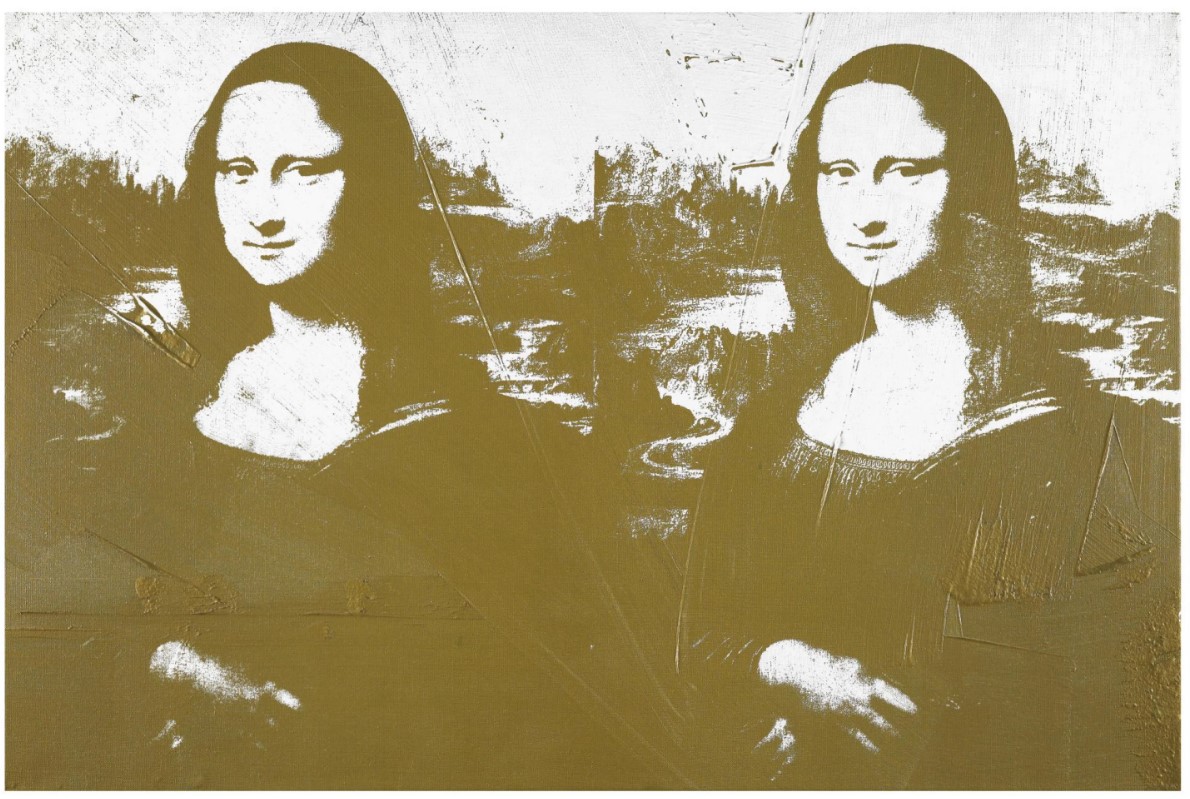
Over beautifully lyrical sweeps of reflective gold acrylic Andy Warhol’s iconic silkscreen has brought into being the mesmerising Two Gold Mona Lisas, multiplying twice the definitive celebrity of Art History. In much the same way as he had portrayed female celebrities of his era, notably Marilyn Monroe, Jackie Kennedy, and Elizabeth Taylor, Warhol turns Mona Lisa into a star. These female subjects are united by a blinding public persona that hides a deep private sorrow: Warhol’s portrayal of them thus uniting his twin obsessions with celebrity and mortality. Just as Marilyn, Jackie and Liz led glamorous public lives that were tainted by personal tragedy, Mona Lisa’s infamous smile seemingly conceals a sadness hidden in her mystifying expression. As the colour that signifies glamour, riches and luxury more than any other, the metallic glow of gold gives the portrait a timeless, other-worldly quality, echoing the most potent golden portraits of Warhol’s contemporary heroines.
When the Mona Lisa embarked on her first voyage outside Europe, to America on 14th December 1962, she could not travel by plane, but instead she travelled as the Queen would on a state visit, by ship. As Donald Sassoon describes: “She was taken to Le Havre, escorted by a motorcade and ‘welcomed’ by the captain of the liner S.S. France… she was then installed in a specially arranged first class compartment, in a purpose-built waterproof box that would float if the ship sank. In other words, she was safer than the passengers and crew – after all the world is full of sailors but there is only one Mona Lisa” (Donald Sassoon, Mona Lisa, The history of the world’s most famous painting, London 2001, p. 244). Her arrival in America was a major media event, and the exhibition tour to Washington’s National Gallery and New York’s Metropolitan Museum was covered by wave upon wave of photographers, both amateur and professional, each hoping to capture the essence of her fame. The press devoted vast column inches in attempting to analyse her wondrous beauty and furthermore her celebrity as the world’s most famous work of art. Her arrival to the United States was unveiled by John F. Kennedy and his wife, Jackie, as a way of improving French-American relations and, indeed, many of the photographers juxtaposed the radiant smile of Jackie with the ‘enigmatic’ one of Mona Lisa. She was a media star in the truest sense of the word and by the end of her trip over 1.6 million people had seen her. Amongst them was one of America’s hottest young artists, Andy Warhol.
The effect was quite immediate. That same year Warhol began a love affair with the Mona Lisa which would last intermittently for most of the rest of his life. His first painting using her image, Thirty are better than one, 1963 was his first serialisation of an art historical painting, the Mona Lisa remaining the only painting he would use in this way until the 1980s. Although he produced relatively few works on this subject during this period, he returned to her between 1978 and 1980, from when Two Gold Mona Lisas is perhaps the finest and most beautiful outcome.
Mona Lisa seems tailor-made for Warhol’s adoration. Allegedly the portrait of a little known Florentine lady, ‘Monna’ Lisa Gherardini, painted by Leonardo circa 1503, it is her image which lives on in the public consciousness. The paintings fragile and precious nature ensures that it rarely, if ever, travels, her fame being spread solely through reproduction. It is the most photographed and reproduced work of art in the world and the fascination with the Mona Lisa ‘brand’ extends its legend through replicas and souvenirs as well as books and postcards. She has attained an eternal and immortal status which is somewhat removed from the humble origins of the original painting. Films have been made about her and songs have been written about her, many of which develop her persona into that of a living being.
Of course, many artists have also attempted to adopt the Mona Lisa image. However, it is the Mona Lisas of Warhol and Marcel Duchamp which are most renowned. While Duchamp’s L.H.O.O.Q. could be regarded, in 1919, as an attempt to subvert high culture, by the 1960s the Mona Lisa was no longer high culture, but a popular cultural icon. When Warhol came to this subject, he was not reacting to the painting as such, more to its fame and, by extension, the power of the image in general in our media saturated culture.
Shimmering with elegance, sophistication and beauty, Two Gold Mona Lisas is quite literally one of the jewels in Warhol’s crown. The ‘Retrospective’ series, first started in the late 1970s found Warhol revisiting many of his most famous images. He returned to his established icons such as Marilyn, Campbell’s Soup Cans, Flowers, and, as here, Mona Lisa with a maturity born of experience and a technique honed to perfection. By comparison with his earlier Mona Lisas he had now refined his silkscreen process to the point where he had complete artistic facility with the medium and could fully manipulate it either to a point of disappearance or, as in this case, to a detailed fullness and depth. We are treated to two immaculately cast screens of the Mona Lisa, yet the feel of each is very different to the other. On the right, the lighter image details most of the original aspects of the painting with the winding mountain road fading into the distance behind Mona Lisa’s right shoulder and the hem of her dress is detailed to perfection as it hangs on her breasts. To the left the stunning detail of the face mirrors that of the right image, while the hand seemingly disappears in the thick gold layers below. This combined with the luscious, thickly applied impasto which implies vast ‘expressive’ sweeps of a fully loaded brush, symbolic of his 1970s works, gives Two Gold Mona Lisas a golden weight to add to its glorious visual gravitas.
Andy Warhol’s meeting with the world’s most famous work of Art in 1963 at such a vital point in his career was fated. Fascinated by contemporary society’s obsession with celebrity and the reproduced image, as well as a keen student of Art History, he was finally confronting the real thing, the ultimate Art celebrity. A highly ambitious young man, he thoroughly believed in the longevity of art at a time when our digestion of images was increasing at a ferocious pace. He aspired to make great works of art which would live long into history and outlast him, in the same way that the Mona Lisa had outlasted Leonardo. The golden pinnacle of a seventeen year relationship with the image, Two Gold Mona Lisas stands alone as a masterful work of art, an icon of its time. More than that, it combines dazzling visual beauty with a deep conceptual intelligence whose relevance transcends time.
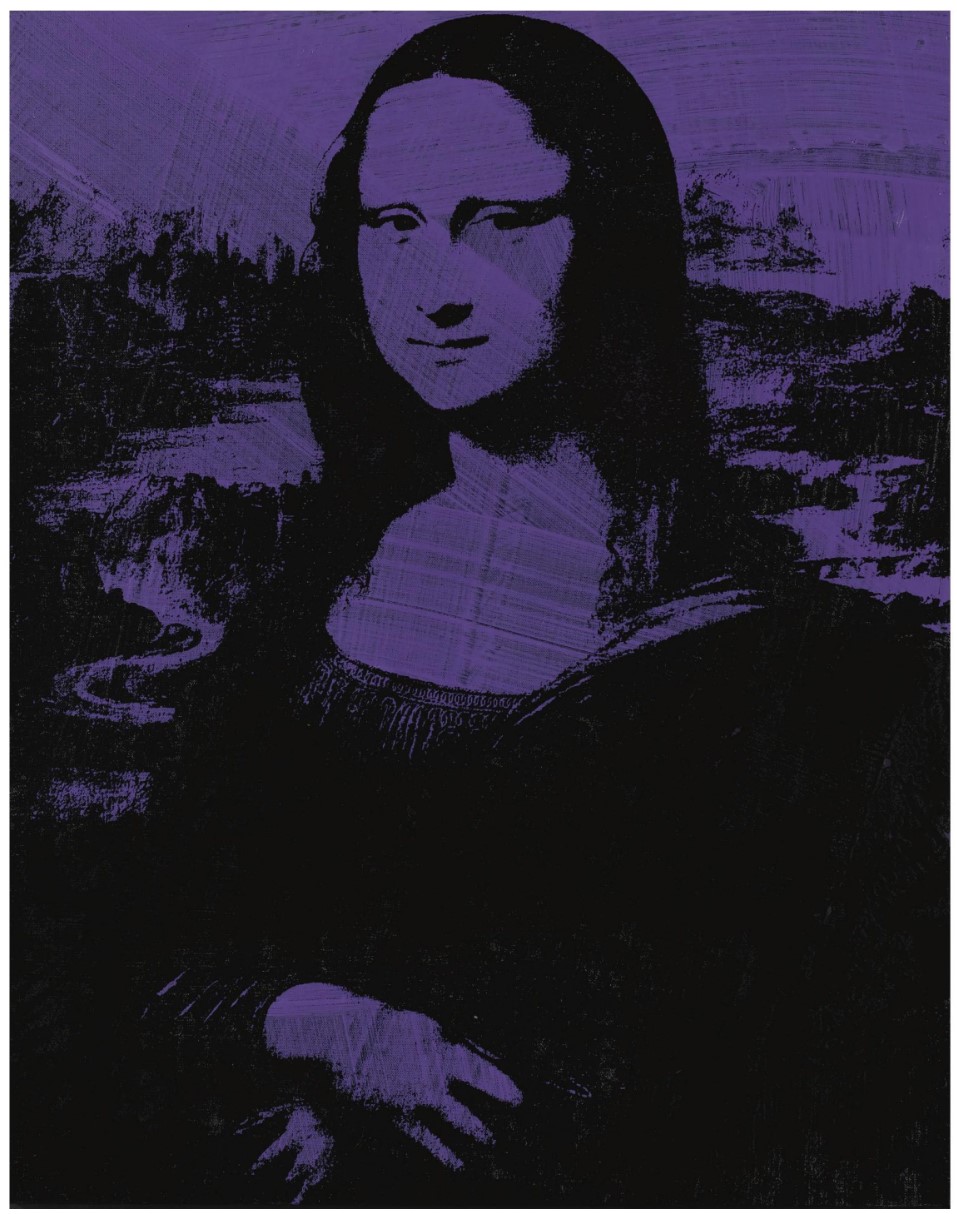
Mona Lisa, 1980
Mona Lisa, 1980
Sotheby’s New-York: 12 May 2009
Estimated: USD 1,500,000 – 2,000,000
USD 1,762,500
 ANDY WARHOL
Mona Lisa, 1980
Acrylic and silkscreen ink on canvas
25×20 inches (63.5 x 50.8 cm)
Provenance
Estate of the Artist
The Andy Warhol Foundation for the Visual Arts, New York
Stellan Holm Gallery, New York
Acquired by the present owner from the above in 2002
Christie’s New-York: 14 November 2002
USD 295,500
Andy Warhol (1928-1987) , Mona Lisa | Christie’s
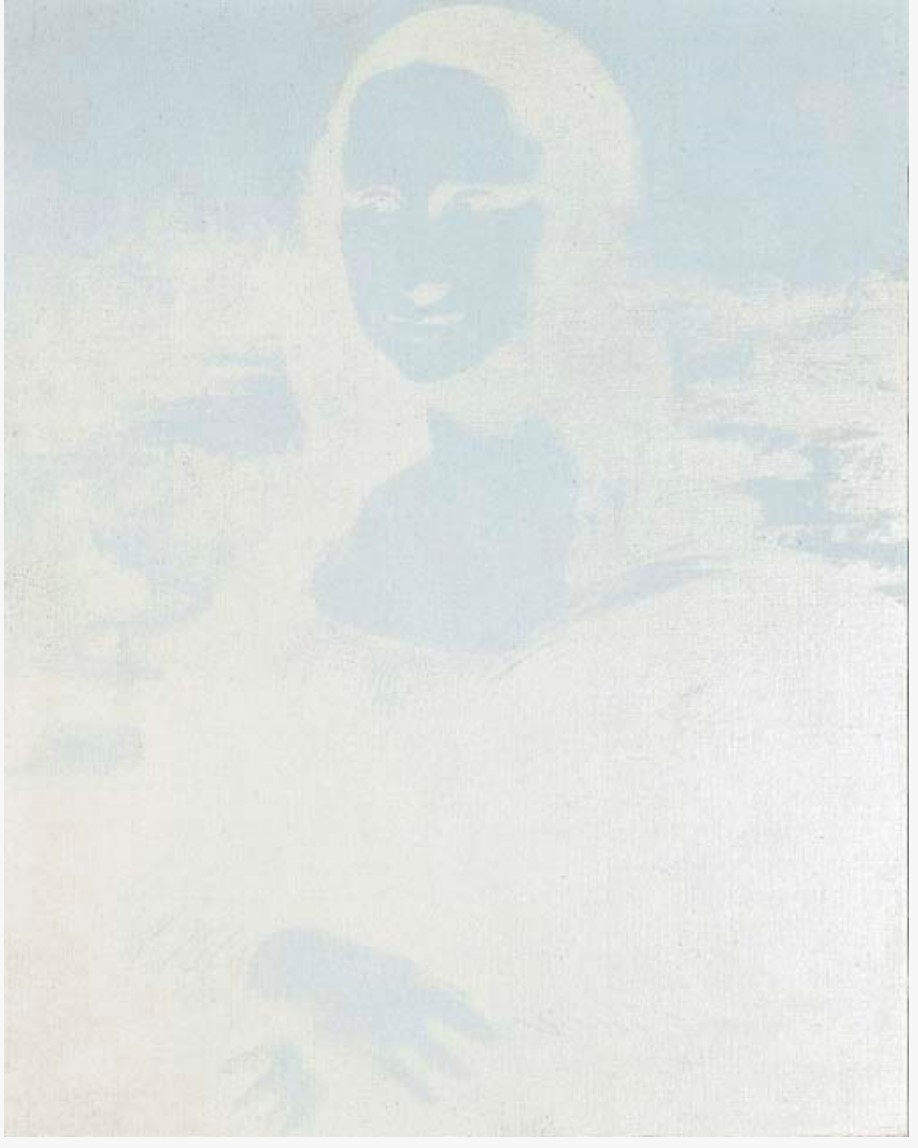
ANDY WARHOL
Mona Lisa, 1979
Synthetic polymer and silkscreen inks on canvas
25×20 inches (63.5 x 50.8 cm)