WORK IN PROGRESS
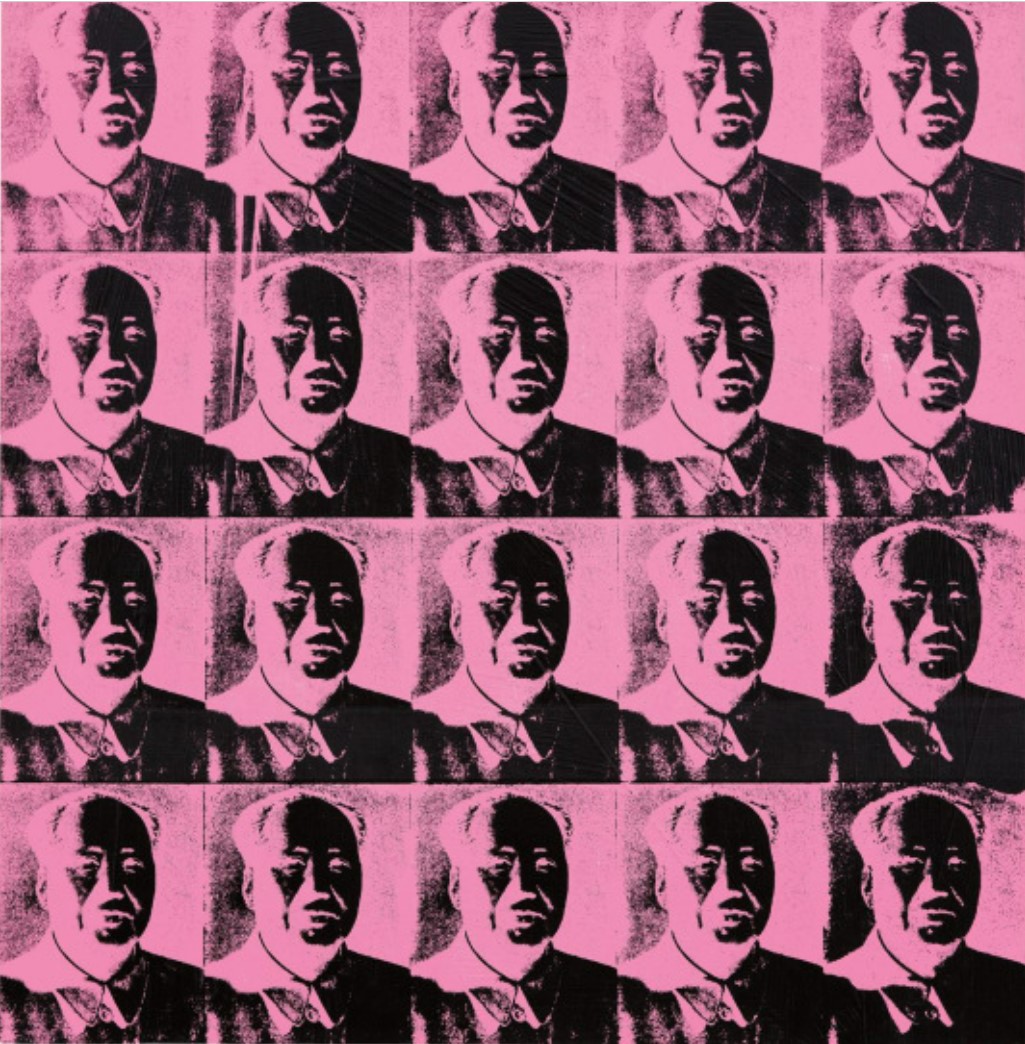
20 Pink Maos (Reversal Series), 1979
Phillips London: 5 October 2016
Estimated: GBP 4,000,000 – 6,000,000
GBP 4,741,000
Andy Warhol 20th Century & Contemporary Art Evening Sale
 ANDY WARHOL
20 Pink Maos (Reversal Series), 1979
Synthetic polymer and silkscreen ink on canvas
39.2 x 38.1 inches (99.7 x 96.8 cm)
Signed, dated and titled ‘Andy Warhol 79 “20 pink Mao’s reversal series”‘ on the overlap
The late 1970s and early 80s was a pivotal time for Warhol, forming a period of self-reflection that pushed him in critically rigorous and aesthetically potent new directions. It was then that the pioneering appropriator of pop culture turned to his own oeuvre as a resource for new creative output; amalgamating earlier series’ into single Retrospective canvases, revisiting the themes of his formative Dollar Bill works with an entirely fresh iconography, and creating his ominous series of Shadows that engaged with the subtle traces that all things leave behind. But it was the Reversal series where Warhol made his most direct and profound interventions. Taking the most significant icons from his corpus such as Marilyn Monroe, the Mona Lisa, the Electric Chair and Chairman Mao, Warhol used self-appropriation to cast a new perspective on the images that seemed most familiar of all. ‘These were the images that had made him famous – the icons, symbols and brands through which he had made his own name and which had therefore to some extent become associated with his own life, history, career and myth.’ (Robert Marrone quoted in, “Retrospectives and Reversals,” Andy Warhol: Big Retrospective Painting, Zurich, Galerie Bruno Bischofberger, 2009, pp. 23-24)
Thought to be the rarest of these interpolations, and arguably the most significant, Warhol’s reversals of Chairman Mao demonstrate a shrewd recalculation of one of the world’s most ubiquitous portraits. Warhol began creating paintings of Mao in 1972 using a widely circulated photograph from the Little Red Book, a pocket-sized index of quotations, thoughts and citations from Chairman Mao. Following President Nixon’s trip to China in 1972, Mao’s image had reached an unprecedented level of international exposure. It was then that Warhol chose to direct his vision beyond America to a global audience. Compared to Mao Tse-Tung, the icons of Warhol’s 1960s portraiture were minor: ‘The image of Mao taken from the portrait photograph reproduced in the Chairman’s so-called Little Red Book, is probably the one most recognised by more of the earth’s population than any other readymade icon, representing absolute political and cultural power. In Warhol’s hands, this image could be considered ominously and universally threatening, or a parody or both.’ (K. McShine, Andy Warhol Retrospective, exh. cat., Museum of Modern Art, New York, 1989, p. 19).
However, if in 1972 the image of Mao represented political ideology and a seemingly indomitable power, by the time Warhol revisited this motif in his Reversal series it had entirely different connotations: Mao Tse-Tung passed away in 1976, marking the end of a regime that had lasted over thirty years. Warhol’s initial depictions of this Communist icon were full of painterly vitality and were depicted on a monumental scale similar to that of Mao’s portrait in Tiananmen Square. This grid of twenty, however, sees the once imposing image realised with far more delicate proportions like a quiet homage to the original source: the pocket sized Little Red Book. Much like the images of Marilyn, the Reversals of Mao represent an iconographical eulogy for a once significant public figure where the images live on like traces or shadows destined to repeat endlessly throughout the world’s cultures.
By inverting the colours of his preceding originals Warhol drastically altered their mood – turning the light areas dark and highlighting the once shadowy negative spaces. However this spectral presentation also brings the works closer to the photo-negatives that would have once been the basis of their formation, aligning the literal artificiality of production with the implied superficiality of Warhol’s subjects. This evocation of the photographic negatives also references Warhol himself as a photographer and image maker, further harmonising with the evident self-referentiality of this series.
The resultant melancholic and self-analytic tone of the Reversal series reflects the brooding sensibility that had begun to pervade much of Warhol’s oeuvre during this period. ‘Here, in these works, and increasingly conscious of the passing of time and his own encroaching mortality, Warhol had seemingly cast his famously cool and objective eye over subject matter that was indicative of both art and death.’ (Robert Morrone, op. cit. p. 24). This existential self-awareness followed Warhol through a succession of series of Guns, Knives and Crosses until the artist’s untimely death in 1988. But by feeding off the sustenance of his own art’s history, Warhol breathed new life into it, allowing his works, much like his own personal myth, to live-on endlessly in the parables of pop culture.
30 Colored Maos (Reversal series), 1980
Sotheby’s London: 27 June 2007
Estimated: GBP 1,000,000 – 1,500,000
GBP 1,252,000
ANDY WARHOL
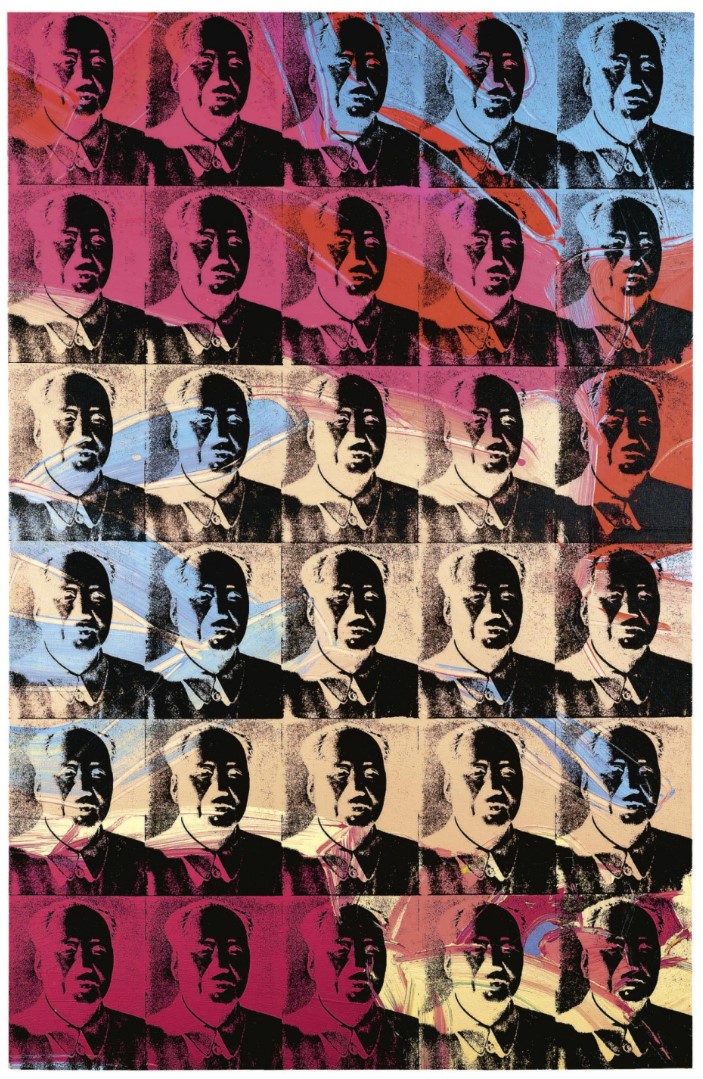
30 Colored Maos (Reversal series), 1980
Acrylic and silkscreen ink on canvas
60 x 38.1 inches (150×97 cm)
With the silkscreen process now honed to perfection, 30 Multi-coloured Maos, 1980, is one of the best examples from this powerfully post-modern body of work, which pivots on the Duchampian notion of the readymade. Warhol had already appropriated images from Fine Art once before, in his 1963 serial painting depicting Leonardo da Vinci’s Mona Lisa, provocatively re-titled Thirty are Better than One. Warhol’s interest in Leonardo’s masterpiece, however, was less about its art historical significance and more to do with its celebrity status. Exceptionally released from the safekeeping of the Louvre for a brief visit to the Metropolitan Museum of Art that year, the press furor surrounding the visit of this normally immovable painting drew hordes of people curious to experience its alluring enigma. Little more than fifteen years later, Warhol’s own paintings and celebrity status were so aggrandized that his instantly recognizable images befitted the same treatment as the Mona Lisa.
The present work revisits the images of the Chinese Communist leader painted by Warhol in the early 1970s. Instantly recognizable throughout the Western world thanks to a press-fuelled Cold War preoccupation with the Eastern superpower, Mao Tse Tung’s official portrait was a widely disseminated icon of Communism. Warhol’s 1973 series of Maos showed the artist’s fascination with the flipside of the coin of celebrity: public notoriety. In the present work, however, the emphasis is less on the celebrity of the sitter and more on that of the artist himself, less a depiction of the dictator and more a reflection of Warhol’s own artistic past.
In 30 Multi-coloured Maos, Warhol starts by broadly brushing skeins of paint onto a length of canvas, in places dragging his fingers over the paint while still wet to create a surprisingly varied and gestural ground anathema to the insistently flat surfaces of his 1960s canvases. In an ironic nod in the direction of his Abstract Expressionist forefathers, this lushly drippy surface in which we feel the physical presence of the artist bears no relation to the superimposed silkscreen image and is subversively drained of meaning. While the earlier Maos were also executed in a brushy style, the coloured grounds nonetheless corresponded to the silk-screened images with different coloured zones being demarcated for the face, the jacket and the background. In the present work, however, the relationship between the printed and hand-painted elements is completely arbitrary, a sardonic indictment of the expressive potential of the brushstroke. Liberating it from its loaded Abstract Expressionist associations, Warhol breathes new life into the brushstroke and in the present work we are left to simply admire the sumptuous, coalescing ripples of pigment.
Set against this glossy, richly textured acrylic ground, Warhol screens six rows of five Maos. The lustrous black silkscreen ink clings to the ridges of acrylic under-painting to create a uniform, unbroken and delicate aesthetic unity. As David Bourdon describes: “Warhol’s Reversals recapitulate his portraits of famous faces… but with the tonal values reversed. As if the spectator were looking at photographic negatives, highlighted faces have gone dark while former shadows now rush forward in electric hues” (David Bourdon, Warhol, New York 1989, p. 378). In the present example, not only is the image printed in negative, but it is also reversed with Chairman Mao looking right instead of left. Through negative printing, Warhol achieves a ghostly dematerialization of his subject, with the shadowy figures now reduced to their recognition value, their memory value alone. Although still recognisable and legible thanks to its common currency, Warhol’s manipulations neutralise the power of the original image to convey meaning. In places his eyes, once dark, shine out like candy-coloured beacons in a witty parody of the original’s all-seeing gaze. Compositionally recalling the serial images of soup cans from the 1960s, through repetition Mao’s debunked image loses its potency as it is lined up in rows like the mundane products of bourgeois consumerism. In a flash of Warholian genius the Mao’s individuality, the uniqueness on which his authority depended, is swept from beneath him. In a subversive tour de force, Warhol transforms the official portrait used for the dissemination of Communism into a commodity of the Capitalist economy, no more consequential than a can of soup or box of Brillo.
XXXXXXXXX
Multicolored Retrospective
Phillips New-York: 18 May 2022
USD 3,748,750
ANDY WARHOL
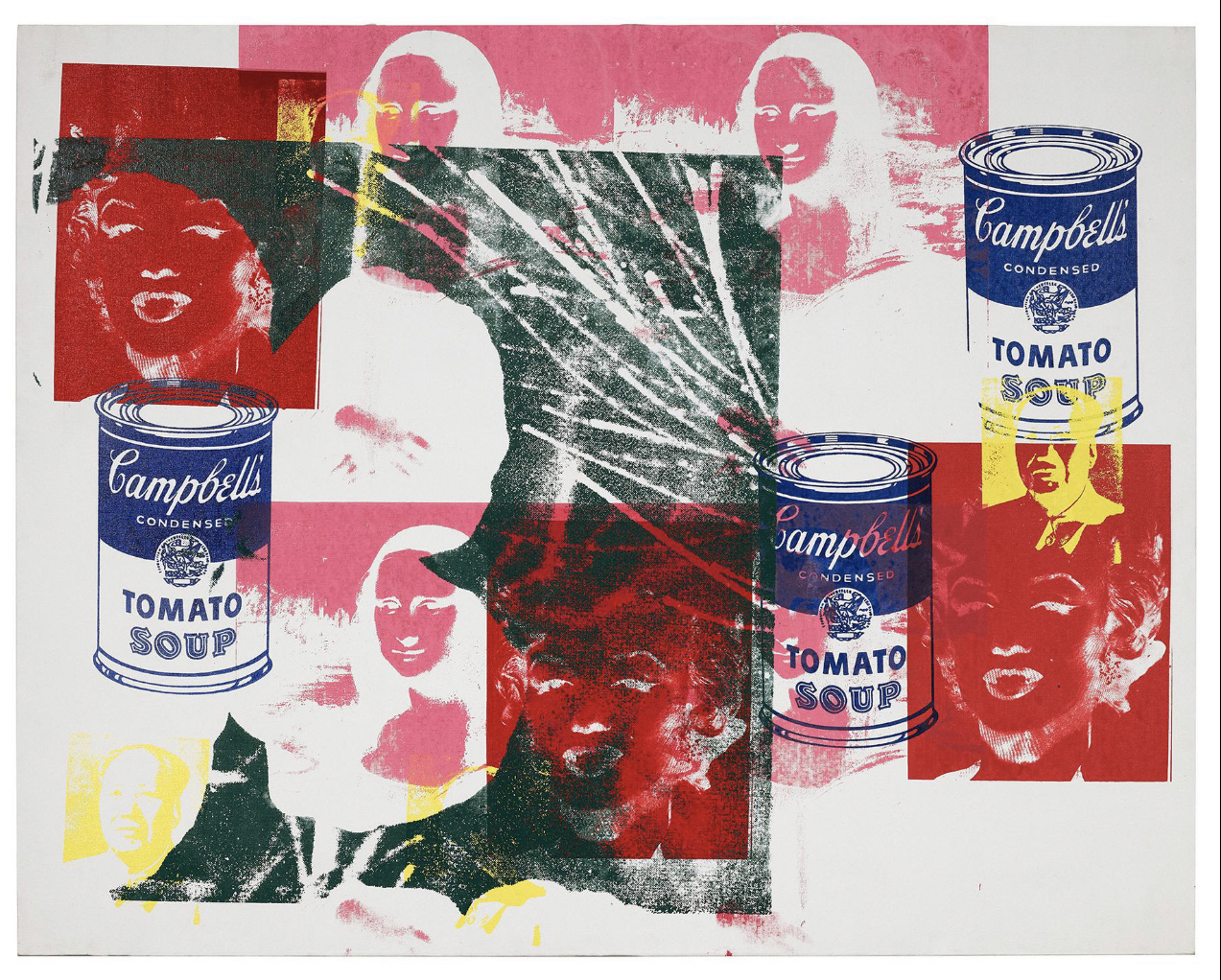
Multicolored Retrospective (Reversal Series), 1979
Acrylic and silkscreen ink on canvas
50.4 x 63.7 inches (128 x 161.9 cm)
Signed, titled and dated “Andy Warhol 79 multicolored retrospective reversal series” on the overlap
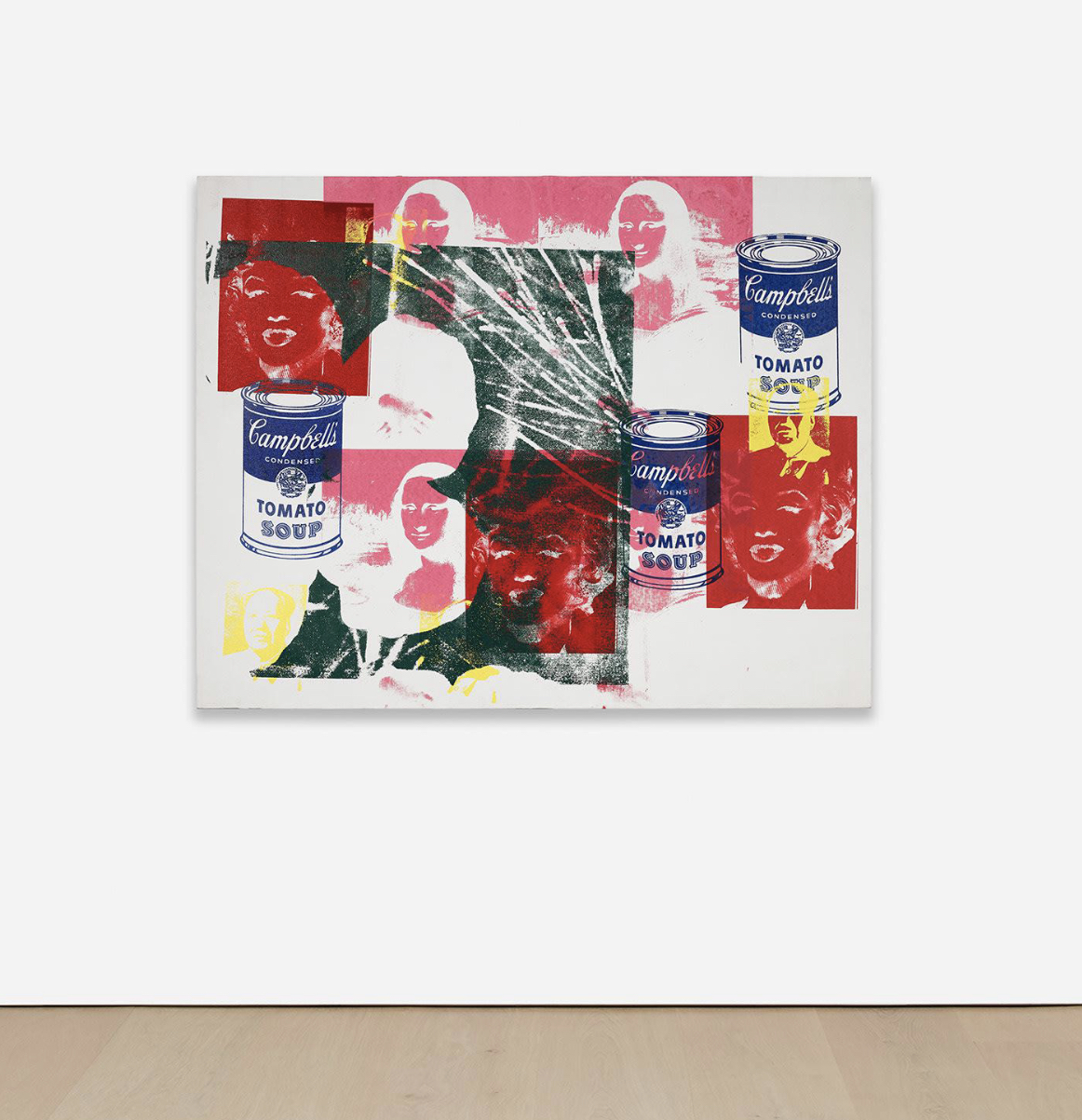
Encompassing five of Andy Warhol’s most iconic motifs—Marilyn Monroe, Mao Zedong, the Mona Lisa, Campbell’s Soup Cans, and his Flowers—Multicolored Retrospective is emblematic of the uniquely personal reflection that defined the last decade of his life. Executed in 1979 during the height of his fame, Multicolored Retrospective disrupted Warhol’s expected seriality with its non-hierarchical, seemingly “collaged” surface in which his most-famous subjects, of diverse quantities, palettes, and sizes, converse in a post-modern visualization of “image overload.” The Retrospectives, which were a discrete subset of Warhol’s Reversals series (1979-1986), brought his oeuvre full circle: as his position was solidified as one of the most influential post-war artists, not even his own practice remained safe from his unceasing appropriation.
A master of timing and context, Warhol understood that revisiting his most iconic images years later—when his life became a point of media scrutiny and his work attracted as much public attention as his original source material—would imbue them with an entirely fresh meaning. The conceptual techniques Warhol employs in Multicolored Retrospective share a close affinity with those of Marcel Duchamp, the master of appropriation and forebear to Warhol’s distinctly post-modernist approach. Warhol owned over 30 works by his greatest influence, including two examples of his famed Boîte-en-valises. These portable retrospectives—leather suitcases and cardboard boxes replete with miniature replicas of Duchamp’s most iconic paintings and readymades—extended the artist’s appropriation to the realm of his own practice and undoubtedly influenced the present work. Taking this self-imitation a step further than the Boîte-en-valises, the identical medium and comparable scale of Multicolored Retrospective to Warhol’s “originals” challenge the very definition of a “reproduction.”
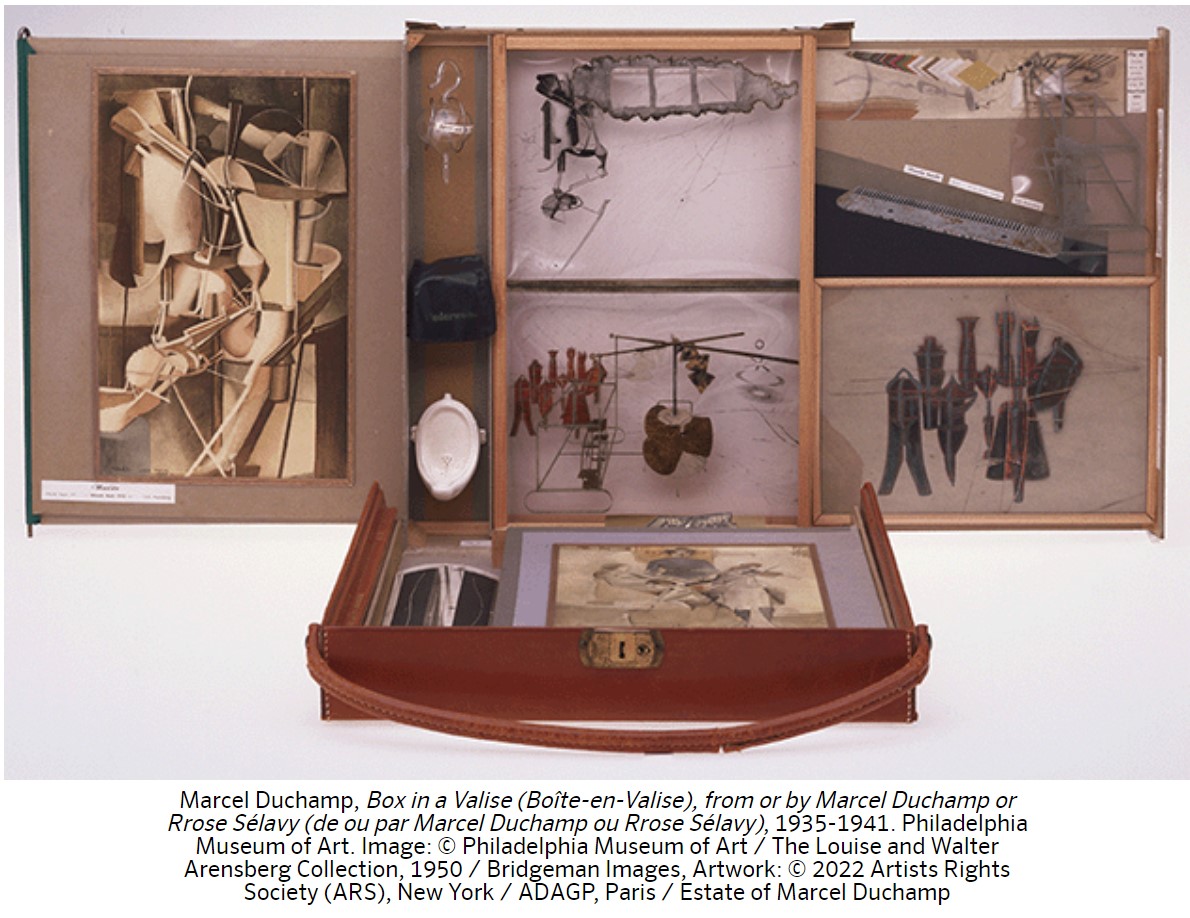
Often incorporating previous drawings and paintings in their collages, other Dada artists arranged found objects in enigmatic, non-hierarchal compositions—a practice Warhol had first experimented with when he was in college. Though the surface also evokes contemporaneous “Neo-Dada” discourse exemplified by Robert Rauschenberg’s tactile, three-dimensional collaged pictures, there is a signature Warholian visual trick at play in Multicolored Retrospective. The seemingly layered surface of the work is initially a compelling illusion; upon further inspection, the flatness inherent to the silkscreening process is revealed. Just as he began juxtaposing screen-printing with gestural brushwork in his 1970s portraits, the Retrospectives series sees him in dialogue with another leading post-modernist of his time.
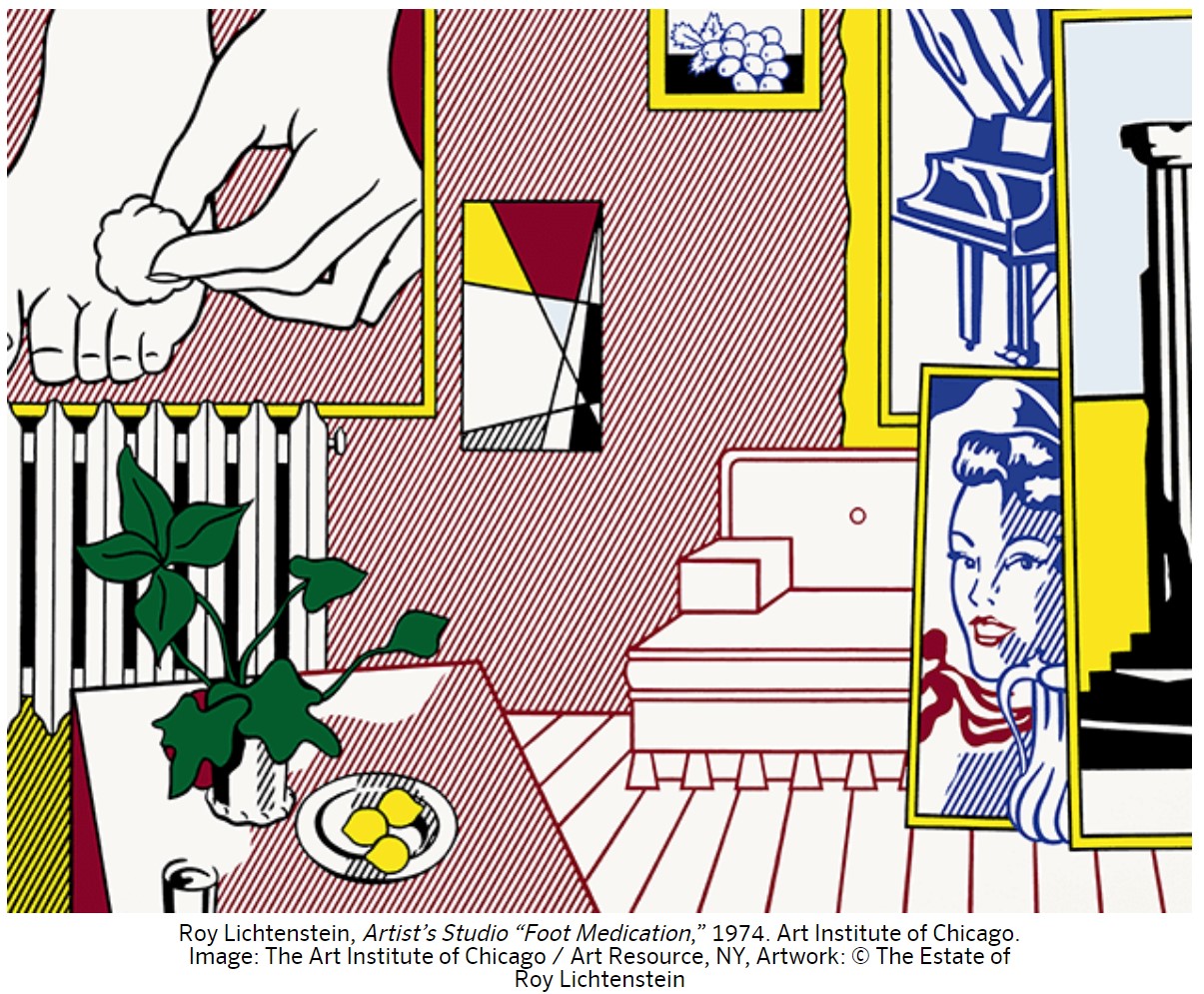
Taking the pervasiveness of his own work as subject matter, Warhol joined the ranks of Duchamp as well as Gustave Courbet, Henri Matisse, and Roy Lichtenstein in distilling a “retrospective” of their oeuvre into a single canvas. A major institutional exhibition meant to honor and encapsulate an artist’s career, the concept of a “retrospective” no doubt intrigued Warhol during a period that found him grappling with the passing of time. In the 1970s, he filled over 600-time capsules with documents, photographs, and ephemera from his daily life and introduced a personal dimension into his work, characterized by gestural brushwork and softer, more expressive portraiture, that his earlier chapter rejected. He always engaged with artists—Leonardo da Vinci, commercial designers, photojournalists, and publicity photographers—but in Multicolored Retrospective he approached his own acclaimed images, underscoring that from a distance they appear both the same and entirely different.
According to Warhol, inspiration for the Retrospectives came from his friend Larry Rivers’ Golden Oldies paintings from 1978, which represented fragments from his most well-known images of past decades. Recalling that many artists, including Barnett Newman, culled motifs from their early chapters for use in later ones, Rivers’ pictures and the conceptual possibilities of revisiting older iconography appealed to Warhol. “It’s like restating it once more,” Rivers elucidated. “In a sense it’s like saying: not only did I mean it, but it’s rich enough for me to take it and do something with it.”
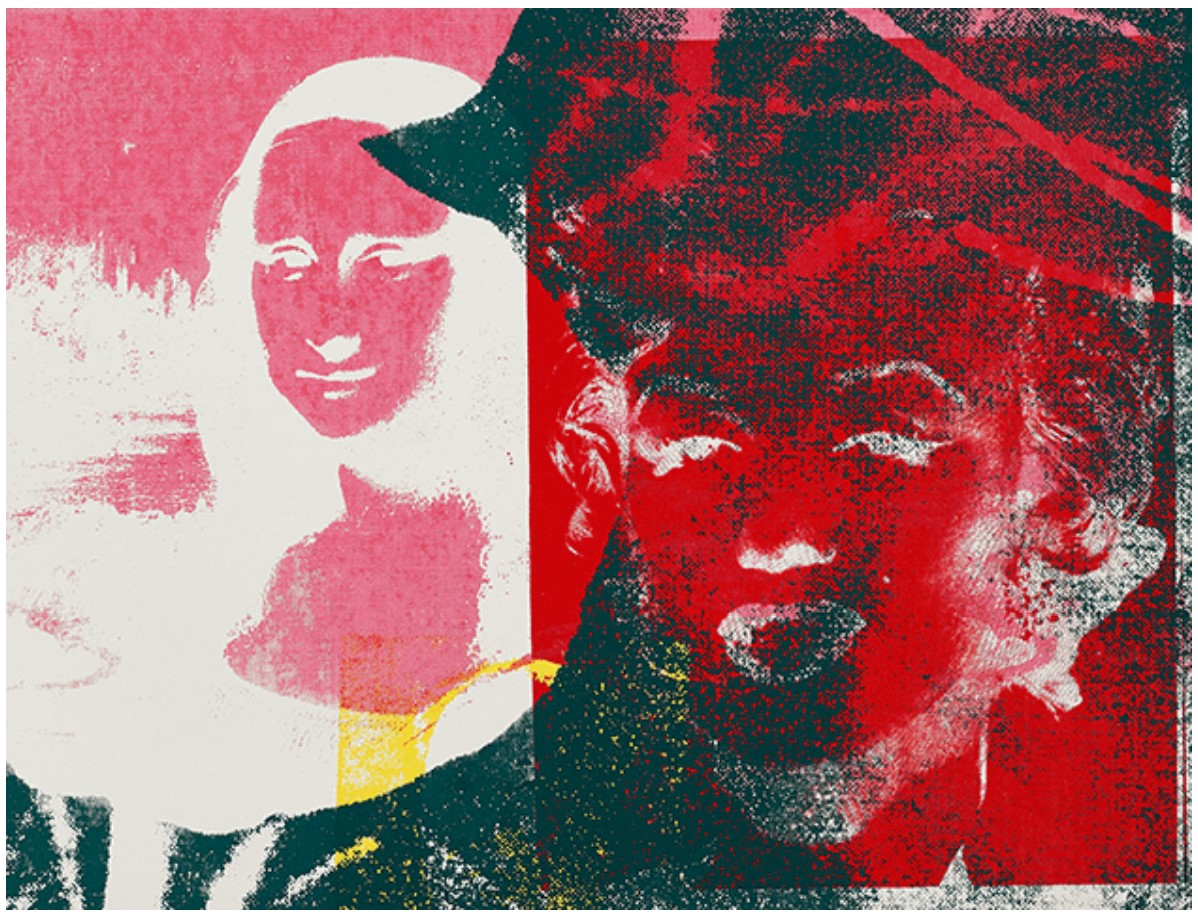
This notion of doubling down on the very images that solidified Warhol’s position within 20th century art history resonated with the Reversals series he had begun around the same time. Depicting his previous subjects including Monroe, Mao, and the Mona Lisa, the Reversals were made from negative acetates of his source material, resulting in somber, contrast-inverted versions of his earlier work that denoted the passing of time. “Like the aging Giorgio de Chirico,” Warhol’s close associate and confidant Bob Colacello reminisced, “he plundered his own past, cynically dragging out his old silkscreens from the sixties…” He chose to represent the “reversed” images of the three figures in Multicolored Retrospective, each a triple reference to: the source photograph or artwork; Warhol’s initial paintings from the 1960s or early 1970s; and to his 1979 Reversals. These myriad allusions reflect the evolutions that took place both in mass culture as well as Warhol’s individual celebrity in the elapsed 17 years of his practice. Simply regarded as color-blocked advertising for a mass-produced food product during his original appropriation in 1961-1962, the Campbell’s Soup Can label had subsequently been elevated by Warhol into the canon of “high” art. When the artist first depicted Monroe’s image soon after her death in 1962, her photographs littered the covers of contemporary tabloids; by 1979, Warhol’s paintings had long superseded any representations of the actress from her lifetime. And Mao’s photograph was widely circulated in China during the Cultural Revolution when Warhol repeated the image in his 199 silkscreen paintings of him—but following Mao’s death these works were considered artistic interpretations of a former historical moment.
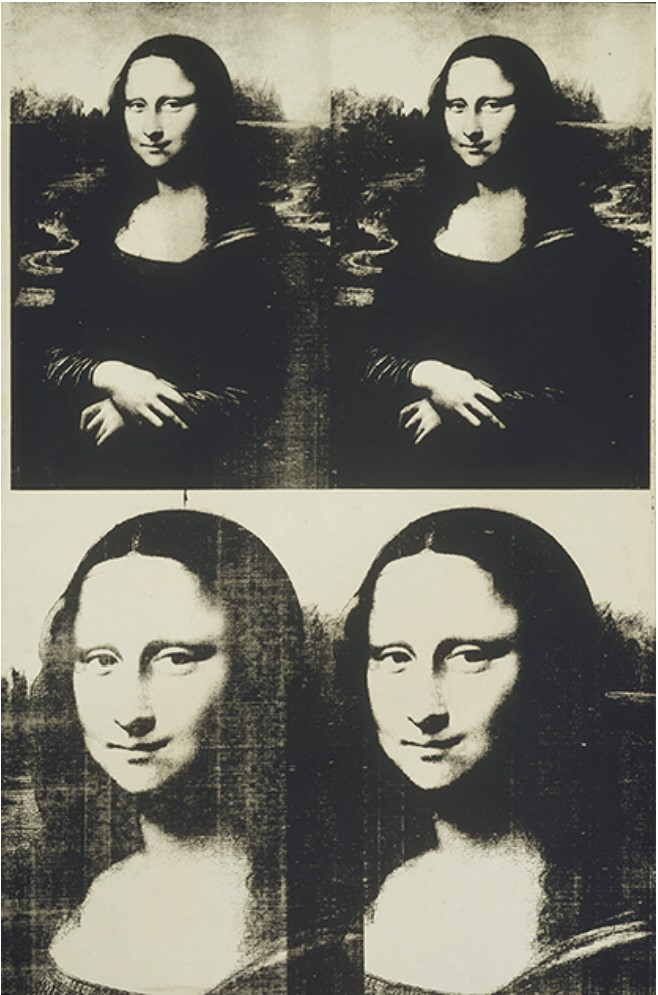
Andy Warhol, Mona Lisa, 1963. The Metropolitan Museum of Art. Image: © The Metropolitan Museum of Art / Art Resource, NY, Artwork: © 2022 The Andy Warhol Foundation for the Visual Arts, Inc. / Licensed by Artists Rights Society (ARS), New York