DAVID HOCKNEY
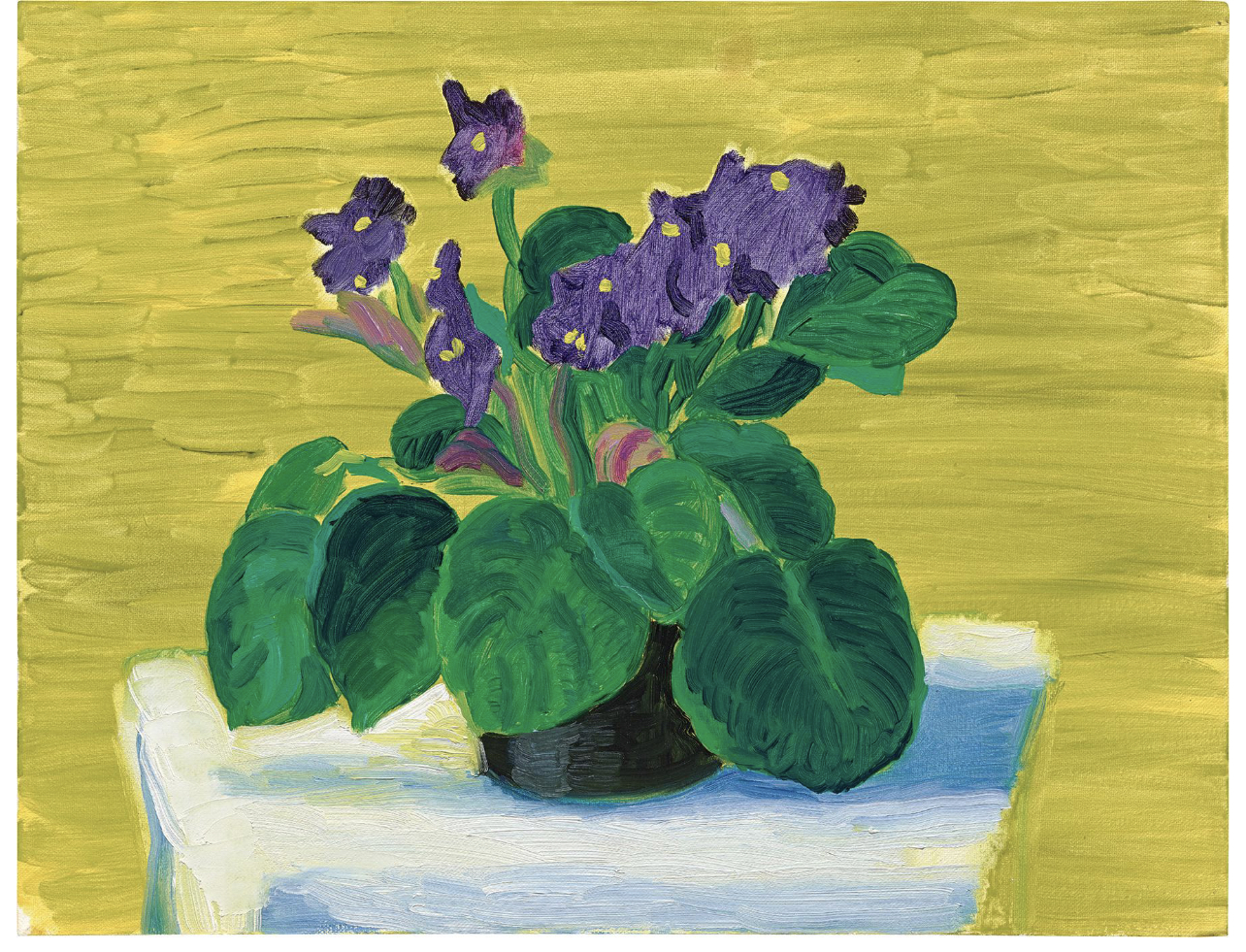
Bridlington Violets, 1989
Oil on canvas
14×18 inches (35.6 x 45.7 cm)
Signed, titled and dated ‘”Bridlington Violets” 1989 David Hockney’ on the reverse
Provenance
André Emmerich Gallery, New York
Nishimura Gallery, Tokyo
Jonathan Novak Contemporary Art, Los Angeles
Private Collection, Florida
Private Collection, Los Angeles (acquired from the above in 2001)
Phillips, London, 8 March 2018, lot 23
Acquired at the above sale by the present owner
Auction History
Phillips Hong-Kong: 30 November 2021
Estimated: HKD 10,000,000 – 15,000,000
HKD 12,350,000 / USD 1,583,960
David Hockney – 20th Century & Cont… Lot 21 November 2021 | Phillips
REPEAT SALE
Phillips London: 8 March 2018
Estimated: GBP 500,000 – 700,000
GBP 609,000 / USD 845,515
David Hockney 20th Century & Contemporary Art Evening Sale
Stemming from David Hockney’s distinguished series of floral still life paintings, Bridlington Violets epitomises the celebration of color and form that defines his magnificent visual world. Set against a juniper yellow-green background rendered in short, horizontal brushstrokes, a lively bunch of noble purple violets burst out from a dark, rounded vase. Though the enigmatic composition denies specificity of both time and scene, the sweeping, visceral strokes of Hockney’s brush imbues the textured plane with movement, capturing the artist’s physical joy in the tactile qualities of paint. A piece of British art history, the present work was created in 1989, just after a major retrospective of Hockney’s work travelled from the Los Angeles County Museum of Art, to the Metropolitan Museum of Art in New York, before closing at the Tate Gallery in London (1988-1989).
The present work draws an instant comparison to Vincent van Gogh’s Irises from 1890, an artist whom Hockney deeply admires. Though Hockney attests that van Gogh’s universal appreciation is attributed to the fact that viewers can really ‘see how [the paintings] are done.
“All the brush marks are visible’, van Gogh was really the first great colorist… great, great colorist. He saw more than other people.”
The same is true for Hockney, as masterfully presented by Bridlington Violets which, like Irises, is composed of opposing hues on the color wheel that strengthen each other by their visual juxtaposition: blue and purple against yellow or green.
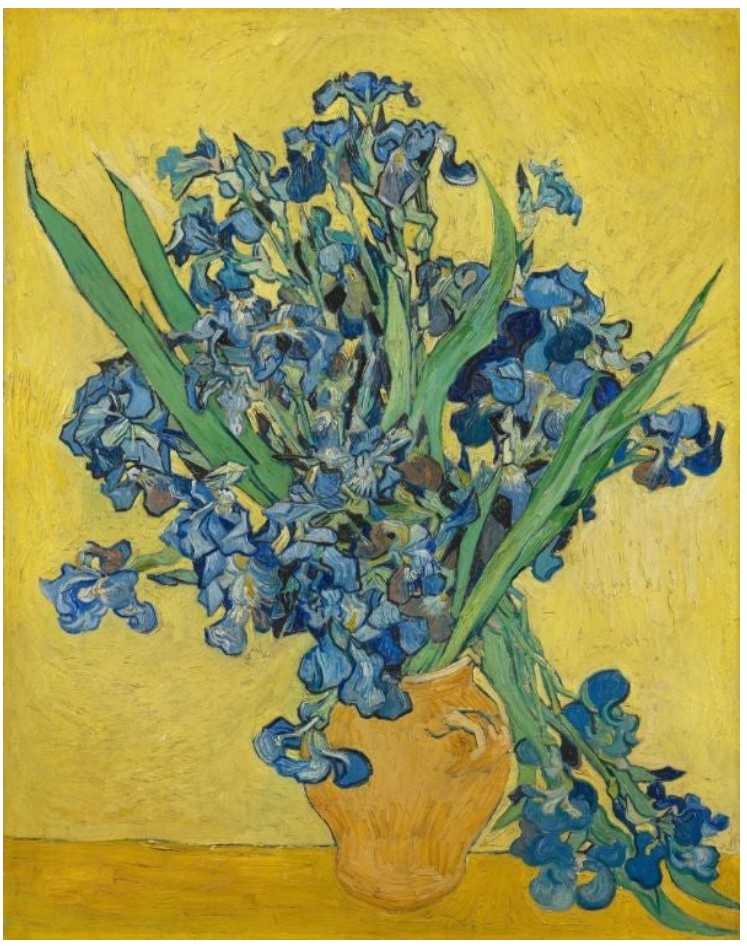
Vincent van Gogh, Irises, 1890 / Collection of the Van Gogh Museum, Amsterdam
© Photo Art Resource/SCALA, Florence 2021
The consequential effect is tremendously rich, of blossoming buds that pop out against the startling background behind, meticulously painted with tonal contrasts that both compliment and contradict, seemingly changing in the light before us as if in harmonious dialogue with the Impressionists. At the same time, like van Gogh’s highly rhythmic application of impasto—which too, was largely influenced by Impressionistic technique. Hockney’s command of texture imbues each petal, leaf, and pane of color with a life if its own, as if painting their individual portraits.
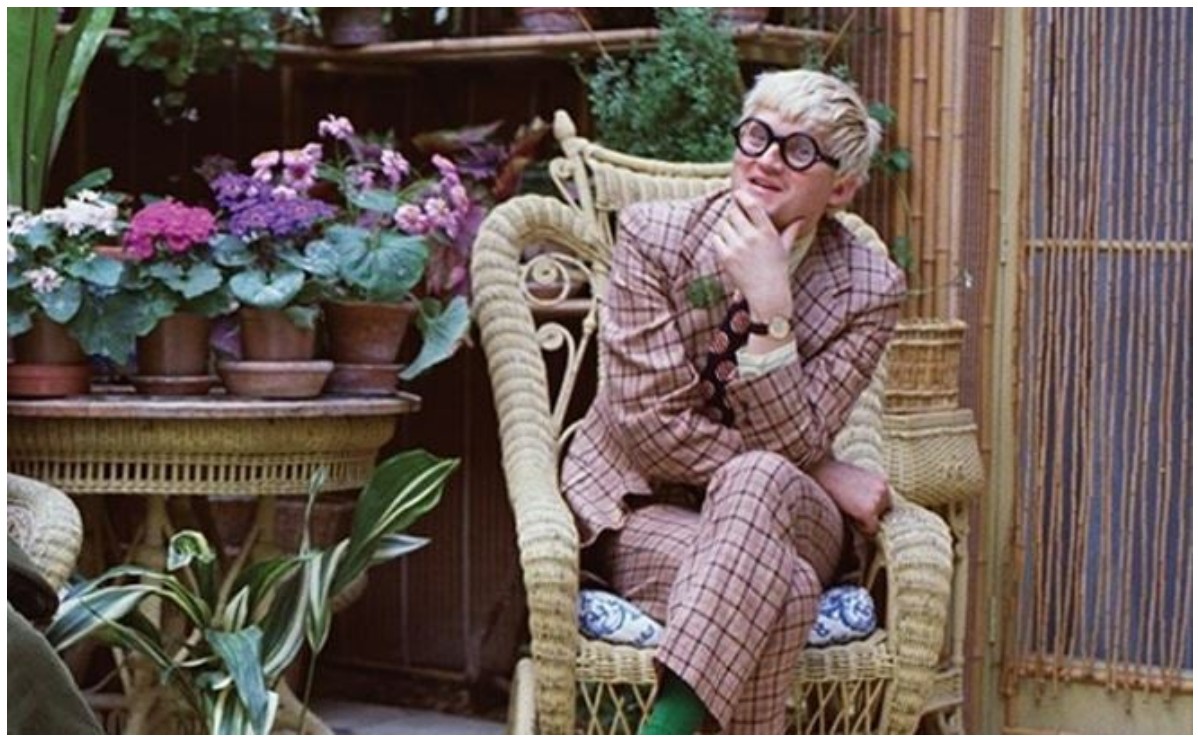
Detail of photograph of David Hockney taken by Peter Schlesinger in 1970
Painted in 1989, Bridlington Violets is a superb example of Hockney’s return to painting after his ambitious ‘post cubist’ experiments with photo-collages that defined his practice at the start of the decade. Enthused by his desire to form compositions that reflect the sensations of observation as opposed to scientifically render a scene, Hockney’s photo-collages ‘solve[d] a problem that he had been musing on for several years; how to make representation of the real world without using conventional single-point perspective.’ iii This perhaps might have been spurred by a trip he took to Paris in December 1984, where he came across Pablo Picasso’s Femme Couchée (1932) at the Centre Pompidou. Musing over how you ‘could see the back and front at the same time’, Hockney remarked ‘you would not ask yourself, where am I? You were inside the picture; you had to be, because you couldn’t be simply outside it and move round it.’ iv
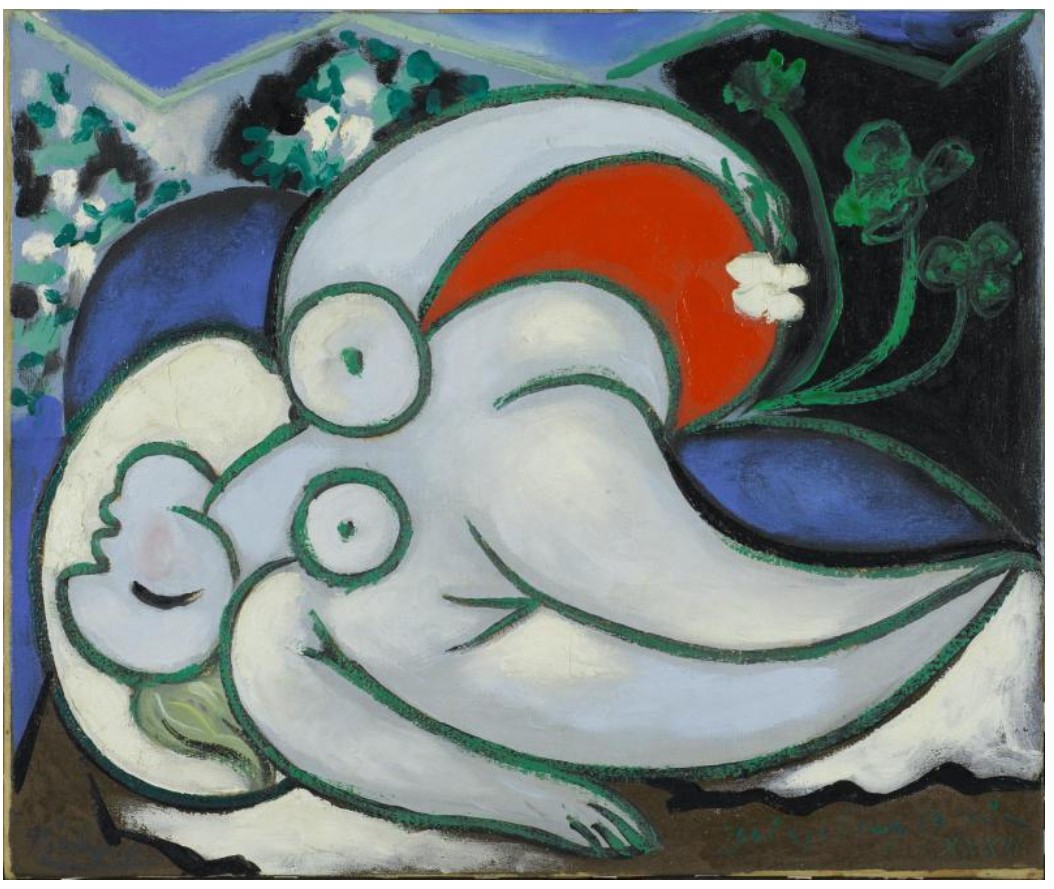
Pablo Picasso, Femme couché, 1932, Collection of the Centre Pompidou, Paris
© 2021 Estate of Pablo Picasso/Artists Rights Society (ARS), New York
That same year, Hockney’s investigations into the possibilities of perspective were further enhanced by his newly found interest in traditional Chinese scroll paintings, owing to his discovery of George Rowley’s 1947 book, The Principals of Chinese Painting. In 1984 Hockney was invited to the Metropolitan Museum of Art in New York to see a 72-foot scroll commissioned by the Chinese emperor dating from 1690, and ‘spent four hours on his knees unrolling the parchment and observing each tiny detail.’ v Mesmerised by how the work could not be seen in its entirety, requiring for the viewer to physically navigate the expansive space with constantly changing viewpoints, Hockney highlighted the experience as ‘one of the most thrilling afternoons [he’d] ever had’, vi later creating a dedicated film centred around the scroll a year prior to Bridlington Violet’s execution.
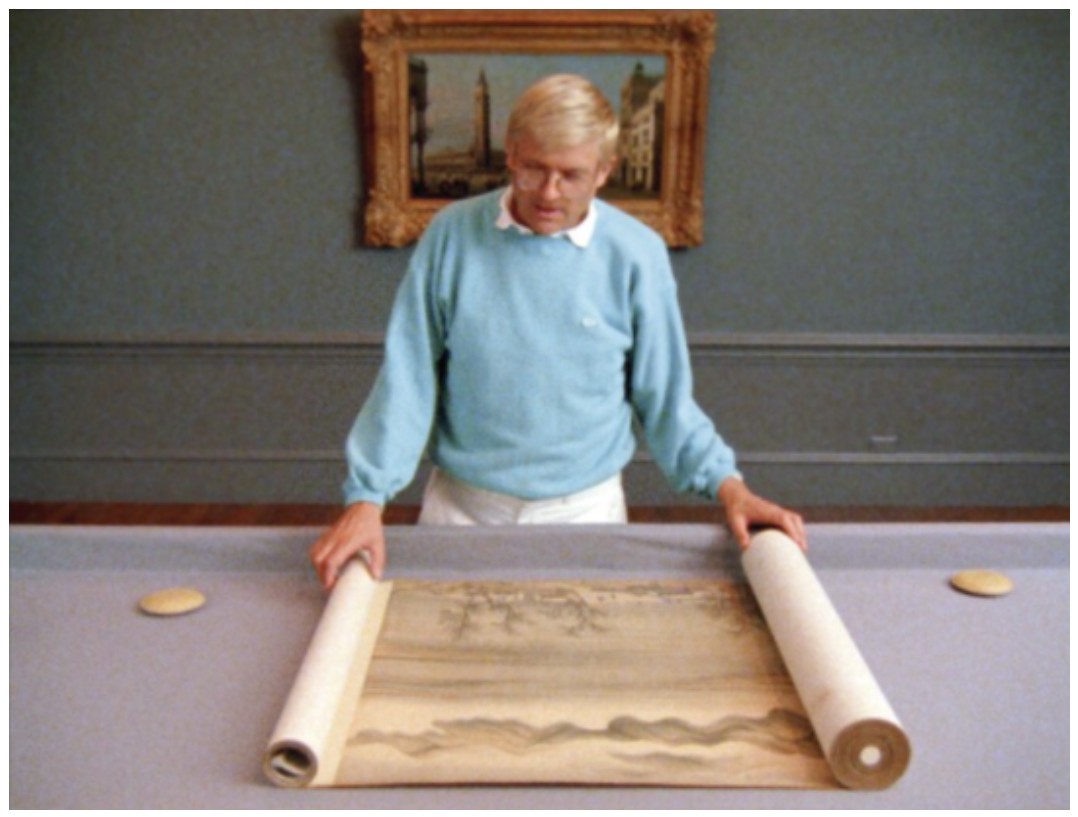
Still from film by David Hockney and Philip Haas, A Day on the Grand Canal with the Emperor of China, Milestone Film & Video,
Publisher, Harrington Park, New Jersey, 1988
Image Courtesy of David Hockney and Philip Haas
These influences marvelously fed into Hockney’s practice as his experiments later expanded into the realm of painting, culminating in works such as Bridlington Violet where although the viewer is presented with the floral vase from front-on, there are constantly changing vantage points that arise when examining the curving leaves and petals in closer detail, leaving the viewer to feel they are experiencing the work from multiple angles concurrently. In constructing coherent space through an arrangement of fragmented views of the same subject, Hockney embraces tradition whilst simultaneously innovates, liberating himself from the constraints of naturalism as he rejects historical ideas of perspective. As he asserts: ‘perspective takes away the body of the viewer. You have a fixed point, you have no movement; in short, you are not there really. For something to be seen, it has to be looked at by somebody and any true and real depiction should be an account of the experience of looking.’
Hockney was born in Bradford, Yorkshire in 1937 and moved to London at the end of the 1950s to study at the Royal College of Art. In the 1960s he relocated to Los Angeles and was struck by the sunny light and color that is now signature of his work. His family began to migrate Eastward in the 1970s, with his sister moving to Bridlington—a seaside town to the East of York where their mother soon joined. Hockney became a frequent visitor, purchasing a house with an adjoining studio which he returned more permanently in 2004, reengaging with the vast countryside landscape of his home.
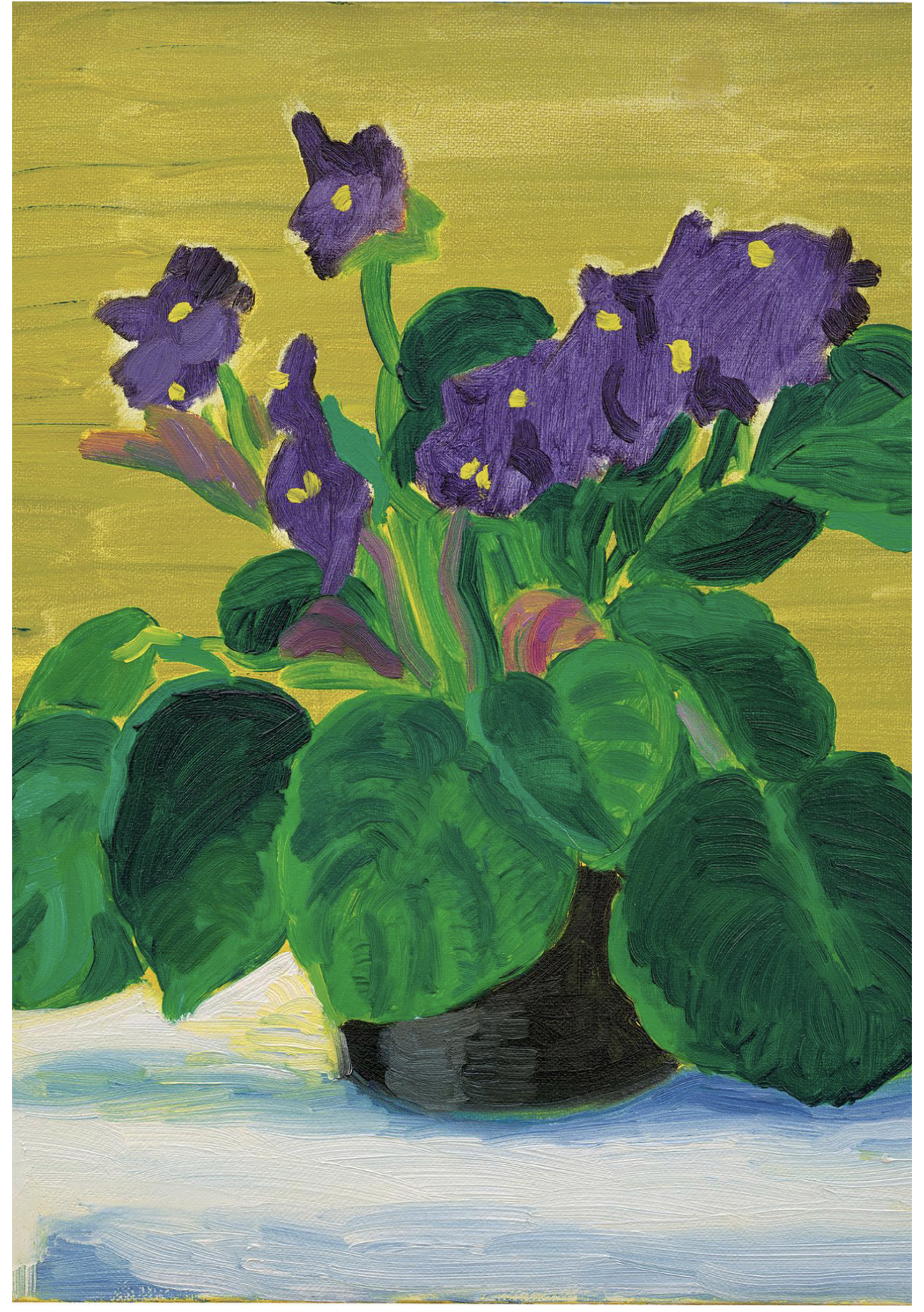
Rendered in bright yellow-green and vibrant shades of purple that showcase a unique proficiency for colour-theory Hockney finessed in California, Bridlington Violets is a joyful celebration of the still life genre, quintessential of Hockney’s celebrated series of painted blooms. And yet, differing to other similar floral works by the artist in that not all are geographically alluded to by their title, Bridlington Violets can be considered a painterly love letter to Bridlington, and to Hockney’s native Yorkshire.