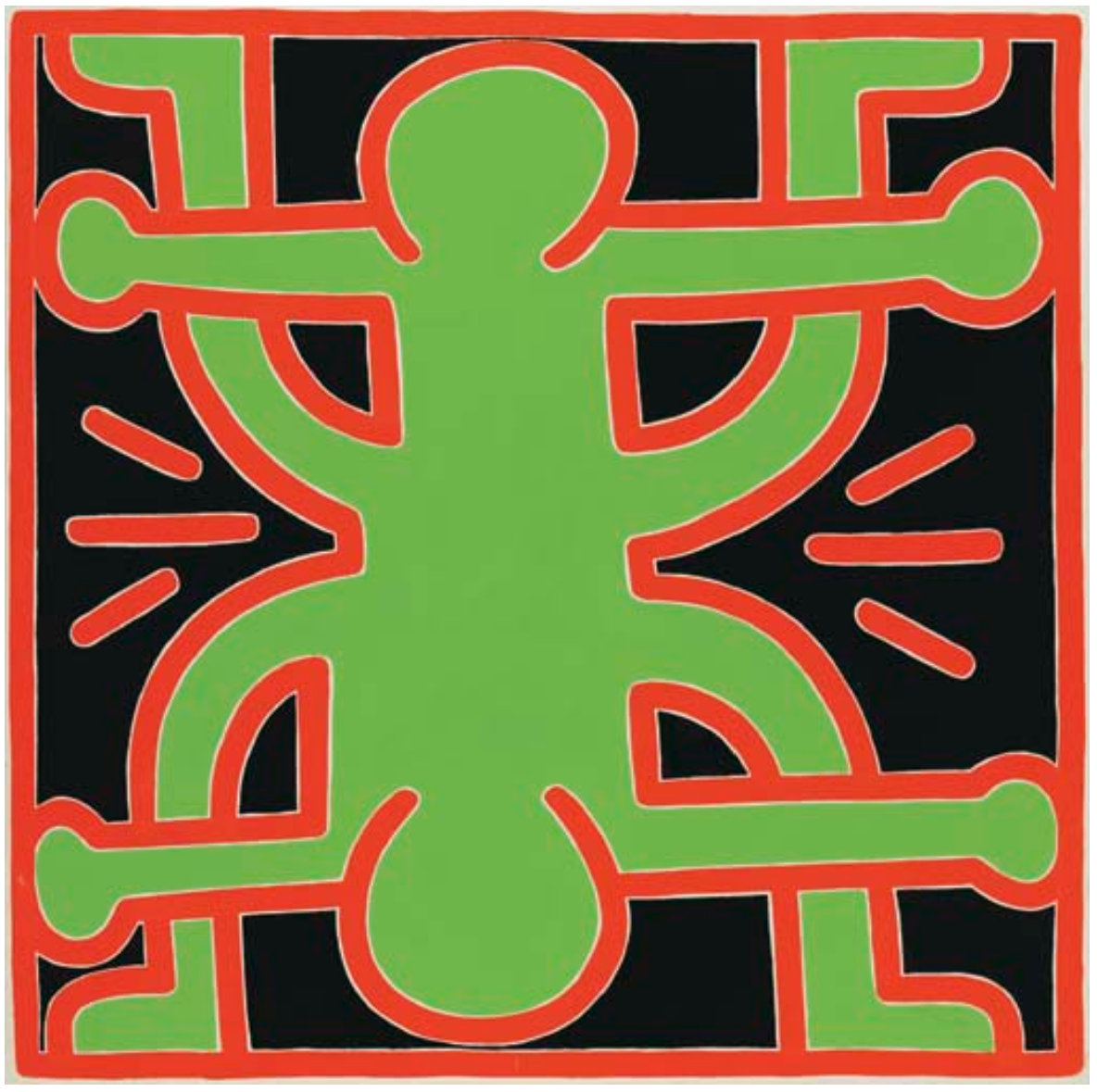
KEITH HARING
Untitled #4, 1988
Acrylic on canvas
60×60 inches (152.5 x 152.5 cm)
Signed, dated and inscribed ‘c K. Haring APRIL 1988 + NYC’ (on the overlap)
Provenance
Michael Kohn Gallery, Los Angeles
Auction History
Christie’s New-York: 9 November 2004
Estimated: USD 300,000 – 400,000
USD 511,500
Keith Haring (1958-1990) (christies.com)
The Eighties was a decade of break-dancing and electric boogie, and Keith Haring captured the climatic moments of the kinetic dance sequences from the dance and club halls of downtown New York City, first onto subway walls, and later onto canvas. What streamed from Haring’s paint brush, however, was not merely a two-dimensional portrayal of his own urban phenomenon but an interpretation of the increasingly media-saturated culture of the Eighties driven by such divisive issues like the Cold War, nuclear weapons, and AIDS.
By 1988, two years before his own death of AIDS, Haring clearly understood his responsibility as an artist. In his legendary Rolling Stone interview with David Sheff on August 10, 1989, Haring concludes: “When you are getting close to the end of the story, you have to start pointing all the things to one thing. That’s the point that I am at now, not knowing where it stops but knowing how important it is to do it now. The whole thing is getting much more articulate. In a way, it’s really liberating.”
Untitled #4 is a highly stylized representation of one of the popular dance moves, the “spider-move”, where two dancers intertwine their bodies to curve, bend, and do daredevil falls and leap until ultimately the bodies fuse. As Robert Farris Thompson explains, “spider-moves define beauty in relation to design and shared space. When b-boys [street dancers] combine in the spider-move pattern, they are not merely dancing. They are living a principle: work with your brother, share space in relation to time. Haring expands on that. It turns into an emblem.” (R. Thompson, “Haring and the Dance,” Keith Haring, New York, 1997, p. 218).