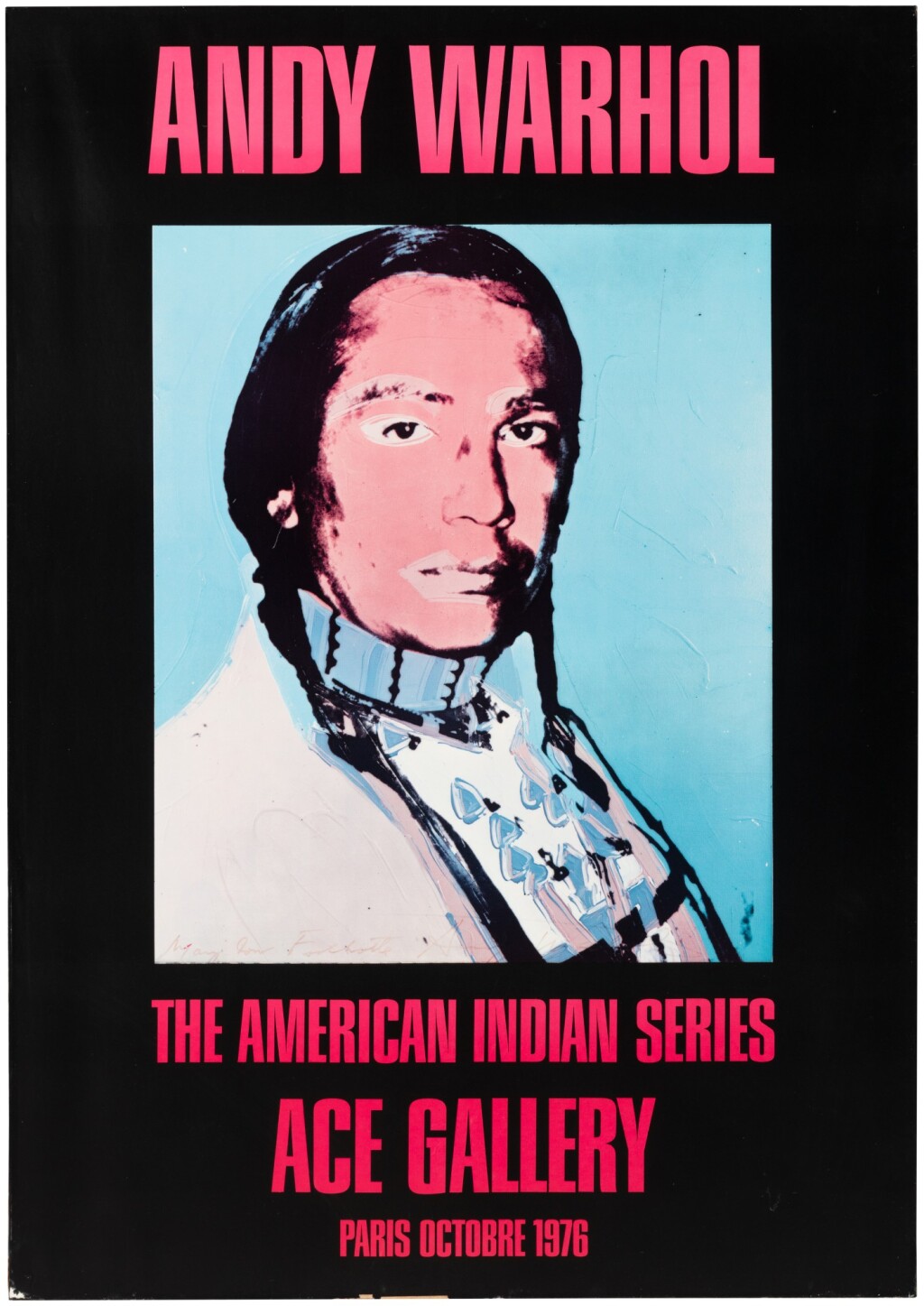
With its remarkable pictorial quality, Russell Means illustrates Andy Warhol’s devotion to political imagery and popular culture in shimmering hues. The result of a collaboration between the artist and Douglas Chrismas, founder of the Ace Gallery in Los Angeles and Vancouver, the ‘American Indian Series’ was initiated at the end of 1976 and completed early the following year.
Introduction
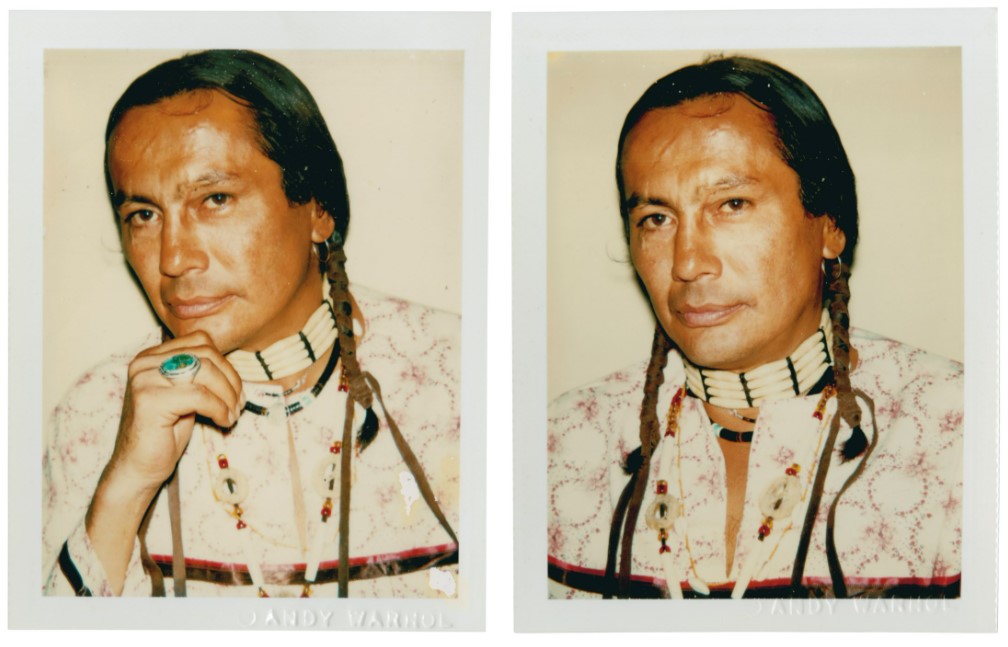
The series comprises thirty-eight paintings divided into two sets: twelve works measuring 214 x 177.8 cm and twenty-six works measuring 127 x 106.7 cm. This was not a commission in the true sense of the word, but rather a ten-year period of exclusivity granted by Andy Warhol to the gallery owner for the acquisition, exhibition and sale of these works. The genesis of the series began in February 1976 when Warhol made eighty-two Polaroids of Russell Means in his legendary studio at 860 Broadway in New York.
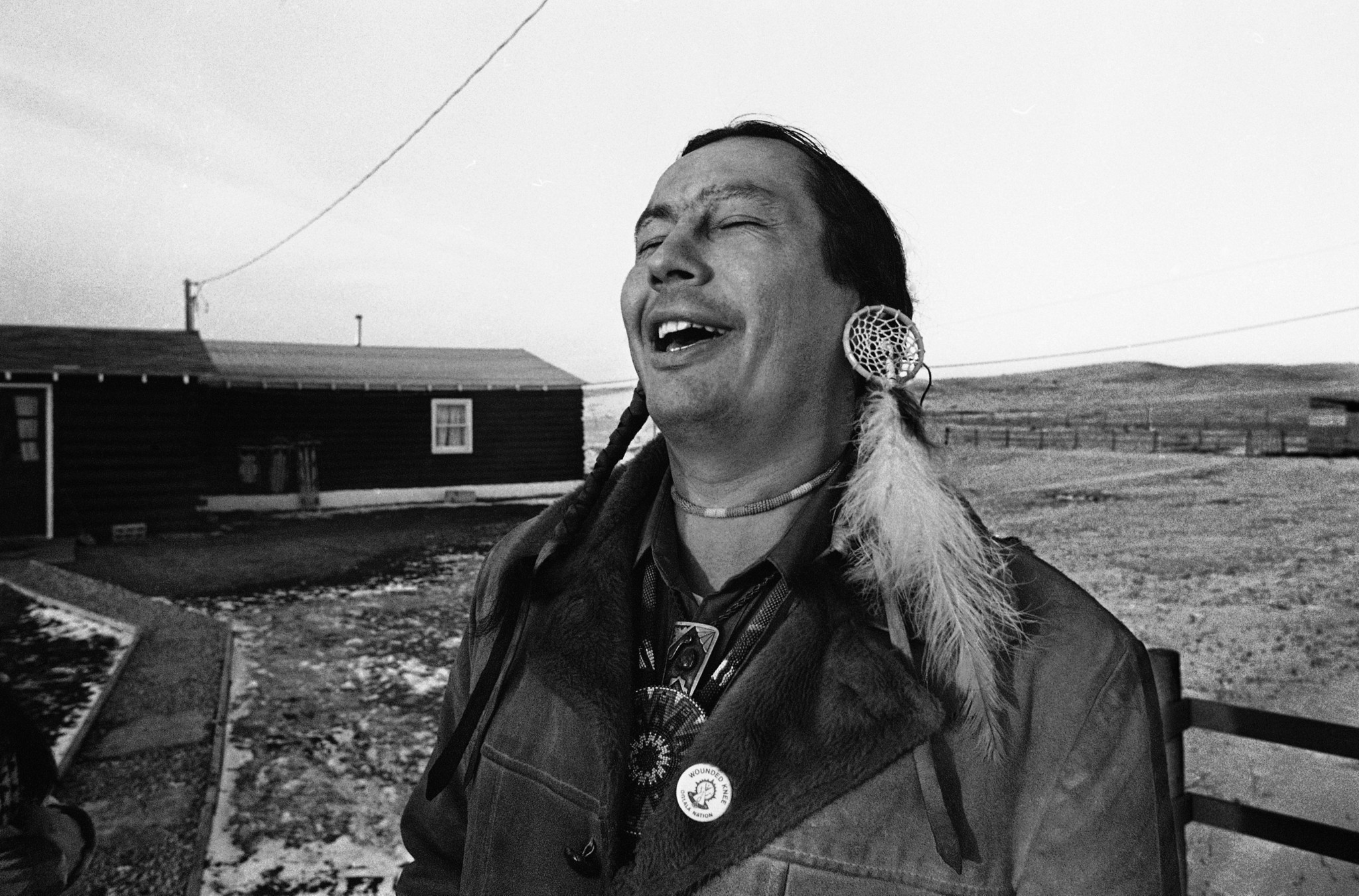
The subject of the series, Russell Means, a member of the Lakota tribe, led the American Indian Movement during the highly publicized, seventy-one-day siege of the town of Wounded Knee, the infamous site of an 1890 massacre of the Lakota by a U.S. Cavalry regiment, as protest of the U.S. government’s alleged tribal mistreatment. A focus of intense media scrutiny, the siege garnered significant attention in Hollywood, resulting in avid celebrity activism. Marlon Brando famously refused to accept his 1973 “Best Actor” Oscar for The Godfather because of Hollywood’s role in degrading the Indian and making mockery of his character. Despite its thematic continuity, The American Indian (Russell Means)’s loosely painted surface illustrates a shift in Warhol’s practice in the 1970s.
At first glance, The American Indian appears to be less a portrait than a picture of a facet of American culture, another icon pillaged from the vast iconographic quagmire of the capitalist world. Warhol has lulled us into a false sense of security by presenting us with an image that could be straight from the cover of a pulp Western novel or a cheap film, yet by showing Means, who was a well-known activist, in this way, he forces us as viewers to question our reactions to the image, our associations with the theme. Warhol points to our own reflexes, highlighting the rapidity with which we pigeonhole this image. This is a reaction made all the more apparent because of the supposedly superficial gloss of Warhol’s own art. For while he has celebrated many aspects of American culture from Coca Cola to Campbell’s Soup to the dollar bill via Elvis, Marilyn and Elizabeth Taylor, there has always been a darker undercurrent that disrupts our presumptions, forcing us to reappraise the world of images that we take for granted. Despite his own denials, there is a weight to Warhol’s work that lurks, hidden, underneath the colourful sheen of the surface. Like quicksand, once we are beyond that surface we are engulfed in complexity and paradox. Warhol deliberately tricks the viewer into seeing The American Indian as a stock character, and then plays on the awkward feelings that a little context provokes.
It was only in 1991 that he became an actor, starring in Michael Mann’s adaptation of Fennimore Cooper’s The Last of the Mohicans. There is an unavoidable whiff of the mischievous in Warhol’s lurid portrayal, with Means is presented as a stock character in his native finery. The persona of the activist and lecturer is bulldozed out of the way by Warhol’s style, his manner of transforming an image, the bright Pop palette. Instead, The American Indian appears superficial, a very Pop Indian, a cliché from the same world that Roy Rogers and the Lone Ranger inhabit. Warhol has managed to turn Russell Means into the very thing that he protests against. Yet Warhol creates these associations in order to highlight them.
Even today, the image of the American Indian from the Wild West is endemic and was much more so in the 1970s when The American Indian was created. Be it in the form of the savage of the early Westerns or the mystical, shamanic presence of the later ones, the Native American is in a sense a construct of the American imagination, a fiction that all too conveniently glosses over the rights and heritages of hundreds of aggrieved peoples. The stereotype of the American Indian is, even when it is meant to be ennobling, a reductive construct. This is a product of the European newcomer, the invader, and no-one is more aware of it than Means himself. In a speech he made only a few years after The American Indian was created, he pointed out that this construct pervades the American cultural consciousness even at a linguistic level:
“You notice I use the term American Indian rather than Native American or Native indigenous people or Amerindian when referring to my people. There has been some controversy about such terms, and frankly, at this point, I find it absurd. Primarily it seems that American Indian is being rejected as European in origin– which is true. But all the above terms are European in origin; the only non-European way is to speak of Lakota– or, more precisely, of Oglala, Brule, etc.– and of the Dineh, the Miccousukee, and all the rest of the several hundred correct tribal names.”
(Means, Black Hills International Survival Gathering, 1980).
In The American Indian, Warhol forces the viewer to navigate the ambiguities of this construct, of this heritage, of the history and presumptions and disinformation and injustice all of which are associated with the past of the native Americans. The Wild West remains one of the richest seams of story and history in the United States, a unique arena in which epic struggles between men and with the elements were fought out. It is for this reason that the cowboys and Indians became so central to American culture. These were new and original characters, unique to the United States, new archetypes at the centre of American myth, and this is reflected in the penny dreadfuls, the novels, the films, the history, the tourism… It is therefore only natural that the Wild West appeared many times one way or another in Warhol’s oeuvre. Be it in his pictures of Elvis, based on publicity stills for the film Flaming Star, or in Warhol’s own film, Lonesome Cowboys, the West was far too rich a source of images and themes to be left alone by this scavenger Pop artist. However, The American Indian is one of the only times that Warhol looked at the other side of the coin, at the Indian not the cowboy. Where in other places he used these subjects as themes in which to undermine the machismo traditionally associated with the West (kissing cowboys, camp Elvis), The American Indian reveals the usually inscrutable and apolitical artist producing an image in which the tension that arises from the discrepancies between content and context is wholly relevant, political and deeply human.
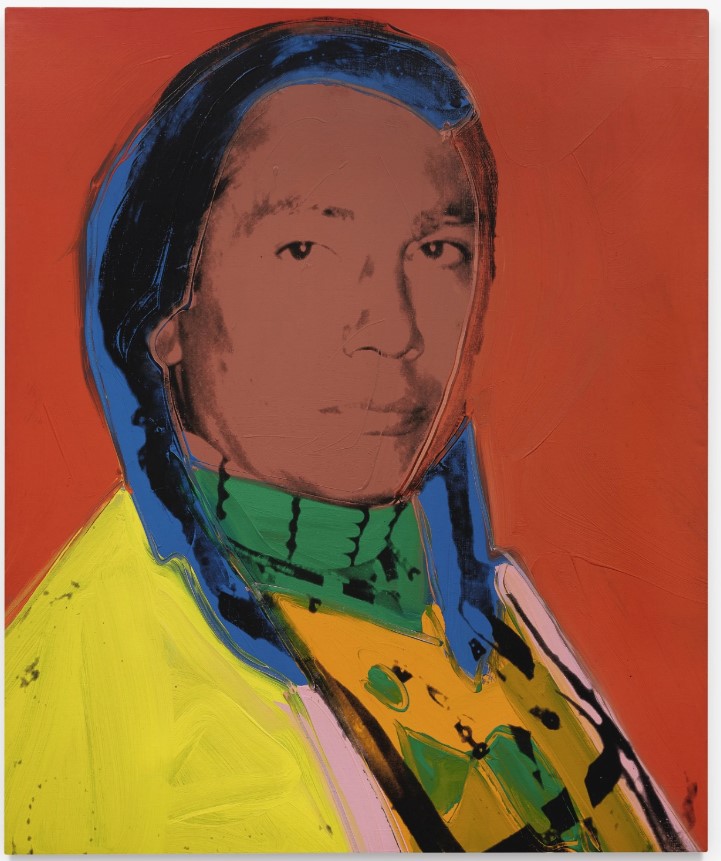
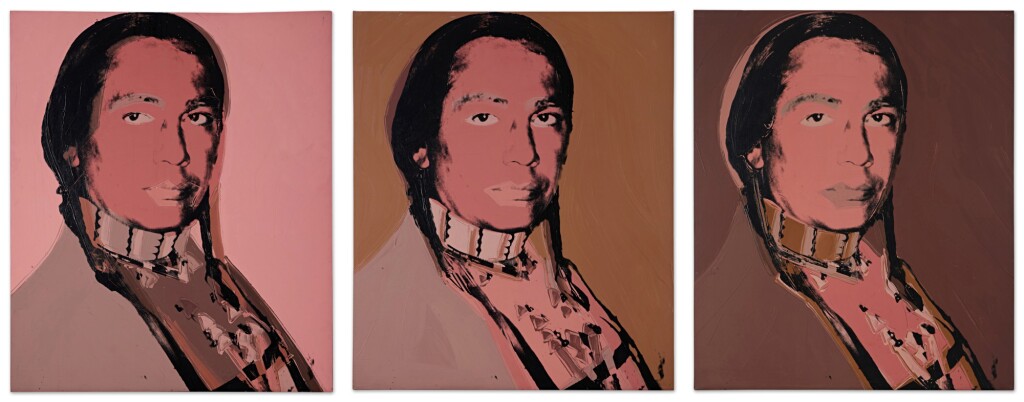
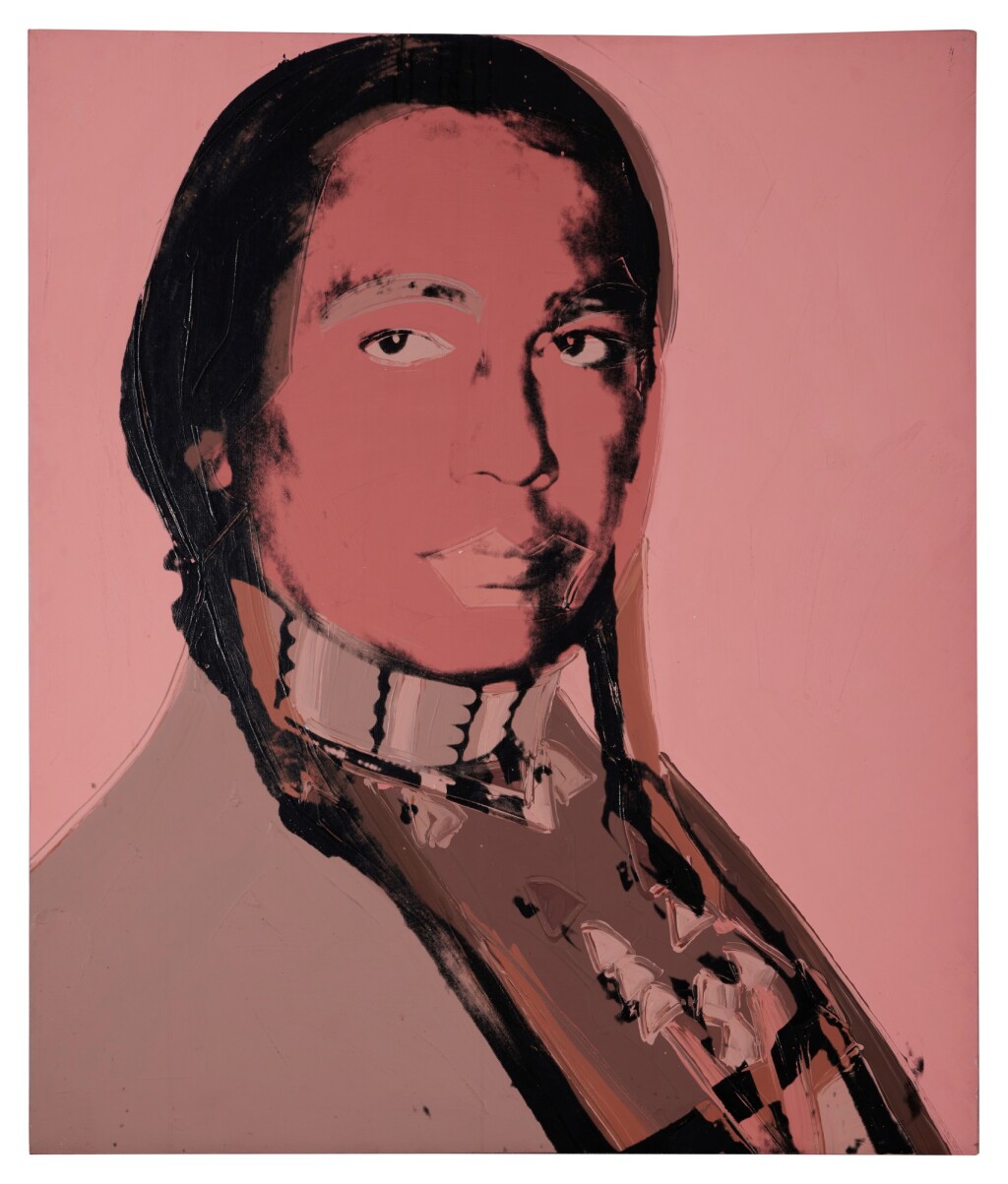
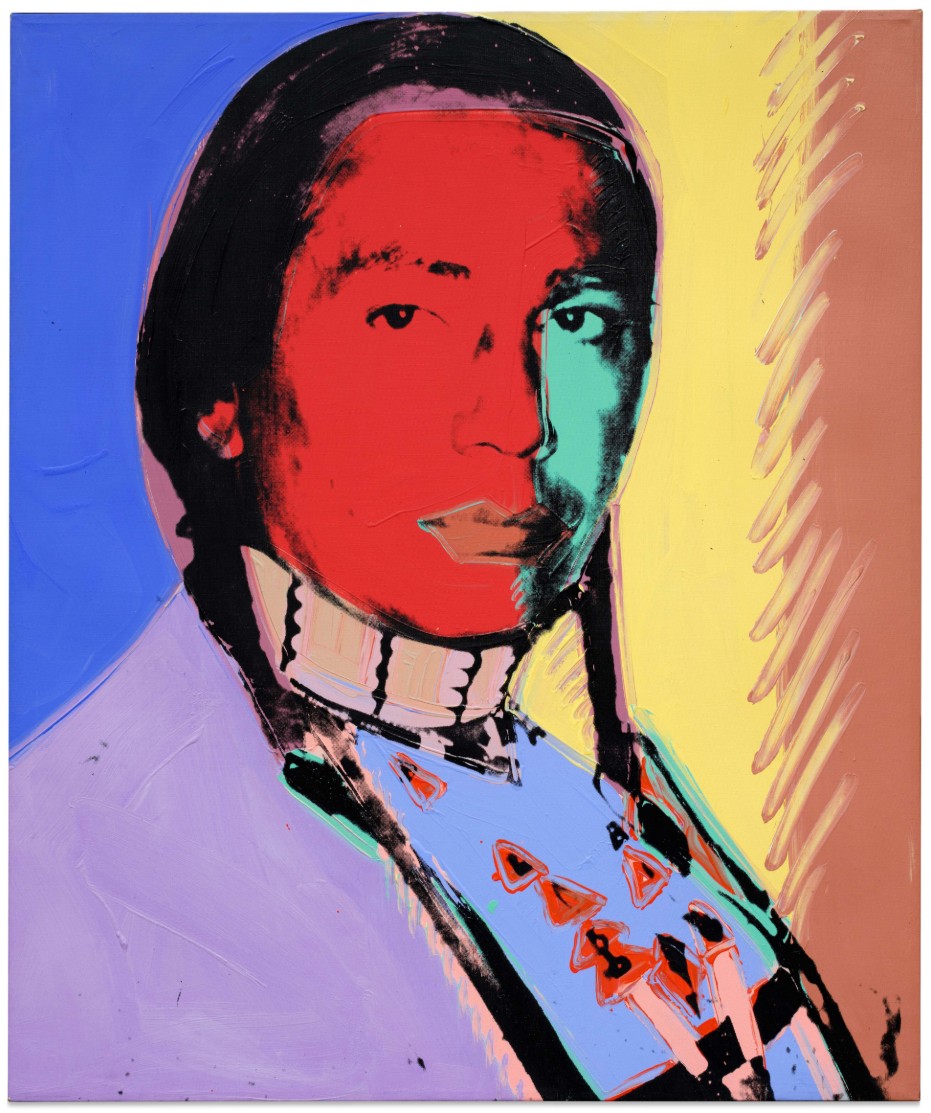
The American Indian (Russell Means) simultaneously proffers Means as a cultural icon and essentializes him, flattening his individuality to the character type of an “American Indian.” Though he positions his body three-quarters away from viewers, Means faces them straight-on: he turns his head to meet their gaze. There is a solemnity to his expression; his right eyebrow raised slightly, as if to acknowledge viewers’ presence, but he bears no hint of a smile. His unflinching stature carries a gravitas that bespeaks his authority within his community, and he consumes the entirety of the canvas, demanding viewers’ full attention. Cropping the portrait to Means’ bust—and therefore adopting the legacy of bust-portraiture, a form typically reserved for Western history’s great leaders—elevates Means’ status for Western viewers. Doing so also lends a sense of celebrity to Means’ image, for it places the portrait in line with Warhol’s many portraits of celebrities and cultural icons, nearly all of whom he removes from their context and crops into a high-keyed, flat backdrop. Warhol emphasizes Means’ dominant facial features: his defined bone structure and his piercing, focused gaze. Unlike many of his other series of portraits—such as Marilyn, Mao, and Ladies and Gentlemen—which he decorates with makeup-like face paints, Warhol renders Means’ face with a monochromatic wash of color. Given the widespread trope of face paint in stereotypes of Native Americans, Warhol’s refrain from stylizing Means’ face with various tones of paint is particularly curious. Warhol uses Means’ accoutrements as an arena for color play instead, coating his subject’s hair with bright blue pigment, swashing his jacket with thick strokes of cadmium yellow, dousing his shirt and collar in turmeric and basil hues, and striping his jacket’s edges with dashes of bubblegum pink.
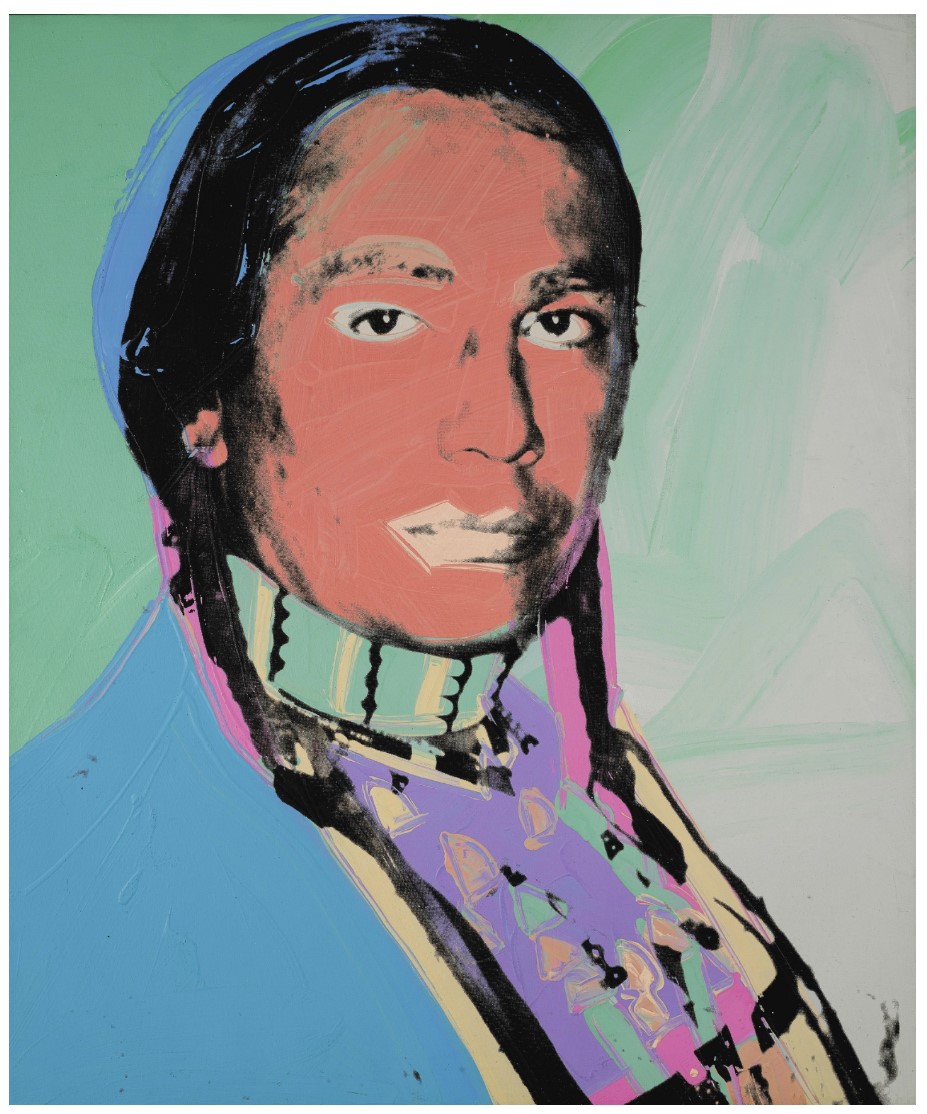 ANDY WARHOL
The American Indian (Russell Means), 1976
With its dual significance, an emblem of a contemporary sociopolitical crisis and an American archetype with far-reaching cultural resonance, The American Indian (Russell Means) makes manifest Warhol’s profound contribution to the history of art. The series’ conceptual grounding in seriality and repetition roots it to the core of Warhol’s oeuvre; with an ethos of mass-production, The American Indian (Russell Means) helps cement Warhol’s status as the most powerful force behind American art’s turn from Abstract Expressionism to Pop Art.
The American Indian (84×70)
The American Indian (Russell Means), 1976
Sotheby’s New-York: 16 May 2019
Estimated: USD 4,000,000 – 6,000,000
USD 6,300,000
(#20) ANDY WARHOL | The American Indian (Russell Means)
ANDY WARHOL
The American Indian (Russell Means), 1976
Acrylic and silkscreen ink on canvas
84.2 x 70 inches (214 x 177.8 cm)
American Indian (Russell Means), 1976
Christie’s London: 21 June 2006
Estimated: GBP 700,000 – 1,000,000
GBP 1,464,000
Andy Warhol (1928-1987) , American Indian (Russell Means) | Christie’s
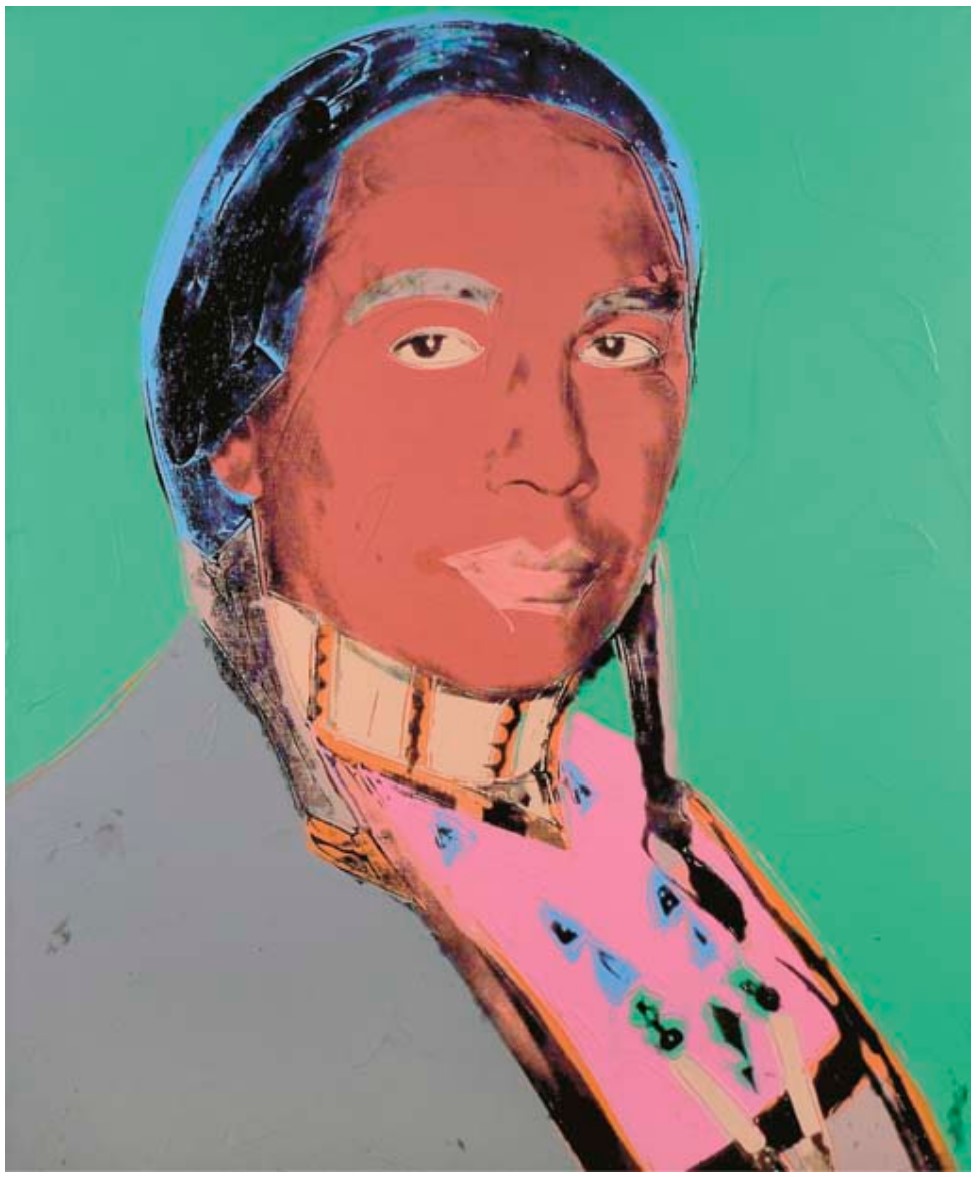
American Indian (Russell Means), 1976
Synthetic polymer paint and silkscreen inks on canvas
84×70 inches (213.5 x 178 cm)
The American Indian (Russell Means), 1976
Estimated: USD 500,000 – 700,000
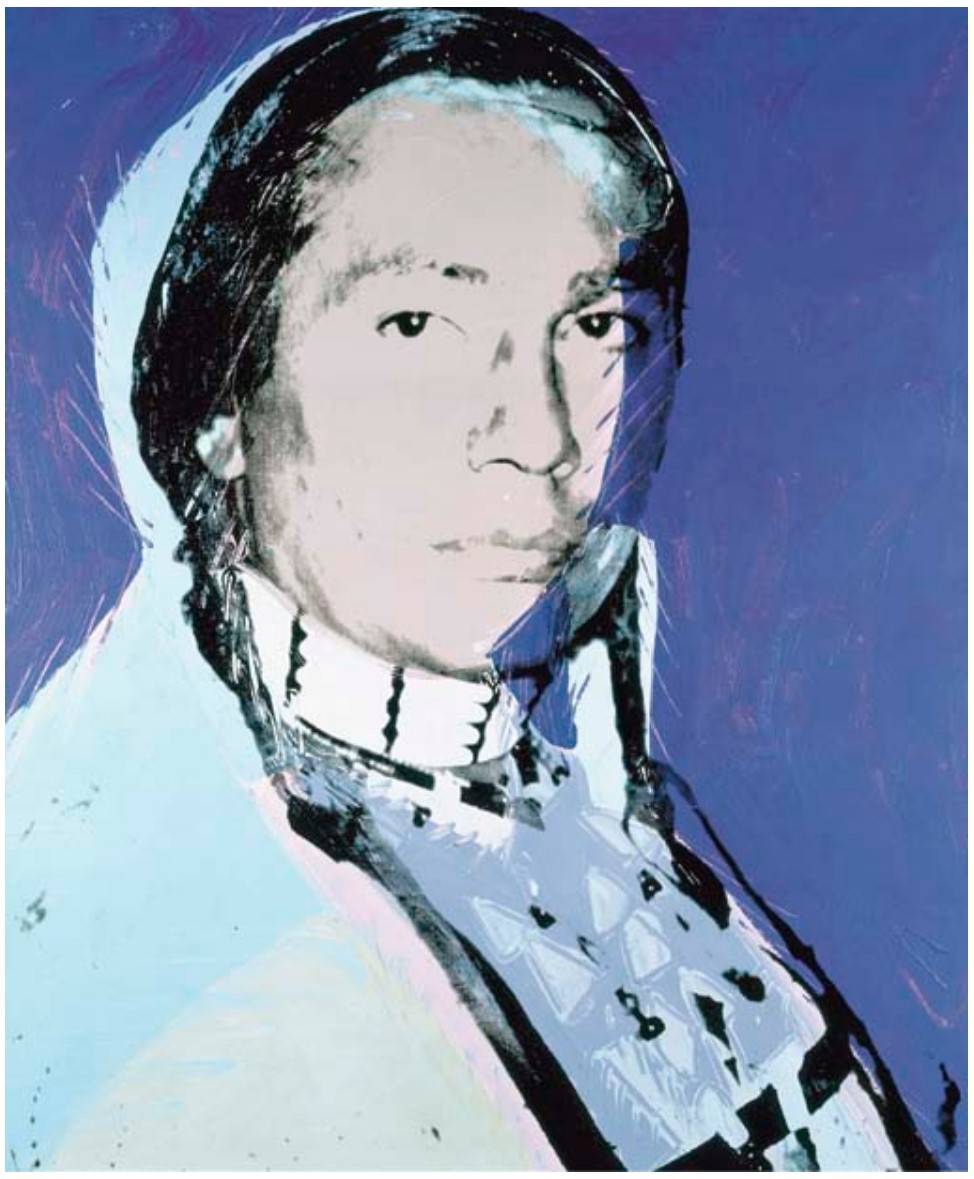
The American Indian (Russell Means), 1976
Synthetic polymer and silkscreen inks on canvas
84×70 inches (213.4 x 177.8 cm)
The American Indian (50×42)
The American Indian (Russell Means), 1976
Property from an Important European Collection
Sotheby’s New-York: 14 May 2026
Estimated: USD 1,500,000 – 2,000,000
USD 3,231,000
Andy Warhol | The American Indian (Russell Means) | The Now &
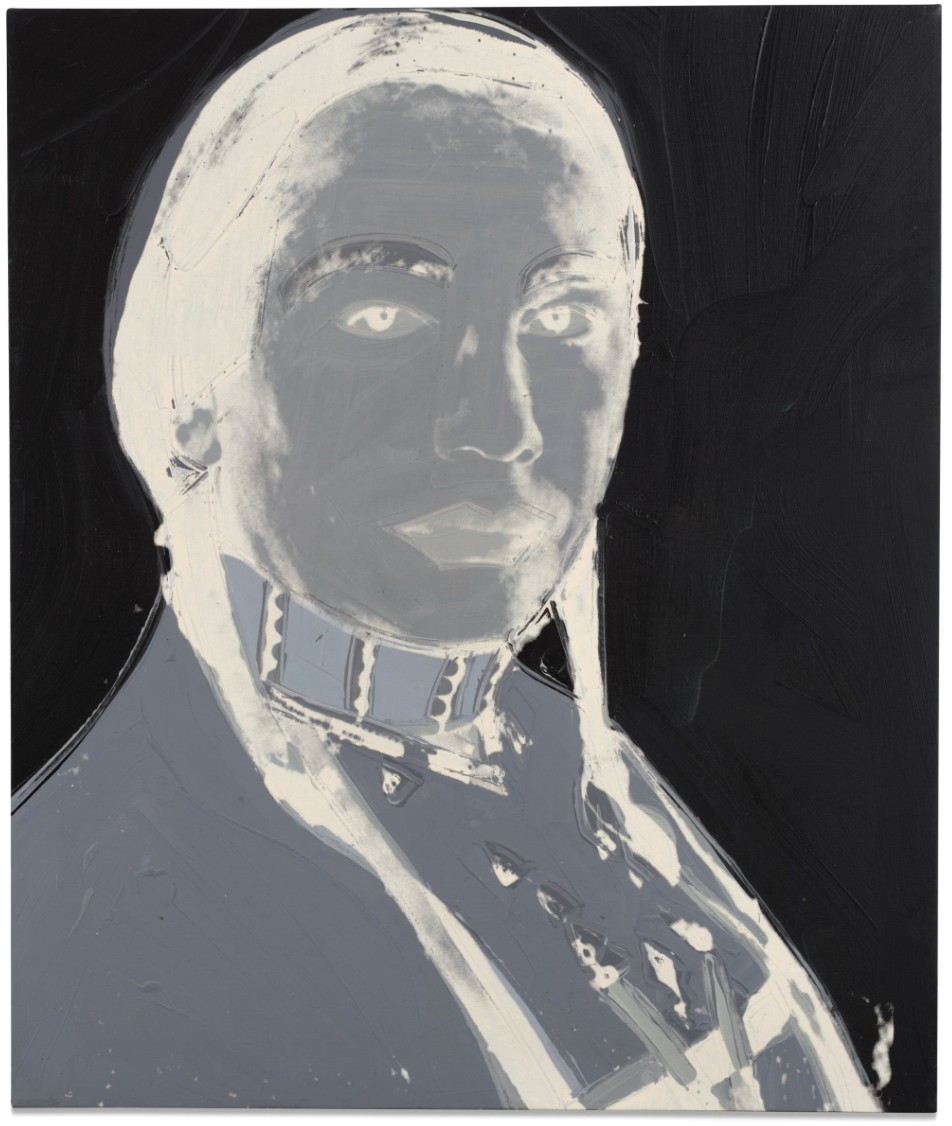
ANDY WARHOL (1928 – 1987)
The American Indian (Russell Means), 1976
Acrylic and silkscreen ink on canvas
50×42 inches (127 x 106.7 cm)
Signed twice, titled, and dated 1976 (on the reverse)
Rendered in a commanding grisaille palette, The American Indian (Russell Means) from 1976 is a stirring synthesis of Andy Warhol’s unparalleled devotion to popular culture and his adoption of political imagery in his artistic output. Encompassing the dual definitions of individual and archetype, The American Indian (Russell Means) embodies Warhol’s most daring explorations of the seriality and portraiture which define the core of his oeuvre. The work, alongside the remainder of The American Indian series, is impressive in scale and intellectually rigorous in theme, revealing Warhol’s incisive and endless fascination with the cultural forces that define the American image. Conceived as a project with West Coast dealer and Ace Gallery owner Doug Chrismas, the present work, in its striking black and white palette, distinguishes it as among the very best from the series.
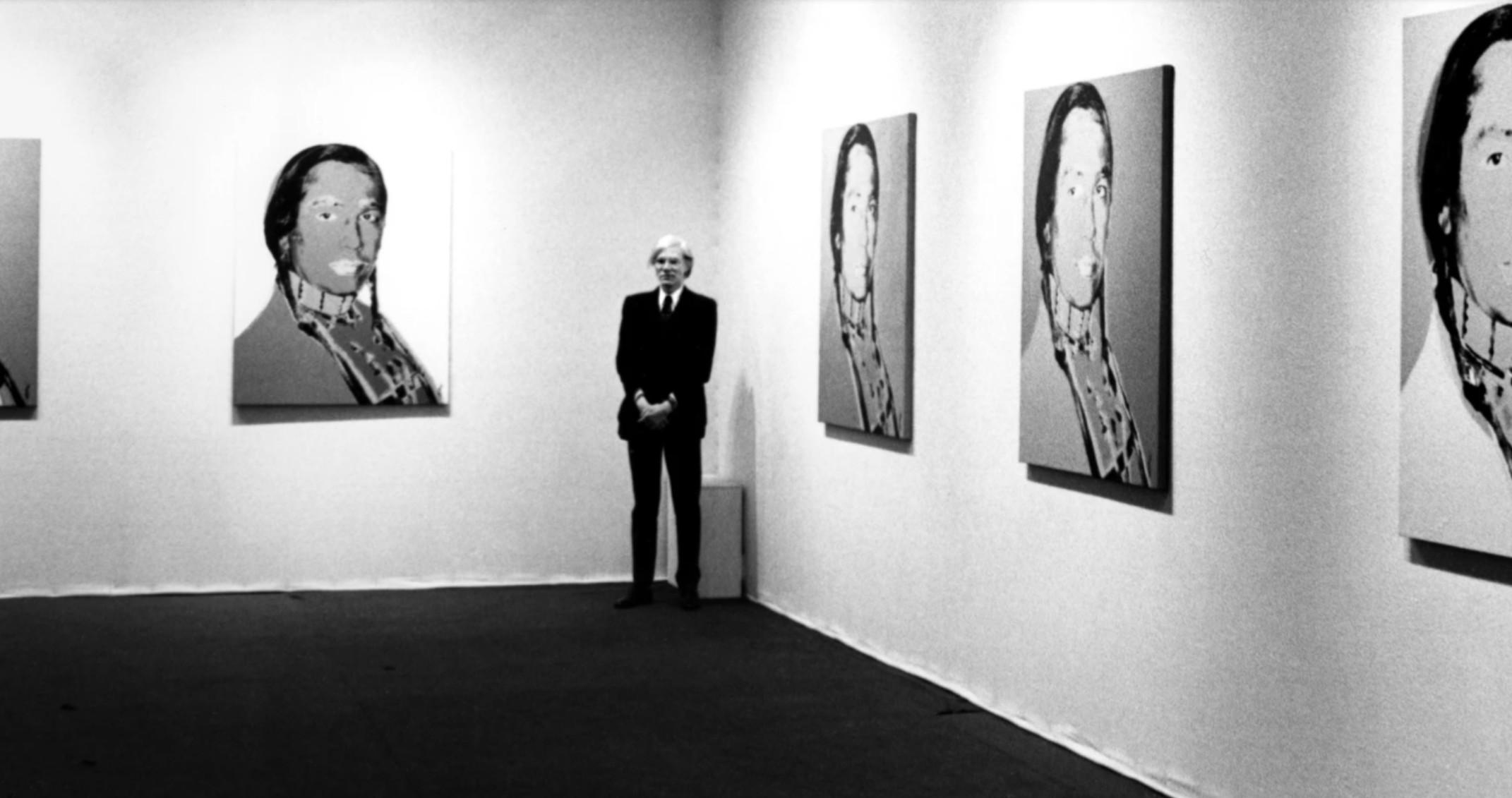
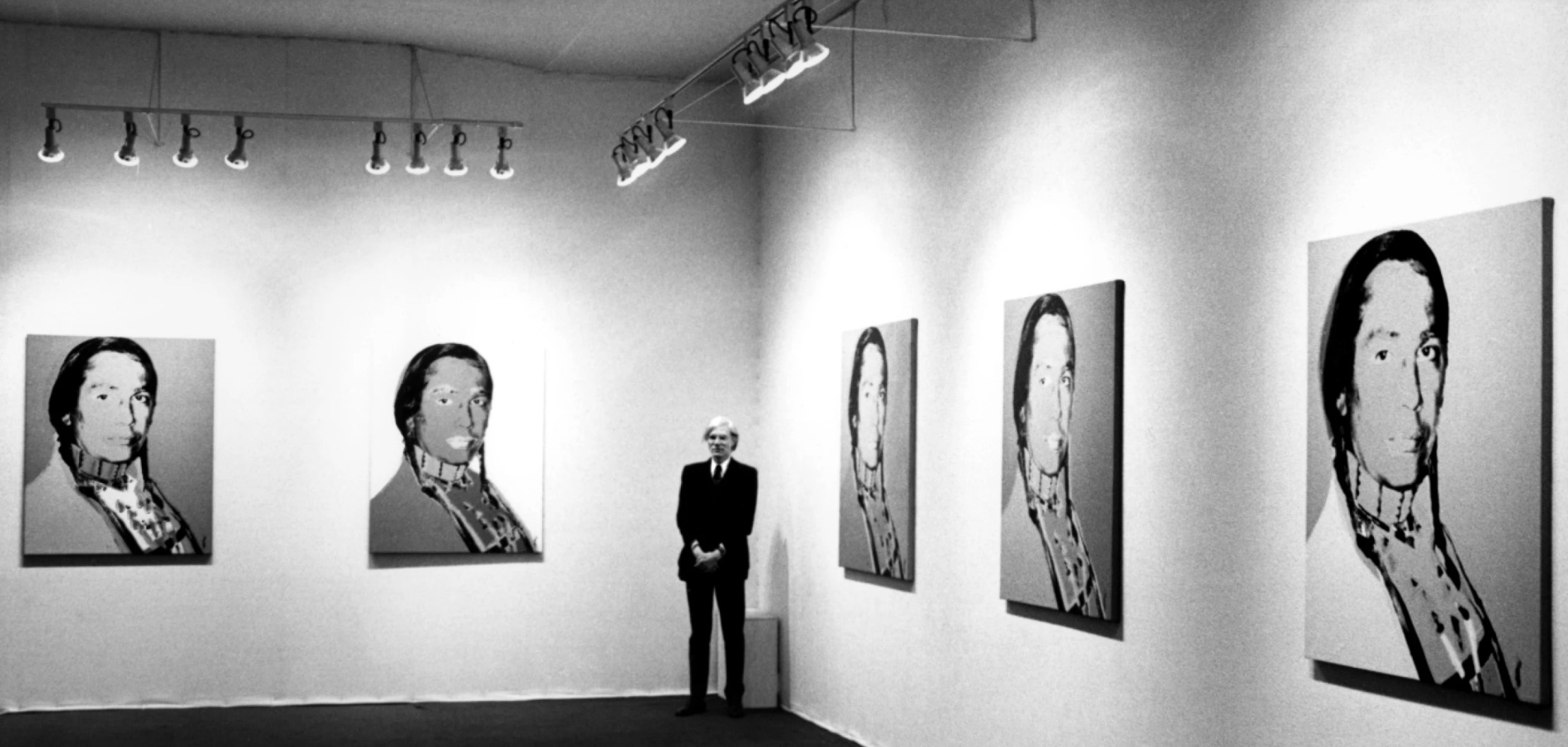
Andy Warhol at the opening of The American Indian Series at ACE Gallery, Paris 1976.
Photo © Courtesy of Ace Gallery. Art © 2026 Andy Warhol Foundation for the Visual Art / Artists Rights Society (ARS), New York
In the series, Means is depicted wearing a calico print shirt, four beaded necklaces and a bone hairpipe choker, with his hair braided with brown leather wraps. His manner of dress was not particularly specific to his Lakota ancestry, but rather “contemporary and generically Indian in a sense, having come into fashion during the 1970s as an expression of American Indian pride.” (Neil Printz and Sally Kind-Nero, eds., The Andy Warhol Catalogue Raisonne, Vol. 4: Paintings and Sculpture late 1974-76, New York 2014, p. 495) Means’ typified manner of dress, refracted through Warhol’s characteristic use of seriality, contrasts with Means’ role as an individual community activist.
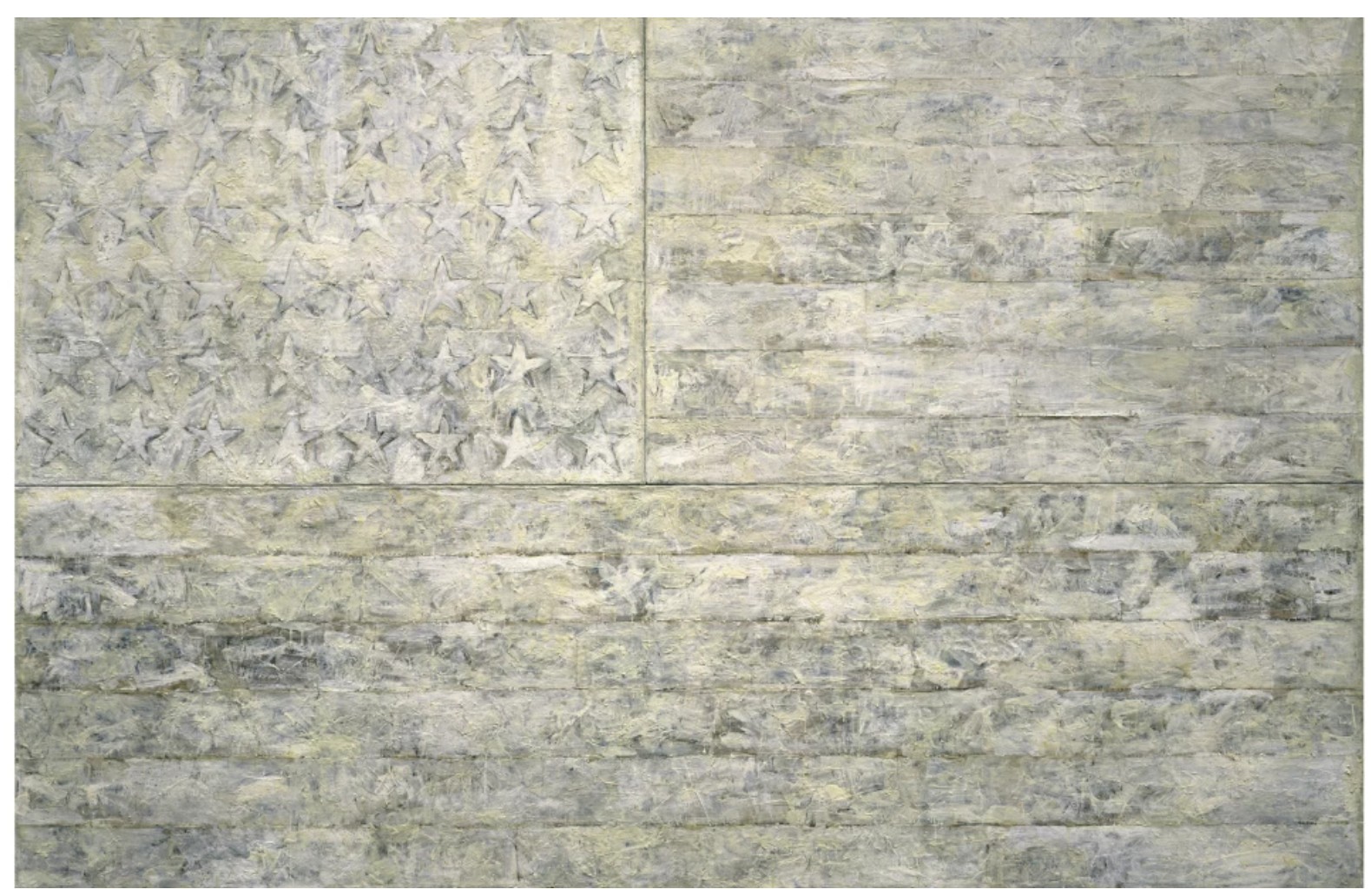
Jasper Johns, White Flag, 1955. The Metropolitan Museum of Art, New York. Image © The Metropolitan Museum of Art. Image source: Art Resource, NY. Art © 2026 Jasper Johns / Licensed by VAGA at Artists Rights Society (ARS), NY
Taken together, these factors form a complex identity for the “contemporary Indian,” who is both undeniably individual and apparently generic; as Rainer Michael Mason remarks on Warhol’s execution of the series, “The master of indifference, with a sureness that is less somnambulistic than it appears, has once more adopted a theme that is simultaneously captivating and banal. The Indian is a conventional accessory of the American scene, for the same reason as its counterpart, the cowboy, or as Coca-Cola, the electric chair, the movie star. The title of the series, moreover, ‘The American Indian’ takes this anonymous and communal dimension into account. At the same time, however, the Indian is the face of a real political problem, of a singular minority, and beyond that of all the American minorities.” (Rainer Michael Mason cited in: Neil Printz and Sally Kind-Nero, eds., The Andy Warhol Catalogue Raisonne, Vol. 4: Paintings and Sculpture late 1974-76, New York 2014, p. 493)
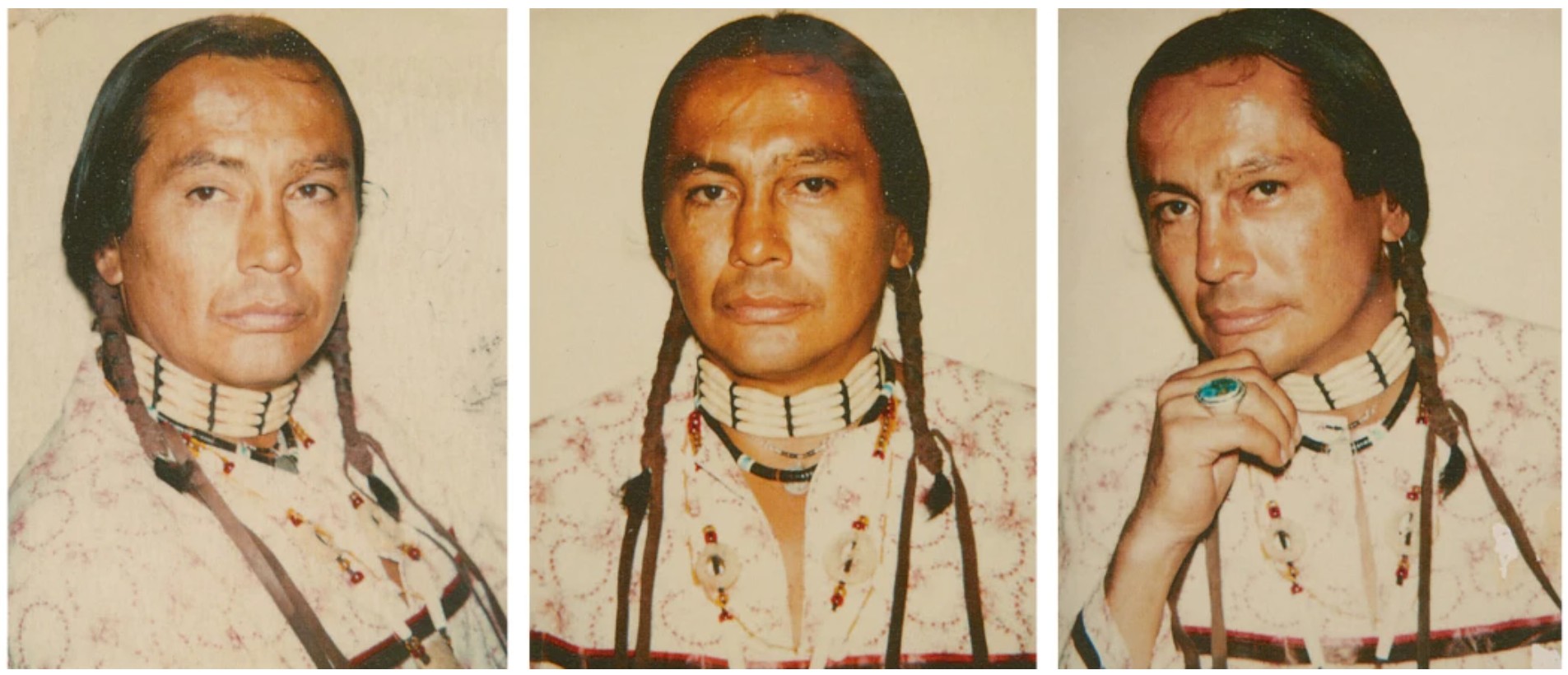
Polaroid studies of Russell Means, 1976. Art © 2026 Andy Warhol Foundation for the Visual Arts / Artists Rights Society (ARS), New York
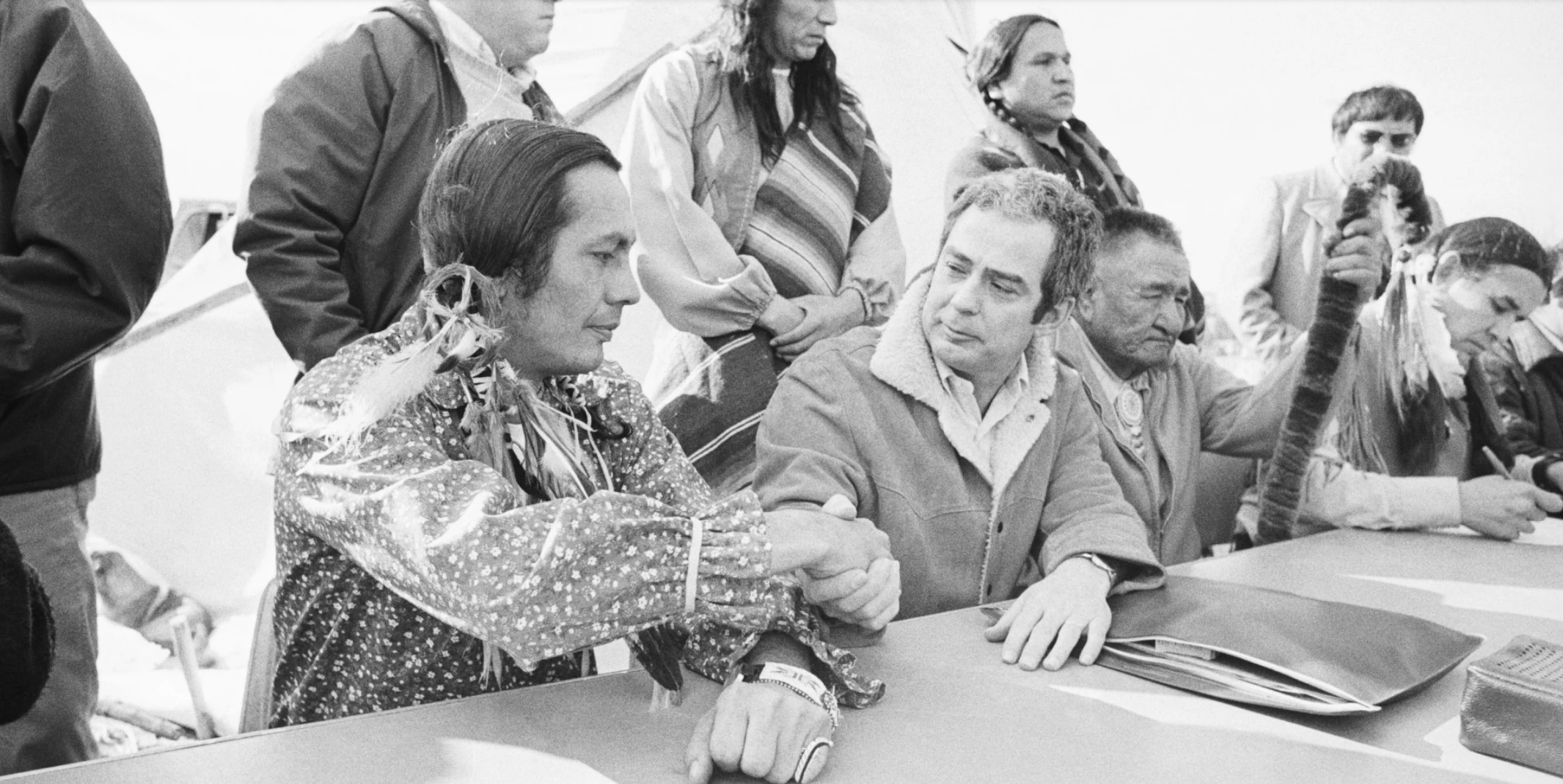
Executed in the years following Russell Means’ siege of Wounded Knee, The American Indian series naturally assumes a political dimension. The lush setting of the American West becomes simultaneously associated with Hollywood myth-making, a force that often contributes to the stereotyping of the Indian and his character. This stereotype is often characterized by face paint, an image that seems commonplace, but in reality possesses a specific cultural meaning: as Means explains, face paint “was put on only those willing to die,” so those who wore such paint “were all the soldiers, the defenders inside Wounded Knee.” (Russell Means cited in: Neil Printz and Sally Kind-Nero, eds., The Andy Warhol Catalogue Raisonné, Vol. 4: Paintings and Sculpture, Late 1974-76, New York 2014, p. 498)
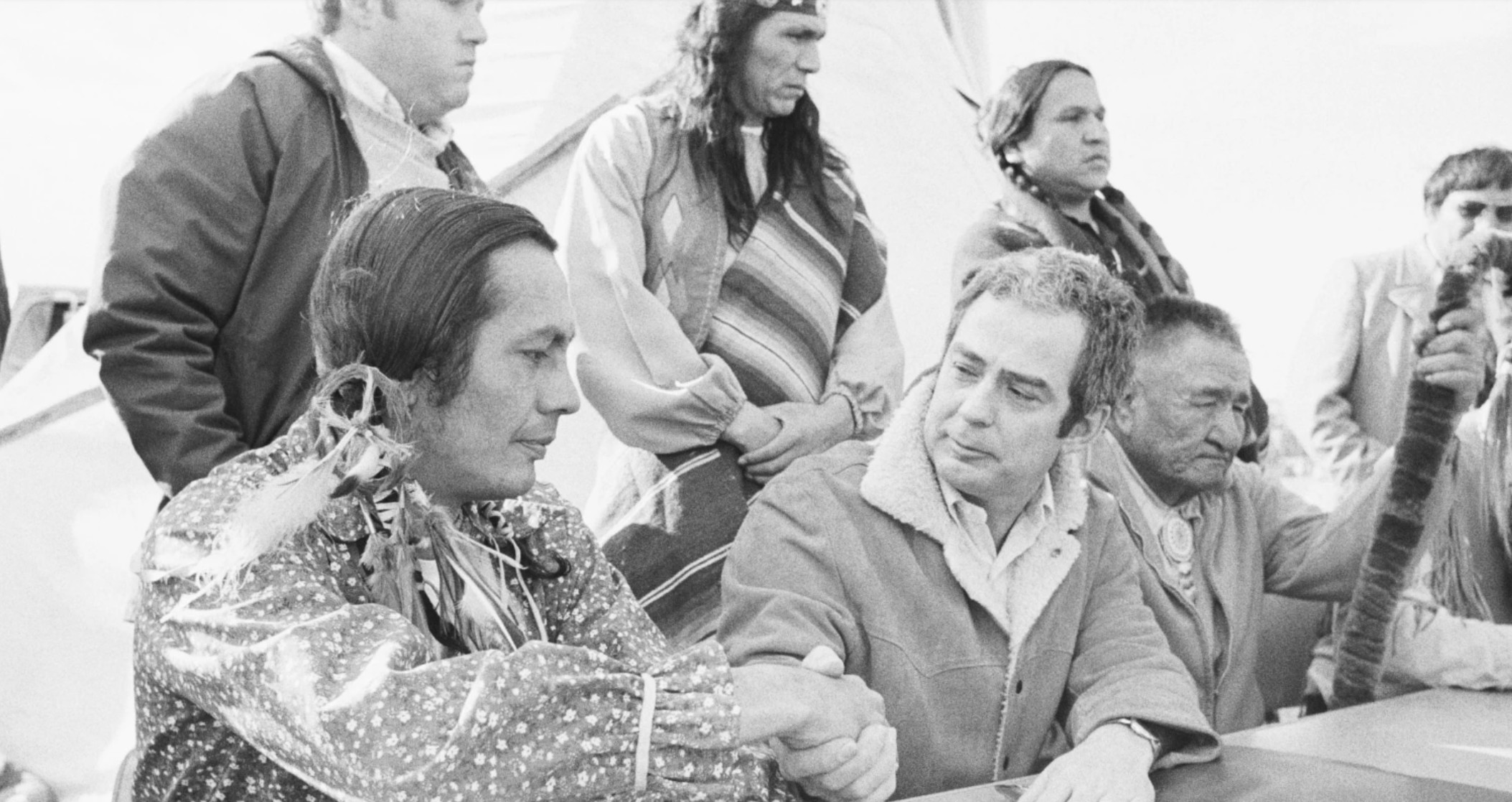
Russell Means and Kent Frizzell shaking hands, 1973. Image © Getty Images / Bettman
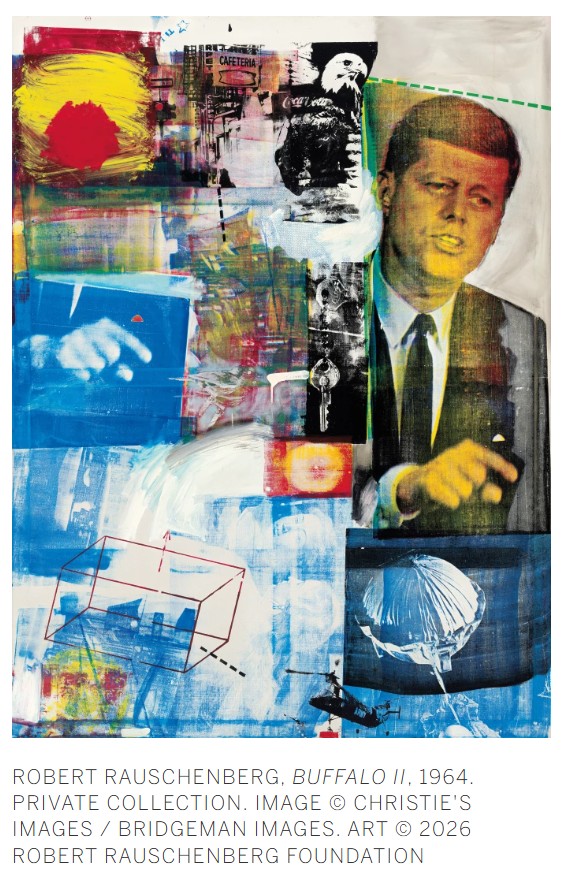
In this context, Warhol’s use of black-and-white paint to portray Means’ face throughout the series is especially striking. In doing so, Warhol lends the image as a whole a sense of ambiguity: oscillating between a dignified individual and a flattened archetype, and playing upon the language of media culture while presenting a sincere artistic representation.
The rich painterly texture and thick application of monochrome hues that subtly sweep across the canvas distinguish the present work as an exceptional example of the series. The shades of charcoal, stone, and white are beautiful. A fascination of American culture: The Wild West, cowboys, and Indians, became central to American culture, providing new archetypes of American myth, yet they proliferated stereotypes. The progenitor of Pop, the arbiter of Consumerism, Andy Warhol artistically examined the Wild West, and it notably became a source of his inspiration in his pictures of Elvis. Although he sometimes used these subjects to undermine the Machismo of the West, here the apolitical, ambiguous artist produces The American Indian (Russell Means) an image which directly explores the discrepancies between content and context, paying homage to the political activism of Russell Means and particularly his significance during the 1970s.
The American Indian (Russell Means), 1977
Sotheby’s New-York: 18 November 2025
Estimated: USD 2,o00,000 – 3,000,000
USD 4,076,000
The American Indian (Russell Means) | The Now & Contemporary Evening Auction | 2025 | Sotheby’s
ANDY WARHOL (1928 – 1987)
The American Indian (Russell Means), 1977
Scrylic and silkscreen ink on canvas
50 1/8 x 42 inches (127 x 106.7 cm)
Residing at the intersection of popular culture, political activism, and celebrity, Portrait of an American Indian (Russell Means) is an exemplar of Andy Warhol’s distillation of diverse ideas into an iconic, enduring image. The image in question—a monumental headshot of Lakota leader and activist Russell Means—stares unflinchingly out at the viewer, clad in the silkscreen ink and bold swathes of color that mark Warhol’s signature style. In a venture with West Coast dealer and Ace Gallery owner Doug Chrismas, Warhol produced a limited suite series entitled, The American Indian, of which many are now held in prominent institutional collections including The National Museum of the American Indian, Washington, D.C.; Hamburger Kunsthalle; and The Andy Warhol Museum, Pittsburgh, among others. The present example, executed in late 1976, is among the very best from the series, possessing exceptional clarity in both line and color. Alongside its stunning visual contrasts, the portrait stirs up the contrasting perceptions of its subject: at once proud individual and general archetype, Portrait of an American Indian (Russell Means) embodies the “ironies” and “powers” that define Warhol’s most rigorous examinations of contemporary culture—as seen through the lens of his art. (Tony Berlant cited in: Neil Printz and Sally Kind-Nero, eds., The Andy Warhol Catalogue Raisonne, Vol. 4: Paintings and Sculpture late 1974-76, New York 2014, p. 492)
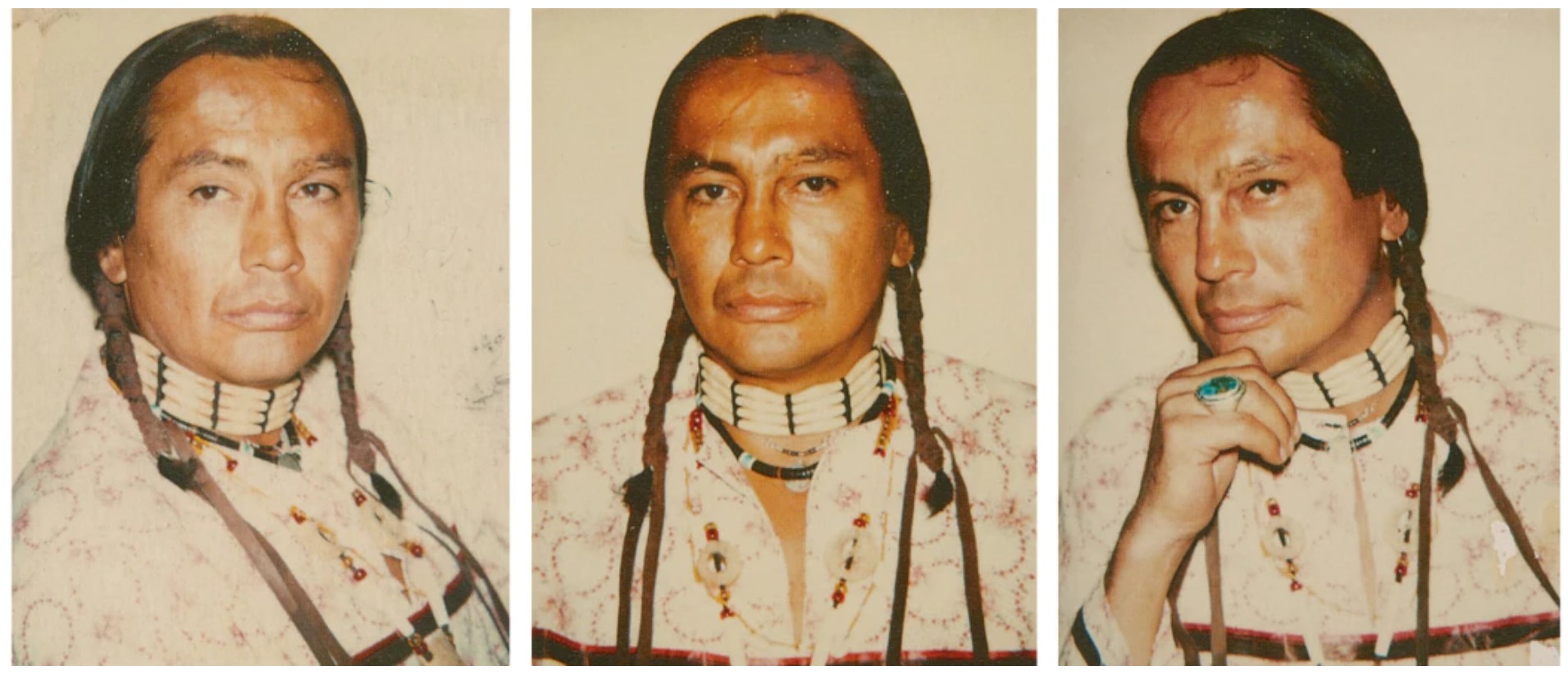
Polaroid studies of Russell Means, 1976. Art © 2025 Andy Warhol Foundation for the Visual Arts / Artists Rights Society (ARS), New York
Russell Means was born into the Lakota Oglala tribe in 1939, eventually rising up the ranks to assume leadership of the American Indian Movement (AIM). By the time he first encountered Warhol in 1976, Means had already established a public presence of his own. In February of 1973, he led the American Indian Movement during the highly-publicized, seventy-one day siege of the town of Wounded Knee on the Pine Ridge reservation—the infamous site of an 1890 massacre of the Lakota by a U.S. Cavalry regiment—in protest against the mistreatment of Native Americans by the U.S. government. The siege garnered significant attention in Hollywood and beyond, with Means assuming the role of public activist, and increasingly, of celebrity himself. Meanwhile, Warhol had separately devised the idea of a series centering the American Indian as its subject. After consulting Indian nations in California and Canada in search of an individual that “best personified the contemporary Indian,” Warhol learned of Russell Means. Starting with a cultural archetype and narrowing his focus to the individual, Andy Warhol invited Means to his New York studio in July 1976 to be photographed. The 82 Polaroid photographs Warhol took of Means that day became the foundation for The American Indian series.
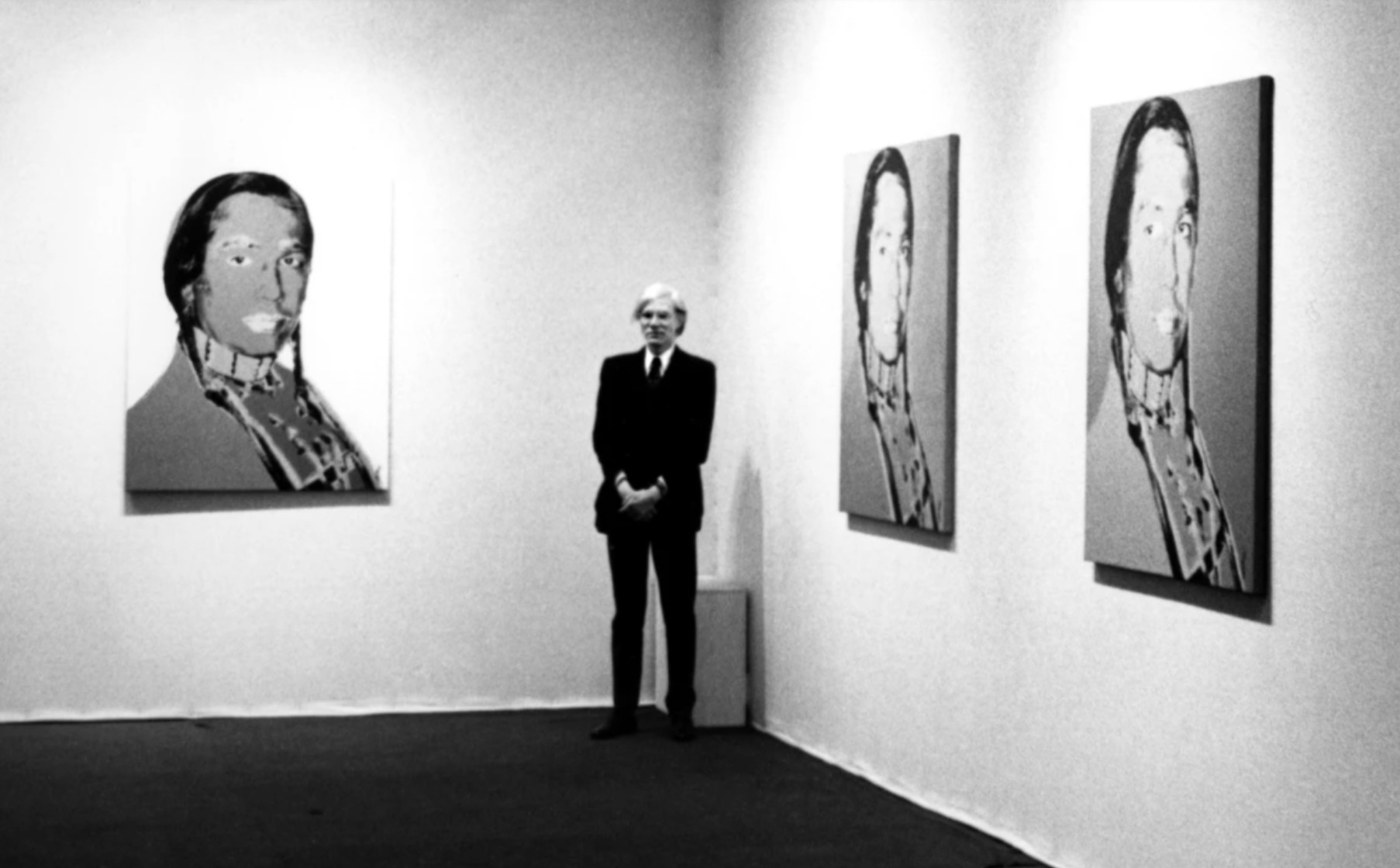
Andy Warhol at the opening of The American Indian Series at ACE Gallery, Paris 1976. Photo © Courtesy of Ace Gallery. Art © 2025 Andy Warhol Foundation for the Visual Art / Artists Rights Society (ARS), New York
In the series, Means is depicted wearing a calico print shirt, four beaded necklaces and a bone hairpipe choker, with his hair braided with brown leather wraps. His manner of dress was not particularly specific to his Lakota ancestry, but rather “contemporary and generically Indian in a sense, having come into fashion during the 1970s as an expression of American Indian pride.” Means’ typified manner of dress, refracted through Warhol’s characteristic use of seriality, contrasts with Means’ role as an individual community activist. Taken together, these factors form a complex identity for the “contemporary Indian,” who is both undeniably individual and apparently generic; as Rainer Michael Mason remarks on Warhol’s execution of the series, “The master of indifference, with a sureness that is less somnambulistic than it appears, has once more adopted a theme that is simultaneously captivating and banal. The Indian is a conventional accessory of the American scene, for the same reason as its counterpart, the cowboy, or as Coca-Cola, the electric chair, the movie star. The title of the series, moreover, ‘The American Indian’ takes this anonymous and communal dimension into account. At the same time, however, the Indian is the face of a real political problem, of a singular minority, and beyond that of all the American minorities.”
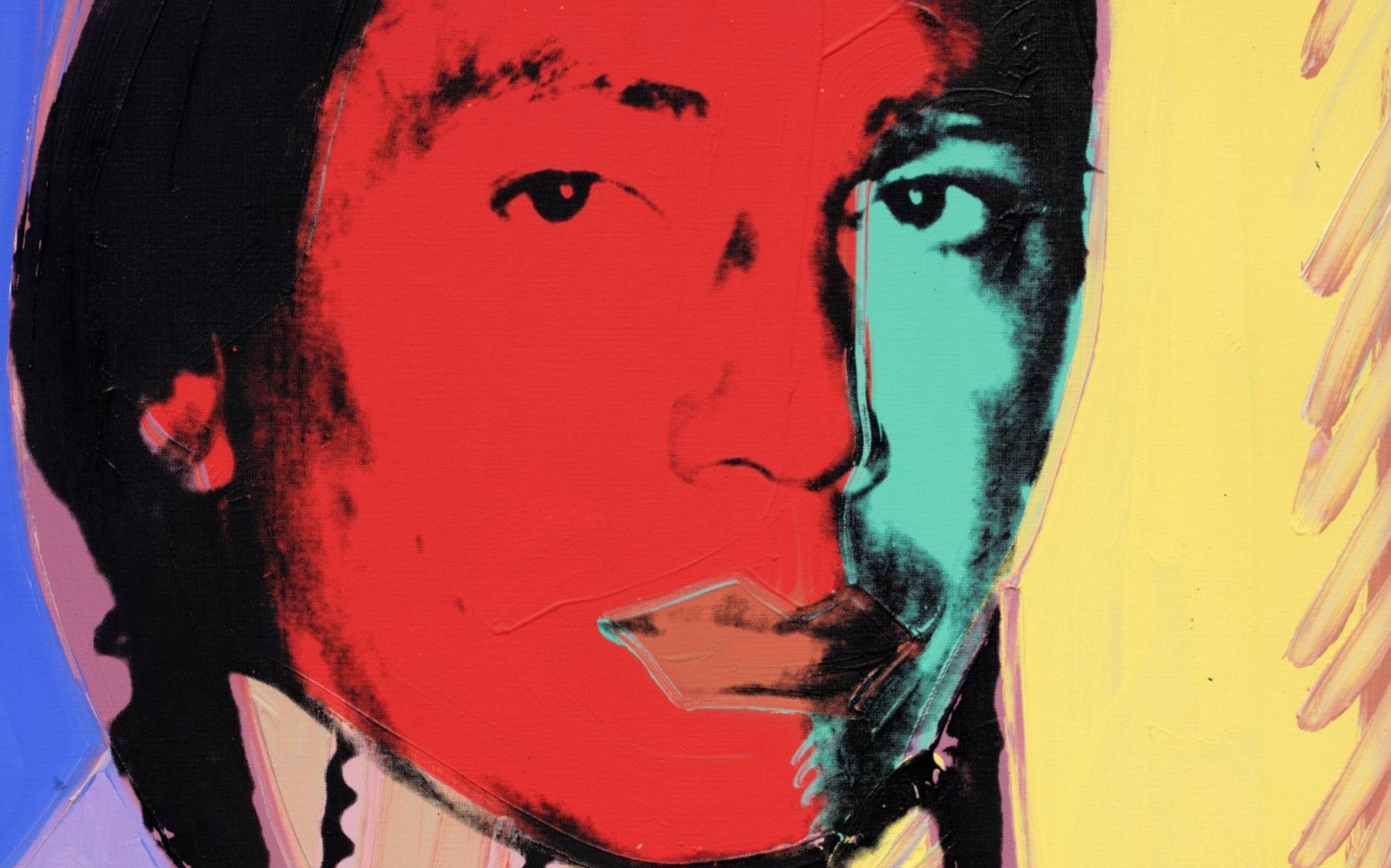
In each portrait, Warhol’s signature style accentuates the complex and commanding presence of Means himself. Defined by vivid, variegated coloration and high-contrast edges, Warhol’s technique lends each portrait a psychic intensity befitting the personal authority of its subject. The present work, Portrait of an American Indian (Russell Means), is a particularly impressive example. Set against a swath of brilliant golden yellow, Means’ face and adornments vibrate in a rich tapestry of lilac, periwinkle, brick red, and cyan. Each bright color is anchored by Means’ silkscreened image, which lends an inky depth to his braided hair, strong bone structure, and piercing gaze. Warhol characteristically built up his paint surfaces in superimposed layers, then would score the layered wet paint with his fingers to create optical effects: this technique is evident in the background, where Warhol pushes yellow paint to evoke scattering sunlight. In contrast to Warhol’s prior portraits of celebrities and cultural figures, which utilize a flat, graphic backdrop, Means’ portrait retains a potent sense of atmosphere: the golden yellow, indigo, and tan colored backdrop undeniably echoes the sky and the desert of the American West.
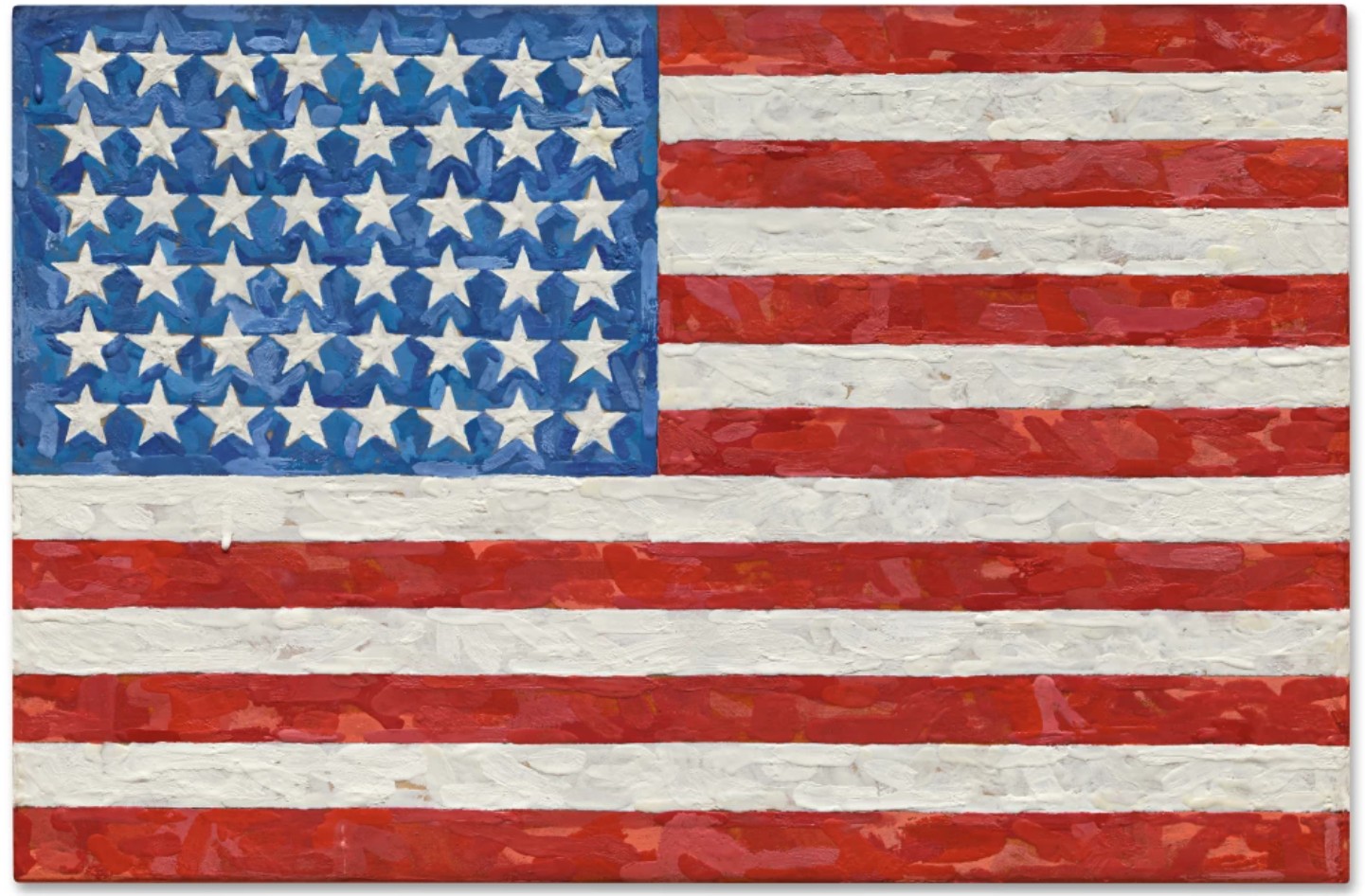
Jasper Johns, Flag, 1983. Private Collection. Sold at Sotheby’s New York in November 2014 for $36 million.
Art © 2025 Jasper Johns / Licensed by VAGA at Artists Rights Society (ARS), NY
Executed in the years following Russell Means’ siege of Wounded Knee, The American Indian series naturally assumes a political dimension. The lush setting of the American West becomes simultaneously associated with Hollywood myth-making, a force that often contributes to the stereotyping of the Indian and his character. This stereotype is often characterized by face paint, an image that seems commonplace, but in reality possesses a specific cultural meaning: as Means explains, face paint “was put on only those willing to die,” so those who wore such paint “were all the soldiers, the defenders inside Wounded Knee.” In this context, Warhol’s use of colored paint to portray Means’ face throughout the series is especially notable. Yet the image as a whole still retains a sense of ambiguity: oscillating between dignified individual and flattened archetype, and playing upon the language of media culture while presenting a sincere artistic representation.
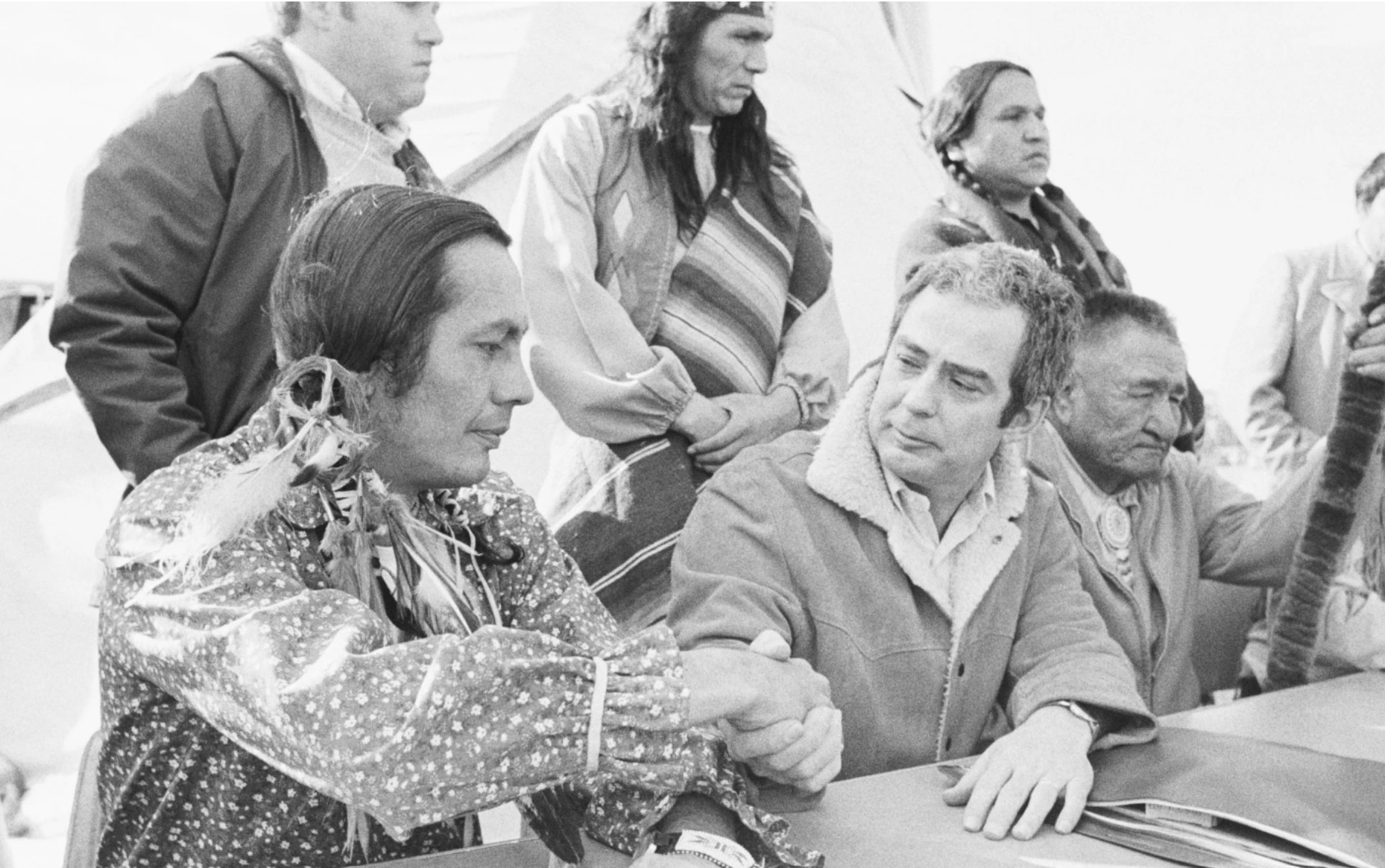
Russell Means and Kent Frizzell shaking hands, 1973. Image © Getty Images / Bettman
Encompassing the dual definitions of individual and archetype, Portrait of an American Indian (Russell Means) embodies Warhol’s most daring explorations of the seriality and portraiture which define the core of his oeuvre. The work, alongside the remainder of The American Indian series, is impressive in scale and intellectually rigorous in theme, revealing Warhol’s incisive and endless fascination with the cultural forces that define the American image.
The American Indian (Russell Means), 1977
Sotheby’ Paris: 25 October 2022
Estimated: EUR 1,200,000 – 1,800,000
EUR 2,697,000
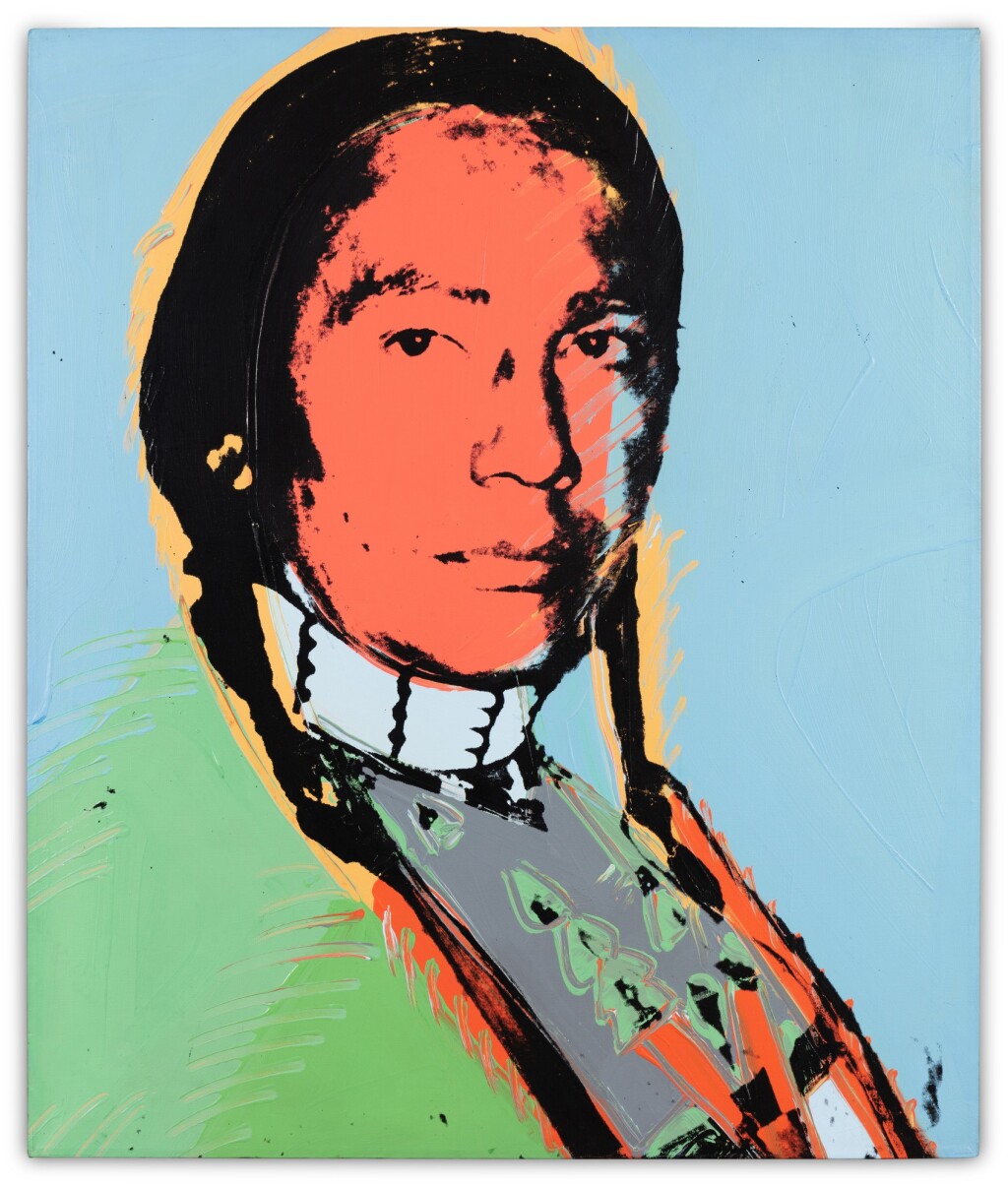
ANDY WARHOL (1928-1987)
The American Indian (Russell Means), 1977
Acrylic and silkscreen on canvas
50 ⅜ x 42 ⅛ inches (128×107 cm)
Signed and dated 1977 on the overlap
The American Indian (Russell Means), 1976
Sotheby’s New-York: 19 May 2022
Estimated: USD 3,000,000 – 4,000,000
USD 6,184,400
The American Indian (Russell Means) | Contemporary Evening Auction | 2022 | Sotheby’s
ANDY WARHOL
The American Indian (Russell Means), 1976
Acrylic and silkscreen ink on canvas, in three parts
Each: 50×42 inches (127 x 106.7 cm)
The American Indian (Russell Means), 1976
Sotheby’s New-York: 18 November 2016
Estimated: USD 800,000 – 1,200,000
USD 2,412,500
ANDY WARHOLThe American Indian (Russell Means), 1976
Acrylic and silkscreen ink on canvas
50×42 inches (127 x 106.7 cm)