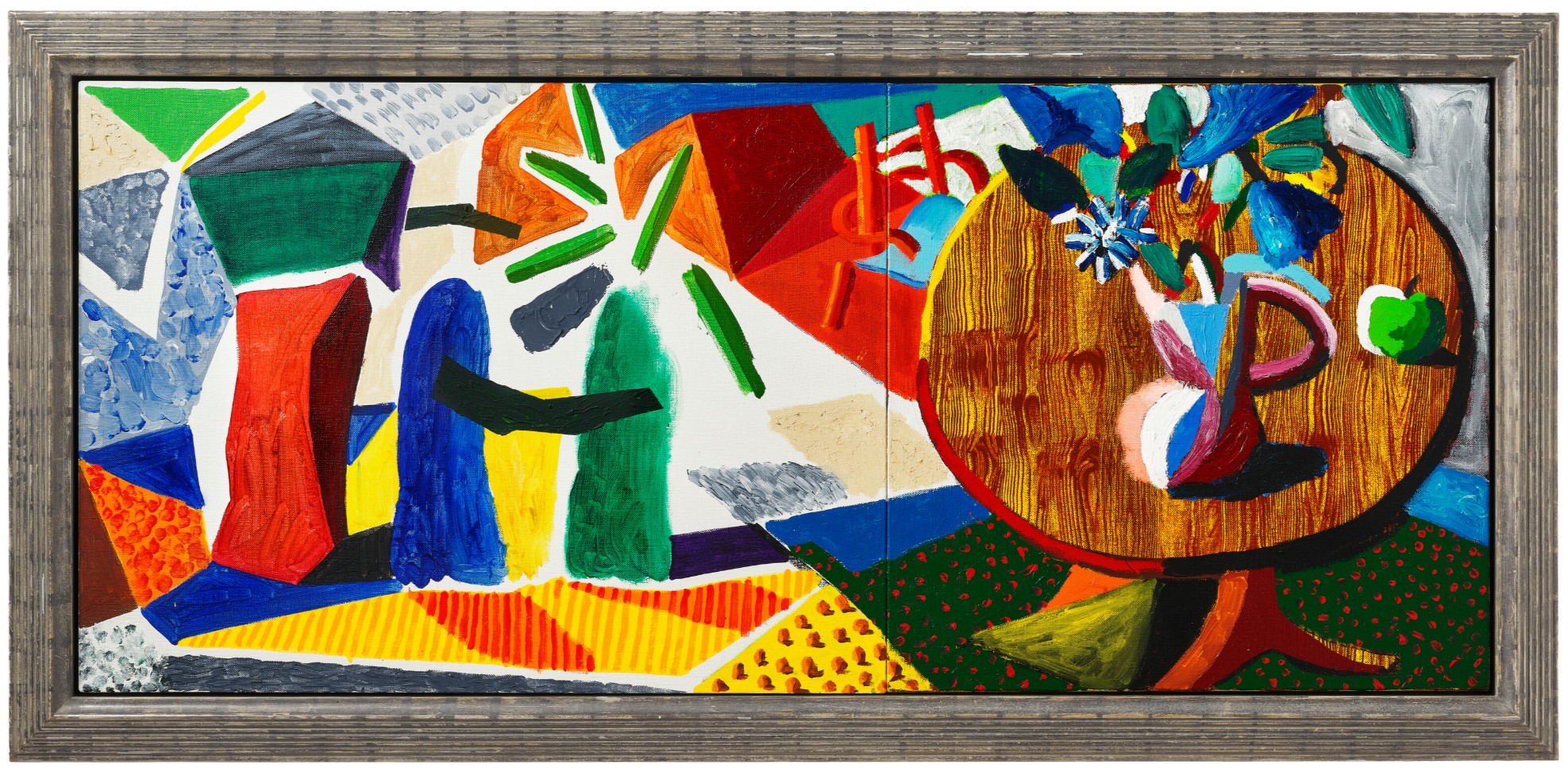
DAVID HOCKNEY (B. 1937)
Table with Conversation, 1988
Oil on two canvases
Overall: 91.8 x 213.5 cm (36 1/8 x 84 inches)
Signed, titled and dated ‘Table “with conversation” David Hockney 1988’ (on the reverse)
Provenance
L.A. Louver, Los Angeles
Paul Witt and Susan Harris, New York (acquired from the above in 1991)
L.A. Louver, Los Angeles
Elaine and Melvin Merians, New York (acquired from the above in 1997)
Christie’s London, 20 June 2007, lot 39
Private collection (acquired at the above sale)
Christie’s London, 2 July 2014, lot 130
Acquired at the above sale by the present owner
Auction History
Christie’s Hong-Kong: 26 September 2025
Estimated: HKD 40,000,000 – 60,000,000
PASSED
Christie’s London: 1 July 2014
Estimated: GBP 500,000 – 700,000
GBP 1,650,500 / USD 2,833,230
David Hockney (b. 1937) (christies.com)
Few works embody the vitality of David Hockney in the late 1980s as vividly as Table with Conversation, a two-metre panorama painted in 1988 at the height of his fame. Painted the same year with his retrospective opened at the Los Angeles County Museum of Art before travelling to the Metropolitan Museum of Art and Tate, the work fuses interior and exterior, East and West, intimacy and vastness into a single sweeping panorama.
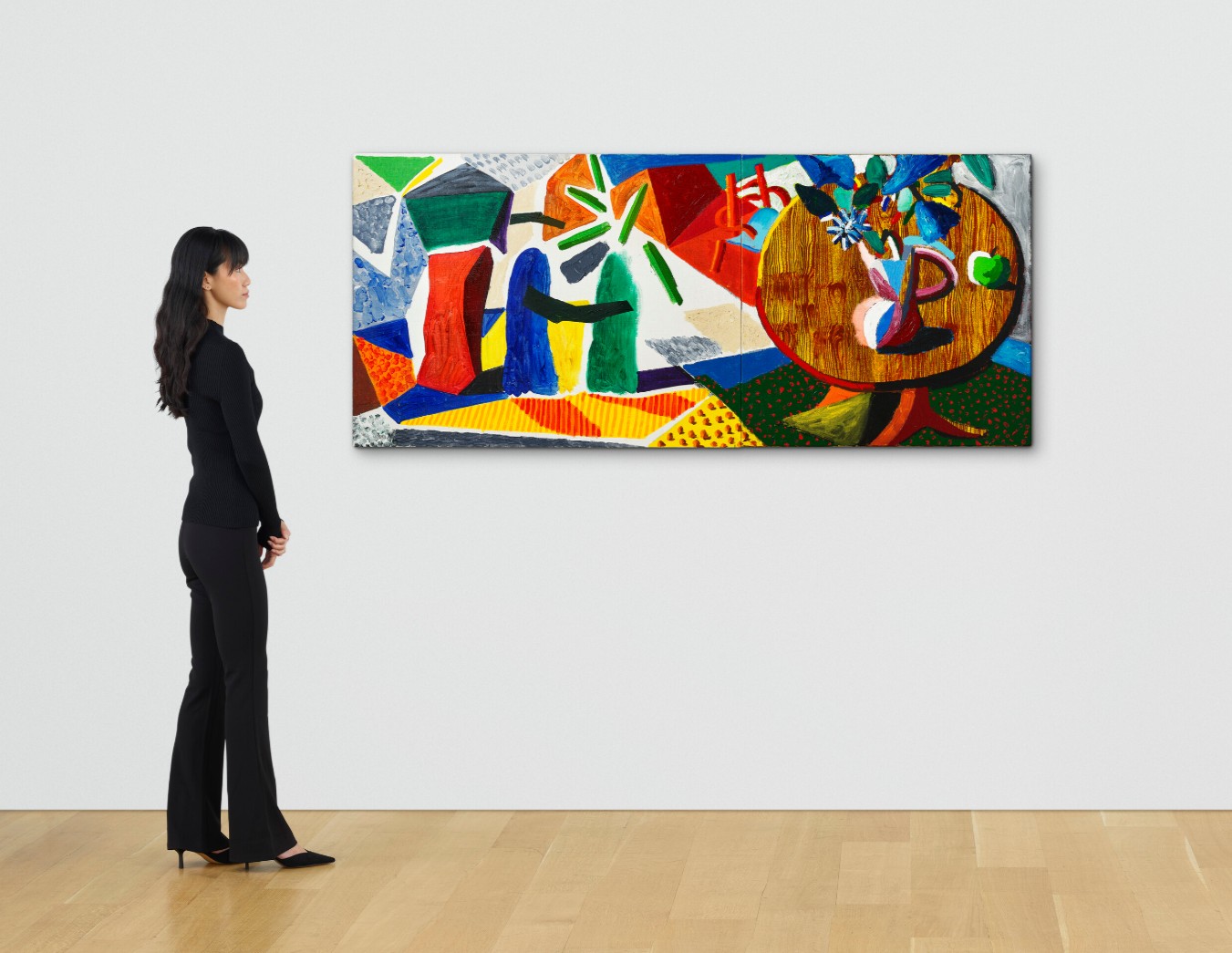
Its significance was swiftly recognized: once in the collection of Elaine and Melvin Merians—celebrated for assembling one of the most important holdings of British and figurative art in the United States—it was chosen as the cover image for the Yale Center for British Art’s exhibition The School of London and Their Friends in 2000. With its immediacy and energy, Table with Conversation embodies the restless brilliance of Hockney’s vision at this moment.
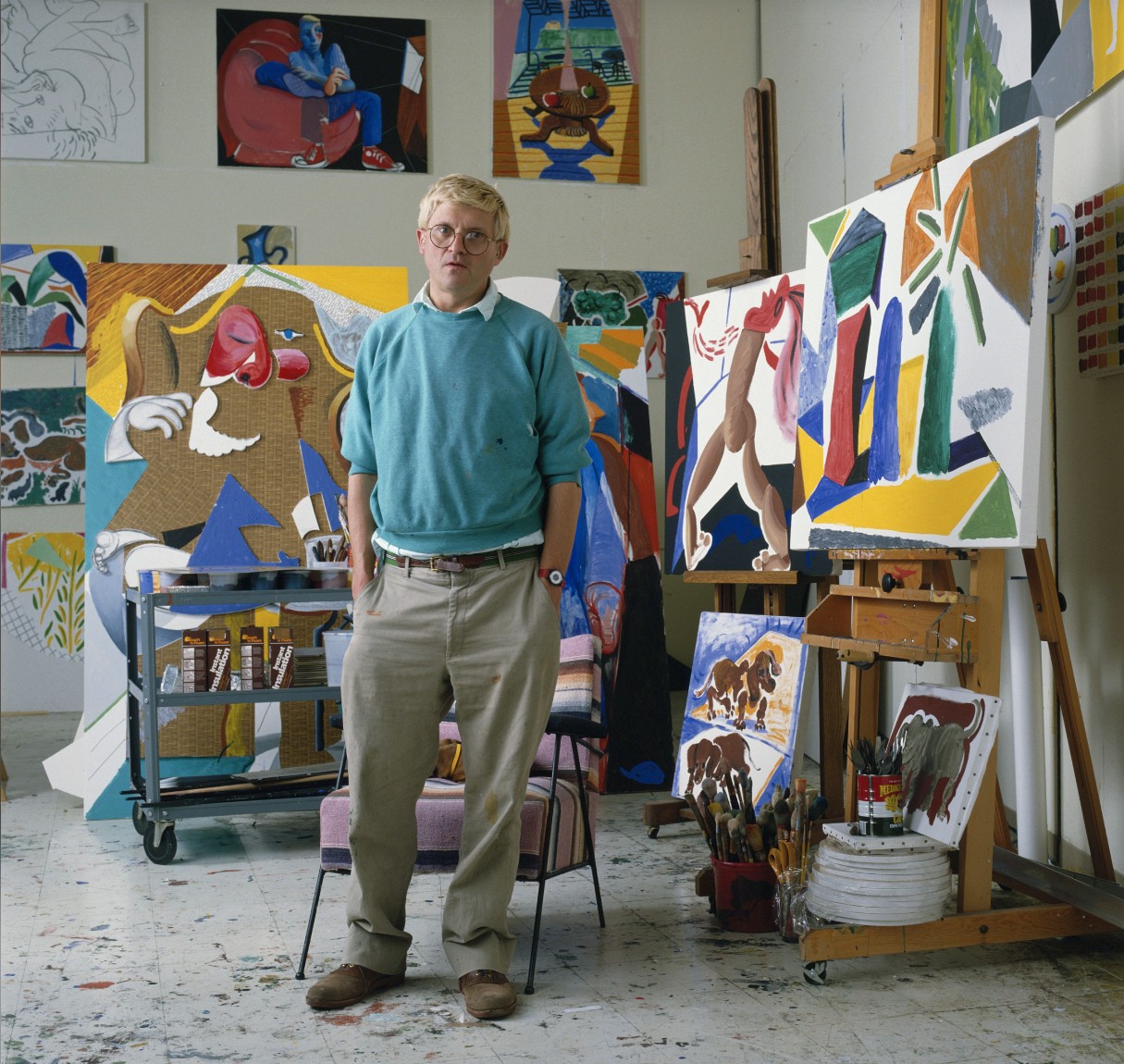
The left panel of our work (in progress) is visible on the easel. English artist David Hockney, 1988. Artist: © David Hockney. Image: Photo by David Montgomery/Getty Images
On the canvas, the viewer’s eye is first caught by the large round table on the right, crowned with a faceted pink and marine vase bursting with flowers and a green apple that seems to teeter on the edge. The table tilts up toward the picture plane, while the precarious fruit recalls Cézanne’s still lifes. Beside it sits an empty chair, angled invitingly toward us, a quiet surrogate for the absent figure. From this anchor of domestic solidity, the composition unfurls into the left half of the canvas, where fractured diagonals of cadmium red, cobalt blue, emerald green, and bright yellow collide with stippled ground and striated passages of paint. Three tall verticals rise against this kaleidoscopic backdrop, their forms oscillating between shadow, tree, column, or figure, holding the composition in balance while remaining elusive. Across the painting, every surface displays a different painterly treatment—heavy impasto against translucent wash, trompe-l’œil wood grain against flat planes of color, meticulous detail beside exuberant gesture. The result is a restless visual rhythm that drives the eye across the canvas, creating an effect at once intimate and expansive, rigorous and playful.
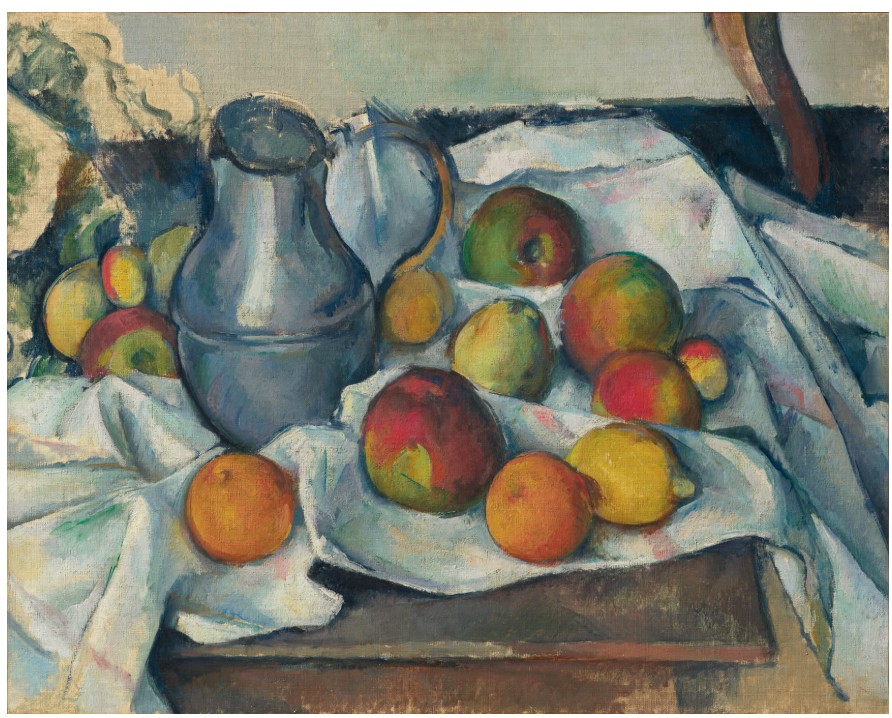
Paul Cézanne, Bouilloire et fruits, 1880-1890, Christie’s New York, May 13 2019, Lot 18A, Sold for USD 59,295,000
Underlying this orchestration of forms is Hockney’s profound engagement with Chinese scroll painting, which had fascinated him since his first trip to China in 1981 and his discovery of George Rowley’s The Principles of Chinese Painting two years later. Rowley described the scroll as a temporal experience, unfolding like music or poetry, guiding the viewer laterally, bit by bit. For Hockney, this offered a radical alternative to the fixed geometry of Western perspective. His interest reached a peak in 1988 when he released the film A Day on the Grand Canal with the Emperor of China, narrating part of Wang Hui’s monumental handscroll The Kangxi Emperor’s Southern Inspection Tour (1691–98). In this painting, the viewer literally “walks” along the landscape, shifting constantly between scenes of the imperial entourage, villages, and riverscapes. Hockney recognised in this shifting, unfolding journey a mirror of how we actually perceive the world: never fixed at a single glance, but always mobile, layered, and temporal. Table with Conversation translates this philosophy into painting, inviting the viewer to move through the composition, whether from the warm embrace of the table into the fractured light of Los Angeles, or the reverse, from open space back into an intimate interior.
This dynamic conception of vision had already driven Hockney’s experiments throughout the 1980s. Inspired by renewed encounters with Picasso—particularly the Museum of Modern Art’s 1980 retrospective—he explored Cubism’s fractured perspectives through photographic collages, or “joiners,” overlaying multiple snapshots to approximate the way the eye constantly shifts and scans.
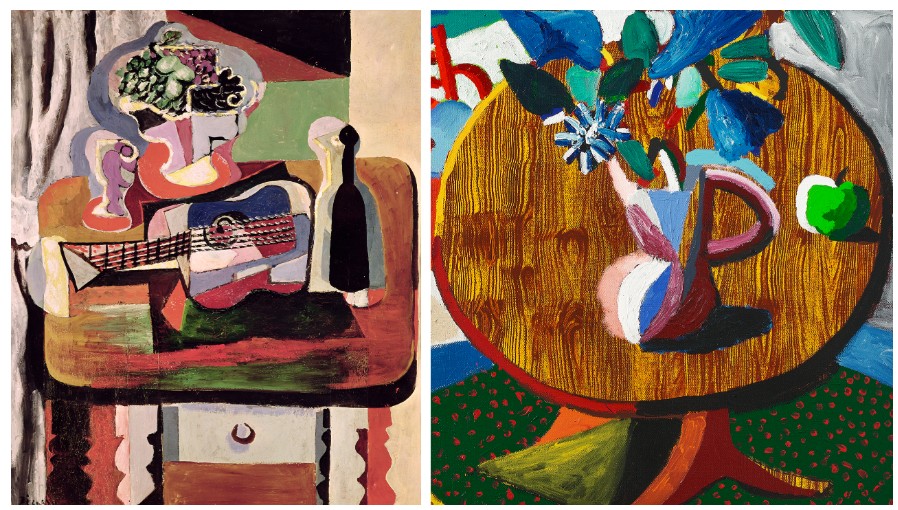
Left: Pablo Picasso, Glass, bouquet, guitar and bottle, 1919. Museum Berggruen, Berlin Artwork: © 2025 Estate of Pablo Picasso / Artists Rights Society (ARS), New York. Image: © Archives Charmet / Bridgeman Images.
Right: Present lot illustrated (detail)
In painting he absorbed these lessons too: the tilted table and faceted vase echo Cubist fracture, while the bold chromatic verticals resonate with Matisse’s late cut-outs. The solitary chair, meanwhile, invokes Van Gogh’s symbolic presence—a motif Hockney had already paid tribute to in earlier works. Rather than quoting these sources directly, Hockney orchestrates them into a vivid polyphony, weaving their voices across the canvas. Every brushstroke asserts its own identity—patterned, stippled, gestural, flat—yet all combine into a coherent whole, a living demonstration of Hockney’s conviction that “I like clarity, but I also like ambiguity: you can have both in the same painting, and I think you should.” (D. Hockney, That’s the Way I See It, London 1993, p. 152)
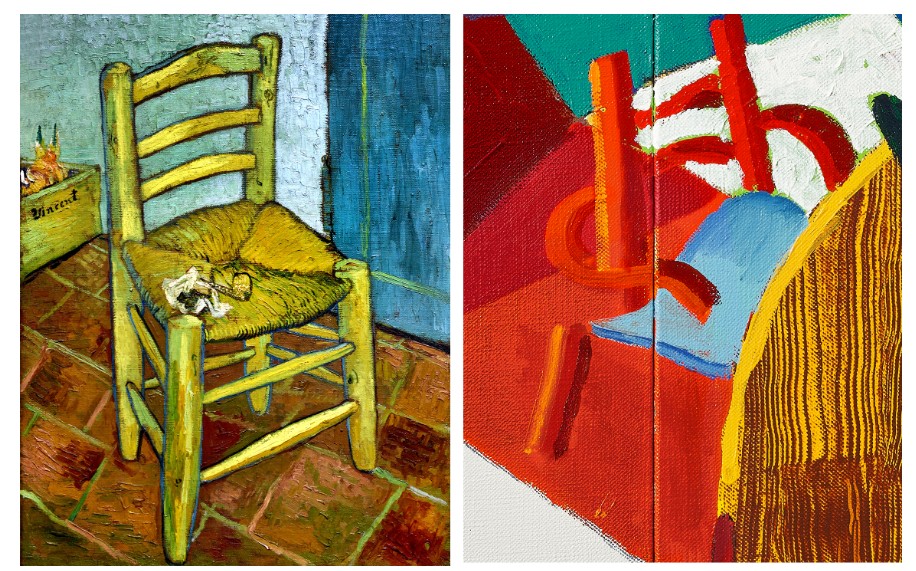
Left: Vincent Van Gogh, Van Gogh’s Chair, 1888. The National Gallery, London. Uwe Deffner/Alamy.
Right: Present lot illustrated (detail)
The year 1988 was also personally defining. His LACMA retrospective—the first comprehensive survey since Whitechapel in 1970—drew record audiences and cemented his international stature. That same year he purchased a house in Malibu, re-immersing himself in painting after a period of photographic and theatrical experiments. Works such as Large Interior, Los Angeles (1988, Metropolitan Museum of Art, New York) emerged from this fertile period, expanding domestic motifs into panoramic compositions that bridged figuration and abstraction.
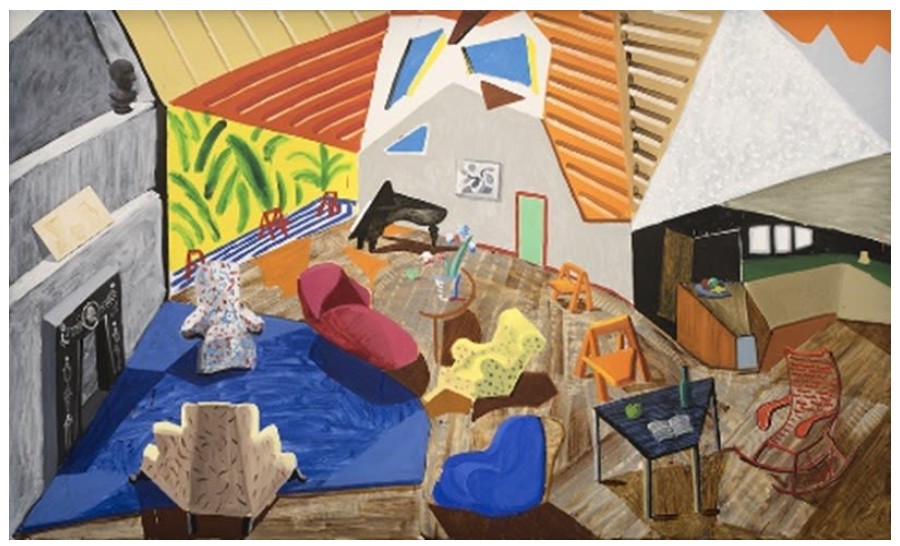
David Hockney, Large Interior, Los Angeles, 1988.
Artwork: © David Hockney. Image copyright: © The Metropolitan Museum of Art. Image source: Art Resource, NY
Table with Conversation crystallizes this moment of renewal: it synthesizes the discoveries of the photographic collages, the lessons of Chinese aesthetics, and the homage to modern masters, while anticipating the abstract canvases of the following decade. Its surfaces burst with color, gesture, and rhythm; its spaces invite us to move, pause, and look again. It is at once rooted in the intimacy of the interior and propelled into a realm of abstraction, a dialogue between modernism and tradition, a fusion of clarity and ambiguity. Above all, it is an open conversation—between artist and viewer, between seeing and experiencing—that continues to unfold with every encounter. David Hockney’s global significance continues to be celebrated on the world stage. He recently held a major retrospective, DAVID HOCKNEY 25, at the Fondation Louis Vuitton in Paris, reaffirming his status as one of the most inventive and influential artists of our time. Looking ahead, the Serpentine Gallery in London is set to dedicate a landmark exhibition to his work in 2026, further underscoring the enduring relevance and boundless vitality of his artistic vision.