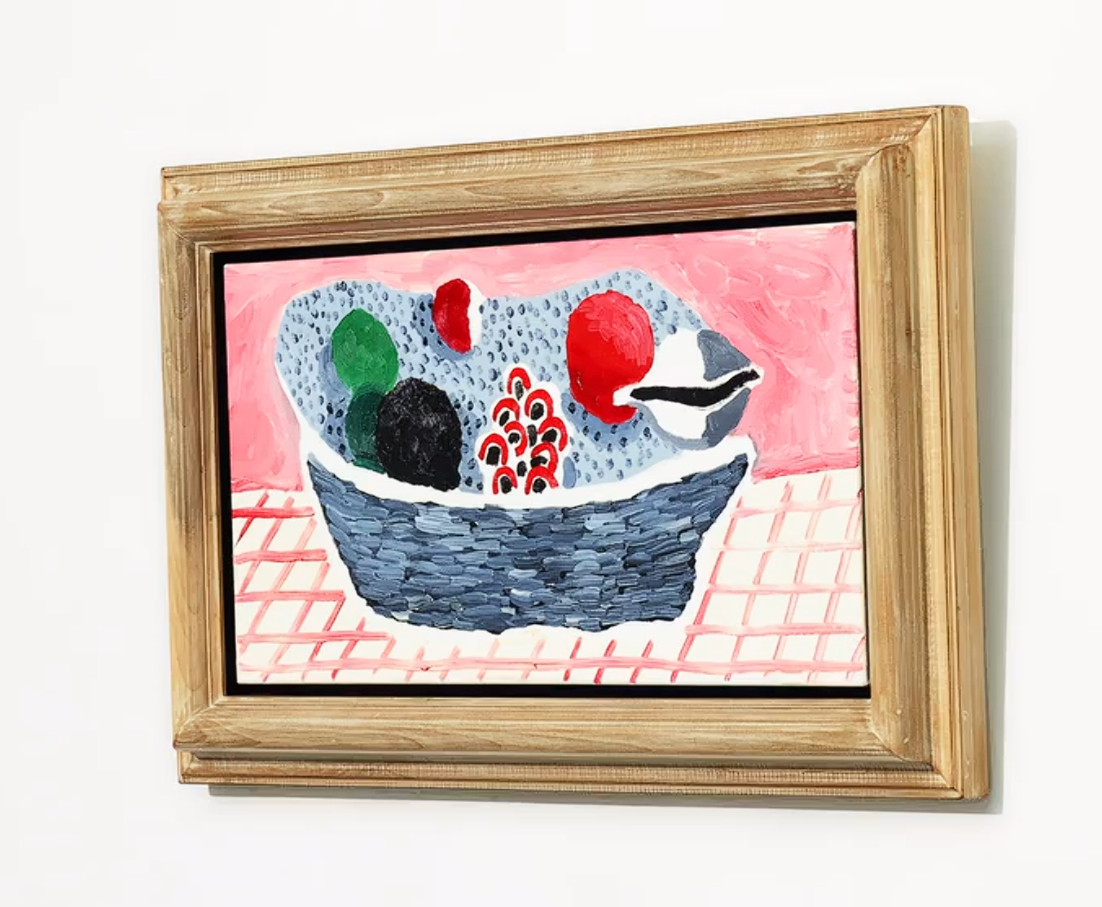
DAVID HOCKNEY
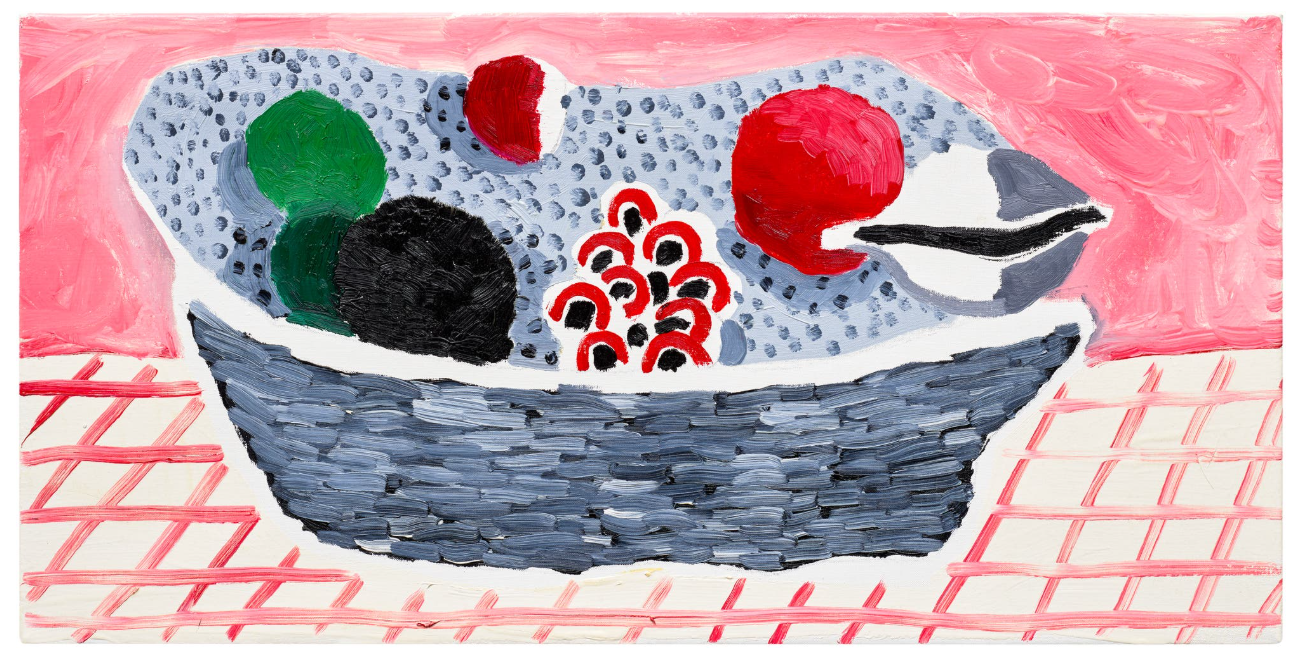
Red and Black Fruit, 1988
Oil on canvas
12 1/8 x 24 1/4 inches (30.7 x 61.5 cm)
Signed, titled and dated ‘red and black fruit David Hockney 1988’ on the reverse
Provenance
Nishimura Gallery, Tokyo
Private Collection, Japan
Acquired from the above by the present owner
Auction History
Phillips London: 15 October 2026
Estimated: GBP 500,000 – 700,000
GBP 993,000 / USD 1,313,840
David Hockney Modern & Contemporary Art Evening Sale
Painted in 1988, Red and Black Fruit reveals the artifice of both technology and material at a critical turning point in David Hockney’s career. Coinciding with the opening of his global touring retrospective which commenced at the Los Angeles County Museum the same year before travelling to the Metropolitan Museum of Art in New York and the Tate in London, Hockney had been inspired by the potential of the machine and its intersection with the realm of art. Driven by a relentless curiosity to probe the boundaries of illusionism, Hockney’s critical engagement with new techniques during the eighties had an equally powerful and illuminating impact on his painting. Against the gingham tablecloth, animated dots, loops and bands of oil contrast and combine, distinguishing the textures of the ruby-red fruits that shimmer within the basket’s weave. Defying the conventions of single-point perspective, shading and modelling, Red and Black Fruit fits stylistically into the art historical continuum and legacy of Cubism as it is filtered through Hockney’s experience of the contemporary condition — an expression of life’s joys and the pure gratification to be gained through the essential act of painting.
“I have always believed that art should be a deep pleasure.”
Though from the beginnings of his career Hockney had explored sight’s broad parameters, by the late 1970s the artist increasingly felt constrained by naturalistic representation and its limitations. The discovery of Wallace Stevens’ poem, The Man with the Blue Guitar, at the height of the summer of 1975 was revelatory, causing Hockney to more closely contemplate the poet’s musings on ‘Picasso, about the imagination transforming things, the way you see’, in relation to his own work.i In the productive, transformative months that ensued, etchings and major paintings like Self-Portrait with Blue Guitar (1977) reflected Hockney’s growing confidence in his break from naturalism and the dissolution of a fixed vantage point to render the subject.
“I became aware that Picasso’s way was far more real than anything else, and I also began to understand why it was more vivid.”
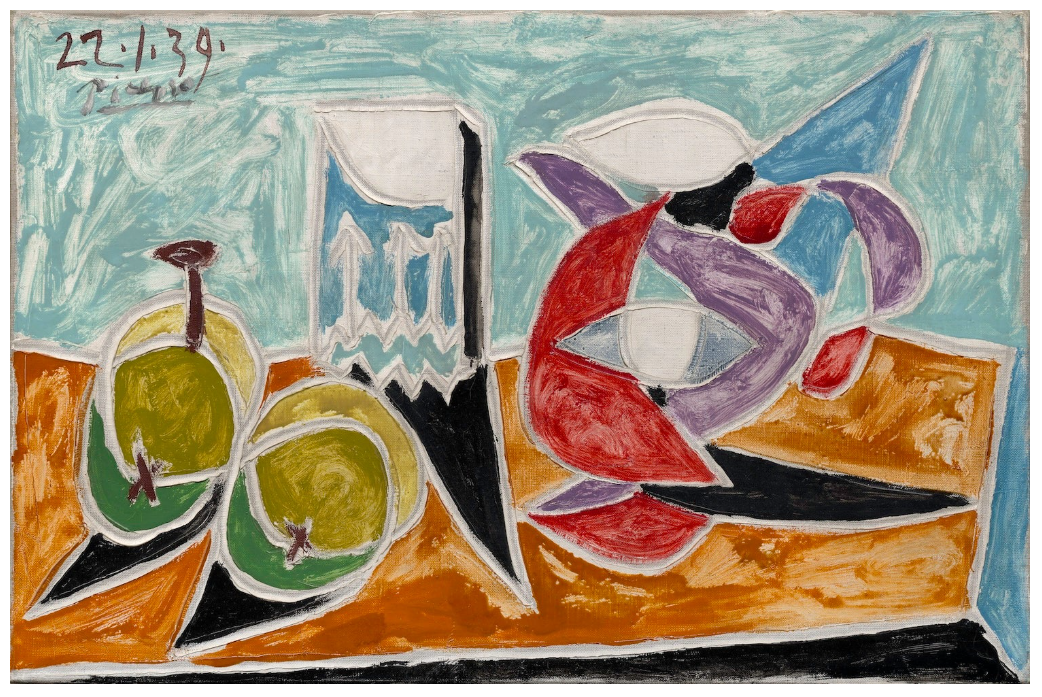
Pablo Picasso, Still Life: Fruits and Pitcher, 1939, Solomon R. Guggenheim Museum, New York. Image: The Solomon R. Guggenheim Foundation/Art Resource, NY/ Scala, Florence. Artwork: © Succession Picasso / DACS, London 2026
Though Hockney’s choice of subject is indebted to the seventeenth-century Dutch masters who popularised the western still-life genre, Pablo Picasso’s outlook also served as an imperative guide for the British painter to explore the malleability of space. Hockney by his own admission had ‘always had a great interest in Picasso’.ii However, moments like Hockney’s visit to Picasso’s New York retrospective at the Museum of Modern Art in 1980 and in December 1984 to a Pompidou exhibition on Daniel Kahnweiler’s collection foregrounding Picasso prompted a deeper pause and reflection on the Spanish master in the lead up to Red and Black Fruit’s creation. Utilising the same compression and foreshortening of ground as Picasso’s Still Life: Fruits and Pitcher, Hockney animates the canvas of Red and Black Fruit with an equally resonant yet condensed range of colours: greens, pewter greys paired with deep and pink-hued reds. Modulating viewpoints imperceptibly, for the fruits and the interior Hockney carefully shifts from three-dimensional shading to schematic, flattened shapes, collapsing the architecture of the environment. Though Hockney’s form is more supplely modelled in comparison to the geometric planes of Picasso, both place emphasis on observation as an active process of discovery, creating scenes that gradually reveal themselves as the eye deciphers and navigates the construction of space.
“Technology always has contributed to art.
The brush itself is a piece of technology, isn’t it?”
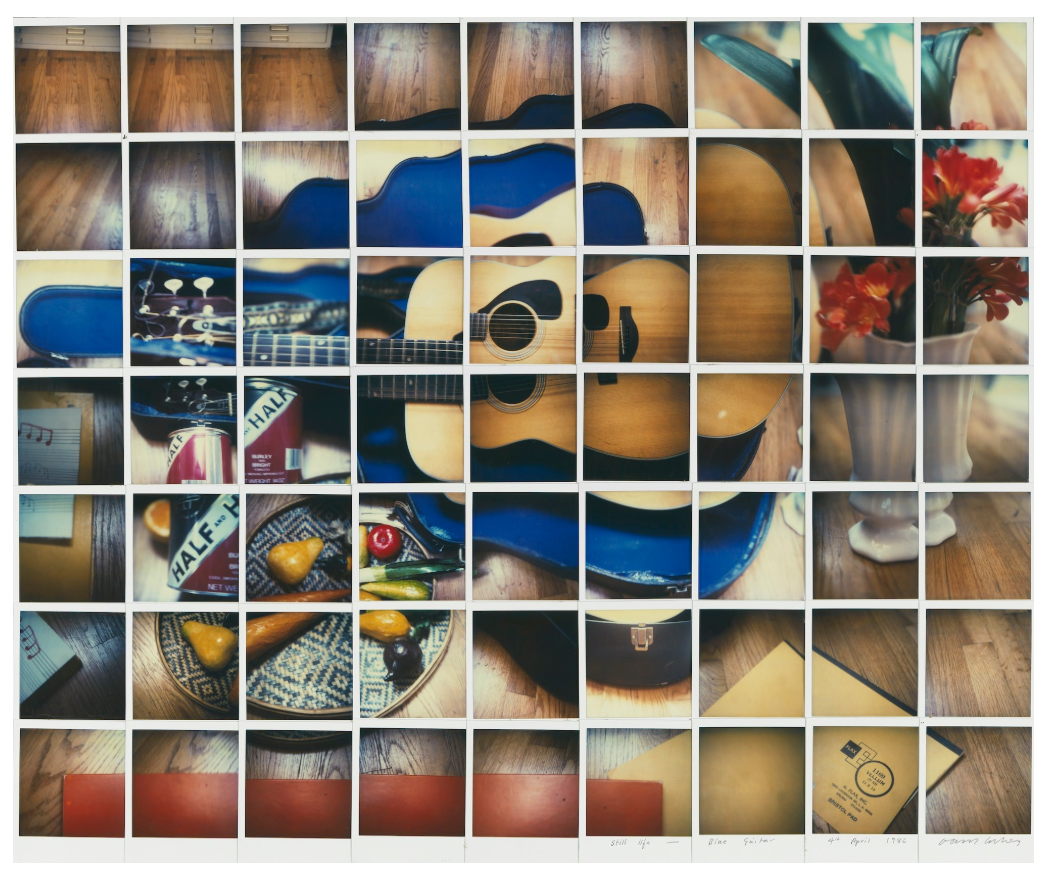
David Hockney, Still Life Blue Guitar 4th April 1982, 1982, Private Collection. Image/Artwork: © Estate of David Hockney.
Hockney’s turn away from purely literal expression was coupled with the artist’s increasing engagement with technological innovation as he created Red and Black Fruit. Such concerns informed his painting in novel ways and broadened his understanding of vision, in turn enlivening the legacy of the still-life genre. Though the process of instant photography was invented in 1948 and had already been utilised by artists including Andy Warhol, Hockney in 1982 developed an entirely new way to overcome the static, single-point perspective of the photograph. By collaging multiple photographs of the same subject recorded from different positions as in Still Life Blue Guitar 4th April 1982, Hockney overcame the constraints of optics built into the camera — frameworks that could be paralleled in paint to reappraise a purely naturalistic paradigm. Continuing his exploration of reproduction during the 1980s, his discovery of color photocopying led to his first trials in 1986 and production of ‘home-made prints’. This process allowed Hockney to ‘work with great speed and responsiveness’ that at the time he described was ‘the closest I’ve come in printing to what it’s like to paint’. In the process of reproduction, the method seems to have convinced Hockney of the impact of the planar, vividly hued images, resulting in a similar economy as he painted to test the image’s legibility. Remaining fundamentally engaged with the physicality of painting, the result in Red and Black Fruit is a composition of rich, internal balance and remarkable joie-de-vivre, comprising the fullness of lived perception with the spatial ingenuity of twentieth-century modernism and the innovations of contemporary mechanization.