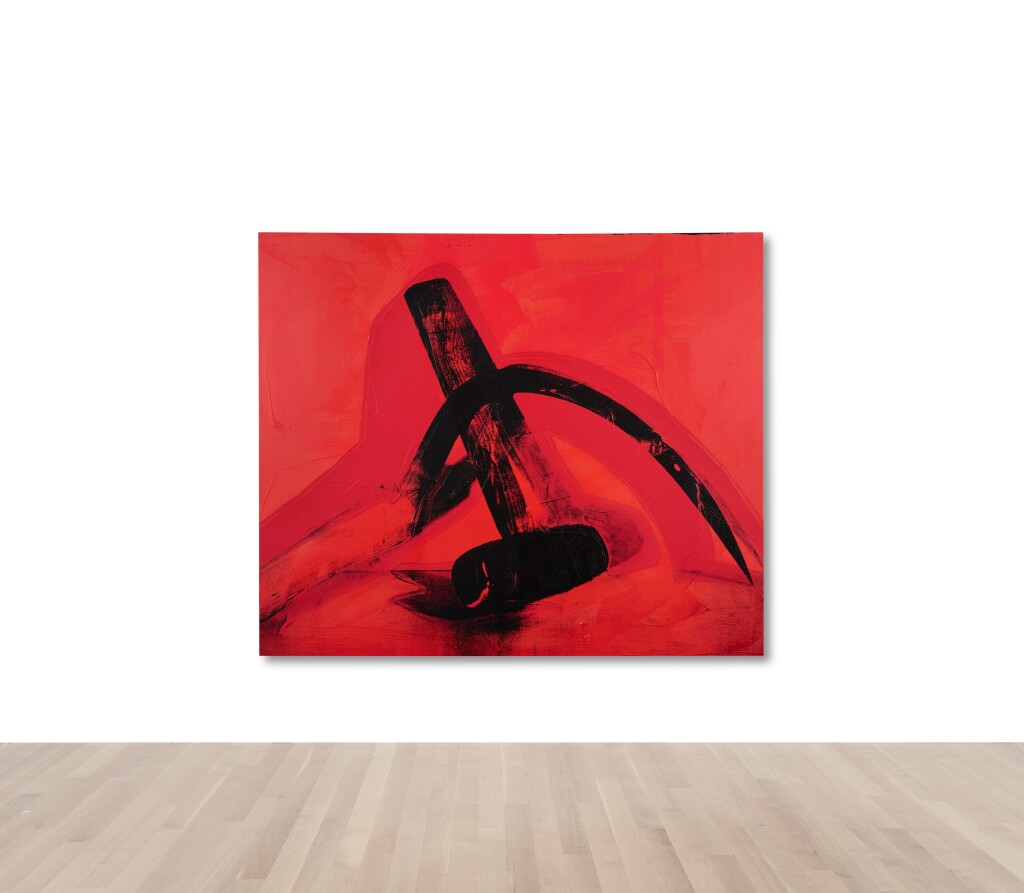
Hammer and Sickle is among the most historically potent, culturally significant, and viscerally charged paintings from the inimitable oeuvre of Andy Warhol. Bristling with the explosive energy of communism’s universally recognizable motif, Warhol’s emphatic rendering of one of the twentieth century’s most iconic and emblematic symbols confronts the viewer with a provocative bravura that rivals that of the artist’s quintessential Pop images of Campbell’s Soup Cans, Marilyn Monroe, and the like.
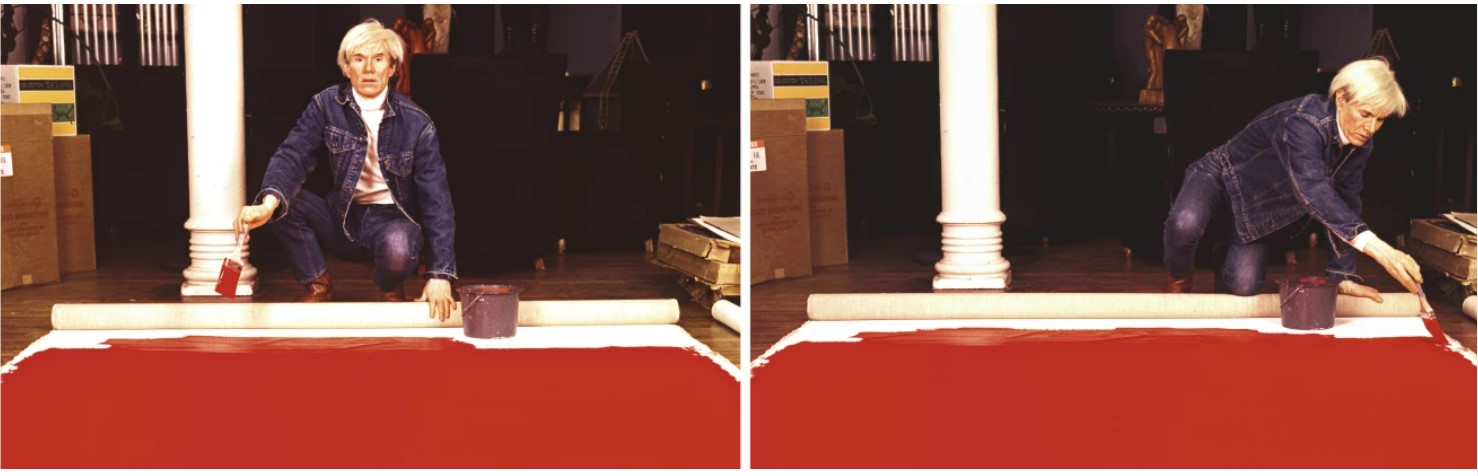
ANDY WARHOL IN HIS STUDIO, NEW YORK, JANUARY, 1983. PHOTO BY CURTIS KNAPP / GETTY IMAGES
Introduction
Warhol’s consumption and subsequent re-appropriation of communist symbolism into his legendary Pop vernacular—both physical, as in Hammer and Sickle, and metaphorical, as in his renderings of Chinese communist leader Mao Zedong and Russian communist revolutionary Vladimir Lenin—profoundly refocused the artist’s ground-breaking aesthetic energies on the political realities of his time. His inspiration for the contentious Hammer and Sickle series came in 1975, as the artist was touring Italy for the opening of his Ladies and Gentlemen exhibition at the Palazzo dei Diamanti in Ferrara. Upon viewing the radical Italian left’s ecstatic embrace of his portraits of African and Latin American transvestites, Warhol wryly remarked, “Maybe I should do real Communist paintings next. They would sell a lot in Italy.” (Bob Colacello, Holy Terror, Andy Warhol Close Up, New York 1990, p. 228) Indeed, in the mid-1970s, the communist emblem of a blunt hammer superimposed on the razor-sharp arc of a sickle was the most conspicuous graffito in the streets of Milan and Rome; despite the establishment of Italy’s democratic government following World War II, the instantly legible symbol still enshrined an anti-establishment fervor and anti-capitalist ideology.
Upon his return to the Factory, Warhol charged Ronnie Cutrone, a trusted studio assistant, to track down a suitable source image of the motif from Soviet paraphernalia. As the latter recounts, he searched through New York’s “Red” bookshops but could not find anything appropriate: “They were too flat or too graphic. The answer was to go down to Canal Street, into a hardware store, and buy a real hammer and sickle. Then I could shoot them, lit with long, menacing shadows, and add the drama that was missing from the flat-stencilled book versions… It always amused me that Andy, the ultimate Capitalist, and me, the ultimate Libertarian, could be suspected of communist activity.” (Ronnie Cutrone cited in Exh. Cat., New York, C&M Arts, Hammer and Sickle, 2002, n.p.)
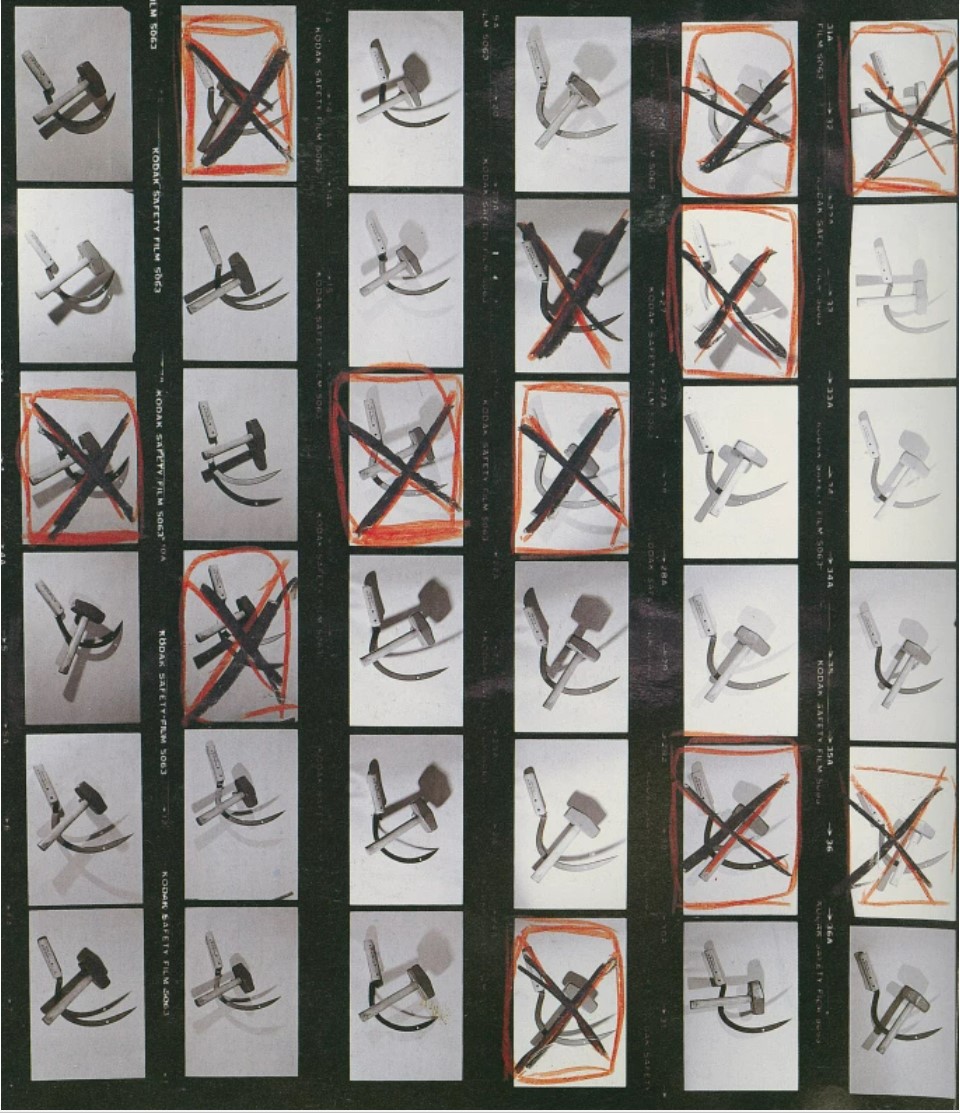
SOURCE MATERIAL FOR THE PRESENT WORK, A HAMMER AND SICKLE PHOTOGRAPHED WITH ANDY WARHOL’S MARKINGS. ART © 2022 THE ANDY WARHOL FOUNDATION FOR THE VISUAL ARTS / ARTISTS RIGHTS SOCIETY (ARS), NEW YORK
Cutrone and Warhol then arranged the objects on a horizontal surface, taking photographs in various compositions and lighting arrangements before Warhol, satisfied with their results, selected the twelve best photographs to serve as source images. The artist then began his trademark process of projecting the source photograph onto a background and painstakingly tracing its contours in pencil, before returning to render the contours in red acrylic. In a second step, the artist silkscreened the same configuration in black onto the existing picture-plane, therein creating the multi-dimensional shadows and optical illusions dramatically articulated in the present work. Only occasionally would Warhol use additional colors or, even more rarely, render the composition in multiple shades of red. One of only two such paintings of this scale to be executed in two shades of scarlet pigment, the present work is the only example in which Warhol emblazoned the motif upon an entirely saturated ground of blood-red pigment; the unique and impenetrable opacity of the crimson canvas instills the painting with a singular aura of zealous civil fervor and profound visual gravitas.
Famous for his droll ambiguity and characteristic preoccupation with artifice, Warhol, in his Hammer and Sickle paintings, once again effortlessly straddles the seemingly antithetical poles of superficiality and penetrating social commentary. Running parallel to the poignant political import of the imagery in the series lies an underlying challenge to canonical art history’s most conventional and traditional genre: the still life. By artfully positioning the purchased hammer and sickle upon a draped white surface, re-arranging and re-lighting with exacting precision, Warhol wryly invokes the precariously balanced compositions and mesmerizing trompe l’oeil of eighteenth-century still life painters. In Warhol’s hands, the hammer and sickle are reduced to a manufactured product that simply reverberates with a highly charged symbolic potency; the most archetypal symbols of socialism are demoted to consumerist objects, dispersing the explosive political charge of the imagery while concomitantly locating it within a broader art-historical and critical framework. A truly magnificent work from Warhol’s most politically potent and indelibly totemic series, Hammer and Sickle is a profound and enduring testament to Warhol’s legacy as the consummate history painter of the modern age.
Hammer and Sickle (72×86)
Hammer and Sickle, 1976
Sotheby’s London: 4 March 2026
Estimated: GBP 3,000,000 – 5,000,000
GBP 3,506,000 / USD 4,683,665
Hammer and Sickle | Modern & Contemporary Evening Auction | 2026 | Sotheby’s
REPEAT SALE
The Macklowe Collection
Sotheby’s New-York: 16 May 2022
Estimated: USD 4,000,000 – 6,000,000
USD 6,414,200
Hammer and Sickle | The Macklowe Collection | 2022 | Sotheby’s
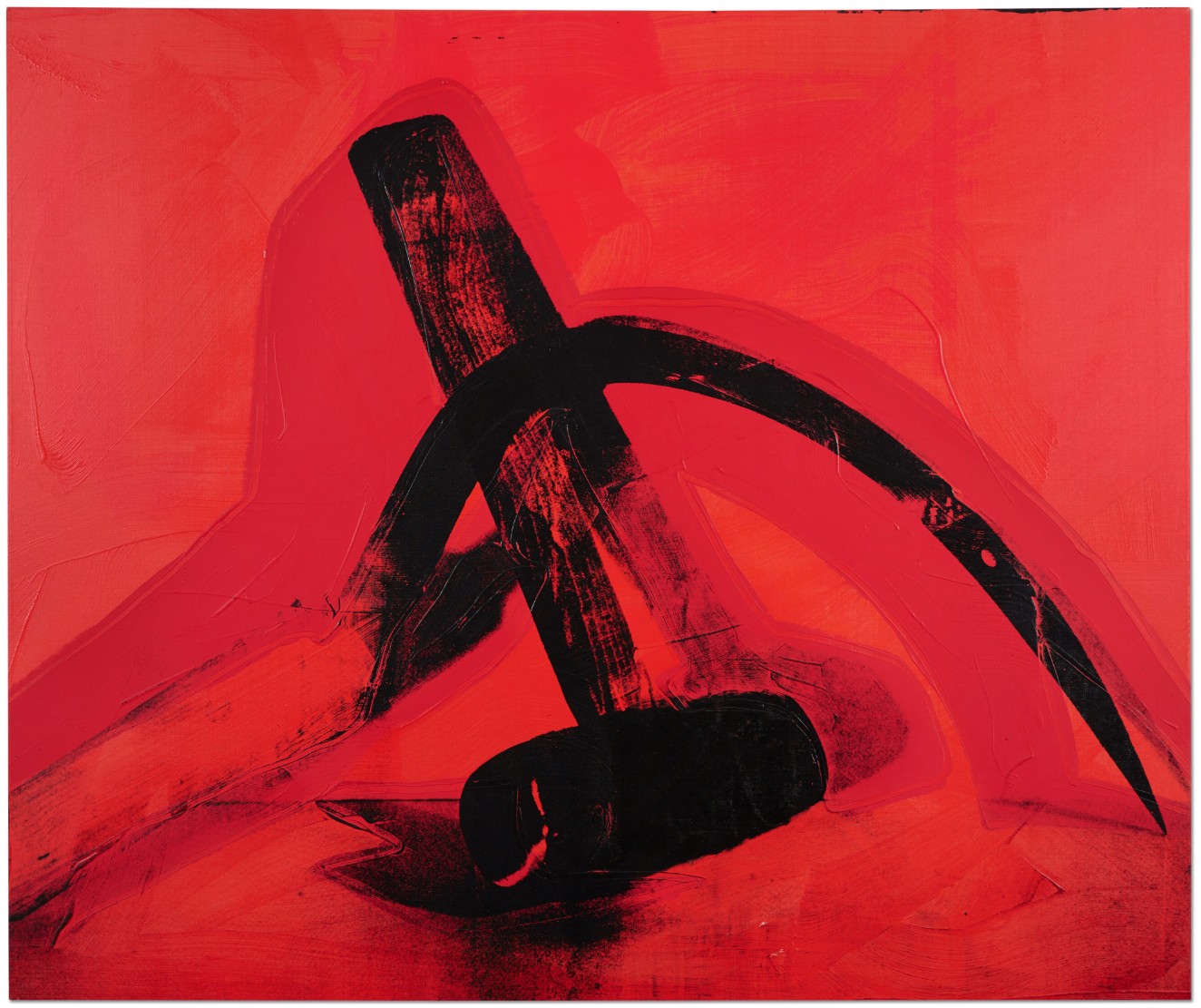
ANDY WARHOL (1928 – 1987)
Hammer and Sickle, 1976
Acrylic and silkscreen ink on canvas
72-1/4 x 86 inches (183.5 x 218.4 cm)
Signed and dedicated to Carlo Bilotti (on the overlap)
Hammer and Sickle is among the most historically potent, culturally significant, and viscerally charged paintings from the inimitable oeuvre of Andy Warhol. Bristling with the explosive energy of communism’s universally recognizable motif, Warhol’s emphatic rendering of one of the twentieth century’s most iconic and emblematic symbols confronts the viewer with a provocative bravura that rivals that of the artist’s quintessential Pop images of Campbell’s Soup Cans, Marilyn Monroe, and the like. Remarking upon this tension in the Hammer and Sickle paintings, critic George Frei notes, “The present series takes a less direct and more complex stand by showing the logo of the American manufacturer and thus marking the tools as products of a free market economy. The representation takes a different tack: the once political emblem has been dismantled into its original components. As in a classical still life, the objects have no secrets, no ulterior meaning: a hammer is a hammer, a sickle is a sickle. Created long before glasnost and perestroika, these works seem to us today almost like a prophetic prediction.” (Georg Frei, “Hammer and Sickle – A Painterly Manifesto,” in Exh. Cat., Zurich, Thomas Ammann, Andy Warhol: Hammer and Sickle, 1999, n.p.)
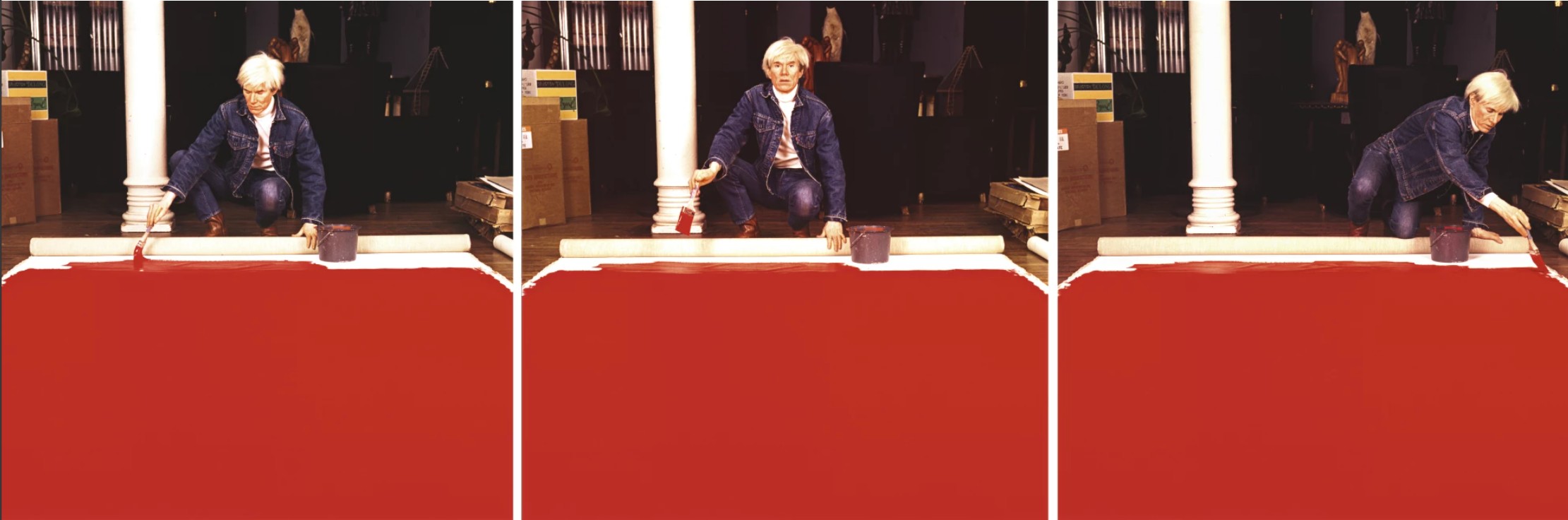
ANDY WARHOL IN HIS STUDIO, NEW YORK, JANUARY, 1983. PHOTO BY CURTIS KNAPP / GETTY IMAGES.
Art © 2026 The Andy Warhol Foundation for the Visual Arts / DACS, London
A superb example from a limited body of large-scale Hammer and Sickle canvases measuring 72 by 86 inches, the present work is one of the only paintings executed in the eruptive red-on-red ground seen here. Further distinguished by its storied provenance, the present work originally belonged to famed patron of the arts Carlo Bilotti. Bilotti, the Italian-American perfumier who would later donate his collection to the city of Rome to form the Museo Carlo Bilotti, often became close friends with artists he commissioned, including Salvador Dalí, Giorgio de Chirico, and Warhol. Indeed, one of Warhol’s rare double portraits was commissioned by Bilotti of his wife and daughter in 1981, and its intimate depiction of the sitters bespeaks their close and lasting relationship with the artist. The present work, executed a few years previously, is inscribed to Bilotti on the reverse. In a searing blaze of incandescent scarlet pigment and crisply delineated shadows, Hammer and Sickle enacts a captivating conflict between the propagandistic fervor of communist Russia and the quintessentially American production of the artist’s Pop oeuvre, transforming the blazing logo into an ironic Warholian emblem.
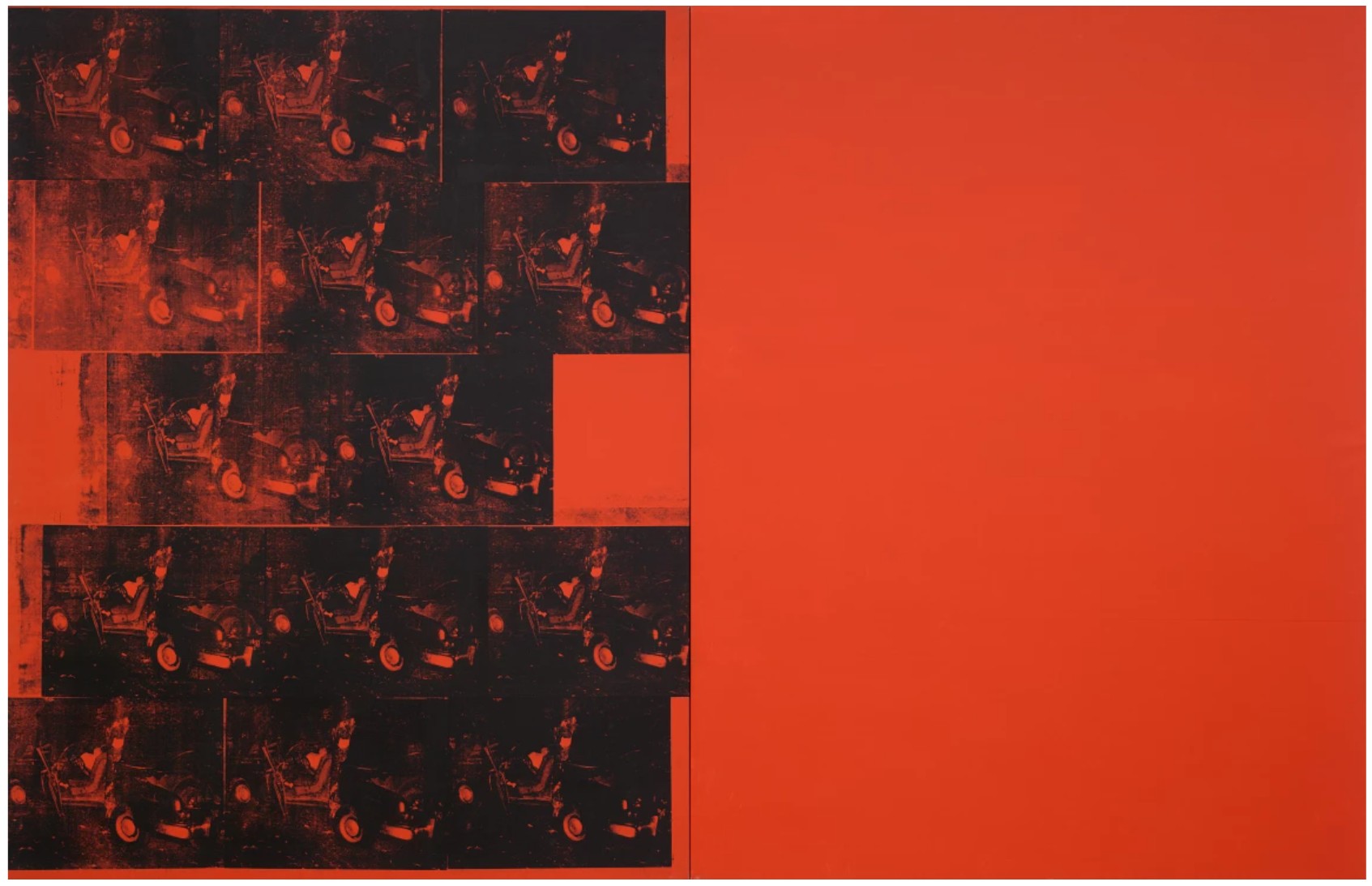
Andy Warhol, Orange Car Crash Fourteen Times, 1963. Museum of Modern Art, New York.
Art © 2026 The Andy Warhol Foundation for the Visual Arts / DACS, London
Warhol’s consumption and subsequent re-appropriation of communist symbolism into his legendary Pop vernacular—both physical, as in Hammer and Sickle, and metaphorical, as in his renderings of Chinese communist leader Mao Zedong and Russian communist revolutionary Vladimir Lenin—profoundly refocused the artist’s ground-breaking aesthetic energies on the political realities of his time. His inspiration for the contentious Hammer and Sickle series came in 1975, as the artist was touring Italy for the opening of his Ladies and Gentlemen exhibition at the Palazzo dei Diamanti in Ferrara. Upon viewing the radical Italian left’s ecstatic embrace of his portraits of African and Latin American transvestites, Warhol wryly remarked, “Maybe I should do real Communist paintings next. They would sell a lot in Italy.” (Bob Colacello, Holy Terror, Andy Warhol Close Up, New York 1990, p. 228) Indeed, in the mid-1970s, the communist emblem of a blunt hammer superimposed on the razor-sharp arc of a sickle was the most conspicuous graffito in the streets of Milan and Rome; despite the establishment of Italy’s democratic government following World War II, the instantly legible symbol still enshrined an anti-establishment fervor and anti-capitalist ideology.
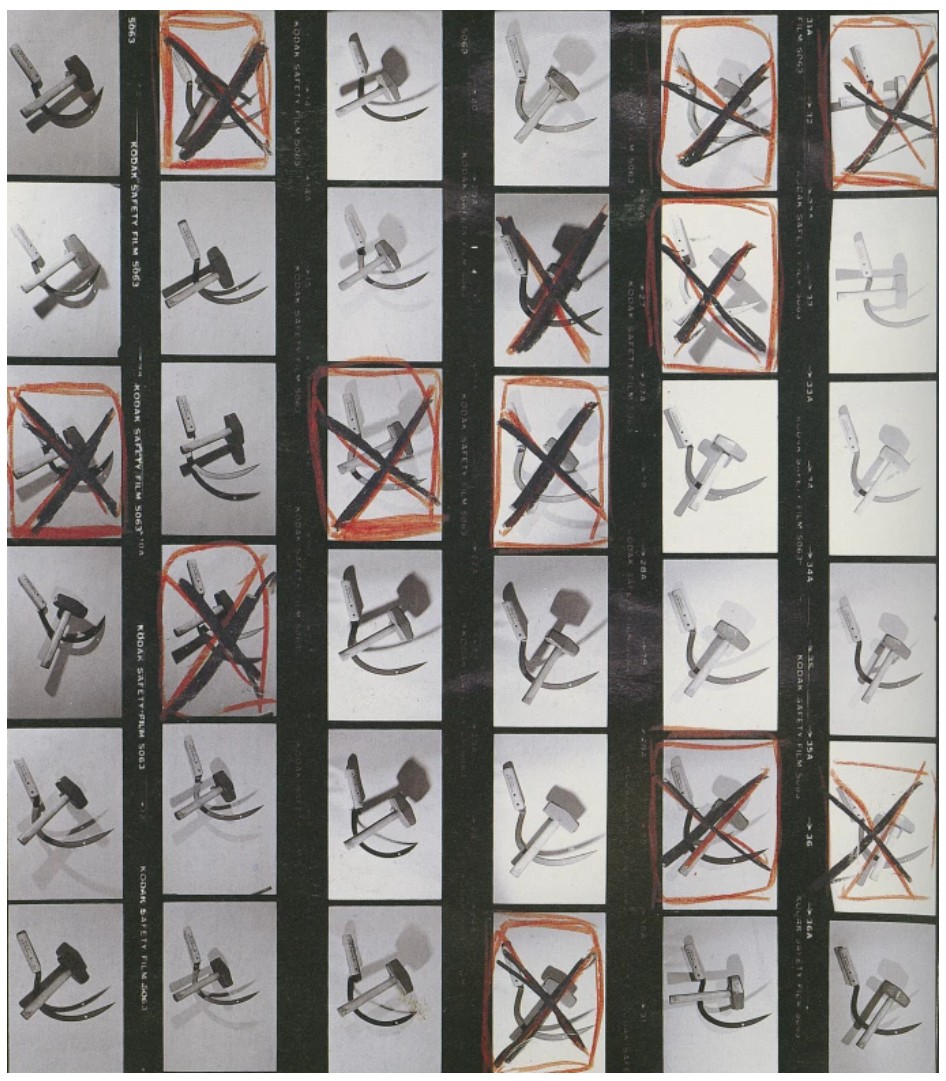
Source material for the present work, a hammer and sickle photographed with Andy Warhol’s markings.
Art © 2026 The Andy Warhol Foundation for the Visual Arts / DACS, London
Upon his return to the Factory, Warhol charged Ronnie Cutrone, a trusted studio assistant, to track down a suitable source image of the motif from Soviet paraphernalia. As the latter recounts, he searched through New York’s “Red” bookshops but could not find anything appropriate: “They were too flat or too graphic. The answer was to go down to Canal Street, into a hardware store, and buy a real hammer and sickle. Then I could shoot them, lit with long, menacing shadows, and add the drama that was missing from the flat-stencilled book versions… It always amused me that Andy, the ultimate Capitalist, and me, the ultimate Libertarian, could be suspected of communist activity.” (Ronnie Cutrone cited in Exh. Cat., New York, C&M Arts, Hammer and Sickle, 2002, n.p.) Cutrone and Warhol then arranged the objects on a horizontal surface, taking photographs in various compositions and lighting arrangements before Warhol, satisfied with their results, selected the twelve best photographs to serve as source images.
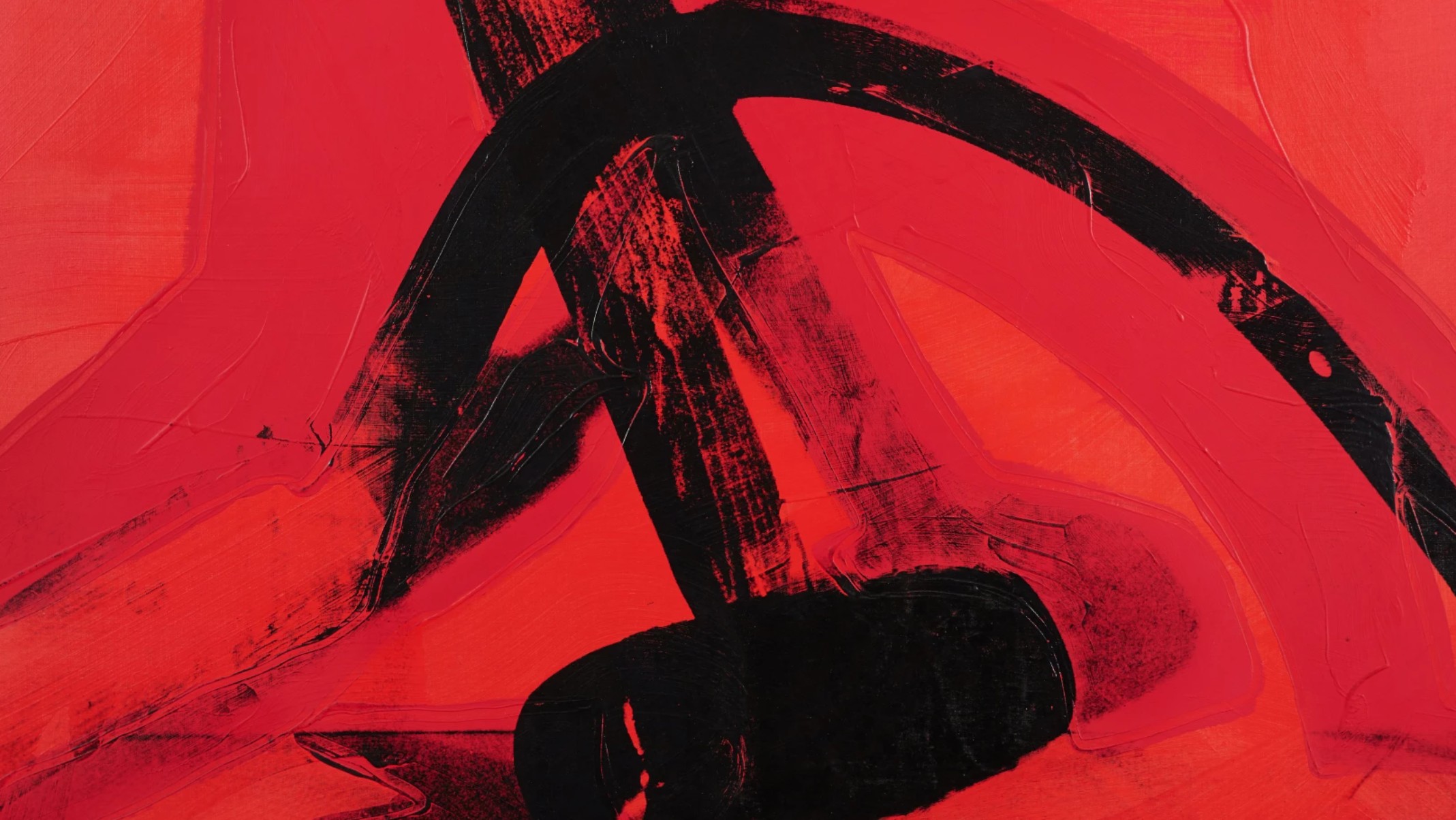
The artist then began his trademark process of projecting the source photograph onto a background and painstakingly tracing its contours in pencil, before returning to render the contours in red acrylic. In a second step, the artist silkscreened the same configuration in black onto the existing picture-plane, therein creating the multi-dimensional shadows and optical illusions dramatically articulated in the present work. Only occasionally would Warhol use additional colors or, even more rarely, render the composition in multiple shades of red. One of only two such paintings of this scale to be executed in two shades of scarlet pigment, the present work is the only example in which Warhol emblazoned the motif upon an entirely saturated ground of blood-red pigment; the unique and impenetrable opacity of the crimson canvas instills the painting with a singular aura of zealous civil fervor and profound visual gravitas.
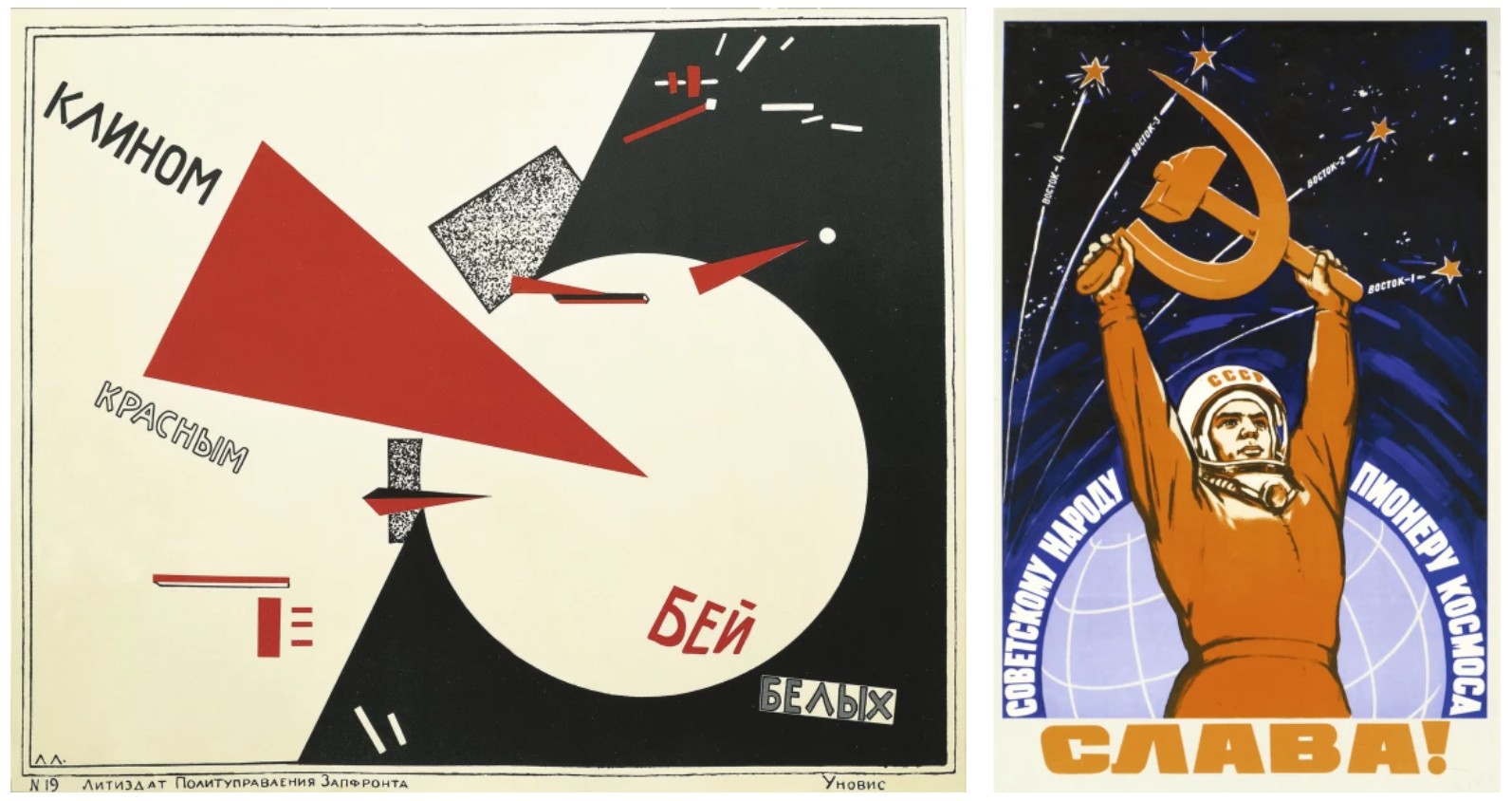
Left: El Lissitzky, Beat the Whites with the Red Wedge, 1919. Russian State Library, Moscow
Right: Russian propaganda poster, “Long Live the Soviet People & Its Pioneers,” circa 1960s. Image © Buyenlarge Archive/UIG / Bridgeman Images
Famous for his droll ambiguity and characteristic preoccupation with artifice, Warhol, in his Hammer and Sickle paintings, once again effortlessly straddles the seemingly antithetical poles of superficiality and penetrating social commentary. Running parallel to the poignant political import of the imagery in the series lies an underlying challenge to canonical art history’s most conventional and traditional genre: the still life. By artfully positioning the purchased hammer and sickle upon a draped white surface, re-arranging and re-lighting with exacting precision, Warhol wryly invokes the precariously balanced compositions and mesmerizing trompe l’oeil of eighteenth-century still life painters. In Warhol’s hands, the hammer and sickle are reduced to a manufactured product that simply reverberates with a highly charged symbolic potency; the most archetypal symbols of socialism are demoted to consumerist objects, dispersing the explosive political charge of the imagery while concomitantly locating it within a broader art-historical and critical framework. A truly magnificent work from Warhol’s most politically potent and indelibly totemic series, Hammer and Sickle is a profound and enduring testament to Warhol’s legacy as the consummate history painter of the modern age.
Hammer and Sickle, 1976
Christie’s New-York: 17 November 2022
Estimated: USD 4,000,000 – 6,000,000
USD 4,380,000
ANDY WARHOL (1928-1987), Hammer and Sickle | Christie’s
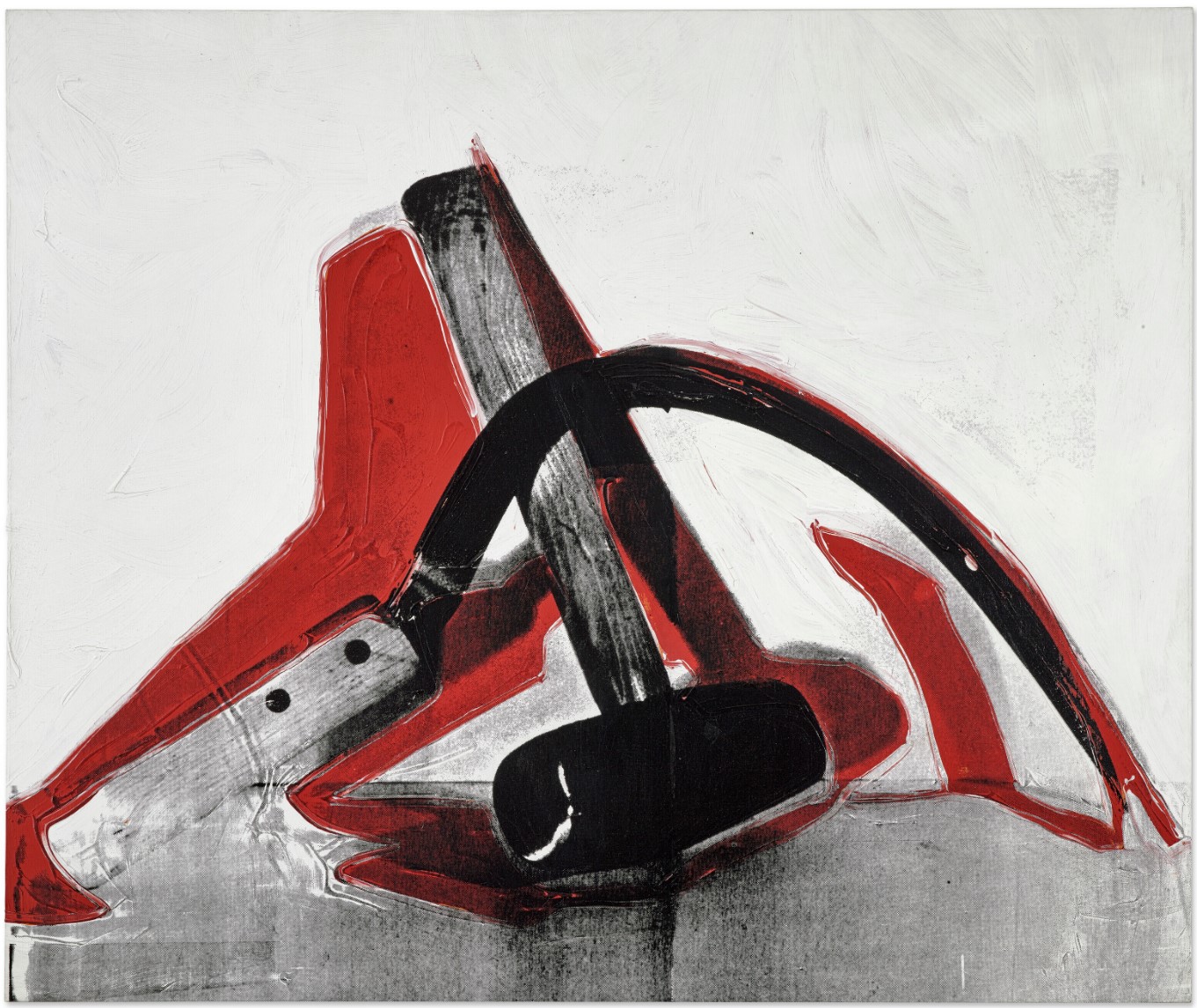
ANDY WARHOL (1928-1987)
Hammer and Sickle, 1976
Acrylic and silkscreen ink on linen
72×86 inches (182.9 x 218.4 cm)
Signed ‘Andy Warhol’ (on the overlap)
Painted in 1976, Andy Warhol’s Hammer and Sickle is one of the artist’s most important creative statements of the 1970s. Mining popular culture, politics, and his uncanny ability to capture the social zeitgeist, the series built on his now iconic portraits of the Chinese Communist leader Mao Zedong that he had produced four years earlier. With a strong sense of irony, the present work depicts the two ubiquitous symbols of the Soviet Empire, a far cry from the society portraits of the rich and famous that had been one of his main concerns up to this point. How perverse and provocative Warhol must have felt dedicating a new series to the symbol of the Soviet Union and worldwide socialism, at the very height of the Cold War and communist paranoia.
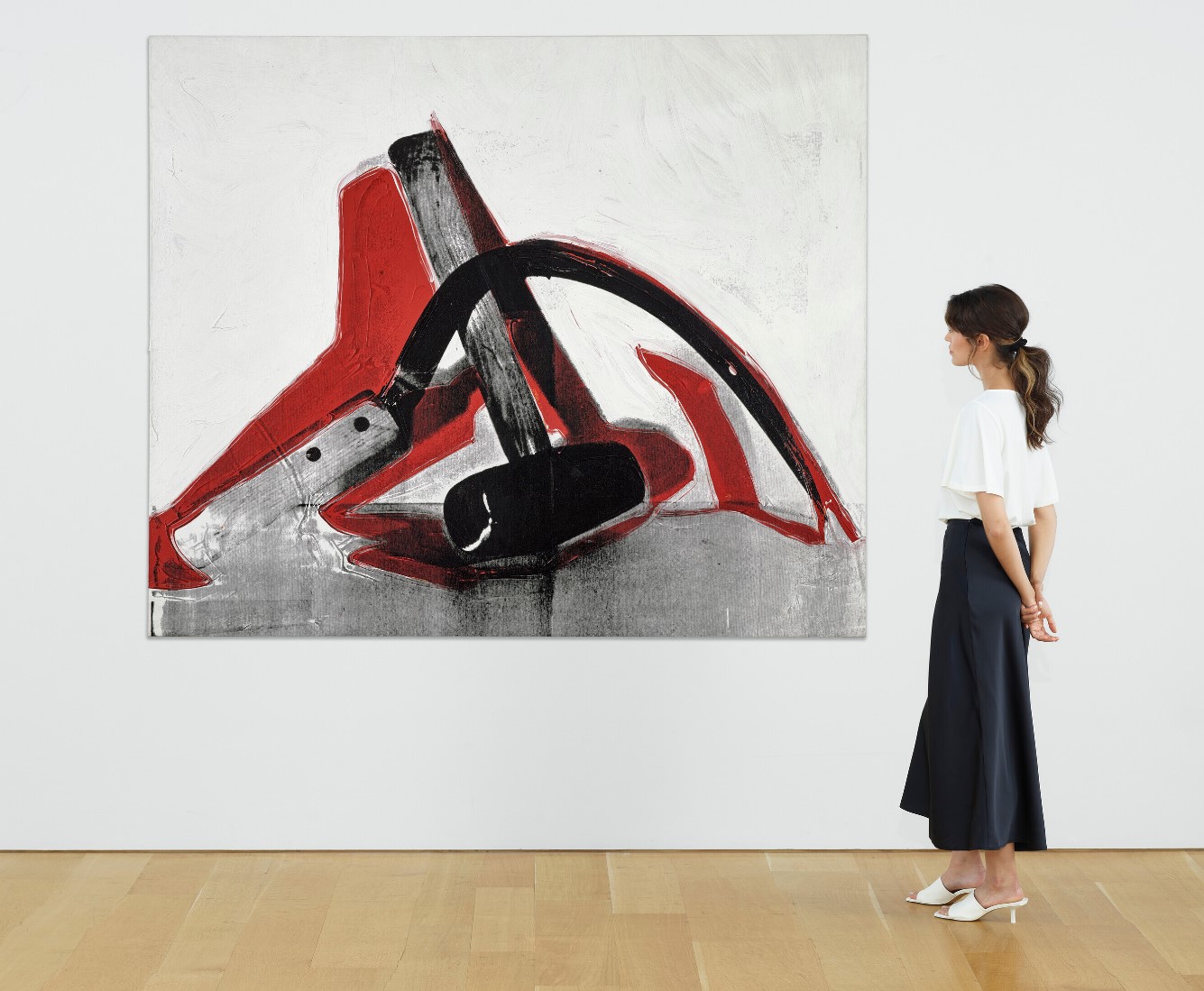
Stylistically minimal, the most striking compositional aspect of Hammer and Sickle is the inversion of implements from their triumphal, raised positions on the Soviet Flag. In Hammer and Sickle they appear at rest, crossing at an arbitrary angle; the flat background field of color—a technique developed from his Skulls, painted the same year – emphasizes the object-like qualities of tangible hammer and sickle, as well as their unwieldy strangeness when related together in three dimensions. Much as the manipulated stacks of soup cans and bottles in his series of Campbell’s Soup and Coca-Cola paintings began to deconstruct and otherwise wear down the clear boundaries of a distinct commercial identity, to Warhol, the evacuated emblem of the hammer and sickle was an enticing sign that also benefited strangely from material manipulation.
The color palette of Hammer and Sickle remains true to the Communist cause. Swathes of dark hues and red delineate the shadows cast by the store-bought tools under bright studio lights. Implying substance but not substantial in their own right, these strong fields of color achieve a balance between the abstract and the representational that the shallow Soviet graphic reduces entirely. Like Chairman Mao’s omnipresent visage throughout the People’s Republic of China, the hammer and sickle had long since transmuted into pure sign, as much a powerful imprint of state oppression as a hastily appropriated mark of graffiti.
Hammer and Sickle, 1976
Sotheby’s New-York: 18 May 2017
Estimated: USD 6,000,000 – 8,000,000
USD 5,525,000
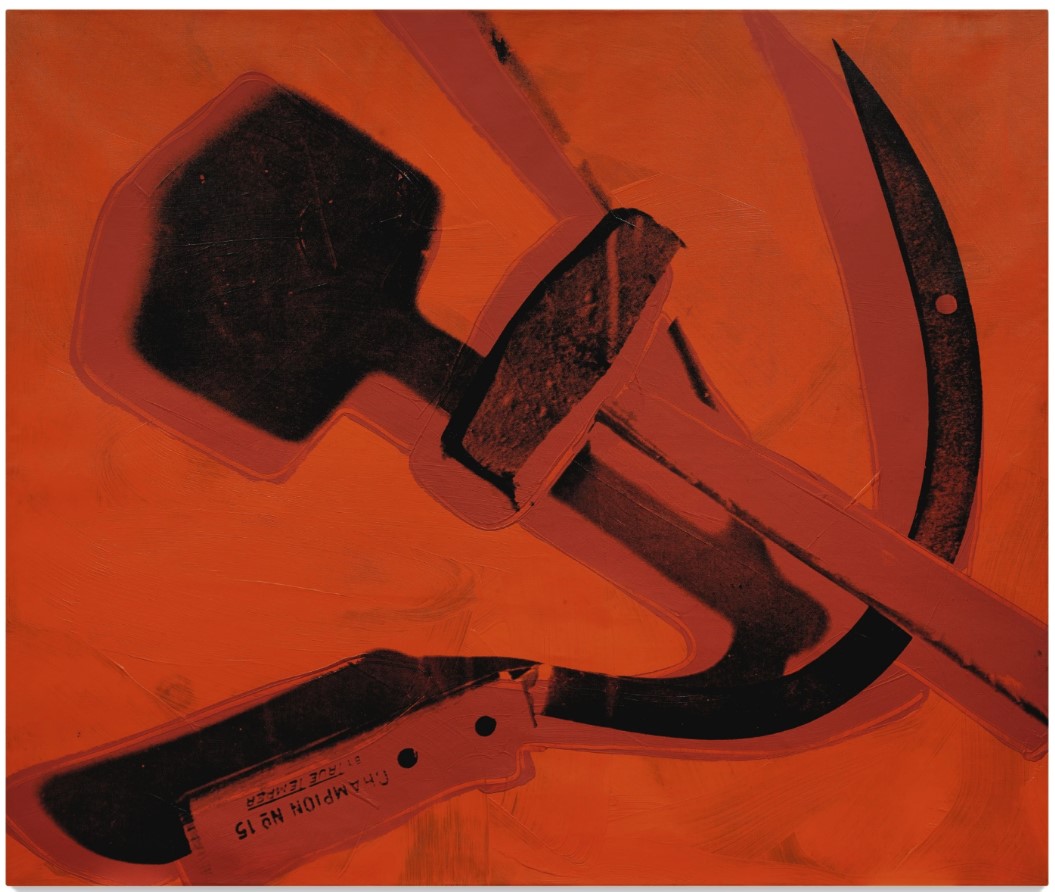
ANDY WARHOL
Hammer and Sickle, 1976
Acrylic and silkscreen ink on canvas
71.7 x 86.1 inches (182.2 x 218.8 cm)
Incontrovertibly arresting in its monumental scale and viscerally charged imagery, the extraordinary Hammer and Sickle from 1976 is among the most historically potent, culturally significant, and incomparably iconic paintings from the inimitable oeuvre of Andy Warhol. Bristling with the explosive energy of communism’s universally recognizable motif, Warhol’s emphatic rendering of one of the Twentieth Century’s most familiar and symbols confronts the viewer with a provocative bravura that rivals that of the artist’s quintessential Pop images of Campbell’s Soup Cans and Marilyn Monroe. A superb example from the acutely limited number of large-scale Hammer and Sickle canvases, the present work is one of the only paintings executed in the eruptive red-on-red ground seen here; in testament to its singularity and outstanding quality, the present Hammer and Sickle is the first of thirty-seven paintings from the series to be listed in the catalogue of the seminal exhibition Andy Warhol: Hammer and Sickle at Thomas Ammann Fine Art in 1999. The striking arrangement of the present work – a resounding parallel to the arrangement of the hammer and sickle emblazoned upon the Soviet flag—is echoed precisely in only four other works from the limited corpus exhibited in the Amman show, two of which are held in the collections of the Museum of Modern Art, New York, and the Museum Brandhorst, Munich. Significantly, the present work was acquired by Warhol’s close friend, the renowned gallerist and founder of the Dia Art Foundation Heiner Friedrich, in the year following its execution; as a striking testament to the friendship between the two men, Warhol personally inscribed Friedrich’s name on the canvas’s reverse. In a searing blaze of incandescent scarlet pigment and crisply delineated shadows, Hammer and Sickle enacts a captivating conflict between the propagandistic fervor of communist Russia and the quintessentially American production of the artist’s Pop oeuvre, transforming the blazing logo into an ironic Warholian emblem par excellence.
Warhol’s subsumption and subsequent re-appropriation of communist symbolism into his legendary Pop vernacular – both physical, as in Hammer and Sickle, and metaphorical, as in his renderings of Chinese communist leader Mao Zedong and Russian communist revolutionary Vladimir Lenin – profoundly refocused the artist’s ground-breaking aesthetic energies on the political realities of his time. His inspiration for the contentious Hammer and Sickle series came in 1975, as the artist was touring Italy for the opening of his Ladies and Gentlemen exhibition at the Palazzo dei Diamanti in Ferrara. Upon viewing the radical Italian left’s ecstatic embrace of his portraits of African and Latin American transvestites, Warhol wryly remarked, “Maybe I should do real Communist paintings next. They would sell a lot in Italy.” (Bob Colacello, Holy Terror, Andy Warhol Close Up, New York, 1990, p. 228) Indeed, in the mid-1970s, the communist emblem of a blunt hammer superimposed on the razor-sharp arc of a sickle was the most conspicuous graffito in the streets of Milan and Rome; despite the establishment of Italy’s democratic government following World War II, the instantly legible symbol still enshrined an anti-establishment fervor and anti-capitalist ideology. Upon his return to the Factory, Warhol charged Ronnie Cutrone, a trusted studio assistant, to track down a suitable source image of the motif from Soviet paraphernalia. As the latter recounts, he searched through New York’s “Red” bookshops but could not find anything appropriate: “They were too flat or too graphic. The answer was to go down to Canal Street, into a hardware store, and buy a real hammer and sickle. Then I could shoot them, lit with long, menacing shadows, and add the drama that was missing from the flat-stencilled book versions… It always amused me that Andy, the ultimate Capitalist, and me, the ultimate Libertarian, could be suspected of communist activity.” (Ronnie Cutrone cited in Exh. Cat., New York, C&M Arts, Hammer and Sickle, 2002, n.p.) Cutrone and Warhol then arranged the objects on a horizontal surface, taking photographs in various compositions and lighting arrangements before Warhol, satisfied with their results, selected the twelve best photographs to serve as source images. The artist then began his trademark process of projecting the source photograph onto a background and painstakingly tracing its contours in pencil, before returning to render the contours in red acrylic. In a second step, the artist silkscreened the same configuration in black onto the existing picture-plane, therein creating the multi-dimensional shadows and optical illusions dramatically articulated in the present work. In the catalogue for the 1999 Thomas Amman exhibition of the series, critic Georg Frei notes, “In some the pictures, the objects and their respective shadows are clearly distinguishable; in others the shadows are unrelated to the shapes and cannot even be identified…Warhol intervenes and manipulates the objects more than in any other series made at that time; he duplicates the play of shadows and additionally enhances the ambivalence between objective/nonobjective.” (Georg Frei, “Hammer and Sickle – A Painterly Manifesto,” in Exh. Cat., Zurich, Thomas Ammann, Andy Warhol: Hammer and Sickle, 1999, n.p.) Frei goes on to note that only occasionally would Warhol use additional colors or, even more rarely, render the composition in multiple shades of red. One of only two such paintings included in the Ammann exhibition to be executed in two shades of scarlet pigment, the present work is the only example in which Warhol emblazoned the motif upon an entirely saturated ground of blood-red pigment; the unique and impenetrable opacity of the crimson canvas instills the painting with a singular aura of zealous civil fervour and profound visual gravitas.
Famous for his droll ambiguity and characteristic preoccupation with artifice, Warhol, in his Hammer and Sickle paintings, once again effortlessly straddles the seemingly antithetical poles of superficiality and penetrating social commentary. Ideologically inverting his infamous consumer symbols in the Campbell Soup Can and Coca-Cola paintings, it is the audacious irony of Warhol, the arch-capitalist, appropriating communist iconography that places Hammer and Sickle at the top tier of the artist’s mature practice. Running parallel to the poignant political import of the imagery in the series, however, lies an underlying challenge to canonical art history’s most conventional and traditional genre: the still life. By artfully positioning the purchased hammer and sickle upon a draped white surface, re-arranging and re-lighting with exacting precision, Warhol wryly invokes the precariously balanced compositions and mesmerizing trompe l’oeil of eighteenth-century still life painters. Remarking upon this remarkable tension in the Hammer and Sickle paintings, Frei notes, “The present series takes a less direct and more complex stand by showing the logo of the American manufacturer and thus marking the tools as products of a free market economy. The representation takes a different tack: the once political emblem has been dismantled into its original components. As in a classical still life, the objects have no secrets, no ulterior meaning: a hammer is a hammer, a sickle is a sickle. Created long before glasnost and perestroika, these works seem to us today almost like a prophetic prediction.” (Ibid., n.p.) In the present work, the brand name of the manufacturer and model–“Champion No. 15 by True Temper”–is screened with remarkable clarity, thereby emphasizing the status of these objects as consumer products and distancing them from the purely symbolic shapes rendered in the iconic Communist image. The hammer and the sickle, in Warhol’s hands, is not an abstraction but a manufactured product that simply reverberates with a highly charged symbolic potency. Here, the most archetypal symbols of socialism are demoted to consumerist objects, dispersing the explosive political charge of the imagery while concomitantly locating it within a broader art-historical and critical framework. A truly magnificent work from Warhol’s most politically potent and indelibly totemic series, Hammer and Sickle is a profound and enduring testament to Warhol’s legacy as the consummate history painter of the modern age.
Hammer & Sickle, 1976
Christie’s New-York: 12 November 2013
Estimated: USD 3,000,000 – 4,000,000
USD 3,525,000
Andy Warhol (1928-1987), Hammer & Sickle | Christie’s
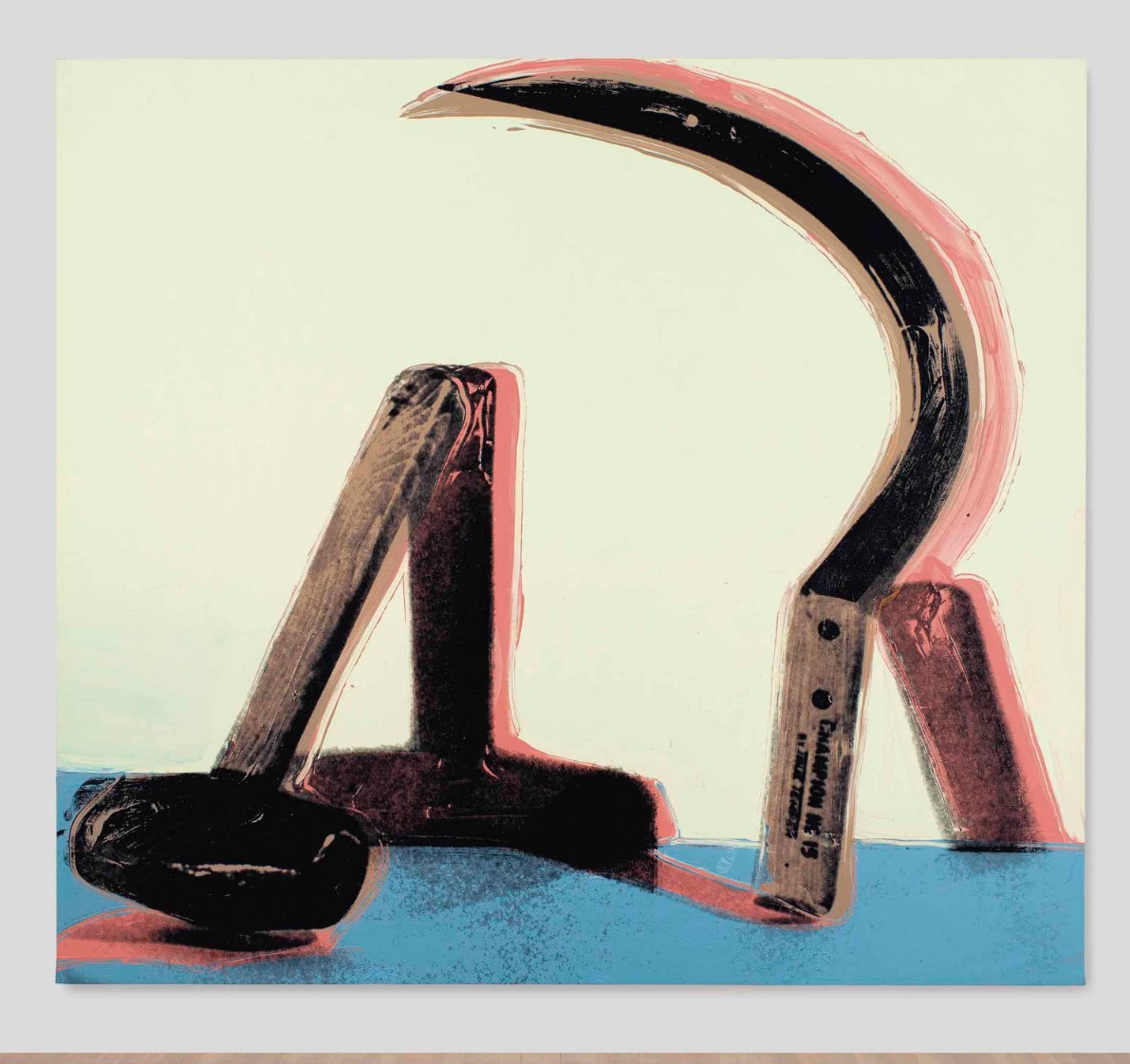
ANDY WARHOL
Hammer & Sickle, 1976
Synthetic polymer and silkscreen ink on canvas
72×80 inches (182.8 x 203.2 cm)
With a strong sense of irony, Andy Warhol’s Hammer & Sickle presents two ubiquitous farm tools that over the course of the twentieth century came to represent one of the most fearsome ideologies in history. The humble hammer and sickle, longtime symbol of the Communist Party, had been instilling fear in the West ever since its adoption by Russian Communists in 1917 and had come to symbolize the oppressive and tyrannical excesses of countless governments across the world. That the modest tools of the worker had grown to represent the mighty forces of the Eastern Bloc intrigued Warhol, who understood the power images had in society and used his astute eye to investigate and deconstruct the meaning of these iconic symbols. Part of a series of drawings and paintings exhibited at the Leo Castelli Gallery in 1977, Warhol’s series of Hammer & Sickle paintings are among his most important artistic statements of the 1970s. At a time when he was busy painting portraits of the rich and famous, how provocative he must have felt dedicating a new series to the symbol of the Soviet Union and worldwide socialism, at the very height of the Cold War and communist paranoia.
The most striking compositional aspect of Hammer & Sickle is Warhol’s dismantling of the implements from their triumphal raised positions on the Soviet Flag to their more innocuous origins. Here they appear at rest, propped up against a wall and separated from their symbolic entanglement, looking as if they have just been discarded by their languid owner. The color palette, too, is far removed from the ominous communist red of its predecessors as Warhol executes the symbols first in a layer of pinkish red, followed by a thinner, more diaphanous layer of black. The featureless, sponge-mopped background field–a technique repeated from Skulls from the same year– emphasizes the object-like qualities of tangible hammer and sickle, as well as their unwieldy strangeness when related together in this way. Much as the manipulated stacks of soup cans and bottles in his series of Campbell’s Soup and Coca-Cola paintings begin to deconstruct and otherwise wear down the clear boundaries of a distinct commercial identity, to Warhol, the evacuated emblem of the hammer and sickle was an enticing, if antithetical, sign that also benefited strangely from material manipulation.
Warhol’s then-assistant Ronnie Cutrone described the inspiration for Hammer and Sickle that came to Warhol while the artist was touring Italy. His glamorized portraits of black and Hispanic transvestites from the series Ladies and Gentlemen, 1975 had recently debuted at the Palazzo dei Diamanti in Ferrera, where they were acclaimed by the Italian radical left as an exposé of American capitalism’s inherent racism. Although Warhol’s imagery in this case had no particular social advocacy aim, he was charmed by the question of political affiliation consequently raised by the Italian press. After returning to New York, Warhol sent Cutrone to track down printed representations of the Soviet emblem. Yet the limited stock of iconography Cutrone collected was, almost paradoxically, too flat for Warhol’s liking. So to flesh out the party symbolism, its referents–a hammer (of the industrial laborer) and sickle (of the peasant)–were acquired from a Canal Street hardware store and arranged into a political still life against a white backdrop in The Factory. Cutrone recalled the incongruence of Warhol eating McDonald’s in the morning and painting Hammer & Sickle in the afternoon.
As the king of American Pop art, Warhol had inherited his Modernist forebears’ gross obsession with surface–but did not limit himself to the two-dimensional plane defined by the painting’s canvas. A prolific manufacturer of iconic images in his own right (with the muscle of mass-reproduction techniques), Warhol’s persistent practice took measure of the variegated exterior surface of the news media, consumer culture, American celebrity and even the construction of his own self-image. In works as diverse in subject matter as his soup can paintings, Liz, 1963, and Birmingham Race Riot, 1964, Warhol unceasingly probed the superficial layers of readymade imagery–and in so doing, unraveled content through the condition of its less than pristine packaging. Yet in many respects, Warhol’s Hammer & Sickle series subverts this working method, because of the ultra-abstraction and ideological other of its subject: Communism. The relatively late development of the work alludes to its function as an aerobic exercise of the hammer and sickle’s iconographic potency, because Warhol– despite sometimes reproducing political images–maintained strictly apolitical views.
Warhol’s practiced postmodern probing of the Soviet hammer and sickle is remarkable for its utter lack of apprehension, as fearless and perhaps twisted an engagement with contemporary threats to Capitalism as his Atomic Bomb (1965). Hammer & Sickle was also prescient precisely for its direct presentation of Soviet anachronism, which would soon succumb to the “commonism” of the market economy mass production that Warhol so adored. A significant and rare achievement within Warhol’s vast oeuvre, Hammer & Sickle has only grown richer with the passage of time and the complete disbanding of Cold War enterprise.
Hammer and Sickle, 1977
Sotheby’s New-York: 13 November 2012
Estimated: USD 3,000,000 – 4,000,000
USD 3,442,500
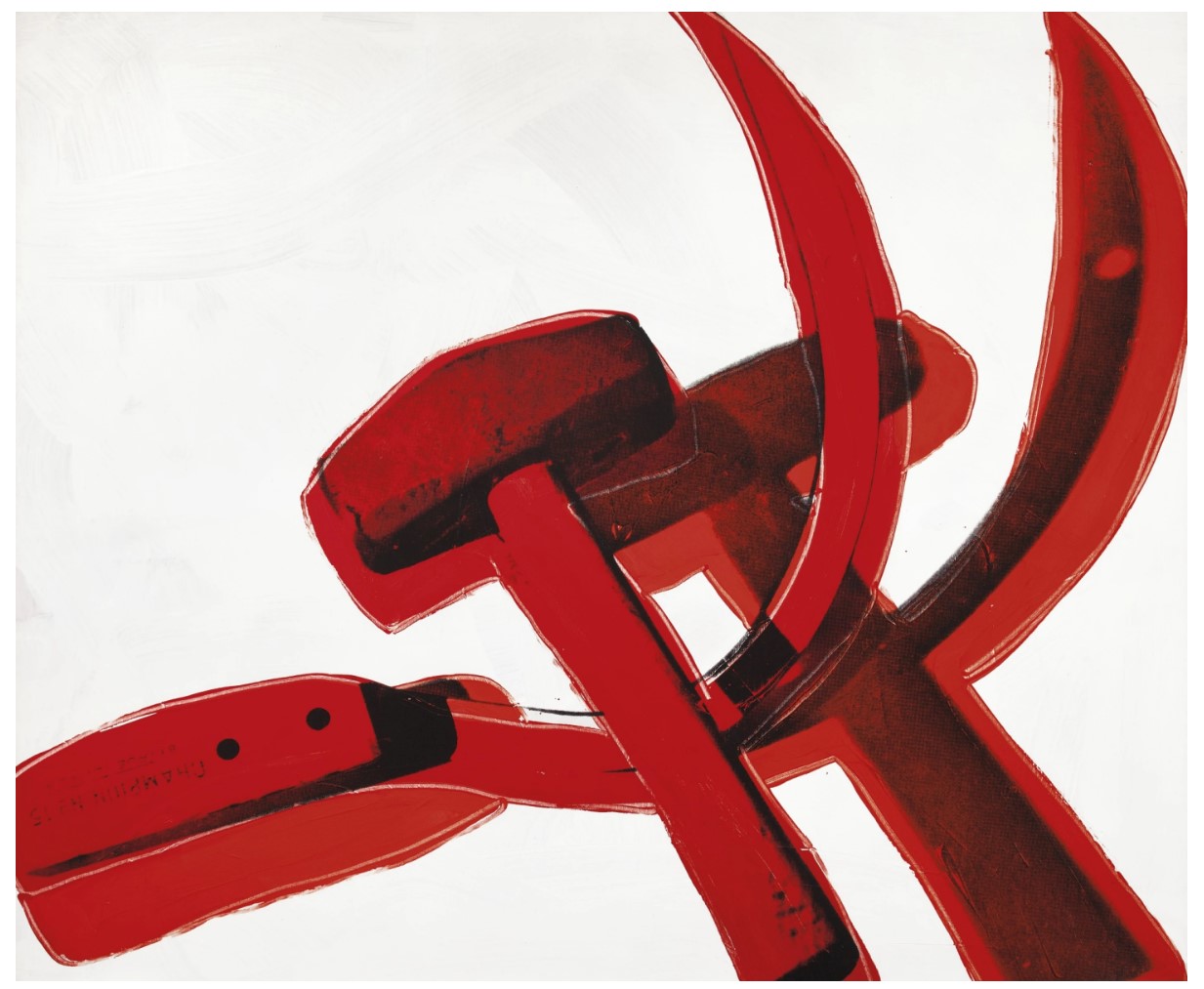
ANDY WARHOL
Hammer and Sickle, 1977
Acrylic and silkscreen ink on canvas
72×86 inches (183 x 218.5 cm)
A resounding exclamation of the notorious hammer and sickle motif – loaded symbols that for more than half a century were the totem of a philosophy and way of life that governed entire peoples – and painted in a palette of vibrant red, white and black readily associated with the propagandistic posters of the Soviet era, Andy Warhol’s non-partisan work both dissembles the poignant political import of the imagery while concomitantly locating it within a broader art-historical and critical framework of the still life genre.
Monumental in scale, this is among the largest works of a series that Warhol had conceived of during a trip to Italy for the opening of his Ladies and Gentlemen exhibition at the Palazzo dei Diamanti in Ferrara in 1975. At the time, the symbol of the hammer superimposed on the sickle was the most conspicuous graffito in the streets of Milan and Rome. In Italy, a democratic country since the end of the Second World War, the instantly legible symbol enshrined an anti-establishment fervor and anti-capitalist ideology, a repost to the increasingly ubiquitous insignia of American consumerism and brands such as Coca-Cola which had become so commonplace across Europe. Just as he had done in the 1960s with the most quintessentially consumerist emblems such as the Coca-Cola bottle and Campbell’s soup can, here Warhol decided to adopt the logo of communism as a subject for his art, transforming it into a Warholian emblem par excellence.
Despite disavowing any political ties to his work, Warhol, the archetypal Pop provocateur, could not paint a series of images of the hammer and sickle in the cultural environment of the Cold War without inviting politicised glosses from his critics. By the late 1970s, the relationship between the American and Soviet Union Superpowers was strained, characterized not by military combat but by a climate of tension and mutual perceptions of hostility between East and West, communism and capitalism. The hammer and sickle were unilaterally recognised as the symbol of international communism, adopted as the official emblem of the Red Army in the 1920s and later set in gold upon the Red Flag of the Soviet Union. Symbols of the industrial proletariat and the peasantry, the hammer and the sickle together symbolised the unity between industrial and agricultural workers under the aegis of the State, the core principle of communist ideology.
On his return to the Factory, Warhol charged his studio assistant Ronnie Cutrone to track down a suitable source image from Soviet paraphernalia. As the latter recounts, he searched through New York’s Red bookshops but could not find anything appropriate: “They were too flat or too graphic. The answer was to go down to Canal Street, into a hardware store, and buy a real hammer and sickle. Then I could shoot them, lit with long, menacing shadows, and add the drama that was missing from the flat-stencilled book versions… It always amused me that Andy, the ultimate Capitalist, and me, the ultimate Libertarian, could be suspected of Communist activity.” (Ronnie Cutrone cited in Exh. Cat., New York, C&M Arts, Hammer and Sickle, 2002)
It is this brilliant irony of Warhol, the arch-capitalist, engaging with communist iconography, which lends the present work its potency. Unsurprisingly, in Warhol’s hands these symbols of socialism are demoted to consumerist objects, like Coca-Cola bottles, Brillo boxes and Campbell’s soup cans, thus paradoxically branding the tools as part of a free market economy and radically destabilising their ostensible political connotations. Yet running parallel to any political gloss is Warhol’s challenge to the canon of art history’s most conventional and traditional genre: the Still Life. By placing the objects on a draped white surface, he mimics the practice of eighteenth-century Still Life painters of precariously balancing knives on a table edge to demonstrate their bravura at creating trompe l’oeil effects with their brush. The Still Life genre has always reflected the age in which it was painted; here Warhol’s ‘still life’ reflects an age where religious, moral and political values have grown subordinate to superficial commercial imperatives – translated onto billboard scale using his levelling silkscreen process it smacks of an era of American promotional advertising where consumerism has triumphed. A landmark work in Warhol’s mature oeuvre, its sardonic comment on the capitalist/ communist dichotomy shows Warhol to be the ever pertinent historical commentator of his day.
Hammer and Sickle, 1976
Christie’s New-York: 11 May 2011
Estimated: USD 3,500,000 – 5,000,000
USD 3,890,500
Andy Warhol (1928-1987) , Hammer and Sickle | Christie’s
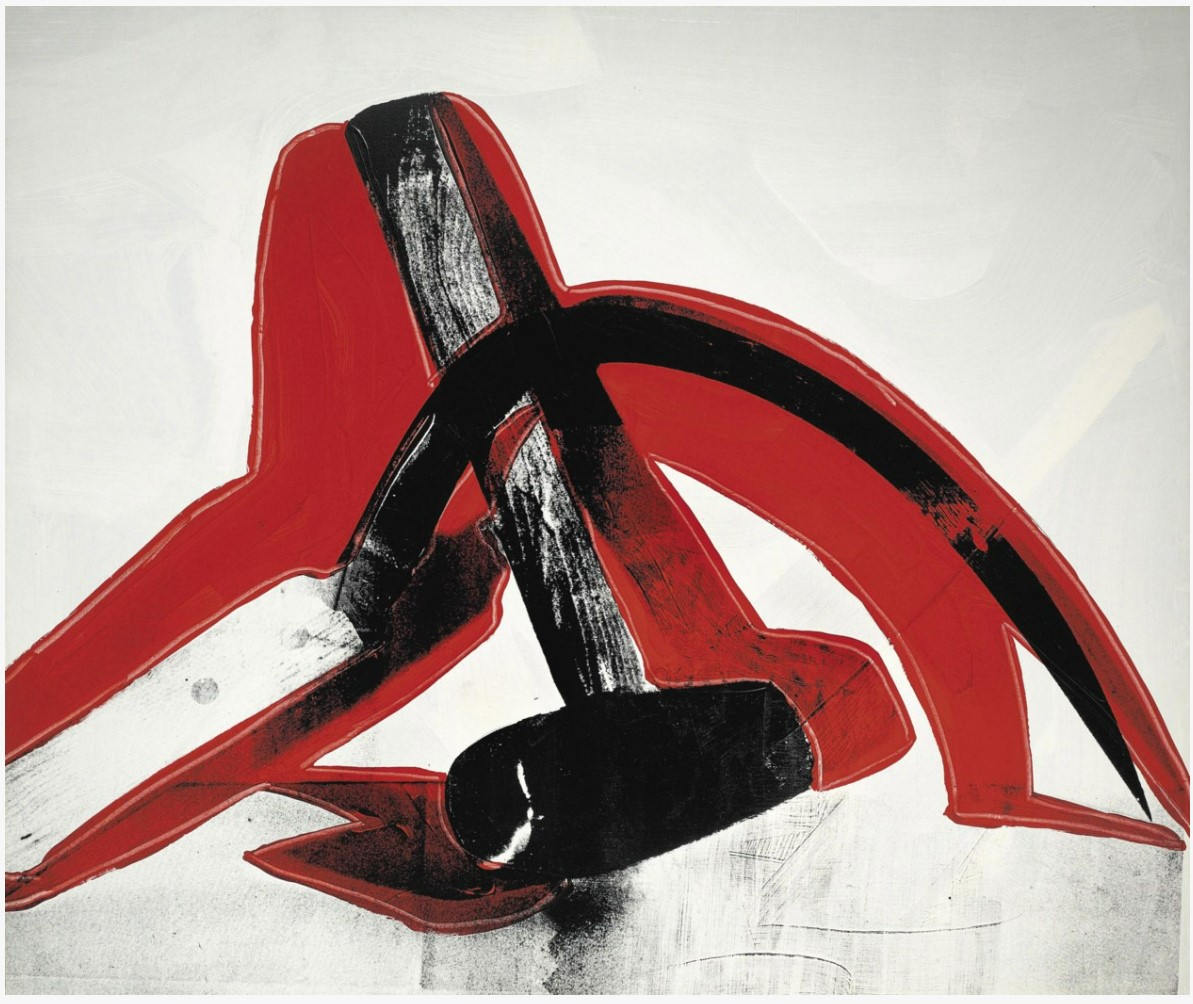
ANDY WARHOL
Hammer and Sickle, 1976
Synthetic polymer, silkscreen inks and acrylic on canvas
72.2 x 86.2 inches (183.6 x 220 cm)
Warhol inverts the implements from their triumphal, raised positions on the Soviet Flag, the most striking compositional aspect of the stylistically minimal Hammer and Sickle. Here they appear at rest, crossing at an arbitrary angle, which lacks both geometric vigor and menace. He repeated a technique from Skulls, from the same year: a featureless, sponge-mopped background field. This emphasizes the object-like qualities of a tangible hammer and sickle, as well as their unwieldy strangeness when related together in three dimensions. The evacuated emblem of the hammer and sickle enticed Warhol, as he captured them in alternative constellations across the Hammer and Sickle series, here screenprinting them from a photographic source. It was a sign that benefited strangely from material manipulation, much like the manipulated stacks of soup cans and bottles in his series of Campbell’s and Coca-Cola paintings, to which it was ideologically antithetical. The antiquated instruments show no evidence of use, in contrast to their counterpart consumable products. In all of these works, Warhol deconstructed and otherwise wore down the clear boundaries of a distinct commercial identity. Hammer and Sickle‘s color palette remains true to the Communist cause, unlike Warhol’s iconic acid portraits of Mao (1972). Swathes of dark and red delineate the shadows cast by the store-bought tools under bright studio lights. These strong fields of color imply substance but are not substantial in their own right, achieving a balance between the abstract and the representational that the shallow Soviet graphic reduces entirely. The hammer and sickle had long since transmuted into pure sign, like Chairman Mao’s visage omnipresent throughout the People’s Republic of China, as much a powerful imprint of state oppression as a hastily appropriated mark of graffiti.
Hammer and Sickle, 1976
Sotheby’s London: 25 June 2009
Estimated: GBP 2,000,000 – 3,000,000
GBP 2,001,250
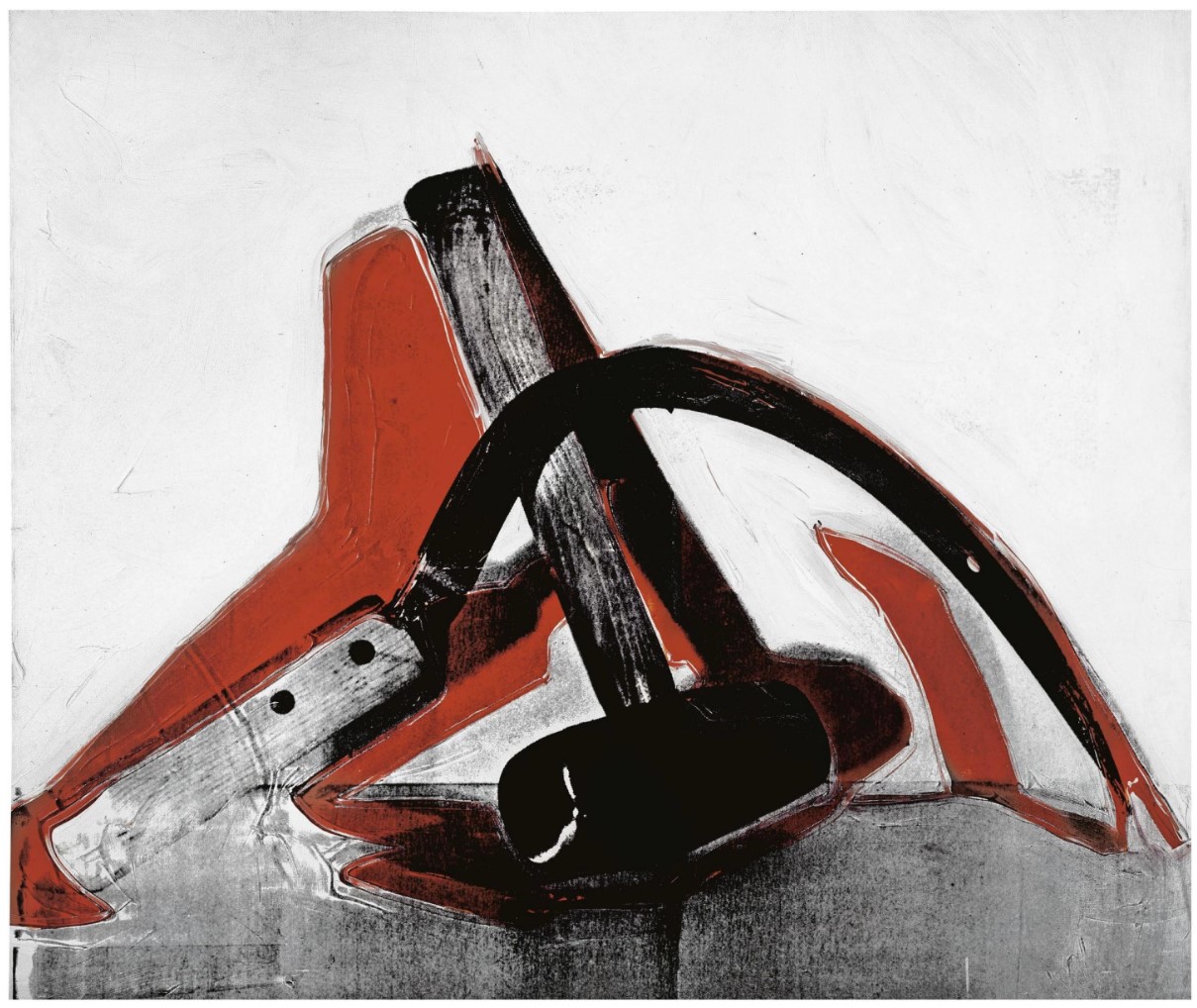 ANDY WARHOL
Hammer and Sickle, 1976
Acrylic and silkscreen ink on canvas
72 x 86.2 inches (183×219 cm)
Signed on the overlap
Executed in late 1976, the present work is from a cycle of paintings that Andy Warhol exhibited under the equivocal title Still Lifes at the Leo Castelli Gallery in New York in 1977. Depicting a hammer and sickle, motifs loaded with political symbolism, and painted in a palette of (socialist) red, white and black readily associated with the propagandistic posters of the Soviet era, Warhol’s non-partisan exhibition title disingenuously dissembles the poignant political import of the work, while concomitantly locating it within the broader art-historical and critical framework of the still life genre. Monumental in scale, this is among the largest works of the series. Warhol conceived of the idea of painting the hammer and sickle series while on a trip to Italy for the opening of his Ladies and Gentlemen exhibition at the Palazzo dei Diamanti in Ferrara in 1975. At the time, the symbol of the hammer superimposed on the sickle was the most conspicuous graffito in the streets of Milan and Rome. In Italy, a democratic country since the end of the Second World War, the instantly legible symbol enshrined an antiestablishment fervour and anti-capitalist ideology, a repost to the increasingly ubiquitous insignia of American consumerism and brands such as Coca-Cola which were spreading through Europe like wildfire. Just as he had done in the 1960s with that most quintessential capitalist emblem, the Coca-Cola bottle, here Warhol decided to adopt the logo of communism as a subject for his art, transforming it into a Warholian emblem par excellence.
Hammer and Sickle (15×19)
Hammer and Sickle, 1976
Christie’s New-York: 17 May 2024
Estimated: USD 350,000 – 450,000
USD 441,000
ANDY WARHOL (1928-1987), Hammer and Sickle | Christie’s
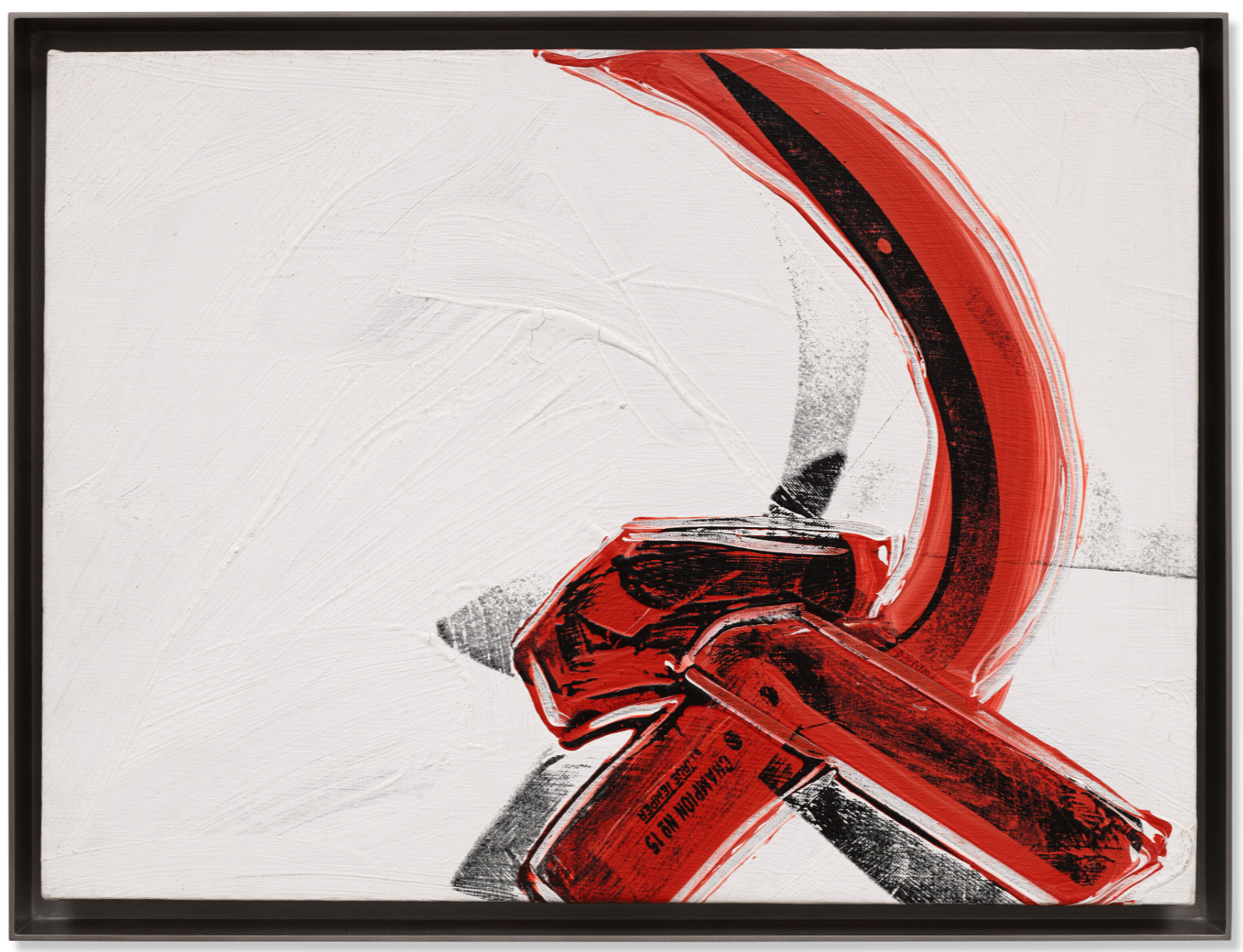
ANDY WARHOL (1928-1987)
Hammer and Sickle, 1976
Acrylic and silkscreen ink on canvas
14×19 inches (35.5 x 48.2 cm)
Stamped twice with the Estate of Andy Warhol and the Andy Warhol Foundation for the Visual Arts, Inc. stamp
Numbered ‘VF PA25.009’ (on the overlap)
Hammer and Sickle, 1976
Christie’s London: 25 June 2019
Estimated: GBP 300,000 – 500,000
GBP 491,250
Andy Warhol (1928-1987), Hammer and Sickle | Christie’s
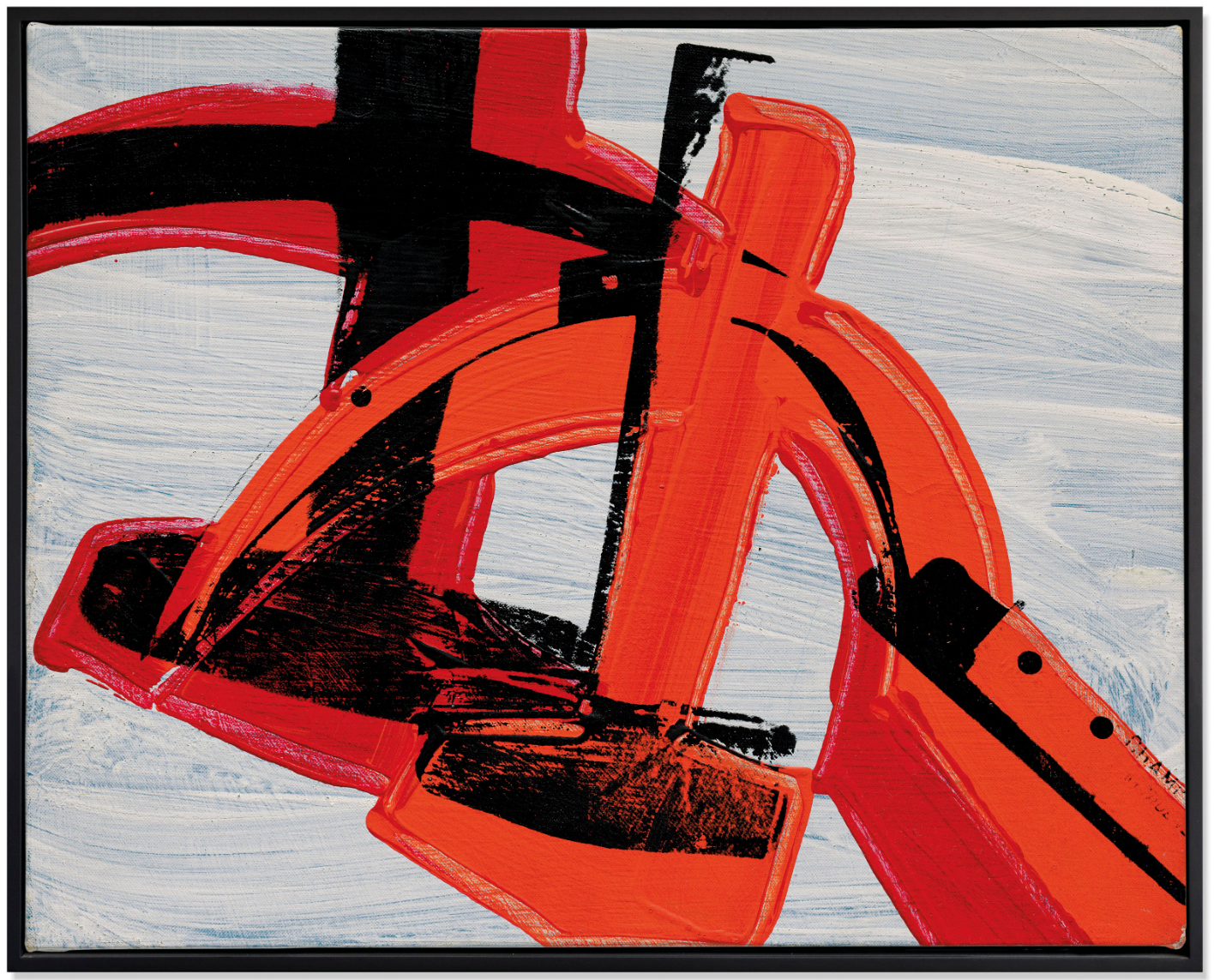
ANDY WARHOL (1928-1987)
Hammer and Sickle, 1976
Oil on canvas
15 1/4 x 19 inches (38.8 x 48.2 cm)
Signed and dated ‘Andy Warhol 1976’
Signed and dated ‘Andy Warhol 1976’ (on the reverse)
A striking example of an enigmatic and powerful series, Hammer and Sickle (1976) sees Andy Warhol bringing his razor-sharp Pop sensibility to bear upon one of the most charged symbols of his time. In a virtuoso combination of silkscreen and painterly techniques, he depicts a hammer and sickle – not as the flat, graphic icon of the Soviet Union, but as a still life of two objects. Deploying the heightened brushwork of the latter decades of his practice, he washes a Prussian blue base layer in bright titanium white for the background; the hammer and sickle are outlined in cadmium red light, and the bold, graphic shadow they cast is painted with a pinkish aura of naphthol crimson. The tools – based on a photo taken by his assistant Ronnie Cutrone – are flipped relative to their usual orientation in the Communist motif, and their compound form is disrupted by their vivid shadow, which casts the structure of the picture into near-abstraction. Warhol once claimed that the Hammer and Sickle series was sparked by a trip to Italy where he was asked if he himself was Communist, due to the images of Chinese leader Chairman Mao that he had made in 1972; another story says that the ubiquitous hammer-and-sickle graffiti he saw daubed on walls on the same trip alerted him to its strength as a Pop logo. Whatever their precise origin, the Hammer and Sickle works, which Warhol began making in 1975 alongside his iconic Skull cycle of still-lifes, went on to form one of the important series of his 1970s practice. Warhol’s focus at this time on photographs composed in his studio as source imagery led to an ever-greater emphasis on dramatic composition and colour in his work, which would culminate in the magnificent abstract Shadows of 1978-79. Hammer and Sickle is an outstanding display of this new formal sensitivity, as well as of Warhol’s typically intelligent destabilising of symbolic meaning.
For all his much-documented interest in the depthless ‘surface’ of things – even his own blank persona reflected the mechanical flatness of his endlessly reproducible silkscreens – Warhol was also alive to the possibilities of three dimensions. His use of real objects in Hammer and Sickle allows him to deconstruct the flat elements of the Communist symbol, reconstituting them as an ambiguous still life. Remembering the genesis of the series, Cutrone says Warhol asked him to find a ‘three-dimensional’ example of the hammer and sickle on his return from Italy. ‘Well, for a couple of weeks – three weeks, actually – I was going to all the Communist stores in New York trying to find something that was three-dimensional, and there just wasn’t anything’, Cutrone recalls. ‘Most of the symbols I found were just flat. So, we decided to use the real objects. So, I went to a hardware store, a number of them, and picked out the best hammers and sickles I could find and brought them back and shot them with three or four rolls of film, all different ways, using different lighting’ (R. Cutrone, quoted in P. S. Smith, Andy Warhol’s Art and Films, Ann Arbor 1986, pp. 278-79). The ‘three-dimensional’ version of the symbol that resulted – Warhol would use seventeen different photographs as a basis for the silkscreens – opens up a diversity of new readings. Created at a time when the Cold War was ongoing and the Bomb a very real threat, the hammer and sickle’s weighty appearance as potential weapons might lend them an edge of physical menace. At the same time, they display a bathetic mundanity when unmoored from the symbol and exposed as everyday objects in themselves; ironically, of course, this particular hammer and sickle purchased from a New York hardware store function as consumer goods in a Capitalist system (part of the ‘CHAMPION’ logo stamped on the sickle’s handle can be glimpsed in the present work). With its sharp, dynamic red, black and white shapes, Hammer and Sickle could also be said to wryly echo the abstract visual language of Russian Constructivism, which posited art as a social force in service of the Revolution during the early twentieth century.
Surely Warhol’s most cutting irony, however, lies in the fact that his own artworks by this time were extremely valuable commodities. He knew that when works from the Hammer and Sickle series were sold, a version of the Communist symbol would end up adorning the walls of wealthy American collectors and institutions. As a Warhol artwork, this visual taboo would become a status symbol and luxury item: perhaps the ultimate image of Capitalism consuming and transforming the apparatus of its adversary. In the world of commerce, Warhol saw a kind of utopia. To some degree, he used similar tools to the Communist regime, albeit to extremely different ends; Hammer and Sickle, after all, is itself is a product of Warhol’s Factory, of his own culture of mass manufacture. Warhol felt that the way of life in the United States, where presidents and poor people alike could drink Coca Cola, was already a form of Communism Lite: ‘The idea of America is so wonderful because the more equal something is, the more American it is’ (A. Warhol, quoted in K. Honnef, Andy Warhol 1928-1987: Commerce into Art, Cologne, 2000, p. 54). Folding these ambiguities into a rich and multivalent image, Hammer and Sickle stands as a potent icon of Warhol’s complex vision of the world.
Hammer and Sickle, circa 1976
Sotheby’s New-York: 15 May 2014
Estimated: USD 300,000 – 400,000
USD 545,000
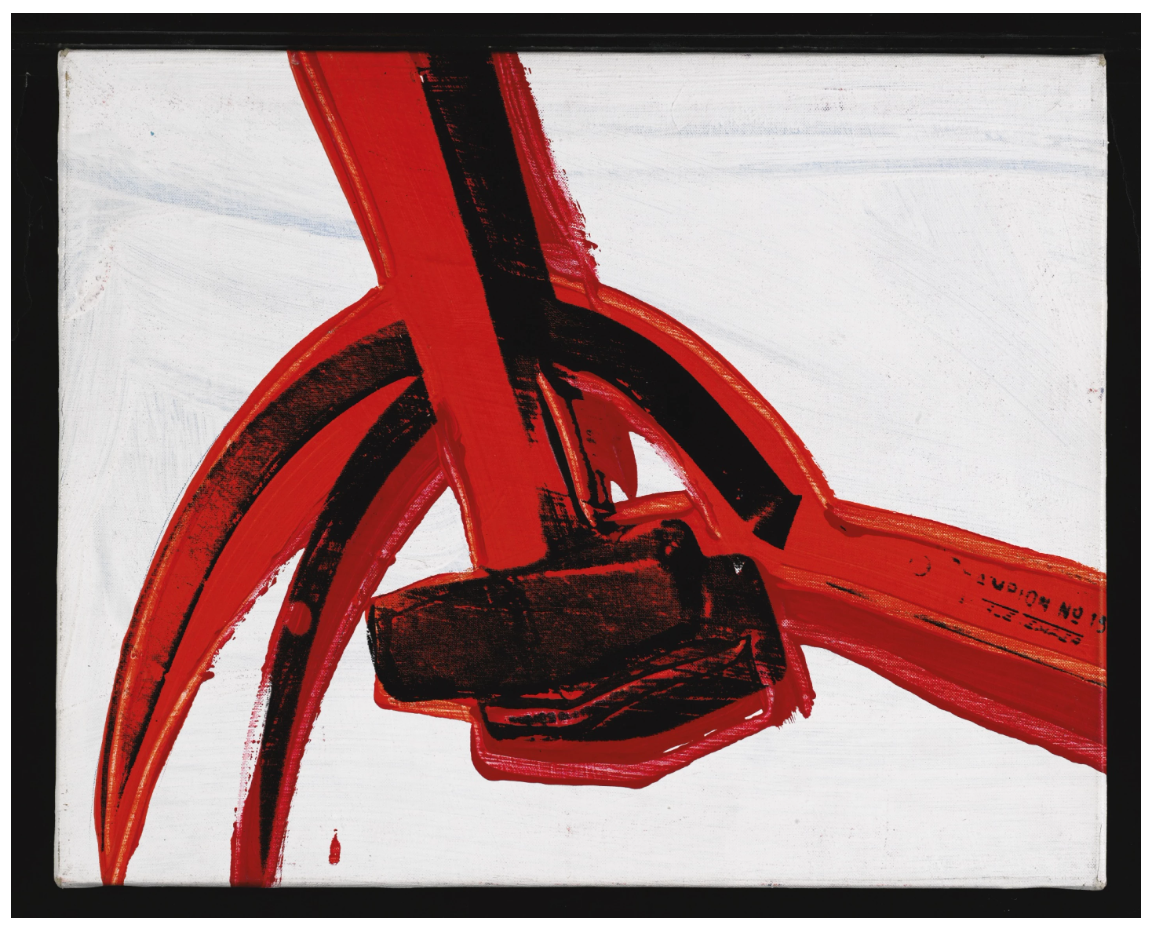
ANDY WARHOL
Hammer and Sickle, circa 1976
Acrylic and silkscreen ink on canvas
15×19 inches (38.1 x 48.3 cm)
Signed on the overlap
Hammer and Sickle, 1976
Christie’s New-York: 13 November 2013
Estimated: USD 150,000 – 200,000
USD 293,000
Andy Warhol (1928-1987), Hammer and Sickle | Christie’s
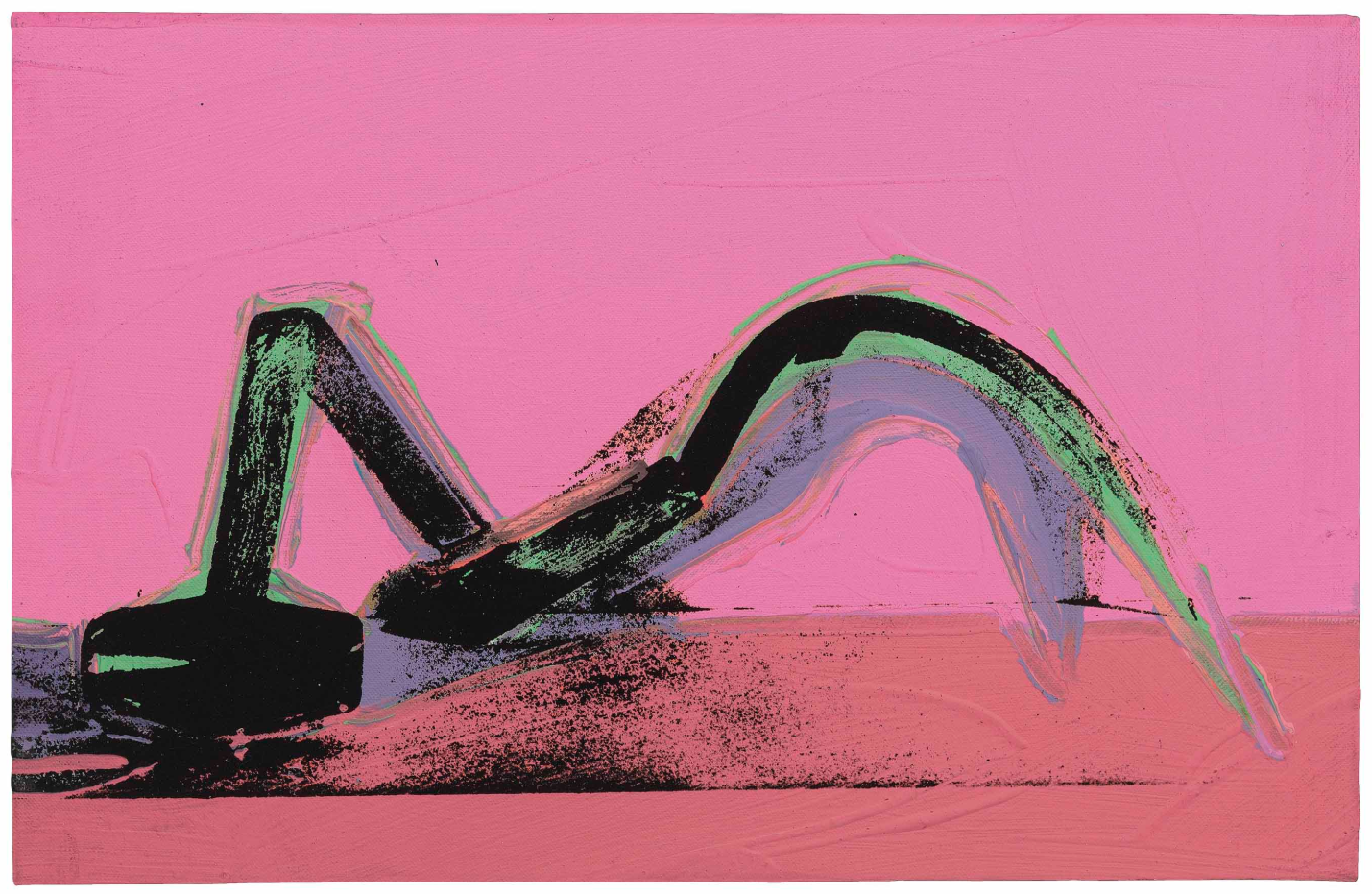
ANDY WARHOL (1928-1987)
Hammer and Sickle, 1976
Synthetic polymer and silkscreen inks on canvas
11×17 inches (27.9 x 43.1 cm)
Stamped three times with the Andy Warhol Foundation for the Visual Arts Inc. stamp
Stamped with the Estate of Andy Warhol Foundation stamp and numbered ‘PA25.013’
(on the overlap and the stretcher)
Works on Paper
Still Life (Hammer and Sickle), 1977
Christie’s New-York: 7 October 2020
Estimated: USD 30,000 – 50,000
USD 37,500
Andy Warhol (1928-1987), Still Life (Hammer and Sickle) | Christie’s
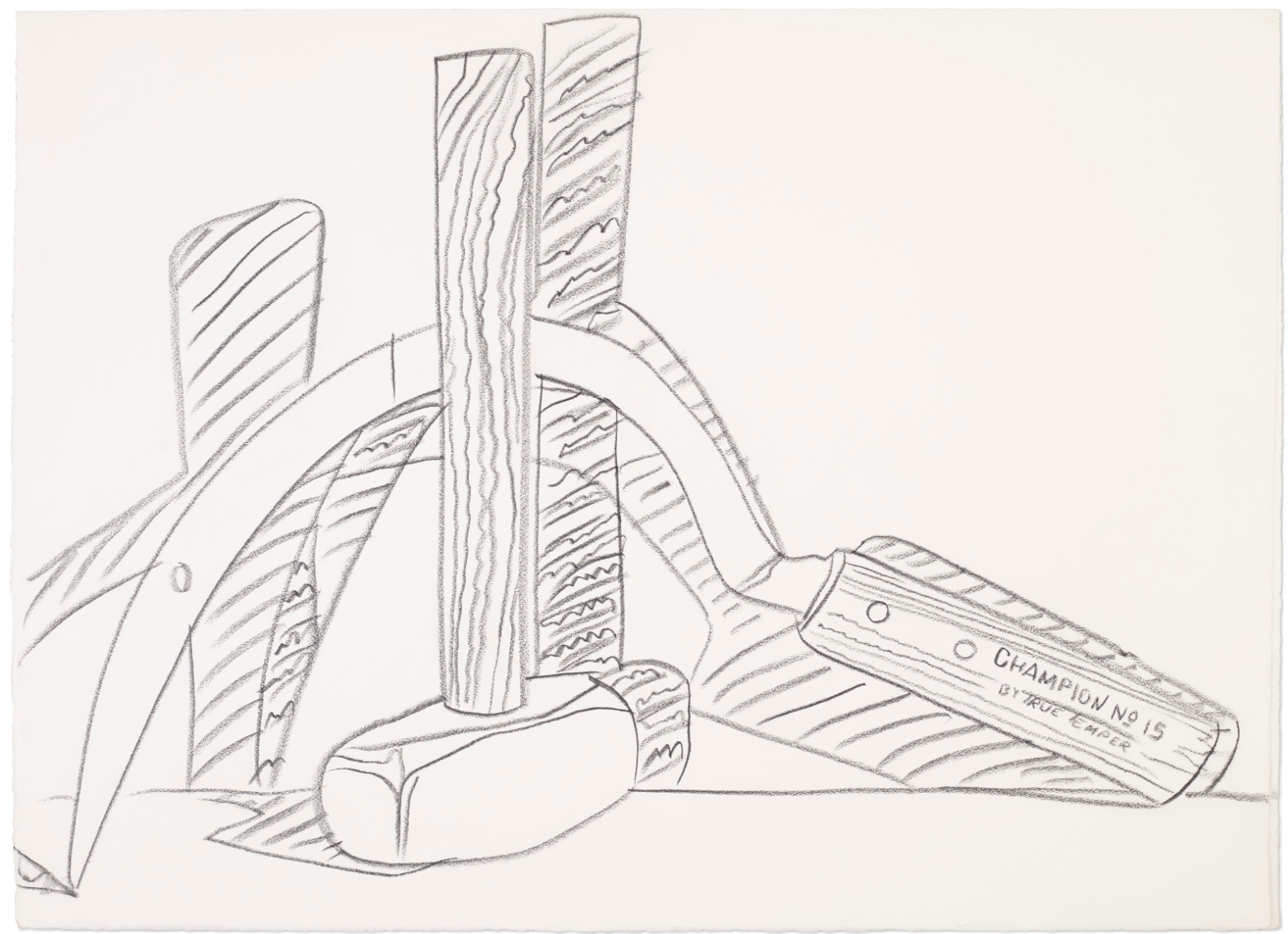
ANDY WARHOL (1928-1987)
Still Life (Hammer and Sickle), 1977
Graphite on paper
20 1/2 x 28 1/4 inches (52.1 x 71.8 cm)
Stamped with the Estate of Andy Warhol and the Andy Warhol Foundation for the Visual Arts, Inc. stamps
Numbered ‘VF 31.005’ (on the reverse)
STILL LIFE (HAMMER & SICKLE), 1976
Sotheby’s New-York: 14 May 2020
Estimated: USD 50,000 – 70,000
USD 118,750
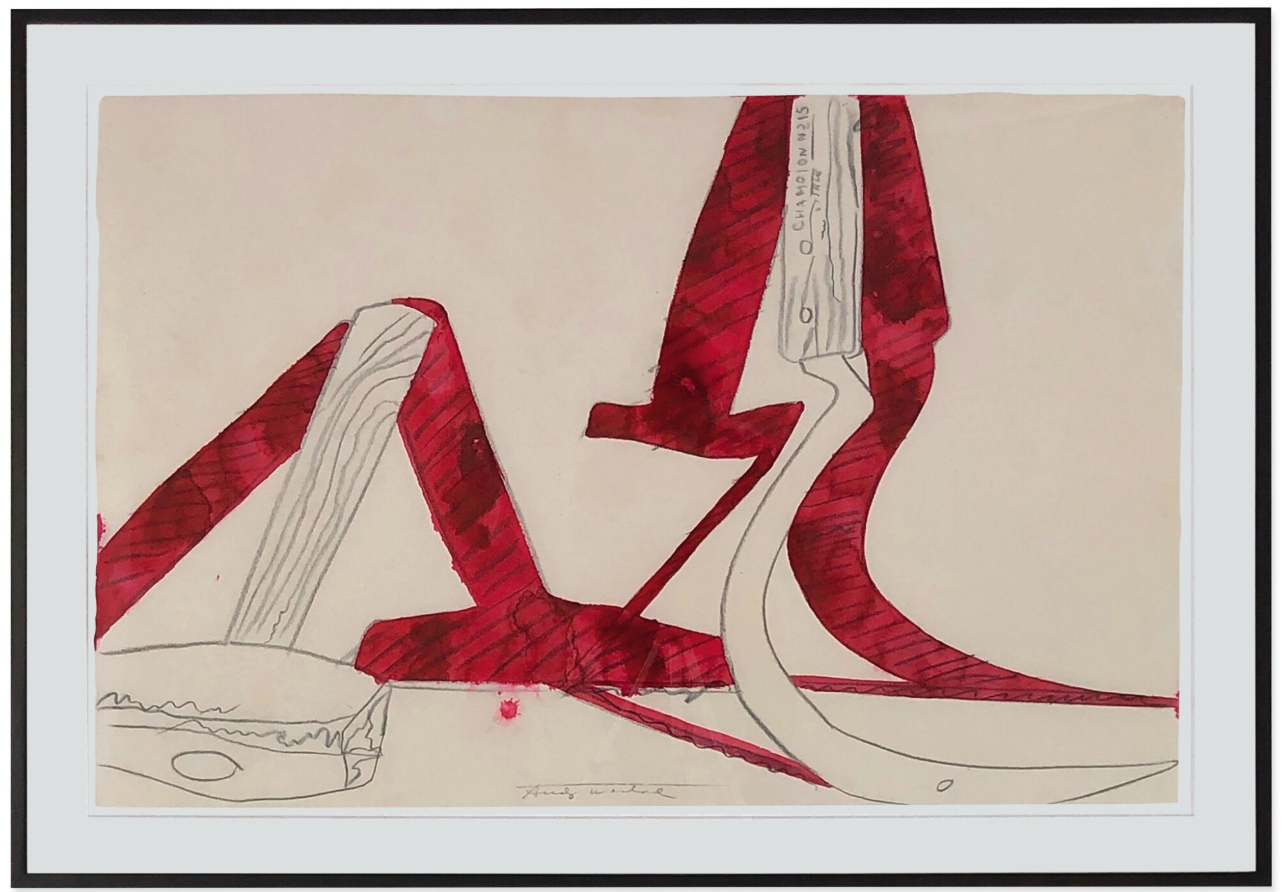
ANDY WARHOL (1928 – 1987)
STILL LIFE (HAMMER & SICKLE), 1976
Ink and graphite on paper
Sheet: 28×41 inches (71.1 x 104.1 cm)
Signed
Still Life (Hammer and Sickle), 1977
Phillips New-York: 13 November 2019
Estimated: USD 20,000 – 30,000
USD 100,000
Andy Warhol – 20th C. & Contempora… Lot 205 November 2019 | Phillips
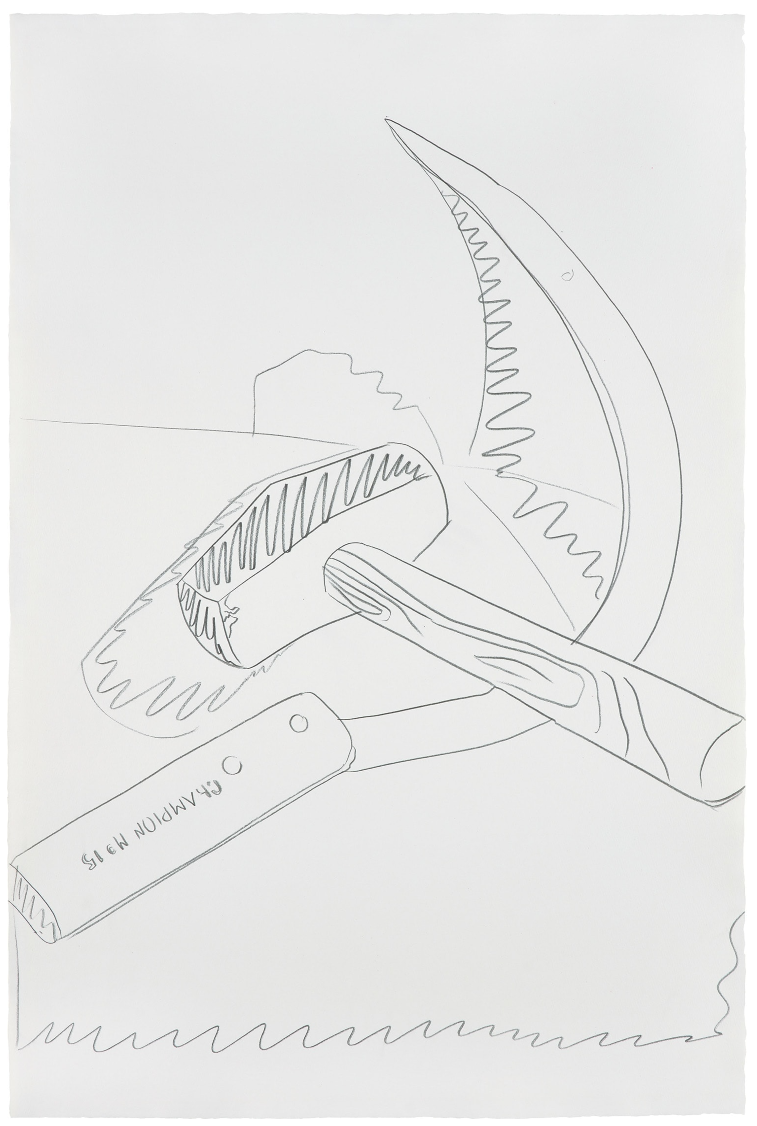
ANDY WARHOL
Still Life (Hammer and Sickle), 1977
Graphite on T.H. Saunders paper
40 3/8 x 26 7/8 inches (102.4 x 68.4 cm)
Stamped by the Estate of Andy Warhol and the Andy Warhol Foundation for the Visual Arts, Inc., New York
Initialed “VF” and numbered “31.010” on the reverse
Still-Life (Hammer and Sickle), 1977
Sotheby’s New-York: 15 May 2013
Estimated: USD 70,000 – 90,000
USD 75,000
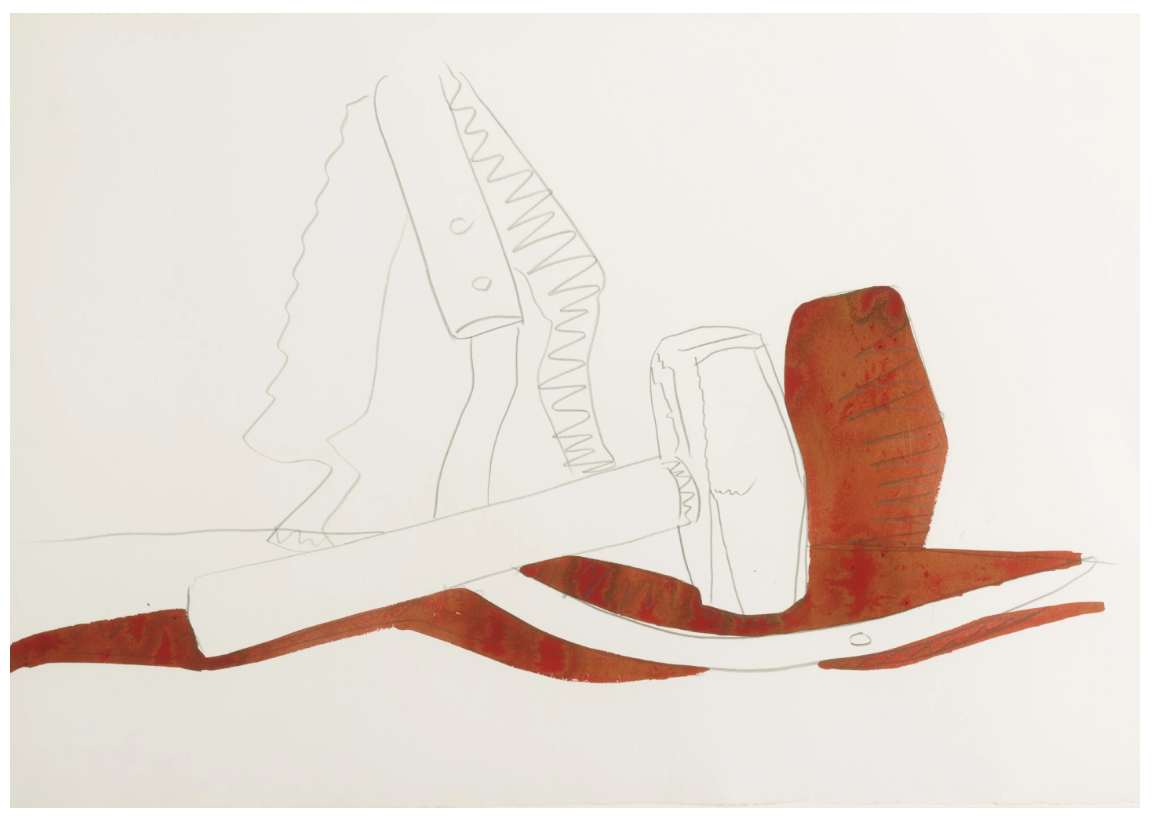
ANDY WARHOL
Still-Life (Hammer and Sickle), 1977
Graphite and gouache on paper
28 x 40 1/4 inches (71.1 x 102.2 cm)
Stamped by the Estate of Andy Warhol and by the Andy Warhol Foundation for the Visual Arts, Inc.
Numbered VF 31.044 on the reverse