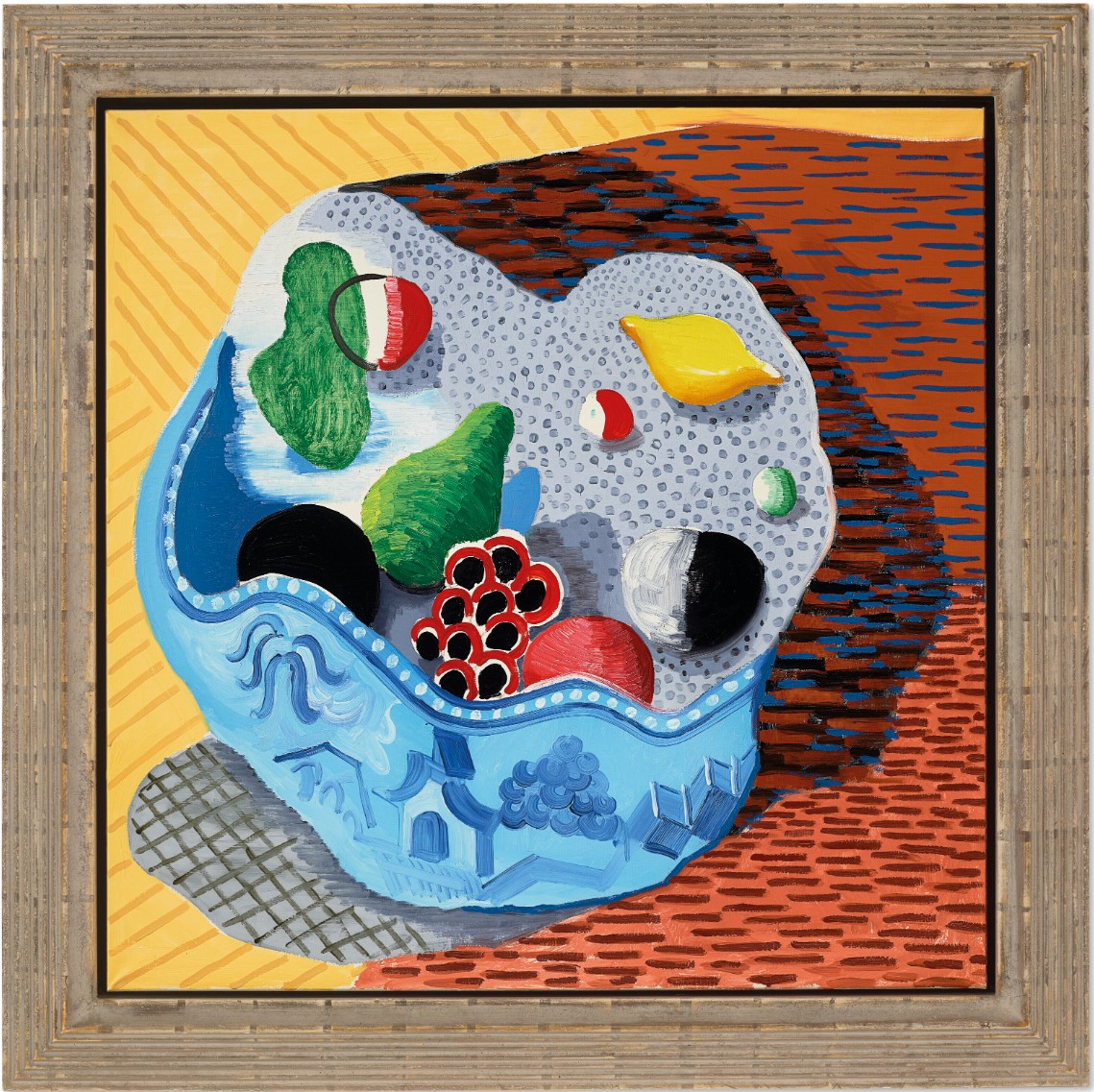
DAVID HOCKNEY
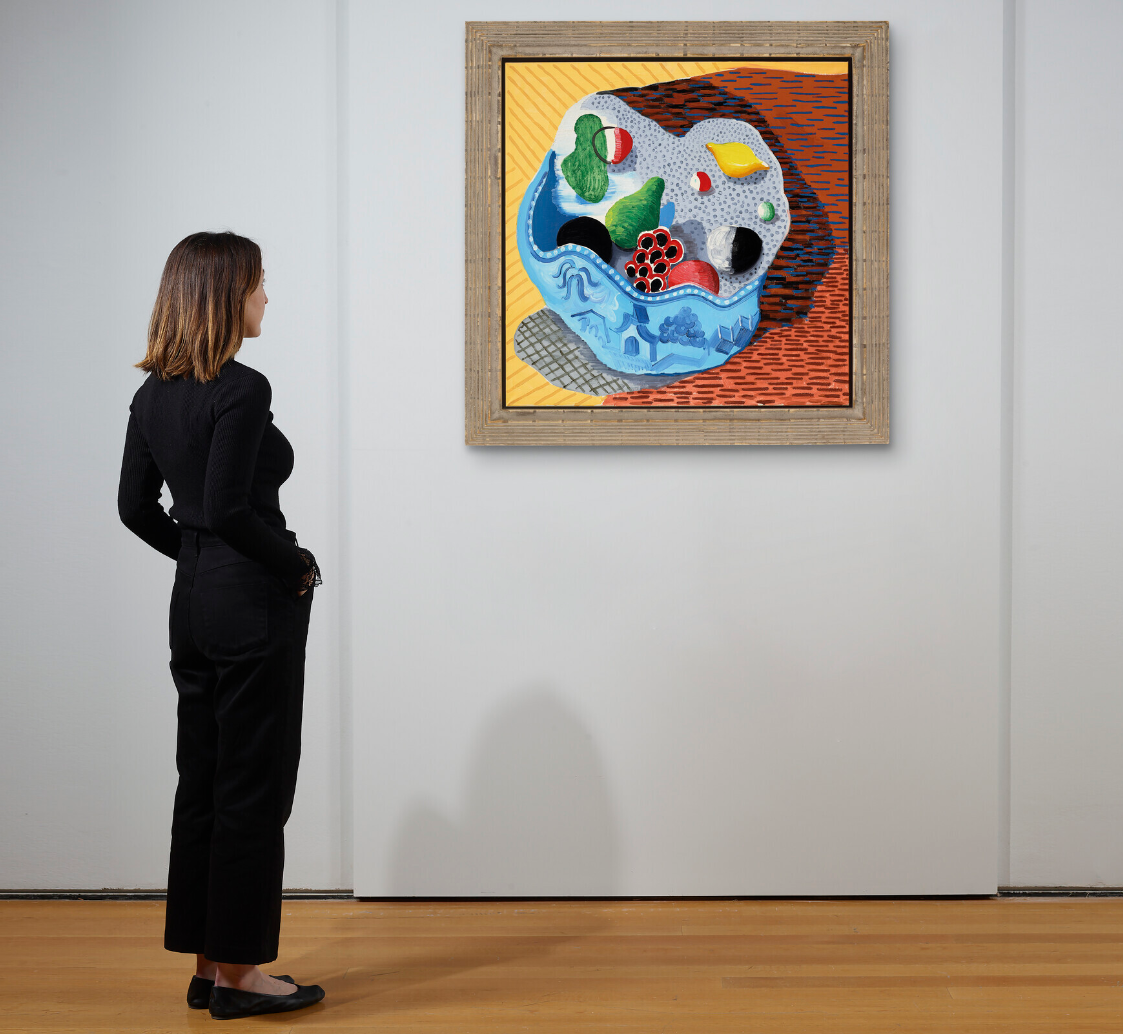
Fruit in a Chinese Bowl, 1988
Oil on canvas
36×36 inches (91.4 x 91.4 cm)
Signed, titled and dated ‘fruit in a chinese bowl August 1988 David Hockney’
(on the reverse)
Provenance
André Emmerich Gallery, New York
Nishimura Gallery, Tokyo
L.A. Louver, Venice, California
Samuel Goldwyn Jr. Collection, Los Angeles (acquired from the above in 1991)
His sale, Sotheby’s New York, 12 May 2015, lot 60
Acquired at the above sale by the present owner
Auction History
Christie’s London: 1 March 2022
Estimated: GBP 2,000,000 – 3,000,000
GBP 3,282,000 / USD 4,370,755
DAVID HOCKNEY (B. 1937), Fruit in a Chinese Bowl | Christie’s (christies.com)
Formerly held for twenty-four years in the celebrated collection of Hollywood producer Samuel Goldwyn Jr., Fruit in a Chinese Bowl is a remarkable still-life that attests to David Hockney’s ground-breaking engagement with pictorial perspective during the 1980s. Against a vivid yellow and russet backdrop, etched with wooden markings, an assortment of lemons, pear, grapes and other fruits glisten in a blue-patterned Chinese bowl. Competing lines and shadows push the eye in multiple directions at once; the fruits, rather than receding into the distance, loom towards the frontal plane of the canvas. Widely exhibited, the work stems from 1988: a triumphant year in which Hockney opened his career-defining touring retrospective at the Los Angeles County Museum of Art. Inspired by the teachings of Picasso, Cézanne and the Fauves, the decade saw Hockney conquer new ground in his interrogation of human vision, concluding that multiple fractured, overlapping perspectives offered a truer representation of how we process visual information. His study of Chinese scroll landscape paintings, following his first visit to the country in 1981, would also prove hugely instructive in this regard: the present work’s bowl, with its undulating scenery, offers an exquisite nod to this influence.
Though Cubism had long fascinated Hockney, it was not until the early 1980s that he truly began to explore the implications of the genre. Inspired by multiple fresh encounters with Picasso during this period—from the Spaniard’s extraordinary 1980 retrospective at the Museum of Modern Art, New York, to Hockney’s engagement with the artist’s designs for the 1917 ballet Parade—he began to ask fundamental questions about his treatment of pictorial space. Aside from its dialogue with the Western art canon, the present work also bears witness to Hockney’s engagement with Chinese landscape painting during this period. The artist had first visited China in 1981, later publishing his photographs and watercolours alongside writings by Stephen Spender in his 1982 book China Diary. While there, he had the opportunity to observe Chinese artists at work, and became increasingly fascinated by scroll painting after discovering George Rowley’s 1947 book Principles of Chinese Painting. Liberated from the constraints of one-point perspective, it explained, the scrolls avoided allegiance to any one viewpoint: by constantly shifting the viewer’s orientation across the composition, they recreated the sense of walking through a landscape, absorbing it bit by bit. In doing so, they placed the viewer directly within the work: the experience of observing it became temporal as well as spatial. In 1988, the year of the present work, Hockney released the film A Day on the Grand Canal with the Emperor of China, in which he attempted to capture this very sensation by narrating part of Wang Hui’s monumental scroll The Kangxi Emperor’s Southern Inspection Tour (1691-1698). Along with Jade Plant, painted the same year, the present work both draws upon the pictorial discoveries of this exercise, as well as featuring imagery that relates specifically to Chinese culture.