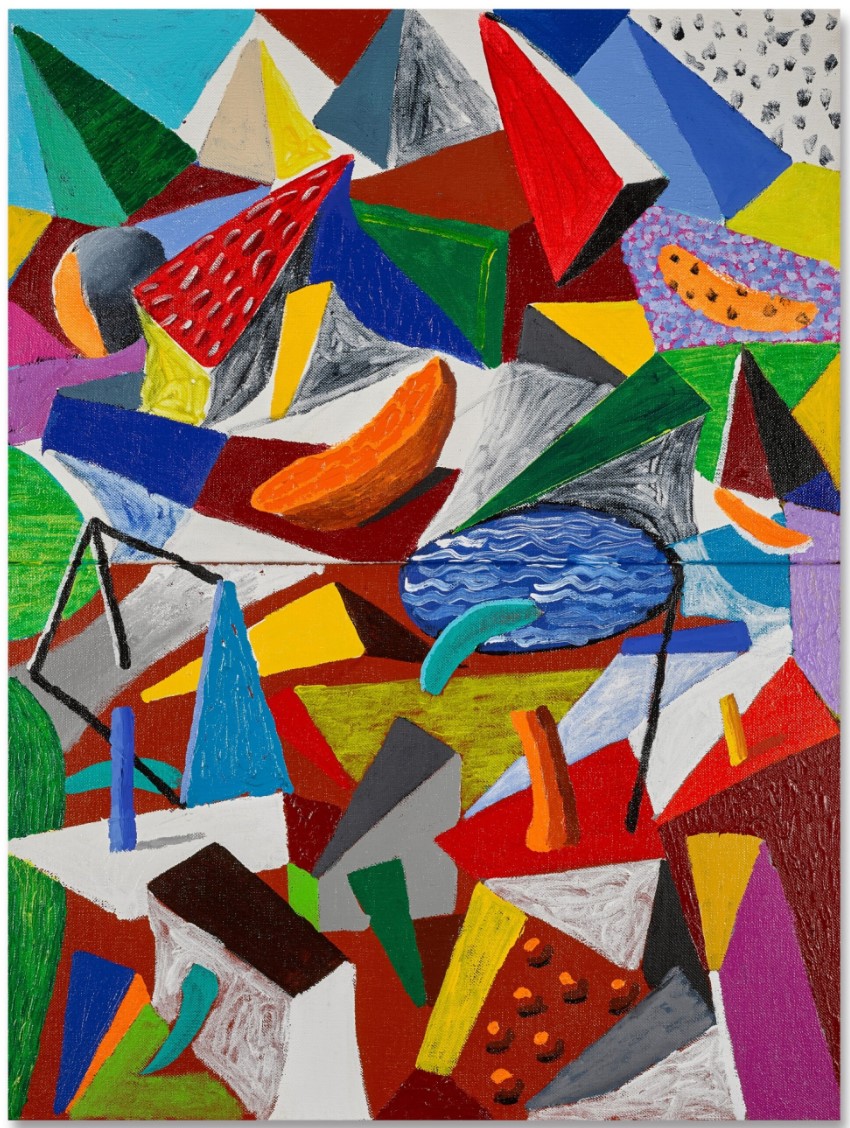
DAVID HOCKNEY (b. 1937)
Big Landscape (Medium), 1987-88
Acrylic on two joined canvases
123 x 91.5 cm (48 3/8 x 36 inches)
Signed David Hockney, titled Big Landscape (Medium) and dated 1987-8 (on the reverse)
Provenance
Gay Men’s Health Crisis Art Auction New York, lot 180 (donated by the artist)
Waddington Galleries Ltd., London
Private Collection
Christie’s London, 1 July 2008, lot 180
Acquired from the above sale by the present owner
Auction History
Sotheby’s London: 14 October 2022
Estimated: GBP 3,000,000 – 4,000,000
GBP 4,149,000 / USD 4,651,345
REPEAT SALE
Christie’s London: 1 July 2008
Estimated: GBP 300,000 – 400,000
GBP 361,250 / USD 719,930
David Hockney (b. 1937) , Big Landscape (Medium) | Christie’s
David Hockney’s Big Landscape (Medium) is a unique, experimental example of the artist’s late 1980s abstract landscape paintings. Painted on and off between 1987-88, the work took form over the course of months, during which the composition expanded, flowing the painting onto another canvas.
“Looking back, I can see that this particular painting led to more new developments in my work than the others from this period… I had put a lot of things in it, rather like notes of what I was going to explore…”
Indeed, throughout the composition, various signature motifs of Hockney’s works emerge, such as the abstracted pool in the center of the canvas, the kaleidoscopic color which recall the brilliant Californian landscapes, and the cubist geometry foreshadowing the Surrealist abstraction that would come to characterize the next phase of his career.
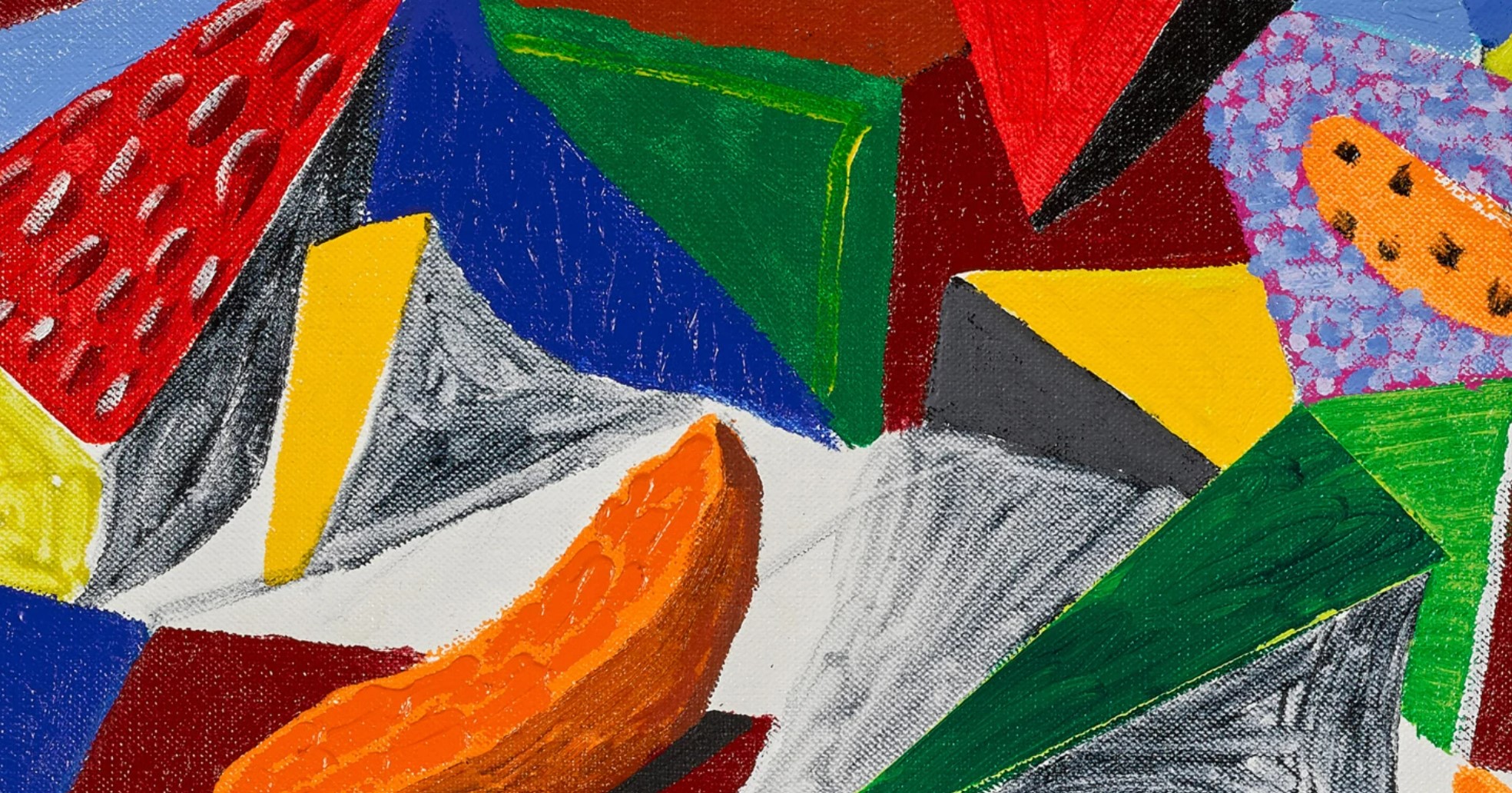
Emerging from a period of intense creativity and experimentation, Big Landscape (Medium) at once references the artist’s past influences and innovations yet to come. Hockney’s preoccupation with photography and the possibilities offered by photo-collage in the in the early 1980s resulted in a fundamental shift in his treatment of pictorial space in painting. It was also around the early-mid 1980s that Hockney was introduced to Chinese landscape paintings through Georges Rowley’s book, Principles of Chinese Painting. Unlike the notion of space in the West which conceives a single central perspective, Chinese landscape paintings situate the viewer within space, moving through the artist’s landscape compositions. Expanded vertically, Big Landscape (Medium) follows the spatial sentiment of Chinese scroll paintings, where the composition grows upwards rather than into the illusionistic depths of the canvas. Even without an indication of relative size and distance, a clear sense of space is evoked through the succession of planes, with architectural forms in the foreground, a swimming pool in the center and pyramidal hills above.
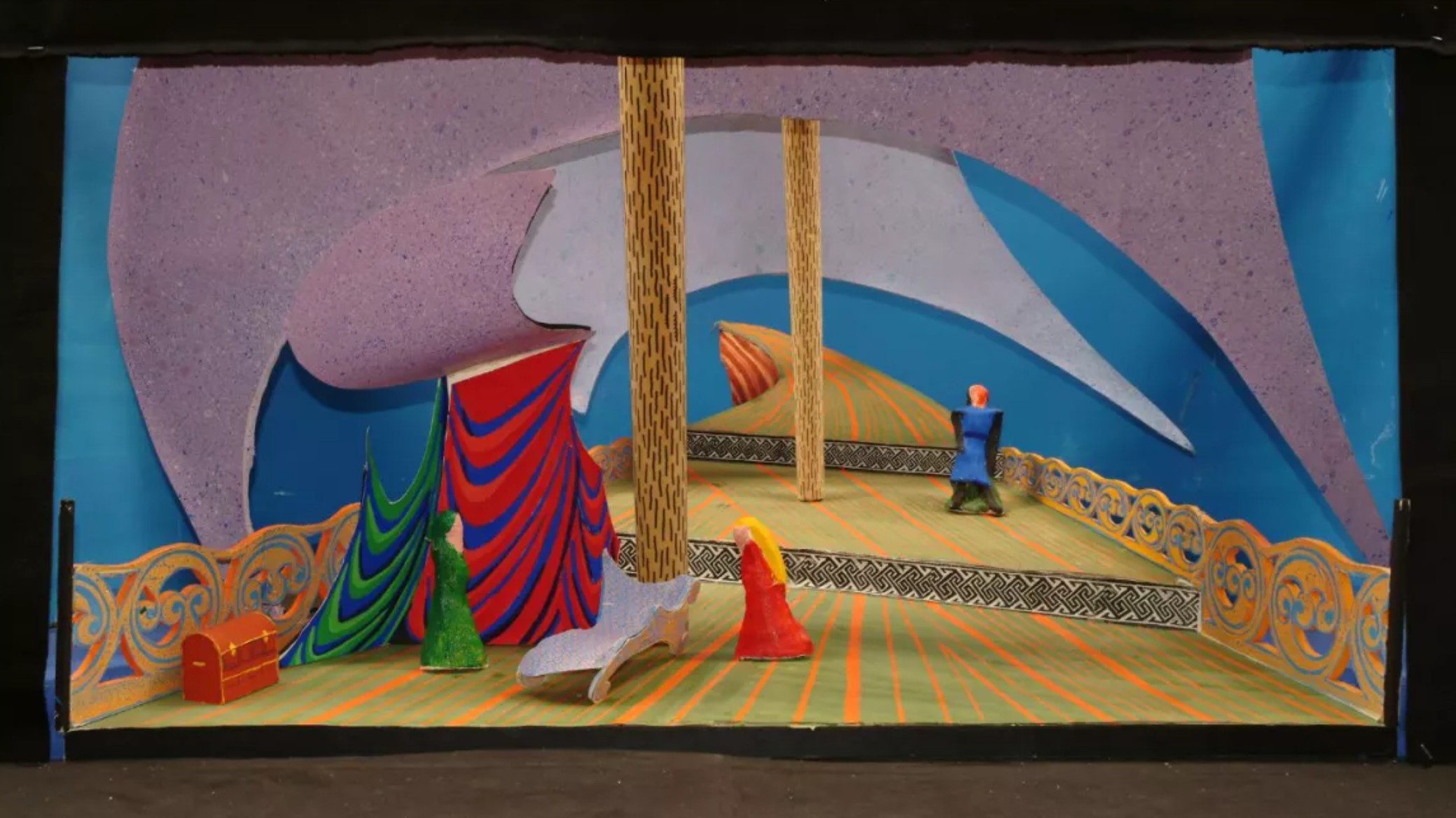
David Hockney, 1″ Scale Model, Act I, Final Version from “Tristan Und Isolde”, 1987
Image/Artwork: © David Hockney Stoddard, Haleigh
Another important artistic activity of this period was Hockney’s work with stage design. Painting in a three-dimensional space intended for movement had a profound impact on the artist’s concept of space. Hockney wrote of his 1986 sets for Richard Wagner’s Tristan and Isolde:
“I started using my ideas about perspective, which I had developed in photography… although it has actually got hundreds of perspectives, looks as though it’s got a normal one as well. I realized one could maybe do this in space.”
Following the completion of Tristan and Isolde, Hockney produced several paintings where he incorporates the flat, silhouette-like shapes from his stage set. The surface of Big Landscape (Medium) is composed of a mosaic of individual areas of color and texture, emulating the flatness these theatrical designs. Some of the colored shapes, whether alone or in groups, cast shadows and are positioned in ways that suggest solid bodies of form, while a few rounded forms seem to evoke landscape references. The influence of Hockney’s stage sets on the paintings is apparent in the present painting, which employs a particular form of chaotic yet articulated abstraction and emulates the flat, lyrical layering which flows between the action downstage and upstage.
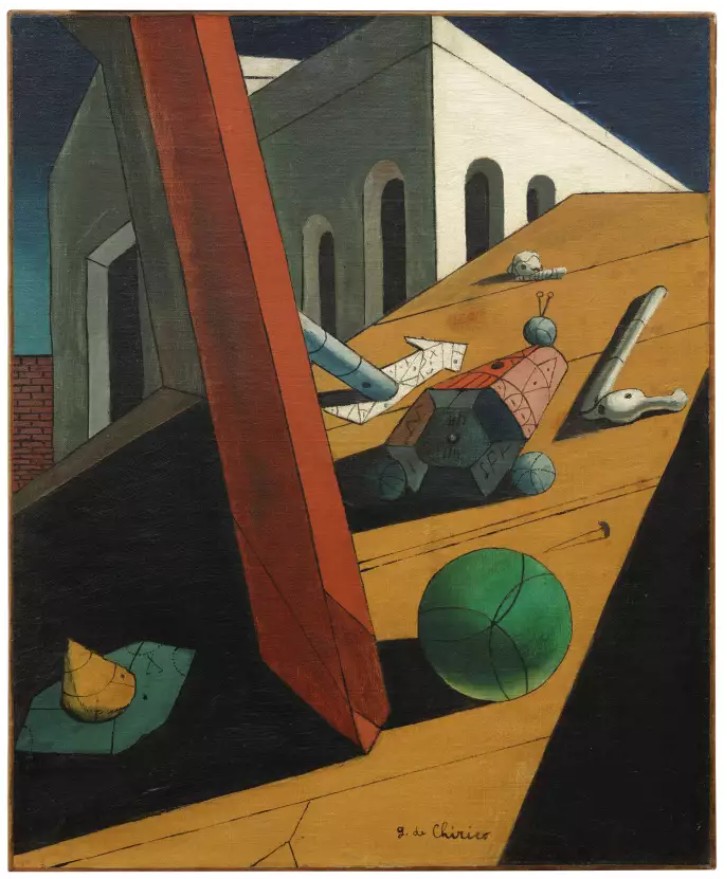
Giorgio De Chirico, The Evil Genius of a King, 914-15
The Museum of Modern Art, New York
Image: © Digital Image, The Museum of Modern Art, New York / Scala, Florence Scala
1988, the year Big Landscape (Medium) was completed, was a particularly fruitful period for Hockney as a painter, which brought forth a series of abstracted landscapes and interiors. Retreating into his studio at Malibu Beach, the present work was painted at around the same time as The Road to Malibu and demonstrates a similar technique of abstracted landscape composed of vividly contrasting textures, patterns, shapes and hues. Triangular shapes dominate the composition, with their strange shadows and dreamlike quality recalling the metaphysical works of Giorgio de Chirico or the Surrealist landscapes of Yves Tanguy. Hockney’s vivid, saturated colours also evoke his Fauvist hero Henri Matisse, while his foreshortening of ground and compression of perspective clearly reveal his abiding interest in Cubism. Perhaps the most important feature of the present work, however, is its sheer painterliness, as Hockney’s mastery of stroke and texture come markedly to the fore. A visual precursor to his series of Very New Paintings, which were conceived and exhibited in 1992, Big Landscape (Medium) shows Hockney returning to painting with a greater freedom of invention in space and form.