JEAN-MICHEL BASQUIAT
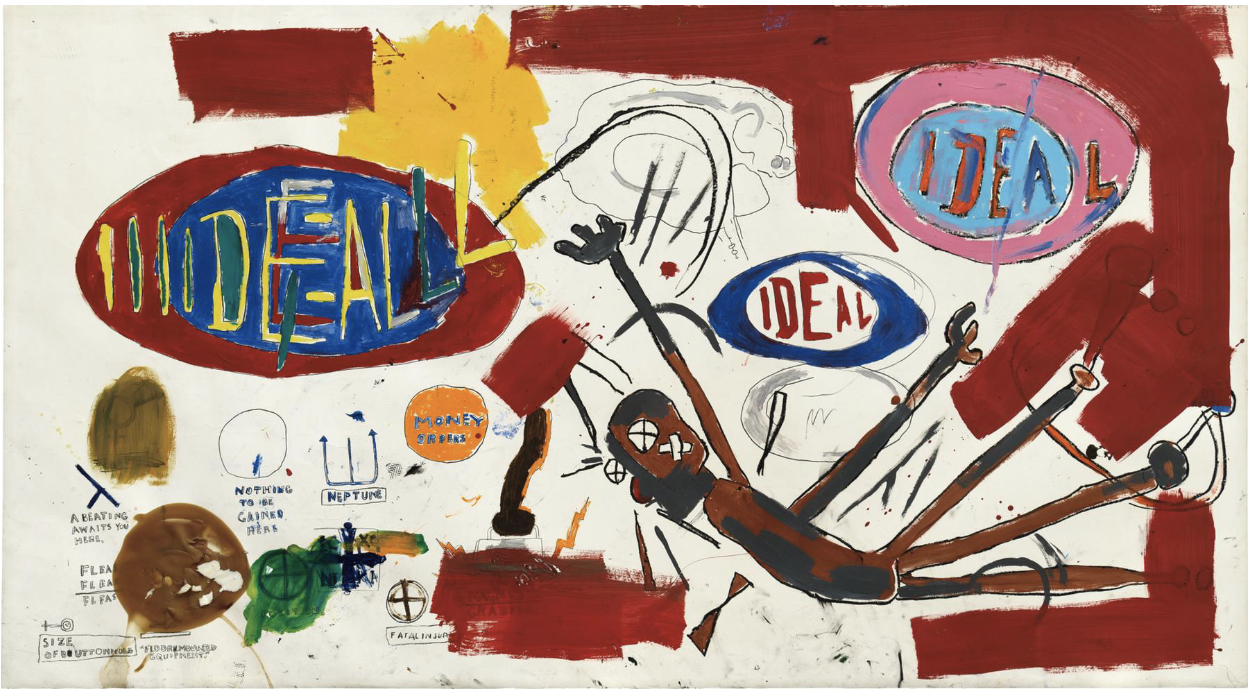
Victor 25448, 1987
Acrylic, oilstick, wax and crayon on paper laid on canvas
72×131 inches (182.9 x 332.7 cm)
Provenance
Tony Shafrazi Gallery, New York
Stephanie and Peter Brant Foundation, Greenwich and New York (acquired from the above)
Christie’s, New York, May 13, 2008, lot 36
Acquired at the above sale by the present owner
Phillips New-York: 2 July 2020
USD 9,250,000
Source: Phillips
Jean-Michel Basquiat – 20th Century and… Lot 10 July 2020 | Phillips
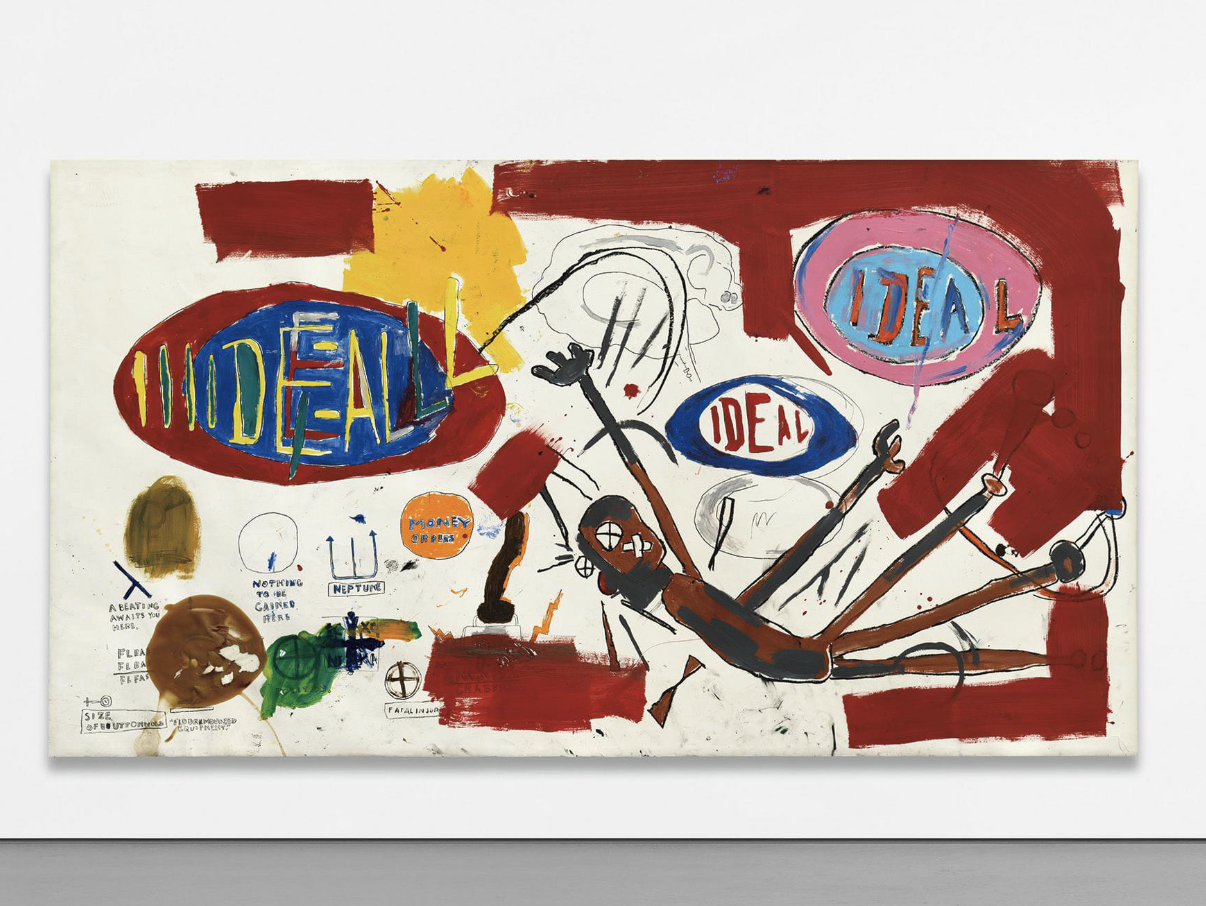
Within Victor 25448 is a constellation of the hieroglyphs, signature motifs, and graffiti imagery that defined Jean-Michel Basquiat’s all-too-brief oeuvre. One of the largest works on paper the artist created, Victor 25448 depicts a black figure, whose bandaged face and X’d eyes indicate him as the victim of violent trauma, in a cartoon-esque scene of brutality. Unlike some of Basquiat’s earlier depictions of racial violence, such as Defacement (The Death of Michael Stewart), 1983, Solomon R. Guggenheim Museum, New York, there is no obvious perpetrator: the circumstances of the assault are left ambiguous. Though the work’s central conflict is unclear, its imagery unequivocally represents a parallel to the physical and emotional hardships Basquiat faced during the final year of his life.
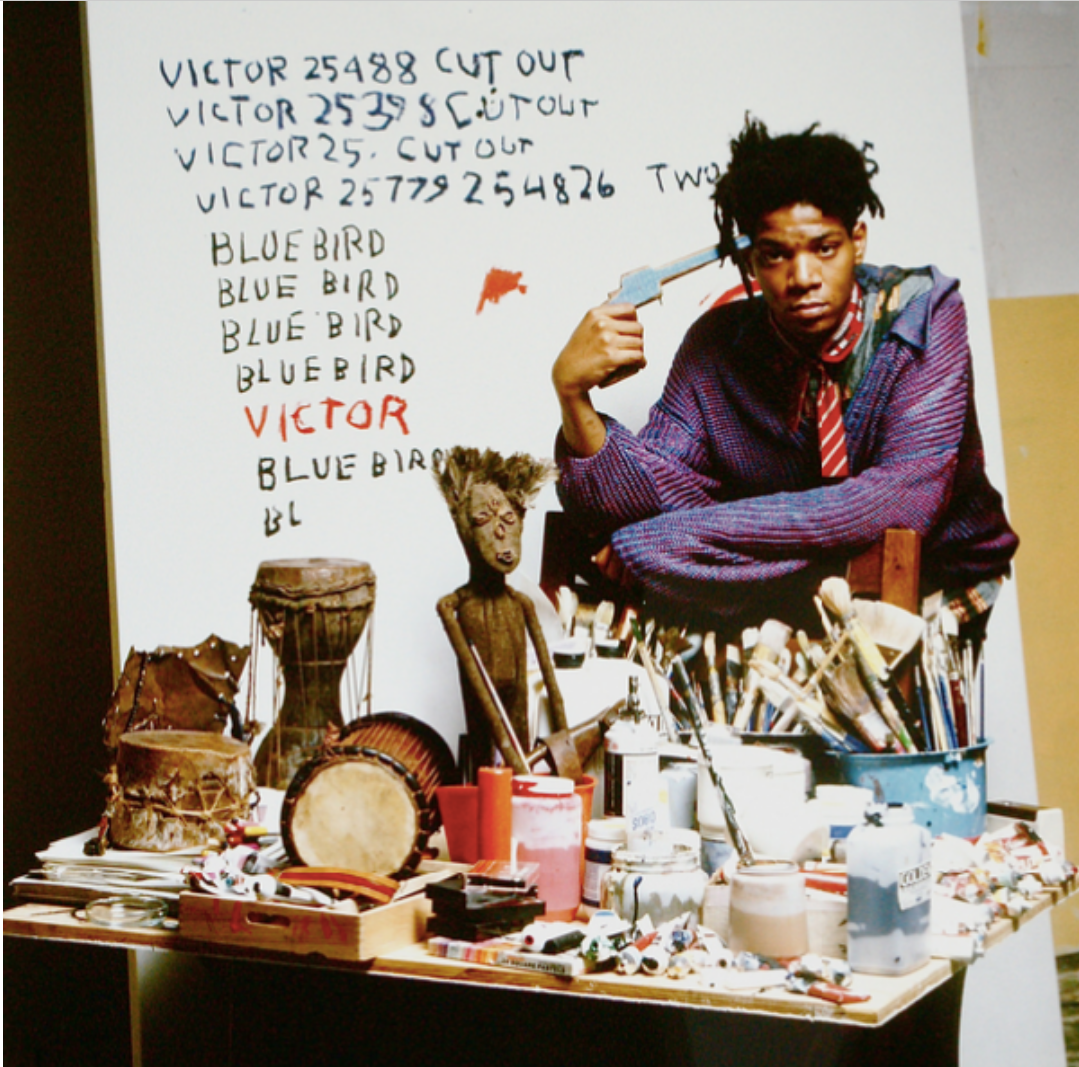
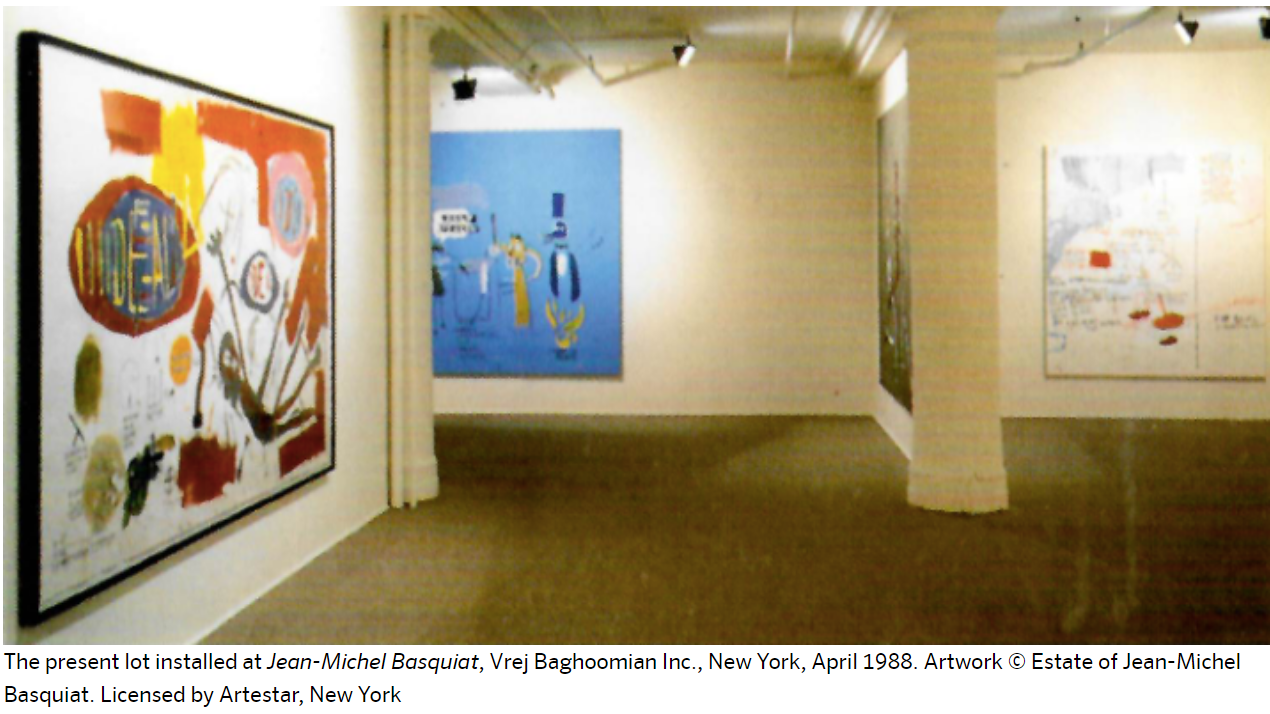
Though the work can be read as a portrayal of Basquiat’s mentor and close friend, Andy Warhol, it is generally agreed to be a depiction of the young artist himself; specifically, it is most probably a portrait of Basquiat’s own fragility following Warhol’s unexpected death earlier that year. Supporting this consensus was its inclusion in the final exhibition of his lifetime at Vrej Baghoomian Gallery in 1988, where it was shown alongside other works betraying Basquiat’s existential grief after his monumental loss, such as Riding with Death, Eroica I, and Eroica II.
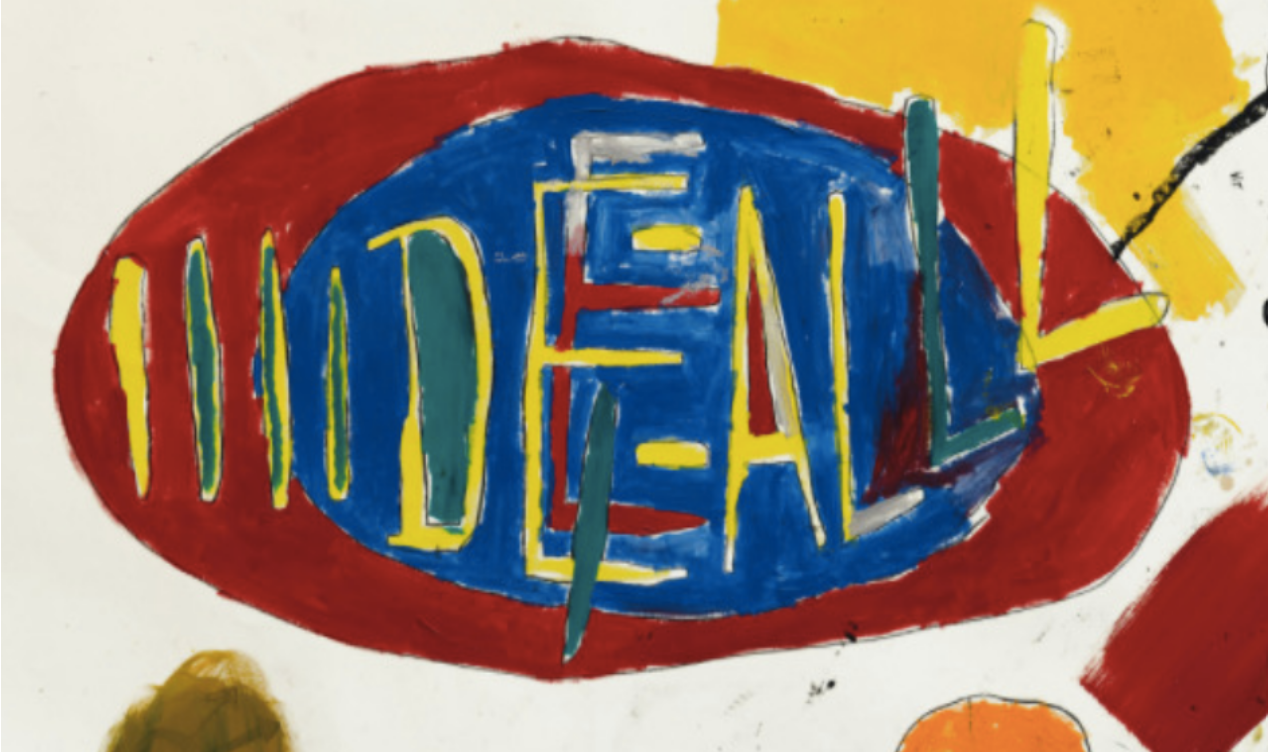
Corporeal loss is juxtaposed with a supreme state of existence in Victor 25448. The foreground of the picture is dominated by a beaten-up, bandaged figure, above which the thrice-repeated word IDEAL hovers—a negation of the symbols and imagery immediately below. Curator and art historian Fred Hoffman interpreted that “the placement of a repeated, large scale, pop-art-charged word juxtaposed with an expressionist-style figure suggests the continuation of the artist strategy implemented in the Basquiat-Warhol collaborative artworks.” Brutalized by conceptions of the “ideal,” the painting’s subject falls into a desolate land of violence, hopelessness, and ambiguity.
Perhaps the most central element in Basquiat’s singular lexicon is the human figure, which the artist used as a malleable iconographic device to coalesce art history, pop culture, autobiography, and the black experience. When discussing the frequent visits he took to his local museum during his childhood, the Brooklyn Museum, the artist told Henry Geldzahler, “I realized that I didn’t see many paintings with black people in them.”
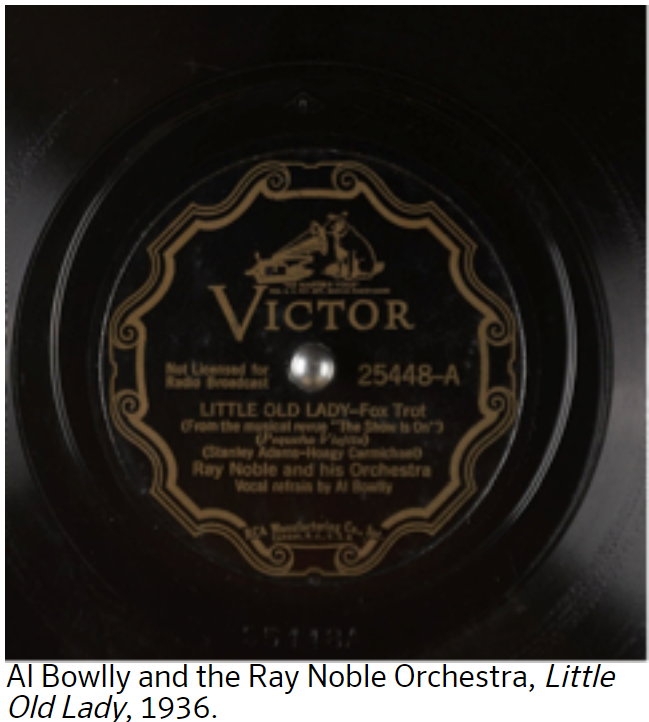
The state of the figure in Victor 25448 is a stark contrast to the victorious boxers that Basquiat depicted during his rapid rise to fame in 1981 and 1982, such as in Untitled, 1982, Museum Boijmans Van Beuningen, Rotterdam. If Untitled is a portrait of Basquiat standing victorious at the one of the most promising moments of his life, Victor 25448 reveals the despondence that plagued him during the final year of his life. Like many other of Basquiat’s masterworks, Victor 25448 is named after a music record—in this case, a 1936 recording of “Little Old Lady” and “Now” by Al Bowlly and the Ray Noble Orchestra. Though bebop jazz constituted most of Basquiat’s collection of over 3,000 albums, his tastes were eclectic, spanning Bach to Beethoven to Donna Summer. In the 1980s, the record company Victor was reissuing 1930s British dance band recordings to unprecedented popularity—and the indisputable star of this boom of nostalgic music was Al Bowlly. The sweetness of these two songs forms a start contrast to the violence of the imagery of Victor 25448, in which the central figure—not at all victorious, but instead defeated—collapses backward, arms and legs flailing.
Though Basquiat began appropriating hieroglyphs from Henry Dreyfuss’s Symbol Sourcebook in 1982, in wasn’t until 1986 that these codes appeared as prominent motifs in the artist’s visual lexicon. Symbols and their corresponding definitions from the book’s “hobo signs” section feature in Victor 25448, such as A BEATING AWAITS YOU HERE, FATAL INJURY, and NOTHING TO BE GAINED HERE. A counterpoint to the IDEAL tags that float above, these very unideal messages pay homage to a language of street art spoken by a disenfranchised and underprivileged population.
The IDEAL tags are evocative of the logo of the toy manufacturing company popular in the 1980s, and reappears several times in Basquiat’s work from this period. One to revel in semantic ambiguity and wordplay, the artist was no doubt attracted to this tag’s myriad references: to actual commodities, to the concept of an IDEA (amplified by the nearby brain and trailing L), to the phrase “I deal” (in drugs, consumerism—or art).