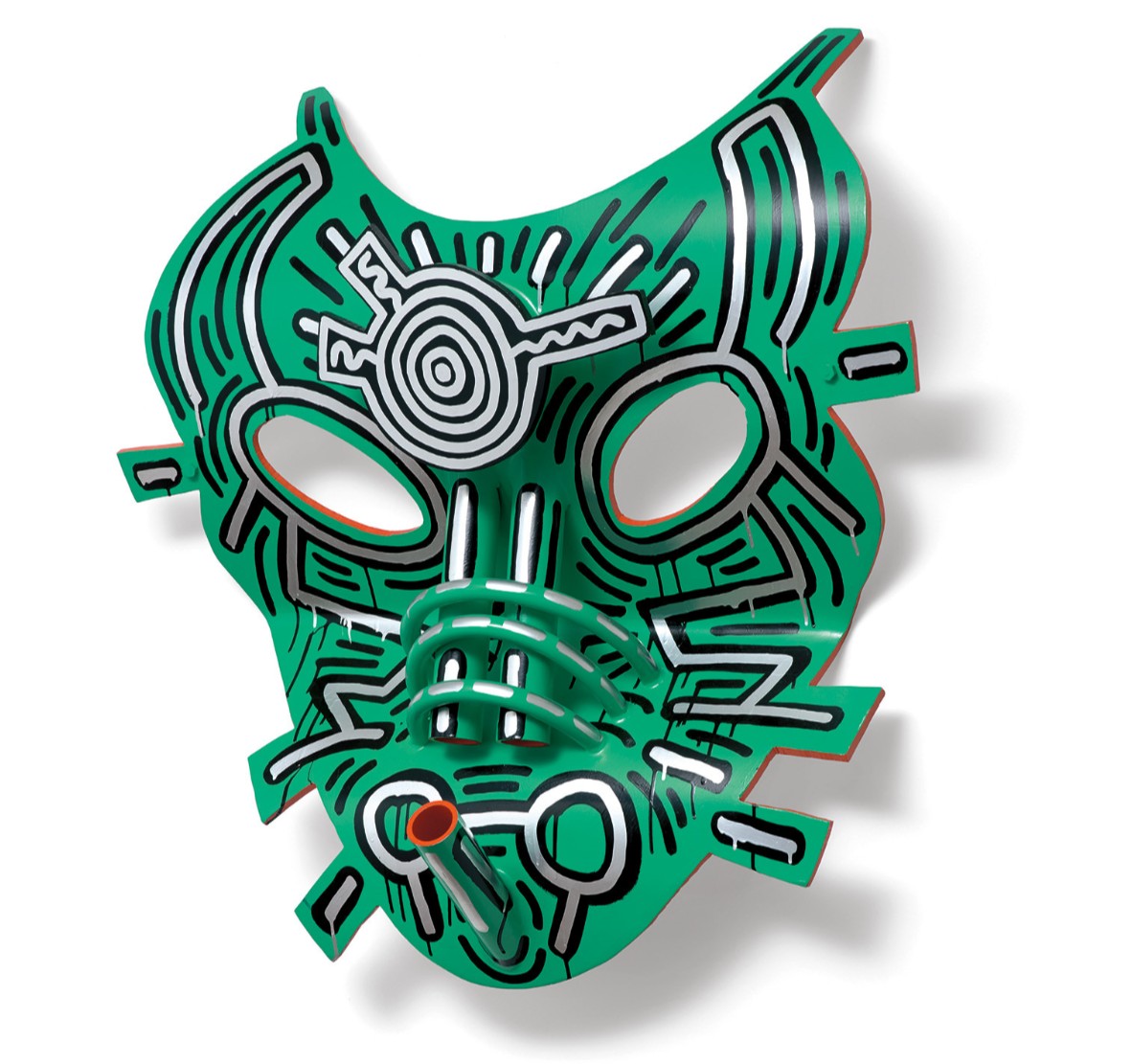
Enamel on aluminum
44-1/2 x 43-1/2 x 12-1/2 inches (113 x 110.5 x 31.8 cm)
Signed and dated ‘© K. Haring 1987 ⨁’ on the reverse
Provenance
Tony Shafrazi Gallery, New York
Hokin Gallery Inc., Palm Beach
Private Collection, New York
Private Collection (acquired from the above in 2017)
Phillips, London, October 20, 2020, lot 12
Acquired at the above sale by the present owner
Auction History
Phillips New-York: 19 May 2026
Estimated: USD 1,500,000 – 2,000,000
USD 2,322,000
Keith Haring Modern & Contemporary Art Evening Sale
REPEAT SALE
Phillips London: 20 October 2020
Estimated: GBP 1,500,000 – 2,000,000
GBP 1,716,500 / USD 2,222,965
Sold To Benefit the Bedari Foundation
Keith Haring 20th Century & Contemporary Art Evening Sale
Among the most arresting and ichnographically charged objects in Keith Haring’s mature practice, Untitled (Grace Jones Mask), 1987, occupies a singular position within an exceptionally finite corpus. In 1987, Haring produced eight aluminum masks finished in enamel paint—a definitive group he never expanded—each animated by distinct imagery culled from his graphic vocabulary. Conceived on a heroic scale that thwarts the diminutive intimacy traditionally associated with the mask form, the present work measures over three and a half feet in height, its commanding dimensions amplifying the totemic presence of an object historically scaled to the human face. A field of saturated mint green provides the ground for a dense lattice of looping silver lines, contoured by Haring’s signature black graffiti drawing. Cartoonish strokes radiate from the cavernous oval eyes, while at the lower apex of the mask’s tapering, shield-like silhouette, a small, vivid red excrescence projects forward to articulate the figure’s mouth—the sole intrusion of warm color into an otherwise cool chromatic register, and a rare instance in which Haring permits the work to physically breach the viewer’s space.
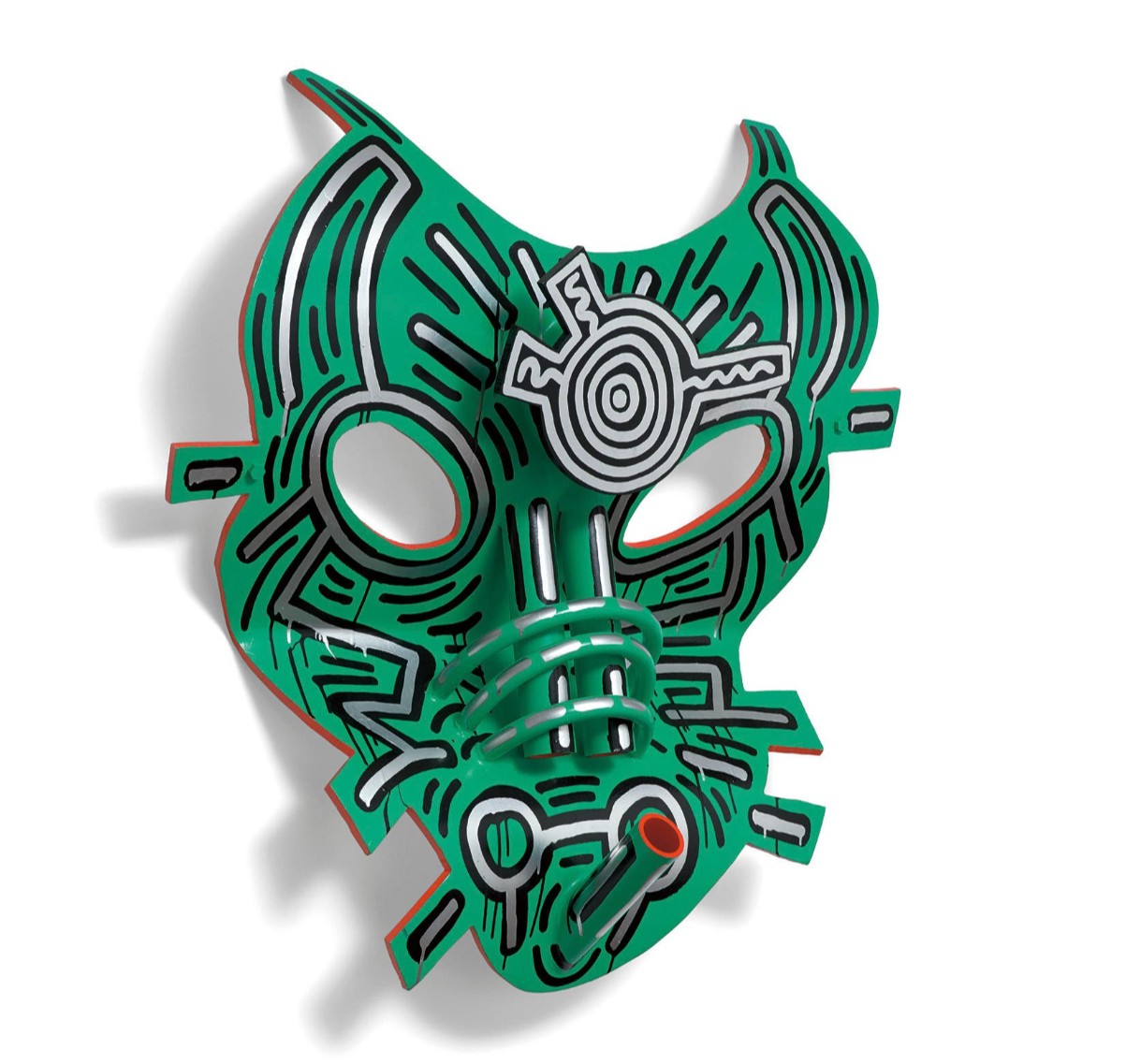
The mask occupies a peculiar position within Haring’s oeuvre, at once anomalous and entirely consistent. Where his canvases and murals operate primarily as flat fields, the masks demand sculptural inhabitation, their planes bowed and notched into projecting tabs that read alternately as ears, feathers, or ritual ornaments. Still, the surface treatment remains unmistakably Haring’s, the enamel applied with the velocity of a draughtsman rather than the deliberation of a sculptor. Drips at the lower edge betray the immediacy of the gesture. Each of the eight masks carries its own iconographic charge, encompassing skulls, beasts, and hybrid physiognomies, yet Untitled (Grace Jones Mask) is among the most legible in its address, its dedication declared in the title itself. The historical significance of the corpus is underscored by the placement of Large Goon Mask, 1987, in the collection of the Museum für Gegenwart, Berlin, on permanent loan from the Marx Collection, and by the present work’s early inclusion in Haring’s important winter 1987 exhibition of sculpture and painting at the Tony Shafrazi Gallery, 163 Mercer Street, SoHo, New York.
“I am intrigued with the shapes people choose as their symbols to create a language.”
To frame the masks solely as formal departures, however, is to overlook the ethnographic project animating them. Haring’s engagement with the mask aligns him with a venerable modernist genealogy that includes Pablo Picasso, Georges Braque, and Constantin Brancusi, all of whom turned to traditional masks and totems as conduits to a primal pictorial energy. That Haring was conscious of this lineage is made explicit by another work in the series, Egg Head, conceived as a homage to Picasso. If for the early modernists the mask served as a screen onto which European anxieties about figuration were projected, for Haring it became something more personal: an instrument of disguise, of costuming, perhaps a means of veiling interior turmoil beneath an exuberant graphic skin. The duality is essential. Beneath the buoyant chromatics and the cartoon vocabulary lies an awareness, sharpened by the epidemic encircling Haring’s community in the late 1980s, of the mask’s older office as an interlocutor between the visible and the unseen.
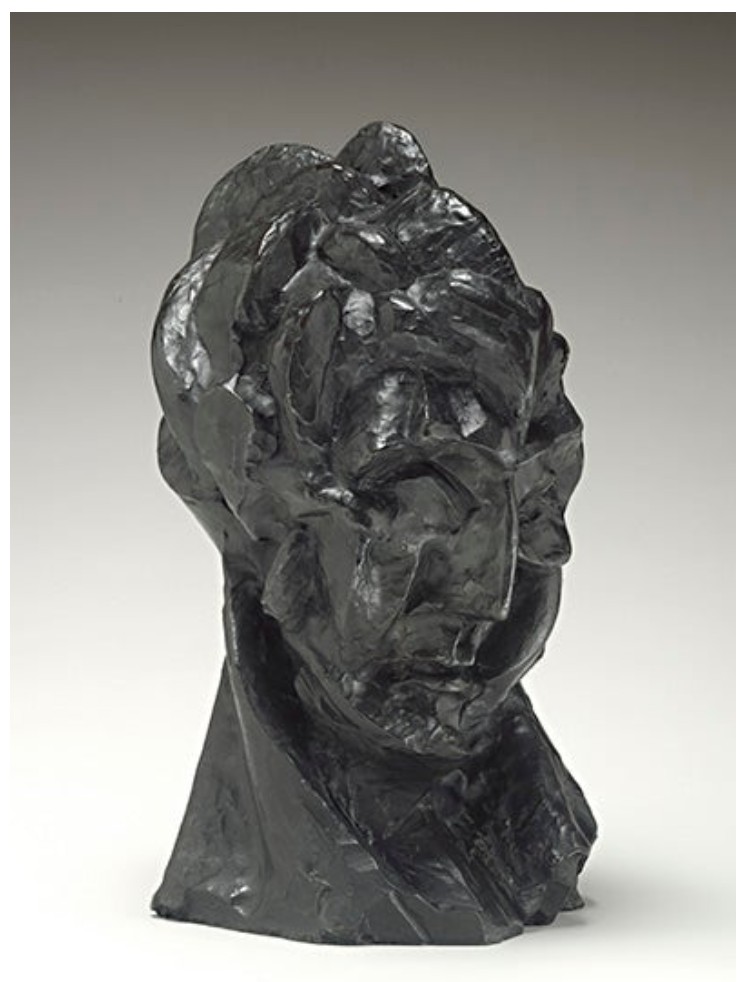
Pablo Picasso, Head of a Woman (Fernande), 1909, cast before 1932. National Gallery of Art, Washington, D. C.
Image: National Gallery of Art, Washington, D.C., Patrons’ Permanent Fund and Gift of Mitchell P. Rales, 2002.1.1,
Artwork: © 2026 Estate of Pablo Picasso / Artists Rights Society (ARS), New York
That Haring should dedicate one of only two named masks within the series to Grace Jones—the other being his Picasso homage—signals the depth of an artistic kinship that had unfolded across the preceding three years. Their first encounter, in 1984, was orchestrated by Andy Warhol for a shoot destined for Interview Magazine and immortalized through the lens of Robert Mapplethorpe. From this seminal meeting flowed an extended series of body-painting sessions, performances, and music-video collaborations, including the 1986 video for Jones’s single I’m Not Perfect (But I’m Perfect for You). Haring saw in Jones the consummate avatar of a metropolitan moment, a figure in whom what Alison Pearlman has termed a “futuristic-primitivist style” achieved its most concentrated expression. The Paradise Garage, New York’s preeminent discotheque and a vital LGBTQ gathering place, served as the site of their most fervent collaborations, where Jones’s body became the canvas for a graphic vocabulary inseparable from the city’s downtown nightlife.
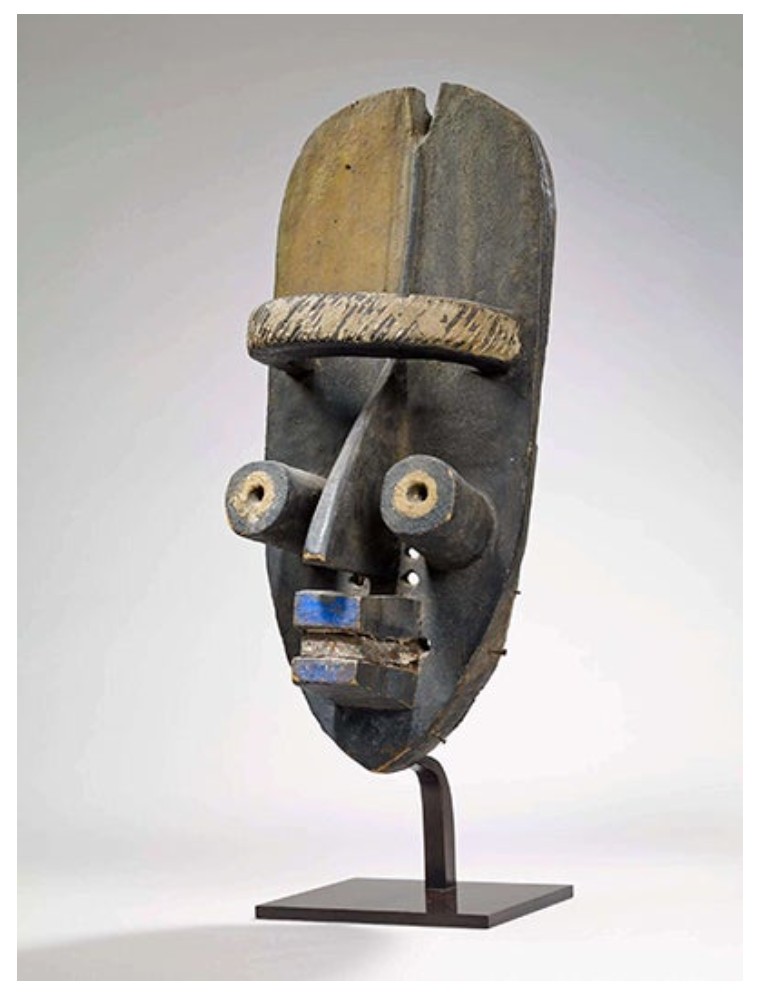
Anthropomorphic mask, Côte d’Ivoire, Grebo, 19th century. Musée du Quai Branly–Jacques Chirac, Paris.
The most striking pictorial precedent for the present work lies in the immediately preceding year. In the 1986 feature film Vamp, Jones appeared as Katrina, Queen of the Vampires, her body and face transformed by Haring’s brush into a chromatic apparition that, in Catalina Dibs’s words, made “her look like a tribal queen, dancing for her gods.”The mint-green field, silver tracery, and red mouth of the present work form an unmistakable echo of Katrina’s spectral palette of green eyes, silvered skin, and parted red lips, translated from the fugitive medium of body paint into the durable register of enamel and aluminum. As Miriam Kershaw observed of these collaborations, the white patterns Haring inscribed across Jones’s body charted “the flow of energy and topography” of her form, transforming her into “a power site.” The mask might be understood, then, as a fixed monument to a series of performances whose nature was otherwise irretrievably ephemeral—a permanent residue of an art that, like the subway drawings, was conceived to dissolve.
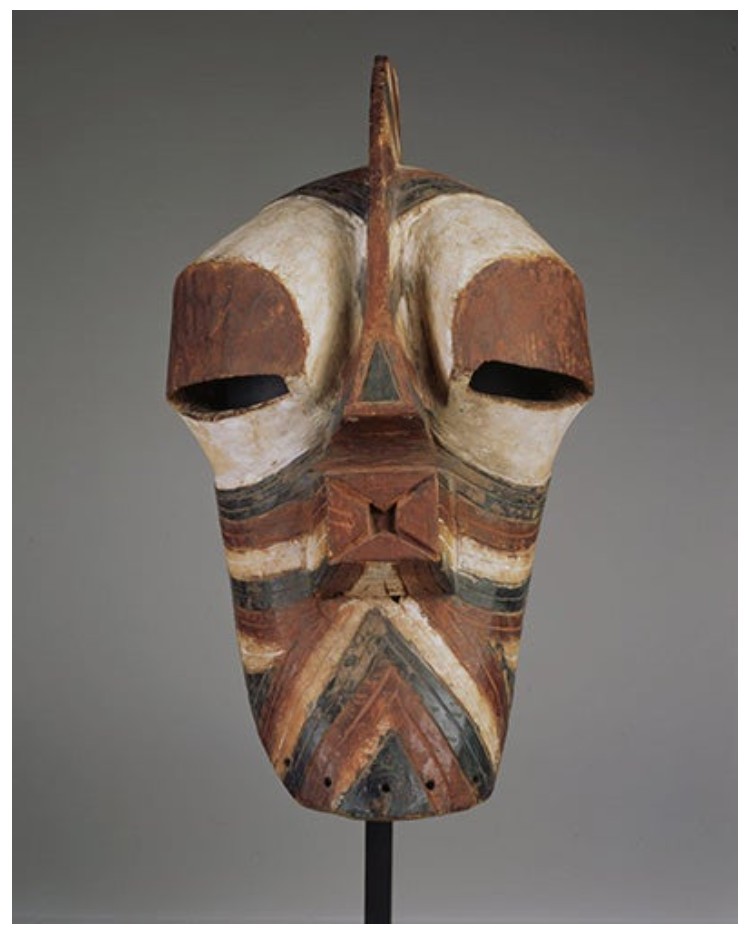
Songye. Kifwebe (Mask), late 19th or early 20th century.
Brooklyn Museum, New York. Image: Brooklyn Museum, Gift of Rosemary and George Lois, 76.165
Kershaw further articulates the cultural stakes of the partnership, observing that Jones’s performances gave dynamic expression to the aesthetic of the 1980s that Haring and Warhol helped to formulate, and that, for Haring, Jones functioned as a signifier for everything he admired in the global crossroads of postmodern New York. The mask consolidates these registers. Its graphic skin braids the urban and the ritualistic, weaving allusions to electronic media, television, and cartoon imagery with sources Haring had absorbed from Aztec, Mayan, North African, and Aboriginal visual cultures. The cultural critic and scholar of African art Robert Farris Thompson identified the white striping Haring deployed in Jones’s 1984 and 1985 Paradise Garage costumes as a borrowing from Masai ritual body painting—a lineage legible, too, in the silver tracery of the present work. A further biographical resonance attends the mask’s genesis. In March 1987, traveling to Munich for Niki de Saint Phalle’s exhibition, Haring attended a lunch at which Jean Tinguely, “fun as usual!”, had “brought masks […] and turned the atmosphere around immediately!” The episode, falling squarely within the year of the masks’ production, suggests an immediate catalyst for an enterprise otherwise without precedent or sequel in his practice. Untitled (Grace Jones Mask) thus stands as the rare convergence of personal history, performative collaboration, and ethnographic ambition—an enduring artifact of one of the decade’s most magnetic creative partnerships.
Forming part of a series of rare, larger-than-life masks that Keith Haring executed in 1987, Untitled (Grace Jones Mask) rises over a meter in height, and evinces a vibrant mint green interspersed with looping lines of silver. At the tip of the mask’s triangular composition, a small round red excrescence protrudes into the viewer’s space, delineating the anthropomorphic figure’s discreet mouth. Despite deriving from a body of work that stands out from the rest of Haring’s creative output, the artist’s masks, of which only eight have been created, all in 1987, display a visual blend of chromatic dynamism and formal whimsicality that is distinctly recognizable as his own. Notably, Untitled (Grace Jones Mask) features the artist’s idiosyncratic graffiti lines in enamel paint, as well as cartoonish strokes surrounding the mask’s eyes, mouth and forehead.
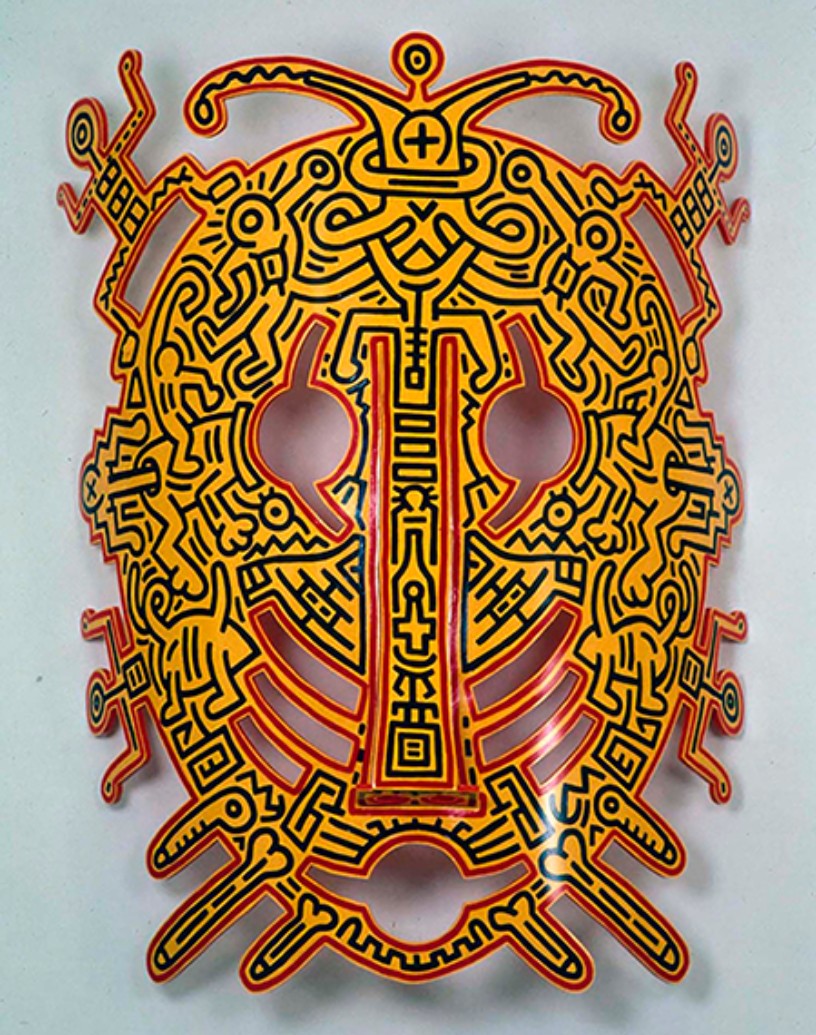
Keith Haring, Untitled (Large Goon Mask), 1987. Keith Haring artwork © Keith Haring Foundation
In its quasi-tribal rendering, Untitled (Grace Jones Mask) attests to Haring’s ethnographic investigations into folk art and various cultural expressions, following from a tradition of modern masters – Pablo Picasso, Georges Braque and Constantin Brancusi, among others – who similarly studied traditional masks and totems in their sculptural and painterly practices. Signifying the masks’ importance and singularity within Haring’s oeuvre, Large Goon Mask, 1987, another example from the artist’s sequence of eight thematic sculptures, currently resides in the collection of the Museum für Gegenwart, Berlin, as part of a permanent loan from the Marx Collection.
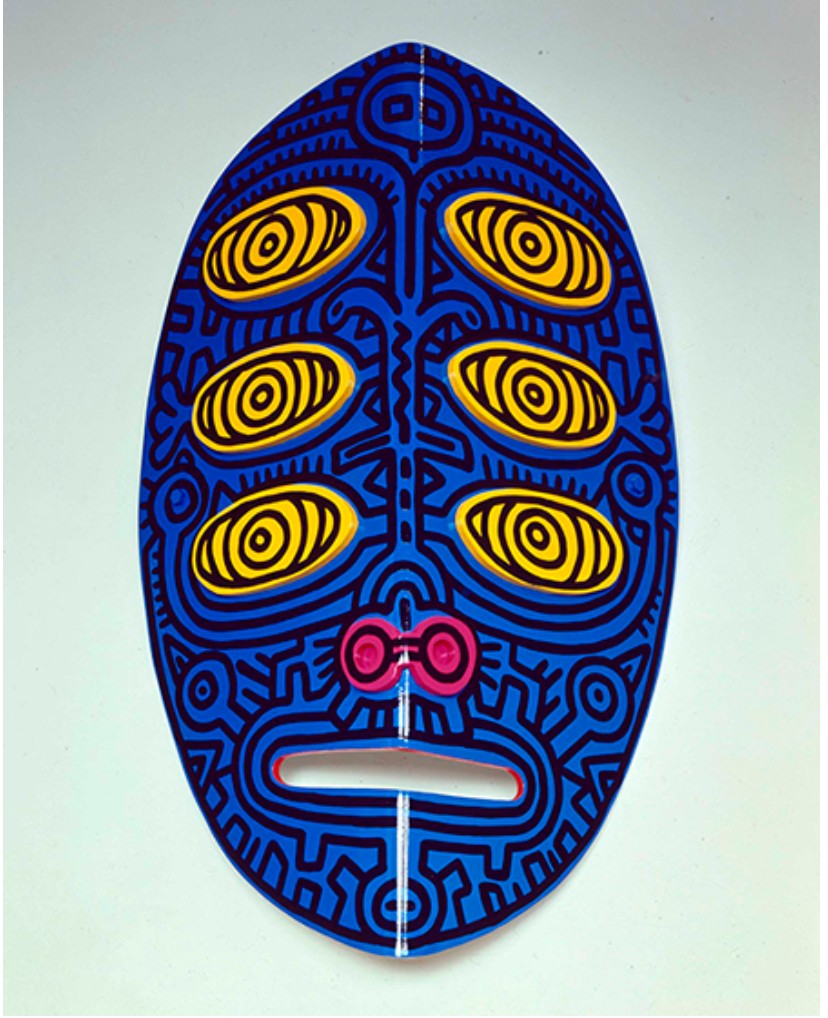
Keith Haring, Untitled (Mask with Six Eyes), 1987. Keith Haring artwork © Keith Haring Foundation
As suggested in the work’s title, Untitled (Grace Jones Mask) specifically references the iconic Jamaican model, actress and singer Grace Jones, whom Haring shared a friendship with since their first artistic encounter in 1984 – orchestrated by Andy Warhol and immortalized by Robert Mapplethorpe. Having collaborated with Jones on another project shortly prior the execution of the present work, Haring envisioned the model as the quintessential embodiment of postmodern New York – what the writer Alison Pearlman defined as a ‘futuristic-primitivist style’. Continually inspired by her brash presence and her ability to immerse herself within diverse cultural realms, Haring mingled with Jones in both artistic and social capacities, most frequently locating their joint creative enterprises at the Paradise Garage – New York’s most vibrant discotheque and festive LGBTQ centre. Untitled (Grace Jones Mask), recycling imagery that Haring had used in body-painting sessions with Jones since 1984, and marking a specific nod to the headdress he created for her during their first communal venture, is a rare perennial artefact cementing the two creatives’ visionary friendship.
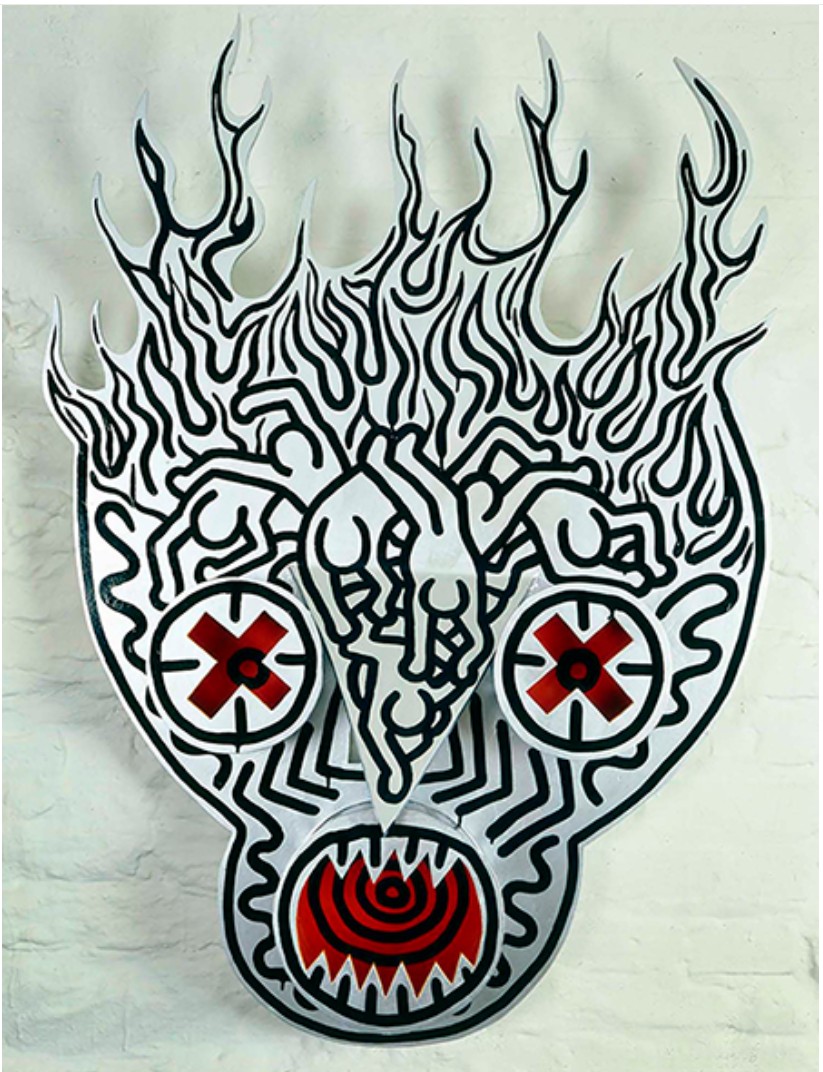
Keith Haring, Untitled (Burning Skull), 1987. Keith Haring artwork © Keith Haring Foundation
Possibly serving as further inspiration for the present work, Haring recounted a thematically related encounter which coincided with the period during which Untitled (Grace Jones Mask) and its sister works were produced. In March 1987, on a trip to Munich to visit Niki de Saint Phalle’s show, Haring had attended a lunch at which his friend Jean Tinguely, ‘fun as usual!’, had ‘brought masks […] and turned the atmosphere around immediately!’. With Haring’s art frequently being informed by his life (and vice versa), it appears possible that the artist’s unique venture into mask-making – constricted to the year of 1987 – was influenced by this specific event.
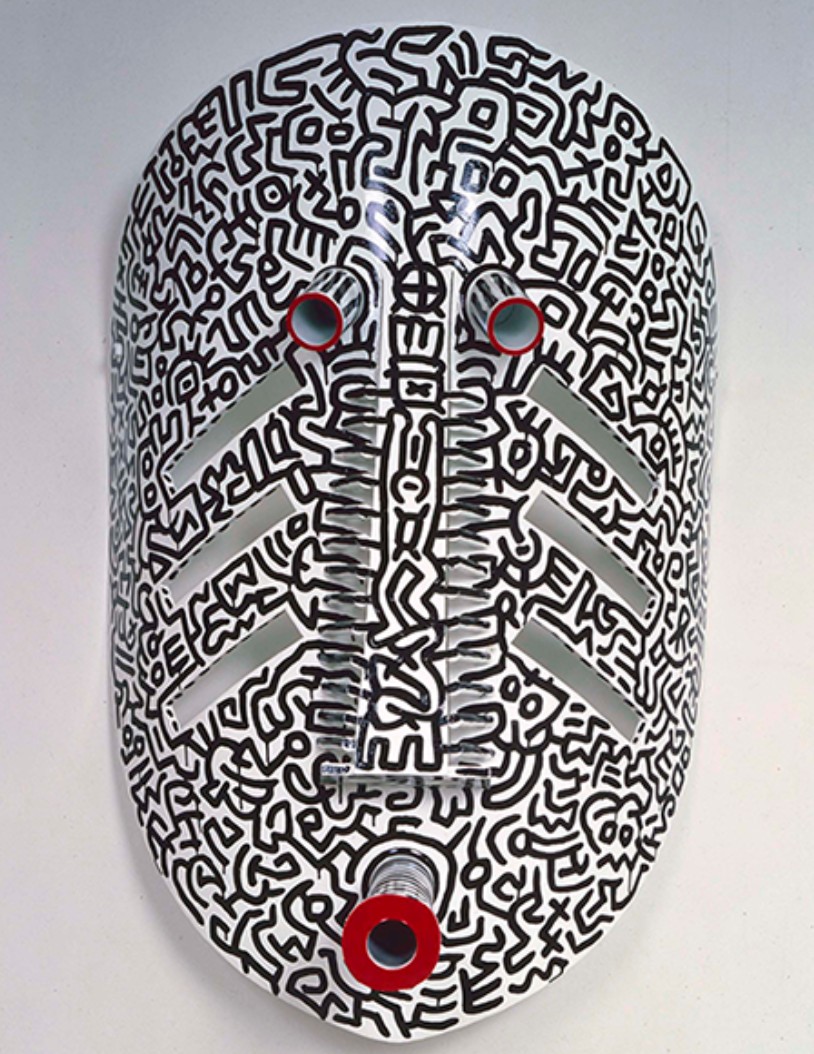
Keith Haring, Untitled (Mask with a Long Mouth), 1987. Keith Haring artwork © Keith Haring Foundation
Recording Haring’s friendship and artistic partnership with Grace Jones, Untitled (Grace Jones Mask) was created on the heels of the actress’s important cinematic venture a year prior – the feature film Vamp, in which she played the Queen of Vampires, Katrina. In this film, Jones’s body and face were painted by Haring in eccentric, primary colours – in fine amounting to an appearance that eluded her likeness entirely. In the present work, the sculptural form’s anthropomorphic silhouette, along with its distinct color combination, provide a resounding echo to Katrina’s red hair, red lips and green eyes in Vamp. In addition to the chromatic paint covering her face, Katrina sported Haring’s instinctive and primary lines all over her body, making ‘her look like a tribal queen, dancing for her gods’. With white patterns marking ‘the flow of energy and topography of Jones’s body’, Jones was ‘transformed into a power site’, wrote Miriam Kershaw.
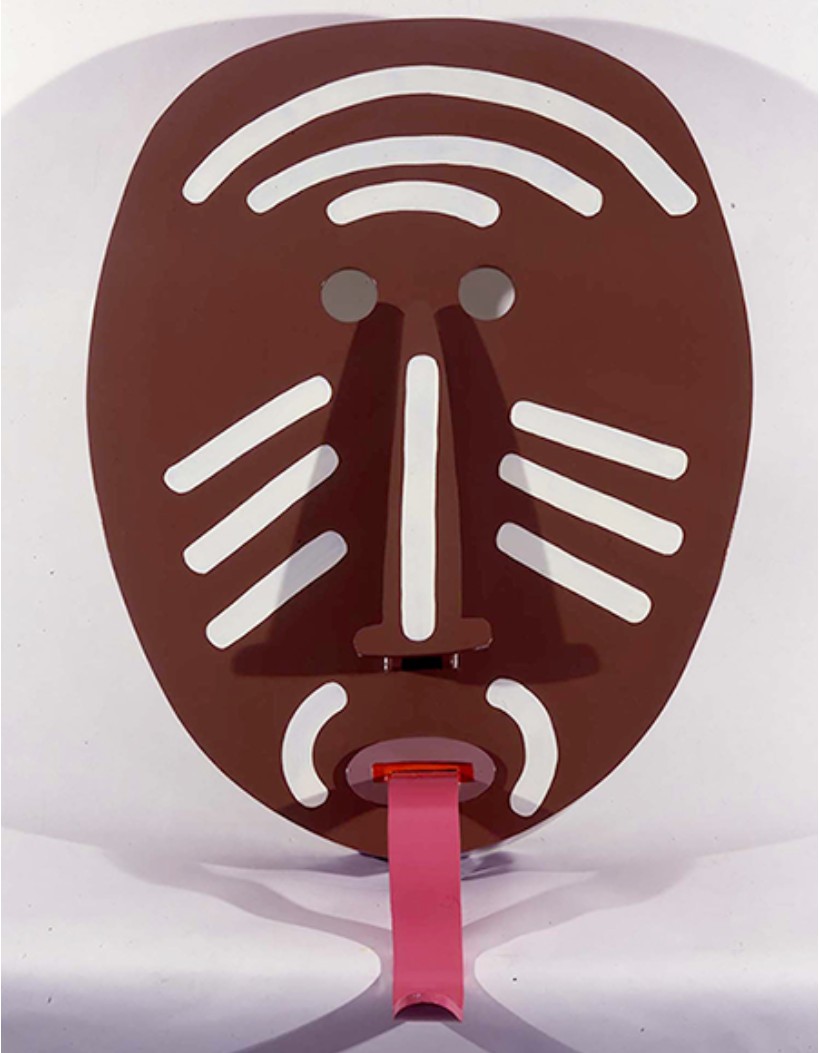
Keith Haring, Untitled (Tongue Man), 1987. Keith Haring artwork © Keith Haring Foundation
Having painted Jones’s body multiple times in the mid-1980s, notably whilst filming the music video for her infamous single ‘I’m Not Perfect (But I’m Perfect for You)’, Haring had never yet dedicated a sculptural object to the model. An exceptional feature within his body of sculptural masks (Haring only dedicated two masks: the other being to his Cubist predecessor Pablo Picasso), Untitled (Grace Jones Mask)’s direct address to Grace Jones denotes the increasingly close relationship the two shared following their first collaboration. After Andy Warhol had orchestrated their artistic introduction for a shoot destined to feature in Interview Magazine in 1984, Haring and Jones continued working together on various projects, most often blending the artist’s painterly endeavors with the model’s striking corporeal presence. About Haring and Jones’ symbiotic collaborations, Miriam Kershaw wrote, ‘Jones’ performances gave dynamic expression to the aesthetic of the 1980s that Haring and Warhol helped to formulate. According to Haring, Jones was a signifier for everything he admired in the global crossroads of postmodern New York’. Indeed, Jones’s body was the ultimate canvas onto which Haring could explore his two foremost aesthetic obsessions: primitive and Pop. The method furthermore presented itself as a natural extension of his ephemeral artistic creations, most famously devised in the streets of New York. Like subway graffiti and wall art, the paint atop Jones’s body could live for just a moment in time before dissolving upon performative completion.
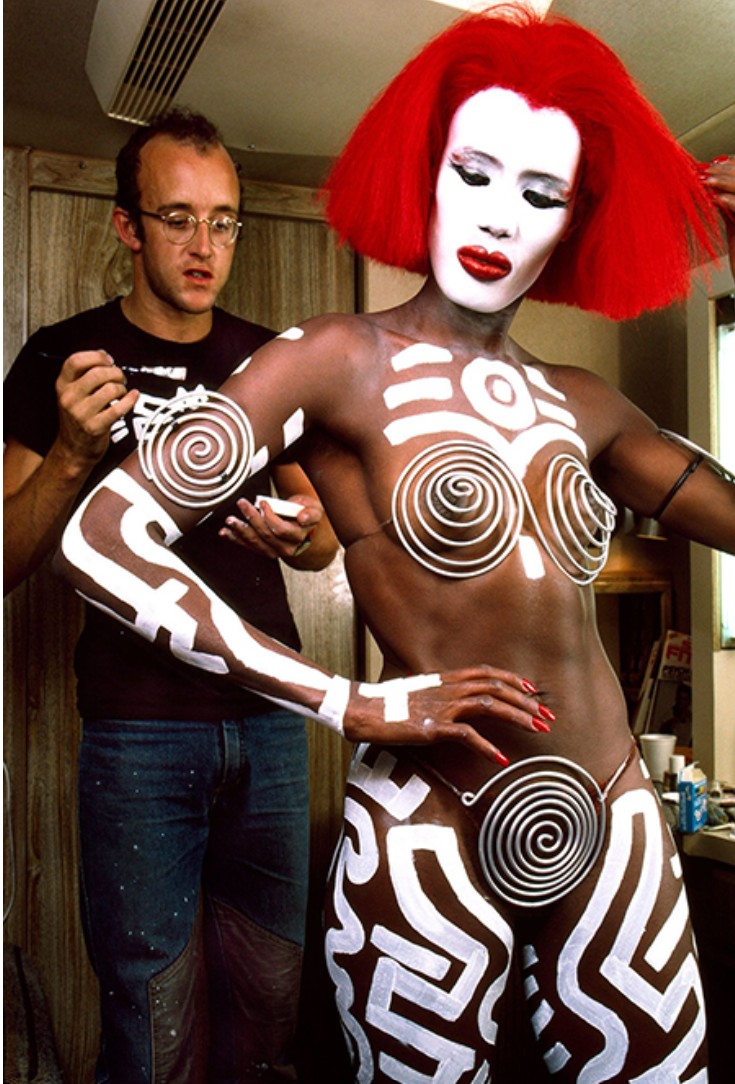
Douglas Kirkland, Keith Haring and Grace Jones in preparation of Vamp, 1986, pigment print on archival paper.
Image: Douglas Kirkland.
A product of his time simultaneously vested with the significance of past art-historical narratives, Haring wove frequent allusions to electronic media, television and cartoons in his work, whilst at the same time infusing imagery from Aztec, Mayan, North African and Aboriginal cultures. As noted by the cultural critic and scholar of African art Robert Farris Thompson, Haring most certainly borrowed from the ritual painting of white stripes on men’s bodies by Masai East Africans in order to create Jones’s costume in her 1984 and 1985 Paradise Garage performances. Equally, the present work’s instinctive aesthetic is undeniably informed by the artist’s longstanding interest in intersecting times and cultures, specifically the fusion of the urban and the ritualistic. Coded with ancestral ethnological signs, and taking the form of an object which for centuries formed part of specific rituals in African tribes, Untitled (Grace Jones Mask) along with its sister works pinpoint the culmination of Haring’s investigation into tribal aesthetics – an allusion rendered explicit by the title of another mask from the present series, Hollywood African Mask.
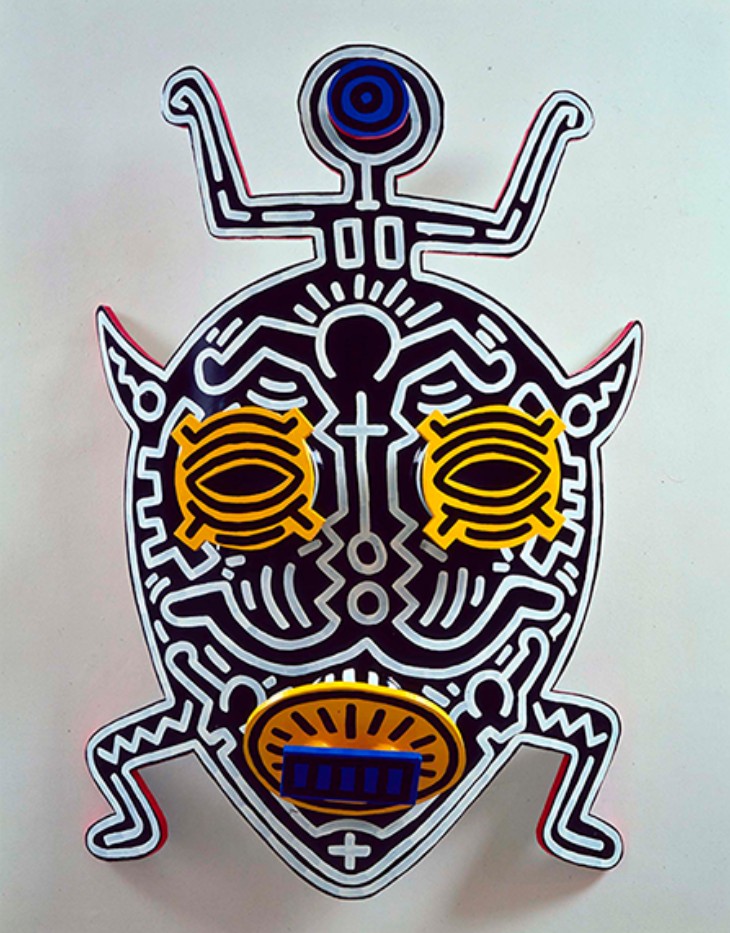
Keith Haring, Untitled (Hollywood African Mask), 1987. Keith Haring artwork © Keith Haring Foundation.
Sold To Benefit the Bedari Foundation
The Bedari Foundation works with partners to catalyze research, education and cutting-edge solutions to global challenges in mental health, environmental conservation and energy transition. We’re devoted to fostering a world where we minimize harm and maximize nurture for humans and the environment, and strive to empower people to have healthy, harmonious relationships with themselves, others and the planet.
But right now, things are moving in the wrong direction. The world is out of balance, and both people and the planet are suffering. More stress and mental health problems, more disconnection and conflict, more planetary damage driven by unfettered consumption. We’re operating in a deficit of care – for ourselves and the earth. But this is where our work begins.
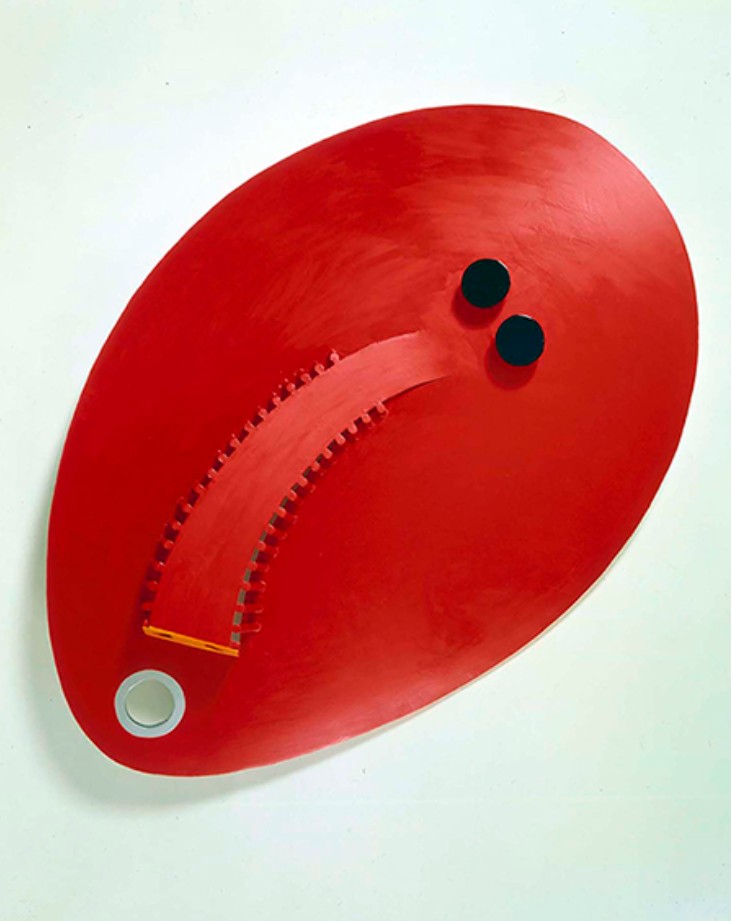
Keith Haring, Untitled (Egg Head for Picasso), 1987. Keith Haring artwork © Keith Haring Foundation