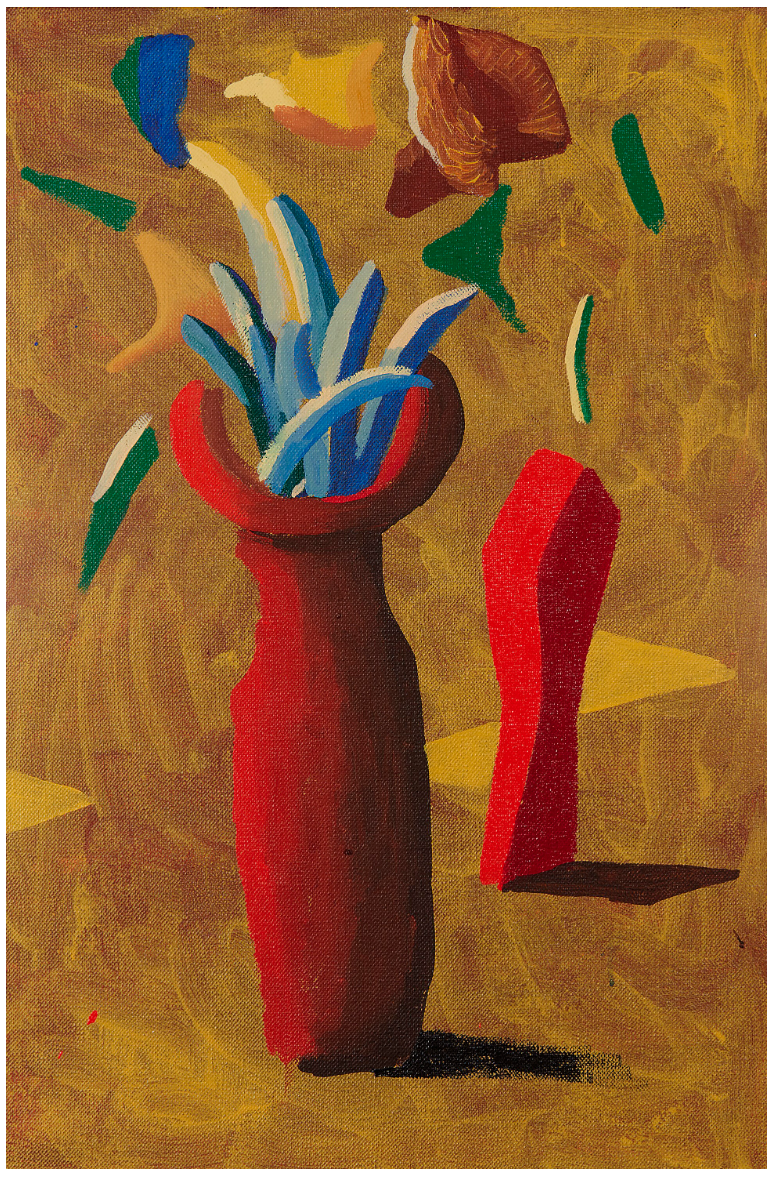
DAVID HOCKNEY
Two Red Pots, 1987
Acrylic on canvas
91×61 cm (36×24 inches)
Signed and dated ‘David Hockney 87’ (on the reverse)
Provenance
Andre Emmerich, Inc., New York
Brook Alexander, New York
Jonathan Novak Contemporary Art, Los Angeles
Helen Wasserman Fine Art, New York
Acquired from the above by the previous owner in November 1994
Sotheby’s New York, 2 October 2020, lot 36
Acquired at the above sale by the present owner
Auction History
Christie’s Hong-Kong: 26 May 2022
Estimated: HKD 9,000,000 – 15,000,000
HKD 11,850,000 / USD 1,509,650
DAVID HOCKNEY (B.1937), Two Red Pots | Christie’s (christies.com)
REPEAT SALE
Sotheby’s New-York: 2 October 2020
Estimated: USD 400,000 – 600,000
USD 988,000
DAVID HOCKNEY | TWO RED POTS | Contemporary Curated | 2020 | Sotheby’s
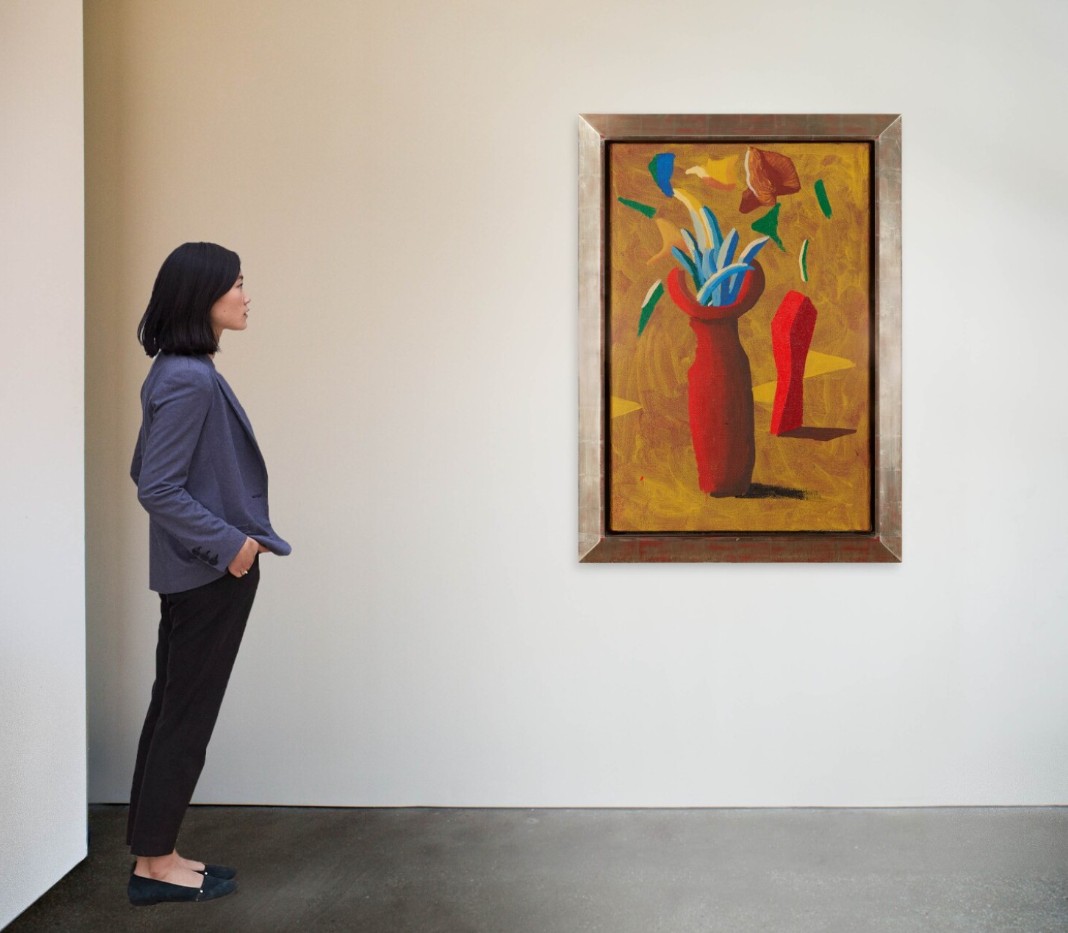
Throughout his remarkable career, Hockney has successfully merged a deep appreciation for and awareness of art historical precedent with an unwavering desire to push the boundaries of Contemporary art through his own, utterly unique painterly vision. Used to remarkable effect in Two Red Pots, this tension between tradition and innovation has, over the past sixty years, distinguished Hockney as amongst the foremost artists of the Contemporary age. Painted in 1987 – the year before the artist’s first, critically acclaimed U.S. retrospective at the Los Angeles County Museum of Art—Two Red Pots deftly demonstrates the transition from mimetic representation to abstraction that occupied this innovative master at the time.
“Painting still lifes can be as exciting as anything can be in painting. I remember once saying to Francis Bacon in Paris, that I knew a painting in California of tulips in a vase that was as profound as any painting he’d made… I was referring to the Cézanne in the Norton Simon Museum. It’s the most beautiful painting, and it was as profound as anything he did. Just some tulips in a vase. The profundity is not in the subject, it is the way it’s dealt with.”
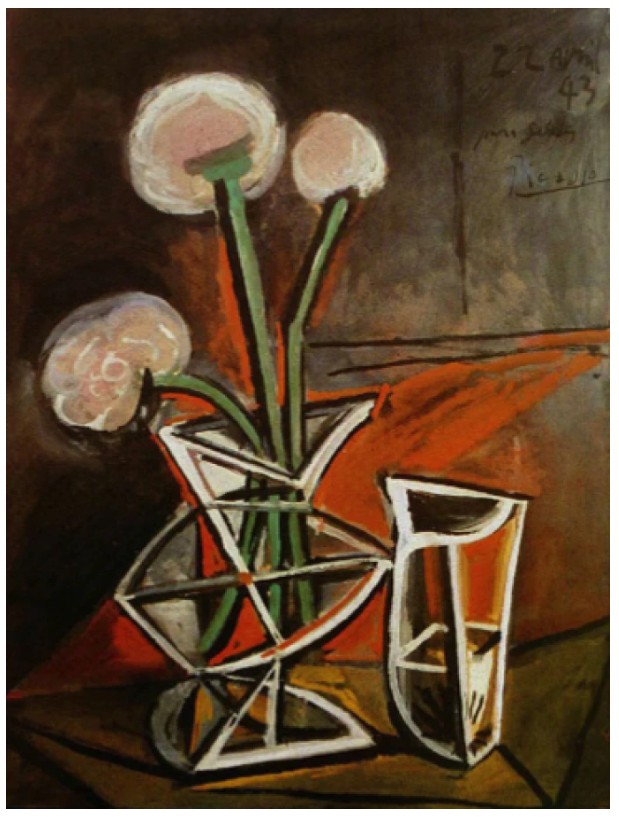
PABLO PICASSO, VASE WITH FLOWERS, 1943.
ART © 2020 ESTATE OF PABLO PICASSO / ARTISTS RIGHTS SOCIETY (ARS), NEW YORK.
Within a composition of vividly contrasting colors and shapes technique and kaleidoscopic color, Hockney fuses the influence of geometric Cubism, Surrealist abstraction, still life genre painting and even his own oeuvre to create an utterly intriguing composition; indeed, Hockney’s ever-evolving artistic practice is a means of advancing art history from within. Two Red Pots seems to do just this; the still life, one of the most traditional genres of painting, becomes Hockney’s template upon which he subverts traditional perspective and notions of depth while trying to depict his own idiosyncratic reality.
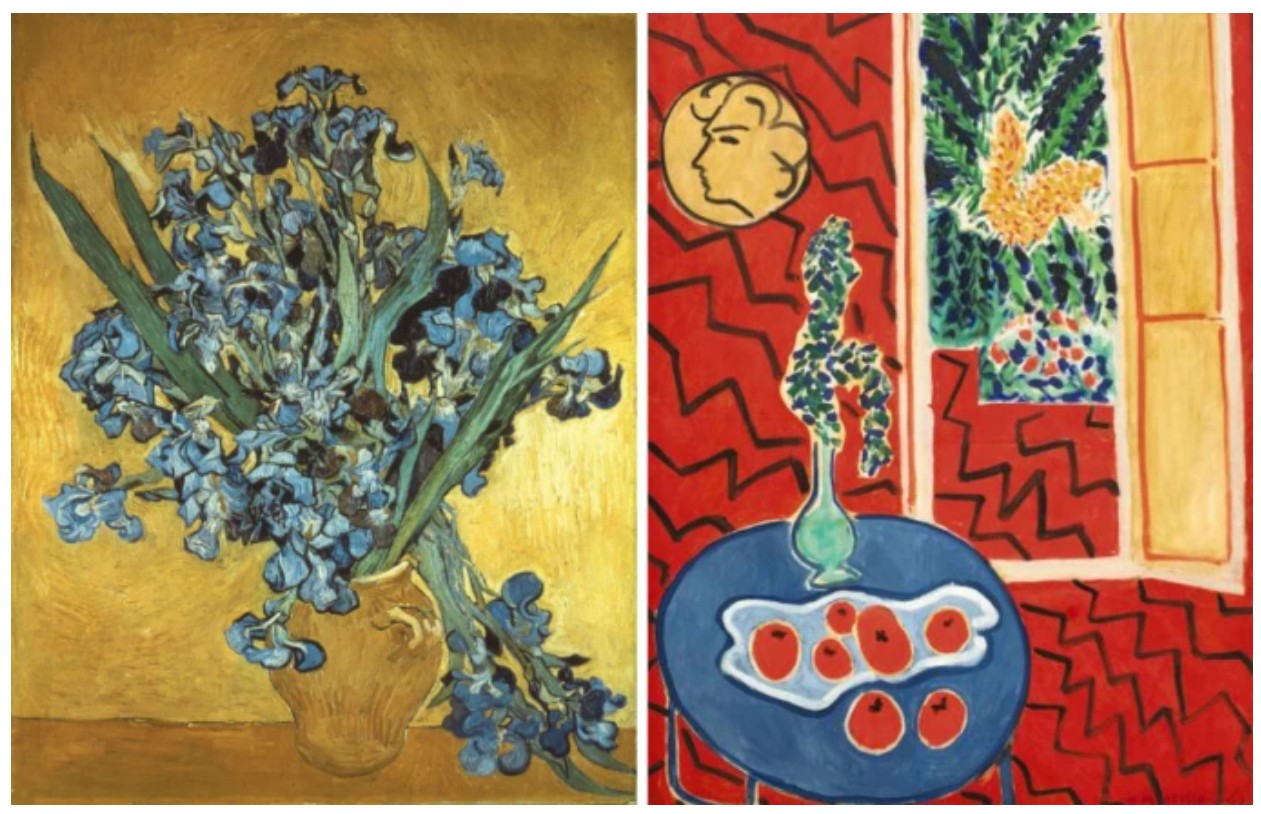
LEFT : VINCENT VAN GOGH, VASE WITH IRISES AGAINST A YELLOW BACKGROUND, 1890
VAN GOGH MUSEUM, AMSTERDAM
RIGHT: HENRI MATISSE, RED INTERIOR: STILL LIFE ON A BLUE TABLE, 1947. KUNSTSAMMLUNG NORDRHEIN-WESTFALEN, DUSSELDORF. ARTWORK © 2020 SUCCESSION H. MATISSE / ARTISTS RIGHTS SOCIETY (ARS), NEW YORK
In its exploration of experimental still life painting, Two Red Pots invokes not only a centuries old art historical tradition, but also a motif that is of central importance within Hockney’s own oeuvre. Still life painting first captured Hockney’s interest in the 1960s, and served as focus for a number of early works; from there, through the precise realism of the artist’s 1970s painting, to the colorful and imaginative abstraction of the present work and other 1980s paintings, the still life genre has allowed Hockney to continually refresh and explore his creative vision through familiar subject matter.
“I think every artist who deals with the visible world must come back to them. You begin to see how many choices you can make in even these simple things right in front of you. How exciting they are.”
In its graphic shapes and intriguing spatial play, Two Red Pots exemplifies not only the masterful sensitivity towards art history for which Hockney is so well known, but also the ways in which he pushes the existent boundaries of prior traditions to produce something entirely unique.
Here, the biomorphic shapes that dominate the composition, with their strange shadows and simplified outlines, recall the metaphysical works of Giorgio de Chirico or the Surrealist landscapes of Yves Tanguy. Hockney’s vivid, saturated colors also evoke his Fauvist hero Henri Matisse, while his foreshortening of ground and compression of perspective clearly reveal his abiding interest in Cubism. Simultaneously, the sheer experimental enthusiasm of Two Red Pots testifies to the greater freedom of invention in space and form with which Hockney approached his canvases of the late 1980s. By dispensing with traditional perspective, Hockney successfully abstracts and flattens the present work: the various colorful elements and background are reduced to a collection of linear yet rhythmic brushstrokes. While the background remains completely abstract, the attention given to the geometric planes, tonal gradation, and accompanying shadows of the two vases and burst of vibrant flowers restores our mind’s ability to recognize depth and three-dimensionality.