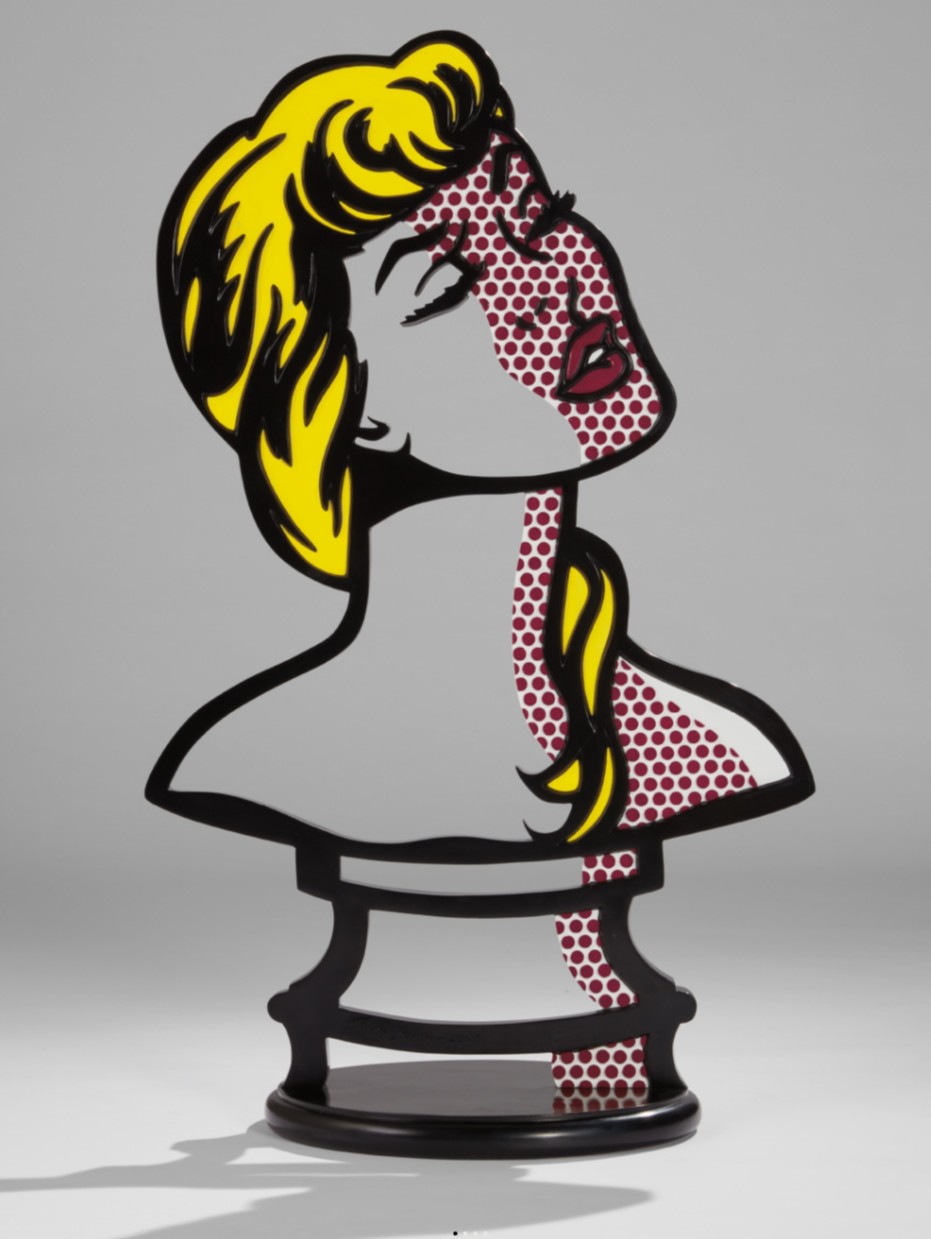
Woman: Sunlight, Moonlight, 1996
Painted and patinated bronze
Edition: 6 + 1 Artist’s Proof
Daring in its conceptual wit and dazzling in execution, Woman: Sunlight, Moonlight stands as a defining statement of Roy Lichtenstein’s sculptural oeuvre and a profound meditation on image, illusion, and form. Executed in 1996, just one year prior to the artist’s unexpected death, Woman: Sunlight, Moonlight is a seminal artwork in the groundbreaking series of flat profile sculptures pioneered by Lichtenstein in the 1990s.
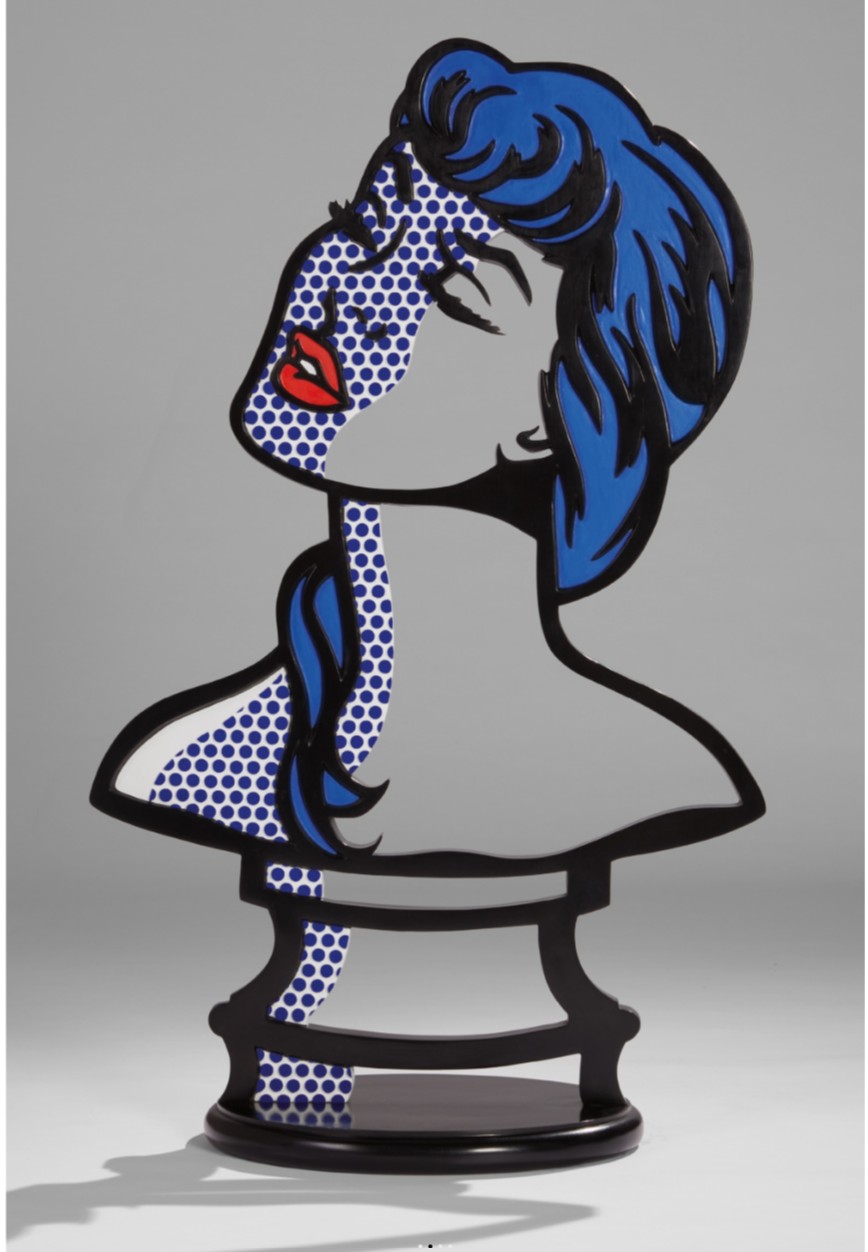
Examples from the bronze edition are held in esteemed collections including The Broad in Los Angeles and have been included in over nine major exhibitions including Lichtenstein’s landmark retrospective at the Art Institute of Chicago and the National Gallery of Art, Washington D.C. Bearing exceptional provenance, the present work has remained in the collection of Dorothy and Roy Lichtenstein since its creation. Presented to the public market for the very first time, Woman: Sunlight, Moonlight is a thrilling evocation of Roy Lichtenstein’s singular process and a remarkable opportunity to acquire an innovative and unprecedented masterpiece.
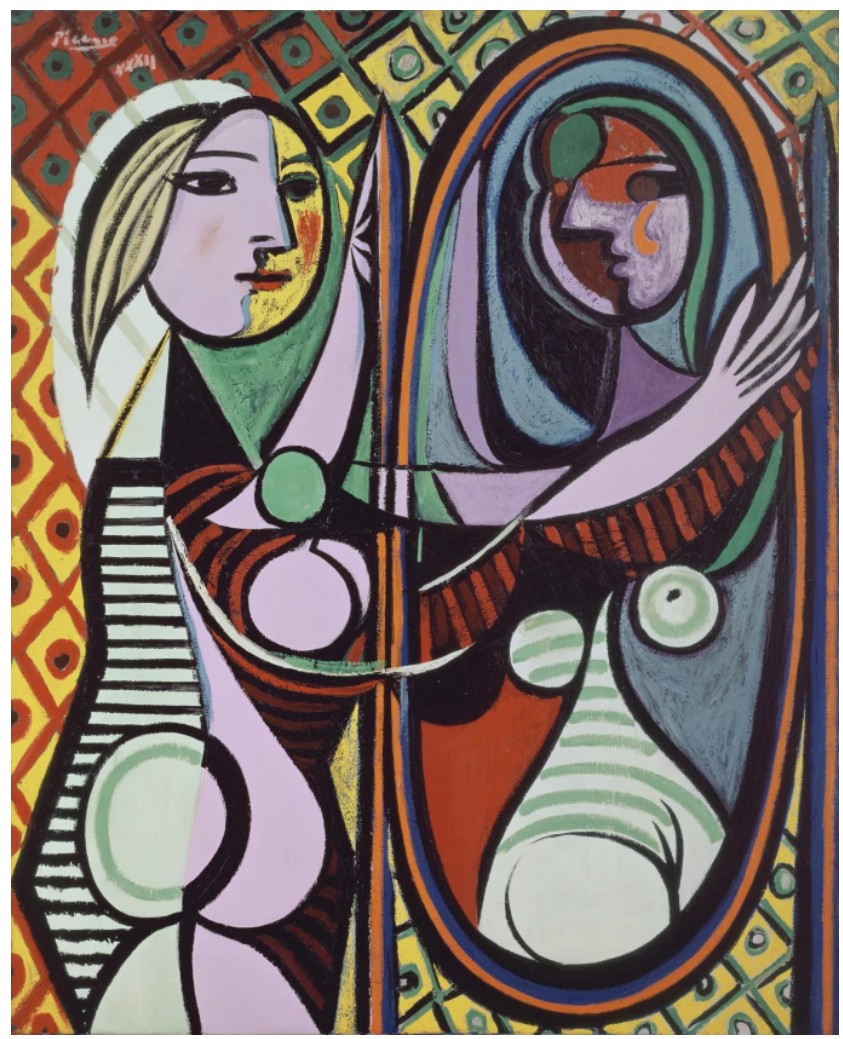
Pablo Picasso, Girl Before a Mirror, 1932. Museum of Modern Art, New York. Image © Succession Picasso/DACS, London 2025 / Bridgeman Images. Art © 2025 Estate of Pablo Picasso / Artists Rights Society (ARS), New York
Executed with Lichtenstein’s signature graphic precision, Woman: Sunlight, Moonlight is a thrilling exploration of the female figure in the artist’s late career as part of his reinterpretation of art history, blending his own celebrated output to create new works of art. Woman: Sunlight, Moonlight presents a stylized female bust rendered in a flat two-sided profile that boldly disrupts sculptural convention. Drawn from the visual vocabulary of 1960s romance comics, in this case the popular romance comic book Secret Hearts, the subject in Woman: Sunlight, Moonlight is at once iconic and archetypal, embodying Lichtenstein’s enduring exploration of mass media’s portrayal of feminine beauty. A pioneer of the Pop Art movement, Lichtenstein gained popularity and acclaim in the early 1960s for his “Girl Paintings” in which he appropriated the cliched archetypes of female beauty from comic books and magazines, brilliantly blurring the boundaries of high and low art.

Roy Lichtenstein in his studio. Photo © Bob Adelman. Art © Estate of Roy Lichtenstein
Woman: Sunlight, Moonlight is a triumphant re-emergence of the female figure in the artist’s work after a lengthy period away from the comic-book inspired motif and exemplifies Lichtenstein’s ability to not only contend with art historical precedent and the contemporary pop culture vernacular, but also to reflect upon his own practice across media and time. Woman: Sunlight, Moonlight reimagines its melancholic heroine as a luminous dual sided bust. Split along a central axis, her visage fractures into two distinct moods or opposing atmospheres, one face radiating the warm tones of daylight with vivid reds and canary yellows, and the other immersed in the cool blues of moonlight. Striking and alluring, she is Lichtenstein’s timeless muse, forever poised between the rising sun and the falling night.
“A sculpture from any viewpoint should work the way a drawing works, which is a two-dimensional thing.”
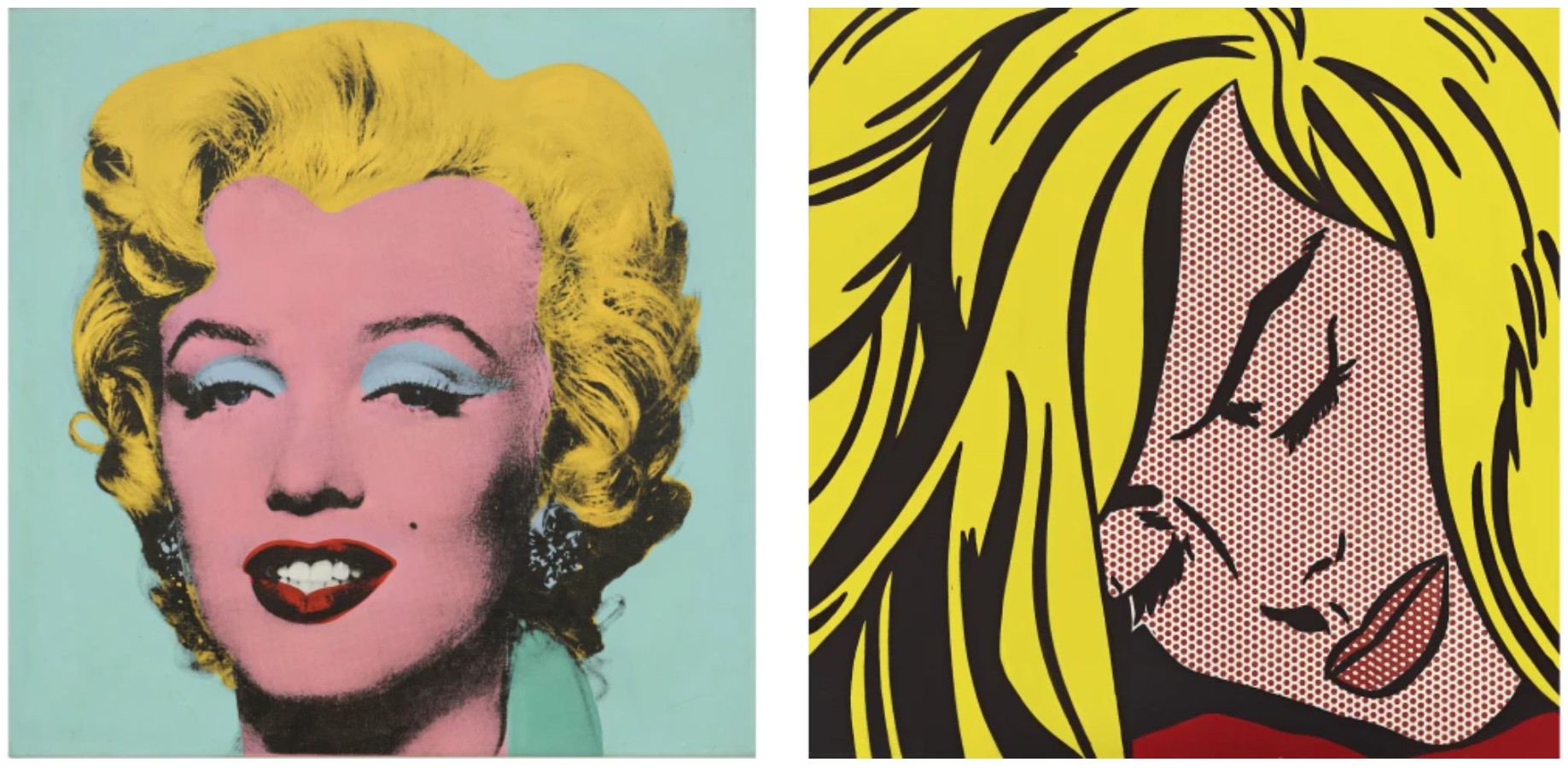
Left: Andy Warhol, Shot Sage Blue Marilyn, 1964. Private Collection. Image © Christie’s Images / © 2025 The Andy Warhol Foundation for the Visual Arts, Inc. / Licensed by DACS, London / Bridgeman Images. Art © 2025 Andy Warhol Foundation for the Visual Arts / Artists Rights Society (ARS), New York. Right: Roy Lichtenstein, Sleeping Girl, 1964. Sold at Sotheby’s New York in May 2012 for $44.9 million. Art © Estate of Roy Lichtenstein
Precise contours and graphic angles animate the surface of Woman: Sunlight, Moonlight with electric tension. Through his iconic Ben-Day dots, bold outlines and graphic color, the artist’s unmistakable visual lexicon is deftly transposed from the canvas to three-dimensional space. From certain angles, the figure appears almost like a cut-out, a drawing sprung into space; while from others, the figure’s profile sharpens into uncanny dimensionality. As the artist himself described, “a sculpture from any viewpoint should work the way a drawing works, which is a two-dimensional thing.” (the artist quoted in: Richard Calvocoressi, Roy Lichtenstein Sculptor, 2013, p. 42) Lichtenstein transforms a traditionally volumetric medium into a site of pictorial experimentation: sharp outlines and clusters of diagonal lines prompt the viewer to conjure depth and mass, suggesting a sense of three-dimensionality despite inherent flatness of the form. Disintegrating and reanimating space simultaneously, Woman: Sunlight, Moonlight furthers the boundaries of the medium, challenging the very substance and definition of sculpture as a necessarily three-dimensional form of expression. As Hal Foster describes, “these pieces exist between painting and sculpture in terms not only of genre but also of structure; where Minimalist objects are neither painting nor sculpture…Pop objects tend to be both-and if most representational painting is a two-dimensional encoding of three-dimensional objects, Lichtenstein reverses the process here, and freezes it somewhere in between.” (Hal Foster, ‘Pop Pygmalion, in: Exh. Cat., London, Gagosian Gallery, Roy Lichtenstein Sculpture, 2005, p. 10) Through exacting precision and controlled simplicity, Lichtenstein collapses the traditional boundaries of painting, drawing, and sculpture into a unified, hybrid form.
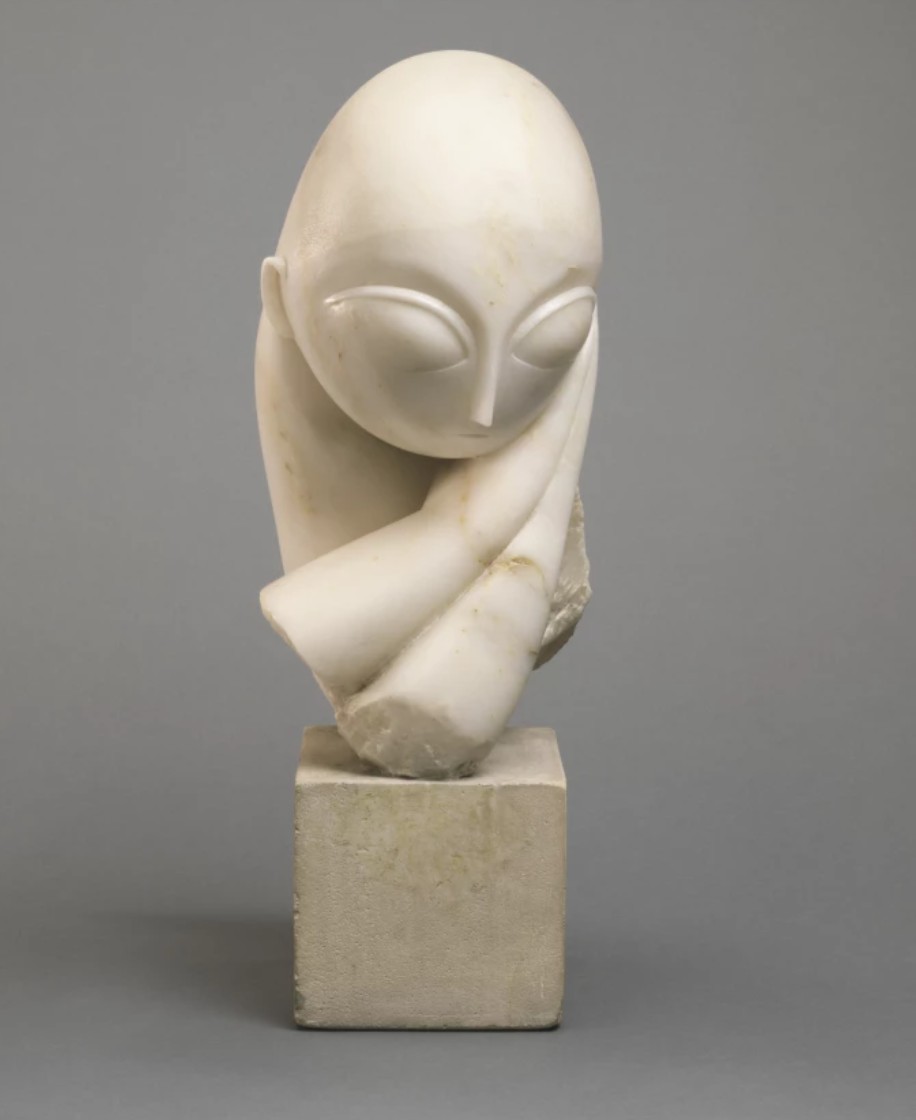
Constantin Brâncuși, Mademoiselle Pogany, 1912. Philadelphia Museum of Art. Image © Philadelphia Museum of Art / Gift of Mrs. Rodolphe Meyer de Schauensee, 1933 / Bridgeman Images. Art © Succession Brancusi – All rights reserved (ARS) 2025
Across media and form, Roy Lichtenstein has probed the semiotics of space and perspective, volume and mass, through his distinctive visual lexicon of color and line. A tour de force of visual wit and technical innovation, Woman: Sunlight, Moonlight is both an homage to and an evolution of Lichtenstein’s most enduring motifs rendered with a masterful sense of visual acuity. Flat yet full of volume, light yet monumental in presence, Woman: Sunlight, Moonlight is a triumph of paradox, simultaneously image and object, illusion and structure. A striking meditation on duality, perception, and the language of image-making, Woman: Sunlight, Moonlight is more than a mere translation of two-dimensional imagery, urging the viewer not just to reflect on the material object, but the act of viewing itself.
XXXXXXX
Roy Lichtenstein’s striking sculpture, Woman: Sunlight, Moonlight, represents the triumphal return of the female figure in the revered Pop artist’s late career. Executed in 1996 – just one year prior to the artist’s unexpected death – this work was created during the pinnacle of Lichtenstein’s career and irrefutably positions itself within the pantheon of his greatest works. Woman: Sunlight, Moonlight, re-processes the art historical trope of the bust through the lens of Lichtenstein’s signature Pop Art idiom. The work comes in full circle with Head with Blue Shadow, 1965 (Nasher Sculpture Center, Dallas), Woman: Sunlight, Moonlight presents a complex portrait of a melancholic heroine in a three-quarter perspective. Standing more than 3 feet tall, the larger than life bust possesses a powerful presence that enchants with its formal complexity. In keeping with Lichtenstein’s style, Woman: Sunlight, Moonlight features black graphic outlines on patinated bronzed, coupled with being partially painted in primary colors with the artist’s signature Ben-Day dots. The unique feature of the work is that each side bears a distinct composition, which invites viewing from two sides. Formally reflecting the work’s very title, Woman: Sunlight, Moonlight, explores two chromatically contrasting renditions of the woman’s face. A quintessential example of the groundbreaking flat profile sculptures that Lichtenstein pioneered in the 1990s, this work beautifully exemplifies Lichtenstein’s unparalleled ability to harness the potential of negative and positive space. Executed in an edition of six, other examples of Woman: Sunlight, Moonlight, are now housed in prominent collections, such as the Broad Museum, Los Angeles, and have been included in over nine major exhibitions, including Lichtenstein’s landmark retrospective at the Art Institute of Chicago, which thereafter traveled to the National Gallery of Art, Washington D.C, Tate Modern, London, and Centre George Pompidou, Paris between 2012 and 2013. Within this edition, the present work distinguishes itself with its impeccable provenance, having notably resided with the Artist Estate since execution and since 2014 in the Roy Lichtenstein Foundation Collection.
Woman: Sunlight, Moonlight is a powerful continuation of some of the core themes that propelled Lichtenstein to critical acclaim in the early 1960s. A pioneer of the Pop Art movement, Lichtenstein first burst onto the scene with his so-called “Girl paintings.” Brilliantly blurring the boundaries between high and low art, Lichtenstein appropriated clichéd images of lovestruck or helpless ‘All-American’ women from comic book and magazine pages and rendered them with his trademark graphic line and boldly colored Ben-Day dots, the dot system used in mass-circulation print sources. As Lichtenstein explained, ‘I am never drawing the object. I’m only drawing a depiction of the object — a kind of crystallized symbol of it.’ By re-presenting and re-casting the then already somewhat dated and cliché images of womankind through the medium of ‘high art’, Lichtenstein ingeniously drew attention to the visual and cultural norms dictating contemporary culture. Indeed, as Diana Waldman aptly observed, these women “were not heroines but supplicants to the male ego, and Lichtenstein did not invent them; they or their counterparts can be found in the ads or romance comic books of the time” (Diane Waldman, Roy Lichtenstein, exh. cat., New York, 1993, p.113).
Evoking such early masterpieces such as Hopeless, 1963 (Kunstmuseum, Basel) or Ohhh…Alright…, 1964, the present work illustrates a re-emergence of this central theme that would occupy Lichtenstein in the final years of his life after a lengthy period away from the comic-book inspired motif of the female figure. Similar to his early works, Woman: Sunlight, Moonlight is based on a comic book frame – in this instance once taken from the popular 1960s romance comic book Secret Heart that depicts a handsome man in conversation with the blonde heroine. To the man’s statement “Don’t count on it Doris! That’s the last you’ll ever see of my dear brother! He’s a failure and always will be one’, the woman wistfully replies “You’re wrong! He’ll be back…And a big success, too! Wait and see!”. Isolating the female’s face and removing all extraneous details, including the speech bubbles, Lichtenstein monumentalizes the heroine in the form of the revered, century-long tradition of the bust. Whereas Lichtenstein’s early project was driven by an interest in elevating the clichés and banalities of popular culture, while also exploring notions of reproduction, his reprisal of the female figure in the 1990s reflects a movement towards the pastiche of established art historical traditions. Engaging in a post-modern meta-discourse with artistic precedents, Lichtenstein here essentially reverses his Pop principles. With Woman: Sunlight, Moonlight Lichtenstein presents us with masterful double loop of appropriation that explores the conventions of art historical precedents – including his own world-famous oeuvre.
The resulting portrait represents the peak of Lichtenstein’s over five-decade inquiry into the possibilities of sculpture. Indeed, sculpture had occupied a central position in Lichtenstein’s oeuvre from its very beginnings: while Lichtenstein already experimented with carved wood and stone, terracotta and various assemblages as early as the 1940s, it was notably of the mid-1960s that he embraced the sculptural form as means to further his unique Pop idiom – translating inherently two-dimensional source images into sculptural form. In 1967, Lichtenstein declared, “I was interested in putting two-dimensional symbols on a three-dimensional object” (John Coplans, Roy Lichtenstein, 1967, p. 16). However, in contrast to Lichtenstein’s early sculpture Woman: Sunlight, Moonlight distinguishes itself with its radical flatness. Woman: Sunlight, Moonlight brilliantly articulates the way in which the artist blurs the boundaries of drawing, sculpture, and painting. “These pieces”, art critic and art historian Hal Foster indeed explained, “exist between painting and sculpture in terms not only of genre but also of structure; where Minimalist objects are neither painting nor sculpture… Pop objects tend to be both-and. If most representational painting is a two-dimensional encoding of three dimensional objects, Lichtenstein reverses the process here, and freezes it somewhere in between” (Hal Foster, ‘Pop Pygmalion, in Roy Lichtenstein Sculpture, exh. cat., London, Gagosian Gallery, 2005, p. 10).
With Woman: Sunlight, Moonlight the viewer is presented with the culmination of Lichtenstein’s exploration of the female bust. Apart from Head with Blue Shadow, 1965 (Nasher Sculpture Center, Dallas), the iconoclastic form of the female bust also prominently featured in Nude with Bust, 1995 – a striking painting from Lichtenstein’s acclaimed Nude series that would arguably serve as the starting point for developing the present sculpture. Isolating the bust depicted in the aforementioned painting, Lichtenstein over the course of a year re-fined the composition in various drawings and mock models, ultimately creating a full-scale maquette from which the casting model would be created. Volume and depth is here transformed into compact line and color, giving the impression of an image cut-out from a newspaper or magazine floating in air. Seemingly drawn in space with fluid brushstrokes, the painted and patinated bronze outlines hover between two- and three-dimensionality – the subtle interplay of negative and positive space giving rise to a tantalizing image in flux. As Lichtenstein importantly explained, “I don’t think the importance of the art has anything to do with the importance of the subject matter. I think importance resides more in the unity of the composition and in the inventiveness of perception” (Roy Lichtenstein quoted in Roy Lichtenstein Beginning to End, Fundacion Juan March, Madrid, 2007, p. 128).
Following in the conceptual footsteps of Picasso and Matisse, Lichtenstein abstracts the lovelorn heroine from the comic-book frame source image, and transforms her into a larger than life sculptural portrait in its own right. Lichtenstein, in the last interview ever given before his death in 1997, described this process of abstraction and slippage in the following way: “I’ve been using gradated dots or colors that go from one form to another, but the idea is that the lines could act like that to make areas or localities of the things that are independent. Of course, they don’t look like anything in nature, so there’s no subject matter excuse–though we don’t really have to have excuses, I think, after Mondrian or Picasso or Cézanne…. If you did it without the subject matter you wouldn’t know this was being done, so the subject matter helps because there’s a reference to reality. Some kind of reality anyway” (Roy Lichtenstein quoted in David Sylvester Some Kind of Reality: Roy Lichtenstein interviewed by David Sylvester in 1966 and 1997, exh. cat., Anthony d’Offay, London, 1997, p.38)”. Belonging to the last works Lichtenstein created, Woman: Sunlight, Moonlight, beautifully articulates the way in which the artist continued his Modern artistic forebears’ investigation into the role of subject in art and the functions of line, color and spatial depth.
Auction Results
Works from the Collection of Dorothy and Roy Lichtenstein
Sotheby’s New-York: 15 May 2025
Estimated: USD 4,000,000 – 6,000,000
USD 4,930,000
Woman: Sunlight, Moonlight | The Now and Contemporary Evening Auction | 2025 | Sotheby’s
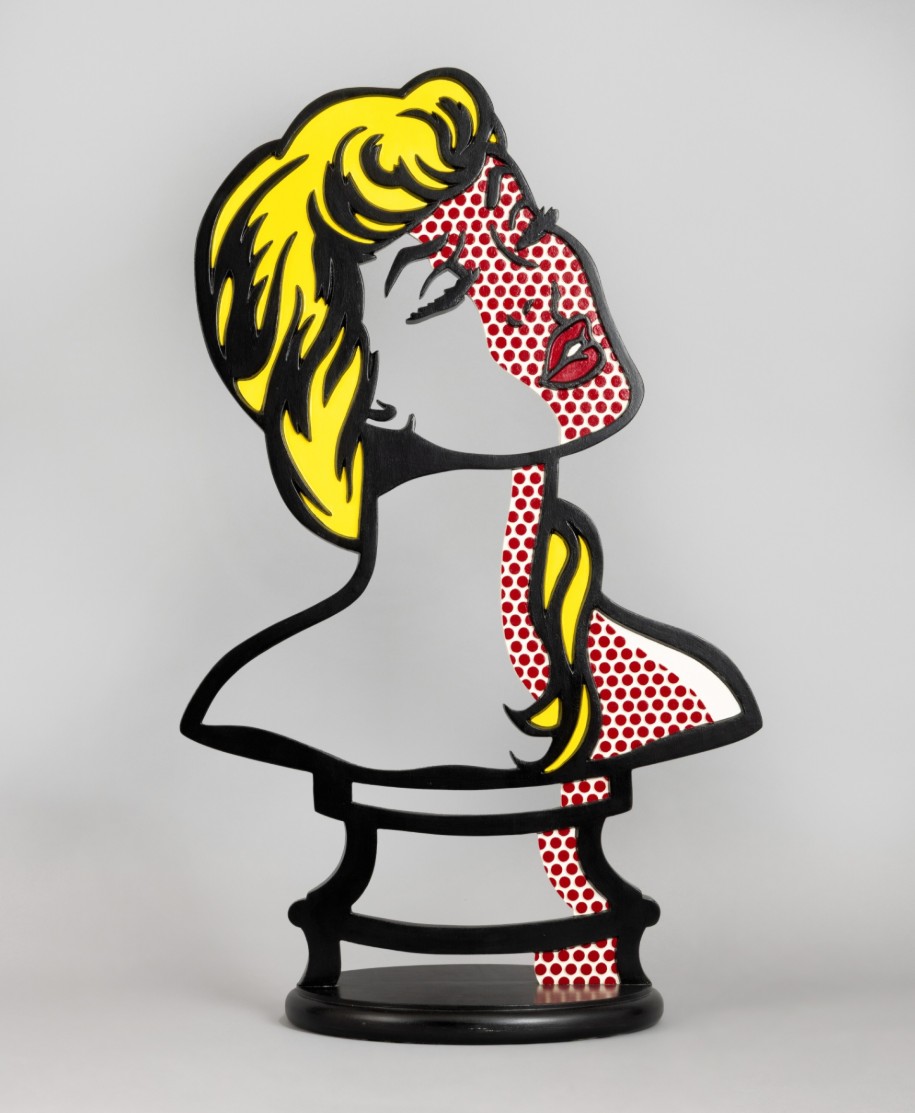
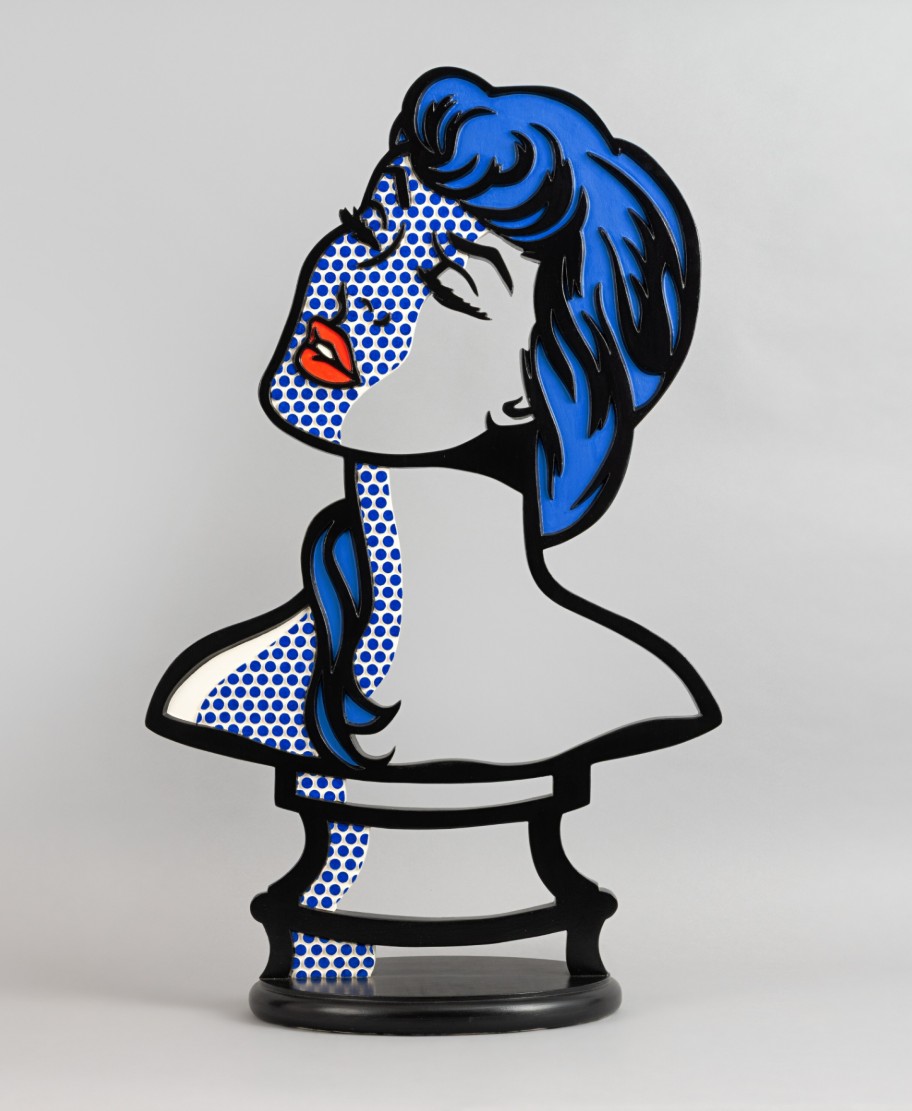
ROY LICHTENSTEIN (1923 – 1997)
Woman: Sunlight, Moonlight, 1996
Acrylic on wood
42 3/4 x 26 x 13 5/8 inches (108.6 x 66 x 35.6 cm)
One of two unique examples of the form executed in wood in preparation for the bronze edition of six, the second of which currently resides in the collection of the Whitney Museum of American Art, New York
Property of the Roy Lichtenstein Foundation Sold to Benefit the Foundation’s Study Center Projects
Phillips New-York: 18 May 2017
Estimate on Request
USD 10,330,000
Roy Lichtenstein 20th Century & Contemporary Art Evening Sale
Woman: Sunlight, Moonlight, 1996
Painted and patinated bronze
Inscribed with the artist’s signature, numbered and dated “0/6 rf Lichtenstein 96” on the Sunlight side