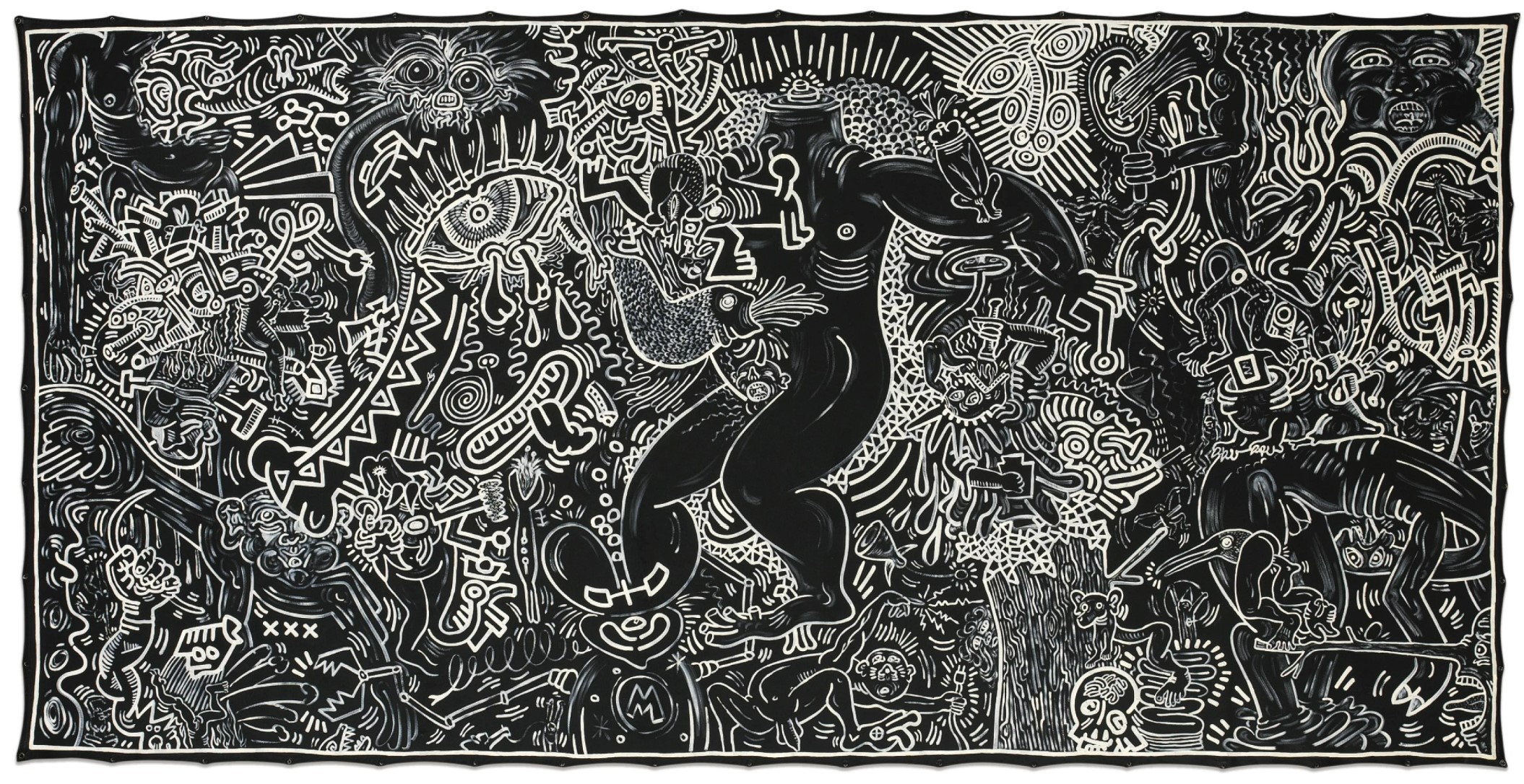
KEITH HARING
Untitled, 1986
Acrylic and enamel paint on canvas with metal grommets
95×192 inches (241.3 x 487.7 cm)
Signed, titled and dated Sept. 14 1986 on the reverse
Estate of the Artist
Deitch Projects, New York
Acquired by the present owner from the above in 1999
USD 4,869,000
(#19) Keith Haring (sothebys.com)
Arriving in the city in 1978, Haring was immediately drawn to the urban music and graffiti scene, working alongside other artists who were also to become legends of their time, such as Jean-Michel Basquiat and Kenny Scharf. Haring first gained renown by leaving his often ephemeral yet powerful mark on the walls and advertising boards of the city’s labyrinthine subway system. The artist recalled the impact that Basquiat’s early graffiti – completed under the moniker of ‘SAMO’ – had on his own work: “There was this art out on the streets. Before I knew who he was, I became obsessed with Jean-Michel Basquiat’s work… The stuff I saw on the walls was more poetry than graffiti… On the surface they seemed really simple, but the minute I saw them I knew they were more than that. From the beginning he was my favorite artist.” (the artist in conversation with David Sheff in “Keith Haring, An Intimate Conversation,” Rolling Stone, August 1989, n.p.) Music and the urban culture surrounding it proved to be another major source of inspiration for the artist: “All kinds of new things were starting. In music, it was the punk and New Wave scenes… And there was the club scene – the Mudd Club and Club 57, at St. Mark’s Place, in the basement of a Polish church, which became our hangout, a clubhouse, where we could do whatever we wanted.” (the artist cited in Ibid.) The extraordinary sensation of movement that pervades Untitled (September 14, 1986) and other large scale examples of Haring’s work can be connected to the artist’s understanding and love of this alternative and highly original music scene at the time.
In its astonishingly assured compositional structure and astounding level of detail, Untitled (September 14, 1986) deserves to be considered as a work of immense significance within Haring’s oeuvre, embodying the dizzying energy and sense of possibility that existed within the New York cultural scene for a brief but heady period during the 1980s. Ultimately, Untitled (September 14, 1986) superbly encapsulates the sensation that Haring declared he was striving for within his art when he stated, “When I paint, it is an experience that, at its best, is transcending reality.” (the artist cited in Ibid.) In its creation of a powerfully distinctive dreamscape, Untitled (September 14, 1986) not only ‘transcends’ reality, but exceeds it as well.