KEITH HARING (1958 – 1990)
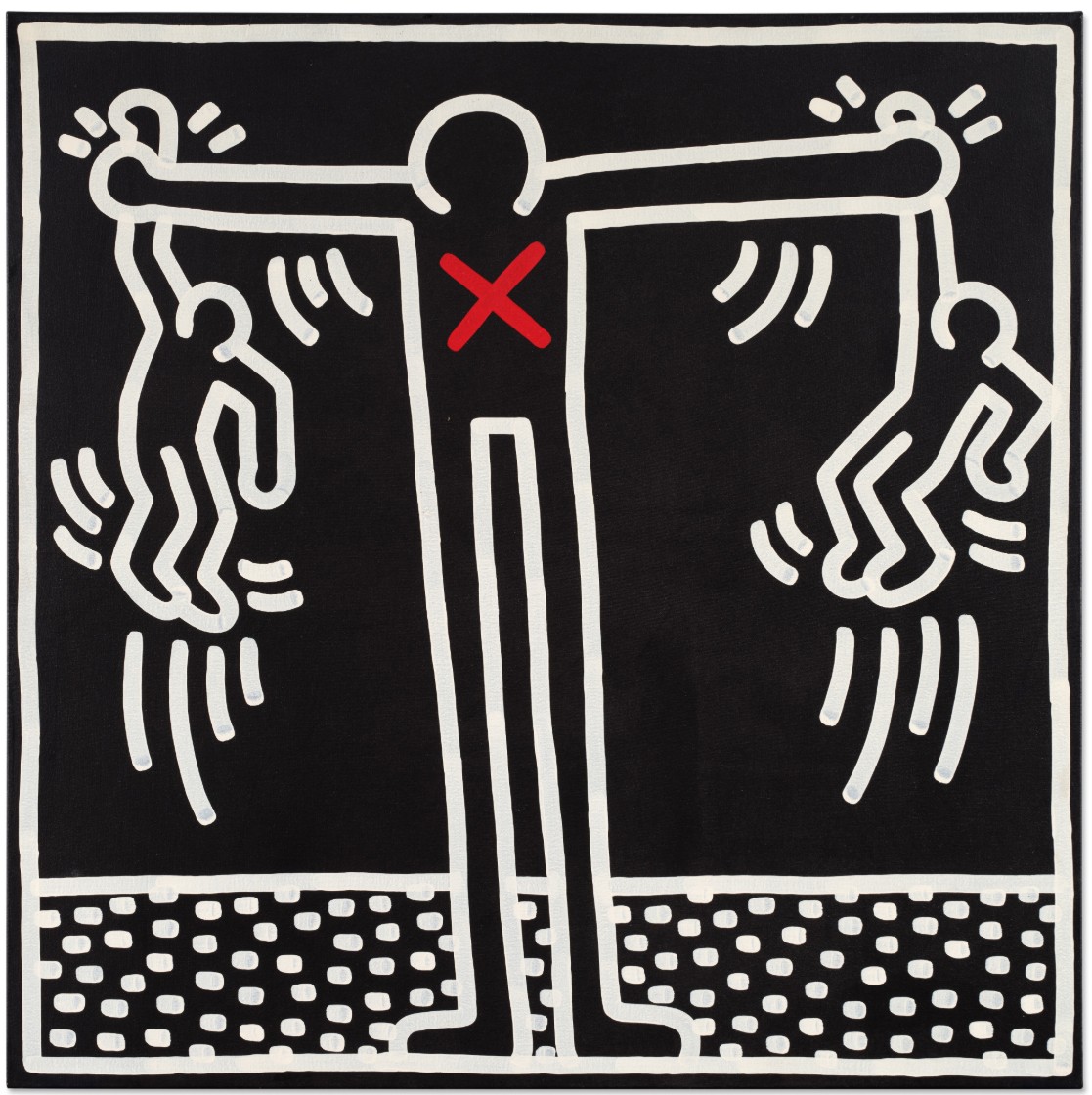
Untitled, circa 1985
Acrylic on canvas
48×48 inches (121.9 x 121.9 cm)
Signed, dated Nov. 7 – 1985 and inscribed Happy Birthday Mary!! Love, Keith (on the reverse)
Provenance
Private Collection (acquired directly as a gift from the artist)
Melton Magidson and Associates Inc., New York
Acquired from the above in 1989 by the present owner
Auction History
Commanding Line: Keith Haring from an Esteemed Private Collection, St. Louis
Sotheby’s New-York: 26 September 2025
Estimated: USD 1,800,000 – 2,500,000
USD 2,490,000
Untitled | Contemporary Curated | 2025 | Sotheby’s
Executed circa 1985, Untitled captures a pivotal juncture in Keith Haring’s meteoric ascent in the New York art scene. Created during a period of extraordinary momentum for the artist, when Haring moved from the streets of New York to the most prestigious international stages, Untitled exemplifies his ability to translate the language of the everyday into a bold, graphic idiom. With its iconic imagery, pared-down palette, and powerfully contoured, hieroglyphic figures, the work pulses with the vitality that would come to define his groundbreaking career.
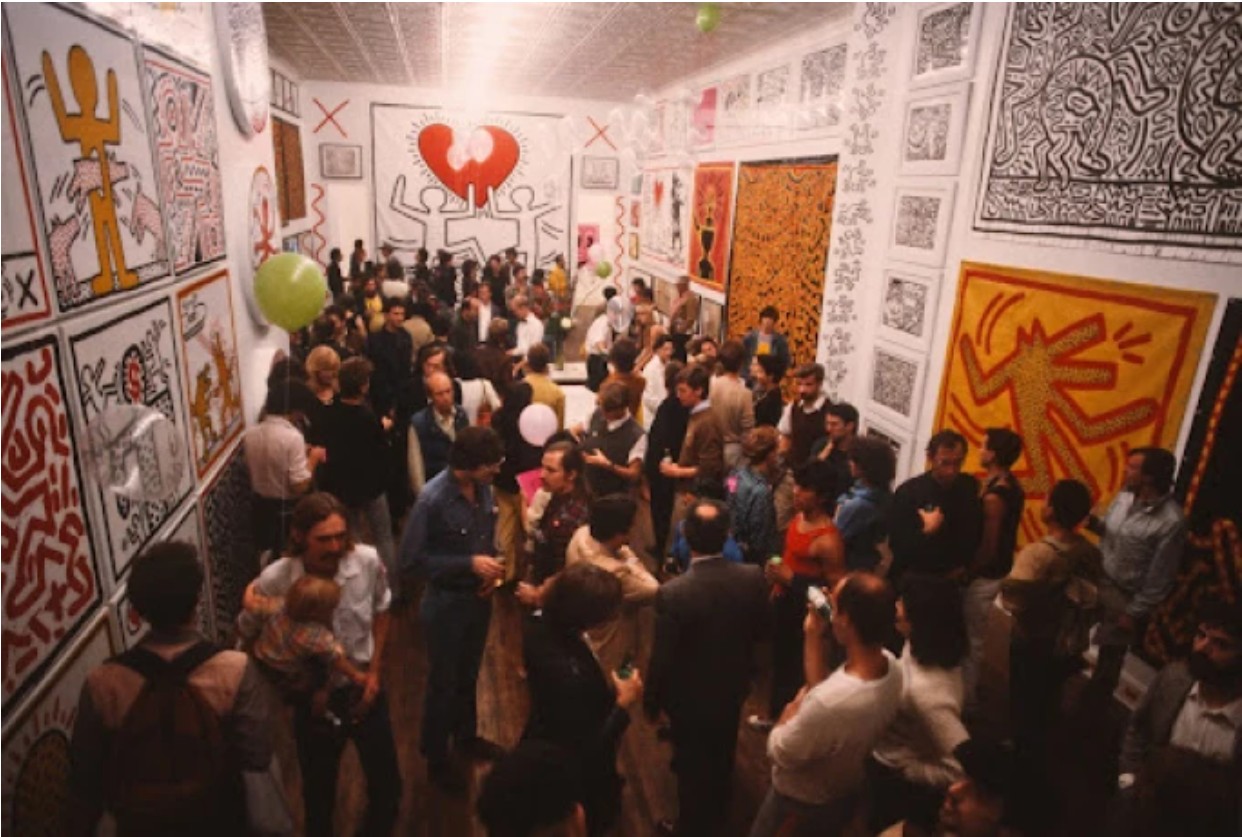
Opening reception of Keith Haring at Tony Shafrazi Gallery, 1982. Art © 2025 The Keith Haring Foundation.
In Untitled, Haring displays his inimitable ability to convey figures with emotional resonance that are distilled to their most basic, essential components. The work possesses the simultaneous symmetry and kinetic motion exemplary of many of Haring’s most instantly recognizable works, making use of his iconic mobile stick figures. These figures, reduced to their simplified anatomical elements, possess an immediate legibility that recalls both the artist’s subway drawings and the enduring resonance of ancient art in his practice. The composition is dominated by the monumental totemic figure at its center, its elongated legs and perpendicularly extended arms raised to support two smaller bodies that are accentuated by Haring’s iconic motion lines. The surrounding negative space around the figures becomes charged with rhythm, amplifying the tension of the central grouping. The palette, stripped to a few high-contrast tones of black, white and red heightens the stark theatricality of the scene and recalls the economy of means of some of Haring’s most celebrated works. Where his earlier subway drawings were ephemeral, existing only until erased or painted over, Untitled monumentalizes his work into lasting form, translating the immediacy of his graphic practice into the permanence of the canvas.

In Untitled, the central figure’s rigidity and perpendicular form immediately recalls the sign of the cross and the Crucifixion, a subject that Haring revisited throughout his career in some of his most iconic works. The central figure is further marked by an arresting red X at the center of its torso, a motif that reappears throughout Haring’s oeuvre and his social advocacy graphics, from his anti-apartheid “Free South Africa” poster to the epochal “Act Up” AIDS activism images that are seared into the communal memory. The X was frequently used by Haring to denote his subjects being targets in his works, especially from racism, xenophobia, and crucially, from the proliferating AIDS epidemic. In Untitled, the central figure is thus both a towering symbol of power and a victim of oppression, the target seared onto its chest. The figure appears both triumphant and straining, caught between exaltation and suffering, while the two smaller forms, suspended above, exhibit a sense of simultaneous struggle and freedom.
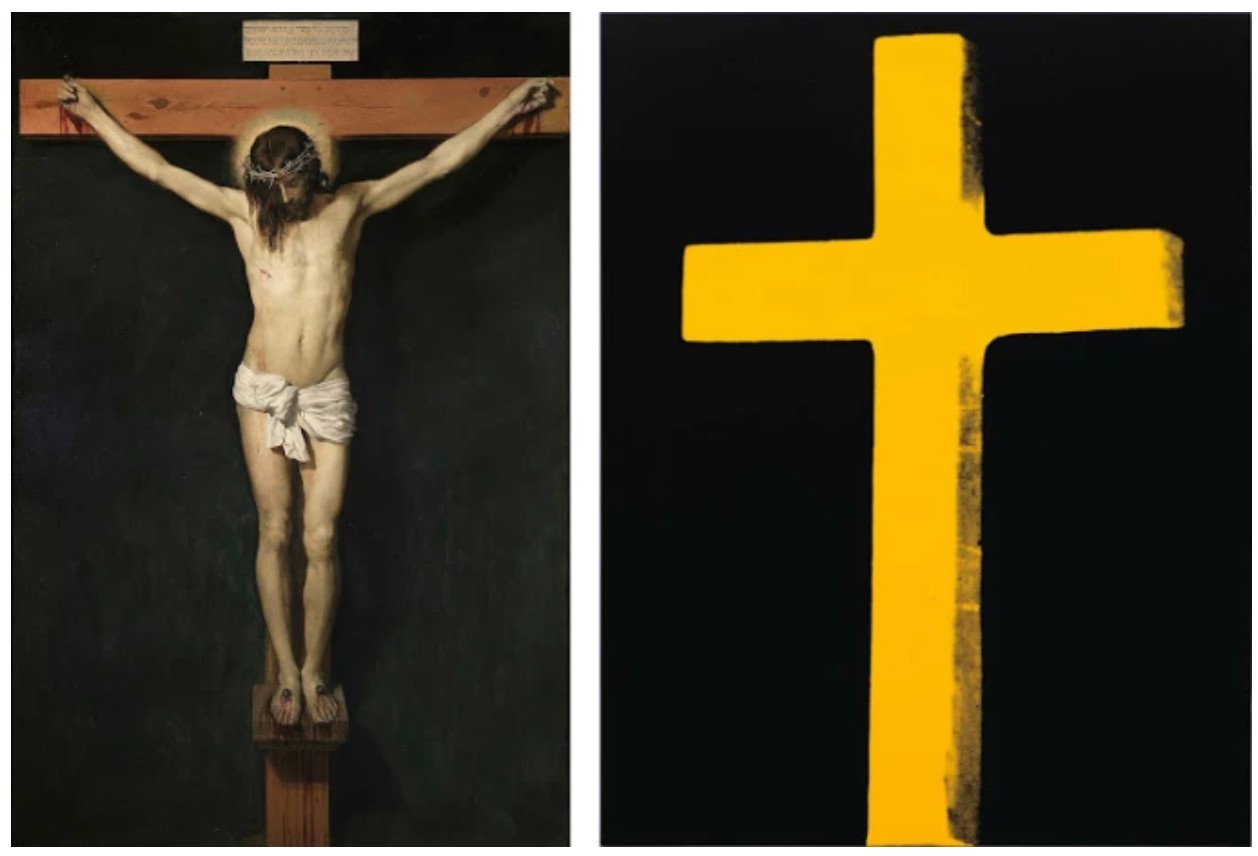
Left: Diego Velázquez, Christ Crucified, 1632. Museo del Prado, Madrid.
Right: Andy Warhol, Cross, 1982. Private Collection. Sold at Sotheby’s New York, June 2020, for $2,660,000. Art © 2025 Andy Warhol Foundation for the Visual Arts / Artists Rights Society (ARS), New York.
Haring, who was raised in a devout Christian household, long grappled with the ways that dogmatic religion was used by the church to control and suppress its peoples. Haring would use his upbringing and interest in Christian iconography by appropriating and subverting it, seen across some of his most iconic figures such as the Radiant Baby and the sign of the cross, transforming them to critique organized religion and reflect the ongoing struggles of the everyday people around him, including, especially, the church’s treatment of the gay population. The specific scene of Untitled even recalls one of Haring’s later and most iconic bodies of work, The Ten Commandments, in which he depicted metaphorical interpretations of the traditional commandments through his own apocalyptic vision. Untitled is situated with a defining period of Haring’s career in which he anchored his reputation as one of the defining voices of a new generation and transcended the immediate cultural sphere of New York street art. In its graphic immediacy, formal clarity, and allegorical representation, Untitled is a consummate example of Haring’s genius, an enduring example of his entirely unique use of art as searing social commentary.