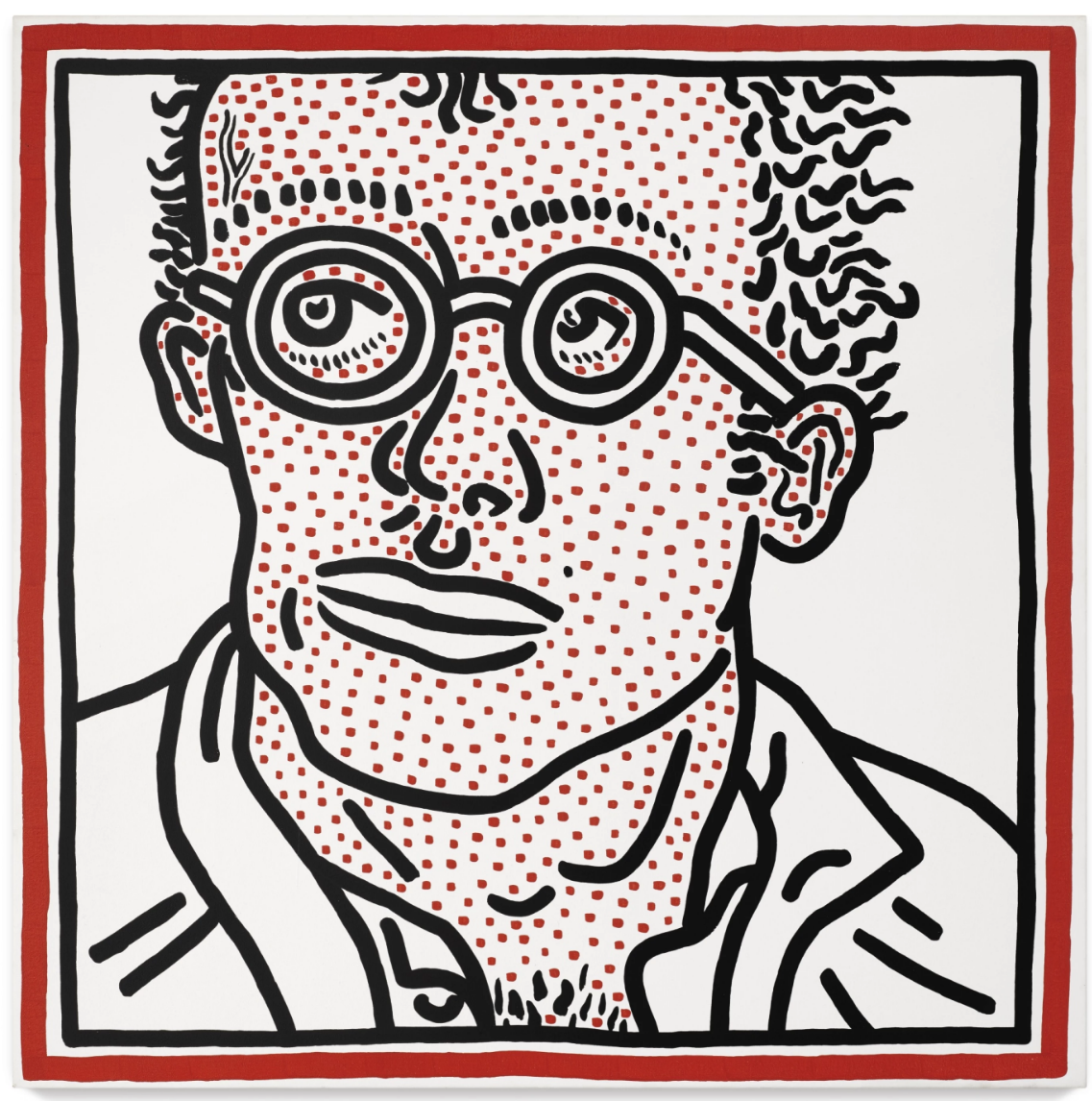
KEITH HARING
Self-Portrait for Tony, 1988
Acrylic on canvas
48×48 inches (121.9 x 121.9 cm)
Signed, titled and dated Feb 2 85 on the overlap
Tony Shafrazi, New York (acquired directly from the artist)
Private Collection
Skarstedt Gallery, New York
Acquired by the present owner from the above in 2008
USD 4,512,500
(#37) Keith Haring (sothebys.com)
Unlike Lichtenstein, Haring’s graphic immediacy does not reference mass-media, but is rooted in the instantaneous symbolic codes of 1980s downtown New York, the graffiti of its streets, and the East Village art scene that the artist trailblazed alongside contemporaries Jean-Michel Basquiat and Kenny Scharf. Self-Portrait for Tony however shows a unique downplay of several of Haring’s aesthetic characteristics: pictorial symmetry; the pulsating intimation of kinetic movement; and the distillation of figurative components to their most basic representational form, devoid of ornamentation. Whilst through his cropped composition Haring presents himself with the immortality of a classical bust, he simultaneously affords a level of directly referential anatomical detail rarely seen in his work. From the vein on his head and the mole above his lip, to the curled chest hair, Haring has adapted his highly reductive style, to encompass unique naturalistic features that give an accurate sense of his appearance. Whilst maintaining his iconic visual impact, Haring created an intimate portrait that is emblematic of his close partnership with the legendary New York dealer who saw him “as the perfect boy-child of the electronic age” and an artist that opened up “the way for a new utopic era of fraternal feeling and self-realization.” (Tony Shafrazi cited in Exh. Cat., New York, Shafrazi Gallery, Keith Haring, 1990, n.p)
Having long viewed himself as “a child of the atomic age,” an apocalyptic anxiety regarding modernity and the fate of mankind permeated much of Haring’s oeuvre. (the artist cited in David Galloway, “The Marriage of Heaven and Hell,” in Exh. Cat., Rotterdam, Museum Boijmans van Beuningen (and travelling), Keith Haring: Heaven and Hell, 2002, p. 56) Expressed in references to nuclear weaponry and environmental decay, such as in one of his final masterpieces The Last Rainforest from 1989, the precariousness of life weighed heavy on his mind. But at the center of a generation and a community devastated by the tragic onset of the AIDS crisis, from the early 1980s Haring’s sense of universal fatalism abruptly morphed into an extremely personal awareness of mortality: “By this time—1985—things have seriously changed in New York, and in my life, because the horror of AIDS had come to light. It totally changed people’s lives.” (the artist cited in John Gruen, Keith Haring: The Authorized Biography, New York, 1991, pp. 131-132) Like Andy Warhol’s iconic Fright Wig self-portraits created the following year, Haring’s turn to self-portraiture expresses an engagement with his own mortality and a rare effort to secure his identity within the eternal history of this genre. Haring’s pressing regard for the brevity of life would be most tragically compounded following his diagnosis with AIDS in 1987. Yet in a diary entry shortly after, he recalled the courageous sense of inevitability with which he had long viewed the temporal nature of his time on earth: “I always knew, since I was young, that I would die young… I live every day as if it were the last.” (the artist cited in David Galloway, “The Marriage of Heaven and Hell,” Ibid., p. 56) As a continuation of his altruistic spirit, the sustained and passionate activism expressed though Haring’s art – from his anti-apartheid “Free South Africa” poster to the epochal “Act Up” AIDS campaign – remains as part of his benevolent legacy to the world. So gleefully attuned to the intrinsic status of life as a previous gift and through the enduring strength of Haring’s line, we find the dreams of a prejudice free world built on the bonds of friendship.