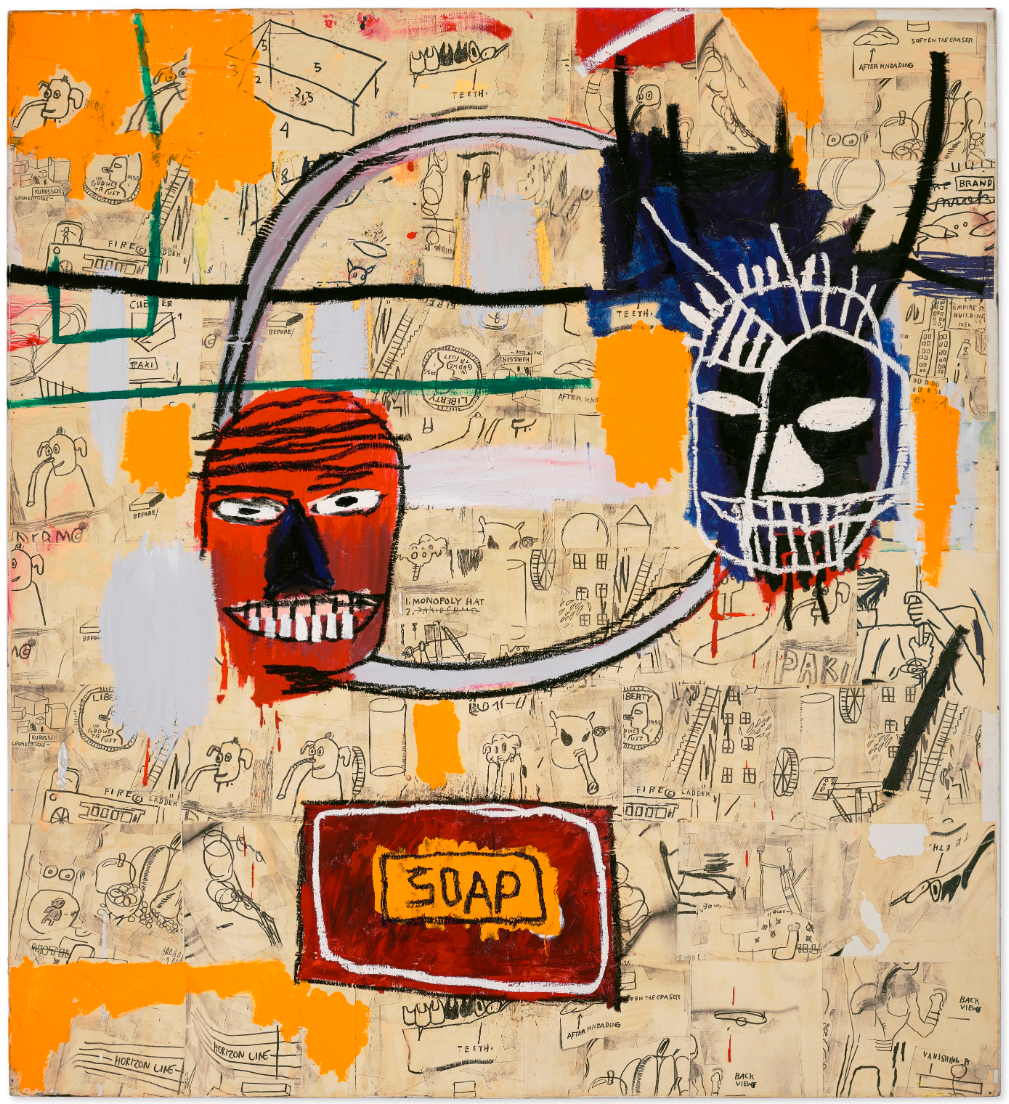
JEAN-MICHEL BASQUIAT
Untitled (Soap), 1983-84
Acrylic, oilstick, metallic paint and Xerox collage on canvas
66×60 inches (167.6 x 152.4 cm)
Provenance
Robert Miller Gallery, New York
Galerie Bernard Cats, Brussels
Private collection, Belgium
Acquired from the above by the present owner
Christie’s New-York: 10 May 2021
USD 13,984,000
Source: Christie’s
JEAN-MICHEL BASQUIAT (1960-1988) (christies.com)
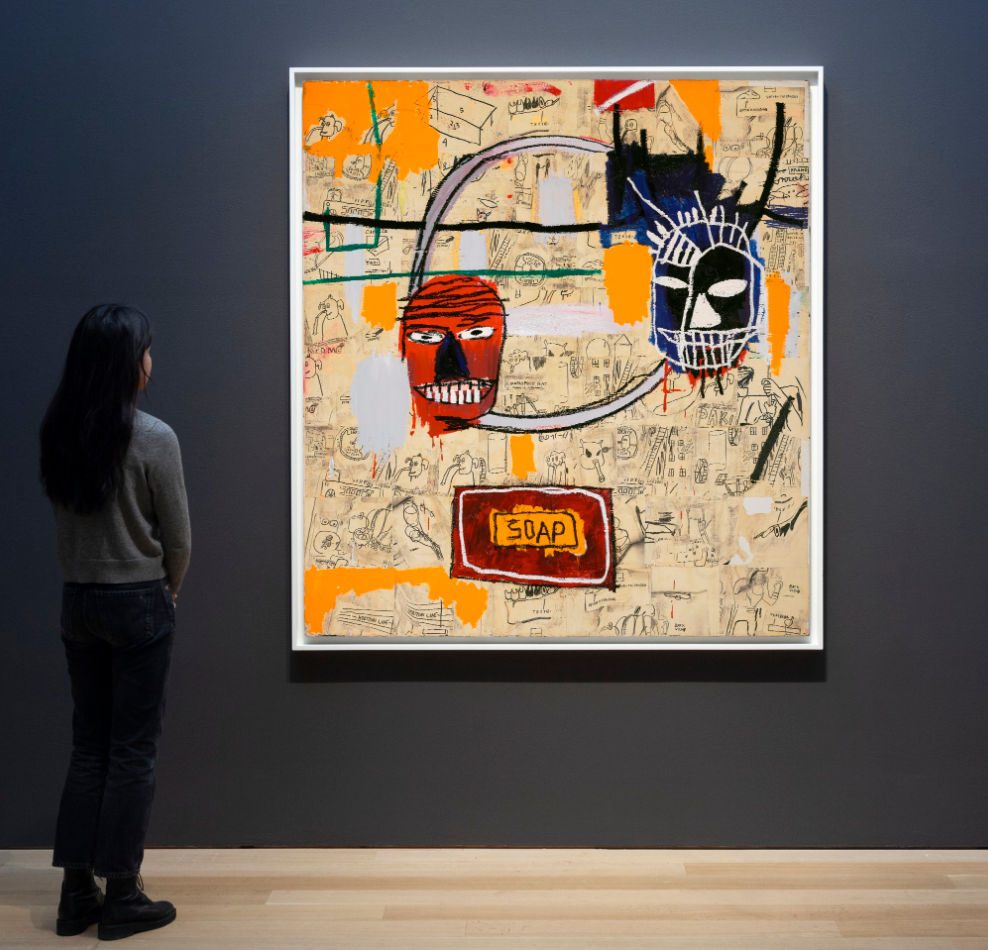
Presenting an intoxicating array of mysterious figures, enigmatic signs, symbols and cyphers, Untitled (Soap) presents one of Jean-Michel Basquiat’s most active surfaces. The painting acts as a guide to the artist’s peripatetic technique, as Xeroxed sheets of the artist’s drawings, energetic gestures manifested in oilstick, and pools of acrylic paint come together in seemingly effortless fashion to present the full range of his practice. Offering both elements of his own life, and that created by his fertile imagination, the present work was executed during a particularly prolific period of Basquiat’s career. Coming off the back of his breakthrough year of 1982, the artist was finally being given the critical attention that his work deserved, and Basquiat had finally migrated from street artist to celebrated wunderkind of the New York art world.
In this cacophonous composition, the viewer is confronted by the full force of Basquiat’s artistic dexterity. In many ways, this painting is dozens of works in one: Xeroxed sheets filled with expressive drawings, overlaid by two dramatic heads, and finally, a motif from Basquiat’s extensive mental library of advertisements and other commercial imagery, namely the titular bar of soap. The Xeroxed sheets offer up an encyclopedic display of the depth and variety of Basquiat’s graphic initiative. Across the more than two dozen sheets, he renders a vast array of objects, both real and imagined. Ranging from fantastical creatures, anatomical renderings, drawings of money, and even firetrucks, these often very personal motifs are drawn from the artist’s lived experience plus his own fertile imagination. Overlaid on this graphic foundation are two examples of Basquiat’s most important expressive device—his iconic animated heads. One dark and brooding, the other bright and vibrant, these offer up the full range of his energetic techniques. Layers of flat acrylic paint are then adorned with details rendered in oilstick; the speed at which the faces are created can be seen in the small drips and splashes that evidence the artist’s rapid painting method. Distinguished by their deep piercing eyes and grimaced teeth, they are accomplished examples of this important motif. Next, Basquiat balances this whole composition by including one of the many objects/phrases/symbols drawn from his extensive memory, specifically a bar of soap. Attracted by their form, their design, or even simply the plosive sound of their names as they are spoken out loud, Basquiat stored up these motifs to use them as and when he saw fit. Finally, Basquiat pulls all these dissonant elements together by joining the prominent graphic forms with a large circular motif, mirroring the smaller round 25cent coins that populate the Xeroxed sheets upon which they sit.
“With a Xerox machine, glue, oilstick, and acrylic paint, Basquiat wove dense networks of information in two- and three-dimensional spaces. His spaces of knowledge not only inspired later generations but also anticipated the present.”
Basquiat’s use of photocopied sheets are a consistent and important part of his oeuvre. It began early with his postcards made out of Xeroxes of collaged images which, in 1979, he famously sold to Andy Warhol and Henry Geldzahler after spotting them eating in a restaurant. Evoking the graffiti and bills posted on sites and billboards all over the city, the sheets provided the artist with a constant supply of visual stimuli. He sought to collage from his everyday life anything he perceived with his five senses. He had a voracious appetite for new source material, and these sheets provided him with an almost limitless source. “He used his collaged drawings and Xeroxes as a counteract to painting,” writes Dieter Buchhart, “They counteract formally and materially with his, often intense, painterly work… With a Xerox machine, glue, oilstick, and acrylic paint, Basquiat wove dense networks of information in two- and three-dimensional spaces. His spaces of knowledge not only inspired later generations but also anticipated the present” (D. Buchhart, “It’s All Xerox: Jean-Michel Basquiat’s Spaces of Knowledge Yesterday, Today and Tomorrow,” in Jean-Michel Basquiat: Xerox, exh. cat., Nahmad Contemporary, New York, 2019, p. 18).
Basquiat’s status as a famous over-acknowledged artist in the media limelight had given American art what has so long been devolved to European artists: the artiste maudit, a sort of absolute criteria, from another world and another society that imposes a language that is so very different that it seems to be the last link of the chain.”