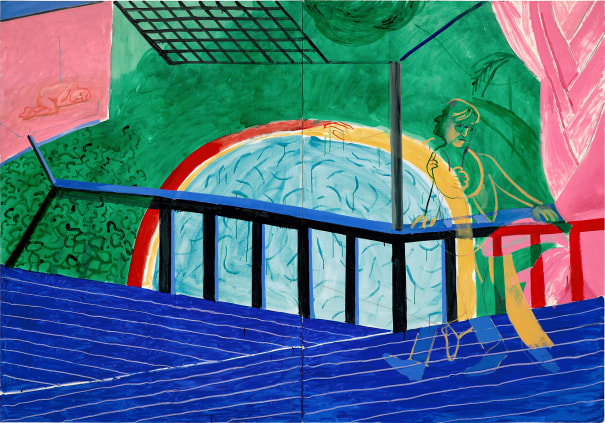
DAVID HOCKNEY
Self-Portrait on the Terrace, 1984
Oil on canvas, in 2 parts
Each: 84×60 inches (213.4 x 152.4 cm)
Overall: 84×120 inches (213.4 x 304.8 cm)
Signed, titled and dated ‘Self portrait on the terrace Jan Feb March 1984 David Hockney’ on the reverse
Provenance
André Emmerich Gallery, New York
Acquired from the above by the present owner in October 1984
Phillips London: 3 March 2022
GBP 4,862,500
Source: Phillips
David Hockney – 20th Century & Contemp… Lot 19 March 2022 | Phillips
‘Whenever I left England, colors got stronger in the pictures. California always affected me with color. Because of the light you see more color, people wear more colorful clothes, you notice it, it doesn’t look garish: there is more color in life here.’
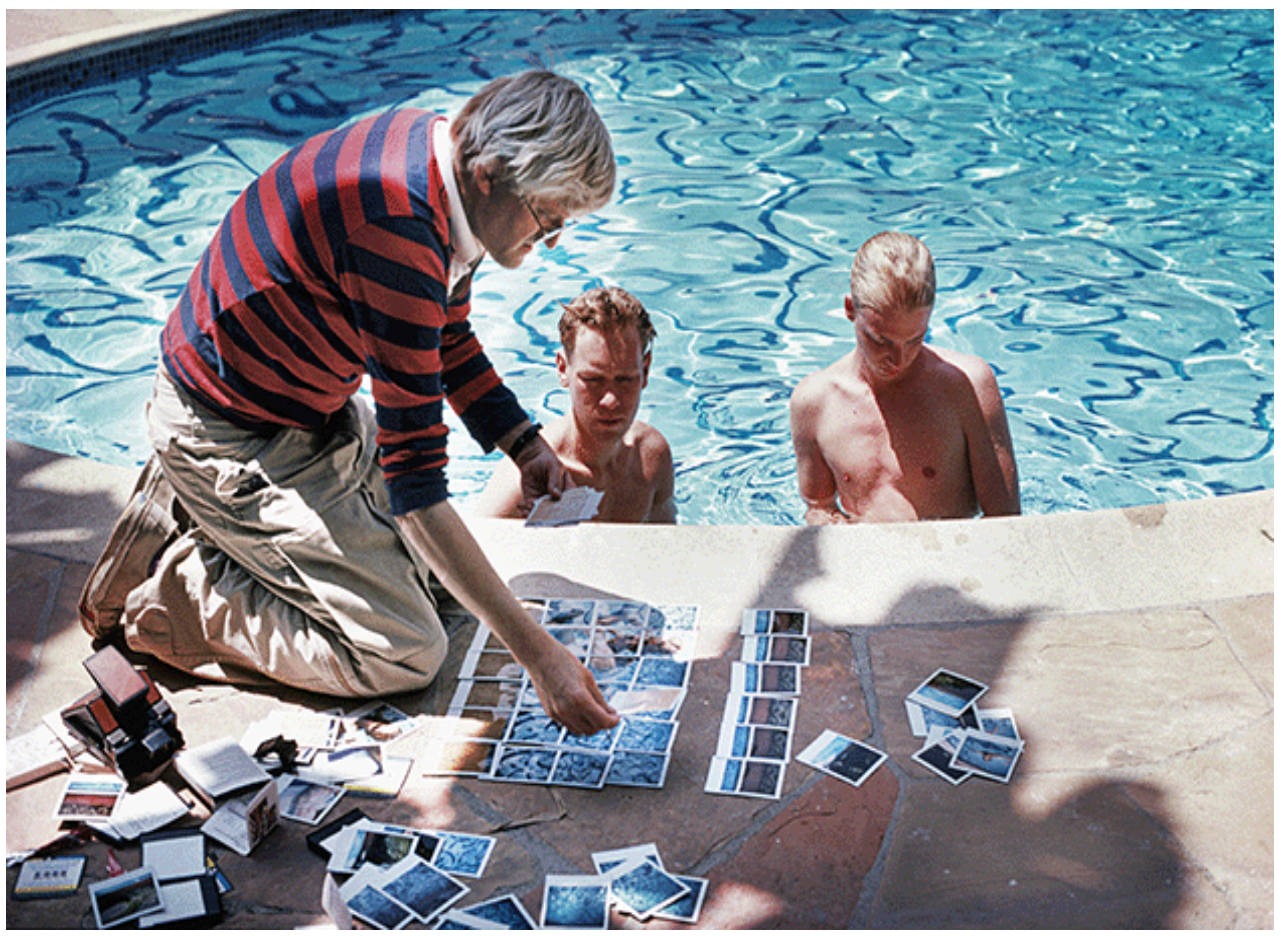
Soaked in a strong, California sunshine and executed in intensely vibrant passages of bright, bold colour, Self-Portrait on the Terrace is an exquisite example of David Hockney’s localised California landscapes, highly unusual in its incorporation of a delicately rendered self-portrait. Painting the areas in and around his Hollywood Hills home after having relocated to this spot on the West Coast in 1978, Hockney took great inspiration from the dramatic, expansive landscapes he discovered on drives through the hills above the city. Amongst the many, truly fantastic paintings of the wide-open vistas and unspooling ribbons of road carved into the hillsides around Los Angeles that Hockney captured in these years, undoubtedly it was the house itself that quickly emerged as a favourite subject, reproduced across a selection of paintings, drawings, and prints from the period.
‘The idea of drawing water is always appealing to me. You can look at it, through it, into it. See it as volume, see it as surface. You can’t do that with a floor or a wall.’
In a flamboyant rejoinder to Le Corbusier’s modernist maxim that houses should be designed as ‘machines for living in’, Hockney transformed his Californian ranch-style home into a lively theatrical set to stage life’s dramas within. Unfolding in a succession of rooms decorated in dazzling shades of electric blues, warm yellows, and hot pinks, Hockney succeeded, as he put it, in ‘slowly […] making my own environment – room by room – as artist’s do.’ A clear inheritor to Henri Matisse’s strong sympathy for bold, unmodulated colour and vibrantly realised domestic interiors, Hockney’s house and the paintings that he made there are in constant dialogue. Directly borrowing the rich, Fauvist palette that he had recently used to realise the set designs for a reimagining of Erik Satie’s ballet Parade, the connections that Self-Portrait on the Terrace draws between painterly experiment, spatial form, and immersive environment are striking, ‘the house being perhaps the closest analogue to the theatre, a real space in which to fashion an ideal world.
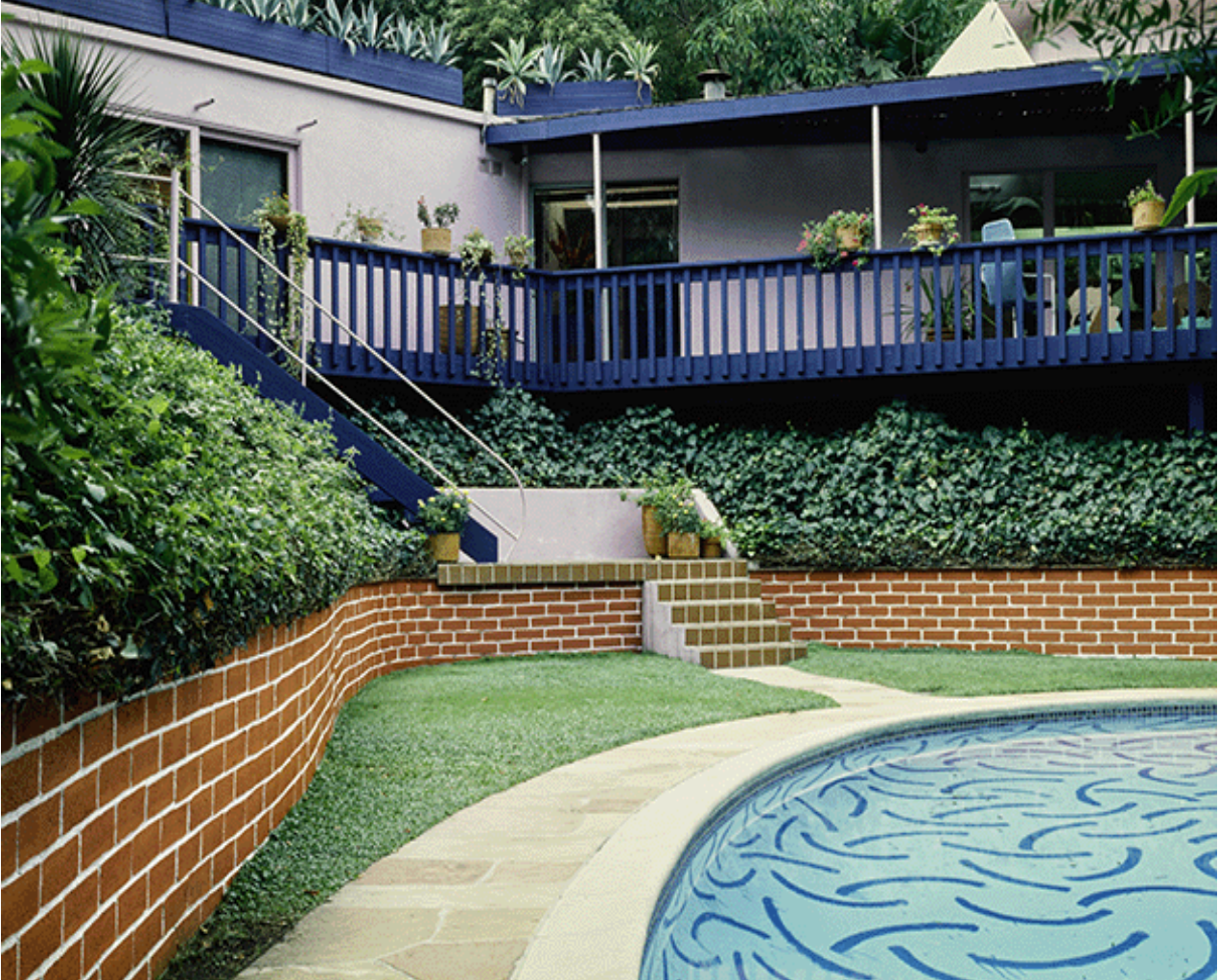
David Hockney’s house on the West Coast, c 1983. Image: Mary E. Nichols, Architectural Digest, © Condé Nast
Looking out from the second-story terrace, fitted with the cobalt blue decking that is wonderfully rendered here, Hockney shows remarkable skill in combining multiple perspectives within the composition, sharply tilting the garden scene beyond the titular terrace so we are at once looking out and directly down onto the circular pool that has become, more than any other motif, a visual shorthand for Hockney himself. Occupying a truly iconic place in the artist’s oeuvre and dominating his production through the 1960s and 70s, examples of Hockney’s pools are undoubtably amongst the artist’s most recognizable and beloved works. Coming to epitomize an idea of 70s ‘California Cool’, Hockney returned to the motif across a huge variety of media including acrylics, watercolor, photography, and his ground-breaking Paper Pools series, which he commenced in 1978.
‘I believe that the problem of how to depict something is […] and interesting on and a permanent one; there’s no solution to it. There are a thousand and one ways you can go about it. There’s no set rule.’
Hockney has spoken frequently and eloquently on the subject of water’s appeal for him, and how fascinating he finds it as a formal problem. Having established his memorable use of short, rhythmically intersecting blue curves as a means of rendering the visual effects of clear water pictorially, Hockney adopted this signature detail on the bottom of his own pool in a playful instance of life imitating art.