
JEAN-MICHEL BASQUIAT (1960-1988)
Orange Joy, 1984
Acrylic and oilstick on canvas
78 1/2 x 62 3/8 inches (198.6 x 158.6 cm)
Signed, titled and dated ‘Jean-Michel Basquiat ORANGE JOY 84’ (on the reverse)
Provenance
Acquired directly from the artist by the late owner, circa 1985
Christie’s New-York: 9 November 2023
Estimated: USD 4,000,000 – 6,o00,000
USD 4,769,000
JEAN-MICHEL BASQUIAT (1960-1988) (christies.com)
A seminal figure in the history of twentieth-century American art, Jean-Michel Basquiat was instrumental in revitalizing the black subject within the figurative tradition. Orange Joy is a potent example of the painter’s ability to draw intense emotional content out of seemingly simple compositions. He brings attention to the individual while also framing her with an almost golden halo of deep yellow and orange, a choice that serves to lionize the woman in a manner similar to the gold-leafed icons of some religious traditions. Well-versed in the trajectory of Western Art, Basquiat sought to dispel the myth of the primitive and bring attention to the contributions of the African diaspora throughout art history. Subverting the narrative of Pablo Picasso, Basquiat noted succinctly:
“Picasso arrived at primitive art in order to give of its nobility to western art. And I arrived at Picasso to give his nobility to the art called ‘primitive’”
Leveraging his own rich heritage, the painter used autobiographical references and an iconic vocabulary extracted from the streets of the five boroughs of New York to create powerful compositions that broke away from tradition in search of a more inclusive visual language. Creating a charismatic and highly influential oeuvre in just a few short years, his mélange of styles and sources has forever altered figurative painting.
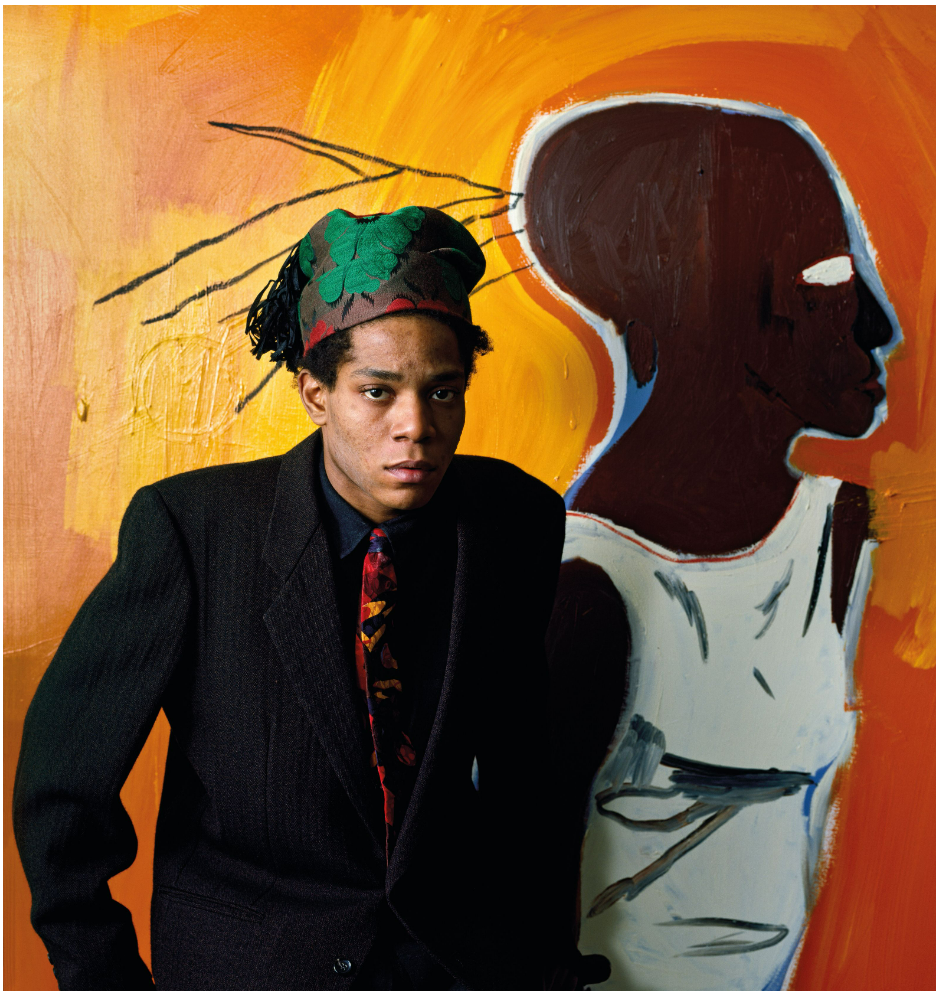
Jean-Michel Basquiat, New York, 1985 (present lot illustrated). Photo: Evelyn Hofer / Getty Images.
Rare for a prolific artist like Basquiat, Orange Joy shows a more intricate rendering of the figure. While still retaining the same style and energy as his other works, this example pays particular attention to the details of the central subject. The figure is presumed to be Joy Bouldin, one of the artist’s muses who Andy Warhol introduced him to at the Mud Club in the early 1980s. Joy sat for Jean-Michel several times in 1984 and is the subject of a small handful of titular paintings, all exuding a shared sense of magisterial bravado. Joy was known at the time not only for her distinct beauty, but also for her position of power and esteem at the exclusive club, Danceteria. As an icon of the downtown scene, Joy had full dominion over the front door, which is encapsulated masterfully in ‘Orange Joy.’
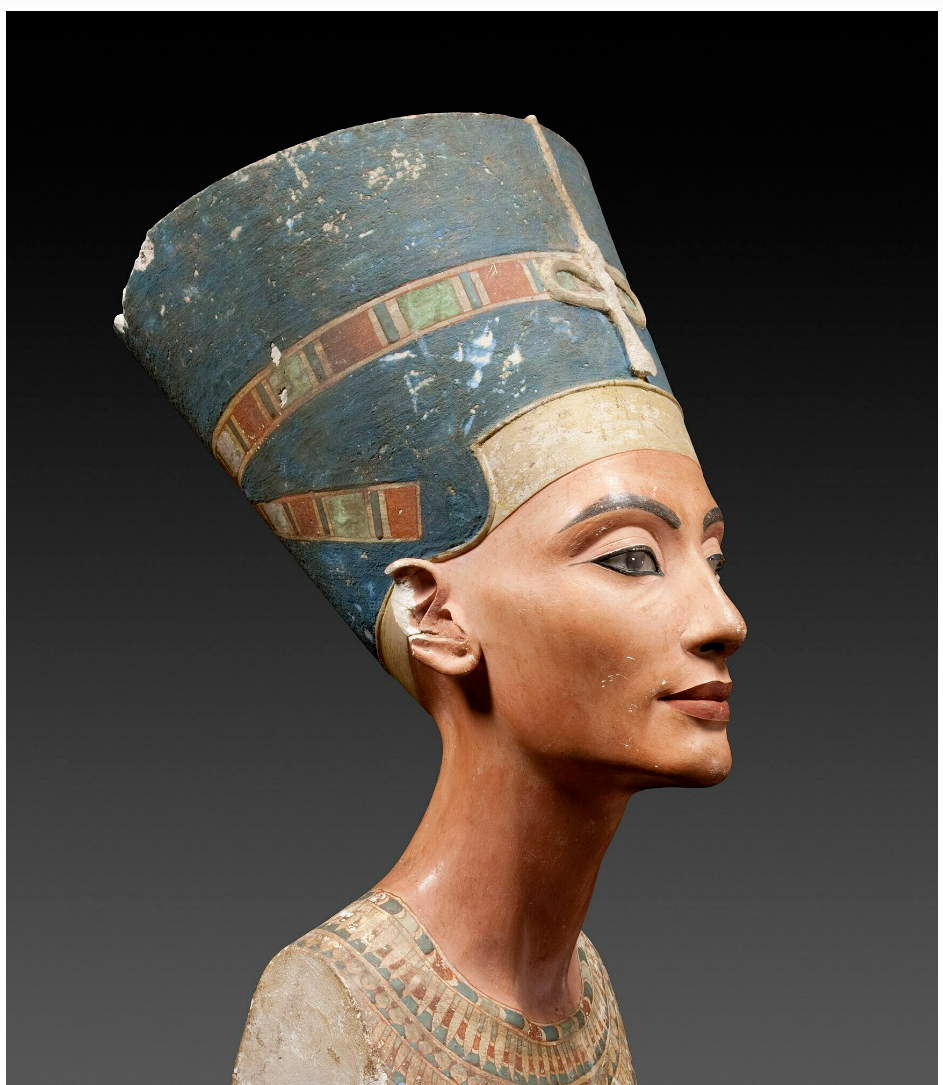
Thutmosis, Model Bust of Nefertiti, circa 1350 BCE. Staatliche Museen, Berlin. Photo: © bpk Bildagentur / Staatliche Museen /Sandra Steiß / Art Resource, NY.
Set against the gleaming background, the cropped form of a woman becomes our immediate focus. Arms at her side and shown in profile, she floats in the marigold brushwork in a white tank top and dark pants. As Marc Mayer notes, “With direct and theatrically ham-fisted brushwork, he used unmixed color structurally, like a seasoned abstractionist, but in the service of a figurative and narrative agenda. Basquiat deployed his color architecturally, at times like so much tinted mortar to bind a composition, at other times like opaque plaster to embody it. Color holds his pictures together, and through it they command a room” (M. Mayer, “Basquiat in History,” Basquiat, exh. cat., Brooklyn Museum of Art, 2005, p. 46). The immediacy of this talent can be clearly seen in Orange Joy as it glows with an innate warmth. The artist has edited out the lower part of the woman’s body which gives the impression of a cut-out or collage element that has been extracted from some other source. A halo of blue and white around the figure accentuates this feeling. The skull is elongated, casting allusions to the reign of the Ancient Egyptians and the stylistic tropes prevalent during that time. The woman’s eyes are white and lack pupils or irises, but the nose and lips are exquisitely rendered with a softness and nuance that beckons to Basquiat’s painterly skill. Quick marks in gray form the folds of her garments, their quick, brushy application pointing toward the artist’s quick proficiency with visual construction. From the back of the woman’s head, several black lines extend, their dreadlock-like forms at odds with the rest of the work. However, this juxtaposition serves to anchor the figure within the work and brings a subtle amount of dynamic tension to the composition. Their spindly presence creates a slight unease that piques the viewer’s curiosity and draws them further into the scene.

Like his fellow Neo-Expressionists, Basquiat took a pointed interest in introducing the figure back into the painted image. Harnessing the vigor and emotional complexity of the German Expressionists and New York School visionaries like Willem de Kooning, these young artists held the Modernist obsession with pure abstraction up to the mirror of history. At a time when some critics foretold the death of painting, Basquiat and his colleagues were inventing new ways to make it more relevant than ever. Specifically, the virtuosic Brooklyn artist focused on re-introducing the black figure back into art history and idolizing these subjects as they had not been throughout the Western world. Pairing them with words, symbols, and a depth of care not afforded to African-American subjects in the mainstream, he pushed for a more diverse representation within his work. For example, the crown, a signature of Basquiat’s iconography, was often used to exalt the figures within his paintings. He used it as an adornment for black musicians, writers, artists, and athletes in an effort to raise these historically undervalued individuals to the realm of royalty and even sainthood. As Fred Hoffman recognized, “Many of the dualities suggested in his work evolve out of the recognition of his predicament as a young black man in a white art world” (F. Hoffman, “The Defining Years: Notes on Five Key Works,” in op. cit., p. 130). By mining his own personal experiences and histories, the painter created an oeuvre that resonated with a wider audience.